Boris Johnson’s controversial care plans face resistance in Lords

Owl wonders whether Simon Jupp saw this coming? 

We have been here before quite recently haven’t we?

www.independent.co.uk

Boris Johnson’s controversial social care bill will “undoubtedly” be amended in the House of Lords, as peers urge MPs to think again about the “Robin Hood in reverse” cap on care costs, The Independent has been told.

Peers said that the Upper House will be “emboldened” in revising the prime minister’s plans both by the size of the Conservative rebellion in Monday’s vote and by the fact that crucial details of the cap’s operation were released only days before the legislation cleared the Commons, giving MPs almost no time for scrutiny.

And a former Tory deputy leader said Mr Johnson should prepare for defeat in the Lords on the bill, which completed its passage through the Commons on Tuesday.

Conservative peer Ros Altmann said there were concerns over how the cap – which threatens to force pensioners with assets of £106,000 or less to sell their homes to pay for care while protecting the property of wealthier individuals – fits in with the prime minister’s professed aim of “levelling up” the country.

Both Baroness Altmann and Tory former health secretary Andrew Lansley are understood to be considering amendments which could force MPs to reconsider the last-minute change announced last week, under which local authority contributions will not be included towards the proposed £86,000 lifetime maximum for spending on care.

Former pensions minister Lady Altmann told The Independent: “Undoubtedly there will be amendments. I am hoping that the government might address some of the problems that have arisen from this bill, particularly relating to the way it may be very good for the well-off, but not at all for middle and working-class families across the country. If we are committed to levelling up, I’m not sure this fits in.

“These changes have happened far too fast, given their importance. The fact that it was rushed out days before MPs were asked to vote will only make peers more ready to ask the Commons to reconsider.”

Professor of palliative medicine Ilora Finlay, who sits in the Lords as a crossbencher, said there was “disquiet” among peers not only about the cap, but also about the failure of the legislation to deal with long-standing problems about the integration of health and social care and the status of care workers.

“Health and social care are treated as separate because they have different budgets, but it is the same person that requires health care and social care if something goes wrong,” Lady Finlay told The Independent.

“There are financial silos and service commissioning silos and the result is that patients find themselves in hospital and can’t be discharged to social care because the facilities are not there and that causes backlogs.

“Government after government has kicked this into the long grass. At least this government is trying to do something. What we need to do is see whether there is something here in the bill that we can build on. I would expect the Lords to do what they do well, which is to scrutinise every line of the bill and debate what needs to be debated to improve it.”

Lady Finlay said there were potential problems with the detail of Mr Johnson’s proposed care costs cap, which effectively treated people differently depending on the increase in the value of their homes since they bought them decades previously.

“If you bought a home in the north of England 40 years ago, it will have increased in value by far less than if you had bought it in Surrey, and that will affect the outcome under the design of this cap,” she said. “There is a risk of widening disparities, which is a potential problem.”

The Health and Care Bill is unlikely to receive its first reading in the Lords much before Christmas, with any crunch votes not expected until February, giving peers a long time to build coalitions behind amendments.

Labour’s leader in the Lords, Angela Smith, said she expected opposition parties to seek cross-party co-operation, building on the widespread concern among Tory peers about the cap plans.

“One of the things that emboldens the House of Lords to act is where there is a sense that public opinion feels the Commons has got it wrong,” she told The Independent. “People have had very little time to find out about this, but I think over the coming months we will see pennies dropping across the country. If Tory MPs are being contacted by their constituents about concerns, they will be in touch with Tory peers and that will help shape thinking.

“There are clearly already tensions because of the scale of the rebellion, and because of the government’s history of U-turns, Tories can’t be confident that the government isn’t going to change its mind under pressure. That will also shape thinking.

“People are already talking formally and informally about how changes could be made. There are a lot of people in the Lords with a background and expertise in social care or experience of social care. They can now give the government the opportunity to do the right thing.”

Former Tory deputy leader Peter Lilley said Mr Johnson must expect to see his plans defeated in the Lords.

Speaking to Times Radio’s John Pienaar, Lord Lilley said: “The government normally does get defeated in the Lords. This is what nobody realises, the rare occasions we win a vote the chief whip sends us an email rejoicing in this rare fact. So it’s normal for the government to be defeated. It will probably be defeated on this, and send it back to the House of Commons.”
Top Tories flood out of donor ball to vote for £900m care hit to the poor

Super-rich donors paid up to £15,000 a table for the chance to rub shoulders with senior cabinet ministers – who left the event early in order to vote through plans to make the poor pay more for social care.

See: www.mirror.co.uk

Evening Standard: Another U-turn? Boris Johnson hit by care backlash

You’ll have to fold on cap when Bill comes back from Lords, PM warned www.standard.co.uk 

Has Simon backed the wrong horse again? – Owl

Boris Johnson’s social care reforms are grossly unfair

Editorial www.independent.co.uk 

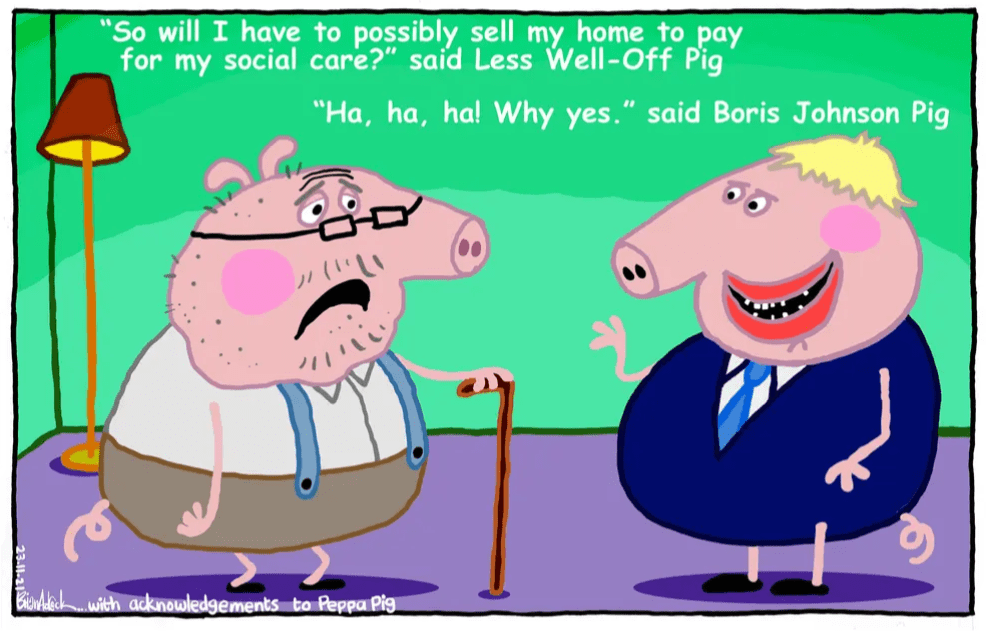
Ever been to Peppa Pig World?” the prime minister asked the bemused delegates at the CBI conference. Not many had, it seems, not least because of the Covid-19 lockdowns over the past 20 months or so, the imposition of which not being aided by Boris Johnson’s disastrous prevarications and confusions.

It was a low point, but perhaps a mercy to the assembled business folk that he got the pages of his speech mixed up, and stopped jabbering. At least the silence was comprehensible, punctuated only by some utterances of “forgive me”. Despite a vague commitment to “levelling up” as a “moral mission”, Mr Johnson was wise to avoid any reference at all to the government’s latest evolution of its social care policy. Which could easily be labelled it’s social “don’t care” policy.

It is effectively a tax policy reversed and turned upside down. It is eye wateringly, heartrendingly unfair. Rather than richer people (and their descendants) paying proportionately more for their care in old age or disability, or even the same as poorer families, it means that they will pay proportionally less. In its way, it is quite an achievement for an administration to come up with such a regressive policy and yet market it as a fair and equitable package of reforms. Flawed as it was before, it is now unacceptable.

It doesn’t do much for “levelling up” or social justice. Given the concentration of personal wealth in the south, the policy will exacerbate the north-south divide. The even more skewed cascade of unearned wealth down the generations will also increase the gap between rich and poor within every region. The financial impact of the social care policy is to entrench disadvantage and widen existing economic divisions. The property that the children of the already wealthy inherit will be rented out to the children of those who have seen their inheritance disappear in social care home fees. The final insult is that the new social care levy, as a form of national insurance, will be paid by the low paid, but not by the landlords living off their newly protected riches.

The new social care policy is nothing less than a powerful engine of inequality. According to Andrew Dilnot, who produced the original and best report on funding social care a decade ago, the less well off will derive little benefit from these changes, and the Treasury will save £900m, a small sum in the wider context.

It is policy being made on the hoof, and in the wrong direction. Having gifted the Labour Party sleaze to run with, now the prime minister has opened another early window on the advent calendar with the most obscenely unfair policy in decades.

Given the disquiet voiced by many Conservatives, precisely because of the potential electoral repercussions, the policy may yet have to be revised once again, and it would certainly not survive a change of prime minister or party of government, as Jeremy Hunt is hinting. It has unhappy echoes of the poll tax of the late 1980s – a well-meaning reform of an outdated and unpopular system, but one that somehow managed to make things more complex and more unfair.

Few noticed the implications of a complex new way of financing local government, naturally, but opposition grew as the details became clear, and then came the riots. The poll tax also inflicted huge political damage on the then Conservative government, and contributed to the fall of Margaret Thatcher (that and relations with Europe and an imperious style of government).

Mr Johnson should heed history, and perform one of his celebrated U-turns before his policy does any more capricious harm to older people and their families, and indeed himself as prime minister. Otherwise he’ll have all the time he wishes to spend at Peppa Pig World.

Conservative Care cap explained

This BBC graphic, being retweeted by some opposition MPs, explains clearly why some people are likely to have to sell their houses if they move into a care home under the current plans.

MPs should not use personal companies to avoid tax, says Starmer

Keir Starmer has indicated he would bar MPs from using personal companies to reduce the tax they pay on second jobs, saying he would stop any Labour MPs from doing so straight away.

Peter Walker www.theguardian.com 

Starmer’s comments came after it emerged that at least 10 MPs, one of them Labour, had channelled income from additional work through their own companies, which is legal but reduces the amount of tax they need to pay.

An investigation by the Times found the MPs were paid in total about £1m via such arrangements. Sir Alastair Graham, former chairman of the committee on standards in public life, told the paper this “should be stopped as soon as possible”.

“MPs should not be avoiding paying the taxes they’ve decided that the rest of the population should pay,” Graham said.

Asked on Monday if any Labour MPs found to have put any outside earnings through a personal company should stop doing so, Keir Starmer said they should.

“The answer to the question is very easy: yes,” he said during a media Q&A following a speech by the Labour leader to the CBI annual conference in Birmingham.

“The whole point of the registration and declaration scheme is that anybody can see transparently what is happening in relation to any income or donations.”

Instead of paying income tax at a rate of up to 45%, the personal company will pay corporation tax at 19%. Further tax is then due when owners draw money out of the company, either via income tax or a tax on dividends, the higher rate of which is 32.5%.

Starmer has already said that in power Labour would prevent MPs from carrying out any outside work, beyond a few exceptions for public interest reasons, such as MPs who are police or army reservists, or medical staff.

The Labour leader, who was director of public prosecutions before entering parliament, has in the past given paid legal advice while an MP. Allies of Jeremy Corbyn have said Starmer was instructed in 2017 to not take a second job with law firm Mishcon de Reya. Starmer’s spokesman insisted Starmer turned it down himself.

The investigation over tax minimisation comes less than a week after the Commons backed a plan to limit MPs’ scope to take on second jobs. While the plans are yet to be worked out, the focus is likely to be on political consulting, and on jobs which take up too much of an MP’s time.

The vote, which saw the government amend a Labour motion, followed days of outcry after ministers decided to change the system by which MPs are disciplined to protect then-Tory backbencher Owen Paterson from punishment for what an official investigation said was a serious breach of lobbying rules.

The government U-turned the next day, and Paterson resigned from parliament.

Revealed: first-time homes have grown less affordable under the Tories

First-time buyers have seen the gap between their wages and house prices grow in the vast majority of councils in England and Wales, casting doubt on Boris Johnson’s promise to “turn generation rent into generation buy”.

Tobi Thomas www.theguardian.com 

Just over a year ago, the prime minister said he wanted to give people “the fundamental life-affirming power of home ownership” and “spread that opportunity to every part of the country”.

Guardian analysis of prices paid by first-time buyers, however, shows that the affordability gap has grown in 98% of England’s local authorities since 2015, and in every part of Wales.

The traditional benchmark for mortgage affordability is that the amount required from a lender – the property price minus a 10% deposit – should not exceed 4.5 times the buyer’s wage or the combined wage of a couple.

But that target is unachievable for single first-time buyers – who are typically aged 32 – in 95% of local authorities in England, based on the median earnings for people in their 30s.

Single first-time buyers in Wales would not be able to afford a home in 86% of local authorities in the country. Although couples fare better, they would struggle to stay within 4.5 times their wage in almost a third (31%) of council areas in England.

The analysis looked at what has happened to affordability in the six years since the Conservatives won a majority government. The party’s 2015 manifesto said “everyone who works hard should be able to own a home of their own” and outlined schemes for cut-price starter homes and a help-to-buy Isa.

In the run-up to the 2019 election, the party said: “For the UK to unleash its potential, young people need the security of knowing that home ownership is within their reach.”

Since then the help-to-buy loan scheme has been extended, and this year a scheme to guarantee 95% mortgages was introduced. But the analysis shows homes have become less affordable over that period.

“Home ownership is now almost completely out of reach for most people on average or low incomes – with house prices continuing to soar, most people can’t scrape together a sky-high deposit to buy and so are stuck paying extortionate private rents,” Polly Neate, the chief executive of Shelter, said.

“The government has ploughed money into a series of expensive home ownership schemes that most people can never hope to benefit from, as they still require a sizeable deposit when most renters don’t have any savings.”

House prices increased by the largest proportion in Salford, in the north-west of England, where the average house price for a first-time buyer increased by 58% over the six-year period.

*Cost in average salaries is calculated by the multiple of the median salary needed to make up the cost of the average first-time buyer’s home

This is despite the fact that Salford is within the top 20 most deprived local authorities in England in terms of deprivation.

In 2015, a single first-time buyer would have needed 4.4 times an individual’s wage to afford a typical mortgage, within the affordability criteria generally sought by lenders.

Today, a buyer on the median wage for a person in their 30s in the region would require 6.4 times the average salary.

In Bristol, while a property was affordable for couples seeking to get on the property ladder in 2015, the increase in prices has not kept pace with wages, rising from four times their joint wage in 2015 to 5.1 times their combined salary in 2021.

Two-thirds of London boroughs remain outside the reach of couples seeking to buy their first property in the capital.

In Wales, the biggest proportional increase in house prices between 2015 and 2021 was in Blaenau Gwent, where prices rose by 52.7% across that period, but the area remains affordable for a buyer in their 30s earning the local median wage.

Conversely, while prices haven’t risen as fast, the gap between a first-time buyer’s wage and the average property price was within the 4.5 times limit in 2015 but has since risen to beyond 5.5 times the average salary in Caerphilly, Torfaen and Carmarthenshire.

The analysis is based on Office for National Statistics data showing the median gross annual wage for the 30-39 age group for 2015 and 2020 at regional level compared with house price data for August 2015 and August 2021 as recorded by the Land Registry.

Affordability is defined as 4.5 times a person’s salary or couple’s combined salary compared with a typical mortgage required for a first-time buyer in each council area. Because the typical deposit is 10% of the house price, this calculation was based on 90% of the average property listed by the Land Registry.

Dan Wilson Craw, the deputy director of the campaign group Generation Rent, said: “It is already a struggle to save the deposit to buy your first home, and as prices have shot up home ownership has become even harder … The government has intervened to encourage banks to lend at higher loan-to-value ratios, so buyers don’t need as much in savings. But ultimately if you’re borrowing that much, your monthly repayments will be huge.”

“Ultimately, the only sustainable way the government can help people buy a home is to throw everything they have at reducing rents. That means building more homes where people want to live, and more council homes.”

A government spokesperson said: “Our economy is on track to reach pre-pandemic levels around the turn of the year and wages are rising in real terms.

“We know how important it is for people to own their own home, which is why we have supported over 700,000 households into ownership through shared ownership and help to buy since 2010, and our new First Homes scheme will provide homes at a discount of at least 30% for local first-time buyers.

“We’re also investing over £12bn in affordable homes over the next five years –the largest investment in affordable housing in a decade, alongside increasing skills funding and the national living wage.”

Social Care new clause – how did our MPs vote?

Despite a significant rebellion from his own MPs, Boris Johnson’s much-criticised changes to social care have been approved on a day to forget for the prime minister.

The new clause in the Health and Social Care Bill, which critics say will hit the poorest hardest, passed with just 272 votes – almost 90 short of the total number of Conservative MPs.

Meanwhile 246 MPs, including 19 Tories, voted against the changes, with many arguing it could lead to people living in cheaper houses having their assets wiped out.

The rebellion capped off a day that began with the prime minister fumbling a speech at the Confederation of British Industry (CBI). (www.itv.com)

Owl has scanned the record of votes cast and finds Simon Jupp voted “aye” but Neil Parish has no vote recorded so he either abstained or was not present.

This, like the sewage bill, may be subject to amendment by the Lords and to the court of public opinion.

Reset planning policy to ban developers from building new homes in high-risk flood areas -Think Tank urges

Exeter, Teignbridge and East Devon are among the 5% of local authority districts in England with the highest percentage of properties at risk of flooding. In Exeter, for example, more than 10% of properties are at risk.

Planning for climate change and flood resilience

localis.org.uk 

Housing secretary Michael Gove should reset planning policy to ban developers from building thousands of new homes in high-risk flood areas, the think-tank Localis has argued.  In a report published today entitled ‘Plain Dealing – building for flood resilience’ the place experts set out how deepening climate change pressures and rising housing demand have resulted in an increase in flooding on properties in at risk areas.

In original research undertaken for the report, Localis discovered that almost 200 planning permissions have been granted on floodplain land so far this year for some 5,283 new homes in the highest-risk local authorities in the country, the overwhelming majority some 4,255 in areas pre-identified as highly likely to flood.

Among its key recommendations, Localis calls for government commitment to empowering communities to manage flood risk locally in a ‘resilient’ way that allows them to pursue their local ecological, economic and social goals. In this context resilience means flood strategies that focus on living with floods instead of just preventing them and involve a flexible approach to flooding and a rapid recovery from inundation.

Other report recommendations for policy and regulatory changes include suggestions to: –

  • Make developers liable for the sustainability and insurability of any new developments built in floodplain areas.
  • Support effective collaboration between the public, private and civil society with the aim of reinvigorating and re-incentivising flood insurance schemes and partnerships – for example comprehensive risk management in at risk urban regeneration zones.

In Detail

The report notes that Exeter, Teignbridge and East Devon are in the top half of the top 10% of local authority districts in England with the highest percentage of properties at risk of flooding (i.e. in the 5% of districts most at risk). In Exeter, for example, more than 10% of properties are at risk.

The report also paints a gloomy picture of the ability of the current planning system to stop making the problem worse: under resourcing; divided responsibilities amongst multiple agencies and lack of overall control.

Read this extract from the Executive Summary:

Problems with the current system

While national planning policy in England should steer development away from current flood risk areas and advises that future risk should be considered, at present there is no clear policy for how local authorities should effectively account for the flood risk associated with increasing climate change in plans and development decisions. Thus, faced with competing interests and institutional agendas such as constraints on building on protected land (e.g. the green belt around urban areas in England) and pressure to meet national housing targets, local authorities frequently permit new developments in flood zones. The complex nature of this issue – local authorities, under-resourced and under pressure to deliver housing targets, working in something of a grey area – highlights the asymmetrical central-local relationship that exists in this area of governance. 

There is a huge mismatch between central and local relations regarding flood risk management, one affecting the entire journey from local plan to development control. This has led to data gaps, a lack of ambition and subsequent lack of effective action and change. Complexity is borne from the multitude of bodies involved in flood risk and service management. In England, local authorities are responsible for housing (district councils in county/district areas), with the county council (if it is a two-tier authority) responsible as the statutory consultee for surface water drainage. Meanwhile the EA is responsible for flood risk and a private water company is responsible for drainage. When there is an emergency, these roles are slightly different and don’t align in the same manner. The district council is responsible for evacuation, with the county council focusing on provision of alternate accommodation. 

The defunding of local authorities since 2010 has naturally had an impact on the ability of councils to manage this complex issue. Just 12 percent of local authorities strongly agree that they have the skills and expertise to take account of flood risk now and in the future in planning decisions. Despite over 60 percent of councils declaring climate emergencies, local authorities have a critical shortage of skills and expertise in relation to planning for climate change. For example, only two percent of local authorities are considering future insurance availability and affordability when making planning decisions, and only a third of local authorities are seriously considering the impacts of climate change when deciding whether to grant planning permission. As local decision-makers, it is paramount that local authority planning departments are better resourced to deal with the flood risk challenges they are facing, both now and into the future.

Planning applications validated by EDDC for week beginning 8 November

More than 5,000 homes in England approved to be built in flood zones

How many will be fitted with Portable Loos or will they be an “optional” extra? – Owl

Gwyn Topham www.theguardian.com 

More than 5,000 new homes in flood-risk areas of England have been granted planning permission so far this year, as local authorities try to tackle the housing shortage.

Researchers analysing 16,000 planning applications lodged between January and September discovered about 200 had been approved, for a total of 5,283 new homes, in areas where more than 10% of homes were already at significant risk of flooding.

Insurers said they were concerned about the numbers of homes being built where owners were at risk of experiencing “traumatic and devastating losses”.

But builders said that the need for new homes meant even flood-risk areas would have to be used – and with the climate crisis leaving more homes exposed, more defences and mitigation measures would have to be put in place.

Martin Milliner, the claims director at LV= General Insurance, which commissioned the report, said: “Whilst we welcome the government’s commitment to increase housing we have concerns about the UK’s resilience to future flood events, and in particular the number of new housing developments in flood-risk areas that are still receiving approval.

“Flooding is an extremely traumatic event which has a devastating impact on a person’s life, both physically and mentally.”

Andrew Whitaker, the planning director at the Home Builders Federation, said: “We face an acute housing crisis. Planning policy already directs development away from those areas most liable to flooding.

“However, where there is no other choice, or sites in high flood risk zones are the most sustainable sites for other reasons, developments have to meet extremely stringent mitigation requirements.”

The Local Government Association’s housing and environment spokesperson, David Renard, said almost 99% of applications were decided in line with Environment Agency flood risk advice.

He added: “Funding for flood defences needs to be devolved to local areas to ensure money is directed towards projects that best reflect local needs. The government also needs to introduce mandatory anti-flood requirements for new homes in building regulations.”

An investigation by Greenpeace this year found that one-third of England’s most important flood defences were in private hands, with more than 1,000 found to be in a poor state of repair.

More than 5m homes and businesses in England are at risk of flooding, according to Environment Agency estimates.

The government said it was investing over £5.2bn in flood and coastal defences in England, which would improve protection for more than 336,000 properties.

A spokesperson said: “Our national planning policy is clear that floodplain development should be avoided wherever possible, and protections must be put in place when building in these areas is necessary – we expect local planning authorities to follow this guidance.”

Devon covid rates soaring

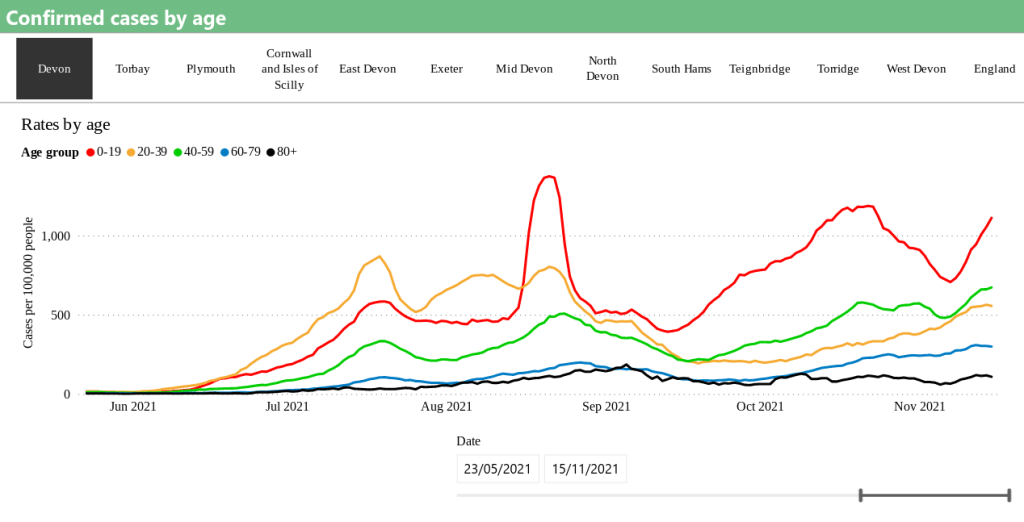
Infection rates across Devon have soared, with every council area in the county reporting a significant increase in new cases. 

Joe Ives, local democracy reporter  www.radioexe.co.uk 

Government figures for the week up to Sunday, 14 November show a total of 6,886 cases across Devon, 33 per cent (1,721) more than in the previous week.

Infection levels are extremely high in some parts of the county and every district has a higher infection rate than the UK average. The average infection rate across Devon is now at 558 per 100,000 of the population. In comparison, the national average sits at 403 per 100,000.

In Torridge, infections have more than doubled within the space of a week. The district’s new 602 infections – 304 more than last week – represent a rise of 102 per cent. The infection rate in Torridge is now at 876 per 100,000 people – more than double the national average.

It’s a similar story for neighbouring North Devon. The district recorded 708 new cases, 183 (35 per cent) more than the previous week. The area’s infection rate now sits at 721 per 100,000, almost 80 per cent higher than the national average.

Overall, the Devon County Council area, which excludes Plymouth and Torbay, saw 4,789 new infections, 1,238 (35 per cent) more than the previous week. The infection rate across its seven districts is now 591 per 100,000 of the population.

Torbay’s infections shot up by 38 per cent, recording 808 new cases, 223 more than in the previous week. The 38 per cent rise takes the infection rate in the Bay to 593 per 100,000 of the population.

Cases rose sharply in Plymouth, too. The city saw 1,289 new infections, 258 (25 per cent) more than in the previous week. The infection rate in the area is now 490 per 100,000.

Despite rising infections in Devon and across the country, prime minister Boris Johnson this week said it was still too early to move to ‘plan b’ and reintroduce restrictions such as mask mandates and working from home orders.

Hospitalisations

As was reported on Tuesday, the latest figures (Tuesday, 2 November) show 127 covid patients in the county’s hospitals – a fall of two on last week’s total. However, this number is likely to rise in the coming weeks as the impact of the rapid increase of infections reaches the county’s hospitals.

There are 49 patients at Derriford in Plymouth, 44 at the RD&E in Exeter, 21 in Torbay and 13. Of the total number of patients, 13 are on mechanical ventilation beds.

Deaths

Deaths have increased, with four more recorded than in the previous week.

Eighteen people died within 28 days of receiving a positive covid test across Devon in the most recent complete seven-day period (up to Sunday, 14 November).

Eleven of the deaths occurred in the Devon County Council area. Meanwhile, four deaths were recorded in Torbay. A further four occurred in Plymouth.

Across Devon, a total of 1,323 people have now died within 28 days of a positive covid test.

Vaccinations

Eighty-six per cent of people aged 12 and above have had their first dose of a vaccine in the Devon County Council area, which excludes Plymouth and Torbay, with 80 per cent receiving both doses.

In Plymouth, 83 per cent have had one dose, while 75 per cent have had both.

In Torbay, 84 per cent have received one dose, while 78 per cent have had both jabs.

This means that vaccination rates in Devon remain slightly behind the rest of the UK. Across the country, 88 per cent of people aged 12 and over have had one dose, while 80 per cent have had both jabs.

All new buildings in England to have electric car charge points from 2022

Boris Johnson will seek to boost the UK’s clean energy credentials after a tricky UN climate crisis conference by announcing that all new buildings in England will be required to install electric vehicle charge points from next year.

Aubrey Allegretti www.theguardian.com 

In a speech to the Confederation of British Industry (CBI) in the north-east of England on Monday, the prime minister will reveal plans, briefed as “world-leading”, to toughen up regulations for new homes and buildings.

From next year developers on sites such as supermarkets and office blocks will be required to install electric vehicle charging points, in an attempt to help phase out the use of petrol and diesel cars before sales of them come to an end in 2030. The government expects the move to lead to 145,000 new charging points each year.

Buildings undergoing renovations that leave them with more than 10 parking spaces will also be subject to the new measures.

Heralding the importance of clean energy just weeks after the UK hosted Cop26, Johnson will say the country is at a pivotal moment, adding: “We cannot go on as we are.”

He will tell business leaders that it should not just be public spending that is used to “adapt our economy to the green industrial revolution”, but that the government will focus on investment in science and technology, raise productivity and “then get out your way”.

Defending the new requirements, Johnson will add: “We must regulate less or better and take advantage of new freedoms.”

The government will also support a new loan programme worth £150m, distributed by Innovate UK over three years, to help British small and medium-size enterprises commercialise their latest research. The “innovation loans” will be accessible to a variety of sectors – including green businesses – and follow a pilot with businesses.

A further £9.4m in funding has been confirmed for what Downing Street said was a first-of-a-kind hydrogen project in the UK’s largest onshore windfarm, near Glasgow. The money will go to the Whitelee green hydrogen initiative to develop the country’s largest “electrolyser” – a system that converts water into hydrogen gas. It is used to store energy and supply local transport providers with zero-carbon fuel.

As part of the government’s bid to reach net zero by 2050, almost 26,000 publicly available electric vehicle charging devices have been installed – including 4,900 rapid ones. A total of 250,000 points in homes and workplaces have already been put in place.

Ed Miliband, the shadow business secretary, accused the government of “failing Britain’s automotive companies and workers”. He said: “Ministers have stepped back and left manufacturers, workers and the public on their own, failing to take the action necessary to make the switch affordable for families hit by a cost of living crisis.

“By extending the help to buy an electric car for those on lower and middle incomes and accelerating the rollout of charging points in areas that have been left out, [Labour] would ensure that everyone could benefit and make the green transition fair.”

The prime minister’s climate spokesperson, Allegra Stratton, raised eyebrows in August when she revealed she was still driving a third-hand diesel. When asked why she did not drive an electric vehicle, she said: “I don’t fancy it just yet.”

Stratton, who lives in north London, said this was because of the length of time it took to make trips to visit her father in the south of Scotland, her mother in Gloucestershire, her grandmother in north Wales, and her in-laws in the Lake District.

However, in October, just before world leaders gathered for Cop26, Stratton revealed she had ditched the diesel car.

Metropolitan Police must investigate the ‘Cash for Peerages’ scandal – Good Law Project

A peculiar trend has been spotted in the House of Lords. Have you noticed it? It looks a bit like high-value donors to the Tory party are being ‘awarded’ a peerage as thanks for massive wads of cash. Dodgy stuff. 

goodlawproject.org

There’s no denying the numbers. Earlier this month, The Sunday Times and openDemocracy revealed that 15 of the last 16 Conservative Party treasurers have been offered a seat in the House of Lords, having each donated more than £3 million to the party. 

Many other Conservative donors have also been ennobled alongside party treasurers. In total, 22 of the party’s main financial backers have been given peerages since 2010. Together, they have given an estimated £54 million to the party.

A former Tory Party chairman reportedly told The Sunday Times, “Once you pay your £3 million, you get your peerage.” And one former Conservative cabinet minister this month described it as a “scandal in plain sight”. 

The Scottish National Party’s Pete Wishart MP wrote to the Metropolitan Police to report this pattern and ask them to investigate. But mere days later, the Met wrote back to Mr Wishart refusing to investigate, saying, “there is insufficient information upon which to launch a criminal investigation”. 

This is baffling. Buying or selling honours is a crime which the police have, in the past, been willing to investigate. In March 2006, Scottish National Party MP Angus McNeil brought a complaint to the police after it emerged that four wealthy businessmen, who had lent the Labour Party a total of £5 million, were nominated by Tony Blair for peerages. The police questioned a raft of politicians over the scandal and made several arrests. 

We think this looks suspiciously like the Conservatives are selling off seats in the heart of our democracy. Members of the House of Lords get a say on laws that affect all of our lives. Why should someone get a vote on Universal Credit because they handed £3 million quid to the Conservative Party? 

When asked about this this week, the Prime Minister defended his party’s reliance on major donors, saying: “Until you get rid of the system by which the trade union barons fund other parties… we have to go ahead.”

If the Government is selling peerages, it’s breaking the law. We think there is more than enough evidence to trigger a police investigation. If the Metropolitan Police refuse to investigate, they must satisfactorily explain why or risk judicial review.  

Alongside Pete Wishart MP, we are asking the Metropolitan Police to share the information and documents they considered before refusing to investigate, and the internal record of the refusal. 

At the heart of this legal action is a simple ask: that Boris Johnson be subject to the same law as you and I. And if there is reason to think he has broken the law, he gets investigated by the police, just like you and I would.


We recognise that this is a difficult challenge, so we will assess the response we get before launching any fundraising. Good Law Project only exists thanks to donations from people across the UK. If you’re in a position to support our work, you can do so here.

Lib Dems and Labour should only target seats they can win, says Ed Davey

The Liberal Democrats will target only one of two forthcoming byelections in Conservative-held seats, the party’s leader Ed Davey has revealed, as he said both his party and Labour should focus their campaigns “where they think they can win”.

Michael Savage  www.theguardian.com 

Davey said that he would not make any formal “deals or arrangements” with Labour over how the parties approach the contests, despite pleas for greater cooperation between them. However, he suggested his party would not be putting significant resources into the London seat of Old Bexley and Sidcup, where Labour is the main challenger.

He said that his party would instead be concentrating on North Shropshire, the safe Tory seat vacated by the resignation of Owen Paterson following his official rebuke over lobbying. While rejecting calls for a pact, Davey said Labour and the Lib Dems had the same goal of removing the Conservative government.

“What I see is a party led by Keir Starmer, who shares our view – that we’ve got to remove Boris Johnson from 10 Downing Street,” he said. “They will campaign in areas where they think they can win and we’ll campaign in areas that we think we can win. We have to manage our resources carefully. It’s no secret that we haven’t put all our effort into some byelections. We certainly want to make our case in North Shropshire.”

North Shropshire is an ultra-safe Tory seat with a majority of more than 22,000. The Lib Dems came a distant third at the last election, but the party believes local election results this year show it is now the main challenger. Insiders said there had been no discussions with Labour, but predicted both sides would “organically” recognise that they stood the best chance in different seats.

Labour sources said the party would contest both seats. But the party has a bigger membership base in London, which can be deployed to help its campaign in Old Bexley and Sidcup, where the Tories are defending a majority of almost 19,000 in less than two weeks’ time. Anything other than a Tory win in both seats would be a huge shock, but the Lib Dems believe they can put up a decent challenge in North Shropshire after overturning a 16,000 Tory majority in the Chesham and Amersham byelection in June.

Despite the fact that the North Shropshire byelection was triggered by the sleaze row, Davey said that “health, health, health” was actually the main local concern his party would be focusing on. “I’ve already been there twice and I’m going there a third time this weekend. And we will be ensuring that some of our best campaigners are there. You know parties put resources where they think that there’s a chance, however difficult. This is definitely tougher than Amersham and Chesham. But in the circumstances, with the Conservatives in serious trouble, with Johnson under pressure in a way he’s never been in his premiership, and the fact that we’ve got some momentum locally with a fantastic candidate, I think, why not?

“Ambulance waiting times are the first thing that comes up on the doorstep. Health is top of the issues, and it’s ambulance waiting times, it’s A&E problems, hospital problems and access to GPs. They’re really coming up on almost every doorstep.”

Concerns over the lack of coordination among progressive parties were raised by a council byelection in West Devon last week. The contest took place in the constituency of former attorney general Geoffrey Cox, who was criticised for voting as an MP while he was in the British Virgin Islands advising its government over allegations of corruption. The Conservative council candidate won by a single vote from Labour, after a big increase in the Green vote. The seat had been held by the Lib Dems.

Some figures within Labour and the Lib Dems have called for more explicit cooperation and electoral reform. Officials in both parties pointed out, however, that such an agreement could never be enforced at local level. “Pacts of non-aggression don’t have great reputations,” said one senior Labour MP.

MPs in safer seats more likely to have a second job

New analysis from better democracy campaigners Best for Britain shows that MPs with safer seats are more likely to hold second jobs.

www.bestforbritain.org 

Of the 643 MPs who take their seats in the House of Commons, 103 currently have second jobs where they have contracted hours or a contractual obligation to provide services and receive personal financial remuneration.

Of this number 87% won their seat with a majority of more than 3,000 votes at the last election and 64% won with a majority greater than 10,000.

The analysis further revealed that of the nine MPs who earn more from their second jobs than from the parliamentary salary, seven have majorities in excess of 17,000 votes and all are Conservative MPs. 83% of all MPs with second jobs are Conservative MPs.

The correlation between second salaries and larger majorities lends weight to the suggestion that MPs are more confident undertaking second jobs for larger sums of money due to their relative security in a future election.

In the context of the UK’s current electoral system where an MP can win with a plurality of votes and where opposition votes are split between at least three parties, better democracy campaigners have criticised suggestions from the Prime Minister and Justice Secretary that voters can realistically regulate the practice by voting these MPs out.

Naomi Smith, CEO of Best for Britain, said

“First past the post delivers disproportionate outcomes, doesn’t represent the majority opinion, and delivers safe seats for too many MPs emboldening those who put personal financial gain ahead of voters. 

“Opposition parties must work together to deliver a government at the next election that will bring our voting system into the 21st century and give the public democratic equality.”

Labour MP, Clive Lewis said,

“By claiming the public can pass judgement on this scandal at the ballot box, the Prime Minister is deliberately misleading people about the reality of elections in the UK where MPs can be elected on a minority of votes, and the opposition vote is split between at least 3 parties.

“First past the post has clearly given some MPs a brass neck and the leadership of opposition parties must accept that the only way they can give the public a realistic opportunity of unseating the worst offenders is by working together to secure a fairer voting system.”

Take action now

Be part of the campaign for better democracy and take action today. Find out how you can make a difference.

Join the campaign for Better Democracy here.

To level up Devon needs £500+M: what chance?

From today’s Western Morning News:

Devon’s economy should get more than £500 million in additional Government support if the county’s hardest hit areas are treated the same as Cornwall.

Analysis for Team Devon shows productivity in six local authority areas is at least as low as Cornwall and therefore should be eligible for the same level of investment from the Government’s planned UK Shared Prosperity Fund which will replace EU funding from April 2022.

In the Budget the Government promised that Shared Prosperity Fund contributions for Cornwall would “at a minimum match the size of EU Funds” but no guarantees have been given for Devon, Plymouth and Torbay.

Team Devon research shows that low productivity in East Devon, Mid Devon, Teignbridge, Torbay, Torridge and West Devon is at least as bad as Cornwall, and the population of the six Devon areas is 612,000, more than the population of Cornwall. Whilst relatively better than Cornwall, productivity in Plymouth, North Devon and South Hams is significantly below the UK average and all areas are struggling with skills shortages and low wages.

If Government simply guaranteed Devon’s local authority areas UKSPF contributions to at least match what they would have received from the EU, they would share around £83.5 million, £11.52 per head, for jobs, skills and business support spread over six years up until 2028. But Team Devon says that if the Government treated Devon the same as Cornwall, that investment would rise to £540 million, £80.19 per head, for the lowest productivity areas and up to £1.13 billion, £155.86 per head, for the whole of Devon, Plymouth and Torbay.

Team Devon is urging the Government avoid the mistakes of the old EU funding system and ensure UKSPF is targeted to help these productivity “cold spots”.

Cllr Rufus Gilbert, Devon’s Cabinet Member for Economic Recovery and Skills, said: “We have no quarrel with Cornwall, Cornwall’s challenges are very similar to those faced by Devon. We simply ask Government to treat the people and businesses of Devon fairly and to put right an injustice which has starved our economy of vital funding.

“For many years Devon, Plymouth and Torbay have missed out on hundreds of millions of pounds of vital economic support because the EU wrapped up the whole of Devon, poorer areas with better off ones such as Exeter which frankly gave a totally false image of Devon’s economy.

“Nor should anyone assume that Exeter, so long the driving force in the Devon economy, is fine as it is. It is vital that Exeter is supported to enhance the city economy, and helped to drive up productivity across the rest of the county.”

Cllr David Worden, Chair of the Devon Districts Forum, said: “Team Devon’s research nails the myth that the severe economic and social challenges facing the peninsula begin and end at the Tamar. If the Government’s Levelling Up policy is going to succeed it has to apply Shared Prosperity funding fairly whatever side of the Tamar you live and work. To do otherwise, risks creating an economic cliff-edge between our two counties.

No 10 legal threat to The New European

Insights into events of the first few days of November when Boris Johnson flew back from COP 26 to attend a Garrick Club dinner and subsequently decided to  order his MPs to tear up the parliamentary standards rulebook. – Owl

George Grylls, Political Reporter www.thetimes.co.uk

Boris Johnson has denied he will take legal action over a “completely untrue” story that he joked about his marriage at a Garrick Club dinner.

The New European published a story alleging that he made a “callous jibe” at the gathering of former Daily Telegraph journalists after flying back in a private jet from the Cop26 summit.

The weekly newspaper, set up by pro-EU journalists after the 2016 EU referendum, said Johnson joked that he had “buyer’s remorse” about marrying Carrie Symonds, who is pregnant with their second child. One guest quoted by the paper said: “It was a remarkable thing to say and there were a number of raised eyebrows around the table.” No 10 called the claims completely untrue.

Matt Kelly, the editor-in-chief, said he had received two calls from No 10 threatening to sue him for libel if he ran the piece.

Kelly said in a statement he had a call at 10.30pm on Thursday from — he later found out — Jack Doyle, Johnson’s director of communications. “His opening gambit was ‘Boris Johnson is going to sue The New European for defamation,” Kelly said. “I made it clear that this was not a threat that troubled me greatly and we stood by our story. After a few minutes, the caller eventually told me, ‘You just crack on then, mate’ and put the phone down.

“I texted him, asking him to repeat his threat of legal action and to send across the Downing Street denial. I also asked him, twice, to identify himself, which he refused to do.”

He established the next day that the caller was Doyle. No 10 had to reply to questions about the reports after Kelly’s account. No 10 denied Johnson had joked about his marriage at the dinner. “The prime minister has been clear that he didn’t make those remarks and they are completely untrue,” No 10 said.

Johnson left the Garrick with Lord Moore of Etchingham, the former editor of The Daily Telegraph. Moore was a vocal defender of Owen Paterson, the former MP for North Shropshire, and raised the issue of the disgraced backbencher’s ban for paid lobbying at the dinner, according to some reports.

The next day Johnson ordered his MPs to tear up the parliamentary standards rulebook in a failed attempt to save the former minister. Paterson resigned amid the outcry.

Boris Johnson told: dump plan for social care charges or face Tory rebellion

Senior Conservatives on Saturday urged Boris Johnson to ditch plans that would see many of England’s poorest pensioners paying more for their social care – or risk being forced by his own MPs into a humiliating U-turn.

Toby Helm www.theguardian.com 

The prime minister, still reeling from sleaze allegations and fury among “red wall” MPs over scaled-back rail investment in the north, is facing another potentially damaging Commons rebellion at the hands of an increasingly mutinous party.

The Observer has learned that several northern Tory MPs took part in an emergency call set up by care minister Gillian Keegan on Friday afternoon, during which she was said to have been “monstered” by backbenchers complaining that the plans were unfair and had not been fully explained or thought through.

According to MPs in on the call, former Tory chief whip Mark Harper challenged Keegan to produce more detailed analysis of the plans – which neither she nor two civil servants present was able to do. Harper then said it would not be good enough for her to produce details on the day of the vote, which is expected to be Monday or Tuesday.

Tory whips are understood to have been told by several senior Tory MPs that they are considering voting against the plans, or abstaining, unless they are amended to make sure pensioners would not be forced to sell their homes to pay for their care, as Johnson previously promised.

Jeremy Hunt, former health secretary and current chair of the health select committee, said it was “deeply disappointing” that the new plans were “not as progressive” as those put forward by Andrew Dilnot, the economist who drew up the original plans for a cap on individual contributions. He said it would now be up to government to improve entitlements once the cap had been introduced.

Damian Green, the former Tory cabinet minister, who was also on the call, told the Observer that the government should drop the plans and adopt a system that would guarantee that people could retain a percentage of their housing wealth.

“I would urge them to adopt a different approach,” Green said. “I think it would be infinitely preferable to guarantee that people can keep a percentage of their housing wealth rather than having a flat rate applying to the whole country.”

Tory WhatsApp groups were said to be full of comments from MPs – including many in red wall seats – talking about a potential rebellion unless the government backed down.

Last week, when MPs’ minds were focused more on troubles over sleaze and the decision to axe the eastern section of the high-speed rail line to Leeds, ministers announced changes to social care plans which would mean poorer pensioners would not, after all, be able to count means-tested payments by the state for their care towards a total cap of £86,000 for any individual. It is believed the change was made under pressure from the Treasury.

Critics said this meant that while someone who owned a £1m house would be able to protect more than 90% of their asset, someone with a home valued at £70,000, in a less wealthy part of the country, would lose almost everything.

Dr Dan Poulter MP, who works part time as a psychiatrist in the NHS, said that the unwelcome change to the plans was the result of government not having set aside enough money for social care when its main announcements on extra NHS funding and care reform was made in September.

“The initial set of proposals for a £86,000 lifetime cap of social care costs were strong and addressed the injustice of people having to sell their homes to pay for their care, but there were always questions about whether the government’s sums added up,” Poulter said.

“So, while this this policy change is surprising, I suspect it may well have been driven by the realisation that an extra £5.6bn, while welcome, was never going to be enough to meet both the care and workforce challenges in the social care system as well as to properly finance the introduction of an £86,000 cap on care costs. Unfortunately, it will be poorer pensioners who have relatively modest assets that will be most affected by these changes.”

When she announced the plans last Thursday, Keegan said they would “reduce complexity” and ensure that people “are not unfairly reaching the cap at an artificially faster rate than what they contribute”.

Analysis by the Observer shows that almost three-quarters of the seats the Tories won from Labour at the last election will be among those hit hardest by these changes.

Of the 54 seats the Conservatives won from Labour in 2019, 41 have average house prices below that level. In the Burnley constituency, for example, the average house is worth £99,950. In Darlington, it is £135,000 and in Durham North West it is £120,000, according to recent figures from the House of Commons library.

Appearing before a committee of MPs last week, Dilnot said that about 60% of older people who end up needing social care would lose out under the government’s plans.

“The people most harshly affected by this change are those with assets of exactly £106,000,” he said. “But everybody with assets of less than £186,000 would do less well under what the government is proposing than under the proposals we made and that were legislated for. That was a big change announced yesterday. It finds savings exclusively from the less well-off group.”

Shadow health secretary Jonathan Ashworth said: “Boris Johnson’s care plans are descending into chaos, with Tory MPs squabbling while ministers admit they haven’t even studied how the proposals disproportionately hammer those with modest assets.

“As civil servants confirm that these changes will clobber some of the poorest pensioners, many in the north and Midlands, Tory MPs must join with Labour in voting down this unfair care con and demand ministers come back with a fair alternative.”

Charles Tallack of the Health Foundation said the average house price in red wall seats of £160,000 meant they were “most likely to be affected by the proposed changes”. The type of people currently using care are also more likely to be worse off under the plans. The majority of people in care are women over 80, who have a median wealth of £156,000.

Devon booster uptake going well

Devon has seen a “really good uptake” of the covid booster jab, according to a health boss.

Ollie Heptinstall, local democracy reporter www.radioexe.co.uk

Nearly a quarter of a million doses (240,000)  have been given out so far to around 58 per cent of eligible people, Dr Paul Johnson, clinical chair of the NHS Devon Clinical Commissioning Group, told a monthly Team Devon meeting of local authority leaders.

He said many of the remaining 42 per cent will also have an appointment booked, “so the real figure of people coming forward for their vaccine at the booster stage is likely to increase.”

It marks a significant shift in tone from last month’s meeting, when Dr Johnson said he was “concerned” about the uptake of booster jabs, with just over 40 per cent of those eligible having received it at the time.

Since then, the criteria for booking appointments has changed. Whilst people still cannot receive a booster until at least six months after their second vaccine, they can now book their appointments after five months.

The eligibility age has been reduced too, with third jabs now being offered to people aged 41 and over. Those who are also more clinically vulnerable and the people they live with, as well as NHS workers, social care staff and care home residents, can also receive their booster.

Dr Johnson says the increase in the number of people turning up at large vaccination sites in Devon for third doses means extra resources having to be put in place, with the number “currently, in some circumstances, exceeding the capacity that we’ve got.”

But he added: “It’s a good problem to have, and it’s one that’s relatively easy to fix by just increasing the resourcing there.”

Locations offering boosters include the Riviera International Centre in Torquay, Home Park football stadium in Plymouth, Exeter’s Greendale on the Sidmouth Road, Newton Abbot Racecourse and Barnstaple Leisure Centre.

The meeting was also told that around 90 per cent of adults over 40 have now had the first two doses of the vaccine, above the national average. Dr Johnson called it “a really good result”.

However, he said there was “still work to be done” in younger age groups, with uptake in ages between 18 to those in their thirties “around about the 75 to 85 per cent of uptake, which is lower than we would like.”

From the Covid dashboard – the latest picture of confirmed infections: