Using Sir Keir Starmers’ description, as he accuses Boris Johnson of “corruption that goes to the very top”.
And we all know that under this Government, the sewer is not a good place to be.

Using Sir Keir Starmers’ description, as he accuses Boris Johnson of “corruption that goes to the very top”.
And we all know that under this Government, the sewer is not a good place to be.
He convinced the government and some backbenchers, does he convince you? – Owl
Aubrey Allegretti www.theguardian.com
At the final hour the Tory MP Owen Paterson escaped an immediate 30-day suspension from the House of Commons for an “egregious” breach of lobbying rules, and avoided a possible byelection.
He convinced the government and some fellow backbenchers to vote to spare him from the sanction, which was recommended by the standards committee watchdog, and to instead refer his case to a new committee chaired by a Conservative former cabinet minister, John Whittingdale.
Although Paterson, the MP for North Shropshire, protested his innocence, several of those who backed reform of the standards system still believe he broke the rules and should be punished. It will now be up to the new committee to assess the evidence and make recommendations about what should happen to him.
Here are the claims Paterson made, along with analysis of how they stack up.
Paterson’s claim: He made approaches to government bodies about two firms, Randox and Lynn’s Country Foods, which employed him as a consultant. The MP said he was acting as a whistleblower in raising concerns about milk and pork standards and that this meant he could claim an exemption from the rules regarding paid advocacy because he was raising a “serious wrong”.
Watchdog response: While this excuse would have been permissible for an initial approach, Patterson’s investigators said it did not cover his follow-up letters and meetings. “What might have been permissible in a single exceptional case, became Paterson’s standard practice,” said the standards commissioner, Kathryn Stone, adding that it “stretches credulity to suggest that 14 approaches to ministers and public officials were all attempts to avert a serious wrong rather than to favour Randox and Lynn’s, however much Paterson may have persuaded himself he is in the right.”
The committee agreed. It said Paterson’s follow-up approaches “sought to promote Randox products” by praising their “superior technology” and that he promoted other unrelated products from the company. “These were all attempts to confer a benefit on Randox, to whom he was a paid consultant,” it found. “At best, Paterson was relying on an exemption he thought probably existed but of whose terms he was unsure. At worst, Paterson was knowingly in breach of the lobbying rules.”
The committee also agreed that Paterson’s attempts to get one of Lynn’s Country Foods’ competitors to relabel their product so as not to compete with Lynn’s own nitrite-free goods, as well his asking for this to be promoted in the press, was not incidental.
Paterson was paid more than £100,000 for his work for Randox and Lynn’s, and the committee was clear. “The paid advocacy rule does not distinguish between lobbying for good causes and lobbying for bad causes. It only applies to lobbying for reward or consideration.” It added that Paterson “went beyond presenting evidence of a serious wrong” in his follow-up approaches to the Food Standards Agency about milk testing.
Paterson’s claim: Paterson said the investigation against him was biased because the commissioner did not interview 17 witnesses who wanted to defend him and provide testimony about what was discussed at various meetings.
Watchdog response: The 17 witnesses provided written statements, which the standards committee said they received and read. However, the committee said that they “do not see what further relevant information could usefully be gleaned by inviting oral evidence from the witnesses concerned”.
Paterson claimed the witnesses would testify that his intentions were good. But the committee said “subjective motivation is not the test under the lobbying rules” and that seven of the 14 approaches found to be in breach of paid advocacy rules were emails or letters from Paterson personally, meaning oral evidence from those who supported him was unlikely to materially alter its conclusions.
Paterson’s claim: His only admission of wrongdoing was having written two letters on Commons-headed taxpayer-funded notepaper. But the major misuse of facilities he denied was hosting meetings in his parliamentary office 16 times between October 2016 and February 2020. He admitted holding the meetings but said the use of his office was “occasional”, and whips told MPs to remain on the estate because parliamentary business at that time was unpredictable.
Watchdog response: It came down to a matter of interpretation but the committee said the number of meetings clearly “went beyond the latitude normally afforded under the rules”. Paterson claimed he “kept his commercial interests entirely separate from his parliamentary activities” but the committee said he should not have used his parliamentary office to conduct business meetings with his paying clients, and that it was trying to take a proportionate and consistent approach with previous rulings on similar issues.
Paterson’s claim: Paterson said the “manner” of the standards commissioner’s pursuit of the inquiry played a major role in driving his wife, Rose, to take her own life last summer at the age of 63.
Watchdog response: While this was his belief, the committee called it an “unsubstantiated, serious and personal” allegation against the integrity of the commissioner and her team, who were unable to respond publicly.
Is worry over future inquiries driving PM to change watchdog?
Three times Boris Johnson has been investigated by the Commons’ standards watchdog, which is more than any other UK MP in the last three years.
Rowena Mason www.theguardian.com
And now the prime minister is facing a fourth possible inquiry by Kathryn Stone, the parliamentary standards commissioner, this time over the funding of his Downing Street flat refurbishment.
With a decision on a fresh investigation due within a matter of weeks, some are raising eyebrows about the timing of Johnson’s move to undermine and overhaul the whole standards system. Others are saying that the system is ripe for reform but it it needs to be stricter or to outlaw lobbying by MPs altogether.
Ostensibly, the Tory plan which emerged this week to introduce a new body for MPs to challenge decisions by the standards committee is to save Owen Paterson’s bacon. The veteran backbencher was facing 30 days suspension from parliament for lobbying government bodies on behalf of firms which paid him more than £100,000 – as revealed by the Guardian two years ago.
No 10 argues that the plan is simply about trying to create a fair system which allows an MP the right of appeal.
But one Tory MP believed the motivation for a shake-up was worry in Downing Street about further standards investigations coming down the track – particularly potential inquiries into lobbying over the award of Covid contracts, and into the prime minister’s loans from a Tory donor for the redecoration of his flat at No 11 Downing Street.
For years there have been warnings that the government has been going in the wrong direction when it comes to tackling inappropriate lobbying and transparency standards, all issues associated with the whiff of corruption and “Tory sleaze”.
As recently as Monday a report by the committee on standards in public life, led by the former spy chief Jonathan Evans, argued that sweeping changes to the system were needed, particularly when it came to oversight of ministers’ behaviour and lobbying by those formerly in power.
The report did not make any recommendations on the standards system for MPs, which is widely seen as imperfect but relatively effective, even though some would like to see the rules tightened further to ban parliamentarians’ second jobs altogether.
Paid advocacy by MPs has been banned in some form or other since 1695, according to Chris Bryant, chair of the standards committee. The ban on direct lobbying was formalised after the cash for questions scandals of the 1990s. The standards commissioner and the standards committee of MPs and independent members, have repeatedly enforced those rules when breaches, such as in the case of Paterson, have been brought to their attention.
But even with the prohibition in place, MPs can legitimately have second jobs advising companies on politics and policy. As an example of the revolving door, Sajid Javid, now the health secretary, was paid £150,000 a year by the investment bank JP Morgan shortly after leaving office as chancellor of the exchequer.
The list of Tories, in particular, with second jobs in areas of their policy expertise is long, with many former ministers now working in the sectors they used to govern. Some advise hotel chains, investment companies, property developers; one link is with a gambling firm.
The fine print also allows some wriggle room. MPs can engage in lobbying if it is “six months after the reward or consideration was received”. They are not allowed to speak in the Commons, make approaches to ministers, vote, or initiate parliamentary proceedings, in return for direct payment in cash or kind.
However, they are allowed to participate in parliamentary proceedings and conversations with ministers that would financially benefit their client as long as they did not start the interaction, the interest is declared and is not for the sole benefit of their client.
Former ministers and public officials can also engage in lobbying just two years after leaving office, under the rules of the Advisory Committee on Business Appointments (Acoba). In practice, some are suspected of doing so under the radar before then, since the watchdog for enforcing lobbying prohibitions has no power to sanction them.
The Greensill scandal, in which the former prime minister David Cameron pestered senior ministers for favours on behalf of his new employer, the supply chain financier Greensill Capital, shows the extent to which intensive lobbying is still permitted. An official parliamentary inquiry found Cameron showed a “significant lack of judgment” but did not breach lobbying rules.
While scandals about lobbying and financial interests of politicians are nothing new, a number of experts, academics – and some MPs themselves – believe standards are being further eroded under the present government. Bryant warned that the public “will think we are the parliament that sanctioned cash for questions”.
Robert Barrington, professor at the Centre for the Study of Corruption, at the University of Sussex and a former government adviser, said on Wednesday that the Paterson case only “illustrates the crisis of standards that is currently undermining democracy in the UK”.
He concluded: “[It is] hard to avoid the conclusion that there is an effort to change the rules when it suits, with arguments based solely on party or tribal loyalty and not any basis of principles or standards. Perhaps that is the luxury of an 80-seat majority.”
Daniel Bruce, chief executive of Transparency International, also said the “direction of travel” had to change in light of recent cases where the prime minister and government had overridden decisions by standards bodies.
Bruce said: “Coming into this year we have a vacuum of oversight on the ministerial code after the Priti Patel [bullying] case when the independent adviser resigned. We’ve had the commission on the appointments to the upper house overruled by the prime minister when the commissioner took a view that a Conservative donor should not get a peerage. We’ve got this woefully inadequate picture of lobbying of the government. We’ve got a decade of decline in FoI [freedom of information] requests being granted in full. Those are four very concerning areas.
“And yet what do we have this week? We now have government-backed attempts to dismantle a system of oversight set up in the height of 1990s sleaze and further strengthened after the MPs expenses saga of 2009 … The very obvious timing of this proposed review to suspend a suspension suggests this is very partisan.”
Bruce said Transparency International had monitored suspected breaches of parliamentary conduct rules and the ministerial code, finding 30 breaches that were not investigated or where no action was taken in 2020.
“The number of cases where questionable behaviour goes un-investigated has intensified in the last few years under this current administration,” he said. “That is the concern, and I await with keen interest the government’s full response to the committee on standards report because as far as I am concerned there is no turning away from that.”
As global leaders discuss tackling climate change at the Cop26 summit in Glasgow, a map shows how rising sea levels could change the shape of Devon’s coastlines forever.
Edward Oldfield www.devonlive.com
The map produced by Climate Central using the latest sea level predictions shows the land which would be below the annual flood level in 2050.
The projections do not take into coast and river defences, which are designed to hold back the waters to protect homes and businesses.
The map shows how an expected increase in the sea level of up to 29cm (11 inches) over the next 30 years could see unprotected land underwater from flooding. It shows how the sea could inundate low-lying coastal areas, and the vital importance of defences to protect homes and businesses.
Low-lying areas of the Devon coast are particularly at risk from tidal flooding, and an increase in storms from climate change could also speed up erosion. Changing weather patterns are seeing more rainfall, which increases the flood risk from rivers.
Coastal features including Northam Burrows near Bideford, and Dawlish Warren, could be at risk from extreme weather, as both appear below the predicted annual flood level for 2050.
The government is funding a series of schemes across Devon as part of a new £5.2billion six-year programme of investment in flood and coastal defences announced in July to protect the most at-risk properties, doubling the amount spent in the previous six years.
Key flood defence schemes include a completed £32million scheme alongside the River Exe at Exeter, and plans for a flood wall along the seafront at Paignton and Preston on the south Devon coast. The effect of storms has already been widely seen, including a major breach of the railway line at Dawlish in 2014, and the main A379 road partly washed away at Slapton in 2018.
The government has set out a strategy to reach Net Zero by 2050 – the point when the output of greenhouse gases responsible for global warming like carbon dioxide is reduced and equals the measures to take them out of the atmosphere.
Around Devon, the Climate Centre map shows that along the coast and estuaries, the land including roads and beaches would be below the 2050 annual flood level.
The map uses the latest predictions of global future sea levels agreed by the Intergovernmental Panel on Climate Change (IPCC), the United Nations body for assessing the science related to climate change, released in August.
Totnes

The map shows land alongside the River Dart which would be below the annual flood level by 2050.
Slapton

The red area shows the land forecast to be below the annual flood level in 2050, including the stretch of the A379 coast road.
Dawlish and Exmouth

The red area includes most of Dawlish Warren, a sandy headland in the mouth of the River Exe, where a £14million beach management scheme to strengthen defences has been carried out. The map also shows the parts of Exmouth at risk from flooding, which have been protected by a recent £12million tidal defence scheme.
Exeter

Low-lying land alongside the River Exe and estuary is at risk, as is land alongside the River Clyst. Recent flood defence works have taken place to protect homes and businesses from river flooding at Exeter and Clyst St Mary. A tidal defence scheme is in development for Topsham, and repairs planned at Bowling Green Marsh.
Newton Abbot

Large areas of land alongside the River Teign are forecast to be at risk from flooding, including Newton Abbot racecourse.
Torquay

Torquay seafront already sees flooding at some high tides, particularly the low-lying land in front of Torre Abbey, and parts including Princess Gardens are on land reclaimed from the sea.
Paignton

Plans are being drawn up for a new sea wall to protect the low-lying town centre from predicted flooding due to rising sea levels.
Teignmouth

Sitting at the mouth of the River Teign, stretches of the estuaryside are predicted to be below the annual flood level by 2050.
Budleigh Salterton

Land alongside the River Otter experiences flooding, and a £15million project is underway to restore the flood plain, allowing the land to flood naturally.
Barnstaple and Bideford

The estuaries of the Taw and Torridge feature on the map where land is predicted to be below the 2050 annual flood level, including Northam Burrows, a sandy headland in the mouth of the estuary. A tidal flood scheme is in development at Bideford, and a defence scheme is being drawn up at Westward Ho!
Dartmouth

The River Dart is forecast to see riverside land below the annual flood level, including parts of the town centre nearest the water.
What is Cop26 Glasgow all about?
The UK Environment Agency says the impact of global warming and climate change is expected to result in the sea level rising by up to 29cm around the UK over the next 30 years, as polar ice melts and seas expand. It warns if temperatures rise by 2 degrees C, the rise would be 45cm (18 inches) by the 2080s, or 78cm (31 inches) if the world heats up by more.

Aerial photo of Dawlish Warren at the mouth of the Exe Estuary, opposite Exmouth (Image: Environment Agency)
120 world leaders have gathered in Glasgow for the Cop26 summit , with the goal reducing greenhouse gases to limit global warming to 1.5C, or at worst 2C, by 2100. But there is a warning that we are on track for 2.7C which the UN says would result in “climate catastrophe”.
In Glasgow, UN Secretary-General Antonio Guterres told the Cop26 summit the world’s “addiction to fossil fuels is pushing humanity to the brink”. Pointing to melting glaciers, relentless extreme weather events, sea level rise and overheating oceans, he warned: “We are digging our own graves”.
Prime minister Boris Johnson warned of the dangers of rising temperatures, jeopardising food supplies for hundreds of millions of people, more wildfires and eventually the loss of whole cities such as Miami, Alexandria and Shanghai. “The longer we fail to act and the worse it gets and the higher the price when we are forced by catastrophe to act,” he said.
What does the Environment Agency say about climate change?
The Environment Agency says that adaptation – becoming resilient to the already inevitable effects of climate change – is just as important as actions to cut greenhouse gases.
It is a case of “adapt or die”, the Agency’s chairwoman Emma Howard Boyd said, warning that deadly events such as the flooding in Germany this summer would hit here if the country did not make itself resilient to the more violent weather the climate emergency was bringing.
In a report to the Government, the EA said climate change would exacerbate the pressure on England’s water environment, which is suffering from problems such as pollution and increased water demand, and make it harder to ensure clean and plentiful water.
The agency alone cannot protect everyone from increasing flood and coastal risks, and traditional flood defences will not be able to prevent all flooding and coastal erosion, the report said.
There will be more and worse environmental incidents, such as flooding, water shortages and pollution, regulation is not ready for climate change and the natural world cannot adapt as fast as the climate is changing, the EA said.
What is the government doing to build flood defences?
In July 2021, six months after the nation was battered by Storm Christoph, environment secretary George Eustice announced £5.2 billion of investment in a new six-year flood and coastal defence investment programme in England from for 2021 to 2027.
This will fund around 2,000 new defence schemes to better protect 336,000 properties. The investment is double the £2.6billion of the first six-year programme which ended in 2021, protecting more than 300,000 homes and businesses.
The programme includes 2,000 new defence projects, as well as maintaining existing schemes, and in total is predicted to avoid around £32billion of economic damage.
The report says: “The risks from flooding and coastal erosion are significant and continue to grow.”
It adds: “Flooding and coastal erosion can be devastating. As well as the potential for loss of life and damage to property, they can impact our businesses and livelihoods, and affect our health and wellbeing. The risks we face are significant and continue to grow.
“Climate change is leading to rising sea levels and warmer and wetter winters, together with an increase in the frequency and intensity of extreme events such as heavy rainfall, coastal erosion and landslips.”
Before we get to that here is the Daily Mail comment:
Owen Paterson scandal is proof this overmighty government is content to twist rules www.dailymail.co.uk
This where you can find how Simon Jupp MP and Neil Parish MP voted (one recorded no vote the other voted aye)
https://votes.parliament.uk/Votes/Commons/Division/1124#ayes
Here are their email addresses should you be inclined to give them your views on the subject.
So we’re back in the Tory sleazy 90s. Remember Neil Hamilton?
His political downfall came in 1996, after the Guardian reported under the headlines “A liar and a cheat” that he had taken money in brown envelopes from Mohamed Al Fayed in the “cash-for-questions” scandal. His libel suit against the paper collapsed, leading to this infamous headline and his resignation from government. He went on to lose his Tatton seat to journalist Martin Bell in 1997’s general election.
Thirty years on:
5 Times MPs Angered The Public With Their ‘Sleazy’ Scandals
Kate Nicholson www.huffingtonpost.co.uk
As Tories MPs have been accused of dragging politics back to the “worst of 1990s sleaze culture” with the latest controversy in parliament, here’s a glance back at some of the most jaw-dropping times MPs have breached the rules.
1. Paterson gets away with lobbying breach
Tory MP Owen Paterson divided Westminster after an inquiry found he had breached parliamentary lobby rules last week.
Paterson was accused of using his position as an MP to the benefit of two separate companies which paid him £100,000 a year to act as a consultant.
Paterson rejected the inquiry and said he was only mentioning safety benefits to other MPs – but the cross-party committee which organised the inquiry swept his protestations aside and claim there is a lot of evidence to suggest otherwise.
Then on Wednesday, MPs – most of whom were Tory – voted in parliament and rejected the committee’s suggestion he should be suspended for 30 days amid attempts to create a completely new watchdog for the MPs.
This has caused widespread controversy, with Labour calling it a return to the worst of the “sleaze” seen in the 90s.
2. Ongoing cronyism
Matt Hancock, then health secretary, was found to have acted unlawfully after of not disclosing the full details of the contracts signed during the Covid pandemic in 2020.
He also broke ministerial code by failing to declare that he had a stake in a family company which won a Covid contract.
Similarly, Michael Gove was found in 2021 to have acted unlawfully when he awarded a contract to a polling company run by one of his associates.
Neither minister left cabinet after such details were revealed.
Contracts worth close to £3.5 billion have been awarded firms with links to the Tory Party, according to Labour.
3. One rule for the public, another for us
Hancock did actually resign after The Sun published security camera photographs capturing the then health secretary kissing one of his married aides in an office in 2021.
While the affair alone stunned the public, it was actually the flouting of the social distancing rules which Hancock himself had advocated for which ground everyone’s gears. Even so, the prime minister did not fire Hancock – he stepped down on his own accord in June this year.
Boris Johnson has recently faced further accusations that he has not followed his own rules after it was claimed that his friend, Nimco Ali, spent Christmas with him last year when mixing was not permitted between households.
However, Downing Street defended the prime minister and said she was part of Johnson’s “childcare bubble”.
4. Expenses scandal
The expenses’ scandal of 2009 saw MPs claim money on a range of ridiculous items which stunned the nation, but many of them did lose their jobs when their claims were revealed.
Sir Peter Viggers, for instance, was paid more than £30,000 for gardening expenses across three years – he admitted claiming £1,645 for a ‘duck island’ alone alone and put in claims for 28 tonnes of manure.
He was told to step down when the revelations came to light.
Another Tory MP Anthony Steen also stood down after claiming the cost of a forestry specialist to inspect 500 trees on his estate.
Senior Tory MP Bill Cash claimed more than £15,000 in expenses to cover his daughter’s rent for her London flat while Labour MP Rosie Winterton tried to put in a triple-digit claim for soundproofing her bedroom – the list went on and on and left the country furious.
5. Robert Jenrick and the planning row
Former housing secretary Robert Jenrick faced calls to resign after he was found to have been involved in a controversial £1 billion development led by a Conservative Party donor.
Jenrick went against the recommendations of a planning inspector and approved the building of 1,500-home development in the Isle of Dogs – even though the local council had also rejected the idea because it did not include enough affordable house.
He did not resign but was pushed out of the role in Boris Johnson’s recent cabinet reshuffle.
Standards in Public life should be sacrosanct – not to be cherry picked to justify sleaze – Owl
According to the Guardian, Boris Johnson will back an unprecedented bid to overthrow an independent inquiry that found the former cabinet minister Owen Paterson committed an “egregious” breach of lobbying rules.
Tory MPs will be instructed by party whips on Wednesday to avoid imposing an immediate 30-day suspension on their colleague by backing a motion that argues the initial probe by the parliamentary standards commissioner was flawed. Instead, a new committee would be set up to review the evidence.
Whether the amendments are selected will be a matter for the Commons Speaker, Lindsay Hoyle. He will announce on Wednesday afternoon which – if any – will be voted on when MPs begin a 90-minute debate on the report into Paterson released last week.
Here are the Committee on Standards in Public Life conclusions that led to their recommended sanctions.
The Committee’s conclusions and recommended sanctions
The Committee commented that it does not doubt that Mr Paterson sincerely believes that he has acted properly. Mr Paterson is clearly convinced in his own mind that there could be no conflict between his private interest and the public interest in his actions in this case. But it is this same conviction that meant that Mr Paterson failed to establish the proper boundaries between his private commercial work and his parliamentary activities, as set out in the Guide to the Rules. The Committee concluded that being able to judge the difference between one’s private, personal interest and the public interest is at the very heart of public service and a senior member of the House with many years standing should be able to make that distinction more clearly.
In accordance with normal practice, before considering sanctions the Committee noted any aggravating or mitigating factors in the case. Aggravating factors included:
The Committee also noted mitigating factors, including:
The Committee determined that Mr Paterson’s actions, in particular those relating to paid advocacy, constitute a serious breach of the rules.
The Committee found that Mr Paterson’s actions were an egregious case of paid advocacy, that he repeatedly used his privileged position to benefit two companies for whom he was a paid consultant, and that this has brought the House into disrepute.
In line with previous cases of a similar severity, the Committee recommends that Mr Paterson be suspended from the service of the House for 30 sitting days.
As the Government Deputy Chief Whip confirmed on 9 September 2021, it is the usual practice for the relevant motions to be tabled by the Government and debated as soon as possible. The Committee recorded its expectation that this should be within five sitting days of the publication of the report.
How is that going to help?
Think of it in a local context. Would EDDC get £10 million + inflation for their new HQ!
EDDC is already the buyer of last resort for failing leisure centres.
And who will buy public toilets – maybe get them sponsored but not by South West Water!
Perhaps, in extremis, Clinton Devon Estates would take back the car parks on Woodbury Common! – Owl
Patrick Butler www.theguardian.com
Two struggling councils have been warned they face government intervention unless they selloff publicly-owned assets, including town halls, public toilets, leisure centres and libraries, and push ahead with further cuts to services.
The threat by local government minister, Kemi Badenoch, followed publication of reviews into the two councils’ finances which concluded both ran the risk of failing to balance their budget – effectively going bankrupt – without urgent action.
Badenoch told Peterborough city council, which is run by the Conservatives in alliance with independents, and Wirral council – run by a minority Labour administration – they must set out plans within 30 days to balance the books or face possible intervention.
“Any faltering in this area would be of considerable concern and could lead to a reconsideration as to whether a different approach might be appropriate to secure the improvements that are necessary,” she wrote.
The National Audit Office said this year that at least 25 councils in England were on the edge of bankruptcy after years of cuts, and amid soaring cost pressures. The pandemic has added more issues and both Slough and Croydon councils have declared effective bankruptcy in recent months.
Peterborough – whose leader warned that “difficult choices” lay ahead – was told by Badenoch it had still not “fully grasped” the scale of its financial challenges, while in a separate letter she told Wirral it “had not fully acknowledged or perhaps even understood the severity” of its position.
Both councils have made tens of millions of pounds of cuts in recent years, despite rising demand for services, particularly in adult social care and children’s services. Both have applied to government for financial support in recent months after concerns they would not be able to balance their budgets.
The review of Peterborough’s finances said it had lost nearly £100m in government funding over the past decade. The council told reviewers services were now at “dangerously low levels” after repeated cuts in recent years and had in some cases reached a basic legal minimum service.
However, the reviews insisted both councils had scope to make further cuts to services and should embark on a sale of assets. In Peterborough’s case this should include the sale of 3,000 acres of farmland, which currently bring in rent of £400,000 a year, the council town hall, and several office blocks.
The review of Wirral’s finances concluded that it should sell off a raft of council-owned assets including golf courses, youth clubs, libraries, leisure centres, community centres, public toilets and office buildings to raise cash to balance its budget.
The review criticised Wirral council’s apparent reluctance to make cuts or sack staff, saying it had a culture of avoiding “difficult financial decisions”. It said: “Until members and officers face up to the need to have to make difficult decisions … its financial sustainability remains uncertain.”
Wayne Fitzgerald, the leader of Peterborough council, said: “The report acknowledges the very significant challenges we have faced in the past but also recognises that Peterborough’s services perform well and are low cost.”
He added: “It is clear though that I as leader, including all other members, regardless of political party, must take on board the seriousness of these reports and set about implementing some of the recommendations which will mean that very difficult choices are ahead.
“Going forward I want to invest more in services for residents and see the city continue to prosper and grow, but we will need the finances to do so.”
Paul Satoor, chief executive of Wirral council, said: “We will take time to fully digest the findings and recommendations made in these reviews.”
Two councils in England represented by Tory ministers have received money under the government’s flagship “levelling-up” fund despite being among the least deprived fifth of local authorities nationwide.
Niamh McIntyre www.theguardian.com
The health secretary Sajid Javid’s constituency of Bromsgrove got £14.5m in the first announced tranche of cash under the scheme.
Central Bedfordshire, which received £26.7m in levelling-up funding for transport improvements and a community wellbeing hub, is partly represented by Nadine Dorries, the culture secretary.
Lewes council, which is represented by the Conservative MP Maria Caulfield, received the ninth-largest per capita award despite being among the least deprived 40% of local authorities. Lewes received funding for local seafood industries and will also benefit from an East Sussex bid for a new road bridge in Seaford.
A number of areas of high deprivation received large awards, including Burnley and Stoke-on-Trent, which got £19.9m and £56m respectively.
Alex Cunningham, the Labour MP for Stockton North, which includes an area that missed out on funding, said: “The Tories like to talk a good game on levelling up, but this is yet more proof that it is an empty slogan and that pork barrel politics is the name of the game.
“I think it’s high time that the prime minister, chancellor and levelling-up secretary come clean and explain to the people of Billingham, and other areas that have significant levels of deprivation but missed out on much needed funding, why they feel places like Yarm and Eaglescliffe in the Tees Valley, and Bromsgrove and Central Bedfordshire further afield, are more deserving of the levelling-up cash than they are.”
The government’s levelling-up fund is designed to combat regional inequality by investing in infrastructure that “brings pride to a local area”, according to the scheme’s prospectus.
Just under half of the 65 English local authorities that will benefit from funding announced in last week’s budget are among the country’s most deprived fifth. However, Bromsgrove, Central Bedfordshire and the Isles of Scilly – which is to receive funding for a ferry service – are among the country’s least deprived.
Although more Labour councils than Conservative-controlled ones received funding in this first tranche, Tory councils did better per capita at £93 per head of population compared with £65 per head for Labour councils. Councils with no overall control received £102 per head while the two Liberal Democrat areas announced thus far, Eastbourne and Hinckley and Bosworth, are in line to receive £183 per capita.
Where funding was originally allocated to a county council or city region, the Guardian analysis split the funding across the lower-tier councils that will benefit from a scheme.
The announced funding is part of the Conservative party’s broader “levelling-up agenda”. Other announcements have already been made under the towns fund and the future high streets fund while a further pot, the £220m community renewal fund, is yet to be announced.
The first tranche of the £4.8bn levelling-up fund announced last week included cultural regeneration funding for Liverpool’s waterfront and the reopening of the Whorlton Bridge over the River Tees.
A spokesperson for the Department for Levelling Up, Housing and Communities said: “This analysis is nonsense. The selection process for the levelling-up fund is transparent, robust and fair, and we publish the criteria on gov.uk.
“The first round of funding will help to ensure opportunity is spread more equally across the UK by empowering local leaders, improving public services and restoring pride in place.”
Nicola Daniel has asked Owl to publish the following:
In my email letter to the Times on Sunday which inspired Tom Ball’s article on the Otter wild beaver colony threatened by sewage (he phoned to discuss it with me). I made a further point, not picked up in the article.
South West Water’s contribution to the £15 million Lower Otter Restoration Project is to renew the original sewer pipe running along the shingle bar and under the river. This is in order that the Budleigh Salterton’s sewage holding tank under the Lime Kiln carpark can still discharge under the sea at the Otter ledge. (In 2020 this happened 60 times, 591 hours). I find this very disturbing that money is available to replace a pipe which will continue to discharge untreated excrement and not to seek to remove the excrement in an environmental friendly way.
This excrement is just a small percentage of the sewage vented into the bay at Budleigh Salterton. The river is very contaminated and the beavers not only live in Honiton’s sewage but overspills from all the settlements along the river. eg Newton Poppleford had 90 discharges, 442 hours in 2020. Surely SWW could sort out the sewage for a village of approximately 1,800? This pours into the sea.
In the last few years at least swimmers could consult a board indicating if it was safe to swim in the bay. Not anymore. It has not been repaired all during the summer.
To my mind the only solution to this disgraceful saga is to cease all house building along the river Otter until our effluent is disposed of in a manner appropriate to the standards of a civilised society living in 2021.
Footnote from Owl: Remember that the Pennon group, owners of South West Water which provides 83% of its profits, has aspirations to take a leading voice in how our local economy is run. It describes itself as: the leading UK infrastructure group behind the ‘Great South West’ Growth Charter. With this record of putting profits before pollution, this is scary!
Let’s hope he is successful for once! – Owl.
 Simon Jupp Conservative, East Devon
The grounds of Tipton St John Primary School in East Devon have been flooded for the second time in a week. Previous flooding of the school led the Environment Agency and the Department for Education to warn of a risk to life. Earlier this year, plans to move the school to Ottery St Mary were rejected by local councillors. Will my hon. Friend please include flood risk in the criteria for the next phase of the school rebuilding programme?
 Robin Walker The Parliamentary Under-Secretary of State for Scotland, Minister of State (Education)
As one who represents a constituency where schools have been flooded, I am sympathetic to the issues my hon. Friend has raised. The Department is aware of the flood risk to the school, and is working with the relevant parties to find a solution. We have consulted on how to select schools for the next round of the school rebuilding programme, and we are currently considering the extent to which flood risk will be part of the selection criteria, alongside other condition and safety concerns.
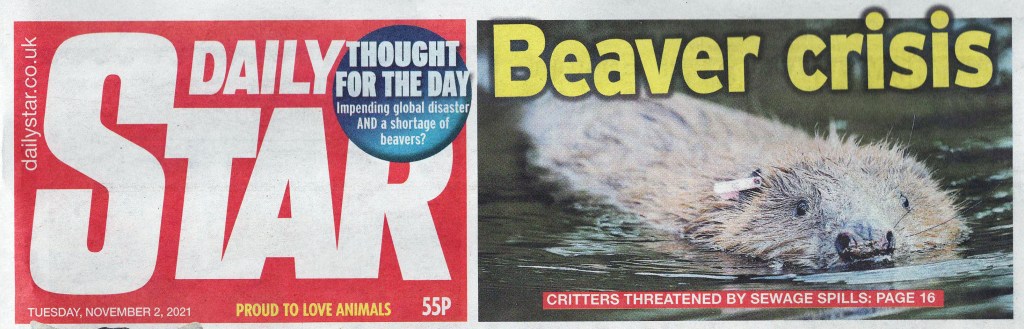
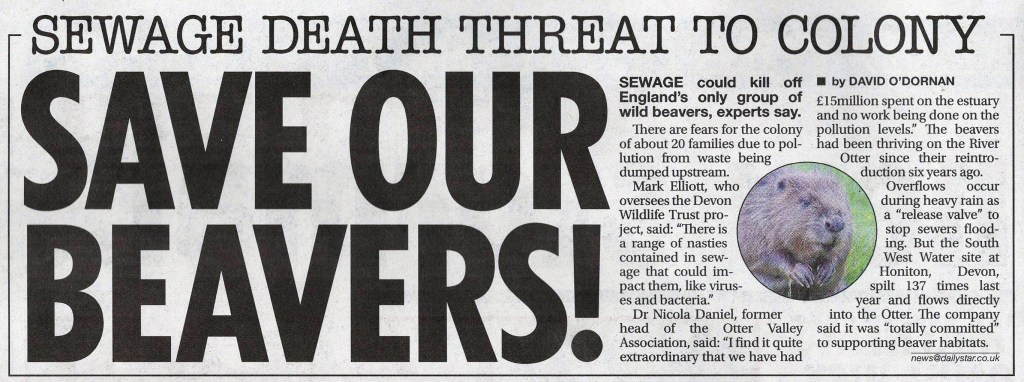
Yesterday the Times, today the Red Tops.
South West Water says it is “totally committed” to supporting beaver habitats.
[Releasing untreated sewage into the Otter, on average, two or three times a week from Honiton (more from elsewhere) seems a strange way to show this – Owl]
Any comment from Simon Jupp MP or Neil Parish MP?
Funding for flood prevention works at Feniton, costing nearly £4 million, has been secured after two years of waiting.

Sixty-six properties are at risk of flooding in the East Devon village, as is the main road which floods regularly.
The school has been evacuated on numerous occasions, because of concerns about children being able to get home safely.
Phases one and two of the Feniton Flood Alleviation Scheme were completed in 2015 and involved channel improvements downstream of Feniton.
Phase three and four needed further funding approval. Unexpected costs also arose with building an undertrack rail crossing and a new large pipe (culvert) system through Feniton.
The village has suffered regular flooding since the 1960s. Two of the largest flooding incidents happened in 2008 and 2012 and in the past two months alone it has flooded twice.
The new works include building large (culvert) pipes, more than one metre in diameter, from the top to the bottom of the village, providing a by-pass around the existing drainage network.
EDDC will now be working with Network Rail to find the next available date to close the railway and carry out an undertrack railway crossing, with the rest of the scheme following after that is complete.

Cllr Geoff Jung, EDDC’s portfolio holder for coast, country and environment, said: “All flood elevation schemes are difficult to deliver with complicated historic drainage systems, many land ownership issues and many funding and budget complications. I would like to thank ex-councillor Susie Bond who was the Feniton district councillor for many years until moving away last year who encouraged and championed this project almost none stop whilst she was a councillor. Finally, through her tenacity and drive the district council will finally deliver this scheme.”
EDDC’s Feniton ward councillor, Alasdair Bruce said:“Let’s hope this brings closer to and end the anguish and stress those in Feniton and the surrounding area have suffered for too long. The mental health issues associated with a flooding event cannot be overstated, it undermines the fundamental premise that your home is your castle as well as your sanctuary. Provided Network Rail now get on and deliver, this woeful chapter can be consigned to the history of Feniton.”
The parts of the UK where Covid cases are continuing to rise
Neil Shaw www.devonlive.com
Covid-19 case rates are continuing to rise in nearly one in five local areas in the UK, with sharp increases recorded in the East Midlands, latest figures show.
Rates in most areas are now falling, however, with national rates also on a downward trend, suggesting the third wave of the virus is now being driven by localised outbreaks rather than a country-wide surge in new cases.
A total of 66 of the 377 local authority areas in the UK (18%) recorded a week-on-week rise in rates in the seven days to October 27, while 311 (82%) saw a fall, according to PA news agency analysis of Government data.

(PA Graphics)
South-west England continues to have the highest rates of any part of the UK, but they are now falling in 26 of the 29 local authorities in the region.
In Tewkesbury in Gloucestershire, the rate is down from 1,228.5 cases per 100,000 people to 846.6, while neighbouring Stroud has seen its rate fall from 1,230.7 to 818.0.
Rates are also dropping in nearly all areas of eastern England, London, north-west England and the West Midlands, while every area in Wales is currently recording a week-on-week fall.
By contrast, of the 10 local areas with the biggest week-on-week increase in rates, five are in Leicestershire: Blaby (up from 363.9 to 496.3), Leicester (312.7 to 415.2), Charnwood (341.3 to 432.6), Hinckley & Bosworth (482.1 to 569.2) and Harborough (390.4 to 476.3).
Nearby Rutland has also recorded an increase (from 392.8 to 471.9), as have other areas in the East Midlands including South Holland in Lincolnshire (416.2 to 472.6) and Nottingham (253.9 to 304.4).
This pattern is not the same for the whole of the region, however, with all areas in Derbyshire and Northamptonshire recording a fall.
There is a similarly mixed picture in other regions, such as south-east England, where parts of Kent and West Sussex are currently seeing a rise in rates but all areas of Hampshire and Berkshire are falling.

(PA Graphics)
The data suggests a shift in the third wave of coronavirus, from a broad rise in new cases across most of the country to increases that are limited to pockets of areas.
It is too soon to say if this shift has been caused by specific events or changes in behaviour, such as the recent school half-term holiday or the rollout of Covid-19 vaccine booster doses.
The Orkney Islands in Scotland have seen the biggest week-on-week increase in rates in the latest figures, up from 227.7 cases per 100,000 to 366.1 – though because of the small population size, this is the equivalent of 82 new cases, up from 51.
In 10 of the 32 local authorities in Scotland rates have increased, along with three of the 11 authorities in Northern Ireland.
Rates remains at a relatively high level across the UK, with only one area (the Shetland Islands) currently below 100 cases per 100,000 people.
But with a majority of local authority areas seeing a fall in new cases in the latest figures, all four nations are now showing a clear downwards trend in rates for the first time in several weeks.
England’s rate stood at 422.1 as of October 27, down week-on-week from 489.8.
In Scotland the rate is 301.4, down from 332.0; Wales is down from 742.5 to 570.1; and Northern Ireland has fallen from 470.0 to 442.7.
Imagine you’ve been in contact with someone who has Covid. So, you do the right thing and order a PCR test. You are relieved when the test comes back negative – and you continue to take your children to school, go into work and care for your elderly relatives.
Then, six weeks later, you are contacted by a private testing firm who tell you you’re at the centre of one of the biggest scandals of the pandemic so far…
Along with tens of thousands of others, you were wrongly told you didn’t have Covid when, actually, you did. Through no fault of your own, the lives of your family and friends have been put in serious danger.
This is the horror story facing 43,000 people who used a private testing firm that the Government assured us was safe. The scandal-hit lab is based in Wolverhampton and owned by a company called Immensa. Now, Covid rates in the South West are soaring higher than anywhere else in the country.
Thousands of lives have been put at risk. How on earth could this be allowed to happen?
Government should have known about these major failings within days of the problem arising, yet it took weeks for them to shut down the site. Shockingly, Immensa is still being allowed to process people’s PCR tests for travel at their lab in Loughborough.
And now it transpires that Immensa was never fully accredited to carry out tests, despite the Government previously insisting it was. And somehow, it was awarded a £119m Government contract in September last year without going through the normal tendering process.
We’ve written to Health Secretary Sajid Javid asking him to immediately terminate Immensa’s contracts, compensate those affected and to take action to properly regulate private testing firms. How many more wake-up calls does this Government need before it starts putting people’s safety ahead of private firms’ interests?
Good Law Project only exists thanks to donations from ordinary people across the UK. If you’re in a position to support our work, you can do so here.
[And don’t forget the beavers trying to survive in it, as reported in the Times yesterday – Owl]
Dear Neil Parish MP,
Sewer storm overflows spilled over 1,000 times and for over 10,000 hours into your Tiverton and Honiton constituency watercourses, using government permits, in the year 2020. In the same period tens of thousands of spills flowed into water courses across the South West for hundreds of thousands of hours.
Neil, these outcomes were predicted when in you voted in favour of deregulation of the private water industry, and for a 75% reduction of Environment Agency funding.
According to South West water’s own figures reported by The Rivers Trust, these are just a few of the spills recorded in Tiverton and Honiton constituency in 2020:
• Seaton South sewer storm overflow spilled 59 times into the River Axe Estuary for a total of 877 hours, using a government permit.
• Holcombe Rogus sewer storm overflow spilled 207 times into tributary of River Lyner for a total of 3085 hours, using a government permit.
• Honiton sewer storm overflow spilled 137 times into the River Otter for a total of 2442 hours, using a government permit.
• Kilmington sewer storm overflow spilled 163 times into the River Axe for a total of 1681 hours, using a government permit.
• Tiverton’s Westexe sewer storm overflow spilled 130 times into the River Exe for a total of 2120 hours, using a government permit.
• Tiverton’s Little Silver sewer storm overflow spilled 107 times into the River Exe for a total of 1191 hours, using a government permit.
• Broadhembury sewer storm overflow spilled 41 times into the Tale River for a total of 452 hours using a government permit
• Cullompton’s Duke Street sewer storm overflow spilled 57 times into the River Culm for a total of 900 hours, using a government permit.
• Bampton sewer storm overflow spilled 73 times for a total of 1716 hours into the River Batherm, using a government permit.
• Colyton sewer storm overflow spilled 63 times for a total of 700 hours into the River Axe using a government permit.
• Dunkeswell sewer storm overflow spilled 55 times into the Madford River for a total of 268 hours, using a government permit.
• Willand sewer storm overflow spilled 75 times into the River Culm for a total of 1233 hours, using a government permit.
• Sampford Peverell sewer storm overflow spilled 123 times into Spratford Stream for a total of 1125 hours, using a government permit.
• Halberton’s Corner Lane sewer storm overflow spilled into Halberton Stream 69 times for a total of 308 hours, using a government permit.
Neil, you let residents down when you voted with the government against the Sewage Bill. The time for action is now. I urge your government to:
As the longstanding Chair of the Environment, Farming and Rural Affairs Committee, and as our MP, these are failures of your most basic of responsibilities. Decisive action must start now. Your residents are horrified by the sheer volume of pollutants in our environment, in our food chain and in the water we swim in. Will you commit to supporting these six immediate priorities, or remain complicit in this government’s conscious degradation of Britain’s natural environment?
Sincerely,
Liz Pole
Constituency Spokesperson
Tiverton and Honiton Labour Party
 Wainholm West 13 Knowle Road Budleigh Salterton EX9 6ARRef. No: 21/2796/TRE | Validated: Fri 22 Oct 2021 | Status: Awaiting decisionBarn West Of Tale Head Cottage PayhemburyRef. No: 21/2780/FUL | Validated: Thu 21 Oct 2021 | Status: Awaiting decision3 Heritage Way Sidmouth EX10 9JYRef. No: 21/2788/FUL | Validated: Thu 21 Oct 2021 | Status: Awaiting decisionHeather Moor Yawl Hill Lane Uplyme Lyme Regis DT7 3RWRef. No: 21/2767/FUL | Validated: Wed 20 Oct 2021 | Status: Awaiting decision11 Northview Road Budleigh Salterton EX9 6BZRef. No: 21/2764/VAR | Validated: Fri 22 Oct 2021 | Status: Awaiting decision4 Court Lane Seaton EX12 2ATRef. No: 21/2778/FUL | Validated: Wed 20 Oct 2021 | Status: Awaiting decision123 Langstone Drive Exmouth EX8 4JERef. No: 21/2768/FUL | Validated: Wed 20 Oct 2021 | Status: Awaiting decisionWindyridge Church Lane Alfington Ottery St Mary EX11 1PERef. No: 21/2755/FUL | Validated: Fri 22 Oct 2021 | Status: Awaiting decisionRooks Acre Rousdon Lyme Regis DT7 3XRRef. No: 21/2757/FUL | Validated: Fri 22 Oct 2021 | Status: Awaiting decisionCrisland Cottage Yarcombe Honiton EX14 9ABRef. No: 21/2758/FUL | Validated: Tue 19 Oct 2021 | Status: Awaiting decisionForelands Redwood Road Sidmouth EX10 9ADRef. No: 21/2753/FUL | Validated: Fri 22 Oct 2021 | Status: Awaiting decisionTreaslake Farm Buckerell Honiton EX14 3EPRef. No: 21/2756/VAR | Validated: Tue 19 Oct 2021 | Status: Awaiting decision9 Farmway Feniton Honiton EX14 3BXRef. No: 21/2754/FUL | Validated: Fri 22 Oct 2021 | Status: Awaiting decisionBrookfield Cottage Woodbury Exeter EX5 1LGRef. No: 21/2749/TCA | Validated: Mon 18 Oct 2021 | Status: Awaiting decision115 Sidford Road Sidmouth EX10 9PARef. No: 21/2744/TRE | Validated: Mon 18 Oct 2021 | Status: Awaiting decision3 Villa Maison 4 Cyprus Road Exmouth EX8 2DZRef. No: 21/2743/TRE | Validated: Mon 18 Oct 2021 | Status: Awaiting decision1 Hamlet Cottages Weston Honiton EX14 3PBRef. No: 21/2741/VAR | Validated: Mon 18 Oct 2021 | Status: Awaiting decisionLand Adjacent To Main Yard Lodge Trading Estate BroadclystRef. No: 21/2740/CPE | Validated: Mon 18 Oct 2021 | Status: Awaiting decisionFourwinds Lime Kiln Lane Uplyme Lyme Regis DT7 3XGRef. No: 21/2736/FUL | Validated: Mon 18 Oct 2021 | Status: Awaiting decisionOak Tree House Trinity Hill Road Axminster EX13 5SSRef. No: 21/2734/FUL | Validated: Mon 18 Oct 2021 | Status: Awaiting decisionThe Warren Warren Park West Hill Ottery St Mary EX11 1TNRef. No: 21/2745/TRE | Validated: Fri 22 Oct 2021 | Status: Awaiting decision14 Stoneyford Park Budleigh Salterton EX9 6TBRef. No: 21/2738/TRE | Validated: Fri 22 Oct 2021 | Status: Awaiting decision20 Barnes Meadow Uplyme Lyme Regis DT7 3TDRef. No: 21/2735/TRE | Validated: Fri 22 Oct 2021 | Status: Awaiting decisionAlston Farm Alston Axminster EX13 7LGRef. No: 21/2748/FUL | Validated: Thu 21 Oct 2021 | Status: Awaiting decisionAlston Farm Alston Axminster EX13 7LGRef. No: 21/2747/FUL | Validated: Thu 21 Oct 2021 | Status: Awaiting decision6 Shackleton Close Exmouth EX8 4PRRef. No: 21/2737/FUL | Validated: Tue 19 Oct 2021 | Status: Awaiting decision5 Orchards Farm Buckerell Honiton EX14 3GJRef. No: 21/2731/FUL | Validated: Thu 21 Oct 2021 | Status: Awaiting decisionThornbury The Strand Lympstone Exmouth EX8 5JSRef. No: 21/2730/LBC | Validated: Thu 21 Oct 2021 | Status: Awaiting decisionThornbury The Strand Lympstone Exmouth EX8 5JSRef. No: 21/2729/FUL | Validated: Thu 21 Oct 2021 | Status: Awaiting decisionFroginwell Vineyard Woodbury Salterton Exeter EX5 1EPRef. No: 21/2719/FUL | Validated: Thu 21 Oct 2021 | Status: Awaiting decisionDawn View Clyst Road Topsham Exeter EX3 0DBRef. No: 21/2711/FUL | Validated: Mon 18 Oct 2021 | Status: Awaiting decision40 Parkside Road Exeter EX1 3TNRef. No: 21/2715/FUL | Validated: Mon 18 Oct 2021 | Status: Awaiting decisionBeeches Talaton Exeter EX5 2RQRef. No: 21/2716/FUL | Validated: Mon 18 Oct 2021 | Status: Awaiting decisionStanley Cottage Whitford Axminster EX13 7PERef. No: 21/2700/LBC | Validated: Fri 22 Oct 2021 | Status: Awaiting decisionLand At Core Hill Field No. 9997 Stowford SidmouthRef. No: 21/2702/FUL | Validated: Tue 19 Oct 2021 | Status: Awaiting decisionSt Andrews Cottage Feniton Honiton EX14 3BERef. No: 21/2706/FUL | Validated: Mon 18 Oct 2021 | Status: Awaiting decisionThe Tallet Aunk Clyst Hydon Cullompton EX15 2NHRef. No: 21/2707/PDQ | Validated: Mon 18 Oct 2021 | Status: Awaiting decision42 Jackson Meadow Lympstone Exmouth EX8 5GZRef. No: 21/2681/FUL | Validated: Thu 21 Oct 2021 | Status: Awaiting decisionWayside Causeway Beer Seaton EX12 3JURef. No: 21/2679/FUL | Validated: Mon 18 Oct 2021 | Status: Awaiting decisionWayside Causeway Beer Seaton EX12 3JURef. No: 21/2680/LBC | Validated: Mon 18 Oct 2021 | Status: Awaiting decision1 Rolle Road Budleigh Salterton EX9 6JZRef. No: 21/2684/FUL | Validated: Fri 22 Oct 2021 | Status: Awaiting decisionAbbots Cottage Combe Raleigh Honiton EX14 4TQRef. No: 21/2683/FUL | Validated: Wed 20 Oct 2021 | Status: Awaiting decisionAcerhill Berry Lane Beer Seaton EX12 3JSRef. No: 21/2660/TCA | Validated: Thu 21 Oct 2021 | Status: Awaiting decision7 Wychall Park Seaton EX12 2EWRef. No: 21/2648/FUL | Validated: Tue 19 Oct 2021 | Status: Awaiting decisionEgypt Millford Road Sidmouth EX10 8DPRef. No: 21/2644/LBC | Validated: Mon 18 Oct 2021 | Status: Awaiting decision40 Camperdown Terrace Exmouth EX8 1EQRef. No: 21/2629/FUL | Validated: Tue 19 Oct 2021 | Status: Awaiting decisionThe Old Manor Talaton Exeter EX5 2RQRef. No: 21/2626/LBC | Validated: Wed 20 Oct 2021 | Status: Awaiting decisionSowden Brake Hulham Road Exmouth EX8 5DZRef. No: 21/2609/FUL | Validated: Mon 18 Oct 2021 | Status: Awaiting decisionChamberlains Cottage Brampford Speke Exeter EX5 5DRRef. No: 21/2605/LBC | Validated: Tue 19 Oct 2021 | Status: Awaiting decision13 Raddenstile Lane Exmouth EX8 2JLRef. No: 21/2590/FUL | Validated: Tue 19 Oct 2021 | Status: Awaiting decisionBeechcroft Marley Drive Lympstone Exmouth EX8 5DYRef. No: 21/2588/FUL | Validated: Tue 19 Oct 2021 | Status: Awaiting decision36 Foxholes Hill Exmouth EX8 2DQRef. No: 21/2573/FUL | Validated: Tue 19 Oct 2021 | Status: Awaiting decisionAbbey Cottage Dunkeswell Abbey Honiton EX14 4RPRef. No: 21/2516/FUL | Validated: Mon 18 Oct 2021 | Status: Awaiting decisionLand At Tillhouse Road, Court Royal And Crannaford Lane Cranbrook Town CentreRef. No: 21/2509/MRES | Validated: Wed 20 Oct 2021 | Status: Awaiting decision3 Travershes Close Exmouth EX8 3LHRef. No: 21/2357/FUL | Validated: Thu 21 Oct 2021 | Status: Awaiting decision4 Redside Terrace Cowley Exeter EX5 5ESRef. No: 21/2303/FUL | Validated: Fri 22 Oct 2021 | Status: Awaiting decision
Any fire break effect from half term not yet showing up. – Owl
Joe Ives, local democracy reporter www.radioexe.co.uk
Covid figures have risen in Devon for the fifth week in a row with infection rates once again higher than the UK average.
In the week to Sunday 24 October, 6,154 new infections were recorded across the county, seven per cent more than the previous week. The infection rate is now 507 per 100,000 of the population, higher than the UK average of 466.
The only council area in Devon with a rate lower than the national average is Exeter. The city currently has an infection rate of 417 per 100,000, but cases are rising, with 556 people in Exeter testing positive last week, 119 [27 per cent] more than the week before.
Overall, 4,115 infections were recorded across the Devon County Council area, which excludes Plymouth and Torbay, up by 215 (five per cent) and bringing the infection rate to 508 per 100,000.
Plymouth had 137 more infections than the previous week, recording 1,368 new cases. The 11 per cent increase takes the city’s infection rate to 521 per 100,000.
In Torbay, 671 people tested positive, up by 85 (15 per cent) and making the infection rate of 493 per 100,000.
The only district council area in the county with a drop in infections was Mid Devon, recording 468 cases, 58 [11 per cent] fewer than the previous week. However, this drop resembles somewhat of a false dawn. It was only last week that Mid Devon’s cases skyrocketed more than 72 per cent. At 562 cases per 100,000 of the population, the district’s current infection rate is the second-highest in the county, second only to West Devon, which has an infection rate of 606 per 100,000.


Hospitalisations
As reported on Tuesday 26 October, the recent rise in case numbers across the county has led to an increase – of 10 – in the number of people being treated for covid in Devon’s hospitals.
Latest figures [on Tuesday 19 October] show 118 covid patients in the county’s hospitals, 49 of whom are at Derriford in Plymouth, 28 at the RD&E, 24 in Torbay and 17 in North Devon. Of those patients, nine are in mechanical ventilation beds.
Deaths
People dying with covid in Devon fell this week – one of the few pieces of good news.
Four more people died within 28 days of receiving a positive covid test across Devon. Two died in the Devon County Council area. Torbay and Plymouth each recorded a single death. Last week, 14 people died across Devon.
Across the county, a total of 1,273 people have now died within 28 days of a positive covid test.
Vaccinations
Eighty-four per cent of people aged 12 and above have had their first dose of a vaccine in the Devon County Council area, which excludes Plymouth and Torbay, with 79 per cent receiving both doses.
In Plymouth, 81 per cent have had one dose, while 74 per cent have had both.
In Torbay, 82 per cent have received one dose, while 77 per cent have had both jabs.
This means that vaccination rates in Devon remain slightly behind the rest of the UK. Across the country, 87 per cent of people aged 12 and over have had one dose, while 79 per cent have had both jabs.
Simon and Neil, these beavers live in your constituencies and have a beneficial impact on pollution and the environment. To drive them away with raw sewage discharges would be a spectacular “own goal”.
Tom Ball www.thetimes.co.uk
England’s only colony of wild beavers is being threatened by pollution flowing downstream from one of the worst sewage overflow sites in the country.

The beavers were only reintroduced to the English countryside six years ago and are now at risk
Since their reintroduction by the Devon Wildlife Trust six years ago, beavers have begun to thrive on the River Otter. However, sewage being discharged weekly from a storm overflow site upstream has the potential to cause the colony of about 20 families serious health problems, wildlife experts say.
The overflow site at Honiton, Devon, spilt 137 times last year, totalling 2,442 hours of spillage. The spill site, operated by South West Water, flows directly into the Otter. The water company was approached for comment.
Mark Elliott, who oversees the beaver project, said that the discharges were a massive concern. He added: “There is a whole range of nasties contained in sewage that could potentially impact them, like viruses and bacteria.”
Overflows usually occur during heavy rainfall as a “release valve” to prevent sewers from flooding. Effluent is diluted with rainwater but remains untreated, introducing contaminants and pathogens into the water that can cause toxic blue-green algal blooms.
Beavers became extinct in England in the 1500s. Their proposed reintroduction, which is out to consultation, forms part of the government’s 25-year environment plan, published in 2018.
Beavers’ dams can reduce pollution and boost wildlife populations, a study from Exeter University shows. Dams mitigate the impact of flooding.
The Lower Otter valley is undergoing a £15 million project to restore natural floodplains and create 55 hectares of mudflats, saltmarsh and other habitats. The project is funded by the EU and the Environment Agency.
Dr Nicola Daniel, former chairwoman of the Otter Valley Association, said: “I find it quite extraordinary that we have had £15 million spent on the estuary and no work being done on the pollution levels.”
Raw sewage spills were a key reason why 84 per cent of rivers and lakes in England failed to meet the government’s target of good ecological status last year. Threatened with a backbench revolt, ministers have tabled an amendment to the Environment Bill, which will force water firms to ensure a “progressive reduction in adverse impacts of discharges from storm overflows”.
Heinz releases limited edition tins of Christmas Dinner Soup (but buy now while stocks last – Owl)
Aidan Milan metro.co.uk

Intriguing (Picture: Heinz)
Obsessed with Christmas dinner to an almost worrying degree? Well, Heinz could be dropping the soup of your dreams.
The food giant is releasing a limited edition Christmas Dinner Soup, and it looks… intriguing.
Chunks of turkey, pigs in blankets, stuffing balls, and potatoes will be all mixed up all one can with a gravy and cranberry sauce.
All that could be yours for just £1.50, plus postage and packaging.
Yes, you’ll have to order your tins of Christmas Dinner Soup online via the Heinz website if you want to get in on the action.
You’ll also have to move fast, as there will be just 500 of these tins up for grabs.

Would you give it a go? (Picture: Jonathan Kennedy/Heinz)
Anke von Hanstein, brand manager at Heinz Soups, said: ‘We are so excited for the lucky 500 people to try this sensational seasonal addition to Heinz’s Big Soup family.
‘It is made for those with a big love for hearty festive flavours and tastes just perfect with a slice of warm crusty bread. Any soup that includes pigs in blankets and roasties is a winner in our eyes – go big or go hungry is what we always say.
‘Christmas dinner is one of our favourite meals too, which is why we’re bringing some additional festive magic to the nation this Christmas with this limited edition, enabling everyone to indulge in those delicious Christmas flavours anytime anywhere with a minuscule fraction of the time and effort
‘And if these lucky few who managed to get their hands on it love it as much as we do, Heinz Christmas Dinner Big Soup might be back next year, bigger and better. Watch this space.’
 East Devon Watch