There was not a by-election. It was just a “gathering” of Lib Dems with voting slips and pencils
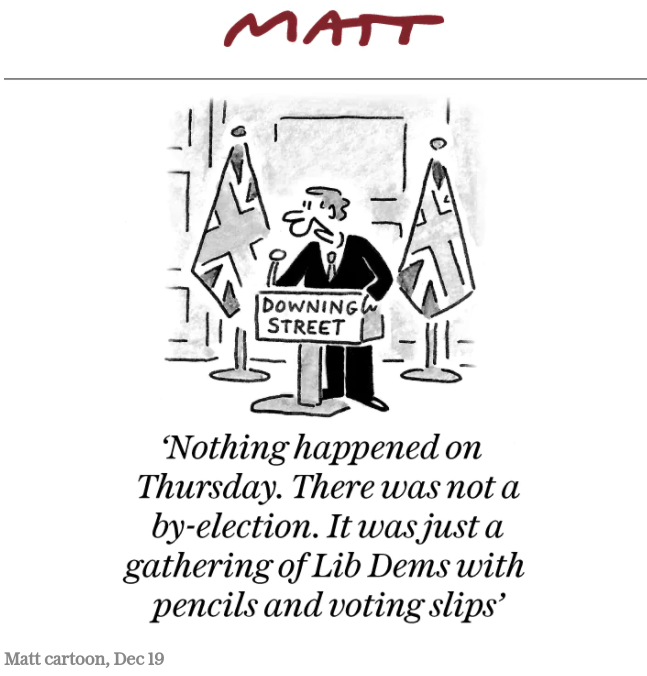

There was not a by-election. It was just a “gathering” of Lib Dems with voting slips and pencils
Brexit minister David Frost has resigned from Boris Johnson’s cabinet in protest at “the direction of travel,” triggering a fresh crisis inside Downing Street after an already turbulent week for the prime minister.
Lord Frost – one of the most popular members of the cabinet among the Conservative faithful – handed in his resignation a week ago and had been persuaded to stay in his post until January but last night said he would step down “with immediate effect.”
His resignation represents a major political blow for the prime minister who is already facing a series of crises over “gatherings” in No 10 during Covid restrictions, growing discontent on the Tory backbenches over his leadership and this week’s historic loss in the North Shropshire by-election – a seat held by the party since 1832.
In his resignation letter, Lord Frost told the prime minister he was disappointed about Covid restrictions, warning him not to be “tempted by the kind of coercive measures we have seen elsewhere,” but also hinted at other concerns, saying: “You know my concerns about the current direction of travel.”
The cabinet minister, who Mr Johnson had elevated to the Lords, helped negotiate the Brexit agreement and in recent months has been instrumental in negotiations with the EU over the Northern Ireland protocol.
His departure will fuel speculation about the future of Mr Johnson’s leadership, but in his letter Lord Frost was careful to express “confidence” in the PM. On Friday, Tory MPs put Mr Johnson on notice while one backbencher revealed he had submitted a letter of no confidence in the prime minister to the chair of the 1922 committee of backbench Conservative MPs.
Jenny Chapman, the shadow Brexit secretary, said: “As if we didn’t already know, Lord Frost resigning shows the government’s in chaos.
“The country needs leadership not a lame duck PM whose MPs and cabinet have lost faith in him. Boris Johnson needs to apologise to the public and explain what his plan is for the next few weeks.”
The Liberal Democrat foreign affairs spokesperson, Layla Moran, added: “This shock resignation is a sign of the chaos and confusion at the heart of this Conservative government. The rats are fleeing Boris Johnson’s sinking ship as he lurches from crisis to crisis.
“Even the prime minister’s once-loyal supporters are now abandoning him, just as lifelong Conservative voters are switching in their droves to the Liberal Democrats.
“At a time we need strong leadership to get us through the pandemic we instead have a weak prime minister who has lost the support of his allies and the trust of the British people.”
On Friday, it had also emerged the UK had abandoned its attempt to strip EU judges of the power to oversee the Northern Ireland protocol – despite repeated pledges by Lord Frost and the government to “remove” the role of the European Court of Justice (ECJ).
In October, Lord Frost travelled to Lisbon and vowed the ECJ would not be allowed to have a remit, but new UK proposals would see it interpret matters of EU law.
Disputes would be settled by an independent arbitration panel, rather than the European Commission, a model offered to Brussels by Switzerland. At a Brussels press conference, Maros Sefcovic, the commission vice-president, said the UK signed up to the ECJ’s existing remit, so it was “a topic we are not ready to include in our discussions”.
Describing Lord Frost’s decision to leave the cabinet as “enormous”, Arlene Foster, the former first minister of Northern Ireland, said: “The resignation of Lord Frost from the Cabinet is a big moment for the government but enormous for those of us who believed he would deliver for NI.’’
In a recent speech to the Centre of Policy Studies, the Brexit minister said he agreed with Rishi Sunak, the chancellor, that the Conservatives’ “goal must be to reduce taxes” and said Brexit won’t succeed if “all we do is import the European social model”.
He was also effusive in his praise of the lack of Covid restrictions during the 23 November speech, saying: “Unavoidably, we have had a lot of state direction and control during the pandemic.
“That cannot and must not last for ever, and I am glad that it is not. I am very happy that free Britain, or at least merry England, is probably now the free-est country in the world as regards Covid restrictions. No mask rules, no vaccine passports – and long may it remain so.”
Covid infections across Devon have fallen in the latest seven-day period, but the numbers don’t yet reflect the surge in Omicron cases hitting the nation.
Joe Ives, local democracy reporter www.radioexe.co.uk
The latest weekly statistics run to Sunday, 12 December. On that single day alone, the UK recorded 50,149 cases. By Friday, 17 December that number had nearly doubled to 93,045, the highest daily figure since the start of the pandemic.
Nevertheless, before Omicron took hold, infections in Devon dropped. Now the new weekly figures to 12 December show 7,591 new cases, 1,412 (16 per cent) fewer than the previous week. On that day, the county’s infection rate was 662 per 100,000 of the population, still higher than the national average of 536.
Cases fell in every council area in Devon apart from Plymouth, where infections rose three per cent. The 2,206 new cases in the city was 56 (3 per cent) more than the previous week. During this period, Plymouth had an infection rate of 839 per 100,000 of the population.
The Devon County Council area, which excludes Plymouth and Torbay, saw cases drop 22 per cent, with 1,331 fewer. The rate of infection across ts seven districts stood at 567 per 100,000.
After having the highest rates of infection of anywhere in the country in late November, Torridge welcomed a drop in cases for the second consecutive week. The number of people contracting covid was down a third (36 per cent), with 408 new infections, down from 226 the week before, and a rate of 594 per 100,000.
Torbay recorded 791 new cases, down 146. The 16 per cent drop takes the Bay’s rate of infection to 581 per 100,000.
Hospitalisations
The most recent data (from Tuesday, 7 December) shows 160 patients in Devon’s hospitals with covid, an increase of 12 from the previous week.
Sixty-nine are at Derriford Hospital in Plymouth, 36 at the RD&E, 30 in Torbay, 22 in North Devon and three at Devon Partnership mental health sites.
Of the total number of patients, 16 are in ventilation beds.
Deaths
Seventeen people died within 28 days of receiving a positive covid test across Devon in the most recent complete seven-day period (up to Sunday, 12 December) – six more than in the previous week.
Ten people died in the Devon County Council area, which excludes Plymouth and Torbay. Six deaths were recorded in Plymouth. One death was in Torbay.
Across Devon, a total of 1,389 people have now died within 28 days of a positive covid test.
Vaccinations
Eighty-seven per cent of people aged 12 and above have had their first dose of a vaccine in the Devon County Council area, excluding Plymouth and Torbay, with 81 per cent receiving both doses. Forty-nine per cent have now had their ‘booster’ dose.
In Plymouth, 84 per cent have had one dose, while 77 per cent have had both. Thirty-eight per cent have had the booster.
In Torbay, 85 per cent have received one dose, while 79 per cent have had both jabs. Fifty-one per cent have had their third vaccine.
The national rates are 89, 82 and 45 per cent respectively.
On Friday, 17 December, promising early research was shared which suggests that booster vaccines could be 85 per cent effective in preventing severe illness from the Omicron variant.
The modelling, from Imperial College London, is based on limited information on Omicron.
The researchers say there is a high degree of uncertainty until more real-world information is gathered.
Imperial researchers Prof Azra Ghani said: “One remaining uncertainty is how severe the disease caused by the Omicron variant is compared to disease caused by previous variants.
“Whilst it may take several weeks to fully understand this, governments will need to put in place plans now to mitigate any potential impact.
“Our results demonstrate the importance of delivering booster doses as part of the wider public health response.”
Dr Clive Dix, former chair of the UK Vaccine Taskforce, said: “There is a huge amount of uncertainty in these modelled estimates and we can only be confident about the impact of boosters against Omicron when we have another month of real-world data on hospitalisation, ICU [intensive care] numbers and deaths.
“It remains the case that we still need to get vaccines current and future to the whole world.”
[Widely reported yesterday, Mr Thomas, new Chair of the Charity Commission, has resigned before starting the job (another one under the bus). Why was he given it in the first place?]
When the Government announced that Martin Thomas was their preferred candidate for the new Chair of the Charity Commission, many people in the charity sector breathed a sigh of relief. This may have been premature.
Mr Thomas had a low public profile and was not an obvious candidate to deliver on the former Culture Secretary’s promise to hire someone who would stop charities pursuing a “woke agenda”.
His credentials suggested he had professional charity sector experience under his belt. Prior to being selected, Martin Thomas was Chair of the Board at two charities, Downside Up and the Forward Arts Foundation. Before that, he was the Chair at Women for Women International UK, which helps women survivors of war rebuild their lives.
But all was not quite as it seemed.
The Times has reported that Martin Thomas is understood to be ‘close friends’ with Prime Minister Boris Johnson. The pair studied Classics at Oxford University at the same time and Johnson is still a patron of Downside Up. In 2013, when Johnson was Mayor of London, Mr Thomas gifted him an antique Russian ‘Takema’ watch.

Then things start to get worse.
We understand that three formal complaints were made against Mr Thomas while he was Chair at Women for Women International. The last of these was partly upheld and was the subject of a serious incident report to the Charity Commission in 2021.
We’ve heard that, following the investigation into the 2021 complaint, the Board of Women for Women International had planned to ask Mr Thomas to step down as Chair immediately, but he resigned before they could. The first complaint, which was not upheld, concerned Mr Thomas sending an unsolicited photograph. He had intended to send it to one female employee, but accidentally sent it to another, and then asked her to forward it to its intended recipient, also female.
Shocking behaviour, especially from the Chair of a women’s rights charity. The sort that might properly disqualify someone from chairing the Charity Commission.
How, despite all of this, did he come to be appointed? Was there political interference? Were references taken up from Women for Women International? Did anyone check with the Charity Commission about his record before appointing him as Chair?
What we’ve uncovered casts serious doubt on Mr Thomas’s suitability, and raises grave questions about the integrity of the process. These must be answered as soon as possible.
This is not how public appointments should happen. We have written asking the Secretary of State to concede that the process leading to Martin Thomas’ appointment was deeply flawed. We’ve asked them to tell us whether the Prime Minister or his staff played any role in the recruitment process; to tell us whether the complaints from Women for Women International were disclosed by Mr Thomas as part of the interview and assessment process; and ultimately, to reconsider and withdraw Mr Thomas’ nomination to be Chair of the Commission.
The independence of the Charity Commission is essential to the future of UK charities, which provide lifelines to countless people and marginalised groups. We will not stand by as its integrity is damaged by this appointment.
Good Law Project only exists thanks to donations from people across the UK. If you’re in a position to support our work, you can do so here.
A week since shocking stories first emerged of illegal gatherings in and around No 10 and still the Met Police won’t investigate. Would they be as shy had you or I broken the law? Look at the form they publish for gathering evidence on breaches of Coronavirus rules by normal people and you rather doubt it.
So why the difference?
We decided to cut through the nonsense and commission two of the country’s leading lawyers – top policing barrister Danny Friedman QC and leading authority on Covid regulations Adam Wagner – to advise on whether the Met Police refusal to investigate is unlawful. We are today publishing that advice in full.
Their view is that a policy of not investigating retrospective breaches is likely to be unlawful; a failure to publish the policy is likely to be unlawful; and a decision not to investigate based on an absence of evidence is also arguably unlawful.
We remain astonished at what looks, to us, like the Met’s willingness to tolerate conduct that undermines public health and erodes trust in the rule of law. In 1733 Dr Thomas Fuller wrote “Be you ever so high, the law is above you.” Those are fine words – and we think the Met should pay heed.
A week ago today we wrote to the Met telling them we intended to sue if they continued to refuse to uphold the law. They have two weeks to change their minds.
Good Law Project only exists thanks to donations from people across the UK. If you’re in a position to support our work, you can do so here.
Read it in the Mail on Sunday
New Allegra tape headache for Boris: No10 braces for fresh embarrassment amid fears ex-spokeswoman was questioned about the PM’s private life in ANOTHER excerpt from Partygate tape that could be screened in days

 East Devon Watch