Historic London landmarks sold off ‘ridiculously cheap’ to developers

Cash-strapped councils in London have sold off historic public assets worth over £70 million in the last five years, Metro.co.uk can now reveal.

Remind anyone of the Knowle? – Owl

Gergana Krasteva metro.co.uk 

Some historic buildings in London will be turned into boutique hotels after they were sold off by councils (Pictures: Credit Getty; Rex; Geograph; Wikimedia Commons)

Some historic buildings in London will be turned into boutique hotels after they were sold off by councils 

In a big blow to communities, instead of refurbishing Grade I and Grade II-listed landmarks to use as youth centres or much-needed housing, some councils gave them away for ‘very, very low’ sums.

This is the case of Fulham Town Hall – built in 1890 with Georgian architecture – which was bought by developer Ziser London for £10 million to be turned into a boutique hotel, spa and a restaurant.

But leader of Hammersmith and Fulham Council Stephen Cowan pointed out that the Grade II-listed landmark opposite Fulham Broadway Station was sold ‘rather incompetently’ under the former Tory council.

The councillor argued that in Fulham, it is hard to buy a house for ‘anything less than £2 million’, so its selling price was ‘absolutely ridiculous’.

He told Metro.co.uk: ‘Our predecessors sold it in 2014 alongside a lot of other properties very, very cheaply.

‘We are not necessarily against selling it, just against selling it for so cheap.

‘When the Conservatives were in office, they decided to sell off community centres, youth clubs and two big council estates – all of which for very low, knocked-down prices – including Fulham Town Hall.

‘We viewed this decision as unbusiness-like and bad value for money. We tried to stop it when we came into office but they had exchanged contracts already with the people they sold the town hall to.

‘So, we did our best to review it but we were legally obliged to honour it. The building was actually sold in 2013 but the process was not complete until 2017.

‘And we thought it was a very bad thing as it was too low and it was sold for ridiculous purposes.

‘If you sell it, sell it for proper value and make sure it is of community use.’

According to dozens of Freedom of Information requests to all London borough authorities, Hammersmith and Fulham Council is not alone in disposing of historic public assets.

After years on the market, Greenwich Council finally cashed in on the dilapidated former East Greenwich library.

The Grade II-listed property, which shut in 2015, was bought by the Redeemed Christian Church Of God – an expansionary religious movement from Nigeria – in 2019 for £1.8 million.

A spokesperson for the council, however, insisted that the sale was not driven by a need to generate money.

In another controversial move, the City of London also sold Snow Hill and the 1960s Wood Street police stations in 2020 for £14.9 million and £40 million respectively.

Magnificent Hotels bought the Grade II-listed building on a 151-year lease to convert the Wood Street property into a five-star boutique hotel after City of London Police declared the station was surplus to operational requirements.

Located a 10-minute stroll from Wood Street, Snow Hill police station is also being transformed into a 219-room hotel by Premier Inn.

A City of London Corporation spokesperson said: ‘Both properties were sold to hotel developers and, once redeveloped, will represent a boost to overnight accommodation in the Square Mile.

‘The capital released by these sales will be reinvested into the new state-of-the-art headquarters for the City of London Police which will form part of the Salisbury Square Development on Fleet Street.’

Another historic property viewed as ‘surplus’ is the former Drill Hall Theatre in Chenies Street, Bloomsbury.

The 19th-century building was snapped up by RADA for £3.4 million in December 2017.
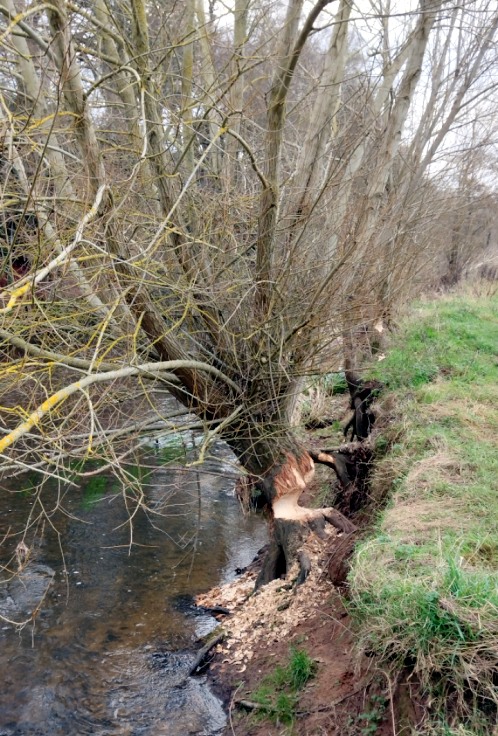
They continue to beaver away in Otterton

The National Trust has  just published their list of Wildlife’s winners and losers in the face of the extreme weather events of 2021. 

One of the winners is beavers which gives Owl an excuse to publish the following photo sent in before Christmas by a correspondent. It shows evidence of “beaver activity”  just below Otterton Mill. 

Owl assumes that the rain in the past few days will have caused more sewage releases across East Devon, including into the Otter.

Going, going……..

[Results from the Scottish beaver trials show beavers fell larger than average trees, with a very strong preference for trees that re-sprout such as willow These provide an immediate and longer term source of food, and the upper branches can be used for dam building material. Beavers dam small streams to provide ponds of deeper water for a  safe underwater entrance to their lodges, rather than larger rivers. So this activity around Otterton looks to be related to feeding. (Readers may be better informed – Owl)]

Once again the PM failed to act, serving his own interests

“Boris Johnson cannot act because his party will not let him.”

Editorial: www.independent.co.uk 

It hardly needs to be stated that no government of almost any kind, let alone a free, democratic one, likes to impose restrictions on its people’s most basic liberties. At various points over the Christmas period, new, legally binding restrictions have been or will be imposed in Wales, in Northern Ireland and in Scotland.

These include limits on the numbers of people who can meet indoors and outdoors, in different kinds of venues. In Scotland, pubs have been restricted to table service only, and only three households may mix together. In Wales and Northern Ireland, nightclubs are shut, alongside various other limits on social interaction of the kind we are all too familiar.

Political leaders take these measures with unimaginably extreme reluctance, and they do so because their scientific advisers have warned them of the consequences coming down the line if they do not act.

And yet the overall prime minister of these three semi-autonomous countries, Boris Johnson, has not acted. He has received, by and large, the same advice as Mark Drakeford, as Nicola Sturgeon and as Paul Givan and Michelle O’Neill. But the part of the country over which he does have authority, namely England, has the most severe Covid crisis on its hands by a huge margin, and yet no new legal measures have been introduced, and given the time that it would take to do so, nor will they before the end of this calendar year.

The reasons for this are clear. They are political. Boris Johnson cannot act because his party will not let him. Last time he tried to bring in new restrictions, he was dependent on the Labour Party to do so, and a hundred of his own MPs rebelled. That is a massive rebellion, quite possibly the second largest in parliamentary history. (Only Theresa May’s first meaningful Brexit vote, when 118 of her own MPs voted against her, was more damning.)

It means, in no uncertain terms, that the prime minister does not have the authority within his own party, which is the governing party, to act on the advice of his own scientific advisers, to take the very basic steps that other parts of his own country consider to be necessary to maintain public health.

The politicians and the large part of the media that continue to support him will continue repeating the same old debatable and uncertain narratives (we deliberately stop short of the word facts); that the Omicron variant causes less severe illness, that the data is not sufficient, as if they somehow understand more than the scientific advisers, when they palpably do not. The data is sufficient for leaders with political authority to act. They have already acted. Because they can, and because they know it’s the right thing to do.

All that is happening is the same old dreary ideological battle, except it’s not dreary, it’s deeply unsettling, not least because it’s happened so many times already in the last almost two full years, with the same consequences, and the same lack of action.

There are many reasons to believe that we, which is to say the rich countries, are reaching the end of our epidemic (the pandemic is not nearly over, and nor will it be until the rich countries get real about vaccinating the entire world). New therapeutic and retroviral treatments that will make Covid-19 a manageable disease are about to hit the mainstream. But they do not mean that the need to act, for one last final push, now, has gone away. It’s obvious. It’s just that the only people who refuse to see it are calling the shots, with entirely predictable results.