Honiton Town Council resumes virtual meetings to limit spread of Omicron variant

Honiton Town Council’s meetings are to be conducted virtually for at least three months after new measures were enacted by the council to limit the spread of the coronavirus. 

Philippa Davies www.midweekherald.co.uk

All town council meetings were halted after the pandemic struck in March 2020, and then resumed remotely three months later. Face to face meetings re-started in June this year, after the emergency legislation permitting remote meetings ended on May 6. 

Under legislation dating back to 1972, there is no scope for local councils to hold virtual meetings and decisions must be taken in person. However, under the same legislation, most council decisions can be delegated to an ‘officer of the authority’, with the exception of financial budgetary decisions. 

At an extraordinary meeting of the council on Monday, December 20, councillors were presented with a motion asking to delegate most decision-making authority to the Town Clerk, and to hold online, ‘consultative’ meetings. 

These virtual meetings will continue until at least May 10 2022. They have worked in the same way as in-person meetings, with the exception that recommendations are made as opposed to resolutions. The consultative full council meeting of East Devon District Council  on December 8 further endorsed this set-up. 

Councillor Jake Bonetta, who sits on both Honiton Town and East Devon District Council, proposed the slightly amended motion to move to virtual meetings. He said: “Conducting virtual meetings not only makes meetings much safer for councillors, officers and residents with the current severe outbreak of the Omicron variant, it also provides easier access for all representatives to access meetings and take part in the democratic process. Consultative meetings are a necessary step until the Government legislates for full virtual meetings, and I call on the Government to enact this as soon as possible.” 

The virtual meetings will be held via Zoom, and will be advertised and open to the public. This is very similar to the current physical set-up of meetings at the council, which have recently started to be recorded and live-streamed through Zoom. Details on how to access these meetings can be found on the agenda for each council or committee meeting. 

On the day of the extraordinary full council meeting, 91,743 people across the UK tested positive for the coronavirus. In East Devon, between December 9 and 15, 717 cases of Covid were recorded – a number which is expected to rise with the increased spread of the Omicron variant. 

Second-home boom boosts tax take

A booming market in second homes has boosted Treasury revenue this year, more than compensating for a stamp duty holiday that let thousands of homebuyers off paying tax.

Carol Lewis www.thetimes.co.uk

HM Revenue & Customs has taken £11.44 billion in receipts from the property tax so far this year. It is the highest amount collected in the first 11 months of a year since 2017.

Rishi Sunak raised the threshold for stamp duty in England and Northern Ireland from £125,000 to £500,000 from July 8, 2020, until June 30, 2021, saving buyers up to £15,000. The threshold was then dropped to £250,000 until September 30, when it reverted to £125,000. There were similar, although less generous, breaks in Scotland and Wales.

The tax break applied to all home purchases, including those of buy-to-let properties and second homes (except in Wales), although the 3 per cent additional home levy still applied in such cases. More than 24,000 second homes were bought in Britain in the 12 months before June 30, according to the estate agency Hamptons, many of them in holiday hotspots such as Cornwall, Devon, north Norfolk and the Lake District.

Figures published yesterday by HMRC showed £1.21 billion in stamp duty revenue in November. This is less than in October, when £1.32 billion was collected, but 22 per cent higher than pre-pandemic levels in November 2019, according to an analysis of the data by Coventry Building Society.

Jonathan Stinton, its head of intermediary relationships, said: “It’s been a big year for the Treasury’s stamp duty receipts, despite hundreds of thousands of buyers being exempt from paying it for the first nine months of 2021. This shows just how high the demand for higher-value homes, second homes and rental properties has been this year.”

HMRC estimates that in the financial year 2021-22 there will be 974,310 residential property sales, making it the busiest year in a decade. The surge in home moves has been precipitated by lockdown disillusionment, increased savings and low mortgage rates. The combination of these factors led many people to adjust their lifestyles during the pandemic: many sought extra space for home offices and bigger gardens away from the cities; some wealthier families decided to acquire second homes in coastal and country regions.

Lucian Cook, head of residential research at the estate agency Savills, said: “We estimate that the stamp duty holiday amounted to a tax break to homebuyers of around £6.4 billion, but given the unexpected strength in the market despite — or arguably because of — coronavirus, receipts to the Treasury have held up remarkably well.

“Over the past 18 months we’ve seen lifestyle drivers and low interest rates support incredibly strong levels of house price growth and a real surge in activity. The Treasury has particularly benefited from high transaction volumes at the top end of the market, where the stamp duty take is highest, bolstered by the 3 per cent surcharge [for those buying second homes] over the period of the stamp duty holiday and beyond.”

One in 16 homes in the UK are expected to have changed hands this year, but the demand far outstrips supply, and each estate agency branch has an average of one home for sale for every 24 would-be buyers, according to the property portal Rightmove. Across the UK only 400,000 properties are now for sale.

At this point in 2020 the number was 630,000, the independent property data analyst TwentyCi said yesterday. It added that if the property market continued as it was, all stock would run out, except in inner London, by the end of next year. Worst affected would be the southwest, where there would be no homes left to sell after seven and a half months.

Anthony Codling, chief executive of Twindig, a property platform, said: “We were surprised that the level of residential housing transactions bounced back so quickly after the end of the stamp duty holiday.

“[It] implies there is more to the underlying level of housing transactions than the impact of stamp duty holidays alone. The pandemic is having a significant impact on where and how we choose to live and where and how we choose to work, and it seems that the race for space is not over just yet.”

‘National emergency’ as care rationed due to staff with Covid

Social care bosses have made an impassioned plea for the public to stay at home “as much as they can”, as the sector experiences a “national emergency”.

Tuesday hawkish ministers demand “incontrovertible evidence” that Omicron risks overwhelming the NHS to justify the cost of taking action

Max Channon www.devonlive.com

Vital care is being rationed like never before and the situation is worsening each hour as care staff isolate or are off sick with the rapidly spreading Omicron variant, the Association of Directors of Adult Social Services (Adass) said.

The sector was already struggling with workforce shortages before coronavirus, and carers are now having to make “excruciatingly painful choices” about who gets support.

Adass is calling for the public to “keep social activities and social contacts to a minimum”, and stay at home unless they are providing care or support.

The group said it is appealing to people to do the right thing, in the absence of any further restrictions being set out by the Government.

The Government’s Plan B is in operation, but the Prime Minister has said no further curbs will be introduced in England before December 25.

Adass president Stephen Chandler called for people to “please stay at home as much as you can, unless you are providing care and support”.

He said: “Staff absences due to the rapid spread of Omicron and the need to self-isolate now mean that there are not enough pairs of hands to provide care for everyone who needs it.

“Every day we are rationing care in ways that we never have before.

“We are making incredibly difficult decisions about who gets care, how much care they get and who misses out – with obvious concerns that this will lead to people becoming isolated and, ultimately, to the loss of lives.

“This is now a national emergency for social care and we need your help to limit the spread of Omicron and to make lives bearable for people over the coming weeks.”

Other “small but important steps” the public can take include providing care and support for family members where possible, checking in on neighbours, volunteering to assist the support efforts of the local council or charities, and getting a booster jab, he said.

New Covid patient deaths at Devon hospitals

A further 13 Covid patients have died at Devon’s hospitals, it can be confirmed.

Tuesday Boris Johnson confirmed his view that there is insufficient evidence to justify new measures. 

Jamie Hawkins www.devonlive.com

New data from NHS England confirmed the deaths happened at the RD&E, Derriford Hospital in Plymouth, Torbay Hospital and the North Devon District Hospital.

The patients have died in these hospitals after testing positive for coronavirus. The recent deaths happened as follows:

  • RD&E – Two new deaths were recorded on December 19
  • Torbay Hospital – Four new deaths: November 18, December 4, and two on December 15
  • North Devon District Hospital – one death on December 18
  • Derriford Hospital – six deaths on November 27, 28, December 18, two on December 19 and one on December 20.

The latest Covid related deaths mean that a total of 353 people have died at the RD&E from the virus, 180 at Torbay Hospital, 132 at North Devon District Hospital and 324 at Derriford Hospital, and 984 across all of Devon’s hospitals.

It comes as people infected with coronavirus can now take two lateral flow tests to reduce the self-isolation period from 10 to seven days.

The UK Health Security Agency (UKHSA) said those infected with the virus can take two lateral flow tests 24 hours apart on day six and seven of their isolation period, which if negative means they can stop quarantining.

The UKHSA said people who leave self-isolation on day seven are strongly advised to limit close contact with other people in crowded or poorly ventilated spaces, and to continue working from home.

This comes after analysis by the UKHSA suggested that a seven-day isolation period alongside two negative lateral flow test results had nearly the same protective effect as a 10-day isolation period without testing.

Studies have also demonstrated that lateral flow device (LFD) tests are just as sensitive at detecting the Omicron variant as they are for Delta.

UKHSA chief executive Dr Jenny Harries said anyone with coronavirus symptoms should still get a PCR test as soon as possible.

She said: “Covid-19 is spreading quickly among the population and the pace at which Omicron is transmitting may pose a risk to running our critical public services during winter.

“This new guidance will help break chains of transmission and minimise the impact on lives and livelihoods.

“It is crucial that people carry out their LFD tests as the new guidance states and continue to follow public health advice.”

Covid round-up as daily cases soar above 100k for first time

A further 106,122 lab-confirmed Covid-19 cases have been recorded in the UK as of 9am on Wednesday, the Government said, the first time daily reported cases have risen above 100,000.

Data on Omicron are being monitored “hour by hour” – the Prime Minister

Max Channon www.devonlive.com

The Government said a further 140 people had died within 28 days of testing positive for Covid-19.

Separate figures published by the Office for National Statistics show there have now been 173,000 deaths registered in the UK where Covid-19 was mentioned on the death certificate.

A total of 51,577,782 first doses of Covid-19 vaccine had been delivered in the UK by December 21, Government figures show. This is a rise of 39,955 on the previous day.

Some 47,156,899 second doses have been delivered, an increase of 54,085.

A total of 8,008 people were in hospital in the UK with Covid-19 as of December 21, Government figures show.

This is the highest number since November 22 and is up 4% from a week earlier.

During the second wave of coronavirus, hospital numbers peaked at 39,254 on January 18.

A combined total of 30,844,888 booster and third doses have also been given, a day-on-day rise of 968,665.

Separate totals for booster and third doses are not available.

It comes after Wales announced it would be bringing back Level 2 Covid restrictions from 6am on Boxing day.

Last night, Boris Johnson said there would be no further Covid restrictions put in place in England before before Christmas.

Earlier today, a new formulation of the Pfizer/BioNTech coronavirus vaccine has been approved for use in children aged five to 11. However, for now it will only be offered to children who are in a clinical risk group, or who are a household contact of someone (of any age) who is immunosuppressed.

Elsewhere, the latest data from South Africa suggests the Omicron variant caused a ‘short’ wave that was “not very severe in terms of hospitalisations and deaths,” according to a senior researcher.

However, Marta Nunes, senior researcher at the Vaccines and Infectious Diseases Analytics, warned against other countries reading too much into this.

She said: “Each setting, each country is different. The populations are different. The demographics of the population, the immunity is different in different countries.”.

Covid: Ministers watch data as studies say Omicron risk lower

This is good news in the longer term. 

Put simply: if Omicron is twice as infective but half as virulent we still have a problem with overloading the NHS in the immediate future.  Unfortunately we have been running with very high levels of overall Covid infection, particularly in Devon. – Owl

Doug Faulkner www.bbc.co.uk

The UK government says it is monitoring Covid data after early studies found the Omicron variant may cause milder illness than the Delta variant.

Scientists said the findings are good news but warned a big wave of cases could still overwhelm the NHS.

New rules have been set out in Wales and Northern Ireland but no further curbs have been announced in England.

Boris Johnson has ruled out any changes before Christmas.

That leaves England out of step with the other nations of the UK – which have all announced further measures to kick in from Boxing Day.

The prime minister has warned the variant “continues to surge across the country faster than anything we have seen before”.

In an article for the Sun he urged people to take “extra special care” to protect themselves and their families against Covid this Christmas.

Early data from South Africa and studies in England and Scotland published on Wednesday suggest Omicron infections may be milder and lead to fewer hospital admissions.

Analysis by researchers at Imperial College London found around a 40% reduction in the risk of being admitted to hospital for a night or more compared with Delta, while an Edinburgh University study suggested there was a 65% lower risk of being hospitalised with Omicron – but it was based on only a few cases.

In South Africa, a study suggested Omicron patients were 70-80% less likely to need hospital treatment. However, it suggested there was no difference in outcomes for the few patients that ended up in hospital with Omicron.

Imperial College’s Prof Neil Ferguson said the research was “clearly good news to a degree”.

However, he warned the reduction was “not sufficient to dramatically change the modelling” and the speed that Omicron is spreading could still mean hospitalisations “in numbers that could put the NHS in a difficult position”.

While the analysis showed evidence of a moderate reduction in the risk of hospitalisation from the Omicron variant, he said this appeared “to be offset by the efficacy of vaccines against infection”.

Dr Jim McMenamin, the national Covid-19 incident director for Public Health Scotland, said the University of Edinburgh’s findings were “a qualified good news story”, but that it was “important we don’t get ahead of ourselves”.

He said a “smaller proportion of a much greater number of cases” could still mean a “substantial” number of people may experience severe Covid infections which could lead to hospitalisation.

The UK Health Security Agency is expected to publish early real-world data on Omicron soon, which could give further indications of the variant’s severity.

Graph showing Covid cases in the UK since March 2020

From Sunday nightclubs in Northern Ireland will have to close and from Monday further restrictions will come into force, including a return to table-service only in hospitality venues.

Also on Sunday, Wales is returning to the rule of six in pubs, cinemas and restaurants.

The number of military personnel supporting the Welsh Ambulance service will nearly double in the new year, with another 183 troops to help out from 4 January – taking the total to just over 400.

The Chief Executive of NHS Wales, Judith Paget, says almost a fifth of healthcare staff could be off work at the peak of the Omicron wave.

In Scotland there will be limits on the size of public gatherings for three weeks from Sunday, and from Monday new restrictions will be placed on pubs, restaurants and other public indoor spaces – including a one metre distancing rule between groups, and table service where alcohol is served.

Simon Jupp: “Once again, our hospitality sector and high street shops are struggling”

This is an example of “crocodile tears”. Simon Jupp is part of the problem rather than the solution. Here is a review of the evidence.

(See his weekly press column and accompanying photo after Owl’s comments.)

The Vote Against

Only last week, Simon Jupp MP abstained in a parliamentary vote on the retrospective extension of mandatory face coverings and voted with the 100 odd rebels against the introduction of covid passes or proof of negative lateral flow tests to enter large venues.

These were designed to reduce the spread of Omicron: helping to save lives; reduce the demands on our hard pressed health services, and protect the economy. So why fail to support them?

The consequences of rebellion in a national crisis

By siding with the rebels on what many of us, including HM Opposition, believe to be a national imperative. Simon’s indulgence has created a “lame duck” Prime Minister at a critical time.

These political games have caused a collapse in public confidence. As a result the public have taken their own action. BBC Spotlight last night reported a 60% reduction in the last week in footfall in Devon’s High Street.

But it gets worse. The core of this rebel group is driven by a right wing libertarian ideology which includes a demand for a low tax economy. The Chancellor of the Exchequer (and wannabe contender for the throne), Rishi Sunak caught at this critical time away from his desk in California, has consequently, failed to act swiftly and decisively for fear of upsetting them (and his chances). 

Economic support in context

The one-off grants of up to £6,000 per premises belatedly offered to compensate businesses for the collapse of Christmas bookings in the hospitality sector doesn’t seem to include the support chain.

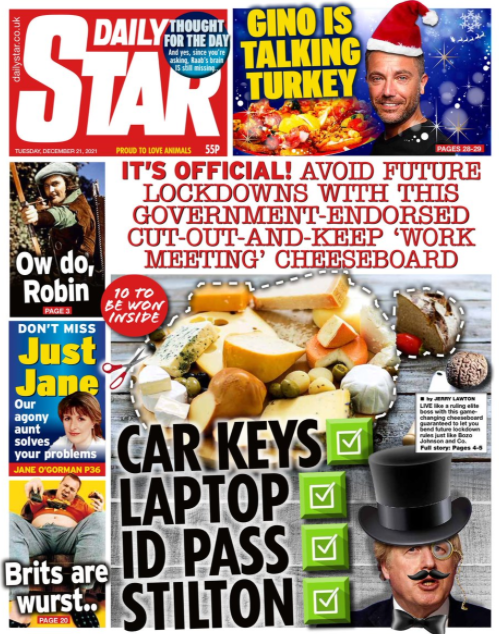
This largesse needs to be seen in the context of day to day Downing Street expenditure. £6K looks insignificant compared to the guesstimated £200K cost to redecorate the Johnson’s flat. Though it’s probably a bit more than sum spent on the series of “no rules were broken” “Secret Santa Christmas Gatherings” and similar “wine and Stilton” events held in the past year.

Put your money where your mouth is

Readers may recall last September: “This week’s PR disaster, Simon Jupp Doomed by his choice”. When Simon was pictured banging the drum for the hospitality sector alongside “yesterday’s man” Robert Jenrick and a couple of empty “Doom Bar” pints.

His pint of choice this time is “Old Speckled Hen”. Excellent Beer, but brewed in Oxfordshire.

Supporting local business means just that Simon. Why don’t you put your money where your mouth is and support, a Devon beer?

“Relax with an Otter”.

“Old Speckled Hen” image used in the Exmouth Journal

Weekly column: Impact of Covid on the hospitality industry

www.simonjupp.org.uk

The festivities are looming and there are a few things I would like to share with you as we head towards Christmas.

Once again, our hospitality sector and high street shops are struggling as we continue to get to grips with Omicron, the latest Covid variant.

Footfall is down and from talking to those who run pubs and restaurants, many bookings have been cancelled or people are simply not even bothering to turn up for their table. Casual staff have had their shifts cut, just before Christmas. Clearly, many are deciding to reduce their socialising to limit the risk of catching or spreading this virus. Many businesses have invested in their premises to improve ventilation to keep us safe.

We need buoyant, sustainable, and successful high streets and hospitality businesses in East Devon as both are vital to the local economy. I want you to know that I am once again lobbying the Treasury to consider bespoke financial support for those businesses affected by this significant drop in custom because of the latest developments.

I would also like to thank the many people we rely on at this time of the year who don’t get a festive break. The emergency services, NHS staff, carers, the RNLI, those working in retail or volunteering for a charity and many, many others. Thank you for doing what you do and for the sacrifices you make every day. Christmas can be a challenging time for some, and we should all be grateful for those who go above and beyond to make it safe, bearable and a little less lonely for many.

Again, I am not sending any Christmas cards this year. I have donated the cost of sending cards across the constituency to support local charities in East Devon. This year, I have donated to Sidmouth Independent Lifeboat, Budleigh Lions and Exmouth-based charity Rock2Recovery, which was setup by former Royal Marine Commandos to support veterans in our community.

Despite the current challenges we are all facing, may I wish you and your family a very Merry Christmas.

Since this column was submitted, additional support has been provided to the hospitality and leisure sectors from the Chancellor. This column first appeared in the Exmouth Journal on Wednesday 22nd December 2021 and in the Sidmouth Herald and Midweek Herald later in the week. 

Councils call for billions of pounds to be diverted from NHS to social care

Town halls in England are calling for billions of pounds a year earmarked for the NHS to be diverted to social care amid warnings of severe care worker shortages and hundreds of thousands of people not getting the help they need.

Robert Booth www.theguardian.com 

The cross-party Local Government Association wants a rethink of the government policy announced in October, which is to reserve 85% of receipts from the new 1.25% health and social care tax for the health service. It warned the measures, announced to deliver Boris Johnson’s promise to “fix social care”, fail to deal with “immediate, frontline pressures facing care services right now”.

The demand “to immediately redirect a significantly greater share of the levy to frontline adult social care” comes amid concern the social care crisis is preventing hospital discharges amid rising Omicron admissions. A four-star hotel in Bristol has become the latest makeshift care home to be pressed into action, after NHS England’s chief executive, Amanda Pritchard, told hospital bosses to use hotel beds to prevent discharge blockages when conventional community care is unavailable.

Across the UK, almost half of homecare providers also now say they can no longer take on new work, with worker shortages a key problem. A total of 38% said they were handing back contracts to councils and the NHS because they could no longer deliver, a survey by the Homecare Association found. Meanwhile, 95% of the largest private care home chains are struggling to find care staff, according to a poll published on Tuesday by the industry group Care England.

Ministers have said the new national insurance levy starting in April 2022 would deliver £12bn a year for the NHS and social care, but only £1.7bn would go to social care. The LGA has calculated that councils need up to £9.5bn a year more by 2025 to cover unmet care packages, increase pay and finance care homes fairly.

“We recognise the NHS faces a significant backlog which needs to be tackled, but so does social care, which faces huge challenges in addressing unmet and under-met need, workforce shortages and care worker pay,” said David Fothergill, the Conservative leader of Somerset county council and chairman of the LGA’s community wellbeing board. “Otherwise we are building towards a future based on inadequate foundations.”

He added: “This means some people cannot access any or as much of the care as they need, impacting upon their quality of life, and also has a direct knock-on effect on getting people out of hospital and into their homes and communities, which is both bad for the individual and for the health service.”

The latest hotel to be used as a care facility is the city-centre Bristol hotel, which is due to start taking patients from hospitals in Bristol, north Somerset and south Gloucestershire from Wednesday. Up to 30 patients will be discharged into rooms on one floor, supported by live-in staff on another. Local health chiefs describe it as “a temporary care facility” to “release much-needed hospital beds” with “rising Omicron cases likely to add to further strain in the coming weeks”.

At least three other hotels have been pressed into use in the south of England, including in Plymouth, despite concerns they do not match care home conditions. The operator, Abicare, said it has been recruiting live-in workers from Spain, Greece and African countries who already have rights to work in the UK.

The Health Foundation thinktank has calculated that funding for social care needs to increase by £4.8bn a year to stabilise the system and £9.3bn a year to enable it to recover. Under the government’s plan, most of the additional £1.7bn a year will cover the cost of the new £86,000 cap on lifetime care bills, aimed at ensuring people who pay for their own care are not forced to sell their homes.

“What the government is proposing to inject into social care is nowhere near enough to address the issues,” said Mike Padgham, the chair of the Independent Care Group, which represents care operators in Yorkshire. “Some £8bn has been cut from social care budgets since 2010 … Financial cutback after financial cutback has left the provision of care in tatters.”

Last week, ministers announced an additional £300m to fund retention bonuses for care staff amid an exodus of workers, but with payments so far only allowing for bonuses ranging from £60 to £150 a worker, and operators fear the additional funds may have limited impact.

The Department of Health and Social Care has been contacted for comment.

Dry rot hell at luxury newly-built (but long delayed) Exeter home

“Caveat emptor” from Grenadier – Owl

Anita Merritt www.devonlive.com

A prestigious development of a former private school into luxury homes has been hailed ‘a nightmare’ by a homeowner who says he has been left to foot a £50,000 dry rot bill.

Simon Firth and his family were the first to move into St Margaret’s Residence in St Leonard’s in September 2019, and ever since he says they have endured numerous problems with their four-bedroom property.

Exeter-based developer Grenadier was granted planning permission for the site to be turned into housing in 2014. However, it took years before it finally started work to build an ‘exclusive development’ of 35 apartments and four townhouses with the first phase finally ready in late 2019.

Just a month after moving into their three-storey home, Simon says the ground floor flooded when its main water inlet disconnected. Simon claims the fault was due to it not being fitted properly and there was no stopcock inside the property to initially stem the flow of the water.

The damage and issue was rectified and paid for by Grenadier but three weeks after the incident during a spell of heavy rainfall, water began seeping in through the front walls of all floors of the property.

Grenadier rendered the whole property to solve the problem but then had to return to the property when there were further problems with its pipework.

A series of problems have been encountered by the first family who moved into St Margaret's Residence in Exeter

A series of problems have been encountered by the first family who moved into St Margaret’s Residence in Exeter (Image: Simon Firth)

Simon, a father-of-two, says that holes in the walls still remain since and form part of a snagging list that remains unsolved.

However, the biggest issue with the property that came to light earlier this year is dry rot.

Simon said: “The developers were given a quote of £50,000 to put it right but then another issue came to light; the developer’s insurance – which should have been in place – was never activated as they did not provide the right documents to the insurance company.

“I don’t think it would have covered dry rot anyway. We were told to sort it out through our insurance, but we were reliant on the developer’s insurance and the chances are it wouldn’t have covered it anyway.

“I’m having to look into getting the money to do it ourselves because the developer has now completely walked away from us as is giving us no support whatsoever.

The damaged ceiling of Simon Firth's home at St Margarets Residence in Exeter

The damaged ceiling of Simon Firth’s home at St Margarets Residence in Exeter (Image: Simon Firth)

“It’s a lovely property, but there have been major issues that don’t just arrive overnight and they are not cheap houses. Grenadier is award-winning but has offered no contribution to it.

“The experts say the dry rot has been there for a while. It needs water to develop and we have had quite a lot of that in the property in the last two years.

“Grenadier’s legal team do not think they have legal liability and we will have to test that, but it will take months, perhaps years. We think they at least have a moral liability to help given the circumstances.”

In hindsight, Simon says he does have some regrets.

He said: “We did not have a full structural survey when buying our home. Was that a mistake? Probably yes because it might have picked up some of the issues we have experienced.”

St Margaret’s Residences was recently awarded Residential Development of the Year and Grenadier was named Best Developer 2021 at the Exeter Property Awards. It recently achieved a UK First for achieving an Energy Performance Certification (EPC) ‘A’ on a Grade II listed building.

A spokesperson for Grenadier said: “At Grenadier we pride ourselves on providing sustainable, high-quality homes with exceptional customer service.

“As for any well-established property developer, we provide snagging services and work to fulfil these quickly.

“Grenadier continues working closely with the property residents to support them with snagging.”

Originally built as single houses, the site was acquired by St Margaret’s and converted into a school in the 1920s.

The Grade II listed building has been redeveloped into new energy-efficient homes with an emphasis on preserving and restoring features within the buildings such as elegant staircases, old marble fireplaces, Edwardian stained-glass windows and ornate ironwork banisters.

Major housing plans for South Hams village outlined – 30% affordables 

Plans to build 120 homes – including plenty of affordable properties – in a Devon village have been unveiled by developers.

These are detailed plans, following outline planing consent. Can the developer be held to these numbers of affordables? – Owl

Lewis Clarke www.devonlive.com 

Newton Abbot-based housebuilder Baker Estates has submitted detailed plans to South Hams District Council for sites in Dartington. The two sites – at Broom Park and Sawmills – were granted outline planning consent in April 2020.

The developer has completed a period of consultation on both sites, including a public exhibition, which was hosted to provide the community with the opportunity to comment and express its views on the proposals.

In total 80 homes are proposed at Broom Park with a further 40 at Sawmills and, in both cases, 30 per cent would be affordable and available to local families either for shared ownership or affordable rent.

The inclusion of the affordable homes in the village, which has a population of around 870, has been welcomed by local officials.

Cllr Judy Pearce, executive member for housing and leader of South Hams District Council, said: “The lack of affordable homes in our area has reached crisis point but it is not enough to simply build more houses – we need high quality homes that respect our local heritage and the natural environment too.

“The best way to build homes that meet our local needs is to get the community involved and listen carefully to what local people want.

“This suite of national awards won is testament to the fact that Baker Estates are achieving high quality results because of their approach to engaging with communities, customer service, and build quality – and I congratulate them thoroughly.”

Devon housebuilder submits detailed plans for two new housing developments in Dartington

A range of one, two, three, four and five bedroom homes including apartments and bungalows will feature in the plans.

Mark Edwards, head of development at Baker Estates, said: “An extensive public consultation exercise is at the very heart of how we have moved forward with our designs and local people were keen to offer their views on how our planning application should be shaped.

“Opinion was diverse on key topics such as sustainable living, architectural styles and landscape plans, with many differing views expressed as to the right approach.

“However, there was broad support for the provision of land allotments at Broom Park and for the woodland to be publicly accessible.

“We are also pleased to have been able to respond directly to comments about the need for green spaces on both schemes. This is particularly evident at Broom Park with inclusion of orchard planting.”

The starting point which has shaped both schemes is ecology, with the retention and protection of important bat flyways around the edge of each site.

This has led the design team to incorporate extensive areas of green open space into both schemes, ensuring that 10m and 20m bat corridors have been embedded into the layout at the outset whilst balancing recreational requirements and sensitively responding to the environment and neighbouring properties.

A different design approach has been taken for each site, with a contemporary approach for Sawmills reflecting the adjacent development and a more traditional design feel for Broom Park with cottage style windows and some barn style units.

Graham Hutton, development director at Baker Estates, added: “Overall, we believe our proposal represents a sensible proposition in an established and sustainable location.

“If approved by South Hams District Council, this will be an outstanding housing scheme for the area.

“We now have a number of legacy developments in Devon which have won regional and national awards and we aim to deliver homes of similar quality for the Dartington community.”

Devon business leader urges PM to ‘get a grip’

“Anyone with half a brain can see what’s going to happen. But stop making these fluffy announcements and be clear so that businesses can make the right decisions and survive.”

Colleen Smith www.devonlive.com

A Devon business leader has called on the Government to “get a grip” and start taking decisive measures – including a new lockdown and a furlough scheme for businesses.

It comes as Prime Minister Boris Johnson confirmed that no further Covid restrictions will be put in place before Christmas, saying there is currently not enough evidence on the severity of Omicron, the hospitalisation rate and the impact of the booster rollout to justify tougher measures ahead of December 25.

Earlier today, the Chancellor Rishi Sunak unveiled £6,000 one-off bailout loans to pubs and restaurants who have seen their Christmas trade wiped out as people stay away to avoid fast-rising Covid numbers.

Hospitality firms had been begging the Government for more support as dire warnings over the spread of Omicron had seen pubs, restaurants and music venues hit with “lockdown by stealth”.

Susie Colley, the chairman of the Torquay Chamber of Trade, has now called on Prime Minister Boris Johnson to “take the flak” from his own party and do what’s best for the country as a whole.

She said: “This new Omicron surge is already affecting businesses badly.

“Are the Government going to come back and furlough people? Loans are no good – people will never be able to repay them.

“The Government need to be clear and concise and yes they need to lockdown and save lives and save the NHS from collapse.

“Yes, it will push the country further into the red – but at least we will be alive to come out the other end.

“I desperately want to see my daughter – but I would rather wait and see her in the summer, if I’m alive and she’s alive. If we carry on the way we’re going, that’s not going to happen.

“If you’re the leader of the country, you’re not there to make friends or keep businesses happy. You have to steer the boat through this huge storm which could go on into 2023.

“Stop vacillating. Stop being woolly. The decisions have to be made now and a great leader will be prepared to take the flak from his own party.

“Get a grip Boris. The scientists are telling us that because of the virulent nature of Omicron it’s doubling every one and a half days.

“Anyone with half a brain can see what’s going to happen. But stop making these fluffy announcements and be clear so that businesses can make the right decisions and survive.”

Bars and restaurants are quiet as people fear the spread of Omicron in the run-up to Christmas.

The Chancellor has today come forward with additional help for the hospitality and leisure sectors in England following days of urgent lobbying from MPs, firms and industry officials.

It includes one-off grants of up to £6,000 per premises for businesses in the affected sectors in England, which the Treasury expects will be administered by local authorities and to be available in the coming weeks.

The Government also intends to use taxpayers’ cash to cover the cost of statutory sick pay for Covid-related absences for firms with fewer than 250 employees.

Cultural organisations in England can also access a further £30 million funding during the winter via the culture recovery fund, the Treasury said.

Cabinet ministers are at loggerheads over post-Christmas restrictions, with a two-hour meeting of the Prime Minister’s top team reportedly exploding into a row yesterday.

Mr Sunak’s announcement has been branded as a “holding package” by opposition leaders, who have accused the Government of being indecisive.

Labour’s Shadow Chief Secretary to the Treasury, Pat McFadden said: “This is a holding package from a Government caught in a holding position.

“The Prime Minister is a prisoner of divisions inside his party and within the Cabinet about whether any further measures are needed and whether they will get past Tory backbenchers. That is not the way that crucial public health decisions should be taken.

“Labour has been calling for an economic support plan for businesses affected by a wave of pre-Christmas cancellations.

“Support is welcome to see but we will be going through the details of this announcement to see which business and workers are included and excluded.

“Business support should have been announced when the Plan B changes were voted on last week but it has only happened after the Chancellor was dragged back from California to focus on the plight facing businesses and workers here in the UK.

“The real question after yesterday’s indecisive Cabinet meeting is what will happen next, when will the country be informed of that and will support for businesses and workers be placed alongside any further public health measures that might be announced.”

The trade body Hospitality UK has reported that many businesses have lost 40% to 60% of their December trade – at what is usually firms’ busiest month.

Speaking in a pre-recorded message to the nation which was released at 5pm today, Mr Johnson said: “There is no doubt that Omicron continues to surge with a speed unlike anything we’ve seen before.

“The situation remains extremely difficult but I also recognise that people have been waiting to hear whether their Christmas plans are going to be affected.

“So what I can say tonight, is that naturally we can’t rule out any further measures after Christmas – and we’re going to keep a constant eye on the data, and we’ll do whatever it takes to protect public health.

“But in view of the continuing uncertainty about several things – the severity of Omicron, uncertainty about the hospitalisation rate or the impact of the vaccine rollout or the boosters, we don’t think today that there is enough evidence to justify any tougher measures before Christmas.

“We continue to monitor Omicron very closely and if the situation deteriorates we will be ready to take action if needed.”

“Madcap” Exmouth development approved

The legacy of the Conservative “Old Guard” still comes to haunt the “New Guard”

The road layout of a “madcap” 300 home development on the edge of Exmouth is to be changed following a vote by East Devon District Council (EDDC).

The 16 affordable homes promised by the developers described as “scandalously low.” 

Joe Ives, local democracy reporter www.radioexe.co.uk

New homes going here (courtesy: Google Maps)

300 new homes, but councillors not happy.

The corner at Goodmores Farm housing development at Hulham Road will now have a simplified road layout. 

Instead of the southwestern portion having two looping roads, it will now just have one, to reduce the risk of flooding through surface water runoff. As a result of the changes the number of homes planned has been reduced by one, to 298.

The Goodmores Farm scheme, put forward by 3West Developments Ltd, a Woodbury-based developer, has divisided opinion for years. 

The principle of the development was granted planning permission in 2014 – a decision that has since tied the council’s hands.  As a result, despite concerns over the small number of affordable homes proposed by developers, full outline permission was given for plans in 2018. 

Although nothing can be done to stop the project now, many councillors feel it is a major mistake in the making.

When first proposed, the development was meant to have 350 houses, a school, open green space, a communal commercial area, and employment land.  A viability assessment submitted by the developer argued that in order to provide some of these facilities it could only afford to make five per cent of the new buildings affordable – a far cry from the council’s normal 25 per cent requirement.

There are concerns too about future residents having to rely on cars, and its alleged poor public transport and cycle links.

In comments submitted before the latest planning meeting, Councillor Paul Millar (Labour, Exmouth Halsden) said: “I continue to object to this planning application along the same lines as Exmouth Town Council, and will do everything I can to delay and frustrate this intellectually incoherent and madcap scheme which ought never have been approved at outline”

Speaking at the planning committee, Cllr Paul Millar described the 16 affordable homes promised by the developers as “scandalously low.” 

Previous road layout for Goodmores Farm, Exmouth (courtesy: ARA Architects)

East Devon is facing an affordable housing crisis. A report by Devon Home Choice says more than 2,700 households in the district are in housing need. 

Nevertheless, with outline approval granted by a previous EDDC administration, there is little that can be done to significantly alter the plans now. 

Commenting on the ‘reserved matters’ application for the road layout changes, Councillor Bruce De Saram (Conservative, Exmouth Littleham) said: “With great reluctance – and I stress with great reluctance – I will have to support approval.”

Councillor Olly Davey (Green, Exmouth Town) welcomed the reduction in the amount of tarmac that will be laid as a result of the road changes. However, he reiterated arguments made previously about the plans, saying: “This is a twentieth-century development and not really fit for the twenty-first century.” 

The reserved matters application was passed unanimously by EDDC’s planning committee. 

Australia trade deal to cause £94m hit to UK farming, forestry and fishing, Government study reveals

The post-Brexit trade deal signed with Australia last week will see British agriculture, forestry and fishing take a £94m hit, the Government’s own impact assessment shows.

By Arj SinghDeputy Political Editor inews.co.uk 

There is also an expected £225m hit to the semi-processed food sector, which includes tinned products, as part of a “reallocation of resources within the economy”.

The impact assessment refers to Australia as a “large, competitive producer of agricultural products”, making clear the “potential for the deal to result in lower output for some agricultural sectors [in the UK] as a result”.

It goes on to warn that the sector is expected “to contract” as a result of increased competition as tariffs are lifted on Australian imports to the UK, compared to if the deal had not been struck.

It comes after then-trade secretary Liz Truss won a Cabinet row with George Eustice over the deal in spring, with the Environment Secretary reportedly concerned about the damage cheap Ausralian lamb and beef imports could do to domestic farmers.

Manufacturing sectors, in particular the manufacture of motor vehicles and the manufacfture of machinery and equipment will benefit from the deal, the impact assessment published alongside the final trade deal on Friday showed.

The Liberal Democrats warned farmers were being “sold down the river” by the Conservatives as a result of the deal.

It came after Boris Johnson’s party suffered a humiliating by-election defeat to the Lib Dems in the largely rural seat of North Shropshire.

Lib Dem environment spokesman Tim Farron said: “This impact assessment proves what so many feared.

“Buried in the small print is a £100m hit to our farming and fishing sectors that will hit rural communities hardest.

“Boris Johnson has sold farmers down the river to make a quick buck in a misguided trade deal with Australia.

“Now the reality of what’s on the table is clear, it’s vital that Parliament is given a vote on the deal.

“Last week’s political earthquake in North Shropshire shows that Boris Johnson’s Conservatives can’t afford to take farmers for granted any longer.”

The Department for Intenraitonal Trade said it had secured safeguards to protect the most sensitive farmers, including tariffs on imports above a certain quota in the first decade of the deal.

From years 11 to 15, 20 per cent tariffs will apply on beef and sheepmeat above a certain quota level.

And a general safeguard will provide a safety net for industries that face “serious injury” from increased imports.

A DIT spokesman said: “The deal is expected to increase trade with Australia by 53 per cent, boost the economy by £2.3bn and add £900m to household wages each year in the long-run. It will also play an important role in levelling up the UK, delivering benefits for towns, cities and rural areas throughout the country.

“Maintaining our high standards is a red line in all our trade negotiations. That is why this deal contains safeguards to support the most sensitive parts of the UK farming community, including a gradual removal of tariffs over 10 years and a safety net that allows tariffs or restrictions to be reimposed if the industry faces serious harm.”

Exposing the Immensa testing scandal: update – Good Law Project

goodlawproject.org

The Omicron variant is creating another season of Christmas chaos and a country-wide shortage of PCR testing has once again revealed shortcomings in the Government’s Covid-19 response.

Amid this, our work to address the failings at the Immensa lab in Wolverhampton is more important than ever. An estimated 43,000 people with Covid-19 were mistakenly given negative PCR results by the lab. They thought they were in the clear, but were actually positive for Covid-19. This contributed to soaring rates of infection across the South West and Wales.

Amber Marshall told the BBC that she believes her grandmother Pam died in October as a result of Immensa’s errors, having caught Covid-19 from a member of staff at Stinchcombe Manor Care Home. The staff member had been given a false negative result and thought it was safe for her to go to work.

Without a proper account of what happened, how can people trust the system won’t fail to protect them and their families and friends again?

We posed a series of questions to the Government, to try and get justice for the families involved and assurances that the situation is now under control, but their responses were vague and wholly inadequate.

We’ve now filed Judicial Review proceedings to ensure the Government reckons with the multiple failures in their oversight of the Immensa lab.

We believe their failure to set up and enforce a proper system to monitor and supervise the accuracy of PCR testing at private labs like Immensa breaches both their duty to protect life under the NHS Act 2006 and the human rights of the thousands of people affected.

It took the Government almost a month to identify the issue and to stop sending PCR tests there. And they didn’t even announce what had happened or start contacting affected individuals until three days after that.

It’s hard to say just how much further the virus spread in that time, but the effects of this mismanagement are potentially huge. As far as we know the Government hasn’t actually investigated or confirmed the true number. Professor Deepti Gurdasani, a senior lecturer in epidemiology at Queen Mary University, estimates that the false negatives may have caused up to 200,000 further Covid-19 infections, and more than 1,000 avoidable deaths.

Many of the people given false negative PCR results have been left deeply distressed. One woman told us that, without a positive PCR result, she missed out on support that she’d otherwise have been entitled to: “I couldn’t believe it when I got the message from Test and Trace. I was so angry. I am 71 years old, and I was completely on my own. I could have died in my flat and no one would have known.”

We’re asking the Court to compel the Government to put in place proper safety checks at private labs to prevent this ever happening again and to acknowledge that people’s human rights were breached. We will keep you updated.

You can learn more about the facts and grounds of this case here. And read the Government’s response to our questions here.


Good Law Project only exists thanks to donations from people across the UK. If you’re in a position to support our work, you can do so here.

Covid restrictions unlikely before Christmas but PM watching data ‘hour by hour’

Boris Johnson has lost control, and potential successors such as Rishi Sunak are looking over their shoulders at the “bonkers” recovery and research groups. 

How to crash the economy and wreck the NHS without really trying  – Owl 

Aubrey Allegretti www.theguardian.com 

New Covid restrictions are unlikely to be imposed before Christmas amid deep cabinet divisions but Boris Johnson warned further measures remain on the table, with data on the threat of Omicron monitored “hour by hour”.

The prime minister was accused of failing to follow scientists’ advice on the need for immediate restrictions while leaving millions of people and businesses in limbo after a two-hour cabinet meeting ended with no decision on Monday.

During the meeting, scientific advisers briefed ministers on the latest data including a steep rise in hospitalisations in London, with the UK’s highest number of Omicron cases, while 91,743 people tested positive for Covid on Monday across the UK.

Afterwards, the prime minister said the arguments for and against stricter measures were “finely balanced” and the situation was “extremely difficult”.

With some people having already departed on Christmas breaks, government sources told the Guardian that fresh curbs were unlikely to be imposed before 25 December – though an announcement could be made in coming days on rules to be brought in before New Year’s Eve.

Measures under consideration include limits on households mixing indoors, social distancing and curfews for the hospitality sector. Parliamentary authorities are preparing for a possible request for the Commons to be recalled on Tuesday 28 December for a vote on any new measures.

Among cabinet ministers pushing for swift action were Sajid Javid, the health secretary, and Nadine Dorries, the culture secretary. However, the chancellor, Rishi Sunak, the foreign secretary, Liz Truss, and the education secretary, Nadhim Zahawi, were said to be holding out for “incontrovertible evidence” that a plan C for tackling Omicron was needed.

Among the plans considered by cabinet on Monday was a return to “stage two” of England’s roadmap out of lockdown, which came into effect on 12 April. People were only allowed to socialise indoors with members of their own household or support bubble, while outdoor socialising was limited to the rule of six or two households.

Johnson said hospitalisations were rising “quite steeply” in London, where Omicron has hit hardest so far, adding that while he understood the strain on hospitality firms, the current plan B restrictions “can be very helpful to us and the country” at slowing the spread of the variant.

The mayor of London, Sadiq Khan, announced the cancellation of the capital’s New Year’s Eve celebration in Trafalgar Square “in the interests of public safety” on Monday. The event had been due to be attended by 6,500 people.

The number of UK vaccines administered within 24 hours broke 1m for the first time this weekend, it was confirmed. Just over 50% of over-12s have now also received a booster dose.

Prof Christina Pagel, the director of University College London’s clinical operational research unit, said that waiting for more definitive evidence of Omicron’s spread could cause the NHS to be overwhelmed and may mean it is too late to avert a crisis.

She urged ministers to “follow Sage advice and return to step two of the roadmap immediately to prevent thousands of infections over the coming days and then monitor the situation hour by hour so that measures can be lifted as quickly as possible, hopefully even in time to enable limited household mixing over Christmas weekend”.

A Department of Health source stressed that while Javid believed responding as early as possible to threats like Omicron was still the best way forward, the possibility of new restrictions remained unclear.

They said: “We want to be as open with people as we can, but it’s not easy. There is new data coming in all the time that we have to look at, from several places. We’re basically scouring for a signal within the noise.”

A former minister said Johnson appeared to be hamstrung by some of his top team. They said: “I don’t really see how it is scientifically defensible [not to act immediately] but it also feels about right in political and publicly-possible terms. The data about transmission points inexorably towards an approach that says ‘better safe than sorry for the sake of the NHS’. But it would also be unforgivable to be too cautious.”

A Tory MP resistant to new restrictions vowed to go ahead with their Christmas and New Year plans regardless of any new rules. They said: “If he tries to push ahead with new restrictions without convincing evidence, Boris is a dead man walking.” Another backbencher, Esther McVey, said ministers had “for once pushed back on the scaremongering by the lockdown fanatics”.

After the cabinet meeting ended with no certainty on restrictions, Labour accused Johnson of being “too weak” to stand up to his own MPs. Wes Streeting, the shadow health secretary, said: “While businesses across the country wonder if they can continue to trade, and families make frantic calls about whether they will see each other this Christmas, true to form the prime minister has put his party before the public.

“Rather than set out a clear plan for the country, he has chosen to protect himself from his own MPs by simply not saying anything. Boris Johnson is unfit to lead.”

Kate Nicholls, the head of UKHospitality, said the industry needed notice of any restrictions that were to be placed on it next week, with financial support crucial. She said firms were in limbo, having lost up to 60% of their trade while still having big rent and rate bills as well as staff wages.

Greg Parmley, the chief executive of Live, which represents live music companies, said the government’s stance was “merely an excuse to withhold desperately needed financial support as sectors like live music and entertainment buckle under the weight of the latest Covid wave”.

Dehenna Davison, the Conservative MP for Bishop Auckland, said: “In the last two days, I’ve had pubs and restaurants contact me asking if they should place food and drinks orders. I’ve had emails from people asking if they should postpone their wedding for the fifth time, or if they can see their mum on Christmas. We really need some certainty.”

Cabinet meets to consider three options (according to the Telegraph)……

And chooses Option 4, the DO NOTHING option.

 “We will not hesitate to act” says Boris Johnson.

Carry on partying!

Planning applications validated by EDDC for week beginning 6 December

Omicron is terrifying – so why won’t we learn from past mistakes? 

Across the country, even before Omicron admissions have started to rise, the bed occupancy in our hospitals is 94%.

“The secret consultant” www.theguardian.com 

That seems a luxury to me; it is quite a while since I saw an empty bed in mine. Our bed occupancy hovers around 100% and has done so for some weeks.

There is nothing unusual in this, however. Successive decades and serial A&E closures, combined with rising healthcare demands from an elderly and growing population, have meant our bed provision is far too small for our area. Even in a normal winter, critical bed crises are a common problem, with operations cancelled and patient care often compromised as a result. The whole system has been slowly gutted to the point that there is not even enough capacity to deal with routine fluctuations in demand.

This, however, is not shaping up to be a normal winter. The Omicron variant is spreading with a speed that is terrifying to me, even after all I have seen and done over the past months.

I don’t even need to look at the figures to know this; the evidence is all around me. Friends and family, even the careful ones, have started testing positive and having to isolate. There are multiple outbreaks in schools again. Football matches are being cancelled. And there are already many colleagues unable to attend work, leaving rota gaps that we are already struggling to cover.

And the worst of it is yet to come.

Extrapolating from the current figures, it looks like within our local area we will have infections in the tens of thousands by the middle of next week. And here comes the biggest unknown.

Is this variant really, as we all hope, less virulent than its predecessors? Will our vaccines and immunity be enough to keep people out of hospital? Even with a hopelessly optimistic low rate of hospitalisations, it still looks like there will be far too many patients for us to look after.

A small proportion of a very large number is still a large number. Remembering also that there is a lag of a week or two between infection rates rising and people becoming unwell enough to present to hospital, this means the potential point of maximum pressure comes around Christmas and New Year, when many of us were hoping, finally, to take a few days off, and many more will be sick or isolating with Covid.

And we have significant other pressures working against us. GPs are scaling back the routine care they offer in favour of vaccinations. Some hospitals are also cancelling elective care so that their consultants can join in the jabbing.

Despite this, the new variant has some power to evade the vaccine, meaning that even the current heroic effort may not put the requisite protections in place in time. Vaccinated patients are unlikely to get critically ill, but even relatively well patients coming into hospital could overwhelm us.

The reduction in usual care is likely to result in more patients seeking help in hospitals, despite best efforts.

One glimmer of hope is the new treatments for Covid now available for patients who are particularly vulnerable, with the aim of stopping the disease progressing and reducing the need for hospitalisations.

The first centres for this went live this week, using staff redeployed from other vital work. The problem is, however, that these were set up and resourced based on numbers calculated from the Delta variant. Within the first 24 hours of opening it became clear that the numbers now identified for treatment already exceeded capacity fivefold and are rising exponentially.

So even this hope must be tempered with realism: how much will these really be able to hold back the tide?

I find myself grudgingly admiring the Covid-19 virus, that with all our modern medicine and incredible science, it is still managing to confound us even 20 months on. It is a fearsome opponent.

So why, yet again, do we seem to be underestimating it? Why do we not learn from our mistakes?

For a healthcare system already strained beyond capacity the potential threat that Omicron poses is obvious, even though its virulence is yet unknown.

Why not therefore take at least some sensible precautions to try to hold back the spread, to buy us time to vaccinate some more and make sure we are set up to give all the therapies at our disposal?

Plan B will make very little difference to a strain this infectious. In any case, these measures take time to work.

By the time that hospitalisations start to rise, it will be too late. Surely it would be better to make the mistake of introducing early restrictions unnecessarily than to make the mistake of not doing so and causing unnecessary deaths?

Boris Johnson “know[s] the pressures on everyone in our NHS”. But does he really? Has he got any idea of the exhaustion, burnout and low morale that I see and feel every day? The dread that my colleagues and I express as we talk about what this winter holds in store, again? How it feels to be potentially facing yet another wave?

And yet still we sit on the fence, pretending we can vaccinate our way out of this while carrying on with life as normal. Talk of shielding the NHS rings hollow in the face of this inaction.

And while we have been working on throughout to keep people safe, it seems that in Downing Street they found the time to have unmasked quizzes and after-hours gatherings. How nice.

It really is hard to put into words exactly how shameful, deceitful, and hypocritical this is.

In medicine we sign up to a “duty of candour” that we all owe to our patients, whereby if mistakes are made we admit them, apologise, do our best to make amends. It is a basic thing that even the most junior medical student knows about. Too basic, it seems, for some important people to be concerned with.

What we have achieved in the NHS over the past year is little short of amazing. And now we are being asked to make another “extraordinary effort” by leaders who show themselves to be above such things yet too cowardly to admit it.

Yet without measures to protect us, will it be enough?