Backbenchers are laughing at ‘arrogant’ Boris Johnson after 2030 claim, rebel Tory MPs say

Would they include Simon Jupp? Owl thinks not but is open to be corrected.

By Hugo Gye, Arj Singh inews.co.uk 

Conservative opponents of Boris Johnson have responded angrily to the Prime Minister’s claim that he could continue in office beyond 2030.

Rebel MPs accused Mr Johnson of being “arrogant” by saying he is considering serving a third term in No 10 before he has completed his first, and with more than 100 backbenchers already opposed to him.

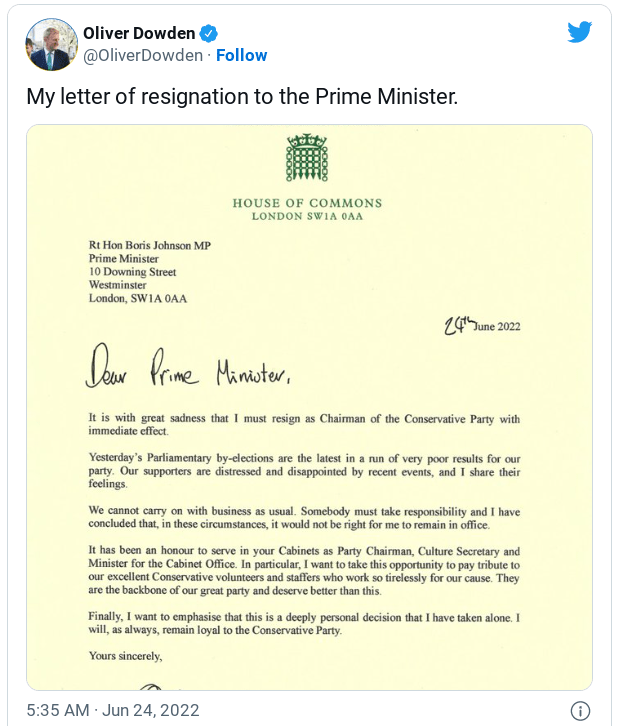
They also called on Cabinet ministers to follow the lead of Oliver Dowden by resigning in protest at the Prime Minister’s leadership.

Speaking in Rwanda, where he was attending a Commonwealth summit, Mr Johnson said: “At the moment I am thinking actively about the third term and you know, what could happen then. But I will review that when I get to it.” He confirmed that this could stretch to “the mid-2030s”.

He later clarified his remarks at the G7 summit in Germany, claiming he was making a point about being focused on the long-term challenges that the UK faces.

A leading rebel MP said that anti-Johnson backbenchers were “laughing” at the claim, which would see the Prime Minister extend his time in office beyond that of Margaret Thatcher.

The backbencher told i: “In three years he’s gone as far as Thatcher in 10. Popular in Ukraine does not equal popular at home.”

Most Cabinet ministers have remained publicly loyal to Mr Johnson despite the double by-election defeat on Friday. Brandon Lewis, the Northern Ireland Secretary, told Sky News: “This is somebody I think who is capable of winning a general election, delivering for our country, as he has done in the past.”

Mr Dowden resigned as Conservative party co-chair hours after it became clear that the Tories had been defeated by Labour in Wakefield and by the Liberal Democrats in Tiverton & Honiton.

He said that “somebody must take responsibility” for the party’s poor position in what was largely seen as a dig at Mr Johnson.

Tim Loughton, the long-serving MP for East Worthing & Shoreham, told Times Radio: “I’d like to see some ministers stand up to the Prime Minister and stand up for their own principles, and stand up for the Conservative Party and the Government. Because at the moment, we’ve got quite a few problems.”

Asked whether he thought it was realistic for Mr Johnson to continue until 2030, he said: “I don’t think it’s very helpful. I think it could be construed as a little arrogant. And I seem to recall Mrs Thatcher, when she was slightly on the ropes, talking about going on and on and on.”

Theresa May’s former deputy Damian Green criticised “the fashion of finding ‘wedge issues’ where you divide the population and leave your political opponents on the wrong side of an argument”.

Writing in the Sunday Telegraph, he also appeared to call for a Cabinet revolt, saying: “It is not a secret that a significant proportion of the Cabinet think they could do a better job of leading the country than the current incumbent. Now would be a good time to demonstrate those leadership qualities.”

You are thrown over the side of a ship, and then you are left to drown

“And that’s how it works and fine, but I saw Mark Spencer on the podcast, Telegraph podcast, saying how caring they all were. I need to put it out on record, they are not.”

 ‘Probably done in’ by some of his colleagues, Neil Parish reflects on the “nasty” party – Owl

Disgraced ex Tory MP Neil Parish says ‘police confiscated his guns in case he shot himself’

Joe Middleton www.independent.co.uk 

Former Tory MP Neil Parish has claimed police took away his shotguns ‘for his own safety’ after he was forced to resign in disgrace.

Mr Parish, who previously represented Tiverton and Honiton, admitted in April he had watched pornography on his phone in Parliament in what he described as a “moment of madness”.

He initially claimed he was ‘looking for tractors’ online when he found the illicit material and later admitted to accessing the adult material deliberately.

When Mr Parish eventually quit as an MP on April 30, he triggered a by-election that was won by the Liberal Democrats on June 23.

Speaking to LBC’s Swarbrick On Sunday about the aftermath of the scandal, he said: “The police very kindly and rightly took away – because I am a farmer you see I’ve got shotguns – so they took those away from me.”

When asked why, he replied: “Because when you have blown up your parliamentary career for 12 years, you are not feeling in the best place, and they took them away for my own safety, not that I was going to shoot anybody else, in case I shot myself.

“I did say to them in a moment of black humour, ‘I am a very bad shot, I will probably miss’, but they didn’t naturally see the joke at the time, or nor was it very funny.”

Mr Parish claimed he received a number of death threats following the scandal and complained of constant cameras outside his house.

“It’s not easy,” he said, “And when you go to the chief whip and ask for help, you expect it. You are thrown over the side of a ship, and then you are left to drown.

“And that’s how it works and fine, but I saw Mark Spencer on the podcast, Telegraph podcast, saying how caring they all were. I need to put it out on record, they are not.

“Mark, actually, was much better than the present chief whip, Chris Heaton-Harris, but you know, this idea that they are all there, caring for us is nonsense.”

Mr Parish went on to claim he was ‘probably done in’ by some of his colleagues.

“I think probably I was,”he said. “Now, I was wrong to be watching it: it was very immoral, it wasn’t illegal, it was immoral, and I shouldn’t have been doing it.

“I was right in the corner of the House of Commons as you go into the lobby to vote, so this idea I think people have got that I was right in the middle of the House of Commons flaunting it is absolutely wrong.

“I wasn’t proud of what I was doing and it was very wrong I was doing it. But I didn’t spend any time in the last 12 years, shall I say, splitting on fellow members.

“I asked to be able to apologise if I caused offence, I was not given that opportunity by the chief whip and I was thrown to the press wolves.

“Have you had three days of the paparazzi outside of your house shouting abuse at you? It is enough to frighten anybody, and I don’t frighten easily.”

Devon and Cornwall Police have been approached for comment.

Is Simon Jupp “losing it”?

There have been two analyses of voting trends, pre-dating the by-election results, that indicate how vulnerable Simon Jupp might now be in his “safe” seat in the increasingly volatile Celtic Fringe.

Electoral pact poll may 2022

Collapse  in tory support threatens celtic fringe in south-west poll finds

The by-election reaction that intrigued Owl was the one from the Tory Mid Devon cabinet councillor who said the result was “uncalled for”. This is a phrase that encapsulates the supreme sense of entitlement that Tories hold as a birth right. 

Hugo Swire is a good example. A local MP who, despite his close connections to “Dave”,  never did anything for East Devon

So how good a local MP is Simon Jupp? He has made lots of “promises” of funding for Exmouth which have never materialised. He certainly pushes his hobby horses such as the hospitality sector. But how committed is he to being the member of parliament for all his constituents, working closely with the elected council members to get the best for the district? 

Owl understands from questions put on social media to EDDC deputy leader Paul Hayward that Simon Jupp MP, despite frequent requests, has yet to meet with the majority group in EDDC,  indeed takes an antagonistic line with the council.

Obviously council concerns to get the best for East Devon gets a low priority from him.

Looks like a good way to lose a “safe” seat. – Owl

“Delusional” Boris Johnson ‘actively thinking about’ third term as PM

Prime Minister for life? What a thought to galvanise voting intentions! – Owl

Boris Johnson has said he is “actively thinking” about a third term, amid criticism of his leadership. BBC

Senior Conservatives accused Boris Johnson of increasingly “delusional” behaviour on Saturday night after he said he was already planning for his third term as prime minister, just two days after the Tories suffered a catastrophic double byelection defeat at the hands of the Liberal Democrats and Labour. Guardian

By Alex Forsyth Political correspondent, BBC News www.bbc.co.uk

The prime minister was asked if he would like to serve a full second term in office – to 2028 or 2029.

“At the moment I’m thinking actively about the third term and what could happen then, but I will review that when I get to it,” he told reporters.

One Tory MP has said he wants the rules changed so Mr Johnson could face another confidence vote.

Speaking to reporters in Kigali, Rwanda, where he has been at the Commonwealth Heads of Government meeting, the prime minister was asked to elaborate on his comment, replying that he was thinking “about a third term – mid 2030s”.

No 10 later suggested he was joking, but it points to Boris Johnson’s bullish mood despite two bruising by-election defeats in the past week in Wakefield, and Tiverton and Honiton.

Following the results, party co-chairman Oliver Dowden resigned, saying “someone must take responsibility”.

The Lib Dems overturned a huge Tory majority in Tiverton and Honiton – their third by-election victory over Boris Johnson’s party in a year.

And Labour retook the seat of Wakefield, West Yorkshire, which it lost at the 2019 general election.

Former Conservative leader Michael Howard called on Mr Johnson to resign following the by-elections, adding “members of the cabinet should very carefully consider their positions”.

Mr Johnson insisted he would lead his party into the next election, and said he wanted to keep driving forward his plan to reduce inequality across the country – what his government calls “levelling-up”.

While acknowledging it would take time, he added that a “huge amount of progress” could be made in two parliaments.

He told reporters: “Forget about me, think about what this country, the UK could do and where it’s gone.

“We’ve embarked on a massive project to change the government, the constitution of the country and the way we run our legal system, the way we manage borders, our economy, all sorts of things we’re doing differently.

“Also at the same time we are embarked on a colossal project to unite and level up. I happen to believe in that incredibly strongly.

“Levelling-up is a great, great mission and it won’t be easily accomplished and people will say it hasn’t worked, it’s not working yet, people in this constituency aren’t feeling the benefits – it’s going to take time and I want to keep driving it forward.”

But Labour leader Sir Keir Starmer accused the prime minister of “taking voters for granted with impunity”, saying “those days are over”.

“They now face a credible Labour Party: a government-in-waiting with a plan to deliver on the country’s demands,” Sir Keir wrote in the Observer.

“For months, Johnson has been privately claiming that he will hold an early election. My message to him is simple: bring it on,” he added.

During his trip to Rwanda to meet Commonwealth leaders, Mr Johnson showed little sign of the pressure he’s faced from critics in his own party who’ve called on him to quit.

And Mr Johnson refused to comment on a report in the Times that he planned to build a £150,000 treehouse for his son Wilf in the grounds of Chequers, the prime minister’s country residence, with possible funding from a Tory donor.

Mr Johnson has faced renewed criticism from inside his party after losing the safe Tory seat of Tiverton and Honiton to the Liberal Democrats

On Saturday he said the question of his leadership was “settled” after he won a confidence vote among his own MPs.

But Tory backbencher Andrew Bridgen confirmed he wanted the party’s rules changed so that Mr Johnson could face another vote of confidence before 12 months are up.

Under the current rules, Mr Johnson is technically safe from a challenge until next June.

Mr Bridgen told the BBC: “Boris Johnson is actually galvanising an anti-Boris Johnson vote.

“The leader of the party should normally be more popular than the party itself, but what we’re seeing with Johnson is he’s a huge drag on the ticket.”


Andy Burnham says Labour must ‘seize moment’ and back proportional representation

Labour should back proportional representation for Westminster elections to allow more cooperation between political parties on a programme of urgently needed social reform, says Andy Burnham.

Toby Helm www.theguardian.com 

Writing for the Observer in the aftermath of two byelection defeats for the Tories, brought about in part by tactical voting by Labour and Liberal Democrat supporters, the mayor of Greater Manchester says PR should be at the heart of an entirely new approach to politics and policymaking.

Burnham insists he is not talking about any form of “electoral pact” involving Labour and other parties, and that his intervention is not part of a leadership bid against Keir Starmer. “This is nothing of the sort,” he says. “I am doing this because I want Keir to seize the moment.”

But off the back of the byelections, he argues there is now an opportunity for the Tories’ opponents to work together more. Doing so, they could create a political system in which power is spread more evenly and fairly, rather than being concentrated in what he describes as a “small Whitehall elite” as a result of a first-past-the-post election system, which traditionally has favoured the Tories.

Changing the voting system, a move likely to boost small parties and increase the chances of coalitions, would foster a spirit of consensus and agreement on other radical and necessary elements of political modernisation, such as replacing the House of Lords with an elected second chamber and more devolution.

“What I am proposing is cooperating now on a programme for political reform. At a grassroots level, Labour is moving towards support for PR,” he says.

“If the party as a whole were to embrace it, it paves the way for agreement with other parties on wider reforms: an elected senate of the nations and regions to replace the Lords and maximum devolution of power out of Westminster.”

These new structures, with the number of MPs from different parties better reflecting the votes cast, would then pave the way for cooperation and consensus on key challenges facing the country, the Manchester mayor suggests.

Instead, today’s Conservative government was an example of paralysis and dysfunction, in which the governing party was seeking division with its opponents in a desperate effort to stay in power, rather than focusing on the urgent national issues affecting the British people.

“Just when we needed a grown-up government, we got one which is not governing but is campaigning for its own survival by inflaming divides and starting fights,” Burnham writes.

A spirit of cooperation was needed on issues such as housing, social care, and public services, with the same urgency as after the second world war.

Burnham adds: “My starter for 10 would be: good housing as a human right in UK law and a major council housebuilding programme to make it real; a higher basic minimum income for all and the end to insecure employment; social care on NHS terms and a substantial increase in mental health spending: and the re-nationalisation of rail and re-regulation of bus services.

“Whatever the precise policy programme, the enormity of the change needed can’t be denied and will require consensus and political foundations to sustain it for a generation or more.”

Labour policy is not to support PR for Westminster elections although several motions on the issue will be put to the party’s conference in September. The country’s largest union Unison recently backed PR for Westminster elections at its annual conference in a move welcomed by electoral reform campaigners as a “huge boost”.

Double defeat points to unwinding of Conservative Brexit coalition

“The Conservatives’ two strongest issues in recent elections, Brexit and immigration, no longer exercise voters, and the government’s efforts to revive them have fallen flat. Alongside the all-consuming cost-of-living crisis, voters’ rising concerns include the NHS, the environment and housing – all stronger terrain for Labour than the government. And a quarter of voters now name “lack of faith in politicians” as one of their main concerns, unlikely to be a winning topic for any government headed by Boris Johnson.”

Robert Ford www.theguardian.com (Robert Ford is professor of political science at Manchester University and co-author of The British General Election of 2019)

Wakefield and Tiverton and Honiton are at opposite ends of the country geographically, socially and politically. But they have two features in common: both voted Leave heavily in 2016, and both turned against the Conservatives last week. Defeats on the same day in a northern “red wall” seat and a southern rural stronghold suggest that, six years on from the EU referendum, the Conservative majority Boris Johnson stitched together with a promise to “get Brexit done” is beginning to unravel.

For both opposition parties, the byelections have a distinctly 1990s flavour, with the return of a pattern from the Major years that has been largely absent in the past decade of Conservative government – voters in both seats seemed determined to eject Tory incumbents and flocked to the local opposition candidate seen as best placed to do so. Tactical coordination among Labour and Liberal Democrats voters is back, and if replicated at a general election, it could put a lot of seemingly safe Conservative seats in play.

Labour’s first byelection gain since Ed Miliband’s 2012 win in Corby ticks a lot of boxes for party strategists – a red wall seat recovered, on a healthy swing which if replicated across similar seats would put Labour on the brink of government. This is a big boost for Keir Starmer, whose leadership was plunged into crisis just a year ago after the loss of heavily Leave-voting Hartlepool.

The Liberal Democrats have now gained three safe Tory seats on huge swings in a year. A toxic government and a dull but unthreatening opposition have enabled the Lib Dems to finally escape the long shadow of coalition. The Lib Dems are once again able to act as an all-purpose vehicle of discontent for voters eager to vent their spleen at an unpopular government even if still sceptical of the Labour opposition.

Byelections are not, on their own, reliable indicators for the contest to come. Margaret Thatcher weathered many heavy swings in the mid-1980s before winning a landslide in 1987; John Major suffered a debilitating double whammy similar to last week’s result in 1991 and prevailed a year later, and David Cameron lost two seats to Ukip in autumn 2014, less than a year before securing a majority against the odds. Yet these past Tory leaders have been able to draw on advantages over Labour in leadership, the economy and the issue agenda to bounce back. The Johnson government looks more vulnerable on all three fronts.

While “boring” is the most common word used to describe Starmer in focus groups, this is better than voters’ verbal reactions to Boris Johnson, the politest of which include “liar”, “buffoon” and “untrustworthy”. The prime minister’s approval ratings, which collapsed in the wake of the Partygate scandal, remain dismal. Starmer may not excite voters, but bland beats toxic, and Starmer is therefore the first Labour opposition leader since Tony Blair to regularly beat his Conservative rival on the “best prime minister” question.

Worryingly for Conservatives, Johnson’s fall has been steepest with the Leave voters who form the bedrock of their new electoral coalition. The prime minister held stratospheric ratings with Brexit backers until last autumn. Partygate brought him crashing down to earth.

The economy has long been the Conservative trump card. Thatcher, Major and Cameron all played on doubts about Labour’s economic competence to rally wavering voters. This advantage, too, is fading fast under Johnson. The government’s ratings on every aspect of economic management have slumped as inflation has soared and wages have fallen. Labour has taken the lead on many economic performance measures, again putting them in their best position since the heyday of Tony Blair’s opposition. And with further strikes and energy price rises ahead, the worst may be still to come for the government.

The broader agenda offers little comfort. The Conservatives’ two strongest issues in recent elections, Brexit and immigration, no longer exercise voters, and the government’s efforts to revive them have fallen flat. Alongside the all-consuming cost-of-living crisis, voters’ rising concerns include the NHS, the environment and housing – all stronger terrain for Labour than the government. And a quarter of voters now name “lack of faith in politicians” as one of their main concerns, unlikely to be a winning topic for any government headed by Boris Johnson. The government, then, is in a deep hole. It may yet get deeper. The present economic troubles divide a Conservative coalition held together by little beyond Brexit.

The interventionist instincts of new Conservative voters and MPs from depressed red wall seats put them perpetually at odds with the small-state instincts of the traditional home counties. Internal opposition has already forced government retreats on planning, transport, energy and much else besides.

A popular and strong prime minister could force MPs into line, but Johnson has neither popularity nor authority. Voters dislike him, colleagues distrust him, and four in 10 Conservative MPs have already voted to dispatch him. The Houdini of modern politics can never be fully counted out, but the escape act ahead looks daunting indeed.

“Unexpected and uncalled for”

The Guardian contacted all the Tory members of Mid Devon district council’s cabinet but only one, Colin Slade, gave a comment. “We are all devastated by the result; it was unexpected and uncalled for,” he said. He refused to speak about Johnson’s position.

However, Owl thinks that this result is an accumulative combination of both National and Local politics.

A retired assistant teacher from Tiverton voted Lib Dem for the first time after becoming “fed up not just nationally, but locally” with the Conservatives. (The Times)

Tories in denial – extracts from the papers

“I have to get on with the job of delivering for the people” – Guardian

Johnson struck a defensive tone at a press conference in the Rwandan capital of Kigali, where he is attending the Commonwealth Heads of Government summit, refusing to admit anything about his own behaviour was to blame for the byelection calamities.

“I genuinely, genuinely don’t think the way forward in British politics is to focus on issues of personalities whether they are mine or others,” he said. “No doubt people will continue to beat me up and say this or that and to attack me.”

He added: “In the end, voters, journalists, they have no one else to make their complaints to. I have to take that. But I also have to get on with the job of delivering for the people of this country and that’s what I was elected to do.”

Why did the girls speak out? Parish should never have stepped down – inews

Back in Westminster, MPs were shellshocked by the heavy defeats – not so much in Wakefield, a classic marginal where Labour was always expected to win easily, but more in Tory stronghold of Tiverton & Honiton.

“They are going bloody mental on the WhatsApp group,” one veteran backbencher commented. “We didn’t think for one moment that we were going to lose that. Voters are lying on the doorstep, like they did in 1997.”

The by-election was triggered by the resignation of former MP Neil Parish, who quit in disgrace when female colleagues saw him watching pornography in the House of Commons chamber. It was “not an ideal situation to put your standing as a party on the line”, one of the Prime Minister’s closest allies admitted.

Some Tories believe Mr Parish should never have stepped down – and even blame the women who reported him. “Parish shouldn’t have resigned,” one MP said. “He should have just gone away with his wife for a few weeks and then come back to the job. I don’t know why the girls had to speak out like that.”

Another suggested the witnesses would “feel like a turd in the swimming pool” after the party’s defeat in Tiverton – remarks likely to inflame tensions within the party, where many women already feel sidelined.

‘Anyone but Boris’ majority could doom the Tories to electoral oblivion – Telegraph

Nightmare scenario of tactical voting could put several Cabinet ministers’ majorities at risk, including the Prime Minister’s……

The electorate, rather than political parties, formed a pact with each other to do whatever it took to defeat Boris Johnson’s party. If the same were to happen again in a national poll, the result could be seismic……

Anyone wanting to know how to use their vote to topple a Tory candidate can now enter their postcode on tactical voting websites, which helpfully recommend which party they should vote for at the click of a mouse…..

Tiverton will be held up at the next election as a rallying cry in all of those safe seats where apathetic voters have stayed at home, believing their vote “won’t make any difference”. …….

Martin Shaw, Chair East Devon Alliance issues following statement on Tiverton and Honiton election

Seaton and Colyton matters

The East Devon Alliance of Independents warmly congratulates Richard Foord on his election as Tiverton and Honiton’s new MP and the Liberal Democrats on their excellent campaign. This historic victory results from a progressive alliance among voters in this part of Devon which has seen many Independent, Green and Labour voters backing Richard. I and other members of the East Devon Alliance of Independents are proud to have played a part in his success and look forward to working with the Lib Dems and all opposition forces in the new era for Devon politics which it opens up.

Martin Shaw

Chair East Devon Alliance

Collapse in Tory support threatens ‘Celtic Fringe’ in South-West, poll finds

[These figures were released on Thursday before the by election results were known.]

A collapse in Conservative support across the South-West of England could see the party lose 11 seats in a general election – and come within a hair’s breadth of losing the constituency of Jacob Rees-Mogg.

Public News Time publicnewstime.com 

YouGov found that Tory vote share in the seats which they dubbed the “Conservative Celtic Fringe” has dropped a remarkable 19 points since the 2019 general election, leaving Boris Johnson’s party on 38 per cent in the region.

The figures were released on the day of a by-election in the Devon seat of Tiverton & Honiton, where Liberal Democrats are hopeful of overturning a massive Conservative majority in an area which has been “true blue” since 1923.

Out of 41 West Country seats which have been in Tory hands since 2015 and voted Leave in 2016, some 11 would fall to Labour or Liberal Democrats if the YouGov findings were borne out in a general election, with a further four on a cliff-edge.

Among those most at risk of loss are environment secretary George Eustice’s Camborne and Redruth, which was held by both Labour and Liberal Democrats under its pre-2010 title of Falmouth and Camborne.

Based on the YouGov figures, Mr Rees-Mogg’s North East Somerset would be at risk, but the Cabinet Office minister would be expected to scrape back into parliament by a slim margin.

As well as Camborne and Redruth, Labour would pick up both Bournemouth constituencies and the seats of Gloucester, Kingswood, and Swindon South.

The Liberal Democrats would re-take Wells, Chippenham, Taunton Deane, and St Ives.

And East Devon would be at risk to an Independent who has stood in the past three elections on a pro-NHS ticket and ran Tories close in 2019.

In the 41 seats studied by YouGov, Conservatives took a 57 per cent share of vote in 2019, with Labour and Lib Dems neck and neck on 19 per cent.

Polling of 813 voters across the constituencies saw the political landscape transformed, with Tories on 38 per cent (down 19 points), Labour on 24 (up 5) and Lib Dems on 22 (up 3).

YouGov associate director Patrick English said: “The scale of losses which might occur in the Conservative Celtic Fringe do not come anywhere close to those in the Red Wall in 2019.

“But if the Tory seat total takes a hit from its South-Western flank at the same time as it does in the Red Wall former Labour heartlands and across the new Blue Wall front, this Labour and Liberal Democrat pincer movement could become very costly to the Conservatives indeed.”

Consultation over future of town centre and seafront

Consultation launched in bid to shape the future of Exmouth’s town centre and seafront

Dan Wilkins www.exmouthjournal.co.uk

People in Exmouth are being asked to share their thoughts on how the regeneration of Exmouth’s town centre and seafront should look. 

A new consultation is being launched in the form of a series of public workshops and an online questionnaire – both aimed at gauging ideas on how the town and seafront should look. 

A Placemaking in Exmouth Town and Seafront Group has been created – led by East Devon District Council (EDDC) – and is looking to gather opinions of residents and visitors on shaping future developments in the town. 

The online questionnaire went live on Thursday (June 23) and will close near the end of August. 

Two workshops will be held at Ocean, in Queen’s Drive, on Thursday, July 14, from 7pm and on Sunday, July 31, from 10am until 12.30pm. 

Two further workshops will be held for stakeholders and officials. 

South West Research Company will also be conducting 400 on-street face-to-face interviews in July and August – 150 and 250 interviews respectively, on behalf of the council. 

All the views gathered will be used to help shape developments in Exmouth town centre and seafront in the future. 

Councillor Paul Arnott, EDDC leader, said: “Exmouth is by far the biggest community in East Devon, and it is vital to listen to the opinions and wishes of local people.   

“We are very grateful indeed to all the town councillors, local residents and stakeholders who have advised us on how best to approach this new consultation and now look forward to hearing what everyone wishes to say. Thank you for taking part.” 

Councillor Nick Hookway, portfolio holder for tourism, sport, leisure and culture, said: “At the first stakeholder session, which was held last Monday, there were many comments on how Exmouth needs to unlock the puzzle that visitors often experience when moving around the town centre to get to the Seafront.  

“Exmouth is blessed with a superb seafront and together with the Exe Estuary Exmouth is an attractive place to visit.  

“Exmouth is a lovely place to live and work in as well. However, there is a need to develop new places that will enhance the town, improve the visitor experience and provide better amenities for residents. New developments will lead to economic growth and provide job opportunities.  

“EDDC would like to hear the views of residents as these new placemaking proposals are put forward. May I encourage as many residents as possible to take a few minutes to complete the consultation.” 

Anyone who wants a copy of the consultation on paper should email exmouthconsultation@eastdevon.gov.uk or call 01395 519960 by Friday, 12 August to discuss. 

To take the questionnaire, visit https://www.eastdevon.gov.uk/exmouth-consultation-summer-2022/

Defeated Tory ‘hides’ from media after election defeat

See video on DevonLive link

Lewis Clarke www.devonlive.com

After a historic and humiliating defeat in the Tiverton & Honiton by-election, Conservative candidate Helen Hurford disappeared via a back door. Video shows the moment she arrived smiling at the count just before the results were announced before slipping away from public gaze.

Accompanied by Tory party officials, she arrived at the count before hiding away in a back room. When approached by DevonLive reporter Lewis Clarke her agent says “We are not speaking” and ushers Mr Hurford away. She simply smiles and says “Oh have they” after being told that the Liberal Democrats have just declared a spectacular win, as the votes stacked in their favour and the 24,000 Tory majority is slashed, with a 30 per cent swing to the Lib Dems.

Ms Hurford and her supporters remained in the back room until the results were announced , with the Liberal Democrats winning 22,537 votes, and the Tories in second place on 16,393. After her ignominious defeat she hastily left the building without any public statement or comment to the press.

The contest triggered by the resignation of disgraced Tory MP Neil Parish offered voters the chance to give their verdict on Prime Minister Boris Johnson just weeks after 41 per cent of his own MPs cast their ballots against him.

Today Oliver Dowden has resigned as chairman of the Conservative Party saying in a letter to Prime Minister Boris Johnson that “someone must take responsibility” for defeats at Tiverton and Honiton in Devon and Wakefield in Yorkshire which was won by Labour.

Devon’s new Lib Dem MP Richard Foord used his acceptance speech to call for Mr Johnson “to go, and go now”, claiming his victory had “sent a shockwave through British politics”.

Tiverton and Honiton election: East Devon District Council leader’s reaction to new MP Richard Foord

East Devon District Council’s leader Councillor Paul Arnott has congratulated Tiverton and Honiton’s new MP – Richard Foord.

eastdevondistrc-newsroom.prgloo.com 

East Devon District Council’s leader, Councillor Paul Arnott said:

“Huge congratulations to Richard Foord for a brilliant campaign run with truth, passion and courtesy. We look forward enormously to a brilliant and effective working relationship with EDDC, where the Democratic Alliance, including the LibDems, is now in a third year of control.

“The Tories were ejected from East Devon after 45 years of running the council in 2019. And now with tonight’s results, it was not just a negative vote against Mr Johnson, it is a historic win for the majority of people who live in this amazing place.

“Richard and I will now meet on Friday to discuss how we will work together with immediate effect for the public good.”

ENDS

With the writing on the wall, the Tory candidate barricaded herself in a room to avoid the cameras

Helen Hurford’s disappearing act at Tiverton and Honiton by-election will likely prove the most memorable moment of a lacklustre campaign

By Nick Gutteridge, Political Correspondent and Will Bolton www.telegraph.co.uk Extract

“She’s locked herself in a room!” Astonishment rippled through the assembled press pack as, barricaded in a dance studio, Helen Hurford, the Tory candidate in the Tiverton and Honiton by-election, prepared to hear her fate.

Her early morning disappearing act at a leisure centre in southern Devon will likely prove to be the most memorable moment of a Conservative campaign that failed to spark into life.

Comparisons will inevitably be drawn with the famous occasion when, during the 2019 general election battle, Boris Johnson hid in a fridge to escape from the television cameras. 

Indeed, the Prime Minister dominated the Tiverton and Honiton by-election, just not in a way that Ms Hurford or the Tories would have wished. 

In a terrible night for the Tories, they lost a huge majority in Tiverton and Honiton and surrendered Wakefield to Labour.

The Conservative candidate and her supporters in Tiverton seemed shell-shocked by the result, which saw the party surrender a record 24,239 majority to the Liberal Democrats. 

She arrived at the Lords Meadow leisure centre in Crediton just before 3.30am, bolting past the assembled reporters towards a safe haven. 

Her team directed her towards a dance studio next to the main counting hall which, ironically, had been set aside for media interviews with the candidates. 

For the next 25 minutes they refused to let anybody in as a bigger and bigger media scrum assembled outside until, with the result imminent, she had to make a dash for it. 

Ms Hurford ducked a volley of questions about her defeat and the role of the Prime Minister and dashed next door to hear her fate confirmed. 

But there was one final indignity for the Conservative candidate, which came when she stumbled while filing towards the stage for the reading out of the results……

Winning the next general election just became much harder for Tories

Mr Johnson’s problem is not simply that his party has lost support. Rather, many opposition voters are now seemingly willing to vote for whichever candidate seems best able to defeat the Conservatives locally. And if that continues, winning the next general election could begin to look a lot more difficult.

John Curtice www.thetimes.co.uk 

The results in Wakefield and Tiverton & Honiton do not make easy reading for the Conservatives.

The 12.7 per cent swing from Conservative to Labour in Wakefield would, if replicated everywhere, be enough to deliver a Labour overall majority.

Meanwhile, as many as 333 Tory MPs could lose their seat if they suffered the 29.9 per cent swing from Conservative to Liberal Democrat registered in Tiverton & Honiton.

However, by-elections provide an exaggerated picture of a government’s mid-term electoral problems. The swings registered in the two by-elections would not necessarily have occurred in a general election on Thursday. To assess the significance of the results we should compare them with past by-elections rather than extrapolate them to a general election.

By that standard, Labour’s performance in Wakefield was creditable. The swing to the party from the Conservatives is the highest recorded so far in any by-election in this parliament, as is the 8.1 point increase in Labour’s own share of the vote.

However, the swing is no higher than that recorded when Labour last made a by-election gain in Corby ten years ago, and is somewhat less than the 13.6 per cent swing recorded the same year when the party successfully defended Middlesborough.

Indeed, there were no less than ten by-elections in the 2010-15 parliament when Labour’s share of the vote rose by more than it did on Thursday – yet the party still lost in 2015.

In short, Wakefield provides less than decisive evidence of a new enthusiasm for Labour. Indeed, it is striking that the 17.3 point fall in the Conservative tally was more than twice the 8.1 point increase in Labour support.

Much of the damage to the Conservatives appears to have been done by a former local Tory councillor who stood as an Independent after calling for Boris Johnson to resign and won as much as 7.6 per cent of the vote.

The Liberal Democrats certainly have reason to be cock-a-hoop about their success in Tiverton & Honiton. The 38.1 point increase in their share of the vote was slightly above the equivalent figure of 37.2 points in North Shropshire in December. Indeed, it represented the third biggest ever rise in the party’s support in a previously Conservative held seat.

Yet the 21.7 point fall in Conservative support in Tiverton was only a little higher than in Wakefield and was well down on the 31.1 point fall the party suffered in North Shropshire. Indeed, there are no less than 19 previous post-war by-elections where the Conservative fell more heavily in a seat the party was attempting to defend.

Bad though Wakefield and Tiverton & Honiton might be for the Conservatives, the results suggest that at least the party’s electoral plight may be no worse now than it was a few months ago at the height of the ‘partygate’ row.

However, there is a very significant fly in the Conservative ointment.

The 14.4 point Liberal Democrat majority over the Conservatives was a little less than the sharp 15.8 point drop in Labour’s share of the vote. While not all those who defected from Labour will have switched to the Liberal Democrats, it is highly likely that many did so, and their decision may have been crucial to the Liberal Democrat victory. Meanwhile, more than half the already diminutive Liberal Democrat vote in Wakefield fell away too.

Mr Johnson’s problem is not simply that his party has lost support. Rather, many opposition voters are now seemingly willing to vote for whichever candidate seems best able to defeat the Conservatives locally. And if that continues, winning the next general election could begin to look a lot more difficult.

Sir John Curtice is a professor of politics at the University of Strathclyde and senior research fellow, NatCen Social Research and The UK in a Changing Europe.

‘Devolved Devon’ drive brings 11 councils together

The boss of Devon County Council has outlined the case for a devolution deal from the government, with Torbay part of the arrangement. Devon is one of nine areas given provisional backing to make more decisions locally. When finalised, it is hoped councils will be given extra powers.

Ollie Heptinstall www.devonlive.com

Talks with Whitehall departments are now under way, the county council’s chief executive Dr Phil Norrey revealed on Monday. The council is working with fellow unitary authorities Plymouth and Torbay on the deal, together with Devon’s eight district councils.

Speaking to Today on BBC Radio 4, Dr Norrey said decisions on how government money should be spent are better made locally. “We’ve got a better idea of what matters to local people and where we’re going to have the biggest impact,” he said.

“And the reality is that central government’s very compartmentalised and we have the opportunity to bring together the various agendas on the ground – linking up things like our response to climate change, housing, economy and skills, and transport.” Any major democratic reorganisation – such as having an elected mayor for Devon, or creating one overall council similar to Cornwall and Somerset – has already been ruled out.

Instead, a combined authority without a mayor may be set up. In February, Devon issued a statement saying this would “enable councils to work together strategically whilst respecting the sovereignty of their respective authorities.” Dr Norrey added they were speaking to the different branches of the government: “to see how far we can push our ambitions, and we are a very ambitious partnership across Devon, Plymouth and Torbay.”

It is possible that a deal for Devon could be finalised by the autumn.

Suspended Tory MP David Warburton Facing Probe By Parliament’s Sleaze Watchdog

Could there be a new by election coming up in Somerton and Frome? – Owl

Sophia Sleigh www.huffingtonpost.co.uk 

Suspended Tory MP David Warburton is under investigation by Parliament’s sleaze watchdog.

The Somerton and Frome MP had the Conservative whip withdrawn earlier this year after a series of allegations relating to sexual harassment and cocaine use.

On Wednesday, the Parliamentary Commissioner for Standards said they had launched an investigation into separate allegations surrounding possible breaches of Commons lobbying rules and the register of interests.

The commissioner’s website says the investigation is into “paid advocacy”, “declaration of an interest” and registration of an interest under a category relating to “gifts, benefits and hospitality” from UK sources.

Meanwhile, parliament’s harassment watchdog, the Independent Complaints and Grievance Scheme, is probing claims made against Warburton by three women.

The Sunday Times also reported allegations that Warburton had taken cocaine and that he had failed to declare a £100,000 loan from a Russian businessman.

The married father-of-two previously denied the allegations, telling the Sunday Telegraph: “I have enormous amounts of defence, but unfortunately the way that things work means that doesn’t come out first.

“I have heard nothing whatsoever from the Independent Complaints and Grievance Scheme. I’m sorry, I can’t comment any further.”

More on Boris brand devalued by 60% in which the Swires get a mention

Owl recently recorded the fact that the “Boris brand” had devalued by 60% since he became Prime Minister. Now there iit appears there is more to the story including prophetic reference to a place called “Tiverton”

The dinner party from hell: Boris, Theresa and Dave

John Crace www.theguardian.com

Earlier this week, the Conservative party raised money by auctioning off the chance for a supporter to have supper with Boris Johnson, Theresa May and David Cameron.

John Crace earwigged one awkward conversation …

David Cameron: (Silence)

Boris Johnson: (Silence)

Theresa May: (Silence)

Cameron: Um …

Johnson: Er …

May: (Silence)

Donor: This is fun …

Cameron: Yes …

May: Is it?

Johnson: Shall we order some more wine?

May: Just try not to spill it this time.

Cameron: So what inspired you to pay £120k for dinner?

Donor: I was actually the underbidder. The woman who pledged the most said she’d pay almost anything not to have dinner with you. But since I’m here, I’d quite fancy a place in the Lords.

Johnson: Consider it done. Now when do I get my cut?

Donor: Sorry?

Johnson: The £60k for talking to you lot…

Cameron: I think you’ll find it was a donation to the Conservative party.

Johnson: Oh. I’d never have offered if I’d known.

Donor: But can I still have a peerage?

Johnson: Let’s talk later. In private.

Cameron: (Silence)

Johnson: (Silence)

May: (Silence)

Cameron: Tiverton is nice this time of year.

Johnson: Why are you bringing up Tiverton?

Cameron: No reason… Sam and I just happened to be driving through the area on the way to stay with Hugo and Sasha Swire. Do you know the Swires?

May: No.

Cameron: Hugo was a junior minister in the Foreign Office when you were home secretary …

May: (Silence)

Donor: So … how do you all think Brexit is going?

Cameron: (Silence)

May: (Silence)

Johnson: Marvellously. Never better. The UK is booming. Bozza Builds Back Better.

Cameron: As in the economy is taking a 4% hit to GDP during a cost of living crisis.

Johnson: Stop talking Britain down, Dave. Jacob Rees-Mogg is getting rid of a European law that would force the UK to have the same phone chargers as other EU countries. So now we’ll have to buy a different one whenever we go abroad. That’s what I mean when I say I’m “getting Brexit done”.

Cameron: Admit it, Boris. Being prime minister is a lot harder work than you expected …

Johnson: It’s certainly very badly paid. I’ve never been so broke in my life. I used to get £275k per year for churning out any old bobbins for the Telegraph. Now I actually have to do a full day’s work. And I only earn about £150k.

Cameron: Though you do have Lord Brownlow to pick up the tab for soft furnishings and other living expenses. By the way, well done for getting rid of Lord Geidt. He did rather hamper your style …

Johnson: Well, there’s no point in having an ethics adviser if you don’t have any ethics … Anyway, tell me. How much do you both pull in as former prime ministers?

Cameron: Well, most of the time life is fairly dull. I just sit in my shepherd’s hut waiting for the phone to ring. But it seldom does. No one really wants to hear what I’ve got to say about anything any more …

Donor: I know what you mean …

Cameron: Still, I did get £800k for my really boring memoir. You should get a lot more if you publish your diaries about how you stabbed me in the back …

Johnson: You’re not still bitter about that are you? It’s your own fault. If you hadn’t been so lazy and slapdash you’d never have lost the referendum. And besides, I betray everyone. That’s what I do. Just ask Marina and all the other women …

May: I’m earning a fortune.

Johnson: WTF?

Cameron: WTF?

May: I’m inundated with offers to give speeches …

Johnson: People pay you to speak?

May: Yes. Well over £100k for little more than 30 minutes …

Johnson: I’m amazed.

May: Yes, people are still interested in the Malthouse compromise

Cameron: I suppose it was no more idiotic than the Northern Ireland protocol. After all Boris went to all the trouble of negotiating a Brexit deal only to have to renege on his own treaty and is now having to renegotiate from scratch. Good luck with that.

Johnson: (Silence)

Cameron: (Silence)

May: (Silence)

Donor: So …

Cameron: So …

May: Geoffrey Boycott.

Cameron: What about him?

May: He was a great cricketer. I once saw him make 17 between lunch and tea in a Test against Pakistan at Lords.

Cameron: And?

May: And nothing. That was it. Geoffrey Boycott.

Donor: OK … Then how do you think you’ll all be remembered?

Cameron: I hope history will be kind. It’s not my fault I took my eye off the ball. Don’t forget I was prime minister for a lot longer than Theresa. And almost certainly Boris as well. Plus I did get a better degree at Oxford than Boris …

Johnson: That’s because you were a girly swot. I will definitely go down as one of the all time greats. The first prime minister who picked up a criminal record. If only Sue Gray and the Met had managed to find out what we really got up to in No 10! The prime minister who stoked division and failed to level up the country. The man who put a smile on refugee faces with his world-leading Rwanda plan …

May: Well I want it on record that I was a lot more popular than Boris. I won my no-confidence vote by a higher percentage of votes than he did.

Johnson: But I am going to hang on …

May: Not if I have anything to do with it.

Cameron: Now, now.

Johnson: (Silence)

May: (Silence)

Cameron: (Silence)

Johnson: As we’re here, I do have one last favour to ask. Carrie is finding it really hard to get a job. Preferably around £100k for a three-day week. Can any of you help her out?

May: Maybe that idiot Jonathan Gullis needs an unpaid intern …

Donor: Didn’t you ask for something similar for Jennifer Arcuri?

Cameron: Shall we give dessert a miss?

Donor: I rather wish we’d done the same with the main course …

Johnson: Can anyone lend me £20 for a cab? I seem to have come out without any money …

Cameron: (Silence)

Donor: (Silence)

May: (Silence)