Kwasi Kwarteng was warned about dangers of mini-Budget tax cuts, Treasury officials say

Kwasi Kwarteng was warned that his disastrous mini-budget could trigger a backlash on the financial markets, Treasury officials have told MPs.

Sam Blewett www.independent.co.uk

Permanent secretary James Bowler insisted on Monday that the then-chancellor was told about the potential impact of his £45 billion package of unfunded tax cuts.

But Mr Kwarteng went ahead with the spending spree in September, triggering the pound’s plunge, the soaring cost of government borrowing and chaos in the mortgage market.

Mr Bowler took over as the top civil servant in the Treasury in October after predecessor Sir Tom Scholar was abruptly sacked by Mr Kwarteng.

Cat Little and Beth Russell stepped up to lead the department during the gap and now are joint second permanent secretaries.

On Monday, Ms Russell told the Commons Treasury Committee: “Cat and I are confident that we gave all the advice to ministers on the economic and fiscal backdrop, the impacts and the market position and particularly around the financing requirement, which was a big issue because of the cost of the measures.”

Asked if there was more they could have done, she said: “Ultimately the decisions here are for the ministers.

“It’s our job to make sure we give the best advice possible on the impacts and the consequences, and I think we both feel we did that on the situation in the markets.”

Mr Bowler backed his colleagues, saying he is “absolutely confident Treasury officials set out the right advice to the chancellor”.

He conceded that they could not persuade Mr Kwarteng to take another route, saying “officials advise but ministers decide”.

Labour’s Dame Angela Eagle told him the mini-budget was a “self-inflicted catastrophe”.

“Your words,” Mr Bowler responded.

He said the financial chaos, as well as the coronavirus pandemic and the response to the war in Ukraine, has dented morale in the Treasury.

“It’s been a tough year for Treasury civil servants,” he said.

“There’s been a lot of crisis upon crisis, so Covid, Ukraine energy, so the mini-budget came on top of that.

“Political change, so four chancellors since the summer, and in some quarters negative commentary on Treasury civil servants, none of that has been helpful.

“In terms of morale I think that has had an impact but staff understand they’re working on really, really important areas.”

Mr Bowler started as permanent secretary on October 10 after Sir Tom was sacked on September 8, with his ousting being partly blamed for the financial crisis.

“I think Tom’s departure wasn’t normal,” Mr Bowler said.

Action group to consult public on Honiton housing developments

A public consultation event is taking place to gather residents’ views on proposals for hundreds of new homes in Honiton. 

Philippa Davies www.midweekherald.co.uk 

The event this Friday, December 16 will focus on the three suggested development sites surrounding the Heathfield, Gittisham Vale and Hayne Lane areas, which are included in East Devon District Council (EDDC)’s emerging Local Plan. 

 It has been jointly organised by the Heathfield Community Action Group and local councillor Jake Bonetta. 

A spokesperson for the event said: “EDDC have a set number of houses that they are required by the Government to build, and failure to meet the target has consequences that could affect us all.  

“The number of houses required is determined by a ‘standard calculation’.  

“The land on which these houses are proposed to be built has been identified by landowners and developers. Due to constraints of building around Honiton, a substantial number of these proposed dwellings lie within the East Devon Area of Outstanding Natural Beauty (AONB). 

“Recent polling of local residents by a campaign group has shown massive opposition to the proposed plans, defining areas for hundreds of new homes inside and bordering the East Devon AONB area. These proposed developments, expanding the built-up area boundary of Honiton, could see Honiton expand to within 400m of the historic village of Gittisham. 

“All residents in the area will have the opportunity to speak to other residents and submit their views on the emerging Local Plan for onward submission at the in-person event, taking place at The Heathfield Inn on Friday 16th December from 3pm until 7pm. Running as a community-based event and not council-endorsed, this event will provide extra opportunity over and above the consultation run by EDDC for residents to input into the process.” 

Responses to the East Devon District Council Local Plan consultation should be submitted to the council by Sunday January 15. The consultation can be viewed online here.  

All the responses received through the community-run consultation process on the three Honiton sites will be submitted to EDDC’s consultation by members of the group. 

A Fairy Godmother sends a message to EDDC Planners

From a Fairy Godmother!

A CHRISTMAS MESSSAGE FROM CLYST ST MARY

TO EAST DEVON DISTRICT COUNCIL PLANNERS!

It is usual for most of us to send good wishes at this time of year to celebrate the year gone by and to look forward to a happy new year in the future.

However, the residents of Clyst St Mary feel they have not got much to celebrate since East Devon Planners approved extensive Winslade Park development in their rural community; firstly by approving the Hybrid Application (20/1001/MOUT in July 2021) then subsequently in 2022 – the double whammy of both losing a protected green field space safeguarded (or so they thought!) in their Local and Neighbourhood Plans with the approval of 38 houses (21/2235/MRES in June 2022), then, close on the heels of that loss, came the approval on 1st December 2022 of 40 four-storey flats overlooking and encroaching on Clyst Valley Road homes and a protected woodland (21/2217/MRES)!

Overall that’s not much to celebrate in this small corner of East Devon!

We appreciate that it is in the psyche of Developers to get whatever they can for the best profit margins, by ignoring and crushing the social and environmental pillars of sustainability, in favour of ‘dangling the carrot’ of inducements of economic advantage – so we all looked to both East Devon’s planning professional and political personalities to make good judgements for our communities – but it would now appear that they rate Clyst St Mary as expendable and only worthy of registration on their ‘Naughty List’ this Christmas!

To all those who supported the protection of this small community from inappropriate development (you know who you are) – we hope you have a Wonderful Christmas and Happy New Year 2023 – but to those who made such bad planning judgements for this village, during the past two years, (you equally know who you are) – we suggest (for the protection of other communities), rather than you either re-locate professionally to another local authority or seek re-election in a district other than East Devon, that you re-train in an entirely different business, so that others, in future, do not feel the ‘bleak mid-winter chill’ that we have experienced from your substandard recommendations and decision-making.

It appears ‘the Grinch’ is not fictional at all – but is alive, administering and personified by far too many established characters at EDDC, who have ruined Christmas this year, through their misconceived recommendations and judgements under their leaky-umbrella -grasp of the planning processes and their misunderstanding of quality planning procedures!

Unfortunately, (unlike Dr.Seuss’ famous celebrity) – it will not all turn out to have ‘a Happy-Ever-After’ storyline – and sadly there is no Fairy Godmother who can wave her magic wand and improve a very worryingly, bad situation! This Christmas, it’s more a NO! NO! NO! State of Affairs for Clyst St Mary – rather than the more traditional HO! HO! HO! one!

Decade of neglect means NHS unable to tackle care backlog, report says

A “decade of neglect” by successive Conservative administrations has weakened the NHS to the point that it will not be able to tackle the 7 million-strong backlog of care, a government-commissioned report has concluded.

Denis Campbell www.theguardian.com 

The paper by the King’s Fund health thinktank says years of denying funding to the health service and failing to address its growing workforce crisis have left it with too few staff, too little equipment and too many outdated buildings to perform the amount of surgery needed.

The UK’s poor public finances, health service staff suffering from exhaustion, and a wave of NHS strikes this winter will also lead to ministers being unable to deliver key pledges on eradicating routinely long waits, the thinktank says.

The findings are especially embarrassing for the Conservatives because the report was ordered by the Department of Health and Social Care (DHSC) late last year. They are critical of the impact on the NHS of the austerity programme initiated by David Cameron in 2010 and continued by his successor, Theresa May.

The report draws an unfavourable contrast with the tactics used by Tony Blair and Gordon Brown’s Labour governments in the 2000s to address the horrendously long waits for care they inherited in 1997.

“Though Covid certainly exacerbated the crisis in the NHS and social care, we are ultimately paying the price for a decade of neglect,” said the King’s Fund chief executive, Richard Murray.

“The sporadic injections of cash during the austerity years after 2010 were at best meant to cover [the service’s] day-to-day running costs. This dearth of long-term investment has led to a health and care system hamstrung by a lack of staff and equipment and crumbling buildings. These critical challenges have been obvious for years.

“The NHS in 2022 faces many of the same challenges it faced in 2000: unacceptably long waiting times and a service hobbled by staff shortages. To that is now added a cost of living crisis, industrial action by staff and a backdrop of a weak economy and weak public finances.”

The report is based on the first in-depth academic research undertaken in the UK into what measures ministers and NHS bosses can deploy to tackle situations such as those prevailing today, where massive numbers of patients are again facing long delays to access planned hospital care.

Its findings are based on a review of evidence around waiting times and, in particular, interviews with 14 experts, including many of the key figures in Labour’s successful eradication of long waits.

One of the experts, none of whom are named, said: “We have essentially had 10 years of managed decline. This is not a Covid problem. This is an austerity problem.”

The report pinpoints Cameron’s decision to reduce the NHS’s annual budget increases from Labour’s 3.6% to an average of just 1.5% as the key reason for the service’s loss of capacity. The service’s performance against a number of waiting time targets that Labour introduced began spiralling downwards in 2015 and has worsened every year since.

The report comes days after the latest official figures showed that the waiting list in England for non-urgent care in hospital had reached a new record high of 7.2 million people. Of those, 410,983 had been waiting for more than a year for treatment – such as a hip or knee replacement, cataract removal or hernia repair – that should take a maximum of 18 weeks.

The leaders of Britain’s A&E doctors as well as NHS ambulance service bosses in England have voiced acute concern about the number of patients coming to harm, and even dying, as a direct result of waiting for an ambulance to arrive or to get into A&E or from there into a hospital bed.

The 81-page document is being published later this week. It says the NHS’s lack of resources, combined with the different political, financial and economic circumstances that apply today, mean that politically important promises made earlier this year in NHS England’s “elective recovery plan” are highly unlikely to be met.

They included pledges to end waits of two years, 18 months and one year by the summer, next spring and 2025 respectively.

The government has promised to put £8bn into tackling the backlog and NHS England has set up dozens of community diagnostic centres to help speed up patients’ tests and treatment.

In his response to the Guardian about the report, Blair criticised all six of the Tory administrations since Labour lost power in 2010, for deviating from the three strategies he used to eradicate delays: reform, investment and political focus. He said that change of approach damaged the NHS’s ability to deliver care within established waiting time targets.

“These key elements were, and I believe still are, essential in improving public services. Since Labour left office, each pillar of these principles has been weakened in regard to our health service,” Blair said. “As the report says, waiting lists are now at their highest level since the 18-week referral to treatment measure was introduced in 2004, as well as a collapse in urgent care.”

He also took aim at ministers’ repeated efforts to depict the massive waiting list for care – which already stood at 4.4 million when the pandemic hit in spring 2020 – as “the Covid backlog”. Blair said: “This isn’t a result of Covid, but chronic underinvestment and mismanagement exacerbated by Covid.”

He added: “The lessons of that [Labour government] period, which ended with satisfaction levels with the NHS at record highs, remain the same because they are lessons about governing: the government and prime minister make it a priority, devoting time and energy; a policy is put in place which is based on what works; and then there is a relentless effort across government to ensure delivery.”

Blair said the King’s Fund’s findings “must act as a political wake-up call to renew efforts to reform the NHS, give this reform the political focus and grip it needs and align this with the right strategic investment”.

The Department of Health and Social Care has been approached for comment.

MP urges water firm to put more profits into upgrades after Sheffield gas outage

How much more damage can the privatised water companies’ lack of investment do?

They pollute our rivers and bathing beaches and now cut off our gas! – Owl

A private water company responsible for maintaining a 50-year-old asbestos-cement pipe that burst and left thousands of people in Sheffield without gas should spend “much more” of its £242m annual profits upgrading its infrastructure, an MP has said.

Helen Pidd www.theguardian.com 

With snow on the ground and temperatures below zero, at least 200 households in the area of north-west Sheffield were still without gas on Monday, 11 days after Yorkshire Water’s mains pipe burst and flooded the gas network with more than 1.5m litres of water. About 2,000 homes were initially affected.

Olivia Blake, the Labour MP for Sheffield Hallam, said Yorkshire Water had “very deep pockets” and should properly compensate everyone affected in the Stannington and Malin Bridge area of Sheffield, as well as invest vastly more of its profits in replacing old pipes at the end of their lifespan.

“Not enough of their profits are going into upgrading their infrastructure, and we see the results not just in the current situation in Sheffield but also in the sewage they allow to flow into our rivers and waterways and the leaks popping up all over communities,” said Blake, who was previously the shadow water minister.

She added: “There have been a series of failures over many years, clearly driven by a want for profit. Yorkshire Water has very deep pockets and should be doing much more.”

Feargal Sharkey, the water campaigner and former frontman of the Undertones, said the Sheffield situation showed “it’s time to make water company directors personally and collectively liable”.

Experts say the 23,000 miles (37,000km) of asbestos-cement piping laid in Britain is coming to the end of its 50-70 year lifespan, with 6% of Yorkshire Water’s pipes yet to be replaced.

The Sheffield pipe had burst before, most recently in 2013, Yorkshire Water said. But the company added it had “no concerns” about drinking water in the Stannington and Hillsborough area after collecting samples since the incident began. About £500,000 had been spent on mains pipes in the affected areas over the past two years, a spokesperson said.

A spokesperson for Cadent, which runs the gas distribution network, said on Monday morning that “just over 200 homes” were still waiting to be reconnected after the incident on 2 December. Most of those are in Malin Bridge, which is at the bottom of a hill and so was particularly badly affected as the water in the pipes was pulled down by gravity.

“We are hopeful that all of these properties will be back on gas by the end of the day,” said the spokesperson. Eight of those are on the vulnerable priority register, she added.

According to its annual performance report, in 2021-22, Yorkshire Water made £242.3m operating profit on a turnover of £1.18bn. The company said it spent £434.1m “acquiring, maintaining, and enhancing assets and infrastructure”. It paid out £52.6m in dividends, which a spokesperson said were “payments to its holding company to cover operating costs and service costs for debt held at holding company level”.

The company was penalised £10.2m by the regulator for not meeting targets on internal sewer flooding and a further £2.48m for pollution incidents, and £7.42m for a total of 41 “significant water supply events” that left customers without water for at least 12 hours.

Yorkshire Water has so far agreed to an automatic £30 payment to all affected customers in Sheffield to go towards excess energy costs. It is also inviting households to claim for additional costs incurred as well as water damage via a form on its website.

Yorkshire Water said: “Our profits are invested directly in improvement to our clean and wastewater networks to develop innovative ways of working and delivering the best value for our customers. We have not paid dividends to investors for the last seven years and during that time have invested £2.5bn in maintaining, innovating, and growing the business and its assets to be fit for the future.”

Cranbrook district heating – it just gets worse

People left without heating for days as temperatures plunge

Homes across Cranbrook have been left without heating for almost a week as freezing cold temperatures take hold. The town is supplied with communal district heating by energy provider E.on – but many homes have been left without heating for around five days.

Mary Stenson www.devonlive.com 

Residents say that E.on, which supplies the entire town with heating, with no alternative available for residents, have told them the issue is in the process of being resolved. But the company has reportedly not offered those affected with alternative methods of heating in the meantime.

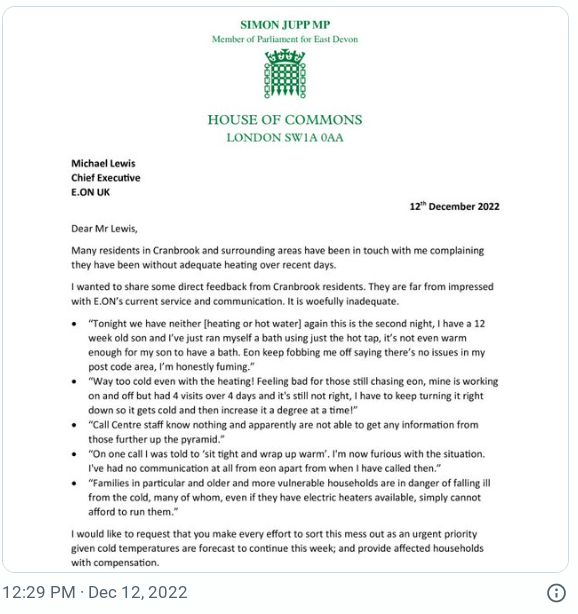
MP for the area Simon Jupp has urged the energy giants to resolve the issue immediately. He wrote an open letter to E.on’s Chief Executive Michael Lewis, in which he slammed their response to the ongoing issue as “woefully inadequate”.

An E.ON spokesperson said that they were aware of a number of customers in Cranbrook reporting issues with their heating and hot water supplies. They said it was not an issue with the network itself, the priority was to return heat to customers, and they apologised for any inconvenience caused.

Affected residents have said that they have been forced to stay with friends and family as it has been too cold to stay in their homes. Some have been forced to use fan heaters to keep warm.

One resident, Faye Thompson, has said she has been taking her children out for the day and been staying with relatives and friends as it is too cold to sleep in the house. She explained that the family has had no heating for five days and, only today has had the heating fixed.

Faye said: “I live in Cranbrook and, along with several others, I’ve had no heating for five days now. I’ve phoned eon multiple times and been told they’re working on it. I’ve asked for electric heaters to be supplied but this is not forthcoming.

“Sunday was the third night I’ve had to take my children out for the day. Friends and relatives are putting us up overnight because I can no longer sleep at home. I’ve received absolutely no communication, despite being told text messages have been sent to customers.

“The situation is completely unacceptable. They told me on Thursday that it was a site issue. (We have communal district heating). I was then told it was an individual on Friday. I’m getting different information every time I speak to someone. I am so frustrated with the whole situation and this cannot continue.”

Faye said that on Monday her heating had been fixed. But she went on to say: “It was eight degrees in my property today and I should work from home. Thankfully they attended late in the morning and it’s now been fixed. I’m so frustrated that this could have been resolved last week.”

Another resident, Julian Bennellick, who has lived in Cranbrook with his wife and daughter for over six years and is having heating issues for the first time. The household’s heating has been off since Thursday and they are now using fan heaters.

After explaining to an operator over the phone on Friday, December 9, that the radiators did not need bleeding and that he believed it was a problem with the heat exchanger, Julian was told an engineer would be sent out to his home today (Monday, December 12).

Julian said: “I’ve taken the day off work. We’ve been running a fan heater all weekend, just to keep one room warm which obviously impacts us because we’re paying for more electricity.

“It’s obviously impacting a lot of people. I think the main thing is that we’re tied into E.on so we can’t even get a third party plumber out. My wife’s a nurse for the NHS and she’s done a night shift and had to come back to a freezing cold home.”

There have been further comments made by others living in Cranbrook on social media, with some claiming that even those on the “priority list” have been told they may have to wait six to eight hours for an engineer. It is unknown if any of the homes affected by this particular issue have had their heating resolved.

Cranbrook is part of a ‘district heating scheme’, meaning they are all heated by an energy centre, rather than a boiler, located half a mile away which can only be run by one supplier, which is currently E.on. All 2,000 homes are signed up to E.on under an agreement which is in place until 2090.

East Devon MP Simon Jupp has also now called on E.on to resolve the issue promptly and offer compensation after he received multiple complaints from Cranbrook households over the course of the last week. The Conservative wrote an open letter to E.on’s Chief Executive Michael Lewis, in which he slammed the energy provider’s response to the ongoing issue as “woefully inadequate”.

In the letter, Mr Jupp asked: “I would like to request that you make every effort to sort this mess out as an urgent priority given cold temperatures are forecast to continue this week; and provide affected households with compensation.

“Your services and basic communication about this matter have fallen far short of what is acceptable. Cranbrook residents deserve so much better.”

My open letter to @EONEnergyUK after many residents in #Cranbrook continue to struggle without heating.

E.ON must step up, urgently reconnect customers & compensate everyone left without heating during this bitterly cold snap.

pic.twitter.com/YXDoA0sxc2

He Tweeted the letter, stating: “My open letter to @eonenergyuk after many residents in #Cranbrook continue to struggle without heating. E.ON must step up, urgently reconnect customers & compensate everyone left without heating during this bitterly cold snap.”

An E.ON spokesperson said: “We are aware of a number of customers in Cranbrook reporting issues with their heating and hot water supplies. This is not an issue with the network itself, the problem stems from an issue with valves in the heat interface units in some customer homes, and this disrupts the hot water flow from the network into individual properties.

“Our priority is to return heat to customers as quickly as possible and engineers have been working around the clock to visit customers and reset or replace valves that have failed. We are prioritising vulnerable customers and redeploying engineers from other E.ON sites in support.

“We apologise to customers and we’re making portable heaters available for their use while our engineers complete the works. All affected customers will be given compensation as part of our service guarantees.”

EDDC named and shamed: Watchdog names social landlords in England with worst complaints records

The social landlords in England with the worst records of maladministration have been named by the housing ombudsman, who said failures were “deeply concerning” and that poor performance was “still at unacceptably high levels”.

[Owl understands EDDC will be releasing a statement this morning]

Robert Booth www.theguardian.com 

Richard Blakeway, the regulator of England’s 4.4m social homes, concluded there was maladministration in 90% of the complaints cases brought to it by tenants of Golding Homes, which provides housing for more than 21,000 people across Kent, including in the case of a resident who complained for seven years about problems including damp and cold.

He said 86% of complaints considered about Lambeth and Southwark Housing Association in London were judged to amount to maladministration, and 89% of complaints about East Devon district council. The figures relate to the period from April 2021 to March 2022.

The physical condition of homes was the biggest reason for referrals to the watchdog over that period, and in more than half of cases it concluded there had been service failures by the landlord. The named landlords have been approached for comment.

Blakeway said: “We recognise that social landlords and residents are facing unprecedented challenges, with a cost of living crisis and ageing homes, but a positive complaints handling culture remains vital. Our review highlights the challenges with embedding this and also shows poor performance in some service areas still at unacceptably high levels.

“Too often landlords can focus on managing the reputational risk to their organisation when things go wrong, rather than learning and improvement.”

Steph Goad, the chief executive of Golding, said: “In 2021-22, we had two findings of maladministration from the housing ombudsman. We understand two cases is still too many and we fully accepted the ombudsman’s findings and have been working to put things right and learn from them.”

The handling of complaints was a major cause of problems, with shortcomings found in more than eight of 10 cases where a tenant had raised concerns about how their complaint to the landlord was handled. There was also a significant decline in the number of residents who think making a complaint would make a difference, compared with the previous year.

There has been growing concern about safety and standards in social housing after the death of two-year-old Awaab Ishak as a result of chronic damp in a rented flat in Rochdale.

After a coroner’s verdict last month that prolonged exposure to mould was to blame for the boy’s fatal respiratory illness, the chief executive of the registered social landlord was fired and Michael Gove, the secretary of state for levelling up, housing and communities, directed all English councils to “make an urgent assessment of housing conditions … with particular focus on issues of damp and mould, and enforcement action being taken.”

Gove said: “I am putting housing providers on notice, I will take whatever action is required to improve standards across the country and ensure tenants’ voices are heard.”

The housing sector and campaigners have argued they need greater funding to build new homes and have warned that a recent decision by the government to cap rent rises at 7% in response to the cost of living crisis will hamper their progress.

Planning applications validated by EDDC for week beginning 28 November

Tonight Owl will be switching off!

(Between 5pm and 7pm)

UK power prices hit record high amid cold snap and lack of wind power

The anticipated surge in power demand on Monday evening will coincide with a planned use of the National Grid’s demand flexibility service between 5pm and 7pm.

Alex Lawson www.theguardian.com 

UK power prices have hit record levels as an icy cold snap and a fall in supplies of electricity generated by wind power have combined to push up wholesale costs.

The day-ahead price for power for delivery on Monday reached a record £675 a megawatt-hour on the Epex Spot SE exchange. The price for power at 5-6pm, typically around the time of peak power demand each day, passed an all-time high of £2,586 a megawatt-hour.

Prices are surging as the weather forces Britons to increase their heating use, pushing up demand for energy, despite high bills.

Snow and ice have caused disruption as the cold weather looks set to continue into this week, with snow forecast for parts of east and south-east England, as well as Scotland.

The cold snap, which is expected to last for at least a week, comes as wind speeds reduced sharply, hitting power suppliers.

Live data from the National Grid’s Electricity System Operator showed that wind power was providing just 3% of Great Britain’s electricity generation on Sunday. Gas-fired power stations provided 59%, while nuclear power and electricity imports both accounted for about 15%.

The increase in power prices come amid jitters over energy supplies this winter. National Grid warned in October that a combination of factors such as a cold spell and a shortage of gas in Europe related to the war in Ukraine could lead to power cuts in the UK.

The anticipated surge in power demand on Monday evening will coincide with a planned use of the National Grid’s demand flexibility service between 5pm and 7pm. The scheme pays businesses and households to cut their consumption at peak times to reduce the strain on the grid.

The scheme has been used several times as part of a series of tests but is yet to be used as a result of electricity supply shortages. National Grid flirted with using it under these circumstances last month but did not do so.

Dr Agostinho Moreira de Sousa, a consultant in public health medicine at UK Health Security Agency, encouraged those with health conditions to heat their homes to a comfortable temperature. “In rooms you mostly use such as the living room or bedroom, try to heat them to at least 18C if you can. Keep your bedroom windows closed at night. Wearing several layers of clothing will keep you warmer than one thicker layer,” he said.

German day-ahead power prices rose 33% to €434 (£373) a megawatt-hour, the highest since 13 September, while the French contract rose 40% to €465 a megawatt-hour, Bloomberg reported.

Campers, please don’t all flush at once

From a Budleigh correspondent:

Observation suggests that trenching is occurring between the Otter Head combined sewer outfall pipe, across the fields, to link up with the Ladram Bay treatment plant (covering the Ladram Bay holiday park).

I cannot find any report of the work being carried out on the SWW site In Your Area – supply interruptions and outages (southwestwater.co.uk)

It seems from the official SWW web site NO work is being carried out at Budleigh Salterton or Ladram Bay! People in Granary Lane, B.S. may not agree. (See https://eastdevonwatch.org/2022/12/09/why-are-budleigh-residents-getting-hammered-daily/)

Does this mean that the Ladram Bay pollution problems will, in future, be diverted to Budleigh Salterton by creating a super combined sewer outlet at the Otter Head?

Campers, please don’t all flush at once!

Devon and Cornwall beaches break records for high water quality standards

How can this be when we all know that sewage discharge into the sea and rivers continues at record levels? – Owl

Environment Agency www.gov.uk and see www.southwestwater.co.uk 

Most beaches met the highest international standards for water quality cleanliness where we bathe. Our beaches and coast helps define the fabulous South West.

Bruce Newport, Devon and Cornwall Area Environment Manager said:

“Our beaches are 100% compliant, so now the challenge is to work collaboratively with everyone to keep our healthy waters in an excellent state for people to enjoy. Our coastline is an incredible natural feature.

We have had relatively few reports of pollution on our beaches this summer which is a credit to everyone maintaining and improving our bathing waters. We would like to say thank you to those groups, communities and businesses which have gone above and beyond to keep pollution out of our water ways.

Bathers and surfers are using our online Swimfo app to make decisions on where to go for the best places to bathe in the summer. Just by looking at Swimfo on your mobile you can get up to date information on the water quality of many of our bathing beaches.”

This year 9 beaches in Devon and Cornwall have improved their bathing water classification, while 4 beaches have deteriorated – Teignmouth Town in Devon,  and Cornwall’s  Readymoney Cove, Porthminster and Swanpool.

Those improving from Good to Excellent are Ladram Bay, Croyde and Plymouth Hoe East in Devon, and Gorran Haven, Pendower, Porthwrinkle and Porthcurnick in Cornwall. Improving from Sufficient to Good are Par Sands in Cornwall and Combe Martin in North Devon.

The improvement this year from Sufficient to Good at Combe Martin is the result of a strong collaborative effort by the Environment Agency, local groups and businesses.

Where foul water is wrongly connected to drains leading to our beaches, poor quality normally follows – this year wrong connections have been identified, fixed and we continue to work with South West Water with this important work.

In North Devon, Croyde has improved from Good to Excellent.  Our scientists have used analytical tests to home in on pollution sources resulting in us working with farmers in the catchment to resolve potential pollution issues. We are committed to doing more in 2023.

In Cornwall, Par Sands has improved from Sufficient to Good, the result again of a collaborative effect by the Environment Agency with local people. We have carried out extensive monitoring in the catchment, investigated potential sources of pollution and ensured problems causing pollution have stopped.

At Teignmouth we continue to work with Teignbridge Council to improve water quality at Teignmouth Town.  We are carrying out investigations into the cause of elevated bacteria numbers in samples taken at Teignmouth in August.

The 9 beaches in Devon and Cornwall which have improved their bathing water classification are:

Devon: Ladram Bay, Croyde, Combe Martin, Plymouth Hoe East

Cornwall: Porthcurnick, Pendower, Gorran Haven Little Perhaver, Portwrinkle, Par Sands

Published 30 November 2022

Has Rishi Sunak’s furlough scheme contributed to the labour shortage?

Did Rishi Sunak with his “passive and prolonged” furlough scheme miss a trick? 

“With the Conservatives we’ve seen our economy grow, with rising wages and unemployment at a historic low.” www.conservatives.com Eh? – Owl

David Smith www.thetimes.co.uk (Extract)

…Brexit is one reason why the UK is an outlier when it comes to employment performance since Covid. But there may also be a contribution from other factors, including the policies designed to fight the pandemic.

The furlough scheme, a first for the UK, achieved its main aim of preventing what could have been a huge rise in unemployment. But there are growing suspicions that it may have contributed to the rise in economic inactivity.

This may have been by giving older workers, those most responsible for the rise in inactivity, a rehearsal for retirement. But also, as Tony Wilson, director of the IES, says, the furlough scheme was “passive and prolonged”.

Other countries, notably France, combined their pandemic job support with “active” measures to encourage workers to train or re-train, rather than just sit at home. Some tried to anticipate the changes in job demand. Most had previous experience with furlough-type schemes. For the UK, it was novel. As Wilson notes, people were “parked in furlough”, with few obligations on them or their employers.

Re-establishing the flow of EU migrants is not an option, at least in the short term. Getting the newly inactive (and some of those inactive longer term) into work, notably those not suffering from long-term ill health, must be a priority. Governments used to do this in response to high unemployment. Now they need to do it in response to rising inactivity, its 2022 equivalent. Both Wilson and Saunders emphasise that there is no shortage of potential “active” labour market measures, as recommended by international bodies.

The labour market needs some help, a necessary element of supply-side policy to boost long-run economic growth. Doing nothing is not an option……

The public sector pay gap and what would it cost to reduce it 

A couple of articles over the weekend consider the background, whether the government’s stance is sustainable and the “affordability” of reducing it. – Owl

The rising pay gap

David Smith www.thetimes.co.uk (Extract)

…What can be done about our dysfunctional labour market? Starting with strikes, the root cause is similar. For public sector workers, and for those where the government stands behind employers, such as the railways, the biggest falls in real wages are happening.

A situation in which private sector pay is rising by nearly 7 per cent a year, against public sector pay growth of 2 per cent, would not be sustainable in any circumstances, let alone when inflation is in double figures.

A government that, admittedly under a different prime minister, was willing to announce big unfunded tax cuts will have to find more money for public sector pay settlements. A 19 per cent pay increase, demanded by England’s nurses, is impossible to justify. A 7.5 per cent increase, which the Scottish government has offered to its nurses — avoiding strike action — is not.

There is little danger that higher public sector pay settlements would trigger a wage-price spiral. Rather, it would be public sector pay catching up. The government wants to limit strike action by essential workers by legislating for minimum levels of service, but that is a long way down the track and of little relevance to the current disputes. The Treasury, of course, gets back some of the cost of higher public sector pay awards in tax and national insurance. Bigger public sector pay increases would flow directly into the economy in these recessionary times….

How much would a public sector pay rise really cost the UK government?

Rishi Sunak called out

Phillip Inman www.theguardian.com 

Rishi Sunak was called out last week for saying it would cost £28bn to prevent inflation eating into public sector wages. According to No 10, a 10% pay rise would cost Britain’s 28m households £1,000 a year in higher taxes.

Not according to the Institute for Fiscal Studies, which says the Treasury’s sums don’t add up. So how much would it cost to give public sector workers a pay rise?

A pay rise of 10%

Ben Zaranko, an economist for the thinktank, says that even using Sunak’s methodology, the figures are wrong. The total public sector pay bill in 2021/22 was £233bn. Using the 10.1% average figure for the consumer price index forecast by the Office for Budget Responsibility, “the cost would be £23.5bn”.

The government has already agreed to finance a 3% rise, so the extra cost is only £18bn, he says. It could be as low as £13bn if the government’s fresh concessions for teachers and other groups are factored in as “already paid for”.

Ministers should also expect to get back about 30% of the extra spending from higher income tax and VAT receipts, reducing the bill to £8.5bn.

A pay rise of 7%

The RMT has called for a minimum of 7%, while some healthcare unions have suggested they would accept a similar amount. If all public sector workers were offered 7% rather than 10%, the total extra bill would come down from £18bn to nearer £12bn – about £9bn with extra concessions stripped out. About £4bn would flow back to the Treasury in higher tax receipts, leaving an extra £5bn bill.

Will a pay rise push up inflation?

A below-inflation public sector pay rise will not increase inflation, especially if lower-paid staff are the biggest beneficiaries of a deal. The public sector does not increase its charges to reflect higher staff pay, as private-sector firms might. The extra spending power given to public-sector workers pay is also likely to be spent on energy bills and food, which are costs dictated by global markets.

MPs urge government to support local news platforms such as Nub News

Would that include “East Devon Watch”? – (Owl imagines Simon Jupp is an avid reader).

FORMER Cabinet media minister and Nub News reader Sir John Whittingdale has called on the government to ensure it supports local online news platforms and uses their effectiveness as a way of informing communities.

honiton.nub.news 

Sir John, who represents Maldon in Essex, is regularly featured on the pages of his local Nub News site and is a keen advocate of ensuring the government recognises the value of online media.

The growing success of Nub News – which this week launched its latest platform serving Stoke – has seen the company grow since launching with just a few sites in 2018 to now publishing to more than 50 local communities across the UK, including our own Honiton Nub News.

Sir John says he has watched the company’s success with great interest and has spoken many times with company founder Karl Hancock and he is hoping to persuade the government to make more use of the Nub News sites and other locally founded and sourced news online news platforms.

In the House of Commons today (Thursday, 8 December) Sir John challenged fellow Essex MP and junior minister Alex Burghart about his view of locally-based publishers and asked: “What recent assessment have you made of the effectiveness of Government information campaigns in local media?”

Mr Burghart, MP for Brentwood and Ongar and the Parliamentary Secretary for the Cabinet Office with responsibility for supporting the cabinet regarding the government’s communications service, responded by saying: “The government monitors the effectiveness of its communications campaigns and we recognise the enormous trust the public has in local media.

“And therefore the important role it plays in spreading our messages.

“As just one example, the recent press partnership on access to NHS services used local media to inform the public of where to seek medical advice. 67 per cent of readers said they trusted the articles – highlighting local print’s importance to the community.”

That prompted an immediate challenge from Sir John, who wanted an assurance that online media will get fair treatment.

He said: “My friend is absolutely right about the power of local media in getting across vital health messages.

“But will he look at ensuring that local online only publishers like Nub News are included in future campaigns as well as local print media?”

Mr Burghart responded: “I thank my honourable friend for his question, I know he knows a great deal about this subject. And I completely agree with him that, all in, all together in harness, the power of media was particularly effective at reaching specific audiences to spread vital information.

“Obviously as he will appreciate, sometimes we want a more targeted approach so that we get better, cost effectiveness but I should also say to him that we use OmniGov and should any local outlets online or otherwise wish to be part of that list they can do so by contacting OmniGov directly.”

OmniGov, which is owned by US agency giant Omnicom, has handled the government’s media services account since 2018 and in December last year retained the account for a second four-year term. The contract is one of the most valuable accounts in British advertising, with an annual spend of more than £200m.

However, not everyone is a fan of the agency, including Sir John who told Nub News that he has been expressing his concern about its effectiveness in reaching local communities and supporting smaller publishers for almost two years.

He said: “I have repeatedly pressed them to include online publications and was deeply frustrated that they were unwilling to do so.

“This is a significant issue and my questions today were just a part of it. Now I have raised it with Alex Burghart in the House, I will be following up with him to press this matter and seek change to support organisations like Nub News.”

Nub News founder Karl Hancock, welcomed Sir John’s support today and thanked him for raising the matter, which Mr Hancock has also previously raised direct when appearing before the government’s Digital, Culture, Media and Sport Committee alongside other leading media industry figures earlier this year.

He said: “I am grateful for the support and advice of Sir John. It is refreshing to see his passion to see a fairer and more level playing field in the media publishing world where the pressure from a few big players make market fairness and opportunity disproportionate.

“As I have said before, the current business model is broken. Something drastic has to happen. I’m not asking the Government for money, I’m asking for a level playing field.

“I look forward to seeing the outcome of Sir John’s challenge and questions today.”

Meanwhile the growth of Nub News which is committed to putting local news back at the top of the news agenda in towns across the UK continues apace.

The latest addition – and a new flagship site for the growing Crewe-based media company – is Stoke Nub News.

Edited by Stoke-born journalist Sarah Garner, Nub News’ latest site exemplifies the ethos of Nub News and our headline agenda of putting local news and community support first, while supporting and promoting local businesses, traders and entrepreneurs.

Mr Hancock added: “The group continues to seek to consolidate in its existing towns and grow them exponentially towards neighbouring towns and communities and there are more new town launches planned.

“As well as providing a regularly updated, easy-to-read news platform free from clickbait, pop-ups, and intrusive surveys we harness the power of social media, with easy-to-follow channels on Facebook, Twitter, Instagram and You Tube. Millions of readers each month are visiting Nub News in all its formats.

“We hope that’s the message the government will be taking on board after today’s debate in the Commons.”

Strep A: Pharmacists challenge government’s reassurance there is no antibiotics shortage

“Frustrated” pharmacists reporting a shortage of antibiotics have urged the government to act now – but health officials continue to insist there are no supply chain issues.

So who do you believe> – Owl

www.itv.com 

The conflicting messages have caused confusion at a time when the health service is tackling a Strep A outbreak, leading to the deaths of 16 children, during its most stretched time of year.

Pharmacists across the UK say they are struggling to get hold of some of the most commonly prescribed antibiotics, such as penicillin and amoxicillin, which are used to treat Strep A.

The Association of Independent Multiple Pharmacies (AIMP), which represents around 4,000 pharmacies across the country, told ITV News that in some cases, patients have been forced to travel over 20 miles to get their prescribed medication.

But Health Secretary Steve Barclay earlier said checks within the Department of Health and Social Care (DHSC) have not revealed an issue with supply of the medicines, after the National Pharmacy Association earlier there were “blips” in the supply chain of liquid penicillin, which is often given to children.

The Royal Pharmaceutical Society earlier said pharmacists are “under enormous pressure” and “struggling to get supplies” amid the outbreak.

AIMP Chief Executive Leyla Hannbeck said pharmacists have for some time seen a steady rise in the number of prescriptions for antibiotics, but since the beginning of this week it’s become “incredibly difficult” to get hold of them – urging the government to act now.

“We are concerned that the government are saying that there are no supply challenges when in fact there is and patients are coming in and we are unable to fulfil the prescriptions,” Dr Hannbeck told ITV News.

“Where is this supply that they’re talking about? Because it certainly isn’t finding its way to pharmacies,” she added.

“And this issue is across the country, it’s not just one area, everywhere is the same.

“Pharmacists simply get a message from suppliers saying that there is no stock availability. Sometimes some lines become available for a short period… but as soon as they come on, they go off again.”

She said this has led to antibiotic prices to “jump up” by several pounds per packet.

“We feel frustrated and as healthcare professionals. We don’t want to turn our patients away. Our teams are exhausted on the frontline,” added Dr Hannbeck.

But she urged the public not to panic and said protocols will be put in place if the government does not act within the coming days. In the meantime, she suggested patients keep trying alternative pharmacies.

Dr Hannbeck said pharmacists may also have to liaise with doctors to consider prescribing alternative antibiotics.

She says the DHSC should have planned better.

“We are constantly, as pharmacists, finding ourselves in this situation – as soon as there’s a little bit more demand, then supply falls flat,” she said.

She urged the department to meet with all groups in the antibiotics supply chain from manufacturers, to wholesalers, to pharmacists: “to identify what the issues are so we can all move forward, and offer solutions so that we don’t fall into this again.”

A Department of Health and Social Care spokesperson said on Thursday: “There is no supplier shortage of antibiotics available to treat Strep A. As the Secretary of State said this morning, we sometimes have surges for products and increased demand means some pharmacies are having difficulties obtaining certain antibiotics.

“We are working urgently with manufactures and wholesalers to explore what can be done to expedite deliveries and bring forward stock they have to help ensure it gets to where it’s needed, to meet demand as quickly as possible and support access to these vital medicines.”

Ministers hold out against proposal on reporting hospitality in new MPs’ code

Rishi Sunak’s government is expected to accept most of a proposed new code of conduct for MPs after the Owen Paterson scandal but has rejected the idea that ministers should declare more details about free hospitality from lobbyists and companies.

Rowena Mason www.theguardian.com 

MPs will debate the proposals put forward by the standards committee on Monday, with Penny Mordaunt, the leader of the House of Commons, likely to accept 18 of the 20 recommendations. Key measures include tightening the rules on lobbying to stop MPs providing paid parliamentary advice, consultancy or strategy.

However, in a move that could trigger another standards row, the government is holding out against a proposal to ask ministers to register with parliament any hospitality provided by third parties worth more than £300 within 28 days, as is required for other MPs.

Instead, they are allowed to make transparency declarations through their departments, without citing a value for hospitality received, and these are often infrequent, delayed and patchy. It is thought Mordaunt may make some alternative proposals to improve their speed and accuracy.

The government is also not accepting the idea of adding a description to the seven principles of public life saying that MPs and other public servants should exemplify non-discriminatory attitudes in their behaviour, which ministers oppose on free speech grounds.

Sunak has promised a more ethical government than under Boris Johnson, but he has so far failed to find a candidate to be the new independent adviser on ministerial interests. This means the disclosure of financial interests of new cabinet ministers is already likely to be delayed from its six-monthly publication.

However, the new administration appears to be willing to accept more proposals than Liz Truss’s government, which issued its response in September rejecting more changes. It is understood the government plans to write to all MPs on Monday setting out its position before the debate.

Chris Bryant, the chair of the Commons standards committee, said it was “bonkers” that the government was refusing tougher disclosure standards for ministers. “It must surely be in the public interest that all MPs are treated equally and that all financial interests are accessible in a timely fashion and in a single place online,” he said.

“The commissioner for standards, the Institute for Government and the 1922 Committee all agree. But oh no, the government is holding out. Penny Mordaunt promises that she will do ‘something’ about this as leader of the house ‘by next summer’. But that won’t include ending the ministerial exemption as she insists on treating ministers differently.”

He added: “It perplexes me that the government thinks it can afford another row over parliamentary standards. I don’t think that is in parliament’s interests, let alone the government’s. Traditionally, the rules of the house are not a partisan matter and MPs are meant to be able to vote freely with their conscience on house business.”

He said that any attempt to whip the Commons on an MPs’ standards matter would “feel like Owen Paterson all over again and voters may conclude that the government has learned nothing at all. Far better to have an unanimous decision by the whole house without a vote to tighten the rules and put our house in order.”

The government’s support for most of the rest of the code means the changes are likely to go ahead on a cross-party basis. This will mean MPs will be banned from providing paid advice as a parliamentary consultant, strategist or adviser – although it stops short of time or earnings limits on second jobs.

However, if they do have a second job, MPs will now have contracts that specify they cannot lobby ministers or officials on behalf of their employer.

A government spokesperson said: “We have worked closely with the standards committee to strengthen our parliamentary standards and enhance our code of conduct. This is important ongoing work and necessary for public trust in democracy.

“We support 18 of the 20 committee recommendations, but this is ultimately for the house to decide.

“With regard to parity on ministerial and parliamentary interests our objectives to achieve parity on the timing of declarations align with the committees. However we do not agree that parliamentary resource, which is there to help the MP represent their constituents, should be used to administer what is a government responsibility, nor that separation of powers and responsibilities should be blurred. We think this has serious negative implications for all MPs. We think that would be unfair to MPs who are ministers or trade envoys.”

Greedy investors try to halt ban on water dividends

Powerful investors, including foreign wealth funds, are trying to derail plans to prevent sewage-dumping water firms from dishing out billions of pounds in dividends. 

Luke Barr www.dailymail.co.uk 

Regulator Ofwat wants firms which illegally dump tons of waste into our rivers and seas to stop funnelling huge sums to their shareholders. Instead, the watchdog believes they should use the cash to fix the UK’s antiquated water systems. In addition to despoiling waterways, firms have also been criticised for hosepipe bans after a heatwave left water supplies dwindling. 

Analysis by The Mail on Sunday revealed water companies had already paid their backers nearly £3billion in dividends in the first part of this year alone. 

That took the total since 2010 to £20billion, benefiting investors from countries including China, Abu Dhabi and Malaysia. Critics say the cash that was siphoned into investors’ coffers should have been invested in improving Britain’s ageing water infrastructure. Ofwat wants the power to halt the vast dividends when firms fail to meet official targets. 

But its chief executive David Black told the MoS he is facing ‘strong opposition’ to the proposal. 

He said companies argue the payments are important and claim that restricting them would make the water sector ‘less attractive’ to investors. Ofwat’s latest report has found poor performance is the norm. 

Black said: ‘Too many companies are performing too poorly in too many areas.’ He took particular aim at Thames Water and Southern Water, saying: ‘They have got a combination of poor finances and really poor operational performance.’ Between them, the pair have almost £20billion worth of debt. 

Over the past three years, bosses of the UK’s biggest water firms have been paid £50million, which includes significant bonuses. ‘We think the public is very frustrated by the perception that company executives are rewarded when performance is poor,’ said Black. He wants powers to compel shareholders to invest more in infrastructure. 

Ofwat has been accused of turning a blind eye to company failures. But Black said: ‘It is very easy to criticise the regulators but ultimately it is the companies that are responsible for delivering outcomes. That’s where the focus ought to be.’

Thousands of new spring bulbs and pollinator plants on Exmouth seafront aim to give a boost to nature

Spring bulbs and pollinator plants in their thousands have been added to Exmouth seafront in a bid to attract wildlife and insects.

Becca Gliddon eastdevonnews.co.uk 

The Beach Gardens, on Exmouth seafront, is now home to more than 2,500 herbaceous perennials and around 3,000 bulbs, that will return year after year as they have been selected to survive harsh coastal weather conditions.

The planting was carried out over five days by Exmouth in Bloom with East Devon District Council (EDDC), and the displays will make up part of the town’s Britain in Bloom UK finals entry next summer.

Exmouth

Councillor Geoff Jung, EDDC portfolio holder for coast, country and environment, said: “It is brilliant to again see EDDC’s Streetscene operatives and Exmouth in Bloom volunteers working in unison to improve the seafront for everyone to enjoy.

“They all work tirelessly to make our green spaces look vibrant and beautiful, as well as ensuring our local wildlife and nature can thrive.”

EDDC promises a ‘sea of colour’ in the spring when the new bulbs and plants bloom at the Beach Gardens.

Bulbs such as Alllium, Daffodils and Sicilian Honey Garlic have been planted for their tolerance to the harsh coastal environment and their benefit to wildlife.

The district council said it aims to make its gardens and open spaces ‘more environmentally friendly while looking after delicate eco-systems’.

An EDDC spokesperson said: “The extended flowering periods, blooming right through from February to October, will make the plants key in providing pollinators with a steady source of nectar and pollen, at a time when flowers are scarce.

“Seed-heads and stems will also be left over the winter as an important food source and habitat for birds and insects.”

They added: “EDDC’s Streetscene teams, along with Exmouth in Bloom volunteers, have been working hard to complete the planting designs before winter frosts arrive – putting in five long days of work.

“The scheme will be another string in the bow of Exmouth as the town prepares for the Britain in Bloom UK Finals in summer 2023.”


Ministers to take us to court to keep Covid review secret – Open Democracy

Jenna Corderoy www.opendemocracy.net 

The government is taking openDemocracy to court to resist having to publish its secret “lessons learnt” review of the Covid pandemic.

Chiefs at the Department of Health and Social Care only last month agreed to publish the document, following an 18-month Freedom of Information battle that ended with a disclosure order by the independent watchdog.

But we were told today that the department had lodged an appeal against the order by the Information Commissioner’s Office (ICO). It means an information tribunal is likely to be held next year.

Layla Moran, the chair of the All-Party Parliamentary Group on Coronavirus, called it a “blatant attempt by the government to gloss over its cack-handed management of the pandemic” and “an insult to the British public”.

The news coincides with the launch and publication of former health secretary Matt Hancock’s pandemic diaries as a hardback book – and the same department’s refusal to hand over his official ministerial diaries covering the same period.

openDemocracy has a strong record of winning Freedom of Information cases – our most recent being against the Cabinet Office.  

The existence of the ‘lessons learnt’ review was revealed by HuffPost UK last year. But the DHSC refused to hand it over, claiming that its release would be “likely to undermine the safe space for experts and government officials to debate live policy issues”. 

It is thought to be the work of civil servants in the DHSC conducting internal assessments of what went wrong to improve best practice.

An independent inquiry into the UK’s response to the pandemic is already under way. Officially launched in July, the inquiry will examine how well prepared the UK was for a pandemic, as well as the decisions taken by the UK government once Covid arrived.

We rely on the backing of our readers to keep going. If you think it’s important that the government release documents like this, back our work here.

Environment Agency to boost natural flood management after pilots

Low-tech “natural” flood management such as using natural materials to slow river flow and storing flood water on meadows will play a key role in preventing future floods, according to the chief executive of the Environment Agency.

[Don’t forget the Beavers. – Owl]

Patrick Barkham www.theguardian.com 

Sixty pilot natural flood management projects have helped protect 15,000 homes and create storage for up to 1.6m cubic metres of flood water, while also helping nature recovery on 380 miles (610km) of river and on 4,000 hectares of wetlands and woodlands.

Announcing the results of the four-year natural flood management pilots, Sir James Bevan, the chief executive of the Environment Agency, said: “The warning signs of the climate crisis are stark – and sadly devastating flooding is likely to become a more familiar sight over the next century. By harnessing the power of nature alongside our traditional flood defences, we can not only help to keep communities safer, but also create wildlife havens and tackle the climate emergency.”

Natural flood management helps to slow the flow of water across the landscape via measures such as restoring meanders to canalised rivers, recreating wetlands that store flood water, and planting trees and hedges by rivers that also help absorb water.

The £15m pilot projects included Cumbrian schemes whereby farmers removed compaction in their soils to reduce water runoff, more than 100 “leaky” wooden barriers built by the Forestry Commission on streams, and a drystone wall redesigned so that it could hold water.

In Warwickshire, the community-led Shipston Area Flood Action Group built 700 leaky barriers and ponds to slow the flow of water on the River Stour during heavy rainfall, reducing the flood risk to 17 villages and towns.

In Sutton, Greater London, sustainable urban drainage systems have been installed in six schools. These systems capture rainwater runoff from surfaces like roofs, roads and pavements, preventing the drainage network from becoming overwhelmed and filtering out contaminants before the water enters drains and ultimately flows into a river.

This scheme, including planters and rain gardens built on playgrounds, is now preventing more than four hectares of hard surfaces sending rainwater into the River Wandle, helping reduce pollution in this chalk stream.

Environment minister Rebecca Pow said: “We know that flooding can have a devastating impact on people’s lives, homes and livelihoods. That is why we are investing a record £5.2bn in flood and coastal defences to ensure more communities are better prepared – and nature-based solutions are a key component of this.

“The additional benefits of natural flood management for people and wildlife are vast – helping us reach our ambitious net zero targets, providing vital new habitats and creating areas of natural beauty for people to enjoy for generations to come.”

Each natural flood management scheme in the pilot cost an average of £250,000 – far less than conventional “hard” engineering such as flood walls. “That’s on a completely different scale to most flood projects,” said Julie Foley, the director of flood risk strategy at the Environment Agency. “For the benefits, given they are so wide-ranging, that’s incredibly good value for money.”

Foley confirmed that the Environment Agency would now spend more of the £5.2bn earmarked for flood management between 2021 and 2027 on “mainstreaming” natural flood management, with a target of doubling the schemes it supports.

There were 85 partners involved in the pilot, including the Rivers Trust, Wildlife Trusts, local authorities, universities and local businesses.

The pilot project report found that involving landowners and land managers was crucial because they are responsible for maintaining the natural defences in the future.

The government’s environmental land management schemes are set to include payments to help landowners provide the “public good” of flood alleviation via such natural solutions.

Sarah Fowler, the chief executive of the Wildfowl & Wetlands Trust, one of the pilot partners, said: “Wetlands help us mitigate and adapt to the consequences of climate change, which is why WWT is calling for the restoration and creation of 100,00 hectares of wetlands in the UK.

“This report demonstrates the power of nature, and wetlands in particular, to tackle flooding. I look forward to WWT working with the Environment Agency, using our expertise in wetland science and wetland delivery, to build natural flood management solutions at scale to manage current and future flood risk.”