Revealed: NHS trusts tell patients they can go private and skip hospital queues

NHS trusts with record waiting lists are promoting ‘quick and easy’ private healthcare services in their own hospitals, offering patients the chance to skip years of queues observer can reveal.

ukdaily.news 

Hospitals offer hip replacements from £10,000, cataract surgery from £2,200 and hernia repairs from £2,500. MRI scans are offered for between £300 and £400.

This comes as figures show a record 7.21million people waiting for NHS treatment in England, routinely exceeding the maximum waiting time of 18 weeks for non-urgent referrals. Health experts warn of the danger of creating a “two-tier” healthcare system. On observer Investigation has revealed:

  • The East Sussex Healthcare NHS Trust has thousands of patients awaiting diagnostic tests but is offering “quick access” to scans through its private department.
  • Great Western Hospitals NHS Trust in Wiltshire is warning patients that services are “extremely busy” while its private department is promoting self-pay treatment for those who “don’t want to wait for an NHS referral”.
  • James Paget University Hospitals NHS Trust in Norfolk advertises private services on its NHS website, stating: “We provide highly experienced, consultant-led services… with no waiting list.”

The premium treatments are provided through private patient units owned and operated by NHS trusts, usually located on hospital premises. Procedures are often carried out by the same staff who would ultimately treat patients if they remained on the NHS waiting list. Under a code of practice, private services cannot impact NHS patient care and profits go back to the health service.

Sussex Premier Health, part of the East Sussex Healthcare NHS Trust, is doing MRI scans in 48 hours for £379, according to a recent Instagram promotion. The Trust has more than 7,800 patients awaiting diagnostic testing.

Sussex Premier Health MRI scan promotion. Photo: Instagram/sussexpremierhealth

Great Western Hospitals NHS Trust in Wiltshire provides private health care through a 20 bed unit, the Shalfourne suite. The private patient website states: “We believe that quality healthcare should be easily accessible.”

A woman whose elderly mother was treated by the Trust in October claims she was told she could avoid long waiting lists if she paid. “My 86-year-old mother has to wait two years for the NHS or can see the same surgeon in the same hospital and be treated for £1,200 in two weeks. How is that right?” she wrote on Twitter.

A North East teacher, who asked not to be named, said she borrowed £350 for an MRI scan. “At the appointment there were posters on the walls saying the times for results to be returned: three days for private, three weeks for the NHS.” The scan revealed she had a swollen cyst on her knee, which is treating had to become.

The private Candover Clinic, part of the Hampshire Hospitals NHS Trust. Photo: Instagram/Candoverclinic

Another trust, Hampshire Hospitals NHS Trust, sponsors services through its private Candover clinic. More than 53,500 patients were waiting for non-urgent elective treatment at the foundation in October.

Meanwhile, Kingston Private Health, the private unit of Kingston Hospital’s NHS Trust in south-west London, is offering “rapid access” without “long waiting lists”. Treatments include hip replacements costing £10,100. Patients will be cared for by “skilled NHS nurses”, the website says.

The Royal Free London NHS Foundation Trust writes on its private department’s website of a “quick and easy way to get immediate access to the healthcare you need”.

Under the Health and Social Care Act 2012, NHS hospital trusts were allowed to derive up to 49% of their income from private patients. By 2015/16 almost £600m a year was being generated by the NHS treating private patients.

The pandemic and record waiting lists prompted a review of private services by some trusts. The NHS Trust at King’s College Hospital in south London has suspended inpatient and outpatient private services during the pandemic to allow inpatient beds to be used for NHS patients. The stationary service has not yet reopened.

Archie Bland and Nimo Omer take you through the top stories and what they mean for free every weekday morning

Newcastle Hospitals NHS Trust, which has some of the longest waiting times in England, says its private patient facilities are “currently being used for NHS services”.

David Rowland, director of the Center for Health and Public Interest, said while it was “potentially defensible” for trusts to offer private services when the NHS was not under pressure, it was “very ethically dubious” during a crisis.

Advocates of private patient units say they can help boost revenue for trusts, but some experts say the benefits are unclear, arguing that if private departments lose money they could drain NHS resources.

Hampshire Hospitals NHS Trust said: “NHS care always comes first. Any revenue generated from our operations will be fully reinvested in the NHS.”

The Great Western Hospital NHS Trust said it has not operated a full private patient unit since Covid and where it offers private treatment “it is out of hours and where there is capacity in empty ambulances”, with NHS patients always “priority care”.

Kingston Hospital NHS Trust said it scaled back private activities over the winter and used the space to ease pressure on the NHS. “Of our 417 adult beds, we currently only have 2 patients in private beds,” a spokesman said.

The Royal Free said it has cut waiting lists over the past two years. “All profits from our private patient unit are reinvested into the trust. It is entirely separate from our NHS capacity and has no impact on the care provided to NHS patients.”

The Department for Health and Social Care said: “NHS hospitals have always been able to generate small extra revenue by treating private patients, which can then be used to improve services for NHS patients.”

Cullompton relief road needed to unlock 2,000 homes plan

Which comes first: the “garden village” of 2,000 or the relief road; and will the “garden village” development stop at 2,000? 

Sounds familiar? – Owl

Ollie Heptinstall www.devonlive.com

Plans for a new Cullompton relief road are progressing despite full funding not yet being secured. Mid Devon District Council is still awaiting the outcome of a fresh bid to the government’s levelling-up fund, which will provide most of the road’s revised new £28 million cost.

However, to prevent further delays, the authority’s ruling cabinet agreed on Tuesday to use a further £210,000 of £10 million cash already secured from Homes England to carry out further technical work. The planned road to the east of the town will improve capacity at junction 28 of the M5.

The aims it also to help reduce traffic through the town centre and unlock the development of 2,000 homes nearby, including an initial 500 properties as part of what is being called Culm Garden Village. It will also provide improved pedestrian and cycle access to the planned new Cullompton railway station, which could be in use by 2025.

Mid Devon approved a new bid to the government levelling-up fund’s second round last June, after an initial bid was rejected in December 2021. Originally set to cost £15 million, the road has now ballooned to a projected £28 million; blamed on increased construction costs, replacing sporting facilities and the potential amount needed to buy land.

Planning permission has already been granted for both the road and a new home for Cullompton Cricket Club, which will need to relocate. Devon County Council supports the project and has pledged £1.5 million, while the area’s Liberal Democrat MP Richard Foord has also given his backing.

Cabinet member for planning and economic regeneration, Councillor Richard Chesterton (Conservative, Lower Culm), told this week’s meeting: “It is the first of more than just this infrastructure that will be needed to deliver ultimately the Culm Garden Village.

“That’s part of what has made the levelling-up bid, we think, quite a good bid that hopefully government will accept, because it does bring forward so much else for the town and allow things that the government are obviously wanting to deliver in terms of the garden village.”

He added: “Hopefully the levelling-up [bid] will be granted but obviously, in the meantime, we have to deliver the relief road to be able to progress long-term on the other items that are on the agenda for Cullompton.”

Highlighting the project’s importance, Councillor Margaret Squires (Conservative, Sandford and Creedy) referred to a comment made by a Cullompton resident, stating: “The existing Cullompton could be dying if the relief road’s not delivered, so I welcome any progress.”

Councillors were previously told how the terms of the funding already provided by Homes England requires the road to be built by March. A council director acknowledged this agreement would need to be reviewed, probably when the outcome of the levelling-up bid is known.

Cabinet members agreed to use a further £210,000 of funding already in place to carry out further technical work, subject to an “agreement on appropriate indemnity” to protect the council from paying back the money if the levelling-up bid fails. It expects to hear whether the bid has been successful by the end of January.

Mid Devon: Second homeowner tax increase

They could pay double next year

Mid Devon plans to double council tax for second homeowners when new powers come into force.

Ollie Heptinstall, local democracy reporter www.radioexe.co.uk 

The government included the surcharge for second homes in its levelling up and regeneration bill last year, but they are not expected to be introduced until next year at the earliest.

On Tuesday [3 January] Mid Devon District Council’s cabinet agreed to adopt the policy, subject to further approval by full council, becoming the latest of Devon’s local authorities to provisionally sign up.

Before Christmas, South Hams Council also agreed to double council tax for people who own second homes, once it has the power to do so. Cornwall Council has agreed likewise.

According to a report, the 100 per cent premium could bring more than £400,000 in extra council tax revenue per year.

It is hoped the change will also free up more properties and ease the current housing crisis in Devon,  with claims that key workers are struggling to move to the area due to the lack of suitable housing.

At this week’s meeting, deputy council leader Clive Egington (Conservative, Taw Vale) said: “I’m sure a number of members are content that the provision for second homeowners will be increased to 200 per cent with effect from 1 April 2024.

“I know this is something that cabinet for a number of years has discussed and wish to have implemented and I’m glad to see that the wherewithal has now given us, effectively, the opportunity to do this.”

When the levelling-up bill was first unveiled last year, including allowing English councils to be able to double tax on unoccupied second homes, housing secretary Michael Gove told Times Radio that he didn’t think second homes were “immoral.”

But he added: “I think it’s important to recognise that when you have people in places like Devon who are local folk who can’t get onto the housing ladder, because the price of property has been bid up by second homeowners, sometimes you need to take appropriate steps in order to make sure that communities can flourish.”

Mid Devon’s cabinet also provisionally agreed to adopt another new power in the levelling-up bill, allowing councils to double council tax faster on properties that have been empty of furniture and residents for 12 months – a reduction from the current two years.

A full meeting of the council will be asked to rubber-stamp the decisions in the coming weeks.

Exclusive: Downing Street Accused Of ‘Quietly Editing’ One Of The PM’s Five Promises To Voters

“No tricks, no ambiguity” – Rishi Sunak

Downing Street has been accused of “quietly editing” one of Rishi Sunak’s five new promises to voters.

Kevin Schofield www.huffingtonpost.co.uk 

The prime minister unveiled the pledges in a major speech setting out his plans for 2023.

They included a vow to halve inflation this year, grow the economy and cut hospital waiting lists.

Sunak said: “No tricks, no ambiguity – we’re either delivering for you or we’re not.”

The original version of the announcement published on the government website after Sunak made his speech on Wednesday says: “By March, NHS waiting lists will fall and people will get the care they need more quickly.”

The fourth bullet point claims waiting lists will fall "by March".

The fourth bullet point claims waiting lists will fall “by March”.

UK government

However, visitors to the same page are now told that it was “updated” on Thursday and the March reference has been removed.

That pledge now says: “NHS waiting lists will fall and people will get the care they need more quickly.”

The page has since been edited and the March reference removed.

The page has since been edited and the March reference removed.

UK government

Shadow health secretary Wes Streeting told HuffPost UK: “Just 48 hours after promising the British people a series of cast-iron promises, Sunak is already quietly editing the small print.

“The longer we give the Conservatives in power, the longer patients will wait.”

Answering questions from journalists after his speech, the PM said: “By spring of next year, we will have practically eliminated those waiting over a year, with the overall waiting list falling.”

A Downing Street source said the target for bringing waiting lists down is March 2024, and the government website had been edited to avoid any confusion.

HuffPost UK can also reveal that former health secretary Sajid Javid first made the March 2024 vow almost a year ago.

Speaking last February, he said: “Assuming half of the missing demand from the pandemic returns over the next three years, the NHS expect waiting lists to be reducing by March 2024.

“Addressing long waits is critical to the recovery of elective care and we will be actively offering longer waiting patients greater choice about their care to help bring these numbers down.”

More on PPE Medpro: Michelle Mone-linked firm referred to UK health watchdog

A company linked to the Conservative peer Michelle Mone was referred to the UK’s health products watchdog for an investigation after it allegedly presented a false document to the government when tendering for PPE contracts.

Can it get any worse? – Owl

David Conn www.theguardian.com 

The referral of the company, PPE Medpro, was described in a high court document made public this week, setting out the legal claim against the company by the Department of Health and Social Care. The DHSC is seeking the return of £122m in public money it paid for the supply of sterile surgical gowns, plus £11.6m for storing and disposing of them.

It has accused PPE Medpro of delivering gowns that were not sterile, did not comply with the regulations for the production of medical devices, and could have compromised patients’ safety had they been used in the NHS.

The DHSC awarded that gowns contract, and another contract worth £80.85m for the supply of face masks, to PPE Medpro within weeks of Mone approaching Conservative ministers in May 2020 offering to supply PPE through “my team in Hong Kong”.

In the court document setting out its claim, the DHSC states that PPE Medpro “made multiple offers to supply different types of PPE”. The referral of the company to the Medicines and Healthcare products Regulatory Agency (MHRA) related to a different tendering process from the one that led to the DHSC granting the company the gowns contract, the legal claim states.

“[PPE Medpro] was found to have supplied a test report (numbered SHAT06648491) purporting to be from an entity called Intertek, but which Intertek denied having issued. As a result, PPE Medpro was referred to the MHRA’s compliance unit for further investigation.”

Intertek is a large, global, UK stock market-listed quality assurance company, which provides technical testing, inspection and safety certification services in a wide range of industries, including medical devices.

PPE Medpro did not respond to a question from the Guardian this week about the DHSC’s allegation that it supplied an allegedly false document purporting to have been produced by Intertek, nor about the referral to the MHRA. Regarding the DHSC’s legal claim, the company said it refuted all the allegations, argued that the gowns it supplied did meet “correct quality standards and specification”, and said it will “rigorously defend” the court action.

In a statement, Intertek said: “We are not involved in the MHRA investigation or court process. We have reviewed the reference to us in the court document and we have no further comment to make.”

An MHRA spokesperson said the agency could not confirm the outcome of the referral to its compliance unit: “We are not able to provide updates regarding the state of any referrals or investigations due to the confidentiality requirements set out in the Medicines and Medical Devices Act 2021.

“However, we review all information and referrals we receive and where necessary we will take appropriate regulatory action.”

Mone has been under intense public and political pressure since the Guardian reported in November that leaked bank documents indicated she and her three adult children secretly received £29m originating from PPE Medpro’s profits on the government deals. Her lawyer told the Guardian at the time: “There are a number of reasons why our client cannot comment on these issues and she is under no duty to do so.”

Mone has previously denied via her lawyers that she had any involvement in PPE Medpro, despite her approach to ministers in May 2020 and the Guardian reporting last year, based on leaked files, that she did appear to have been secretly involved. Her lawyer has also said she did not declare PPE Medpro on her Lords register of interests because “she did not benefit financially and was not connected to PPE Medpro in any capacity”.

Lawyers for Mone did not respond to requests for comment about the DHSC’s legal claim or the purported Intertek document.

PPE Medpro is the subject of an ongoing potential fraud investigation by the National Crime Agency (NCA). Lawyers for PPE Medpro have declined to comment on the NCA investigation.

For the Love of Money: Michelle Mone – the Epitome of Modern Conservatism Byline Times 

The scandal-hit baroness was elevated for years by the party now backtracking over the PPE firm linked to her that won millions in pandemic contracts

bylinetimes.com

Michelle Mone is today’s tabloid baddie.

The baroness stands accused of earning a fortune from two 2020 contracts that went to PPE Medpro worth £203 million to supply masks and medical gowns during the pandemic.

The claim is that the company, which was only a few weeks old when it landed its first contract, was lobbied for by Conservative peer Mone herself. If true, this might constitute an abuse of power, given that she enjoys a seat in the House of Lords. 

It has been alleged that millions of pounds worth of the medical gowns were never even used, even though PPE Medpro claims it delivered the contract to its terms and supplied equipment “fully in accordance” with the contracts.

It has also recently been revealed that a company linked to Mone’s husband donated £171,480 to the Conservative Party. The payments were made through UK firm Lancaster Knox LLP, which forms part of the Doug Barrowman Knox Group. The donations were made before he and Mone were alleged to have benefited from the PPE deal struck during the pandemic.

In response, the Government has announced it is suing PPE Medpro, which won contracts through the so-called ‘VIP lane’ of suppliers, claiming that the gowns supplied “did not comply with the specification in the contract”.

Mone’s reputation stands in tatters. But she isn’t the only villain in all of this.

The baroness is the product of a Conservatism that has uplifted and honoured her up until this point of hubris. She was steadfastly very much the epitome of a modern day Tory, and the Government suing the firm linked to her shouldn’t mask what’s really under all that political greasepaint.

When that is removed, it is clear that – in truth – Mone represents stolid Conservative values.

First, she is the epitome of the Conservative ‘rags to riches’ promise. Born in the east end of Glasgow, her story is one of being raised in a one-bedroom house with no bath and becoming a millionaire through hard work and perseverance. It is the ‘pull yourself up by your bootstraps’ political trajectory that she shares with the likes of Nadine Dorries, Sajid Javid and Gillian Keegan.

Although just one in 100 Conservative MPs have come from a working-class job, Mone’s rise from The Barras to the Baronetcy is held up as heady proof that Thatcher’s promise holds true. The self-same entrepreneurial spirit that saw Mone make her millions out of lingerie was lauded until it made the Conservative Government look bad. 

Mone’s story is representative of a Conservative ethos that has all too clearly been recently revealed: that political connections are not there to debate ethical principles and work together for society. They are there for profit. Her messages to Michael Gove – WhatsApp discussions the Government once refused to admit even existed – were just a fraction of the secret lobbying endemic in Westminster.  

Connections matter. Yes Gove, poor man, claimed he was “bullied” into giving her company a contract. But don’t forget that – as reported by this newspaper – more than half a billion pounds in Government PPE deals went to Conservative backers. Remember too that companies which were referred by Conservative MPs and peers to the expedited ‘VIP lane’ have since seen their profits quadruple. When it comes to Conservatives profiting from the pandemic, Mone is not alone.

But Mone’s own place and behaviour in the Lords also reflects a wider pattern that seems noticeable among some Conservative peers.

The baroness, who joined the second chamber in 2015, has not taken part in a vote since last April and has not spoken in a debate since March 2020. She has now taken a ‘leave of absence’ from the Lords – a seeming technicality given her attendance rating – but hers was always a lukewarm commitment to public service that exposes the upper house for what it has become.

Take Lord Evgeny Lebedev, co-owner of the Evening Standard and the Independent newspapers. He was appointed to the Lords by Boris Johnson in December 2020, but has since turned up to just 1% of sessions. Similarly, Lord Bamford, the JCB owner and Conservative Party donor, attended only 32 times between April 2015 and March 2022. Indeed, of the 1,042 peers who have sat in the House of Lords since April 2015, 142 (13.6%) attended the Palace of Westminster on 25 days or less, with 58 having never attended during that period. 

Under the Conservatives, the House of Lords has become more sclerotic, not less. The fact that this roughly 800-member club has seen appointments such as Johnson’s brother, Lord Johnson of Marylebone, has already raised concerns. And that, of all upper houses in the world, only the Chinese National People’s Congress is bigger shows just how much it’s been packed by donors and sycophants.

Mone’s place there – or her absence – is reflective of a wider decay of an institution whose average age is 71. No wonder Labour wants to get rid of it.

Then there are her opaque business interests in the Middle East. Whether working with the Sultan of Oman or trying to sell apartments in Dubai using crypto-currency, Mone reflects a wider Conservative obsession with the oil-rich states. 

‘Follow the money’ might be an investigative journalist’s mantra, but it is also a Conservative’s own. From scandals such as the Conservative Party chair Ben Elliot failing to disclose client ties with Middle East envoys, to Middle East-based magnates being revealed as major party donors, and the UK Government being paid more than £300 million by Saudi military for weapons systems training, there are countless political scandals linking Conservative politics to the Gulf states. These are the result of stronger post-Brexit ties with countries like Oman and Saudi Arabia driven forward by a Tory Party desperately seeking economic allies, regardless of their human rights records.  

Finally, there is Michelle Mone’s own poor character. There was the Met Police investigation, for instance, into allegations that she sent a racist message after a banker of Indian heritage Richard Lynton-Jones complained to the police. During a disagreement following a fatal yacht collision in 2019, Mone told him in a WhatsApp message that he was “a waste of a man’s white skin”. She settled for £50,000.

There was also the time she replaced Rod Stewart’s wife with his ex, choosing Rachel Hunter as the face of her bra company Ultimo, ditching model Penny Lancaster. The singer branded Mone “a manipulative cow”. Mone said she had done it “for the publicity”.

Then, in 2016, she faced her fourth employment tribunal over claims of bullying and failure to pay wages, her company having lost or settled the previous three. Mone had bugged employees’ offices and listened to the recordings for evidence of disloyalty.

Mone’s behaviour – evident in her litigious threats to reporters covering the PPE scandal – appears to show a person who seems to care little for the feelings of others. And, in this way, given all the scandals of bullying by Conservative ministers – with Dominic Raab, Priti Patel and Gavin Williamson all exposed as martinets – she seems to fit right in.

Mone then does seem to be driven forward by a desire for power not principle, whatever the cost. And just over her shoulder, stood the Conservative Party – facilitating, or at the least not condemning, her behaviour all the way.

District council agrees council tax reduction changes

At a cabinet meeting on Wednesday (4 January), East Devon District Council agreed a series of council tax reduction (CTR) changes to help people in arrears during the cost-of-living crisis.

sidmouth.nub.news 

Currently, 18 per cent of households in tax arrears in East Devon are of working age, up from 13 per cent in 2019 before the start of the covid pandemic.

It was decided that the council should cover 100 per cent of council tax for band one households – up from 85 per cent – and matching the discount already being applied by North Devon, East Devon and Teignbridge.

The council agreed that self-employed people who work at least 16 hours per week are entitled to support, in line with universal credit. This means people who are self-employed who do not work more than 16 hours a week due to caring responsibilities are covered under the scheme.

Claims can be backdated for up to 12 months, with any increased income from universal credit also being considered when dealing with tax reduction claims to ensure that those receiving such funding or other emergency schemes don’t lose out.

Devon Fire and Rescue Service, and Devon and Cornwall Police, both supported the scheme, although Devon County Council objected on the grounds that it is forecast to cost the council more than half a million pounds.

Of the 178 members of the public who responded to a six-week consultation, 25 were “very against” the planned council tax reductions for eligible people.

Some respondents felt that discounting taxes based on low income did not ‘incentivise working,’ and that cases involving self-employed workers should be considered using their actual income, rather than the hours they work.

Others suggested that allowing backdating for 12 months would be “excessive,” and that considering emergency income through other schemes is “unfair” to those whose income does not include government support.

Cllr Paul Hayward (Independent East Devon Alliance, Yarty) asked that those against the proposal show a little more compassion.

“It reads like watching the first 10 minutes of Christmas Carol over and over again,” he said. “And it appears that the milk of human kindness has just curdled for some of these people who respond.

“It’s just astonishing that… we are simply attempting to help those most vulnerable people who have the least, who are struggling.”

Libby Jarrett, the officer presenting the proposal, reasoned that increasing band one support to 100 per cent has the same effect on the tax received as simply writing off the arrears. Cllr Hayward agreed.

“If we don’t do this, they’ll end up reneging, they’ll end up defaulting, and we’ll end up in the same position,” he said. “So actually we can be ahead of the game and help people at this time of absolute crisis, so I’m delighted to propose this.”

Tory leader confident Conservatives can take back control of East Devon District Council

“We believe in what we believe in, and we go from there.” (Cllr Phil Skinner leader of the EDDC Conservatives).

Well that clarifies things, Owl is always in favour of transparency!

For those wanting to know where our “Blue Leader” is coming from, you only have to type “Skinner” into the Watch search box (above right) to find out, or refresh your memory. Our Phil has plenty of “form”.

As Leader, all Tory candidates will be expected to follow his example or “beliefs”.

Really think you can win Phil, having won less than one third of the seats in 2019 and with the Tories polling 113 votes in the October by-election coming third behind Labour?

The leader of the Conservatives in East Devon is feeling positive ahead of local elections in May.

sidmouth.nub.news 

The 2019 elections in East Devon dealt a blow to the party which, having won 35 seats in 2011, added another to that tally in the next full poll four years later.

However, the Tories came out of the elections four years ago with just 19 seats, and after the Liberal Democrats, the East Devon Alliance, the Green Party, and three Independents joined forces to form the Democratic Alliance, the Conservatives lost control of the council they had led since the district was created.

Right now, though, East Devon District Council has no overall majority, and Conservative leader Cllr Paul [sic] Skinner (Conservative, Tale Vale) ) believes the time for change has come.

“It’s difficult from a Westminster perspective [that the Tories will do well],” he said. “But as far as [local] Conservatives, I think the true values that people sit within are at the core of the Conservative party.

“I think people believe, in a general sense, in a capitalist state, but what we want is a capitalist state that’s also got responsibility in ensuring people are able to afford and pay for services, and that’s what we want.

“I think Rishi Sunak, from a perspective of central government, is doing a fantastic job. And I happen to think that, in many aspects, East Devon District Council are not doing a very good job.

“I think there’s a change of administration required at East Devon District Council, and I’m very optimistic going forward.

“We’ve nearly fulfilled most of our places now for our seats, so there’s many people wanting to stand as Conservatives, and no one’s shying away from that – why would we?

“We believe in what we believe in, and we go from there. As leader of the Conservative boot, I’m very optimistic in the teams we’ve got going forward. That optimism is shown by many candidates coming forward and by existing councillors.”

Cllr Skinner is confident of taking back overall control of East Devon.

“Absolutely, and I firmly believe that,” he said. “That’s not just a limp comment, I firmly believe that. We are tainted I’m afraid to say with what central government does, because people see that as a concern when you mention Conservatives on the doorstep; people immediately revert to central government.

“There are lots of people who know local cabinets, and who know that we do things for the area which we live in. We’re very passionate about delivering for East Devon.”

Other parties have been asked for their views about the forthcoming elections.

The Democratic Alliance said that it was “too soon” to make any predictions, while Labour said they did not want to speculate, but will be “fighting to win.”

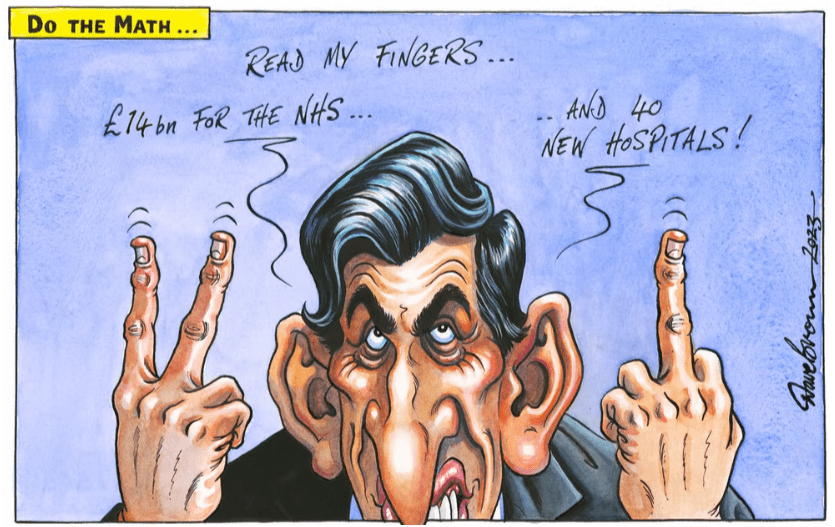
Don’t cancel operations – do the maths

Sunak’s cunning plan:

The laugh of the day is the following from our man who says he is PM.

Ben Jennings www.theguardian.com 

Rishi Sunak tells hospitals not to cancel operations despite pressure on NHS.

I assume he has obtained the number of elective operations that are needed each month.

Then that he has found out how long they take.

Then multiplied them together to get the total operation hours needed.

Then divided by the number of operation hours a team can carry out in a month, not forgetting that they have time off leave and sick leave just like other human beings.

That will give him the number of operating teams needed for elective surgery..

Next I presume he has compared the number needed with the number available, so he knows whether he is asking for the possible.

And next I assume he has costed the work to check it is within budget.

That is why people need to do maths. And it is one of the things those administrators in hospital have to be able to handle.

So Rishi wants everyone to learn maths and he wants hospital operating teams to move faster than the speed of light, something Einstein told us is impossible.

NHS using hotels in Plymouth and Bristol to house patients amid pressure on hospitals

Hotels in the South West are being used to care for patients who are ready to be discharged from hospital as pressure on the NHS continues to grow.

ITV News www.itv.com

People who are medically fit enough to leave hospital but can’t get the social care they need in the community are being put up in the hotels to help free up beds.

Hospitals in Plymouth and Bristol are among those using hotels to relieve pressure, and the scheme is currently being discussed by health bosses in Cornwall.

It is understood the Leonardo Hotel in Plymouth City Centre, previously a Jury’s Inn, is among those being used to provide care.

NHS Devon has been using their care hotel since mid-October 2022 with 40 beds available across two self-contained floors.

A spokesperson for NHS Devon said: “Care hotels are just one of many positive measures health and care partners have put in place to reduce pressure on busy health services this winter.

“They are not used for hospital patients and are used to provide social care for people who are medically fit and do not require hospital care but do need additional living support after a stay in hospital or to prevent them from needing to be admitted.”

One anonymous user of the service praised the “camaraderie from everyone” at the site, adding: “You have all been so kind to me, nothing is too much trouble. Such pleasant memories.”

While another patient at the Devon care hotel added: “I feel very grateful the carers have been very caring and good to me.”

Meanwhile in Bristol 30 beds have been put aside at an unknown hotel in the city centre for patients leaving hospitals in the area.

The average length of stay at the site, which has been running since the end of last year and will continue until the end of March 2023, is expected to be around three weeks per patient.

A spokesperson for the Bristol, North Somerset and South Gloucestershire Integrated Care Board (ICB) said: “Local health and care services are under significant pressure and this temporary care facility delivered at a local hotel will help us to improve the ‘flow’ of patients through our hospitals by ensuring more people can be discharged as soon as they are medically fit to leave hospital.

“Nobody should have to stay in hospital longer than necessary and this facility will ensure more people can be discharged promptly.

“It will also improve the flow of patients through our hospitals while helping to address ambulance handover delays.”

The care facility is being provided by CQC-registered homecare company Abicare and is being delivered by live-in care workers on a 24/7 basis with visiting clinical teams providing rehabilitation and primary care support.

In Cornwall, discussions are underway about the use of the care facilities in the Duchy.

A spokesperson for the Royal Cornwall Hospitals Trust said: “Health and care system discussions to set up a facility – similar to a care hotel that was in operation last year – are currently underway, however details are yet to be confirmed.”

Extra council cash is made available for homes struggling with the cost-of-living crisis in East Devon

Extra council cash has been found to help those in East Devon struggling with the cost-of-living crisis, writes local democracy reporter, Rob Kershaw. eastdevonnews.co.uk

East Devon District Council (EDDC) has agreed to change the name of its Covid-19 Hardship Fund to the Cost-of-Living Hardship fund, with the money left over from the pandemic support scheme being used to help households in need.

It follows a meeting of the council in October 2022, during which Councillors asked officers to create “an additional discretionary energy support fund based on evidence from the poverty dashboard data.”

Currently, the district council has £257,000 left from the renamed scheme, and it intends to use it to provide “targeted” assistance to those struggling to make ends meet.

The fund is currently due to be rolled out on April 1,2023, after the end of the current Housing Support Fund (HSF) being delivered across Devon.

Under the HSF scheme, qualifying households in the county receive grants of up to £650 to help with bills, enabling them to avoid falling behind on their council tax.

This scheme, which in East Devon runs on a budget of a third of a million pounds, is being delivered through vouchers that must be collected before the end of March. Any money not used by then will be taken back.

However, if the HSF cash runs out before March 31, EDDC may start eating into the £257,000 pot, playing virtually the same role as HSF.

The difference is that additional groups in need of support can be helped by the cost-of-living fund, but they are yet to be identified.

As for energy bills, EDDC will soon roll-out an Additional Support Fund – a £400 payment for residents who live in park homes or on commercial premises, such as flats above shops.

The council also hopes to have an Additional Fuel Fund to help those whose homes are not heated by mains gas or electricity.

This will be targeted at households that did not receive the Government’s £400 discount on their energy bills in the second half of 2022.

However, it is not yet known whether either of these funds will cover the scores of residents of Cranbrook, many who were left without hot water and heating in December 2022 due to maintenance problems.

Campaigners’ shock as Straitgate quarry refusal overturned at appeal

Controversial plans for a 100-acre quarry near Ottery St Mary have been given the go-ahead after planning refusal was overturned at appeal. 

Economic benefits outweigh any harm – the all too often verdict of an appeal and a deeply disappointing result. – Owl

Philippa Davies www.midweekherald.co.uk 

Devon County Council rejected the Straitgate Quarry application in December 2021. Their reasons included potential harm to ‘heritage assets’ such as Cadhay House, the health risks caused by potential dangers to the water supply, a lack of evidence of measures to conserve protected species and lack of a surface water management plan and subsequent potential flood risks. 

The quarrying company Aggregate Industries (AI) appealed against the refusal and both sides argued their case during a hearing in October which lasted several days. 

Today, Thursday December 5, the planning inspectors published their decision to allow the appeal. This gives the company planning permission to extract up to 1.5 million tonnes of raised sand and gravel over 10 to 12 years, and transport it to Hillhead Quarry near Uffculme for processing.

The appeal hearing examined all the areas of concern, but in each case the planning inspectors concluded that there were not sufficient grounds to block the scheme. They said AI had provided a ‘robust’ hydrogeological assessment and ‘it has been clearly demonstrated that the development would not be likely to result in unacceptable adverse effects on water supplies and human health’. 

With regard to heritage assets, they said ‘there would be no harm to Cadhay House or its garden, and that although there would be less than substantial harm to Straitgate Farmhouse during operations, that harm would be outweighed by public benefits’. 

Concerns had also been raised about potential road safety risks of HGVs using the B3174, but the planning inspectors said this could be managed by limiting the HGV movements. Responding to concerns about damage to the natural environment, they said ‘the proposal would not result in any unacceptable adverse effect in terms of its impact on trees and hedgerows’. 

The county councillor for the Otter Valley, Cllr Jess Bailey, said she is ‘horrified’ by the decision to overturn planning refusal. 

She said: “From my initial reading of the decision notice it certainly appears to me that the Inspectors have failed to recognize the very great harm and risks associated with this proposal and some of their conclusions appear flawed. I strongly disagree with their decision and as far as I am concerned the proposal remains completely unacceptable.” 

The Straitgate Action Group, which has been opposing the quarrying for more than 20 years, said it is ‘disappointed’ with the planning inspectors’ decision. A statement on the group’s website says: “We would like to thank all those who have have campaigned with us, and all those who have so generously supported us over the years – we are so sorry that the end result was not the one we had all hoped for.” 

Rishi Sunak’s five pledges to fix Britain are big targets – but how easy are they to hit?

Rishi Sunak says they will offer people “peace of mind” – Owl

Richard Vaughan inews.co.uk

Rishi Sunak has drawn up a list of five promises to the British public that he believes will improve people’s lives and public services in a bid to kick-start his premiership.

The Prime Minister said the pledges will offer people “peace of mind” as they enter 2023, which has already been dogged by strikes, record inflation and an NHS that is teetering on the brink of collapse.

But Mr Sunak’s five promises could easily be described as a wishlist, given the external forces that are buffeting the UK economy.

Here i looks at each of his “five foundations” and how achievable they will be for the Sunak administration.

1. “First, we will halve inflation this year to ease the cost of living and give people financial security.”

Forecasts have predicted that inflation will fall from its current rate of 10.7 per cent over the course of this year. The Bank of England has said it expects to see inflation will fall sharply by the middle of this year, as energy costs are unlikely to continue rising as high as it has over the last year and government support will help with this. The cost of imported goods is also expected to settle, while demand for goods and services will also fall due to higher interest rates. Whether inflation will be cut by half remains to be seen, as further flare-ups in Ukraine, another wave of Covid or China invading Taiwan could cause major shocks to the economy. If inflation is halved then Mr Sunak is likely to be claiming success for achievements that have little to do with his government.

Difficulty rating: 3/5

2. “Second, we will grow the economy, creating better-paid jobs and opportunity right across the country.”

If only other governments had thought of this. Prime ministers of all hues have promised to grow the economy and deliver better paid jobs, but if it was so easily done then the UK’s economy would not be among the most misfiring of OECD countries at the moment. Mr Sunak’s predecessor, Boris Johnson, based his entire administration on “levelling up” and spreading opportunity across the UK, while Liz Truss had a near maniacal focus on growth, but both failed. Indeed, analyses by Goldman Sachs says the UK economy will shrink by 1.2 per cent this year, while KPMG says it will contract by 1.3 per cent. This places the UK’s recession near or equal to Russia’s, which is currently facing major international sanctions.

Difficulty rating: 5/5

3. “Third, we will make sure our national debt is falling so that we can secure the future of public services.”

Crucially, Mr Sunak does not say when national debt will be falling, or by what measure. The OBR in its analysis of the Autumn Statement late last year predicted national debt to be falling as a share of the UK economy by 2027-28. This would be several years after the next election, after which the Conservatives could well be out of power.

Difficulty rating: 4/5

4. “Fourth, NHS waiting lists will fall and people will get the care they need more quickly.”

Again, Mr Sunak does not say by how much the NHS waiting lists will fall, nor does he say how quickly people will get the care they need. But many voters are likely to argue that getting NHS waiting lists down and speeding up care is the bare minimum that is expected from any government. Given people are currently being treated in ambulances, or even in cupboards due to overcrowding in hospitals, voters would be forgiven for thinking why this promise was not number one on his list.

Difficulty rating: 3/5

5. “Fifth, we will pass new laws to stop small boats, making sure that if you come to this country illegally, you are detained and swiftly removed.”

No 10 has previously said that fixing the small boats crisis was his number one priority after the economy, following the market meltdown caused by Liz Truss’s mini-budget. New laws to clampdown on the Channel crossings have been mooted for some time, but even as recently as this week, Downing Street has been unable to say when the new laws will be published. Much of the problem lies with the European Convention of Human Rights, of which the UK is a signatory, and any attempt to scrap the country’s obligations under the convention will spark a serious backlash from Tory MPs, opposition parties and in the Lords.

Difficulty rating: 4/5

Tiverton & Honiton MP demands recall of Parliament over NHS crisis

The MP for Tiverton and Honiton, Richard Foord, has called for Parliament to be recalled immediately over the crisis in the NHS.

What about “Whatchamacallit” the other, rather silent, East Devon MP? Where does he stand on this? – Owl

Learn to pronounce

Philippa Davies www.midweekherald.co.uk

The Liberal Democrats are demanding the Government pass an emergency health plan and declare a ‘national major incident’. 

It has been estimated that up to 500 people each week are dying because of A&E delays. 

In recent days ambulance services across the country have declared critical incidents, while ambulance staff have also been urged to conserve oxygen supplies due to a surge in demand. 

Over the Christmas and New Year period local ambulance services across Devon have been struggling to keep up with demand, with a ‘critical incident’ being declared for several days and patients urged to avoid attending A&E unless their condition is life-threatening. 

In view of the extreme pressure on hospitals and the social care system, Richard Foord wants Parliament to be recalled so that the Government can take urgent action to stop people from dying. 

He said: “This is a life or death situation for large numbers of patients across the country, including here in our part of Devon. 

“Despite the valiant work of our heroic NHS staff, local services are buckling in front of our eyes due to demand – yet the Prime Minister and Health Secretary are nowhere to be seen. 

“Every week I hear from people who are in shock after calling an ambulance or visiting A&E only to learn that ‘emergency’ care now means waiting hours and hours for help. 

“This is a national crisis, and the country is unlikely to forgive the Conservative Government for failing to act while hundreds of people die in parked ambulances or crowded hospital corridors. 

“Nobody should lose a loved one because the Government is asleep at the wheel. 

“Paramedics, nurses, and doctors have been left high and dry by the Government. They need help right now before this crisis gets even worse. 

“I am calling for Parliament to return without delay. The Prime Minister must declare a major incident to put the NHS back on a pandemic-style footing amid soaring numbers of deaths.” 

Reform UK to field candidate against every Tory at next election, says leader

Look over your shoulder Simon!

Right wing vote could be split in East Devon – Owl

The leader of Reform UK, Richard Tice, has offered a “cast-iron guarantee” the party will put up a candidate against every Conservative in the next general election, ruling out a 2019-style deal even if the Tories back some of his policies.

Peter Walker www.theguardian.com 

After a speech to relaunch the party, which was level with the Liberal Democrats in some recent polls, Tice said Reform UK already had 600 candidates in place and would stand in every seat outside Northern Ireland.

“Absolutely not,” he told the Guardian when asked if the party could potentially stand aside for Tory candidates who explicitly backed the party’s low-tax policy platform. “It’s a 110%, cast-iron guarantee. We’ve already got 600 candidates, we will stand everywhere.

“I think people are starting to realise that we’re serious about this. For obvious reasons, some people have ignored us until now, but we’ve got momentum. We’re equal or above the Lib Dems.”

The commitment will add to Rishi Sunak’s political woes and could make a Conservative defeat in the general election, expected next year, more likely.

In 2019, what was then the Brexit party greatly boosted Boris Johnson’s chances by standing aside in more than 300 Tory-held seats after he gave commitments on a hard Brexit.

While Tice’s party is unlikely to win a seat in the next election, if it were to take up to 8% of votes, as polling indicates it could, the bulk of these would come from disgruntled Conservative voters, a demographic the relaunch squarely targeted.

Tory MPs might be more nervous still if Nigel Farage, who led the party until March 2021, returned as leader. But Tice said this would not happen, and that Farage would remain focused on his media career.

“He’s done that,” Tice said when asked if Farage might take the helm again. “He’s very much enjoying what he’s doing. I speak to him two or three times a week. He’s on his own really good form and he’s massively supportive of everything that we’re doing.”

Tice’s speech, at a hotel in central London, focused on policies the party has advocated for some time, including an increase in the starting rate for income tax from £12,570 to £20,000, efforts to get people off out-of-work benefits, and policies to assist the NHS, including a period in which frontline staff would pay no income tax.

The costs – Reform UK say the income tax threshold plan would cost £40bn a year – would be recouped through moving people off benefits and cutting government waste, Tice said.

Speaking afterwards, he said the income tax cut would be “the fastest, most dramatic way to help people on the lowest incomes”. “I’ve been talking about it for 20-odd months, but for obvious reasons people have sort of ignored us until suddenly we’ve appeared as having momentum,” he added.

Dismissing Labour as being devoid of ideas, Tice pointed to a newspaper column last week by the Tory peer David Frost urging Conservatives “to fight for the party and not be tempted by a Reform UK vote”, as a sign the government was alarmed.

“You know the Tories are worried when they’re writing in newspapers ‘please don’t vote Reform’,” he said.

‘Calling for kindness and moderation in East Devon in 2023’

Paul Arnott 

May I wish all readers a happy new year, and mention as I do so a few of the wider comments posted on the internet from some councillors I greatly respect? They want 2023 to be informed by kindness and moderation in the way we all speak to one another.

Which of us would disagree? It’s been a central tenet of many faiths from Buddhism to Christianity that the world would be more harmonious if we all lived by the maxims of tolerance and respect.

Unfortunately, there is another factor at play when it comes to national and indeed regional and local politics. It’s almost impossible to hold this meek and worthy line when figures in power are prepared to tell such whopping lies.

2023, however, gives us the greatest opportunity this century to reform these ways. Why? Because in 2022 we all got a PhD in how politicians can lie for the heck of it. And because we now have no alternative.

The key evidence at the start of 2023 is about our health service. When a distinguished professor who chairs the British Medical Association says that the health service is dying, that 500 extra people will certainly lose their lives at A&E per week this winter because the system cannot cope, there is no glib answer a politician can give.

Like many others in East Devon, thousands I think, I became fully aware that the NHS was not safe in the hands of the Conservatives about ten years ago. The scales dropped from my eyes.

May I perhaps offer a fictional comparison? In a healthy society, if a massive great hole appeared in a school playground, parents, teachers and locals would come together to work out why it had happened, what to do about it, and how to commission the work. Cost would be an issue, so this work would be tightly controlled by a local project team.

That is not how the Conservatives have approached the NHS for many decades (though I am content that many voters did not realise this).

By their methods, on hearing that the hole had appeared, one of their number would contact their mate, either the CEO of Fill-A-Hole PLC, or, if Covid is an example, was fortuitously just about to set up that very company.

By the time the first public meeting was called, a plan would be done and dusted, leaving locals to wonder what had just happened. Filling the hole would then become part of Fill-A-Hole PLC’s “work-stream”, the actual fulfilment of the repair put in the hands of a recent graduate who could take the blame if it went wrong.

This is where we have got to with the NHS. Leading members of the Conservative party have believed their entire adult lives that the health service would be better delivered by private companies. Not even the havoc of privatised railway companies has cured them of this obsession.

As it happens, their pals will not let them forget this, if for some reason a Conservative becomes a bit wet round the edges, because private finance, its lobbyists, and its many billions of US cash looking to invest, is always knocking at the door. Usually at Conference time bearing a healthy donation to the party.

So, this is the truth, which if accepted can lead to kindness and moderation. People like me saw, at the point where in-patient beds were shut in Axminster, Honiton, Ottery and Seaton in recent years, that this other private sector agenda riddles the government’s handling of the NHS like a disease. First break it, then privatise it.

The Tories have broken it – the next stage is up to us, the people. Will we passively accept what is happening, or use our votes and voices in 2023 to demand the unvarnished truth?

www.midweekherald.co.uk

East Devon solar farm debate not over yet

An East Devon councillor says he would be “surprised” if the developers of a rejected solar farm near Exeter do not lodge an appeal.

Rob Kershaw, local democracy reporter www.radioexe.co.uk

Cllr Olly Davey (Green, Exmouth Town) was commenting after the district council threw out a proposal last month that would have seen 60,000 solar panels built on farmland near Exeter. Six councillors called for the plans to be dismissed.

Among the reasons for turning down the solar site at Marsh Green were environmental damage, the visual effect on the landscape, and the location’s proximity to heritage landmarks.

Cllr Richard Lawrence (Conservative, Whimple and Rockbeare) spoke against the development which he believes will be difficult for large vehicles to access, and where flooding is frequent.

He is sceptical as to where the money would come from to restore the surrounding area to its current state after work is complete, and concerned about the funding to maintain the solar panels over the 40 years.

While the councillor says he supports the installation of solar panels, he suggests they are placed in more suitable areas.

He highlighted the new housing development in Cranbrook, with runs alongside East Devon’s local plan to create a “self-sufficient, low carbon, new town.”

“I’m not averse to solar panels, I’ve got them on the roof of my house,” explained Cllr Lawrence. “I think they perform an extremely important function. The only problem I have with it is where they’re positioned.

“I feel that there are number of brownfield sites and roofs of commercial buildings around East Devon that would be best served with the solar panels on, rather than taking up greenfield sites.

“We’re in the process of building Cranbrook, which is going to be 6,500 houses,” he added. “I know they have their own heating system – albeit it doesn’t work very well – but there’s nothing to stop them having solar panels on the rood connected to the national grid.

“There’s not a solar panel in sight in Cranbrook, which just seems a but odd to me. We continue to build new houses, but we don’t enforce solar panels on the roofs.”

Cllr Olly Davey supports the plans, arguing that “no unacceptable harm” would be caused to the area, and that every effort had been made to minimise flooding.

On that basis, he suggested that an appeal from the developer would have a strong chance of success.

“I would be very surprised if the developers didn’t put in an appeal,” he said. “They will have invested quite a lot in this already, so I would expect them to lodge an appeal, and I think they’ve probably got fair confidence that it would ger passed on appeal.”

Cllr Davey also feels that, while roofs and brownfield areas lend themselves well to solar panels, larger sites such as Marsh Green are also needed in the interests of sustainability.

“I don’t think it’s an either/or,” said Cllr Davey. “I feel that there’s an awful lot of false dichotomies that are set up; you either put them on roofs or you put them in greenfield sites. The way things are going, I think we’re going to need both.

“I absolutely support panels on roofs, I’ve got them myself. We were what we call early adopters; we’ve had our panels over 10 years now. It was one of the first things we did when we moved in.

“I would like to see solar panels on every available roof, and it’s a source of despair to me when I look at all the houses that could be absolute prime sites for solar panels, but they don’t have them.

“But the incentives aren’t there, and the interest to do it [isn’t there]. I think people don’t realise that it’s not a very disruptive thing to do, and it gives you an awful lot of free energy.”

Fury as Rishi Sunak claims NHS ‘has funding it needs’ to tackle crisis

Bean counting in an ivory tower! – Owl

Rishi Sunak has said the NHS has all the funding it needs to deal with the crisis engulfing hospitals, despite repeated warnings from health leaders that immediate investment is needed to protect patients.

Kate Devlin www.independent.co.uk

Healthcare officials have warned the NHS is on a knife edge, with many A&Es struggling to keep up with demand and trusts and ambulance services declaring critical incidents.

On Tuesday NHS leaders in London said ambulances would wait only 45 minutes to hand patients over to hospital staff. Experts believe the problems at A&Es are responsible for the deaths of up to 500 patients every week.

Critics said claims the NHS had enough resources were “an insult to all those suffering in hospital corridors or in the back of ambulances because the government refused to act sooner”.

Downing Street said the government has been “up front” with the public about the pressure the NHS faces this winter, with the prime minister’s official spokesperson acknowledging that the health service is facing an “unprecedented challenge”.

Wes Streeting, the shadow health secretary, accused Mr Sunak of taking a stance that was “negligent, irresponsible, and a risk to the public’s health”.

The row erupted after No 10 said the prime minister was “confident … we are providing the NHS with the funding it needs – and as we did throughout the pandemic – to deal with these issues”.

But Downing Street did admit some patients would find it difficult to access care, even as it sidestepped the word crisis.

Dr Vishal Sharma, from the British Medical Association (BMA), which is balloting junior doctors for strike action, hit back saying: “For staff working in the NHS or any patients desperately trying to access care, it is plain for all to see that the NHS is completely broken. This did not happen overnight but is a direct result of the government underspending on health and ignoring repeated warnings from staff about workforce shortages, soaring demand and crumbling infrastructure.”

Royal College of Nursing general secretary Pat Cullen, said: “Presented with a picture of an NHS teetering on the brink of collapse, with staff shortages across the board, it’s hard to see how more funding couldn’t improve the situation.”

Adam Brimelow, director of communications at NHS Providers, said: “It is clear that the resources available to the NHS have not kept pace with the changing needs of the population.”

Others challenged the claim that the Covid backlog was to blame for the current crisis. Dr Adrian Boyle, president of the Royal College of Emergency Medicine, said it was “disingenuous to blame the current situation on the pandemic”, warning of staffing issues, a lack of beds and capacity and a lack of social care – “all problems which are due to under-resourcing”.

Dr Tim Cooksley, president of the Society for Acute Medicine, conceded that the government had been “up front” about the challenges this winter, but “the reality has been more intolerable and unbearable for staff and patients than envisaged”.

Late on Tuesday, health secretary Steve Barclay blamed “particular pressures” of flu and Covid, and insisted the NHS was safe, saying: “We are putting in more funding, we’ve got more staff, over 34,000 more staff working in the NHS, so there’s more nurses, more doctors, we have got an extra 7,500 going into social care [and] looking at greater support for domiciliary care.”

However, Matthew Taylor, chief executive of the NHS Confederation, said the NHS went into the pandemic with too many staff vacancies, a figure that now stands at more than 130,000, “and we were coming off the back of the longest financial squeeze in the NHS’s history”.

With another four days of strikes looming later this month, he also urged the government to reopen talks with unions over pay.

The Royal College of Emergency Medicine warns that between 300 and 500 people a week are dying as a result of delays and problems with urgent and emergency care. NHS England has said it did not recognise these numbers, but Dr Ian Higginson, the vice president of the college, accused political leaders of “a battle of machismo and denial”.

Mr Sunak is under increasing pressure from Tory MPs about the crises escalating on his watch. He is not due to make any public appearances this week, with officials insisting he is hard at work inside Downing Street.

The last time they visited a hospital both Mr Sunak and Mr Barclay were berated by members of the public.

One former Tory minister warned the chaotic scenes at hospitals, combined with the week-long rail strike, were “helping no-one … except Labour”.

Mr Sunak is also facing growing calls from within his own party to soften his stance on public sector pay rises.

One Tory MP said it was time for Mr Sunak to compromise on NHS pay, even if he holds firm in other sectors. The red wall MP said the current stance was “unsustainable”.

“I don’t think saying, ‘We can’t afford it’, is going to work,” the MP said. “You can’t keep seeing if nurses or the government will win sympathy – you’re not going to win that.”

Former cabinet minister David Davis backed the government’s stance on pay, but warned Mr Sunak that he could lose the battle for hearts and minds over strikes unless the government gets better at making its argument.

“What’s an issue is the way the government is not really presenting its case,” he said. “People will die as a result of the NHS union strikes. We need to make that point clear. I want the government to make it clear to the public that there’s a price to this.”

Lib Dem health spokesperson Daisy Cooper said the idea the NHS had enough funding was “an insult to all those suffering in hospital corridors or in the back of ambulances because the government refused to act sooner”.

Tory voters believe the Government has failed on NHS, education and austerity, poll finds

Conservative voters overwhelmingly believe their party has failed in its management of the NHS during their time in Government, a poll suggests.

Arj Singh inews.co.uk 

A vast majority (73 per cent) said they thought NHS management had been a failure in the last decade, compared to just 16 per cent who said it had been a success, according to the Opinium survey for Compassion In Politics, shared exclusively with i.

Of voters who backed the Tories in 2019, more also believe their party’s austerity policies have been a failure (47 per cent) than those who believe they were a success (16 per cent).

Underlining the grim electoral situation facing Rishi Sunak, more Tory 2019 voters believe education reform has been a failure (46 per cent) than a success (22 per cent).

Tory voters’ views on the NHS and education were close to the opinions of voters of all parties – though a markedly bigger proportion of the total sample thought austerity was a failure (57 per cent).

However, bucking the trend, more Tory voters (43 per cent) believe Brexit has been a success than a failure (33 per cent. Among all respondents, the outcome was the opposite: more viewed quitting the EU as a failure (57 per cent) than as a success (24 per cent).

Opinium questioned 2,000 British adults from 16 to 20 December 2022. Results have been weighted to be nationally representative, with almost 700 respondents being Conservative voters in 2019.

Asked to grade the Tories’ time in Government, one in five of the party’s 2019 voters gave it a “fail” mark, with 11 per cent giving them a D grade and 28 per cent a C.

Only 15 per cent awarded the party an A or A*, and a quarter (25 per cent) a B.

Among voters overall, just 8 per cent gave the Tories an A* or A grade, with 29 per cent rating the party at a C or D and 42 per cent a fail.

Jennifer Nadel, co-director of Compassion in Politics which describes itself as a cross-party campaign organisation, said the poll showed that voters were putting the Conservatives “on notice” ahead of the next election.

She added: “There is a hunger and a need for change. A decade of underfunding, low pay, and inadequate social security support has impoverished millions, weakened our public services, and spread financial fear, stress, and worry.

“Into that mix we’ve had the continuing disruption and prolonged uncertainty of Brexit. The public have judged this record to be one of failure and they’re putting the Government on notice.”

Ms Nadel called for new policies including a right to food, income and housing and greater social security support from the Government. Some of these options were put to the poll respondents, who were asked which policies they would most like to see implemented.

A quarter backed better socio-economic rights, a fifth (21 per cent) said a universal basic income, 18 per cent backed an honesty law, and eight per cent favoured citizens’ assemblies.

The rest either said they did not know (16 per cent), did not back any of the policies (10 per cent), submitted other asks from the Government (two per cent).

Ms Nadel said: “It’s up to the Government to learn the hard-earned lessons of the last twelve years and lead us towards a future economy which supports, empowers and cares for all.”

The Conservative Party was contacted for comment.