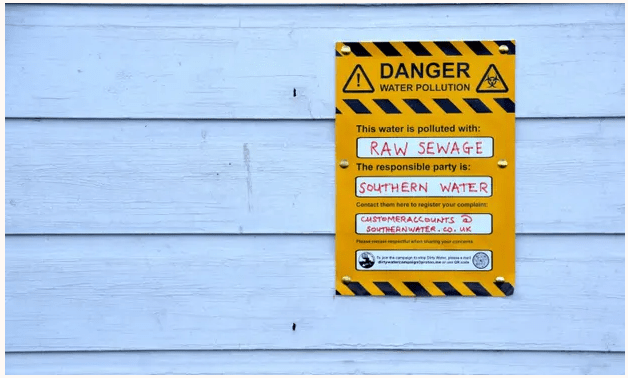
Dorset’s River Lim declared ‘ecologically dead’ after sewage spills triple

Locals living alongside a once-idyllic Dorset river have declared it “ecologically dead” after the amount of human waste overflowing into it tripled in less than a year.

Will Humphries, Southwest Correspondent www.thetimes.co.uk 

The River Lim, which flows into the sea at Lyme Regis, used to be a thriving ecosystem with trout, eels and kingfishers living along its course.

But local residents and conservationists have reported “a layer of brown sludge” coating its surface 2,200 hours of sewage spills were discharged into the river by South West Water (SWW) in 2022, more than triple the amount in the previous year.

Tests found the waterway also has “shocking” levels of E.coli, prompting the local authorities to erect yellow warning signs advising the public to keep out of the water.

A retired freshwater ecologist carried out a recent survey which found there were “barely any” invertebrates in the river. Without mussels, larvae and snails, the bottom of the food chain is cut off, reducing the number of larger species that can survive. Data gathered by the River Trust showed a steep rise in human waste surging into the river from storage tanks at a nearby SWW treatment centre.

Graham Roberts, who worked as a freshwater ecologist for 40 years, described the Lim as “ecologically dead”. He joined the River Lim Action Group two years ago hoping to understand and fix the problem.

Roberts said: “The river is in an absolutely disgusting state. I carried out some baseline surveys to understand what was happening to the wildlife in the river. There were virtually no invertebrates at all in it. In a healthy river you would expect to find hundreds and thousands of shrimps in a three-minute survey. We weren’t finding any at all.

“It has a real knock-on effect on the rest of the animals in the area. There just won’t be enough food. We were lucky enough to have an otter move in recently but I worry that by ingesting the sewage it will become infertile or, in the worst-case scenario, it will die.”

Environment Agency data shows there were nearly 2,200 hours of sewage spills last year coming out of the six combined sewer overflows (CSOs) on the Lim. This compares with 680 hours in 2021 and 376 hours in 2020. Locals believe the increase is due to heavier rainfall and insufficient storage facilities nearby.

Vicki Elcoate, a member of the action group, said: “People who have lived here for decades talk about how they used to see the river full of trout and eels. Kingfishers used to be spotted flying up and down the river among the reeds. Now, there is a layer of brown sludge coating the top of the water and you’re lucky to ever see a fish in there at all.”

Laura Noel, 71, a retired NHS worker, said: “We monitor eight points along the River Lim every month and we keep track of different factors, such as phosphate levels. We started the group after lots of people started noticing horrible smells and the water not looking right.

“We contacted SWW and then the Environment Agency via a hotline to get a team looking into it. That was 18 months ago now. We discovered that SWW is one of the worst-performing water companies in England. Getting information out of them has been really hard, slowly being drip-fed and ultimately getting nowhere.

“There are things we can do to stop this. The main thing is for SWW to invest in a larger storage container at Uplyme. They have to do something — it is increasing so much.”

An Environment Agency report carried out in February analysed the levels of E. coli along the Lim. It said: “The high E. coli results for the surface water outfall at Woodmead Road Bridge confirmed that it was contaminated with faecal bacteria. The survey results clearly demonstrate that under baseflow conditions there is an increase in levels of E.coli in the River Lim as it flows through Lyme Regis.”

A South West Water spokeswoman said: “We are reducing the use of storm overflows and our plan is working but there is more to do. We want everyone to feel confident about water quality and to know that we are serious about reducing the use of storm overflows.

“We’ve installed 100 per cent monitoring on our storm overflows, ahead of target. We are investing significantly to reduce our impact on rivers by one-third by 2025, as we look to ensure we are not the reason for any river failing to meet ecological standards by 2030.”

SSW, which provides sewage services to Devon, Cornwall and small parts of Dorset and Somerset, is being investigated by the water regulator Ofwat, which called the number of storm overflows spilling sewage “shocking”.

The most recent official data on storm overflows discharges, for 2021, showed it was the only wastewater company to have more than 10 per cent of its overflows spilling more than 100 times a year. The figure for SSW was 10.4 per cent. United Utilities, which covers the northwest of England, was the only other company that came close, at 9.5 per cent.

The Times is demanding faster action to improve the country’s waterways. Find out more about the Clean It Up campaign.
Something stinks about water bosses’ bonuses — even my dog can smell it

Rejoice. Three water company chief executives will forgo their bonuses this year, having apparently noticed that their customers aren’t terribly keen on swimming with “brown dolphins”. Sorry. Just my little “poophemism”.

Carol Midgley www.thetimes.co.uk 

After public fury over sewage pollution, Sarah Bentley of Thames Water and Susan Davy of South West Water will waive their performance-related payout, which last year amounted to £496,00 and £522,000 respectively, and will somehow get by on their salaries of £2 million and £1.6 million.

And, good on them actually. This sets an example that might even shame other brazen muck-spreaders (sorry, “water company bosses”) into following suit, not simply doubling dividends to £1.4 billion as children paddle in E. coli and fish suffer death by sanitary towel. In fact by the end of yesterday it was already having an effect: Nicola Shaw of Yorkshire Water said she wouldn’t be taking hers either.

But I do have a few minor questions. Such as why were water company bosses in line for “performance” bonuses in the first place when they released raw sewage into rivers and seas in England for more than 1.75 million hours last year? The only thing many people think they should have been in line for is a prison van.

What’s that, water bosses? I suppose you’ll tell me this was a 19 per cent reduction on “spills” the previous year? Well, perhaps, but may I be frank? That’s still nothing to brag about. It’s still an awful lot of shit.

Besides, the Environment Agency said this was due to drier weather and not any action the water companies took. I’m reminded of a report by researchers from Hamburg Medical School this week that declared, quite reasonably, that there’s no such thing as a “beautiful scrotum” — “we must instead speak of the least ugly”. It’s the same with sewage spills, in my view. A reduction is fractionally less ugly but still absolutely hideous to behold (apologies to scrotums everywhere. No offence).

Still, if there is any money going spare from untaken bonuses, do chuck some my way. Because after my dog’s close encounter of the turd kind in a river, I’m out of pocket. The dog ran in the water gaily and splashed about. Then she emerged sheepishly in what can only be described as a sewage suit, a craply-coloured dreamcoat.

She stank like the colon of Satan. I’ve honestly never smelt anything like it. Lumps clung to her collar and harness like hell-baubles. Even she looked disgusted and she’s eaten fox poo. By the River Mersey I sat down and retched.

Cut to: having to bin her (expensive) collar, harness and lead. Then having to have the car cleaned. I’d had no choice but to drive her home, and it still stinks now. My husband had to help me to give the dog three baths while gagging and I shall never speak of the horror of what was left clogging my plughole.

All the while I couldn’t help thinking of the “chief customer officer” at Southern Water last year telling swimmers to “use your judgment on whether you feel it’s safe to go swimming or not” after a “release” (another poophemism! Add it to your file). The sea was “95 per cent rainwater,” she added. Well, that’s certainly reassuring. I’m sure she won’t mind if I serve her a cup of tea that’s “only 5 per cent faeces”. How she’ll laugh when I say it’s “Typoo”.

Local flooding – who cares?

February 2020:  John Hart says “you are on your own”. 

Following a week of flooding, the County Council Lib Dems had called for millions more to be spent on improved drainage. Council Leader, John Hart’s solution, however, is to encourage a modern day dad’s army of individuals, villages and Parish Councils, where they care, to do more for themselves. Self-help, he said, is going to be the order of the day.

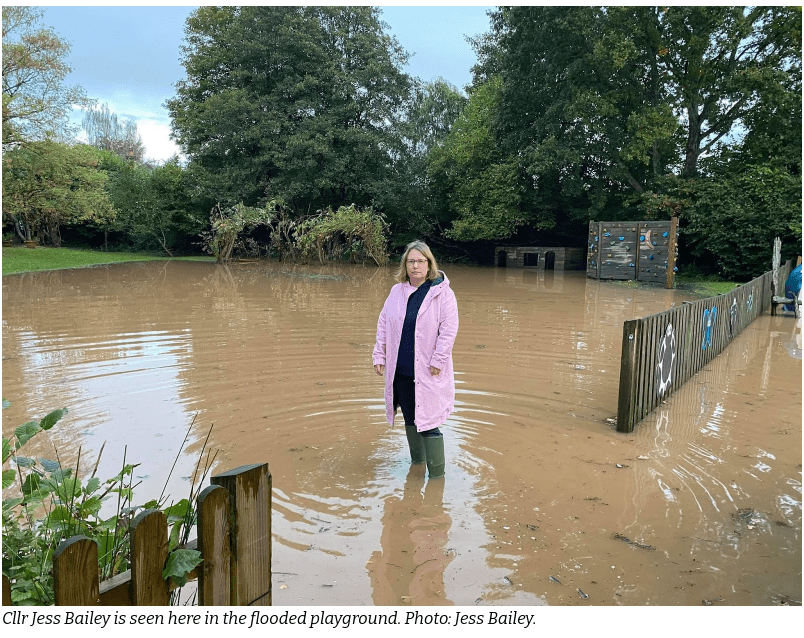
October 2021: Cllr Jess Bailey on flooding in Tipton St John Primary: “I saw myself first-hand the risks of flooding in October 2021 when after heavy rain the school was surrounded by lakes of water – and water was lapping at the doors of the buildings.

“I have witnessed children as young as four and five practising their escape drill with a rope across the road to prevent children being swept away in the rising waters.”

Woman devastated as major flood rips through home in Newton Poppleford.

She has described the community’s support as “absolutely brilliant” as people in the small village have banded together to organise a huge clear and clean up effort. 

She said: “We’ve got a big field that the farmer has ploughed and beyond that we’ve got the common. Basically all the water came down off the hills. We’ve got a six foot stone wall and it’s breached the wall and it’s just completely flooded through our house.

[For more images of the local flooding see: PHOTOS and VIDEOS: Flash flooding turns roads to rivers across East Devon, leaving ‘devastated’ residents counting the cost of the clear-up – Owl]

Mary Stenson www.devonlive.com

A woman living in a Devon village that was among the worst hit by flooding yesterday (May 9), has said she is “devastated” and “emotional” after water rapidly gushed into her home, causing significant damage.

Following a yellow weather warning from the Met Office, rain battered Devon yesterday afternoon. Newton Poppleford in particular suffered flooding which some motorists described as “horrendous”, with some parts of the village becoming totally impassable.

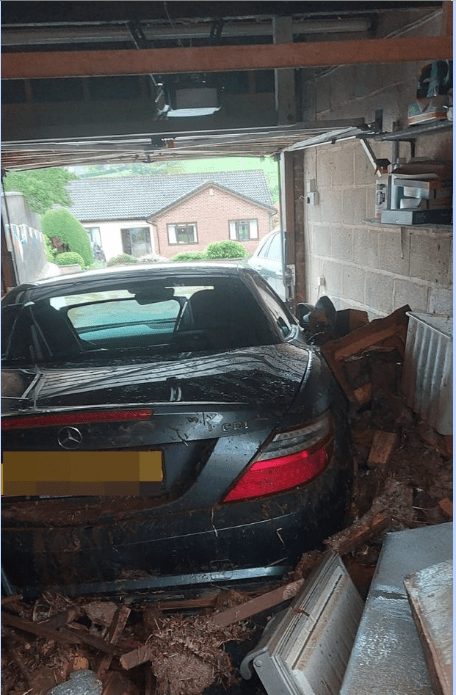
One household in the village is facing a huge clean up as their home became severely damaged by torrents of water flowing in. Hilary Pinfold and her husband have lived in the house for two years but this is the first time they have experienced flooding in their home. They said they were “shocked” by the power of the flood which knocked over walls, a fridge-freezer and even moved their car.

(Image: Hilary Pinfold)

When asked what was going through her head as water poured into her home, Hilary said: “I don’t think I can repeat it to be honest. We were just shocked because we just felt helpless because we didn’t know what to do.

“We couldn’t get our heads round the volume of water and how powerful it was. It had the power to move a car, it’s moved my husband’s car in the garage, it’s turned over a fridge-freezer, it’s knocked down two walls in the garage that have just collapsed.

“I just heard my neighbour shouting at one point ‘your outhouse is going’ and the outhouse just collapsed. We’re in a bit of a mess.

“We’ve got to have the floors replaced because we don’t know if water’s gone under the house. We’ve lost a hell of a lot of stuff as well.”

The water was able to enter the property as it ran down from a field behind the house that had recently been ploughed. In footage captured by Hilary, the water can be seen coming into the garden, leaving behind thick silt the next day.

She said: “We’ve got a big field that the farmer has ploughed and beyond that we’ve got the common. Basically all the water came down off the hills. We’ve got a six foot stone wall and it’s breached the wall and it’s just completely flooded through our house.

“The garden is a nightmare because we’ve got about eight to ten inches of silt in the garden. I don’t know what we’re going to do with it. If there’s any gardeners out there that know what to do then that would be very helpful.”

Hilary went on to explain that she has felt “very tearful” and “emotional” in the 24 hours following the flood. She says this made it difficult for her to sleep and the family dog has even felt the impact as Hilary explains it is “absolutely petrified”.

She said: “(I feel) shocked and very tearful at times and emotional and tired, really tired because I was up at about 5am and I don’t think I fell asleep until about 1am.

“The dog is absolutely petrified and doesn’t know what’s going on, the poor thing.”

Despite the devastation to their home, Hilary has described the community’s support as “absolutely brilliant” as people in the small village have banded together to organise a huge clear and clean up effort. She said: “The community spirit has been absolutely brilliant. We’ve had a team of volunteers because so many houses affected. We’ve had so many people just cleaning and digging and clearing out the garage. People from the church have just been and taken away the towels to wash and things.”

Water chiefs not taking their mini bonuses? Hurrah for small mercies 

Have the trio volunteered to give up bonuses they wouldn’t have received or, despite their environmental performance, were they in for bonuses anyway? – Owl

Contain your excitement at news that bosses of a few water companies won’t be taking their bonuses this year. In all three cases – South West Water, Thames Water and Yorkshire Water – acceptance of any bonus at all would rightly have provoked general outrage. These firms were at, or near to, the bottom of the league table in the Environment Agency’s last set of annual environmental performance ratings.

Nils Pratley www.theguardian.com 

At the most sludgy end, South West joined Southern in scoring the lowest possible one star out of four, which the chair of the EA – a body that itself has hardly excelled during three decades of under-regulation – translated into plain English: it meant the companies’ environmental performance “was terrible across the board”. Thames and Yorkshire were two of four companies getting two stars, which indicated a need for “significant improvement”, so still deeply in cruddy territory.

It is conceivable, of course, that the trio have upped their game and undergone a transformation since the EA published its ratings for 2021 last July. But, even if they have (don’t hold your breath until this July), the timing doesn’t work bonus-wise for the 2022-23 financial year. Improvement has to be seen to have happened – and then to be achieved regularly to remove weather-related vagaries.

Given the star ratings, many may wonder if Sarah Bentley at Thames, Susan Davy at Pennon (owner of South West) and Nicola Shaw at Yorkshire are volunteering to forego bonuses they wouldn’t have received anyway. The answer – strange as it sounds – is that, actually, they are probably surrendering a few hundred thousand pounds or so each.

In common with the set-up across the entire UK quoted-company scene, the formula for awarding bonuses tends to include so many metrics that it is hard for a chief executive to be awarded zilch. Aside from financial targets, the service-related metrics themselves contain a dashboard of dials. There’s always something to achieve.

Bentley’s incentives, for example, include reducing complaints from customers – an area where the numbers at Thames have markedly improved recently. And Davy’s bonus last year included ticks for hitting leakage targets, reducing emissions and maintaining a “great place to work” accreditation. That was despite South West’s “wastewater pollution incidents, per 10,000km sewer” running at more than three times the target level and the water quality being deemed miles away from the required standard.

The mini bonus surrender, then, can be seen as an acknowledgment that handing out prizes for financial performance or minor operational triumphs is unacceptable if you’re still failing on core environmental measures. Quite right too: the customers don’t care if South West is a nice place to work; they are overwhelmingly bothered about water quality and sewage dumping.

Bentley and Davy were first out of the blocks in recognising the bleedin’ obvious. Counterparts at the sector’s other laggards now know what’s expected – and shouldn’t hang about. But the other conclusion here is that relying on executives’ sense of embarrassment when public anger is red-hot is a terrible way to structure a performance-related remuneration scheme.

Thames has semi-grasped the point by promising to review its pay structure with the aim of giving “a greater weighting to customer service and environmental performance than financial results”. It – and others – should go further. Utilities with public service obligations aren’t like regular companies, so here’s a simpler pay principle to concentrate minds: no bonuses for financial success until the environmental scores are consistently on the right path.

Have your say on how the region adapts to climate change

People in Devon can have their say on a new consultation will help ensure  can make the changes needed to cope with the worst effects of climate change.

Adam Manning www.midweekherald.co.uk

From Tuesday May 9 until June 30 residents are being consulted on the Climate Adaptation Strategy for Devon, Cornwall, and Isles of Scilly ahead of its publication later this year.

To effectively respond to the climate crises, it is vital that strategies are put in place to deal with both the cause of rising greenhouse gases and their effect on our communities, also called Mitigation and Adaptation.

Mitigation focuses on tackling the causes of climate change to make the inevitable impacts of rising global temperatures less severe by reducing the emission of greenhouse gases to net-zero.

Whereas Adaptation is the process of adjusting to the impacts of climate change that we are already seeing and can be expected in the future.

The draft Adaptation Strategy has been delivered by the Devon, Cornwall, and Isles of Scilly Climate Impacts Group, with the assistance of RSK, an engineering and environmental consultancy.

The Group is a partnership of strategic organisations, including local authorities, that is chaired by the Environment Agency. The draft Strategy specifically looks at climate impacts which require, or which would benefit from, working in partnership.

The Strategy accepts that significant climate ‘shocks’ are inevitable, and as the world grows warmer, different places, depending on factors like geography and population, will be affected in different ways.

For instance, our region has approximately 1500km of coastline, and rising sea levels of up to 78cm by the 2080s will put the region’s low lying and coastal communities at increased risk while extreme weather events such as storms will become more severe and more frequent and could lead to increased flooding for communities near rivers and watercourses.

Public water supplies will need more than 3.4 billion extra litres of water per day by 2050 impacting our rural economy as crop failures will become more frequent in response to droughts.

And as global temperatures rise, the seas will become more acidic, putting fishing stocks at risk.

The Adaptation Strategy is divided into three, beginning with a Risk Assessment of the impact of climate change in our region including flooding, sea level rise and coastal erosion, reduced availability of water and extreme temperatures.

The second part is the Strategic Adaptation Plan which sets out the conditions to enable regional partners to act on adapting to climate change together; and finally, an Action Plan, highlighting where we should focus our efforts over the next five years.

Mark Rice, the Environment Agency’s Area Director, Devon, Cornwall and the Isles of Scilly, said: “Significant impacts from climate change are now inevitable, but we can successfully respond to the climate emergency through greater, collective focus on adaptation to the increased hazards that are already evident.

“Mitigation and adaptation are of equal importance, but while reducing emissions now will help minimise the extent of climate change and its impact on communities and wildlife, in the longer term it is adaptation and how well prepared we are for climate shocks that will save lives.

“This is why the Climate Adaptation Strategy is so vital – it looks at climate impacts, risks and actions which require regional solutions.

“By responding to the consultation, you will have the opportunity to influence the future resilience of your community.”

You can view the Adaptation Strategy, a series of ‘short-reads’ and respond to the consultation HERE.

If you’ would like to fill out the questionnaire at home, you can order a copy by emailing environmentalpolicy@devon.gov.uk or by phoning 03451551015.