River Otter: Sewage Pollution – Adjournment debate, Thursday 18 June 2026
Summary
Richard Foord laid out the problem in detail using the evidence produced by the Otter River Catchment Action group (ORCA) and its 75 citizen scientists.
He quoted three pledges made by South West Water’s then CEO, Susan Davy, in October 2025: to tackle any storm water overflow releasing more than 20 times a year; to act where SWW assets are not performing as they should or are causing environmental damage; to target improvements in SWW as part of their 2025–2030 investment programme. None of which has materialised.
The river Otter is badly polluted by e.coli and phosphates resulting in Budleigh Salterton, at its mouth, losing its Blue Flag bathing water status. It ranks amongst the 20% most polluted rivers.
The phosphate removal scheme at Honiton sewage works has been deleted from SWW investment plans and the works currently operates at 40% over capacity. With further housing development this is predicted to rise to 73%.
Effectively, South West Water, Foord said, has been using the River Otter as a conveyor—a free, open, half-pipe sewer—resulting in significant environmental harm.
He ended by telling the Minister that recovery can happen but will require urgency, transparency, and a willingness to move beyond promises and towards delivery. He called for stronger accountability, investment in infrastructure, and tighter controls on executive bonuses when environmental standards are not met.
The Minister, Mary Creagh, gave him a surprisingly long reply containing a lot of promises but listing a few actions. For example: she said the Environment Agency is currently investigating potential offences at Ottery St Mary’s sewage attenuation tank. It is in the process of agreeing an enforcement undertaking with South West Water and investigating event duration monitoring data from the site.
From the length of her reply we may conclude that at least the scale of the problem is now recognised, and that civil servants and staff at the environment agency have had to scurry around and dig out a lot of information for her. [Ministers don’t like to face a debater better briefed than them].
If nothing more, the River Otter is now firmly on Whitehall’s map.
Note: Richard Foord declined an offer of hospitality (breakfast in Parliament) from the new chief executive of South West Water and its parent company Pennon Group on the morning of this debate. Surprising that Keith Haslett, Pennon’s new CE, has the time from his duties in the South West to breakfast in Whitehall! – Owl
Full Text
This debate is sourced from the uncorrected (rolling) version of Hansard and is subject to correction.
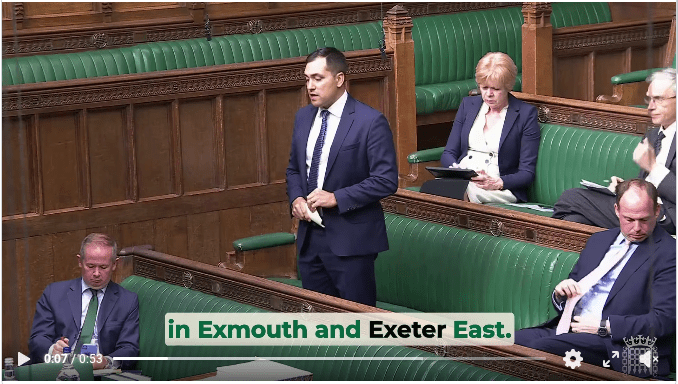
Richard Foord (Honiton and Sidmouth) (LD)
I am grateful for the opportunity to raise the issue of sewage pollution in the River Otter, a river that flows through many of the Devon communities that I represent.
I should say at the outset that, this morning, I declined an offer of hospitality from the new chief executive of South West Water and its parent company Pennon Group. They offered breakfast in Parliament, but I did not accept as I was here, in the Chamber, trying to catch Mr Speaker’s eye to talk about the Jurassic coast UNESCO world heritage site, and it is helpful that I will get to talk a little bit about that now. My office has written back to South West Water to request a separate meeting with the chief executive to talk through some of the issues that I will raise in the debate. In fairness, the debate is also about issues that apply across the water industry, not just with Pennon Group.
I pay tribute to the more than 75 water testers, campaigners and citizen scientists of the Otter River Catchment Action group—ORCA. The ORCA group developed out of the Otter Valley Association, and it has devoted almost as many hours to understanding and protecting the cherished River Otter as there have been hours of sewage spills into that river, which is saying something. The work of ORCA has provided much of the evidence in my contribution. The dedication of the ORCA volunteers represents the very best of self-organised civic community action and public service.
In particular, I would like to pay tribute to Bruce McGlashan, who passed away suddenly in April this year, just days after ORCA hosted a public meeting at The Institute in Ottery St Mary. Bruce brought to ORCA his experience of having been a manager at the Environment Agency for 30 years. He was also secretary of the River Otter Fisheries Association. Bruce was central to ORCA, and helped us to correspond with South West Water and the Environment Agency. It is hard to believe that he, Peter Williams and I stood on the shingle outside the Otter Inn at Honiton, after a meeting with the Environment Agency, just days before Bruce died. He should have lived to see the River Otter returned to full ecological health.
The Otter should be one of England’s ecological success stories. It runs through a beautiful valley in Devon that supports agriculture, tourism and recreation, and ought to be a rich and diverse habitat. Yet today, most sections of the Otter and its key tributary, the Wolf, are classified by the Environment Agency as having poor ecological status. That places the rivers within the 20% of water bodies with the poorest ecological status in the country. This issue does not just concern the local environment: it also concerns public health and infrastructure, and it is increasingly a question of public trust in the Government’s ability to regulate companies that provide utilities properly.
The facts on the ground are damning. Data obtained from South West Water through freedom of information and environmental information regulation requests reveal an alarming picture of bacterial contamination in the River Otter. Between November 2024 and May 2025, average daily levels of E. coli measured in the river were five times higher than the acceptable level for safe swimming. After periods of rainfall, those levels spiked up to 100 times the safe limit, remaining at increased levels for days or weeks at a time. During the period analysed, E. coli levels exceeded the safe swimming limit on more than 90% of days.
Budleigh Salterton, where the river meets the sea, lost its blue flag status this year because of a deterioration in water quality. Following the loss of that blue flag status, South West Water stated publicly that the E. coli levels at Budleigh’s beach:
“could be caused by birdlife in the new Otter Nature Reserve”.
However, ORCA samples from the mouth of the River Otter show E. coli surges correlate with surges upstream of the nature reserve.
We should be honest about the scale of the sewage problem. This challenge is made more difficult by the fact that regular monitoring has been limited. Until recently, nobody was routinely measuring E. coli levels along the River Otter. ORCA volunteers are collecting samples every two weeks. They do so at three locations along the river, building a much-needed evidence base to understand pollution levels, rainfall impacts and likely sources of contamination.
In 2024, South West Water released untreated sewage into the River Otter for more than 9,500 hours. In terms of duration, that is three times more untreated sewage hours spilled into the River Otter than into Exmouth bay. In 2025, more than 8,000 hours of untreated sewage were discharged into the river and its tributaries, following hundreds of monitored sewage overflow events. Untreated sewage is entering the river on a routine basis, and at a scale that cannot be dismissed as a consequence of exceptional weather.
Phosphate pollution further damages the river’s ecology. High concentrations of phosphate cause algal bloom and eutrophication and reduce oxygen levels in the water, causing significant harm to aquatic plants, fish and wildlife. The evidence gathered by ORCA is striking; its monitoring suggests that the presence of a single sewage treatment works on the river can increase harmful phosphate concentrations in the river by around 80% during the summer months. Its testing indicates that around 70% of phosphate found in the middle and lower River Otter can be attributed not to agricultural pollution, but to treated sewage effluent.
One of the most frustrating aspects of this situation is the gap between the pledges we have received from South West Water and the delivery we have seen on them. In August and October 2025, South West Water’s then CEO, Susan Davy, publicly committed to three critical objectives for the River Otter by the end of 2029, which I will quote.
The first objective is that
“any storm overflow that is persistently releasing more than 20 times a year will be tackled following investigation of the cause”.
The second objective is that
“where our assets are not performing as they should, or where they are causing environmental harm, we will act”.
The third objective states:
“As part of our 2025–2030 investment programme, we’re targeting improvements across the Otter catchment—including at Ottery St Mary—to reduce storm overflow use, and lower phosphate in our treated discharges”.
At the time, those commitments were welcome, but residents are entitled to ask what progress has been made in the last year. First, at the 11 worst discharge points along the river, there was still an average of 67 untreated discharges in 2025. That is not fewer than the 20 that we were pledged. Secondly, South West Water has published only a limited programme of what it describes as “tactical improvements”. That is hardly action.
Thirdly, despite repeated engagement from local campaigners and community groups, South West Water currently has no scheme to remove phosphate from treated effluent by 2030 and no published plan to meet the commitments made by the former chief exec. There was a time when South West Water talked about a phosphate reduction scheme for Honiton sewage treatment works, which would have removed 35% of all South West Water-sourced phosphate before 2030. According to South West Water more recently, the scheme
“had been removed from the 2025-2030 plan.”
Another consequence of sewage pollution is its impact on housing developments. East Devon district council commissioned a water cycle study as part of its local plan. Honiton sewage treatment works—the largest treatment works on the river—is already operating at 40% above capacity. That is projected to rise to 73% above capacity when future building plans are taken into account.
The council’s report identified many serious failings in South West Water’s sewage infrastructure in the River Otter catchment. That includes failings at three major sewage works that are already operating in excess of their capacity. Their excess untreated sewage is being discharged regularly into the River Otter. Effectively, South West Water has been using the River Otter as a conveyor—a free, open, half-pipe sewer—resulting in significant environmental harm. The council’s report was plain that new housing approvals will require that South West Water delivers suitable additional treatment capacity.
The costs of inaction are mounting: we have environmental degradation, risks to public health, constraints on housing, additional pressure being added by new housing, and growing public frustration.
Residents ask a simple question: why must local communities accept continuing environmental damage, rising bills, and insufficient investment in the infrastructure required to clean up this mess?
According to Ofwat’s most recent water company performance report from 2024-25, South West Water had 108 pollution incidents per 10,000 km of sewer, based on self-reported data—more than double the average for the sector. In fact, South West Water failed to meet its own performance targets for pollution incidents for each of the five years of the 2020-25 period. ORCA’s trained citizen scientists have logged over 2,800 individual tests and observations, whereas the Environment Agency carried out 24 location tests on the River Otter over that period. The public should not have to rely on volunteers to provide the evidence base for environmental protection. The volunteer action we have seen is invaluable, but safeguarding rivers must be the responsibility of water companies, regulators and, ultimately, the Government.
Are we going to have to wait years for the Otter to be coaxed back to health? What specific measures to address these local issues might we see in the Government’s upcoming clean water Bill? Residents of towns and villages across this corner of Devon would love to know. Over 50,000 people have signed a petition that was initiated in February by Marc Astley. Marc lives in Ottery St Mary, and he and his family put together a petition stating that
“if environmental standards aren’t being met, executives shouldn’t be receiving bonuses. The government has introduced new powers intended to block payouts when environmental performance fails…But loopholes remain—rewards can still be restructured as retention payments or routed through parent companies. To the public, that looks like bonuses by another name…The end goal is clear: close the loopholes and link executive rewards directly to measurable environmental outcomes—cleaner rivers, healthier seas and fewer sewage discharges.”
I know that the Minister also wants to see cleaner rivers and seas, and that she is committed to her brief. Can she confirm to the more than 50,000 people who signed that petition that those loopholes will be closed by new legislation?
The River Otter is not a cost-free extension of the sewerage infrastructure network that enables bill hikes and increased shareholder returns. It is supposed to offer a living ecosystem, a valued recreational resource, and an integral part of the lives of the people who live in east Devon. The people who live along the banks of the Otter are not asking for miracles; they are asking for honest monitoring, adequate infrastructure and accountability, with pledged commitments being met. The River Otter can recover—we have seen elsewhere that targeted investment in treatment infrastructure and phosphate removal can make a real difference—but recovery will require urgency, transparency, and a willingness to move beyond promises and towards delivery. Bruce McGlashan’s legacy will live on if the polluters, the regulators and we Members listen to, and act on, the citizen science carried out by the volunteers I represent today.
The Parliamentary Under-Secretary of State for Environment, Food and Rural Affairs (Mary Creagh)
It is a pleasure to respond to this afternoon’s debate on behalf of my colleague the Water Minister, my hon. Friend the Member for Kingston upon Hull West and Haltemprice (Emma Hardy), who is sadly unable to be with us because she is attending an international conference on the marine environment. I thank the hon. Member for Honiton and Sidmouth (Richard Foord) for raising this important issue.
This Government are absolutely determined to fix our broken water system. As the hon. Gentleman has rightly set out, the situation we inherited was one where pollution warnings and sewage discharges were commonplace; where regulation was stripped back; where water companies were allowed to mark their own homework; and where there were simply no penalties for failure, with incompetence and pollution rewarded. That stopped with this Labour Government. Not only have we taken action over the past two years; we have seen action this week, with the Secretary of State for Environment, Food and Rural Affairs sending a letter to the regulator about the investment plans for Thames Water. That action is ongoing.
The River Otter reflects the previous failure. It is poor in the upper reaches, has moderate water quality in the middle and is poor again downstream, with excessive nutrient levels across the catchment. South West Water has not met the standards that people rightly expect. At Honiton, the sewage treatment works has exceeded its permitted flow limits and its performance has fallen short. That is not acceptable, because rivers like the Otter are not lines on maps; they are places where families walk, children explore, and where our nature and wildlife thrive. They are part of our shared national inheritance, and they deserve better.
We recognise that nutrient levels in the River Otter are too high. That leads to excessive algal growth that harms local wildlife, and the Environment Agency has, under this Government, stepped in, challenging South West Water, increasing oversight and requiring improvements. South West Water has had to fix failures in how it monitors and manages its network. Spill levels, as the hon. Member has set out, have been unacceptably high at some sites. Regulators have made it clear that that must improve. We are seeing early improvements, but there is still much more to be done, and we will hold South West Water to account until it delivers.
The Environment Agency is expanding monitoring of the river, and it welcomes the support of local groups, including the Otter Valley Association and Otter River Catchment Action, ORCA. I echo the hon. Member’s tributes to Bruce McGlashan. After 32 years working for the Environment Agency, he retired and had to carry on doing what he was doing as an Environment Agency officer. I send my condolences to his family. I pay tribute to Peter Williams, too—I thank them both for their incredible efforts. I watched the “Dirty Business” documentary about the water industry, and was absolutely furious, seeing the scale of deregulation under the previous Government. Of course, the water companies could do their data dumps, but without a PhD in mathematics, no one could reverse-engineer the maths to see what was really happening.
There are arguments about the data and the sources, which I will come to, but I first put on record my thanks to those people for their work collecting data, raising concerns and building the evidence needed to drive positive change. I pay tribute to similar groups up and down the country who are helping us to hold polluters to account. We will secure a fair deal for customers, we will rebuild public trust, and we will protect the environment to support health, nature and our economy.
The Environment Agency has identified agriculture as the largest source of pollution in the Otter, and we are taking action to tackle it. We are creating a single, clear set of rules for farmers. We are doubling farm inspections, enabling at least 6,000 inspections a year by 2029, while working with farmers to raise their standards. That is an increase from around 700 inspections in 2021. We are increasing funding for environmental land management schemes from £800 million in 2023-24 to £2 billion by 2028-29. That funding targets crucial issues, such as improving water quality.
We are also taking decisive action on sewage pollution, strengthening enforcement and holding water companies to account. We have £104 billion of private investment from water companies to upgrade our ageing, creaking, leaking water infrastructure. That includes more than £10 billion to improve around 2,500 storm overflows in England by 2030 and £4.5 billion to reduce nutrient pollution over the same period, including upgrades to nutrient removal at Feniton treatment works. We have set a target in our environmental improvement plan to reduce phosphorus from waste water by 55% by 2030, putting us on track for an 80% reduction by 2038. We are well on our way to delivering that, and phosphorus removal improvements were completed at Churchinford treatment works in 2024.
We are requiring water companies to ringfence investment so that it is spent on infrastructure upgrades and not diverted elsewhere, and we have, as the hon. Member notes, introduced the Water (Special Measures) Act 2025 to raise standards and enforce accountability. As of 1 April 2026, water companies must publish annual pollution incident reduction plans. Under the previous Government, reduction plans were voluntary. Now they are mandatory and public, so that everyone can see what the water companies have set out to do.
The Act introduced a requirement for spill monitoring at all emergency overflows, matching the pre-existing requirement to monitor discharges from storm overflows—those are two separate things. It has also given regulators powers to ban bonuses for executives at failing water companies and pursue criminal charges against bosses where needed. We have already stopped more than £4 million in bonuses for the bosses of polluting water companies. This month, we fined South West Water more than £1.8 million after the Brixham water supply incident, which involved cryptosporidium from agricultural run-off. That is a record penalty for a drinking water offence, reflecting the seriousness of the company’s failure. Where water companies fail, this Government act.
I am concerned to learn that South West Water has made statements to local communities that did not accurately reflect the full position. In relation to Honiton, the company told a local group that it had sought a tighter permit limit. That was incorrect. The Environment Agency challenged that directly. The company has since acknowledged that its statement was not a true reflection of events, apologised and committed to issuing a formal retraction. This is what accountability looks like, and we will continue to enforce it. I hope that the hon. Gentleman can reassure Marc Astley and the 50,000 petitioners that we are taking action to tackle bonuses given through back-door retention payments. Companies must comply with the spirit as well as the letter of the law.
I am also concerned to hear from the hon. Gentleman that the gorgeous beach at Budleigh Salterton has lost its blue flag status, given that it is a designated bathing water site. We have designated more sites in order to force water companies to up their game, but this is not how it is supposed to happen; beaches are not supposed to lose their blue flags. We will look into that issue.
Unlike the previous Government, we are committed to stopping pollution before it starts. If we take rainwater out of our sewers, we reduce pressure on the system and cut storm overflow spills. Capturing rainwater where it falls reduces the amount of water entering the network. It is estimated that the average household roof collects 85,000 litres of rainwater each year—equivalent to around 4 trillion litres, or 1.6 million Olympic-sized swimming pools, annually across the UK. Of course, that all runs off and is lost, and then we enter summer, there are heatwaves and drought ensues. Managing that water better can reduce discharges into rivers, like the Otter.
In the clean water Bill, which will be introduced in this Session, we will commit to ensuring that regulatory mechanisms and funding support the delivery of solutions. We want to maximise the opportunities offered by better managing rain where it lands. That approach will benefit communities and the environment, prevent flooding and help with urban development, ensuring that policies and services work better to deliver.
We recognise that the water sector does need reform. The clean water Bill will deliver on commitments in the White Paper, driving reforms to transform the water system for good and secure a sustainable system for future generations. It will establish an enhanced regional planning function to help identify lower cost, higher impact solutions across whole catchment areas—looking at the entire river from source to sea, instead of at individual works—and considering opportunities across sectors. That will improve water quality and supply. It will also enable a greater uptake in preventive interventions and nature-based solutions to reduce long-term costs and improve resilience. The Government are committed to improving the regulation of private sewerage to reduce pollution from those systems, which I am sure the hon. Member is aware of. We recognise that the current sewer adoption arrangements need review and will consider how to enact that change.
On the Otter, the Environment Agency’s team carried out over 900 inspections in Devon and Cornwall in 2025-26, including unannounced visits, prioritising the most environmentally sensitive sites, some of which will have been in the Otter catchment. The Environment Agency is currently investigating potential offences at Ottery St Mary’s sewage attenuation tank. It is in the process of agreeing an enforcement undertaking with South West Water and investigating event duration monitoring data from the site. I am sure that will be of interest to the hon. Member, to the campaigners and to everybody who cares about this precious river.
Our water system has not worked as it should, but the Government are taking strong, robust action to fix it. We are acting to clean up rivers and to hold the water companies to account for their pollution, their neglect and their negligence, and we are stopping them from marking their own homework. We are securing record investment to rebuild infrastructure, tackling pollution at its source and restoring trust in this damaged industry. We are delivering a cleaner, healthier River Otter for future generations to enjoy.


 East Devon Watch