David Reed says he wants his constituents to have their say on local government reorganisation but he’s two months too late.
The Ministry of Housing, Communities and Local Government (MHCLG) conducted a statutory consultation on five proposals for restructuring local government in Devon, Plymouth, and Torbay.
This closed on 26 March 2026.
The government “is expected to respond in summer 2026”.
Why play catch up now? Where have you been this spring? – Owl
“The Government is planning major changes to local government in Devon. East Devon District Council, Exeter City Council and Devon County Council are set to be abolished, but there is still no agreement about what will replace them.
“Some proposals would see communities including Budleigh Salterton, Exmouth, Whimple and Lympstone absorbed into a much larger council centred on Exeter, with decisions on housing, planning, local services and council tax taken further away from our local communities.
“The Government is also proposing elected mayors with wide-ranging powers over planning, transport and local taxation across Devon.
“These are important decisions that could shape our area for many years to come, and I want to make sure constituents have the opportunity to have their say.
“I would be grateful if you could take a few moments to complete my survey on the future of local government in Devon. [After filling in your name, address and email]
After more than 25,000 responses to the consultation, I welcome the Devon County Council Liberal Democrat administration’s decision to drop proposals that would have reduced access to local libraries.
The message from local people could not have been clearer and I’m grateful to everyone who made their voice heard.
The original plans were based on the idea that libraries could simply be grouped together, with people expected to travel elsewhere when their own branch was closed. But an overwhelming number of respondents said they would rather wait for their own library to reopen than travel to another library.
That should have been obvious from the start.
The proposals showed a complete misunderstanding of how valued and relied upon these services really are.
There is a certain irony in Liberal Democrats now trying to present themselves as the defenders of libraries after spending months consulting on cuts brought forward under their own administration.
In the end, public pressure forced a rethink and all libraries will now keep their current staffed opening hours.
I also welcome the decision to invest more in books create a new Libraries Transformation and Rural Hub Fund.
For context, the Conservatives ran Devon County Council until May 2025 so I have limited my observations to the 10 years prior, David.
” Between 2015 and 2025, Devon’s public library service moved from direct council control to an arm’s‑length charity model and then faced repeated real‑terms and cash reductions as Devon County Council (DCC) grappled with wider budget pressures.
In 2016, DCC transferred operations to Libraries Unlimited, a public service mutual created to sustain the network under austerity. The shift itself wasn’t a cut on day one, but it set the framework for multi‑year savings, efficiencies, and income generation targets that effectively reduced the taxpayer contribution in real terms through wage, energy, and price inflation outpacing uplifts.
From 2015–2017, DCC sought savings across cultural services; contemporary case studies note the creation of Libraries Unlimited as a vehicle to deliver efficiencies after years of national grant reductions.
While explicit single‑year percentage cut figures for those early years are not consistently published in one place, the direction was a managed reduction in the core subsidy and staffing costs, with a focus on maintaining the 50‑library footprint by trimming overheads, refocusing opening hours, and expanding volunteer support.
In real terms, this period likely equated to a mid‑single‑digit percentage squeeze spread over two to three years (for example 3–5% cumulative), once inflation is considered, even where cash allocations appeared flat.
From 2018–2021, libraries in Devon generally experienced continued real‑terms erosion rather than headline cash cuts, as social care and SEND pressures consumed a growing share of the council budget. Libraries Unlimited increased external fundraising and project grants to protect frontline access, but these one‑off or ring‑fenced funds could not replace the unrestricted core contribution.
In practice, a flat or marginally increased cash budget during above‑target inflation years functions as a de facto annual cut of roughly 2–4% in real terms.
In 2025, DCC’s savings plans translated into service changes proposals centred on opening hours. Public consultation materials and local analysis described reductions to core library opening hours of about 30%, signalling that operational cuts were now being used to achieve budget savings at scale. While a 30% reduction in opening hours does not directly equal a 30% funding cut, it reflects the magnitude of savings sought. Taken with earlier subsidy reductions, the 2025 picture indicates a cumulative real‑terms contraction across the decade on the order of 20–30%, with the later years carrying the steepest drops in cash terms (circa 8–10% to the core in 2023–2025) and earlier years dominated by real‑terms squeezes.
Key takeaways:
2016: service spun out to Libraries Unlimited to deliver efficiencies.
2015–2021: predominantly real‑terms cuts, roughly 2–5% cumulative every few years via flat cash plus inflation.
2023–2025: explicit cash reduction to core funding around £0.55m (~8–10%), with proposals leading to ~30% reduction in core opening hours.
Net effect 2015–2025: approximately 20–30% cumulative real‑terms impact, with the sharpest visible changes in 2024–2025.
Summary: Your party was responsible for the chronic under-funding of Devon’s Library service and now you have the chutzpah to call out the new DCC administration picking up the pieces of 16 years of Tory cuts and service decline. Wow! I’ll send you a tin of Brasso for that neck of yours.
In a world where it sometimes feels like nobody listens, you have all spoken and you have all been heard.
After an overwhelming response to the Devon County Council consultation on the future of the library service in Devon – proposals to cut library hours across the county have been dropped. All libraries will retain their current staffed opening hours.
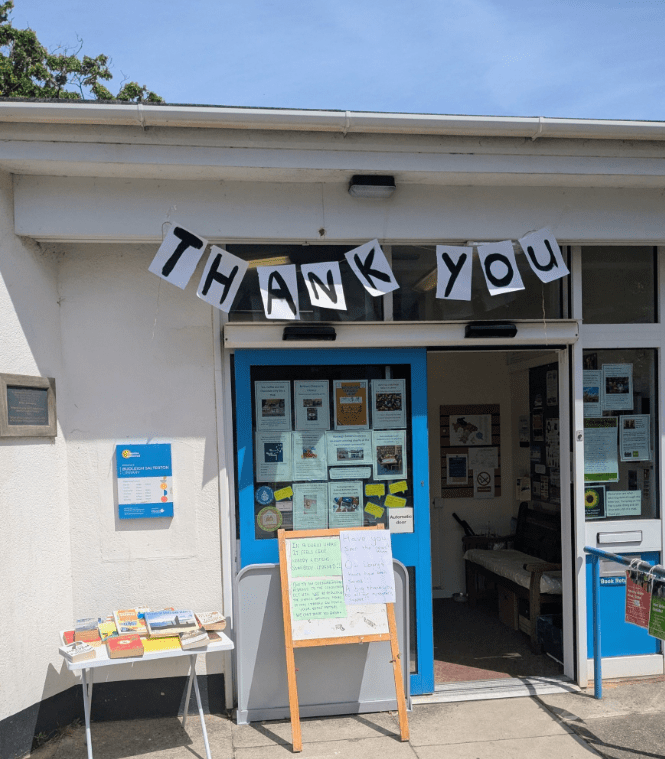
We cannot thank you enough for the support we received during the consultation period and in the months since. Special thanks go to the Friends of Budleigh Library committee who have been extremely caring and generous with their time – and have lightened the load in so many ways. Chaired by Geoff Woodman who was supported by his wife Susie, this wonderful bunch were relentless in their campaign to support Budleigh Salterton Library. We don’t know how we would have managed without them.
We must also mention Councillor Charlotte FitzGerald [LibDem District Councillor] who knew she needed to do something to help the library she loves and had a small seed of an idea that grew into something quite amazing. Supported by Councillor Penny Lewis, Charlotte organised the town meeting that many of you were turned away from because there was no space left in the public hall. Library staff will never forget the feeling of walking into the meeting and seeing that sea of friendly and familiar faces.
Thank you to absolutely everybody who filled in the consultation, came to the meetings, wrote to MP’s, the press, authors, the Queen …. thank you to everybody who supported us in your own quiet (and not so quiet) ways.
Thank you also for the kind words, concern and hugs (so many hugs!). We have been overwhelmed from the start by the love you have for this library and for the staff. This library is a special place but it is a joint effort. This library wouldn’t be what it is without the people who use it. You are a lovely bunch.
Although the consultation has been a very challenging and upsetting process (for you as well as us) it has also been very uplifting to see the Budleigh Salterton community come together in such a strong and powerful way. You should all feel very proud of yourselves.
“We asked them about opening negotiations with other progressive groups on the council to form a co-operative council – they refused and they’re determined to hang on to control.” – Diana Moore, Green Party leader.
Labour may have lost its majority on Exeter City Council but the party is still in control of the authority.
At the council’s annual meeting on Wednesday the Labour leader Phil Bialyk said he woud be continuing as leader and the announcement went unopposed.
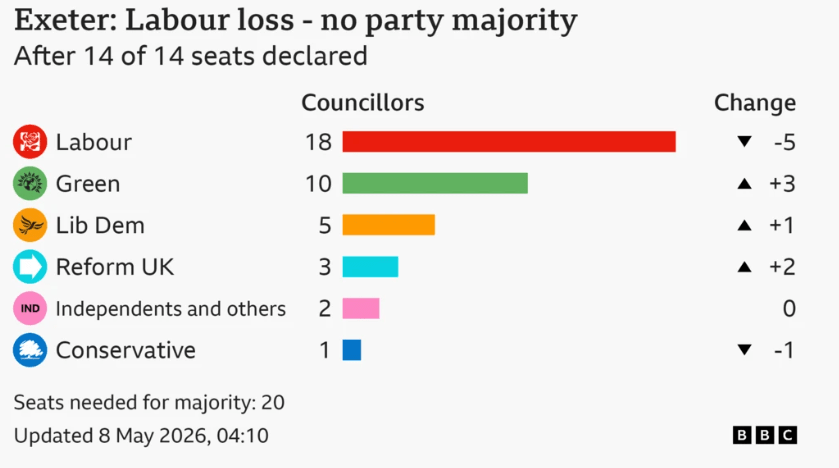
The party was reduced to 18 seats out of a total of 39 seats in the elections on 7 May with the Green Party as the main opposition with 10 seats.
The Green Party leader said she had wanted to share power with Labour but the offer had been rejected.
Bialyk said the Green Party was “desperately wanting to run things here in Exeter”.
But he said the Greens would have had to form an alliance with all of the other parties – Reform, the Liberal Democrats, the Conservatives and the Independents – to take control.
“We’re still the largest party,” he said.
Diana Moore, Green Party leader, said: “Labour may have the numbers to form a minority administration but I just question whether they have the mandate.
“We asked them about opening negotiations with other progressive groups on the council to form a co-operative council – they refused and they’re determined to hang on to control.”
A year of accredited citizen science testing reveals the extent of pollution in the Otter.
Yesterday Owl posted an article about Sidmouth’s Paddle Out Protest“standing in solidarity with those people less fortunate than ourselves, like our friends in the Otter Valley where they’re really struggling with pollution in the River Otter.”
As a consequence Owl received copies of recent Otter Valley Association newsletters which contained astonishing revelations on pollution in the Otter obtained from their citizen science initiative which has just completed a full year of testing.
Their 54 accredited volunteer testers performed 288 location tests compared to the 24 location tests conducted by the Environment Agency over the same period. (Consuming 620 sandwiches, 74 cream teas and 82 beers in the process!)
Richard Foord MP is fully involved – David Reed MP where are you? – Owl
Summary
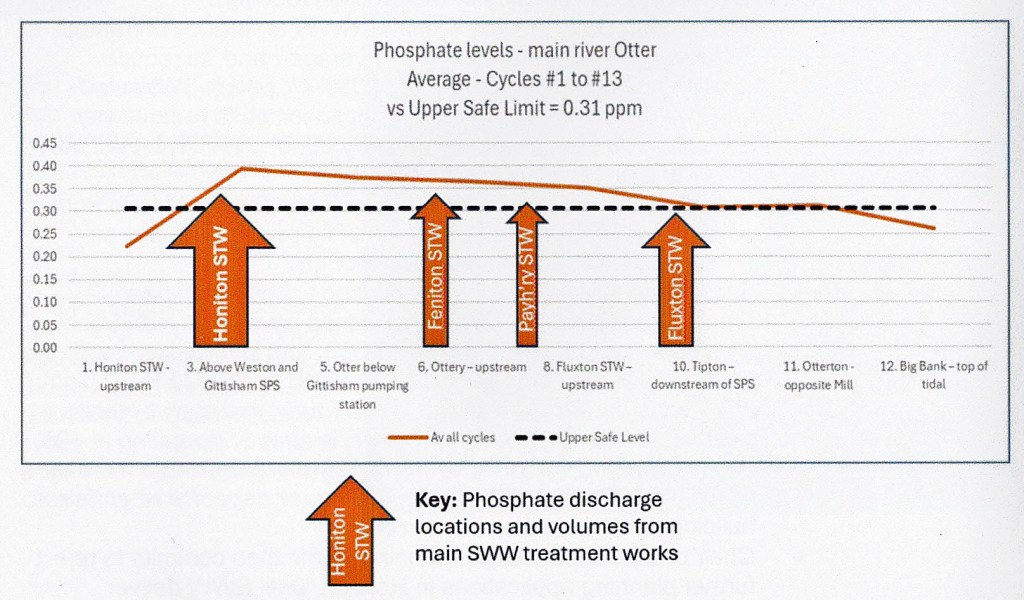
The results show that phosphate levels rise to alarming levels just south of the main Honiton Sewage works, and remain high all the way down the river as more sewage effluent is pumped into the river at subsequent treatment works and pumping stations, only dropping below the Environment Agency’s “Upper Safe Level” below Otterton.
Following a “Freedom of Information” request to South West Water, daily test results were obtained.for E.coli levels. These were taken at a number of locations around the lower river and Nature Reserve, from November 2024 through May 2025. At White Bridge, where the river Otter meets the tidal estuary. the E.coli levels are higher than the generally accepted ‘Safe Swim Level’ on 90% of days during that period, with the average E.coli reading being five times the ‘Safe’ level.
Following the loss of Budleigh’s Blue Flag beach status in 2025 due to high levels of entero-bacteria, South West Water stated publicly that the E.coli levels at Budleigh’s beach ‘COULD BE CAUSED BY BIRDLIFE IN THE NEW OTTER NATURE RESERVE‘ [did Simon Jupp think that one up?].
In fact, the evidence shows that the nature reserve is a recipient of the River Otter’s entero-bacteria pollution, NOT a significant source for increase.
The team continues to work with Richard Foord, MP, and the River Otter Fisheries Association (ROFA) to engage with both South West Water (SWW) and the Environment Agency (EA). Specific requests have been put to the Environment Agency, including:
Review the operation and permit for Honiton STW in light of environmental harm being caused to a river which is already classified as being “at risk due to phosphate”.
That consideration be given to an amendment to the permit for the Feniton STW upgrade which is due in 2030. such that it requires a high-level of phosphate removal, similar to that which has been highly successful at Fluxton.
That EA add a regular sampling point to the Middle Otter section, somewhere just downstream of Honiton STW. Currently EA have no routine visibility of water quality in the middle or lower Otter, until the sampling point at Dotton. – Owl
One full year of Community Monitoring[OVA spring newsletter]
We set up the ORCA campaigning group about 18 months ago with a call for volunteers. Following the recruitment process, these volunteers were all trained, risk assessments were published and the OVA provided relevant insurance for the testers to operate. Since then we have now completed a full year of 24 completed test cycles by 54 accredited testers performing 288 location tests, on 13 sunny days, 11 rainy days, 3 floods … consuming 620 sandwiches, 74 cream teas and 82 beers! Over 2,880 individual tests and observations have been logged. For this, we would like to extend a huge thank you to our amazing team of volunteers.
This testing is the most comprehensive testing performed on the river Otter — to put this in perspective, the Environment Agency carried out just 24 location tests on the River Otter in the same period.
Our results show that phosphate levels rise to alarming levels just south of the main Honiton Sewage works, and remain high all the way down the river as more sewage effluent is pumped into the river at subsequent treatment works and pumping stations, only dropping below the Environment Agency’s “Upper Safe Level” below Otterton.
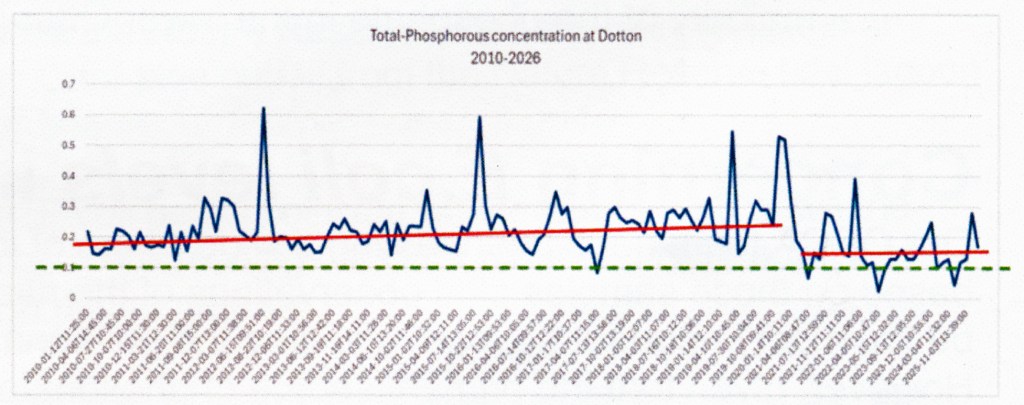
As well as analysing our own ORCA data, we also review all other river data sets produced by the Environment Agency, South West Water and other conservation groups. Although the Environment Agency only sample at a few spots in the catchment, the one benefit of their data is that we can analyse phosphate levels at Dotton, a few miles south of Newton Poppleford, once per month over the past 15 years.
Using this data set, we can make a number of important observations:
The general trend from 2010 to 2020 is a very high and gradually increasing phosphorous concentration in the River Otter, where the increase appears to correlate with the local population increase in the catchment
Phosphorous level at Dotton then drops significantly in March 2020. This drop coincides with some basic phosphate removal work being completed at Honiton, but more importantly it’s the date when a state-of-the-art phosphate-removal scheme went live at Fluxton sewage works. As Dotton is about four miles downstream of Fluxton sewage works, we see the full impact of this local reduction.
This significant drop demonstrates that Phosphate-reduction projects at sewage works, of the type we are calling for, really do make a material difference to total phosphate levels in the river
It also indicates that a similar reduction from sewage works in future, particularly at Honiton and Feniton, would likely produce a similar step-change improvement in measured phosphate levels downstream
Unfortunately, the chart then shows a slow background increase in phosphate levels from 2020 through to 2026, again likely reflecting increased wastewater from population growth
It’s clear from the chart that NO other factors appear to have impacted phosphate levels at Dotton, in any way that exceeds the background increase in phosphate through population growth. This includes all agriculture regulatory and advisory work by EA, Westcountry Rivers Trust and Devon Wildlife Trust, which have received £millions in investment. Whilst this work has reportedly reduced phosphate levels in the upper reaches of the Otter and in several of the tributaries, it does not appear to have any impact on net phosphate levels in the lower river.
That certainly does not mean however that this agriculture advisory work has not delivered important ecological benefits. Key focus areas include reducing soil run-off, stopping livestock from dumping their waste directly in the river, and advising on proper storage of farm waste – which reduces the potential for catastrophic fish kills from slurry. All of this work is very important in creating a rich river environment for the benefit of wildlife and people
The lack of any apparent reduction in agriculture-derived phosphate levels at Dotton though, given its success elsewhere in the catchment and on other neighbouring rivers such as the Axe, provides important evidence that the majority of the phosphate in the lower Otter is sewage derived.
E.coli levels
Our ORCA team have been testing a wide range of indicators of river quality, and based on those samples plus observations of the river ecology, phosphate appears to be the most important element affecting the environmental health of the river. However, given that the primary source of phosphate is sewage works, and the very high levels of untreated sewage discharges dumped into the river Otter, we were also interested to see what the E.coli levels in the river Otter have been.
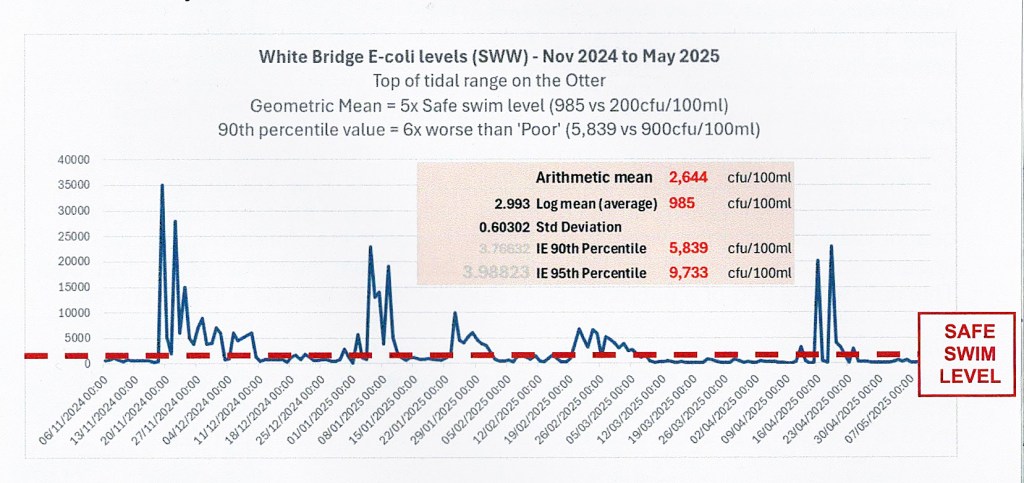
Following a “Freedom of Information” request to South West Water, we obtained their daily test results for E.coli levels which were taken at a number of locations around the lower river and Nature Reserve, from November 2024 through May 2025. In particular, we focussed on one key location, White Bridge, where the river Otter meets the tidal estuary. The results are shown in the chart below.
As you can see, the E.coli levels are higher than the generally accepted ‘Safe Swim Level’ (dotted red line) on 90% of days during that period, with the average E.coli reading being five times the ‘Safe’ level.
High levels of E.coli come down the River Otter, particularly after even very slight rainfall in the catchment. Sources are livestock agriculture and untreated sewage discharges, of which there were over 8,000 hours in 2025. Whilst not included in the ecological health classification, high concentrations of these entero-bacteria create a hazard for human and animal health.
Following the loss of Budleigh’s Blue Flag beach status in 2025 due to high levels of entero-bacteria, South West Water stated publicly that the E.coli levels at Budleigh’s beach ‘could be caused by birdlife in the new Otter Nature Reserve’.
To see if that could be the case, we analysed the same SWW dataset to compare the E.coli levels at White Bridge (so above the Nature Reserve), with the daily readings at Otter mouth, which carries the River Otter plus outfall from the Nature Reserve tidal lagoon out to the sea, and from there to our beach.
The Otter mouth samples show ALL E.coli peaks coincide with levels coming down the Otter at White Bridge. Therefore, high E.coli readings at Otter Mouth do NOT appear to come from bird life or other factors in the nature reserve.
In fact, the evidence shows that the nature reserve is a recipient of the River Otter’s entero-bacteria pollution, NOT a significant source for increased E.coli.
We were delighted to have been approached recently by Plastic Free Budleigh to help them in a water testing program in Budleigh Bay. They had been contacted by a team called “Bugwatch” led by Dr Jonathan Cox from Aston University and the Microbiology Society. They are looking to test the water quality at Blue Flag beaches for 7 consecutive days over the Easter period.
As you all know, Budleigh lost its blue flag last year! The team were very happy for us to be involved (for which we say thank you !). So, we asked our ORCA water testers if any of them would be interested in helping out. While this is not exactly on the river, it is testing where the river Otter hits the beach. We were delighted when the team responded in the affirmative. So, we undertook 7 continuous days of testing on the beach near the mouth of the river Otter. These data will be part of a published case study which we will share in due course.
We are now looking at how we can add E.coli testing to the river at selected locations alongside our current chemical testing. To do this we need to invest in new testing equipment and the relevant reagents that are used during each test. We will share more of this testing in future issues of “Otter Life” and via Facebook and web
Collaborating with the EA
Our ORCA team continues to work with Richard Foord, MP, and the River Otter Fisheries Association (ROFA) to engage with both South West Water (SWW) and the Environment Agency (EA). Our latest meeting was a positive and engaging meeting with Richard Foord, ROFA and the EA in order to review all of the data sets relating to phosphate attribution data, ie: apportion where the phosphate in the river comes from. This is important as the Environment Agency use this attribution data to ‘inform where action is most needed and support investment decisions aimed at improving water quality’.
OVA/ROFA’s analysis suggests that sewage works remain the primary source of phosphorus in the Lower Otter, and supports the data published by the EA in 2024.
Our requests from the Environment Agency:
1. A further meeting with EA’s technical team to review EA and ORCA detailed data sets with EA staff in relation to the attribution models, and confirm an attribution model which aligns with measured Phosphate data and timeline of known changes to sewage system.
2. We are asking EA to review the operation and permit for Honiton STW in light of environmental harm being caused to a river which is already classified as being `at risk due to phosphate’, plus East Devon District Council’s damning Water Cycle Study and Honiton’s sewage treatment capacity vs demand today and after a planned 980-home increases. These are just some of the many issues currently affecting Honiton STW. We are asking EA to consider placing a requirement for increased treatment capacity and a state-of-the-art Phosphorous removal scheme and permit.
3. To improve the Feniton STW upgrade which is due in 2030. SWW state that the primary objective is Nitrogen removal, rather than Phosphate. During our discussions with EA, it seems that this upgrade will also now include a (new?) minor form of phosphate removal. However, in view of the clear evidence of environmental harm in the river due to high phosphate levels, we are asking that consideration be given to an amendment to the permit, such that it requires a high-level of phosphate removal, similar to that which has been highly successful at Fluxton.
4. Request that EA add a regular sampling point to the Middle Otter section, somewhere just downstream of Honiton STW. Currently EA have no routine visibility of water quality in the middle or lower Otter, until the sampling point at Dotton.
“We are really lucky. We’ve seen some investment from South West Water very recently, so they’ve reduced the number of sewage spills, or they will when they finish the work down in the Ham.
“We do have to recognise that, but we are standing in solidarity with those people less fortunate than ourselves, like our friends in the Otter Valley where they’re really struggling with pollution in the River Otter.” [Budleigh lost its Blue Flag Beach status in 2025.]
Liberal Democrat MP for Honiton and Sidmouth Richard Foord attended the protest and described the turnout as “fantastic”.
Budleigh residents might ask: where is “on the same page” David Reed?- Owl
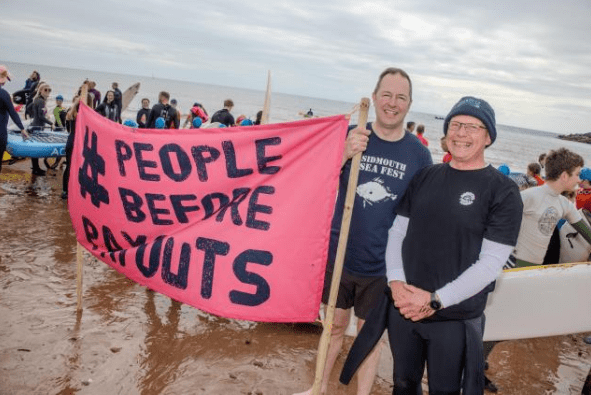
Dozens of protesters took to the sea in a mass “paddle out” demonstration as campaigners demanded an end to sewage pollution along the UK coastline.
Surfers, swimmers, paddleboarders and youth groups gathered off the coast at Sidmouth on Saturday, May 16 as part of a nationwide protest organised by Surfers Against Sewage.
The event was one of almost 60 demonstrations held across the country calling for action over sewage discharges and water industry reform.
Organiser Robin Goodman said the protest aimed to send a clear message to water companies and the Government.
Robin said: “We need to see the end to, as you’ve seen in the banner, people before payouts. That is the message today.”
He said the Sidmouth event marked the first large-scale “paddle out” protest held in the town in recent years.
Robin added that Sidmouth had seen improvements following investment by South West Water, but said campaigners wanted to stand alongside communities still dealing with pollution problems.
He said: “We are really fortunate and I’ve made a point of saying that to anybody.
“We are really lucky. We’ve seen some investment from South West Water very recently, so they’ve reduced the number of sewage spills, or they will when they finish the work down in the Ham.
“We do have to recognise that, but we are standing in solidarity with those people less fortunate than ourselves, like our friends in the Otter Valley where they’re really struggling with pollution in the River Otter.”
Liberal Democrat MP for Honiton and Sidmouth Richard Foord attended the protest and described the turnout as “fantastic”.
Sidmouth, Surfers Against Sewage, Paddle Out 2026 – Richard Foord with Robin Goodman(Image: Lewis Clarke)
Before heading into the water he said: “You can see the Surf Life Saving Club out in the water. You can see loads of youth groups and young people joining, young and old, to really show the passion that people feel on this subject.
“It is so much bigger than just one seaside town.
“This is something that people across the country feel strongly about, particularly across the south west of England where, because we have such a large coastline and we have South West Water, people feel particularly strongly about this.”
Mr Foord said rising water bills and concerns over infrastructure investment had fuelled public frustration.
He added: “What people have seen is that their bills are shooting up and they understand that the infrastructure is not being invested in at the rate that it ought to be.”
The MP said he welcomed proposed Government reforms to the water industry but urged ministers to move faster.
He said: “We want to see these water companies, when they fail, put into mutual ownership so that they become public benefit companies.
“We want to see people with ecological understanding, environmentalists, on the board of these companies so that they’re not run solely for profit in the way that they have in recent years.”
Speaking about South West Water’s new chief executive Keith Haslett , Mr Foord said he planned to meet him within the next fortnight.
He said: “My message to him is South West Water really needs to invest in the infrastructure so that we do not see this company run in a way that it’s all about extraction of profit.
“This company needs to be run in support of people’s health and wellbeing and not for profit.”
Robin said he believed campaigners would return for another paddle out event next year.
Prompted by your article dated 15th May, HOW HARD DO OUR MPS WORK FOR US , I conducted my own survey choosing an MP, newly elected in 2024, whose constituency is closest to ours from each of the political parties based in England. I haven’t chosen MPs who have established new political parties since 2024.
These figures are accurate as at 17th May, 2026
NAME OF MP
POLITICAL PARTY
CONSTITUENCY
NUMBER OF SPOKEN CONTRIBUTIONS IN PARLIAMENT
Martin Wrigley
Liberal Democrats
Newton Abbot
224
David Reed
Conservative and Unionist Party
Exmouth and Exeter East
216`
Carla Denya
Green Party
Bristol Central
212
Steve Race
Labour andCo-operative Party
Exeter
147
Nigel Farage
Reform UK Limited
Clacton
67
It was interesting looking online at their contributions in the Houses of Parliament using the Government’s (Hansard) website. Some MPs speak mainly about their parliamentary responsibilities rather than making sure their constituents’ voices are heard about issues that affect them such as businesses, cost of living crisis, education, health, housing, jobs, policing etc.
Devon’s Reform UK leader has issued a bid to launch a multi-party ‘shadow cabinet’ to “try something radically different”.
The two East Devon Indys (Paul Hayward and Jess Bailey) have politely declined; how many of the seven Tories will join this “non-political working relationship” is currently unknown. Then there is the question of the political allegiances of Cllr Ed Hiil, Pinhoe & Mincinglake and Cllr Angela Nash, Wonford & St Loyes. They were originally elected as Reform councillors, “became” independent, then joined Advance. Both these are currently listed on the Devon County web site as having reverted to “Independent” once again.
Can we call this “political bed hopping”? So is this what “multi-party” means? – Owl
Devon’s Reform UK leader has issued a bid to launch a multi-party ‘shadow cabinet’ to “try something radically different”.
Councillor Michael Fife Cook (Reform UK, Yelverton Rural) has invited any councillor outside the ruling Liberal Democrat and Green Party coalition that leads Devon County Council to join to try and better organise the council’s opposition parties.
Nigel Farage, the national leader of Reform UK, recently dubbed his leadership team a ‘shadow cabinet’ even though the leader of the opposition and shadow roles are given to the largest party not in government, which is currently the Conservatives.
Cllr Fife Cook (Yelverton Rural), who has recently been selected to lead his party in Devon for a second year, invited councillors to form a shadow cabinet “based solely on meritocracy”.
“I would like to ask if you might be willing to help try something radically different,” Cllr Fife Cook wrote to Devon County Council’s non-Lib Dem and Green members.
“We are going to be forming a shadow cabinet, and I want to ask all of those with ability, who are not LibDem/Green, to join with us and form a united opposition, so that we might have more say in the way forward for Devon.
“If you feel you would like to be part of this non-political working relationship, hopefully in training to take the reins as soon as needed, and if you have the courage to really work together for the people of Devon, then please step forward.”
Councillor Paul Hayward, an independent member who represents Axminster, said while he was “flattered to be asked” he was unable to join.
“I simply don’t have enough time in my day with my own [parish] council-employed role, Devon Association of Local Councils, Local Government Association, as well as being a member at East Devon District Council and the county council to take on anything else.”
Another independent, Councillor Jess Bailey (Independent, Otter Valley) said she felt accepting such an invitation would be “difficult” because of her role leading a committee.
“I chair the health and adult care scrutiny committee, which performs a really important scrutiny role, so I don’t think I could be in a shadow cabinet,” she said.
“I try to keep whatever political views there are out of the committee to ensure it is effective, so I couldn’t join this.” She acknowledged she understood Cllr Fife Cook’s motivation, but added that challenging an authority didn’t necessarily require a shadow cabinet.
Cllr Fife Cook said the recent local election results had “moved the goalposts” ahead of local government reorganisation, which is the process launched by government to overhaul local councils.
While no decision has been made yet, most of Devon’s existing councils are likely to be abolished and replaced by fewer but larger unitary councils, which are responsible for all services within their administrative boundary.
Cllr Fife Cook said while it wasn’t guaranteed that everyone who expressed interest could join, he wanted it to represent different parties and independents, “making use of those who have good knowledge, understanding and interest in the various subjects to be covered”.
He added there would be a “small group” choosing the shadow cabinet members that would do so “[without] favour or partisan alliance in any way”.
“This is our chance to show the public how councillors should work together in saving Devon and doing what we were all elected to do,” Cllr Fife Cook added.
While only Lib Dem and Green members are on Devon’s cabinet, the leaders of other parties are invited to cabinet meetings to have their say on decisions, and members can also support or oppose initiatives and proposals brought to the full council.
Scrutiny committees can also invoke a so-called ‘call-in’ of cabinet decisions, whereby they can raise further queries, but they do not have the power to overrule cabinet decisions.
Owl frequently features Richard Foord MP’s contributions to parliamentary debates, most recently when he led a debate on farming, but seldom those from David Reed MP.
However, since David Reed has just put his head above the parapet, Owl thought it opportune to review the record and compare both these two local MPs.
Richard Foord won the by-election for Tiverton and Honiton in July 2022 following the resignation of “tractor porn” Neil Parish. He was then elected as MP for the new constituency of Honiton and Sidmouth in the July 2024 general election.
David Reed was elected as MP for the new constituency of Exmouth and Exeter East in the 2024 general election.
Richard Foord has, therefore, been in parliament two years longer. In that time he has made 634 spoken contributions; 321 since July 2024.
In comparison David Reed scored only 113 (a third of Richard Foord’s tally for the same period)
Richard Foord also far outstrips David Reed on tabling early day motions in the same period: 240 to 5.
With political turmoil at home and instability abroad, what prompted David Reed to speak out this week?
What does he really think is bugging his constituents? Cost of living? NHS? Housing? Regional inequality?
Nope – none of these, it’s something a little bit more personal.
Adjournment debate 13 May
David Reed Opposition Assistant Whip (Commons)
“Like many other Members, I am exhausted by dealing with the Liberal Democrats on East Devon district council and Devon county council. They seem completely unaccountable, so can I ask the Ministers directly what can be done to make local government more accountable for the adoptions of roads?”
To which the Minister, Matthew Pennycook, replied with the following put down:
I would refer the hon. Gentleman in the first instance to that CMA house building report, which says very clearly that a twin-track approach is needed. We need common adoptable standards. Only at the point that we have common standards can we force local authorities to adopt. I understand, as I know many hon. Members do, the dilemma that local authorities can face when they have substandard amenities and are asked to adopt them and incur all the costs of bringing them up to the necessary standard, as well as the cost of their ongoing maintenance.
Who was David Reed speaking on behalf of?
Post Script: David Reed’s lacklustre performance highlighted in local press.
This new parliamentary activity report for 2025 has ranked a Devon MP in the top three for contributions made by new MPs elected for the first time in 2024.
Newton Abbot’s Liberal Democrat MP Martin Wrigley is in third place of 333 new MPs for his tally of combined spoken contributions and written questions, according to the political monitoring service PoliMonitor UK.
Where did David Reed come? 229th
Just in front of Fred Thomas (Labour, Plymouth Moorview) at 267th , bottom of the list in Devon, and just behind Steve Race (Labour, Exeter ) in 198th position.
Labour lost 50% of the seats it held in Exeter (4 out of 8) but lost 80% of the seats in Plymouth, holding only 2 out of 11.
Both cities have a four yearly electoral cycle. For the first three years, one third of the seats are contested each year on rotatiion. The fourth year is a “pause” year. In neither city is 2027 a “pause” year.
So 2027 will likely findCllr.Phil Bialyk in Exeter and Cllr Tudor Evans in Plymouth staring into the abyss.
Their claims to represent local views looks like a busted flush.
Psst – a word in your ear
Owl has always wondered to what extent these two Leaders have been whispering in ministerial ears on the subject of local government reorganisation, aka “Devon Disintegration”, especially regarding their expansionary plans to bring neighbouring communities within their grasp.
If so, the government would do well, in the light of these election results, to disregard any such whispers.
Exeter and Plymouth election analysis ‘tale of two Labour cities’
This year’s local elections in the South West were a tale of two Labour cities.
In Plymouth’s case the size of Labour’s majority and the fact that only a third of the seats were up for election made it a forgone conclusion that the party would still be running the city on 8 May.
Exeter too was only electing a third, but Labour’s small majority there made it obviously vulnerable to just a few seats changing hands.
In the event Exeter did slip into No Overall Control with the Greens taking three of Labour’s seats and Reform UK a fourth, while Labour managed to hang onto half the seats it was defending.
‘Established strongholds’
The council’s Labour leader was quick to say the results were much better than some had been predicting.
And he has a point.
Last year’s Devon County Council elections saw all of Labour’s Exeter seats snapped up by a combination of the Greens and Reform UK – the two insurgent parties which have been making much of the running in British politics ever since.
And what happens to Labour in Exeter arguably matters far beyond the city’s boundaries.
Labour has few established strongholds in the South West but Exeter has been its absolute bedrock over the last few decades through all the party’s up and downs.
So if Labour is in trouble in Exeter what does that say about its prospects in other parts of the region where its relationship to power has always been more tenuous?
Like Plymouth, for instance.
There is a strong and longstanding Labour tradition in Plymouth but it waxes and wanes.
This set of results – with Labour losing a great swathe of seats to Reform UK – suggests it’s now in the latter phase.
The implications of this for Labour’s future in the city are perhaps more significant than the headline loss of its majority in Exeter.
‘Impressively high figure’
Another eye-catching feature of the night was the turn-out figures.
Local elections often fail to enthuse voters but turn-out in some of the Exeter wards was nudging 50% – an impressively high figure.
At one point during the Exeter count there was audible astonishment in the hall when the turnout was announced.
So whatever you think of the results there’s no doubt a lot of people were very keen to shape the democratic process.
While the party remains the largest group at the authority, it lost five councillors from the previous time the seats were up for election in 2022, taking its overall number down to 18 – two below the majority mark.
The Green Party gained three seats to move to 10 seats overall and remains the second largest group at the authority while the Liberal Democrats gained a seat – taking their total to five.
Reform UK ended the night with three seats – a gain of two compared to 2022 – while the Conservatives lost a seat to have one councillor at the authority. Independents had no change to remain at two councillors.
Update: City council’s deputy leader Laura Wright was the highest-profile casualty of the night.
Just before parliament prorogued a week ago Richard Foord led a Westminster Hall debate on the question of Government support, or lack of it, for agriculture under the chair of independent MP, Karl Turner.
This followed his meeting the previous Friday with members of the National Farmers’ Union in his constituency.
Westminster Hall debates only last 30 minutes but are an opportunity to put arguments and questions directly to the appropriate minister. In this case Angela Eagle, The Minister of State, Department for Environment, Food and Rural Affairs
The debates can be confusing to follow because MPs often make short interjections designed to make a quick point on behalf of their constituents, sometimes in collusion with the lead speaker. Two interjections are highlighted in Owl’s summary below.
Despite the topic being on “home ground”, not a single Conservative MP spoke. The full transcript can be foundhere.
Richard Foord started by saying that food security is fundamental to our national resilience. At a time of global instability, farming underpins the rural economy, although we tend to take the produce for granted.
Immediately, Sarah Gibson, Lib Dem, Chippenham interjected that Labour is compounding the damage left by the Conservatives, with an underspend of millions in the farming budget. Shockingly, the Government’s own statistics say that in 2023-24, between 17% and 29% of farming families did not turn a profit.
Richard Foord continued: my Hon. Friend rightly mentioned farming profitability. Minette Batters, the former president of the NFU, conducted a review of farming profitability in December and came up with more than 50 recommendations. It would be interesting to hear from the Minister the Government’s reflections and progress on fulfilling some of those.
He focussed his subsequent remarks on three topics: international trade, tax and planning, drawing on his conversation with Devon farmers.
On trade he said that at a time when uncertainty on the international stage continues, food and farming policy should be about resilience. Instead, the Government preside over continued dependence on imports, higher costs and a system of support that is unpredictable and bureaucratic. Farmers are being asked to bear the brunt of shocks at a time when many of them are struggling to make ends meet.
On the balance of tax and incentives for the farming industry, he pointed out that Government policy is undermining the viability of many of our family farms. Farmers are not seeking to get rich; they dedicate their lives to the intense labour required to manage their farms, and ask for some stability in return—predictable costs, fair taxes and support systems that reward their productivity.
Lastly he talked about planning concerns. “As I understand it, there are delays in the planning systems across local authorities that are preventing farmers from doing the right thing. Last week, I talked to one who had applied for a cover on a slurry store and was still waiting, eight months later, for a verdict on whether he could go ahead and make the modification.”
In summary, at the end of his speech he said:
From what I understand, there is a national shortage of planning officers, and many of them are stretched across a number of things; they might be looking at applications for big housing developments. Sometimes, farm improvements that are geared towards improving environmental practices are quite low down the list for some of those planning officers. I question whether we might have dedicated planning officers who specifically look at some of the applications from farms. That would make a huge difference by improving the contribution of farmers to the environment.
To recap, we are calling on the Government to reduce exposure to volatile global inputs by supporting domestic fertiliser production. We are calling for a tax policy that recognises that family farms need stability, rather than the Government adding to global shocks with one or two of their own. We need farm support schemes that are predictable, accessible and fair, alongside systems for planning developments that work towards following clear timetables, rather than deadlines that continue to slip.
Farmers are doing their best in very trying circumstances. They are adapting and innovating, and trying to produce food for all of us while under immense economic pressure. They do not need warm words from the Government—they do not need “monitoring”. What they need now is a Government that are prepared to take action to match their rhetoric. I look forward to the Minister’s response.
Here are some extracts from Angela Eagle’s reply for you to judge to what extent the points were answered.
Minister: I also want to talk about the Batters review and its 57 recommendations. We have already announced that we will take forward a number of the review’s recommendations, including the formation of a Farming and Food Partnership Board. Indeed, that board has already met and decided that horticulture will be the first agricultural sector to have a sector growth plan, which will be developed as part of the board’s work. I agree with the hon. Member for Honiton and Sidmouth that we need to consider what we can do make the growing of fruit and vegetables more resilient; he pointed out that that is the sector where we have the most difficulty in generating resilience. The Farming and Food Partnership Board is also looking at the poultry sector.
We will continue to develop our farming road map, which will be published later this year alongside our formal response to the rest of the recommendations of the Batters review. This road map will set the course for farming in England up to 2050, setting out how farming will evolve in response to changing markets, technologies and environmental pressures. In developing the road map, we have held workshops, meetings and listening sessions across the country, to ensure that it reflects what farmers need on the ground to plan for the future.
I think that this is the first time since the second world war that a Government have tried to set more of a Government direction for agriculture, so that we can work with the farming sector to ensure that we can increase resilience and give food security the proper priority it deserves. By definition, some of that work means that we have to look through the near-term pressures and problems that the hon. Member for Honiton and Sidmouth has raised today. However, it is important strategically that we are able to do that……..
I recognise the pressures many farm businesses face. Input costs can rise quickly and global markets, as we have seen recently, can shift overnight. That uncertainty makes it harder to plan, invest and employ, which is why the approach of the Department for Environment, Food and Rural Affairs is both long term and practical: stable funding, and simpler, fairer schemes designed to make farming more resilient and sustainable in the future—sustainable both environmentally and financially.
I will first address fertiliser, because I appreciate it is the major input in an arable setting. It is a cost that is a real worry for farmers. Recent market volatility has seen a 40% increase in prices for some fertiliser products and DEFRA is monitoring the impact on agricultural supply chains. We have direct lines open with domestic fertiliser suppliers, commodity traders and farming stakeholders, including the National Farmers’ Union—in fact, I have just been in a meeting with Tom Bradshaw. We all do our bit to meet as many of our farmers and their representatives as possible to know exactly what is going on where, so that it can inform our decision making.
Better information helps farmers make decisions that are up to date with the current situation, which is obviously in great flux. That is why we asked the Agriculture and Horticulture Development Board to increase the frequency of fertiliser price reporting, and welcome its move to publish price data weekly, giving farmers more timely and transparent information. We also recently ran a survey to understand how the rise in fertiliser prices and supply issues are impacting our farmers and land managers on the ground. Responses are being reviewed alongside other industry intelligence to guide how we shape future support.
DEFRA’s new nutrient management planning tool is supporting farmers by matching nutrients to crop and soil needs, enabling them to make the most of nutrient sources, reducing their reliance on artificial fertilisers. Over 500 farms have used this since it was launched. We are also consulting and gathering evidence to modernise fertiliser product regulations, improving future supply options and resilience.
The pressures imposed by events in the middle east only underline the importance of increasing the efficiency of fertiliser use. Whether through more effective use of technology or adoption of more sustainable farming practices, we can better equip our farmers and growers to produce food in a more resilient way. The Government stand ready to help farmers do just that, whether through our innovation funds and equipment grants, or our continued shift from area-based subsidy to environmental land management schemes……
Fuel is another issue that was raised in the debate. Price spikes can feed straight into farm costs, particularly for those who rely on red diesel. Red diesel continues to benefit from an 80% discount, saving farmers almost £300 million a year. There is also a 5p fuel duty cut in place from March until September. Where concerns have been raised about price transparency, we have raised them with the Competition and Markets Authority, which is monitoring petrol and supply prices closely. Industry bodies have been clear with us that fuel production and imports are continuing across the UK as usual. The Government continue to monitor sales, deliveries and stock levels, and well-established contingency plans exist should they ever be required.
The hon. Member for Honiton and Sidmouth raised farming schemes and grants. I understand the pressure that the uncertainty we are now facing in the world because of what is happening in the middle east applies to farmers, coming as it does after the impacts of climate change-related extreme weather in recent years, which have damaged harvests. This Government will work with farmers to deliver long-term solutions to the risks of extreme wet and dry weather, and to increase profitability, because when farmers can run profitable businesses, it is good for the whole economy and vital for our food security.
Now to the second intervention that caught Owl’s eye – a swipe at council reorganisation.
Caroline Voaden, Lib Dem South Devon: I just wanted to make a brief Intervention on the issue of entry into farming. Devon county council has several farms and it is very keen to use them as a way to get young people into farming, especially those who do not have a family farm of their own. It is quite worrying what might happen to those county farms if Devon county council is divided up in the local government reorganisation process. Is there any way that they could be protected through the decimation of Devon, which might happen over the next year through LGR?
Angela Eagle replied: I will not get into the decimation of Devon; I will leave that to the hon. Lady. I have clocked the existence of county farms. I think they are a good thing and I have sought some advice on what we can do to support them sensibly, because they are a way for people to get into farming that we should cherish.
The EFRA Committee has today [Friday 1 May] declared it has no confidence in the Chief Executive or Board of South East Water (SEW) to address the company’s multiple and ongoing failures and protect residents from disruption, highlighted by the major recent water outage in Tunbridge Wells.
In a new report the cross-party Committee finds SEW’s leadership’s incompetence has accompanied a culture of unaccountability that has perpetuated the company’s poor performance. Its wholly inadequate governance framework has also failed to hold its senior employees to account.
The report comes after two Committee hearings into the major water outage in Tunbridge Wells in late 2025, in which tens of thousands of customers, many of them in care settings or vulnerable, were left without drinking water for two weeks. The Committee recalled SEW’s leadership after concerns about the accuracy of evidence it initially gave during a Committee hearing in January.
The report states: “South East Water presents as a company devoid of proper leadership, riddled with cultural problems that raise serious concerns about the ability of the executive team, led by the CEO David Hinton, to bring the company back into compliance and deliver the services their customers deserve. Leadership teams play a major role in how company culture develops; culture change at this scale requires South East Water’s leadership to change.”
The Committee is also calling on shareholders in SEW – Utilities Trust of Australia, NatWest Group Pension Fund and Desjardins Group and associated holding companies – to hold the company to account.
A summary of the report’s conclusions and a timeline of major incidents are included below.
“We have taken the unusual but necessary step of declaring no confidence in SEW’s CEO and Board because we feel obliged to highlight the gravity of this extraordinarily poor situation. This is an exceptional failure of management and of corporate governance. The refusal of anyone in the company to be accountable for this failure cannot, in our view, be overlooked.
“One cannot overstate the dangers of so many communities losing water supply for extended periods, including schools, GP surgeries and care homes. The Committee heard that many South East Water customers have so little confidence in the security of their supply that they are stockpiling bottled water because they fear the inevitable will happen again. In twenty-first century Britain that is an almost incredible state of affairs.
“Someone in this company needs to take a grip, be accountable for its failings and to put them right. That should be for the executive leadership of the company and, failing that, it should then be the non-executive directors. That would normally be the end of the road, but when that fails, shareholders have a duty to act. We urge them to read this report and to take action. They can no longer be allowed to ignore the consequences for the consumers that they are licensed to serve.”
Summary of the report’s conclusions
Failure to monitor critical risks
SEW lacked the processes and oversight to identify mitigate risks at Pembury Treatment Works, where various asset failures led to a two-week outage in Tunbridge Wells last year. Among the most significant errors, SEW failed to carry out the jar tests that the Drinking Water Inspectorate (DWI) had directly advised them to do which would have allowed SEW to understand why their remedial interventions were failing. Having failed to action DWI’s recommendations, SEW was “flying blind” at the time of last year’s Pembury incident. This was a fundamental failure.
Failure to maintain assets
One of the most fundamental and basic responsibilities of a water company is to plan for and have the staff available to maintain assets, particularly assets that are most vulnerable.
At the time of writing, Ofwat is consulting on issuing a fine of up to 8% of SEW’s annual turnover (£22.46 million).
The DWI said that routine maintenance and cleaning were not undertaken at Pembury before the Tunbridge Wells incident. Ofwat’s investigation, between 2020 and 2023, flagged issues with the maintenance of reservoirs, bore holes and trunk mains. Not enough resourcing and planning to tackle these problems had been put in since the 2019 Price Review, despite in many cases being costed for.
Failure to invest
Regulators told South East Water repeatedly over four years that it needed to invest in new infrastructure to be resilient to potential shocks. Single points of failure (such as at Pembury), supply shortfalls and a lack of regional connectivity should have been improved.
Spending allowances in previous price reviews, determined by Ofwat, likely made for difficult spending decisions, but ultimately these decisions are the company’s responsibility. Worse still, through successive price reviews, SEW has either not attempted or failed to make the necessary investment case. This suggests shareholders also deserve a share of the blame.
Failure to plan
SEW has regularly used increasing water demands, and extreme weather to explain its failings. Ofwat and the DWI have shown that the company failed to model upcoming peaks and troughs and take the necessary steps to boost resilience. Its leadership’s approach to incident response planning is pitiful; there are signs that incident response plans either do not exist or are of poor quality, having little or no stress-testing to improve them.
Failure to respond, communicate and deliver for vulnerable customers
There has been widespread criticism of SEW’s provision of bottled water stations and home deliveries for vulnerable residents. During the Tunbridge Wells incident last year, some preselected sites for water stations were quickly abandoned after realising they weren’t suitable, and only three stayed open. Provision was too reliant on residents having access to cars and SEW relied on local authorities to distribute bottled water and provide toilets in some areas. GP surgeries, schools, nurseries and the Tunbridge Wells Kidney Treatment Centre had gaps in support. Deliveries were left outside some vulnerable residents’ homes overnight without telling them, or in packages too heavy for some to lift.
There were failings in its communications, with incorrect information issued about bottled water stations and wrong postcodes provided. Communications were said to contain poor choices of language and lacked empathy. Given the number of outages SEW has overseen, it is remarkable that the company failed to learn and apply lessons.
Group-think and obfuscation
SEW’s leadership team has demonstrated a clear pattern of blaming factors outside of their control, even despite clear evidence to the contrary. A lack of data-analysis skills might be partially to blame, but there is also a clear culture of obfuscating responsibility that is seriously inhibiting their ability to analyse problems and learn lessons. The company’s investigations, as well as that of the DWI, have identified potential issues with a lack of challenge or groupthink within the company.
The company even attempted to secure an injunction to block Ofwat from publishing a report that contained pertinent information to credit agencies.
In February/March 2018, a freeze-thaw event saw three areas in SEW’s Eastern region experience supply interruptions for more than 12 hours. 26,705 customers lost tap water supply throughout the company’s patch, with up to 6,000 of those customers having no water for more than 48 hours.
In August 2020, tens of thousands of SEW customers experienced low or no water pressure due to a “high demand” event as temperatures reached highs of 34C, in combination with a new trend of people working from home.
In February 2022 Storm Eunice led to nearly 86,000 customers losing supply, with Sussex the hardest hit. The storm downed power networks which impacted “over 100 assets” belonging to SEW.
In December 2022 a freeze-thaw event saw 85,000 customers affected. SEW paid out £3,723,545 in compensation to 24,763 household customers. Supply was lost as leaks resulted from burst water mains. SEW said it carried out 316 repairs.
In June 2023 several schools were forced to close due to supply interruption when reservoirs ran low after low levels of rainfall. Ofwat said it opened an investigation following this event, as SEW’s response had been unsatisfactory.
In January 2025, a power cut shut down a water treatment works that supplied 5,000 properties in Kent. Water supplies were restored after six days.
In March 2025, a burst pipe flooded a treatment station in west Kent, which affected 7,000 customers, some of whom were cut off for five days.
In July 2025, 3,000 properties around Herne Bay, Kent, lost supply, some for six days. SEW said a heatwave at the time was to blame.
November to December 2025: a failure at Pembury Treatment Works left 24,000 properties – including business, schools, health and care settings without clean drinking water across 14 days.
January 2026: a freeze-thaw event and Storm Goretti left up to 30,000 customers without water for varying lengths of time between 10th and 19th January. 6,500 customers in Tunbridge Wells lost supply, having already been affected in the previous month.
Hmm? – (Brings back memories from 45 years ago and a famous quote from David Steel) – Owl
It has been an election buildup dominated by the rise of Reform UK and the Greens, and the contrasting woes of Labour and the Tories. But there is a chance that on 8 May the Liberal Democrats, largely ignored in recent weeks, could wake up as the biggest party in English local government.
This is just one of several paradoxes for the party’s leader, Ed Davey, and his team. They are fifth in many national polls, with a rating barely changed from 2024. But Lib Dem bosses are sanguine, convinced that UK politics is now so different, so atomised, to make headline polling almost irrelevant.
One senior Lib Dem said: “A lot of people seem to be misreading the way things are going. We think we have some of the answers.”
In one sense, the ambitions are familiar. Barring an unexpected change of fortunes, the Lib Dems will increase their total number of councillors for an unprecedented eighth set of local elections in a row.
A particularly good night for the party, plus heavy losses for the Conservatives, could result in the Lib Dems overtaking Kemi Badenoch’s party. If Labour fared very badly, there is an outside chance this second place could become first.
One party strategist said: “It’s not something we’re necessarily expecting this time – it’s more likely in a year or two. But for all the fuss about Reform, year after year we are quietly making gains. It’s the tortoise and the hare.”
Beyond the raw metrics there will be two main gauges of success for the Lib Dems. The first is consolidation or progress in “blue wall” areas where they took dozens of parliamentary seats from the Conservatives in 2024. “In places like Surrey we want to show we can finish the job on the Tories,” as one Lib Dem MP put it.
“I call it electoral bamboo,” another MP said. “I’m still surrounded by Conservatives, but we are spreading out quickly.”
The other gauge, which feels less certain, would be gains on councils which, in recent years, have been less promising ground for the Lib Dems, such as Birmingham and Preston.
It is the latter category where Lib Dem strategists hope to test out a campaigning model based on a mixture of rigorous voter targeting and being able to, as one planner put it, “cut through the noise” of an increasingly fragmented political system.
For the local elections, this is based around occasionally Reform-adjacent retail policies, such as a demand to cut fuel duty by 10p to help with costs from the Iran war, coupled with relentless attacks on Nigel Farage, particularly his closeness to Donald Trump.
The party is now running its biggest-ever programme of digital adverts, most targeting Farage, contrasting his support for Trump with Davey’s repeated willingness to criticise the US president.
“Iran has had real cut-through,” one Lib Dem MP said. “It’s not uncommon to have someone complain about potholes and then switch directly to the war and their worries about Trump.
“It is also really notable the number of doors you knock on where people say they are desperate for anyone except Reform to win. Farage is really polarising.”
This phenomenon is central to a strategy aimed mainly at the next general election but getting an initial try-out on 7 May. Based on huge amounts of internal polling, the Lib Dems are working on the basis that about half of voters will do whatever is necessary to block Reform in their local area.
One senior Lib Dem said: “We are seeing huge, huge, levels of tactical voting, in a way we haven’t seen before.” It is this context that makes the party relaxed about polling about who will definitely vote for them, and to focus more on those who would consider it, perhaps tactically.
With about a quarter of voters seen as strongly pro-Reform – the “burn everything down and start again” sector, as one Lib Dem official put it – another quarter are frustrated with the government and flatlining incomes, but uncertain where to go.
This is where campaigning is aimed, based on a mixture of retail policies centred on the cost of living and presenting the Lib Dems, particularly Davey, as able to understand their worries but without the baggage or discord that comes with Reform.
One senior Lib Dem said: “We don’t need to chase the 50% who are already anti-Reform. They will vote tactically regardless of almost anything else. In 2019 we tried to win just with these people and got hammered. It’s easy to boost polling numbers and lose seats.”
This will, however, at most be a partial test. Local elections are not general elections: turnout is lower, and many voters are less worried about a Reform-run council collecting their bins than the idea of Farage in Downing Street.
But there will be lessons to uncover, including whether the Lib Dems’ electoral ground game still works in a five-party battle, and if Davey, whose performance has prompted some grumblings among MPs, has the ambition and charisma to expand the party’s brand outside its strongholds.
Thus far, the mood feels hopeful. “There is more work to do, but we are getting towards being on the right track,” one MP said. “Some of the movement on economy is positive.”
But with the two-party system seemingly smashed and voter loyalty a memory, all predications come with caveats. This is new ground for everyone.
“I knocked on a door and a man said he wanted to vote for Restore Britain,” one MP said, referring to the Rupert Lowe-led start-up party that sits even further to the right than Reform. “When I told him they aren’t standing here he said: ‘Well, it’s probably you then.’ That was a first.”