More on: Devon ‘betrayed’ as Exeter and Plymouth given land-grab green light

Devon’s residents have been “betrayed” in a fundamental overhaul of how Devon’s councils will be reorganised and which services they will be responsible for, it has been claimed.

Bradley Gerrard www.devonlive.com

The government has today confirmed its local government reorganisation plans for Devon, which will see four new councils created in the place of its current 11.

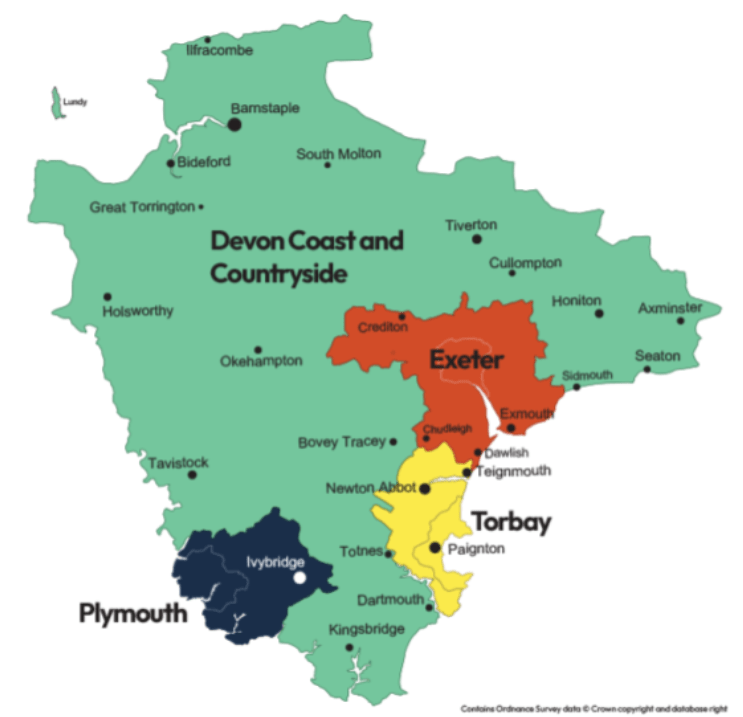
Those changes will see Plymouth City Council subsume parts of some of the South Hams, while Exeter has been granted permission to swallow up parts of Teignbridge District Council, as well as East Devon and Mid Devon district councils.

Steve Reed MP, the secretary of state for housing, communities and local government, told the House of Commons the changes would bring decision-making closer to communities, and that the move to unitary councils would be easier for residents to understand.

He added that altered boundaries for the new councils would better reflect how populations live and work in those areas, and that his proposals would ensure places like Plymouth and Exeter meet their growth potentials.

Councillor Julian Brazil, the Liberal Democrat leader of Devon County Council, believed the outcome was “shocking” and expressed incredulity that Devon’s two Labour councils had been given permission to take the best parts of their neighbours to create new councils.

“It is shocking and Devon has been betrayed,” he said.

“The government has said it looked at all the proposals but that the Secretary of State has gone with the one suggested by Exeter and Plymouth.”

He added: “I wonder what [those councils] have in common with the government,” pointing to the fact both cities are run by Labour administrations, the same party in power at Westminster.

Exeter’s Labour MP, Steve Race, said it had been “increasingly unsustainable for Exeter to remain a poorly funded district council, with most spending decisions taken by Devon County Council”.

“”Creating a unitary authority for Exeter will secure local democracy, provide the opportunity to improve local services, and create sustainable economic and jobs growth,” he said.

“Under a new unitary authority on boundaries that include Exeter’s wider economic footprint, Exeter will be better placed to unlock new opportunities for jobs, housing, innovation, and investment, while ensuring we advocate for the transport and infrastructure we need as more people choose to call our city their home and their workplace.”

Mr Race added it would bring decision-making closer to communities rather than the confusion of the current two-tier system.

“It will also finally give those people living in the surrounding area, who already work and socialise in Exeter, a say in the way our city is run,” Cllr Race added.

Councillor David Wulff, the Liberal Democrat leader of Mid Devon District Council, called the changes a “political city land grab”, claiming it would create a “two-class Devon”.

“I am deeply disappointed that the government has squandered a genuine opportunity to deliver meaningful reform of Devon’s councils, strengthen local accountability and bring decisions closer to the residents and communities they affect,” he said.

“Instead, it has chosen a remote, centralising model that weakens local identity and leaves rural communities with less influence over their own future.

“The government claims that this exercise is about removing two-tier local government. In reality, it is creating two classes of council: enlarged city authorities handed additional population, development land and tax base, and a sprawling rural authority left to provide more expensive services across the remainder of Devon.”

He added Crediton was a “proud and historic Devon market town”, noting that “it is not an Exeter suburb, and it should not be treated as a balance-sheet asset to be transferred to City Hall”.

“Rural Devon is not a piggy bank to be raided whenever an urban authority needs more taxpayers, more land or a stronger financial base” Cllr Wulff said.

“Yet that is what this decision appears to do. Westminster and the city halls are asking rural communities to surrender their taxes and shoulder the financial risk of a reorganisation designed around the needs of expanded urban authorities.”

In Parliament, Steve Reed MP, the secretary of state for housing, communities and local government, said the changes were the “most ambitious” overhaul of local government undertaken, and that the aim was to “devolve power out of Whitehall”.

“Devolution is about strong local councils delivering good public services and supporting economic growth while being closely connected to the communities they serve,” he told the House of Commons.

“The current two-tier system of local government is confusing, it slows down decision-making and blurs accountability.

“In many areas, the existing boundaries don’t match the services provided or public identities of those areas.”

He confirmed the proposal to change Devon’s make-up into four new unitary councils, with an expanded Plymouth, an amplified Exeter, bigger Torbay, and the rest creating a so-called ‘coast and country’ unitary.

He namechecked Plymouth as a city of “nationally significant growth location”, suggesting the changes could help fulfil its potential in areas such as housebuilding.

Mr Reed also named Exeter as a beneficiary of his proposals, once again stating it would help the city grow and enable the government to “get the homes built that we need”.

Mr Reed stated areas undergoing local government reorganisation will receive more than £1 million per new unitary created to support the changes.

His opposite number, James Cleverly MP, the Conservative shadow secretary, claimed the rationale for the changes was “blatant” and that they had been “driven by party politics”.

He highlighted the changes in Devon as those “put forward by Labour in Exeter and Plymouth”.

“Many communities will be left in limbo while Labour councils have been allowed to redraw the map ahead of future elections they will be engaged in,” he said.

“If the Secretary of State wanted to avoid accusations of gerrymandering, then why create such a gerrymandering set of boundaries?”

Mr Cleverly asked Mr Reed if any analysis had been conducted on the potential for judicial reviews.

Cllr Brazil said the costs of a judicial review paled into insignificance compared to the amount of money to enact the overhaul.

“I’m almost certainly minded to judicial review this,” he said.

“When you look at the costs of local government reorganisation for Devon possibly hitting £80 million versus the £250,000-£500,000 cost of a judicial review, the latter would be money well spent.”

The changes, which need to be approved by Parliament, will see the two-tier system in Devon eradicated.

That will mean that instead of the district and county council system that exists in much of Devon now – where different services are overseen by different councils – bigger unitary councils will be created.

Unitary councils are responsible for all the services within their boundaries, such as happens within Plymouth and Torbay now.

Under the changes confirmed by Parliament, Plymouth will subsume 13 parishes currently in the South Hams, while Exeter will nab 15 from Teignbridge, 28 from East Devon and six from Mid Devon as part of a new expanded council, while Torbay will expand its boundary to take on 22 parishes in total from Teignbridge District Council and South Hams.

The remaining bits of the county – predominantly the northern and mid areas, will be pushed together into a so-called coast and country unitary.

Devon plans judicial review as government makes LGR announcement “on last day of term”.

This is not a good start to Andy Burnham’s vow to give Britain the circuit breaker it needs.

This looks like more of the same old cronyism and sneaky gamesmanship of Whitehall knows best.

Labour demonstrates it doesn’t understand or care about the countryside, it’s a party of townies. – Owl

Making the LGR announcement “on the last day of term”, does not show “local government the respect it deserves”. – Labour Chair of Commons’ local government committee, Florence Eshalomi. She also said the government “still haven’t provided” the evidence that it will provide significant savings.

DCC Leader, Julian Brazil, who was interviewed by Ewan Davies on BBC Radio 4 “PM” last night (about 1710), confirms his council plans to launch a judicial review. Read on.

Three counties consider LGR judicial reviews

www.lgcplus.com

At least three counties are considering legal action against local government reorganisation decisions announced today.

Devon CC leader Julian Brazil (Lib Dem) told LGC his council plans to launch a judicial review and will be sending a letter of intent soon, calling the proposed geographies of the new unitary authorities “ridiculous” and the decision “shocking”.

He said the council has filed freedom of information requests to MHCLG to determine the rationale behind the LGR decision.

He accused the government of “blatant gerrymandering” as the business cases from Labour-run Exeter and Plymouth City Councils were chosen. This option will reorganise 11 councils into four unitaries.

According to Cllr Brazil, previous judicial reviews had been defended by the government under the terms of “place making,” an idea he described as “murky, foggy and grey”.

Cllr Brazil argued that this argument is not suitable for the decision in Devon and Torbay due to the nature of the county. He said that “the people in Exeter and Plymouth probably have no idea what rural Devon looks like”.

Despite this, Cllr Brazil said that he is “not against LGR and the destination” but is concerned about the “journey to get there”.

In contrast, Torbay council leader David Thomas (Con) suggested his authority would not take legal action, saying: “This isn’t the result we wanted but I recognise that government has made their decision and here in Torbay we will embrace this change.”

Hertfordshire CC leader Steve Jarvis (Lib Dem) said the “worst option” was chosen and promised to “explore ways in which we can challenge the government’s decision”.

Cllr Jarvis said: “It will cost the council taxpayers of Hertfordshire more and projections show that one of the new councils will be running in deficit from the day it is created”.

However he said his team will “continue to work with other Hertfordshire councils to prepare for reorganisation and to make our case for a mayor as strongly as possible”.

Reform-led counties

A Reform UK source told LGC “several Reform councils are not happy” with the LGR decisions, and they would not be surprised if “several” opt for legal action but the decision to “spend taxpayers’ money on legal action obviously will require some proper analysis”.

They said Reform leaders see the LGR outcomes as a “political decision rather than a practical one” and shared fears that models put forward by Labour-led cities were favoured over the counties’ preferences.

Reform leader of Leicestershire CC Dan Harrison has publicly declared his intention to “take legal advice on launching a challenge to government”.

He branded the government’s decision to go ahead with Labour-led Leicester City Council’s plan to expand the city as a “disastrous day for democracy”.

Cllr Harrison, who backed plans to combine the county’s footprint with Rutland CC and keep Leicester at its current size, said: “I’m furious, shocked and bitterly disappointed.”

He said: “We’ve always been clear an expanded city would be costly and disruptive. Financially and strategically, this is madness and it’s not the right decision for Leicestershire. ​”

He added: “Our professional officers will get on with the job. But this is reckless and we’ll continue to fight for those residents who’ve been let down by the government today. ”

Reform leaders not taking action

However, the leader of the Local Government Association’s Reform group Stephen Atkinson suggested his council Lancashire CC would not pursue legal action.

Cllr Atkinson (Ref) said he has “serious concerns” about the “scale and complexity of delivering such a significant reorganisation,” but will “work alongside” councils in the areas to “deal with the reality in front of us”.

He had previously spoken out against LGR and wrote to the government calling for the plans to be delayed. Today he reiterated his concerns that “larger authorities risk moving decision-making further away from communities”.

But he shared a commitment to work “constructively” with the 14 other councils during the transition into four new unitaries.

However, in a letter seen by LGC, Burnley BC leader Afrasiab Anwar (Ind) told the communities secretary Steve Reed the decision to put his borough with Blackburn is a “serious error of judgement”.

He said the proposed Pennine Lancashire authority “would inherit exceptionally high and deeply entrenched levels of deprivation, bringing together communities that are among the most deprived in England”.

He added: “Unless its creation is accompanied by a substantial, long-term and needs-based government funding settlement, there is a serious risk that reorganisation will entrench disadvantage rather than help overcome it.”

Meanwhile Kent CC leader Linden Kemkaran (Ref) said her team will “take the time needed to review the detail and understand exactly what it means for Kent, including how the new arrangements would be implemented and the timescales involved”.

Lincolnshire CC leader Sean Matthews (Ref) said the creation of a new Lincolnshire unitary authority and the expansion of Lincoln into a separate unitary will be a “significant change”.

He added that it would be a “long-term piece of work to implement” and he would work will all councils “to get the best outcome for residents”.

While Derbyshire CC leader Alan Graves (Ref) did not back the government’s LGR decision for a north/south split for the county, he described the move as a “fresh start and an opportunity to do things differently”.

Cllr Graves said his team is “focused on working with our district, borough and city council colleagues to plan how services will be delivered by two councils in the future”.

Staffordshire CC leader Martin Murray (Ref) said the proposed north/south divide of his county “follows the government’s rules, has clear strengths and is financially viable in the long term”.

He added: “We will work professionally with neighbouring councils to make the change happen safely, with residents’ needs at the heart of the process.”

Working together

The six councils in Warwickshire, nine councils in Nottinghamshire and seven leaders in Worcestershire sent joint statements despite holding differing views ahead of the government’s decision.

The joint statement from North Warwickshire, Nuneaton and Bedworth and Rugby BCs, Stratford-on-Avon and Warwick DCs, and Warwickshire CC acknowledged the “different views on the best structure”.

But they said they “have a history of working well together” and will “remain committed to continuing to work together constructively and responsibly as we move into the next stage of this process”.

Worcestershire CC and the six districts in the county declared the “debate is now over,” and have chosen to “come together to express our commitment to work collectively to make these new arrangements a success for residents, businesses and communities across the county”.

This statement was signed by the leaders of Bromsgrove, Malvern Hills, Wychavon and Wyre Forest DCs, Redditch BC, Worcester City Council and Worcestershire CC.

Meanwhile a similar sentiment was shared in the joint statement by Ashfield, Bassetlaw, Mansfield, Newark & Sherwood and Rushcliffe DCs, Broxtowe and Gedling BCs, Nottinghamshire CC, and Nottingham City Council.

It said: “All nine councils have worked hard to meet the deadlines set by central government and to provide submissions that we believe are best for the residents we serve. We will continue to work together to ensure services continue and that residents and businesses remain our priority.”

Despite this, Gedling BC councillor and MP Michael Payne (Lab) called on the communities secretary Steve Reed to “hold off” on the decisions in Nottinghamshire and Nottingham that would result in his borough being split between the two new unitary authorities.

In the commons’ today, Cllr Payne said it was “bad policy making” to “split communities” against “their will,” adding “I cannot and will not support” the decision.

Concerns over timing

Chair of the Commons’ housing, communities & local government committee Florence Eshalomi (Lab) said the timing of the LGR announcements “on the last day of term”, does not show “local government the respect it deserves”.

Speaking to the Local Government Association’s councillors’ forum this afternoon, she said the consultation for these areas ended in March, so “the government would have known what they were doing before” the “last day of term”.

Ms Eshalomi said the government “keeps saying” LGR will end the “duplication” of services but the government “still haven’t provided” the evidence that it will provide significant savings.

Ms Eshalomi added that the funding the government has promised to cover LGR today is “still not enough”.

She said that LGR will not change the financial position “overnight” so the sector needs to “manage expectations and be realistic” during the transition.

Ms Eshalomi shared her worry that many councils are still “reliant on” exceptional financial support and issues over local government finances “continues to grow”.