
Just a few days into the campaign and guess who’s already two pints up!

Rishi Sunak says sorry for leaving D-day events early to record TV interview
(In order to defend claims he had made about Sir Keir Starmer’s tax plans).
Rishi Sunak has apologised for leaving D-day anniversary events early to take part in a TV interview, admitting it was “a mistake not to stay in France longer”.
Aletha Adu www.theguardian.com
The prime minister had been heavily criticised for allowing the foreign secretary, David Cameron, to take his place in the late afternoon ceremony at Omaha beach on Thursday, while he left Normandy to do a prerecorded ITV segment.
On Friday, the prime minister said on X: “I care deeply about veterans and have been honoured to represent the UK at a number of events in Portsmouth and France over the past two days and to meet those who fought so bravely.
“After the conclusion of the British event in Normandy, I returned back to the UK. On reflection, it was a mistake not to stay in France longer – and I apologise.”
Conservative activists reacted with fury at the sight of Cameron standing alongside the French, German and US leaders, Emmanuel Macron, Olaf Scholz and Joe Biden, , with one saying it had left them questioning whether to “bother to continue campaigning”.
Sunak was forced to apologise after the ITV presenter Paul Brand confirmed on News at Ten that Sunak returned from Normandy to speak to him. Brand said ITV was interviewing all of the party leaders and had been working to secure a date with Sunak for some time. “Today was the slot they offered us,” he said. “We don’t know why.”
Opposition politicians criticised the prime minister on Friday morning, saying he had “brought shame” on the office.
Labour’s Jonathan Ashworth said: “Yesterday’s D-day commemorations were about remembering the bravery of all those who serve our country. In choosing to prioritise his own vanity TV appearances over our veterans, Rishi Sunak has shown what is most important to him. It is yet more desperation, yet more chaos, and yet more dreadful judgment from this out-of-touch prime minister.”
The Liberal Democrat leader, Ed Davey, said: “One of the greatest privileges of the office of prime minister is to be there to honour those who served, yet Rishi Sunak abandoned them on the beaches of Normandy. He has brought shame to that office and let down our country.
“I am thinking right now of all those veterans and their families he left behind and the hurt they must be feeling. It is a total dereliction of duty and shows why this Conservative government just has to go.”
The Reform UK leader, Nigel Farage, posted on X that Sunak “could not even be bothered to attend” the Omaha Beach event.
One Tory activist said: “Lots of us are asking each other what’s the point, across associations. He allowed a former PM to get some pics next to Biden in his place. Why should we bother to continue campaigning, knocking on hundreds of doors when Sunak seems to be doing all he can to completely ruin our chance of losing in a way that’s just about tolerable.”
However, a Conservative source played down the diplomatic impact of the prime minister’s absence from the event, as they said Sunak would see Macron, Biden, Scholz and other key leaders at the G7 summit in Puglia, Italy, which starts next Thursday.
Sunak did attend an event on Thursday morning at Ver-sur-Mer, in Normandy, which was also attended by Macron, King Charles and Queen Camilla.
Sunak’s apology came minutes after a junior Conservative minister defended his absence. David Johnston told Times Radio: “As children’s minister I don’t exactly know what the prime minister’s diary looks like.
“But I do know, because we saw him at the various commemorations this week, that he has been paying tribute to our veterans and marking the D-day commemorations and I think everybody can see he’s very committed to that.”
Tory pledge not to reform ‘increasingly absurd’ council tax system in England blocks levelling up, says IFS
Andrew Sparrow www.theguardian.com
The Institute for Fiscal Studies thinktank has published a damning assessment of the Conservative party’s decision to rule out reform of the way council tax operates in England in the next parliament. (See 9.28am.)
In the briefing, David Phillips, an associate director at the IFS, said:
The new ‘family home tax guarantee’ [the Tory term for its new pledge] would mean perpetuating the increasingly absurd situation whereby the council tax that households pay is based on the value of their property relative to others in England on 1 April 1991 – a third of a century ago, when Mikhail Gorbachev was President of the Soviet Union and Chesney Hawkes topped the charts with The One and Only.
Since this one and only valuation of houses, values have increased by massively different amounts around the country, meaning that at least half are now effectively in the ‘wrong band’. Households in the north and Midlands are often in too high a band – and pay too much – while those in London and its environs too low a band – and pay too little – compared to what they would under a modernised tax. In other words, in its current form council tax works against levelling up.
And here are three charts from the briefing that prove this point.
This one shows how people living in low-value homes have to pay much more in council tax, as a proportion of the value of their home, then people in expensive properties.

Cost of council tax as % of value of your home
This shows how, if council tax was now based on current property values, instead of 1990 values, people in most of the north of England and the Midlands would gain, because their homes have not risen in value over the last 30 years as much as properties in the south. But people in London would face a particularly big increase, and other people in the south or east of England might pay more too.
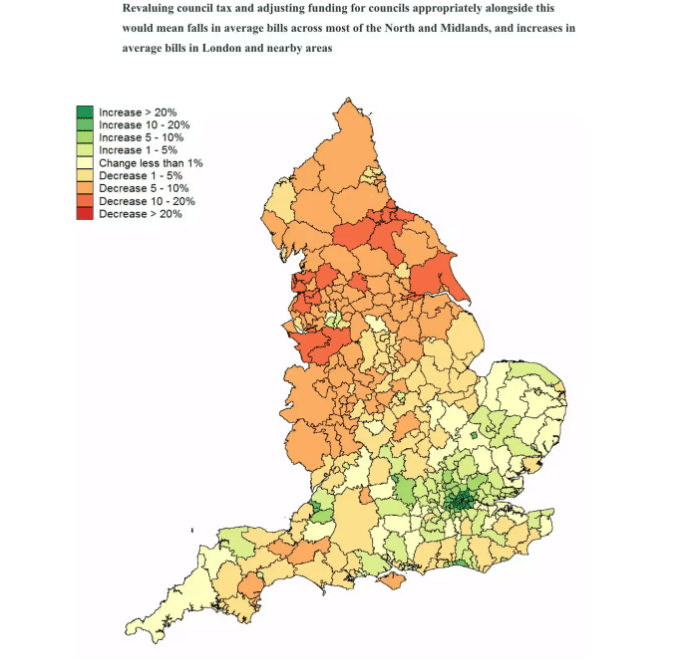
Winners and losers from potential council tax revaluation
But the IFS is also in favour of reforming the system to make council tax proportional to the value of property. It set out the case for this in a report four years ago and this chart show how around seven out of 10 households – all but the richer ones – would gain from this approach.
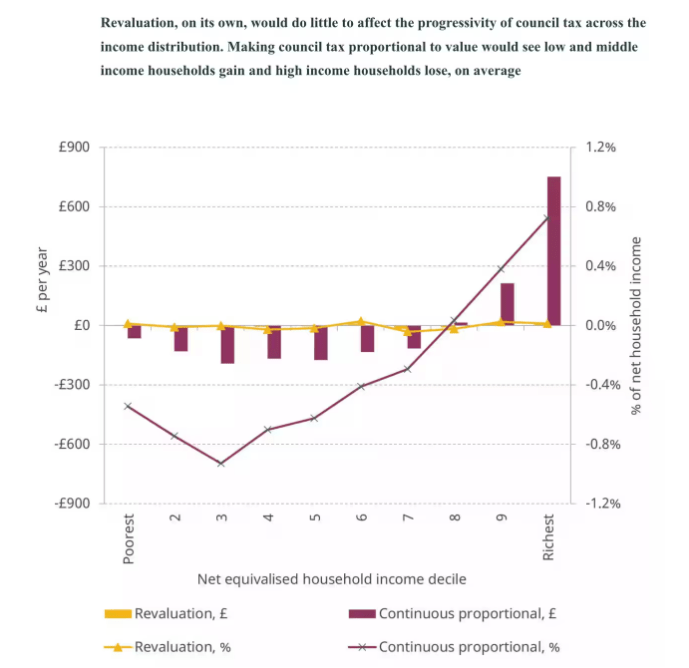
Winners and losers from making council tax proportional to value
Lucie Heath inews.co.uk
Today the Liberal Democrats become the first political party in Britain to sign up to i’s blueprint to save the nation’s rivers.
Martin Shaw explains why electoral predictions at constituency level are pushing the limits, particularly for idiosyncratic constituencies such as the new Exmouth & Exeter East one.
It is the reason that Owl has only referred to the electoral calculus predictions at constituency level. That takes the multiple regression analysis to a deeper level than the others, but would certainly benefit from increased sampling.
Thank you Martin for drawing this to the attention of Survation, YouGov and Electoral Calculus.
Seriously flawed polling could do more harm than good.
As a politics academic myself, I have been in touch with a number of pollsters about some perverse-looking projections for the seats in East Devon. Survation even has Labour to win Honiton & Sidmouth – although they got only 3.7 per cent in the by-election and are not even campaigning now! However, most now seem have to recognised that it’s a fight between Richard Foord and the Tory.
The problem is, one pollster admits to me, they are using “national level data for small area estimation”, telling me: “You are certainly correct that there are some surprising estimates in the MRP model, particularly when it comes to idiosyncratic seats.”
The most idiosyncratic seat of all is probably EXMOUTH & EXETER EAST, because most non-Tory voters in the old East Devon seat (which is three quarters of the new one) backed Claire Wright in 2019. She got 41 per cent, while Labour got only 4.5 per cent and the Lib Dems 2.8 per cent – but some pollsters have used these tiny and out-of-date figures to estimate that Labour could be leading the Lib Dems in 2024!
Recognising the problem, Survation tells me that they, YouGov and Electoral Calculus have now agreed to poll more people in both Exmouth & Exeter East and Honiton & Sidmouth, to try to get a more accurate picture.
In the meanwhile, Electoral Calculus are the only pollster to have tried to take into account the unique circumstances of Exmouth & Exeter East – they have the Tories on 33, Lib Dems 29.7 and Labour 23.
Today every political party in Britain is challenged to sign up to a blueprint that will save the nation’s rivers.
Lucie Heath inews.co.uk
Amid growing public anger at the health hazards from sewage and other pollution – and the widespread destruction of wildlife – i has created a manifesto to rescue UK rivers and seas.
The plan is simple but requires political willpower, rather than the current blame game. Every political party in the UK will be asked to support it. There are five key pledges to reverse the destruction of our precious waterways.
Taking these five steps will transform Britain’s rivers. i will reveal which parties back the plan, which decline to, and why.
Any member of the public who feels strongly about the issue will be able to use this manifesto to help drive change.
The objective is to finally force political action – and stop our rivers being used as 24/7 open sewers, returning them to people and nature.
The plan would guarantee a legacy for i’s Save Britain’s Rivers campaign, which was launched in 2023 in collaboration with our sister publication, New Scientist.
The manifesto is expected to attract strong cross-party support, as well as the backing of Britain’s environmental groups and their millions of supporters.
i’s editorial team decided to take action because of growing disgust and anger among readers in communities around the UK.
Since environmental issues are largely devolved, the policies in i‘s manifesto focus primarily on the protection of England’s rivers, because this is the jurisdiction that the UK government has full control over.
However, i is challenging political parties in all four nations to sign up to the manifesto ahead of the general election in July, and for equivalent measures to be introduced by policymakers across the UK.
Here are the five pledges:
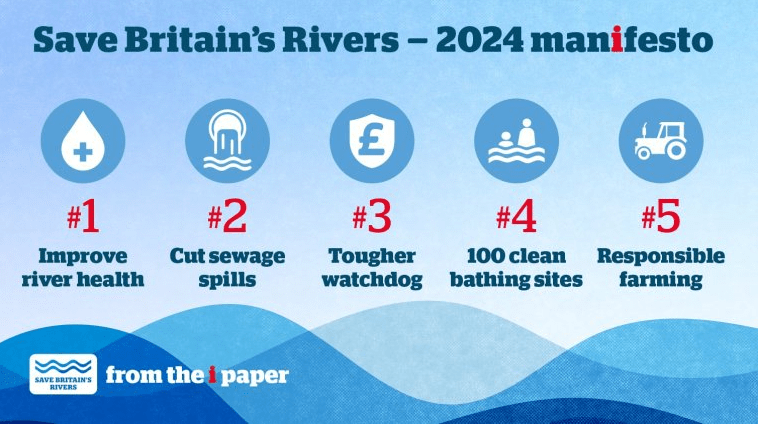
#1. RIVER HEALTH: 77% rivers in good health by 2027
Current situation: England’s rivers were once havens of biodiversity, but the vast majority are now struggling to support healthy ecosystems of plants and wildlife. Just 14 per cent of rivers in England are currently in good ecological health and not a single river has achieved good chemical health. The current Government has set a legal target that 77 per cent will achieve good ecological status by 2027 – but without urgent action this will not happen.
Target: Within its first six months in power, the next Government will publish a roadmap on how it is going to achieve this existing legal target, and its long-awaited chemical strategy. The plan must include increased funding for the Environment Agency so the watchdog can do its job – and enforce the law.
#2. SEWAGE: Sewage spills will not damage high-priority areas – including bathing spots and nature sites – by 2030
Current situation: Bathing waters and nature sites are being destroyed by sewage spills, but water companies will not be required to clean up all these spaces until 2045.
Target: Untreated sewage will not cause damage to high-priority sites (which are bathing spots, protected nature sites, National Parks and chalk streams) by 2030. Water companies who fail to meet this target will be prosecuted. Nature-based solutions will be used to clean up sewage wherever possible.
#3. WATCHDOG: Regulators will stop water companies destroying the environment in pursuit of profit
Current situation: Water companies have paid their investors healthy dividends while failing to invest enough in their infrastructure to prevent environmental harm. This is partly caused by a disjointed regulatory system that prioritises economic outcomes over the environment.
Target: Within its first year in power, the next Government will publish a plan to reform regulation of water companies. This plan must be legislated on and executed within the first term of Parliament. This will include tougher powers to restrict dividends and bonuses for underperforming water companies, alongside greater resources to pursue prosecution. A “green duty” will be placed on Ofwat, which will force the regulator to place greater emphasis on the environment when making decisions over water companies’ business plans.
#4. BATHING: Create 100 clean bathing spots in rivers by 2030
Current situation: People in the UK have discovered the joy of wild swimming. But there are only 15 official bathing spots in English rivers, and many are not safe.
Target: 100 bathing spots in English rivers by the end of the next Parliament. The Environment Agency must start monitoring water quality throughout the year and take action to improve water quality at these sites. Bathing regulations will be altered so polluters can be prosecuted when bathing sites fail water quality tests.
#5. FARMING: Farmers must be funded to improve water quality, and face enforcement action if they damage the environment
Current situation: Agriculture is the biggest source of pollution in many rivers, but many farmers warn they are struggling to make ends meet under post-Brexit farming subsidies. Meanwhile, the Environment Agency is failing to enforce farming water-quality regulations.
Target: Within its first year in power, the next Government will strengthen its Environmental Land Management scheme so farmers are given more grants, support and advice to undertake activities that will improve water quality. The Environment Agency will commit to a year-on-year increase in the number of farms being inspected – and take enforcement action against those who commit breaches of the “farming rules for water”.

In 2023, water companies in England and Wales spilled untreated waste into rivers, lakes and seas almost 580,000 times. There is currently not the same level of data available for Scotland and Northern Ireland, but high volumes of sewage are discharged in both countries.
i’s Editor-in-chief, Oliver Duff, said: “The water industry’s watchdog is asleep and the Environment Agency has been crippled by budget cuts. It’s a polluter’s charter. The law already criminalises this behaviour but it is not being enforced. Our readers want action.”
He added: “We’re not willing to sit back and let this keep happening – and neither should the next government.”
Already, 21 prominent environmental groups and campaigners have backed i’s manifesto.
They urged the next government to stop treating the UK’s waterways as “open sewers” and to take urgent action to revive them.
The Rivers Trust, Surfers Against Sewage, Friends of the Earth, The Wildlife Trusts and Greenpeace are among the groups supporting the manifesto, while Chris Packham and Deborah Meaden, public figures with a history of campaigning on environmental issues, are also endorsing it.
“Our rivers are the lifeblood for people and nature and they are in a terrible state with no clear plan to heal and protect them. It is essential that any incoming government fully commits to cleaning up our precious waterways and that is why i‘s rivers manifesto is so important. It has my full support,” Meaden said.
i‘s manifesto includes policies designed to minimise damage caused by sewage spills and farming and ensure our rivers are thriving for humans and wildlife alike.
Without action, we will continue to hear stories like the “death” of the iconic River Wye, its wildlife decimated by pollution.
Unsafe levels of E.coli are already found in many rivers and coastal waters, blighting some of the country’s most beloved bathing spots and posing risks to human health.
The following organisations and individuals have pledged their support to i‘s manifesto asks:
Currently just 14 per cent of England’s waterways are rated as having a “good” ecological status, while 0 per cent have a “good” chemical status.
The Government has set a legal target of 77 per cent of England’s rivers achieving a “good” ecological status by 2027, but this target is likely to be missed, according to its watchdog, the Office for Environmental Protection.
i’s manifesto urges the next Government to get the country back on track to achieving this target by publishing a detailed plan within its first six months in power on how it will achieve this.
This must include a commitment to increase funding for the Environment Agency (EA), which has been cut to the bone in recent years, leaving it unable to properly hold water companies to account.
Sewage pollution has captured the public’s attention and is one of the biggest challenges facing our rivers.
Following years of tireless campaigning by environmentalists to expose this issue, in May 2023 water companies issued an apology and proposed to invest £10bn in reducing sewage spills.
i’s manifesto urges the firms to go further and ensure that investment is targeted to ensure the maximum benefit for our environment.
We want to see a commitment that sewage spills will no longer destroy high priority sites, including protected nature areas, by 2030.
Where possible, water companies should be supported by the EA to achieve this through nature-based solutions, such as the creation of wetlands, rather than building large concrete storage tanks for sewage.
At the same time the regulation of the water industry must be radically reformed so our environment is prioritised over dividend payments. Since water companies in England were privatised in 1989 they have paid billions in dividends to their shareholders, while investments in infrastructure have failed to keep pace with urban growth and climate change.
This is partly due to decisions made by the regulator Ofwat, which has been accused of prioritising financial growth over the environment. The next Government must set out its plans to overhaul Ofwat in order to rebalance the industry.
We also want to see communities across the country have access to clean, safe water for wild swimming through the creation of 100 clean bathing spots in rivers.
But i’s manifesto also recognises that sewage pollution is only one part of the problem and calls for urgent action to address damage from agriculture, the largest source of pollution to our rivers.
The ongoing intensification of farming is resulting in increased pollution from fertiliser and animal waste.
An incoming Government must reform the current post-Brexit green subsidy scheme to ensure farmers are properly supported to introduce measures in their farms that will reduce river pollution.
The group River Action said it “wholeheartedly endorses” i’s manifesto – and urged the public to join in demanding action.
“For too long our rivers have been treated like open sewers by the water industry and intensive agriculture alike, while regulators seem primarily motivated to prioritise the making of dirty profits rather than protecting the environment,” said Charles Watson, founder and chair of River Action.
“The time has come to implement forthwith the radical actions that are being advocated by i.”
Surfers Against Sewage has also joined the campaign. Its policy and advocacy manager, Henry Swithinbank, said: “The incoming Government has an opportunity to put a stop to water companies’ dirty tricks.
“We are calling on the people in power to listen to the public and finally put an end to sewage pollution in our rivers and seas.”
While the five pledges will go a long way in protecting our rivers, it is not a comprehensive list of everything the Government must do to ensure the health of our waterways.
“The state of our rivers across the UK should be front of mind for the next government and measures such as protecting high priority sites from sewage spills and encouraging regenerative farming are important first steps,” said Mark Lloyd, CEO of River Trust.
“We also urgently need robust strategies to tackle pollution from road runoff and toxic chemicals, without which we have no chance of rivers achieving good overall health in our lifetimes.”
If you want to push the next Government to act to protect Britain’s rivers, you can support i‘s manifesto by doing the following:
While Labour and the Conservatives shout “yah boo” at each other, another party takes a different approach:
Caring isn’t just Ed’s story, it’s the story of millions, caring for each other, dealing with tough times, and keeping going with love. The Liberal Democrats will be the voice of carers every day, fighting their corner in Parliament.
 Land At Addlepool Farm Clyst St GeorgeRef. No: 24/1082/DOC | Validated: Fri 24 May 2024 | Status: Awaiting decision54 Withycombe Village Road Exmouth Devon EX8 3ABRef. No: 24/1083/DOC | Validated: Fri 24 May 2024 | Status: UnknownThe Lawn House Oakhayes Road Woodbury Devon EX5 1JTRef. No: 24/1073/TCA | Validated: Thu 23 May 2024 | Status: Awaiting decisionKeates Farm Broom Lane Tytherleigh Axminster Devon EX13 7AZRef. No: 24/1075/DOC | Validated: Fri 24 May 2024 | Status: Awaiting decision91 Claremont Field Ottery St Mary EX11 1RPRef. No: 24/1069/GPD | Validated: Thu 23 May 2024 | Status: Awaiting decisionJune Cottage Hillside Road Sidmouth Devon EX10 8JGRef. No: 24/1059/DOC | Validated: Thu 23 May 2024 | Status: Awaiting decisionHigherfold Whalley Lane Uplyme Lyme Regis DT7 3UPRef. No: 24/1057/DOC | Validated: Thu 23 May 2024 | Status: UnknownGarden Close Yonder Street Ottery St Mary Devon EX11 1HHRef. No: 24/1054/FUL | Validated: Wed 22 May 2024 | Status: Awaiting decisionUnit 10 Mushroom Road Hill Barton Business Park Clyst St MaryRef. No: 24/1051/FUL | Validated: Wed 22 May 2024 | Status: Awaiting decisionThe Farmhouse South Street Axminster EX13 5ADFairmile Cottage Road Through Fairmile Fairmile Devon EX11 1LPMonterey 22 Douglas Avenue Exmouth EX8 2HQKuni Kirei Courtlands Lane Exmouth Devon EX8 3NXLand At Frogmore Road East Budleigh21 Springfield Road Exmouth Devon EX8 3JYGommes 11 Marlpit Lane Seaton EX12 2HHSt Andrews Harp Lane Aylesbeare EX5 2JL4 Westbourne Terrace Budleigh Salterton EX9 6BRLand At Haynes Burton Upton PyneMusgrove Farm Lane Past Musgrove Farm House Dunkeswell Devon EX14 4RRMusgrove Farm Lane Past Musgrove Farm House Dunkeswell Devon EX14 4RRSite Of Cranbrook New Community London Road BroadclystMusgrove Farm Lane Past Musgrove Farm House Dunkeswell Devon EX14 4RRSouth Whimple Farm Clyst Honiton Exeter EX5 2DY14 Chestnut Crescent Stoke Canon Exeter EX5 4AAThe Old Toll House Exeter Road Honiton Devon EX14 1AZBung Ho Southdown Road Beer Devon EX12 3AE31 Lock Close Sidmouth EX10 9GBCoachmans Cottage Woodhouse Fields Uplyme Devon DT7 3SH15 Fore Street Sidmouth EX10 8AH11 Rolle Street Exmouth Devon EX8 1HH1 Lower Woodhayne Whitford Axminster EX13 7NPYard Rear Of The Leighs WestonWestaways Broadhembury Honiton EX14 3NQOakland Service Station Sidmouth Road Aylesbeare Devon EX5 2JJBarton House Church Hill Otterton EX9 7HUThe Beeches Town End Broadclyst EX5 3HW21C Morton Crescent Exmouth Devon EX8 1BGTelecommunications Mast Branscombe Water Tower (Opp Kings Down Tail) Branscombe5 Orchard Close Ottery St Mary Devon EX11 1HTApple Tree Farm Broadhembury Devon EX14 3JZ
The next election will be Nigel Farage’s eighth attempt to enter the House of Commons. Regardless of what happens in Clacton, it could be his most influential Westminster campaign yet.
For more than a year, opinion polls have shown support for the Conservatives squeezed on the left by Labour and on the right by Reform, who have been polling at around 11 per cent since the start of the general election campaign. What would a Farage boost do to the Tory vote?
Tom Calver www.thetimes.co.uk
Most polls taken this year generally agree that a Farage-run Reform could boost the party by several points. But to properly understand how that will translate into seats, we have to know where that vote comes from. Will Reform take votes away from both main parties?
The bad news for Rishi Sunak is that May’s local elections suggest any Reform bounce will hurt the Tories more than Labour.
Thanks to figures obtained by the election expert Sir John Curtice, professor of politics at the University of Strathclyde, we can compare wards where Reform candidates stood with wards where they did not.
In areas where Reform didn’t stand, the typical Tory vote share was down 1.7 percentage points compared with 2023. But where Reform did put up candidates this year — and didn’t last year — the Tory vote dropped by a far bigger margin of 5.3 points. The Labour vote share, by contrast, barely fell at all.
This suggests a significant chunk of Reform’s support is coming at the expense of would-be Conservative voters. And it makes sense when we look at who Reform’s potential voters are.

In Britain, support for Reform — just like support for Brexit during the referendum — tends to increase with age, just as support for the Conservatives does. There is far less overlap with Labour’s younger support base.
Since 2016, the Conservative Party won support by swallowing the anti-EU base, which worked to the party’s advantage in 2019. Now, though, a resurgent Farage threatens to split those voters again. “The current Labour coalition is much more Reform-proof than the Conservative coalition,” says Rob Ford, professor of political science at the University of Manchester.
Another way of framing the problem for Sunak is how much more popular Farage is than him. Among 2019 Tory voters, 50 per cent have a favourable view of Nigel Farage, while just 41 per cent have a positive view of Sunak himself.
What, then, would a Reform bounce do to parliament?

The latest YouGov MRP poll of 50,000 voters, published on Monday, puts Reform in second place in 27 constituencies. Eleven of these seats are in Yorkshire, including Barnsley South and Doncaster North. With Labour so far ahead, it is not close to winning in any of them.
However, the distribution of votes suggests even a slight swing to Reform could have a big impact on the scale of Tory losses. If we assume that Reform takes two votes from the Conservatives to every one vote from Labour, then a modest five-point Farage bounce reduces the Conservatives from 140 seats to 118. Labour, despite losing voters, would actually gain eight seats, putting it on 430.
Yet things could get worse. If we assume that Reform takes virtually all its support from people who currently say they would vote Tory, then a four point Reform bounce would reduce the Tories to 95 seats and a five point boost to Reform would leave the Tories with just 78 seats. Indeed, a seven-point increase in Reform’s vote, at the expense of the Conservatives, would knock the Tories back to being the third-largest party in parliament.
When support is low, and your voter base is split, first past the post can be a cruel system. And for all of the damage they inflict on the Conservative Party, it would still take a massive national swing for Reform to actually pick up any seats in parliament at all.
Of course, even megapolls are not very good at predicting local winners. People in different areas behave differently; separate polling of the constituency of Clacton done earlier this year suggests Farage would probably win the seat if he contested it.
But one party is set to do exceptionally well from any potential Farage bounce: the Liberal Democrats.
The party may be running at about 10 per cent of the national vote share, even less than Nigel Farage’s party and below what it achieved in 2019. Yet because it is now a close second in several seats in the south of England, a modest swing to Reform could result in up to a dozen extra seats.
There will be six different types of voter at the forthcoming general election, according to new analysis by a leading pollster.
The National Centre for Social Research (NatCen) has identified six distinct categories of UK voter, based on responses to 12 questions put to the public.
Joe Middleton www.independent.co.uk
The groups have shared characteristics, such as gender or social class, and align on key political issues such as the economy or immigration.
The underlying data is taken from the British Social Attitudes (BSA) survey, the latest iteration of which will be released in full next week.
Professor Sir John Curtice, senior research fellow at NatCen and professor of politics at Strathclyde University, said: “Much of the commentary on the election focuses on questions of performance. But elections are also influenced by voters’ values and their perceptions of politics and politicians.
“The electorate is not just divided between ‘left’ and ‘right’, but also between ‘liberals’ and ‘authoritarians’, while many people sit in the middle and are not especially interested in politics. This poses particular challenges for the two main parties, who will have to reach out to voters well beyond their own ‘comfort zones’ to succeed.”
Middle Britons (26%)
Middle Britons make up the largest group of voters, comprising more than a quarter of the electorate (26 per cent). They are mostly in the middle ground across political issues and are closest to a “typical” voter, with no clear political affiliation. They are hard for politicians to win over, and not that likely to vote.
Well-Off Traditionalists (12%)
Highly politically engaged and likely to vote, many Well-Off Traditionalists live in the rural South East. This group holds socially conservative views that often align with Conservative policies. They make up 12 per cent of the electorate.
Apolitical Centrists (17%)
The least politically engaged group is generally on the right on economic issues but more centrist on social issues. The Apolitical Centrists are relatively young and on low incomes. Many in this group will likely not vote, but those that do will probably choose either Conservative or Labour. They comprise 17 per cent of the electorate.
Left-Behind Patriots (15%)
This group mostly voted for Brexit and would consider themselves patriotic. They are opposed to economic inequality, but are conservative in their social outlook. The Left-Behind Patriots have no strong allegiance to any party, but are more likely than others to support Reform UK. They make up 15 per cent of the electorate.
Urban Progressives (16%)
Typically university-educated professionals, Urban Progressives lean strongly to the left on economic issues and in a liberal direction on social ones. This group is likely to support Labour or the Greens, and its members, who account for 16 per cent of the electorate, are highly likely to vote.
Soft-Left Liberals (14%)
This group is university-educated, politically engaged, and liberal on social issues, but more centrist on the economy. Soft-Left Liberals are likely to vote Labour, Green, or Lib Dem. They make up 14 per cent of the electorate.
‘This is a sensible solution. It is time for healing’
Exeter’s controversial Active Streets traffic experiment has been scrapped.
Guy Henderson – Local Democracy Reporter www.radioexe.co.uk
Some of the regulations stopping traffic getting through parts of the city will be suspended straight away. Others will stay in place until the school summer holidays.
Cllr Rob Hannaford (Ind, Exwick and St Thomas) said the phased approach was a ‘fudge’ but Cllr Phil Bialyk (Lab, Exwick) said lessons had been learned and a compromise could be made.
“I think this is a sensible solution,” he said. “It is time for healing.”
A boisterous public gallery at County Hall heard arguments for and against the Low Traffic Neighbourhoods trial, which has seen restrictions placed on some roads in the Heavitree and Whipton areas since August last year, stopping through-traffic in a bid to cut pollution and make the roads safer.
A hybrid committee made up of Devon County councillors and members of Exeter City Council voted to end the trial early amid huge public protests.
Heavitree estate agent Lyn Burgoyne said her business had been badly hit ‘almost overnight’ when the Active Streets Trial began, but climate scientist Professor Richard Betts of Exeter University said council reports advising the scrapping of the scheme were based on ‘poor quality analysis’.
Members of the city’s highways and traffic orders committee (HATOC) heard arguments for and against the experiment.
Objectors say the trial scheme merely moved congestion and pollution elsewhere, and roads on the fringes of the trial area are experiencing jams and delays.
More than eighty per cent of more than 24,000 people who responded to consultations came out against the scheme.
A report to the committee recommended stopping all the experimental traffic regulation orders as soon as possible.
But members agreed an amendment that the Hamlin Lane, Whipton Lane and Vaughan Road closures should be suspended within weeks. St Marks Avenue and Ladysmith Road will wait until schools have closed for summer at the end of next month.
Wooden planters in the road will stay in place to slow traffic, and discussions will be held with schools and community groups to discuss the way forward.
Chairman Carol Whitton (Lab, St Davids and Haven Banks) proposed the amendment and said lessons must be learned from the trial. “It is not for politicians to inflict harm on the most vulnerable in our society,” she said,
Cllr Lucy Haigh (Ind, Heavitree) was elected to the city council last month after campaigning against the project. She said: “I and many thousands of others believe this experiment is failing in many areas and should be suspended.”
Cllr Peter Holland (Con, St Loyes) told members: “This is a moment in time when you can make a difference for thousands of people.” And Cllr Alison Sheridan (Con, St Loyes) added: “‘To right this terrible wrong, action must be taken’
But Cllr Tess Read (Green, St Davids) urged: “If not this scheme, then what? That’s what we need to explore.”
South West Water withheld sewage data to avoid political attention
The water company behind a recent parasite outbreak in drinking water tried to hide sewage data to avoid “political attention”.
Adam Vaughan www.thetimes.co.uk
South West Water, whose chief executive was called to parliament over the Cryptosporidium outbreak, repeatedly refused to divulge information to The Times on sewage discharges that could reveal illegal dumping into rivers and seas on dry days.
Raw sewage releases are allowed during heavy rain, with spills on dry days considered risky for swimmers and more harmful to the environment.
The company told the UK’s data watchdog that it wanted to withhold the stop and start times of sewage spills because it would allow third parties to analyse the data. “These analyses may not be accurate and could in turn cause undue media and/or political attention,” it told the Information Commissioner’s Office.
South West Water feared that attention would result in pressure being put on the Environment Agency and Ofwat, the regulator, which are investigating its possible illegal practices. The water firm, which wants to raise household water bills by 20 per cent by 2030, warned of an “adverse effect on the course of justice”.
Susan Davy, its chief executive, was asked by the environment, food and rural affairs committee to a hearing after residents in Devon were told to boil water because of the parasite. The hearing was due to take place this week but was cancelled because of the announcement of the general election.
South West Water is one of six firms that have been formally ordered by the commissioner’s office to release pollution data, enabling scrutiny of whether it is discharging sewage when it is not raining.
Northumbrian Water, another one of the six, made a similar objection to its figures being made public. “The data could become the subject of significant media or political attention and a public conversation of this kind could result in pressure being applied, directly or indirectly, to the independent investigators,” it said.
The regulators are looking into whether several water companies have breached permits for handling sewage at their wastewater treatment works. An initial assessment indicated “widespread and serious” non-compliance by not treating enough sewage before releasing it into rivers and seas. Water firms could face financial penalties when the 30-month investigation reports its findings.
The Times was repeatedly rebuffed by the six water companies, including Yorkshire Water. It said the stop-start times of its spills, which could be cross-referenced with weather data to find potential evidence of illegal discharges on dry days, could lead to inaccurate analyses. It also suggested that releasing the information could “lead to pressure being applied to the investigations being conducted”.
Another of the companies, Anglian Water, argued that the data could “prejudice the conduct of fair trial”. It told the ICO: “It is our understanding that journalists … will attempt to ‘marry up’ spill data with weather data in order to reach conclusions regarding the occurrence of pollution events.”
Pollution of the UK’s waterways and coastlines has emerged as a key environmental issue of the election campaign. Sir Keir Starmer, the Labour leader, cited sewage as an example of Tory “chaos” after the prime minister, Rishi Sunak, called an election, while the Liberal Democrat leader, Sir Ed Davey, highlighted sewage dumping in Windermere.
On Sunday the Liberal Democrats said their manifesto would include plans for “blue flag rivers”, a protected status to help swimmers and wildlife. The election has already delayed a decision by Ofwat on how much water firms can increase bills over the next five years to pay for new infrastructure, with the announcement pushed back to July 11.
“Water firms are trying to avoid scrutiny by withholding vital information on sewage spills. It is time we got tough on these polluting and profiteering companies,” Tim Farron, the environment spokesman for the Lib Dems, said.
Last week the government announced it would no longer accept applications for new bathing waters until 2025, which is a disappointment to swimming groups. The Times’s Clean It Up campaign has been calling for hundreds of new bathing waters on rivers by the end of the decade to prompt an improvement in water quality.
The Times is demanding faster action to improve the country’s waterways. Find out more about the Clean It Up campaign
Britain’s next government will need to fill a shortfall of up to £33bn in the public finances unless it is prepared to push through a fresh round of severe austerity measures, a thinktank has warned.
Larry Elliott www.theguardian.com
The Resolution Foundation said the debate between Labour and the Conservatives over the funding of specific pledges was “detached from reality”, with election promises based on cuts that would be hard to deliver.
The thinktank said both the main parties were committed to reducing debt as a share of national income within five years but higher interest payments on debts, slower-than-expected productivity growth and the £10bn cost of compensation for the infected blood scandal would make that more difficult.
The Office for Budget Responsibility, the Treasury’s tax and spending watchdog, has estimated that the government is on course to meet its debt-to-GDP target with just £9bn to spare, but the Resolution Foundation said the winning party in the general election would face the choice of raising taxes or cutting spending to meet its debt target.
The thinktank said if the next government stuck to current spending plans the size of the deficit was likely to be about £12bn, but if it chose to spare prisons, the police and local government from fresh cuts, it could be as big as £33bn. In its annual health check on the UK economy last month, the International Monetary Fund warned of a £30bn post-election hole.
James Smith, the Resolution Foundation’s research director, said: “The state of the public finances has dominated the election campaign so far, with the inevitable arguments over how each spending pledge is funded. But this narrow focus risks distracting the electorate from the bigger question of how each party would manage the uncertainties facing the public finances.
“This question is crucial, as whoever wins the election could be confronting a fiscal hole of £12bn, if today’s uncertainties turn into bad news after the election. And if the next government wants to avoid a fresh round of austerity, that black hole could rise to over £33bn.”
The budgets for NHS England, education, defence and the Foreign, Commonwealth and Development Office are ringfenced, but this would result in inflation-adjusted, per-person spending cuts to unprotected departments – such as justice, the Home Office and local government – of 13% between 2024-25 and 2028-29. Cuts on this scale – equivalent to £19bn – would amount to repeating nearly three-quarters of the cuts made during the 2010-2015 parliament.
“Delivering these cuts in the face of already crumbling public services and the public desire for more, not less, spending on public services would likely prove very challenging,” the Resolution Foundation said.
While the stated aim of both parties was to get debt falling, the next government could be on course to miss this target by more than £30bn. History and politics had left the fiscal debate “detached from this reality”, it added.
One of them is “just add lemon” South West Water!
The drinking water regulator for England and Wales has brought only three prosecutions against water companies for providing poor quality water since 2021, despite 362 instances in which water was flagged as being unfit for human consumption.
Helena Horton www.theguardian.com
Periodically, members of the public or companies have informed the Drinking Water Inspectorate about water that has not been not safe for human consumption. In those instances, the DWI can issue legal instruments that require companies to put in place a package of measures.
The problems range from old pipes causing discoloured water to a deteriorating water-treatment process. Improvement measures vary from replacing pipes to rebuilding water-treatment works.
Figures reveal only a tiny fraction of these legal instruments led to a prosecution. Water companies are under a legal obligation to provide safe drinking water to their customers.
Since 2021, the DWI has brought three prosecutions: against Southern Water and South West Water in 2022 and Wessex Water in 2023. It also gave two cautions: against Thames and Southern Water in 2023.
Southern’s prosecution related to water contaminated with sodium hypochlorite that resulted in drinking water containing chlorate above the World Health Organization’s recommended guidelines. The company was fined £16,000 and a victim surcharge of £170.
South West Water was fined £233,333 and a victim surcharge of £170 for providing water unfit for human consumption. It was brown and had a strange odour, and the company responded at the time by telling customers to add a slice of lemon to remedy the taste.
Similarly, Wessex Water was prosecuted for supplying water unfit for human consumption due to its appearance and taste. It was fined £280,000 and a victim surcharge of £190.
The DWI can take prosecutions forward when there is evidence an offence has been committed, such as providing water that is not fit for human consumption, where the company does not have a defence that it took all reasonable steps and exercised all due diligence, and when such a prosecution is regarded as being in the public interest.
In the run-up to the general election, the Liberal Democrats have announced plans for “blue flag” rivers and, if elected, the party said it would set legally binding targets to prevent sewage dumping in those sites. Blue flag rivers would also give special protected status for swimmers and wildlife.
Ed Davey and the Lib Dem parliamentary candidate Jess Brown-Fuller during a visit to Birdham Pool Waterside and Marina to announce his party’s plans to abolish Ofwat. Photograph: Andrew Matthews/PA
The Lib Dems also pledged to protect coastal marine wildlife, which would expand the blue belt of marine protected areas to cover at least 50% of British territorial waters by 2030.
The Lib Dems also plan to abolish Ofwat, the water regulator for England and Wales, and introduce one with greater powers. The party also wants to ban bonuses for water company executives.
Last month, unsafe drinking water led to more than 100 cases of cryptosporidium in Brixham, Devon. About 17,000 households and businesses were told by South West Water not to use tap water for drinking without boiling and cooling it first after the parasitic disease was detected in the supply. People have also been falling ill in Beckenham, south-east London, prompting Thames Water to test the supply for a potential cause.
The Guardian understands Labour is also considering adding an overhaul of the regulators to its manifesto.
The Lib Dem environment spokesperson, Tim Farron, said: “It is a national scandal that drinking water is being contaminated by profiteering firms [that] show complete disregard for public health and the environment.
“Toothless regulators and failed Conservative ministers are allowing water firms to get away with this. A slap on the wrist for contaminated water is not enough. This shows what a farce the regulations are.
“The Liberal Democrat bold plan to bring in a new water regulator, ban bonuses and reform water firms will crack down on this scandal. Under this Conservative government, water company bonuses and profits have soared while water supplies have suffered, all while sewage is destroying beaches and lakes.”
The Drinking Water Inspectorate declined to comment.
Another eye roller.
Rishi Sunak doesn’t escape the “small boat” problem while taking Coffee and doughnuts at a Henley rowing club.
If nothing else you have to admire the timing! – Owl

The Liberal Democrats launched their campaign for the Exmouth and Exeter East constituency on Saturday (June 2).
Adam Manning www.exmouthjournal.co.uk
Supporters gathered at Exmouth Football Club to mark the official campaign launch of Paul Arnott, Liberal Democrat Parliamentary Candidate for Exmouth and East Exeter.
Other candidates standing in Exmouth and East Exeter constituencies include David Reed for the Conservatives, Helen Dallimore for the Labour Party, Olly Davey, Green Party and Daniel Wilson for the Independents, and Garry Sutherland for the Reform Party.
The Lib Dems say they ‘are currently positioned as the main challenger to the Conservatives in the new constituency.’
Cllr Arnott has been leader of East Devon District Council heading up a Democratic Alliance of LibDems, Independents and Greens for the last five years.
Independent candidate, who stood in the 2019 election Claire Wright is backing Arnott and the Lib Dems because “only the Lib Dems can beat the Tories in the contest for the seat”.
She added: “I am backing Paul to win because he is decent, hard-working and tough, but also incredibly compassionate with a laser-like focus, leaving no stone unturned when justice is at stake. Paul will make a strong and wonderful MP.”
Cllr Arnott, added: “Both myself and Claire share the same values and we hope that the thousands upon thousands of constituents who were loyal to her will lend their votes to myself, resulting in a win for the Lib Dems – and ultimately, a win for the people of Exmouth and East Exeter.”
He told his supporters: “I never wanted to become a parish councillor in 2007, but I had to because of the sitcom that was playing out on my doorstep which wasn’t serving the people well.
“I never wanted to become a district councillor in 2019 but due to the well-known concerns about Conservative probity in planning, I had to. I did not expect to become Council Leader in 2020, leading it through and beyond the Pandemic.
“It was never in my life’s plan to run for a member of parliament, but I was asked to by many people. Now I can draw on the depth of my experience to make a difference where it’s so desperately needed.
“I am honoured the Lib Dems have put their trust in me and I will seize this opportunity to make things better here for everyone.”

Hospital patients are “dying in corridors”, nurses have warned as they declared a “national emergency” in the NHS.
Patients are regularly treated on chairs in corridors for extended periods of time – and sometimes even days, the Royal College of Nursing (RCN) has said.
They are also receiving cancer diagnoses in public areas, and may have to undergo intimate examinations there too, the union added.
A survey of almost 11,000 frontline nursing staff across the UK shows the practice has become widespread, the RCN said.
When asked about their most recent shift, almost two in five reported delivering care in an inappropriate area, such as a corridor.
Patient privacy and dignity had been compromised, almost seven in 10 said.
“You wouldn’t treat a dog this way,” one nurse said.
Another nurse recounted a patient with dementia being in a corridor for hours without oxygen.
They said: “When I arrived, she was in a wheelchair on a corridor with her daughter. She was extremely agitated, crying and confused. This care environment for any patient, never mind with dementia, was completely inappropriate.”
The RCN’s acting general secretary, Professor Nicola Ranger, will declare a national emergency at the start of the union’s annual conference.
The organisation will also publish a report on clinical care in inappropriate areas.
In order to show how widespread the practice has become, the RCN is calling for mandatory reporting of patients cared for in corridors.
“Our once world-leading services are treating patients in car parks and store cupboards,” Prof Ranger will tell delegates.
“The elderly are languishing on chairs for hours on end and patients are dying in corridors. The horror of this situation cannot be understated.
“It is a national emergency for patient safety and today we are raising the alarm.”
She will add: “Receiving a cancer diagnosis in a public area isn’t care. It’s a nightmare for all involved. We need to call it out as nursing staff, and health leaders and ministers need to take responsibility.”
Corridor care is a “symptom of a system in crisis”, the RCN’s report says, with patient demand in all settings, from primary to community and social care, outstripping workforce supply.
Boiling the water or boiling with rage, or both?
“Our main priority is to return supply to the quality our customers expect and deserve, quickly and safely.” Is this what South West Water considers to be quickly? – Owl
Three weeks on from UKHSA first reports of the outbreak and five weeks since people started falling ill.
[The UKHSA reported the crypto outbreak on Monday May 13. And there were reports of people falling ill almost two weeks before SWW announced its boil notice early on Wednesday May 15
Radio Exe News www.radioexe.co.uk
But water company says they’re making progress
Nearly a month on from an incident which has left people in parts of South Devon needing to boil their water before drinking, or rely on bottled water, South West Water claims it’s making progress on making the water supply safe again.
More than a hundred people have been taken ill because of a parasite called cryptosporidium.
Affected households still need to take precautions and not drink direct from the tap, but the firm says it will help if they flush loos and clean with the public supply.
Incident director David Harris said: “Our regular sampling results show we are making good progress with removing cryptosporidium from the water supply in Kingswear, Hillhead and upper parts of Brixham area.
“Our teams are continuing to complete our programme of work, which includes rigorous cleaning processes, as well as installation of additional protection measures, such as specialised filters and ultra violet treatment.
“In the meantime, we encourage people to continue to use water around their homes for washing, cleaning and flushing toilets. The smaller pipes in customer homes compared with our network means that water moves through home plumbing at a much greater speed. This speed of movement creates enough force to clean the pipes in customers’ homes and so it is important customers continue to ensure they use water, but boil it for any consumption like drinking and brushing teeth.
“We are working as quickly as possible to fix this situation. Public health remains our absolute priority and we will only lift the boil water notice when we are confident it is safe to do so and our public health partners agree. We will continue to keep customers and businesses up to date with progress.
“Our main priority is to return supply to the quality our customers expect and deserve, quickly and safely.”
South West Water knew of crypto bug more than 24 hours before boil notice
A worried correspondent reports tanker operations have been frequent in the past week .


 East Devon Watch