“Surge in outsourcing after Carillion collapse ‘staggering’, unions say”

“Trade unions have accused the government of failing to learn lessons from the collapse of Carillion, instead pumping even more money into outsourcing companies, a year on from the firm’s high-profile demise.

The lifetime value of outsourcing contracts awarded in 2017-18 “rocketed” by 53% from £62bn to £95bn in the past year, according to the GMB union, which pointed to nearly £2bn in contracts awarded to Capita and Interserve despite both issuing profit warnings.

The GMB said this showed a government “hell-bent” on privatisation, despite the warning signs given by the collapse of Carillion, which managed public sector contracts to provide services such as prison maintenance and school dinners.

The GMB national secretary, Rehana Azam, said: “What other explanation can there be for this huge increase on outsourced contracts in the year Carillion went bust and when other outsourcing giants look like they’re on life support?”

The GMB’s criticism comes on the first anniversary of Carillion’s failure, which has cost the taxpayer an estimated £150m and has caused major delays to two multi-million pound hospital construction projects in Liverpool and Birmingham.

Unite, Britain’s largest trade union, bemoaned a lack of action taken against former Carillion directors, who were accused by a committee of MPs of “recklessness, hubris and greed”, reiterating calls for a criminal investigation. …”

https://www.theguardian.com/business/2019/jan/15/surge-in-outsourcing-after-carillion-collapse-staggering-unions-say

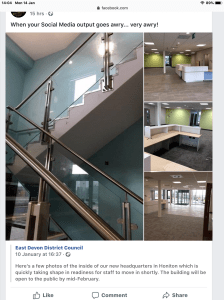
EDDC new HQ: take pics, post and boast on social media and ….

On 10 January 2019 EDDC posted pictures of its glam new shiny HQ building in Honiton

Unfortunately, they didn’t think it through and here are a few comments on that post:

Excellent!! So whilst many many families can’t afford to eat and are having to use food banks, or can’t afford gas and electric, you decide, the best thing to do is to put on your page pictures of your new offices, that the people who can’t afford to eat, have paid for it. …

They do as they please because they’re a law unto themselves. They can do what they want with your money and get away with it. You can argue with them til your blue in the face and NOTHING. They will always win. …

Shame you sold all the stuff from the old building off dirt cheap to the staff and councillors. £50 for a 24 seat mahogany table. Shame shame shame on you. …

My god, the more I see this, the more it’s unbelievable, really EDDC, you should be ashamed, not only is this building an eye sore on our towns landscape, the disgusting amount of money it is costing is nothing short of a disgrace, and then you have the audacity to show off the extravagant interior on Facebook, when there are families struggling to pay your thieving council tax. Let’s hope your illustrious leader, whoever he or she is, comes on here and apologises for this self indulgent, disgraceful post, shame on you EDDC!!!!!

Unused army ration packs to be donated to elderly and food banks

“Army ration packs are to be given to charities supporting the homeless and lunch groups for the elderly, the government has announced.

The Ministry of Defence (MoD) says that up to 20,000 unused ‘operational ration packs’ are to be donated over the next few years.

The military will provide the packs to FareShare, a charity that distributes food to nearly 10,000 charities across Britain, including community groups, homeless hostels and lunch groups for the elderly.

The ration packs include items for breakfast, lunch and dinner and each provide 4000 calories, enough to sustain an active person over a whole day.

Minister for Defence People and Veterans Tobias Ellwood said: “Ration packs help provide nutritionally balanced meals to our armed forces on operations around the world. But charity begins at home, and I’m pleased our partnership with FareShare will make sure no food goes to waste.

“FareShare does a fantastic job redistributing food across the country and I’m proud the military can support communities in this way.” …”

https://www.telegraph.co.uk/news/2019/01/14/pasta-peaches-powdered-balti-army-rations-menu-homeless-elderly/

“Local councils blame austerity for lack of investment in road improvements”

“Council leaders have hit back at suggestions rising revenues from car parking charges are not re-invested in roads in Great Britain.

All surplus income generated from parking charges was funnelled back into “essential transport projects”, the Local Government Association said, responding to a report from price comparison website confused.com.

Councils in Great Britain made £847m from parking activities in the 2017-18 financial year, according to confused.com’s analysis of government data.

This was a 24% increase (£165m) on the £682m they earned in 2013-14, the report calculated from local authorities’ published accounts. Over the same period, however, their spending on road improvements fell from £2.8bn to £2.4bn, confused.com said.

Amanda Stretton, confused.com motoring editor, said: “While councils are often justified in charging for parking and issuing fines for illegal parking, many motorists are confused about why this money isn’t being re-invested into our roads.

“Poor road conditions is a major concern for drivers, with roads riddled with potholes and unclear markings, it’s no wonder drivers want councils to be putting more into making these better.”

The LGA said the report ignored the effects of austerity on councils.

Martin Tett, Transport, spokesman for the Local Government Association, which represents 370 councils in England and Wales, said: “Any income raised through on-street parking charges and parking fines is spent on running parking services and any surplus is only spent on essential transport projects, such as tackling our national £9 billion roads repair backlog and other local transport projects that benefit high streets and local economies.

“This report completely ignores central government funding reductions. Between 2010 and 2020, councils will have lost 57p out of every £1 the government had provided for services, which is a much more significant source of funding for roads than surplus parking income.”

He added: “Surplus parking income is not the only source of money for roads and not all transport spend is spent on roads but can still be helpful to motorists, such as supporting concessionary bus fares to help reduce congestion.”

A government-commissioned report recently advised councils to slash parking charges to bring shoppers back to the high street. The High Street Report was carried out by a panel led by retail expert John Timpson.”

https://www.publicfinance.co.uk/news/2019/01/local-councils-blame-austerity-lack-investment-road-improvements

“NHS and councils full of financial problems, says watchdog”

“National Audit Office shocked by state of bodies including police and fire authorities.

The number of NHS and local government bodies with significant financial weaknesses in their ability to give value for money is unacceptably high and increasing, according to Whitehall’s spending watchdog.

The National Audit Office has examined the financial statements from nearly 937 local health authorities, councils, police and local fire bodies which are responsible for about £154bn of net revenue spending every year.

Auditors conclude in a report published on Wednesday that the number of local bodies with significant weaknesses increased from 170 (18%) in 2015-16 to 208 (22%) in 2017-18.

It follows the publication of an International Monetary Fund report in October which found that the UK’s public finances were among the weakest in the world after the 2008 financial crash.

Sir Amyas Morse, the head of the NAO, said he was shocked by the persistent high level of qualified audit reports at local public bodies.

“A qualification is a judgment that something is seriously wrong, but despite these continued warnings, the number of bodies receiving qualifications is trending upwards,” he said.

“Let us hear no cries of: ‘Where were the auditors?’ when things go wrong. The answer will be: ‘They did the job, but you weren’t listening.’

“This is not good enough. Local bodies need to address their weaknesses, and departments across government should ensure they are challenging local bodies to demonstrate how they are responding.”

Each year, local auditors give an opinion on whether local public bodies have produced financial statements which comply with reporting requirements and are error-free, and conclude whether local public bodies have arrangements to manage their business and finances.

Wednesday’s report examined accounts from 495 local authorities, local police and local fire bodies in England; and 442 local local NHS bodies in England, which include clinical commissioning groups, NHS trusts and NHS foundation trusts.

In the NHS, the number receiving qualified accounts rose from 130 (29%) to 168 (38%) across the same period. The number of local government bodies receiving qualified conclusions was 40 (8%) in 2015-16, but 18% of single-tier local authorities and county councils received a qualification in 2017-18.

Meg Hillier, the chair of parliament’s public accounts committee, said: “It is deeply concerning that local auditors are raising increasing numbers of concerns about local bodies’ arrangements to secure value for money, but these are often not being listened to and there is no consequence for the local bodies themselves.

“With ever-stretched public services, citizens deserve to know that there are effective arrangements in place to make sure they are getting value for money.

“Local auditors should be using the full range of their powers and local bodies should be acting on their findings transparently, with departments holding them to account.”

https://www.theguardian.com/society/2019/jan/10/nhs-and-councils-full-of-financial-problems-says-watchdog

“MPs want hunger minister role introduced”

This is a cross-party group of MPs, not just opposition MPs. Truly shameful. But it seems only Brexit can enrage the general population these terrible days.

“A group of MPs wants the government to introduce a Minister for Hunger to respond to a growth in food insecurity in the UK – especially among children.

The Environmental Audit Committee highlighted 2017 Unicef figures showing 19% of children under 15 in the UK live with adults who struggle to buy food.

It says ministers have failed to recognise and respond to the problem.
The government says the number of children living in workless households is at a record low.

But MPs say the number of people without reliable access to affordable, nutritious food – or food insecure – is “significant and growing”, with the unemployed, sick or those with children most likely to be affected.
The committee wants to see the appointment of a new minister with “responsibility and accountability for combating hunger and food insecurity within the UK”.

The job would involve exploring the scale, causes and impact of hunger, food insecurity and malnutrition and implementing strategies to improve the situation. …”

https://www.bbc.co.uk/news/education-46810707

NHS: the REAL cost of privatisation

“The biggest emergencies-only hospital in Europe will take three years longer than expected to build and cost nearly twice its original budget.

The Midland Metropolitan Hospital was intended to treat 170,000 A&E patients a year from this summer but will not open until 2022. It will also cost at least £605 million, despite originally being priced at £350 million.

The problems were highlighted after Theresa May unveiled a ten-year strategy for the health service that included a £20 billion spending boost by 2023. The delay and increased costs were caused by the collapse a year ago of the construction company Carillion, halting building under the private finance initiative. The failure forced the NHS to implement contingency plans in 14 hospitals to maintain essential services delivered by Carillion.

The new 670-bed hospital in Smethwick, West Midlands, is meant to replace large parts of Sandwell Hospital and City Hospital, Birmingham. Carillion was paid £205 million towards the project before the firm’s collapse.

Toby Lewis, chief executive of the Sandwell and West Birmingham Hospitals NHS Trust, told its board last month that more than £400 million would be spent completing the hospital and keeping emergency services running at the Birmingham hospital.

The trust is paying Balfour Beatty, the construction company, £10 million to “winter-proof” the new hospital, which was left open to the elements. It is poised to seek bids from companies to complete the building, although some have already made clear that they are not interested.

John Spellar, Labour MP for Warley, said that outlay on maintaining existing hospital facilities had been cut in anticipation of the new building and that the delay was affecting recruitment and training. He said that civil servants were to blame for transferring too much risk to the private sector when they had “no concept what it actually means”.

A parliamentary inquiry into the failure of the multinational contractor with liabilities of almost £7 billion found that its “business model was an unsustainable dash for cash. The mystery is not that it collapsed but how it kept going for so long”.

Carillion was also building the Royal Liverpool Hospital, which features in a BBC Two documentary to be broadcast tomorrow. Aidan Kehoe, chief executive of the Royal Liverpool, tells the Hospitalprogramme: “I am very angry at the way Carillion have behaved. To leave us in this position is, I think, just unacceptable. These people are taking huge bonuses that they are not paying back and they are leaving the people waiting years more for a hospital. Serious questions have to be asked about the way Carillion have behaved.”

The £500 million Liverpool hospital building was due to be finished two years ago but is not expected to be completed until next year.

Jayne Halloran, an associate director at the Royal Liverpool and Broadgreen University Hospital Trust, said that it was expensive to maintain the partially built hospital, where 14 staff work full time turning taps on and off to stop legionella bacteria from growing. “It takes six days to complete that for the whole building,” Ms Halloran said.”

Source: Times, pay wall

“14 MPs turn up to discuss UN report on 14 million people living in poverty”

“The UN’s report on poverty in Britain is at risk of being swept under the carpet after just 14 MPs turned up to debate the issue in parliament yesterday.”

https://www.thelondoneconomic.com/news/14-mps-turn-up-to-discuss-un-report-on-14-million-people-living-in-poverty/08/01/

Meanwhile for the debate on increasing MPs pay:

“”England ‘needs millions of homes to solve housing crisis’ “

“Three million new social homes must be built in England over 20 years to solve the “housing crisis”, a report says.

Housing charity Shelter says upfront costs of £11bn a year could come from housing benefit savings by moving tenants from high-cost privately rented homes to social housing. … ”

https://www.bbc.co.uk/news/uk-england-46788530

“370,000 More Families Hit By Tory Child Benefit Cuts, Institute For Fiscal Studies Reveals”

“The number of families hit by child benefit cuts has soared by 370,000 thanks to Tory ‘stealth’ tax changes, a leading think tank has revealed.

The Institute for Fiscal Studies found that George Osborne’s decision to freeze income eligibility thresholds will leave one in five families facing the loss of all or some of the payments.

Six years to the day since the former Chancellor introduced his austerity crackdown, the number of those affected has surged by a third, the IFS analysis discovered.

Labour’s John McDonnell pounced on the figures as proof of the continuing impact of Osborne’s cuts programme, telling HuffPost UK that it was further evidence for the need to back Labour’s Budget amendment on Tuesday to review child poverty and equality levels.

Child benefit was a ‘universal’ benefit until the Tories decided in 2012 to severely restrict eligibility to exclude any household with someone earning above £50,000 a year.

But the IFS study found that failing to increase the threshold in line with inflation – while increasing higher rate tax thresholds – has dragged many more middle income families into the cuts.

“For the first time, significant numbers of families without a higher-rate taxpayer will lose some Child Benefit,” it said.

Based on current earnings growth, it estimates that 60,000 families without anyone earning £50,000 will lose out in 2021–22, doubling to 120,000 such families in 2022–23.

Child benefit is currently worth £1,079 per year for the first child and £714 for each subsequent one.

The IFS said that in its first full financial year of operation (2013-14), the new policy meant that 13% of families with children, or around a million, lost at least some of the benefit as a result of the policy, with around 700,000 losing all of it.

In 2019-20, it estimates that the share of families with children who are affected will be 18%, or 1.4 million, of whom a million will have lost all of their entitlement.

“In other words, the number of families with children who are affected will have risen by about 36%, or 370,000, in just six years.

“What cannot be justified is to have an ever-increasing proportion of families exposed to the policy over time, with the increase determined by the rise in prices since 2013.

“The cumulative impact it has in raising taxes or reducing benefits by stealth can do nothing for trust in government….”

https://www.huffingtonpost.co.uk/entry/14-million-families-will-be-hit-by-tory-child-benefit-cuts-institute-for-fiscal-studies-reveals_uk_5c33d1e7e4b05d4e96bb243a

“Nearly 5,000 schools in England not given promised cash – union”

“England’s biggest teaching union has accused the government of breaking its promise to provide a modest cash boost to every school in England, claiming figures reveal that nearly 5,000 schools have received no extra funds or have even had their funding cut.

In the wake of mounting concern among teachers and parents about a school budget crisis, the education secretary, Damian Hinds, told MPs last year that a new national funding formula would guarantee each school “at least a small cash increase”, a pledge repeated by the prime minister in the Commons last May.

The National Education Union argued the offer was inadequate given the scale of the school funding squeeze, but its analysis of recent government figures subsequently revealed that 4,819 schools had either received no extra funds or had had their budget cut.

“This is yet another failure and another broken promise by government on school funding,” said Kevin Courtney, NEU joint general secretary. “The fact remains that schools were never going to manage on the money promised by government.

“However, headteachers, teachers, school staff and parents will be dismayed that even the meagre amounts of funds supposedly allocated to schools will not be received by everyone. Parents and school staff simply cannot trust what the government says on education funding.”

The NEU compared the schools block funding allocations for 2017-18 and 2018-19 and found that a quarter of primary schools (25%) and one in six secondary schools (17%) either received no cash increase or suffered an actual cut to their funding.

Responding to the NEU analysis, a Department for Education (DfE) spokesperson said that since 2017 the government had given every local authority more money for every pupil in every school in order to ensure fairer funding across the country.

“Government provides this money to local authorities and they have the freedom to work with schools to allocate their budgets in a way that best suits local needs,” the spokesperson said.

“While there is more money going into our schools than ever before, we do recognise the budgeting challenges schools face and that we are asking them to do more. That’s why we’re supporting schools and headteachers, and their local authorities, to make the most of every pound.”

According to the Institute for Fiscal Studies, total school spending per pupil in England has fallen by about 8% in real terms between 2009-10 and 2017-18. …”

https://www.theguardian.com/education/2019/jan/07/nearly-5000-schools-in-england-not-given-promised-cash-union

“Need to sign on? You’ll have to walk 24 miles to the jobcentre”

A lesson for all rural dwellers unlucky enough to lose a jobm

“Twenty-four miles there and back is one hell of a hike to your local jobcentre. But when Ray Taylor, 56, had his benefits cut for 13 weeks after illness meant he missed an appointment to sign on, he had no option but to get out his walking shoes. He doesn’t have friends with cars to give him a lift, and with no money coming in, he couldn’t pay the £7 bus fare from the small Cambridgeshire town of Ramsey to Huntingdon, where he is registered for benefits. And if he missed signing on again, he would be sanctioned again.

Taylor, a former electrician – he couldn’t afford to update his qualifications after being made redundant and going freelance – is remarkably stoical about what could be a weekly trek. “If you’ve got a 9 o’clock appointment, you have to set off in the early hours to make sure you get there,” he says. There have been “quite a few times” he has set off at two in the morning to avoid penalties for lateness. (“Sanctions” can involve benefits being reduced – or stopped entirely.)

A pre-dawn start in the pitch-black of rural Cambridgeshire with cars and farm lorries rumbling along pavement-less roads doesn’t sound all that safe. Taylor, who survived being homeless in Cambridge for seven years before being housed in Ramsey, smiles as his eyes stream from the cold. “There’ve been a few moments.” The police have picked him up a couple of times and taken him home to ensure his safety, he recalls.

Come the end of March, other Ramsey residents may have to embark on this trudge that is nearly the length of a marathon. That is because the No 30 bus that is the sole public transport link between Ramsey and Huntingdon is due to be cut. The only alternative for anyone without a car will be to beg lifts from friends or family, cycle or find the £40 round-trip taxi fare. It is an impossible sum for anyone on a low income, and even most working people couldn’t find it five days a week.

To experience the route Taylor has walked “oh, maybe 20 or 30 times”, we meet at the more civilised hour of 8am by the decorative wrought-iron bus shelter next to Ramsey’s clocktower. The night before, driving across Cambridgeshire, gusts of wind hurling rain across my windscreen, I begin to dread the walk to come. Morning, however, has dawned bright but chilly. Hoiking our rucksacks on our backs, we pull our hats down and head south out of town. We are accompanied by Steve Corney, the town council’s new mayor, and Jane Sills, the chair of the Ramsey Million Big Local residents group, which has campaigned for the past 18 months against the cutting of the No 30 bus.

“For the people here, the bus means everything,” says Corney over the noise of traffic streaming out of Ramsey. There are no big employers in the town, so there is a daily exodus. “It’s frustrating because when you see it, there’s a lot of people on it.” Corney notes too that housing development means Ramsey’s population of 8,000 is expanding.

We pick up the pace as we reach the edge of town, where Corney peels off. As we march past a long-abandoned RAF station, it is the isolation suffered by older people and teenagers in cut-off rural areas that is on Jane Sills’ mind. James Palmer, the mayor of the new Cambridgeshire and Peterborough combined authority, which is reviewing all the area’s bus routes, will visit Ramsey later this month, and Sills’ group of residents intends to lobby him hard. “He should know by now just how important it is for people on low incomes and for young people that they’re not trapped in a small town with their life chances inhibited,” she says.

Sills has a strong card up her sleeve. As well as marshalling a petition that gained more than 1,000 signatures – and secured a short-term stay of execution for the route – members of her group decided to use some of the Big Local Lottery money they had been awarded to strengthen their case. A report commissioned from the Campaign for Better Transport revealed that the local authority subsidy paid to the bus operator Stagecoach to run the No 30 bus is the lowest of any on the list of proposed route closures in Cambridgeshire.

The report also showed, Sills says, “how Ramsey already compares poorly to other parts of the county” in terms of its access to buses.

If Cambridgeshire’s long-term transport strategy is ratified later this year – it is the new Cambridgeshire and Peterborough combined authority, not Ramsey town council, that will set commissioning policy until 2031 – Ramsey will be cut off from the new “hub and spoke” public transport system. There will be no buses in or out at all.

Ramsey’s residents, of course, are not alone in their plight. The Campaign for Better Transport calculates that since 2010, councils in England and Wales have cut £182m – 45% – from the support they give to bus routes that would otherwise be unsustainable. Some areas have seen particularly harsh cuts: Somerset by 50%, Leicestershire by 72%, North Yorkshire by 81%. In the past year alone, according to the charity’s recent Buses in Crisis report, more than 300 routes have been reduced or withdrawn in England and Wales, and 3,347 since 2010.

“Whole areas are now transport deserts,” says the charity’s chief executive, Darren Shirley. “The people who are the most impacted are those who are most in need of public transport. Jobseekers who are reliant on public transport to get to work. People in poor health who need it to get to hospital.” Buses, he points out, are the only form of transport in England not to have a long-term investment strategy. …”

https://www.theguardian.com/uk-news/2019/jan/07/need-to-sign-on-youll-have-to-walk-24-miles-to-jobcentre

“Yvette Cooper: It’s time to boost Brit towns and not lock cash funds in cities”

“… Research done for the Labour Towns group of MPs and councillors found that overall job growth in towns since the last recession has only been half the rate of growth in cities.

The economic divide between cities and towns is growing and the Tory Government is making it worse. …

Austerity has hit towns and smaller cities hard, so it isn’t just retailers who have been leaving.

Often the libraries, police stations, council offices, magistrates courts, swimming pools, community centres, A&E or the maternity services have been closed, forcing people to travel to nearby cities instead. Lottery and arts funding is higher in cities too.

Manufacturing jobs in towns are being squeezed while new service or creative opportunities are concentrated in cities.

Meanwhile most of the transport money goes to London or other major hubs. Buses have been cut.

… It’s time to support Britain’s towns. Instead of making everyone travel to cities for public services, we need more in towns.

Instead of rolling out new broadband or 5G infrastructure in cities first, why not start in nearby towns? Instead of always using all the transport money on overruns for big city projects like HS2 or Crossrail, why not start by improving local trains and buses?

The Government seems to think if you only support cities, everything will just trickle down and out to the towns, but it hasn’t worked. Let’s have a fair deal to boost our towns and cities together. … “

https://www.mirror.co.uk/news/politics/yvette-cooper-its-time-boost-13768773

“Academies failing poorer students, research shows” (and there are many more poorer students)

“Two-thirds of academy school groups performed below the national average for disadvantaged pupils, according to research released today.

A five-year study by the Sutton Trust educational charity analysed 58 ‘academy chains’ – partnerships between a group of academies – and found in 38 of these disadvantaged pupils performed below the national average for all state schools.

In 12 of the 58 chains analysed, poorer pupils performed above the national average but this good practice had not been shared with other academy chains, the report found. It defined disadvantaged pupils as those entitled to the ‘pupil premium’ – a funding package from central government.

Becky Francis, director of the UCL-Institute of Education and co-author of the report, said it was “perplexing that the government has done so little to explore the methods of these successful chains and to distil learning to support others”.

“Our five year analysis of sponsor academies’ provision for disadvantaged pupils shows that while a few chains are demonstrating transformational results for these pupils, more are struggling,” she said.

Francis said that the government should capitalise on the successes of various schooling organisations including local authorities and multi-academy trusts.

The report found that long-standing academy chains achieve better exam results, with newer chains frequently performing poorly.

Peter Lampl, founder of the Sutton Trust, said: “Two-thirds of academy chains perform below the national average for all state schools on key measures of attainment for disadvantaged young people. Improving their educational achievement was the original reason why academies were set up. In this regard they have not succeeded.

“We at the Sutton Trust are recommending the sharing of good practice of the best academy chains with the rest. More generally schools should make increased use of the body of what works evidence.”

Lampl noted struggling schools are having difficulty attracting and retaining good teachers.

The charity’s report said there is “little to suggest” that regional schools commissioners – who are responsible for approving new academies and intervening in underperforming ones – are bringing about improvements.

RSCs must act “more decisively” with chains that do not deliver improvement on time, the trust said.

Anntoinette Bramble, chair of the Local Government Association’s children and young people board, said: “This research reinforces the compelling need for the government to give councils the powers to improve struggling schools.

“Councils have a strong track record in school improvement, with 91% of council-maintained schools now good or outstanding while evidence shows councils are better at turning around failing schools than those converted to a sponsor-led academy.”

The Department for Education has been approached for comment.

An annual report released last month showed that academies in England recorded a £6.1bn deficit in August 2017.

Previously the National Audit Office called on the government to ensure that academies could be trusted to manage large amounts of public money.”

https://www.publicfinance.co.uk/news/2018/12/academies-failing-poorer-students-research-shows

NHS – inequality between regions

“The government must show more urgency in addressing regional health funding imbalances, MPs have warned.

The Public Accounts Committee has also expressed concern about the Department of Health and Social Care’s lack of planning for staffing and medical equipment after Brexit, in a report out today.

The MPs noted there was “significant regional variation” in funding of NHS providers and clinical commissioning groups. DHSC’s 2017-18 annual report and accounts suggest an improvement in finances when taken as a whole but this “masks the underlying deficits at local level”, the PAC report said.

MPs said the department was performing a “balancing act” by offsetting NHS providers’ deficits with a surplus from NHS England’s finances. In 2017-18, 101 of 234 NHS providers were in deficit, although this was mitigated by NHS England’s surplus, the report said. Although, 75 of the 207 CCGs reporting an overspend in the same year.

PAC chair, Meg Hillier, said the number of CCGs overspending was “concerning”.

She added: “The Department of Health and Social Care must show far more urgency in getting to grips with regional funding imbalances and demonstrate it understand the effects these have at the frontline.”

The report was also critical of DHSC’s planning for Brexit, especially around staffing and medical equipment.

It said there is a “lack of a clear plan” for recruiting staff post-Brexit and added: “We are not reassured by the department’s assertion that it has not seen a large exodus of staff since the referendum and that the number of people from the EU working in the NHS has increased.”

Health bodies recently warned that the NHS workforce shortfall could jump from 100,000 at present to almost 250,000 by 2030 without effective planning.

Despite the NHS procuring 56% of medical consumables (gloves, dressings, syringes) from, or via, the EU, DHSC is not putting specific contingency measures in place to stockpile this type of equipment, the PAC revealed.

Hillier said: “The department’s lack of clear Brexit planning could threaten the supply of medical equipment. Staff shortages could deepen. The potential consequences for patients are serious.

“These and other uncertainties are amplified by the continued absence of the government’s promised 10-year plan for the NHS, its promised plans for social care, and its promised plans for immigration.” A DHSC source has confirmed to PF the social care green paper and NHS 10-year plan are now likely to be published in the new year, rather than by the end of this year, as originally intended.

Regional variances in staff vacancies could also be overlooked, the PAC noted. The NHS examines vacancy rates at a national level – rather than a local level – which “hides underlying disparities in specific specialisms and local areas and does not allow them to fully understand the impact of staff shortages,” the report said.

The report also expressed concern that the NHS staff pay rise announced earlier this year would not be distributed fairly. By funding pay awards through the National Tariff the PAC is concerned that NHS Providers in more affluent areas will receive “disproportionately higher share of funding” because the tariff accounts for the cost of operating in different geographical locations.

DHSC has been contacted for comment.”

https://www.publicfinance.co.uk/news/2018/12/government-must-address-health-funding-imbalances-say-mps

More rural bad news: “Bus travel: Fewer passengers as funding falls”

Buses are the most common mode of public transport, accounting for 60% of all trips.

But on the buses, passenger numbers are falling.

There were 9% fewer journeys on local bus services in Britain in the first three months of this financial year than in the same period a decade ago.

The Campaign for Better Transport says this is partly down to cuts to the amount local authorities England and Wales are spending on buses.

In the past seven years, council spending on buses has fallen by 45%, according to figures released to the campaign group under the Freedom of Information law.

Outside London, buses are largely run by private companies, which make their money from passenger fares. Then, local councils pay subsidies to plug the gaps, often in rural areas where running a route is more expensive or less lucrative for companies.

Areas where running a bus service is the least lucrative for private operators will rely most on council subsidy – and so be most effected by the cuts.

In 2017-18, there were 11 councils in England that spent nothing at all on running bus services.

This has meant 3,000 routes being reduced or scrapped since 2010-11.

There are significant differences in fares, too.

Between September 2017 and September 2018 in London, fares rose by 0.4% – in the capital, buses are still public and regulated.

In other metropolitan areas in England where fares are left to the free market, there was an average 2.4% increase, while in non-metropolitan areas fares rose by 7.9%.

But if bus cuts and fare rises leave some people unable to get around, don’t councils have a duty to do something about it?

In fact, councils have very few specific obligations around buses, making them an easy target for councils as the cuts bite.

There are specific things they legally have to do, for example provide transport for children otherwise unable to get to school.

They also have to make sure there are concessionary fares for older and disabled people. Although this is partly funded by central government, the grant has been falling, leaving councils to make up the difference.

But other than that, they are not obliged to fund buses and ensure everyone has access to them.

What do councils have to do?

It’s possible a council could be challenged in the courts under equality legislation if it could be shown to be disproportionately restricting certain groups of people.

But legal guidance suggests it would be difficult to challenge a council if it could show it had assessed the needs of a local area and the impact of removing a bus service, particularly on elderly and disabled people.

If after this assessment, councils decide they need to make cuts because of a lack of funds, this would be likely to be legal.

But councils can’t let bus cuts leave a community that needs transport with no transport service at all.

And in some areas, councils have used community transport services – often minibuses driven by volunteers – to fill the gaps.

There could be other reasons for the fall in passenger numbers, though.

For the past couple of years, passenger numbers have also been falling in London, despite its relative protection from cuts.

Mayor Sadiq Khan has suggested this could be driven by fewer people going out, as Netflix and Deliveroo make staying at home easier and more tempting.”

https://www.bbc.co.uk/news/uk-46524510

“NHS commissioning ‘needs period of stability to transform’ “

Owl says: You cannot make it up – body set up to transform the NHS needs time to transform itself before issuing its transformation policies to transform anything else!

“NHS commissioning needs a prolonged period of organisational stability after almost three decades of change, according to the UK’s spending watchdog.

Continued organisational restructuring causes major upheaval and commissioning in the health services needs stability to transform, the National Audit Office urged in a report released today.

Amyas Morse, head of the NAO, said: “We have seen almost three decades of change to NHS commissioning.

“It would be a huge waste if in five years’ time NHS commissioning is undergoing yet another cycle of reorganisation resulting in significant upheaval.”

He added: “The current restructuring of Clinical Commissioning Groups must deliver balanced and effective organisations that can support the long-term aims of the NHS and deliver a much-needed prolonged period of stability.”

A period of stability would allow commissioning groups to focus on transforming and integrating health and care services rather than on reorganising themselves, the report said.

Since CCGs replaced primary care trusts in April 2013, there have been eight formal mergers, reducing their numbers from 211 to 195 in April this year. Further mergers are expected.

The report also highlighted an increasing number of NHS commissioning bodies in England were exceeding their planned expenditure.

A total of 75 of 207 (36%) CCGs went over their budgets in 2017-18, the NAO noted. The total overspend across the groups was £213m.

This compared to 57 CCGs over spending on their budgets in 2016-2017 and 56 in 2015-2016.

“Many CCGs are struggling to operate within their planned expenditure limits despite remaining within their separate running cost allowance,” the report warned.

Increased pressures, the uncertain futures of CCGs and a lack of access to training and development were cited as reasons for the continuing issue of commissioning bodies being unable to attract and retain high-quality leaders.

Even though “both NHS England and the CCGs stressed [to the NAO] the importance of high-quality leadership”.

The watchdog also warned with further mergers there was “a risk that working across greater areas will make it more difficult for CCGs to design local health services that are responsive to patients’ needs”.

The total net expenditure of CCGs in England in 2017-18 was £81.2bn with net running costs at £1.1bn. Staff costs made up 57% (£693 million) of CCGs’ running costs, the NAO noted.

A 10-year long-term plan for the NHS and how it will spend an extra £20.5m a year was expected to be released by the end of this year.

A source from the Department of Health and Social Care has confirmed to PF it is now “likely” this plan will be release next year.

Responding to the report, chair of the Public Accounts Committee Meg Hillier said: “We should be concerned that increasing numbers [of CCGs] are overspending against their budgets.

“Like previous changes to NHS commissioning, CCGs are going through more change and the NHS is crying out for stability.”

She added: “It is vital that further restructuring supports the 10-year plan and isn’t an unnecessary distraction to addressing the real challenges in the health service.”

https://www.publicfinance.co.uk/news/2018/12/nhs-commissioning-needs-period-stability-transform

After health “hubs” come rough sleeper “hubs”

Definition “hub”: a pseudo-service that is put in place when a full service is withdrawn, often with privatised funding and/or staff, usually resulting in an inferior service.

“Ministers have announced that 11 new “rough sleeping hubs” will be established next year through a £4.8m project aimed at tackling rising levels of people in England sleeping on the streets.

Unveiling plans for the centres, the government said thousands of vulnerable people will be able to receive specialist support to address mental health problems and provide immediate shelter and rapid assessment for rough sleepers.

It will form part of the already announced £100m rough sleeping strategy and will be launched in 11 areas in the spring across England, including Derby, Liverpool, Preston, Bristol, Lincoln and Nottingham City.

The measures coincide with an announcement from Labour, who have also pledged £100m to give every rough sleeper a place to stay in the winter months – funded through a levy on second homes announced at the party conference in September. …”

https://www.independent.co.uk/news/uk/politics/rough-sleeping-hubs-homeless-uk-statistics-government-shelter-labour-party-england-a8687971.html

Times says 7 more privatised companies may be under threat

“As the country wonders which big name in the construction and services industry will follow Carillion into bankruptcy, Stephen Rawlinson may have hit upon the answer — and it’s one that offers little reassurance to any of the leading players.

According to the respected independent analyst: “We are asked continually, ‘Who is the next Carillion?’ There are individual candidates, of course, but the sense we have now is that it could be the whole UK-based construction and services sector.”

That view will ring alarm bells in corporate boardrooms and public sector committee rooms nationwide, but it rings true with investors. Shares of the industry’s heavyweights, government contractors providing public services, looking after public buildings and estates and/or building them, have plummeted. The reasons why — and why recovery, if at all, has been slow — are troubling enough on their own, but added together they sum up the huge challenge facing the outsourcing industry. …”

[The article goes on to name G4S, Babcock, Mitie, Kier, Interserve, Capita and Serco]

Source: The Times, paywall

Local authority settlement fails to address major funding issues and shortfalls

AND government has said if councils need more money they should hold referendums which might, or might not, agree to further council tax rises to make up for the shortfall.

“Last week’s provisional settlement for local government was predictably disappointing, says Richard Harbord, while the big issues of funding social care and council tax reform wait unaddressed in the political long grass.

The delayed settlement was eventually published last week, leaving local authorities little time to do any detailed work on it before Christmas.

It has to be said it was never going to be earth-shattering, being the last year of an agreed multi-year settlement negotiated four years ago.

The actual settlement says that the government are planning to increase resources by £1.3bn next year, but this seems to include a number of separate issues such as Winter Pressures Funding for social care, the bulk of which comes with conditions, and the removal of the threat of negative grant.

The Local Government Association in a somewhat low-key response says that this settlement will still leave local authorities some £3.2bn short of the resources they require to maintain a reasonable standard of service.

Other announcements were expected at the same time but a number of these did not appear. The amount of time and energy spent on leaving the European Community has left a large void in moving forward to resolve the many problems local government faces.

There was a consultation paper on business rate retention, but this has been so long discussed in the joint working parties between central government and the LGA that it is hardly new. It is now set at 75%, this is somewhat less than Eric Pickles’ 100% and the various other figures talked about over the last few years, and is perhaps a disappointing increase on the 50% which has been the scheme for the last few years.

The announcement says that the government continues to work on the Fair Funding Formula which was also expected to go out to consultation. This was never intended to take effect next year, but local authorities need to know if there are to be major changes to distribution and to account and allow for them in their medium-term financial plans.

We had already been warned that perhaps the most important of all – the options for dealing with the increasing expenditure on social care – had been put back until next Summer. This was, it will be remembered the subject of a bungled announcement during the last general election campaign which had to be withdrawn with a Green Paper promised for immediately after the vote.

This has been delayed several times. It is just too difficult to find options that are acceptable to the majority. If there is to be a central funding solution rather than an insurance solution, it will have to come from additional taxation. Politicians continue to believe that increases in taxation are to be avoided at all costs but a relatively small increase in taxation could produce workable options.

The LGA urges the government to reconsider and to improve the offer by the time of the final settlement early next year. This is extremely unlikely to happen.

The fact is that this settlement does nothing to help local authorities become sustainable and to save them from having to make even more serious cuts in services going forward.

Business rates retention may have been sorted, but the government really needs to address the issue of council tax. Hopelessly outdated and not understandable to owners of properties, it is in desperate need of reform.

The government argue that it is open to local authorities to run referendums to increase council tax by over 3 % , indeed they have encouraged local authorities to do so but the limited gains and negative publicity have put authorities off.

At the very least the values used need to be current values and the banding system needs drastic revision to reflect the fact that so many properties are valued at over £1m and should be contributing more to local services.

We do now look forward to the spending review, but there cannot be widespread optimism that all will be well.”

http://www.room151.co.uk/blogs/provisional-settlement-does-nothing-to-help-local-authorities/