County elections: only 8 seats need to change hands to change the political majority

As EDA candidate Paul Hayward points out on his Facebook page:

Over the last 8 years, across the whole of Devon, decisions have been made by a majority group with no effective opposition. Result. Cuts, cuts and more cuts.

But in 2017, it only takes 7 seats to change and a new era of cooperation, debate and compromise can begin at Devon County Council.

Services can be protected. Fair funding can be applied. National party politics can be taken out of local government.

On May 4th, please choose to mark Independent, East Devon Alliance on your voting slip.”

You want change, you have to vote for it.

“Tory candidate defends spending up to £1m on West Midlands mayor campaign”

You just KNOW when a Tory candidate has £1 million behind his campaign that most of the people or companies contributing are not doing it out of the goodness of their hearts!

Labour’s campaign spending is thought to be between £100,000 and £200,000. It has focused on social media campaigning and phone banks, where volunteers call up voters to ask for their support. The Lib Dem candidate has spent about £50,000.

https://www.theguardian.com/politics/2017/may/01/andy-street-mayor-campaign-spending-labour-sion-smith-west-midlands

CPS criteria for election fraud prosecutions

“Proceedings for major infringements will normally be in the public interest.

Proceedings for other infringements may not be in the public interest in situations where:

the offence is of a “technical” nature which does not infringe the spirit of the legislation;

the offence was committed as a result of a genuine mistake or misunderstanding;

the offence could not have influenced the result of the election process; or
the offender has remedied any breach of the law.

If the offence falls to be considered under one or more of the criteria above, the matter may be dealt by way of a caution administered by the police or, where appropriate, the provisions of advice as to an individual’s future conduct.

In practice, it may be difficult to prove that the result of an election has been affected by an infringement. However, the fact that a breach has or may have affected the result of an election is a factor to be taken into consideration in deciding whether proceedings should be instigated.

Whilst every case will of course turn on its own facts, where there is clear evidence that a breach has affected the result or is likely to have done so, the public interest is more likely to require a prosecution – even if the infringement itself is relatively minor.”

Dr Mark Pack notes:

“It’s worth in particular noting that a few of the more common reasons that crop up on online chatter either from Conservatives, or reported as being said by Conservatives, do not feature in the criteria.

In particular, the fact that someone might have secured re-election before a court case could proceed against them is not a factor.

Moreover, prosecutions are not restricted to proceeding only on the basis that the offence altered the election result. That’s only required for one very specific set of legal action, which isn’t what’s at stake in the current cases involving so many Conservative MPs.”

http://www.markpack.org.uk/149609/cps-prosecution-guidelines-election-offences/

How to contribute to judicial reviews for Seaton and Honiton hospitals

Seaton:
Judicial Review: League of Friends’ donation form

Honiton:
https://www.justgiving.com/crowdfunding/honitonhospitalbeds

What can US and French elections tell us about East Devon?

The voters of the US and France have each sent out strong signals that people are not just tired of party politics but that they will seek actively to stop them by favouring candidates who promise that they will make independent decisions rather than follow party dogma.

Trump is decried by his own party – the Republicans – for not toeing their party line. The Democrats really wanted Bernie Sanders to stand – a man whose policies were a far cry from those of Clinton – but party grandees went for what they saw as the “safe” party choice. The choice that lost them the election.

The old “left” and “right” no longer speak to an electorate that sees that, in fact, they are the same side of the coin, both standing for the status quo.

The constituency electorate wants people who can think for themselves and do what they need locally, even more than nationally and internationally. They want people who will fight THEIR corner and only their corner. That means sometimes choosing “right wing” decisions and sometimes “left wing” because that is how they themselves see the world.

They see that parties are too hidebound and stuck in their ways, too rigid to think on their feet and support the correct course rather than the party course.

This will spread to the UK – maybe not in time for this election – but certainly for the next one.

In the Netherlands many parties have to work together in coalition. This means that each of them gets something but no party gets everything – horse trading goes on to ensure that each group in the coalition is prepared to work with others. They still choose a Prime Minister, Foreign Minister, etc but based on a wide variety of choices available, not just a party leader. Just one way that a wider political spectrum works.

Interesting times.

“Why a snap election? Ask the 30 tories facing criminal charges…” says Daily Mail article

If the Daily Mail says this, then it seems things are much worse than they appear with the election fraud scandL

“This is a flap election, not a snap election. It has been called to get the Government out of what might be serious legal trouble. I am amazed this has not attracted more attention.

It is this simple. The Crown Prosecution Service is now looking at the cases of 30, yes 30, Tory MPs and agents, who have been investigated for breaking spending rules at the last General Election.

The allegations have been probed by 14 police forces after claims that the Conservatives’ ‘battlebus’ campaign broke legal spending limits in several key marginal seats.

The Tories have already been in deep trouble over their new election techniques, where busloads of outsiders flood into winnable seats to round up crucial extra votes. This was a way of making up for the Tory party’s severe loss of active members, who used to do this donkey work. But it is sailing very close to the legal wind.

Last month they were hit by the Electoral Commission with a record £70,000 fine – the maximum – for failing to declare their spending. The forces involved are Avon & Somerset, Cumbria, Derbyshire, Devon & Cornwall, Gloucestershire, Greater Manchester, Lincolnshire, Northamptonshire, Nottinghamshire, Staffordshire, West Mercia, West Midlands, West Yorkshire and the Met.

These cases are likely to result in some charges (I have no idea how many) in the next few weeks, probably just before polling day. Trials, assuming these go ahead, will be much later in the year and might not reach verdicts until well into 2018.

If there had been no election, any convictions could have meant MPs found guilty being forced to stand down, and elections being rerun. A General Election makes this much less of a threat, especially if Mrs May manages to increase her meagre majority.

This menace has been worrying the Cabinet for some months, as it has become clear it will not go away. And it is a far better explanation of the Prime Minister’s change of heart than her rather weird and incoherent speech in Downing Street. I happen to think she is a naturally truthful person and meant what she said when she previously declared several times that she was going to stay on till 2020.

But the expenses allegations, which started as a cloud on the horizon no bigger than a man’s hand, have grown and grown. I suspect her advisers have been telling her she cannot risk them coming into the open late in a Parliament when, perhaps, the economy is not doing well, or EU negotiations are going badly or Labour has a new leader.

As a result of this semi-secret crisis, the Tory campaign this time will have to be a good deal more cautious about such things, which may weaken it, especially if the campaign goes wrong – and this is not impossible.

Even now the affair could be highly damaging – but early in a new Parliament, with a secure majority, the Government should be able to weather it far better than if Mrs May had soldiered on. But all elections are risks. It is amazing how often governments lose control of them.

Politics in this country are a good deal less solid and stable than they seem.”

http://www.dailymail.co.uk/debate/article-4436518/PETER-HITCHENS-snap-election.html

Axminster and Seaton independent DCC council candidates: YouTube videos

Paul Hayward

Martin Shaw

Many young people registering to vote – more needed!

Almost 350,000 people have registered to vote since Tuesday’s surprise announcement that there would be a general election on 8 June.

The highest number of registrations was on the day itself, with 147,000 people registering online after Theresa May fired the election starting gun, along with 3,364 paper forms being submitted.

This was the biggest total recorded for a single day since the EU referendum campaign in 2016.

And the number of young people registering is the highest of any age group.” …
http://www.bbc.co.uk/news/uk-politics-39678859

Register to vote by 22 May in General Election

Anyone planning to vote in June’s general election who isn’t yet on the electoral roll has only until Monday 22 May to register.

You’re eligible to vote in the 8 June general election if:

You’re a British, Irish or Commonwealth citizen aged 18 or over who is currently living in the UK.

You’re a British citizen aged 18 or over who’s been registered to vote in the UK in the past 15 years.

However, simply being eligible to vote doesn’t mean you’re actualnly able to you have to register by 11.59pm on Monday 22 May, otherwise you won’t be able to vote in the general election.

In addition to giving you a vote, registering boosts your chances of getting credit, as lenders can use the electoral roll to check out potential borrowers. See our Credit Scores guide for more on this and other tips on how to boost your score.

How to register

Check if you’re registered to vote by getting in touch with your local authority. Enter your postcode on Gov.uk to find your local electoral registration office and contact it directly.

If you were registered for last June’s Brexit referendum or are for the local elections on Thursday 4 May this year, AND you still live at the same address, you should already be registered to vote but if not, you need to register by Monday 22 May.

If you’re not on the electoral roll, visit Gov.uk to register to vote in England, Scotland and Wales. Registering online takes about five minutes.

Or you can download a form to register by post, which you’ll need to send to your local electoral registration office, but make sure it arrives by 22 May.

To register in Northern Ireland, visit the Your Vote Matters website to download the form and return it to your local area electoral office.

Postal and proxy votes

If you’re already registered to vote in person and you wish to switch to a postal vote or a proxy vote (where a voter nominates a trusted person to cast a vote on their behalf) in time for the general election, there are separate deadlines for changing your voting method.

To switch to a postal vote, you’ll need to register by 5pm on Tuesday 23 May. If you’re opting for a proxy vote, the deadline is 5pm on Wednesday 31 May.

If you’re in England, Scotland or Wales, you can change your voting preferences by downloading a postal vote or proxy vote form from Gov.uk. To do this in Northern Ireland, different forms are required.

https://t.co/ynrYmAVfAb

General election purdah begins today

The Local Government Association (LGA) has clarified its position on the commencement of Purdah ahead of the general election in June, following the publication of its guidance

http://www.local.gov.uk/purdah-short-guide-publicity-during-pre-election-period

The LGA has confirmed that Purdah begins tomorrow for the civil service, but does not come into effect for all of local government. Instead, it said, that those authorities that do not have local elections this year (mostly councils in London) should commence a period of “heightened sensitivity” as set out in the local government code governing publicity.

The LGA advised that extra care should be taken when undertaking anything which could directly, or be perceived to, affect support for a party or candidate and urge officers to seek advice from their MO at all times. The LGA also stressed that pre-election activity can also include such things as use of council facilities, resources, codes of conduct, developing new or controversial policies and holding events (including some meetings) featuring candidates.

The full recommended code of practice can be downloaded at the following link:

https://www.gov.uk/government/publications/recommended-code-of-practice-for-local-authority-publicity

Twiss and shout in Feniton

Phil Twiss is hoping to follow in the footsteps of disgraced fellow Tory Graham Brown, and latterly independent councillor Claire Wright to represent the ward of Feniton and Honiton in the forthcoming County Council elections.

Leaflets currently adding to EDDC’s recycling efforts include a testimonial from MP Neil Parish that “Phil will be an asset in a number of matters, such as helping positively to continue with the work put together, to make Feniton more secure from flooding”.

Strangely there seems to be no room to acknowledge Graham Brown’s inability to get a flood scheme going for Feniton, Claire Wright’s dogged success in ensuring that the scheme was not forgotten, and independent District Councillor Susie Bond’s determination and success in getting the £1.6m programme implemented. Not to mention Susie Bond’s tireless work as a flood warden and information broadcaster each time danger has struck the village.

Any “continuation” is totally down to the efforts of these two ladies.

Whether Mr Twiss is willing to acknowledge their contribution on the stump remains to be seen.

Readers will recall it was Mr Twiss who, in 2014, took offence at a metaphor on Ms Wright’s blog about the need to “cull” Conservatives in East Devon.

Police subsequently declined to investigate. Hardly surprising since Conservative Leader David Cameron used the word in exactly the same sense in 2012:

https://www.theguardian.com/politics/2012/sep/04/david-cameron-cabinet-reshuffle-deliver

Truth or post-truth in Feniton’s election?

Pigs … troughs … snouts … what happens in a cosy council

“Tory councillors on Swale Borough Council have awarded themselves an inflation busting bumper pay deal whilst council employees pay remains capped at 1%.

On average a Tory councillor is now a staggering 15.59% better off than last year whilst the average pay of a UKIP councillor has seen a pay cut of 4.70%. …

We asked the leader of the Council Andrew Bowles whether he cared to offer any justification for the increase to which he said, “Come on, I know it’s election time but 39K divided between 47 councillors is hardly large”. …

You may well ask how this was allowed to happen, surely there are restrictions in place to prevent such an outcome. Well that’s true, but you can always play the promotion game to circumvent the rules and that is exactly what has occurred in this case.

The remuneration of councillors is based on the recommendations of an independent panel, but their recommendations are not mandatory and have been overruled on previous occasions. …

This year in an apparent bid to share the workload, although not the pay, Tory members approved the creation of 7 brand new positions, all of which are for destined for Tory councillors and all of which attract additional pay. …

Out of the current crop of 32 Tory councillors, over half, 18 in fact will now hold special positions attracting additional pay. …

That’s nearly half the Council who need to keep the leader happy for fear losing a paid roll. This destroys independence of thought amongst Councillors, and ensures that residents’ interests will always come second to those of the Conservative Party. This is not democratic, it is not open and transparent governance, and is quite frankly a betrayal of the people who put their faith in this system.”

And if you think this year’s pay awards are just a one-off, I’m sorry to disappoint because over the last five years the basic allowances have risen by 50% and the Special Responsibility Allowances by an eye-watering 66%. ”

http://www.sittingbourne.me/sittingbourne-blog/council-leader-says-pay-rise-is-not-large

Sidford hustings: strong performance from Councillor Rixson (Independent EDA)

Best candidate for County Council? It’s your choice. Voting’s on 4th May!

The Devon County Council hustings at Sidford on Wednesday evening (19 April),brought together five of the six candidates vying for the Sidmouth division, which now covers the whole of the Sid Valley.

They are Jeannie Alderdice (Green), Ray Davison (Labour), Stuart Hughes (Conservative), Marianne Rixson (Independent East Devon Alliance) and Richard Wright (UKIP). Only Lewis Ragbourn (Lib Dem) was unable to attend the event, which was Chaired by Cathy Debenham of the Sidford-Sidbury Residents’ Group.

A common thread for most candidates was “transparency, accountability and listening to residents”; concerns about cuts to NHS, social care, and education; and inappropriate development. Despite passionate speeches from Jeannie Allerdice (“EU environmental rules should apply post-Brexit”); Ray Davison (“Conservative austerity policy is past its sell-by date”);and Richard Wright (“countryside not concrete”), just two serious candidates emerged based on their respective records as serving councillors: Marianne Rixson, and Stuart Hughes.

Cllr Rixson has a solid reputation for thoroughness and efficiency, much appreciated by local people in the successful fight against the planned Sidford business park. Long-serving Cllr Hughes offered promises such as “the long-awaited Sidmouth traffic management plan”, and “funding for Alma Bridge” this year.

On the basis of this hustings, Caroline Lucas’ suggestion this week of an informal coalition of e.g. Greens, Labour and Lib Dems, against the Conservative Party machine, sounds a sensible idea.

A second hustings, arranged by the Vision Group for Sidmouth, is scheduled for 28th April , 7pm, in the cellar bar at Kennaway House. For details, see futuresforumvgs.blogspot.com Voting for this DCC election is 4th May, 7am-10pm.

Claire Wright asks for “army of helpers” for bid to challenge sitting MP

An army of helpers are required if I am to run as a parliamentary candidate again!

I am seriously considering putting my hat in the ring as an Independent candidate in the 8 June General Election.

I have been for many years, deeply concerned at this government’s attitude towards public services, especially the NHS, social care and education, all of which are underfunded and hugely struggling, especially in Devon.

Devon County Council has seen over half its budgets disappear due to austerity measures. Many services have been cut back, or lost as a result.

I am also concerned about the effect of Brexit on the vast amount of land and species currently highly protected under EU legislation. This is at risk of not being properly protected as we leave the EU.

In Devon alone, there are 122 sites across 115,000 hectares, including at Woodbury and Aylesbeare Commons.

The transfer of this EU legislation to UK law needs carefully monitoring.

Since Tuesday morning I have received hundreds of messages of support and offers of help if I decide to run again, which has been touching and inspiring. This has forced me to consider my options carefully.

To run a successful campaign at such short notice, however, I need an army of leafleters and helpers.

If enough people come forward to offer practical help, I will be able to run.

If you are able to help, please contact me at

claire@claire-wright.org

stating relevant skills you have and how you can help.

Thank you.

NHS a major concern for voters

“Health is always discussed on the doorsteps in general election campaigns.
Labour has long seen the NHS as its defining electoral issue.

The Conservatives have tried hard to demonstrate their commitment with pledges in recent years of above-inflation investment.

But how much difference will it make this time in a campaign that is sure to be dominated by Brexit?

Polling suggests the state of the NHS is high on people’s list of concerns.
An Ipsos/Mori survey in January in association with the Economist showed that 49% of respondents considered it to be one of the biggest issues facing Britain, up nine percentage points since December and the highest level recorded since April 2003.

This was slightly ahead of the proportion (41%) seeing the EU and Brexit as a major issue. Immigration was next on the list, though lower than in December.

The same survey just before the general election in May 2015 had the economy, the NHS and immigration bunched quite closely together as issues of the highest public concern.

The latest snapshot has the NHS pulling ahead of both. But the key question is whether what people tell the pollsters are key issues translates into voting intentions.

The King’s Fund think tank recently analysed the British Social Attitudes survey taken across England, Scotland and Wales and found that public satisfaction with the NHS was high at 63%, little changed from 2015.
It is worth pointing out, though, that this polling was carried out in the summer and early autumn of 2016 before the latest bout of winter pressures.
The general election health debate will be about England as governments in Scotland, Wales and Northern Ireland run their health services and they have no elections this time.

Labour made health a central plank of its 2015 election campaign. Andy Burnham, then the party’s health spokesman, spoke out forcefully about the pressures on hospitals over the preceding winter. He also accused the Conservatives of encouraging privatisation of the NHS, which they in turn denied.

But this failed to cut through, as the Tories achieved a majority.
This time Labour is stressing that health will again be central to its campaigning effort.”

http://www.bbc.co.uk/news/health-39640624

A tactical voting guide

https://docs.google.com/spreadsheets/d/19_yf4RL133fBKscvSbID4eRKwztzY9KSI_2BMaI1bU8/htmlview?sle=true#

Young people: time to have your voting voice heard

Too late to register to vote in county elections on 4 May but NOT too late to vote in the general election on 8 June:

A full FAQ guide:

http://www.independent.co.uk/news/uk/politics/general-election-2017-uk-how-do-i-register-when-is-it-am-i-registered-renting-address-constituency-a7688851.html

Many young people claimed they did not vote for or against Brexit because “it would make no difference”. Well, it would have done, so don’t make that mistake this time. Your votes could be decisive.

DCC Hustings: Sidford tonight 7 pm

From Save our Sidmouth website:

Who do you want to represent us? Quiz Devon County Council candidates at hustings TONIGHT, 7pm, Sidford Social Hall

All six candidates have been invited to answer the public’s questions at tonight’s hustings, organised by the Sidford-Sidbury Residents’ Group. Don’t miss this chance to assess who will be your best choice.

Jeannie Alderdice (Green)
Ray Davison (Labour)
Stuart Hughes (Conservative)
Lewis Ragbourn (Liberal Democrats)
Marianne Rixson (Independent East Devon Alliance)
Richard Wright (UKIP)

Whatever happens at national level, your vote at the local Devon County (DCC) elections on 4th May will affect your daily life. Sid Valley has experience of this, having being let down by a flawed County Highways report, which initially supported a proposed Business Park site at Sidford. The report was only re-assessed, and the proposal rejected, after massive public pressure inspired by meticulous research from our newly elected District Councillors and the Sid Vale Association (a founder-member of the Save Our Sidmouth, SOS, campaign).

As reported in the Sidmouth Herald (14 April 2017), the date limit for an appeal on the Business Park refusal expired on 27th March 2017. Richard Thurlow, Chair of the Sid Vale Association (SVA) Conservation and Planning Committee , is quoted as saying, “We were all delighted when the application was refused in September last year, but there was always the chance that the decision might be appealed. We can now feel relieved that this ‘Sword of Damocles’ has been lifted. However, the site still exists in the Local Plan as an ’employment site’ and we must still be aware that other proposals might come forward–and we must be prepared to fight them if they do.”
Meanwhile, South West Water began drilling boreholes on the ’employment site’ in January this year. Results of their testing for water quality, apparently relating to a possible new supply for a rapidly expanding Sidmouth, are awaited.

Who do you want to represent us? Quiz Devon County Council candidates at hustings TONIGHT, 7pm, Sidford Social Hall

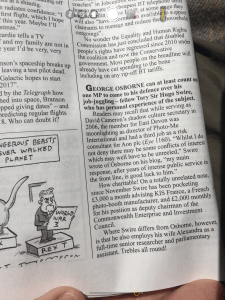
“3 jobs Swire” makes Private Eye

Not quite in his mate George Osborne’s league but getting there …

see:
https://www.hugoswire.org.uk/news/blog-greed-george-osborne

for the more gory details of this story.