“‘I’m afraid a child will die’: life at the sharp end of council cuts”

…. A recent analysis by the charity Action for Children concluded that spending on early intervention services for children in England has dropped by 26% over the last four years. The number of children’s centres lost since 2010 is estimated to be as high as 1,000. As the prime minister promises “the end of austerity”, many of these changes look irreversible, not least because increasing numbers of councils are facing dire financial problems.

Precisely tracking what is happening across the country is all but impossible, but freedom of information requests lodged by Labour’s shadow minister for early years, the Yorkshire MP Tracy Brabin, give a strong sense of what is going on. In Reading, the last eight years have seen the number of people employed in SureStart work drop from 95 to 53. In Wirral, the number has dropped from 219 to 63; in Southampton, from 1,189 to 583.

The vast majority of Somerset’s GetSet workers are women. Many of them do not just provide direct family support, but also organise the open playgroups that often provide a first point of contact for troubled families. “My worst fear is that a child’s going to die,” says one worker. “

https://www.theguardian.com/society/2018/oct/12/im-afraid-a-child-will-die-life-at-the-sharp-end-of-council-cuts

“Call for a £60,000 pay rise for high court judges sparks anger”

“Senior judges could be awarded an annual pay rise of almost £60,000, a proposal which has sparked anger among other public sector workers.

A government-commissioned review has reportedly recommended that high court judges should receive a 32% salary hike due to claims of low morale within the judiciary.

The rise would see their pay jump from £181,500 a year to £240,000 – an increase of more than £1,100 a week – if the findings of the Senior Salaries Review Body (SSRB) are accepted.

A combination of long hours and tax changes to pension schemes for high earners was said to have led to a recruitment crisis in the judiciary.

The Ministry of Justice confirmed Theresa May and the justice secretary, David Gauke, had received the SSRB’s report at the end of September. But officials said no decisions had been taken as to whether to accept its recommendations.

A ministry spokesman said: “The government values the work of our world-renowned judiciary, which is why we commissioned this review and are considering its recommendations. We will respond in due course. …”

https://www.theguardian.com/law/2018/oct/12/call-for-a-60000-pay-rise-for-high-court-judges-sparks-anger

“Food deserts”

“More than a million people in the UK live in “food deserts” – neighbourhoods where poverty, poor public transport and a dearth of big supermarkets severely limit access to affordable fresh fruit and vegetables, a study has claimed.

Nearly one in 10 of the country’s most economically deprived areas are food deserts, it says – typically large out-of-town housing estates and deprived inner-city wards served by a handful of small, relatively expensive corner shops.

Public health experts are concerned that these neighbourhoods – which are often also “food swamps” with high densities of fast-food outlets – are helping to fuel a rise in diet-related conditions such as obesity and diabetes, as well as driving food insecurity. …”

https://www.theguardian.com/society/2018/oct/12/more-than-a-million-uk-residents-live-in-food-deserts-says-study

Yet another “free school” scandal

“University technical colleges – part of the free schools changes pushed through by Michael Gove – have been described as ineffective and unpopular by a report that found more than half their students dropped out.

Of those who remained at UTCs, many made poor progress, with even previously high-achieving students performing less well in their exams, according to the Education Policy Institute.

About 60 UTCs have opened since 2011, after being championed by the Conservative Lord Baker and the then prime minister, David Cameron, enrolling students aged 14 to 18 and designed to encourage the study of science, technology and engineering.

But despite official encouragement and lavish funding, they have failed to generate enthusiasm among parents, and 10 have subsequently closed or converted into conventional schools.

David Laws, the EPI’s executive chairman, said after spending “hundreds of millions of pounds” on UTCs, the Department for Education (DfE) should halt any further expansion until their effectiveness has been reviewed.

Baker, a former education secretary who chairs the Baker Dearing Trust, which promotes UTCs, accused EPI researchers of ignoring evidence.

“EPI start with their conclusion that a 14-18 institution cannot fit into an 11-18 system and then use statistics to support that,” he said.

“It is a pity that they did not take up Baker Dearing’s offer to visit several of our 50 UTCs and speak to teachers, students and parents.”

The EPI found many UTCs struggled to recruit students, and failed to retain the majority of those who did enrol. More than half of all UTC students left between the ages of 16 and 17 after taking GCSEs, while more continued to quit before finishing key stage five at the age of 18.

One in five UTCs were rated as inadequate by Ofsted inspectors, the EPI found, while a further 40% were rated as requiring improvement – well above the national average for mainstream schools in England.

Julian Gravatt, the deputy chief executive of the Association of Colleges, said the report showed UTCs “are an experiment that hasn’t worked”.

“Given the high level of support given to them by the DfE and the capital funding allocated by the Treasury, this is obviously depressing,” he said.

The analysis also found UTC students’ GCSE results were almost a grade lower than their peers at secondary schools. “Significantly, this poor progress is particularly acute for high attainers, who make over a grade’s less progress than high attainers in all state-funded schools,” the EPI noted.

The National Education Union said the report backed up its research, which found Black Country university technical college in Walsall cost more than £11m between its opening in 2011 and closure in 2015, with 158 students enrolled out of a planned 480.

Another UTC in Burnley cost £10m but closed three years after opening in 2013, with 113 students enrolled despite plans for 800.

The EPI did note several benefits from UTCs, including that they offer a wider range of technical subjects such as computer science than other schools.

The report concluded that existing UTCs should be repurposed as 16-18 colleges offering post-GCSE technical qualifications, such as the government’s promised T-levels.

But Gravatt said such a change needed careful consideration. “The 16-to-18 sector of education is already a chaotic and underfunded market,” he said.

A DfE spokesperson said UTCs were an important part of England’s diverse education system.

“Our most recent data shows that when young people leave a UTC, they are headed in the right direction – with twice as many key stage four students beginning an apprenticeship compared to the national average,” they said.”

https://www.theguardian.com/education/2018/oct/11/university-technical-colleges-schools-report-education-policy-institute

“Universal Credit: 580,000 People Risk Losing Benefit Payments In Next Roll Out Of Reforms”

Many of these people are working and it includes children. At its current pace, around 1% of the population will be classed as destitute.

And we are told austerity is over. For whom?

“As many as 580,000 people could lose out on benefits payments in the changeover to Universal Credit, leaving vulnerable and hard-up families in crisis.

The Department for Work and Pensions (DWP) is currently rolling out the government’s flagship benefits reform programme and is due to move 2 million more claimants onto Universal Credit next year.

But the latest data shows that a “worryingly high” rate of claims are not being successfully processed onto the new system, HuffPost UK can reveal, with 29% closed or not paid.

If the current claim failure rates were replicated in the next stage of Universal Credit roll-out then 580,000 people who are currently receiving benefits, including many low income families who are in work and receiving income support, would lose out on payments.

The figures have led to urgent demands for the government to halt Universal Credit, which has been besieged by criticism from both the Labour Party and disability and welfare charities. …”

https://www.huffingtonpost.co.uk/entry/universal-credit-process-rate_uk_5bbe232ee4b01470d057ffcc

Is this why we now have a Minister for Suicide Prevention?

“Theresa May told to scrap fit-to-work assessments after nearly 50% of women attempted suicide during process:

Theresa May has been told to scrap “appalling” fit-to-work assessments after The Independent revealed nearly one in two women trying to claim benefits had attempted suicide.

SNP’s Ian Blackford grilled the prime minister on “the impact of her government’s own social security policies” on people’s mental health after she made a public commitment to reduce the number of self-inflicted deaths.

He pointed to an exclusive report by The Independent, which revealed that attempted suicides among out-of-work disability benefit claimants have more than doubled since the introduction of fit-to-work assessments in 2008.

Mr Blackford used the weekly prime minister’s questions clash to challenge Ms May to agree to “eradicate policies and circumstances that lead to people to believe that suicide is their only option”.

He told MPs: “I’m glad the prime minister agrees with me because, as reported by The Independent, nearly one in every two women taking part in the UK government’s work capability assessment say they have attempted suicide after or during the process.

“A series of secret internal enquiries into these reveal that Conservative ministers were repeatedly warned of the policies shortcomings.

“Will the prime minister commit today to ensuring that her new minister of suicide looks at the impact of her government’s own social security policies and at long last scrap the appalling work capability assessment?”

Ms May defended the assessments, which she said were regularly reviewed by the Department for Work and Pensions.

She said: “These were assessments that were introduced by a previous government [Labour in 2008].

“It is important that we get these assessments right. I think it is right that we are encouraging people into the workplace and wanting to ensure that those people are in the workplace – who are able to be in the workplace – are given the support to enable them to do that.

“That is what we want to do, I think it is right that we maintain assessments.”

The row came after Ms May appointed Jackie Doyle-Price as the first ever minister for suicide prevention as part of a £1.8 million push to reduce the number of people taking their own lives.”

https://www.independent.co.uk/news/uk/politics/theresa-may-fit-to-work-assessment-women-suicide-benefits-disability-a8577306.html

“Shoebox Britain: how shrinking homes are affecting our health and happiness”

“… Jenny pays £475 a month, excluding bills, for one of the smallest of nine flats carved out of a Victorian terraced house on a busy road. One of them is not more than a glorified shed crammed into the garden. She doesn’t know the floor area, but planning documents show that her room, which includes a double bed, kitchen sink, hob, oven, washing machine and a clothes rail, covers 15 sq metres. The tiny, windowless bathroom adds 3 sq m. Her whole home is barely bigger than the average living room and would fit 14 times on to a tennis court.

“When I come home I feel this sense of doom,” Jenny says. “I can’t have the window open because I’m on a noisy, polluted road, and I can’t have the blinds open because there’s a bus stop right there. I’ve had people weeing on my doorstep, doing crack outside my front door.” There are practical challenges. Jenny eats on her bed, which, like her clothes and everything else she owns, smells of whatever she cooks. Without proper storage, anything out of place can make the flat feel chaotic. The hum of the fridge keeps her awake at night.

“I think that even if someone didn’t suffer from anxiety or depression, living in this flat would affect them mentally,” she says, wondering how she might start to recover in a house like this. “You feel it – oh my God, the air is so … heavy.”

… But standards and ideals can get blurred in a vicious economic cycle. Ministers relax planning rules to enable more building and development. Developers and landlords find profitable loopholes in those changes. Local authorities, desperate for alternatives to their own dwindling housing stock, direct residents to those landlords, fuelling further exploitation at a time when councils also lack resources for planning and building control. Residents, often faced with homelessness, endure the cramped results, until society notices and someone writes another report.

“My concern is that people are becoming inured to something that they shouldn’t have to put up with,” says Julia Park, the head of housing research at architectural firm Levitt Bernstein. She has written a history of space standards and is surprised by how little we consider the effects of domestic confinement. “When you’re living in smaller and smaller flats, you reach a point where it makes sense to take out the walls because one big room feels nicer, but I think that implies a lot of compromise we’re not examining,” she says. “Some of these flats pose threats to physical health, but, in small spaces, it’s going to be mental health that is most affected.”

… Park, who advises local authorities, laments the way sleeping, cooking and washing are increasingly viewed as the only functions of a dwelling in a housing market where a living room is becoming a luxury. She is especially worried about the types of homes that have emerged in the gaps in policy. This summer, she noticed a seven-floor former office block in Croydon, in south London that had been divided into flats. Planning records showed that each of the six upper floors in the building had been converted into 10 studios, including single flats of just 13 sq m.

By current standards, these flats are barely a third of the recommended size. Park was instrumental in drawing up the “nationally described space standard”, a nationwide metric implemented by the government in 2015. It recommends 37 sq m for a one-person, one-bedroom flat; a two-person, one-bedroom flat should be 50 sq m.

Park was surprised that the government had agreed to the recommendations, given its austerity policies. “The compromise was that it is optional,” she adds, estimating that fewer than half of councils have adopted it. Even when they do, it only applies to new buildings or developments that go through the planning system, but not to a range of “permitted developments”. So, for a relatively small investment, the owner of an office building, for example, can convert it into self-contained flats with only “prior notification”.

Ben Clifford led a team that visited more than 500 converted office buildings for a report published last May by the Royal Institution of Chartered Surveyors. “We were shocked by how many of these flats were of a very poor quality,” says Clifford, a senior lecturer in spatial planning and government at University College London’s Bartlett school of planning. In one, Clifford called the fire brigade after spotting walls dividing flats made only of plywood. “We spoke to one resident who was in a tiny one-bed flat with two children and no balconies or open space,” he says. “Another woman, in an 80s office building, said it just wasn’t very nice to live in a flat with big tinted windows that don’t open.”

In the so-called “lockdown” model, meanwhile, rogue landlords are converting family homes into tiny studio flats specifically to attract tenants aged 35 or over who, like Jenny, claim the higher housing allowance for a self-contained dwelling. By including a token shared facility, such as a tiny kitchen – or by ignoring rules altogether – these landlords also bypass planning permission by treating such developments as flat-shares (another permitted development). The rental income from six cheaply built studios is multiples of that for a three-bed flat share in the same house – and it is the taxpayer who lines the landlord’s pockets. “It’s basically the warehousing of homelessness,” says Jon Knowles, a computer analyst and campaigner who has recorded hundreds of such developments.

… Few housing campaigners have much hope that conditions might soon improve for the occupants of our shrinking homes. Clifford says there is a minor backlash against abuses of the permitted development rules, and several local authorities are moving against them. “We have to be much tougher on landlords and on standards,” Park says. “There are going to be compromises because we are desperately short of housing, but we cannot give people a free pass.” … “

https://www.theguardian.com/money/2018/oct/10/shrinking-homes-affect-health-shoebox-britain

Council tax, stamp duty or a home value tax?

“COUNCIL tax and stamp duty should be scrapped and replaced by a new annual levy based on the value of people’s homes, a powerful think tank has said.

The radical plans put forward by the Institute for Public Policy Research (IPPR) would see households pay yearly property taxes based on the current market price of their home.

It argued the move would help reduce wealth inequality between those who own a home and those who don’t.

The think tank claimed housing is currently “undertaxed” relative to other assets, distorting investment behaviour and contributing to inequality between homeowners and renters.

A property tax rate of 0.5 per cent would mean an annual tax bill of £1,243 for the owner of an averagely priced UK home valued at £248,611, the IPPR said.

The think tank claimed if the new property tax was set at 0.5 per cent it would raise at least as much as current council taxes. …

Carys Roberts, senior economist at IPPR, said: “Council tax is a regressive tax as it falls disproportionately on those with lower incomes and wealth.

“It’s also outdated, as it’s based on valuations that have not been updated since 1992.

“A new new property tax would be far more progressive, and would effectively capture increases in house prices in a way the current system does not.”

Property owners have seen their wealth and income grow, while rising numbers are locked out of home ownership and must pay increasingly high rents, according to the IPPR.”

https://www.thesun.co.uk/news/7448976/property-tax-scrap-council-tax-stamp-duty/

Failing our vulnerable children – we sink even lower

“The NHS and councils need to collaborate to develop a system to support children with mental health problems, the Local Government Association has said.

Its call came in the wake of a Education Policy Institute report, published yesterday, which revealed a 26% increase in the number of children referred to mental health services.

At the same time, a quarter of councils have phased out support they offer to children including schools-based services, family counselling and support for those exposed to domestic abuse.

One in four children referred for mental health support were rejected, the report said.

David Laws, chair of the EPI, said it was “very worrying” that services and support were being cut back just as demand was rising.

“A large number of children referred to mental health services are already rejected for treatment, and the follow up for these children looks unsatisfactory,” he said.

“It is also disturbing that many mental health providers seem unwilling or unable to provide even basic data on their services – the government should take steps to compel all providers to report regularly on their standards and performance, and this data should be collected and reported nationally.”

Responding to the findings, the LGA highlighted the £3bn funding gap that will face children’s services by 2025.

“As a result, many councils are being forced to cut early intervention work, including youth services, which helps children avoid reaching crisis point, perform better at school and avoid mental health issues in later life,” said Anntoinette Bramble, chair of the LGA’s children and young people board.

“This has been compounded by government cuts to councils’ public health funding, which also helps young people to get the best start in life.”

She said there was a need for an “urgent root and branch review” of children’s mental health services and local government and the health should together develop a system that “says yes” to children, rather than rejecting them.”

https://www.publicfinance.co.uk/news/2018/10/children-mental-health-problems-need-public-service-collaboration

Rich council has 621 billionaire/millionaire homes left empty as investment vehicles

“A west London council has requested new powers to take over so-called ‘ghost homes’ and use them for council tenants when they are left unoccupied for long periods of time.

Kensington and Chelsea council’s deputy leader Kim Taylor-Smith has written to the housing minister to call for an overhaul of council powers to acquire unused houses.

Mr Smith said growing demands for social housing in the west London borough had been “framed by the Grenfell tragedy”, which led to the deaths of 72 people and left hundreds of council tenants homeless in June 2017.

Kensington and Chelsea was said to have a “huge buy-to-leave investment market”, meaning properties are bought and left empty, often to accrue value.

Mr Taylor-Smith said 621 properties in the area have been empty and unfurnished for more than two years, 347 of which are “amongst some of the most expensive in the borough”, including one worth almost £30 million. …”

https://www.standard.co.uk/news/london/london-council-calls-for-extra-powers-to-take-over-millionaires-empty-homes-a3955186.html

“CIH calls for right to buy to be suspended as discounts climb to ‘£1bn’ “

“Right to buy is costing English councils £1bn – £300m net – a year and cutting the discounts could lead to an extra 12,000 homes being built every year, a trade body has said.

Since 2012, when the discount was increased to £108,000 in London and £80,000 in the rest of the country, 69,467 homes have been sold, the Chartered Institute of Housing revealed in a briefing paper on Tuesday.

But construction has only started on 18,958 to replace those homes sold, the CIH calculated.

The housing body is calling for the policy to be suspended and for the government instead to invest in building more social homes for rent.

Terrie Alafat, CIH chief executive, said: “Not only are we failing to build enough new homes for social rent, we are losing them at a time when we need them more than ever.

“Suspending the scheme means the government could invest the savings in more homes for social rent – which is often the only truly affordable option for people on lower incomes – and also in fairer and more cost-effective ways to help tenants access home ownership.”

CIH research from January found that more than 150,000 social homes for rent in total had been lost between 2012 and 2017 due to right to buy and other factors. It estimated this figure will reach 230,000 by 2020 unless “we take action now”, Alafat said.

Council leaders warned earlier this year that just one third of councils were able to replace homes sold under the scheme in five years’ time.

The Local Government Association called for “fundamental reform” of the scheme and for councils to be allowed to borrow in order to build new homes….”

https://www.publicfinance.co.uk/news/2018/10/cih-calls-right-buy-be-suspended-discounts-climb-ps1bn

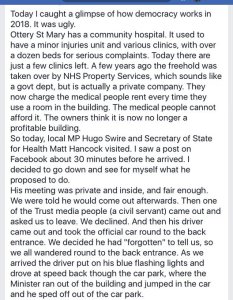
Report that Randall-Johnson was with Swire and Minister of Health at Ottery St Mary

“If you thought Health Secretary Matt Hancock was a safe pair of hands for the NHS after Jeremy Hunt think again. Comedy antics ensued when the Hancock turned up at Ottery hospital. First he hid, then he hurried.

Matt may well have been doing a favour for a rich mate, East Devon money-bags MP Hugo Swire, but at what price, making him appear a hapless lacky to East Devon’s Tory elite.

Hugo by-passed the Department of Health to take Matt hospital surfing. They went to Budleigh Salterton Hospital, before popping into in Ottery.

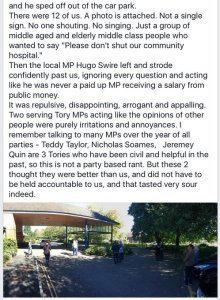
East Devon Councillor and Devon County Council Health and Adult Care Scrutiny Committee Councillor Claire Wright was on hand, along with some residents, to ask the Health Secretary some questions.

Unfortunately, he was holed up solely with a number of East Devon Tories, including Sara Randall Johnson, chair of the Health and Adult Care Scrutiny Committee. East Devon MP, Mr Swire and his aides were also present.

Have a read of Claire’s account. It certainly seems weird, so does the behaviour of the communication people of the NEW Devon Clinical Commissioning Group.

‘Why was he so frightened about talking to a dozen residents, and the local county councillor?’ asks Claire.

‘I had been quite encouraged that he was visiting the hospital and wanted to hear from him that he will protect Ottery’s and other hospitals. After all, Mr Hancock commands the NHS and also NHS Property Services, which now owns many hospital buildings in the area.

‘They are all at risk of possible closure and sell-off due to the lack of funding available to pay the enormous rents NHS Property Services demands.

‘But his cowardly escape bid simply gave the impression of a man who does not wish to be even remotely accountable.’

But that’s not all. Here’s the response of an East Devon constituent, as posted by Channel 5 News Health Correspondent Catherine Jones (check out the picture).

[There follow many hilarious comments on Swire’s justification for his actions and a You Tube video of Hancock doing a karaoke version of “Can’t Stop Me Now]

http://www.theprsd.co.uk/2018/09/27/first-he-hides-then-he-hurries-health-secretary-hancock-hot-foots-it-on-east-devon-hospital-visit/

6th richest country in the world: “Nearly 1 In 10 School Staff Are Bringing In Food, Tampons And Pens For Children In Need”

“Stories about teachers paying out of their own pocket for student’s food and teaching materials, are nothing new, but a study has now shown the extent of the practice in UK schools in 2018.

More than 50 per cent of classroom-based support staff have revealed they are spending their own money on items for children at school, ranging from tampons and toilet paper to pens, pencils, books, and toys for break time.

And nearly one in 10 said they were forced to bring in food from home to feed hungry children: many reported seeing pupils attending school without having eaten breakfast, or without any money for food at break times. …”

https://www.huffingtonpost.co.uk/entry/nearly-1-in-10-school-staff-are-bringing-in-food-tampons-and-pens-for-children-in-need_uk_5bb499cce4b028e1fe393bd4?guccounter=1

6th richest country in the world: “Fuel bills and council tax pushing people into debt the fastest – charity warns “concerning” bill rises are ruining lives”

“A debt help charity is seeing growing numbers of people falling behind with fuel bills and a resurgence in the proportion of clients with high-cost credit such as payday loans.

StepChange Debt Charity said the proportion of clients in arrears with council tax is also “stubbornly high”.

In the first half of 2018, 13.1% of all new clients were behind on a gas or electricity bill compared with 11.4% in the first half of 2017.

The charity said the increase coincides with some companies having already raised prices this year.

While some customers could potentially reduce their bills by switching, those facing financial difficulty may be nervous of the complexity of price tariffs and wary of being caught out and put in an even worse financial position, StepChange said.

It wants more utility providers to establish flexible repayment schemes, as well as sharing effective good practice on working with people who are struggling to pay to minimise their costs. …”

https://www.mirror.co.uk/money/fuel-bills-council-tax-pushing-13355881

New Health Secretary says no more community hospitals will be closed because they are vital to NHS!

Owl says: he makes no mention of what will happen to those already closed and up for sale. This also raises major inequality-of-care issues for the eastern side of East Devon (where all community beds have been cut) and western East Devon where the only community beds are in Sidmouth and Exmouth.

“The Health Secretary has promised to end the closure of community hospitals to ensure patients can be treated near their homes.

Matt Hancock said it was time to end the era of moving medical departments to large regional hospitals while smaller ones were closed.

He wants more patients to be cared for locally, particularly for routine procedures such as scans, physiotherapy and treatment for minor injuries.

Set up 150 years ago as cottage hospitals with just a few beds, Britain now has around 500 community hospitals that provide a broad range of services for local patients, including end-of-life care, rehabilitation for the elderly, scans, X-rays and minor injury units.

But NHS cuts mean dozens are facing closure across the country, including in Derbyshire, Gloucestershire, Cumbria, Leicestershire, Devon and Dorset.

Local health officials have been told to make savings and improve care, and many argue that patients can be treated more safely and cheaply in larger hospitals, even if they have further to travel.

But Mr Hancock believes that although patients should be prepared to go further afield for major operations such as heart bypass surgery, other procedures should be offered closer to home. …”

https://www.dailymail.co.uk/news/article-6233389/Health-Secretary-promises-end-cull-community-hospitals.html

“Poorest to be worst hit by a cashless society, warns Which?”

Lyme Regis hit the headlines last week when it became yet another bank-less town. In East Devon we already have Ottery St Mary and Budleigh Salterton without banks, with surely others to follow.

“Lower-income households and older generations will be hardest hit by bank branch and ATM closures that threaten their vital access to cash, as these groups use cash more frequently than average, new research from Which? reveals.

More than three quarters (78%) of consumers in the two lowest income households groups rely on cash, using it at least two or three times a week. This group are less likely than average to use a credit or debit card – in fact, just over a quarter (26%) never use card payments.

Cash usage is high among over-65s – the group perhaps most at risk of social exclusion when bank branches and ATMs disappear – with four in five (80%) reliant on cash, using it at least two to three times a week.

The findings come amid concerns that consumers’ access to cash is under threat, due to a severe reduction in bank branches on Britain’s high streets and changes to the funding model of ATMs that is seeing 250 disappear every month.”

https://www.which.co.uk/news/2018/10/poorest-to-be-worst-hit-by-a-cashless-society-warns-which/ – Which?

Tory grandee blames socialism, tax credits and Karl Marx for divorces

“No-fault divorces are “lacking in morality” and could destroy “the institution of marriage”, a senior Conservative politician has declared.

Archaic laws demand proof that a marriage has broken down due to a partner’s adultery, unreasonable behaviour, or desertion – but Justice Secretary David Gauke has said this approach will be scrapped as soon as possible.

But speaking at an event at the annual Tory Party conference in Birmingham, the party’s former treasurer, Lord Farmer, condemned the move and said liberalising the law was immoral and causing the “breakdown of society”.

He also blamed tax credits for a rise in break-ups and said the key to ending domestic violence “cannot simply be more refuges for victims to flee to”.

Farmer, who converted to christianity age 35 and is on the right of the party, said one or both partners should take blame when they “fail to live up to the promises made” at their wedding.

He said: “It is simply another example of the hyper-liberalism that treats family breakdown as inevitable.

“Making marriage easier to exit and sanitising divorce may make it less painful to the adults involved, but it is far more likely to weaken the institution of marriage than strengthen it.

“It will render marriage more voluntaristic and like cohabitation with its assumption that a couple may only stay together whilst it works for both of them.

“Marriage on the other hand is a solemn vow, an explicit statement of commitment, ‘until death’. Saying it’s no-one’s fault when one or both parties fail to live up to the promises made empties those promises of all meaning.”

He added: “I would go further and say support for no-fault divorce is lacking in morality.”

At the event on “strengthening families”, which saw arch-Brexiteer Jacob Rees-Mogg introduce Farmer’s speech, said the decline of marriage began with socialism.

“In many respects, it goes back to Engels, it goes back to Marx, the destruction of the family and building up reliance of everyone on the state, not the family,” he said.

He added that policies of the 1997 Labour government had accelerated divorce rates among low-income families and said former Prime Ministers Tony Blair and Gordon Brown took an “unreservedly liberalising approach to family change” which judged that all families “were deemed to require and deserve state support”.

Farmer hit out at the Working Families Tax Credit, introduced by Brown, which increased the benefits available to single mothers who went out to work for 16 hours a week or more.

Marriage breakdown was also leading to poor health and high suicide rates among single men, and, Farmer claimed, encouraged children to join gangs.

He said: “Defenders of the defamilialising approach argue that it is potentially very harmful for women to be dependent on men who might be abusive if they are to make ends meet. Of course this is true.

“It is also very harmful for men, women and children and society if men become surplus to requirement in families.”

He went on: “Defamilialisation and tyrannous hyper-liberalism have not ushered in a better, freer world but have facilitated an individualisation in social life which has resulted in father absence on a massive scale”.

He added that most of the 50,000 young people caught up in county lines drug activity “come from a broken home”, adding: “Also a lack of a good male role model helps lure young men into substitute family of a gang.”

Farmer went on to say more charities should aim to mediate between couples trapped in domestic violence, adding: “The response to our completely unacceptable levels of domestic abuse cannot simply be more refuges for victims to flee to.”

Farmer also called for the Government to appoint a senior cabinet minister for families and said welfare overspending, rough sleeping and educational underachievement had their roots in family breakdown.

“The welfare system picks up the pieces when relationships crumble, because people who were previously dependent on each other become dependent on the state,” he said.

He even claimed the housing crisis was exacerbated by marriage breakdown as demand for properties went up because “couples with children split up and both want family-size homes”.

Rees-Mogg, who is father to six children, called the fringe meeting “one of the most important meetings of party conference” and said “the family is the building block of society”.

https://www.huffingtonpost.co.uk/entry/no-fault-divorce-lacking-in-morality-says-former-tory-minister_uk_5bb33255e4b00fe9f4fa27b2

“Business rates: one John Lewis store will pay four times the tax of Amazon”

“John Lewis, the embattled retailer whose profits collapsed by 99% in the six months to July, will be charged £10.5m in business rates for its flagship Oxford Street shop from April, according to new figures — a 60% rise in three years.

A short walk away, Selfridges’ flagship shop also faces a 60% hike: its business rates bill will climb to £17.5m. That figure is almost four times the total UK corporation tax paid last year by the online retail giant Amazon: just £4.5m.

The looming threat to the high street will put pressure on the chancellor, Philip Hammond, to throw businesses a lifeline when he delivers his budget on October 29.

This weekend, Helen Dickinson, the chief executive of the British Retail Consortium (BRC), said: “These figures lay bare the shocking burden the business rates regime places on British retailers, who make up 5% of the economy and pay 25% of business rates — £7bn a year. The rates bill is leading to store closures, preventing the reinvention of our high streets, and is damaging communities the length and breadth of the UK.”
The BRC is lobbying for a two-year freeze in business rates until a revaluation in 2021, while the New West End Company, which represents businesses in London’s West End, is lobbying for a rates reduction of £5bn. This would be financed by a 1% tax on online businesses but would not apply to traditional retailers’ internet sales.

High street trading has been squeezed by online shopping, which now accounts for 18.2% of the market, with fewer stores surviving to shoulder the rates burden.

A phased four-year settlement in 2017 will bite hardest from April, with some stores facing huge increases. Burberry, which this month unveiled a new collection, faces a hike for its London headquarters of 186% compared with its rates in 2016-17.

In Manchester, Zara must pay £1.26m and Manchester City football club £2.4m, up from £1.7m in 2016-17.

Altus Group, the property adviser that researched the figures, found NHS hospitals will have to pay £386m and council-controlled state schools £957m.

Nickie Aiken, the Conservative leader of Westminster council, said: “Our taxes should reflect our way of life. I would ask the Treasury: do we want to continue the decline so that the only things left on the high street are charity shops and betting shops?”

Source: Sunday Times (pay wall)

Privatisation not making your company enough money? Don’tworry – taxpayers will stump up for your losses

“Carillion taxpayer bill likely to top £150 million

Taxpayers are on course to pay more than £150m following the collapse this year of Carillion after it was revealed the bill for redundancy payments is expected to hit £65m.

A freedom of information request by the Unite union showed an arm of the Insolvency Service has already made £50m of redundancy payments to former Carillion workers and expects to hand over a further £15m.

The cost of lawyers and accountants handling the liquidation of the construction and services companies is expected to be more than £70m and other costs are expected to escalate above £20m, taking the total beyond £150m.

Earlier this year the National Audit Office said the cost would hit £148m, prompting condemnation from opposition MPs who accused the government of mishandling the company’s collapse and leaving taxpayers to foot the bill.

Considered one of the most spectacular corporate collapses of modern times, Carillion filed for bankruptcy in January after its stock market value slumped 90% on the news it had racked up debts of about £1bn and was struggling to fill a £600m hole in its pension fund.

At the time, the Wolverhampton-based company had more than 19,000 employees, many of them working on Whitehall-commissioned contracts to build roads, schools and hospitals.

Ministers were accused of realising too late that the company was in financial difficulties and then making matters worse by offering fresh contracts in an attempt to boost investor confidence.

Several contracts were taken over by rivals after the collapse, but the £335m Royal Liverpool hospital will be finished with government money, the hospital’s chief executive said on Tuesday, while the £550m Aberdeen bypass will be completed by the joint venture partners Balfour Beatty and Galliford Try.

Labour’s shadow cabinet spokesman, Jon Trickett, said he had received pledges from ministers in response to questions in the Commons that the costs associated with Carillion’s downfall would be met by shareholders.

“We were assured that shareholders, who have taken hundreds of millions out of the company over the years, would bear the burden, not the taxpayer,” he said. “Now it feels like the taxpayer has been skinned twice. First by contracts ministers signed with Carillion that were a bad deal and then by picking up the tab for the company’s failure.”

The Redundancy Payments Office said: “The total amount we may pay out is approximately £65m, of which £50m has been paid so far based on actual claims received.”

Unite said ministers were to blame for allowing Carillion to file for compulsory liquidation with only £29m in the bank, rather than enter a managed form of administration.

It said the decision meant thousands of staff that transferred to other employers could not claim continued employment and fell outside the transfer of undertakings (protection of employment) regulations (Tupe) that protect a worker’s pay, terms and conditions.

“The lack of continuation of service means that the affected workers are considered new starters and have also lost many of their employment rights for a two-year period,” Unite said.

“The taxpayer will also have to pick up the bill for the work to complete several of Carillion’s key strategic projects including the Royal Liverpool hospital and the Midland Metropolitan hospital in Sandwell, West Midlands. The cost of concluding these projects is expected to be in excess of £100m. …”

https://www.theguardian.com/business/2018/sep/25/carillion-collapse-likely-cost-taxpayers-more-than-150m-unite