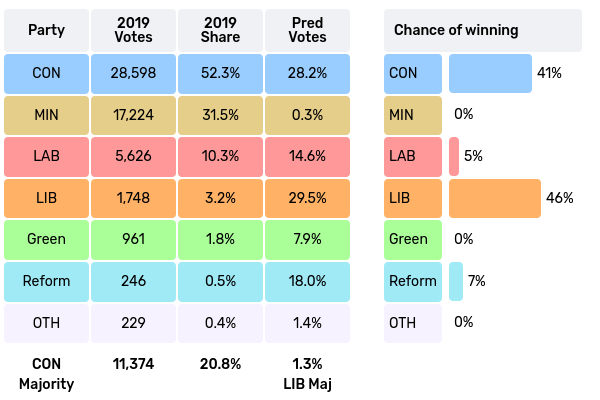
Latest prediction from Electoral Calculus (who actually poll the constituency) restores a narrow lead for Paul Arnott in Exmouth & Exeter East. Labour trail in fourth place but have taken Lib Dem votes as Reform have reduced Tory votes.
Seaton’s Liberal Democrat MP for the last two years, RICHARD FOORD (pictured speaking), dominated last night’s hustings in the Gateway, leaving his Conservative rival, Simon Jupp (on the right, looking on) a marginal figure. As Richard outlined his decades of experience in the military and education, Jupp’s background a special political adviser seemed no match.
As Richard recounted, it was he who, after hearing from the League of Friends of the threat to a wing of Seaton Hospital, first alerted the local community. Jupp repeated the lie that he had been ‘blocked’ from joining the Hospital Steering Committee which was set up in November at the public meeting I organised, but the simple truth is that – as I reminded the hustings – he didn’t bother to turn up, despite already having canvassed in Seaton for a whole year by that point.
Concerns about the NHS and social care dominated the meeting, but the Party of Women candidate, Hazel Exon, provoked anger from the floor when she answered questions about the environment by repeating her conspiracy theories about trans people – which were ably challenged by a young woman in the audience.
Jupp showed his right-wing instincts by pitching for support from climate and vaccine sceptics, but sounded subdued – the audience had largely moved beyond the Conservatives. Having moved first to Exmouth and then to Sidmouth so that he could call himself a ‘local man’ in his election leaflets, Jupp must now be wondering where he will go after Friday’s result.
The “Prof” (for that is what he is) takes another look at who is best placed to defeat the Tories in Exmouth & Exeter East.
“Let’s look at the fundamentals. The Lib Dems, whose vote Claire Wright effectively took over in 2015, 2017 and 2019, had always been the challengers in the area. The Lib Dems were far ahead of Labour in the local elections in 2023. Claire herself is backing Paul Arnott, the Lib Dem candidate, this time. The one MRP projection which we know takes these factors into account, Electoral Calculus, tips Paul to run the Tories very close, as does the Financial Times. The bookies have him a narrow favourite with Labour as also-rans.“
‘PROJECTED TORY WIN’ says tactical voting site, StoptheTories.vote, for Exmouth & Exeter East (EEE).
Although Simon Jupp only got 50 per cent of the vote last time, leading him to jump ship to what he thought was the safety ground of Honiton & Sidmouth (where the Tories had 60 per cent), it now looks as though his successor could cling on – while Richard Foord blocks Jupp in his new seat.
‘TACTICAL VOTE UNCLEAR. Data is mixed on best progressive party’, says StoptheTories.vote about EEE. ‘VOTE LABOUR OR LIB DEM’. The voters in this constituency are the victims of the new ‘MRPs’, which offer projections of local results based on a national model of how voters with particular social backgrounds might behave, given certain baseline political assumptions. The trouble is that these models are NOT polls of actual local voters, and they are NOT designed to provide tactical voting advice.
Crucially, their baseline assumptions are often flawed. For most of the models, the key assumption is that the opposition parties’ 2019 shares tell us who the main 2024 challenger is likely to be. The problem is that in EEE the main challenger was Claire Wright, the Independent who is not standing this time, who got over 40 per cent. Most of the models simply can’t cope with that, as several pollsters have admitted to me when I’ve questioned them. So they’re left using the 4.5% that Labour got in 2019 to pitch them as the main challenger over the Lib Dems who got 2.8% – although both lost their deposits and these miserable scores tell us nothing about how Claire’s 40 per cent will vote.
Let’s look at the fundamentals. The Lib Dems, whose vote Claire Wright effectively took over in 2015, 2017 and 2019, had always been the challengers in the area. The Lib Dems were far ahead of Labour in the local elections in 2023. Claire herself is backing Paul Arnott, the Lib Dem candidate, this time. The one MRP projection which we know takes these factors into account, Electoral Calculus, tips Paul to run the Tories very close, as does the Financial Times. The bookies have him a narrow favourite with Labour as also-rans.
Yet other tactical sites are using the flawed MRPs to say that Labour are the challengers, Labour are understandably reluctant to look a gift horse in the mouth, and many would-be tactical voters are totally confused. Much damage has already been done, with the opposition vote sufficiently split, perhaps, to let the Tory squeak through. I can only say that, based on my understanding of the fundamentals and the problems of the so-called polls in this case, Paul Arnott remains the best bet to take the seat. He would also be an excellent MP. I hope that voters will give him the chance.
Since its foundation in 1900, the Labour party has had a Janus-headed attitude to capitalism. It needs capitalism to be successful, dynamic and job creating, even while it instinctively distrusts capitalism, with its capacity to generate extreme inequality, invest too little, cut corners and treat workers exploitatively. But its past efforts at improving things – nationalisation, top-down planning, championing strong trade unions or simply (as New Labour did) largely giving capitalism its head – have not been notably successful. It has been a standoff that the Conservative party has ruthlessly exploited.
The seismic importance of 4 July is that Conservatism’s approach to wealth generation – trying to shrink the state whose size and excess taxes supposedly “crowds out” suppressed investment and enterprise – is exposed as a dead end of stagnant living standards and eviscerated public services. Keir Starmer, boxed in by this dreadful legacy, has declared that Labour will become the party of growth and wealth generation. Only thus can sustained tax revenues be generated to repair the ravages of the past 14 years. My bet is that he has a better than even chance of pulling it off – and transforming Labour into Britain’s natural party of government.
His first advantage is that the economic evidence is unambiguous: the state does not “crowd out” investment, and low taxes do little to stimulate enterprise. What capitalism needs from the state is well-designed and stable policy that proactively manages the business cycle while “crowding in” innovation, infrastructure and abundant fit-for-purpose training, and shapes the savings system to deliver buoyant company share prices – the necessary if insufficient precondition for raising capital to enable higher investment and a startup and scale-up boom.
This is becoming the new common sense in business, finance and the financial markets. It is why investors are buying shares anticipating a Labour government, and why Dame Amanda Blanc, CEO of Aviva, suggested last week that there could be as much as £100bn from UK insurers ready to flow into business investment if chancellor Rachel Reeves can deliver her promises on stability. That alone would go some way to lift British public and private investment by £100bn every year – the scale of the gap between us and our major competitors – while not risking another Liz Truss-style fiasco.
One important avenue to growth, cited in the Labour manifesto, is the prospect of unleashing some of the £1.4tn funds fossilised in Britain’s 5,100 defined benefit pension fund schemes. Linked to a generous fraction of workers’ final year’s pay, they have become a financial burden. To wind them up, companies have closed them to new members, creating a £1.4tn universe of wholly risk-averse zombie funds. They need to be consolidated into bigger funds that can take risks – and the money made to work to accelerate Britain’s investment recovery.
There is the tool to hand. One of the most startling policy successes of the past 20 years has been New Labour’s Pension Protection Fund (PPF), established in 2005, which takes over the management of distressed defined benefit pension funds, guaranteeing the future pensions. Managed with great professionalism, the PPF has already consolidated more than 1,100 pension funds and is currently worth £33bn with a £12bn investment surplus – one of the most successful funds of its type globally in securing high investment performance. Industry insiders believe that there is another £600bn locked up in small, high-cost zombie funds that could be liberated for productive investment.
The first staging post would be to scale up the current PPF to at least £100bn. Conservative objections that this would leave the pension funds with no fiscal backstop can be easily overcome; backed by the state, the PPF will become the new backstop via a guarantee that does not score as public borrowing. Nor, because the PPF is so rich, would the state ever be at risk. Reeves will be on her way.
After all, such a guarantee is already delegated to the UK Infrastructure Bank (UKIB) to underwrite £10bn of commercial bank lending on infrastructure projects. Reeves should lift the facility to £50bn. A similar guarantee would enable the British Business Bank (BBB) to offer venture debt to startups and scale-ups, and seek out promising companies to back: there is an estimated annual shortage of up to £10bn of venture lending that needs to be closed. My understanding is that a scaled-up PPF would support both the UKIB and BBB; at a stroke, Britain would have equipped itself with an investment trio of financial institutions dedicated to serious multibillion-pound economic development and resultant growth – without additional direct government borrowing. It’s a fiscal get-out-of-jail-free card.
Against this background, Reeves can use her proposed rewriting of the fiscal rules to supplement public investment directly. The Financial Times recently reported that asset managers would buy an extra £20bn-£30bn of government debt if it were earmarked for investment projects and R&D. Altogether, the UK’s growth rate could accelerate to above 2.5% by the end of the parliament, with even the dropped £28bn target for green spending met. Growth would be higher again the more Britain regained access to lost EU markets.
In the near future, before growth kicks in, Starmer and Reeves may have to increase the current yields from capital gains, inheritance and council tax by up to another 1% of GDP. But overall there will be the funds to resuscitate education, the NHS, local government, defence, the criminal justice system, the arts and welfare. Do I dream? Some commitments are in the manifesto, others set out in Reeves’ Mais lecture in March, others have not been excluded during the election campaign, and the ambitious teams in the investment trio are all standing by for the call.
Some in the Treasury will oppose. And never underestimate the conservatism and parochialism of the pension fund world. Geopolitics may kill all hopes. But Britain under Labour could at last fulfil its economic promise and build a high-investment, inclusive, high-wage capitalism that treats its workers fairly. This time, no mistakes.
Ed Davey, the Lib Dem leader, spent Sunday campaigning in Bicester, where the party believes it can defeat the Conservative candidate, Rupert Harrison, a highly regarded economist and one-time adviser to the former chancellor George Osborne.
Davey’s visit was part of a strategy that has seen the party roam further into safe Tory territory as the campaign has gone one, buoyed up by polls that show it picking up support across large parts of the south and south-east.
A party source said: “We’re really encouraged by what we’re seeing in the final stretch of the campaign. Tory support seems to be collapsing in southern England and we’ve continued to pick up support.”
The party went into the election focused on 80 seats where it finished second in 2019 – almost all Tory held. Officials say more of those 80 are now in play than when the campaign first began. “Canvass returns are looking better than they were a week ago, and even better than they were two weeks ago,” said one.
Internal Lib Dem polling seen by the Guardian suggests there will be close races in Bicester and Woodstock, Didcot and Wantage, Henley and Thame – which includes much of Johnson’s former seat – and Witney, Cameron’s old constituency. The party believes each of these could be won by a margin of just 500 seats.
This tallies with national polls that suggest the party has picked up more than one percentage point during the campaign, while the Conservatives and Labour have shed support. Large-scale MRP models suggest every pollster expects the party to win Henley and Thame, but they are split over which party will win the other three Oxfordshire target seats.
The party will spend the final days of the campaign targeting Labour voters in seats where Labour finished third in 2019, hoping they can unlock as many as 25 seats in a final frantic effort. As well as the Oxfordshire seats, the party is pouring resources into Theresa May’s former seat of Maidenhead, as well as the south-western seats of Frome and East Somerset, and Torbay.
An editorial in Rupert Murdoch‘s flagship Sunday broadsheet said the Conservatives had “in effect forfeited the right to govern” and that it was “the right time for Labour to be entrusted with restoring competence to government”.
But the lukewarm support does not necessarily mean that all News UK titles will urge readers to vote Labour, i understands.
While newspaper circulations have declined, reducing their influence, the Murdoch papers have traditionally sought to back the winning side in elections.
Labour welcomed The Sunday Times switch, which accompanied an exclusive joint interview with the party’s leader and his shadow Chancellor, Rachel Reeves.
But winning the support of The Sun, which has backed the Conservatives for the past 15 years, is seen as a symbolic prize by the Labour leader’s team.
Pat McFadden, Labour’s election campaign co-ordinator, told LBC: “We always welcome endorsements, I think they matter.
“We have changed, broadened our appeal. You can’t win by just speaking to people who already agree with you.
“I would likeThe Sunto endorse us but it’s a decision for them.”
Labour also won the endorsement of the Financial Times on Sunday night. In a leader column headlined “Britain needs a fresh start”, the paper wrote: “The Conservatives have run out of road. Labour must be given a chance to govern.”
Shadow Health Secretary Wes Streeting posted on X, formerly Twitter: “The Sunday Times backs Labour. Britain needs change. If you want change, you have to vote for it.”
But a News Corp insider said that the endorsement was “more about the anti-Tory mood than support for Labour”.
“If the Tories are heading for a hammering then the papers have to acknowledge that and remain relevant,” they said.
“But at The Sun, the feedback from readers is they are fed up with the Tories but they still don’t trust Labour on key issues like immigration, tax and union rights.”
The Sunday Times held fire until its final edition before polling day to make its call. It wrote in its election editorial: “We cannot go on as we are, and we believe it is now the right time for Labour to be entrusted with restoring competence to government.”
“Britain needs to do better as a place to live, work and do business.”
The period since 2016 was described as being “defined by political chaos that has fatally distracted the political class from those issues that matter most to voters – healthcare, schools and the economy”.
The switch was in stark contrast to other right-of-centre Sunday papers which led with dire warnings that a Starmer government would “wreck” Britain.
David Yelland, former editor of The Sun, wrote on X: “The Tory Sundays are in collective nervous breakdown as their power wilts, these front pages are wild howls at the moon.”
Ayesha Hazarika, a former Labour adviser, said: “Although newspaper endorsements are not as potent as they once were, a significant move for The Sunday Times to back Labour after almost 20 years.”
Baroness Hazarika added: “Support for Scottish Labour in the Daily Record and Sunday Mail is also worth noting – Scotland is very important in this election.”
Sky Newspolitical reporter Ben Bloch described it as a “big blow to Rishi Sunak”.
Paul Mason, the former BBC journalist who sought selection as a Labour candidate, wrote on X: “Sunday Times becomes first Murdoch newspaper to back Labour … the rationale is functionalist: my car keeps breaking down so I must change it but it offers no clue as to why the car is so faulty… only that changing the salesman didn’t help either.”
Carol Vorderman, the TV personality-turned-anti-Tory campaigner, said: “The Sunday Times has endorsed Labour today… do you think that will change many people’s view? I don’t think so.”
The Sunday Mirror, as expected, urged readers to vote Labour, along with The Observer. The Independent used a blacked-out front page to urge people to vote for Labour.
The Sunday Express and Sunday Telegraph lined up for the Tories.
The Mail on Sunday wrote: “It is not all over yet. Vote Conservative on Thursday and we may yet escape a long and punishing season of hard Labour.”
Sir Tony Blair convinced Mr Murdoch to back New Labour at the 1997 election after years of wooing.
But The Sun‘s full-throated backing for Sir Tony, at the launch of the 1997 general election campaign, has not been repeated for Sir Keir, who sanctioned prosecutions of a number of tabloid journalists over hacking allegations when he was director of public prosecutions.
The paper’s daily “Sun Says” editorial columns have been critical of the prospectus offered by Labour throughout the campaign.
The Sunday Times leader column may register less highly with voters than Sir Elton John’s call for a Labour government on Saturday.
Whilst the influence of newspaper endorsements may be declining, The New York Times editorial calling for President Joe Biden to drop out of the US presidential election after his faltering debate performance last week caused shockwaves in Democrat circles.
Among them is the dominant JN1 variant and the KP2 variant. They account for many current Covid cases in England. The KP3 variant, which has driven a rise in cases in the US, has also been identified in the UK in small numbers.
The UK Health Security Agency (UKHSA) said it needed “more data” on the new variants to understand how severe and transmissible they might be.
The agency, which is responsible for public health, also said it was “impossible” to tell at this stage whether these variants were behind the small rise in hospital admissions.
As it does with all new strains, the UKHSA said it would “continue to monitor these variants” in the UK and internationally and would gather more information on how well the vaccines protect people against them.
But the agency said there was no current change to public health advice.
It is normal for a virus to change and mutate and the UKHSA says the healthcare system is still “getting to grips” with the ebb and flow of cases.
Prof Hunter said Covid was now part of life and should not be as alarming as it once was.
He said: “We are all of us going to get repeated Covid infections from births through to death.
“Generally what we’ve seen is that over the last three years, four years, the severity of illness associated with Covid has gone down a lot.
“Ultimately, it’s going to become another cause of the common cold and, for many people, that’s what it is now.”
He added: “To be honest, you can’t really avoid it because it’s so common.”
Have Covid symptoms changed?
The official list of Covid symptoms has not changed, according to the UKHSA.
There are no longer any legal restrictions requiring people to self-isolate if they have Covid. You also do not need to take a lateral flow test and there is no requirement to wear masks.
However, government advice, external is to try to stay at home and avoid contact with other people for five days after testing positive.
People should also avoid meeting people who are more likely to fall seriously ill if they were to catch Covid, such as elderly people or those with weakened immune systems.
“If you are showing symptoms of Covid-19 or flu, help protect others by staying at home and avoiding contact with other people, especially those who are more vulnerable,” the UKHSA’s consultant epidemiologist Dr Jamie Lopez Bernal said.
Can you still get a Covid vaccine?
The vaccine programme has been scaled back since the initial rollouts early in the pandemic. Now, only certain people are entitled to jabs under seasonal booster programmes.
The latest data showed four million people – 59.6% of those eligible – had been vaccinated under the scheme since April, including two-thirds of care home residents.
There has been a tremendous response. (See EDDC Commonplace pages)
One major concern to emerge is that the current sustainability appraisal in the draft plan does not identify the water quality issues in river catchment areas caused by the combined impact of proposed and existing developments.
Watershed’s newpollution map, referred to in the previous post shows that ALL the main rivers in East Devon are in poor shape. Currently the Axe is so polluted in Somerset, it has been given an emergency level of protection by the Environment Agency.
Much of the proposed new development will feed into either the Otter or the Clyst.
Ultimately the responsibility lies with the strength of legislation and its enforcement determined by central government.
The Rivers Trust has this to say about each of the main party commitments made in their manifestos:
Preventing Pollution
Conservatives
The Rivers Trust is concerned to see that the Conservatives intend to scrap nutrient neutrality rules following widespread outcry [by developers – Owl] against this move last year. These vital environmental laws protect our most sensitive natural sites from additional pollution. The Rivers Trust continues to urge political leaders not to undermine these protections.
Labour
The Rivers Trust is glad to see that Labour is committed to making nutrient neutrality rules work for development as well as nature and will retain these vital environmental protections. Unfortunately, the manifesto does not tackle other sources of pollution, such as agricultural and road run-off, which are causing havoc for our waterways.
Liberal Democrat
The Rivers Trust is glad to see the Liberal Democrat commitment to increasing funding for the Environment Agency and Natural England, and strengthening the role of the Office for Environmental Protection. These environmental agencies play a vital role in holding polluters to account and protecting our natural environment; proper resourcing will enable fair and effective regulation of all kinds of harm including sewage, agricultural, and chemical pollution.
Thousands of polluted landfills across England could be leaking toxic chemicals into the environment and harming people who live nearby, experts have warned.
A few decades ago, the method for getting rid of industrial and domestic waste was to stick it in a hole in the ground, cover it up and hope for the best. It was known as “dilute and disperse” and it assumed toxic substances would seep into the surrounding soils, air and water and become harmless.
There are more than 21,000 of these “historic” landfills across England, with contents that are largely unknown. A report in the British Medical Journal found that 80% of the British population lives within 2km of a functioning or closed landfill site. The location of historic landfills and current waste sites can be viewed on a new pollution map published by Watershed Investigations, along with thousands of other potentially polluting sites.
The landfills are not distributed evenly; analysis of the government’s scrappy historic landfill database by the Guardian and Watershed Investigations reveals that the most deprived parts of the country contain five times more old landfills as a proportion of their area than more affluent places, and three times more operational waste sites.
The forensic environmental scientist Dr David Megson, a contaminated-land expert, said he was “not surprised that many of these sites tend to be in less affluent areas. They are often left as a public open space, as a developer wouldn’t be able to obtain planning permission to build houses on them due to the high levels of chemical pollution.
“Many back on to council estates and it’s not uncommon for children and teenagers to use these sites. These guys are not sticking to the paths and only using the sites occasionally, they are out there regularly exploring and digging in the dirt, I’ve even seen evidence of people lighting ground-gas monitoring boreholes on fire due to the high levels of methane present.”
Methane is an extremely potent greenhouse gas and exposure to high levels of it can lead to mood changes, slurred speech, vision problems, memory loss, nausea, vomiting, facial flushing and headaches. In severe cases, it could affect breathing and heart rate, and cause balance problems, numbness, unconsciousness and even death.
It is also known that landfills can leach a range of nasty substances into the environment, including banned toxic chemicals.
Environment Agency data obtained by the Guardian and Watershed Investigations reveals that long-lasting toxic carcinogens known as “forever chemicals”, such as perfluoroalkyl and polyfluoroalkyl substances (PFAS), have recently been found in the ooze, known as leachate, from dozens of old and existing landfills, along with polychlorinated biphenyls (PCBs) and brominated diphenyl ether (BDE) flame retardants. In some cases the leachate is captured and treated, but this is not always the case.
“PFAS is pretty much ubiquitous and found in all [the sampled] sites, BDEs also come up quite a bit,” said Megson. “These are of interest as they have been emerging pollutants over the last two decades, compared to more traditional pollutants – such as heavy metals, PCBs and dioxins – that we have known about for much longer.
“Treatment procedures, if present at all at these sites, are not designed to deal with PFAS and BDEs. We’ve only been monitoring these pollutants recently, so there could be many large historic landfill sites that were deemed safe under previous investigations, but these investigations did not test for PFAS or BDEs – so they could actually be deemed contaminated land if we were to test them now.”
The environmental scientist Dr Daniel Drage examined the data and noted that the “fact that we are seeing PFAS in landfills that haven’t received waste in 20 to 30 years, and are seeing the highest levels now, shows what a challenge we are facing in tackling the issue. Dealing with PFAS-contaminated waste over the next five to 10 years is going to be a multi-billion pound industry, and landfill simply isn’t an appropriate method for its disposal. There is plenty of evidence to show that PFAS will not remain in landfill, and much of it would end up re-entering the environment.”
Particularly of concern are the thousands of landfill sites situated in flood zones and on the coast; flood water mobilises chemicals, and waves batter and erode landfills built on shorelines.
Councils are supposed to be responsible for looking after old landfills if an owner cannot be identified. Responsibility shifts to the Environment Agency only when a site is considered to present a risk. But since the government withdrew the contaminated land fund in 2017, cash-strapped local authorities rarely have the resources to seek out or actively manage sites.
A spokesperson for the Environment Agency said: “We provide expert technical and regulatory support to local authorities to help them carry out their responsibilities for regulating contaminated land in England. Where contaminated land needs to be remediated, we work with partners to reduce unacceptable risks to human health and the environment.”Historic landfills and operating waste sites can be viewed on Watershed’s new pollution map
Here are some illustrations of the sort of information available:
Electoral Calculus continues to put Richard Foord ahead with 37% of the vote. But his lead is very much dependent on a sharply divided right wing. Unlike Exmouth & Exeter East, Reform is predicted to be polling on a par, if not ahead, of Simon Jupp. This looks potentially volatile to Owl
Turnout is predicted around 70% (compared to 57% in Exmouth & Exeter East), reflecting the much greater observed interest in this constituency. Low turnout usually benefits Conservatives with their strong tribal loyalty.
Betting on the election is very much in the news, so Owl has been checking out the odds for Exmouth & Exeter East to see what the betting community makes of this first past the post race.
Not that Owl was considering a bit of a flutter, you understand.
This confirms the view, emerging from the polls, that this is seen as a two horse race.
The most popular bets seem to give the Lib Dems, at the moment, a bit of a “nose” over the Tories and confirms that Labour is very much one of the outsiders.
[For those like Owl unfamiliar with the betting scene and wanting to convert odds to implied probabilities here is an online calculator.]
The most popular bets being cast at the moment (in descending order of bets being placed) are:
I hate to be boring but in this beautiful hot weather Surfers Against Sewage gives Budleigh Salterton a SEWAGE ALERT again.
But the Environment Agency information solar panel, displayed by the Longboat, says there is no pollution warning available.
Who is the bather to believe? I know which I do.
As I walked the dog yesterday I saw so many enjoying playing in the sea, especially children.
Meanwhile, the tankers full of “non-hazardous waste?” sewage still rattle along the Parade and destroy the surface of the High Street.
What is happening? I have heard so many different rumours. Do we have a crack in the Lime Kiln car park storage tank? Is there a blame game happening with SWW laying the this at the door of the LORP project? Who will pay for to have this mess sorted? (drawn- out litigation comes to mind) How long will BS and our vital tourism have to suffer?
Residents appear to have been posting their own alert that this could be an ongoing problem all summer !
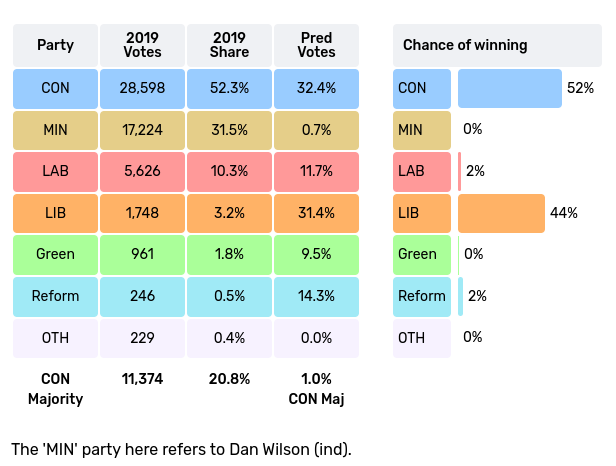
A week ago Electoral Calculus (the gold standard for MRP seat by seat predictions) gave Paul a small lead over the Tories (30% – to 29.2%). Their latest poll shows David Reed, the blow- in Tory, bucking the trend and increasing his vote share to 32.4%, overtaking Paul who also continues to gain ground. Reform in this constituency appears static. Labour has dropped from 17.8% to 11.7% and is now given only a 2% chance of winning. Olly Davey, Green, has increased his vote from 2.8% to 9.5%.
Obviously these seemingly precise numbers are surrounded by substantial uncertainty. We need to read them with caution. In these small sample predictions what usually has statistical significance are consistent trends. So over three polls we have the Conservative vote going up and down, Labour has been falling consistently, Lib Dems and Greens have been rising consistently.
Overall conclusion This is a two horse race, too close to call at the moment, but onlyPaul Arnott can beat the Tories. Voting Labour or Green is likely to hand the seat to David Reed.
A correspondent received this communication from Greenpeace which is equally applicable to Exmouth & Exeter East – Owl
‘At this election, Honiton and Sidmouth could be a close race so your vote is powerful. To help you cut through the political spin, we’ve teamed up with Friends of the Earth to comb through the parties’ manifestos and reveal who’s really standing up for the future of our planet. Everyone has to make their own choice about how to vote. But if climate and nature is a priority for you, we hope you find this helpful.
Key points to know:
Across the main UK-wide parties, the Green Party tops our list for its climate and nature plans, followed by the Liberal Democrats, Labour, and lastly, the Conservatives.
A poll last week suggests it is most likely to be either the Liberal Democrats or the Conservatives that win in your area.[1]
We found a big gap between these two parties on their plans and have scored the Liberal Democrats over six times higher than the Conservatives on climate and nature.
Commitments from the Liberal Democrats that are particularly promising include raising money through wealth taxes to invest in green homes, better public transport, nature restoration and more support for developing countries. The party also has an excellent plan to tackle sewage in our rivers and seas. Sadly, they have not committed to an end to oil and gas licences or to ratify the Global Oceans Treaty – both areas they need to go further on.
The Conservative Party’s manifesto is worrying reading. They’re doubling down on oil and gas when increased dependence on gas will result in higher bills, more energy price shocks and an increase in our climate-wrecking emissions. It’s good news that they would ratify the Global Oceans Treaty swiftly, but there’s no credible plan to stop sewage in our rivers and seas.
Polling day is Thursday 4 July – use your vote and remember you need ID.
Want to get the full picture on where parties stand?
Read the guideRead and share this guide on voting for climate and nature at this election
Thank you for joining me in demanding a greener, healthier country for us all. In hope and solidarity, BeckyGreenpeace UK
P.S. Have you signed up to be a climate voter? Our movement will be holding the new government to account beyond the election and we need your help to do it. Join us here. [1] Polling from YouGov released on 19 June
A Devon Reform UK candidate appears to have posted controversial social media posts, including one alluding to prime minister Rishi Sunak’s Indian heritage.
Paul Quickenden, who is standing in the new Honiton and Sidmouth constituency, has a mocked-up picture of Mr Sunak with the heading ‘Dahl Boy’ on his Facebook page.
The image places Mr Sunak’s head on the body of sitcom wideboy from Only Fools and Horses, Del Boy, and also features Labour leader Sir Keir Starmer and London mayor Sadiq Khan as ‘grandad’ and ‘Rodney’, respectively, from the show.
The famous yellow Robin Reliant is also in the image, but rather than ‘Trotters’, the surname of Del Boy in the show, it says the word ‘Traitors’, and has 666 as the number to telephone.
666 is a biblical reference popularly known as the number of the beast, or devil.
Mr Sunak is a British Sikh of Punjabi Indian heritage.
It’s unclear who originally created the image that Mr Quickenden is promoting to his Facebook followers.
The image came to light as part of an investigation by ITV which claimed that four Reform UK candidates belonged to a public Facebook group that regularly posts racist messages.
Mr Quickenden has also posted comments and shared Facebook posts, including one with 24,400 followers saying: “Cultural Jihad , happening now in plain site and encouraged by both main parties.”
Mr Quickenden uses this post to advance his campaign in Honiton and Sidmouth, inviting followers to vote for Reform UK in the constituency.
The ITV report also referenced two other unnamed Reform candidates who had posted potentially racist posts, with one allegedly commenting in 2016 that ‘Hitler founded Israel’, and then another posting the image of Mr Sunak, which has since been reproduced on Mr Quickenden’s profile.
Discussing the issue from a national perspective, Reform UK’s leader Nigel Farage told ITV it hired a vetting agency, vetting.com, to perform background checks on its candidates, but the firm said the speed with which the general election was announced meant its process had to be rushed.
“Our candidates are not sophisticates or Oxbridge graduates,” Mr Farage told ITV.
“Our candidates may have a sense of humour that is a bit rough and ready, but we believe in free speech.”
Mr Quickenden has a GoFundMe campaign to help him pay for election costs, and has raised £1,170 from 16 donations out of his £2,000 target as of 24 June.
A Devon spokesperson for Reform UK has not responded to requests for comment.
Multiple victims have been told by the force that he was arrested on suspicion of offences under the Online Safety Act and harassment. Labour is understood to have suspended him after it was notified of his arrest.
Earlier this year a high-profile MP William Wragg was suspended by the Conservatives over his role in the scandal.
He admitted giving the phone numbers of colleagues to the scammer after he shared explicit images of himself when they began talking on a dating app.
It came after Politico reported that political figures had received the unsolicited messages from someone using two unfamiliar numbers calling themselves “Abi” or “Charlie”.
The messages would include details of the MPs and staffers’ careers and campaigns they had worked on to build rapport with victims. They would then descend into sexually explicit messaging, with “Abi” or “Charlie” sending graphic images to victims and asking for nude photographs in return.
It is understood that two of the individuals targeted responded by sending an explicit image of themselves, with the attack described as an attempt at spear phishing. Spear phishing involves scammers pretending to be trusted senders in order to steal personal or sensitive information.
Other senior figures targeted by the honeytrapper included Conservative MP Dr Luke Evans, who said he had received unsolicited explicit images and messages over WhatsApp. It is believed that at least 12 men in political circles received the unsolicited messages.
In a statement, the Met said: “Police executed a warrant at an address in Islington.
“A man was arrested on suspicion of harassment and committing offences under the Online Safety Act. He was taken into custody where he remains.
“The arrest relates to an investigation being carried out by the Met’s Parliamentary Liaison and Investigation Team following reports of unsolicited messages sent to MPs and others.
“The investigation remains ongoing.” The investigation has seen officers interview all those who received messages from the scammer, which included Labour and Conservative MPs.
Historically, in Devon, there have always been tensions between the walled city of Exeter and the County beyond, though you may have to be a 300 year old Owl to know it.
Are we seeing an action replay in this election where Exeter labour activists seem to be under the illusion that they can “take over” the new constituency of Exmouth and Exeter East? Despite only a small fraction of Exeter’s suburbs being added to the Exmouth side of the old constituency.
Labour’s candidate in 2019 was Dan Wilson, an EDDC councillor for Exmouth Halsdon. This time he stands as an Independent.
Dan quit the party in March, citing amongst his reasons: Labour’s reneging on the Green New Deal and turning a blind eye to whistleblowing on candidate behaviour. Dan says “When I was in the Labour Party, that’s the kind of thing I expected of the Conservatives, and I felt [the Labour party] should hold itself up to higher standards.”
As has been reported and commented on by Owl, Labour have drawn false conclusions on their strength from polls attempting seat by seat predictions on small samples. Their illusion is beginning to dawn, though Owl can find no evidence of their campaigning cutting through in the constituency heartland in Exmouth.
Nationally, both Labour and the Conservatives are losing votes with Reform and the Lid Dems gaining.
Disappointing (but predictable?) that EEE Labour has switched off replies to this. Not only has Electoral Calculus projected the Lib Dems to beat the Tories, but now the FT – whose outdated figures Labour uses on its leaflets – has the LDs moving ahead to become the challenger.
Huge sums of taxpayers’ money literally has gone up in flames. – Owl
An estimated £1.4bn-worth of personal protective equipment (PPE) bought by the government in single a deal has been destroyed or written off, according to new figures described as the worst example of waste in the Covid pandemic.
The figures obtained by the BBC under freedom of information laws showed that 1.57bn items from the NHS supplier Full Support Healthcare will never been used.
They were part of a £1.78bn deal the firm struck with the government to supply masks, aprons, eye protectors and respirators in April 2020 at the height of the pandemic. It was the government’s largest PPE order during the pandemic accounting for 13% of the government’s spend.
Out of total of 2.02bn items provided by Full Support Healthcare in the deal, only 232m were sent to the NHS or other care settings, the figures show. About 749m items have already been destroyed and a further 825m of excess stock is being considered for disposal or recycling, the disclosure revealed.
The shadow health secretary, Wes Streeting, described the deal as a “staggering waste”.
He said: “We know that billions of pounds were wasted during the pandemic on corruption and incompetence by the Conservatives, but this is the worst example I have ever seen.
“£1.4bn on one contract, paying for PPE that was never used, and Rishi Sunak’s fingerprints are all over it. That is money that could have been used to pay the salaries of 37,000 NHS nurses.”
Daisy Cooper, the deputy leader of the Liberal Democrats, said it was “colossal misuse of public funds”.
She added: “This is just the latest in a series of damning revelations on the Conservatives’ record of mishandling Covid contracts.
“Instead of this troubling pattern of waste, shortcuts and lack of oversight, the public deserve transparency on the true cost of these failures.”
The health secretary, Victoria Atkins, said the £1.4bn figure was “not accepted” but her department has not provided an alternative estimate.
She defended the government’s procurement of PPE during the pandemic as “the right thing to do”. Challenged on the disclosure during a press conference on Tuesday, she said: “The whole country wanted us to get the PPE that our frontline staff needed both in healthcare and in social care, and we managed to procure billions of pieces of PPE equipment.”
There is no suggestion that Full Support Healthcare, or its co-directors, Sarah and Richard Stoute, have done anything wrong.
The couple’s lawyers told the BBC: “Full Support Healthcare stock arrived quickly by summer 2020, much earlier than most and in larger quantities. It had either a two- or three-year shelf life. This means the PPE products are more likely to have passed their use-by date.”
The couple’s business is based offshore in Jersey, “solely to maintain privacy”, the lawyers told the BBC.
The couple and their company remain registered in the UK for tax.
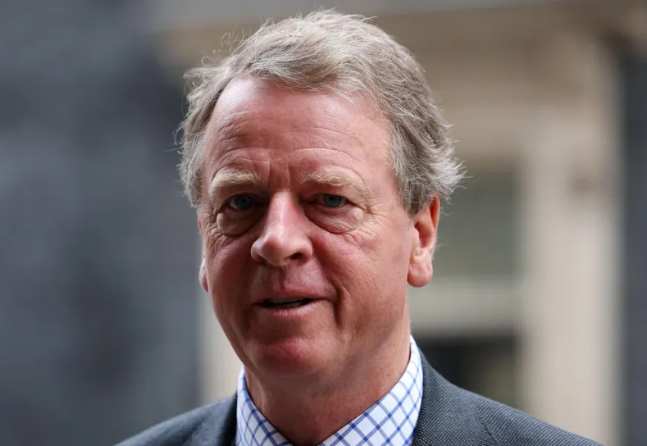
Shortly after Prime Minister Rishi Sunak announced the election date, Scottish Secretary Alister Jack told the BBC he had made £2,100 after betting on June and July election dates. He claimed one of the bets was placed at odds of 25/1.
Last week, Mr Jack told the BBC the comments were “a joke… I was pulling your leg”.
Today, the Scottish Secretary said in a statement he “did not place any bets on the date of the general election during May”.
Rishi Sunak made his surprise election announcement on 22 May.
“I am very clear that I have never, on any occasion, broken any Gambling Commission rules”, said Mr Jack.
“I did not place any bets on the date of the general election during May – the period under investigation by the Gambling Commission.
“Furthermore, I am not aware of any family or friends placing bets. I have nothing more to say on this matter.”
A spokesperson for the Gambling Commission said: “We are not confirming or denying the identity of any individuals involved in this investigation.”
Alister Jack had been telling colleagues and journalists for at least a year that he thought a June or July election made the most strategic sense for his party.
He has represented Scotland in the UK cabinet since 2019, under the premierships of Boris Johnson, Liz Truss and Rishi Sunak.






 East Devon Watch