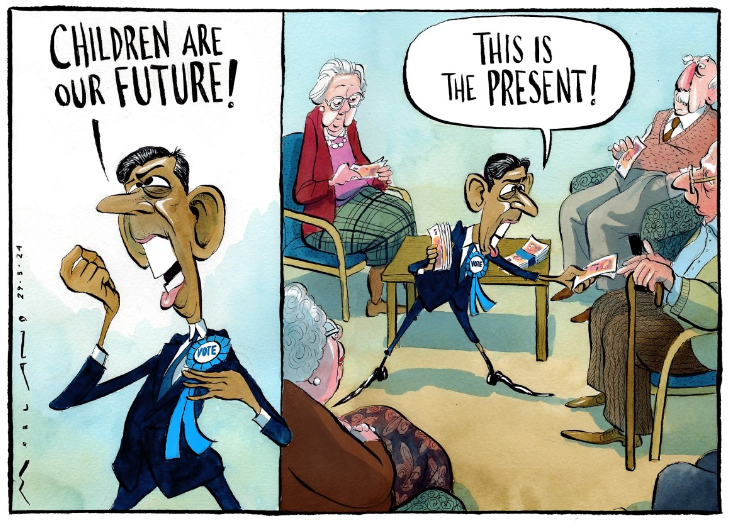
Another eye roller.
Rishi Sunak doesn’t escape the “small boat” problem while taking Coffee and doughnuts at a Henley rowing club.
If nothing else you have to admire the timing! – Owl

Another eye roller.
Rishi Sunak doesn’t escape the “small boat” problem while taking Coffee and doughnuts at a Henley rowing club.
If nothing else you have to admire the timing! – Owl

The Liberal Democrats launched their campaign for the Exmouth and Exeter East constituency on Saturday (June 2).
Adam Manning www.exmouthjournal.co.uk
Supporters gathered at Exmouth Football Club to mark the official campaign launch of Paul Arnott, Liberal Democrat Parliamentary Candidate for Exmouth and East Exeter.
Other candidates standing in Exmouth and East Exeter constituencies include David Reed for the Conservatives, Helen Dallimore for the Labour Party, Olly Davey, Green Party and Daniel Wilson for the Independents, and Garry Sutherland for the Reform Party.
The Lib Dems say they ‘are currently positioned as the main challenger to the Conservatives in the new constituency.’
Cllr Arnott has been leader of East Devon District Council heading up a Democratic Alliance of LibDems, Independents and Greens for the last five years.
Independent candidate, who stood in the 2019 election Claire Wright is backing Arnott and the Lib Dems because “only the Lib Dems can beat the Tories in the contest for the seat”.
She added: “I am backing Paul to win because he is decent, hard-working and tough, but also incredibly compassionate with a laser-like focus, leaving no stone unturned when justice is at stake. Paul will make a strong and wonderful MP.”
Cllr Arnott, added: “Both myself and Claire share the same values and we hope that the thousands upon thousands of constituents who were loyal to her will lend their votes to myself, resulting in a win for the Lib Dems – and ultimately, a win for the people of Exmouth and East Exeter.”
He told his supporters: “I never wanted to become a parish councillor in 2007, but I had to because of the sitcom that was playing out on my doorstep which wasn’t serving the people well.
“I never wanted to become a district councillor in 2019 but due to the well-known concerns about Conservative probity in planning, I had to. I did not expect to become Council Leader in 2020, leading it through and beyond the Pandemic.
“It was never in my life’s plan to run for a member of parliament, but I was asked to by many people. Now I can draw on the depth of my experience to make a difference where it’s so desperately needed.
“I am honoured the Lib Dems have put their trust in me and I will seize this opportunity to make things better here for everyone.”

Hospital patients are “dying in corridors”, nurses have warned as they declared a “national emergency” in the NHS.
Patients are regularly treated on chairs in corridors for extended periods of time – and sometimes even days, the Royal College of Nursing (RCN) has said.
They are also receiving cancer diagnoses in public areas, and may have to undergo intimate examinations there too, the union added.
A survey of almost 11,000 frontline nursing staff across the UK shows the practice has become widespread, the RCN said.
When asked about their most recent shift, almost two in five reported delivering care in an inappropriate area, such as a corridor.
Patient privacy and dignity had been compromised, almost seven in 10 said.
“You wouldn’t treat a dog this way,” one nurse said.
Another nurse recounted a patient with dementia being in a corridor for hours without oxygen.
They said: “When I arrived, she was in a wheelchair on a corridor with her daughter. She was extremely agitated, crying and confused. This care environment for any patient, never mind with dementia, was completely inappropriate.”
The RCN’s acting general secretary, Professor Nicola Ranger, will declare a national emergency at the start of the union’s annual conference.
The organisation will also publish a report on clinical care in inappropriate areas.
In order to show how widespread the practice has become, the RCN is calling for mandatory reporting of patients cared for in corridors.
“Our once world-leading services are treating patients in car parks and store cupboards,” Prof Ranger will tell delegates.
“The elderly are languishing on chairs for hours on end and patients are dying in corridors. The horror of this situation cannot be understated.
“It is a national emergency for patient safety and today we are raising the alarm.”
She will add: “Receiving a cancer diagnosis in a public area isn’t care. It’s a nightmare for all involved. We need to call it out as nursing staff, and health leaders and ministers need to take responsibility.”
Corridor care is a “symptom of a system in crisis”, the RCN’s report says, with patient demand in all settings, from primary to community and social care, outstripping workforce supply.
Boiling the water or boiling with rage, or both?
“Our main priority is to return supply to the quality our customers expect and deserve, quickly and safely.” Is this what South West Water considers to be quickly? – Owl
Three weeks on from UKHSA first reports of the outbreak and five weeks since people started falling ill.
[The UKHSA reported the crypto outbreak on Monday May 13. And there were reports of people falling ill almost two weeks before SWW announced its boil notice early on Wednesday May 15
Radio Exe News www.radioexe.co.uk
But water company says they’re making progress
Nearly a month on from an incident which has left people in parts of South Devon needing to boil their water before drinking, or rely on bottled water, South West Water claims it’s making progress on making the water supply safe again.
More than a hundred people have been taken ill because of a parasite called cryptosporidium.
Affected households still need to take precautions and not drink direct from the tap, but the firm says it will help if they flush loos and clean with the public supply.
Incident director David Harris said: “Our regular sampling results show we are making good progress with removing cryptosporidium from the water supply in Kingswear, Hillhead and upper parts of Brixham area.
“Our teams are continuing to complete our programme of work, which includes rigorous cleaning processes, as well as installation of additional protection measures, such as specialised filters and ultra violet treatment.
“In the meantime, we encourage people to continue to use water around their homes for washing, cleaning and flushing toilets. The smaller pipes in customer homes compared with our network means that water moves through home plumbing at a much greater speed. This speed of movement creates enough force to clean the pipes in customers’ homes and so it is important customers continue to ensure they use water, but boil it for any consumption like drinking and brushing teeth.
“We are working as quickly as possible to fix this situation. Public health remains our absolute priority and we will only lift the boil water notice when we are confident it is safe to do so and our public health partners agree. We will continue to keep customers and businesses up to date with progress.
“Our main priority is to return supply to the quality our customers expect and deserve, quickly and safely.”
South West Water knew of crypto bug more than 24 hours before boil notice
A worried correspondent reports tanker operations have been frequent in the past week .

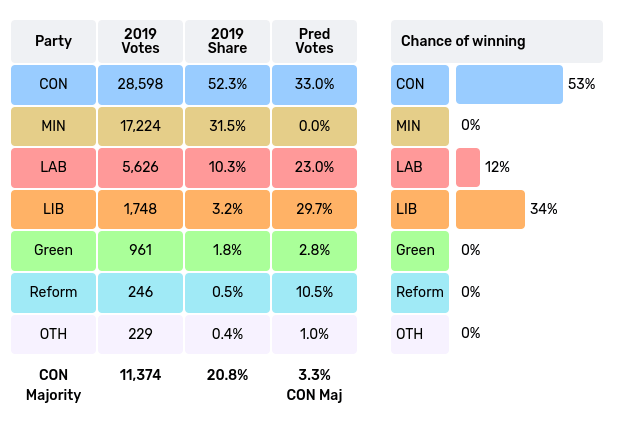
A gold standard constituency by constituency poll from Electoral calculus indicates that the new Honiton & Sidmouth constituency, unlike Exmouth & Exeter East, is likely to be a straight fight between two former MPs: Richard Foord for the LibDems and Simon Jupp for the Conservatives.
Richard Foord is currently predicted to have 45% of the vote and a 74% chance of winning.
Jupp is currently trailing by ten points and is predicted as being ahead in only 4 of the 26 wards. He is considered as having only a 26% chance of winning.
In February 2023 Simon Jupp announced he was abandoning 78% of his current constituents as he became the Tory candidate for the new seat of Honiton and Sidmouth.
He claimed that Sidmouth was where his home was.
Many of us thought he was on the chicken run, opting for what he thought was the safer seat.
If he is doing a “chicken run” then it looks like he has failed to impress his new constituents. His social media shows he has little feel for what local people want or connection to them.
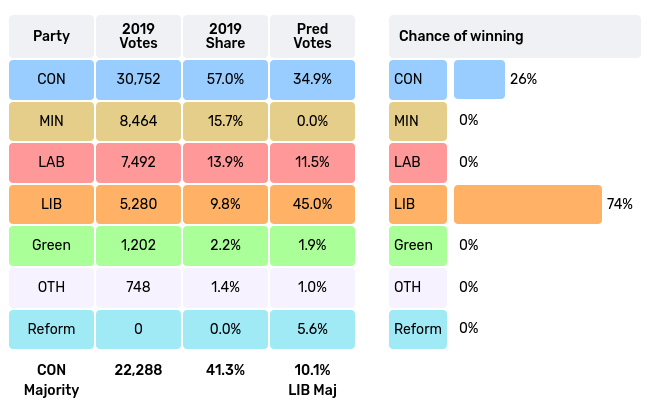
A gold standard constituency by constituency poll from Electoral calculus gives the Conservatives only a 53% chance of winning the new Exmouth & Exeter East seat on a mere 22% of the vote.
Paul Arnott for the Lib Dems is already only 3 points behind in second place and his campaign has hardly begun.
The Labour, Lib Dem and Green parties are predicted to command 56% of the vote (Reform are on 11%). [Numbers rounded]
Labour are currently claiming that only they can win but these numbers don’t back this claim.
In fact, detailed analysis would place Labour voters in a majority in only one ward, that of Pinhoe.
Labour is only given a 12% of winning.
Will a divided majority opposition hand the seat to the fifth of the voters who vote Tory?
Voters, what do you really want to achieve? – Owl
(Predicted turnout 66%)
Hilarious! Don’t you just love the folk of Honiton’s reaction to being the “canned audience” for Sunak’s flying visit (down by train shoulder to shoulder with real people but returned by private helicopter)?
As before Simon Jupp has a very small walk on part. Blink and you miss it. Maybe he is practising auditioning? – Owl
Councillors heard that occupancy is currently 10 per cent below break-even.
In 2015 Owl wrote: It seems all is not well at these so-called high-tech industrial areas [Sky park and the Science Park] on the outskirts of Exeter and Cranbrook. Yet thousands of houses are already being built for people supposed to be working in them. Recipe for disaster? [Exeter Science Park was “topped out” ten years ago in August 2014] – There’s plenty more in the EDW archive to follow this saga.
Guy Henderson – Local Democracy Reporter www.radioexe.co.uk
Exeter City Council has been urged not to ‘crash’ the city’s Science Park project as it tries to recover a £1 million loan.
The authority has decided to convert the loan into shares in the company running the high-tect park near Exeter Airport after hearing there is no prospect of the money being repaid when it becomes due next January.
The city council advanced the initial loan in January 2015, and it is due to be repaid – plus interest – after 10 years. But a report to an extraordinary meeting of the council said: “There is no security for the loan. The council is an unsecured creditor. Exeter Science Park Ltd is unable to repay the loan when it falls due.”
The council had the option to take enforcement action, but was warned that this was likely to undermine the company and deter potential investors. Converting the loan into equity would give the city extra security for its money.
Exeter Science Park is just off the M5 and the A30 east of the city. It sits within the East Devon District Council area, and is owned by four shareholders, Devon County Council, Exeter City Council, East Devon District Council and Exeter University.
It was set up to cater for businesses working in science, technology, engineering, maths and medicine. It currently hosts 45 companies, creating 750 jobs, across six high-specification buildings.
But councillors heard that occupancy is currently 10 per cent below break-even.
Council leader Phil Bialyk (Lab, Exwick) told the meeting it was important to reaffirm the city’s support for the project as a driver to deliver high-quality jobs.
“I don’t think crashing the science park is the answer to getting our money back at this stage,” he said. And he said he accepted some criticisms from opposition councillors that the authority should not have been in the current position.
“Perhaps we have not had our eye on this particular ball,” he said. “We need to put that right going forward, and I think we will.”
But Cllr Tammy Palmer (Lib Dem, Duryard and St James) said the council risked making ‘yet another poor financial decision’. She went on: “We took a large chunk of public money and invested it without asking any of the right questions.
“We need to reassure people that we’re not just wasting money on vanity projects.”
And Conservative group leader Anne Jobson (St Loyes) said converting the loan into shares was the wrong approach.
“Surely our duty is to recover those funds?” she said. “We can’t afford to be generous with council taxpayers’ money. This is all too speculative, and there is no evidence that there is any further investment in the pipeline for the Exeter Science Park.
“Council taxpayers can’t rely on speculation.”
Progressive group co-leader Diana Moore (Green, St Davids) put forward amendments calling for greater scrutiny and accountability. She said the council had to learn lessons from previous ventures, including the demise of affordable its housing company Exeter City Living.
The amendments were defeated, but she said it was important that Exeter Science Park’s fortunes were turned around.
“I want to see real action and real change in the way this company is operating,” she said.
“The time to act is now.”
Because of possible contamination from hydrocarbons, following a long standing fuel leak.
Readers may remember South West Water was fined £233,000 in 2022 for supplying “just add lemon” water to residents of Bratton Flemming in 2022. – Owl
Meanwhile Devon cryptosporidium victims hit 100 and residents told water is STILL too contaminated with faeces…www.dailymail.co.uk
Hundreds of homes get ‘do not drink water’ warning
More than 600 households in a Surrey village have been warned not to drink tap water after tests carried out by Thames Water following a previous fuel leak.
Amy Walker, Julia Gregory & Victoria Park-Froud www.bbc.co.uk
The water company said it was issuing the advice as a precautionary measure for properties in Bramley, where there has been concerns over several months about the spill from a petrol station.
Thames Water said “concerning results” had been identified in three areas., showing “elevated” levels of hydrocarbons, which petrol is made from.
Bramley resident Helen Melia said: “It’s hugely inconvenient – hugely worrying.”
Tess Fayers, Thames Water’s regional operations director, told BBC Radio Surrey: “It is all linked to an issue with a fuel leak which has been plaguing the town of Bramley for quite some time”.
Residents were visiting local shops to buy bottled water on Friday morning.
Catha Holt said she had been drinking only bottled water since the start of the year because of concerns about the water supply.
She added that the notice was “quite worrying for people”.
Raymond Vincent, who lives outside of the affected area in Bramley, said he had bought bottled water “because I’m taking a precaution”.
Steve Hardstone, landlord of the Jolly Farmer pub, said it had the only deep cellar in the high street, and the smell of fuel had “permeated the whole building”.
“It’s damaged us massively… We’ve had customers literally walk in and walk out again,” he added.
But the pub is not covered by the advisory notice, and Mr Hardstone said it would continue to use water “with some reservation” on Friday.
Bottle banks have been set up outside Bramley library and at Artington Park-and-Ride.
Ms Melia said she had not received any bottled water from Thames Water, but had some in the house already to brush her teeth and make tea.
The company is advising customers to avoid using tap water to brush teeth or prepare food, even after boiling.
But it said the water could be used for bathing, flushing toilets and in washing machines.
Water supply in the village “has been safe to drink up to this point”, the firm said.
Results on Thursday indicated high levels of hydrocarbons – which are found in petrol, Thames Water said.
Ms Fayers added that it had “isolated” the issue and had retested the three locations which raised concerns, with results being processed at an independently-verified laboratory.
Evan Venn said he didn’t know about the issue until this morning
Evan Venn, 68, said he did not hear about the notice – which Thames Water issued on Thursday night – until this morning.
He said: “I drank two-and-a-half litres of tap water between last night and this morning. I went to the gym and had no idea.
“My wife told me this morning… she found out on Facebook.
“The communication is not very good full stop. I only found out this morning by opening the door that they had delivered the water and in there was the warning card.”
Peter Hall, 88, also wasn’t aware of the issue until this morning and has received a delivery of bottled water.
“We’d already had our breakfast, so we’d already consumed a quantity of the water and cleaned our teeth,” he said.
The alert comes amid an ongoing fuel leak from the village petrol station.
The Environment Agency said earlier this year it was continuing to investigate an “ongoing groundwater pollution incident in Bramley”.
The long-running issue has led businesses to say they have lost £100,000 due to the stench of fuel.
The firm is currently replacing a water pipe outside of the petrol station, with works set to last for about four weeks.
Thames Water has been regularly carrying out extra tests on water since October, but has recently ramped up efforts to about 12 a week.
It said that when ingested with drinking water, hydrocarbons “may lead to nausea, vomiting and abdominal pain, however low levels of exposure are not expected to cause long term health effects.”
Jane Austin, a Conservative councillor on Waverley Borough Council (WBC), said the latest water warning was “just yet another horrible thing that’s happened to our village because of this fuel leak”.
She told BBC Radio Surrey: “We are so frustrated by what’s been thrown at us by something that’s completely… not of our choosing.”
WBC said it was working with Thames Water and other agencies to “mitigate the impact on residents”.
Earlier this month, thousands of people in Devon were told to boil their tap water before drinking it after a parasite outbreak was identified.
South West Water said the Hillhead reservoir and the wider Alston area was being investigated as a potential cause for the outbreak.
The number of confirmed cases of cryptosporidium has now reached 100, the UK Health Security Agency said on Thursday.
Separately, residents in Bramley have faced at least two water outages due to technical issues over the last year.
Let’s recall what the politicians have said and Defra’s knee jerk reaction to this “invasive” species
They are not essential. “For what it’s worth, I think there are more important things than beavers,” Thérèse Coffey a year ago June 2023.
From a Guardian article of 2014 soon after beavers were confirmed as living on the Otter:
If the government gets its way, the presence of these beavers in a corner of Devon – the first to be sighted in England for 500 years – will be a short-lived affair. This month, the Department for Environment, Food and Rural Affairs (Defra) said it planned to trap the colony and transfer them to a zoo or wildlife park, arguing they are an invasive non-native species and could carry disease.
The move has caused consternation. Almost 8,000 people have signed a petition against Defra trapping the beavers and animal rights campaigners are patrolling the banks of the river Otter, ready to raise the alarm if the hunters move in. There are whispers that hunt saboteurs are preparing to disrupt any moves to trap the beavers.
District councillor Claire Wright said [ten years ago] there was no logic in removing them. Like many, she disagrees with the government’s definition of them as invasive. “They are a native species. The obvious way forward is to monitor them carefully and see what impact they have,” she said.
Who has bee on the right side of history? – Owl
BBC News www.bbc.co.uk
Devon’s beaver population is playing a vital role in easing the impact of flood and drought in the region, according to researchers.
Experts from the University of Exeter and Devon Wildlife Trust have spent 10 years studying the effect beavers are having on the local environment.
They found that across four separate family areas, the beaver-created wetlands were storing more than 24 million litres (5.3m gallons) of water.
Researchers said this reduced river levels flowing through downstream communities during wet weather, whilst ensuring healthy stream flows during dry spells.
Dr Alan Puttock, Lecturer in Applied Nature Based Solutions at the University of Exeter said: “We have found that beaver-created wetlands contribute significantly to more resilient landscapes, reducing both the impacts of flooding and drought.
“Above flood-prone communities in the River Otter we have observed that beaver-created wetlands have significantly reduced storm flows.”
Devon Wildlife Trust is now using the research findings to make the case for creating more space for beavers and their wetlands.
The charity is also hoping to unlock more funding to compensate land owners who agreed to turn grazing land into habitats for beavers.
The Trust’s Green Finance Officer, Dr Holly Barclay, said: “We need to provide space along our waterways for beavers to live and create their wetlands.
“That’s why we are developing new funding streams which can reward land managers for the benefits they are providing to society – including flood and drought alleviation – by allowing beaver wetlands to develop on their land.
Wild beavers were found living in the River Otter in east Devon 2014 and given the legal right to stay in 2020.
The Devon Wildlife Trust monitors the animals and estimated the rodents are now living in 20 separate family territories along the river and its tributaries.
Rishi Sunak has suffered another general election blow after a top economic think tank said income growth under the Conservatives has been the worst in generations.
Archie Mitchell www.independent.co.uk
The prime minister had enjoyed a period of respite this week following an uptick in the polls for his party after infighting engulfed the Labour Party over the future of Diane Abbott MP and the academic Faiza Shaheen, who has not been selected to stand as an election candidate over social media activity in 2014.
But a damning new report has laid bare 15 years of languishing living standards under successive Conservative governments.
The study, by the influential Institute for Fiscal Studies (IFS), found average incomes grew by just 6 per cent from 2009-10 to 2022-23. Before the financial collapse in 2008, the UK would have expected income growth of 30 per cent in the same period.
The study also found that absolute poverty has fallen by just 3.4 per cent in the last 15 years, a fifth of the speed it fell under the last Labour government.
It pointed to a global slowdown in the wake of the credit crunch in 2008-09, but said Britain has fallen from one of the fastest growers to one of the weakest performers since.
And while disposable incomes have returned to pre-pandemic levels, the report also found that pay growth since 2008-09 has been “very poor”. Average pay is currently just 3.5 per cent higher than at the same time in 2009-10, it said.
Despite the largely damning findings, the report gave a boost to the Tories tax-focused campaigning. The IFS said average earners are now paying £2,000 less in taxes than someone on the equivalent pay in 2010, which will pour fuel on Mr Sunak’s warnings that if Sir Keir Starmer enters Downing Street families will be hit with tax hikes.
The Abrdn Financial Fairness Trust, which funded the report, said living standards “have languished for more than a decade”.
Chief executive Mubin Haq said: “On a range of measures UK performance has been weak, especially in comparison to other wealthy countries. The danger is that stagnation becomes the new normal. This is in no one’s interests and stunts too many futures and too many lives.”
Mr Haq urged whoever wins the general election to oversee a “renewed drive to tackling hardship and improving living standards”.
IFS associate director Tom Waters, who authored the report, said poor income growth has been an unfortunate feature of life in Britain for the past 15 years.
He added: “It has been slow growth for essentially everyone; rich and poor, old and young. This means that even while income inequality has been stable, progress on reducing absolute poverty has been painfully slow.
“Although there has been a widespread slowdown in growth internationally since the financial crisis, the UK has fallen from being one of the fastest growers prior to the Great Recession, to one of the weakest performers.”
The report followed an almighty row between Labour and the Conservatives over tax and the economy.
Both parties accused each other of having made billions of pounds worth of unfunded spending commitments, while both also ruled out raising income tax, national insurance and VAT.
Jeremy Hunt said Labour would “hammer families” with a 1p increase to VAT, which shadow chancellor Rachel Reeves branded as “nonsense”.
Ms Reeves hit back, saying Mr Hunt’s “£71bn unfunded spending plans risk putting up interest rates and people’s mortgages”.
Discerning seagulls pay tributes in Exmouth to their departing MP
Experts rank environment policies from Tories, Labour, Lib Dems and Greens
Labour and the Conservatives must announce more ambitious green pledges to demonstrate “bold leadership” on the environment, a leading campaign group has warned.

Lucie Heath inews.co.uk
An analysis by Friends of the Earth, shared exclusively with i, has ranked the Conservatives, Labour, Liberal Democrats and Greens’ plans on 10 key environmental issues, including cutting carbon emissions and protecting Britain’s nature.
Each party was then given an overall score out of 100, with the Greens coming on top (82), followed by the Liberal Democrats (68), Labour (51) and the Conservatives (27).
The scoring is based on any policy announcements made by the parties to date, as well as the Conservative Party’s record in Government, and will be updated when the manifestos are published during the election campaign.
While the Liberal Democrats and Greens are often able to be more ambitious with their pledges – as neither party expects to be in government – Friends of the Earth said the results showed it was time for all parties to “speak up, not keep silent” on green issues.
The party manifestos are expected to be published in full in the coming weeks in the run-up to the election on 4 July.
Mike Childs, head of policy at Friends of the Earth, told i the rankings could change once parties released their manifestos and said he believed Labour was currently keeping “their cards very close to their chest”.
He added: “We’re not at the finish line yet – and our analysis shows all the parties have more to do. Now the campaign is properly under way, voters want to hear concrete plans on how they will build the greener, fairer, more prosperous future we so urgently need.”


The Conservative Party scored the lowest in all 10 categories, including cutting carbon emissions and protecting the environment.
The Tories scored the only zero in the exercise, for defending democracy. Friends of the Earth said this was because the Government has overseen a “plethora of restrictions on liberties”. They cited the recent Police, Crime, Sentencing and Courts Act and the Public Order Act, which have placed tougher restrictions on protest in response to climate action by groups such as Extinction Rebellion.
Mr Childs admitted the Tories’ green policies had been “easier to scrutinise” due to their record in Government.
The last year has seen ministers U-turn on a number of green pledges, including upcoming bans on new petrol cars and gas boilers. Rishi Sunak also sparked the ire of environmentalists following his decision to allow new oil and gas drilling in the North Sea.
“Unsurprisingly, with such an abysmal track record, they have scored particularly badly,” Mr Childs said.
Labour’s scoring was more mixed. The party achieved a nine out of 10 on green energy, thanks to its pledge to decarbonise UK power by 2030, which Friends of the Earth described as “seriously aspirational”.
However, the party scored lower on issues including meeting the UK’s international climate targets and protecting nature.
On international commitments, it said Labour had so far refused to agree to return the UK to its commitment to spend 0.7 per cent of gross national income (GNI) on international aid, and had not made clear whether the party would uphold the UK’s £11.6bn climate funding pledge for the world’s poorest nations.
Friends of the Earth said Labour was “short on solid policy” so far on preserving Britain’s nature. The leaders of four major charities have sounded the alarm, in an op-ed for i, over the declining state of biodiversity in the UK, with one in six species facing extinction.
Mr Childs said Labour would have scored better if it hadn’t scrapped its pledge to invest £28bn annually on green investments. In February, Sir Keir Starmer confirmed his party would slash its green budget to under £15bn per year, with only a third of that being new money that is not already committed.
Labour said the U-turn was due to the current state of the UK economy. The party has set out strict fiscal rules on spending if it wins the election.
While Labour’s fiscal approach has won the party the support of businesses, environmentalists fear its stance on green issues has weakened.
But Mr Childs said it’s “all still to play for” and that Labour could “still pull it out the bag” with its manifesto if it includes strong policies “to put our national and international climate targets back on track, end the sewage scandal, and restore nature”.
A Labour spokesperson said the party “looks forward to being judged on our manifesto”.
They said the choice at the election was “clear” between a Tory party “that pollutes our rivers” and is “funded by climate deniers”, or a Labour Party that will “restore nature” and “deliver the largest investment in clean energy in our history”.
The Liberal Democrats performed better than Labour and scored a 10 out of 10 on the category of “Ensuring a healthy environment for all”. Friends of the Earth said the party had a “strong package of policy on the environment”, including on issues such as air quality and sewage discharge.
The party has made the environment a central tenet of its campaign this year in a bid to win over Tory voters outraged by the sewage scandal. On Tuesday, Lib Dem leader Sir Ed Davey went paddle-boarding on Windermere, which has become a symbol of the filthy state of Britain’s water.
Overall, the Green Party, as you might expect, achieved the highest score, with full marks on categories including retrofitting the UK’s housing and protecting nature.
Green Party co-leader Adrian Ramsay said the analysis “underlines why it is so important to get more Green MPs elected to Parliament”.
“With Labour so far ahead in every single poll, it’s clear that Labour is set to form the next government. What is in doubt is Labour’s commitment to make the real changes needed,” he said, adding that Green MPs “want to be in Parliament to hold the new Government to account”.
Rishi Sunak and Sir Keir Starmer are out on the campaign trail after the Prime Minister announced a surprise snap election on 22 May. i‘s general election live blog follows all the twists and turns of the election period from all the major parties.
So far, the Tories have announced a controversial mandatory national service policy which has garnered mixed opinion from across the political spectrum, and a “triple lock plus” for pensioners. Meanwhile, Starmer has set out a five-year plan to clear the NHS backlog, but eyes are on Diane Abbott after she was reportedly blocked from standing in her seat for Labour.
Odds on who will become the next Prime Minister currently favour Starmer, and the polls tell the story of a massive Labour majority.
Keep up to date with the 2024 general election in our extensive coverage, on everything from the main parties’ pledges on policies like immigration and pensions to the seats still without a candidate.
The PAC report finds that, despite the Home Office committing significant sums of money to the Rwanda partnership and its large accommodation sites, there is little to show for the money spent so far. Questions also remain as to what will happen to the more than 50,000 people left in limbo by the system – people who are living in the UK, with no ability to claim asylum, who are officially “pending relocation”.
The outgoing government’s flagship Rwanda partnership scheme: had no credible implementation plan; failed to protect values for money; lacked the necessary transparency etc etc – what a shambles, Owl
Conclusions
We are concerned that the Home Office does not have a credible plan for implementing the Rwanda partnership.
In its haste to establish large accommodation sites, the Home Office made unacceptable and avoidable mistakes, and failed to protect value for money
We are not convinced the Home Office has put in place sufficient measures to safeguard those pending relocation while they wait to hear what will happen to them.
We are concerned that the Home Office has not engaged effectively with local authorities about the impact its work is having on local areas.
The Home Office does not yet know how it will evaluate the impact and value for money of the Rwanda partnership.
We are disappointed that, despite the Committee previously raising concerns, the Permanent Secretary is still not providing the necessary transparency to enable Parliament to hold the Home Office to account on its asylum and immigration plans.
1. We are concerned that the Home Office does not have a credible plan for implementing the Rwanda partnership. The government intends to start flights to Rwanda as soon as possible now that the Safety of Rwanda Bill has received Royal Assent and UK-Rwanda Treaty has been ratified. There are currently more than 50,000 people who are deemed to be in the UK illegally, and that the Home Secretary will have a duty to remove. On 22 April, the Prime Minister set out some high-level proposals to begin relocations. But during our session, the Home Office was unwilling to say how many people it is planning to relocate to Rwanda, and how it would do this. The Home Office asserts that it has robust operational plans, which are dependent on the flow of relocations. However, we are concerned by the Home Office’s inability to explain the practical details including, for example, where those people who may be subject to relocations currently are and the arrangements for escorting them to Rwanda. Further, it could not provide clarity on escort or flight costs, including whether training costs were included in its contract with Mitie. We are left with little confidence in the Home Office’s ability to implement the Rwanda partnership, and its understanding of the costs, particularly given its track record in delivering other major programmes.
Recommendation 1: In its Treasury Minute response, the Home Office should set out its implementation plan for the Rwanda partnership, including a breakdown of current cost estimates. This should include an update on the arrangements for —and cost of—transporting people to Rwanda. It should also explain how it has assessed the feasibility of relocating people, based on the revised plan.
2. In its haste to establish large accommodation sites, the Home Office made unacceptable and avoidable mistakes, and failed to protect value for money. The Home Office asserts that its need to deal with a “national emergency” meant it had to take quick decisions, and so it pressed ahead with setting up expensive large asylum accommodation sites without an adequate understanding of what would be required. The Home Office’s estimates of the set-up costs for the large former military sites fell far short of reality. It estimated that it would cost £5 million to ready each of the sites at Wethersfield and Scampton. But costs spiralled to £49 million at Wethersfield, and has cost £27 million so far at Scampton. It also failed to maximise competition in awarding its contracts by simply amending current contracts or using frameworks. Furthermore, these two previous RAF bases will now accommodate significantly fewer people than the Home Office envisioned. Fewer people on sites means a higher per person cost. These errors may ultimately cost the taxpayer £46 million more than if the Home Office had simply retained the use of hotels instead. It is essential that departments ensure that taxpayers’ money is protected, even when required to work quickly.
Recommendation 2: As part of its Treasury Minute response, the Home Office should set out what it will do differently in the future so it ensures it undertakes sufficient due diligence at the outset of projects and protects taxpayers’ money when working at pace.
3. We are not convinced the Home Office has put in place sufficient measures to safeguard those pending relocation while they wait to hear what will happen to them. The Home Office is not processing asylum claims for more than 50,000 people who have arrived in the UK via small boats and other irregular means and are deemed ‘inadmissible’ to the asylum system. Currently, the only viable option for many of them is to remove them to Rwanda, as other potential third-country partnerships would need significant lead times to be up and running. Meanwhile, these people remain in limbo – some people have now been waiting for over a year to be told what will happen to them. Many of them are living in temporary Home Office accommodation, where there have been numerous reports of self-harm and suicide. While the Home Office told us it incorporated safety measures into its contracts with providers, it could not provide information about any penalties for falling below standards, despite reports of significant safety failures on sites.
Recommendation 3a: The Home Office should, before the end of July, write to the Committee to explain how it is ensuring the wellbeing of people pending relocation and what plans it has to provide clarity for their future.
Recommendation 3b: The Home Office should also update the Committee quarterly on the number of people awaiting relocation and how many are being supported by the Home Office, including specifying how many have waited for more than one year.
Recommendation 3c: The Home Office should also update the Committee quarterly on any penalties issued relating to safety matters (including health and welfare). The update should state for each penalty the size of the penalty, the reason for it, the location concerned, and the contractor to whom the penalty has been issued.
4. We are concerned that the Home Office has not engaged effectively with local authorities about the impact its work is having on local areas. The Home Office is making progress in its plans to reduce its use of hotels. By the end of March, it had exited 100 hotels, with around 300 still in use. But it still could not say when it intends to stop using hotels altogether. The Home Office’s actions to reduce its reliance on hotels risk having unintended consequences such as driving up rental costs, increasing homelessness and putting unacceptable pressure on local councils. There are also substantial additional costs for local areas where the Home Office develops alternative accommodation such as large sites. West Lindsey District Council, in which the site at Scampton resides, estimates that it and its neighbouring councils have faced additional costs of nearly £0.5 million as a result of needing to employ additional staff and updating infrastructure. We are pleased to hear the Home Office is now sharing more data with local authorities about the asylum seekers in their communities and that it has put in place dedicated liaison officers.
Recommendation 4: The Home Office should, within three months, write to us setting out what it will do to better understand the impact its asylum policies are having in local areas and how its liaison officers will help resolve the litany of problems raised with us by councils.
5. The Home Office does not yet know how it will evaluate the impact and value for money of the Rwanda partnership. The success of the Rwanda partnership is dependent on whether it deters people from making dangerous and illegal journeys to the UK, including small boat crossings. The Home Office estimates that illegal entries need to fall by one third from 2022 levels for the Rwanda partnership to be considered value for money. However, measuring the deterrent effect of the partnership will be complex as it will require an understanding of: the motivations of asylum seekers (including why they are not coming to the UK); the impact of other government policies to deter illegal entry to the UK; and the full costs of the Rwanda partnership and asylum accommodation in the UK. Despite the deterrent effect being critical to the partnership’s success, the Home Office has not yet worked out how it will measure success or what data it will need.
Recommendation 5: As a matter of urgency, the Home Office should develop a robust evaluation strategy to assess the deterrent impact of the third country asylum processing policy, carefully considering whether it is possible to assess the success of this policy in isolation. It should also explain how it intends to assess value for money.
6. We are disappointed that, despite the Committee previously raising concerns, the Permanent Secretary is still not providing the necessary transparency to enable Parliament to hold the Home Office to account on its asylum and immigration plans. We have previously raised concerns about the Accounting Officer’s transparency to Parliament. Despite this, the Home Office published the summary Accounting Officer Assessment for the Sovereign Borders Programme nine months late, and 15 months after it approved the programme. The assessment did not cover the implementation of the Illegal Migration Act, despite this representing a major change to asylum policy. The Accounting Officer asserts that it is up to ministers when to make these assessments public, but other departments have repeatedly shared assessments in a much more timely manner, without Ministerial approval being a barrier. The Accounting Officer was also unwilling to share any details on negotiations with other countries over other potential third country asylum processing partnerships. While respecting the need for a level of confidentiality, we are concerned at the Home Office’s unwillingness to engage with the Committee on its only “plan B”.
Recommendation 6: As a matter of urgency, and no later than one month after the publication of this report, the Home Office should:
Water regulator Ofwat has been ridiculed after reports suggested fines may be reduced for polluting water companies to help them avoid financial collapse.
Lucie Heath inews.co.uk
Ofwat is currently drawing up plans for a special regulatory status for Thames Water and other struggling water companies under which firms could avoid fines for spilling sewage in exchange for boosting infrastructure, according to the Financial Times.
Campaigners have slammed the proposals arguing that lighter penalties “send a dangerous message that companies can get away with pollution”.
Several of England’s water companies are struggling with huge debt burdens, most notably Thames Water, whose parent company, Kemble, is saddled with £16bn in debts and recently defaulted on a £400m loan.
At the same time, firms are under pressure to increase investment in their infrastructure due to public outrage over the huge volumes of raw sewage that are being discharged into England’s rivers, seas and lakes.
A number of firms have requested that Ofwat should allow them to hike bills by significant amounts to meet these costs. Thames Water has asked to increase bills by 59 per cent to £749 per year, while Southern Water has requested to increase bills by 91 per cent to £915.
Ofwat was due to make an initial decision on these proposals on Wednesday 12 June but this has now been delayed until after the election.
While it is thought that Ofwat is on the verge of drawing back from any large increases to consumer bills, it appears the regulator may now be considering lowering fines for struggling firms as an alternative.
According to the Financial Times, struggling water firms could be put in a “recovery regime” by the regulator, which could see them avoid fines and be given easier targets for sewage spills, water leaks and outages.
The proposal could initially apply to Thames Water, as part of a move to avoid nationalisation as the firm struggles financially. However, other firms grappling with their finances, such as Southern Water, South East Water and Yorkshire Water, could be eligible.
Such a move could placate shareholders, who have argued that a tightening regulatory regime is making water companies uninvestable.
Questions remain over whether the regime will become reality.
Shadow Environment Secretary Steve Reed said the plans would not happen “with a Labour government”. He said: “Labour will put the water companies under tough special measures. We will block law breaking bosses’ bonuses until they clean up their filth.”
Environmentalists have criticised the proposals, arguing that it would absolve water companies of decades of under investment and pollution.
“The idea that Ofwat would slash the water company fines whilst they continue to systematically break the law by illegally polluting our rivers, lakes and seas is just beyond outrageous,” said Charles Watson, founder and chair of the campaign group River Action.
He said the fines are already “so pathetically small”, adding that fines levied against water companies last year equate to roughly one per cent of the amount paid to shareholders in dividends.
Nick Measham, chief executive of WildFish, said water companies have “persisted in breaking the law” and that Ofwat’s proposals would “let them off the hook again”.
“How out of touch do you need to be to slash fines for water companies that have devastated our rivers and seas, after such an immense public backlash?” added Kierra Box, campaigner at Friends of the Earth.
Ali Morse, water policy manager for The Wildlife Trust, also criticised the proposals and said water companies “must invest upfront to rapidly reduce sewage spills so penalties aren’t needed down the line”.
She said “a greater use of nature-based solutions”, such as creating wetlands to trap rainwater and avoid overwhelming sewers, can help firms “meet environmental requirements in a more cost-effective way”.
The timing of the election means it could be up to Labour to work with Ofwat to decide what to do over Thames Water and the wider water industry.
If the party wins the election, the future of Thames Water could be one of the party’s first major challenges in Government.
There is wide public support for nationalisation of the water firm, but Labour leader Sir Keir Starmer has backtracked on plans to take struggling water companies into public ownership.
Ofwat declined to comment.
Cabinet special advisor Frederick Ellery was scrambled from the sidelines to hide a woman laughing behind Prime Minister Rishi Sunak to prevent her from being seen by television cameras as he delivered his speech.
David Gilmour www.mediaite.com
The incident occurred during a broadcast on the campaign trail at Supacat, an armoured vehicle manufacturer in Devon, where Sunak was addressing workers.
Sunak nodding back to the pandemic and cost of living crisis, told those in attendance: “Look, it’s been difficult the last few years. You know that, I know that. I hope that you saw throughout all of that that I had your back.”
Behind him, a woman in the audience is seen laughing and contorted her face in disbelief.
Moments later Ellery appeared, looking at his phone, approached from the woman’s left and moved to obstruct her from the camera’s view.
Ellery, formerly an intern at the Policy Exchange think-tank, now works as a special advisor for the office of the deputy prime minister.

To watch video click here
Simon Jupp, now PPS in ministry for “funny claps”
Splendid work. And to the far right of the shot, just after Ross Kemp pockets his phone, a brief comedy cameo by serial constituent ignorer and dodgy website MP Simon Jupp, doing the most peculiar impersonation of how human beings do clapping.

To watch video click here
Tory candidate claiming to be “getting on” with the job of ending sewage pollution!
His opponent Paul Arnott, as leader of East Devon District Council, really has started to hold South West Water ro account. David Reed’s claim, below, is all “piss and wind” – Owl

Text reads:
MP candidate is fighting to end our sewage situation.
Ending sewage pollution into our water will-remain a top priority until we get the results that we deserve. For too long our waters have been wilfully neglected and the scale of the abuse is now clear for all to see.
Although a lot of progress has been made over the past year to bring water companies to heel. more needs to be done to empower the regulator, Ofwat. This means giving Ofwat sharper teeth to bite down on water companies that don’t play by the rules.
Our approach is to create kcal change and, if elected, vote for effective national legislation.
David Reed is calling on South West Water (SWW) to be fully visible and accountable to us, their customers. He also wards SWW to expedite their planned network infrastructure upgrades in Exmouth and Exeter East so that we can see a faster reduction in sewage releases and a cut to the use of storm overflows.
If David is elected as our next MP, he wants local people to hold him accountable for this, and he will continue to advocate for clean water policies. We cannot and should not settle for anything less than a complete end to this problem, and David is committed to delivering this for local people.
If David Reed is elected he will continue to pursue Conservative policies of light touch regulation, starving regulators of funds (austerity to fund tax cuts) and a general disregard for our ecology (cutting the green crap). – Owl