Cuts could reduce education in England to ‘bare bones’, headteachers say

Education in England is in danger of being reduced to a “barebones, boilerplate model”, headteachers have said, after an embarrassing £370m government bungle forced them to plan for further cuts.

Sally Weale www.theguardian.com

Some heads are looking at cutting teaching assistants (TAs), who often work with children with special educational needs (SEN). Others are considering delaying infrastructure projects and reducing pupils’ enrichment activities in order to balance their books.

“The impact of not just this error, but other funding shortfalls and cuts is that education is in danger of becoming reduced to a barebones boilerplate model or basic schooling,” said one Essex headteacher, James Saunders, whose school will receive £50,000 less than anticipated.

The Department for Education (DfE) was forced to apologise this month after an error in forecasting pupil numbers resulted in the schools budget for 2024-25 being inflated by 0.62%. As a result of the downward adjustment, schools will receive £370m less than they were told in July.

The schools minister, Nick Gibb, minimised the potential impact of the error on schools when he spoke in the Commons this week, saying the July figures were merely indicative and schools had not yet received funding for 2024-25.

Gibb said the total amount of funding schools receive would remain unchanged at a record £59.6bn for 2024-25. But headteachers have said they are having to revisit their budgets and are facing tough decisions as a result of the error.

Darren Gelder, executive headteacher of Grace Academy Solihull, a secondary school with 1,000 pupils, said: “It’s beyond the pale really. Someone at that level making this sort of mistake with such huge consequences is just unbelievable. The implications of that for every school in England is beyond words.

“Most academies run as pretty efficient businesses, with a reliance on understanding what income is likely to be. So when that changes, plans have to change. We’ve had to go back now and look – how do we continue to deliver a balanced budget with less income?”

Gelder and his team are reviewing all their financial plans – for everything from lighting to carpeting, ICT and staff. “It would be foolhardy to think that there aren’t consequences. We are looking at all those budget lines, things that we were hoping to replace. We will be carefully looking at our staffing budget, and it will be the support staff – sadly – more than likely we would need to look at.”

Steve Hitchcock, headteacher at Saint Peter’s Church of England primary school in Budleigh Salterton, Devon, said he just laughed when he heard about the DfE error. He said Devon schools as a whole would be £5m down on what was anticipated. In Cambridgeshire, schools would get £4.4m less, a local Labour MP, Daniel Zeichner, told the Commons.

Hitchcock said: “This is just par for the course now. We’re always having to deal with less money and things coming out of left field, so I’m trying not to worry about it. But based on what I’ve seen, I think we’re probably going to lose a teaching assistant.”

Losing a TA will affect children with SEN the most, as well as children still needing to catch up after Covid. Hitchcock said his budget was already so squeezed he has had to go to the parent-teacher association (PTA) and crowdfund for everything from paper to educational psychologists and dyslexia assessments.

He used to work to a three-year budget, but as money dwindled and pressures mounted, he scaled back to a two-year budget, then down to one. “I honestly don’t bother planning beyond each term now. I’ve gone past getting angry, upset, or losing sleep. We’ve got no control over this.”

Glyn Potts, headteacher at Saint John Henry Newman RC College in Oldham, expects his budget to be £75,000 adrift as a result of the miscalculation. “We’re in a no-win situation. If we do cut it’s likely to be something around classroom provision for children with special educational needs because we’ve invested in that area.”

Manny Botwe, headteacher of Tytherington secondary school in Macclesfield, said his school was £44,000 down. He will have to look at infrastructure projects and appointments the school had hoped to make, including additional pastoral workers to help improve attendance – a government priority – and support children with SEN. “Whenever there are cuts to the budget, these are the youngsters who are most affected, because we make the most adaptations for them.”

Saunders, who is headteacher of Honywood school in Coggeshall, Essex, which has already been hit hard by the Raac concrete crisis, said: “My fear is that we could lose all of the things that make schools unique – the opportunities to provide enrichment, social and cultural capital through extending the curriculum.”

The shadow education secretary, Bridget Phillipson, said: “The schools budget debacle is more evidence that this Conservative government has given up on delivering the high and rising standards our children need to achieve and thrive.”

James Bowen, assistant general secretary at the NAHT school leaders’ union, said: “Years of real-terms funding cuts and the continued impact of inflation mean that many schools still face really difficult decisions when budgeting, affecting everything from staffing to learning resources. The error in school funding estimates means there will be even less wriggle room in budgets than school leaders had expected when the final amounts are confirmed in December.”

More crap concrete found in schools

A Devon school is among a further 41 in the UK where traces of the dangerous reinforced autoclaved aerated concrete (RAAC) that has affected more than 200 schools in the UK has been discovered. Exmouth Community College now joins Colyton Grammar School and Petroc College in Devon as having the dangerous material in its building.

Elliot Ball www.devonlive.com 

In September, headteacher Tom Inman issued a letter to parents confirming the discovery of RAAC. However, he stressed that the material had only been found in “one small part of the Gipsy Lane site”. He said that this area was an extension on an older building and affected four science laboratories.

Mr Inman said: “In line with the updated guidance, we have informed the DfE and closed this area as a precaution whilst further assessment and actions take place. Whilst RAAC is present, our surveyor is content that the building is showing no signs of failure, and therefore whilst we will not use the space there is no immediate danger. We are making the necessary changes to student timetables to minimise the impact on learning for students.”

The initial list of schools, which was finally released at the start of September after days of confusion, confirmed 147 education settings in England had been forced to put mitigations in place as of August 30. That rose to 173 as of September 14.

Education unions have been pushing for more information for weeks amid fears the true scale of the crisis is not yet known. The Department for Education finally published a new update today (October 19).

Education Secretary Gillian Keegan said in a statement: “As of 16 October, there are 214 education settings with confirmed RAAC in some of their buildings. Thanks to the hard work of school and college leaders, 202 settings (94%) are providing full time face-to-face education for all pupils. 12 settings have hybrid arrangements in place.

“This may involve some remote learning on some days as not all pupils can currently receive full-time face-to-face education. There are no education settings with confirmed RAAC where all pupils are in full-time remote learning.”

She added: “I want to reassure pupils, parents and staff that this government is doing whatever it takes to support our schools and colleges in responding to RAAC and minimise disruption to education.”

Daniel Kebede, General Secretary of the National Education Union, said: “The number of schools with RAAC continues to rise, and we are nowhere near the conclusion of this saga. Parents and the wider public need reassurance that the Department for Education has this problem under control. Their reluctance to publish on time speaks volumes, demonstrating that there is a failure at the heart of the Government to take seriously the various crises facing education.”

Paul Whiteman, NAHT General Secretary, said the rise in the number of affected schools was a major concern because of the disruption for children, parents and staff.

“While ministers have made promises over funding and support for schools, there is no clear timeline for when work will be completed and there appears to be no end in sight to this crisis,” he said. “The Government must set out clearly when it will provide the longer-term funding our school buildings desperately needed.”

The NHS must end its neglect of Seaton: Martin Shaw’s reply to the ICB’s report on the hospital

To all who raised 50% of the original cost of the Hospital in the 1980s and helped to fund it ever since, the dealings of the ICB must look like daylight robbery. – Owl

seatonmatters.org 

I have sent the following reply to the ICB over its report (which I reproduced in my last post). This reply has gone to our MP and I am sending it to the press.

Thank you for sharing the report, which I am making available locally. I cannot understand, however, why it was not published together with the Board’s minutes and that it has taken pressure from me and possibly others to produce it.

I appreciate that you are consulting with partner organisations but it is wholly unacceptable that you have still not outlined any plan to communicate this decision to, or consult with, the local community in Seaton, Colyton, Beer, Branscombe, Axmouth and surrounding areas which depend on this hospital, who contributed half of its original cost in the 1980s, and have helped to fund it ever since – overall donating some £5 million at current prices.

Perhaps unsurprisingly given the constant turnover of NHS organisations and leaders since 2017, the report provides a very incomplete and distorted account of the background. It states that the beds were removed ‘following full public consultation’ and notes the numbers of consultation events, responses to surveys and letters from the public. It fails however to mention that the consultation events in Seaton showed overwhelming opposition to the proposals; that the opposition to the closure of the beds in Seaton was greater than to any other closures; and that the local MP, town council and councillors of all parties were adamantly opposed.  

The report also fails to mention that the CCG originally originally proposed to keep the beds in Seaton, the furthest of all the affected towns from an acute hospital, changing its mind at the last minute in March 2017 and switching the retained beds to Sidmouth. No plausible rationale was presented for this switch, so that the decision was widely perceived as a political fix because Sidmouth, unlike Seaton, was then in a marginal constituency. The report fails to mention that because of this, the decision was the subject of especially strong criticism at the Devon Health Scrutiny Committee, which rejected by only one vote a proposal to refer the decision and the wider plans to the Secretary of State.

It is particularly outrageous that the report provides no explanation for the scandalous failure of the ICB and its predecessors, together with the RD&E, to make proper use of the former ward over the last 6 years. If poor use has been made of taxpayers’ money, that is not only because NHS Property Services is charging outrageous rentals (could you clarify for that £300,000 p.a. really refers to this wing of the building alone?). It is also because you have failed to take the opportunity to improve local health provision, which is weaker than in many comparable areas of Devon, although Seaton has the most elderly population in the county (after Budleigh Salterton) and lower life expectancy than neighbouring towns like Sidmouth. 

Not only has the NHS left Seaton with a lower level of services than any other community hospital in East Devon, but clinics have been allowed to be discontinued and proposals to introduce new services – like one to locate FORCE chemotherapy here which I myself made – were ignored. It is also very disappointing that the report claims that no viable proposals have been received for the use of the ward, ignoring the detailed, costed proposals for using the hospital made by Seaton Area Health Matters, chaired by Councillor Jack Rowland – a body which was set up with CCG and RD&E encouragement after the 2017 events, but in which you subsequently failed to maintain your interest.

I think I speak for a very large section of the local community when I say that it is essential that this decision becomes an opportunity to reverse the neglect of Seaton Hospital, rather than a confirmation of it, and that we expect the ICB itself to play a full part in putting the hospital on a better footing, not least to compensate the local community for your and your predecessors’ neglect over the last 6 years.

I trust that you will make this letter available to the Chair and other members of the Board. I have copied it to Richard Foord MP and Cllr Paul Arnott, Leader of East Devon District Council, and I shall be making it available to the press as well as locally.

NHS makes its report on Seaton Hospital available to Martin Shaw

He says: “It presents a distorted history of the hospital and cannot be accepted” see this associated post where Martin spells out his reasons.

Looks like a win for the bean counters as they shuffle money from one public sector purse into another.

Meanwhile the NHS hospital beds are down 3,000 despite ministers promising to increase them by 5,000 “before winter”. – Owl

seatonmatters.org 

Following my request, the Devon Integrated Commissioning Board (ICB), successor to the CCG which closed Seaton Hospital’s ward in 2017, has made public the report which was used to make the decision on 4 October to potentially hand the ward building back to NHS Property Services, which could lead to its demolition. In the interests of public information I am publishing this in full. The first page is reproduced as a photo – the remainder of the report continues as text.

However this report presents a distorted history of the hospital and in a following post I will spell out precisely why it cannot be accepted.

The beds were removed following full public consultation when new ways of looking after people in the local community – often in their own home – were brought in and they have been very successful.

The Your Future Care consultation ran from 7 October 2016 until 6 January 2017 and was led by the then-Northern, Eastern and Western Devon Clinical Commissioning Group (CCG). It focussed on proposals to provide more care and support for elderly and frail people at home and in the community. The aim was to prevent unnecessary admissions to hospital and, if patients need to go to hospital, to get home as quickly as possible, improving their chances of a better recovery.

Throughout the consultation period, the CCG attended over 70 events and public meetings. More than 2,000 people attended these events and discussed the proposals. 1,552 responses to the survey were received, in addition to more than 650 letters and emails.

Separately, ownership of Seaton Community Hospital transferred from the then- Northern Devon Healthcare NHS Trust to NHS Property Services in 2016 when the community services contract moved from NDHT to the then-Royal Devon and Exeter NHS Foundation Trust.

NHS Property Services charges market rent and other property costs on empty space in its buildings. Where there is no tenant, these ‘void costs’ are paid by the integrated care board, in this case NHS Devon.

Since the Your Future Care consultation, vacant space at the hospital, including the empty ward and linked office space, has cost the NHS in Devon around £1.5millon – poor use of taxpayers’ money. The ward has been fully decommissioned, with utilities disconnected to reduce service charges.

Working with health, care and community partners

This year we have been working with local health, care and community partners to see if they are interested and able to take on the space. These partners include:

o NHS Devon commissioning colleagues o Devon’s acute trusts
o Devon’s mental health providers
o Local GPs

o The Eastern Local Care Partnership
o Local voluntary, community and social enterprise sector groups o Other commissioners
o Other interested parties

With all partners who have expressed an interest in occupying the space, we have been clear that any proposal would need be viable financially, which means being able to cover the cost of bringing the building back up to useable standard, reconfiguring it and then paying the annual rent and service costs. We estimate that the cost of bringing it back into a usable condition would be significant.

Generally, hospital buildings need to be built and maintained to a higher standard than normal commercial buildings, which means they can be comparatively expensive to occupy.

This has meant some local groups would like to occupy the space but can’t afford to and no viable schemes have been received from any of the partners we have approached about occupying the ward.

With that in mind, and faced with ongoing stark financial challenges, we have started the process of surrendering this space so we can save the money that is not currently able to benefit patients. We took a decision on this in September, which effectively means we are in the process of handing the former ward area back to the building owner, NHS Property Services.

No NHS services affected

No NHS services are affected by this work. All services at the hospital continue as normal and there is no proposal to change any services. Local people should continue to attend appointments at the hospital as normal.

Next steps

The current position is that negotiations with NHSPS continue on what will happen next as the handback process is not straightforward.

We have always been very happy to talk to prospective occupants of the space if they have a financially viable scheme to take it on – and we remain so.

Ideally, a solution will be found that involves a positive future for the former ward but the NHS in Devon is under significant pressure to tackle its financial challenges and any possible solutions need to be found as quickly as possible, mindful of the ongoing and significant financial burden the empty space places on our finances.

There are many possible ways forward and all of them are being explored. If the ward was handed back to NHS Property Services, it would be for NHS Property Services to determine what to do with the building.

We continue to meet with local partners to talk about this work.

Claire Wright: We wait for the next instalment of the Jittery Jupp soap opera!

[And he will be a whole lot more jittery this morning when he wakes up to the two by-election “safe seat” defeats. – Owl]

From Claire Wright’s facebook page

Full text of facebook post:

Marginal seat drama: Simon Jupp LOSES HIS HEAD over Seaton Hospital!

Richard Foord MP is the MP for Seaton and is working hard for his constituents, most recently over the threat to Seaton Hospital.

Simon Jupp, however, seems to be panicking somewhat.

He’s been rushing around taking credit for successes in Richard’s constituency for some time.

Just a few examples are:

Honiton Police Station reopening (that his own govt closed under austerity!)

Jupp then boasted his ‘campaign’ had achieved a railway station at Cullompton. He even got his Tory mate, Mark Harper, to praise him in the Commons!

But the latest example really takes us to new heights of behaving like one of those whirligig beetles you see in ponds.

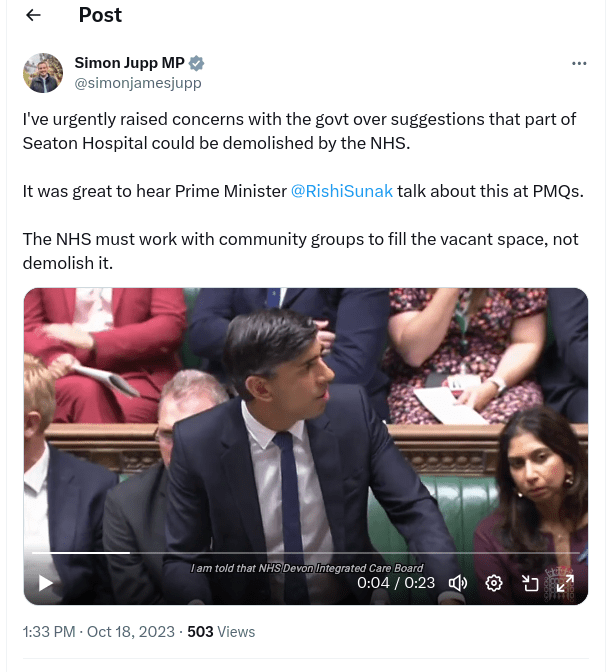
Richard Foord asked a question at PMQs yesterday about the threat to Seaton Hospital…. But Jittery Jupp had got there first! Sunak’s reply ludicrously commended Jupp’s ‘work’ on the issue!

Jupp then rushed to post a misleading video on social media of Sunak’s answer, which cut out Richard’s question!

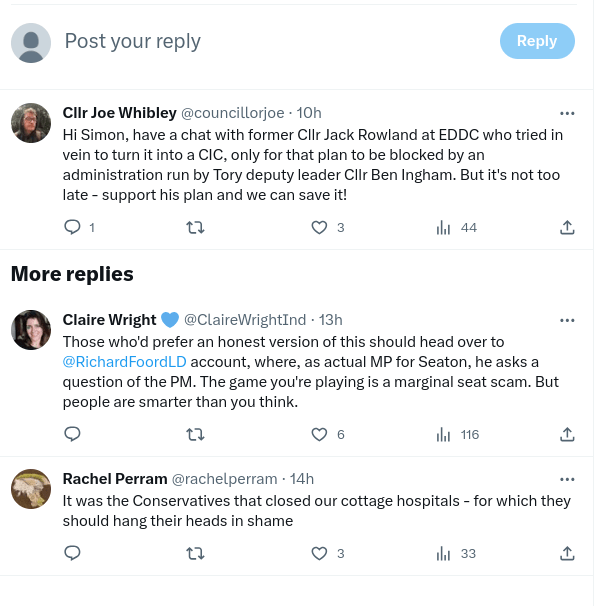
Jupp later deleted my comment on his Facebook page directing people to Richard’s post for an honest version.

The full PMQs excerpt of this ridiculous charade saw Jupp smirking and giggling as Sunak praised him for his non work for an issue that’s not in his constituency.

What shameless scam will he come up with next I wonder?

We will have to wait for the next instalment in the Jittery Jupp soap opera!

Hull set to allow ‘right to grow’ on unused council land in UK first

Hull is set to become the first city in Britain to give people a “right to grow” on unused council land.

Patrick Barkham www.theguardian.com

Community groups, charities and even small groups of neighbours would be able to cultivate fruit and vegetables on suitable council land in what campaigners say will provide healthy local food, boost mental health and revive neglected spaces.

Hull councillors unanimously passed the “right to grow” motion that means the council will produce a map of suitable land it owns and help those who want to grow food on it overcome practical obstacles such as insurance or provision of water for the plants.

The motion, which will first go before the council scrutiny committee, follows a burgeoning local and national campaign for a “right to grow” on neglected urban land.

The waiting list for allotments in England has risen by 81% over the past 12 years as more than 150,000 people seek a place to grow fresh food.

“It will benefit Hull in many ways,” said Gill Kennett, a local councillor who backed the motion, which received cross-party support. “We are a deprived city and we do need cheap food. In terms of mental health benefits, growing food gives people something to do, it gives them confidence, it ticks so many boxes.”

Incredible Edible, a grassroots network of more than 150 community growing groups, is calling for a national “right to grow” law obliging all local authorities to keep a register of land that could be used for growing, and which people could apply to.

Campaigners say councils can meet the growing demand for places to grow in urban areas by stripping away bureaucratic obstacles such as growers requiring public liability insurance, which could be provided under councils’ existing insurance. Even land earmarked for development that sometimes lies unused for years could be cultivated for one or two harvests.

Pru Elliott of Incredible Edible said: “We need to see a change of rules and a change in the way land is used. If communities are given a right to grow they will use it. We just need to get rid of the red tape. If Hull can bring this to life I hope it will be an example for councils around the country that it’s something really tangible that they can run with. It’s about letting go of control a bit and trusting communities.

“It’s producing healthy food, it’s benefiting mental health, it’s reducing crime and antisocial behaviour – we’re seeing that councillors in more deprived areas get it. They recognise all these extra benefits that come with something as simple as people growing food in the local community.”

The Create Streets thinktank, whose chair is an adviser to the levelling up secretary, Michael Gove, recently produced a report calling for a “right to grow” as part of a greening up of British cities.

In Hull, the motion came about after Hull Food Partnership – a collaboration between local people, businesses, charities and the council – devised “food hustings” at the local elections, where councillors discussed how Hull could address local food issues from food banks to “food deserts”.

Anna Route of Hull Food Partnership said: “Everyone should have the ability to access good quality locally produced food regardless of their background or income, and we want to remove as many barriers to feeding people well as possible.”

Darren Squires of Rooted in Hull, a social enterprise that grows food on former industrial land in Hull, said the benefits of growing food in urban spaces included providing fresh, healthy produce for food banks, boosting mental health, growing low-carbon food, and also providing wildlife-friendly green corridors in the city.

“People do want to grow but we don’t have the opportunity to unlock that land normally,” he said.

Squires said he hoped the motion would result in the council providing groups with public liability insurance under its own umbrella as well as practical help such as connecting up growers with sources of water for dry spells, whether harvested from nearby roofs or via mains pipes.

“I grow in a small yard and I can eat salad all summer and it costs me a few pounds rather than a few pounds every couple of days from the supermarket,” he added.

“There are some veg that no amount of money will get you the same quality as something you get when you pick and eat it the same day. You’ve not eaten French beans until you’ve eaten some you’ve grown.”

Business rates could rise by £1.95bn in ‘bleak picture’ for UK retail and hospitality

For Simon Jupp’s information: Business Rates are set by central Government.

Simon, readers will remember, claims that it’s East Devon that is killing off the high street. Not true! – Owl

Sarah Butler www.theguardian.com 

High street shops could see their business rates bill increase by up to £1.95bn next year because the rate charged is linked to inflation.

Hospitality industry leaders warned the expected rate rises would “undoubtedly be the final nail in the coffin” for many businesses which have already been squeezed by the rising costs of labour, energy and ingredients.

Helen Dickinson, head of the British Retail Consortium trade body, which represents most of the UK’s major chains, said the rise would “inevitably put renewed pressure on consumer prices” and called on the government to take steps to ease the expected increase.

Last month, bosses from major retailers including Tesco, M&S and Ikea called on the government to scrap the planned inflation-linked rise in next month’s autumn budget.

The September inflation figure is typically used to decide the annual increase in the property-based tax levied by local councils from businesses such as retailers, pubs and offices. On Wednesday, the Office for National Statistics revealed the inflation rate for September was 6.7%.

The data signals a £1.95bn jump for business rates in England, according to the real estate intelligence firm Altus Group. Property experts at Gerald Eve have predicted it will be closer to £1.7bn.

Kate Nicholls, the chief executive of UKHospitality, warned of a “bleak picture”. She said the trade body estimated the jump in tax bills paid by pubs, restaurants and hotels to be £234m, while an end to government relief schemes on rates could add a further £630m to costs.

“Almost a billion pounds in extra costs from business rates alone is unfathomable – and insurmountable – for many,” she said. “Such dramatic cost increases would undoubtedly be the final nail in the coffin for many businesses. It would be particularly perilous for small, independent businesses, for which ongoing relief measures are a lifeline at a challenging time.”

Alex Probyn, the global president of property tax at Altus Group, agreed there could be a “double whammy” on business rates if relief in place for small businesses and certain categories, such as music venues, were removed.

Simon Green, head of rates at Gerald Eve, said: “Clobbering high streets, retail parks, office blocks and logistics firms with these sky-high rises will create a significant blow to the economic recovery that everyone wants to see.”

Tories on backfoot over threat to Seaton Hospital

Longstanding readers will remember 2017, the year the local Tories ruthlessly started stripping out our Community Hospitals and the disgraceful part played by Sarah Randall -Johnson in particular.

Now Simon Jupp is trying to rewrite history in order to save his skin.

Below is the Hansard record of Richard Foord’s attempt to raise the matter in yesterday’s PMQs.

The prime Minister’s reply is a desperate attempt to deflect the question into a pathetic name check for Simon Jupp who has no official parliamentary standing to be representing Seaton. 

What does “providing a future sustainable use” actually mean?

It shows just how worried the Tories are of being wiped out in East Devon.

Richard Foord 

(Tiverton and Honiton) (LD)

Q3. On behalf of the Liberal Democrats, may I associate myself and my party with all the comments about the protection of innocent civilians today wherever they may be? A whole wing of Seaton Hospital in Devon is earmarked for demolition under this Government. The proposal to demolish this wing is an insult to the communities that raised millions of pounds to help fund the upkeep of services at that hospital. The space was given to NHS Property Services, but, thanks to the charging policy introduced by the Conservatives, that company is demanding £300,000 in rent. Will the Prime Minister let NHS Property Services hand over the space to health charities and community interest groups so that we can stop a wrecking ball going through Seaton Hospital? (906571)

The Prime Minister 

As the hon. Gentleman knows, decisions about hospital infrastructure are a matter for the NHS. I am told that Devon Integrated Care Board is working together with NHS Property Services and local community healthcare providers to establish a future sustainable use for the currently vacant space. May I also take the opportunity to commend the work that my hon. Friend the Member for East Devon (Simon Jupp) is doing on this topic?

And here is how Simon Jupp twists the reality on his twitter account. We are left to infer that it was him who asked the PMQ. His video clip, for example, doesn’t include Richard Foord asking the question.

Claire Wright calls the game he’s playing “a marginal seat scam”.

Owl’s message – Leopards don’t change their spots!

The video recording of PMQs can be found here. Richard Foord’s question starts at 24:30 mins. If you continue to the next question you can catch a short glimpse of Simon Jupp sitting at the back of the chamber looking very smug after being mentioned by the PM.

Unlike Transport, Housing & Communities Secretary gives Richard Foord a positive reply

Could that be because Michael Gove hasn’t got Simon Jupp writing his scripts for him?

A year ago Simon Jupp jumped on Liz Truss’ bandwagon and was rewarded by becoming PPS to right-winger Simon Clarke when she appointed him Secretary of State for Levelling-up, Housing and Communities. 

After Fizzy Lizzie’s defenestration, Rishi Sunak sacked Clarke and appointed Michael Gove to replace him. As PPSs are personal appointments by the minister, Simon Jupp was out on his ear as well. Gove didn’t re-appoint him.

This looks like the moment Jupp’s political career started to go downhill.

His subsequent appointment as PPS to Mark Harper at  Transport represents a significant demotion in the “pecking order” of ministries. 

Photo of Richard FoordRichard Foord Liberal Democrat Spokesperson (Defence)

Local authorities are struggling to retrofit ageing rural council housing stock, which has allowed mould to set in. What will the Minister do to avoid councils having to spend huge sums of council taxpayers’ money on positive input ventilation units to provide mould-free homes?

Photo of Michael GoveMichael Gove Secretary of State for Levelling Up, Housing and Communities, Minister for Intergovernmental Relations

The scourge of damp and mould, particularly but not exclusively in the social and private rented sector, is an issue that the Government recognise that we need to tackle. That is why we are providing additional support to local government and to housing associations in order to deal with that issue. I look forward in particular to dealing with the hon. Gentleman to assess the situation in Tiverton and Honiton.

Cullompton station funding – is this a “yes”, or..

Or is the Secretary of State for Transport playing Simon Jupp’s game of trivial point scoring? – Owl

Photo of Richard FoordRichard Foord Liberal Democrat Spokesperson (Defence)

I welcome sincerely the news of the Secretary of State’s support for Cullompton railway station. It is not new, given that my predecessor as MP for Tiverton and Honiton, Neil Parish, secured restoring your railway funding for Cullompton station two years ago. At that time, Neil said that

“construction could take place as early as 2024”; will the Secretary of State tell my constituents whether Cullompton station is still on track to open in this Parliament?

Photo of Mark HarperMark Harper The Secretary of State for Transport

It is very important, when projects are promised, that we have the funds to pay for them, and it is by cancelling the second phase of HS2 that we are able to fund that important project, which I am glad the hon. Gentleman welcomes. I do not think that the rail Minister and I, in the time we have been in post, have had any communication from the hon. Gentleman campaigning for the station, whereas my hon. Friend Simon Jupp has campaigned for it assiduously, as has my hon. Friend Rebecca Pow.

The voters deserve better than this.

IFS report highlighting £52bn stealth tax rise shows Tories have ‘crashed our economy’, says Labour 

Or as the Daily Mail has it:

The number of people paying higher-rate income taxes is set to more than double from 4.4 million to 9 million by 2027 under the government’s £52 billion stealth tax raid, analysis finds. www.dailymail.co.uk

Despite this colossal rise in the tax take the IFS says the government cannot afford to cut taxes in the autumn statement.

www.theguardian.com Politics Live

The Conservatives have fought every election at least since the 1980s as the party of low taxation. But, as the IFS report suggests, that is no longer plausible. It says that Rishi Sunak’s decision to freeze the income tax personal allowance at its 2021-22 level for four years in his March 2021 budget, and Jeremy Hunt’s decision last year to make that a six-year freeze, not a four-year freeze, is now set to raise £52bn by 2027-28 – the same as a 6p rise in basic rate and higher rate income tax. The IFS says:

“If we instead calculate revenue based on the latest inflation forecasts from the Bank of England (August 2023) and assuming that beyond 2026Q3 inflation remains at 2%, it looks like the freeze to both income tax and NICs thresholds is now on course to raise £52bn in 2027–28 (or £43bn if subtracting the cost of the increase in the point at which employees and the self-employed pay NICs)

This is a huge tax rise. To give a comparison, the biggest single tax-raising measure in recent history was the June 2010 budget decision to increase the main rate of VAT from 17½% to 20%, which is estimated to raise £21bn in 2027–28. Or, to put it another way, other ways to raise roughly £52 bn of revenue include increasing both the basic and higher rate of income tax by 6p, or increasing the main rate of VAT from 20% to 26%.”

Despite this colossal rise in the tax take (a consequence of what is known as “fiscal drag”), the IFS also says the government cannot afford to cut taxes in the autumn statement.

Labour says this shows the Tories have crashed the economy. Darren Jones, the shadow chief secretary to the Treasury, said:

“After 13 years of chaos and instability, the Conservatives have crashed our economy and left working people worse off.

Successive failures by Conservatives ministers have left us with low growth, high tax and national debt at the highest level in generations. Britain cannot afford another five more years of the Conservatives.”

And Sarah Olney, the Lib Dem Treasury spokesperson, said:

“This research lays bare the sheer scale of economic vandalism by the Conservative party.

Ministers have condemned the UK to sluggish growth, high inflation and soaring interest rates. It is hard-working families who are left to pick up the pieces, shouldering a huge burden of unfair tax rises and seeing our public services on their knees.”

Outrageous proposal to demolish part of Seaton Hospital – Martin Shaw

Seatonmatters.org

www.midweekherald.co.uk/news/23859905.wing-seaton-hospital-demolished-save-nhs-money/

When the Conservatives allowed the removal of Seaton Hospital’s beds to go ahead in 2017, it looked as though the next step was the complete closure of the hospital, which the government was giving incentives for at the time. The resolute community opposition to the whole scheme derailed this plan. Now it’s back in a new form – the partial demolition of the hospital.

The League of Friends, Re:store, Richard Foord MP and Paul Arnott, Leader of EDDC, are already on the case. But the local community will need to act. The NHS managers we fought last time have obviously moved on and the new ones don’t know what the Seaton community is made of. They’re in for a big surprise. I’ve spent some of my ‘retirement’ researching the history of protest movements and I now know a lot about direct action. If the NHS has any sense they’ll drop this idea pronto.

A wing of Seaton hospital could be demolished to save NHS money

Two Seaton charities and Honiton MP Richard Foord have raised concerns over plans to demolish a large part of Seaton Community Hospital.

Adam Manning www.midweekherald.co.uk

Seaton & District Hospital League of Friends and Re:store are instead calling for the space to be repurposed as a new ‘care hub’ to support local people. 

The cottage hospital opened in 1988 to serve Seaton and the surrounding areas. In that time, fundraising by the community has raised more than £1 million pounds to build, maintain and support the facility. 

Proposals from the Devon Integrated Care Board (ICB), include demolishing the whole wing of the hospital to reduce the cost of maintaining the facilities. The space is currently rented by the Devon ICB from NHS Property Services. The wing, set across two floors, has gone largely unused since 2017, when the hospital saw the removal of several wards and beds. The level of care available at the hospital site was then reduced. However, several offices across the second floor are home to the palliative nurse team and other teams. 

Seaton & District Hospital League of Friends and Re:store has now joined with MP Richard Foord to propose the disused hospital wing is used for a new ‘care hub’, which would offer a wide range of services. 

The space used to increase support for people affected by dementia and frailty – including their families. It would be used to provide the very best care at the end of life, and it would offer bereavement support. There is also scope to develop the space for exercise and groups that promote physical and mental wellbeing. To make these plans viable, they are urging NHS Property Services to classify the space as non-clinical and review the rental arrangement for community groups and local charities. 

This would enable savings for the NHS and could potentially reduce the cost to other parts of the NHS, as local charities would use the hospital to work for our communities. The charities believe that Seaton Hospital is the ideal space to run these services, as it currently has an unoccupied wing adjacent to the NHS outpatient and therapy departments. By bringing these services under one roof, they believe there will be opportunities for individuals to access multiple relevant services, without difficult, costly travel.  

Liberal Democrat MP Richard Foord said: “Seaton Community Hospital is a much-loved community asset. Local people are passionate about protecting their hospital and keeping services local, with organisations like the League of Friends and others having helped to raise huge sums of money to support the hospital. 

“We’ve seen in recent years the damage that can be caused when vital healthcare facilities like this are scaled back; it can leave people struggling to get the care they need and puts extra pressure on staff working at the RD&E or out in the community, as people have nowhere else to turn. 

“Seeking to demolish a large part of the hospital’s current premises feels like a step towards getting rid of some of our community hospitals altogether. It’s a short-sighted move that fails to take into account the huge benefit that could be delivered if the space was repurposed for the benefit of the community. 

“I fully support the plans to revive the space and turn it into a new ‘care hub’ to offer a new range of specialist services to support our ageing population and ensure the long-term future of the hospital as a whole is protected. 

“I shall be writing to NHS Property Services about this situation, to see if we can come to an arrangement that will enable these innovative plans to go ahead. I urge the local community and voluntary groups to get involved and help develop this new vision for care in Seaton.” 

Dr Mark Welland, chair of trustees for Seaton & District Hospital League of Friends, said:  “Proposals to demolish a whole wing of Seaton Hospital are deeply concerning. Seen from a distance it could be seen as financially sensible to demolish an unused hospital wing in order to reduce the cost of maintaining the space. However, seen from the local level it clearly is nonsense to destroy a local asset and weaken access to care for an ageing population.  

“The current arrangement, which sees Devon’s Integrated Care Board rent the space from the NHS, simply doesn’t work for rural areas like ours. It is the product of an NHS business model designed for the large scale, but which has become a barrier at the small scale to providing services responsive to local community needs.  

“Local charities and organisations are already demonstrating their ability to work alongside the NHS to enhance local services. Examples in Seaton are the work of Re:store in providing mental health support, balance classes, and the League of Friends commissioning nursing support at the end of life.  

“We are now asking NHS property services to change the rental arrangement and recognise the wider cost savings that our services will provide, by enabling local charities to use the full potential of Seaton Hospital to work for our community.”

NHS hospital beds down by 3,000 despite government’s winter pledge

The number of hospital beds in England has fallen by almost 3,000 since ministers promised 5,000 before winter, prompting warnings that patients are being “warehoused” in emergency departments.

Kat Lay www.thetimes.co.uk 

Nurses are run ragged dealing with the equivalent of a full ward of patients waiting in casualty departments due to a lack of beds , and patients are receiving “less good care, in the wrong place”, the UK’s top A&E doctor said.

Emergency medicine leaders have said they feel let down by a lack of progress since the prime minister and health secretary joined NHS chiefs in January to announce a “recovery plan” for urgent and emergency care, promising “5,000 more staffed, sustainable beds in 2023-24”.

Analysis of NHS England data by the Royal College of Emergency Medicine (RCEM) showed that between January and September, bed numbers in major acute hospitals fell from 100,046 to 97,332.

Announcing the target at the start of the year Rishi Sunak said: “Our plan will cut long waiting times by increasing the number of ambulances, staff and beds — stopping the bottlenecks outside A&E and making sure patients are seen and discharged quickly.”

NHS England said the baseline for its promise was the 94,500 core hospital beds it had planned to have available last winter, before pressures led to the opening of extra escalation beds across the country. It is still aiming to have 99,500 core beds by winter.

Adrian Boyle, president of the RCEM, said a lack of beds meant “patients who need to be admitted end up stuck in the emergency department”.

He said: “Most emergency departments are lodging or warehousing the equivalent of three quarters and a full medical ward inside the emergency department, while trying to look after all the new arrivals.”

He said emergency department nurses were not trained to provide the kind of inpatient and continuing care that those patients needed. He said: “People are getting less good care, in the wrong place.”

Boyle said the college was disappointed with the lack of progress, which he feared was driven by financial concerns and budget deficits in many areas.

It was unconscionable that hospitals where patients are being warehoused were closing beds, he said. “We feel we supported the urgent and emergency care recovery plan in good faith — and we feel let down.”

Officials said core beds are always lower in September than over winter and increase as pressures rise.

The number of core beds reported last month was 95,171, with a further 2,161 “escalation beds” — a total of 97,332, 93 per cent, of which were occupied. Last September there were 96,668 core beds, with 94 per cent full.

While the NHS can increase the number of beds quite quickly when needed, this often resulted in “providing not very good care in less than ideal clinical areas”, Boyle said. “The fact that people have had six months to build that capacity but appear not to have [done so] is cause for concern.”

The college had suggested 5,000 beds would not be enough to reduce capacity down to a safe, 85 per cent, operating level. It wants political parties to commit themselves to increasing the number of hospital beds in manifestos for the next election.

Siva Anandaciva, chief analyst at the King’s Fund, said: “The UK has fewer hospital beds per person than many comparable countries and this is a key reason for why the NHS comes under serious pressure every year and waiting times for patients reach eye-watering levels.”

A lack of beds has ripple effects through the rest of the system, he said, meaning A&E departments filled up with patients who needed admission and ambulances could not transfer patients into A&E and get back on the road.

He warned: “Hospitals can only open more physical or virtual beds if they have the clinically trained staff to run them. And due to a combination of staffing shortages that are only now being slowly reversed and industrial action on an unprecedented scale, the NHS is heading into winter with bed occupancy levels that are far higher than they should be to ensure timely care for patients.” The NHS has hit a target of opening 10,000 beds on virtual wards before winter. Virtual wards allow patients to be treated at home using technology such as apps and wearables to let clinical staff monitor the patient’s recovery.

An NHS spokeswoman said: “We know that the NHS is already under considerable pressure as we head into winter with continuing high demand for services and the impact of industrial action, but thanks to the hard work of staff and the measures outlined in our urgent and emergency care recovery plan there are hundreds more hospital beds open now compared to this time last year.

“Our focus has been on ensuring the NHS is more resilient coming into winter with more beds available on a regular basis, and work continues towards delivering our recovery plan commitment of 99,500 core beds to help manage pressures, boost capacity and to provide the best quality care for patients.”

Planning applications validated in EDDC for week beginning 2 October

Exeter council owed £10m by its property developer

Exeter City Council has found itself at the centre of huge scrutiny and facing financial losses of more than £10 million due to the significant delivery failings of its subsidiary property development company Exeter City Living (ECL). The profit-for-purpose limited company was set up in June 2018 to ‘transform the lives of others through innovative and sustainable building and development’.

Anita Merritt www.devonlive.com

An independent review of its operation was commissioned by the council in April following the failure of ECL to secure a contract for the development of the Clifton Mews site – formerly Clifton Hill leisure centre – and the continued uncertainty around the development said to be due to the ‘difficult current economic climate’. It was also initiated due to concerns relating to the financial position of ECL and its continued ability to repay its loans to the council.

It owes the council more than £10 million against loans intended to deliver hundreds of new homes on sites in Exeter. ECL is said to have made cumulative losses of more than £4.5 million and without intervention from the council, it would be insolvent.

The council’s finances are already under strain having had to cut another £5 million from its latest budget. At an executive meeting of the council earlier this month, it was agreed to recommend to wind down the operations of ECL. The matter will now go before the full council tomorrow, October 17.

It means the council will acquire all of ECL’s assets – with the exception of the six leasehold flats in the Guildhall Shopping Centre – and any work in progress by releasing the company from its loan obligations, leaving it to settle the company’s loan liabilities when its creditors are repaid.

A spokesperson for Exeter City Council said: “The report will now go before council tomorrow night [October 17], where councillors will have an opportunity to decide whether to back the recommendations. We would not therefore want to comment before that decision is made.”

The council has approved loans with a value of nearly £25 million to ECL and, to date, ECL has borrowed nearly £11 million from the council. It has around £10 million in debts outstanding. Based on the company’s latest accounts, it has work in progress totalling £4 million cash in the bank stands at around £1.8 million which could be subject to change.

If councillors agree to a managed reduction in the size and type of activity of ECL as recommended, then the council will be required to write off any remaining outstanding element of the loan.

Regarding the impact of this, the report, written by the council’s new chief executive, Bindu Arjoon, states: “In respect of any write off in respect of the loan, there will be no immediate impact on the council taxpayer, other than for the council to make repayments in lieu of the loan repayments from the company. However, as there is no longer an asset associated with this debt, the council will need to make arrangements to repay the debt as soon as is practicable.

“The options for this are to sell assets to generate capital receipts or to set aside revenue resources. Depending on the value of debt outstanding, it is likely that the sale of an asset (or assets) will be required.”

The council’s controversial decisions are said to have included a loan to the company of up to £44 million to finance construction and also spend £46.3 million buying the resulting housing, underwriting the company at both ends after failing to change course when new local government borrowing rules rendered the company redundant just 10 weeks after it was set up.

The report to the council’s executive, debated on October 3, states within its recommendations: “In the likely event that the value of the assets to be acquired from ECL is insufficient to repay the loan to the council, then delegated authority be granted to the chief executive, in consultation with the leader and section 151 officer, to write off any shortfall. Thereafter, ECL, in a much-reduced capacity shall continue for the purpose of holding and managing property and in particular the six Guildhall flats.”

It added it was too early to know what impact it will have on the staff at ECL, and that work will be done to identify if those staff can be redeployed elsewhere in the council.

Giving further insight into the financial impact on the council, the section 151 officer said: “The objectives and intentions of ECL were ambitious and in line with aspirations. The challenging environment caused by external factors has meant that a reduction in the capacity of the company is financially prudent at this time.

“It is important that the council has regard to the future management of the flats located within the Guildhall Shopping Centre. At this stage, it is not envisaged that the debt will require the sale of any assets that were not already earmarked for redevelopment.”

The monitoring officer added: “ECL was set up with the very best of intentions but as a commercial venture, it was susceptible to market forces which have had a significant, negative impact on its viability for the reasons set out in this report.”

The reasons stated include the global pandemic, the invasion of Ukraine, significant rises in interest rates, and prolonged uncertainty surrounding Brexit.

ECL is described as a housing delivery vehicle that was set up five years ago as a wholly-owned subsidiary of Exeter City Group (ECG). Its aim was to provide much-needed housing in the city to help tackle the housing crisis.

The idea was the company would also generate an income stream for the council at the same time as unlocking sites that other developers were unable to. Since it was founded, ECL has so far completed three sites – Anthony Road, Thornpark Rise (Hockings Green) and Bovemoors Lane – providing 22 homes.

It has two developments under construction. A scheme of 21 new Passivhaus apartments at Hamlin Gardens is due for completion in March 2024. The second is 35 new Passivhaus affordable apartments at The Gardens Whipton, Vaughan Road, which is the first phase of 91 new homes due for completion in December 2024.

A further site to provide 41 homes at Clifton Hill is cleared and ready to start construction when ‘economic conditions improve’.

ECL has been approached for a comment.

Projects taken on by ECL as reported in the independent review issued in August 2023:

Vaughan Road

Former tower block site (now cleared) held within the HRA located within a wider estate regeneration area. Being delivered in three phases to enable mid-sized contractors to tender for the phase scheme. Considering densification of site via later phase development which would replace older bungalows. Looking to bid into BRLF. Will deliver 80-120 houses on vacant site.

Contractor secured for first phase and development is progressing. ECL plans to include phases 2 and 3 within the current work package, which is subject to full council approval. All phases are due to complete by December 2024.

Clifton Hill

Site of former leisure centre with planning permission for 42 units. It has been described as a ‘challenging site’ with level changes impacting on development costs. Following a failed procurement and contractor supply chain issues, the site has been put to a separate contractor to examine alternative design/ engineering solutions and identify associated cost savings, including simplified unit types.

The council’s report says it is a ‘stalled site’ and delivering a viable scheme may remain a challenge in the absence of gap funding.

Mary Arches Car Park

This site is allocated in LocalPlan. BLRF bid is submitted and proposals are currently at RIBA Stage 1/feasibility stage. Development would contribute to Liveable Exeter ambitions. There are two halves to the scheme proposals. Phase 1 relates the MSCP site with a concept plan for 100 build to rent homes to be held by either ECL or PropCo.

The scheme requires the securing of vacant possession of two ground floor units, however, in relation to one unit, there is the potential need to affect powers which, if required, will impact on the timing of delivery and will incur additional costs. BLRF has been secured for the demolition works and in line with funding conditions the development will need to start/or land transferred by March 31, 2024.

Archaeological digs will be required which is a potential risk to this subsequent phase of development in terms of delays and costs. ECL propose they negotiate disposal with the city surveyor and then pay Best Consideration when the option is exercised. (determined via an independent valuation). This is to preserve BLRF funding.

Exeter Canal Basin

Exeter Canal Basin is held within the General Fund. ECL is in the process of assembling scheme proposals with a view to submit for planning in June 2023. Capacity for 37 units including four duplexes and apartments (3 and 4 storey). ECL is to provide the results of their options analysis to inform ECC decision-making. Aspirations are for the scheme to retain the Exeter Watersports centre and contribute towards net-zero targets.

Viability is a potential risk and is to be determined in conjunction with the options analysis and a land value/ land receipt confirmed. There are issues related to securing vacant possession of existing buildings.

Bonhay Meadow

Bonhay Meadow is held in the General Fund. This is an area of open space which is owned. Set in Liveable Exeter Strategy this area is seen as a significant regeneration area.

Proposals are paused. We are advised that this is a sensitive site, due to some resistance development from planning and political sensitivities regarding building on open space.

There are also some concerns which have been flagged from the Environment Agency .BLRF has been secured but is at risk with transfer of land or start on site by March 31, 2024 a funding requirement. ECL proposing land be transferred to ECL and leased back to ECC to protect the BLRF. However, this is a risky strategy as it is possible that the site remains undeliverable in view of the issues highlighted.

Cathedral & Quay Car Park

The site is held in the General Fund. Council car park with structural issues. Need to look at the options for delivering this site. Workstage 2 end of this month. Capacity for 31 units. Potential for off-site affordable housing and 100% market sale onsite.

Project has been paused. Key risks associated with development include: £2m BRLF which is at risk. Need to transfer land or start on site by March 31.

Belle Isle Depot

Site in council ownership (still operational depot). Site has capacity for 32 units, and is intended to deliver family homes/apartments for sale, to a Passivhaus or Net Zero standard, and improve the national cycle route experience.

Alternative premises for the depot, and vacant possession of the existing depot which remains operational, and development viability. Significant contamination is likely.

Glasshouse Lane

This site is in third-party ownership. Open space/park situated within a council estate area. Restrictive covenant associated with use as Church. Review of open space – planners indicate this is not needed. Capacity for 24 affordable units.

Map shows Devon’s rising Covid cases

Daniel Clark www.devonlive.com 

The number of Covid cases in England and Wales has started to fall after an initial rise at the start of Autumn – but numbers are still rising in Devon.

[The Zoe study that continues to track symptoms, and which has proved reliable throughout the pandemic, is not yet showing a downturn – Owl]

There were a total of 15,797 new cases of the disease in England in the week leading up to October 7, according to the latest government figures. It’s the equivalent of 27.9 new cases for every 100,000 people in the country. That’s down from 16,186 cases, or 28.6 for every 100,000 at the same point a week earlier, on September 30.

In Devon the latest Covid rates are at 32.3 per 100,000, which is up four per cent week on week. In Torbay they are at 40.4 per 100,000, which is just outside the top 10 nationwide for upper tier authority areas, but that is down 16 per cent week on week.

Babbacombe & Plainmoor is the area of Devon with the highest Covid rates of 107.4 per 100,000. That equates to six positive cases in the seven day period ending October 7. Tavistock, with ten, was the only area of Devon to record double figure number of cases.

Below is the list of latest Covid rates and cases for East Devon and Exeter (full list in devonlive article). If the area is not mentioned, it recorded fewer than three cases.

(Covid rates shown in last two columns are: rolling rate of cases per 100,000 and cases in the last seven days)

East DevonSeaton79.36
East DevonAxminster63.16
East DevonHoniton North & East66.44
East DevonClyst, Exton & Lympstone584
East DevonExmouth Withycombe Raleigh54.24
East DevonExmouth Halsdon42.93
East DevonExmouth Littleham39.43
East DevonOttery St Mary & West Hill32.83
ExeterHeavitree East & Whipton South79.66
ExeterPinhoe & Whipton North52.15
ExeterCentral Exeter39.55
ExeterWonford & St Loye’s47.84
ExeterSt Thomas West41.63
ExeterHeavitree West & Polsloe34.73

Another one bites the dust -Owl

Tory MP Peter Bone ‘exposed himself to staff member and trapped him in hotel bathroom’

Tory MP Peter Bone could be banned from parliament for six weeks after he was found to have indecently exposed himself to a staff member and trapped him in the bathroom of a hotel room.

Archie Mitchell www.independent.co.uk 

The parliamentary commissioner for standards upheld five allegations of bullying and one of sexual misconduct against the Wellingborough and Rushden MP. The recommended six-week suspension for Mr Bone would trigger a recall petition if approved by parliament, creating a fresh by-election headache for Rishi Sunak.

Mr Bone was found by parliament’s Independent Expert Panel (IEP), which rules on complaints against MPs, to have “committed many varied acts of bullying and one act of sexual misconduct” against a member of his staff in 2012 and 2013.

The MP, elected in 2005, was found to have engaged in “violence, shouting and swearing, mocking, belittling and humiliating behaviour, and ostracism”.

In its report, the standards commissioner found Mr Bone had:

  • Indecently exposed himself to the complainant on an overseas trip, initially in the bathroom of the hotel room they were sharing and then in the bedroom
  • “Verbally belittled, ridiculed, abused and humiliated” the complainant
  • “Repeatedly physically struck and threw things at” the complainant
  • “Imposed an unwanted and humiliating ritual on” the complainant, including instructing, or physically forcing, the complainant to put his hands in his lap when Mr Bone was unhappy with him or his work
  • “Repeatedly pressurised [the complainant] to give him a massage in the office” 

The “willful pattern of bullying also included an unwanted incident of sexual misconduct”, in which Mr Bone indecently exposed himself to a staff member in a hotel in Madrid.

The report detailed how Mr Bone booked a single hotel room for himself and the complainant during a work trip in Spain, which one staffer told The Independent is extremely unusual.

Mr Bone then became angry when the complainant separated the two single beds in the room before engineering a situation in which the complainant was “confronted by his penis at very close quarters”, the report said.

In a statement posted on Twitter/X, Mr Bone said the allegations were “false” and “without foundation”, adding: “None of the misconduct allegations against me ever took place.”

Mr Bone indicated he would fight the suspension, saying it has been “an honour” to represent his constituents and “I will continue to represent them to the best of my ability.”

He accused the parliamentary watchdog’s investigation of being “flawed and procedurally unfair”. “I am currently in discussion with lawyers what action could and should be taken,” he added.

Mr Bone’s complainant first complained about the MP’s behaviour to the Conservative Party in 2017, but it was unresolved and parliament’s watchdog began investigating five years later.

The complainant felt that he had to leave his job as “a broken shell” and give up a career in politics entirely. The report said there had been a “long-lasting negative impact on his life”, adding that he has suffered continuing anxiety and required treatment for his health.

The Liberal Democrats called for Mr Sunak to withdraw the Conservative whip from Mr Bone.

Lib Dem chief whip Wendy Chamberlain said Britain deserves better than “endless Conservative Party sleaze and scandal”.

She added: “Rishi Sunak needs to remove the whip from Peter Bone and call on him to resign. There is no place anywhere in our society for this kind of sexual harassment and bullying.”

The recommended six-week suspension for Mr Bone would trigger a recall petition if approved by parliament.

It would set up the latest in a series of testing by-elections for Mr Sunak in safe Conservative seats, with the party lagging Labour in the polls.

Mr Bone has an 18,540 majority in the seat, smaller than that overturned by Labour MP Keir Mather in Selby and Ainsty in July.

His recommended suspension comes days before Mr Sunak faces key by-elections in Mid Bedfordshire and Tamworth – with voters able to give their verdict on the government’s performance.

Mid-Bedfordshire is Nadine Dorries’s former seat, which she quit in protest at being left off of Boris Johnson’s resignation honours list.

Tamworth’s by-election was forced by the suspension of Chris Pincher, who was found to have drunkenly groped two men at a private members’ club last year.

Labour is the second biggest party in Mr Bone’s Wellingborough seat and, with an 18-point lead in the polls, could threaten to turn the constituency red for the first time since Tony Blair’s 1997 landslide.

In July, Labour celebrated its largest-ever by-election win in Selby and Ainsty, with a 23-point swing away from the Tories. On the same day, the Liberal Democrats won a huge victory in Somerset, toppling the Tory safe seat of Somerton and Frome.

As Britain’s town hall services crumble, the case for reform is overwhelming

The latest local authority to discover it has a ‘Millstone of debt’ from risky investments is Camberley in the backyard of Michael Gove’s Surrey Heath patch.

The Lib Dems took over this poisoned chalice from the Tories last May.

The empty House of Fraser building and the shopping centre were bought by the council for a combined total of £113m in 2016. Funding was tight and the purchase, paid for by borrowing, seemed a way of regenerating the town centre and producing an income stream.

Seven years on, with high streets across the UK struggling, compounded by the Covid pandemic, the two sites are thought to be worth £33m – 70% less than the purchase price – while rising interest rates mean the cost of servicing the council’s debts has increased.

The quirks of local authority financing mean properties remain on the council’s balance sheet at their original value – but if they were sold at a loss, the authority would have to set aside enough reserves to cover the gap.

As Britain’s town hall services crumble, the case for reform is overwhelming

Richard Partington www.theguardian.com 

In most of Britain’s towns there are buildings hinting at a more prosperous past. Vast stone public libraries, swimming baths and theatres; all encircling the grand town halls that once controlled them. Many are long shut, converted or owned by someone else. But the symbolism remains – local government used to do stuff.

Today, England’s councils are in the worst crisis since the foundation stones of these municipal palaces were laid.

Birmingham, the largest local authority in Europe, is the tip of the iceberg in its effective bankruptcy. Croydon, Northamptonshire, Slough, Thurrock and Woking have all gone bust. Dozens more are perilously close – from “red wall” Stoke-on-Trent to the blue-blooded Royal Borough of Windsor and Maidenhead.

As the Conservatives hold their annual conference in Manchester this week, the collapse of the English system of local government ought to worry Tory MPs far more than HS2, taxes or the rights of motorists to drive faster than 20mph.

In the backyards of current and former cabinet ministers, in important target seats, and across the country at large, a wave of local austerity is coming.

“I often quote it, and misquote it – but the phrase here is Denis Healey’s ‘the sky is darkening with the wings of chickens coming home to roost’,” says Tony Travers, a professor of local government at the London School of Economics.

“Had the government wanted to go out of its way, back in 2010, to ensure nearly 15 years later that people were absolutely aware of how austerity was being delivered, they couldn’t have gone about it in a better way than this.”

England’s councils are facing a collective multibillion-pound black hole in their finances, up to £3.5bn on one estimate, as the impact from an almost 60% cut in central government funding since 2010 collides with stubbornly high inflation and pressure on services from an ageing population.

The result will be yet deeper cuts to public services, council tax rises and ever higher fees for parking and other council charges. Already since 2010 there have been £15bn worth of public assets flogged to help plug holes in council budgets.

But, where there is anything left to cut, close, privatise or pass into charity hands, get ready for that too. Just ask people in Woking and Kirklees, where plans announced in recent weeks include the closure of swimming pools, care homes, sports facilities, public toilets and community schemes.

For Birmingham the tragedy is most pronounced, as the cradle of modern local government – where Joseph Chamberlain put into action the “Civic Gospel” of improvement that helped define the Victorian age.

As the city’s Liberal mayor, he pioneered the building of municipal swimming pools and schools, and used corporation funds to buy the town’s gas and waterworks.

After Birmingham’s financial implosion, Rishi Sunak sought to pin blame on the council’s Labour leadership. The local party isn’t without fault, to say the least. But context also matters: for every Labour-run authority in dire straits, there is at least another Tory or Liberal Democrat one in a similar predicament.

Michael Gove, who as levelling up secretary is in charge of local government, should know better than most. Surrey Heath borough council, in his constituency, is close to effective bankruptcy, while six of its near-neighbours were on a Moody’s watchlist published earlier this month.

The mess in this leafy London commuter belt should have more Tories worried. The party dominates here in parliamentary elections, but several councils have fallen from its control after racking up vast debts – including Spelthorne, in former chancellor’s Kwasi Kwarteng’s seat, and Windsor and Maidenhead, in Theresa May’s.

The wider economic context matters, too. To offset austerity-era cuts, many councils took on their debts while borrowing was cheap in the period of low interest rates after the 2008 financial crisis. The money went into schemes to generate financial returns to plug gaping budget shortfalls, or into town centre regeneration. Projects meeting both criteria were prized most.

However, they were often on to a losing bet. Town centres have been drained of life in recent years by the rise of online shopping, as well as benefit cuts and sluggish wage growth sapping consumer spending power. The Covid pandemic then turbocharged these trends, leaving any council that had been acting as a buyer of last resort in a deeper mess.

Even for authorities that steered clear of the property market, the cost of providing services has ballooned as Britain grapples with the highest inflation in the G7, while the cost of living crisis leads more households to need their help. Deep divisions in economic prosperity between Britain’s richest and poorest areas also make it a tougher crisis to fix.

Urgent solutions are clearly required. Aiming to plot a way forward, a forthcoming report from the Fabian Society thinktank recommends greater devolution of tax and spending powers to local communities. It’s a tough sell when so many councils are going bust. But it is not without merit.

England is one of the most centralised nations of its size in the developed world, with central government involved in almost every aspect of how councils operate. As much as 95p in every £1 of tax raised goes to the Treasury, which then decides on how best to reallocate money to local areas – often grudgingly.

Greater devolution could help sidestep the postcode lotteries and council bidding wars witnessed with Boris Johnson’s centralised pots of levelling up money, which were often spent on pork barrel schemes in Tory target seats anyway.

However, any increase in local power will require serious efforts to bolster local governance structures to prevent future town hall financial scandals.

The case for reform is overwhelming. Voters will not thank any party, locally or in national government, for the steady demise of the most visible aspects of the public realm: town centres, public buildings, parks, streets and services. It’s about time local government did stuff once again.