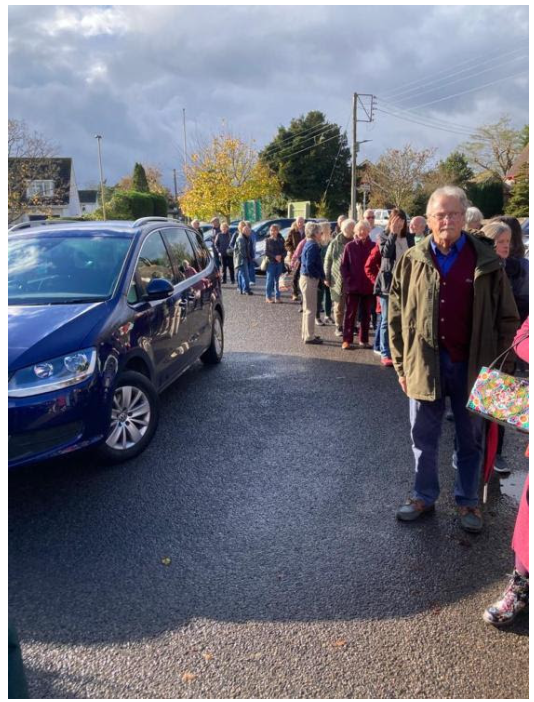
Help design Cranbrook’s new town centre and you could win £50!

Local people can share their ideas on how Cranbrook’s new town centre should look. eastdevon.gov.uk

By answering a short survey at eastdevon.gov.uk/cranbrook-town-centre before 10th November 2023, you could be in with a chance of winning a £50 voucher.

Cllr Paul Arnott, Leader of East Devon District Council and Chair of the Exeter and East Devon Enterprise Zone, said:

“This is an important opportunity for you to help shape the future of Cranbrook. Your ideas really matter. We want to hear from as many people as possible – especially young people and those who don’t normally get involved.

“Legal agreements are being put in place which mean developers will contribute millions of pounds towards facilities and spaces in the town centre, like a library and leisure centre.

“We want your ideas to help decide what else should be included, what should be built first and where it should be built. Your views and ideas will then be used by EDDC and its partners to create a long-term town centre masterplan in summer 2024.”

To discuss in more detail, please come along to drop-in sessions. The first one takes place at the free Family Fun Day on 24th October, 10.30am – 1.30pm at Cranbrook’s Younghayes Centre, where there will be refreshments and children can have fun on a bouncy castle or get creative in THG’s Creative Cabin . You can also share your ideas on 9th November from 4-7pm at the Younghayes Centre or on 16th November at the Cranberry Farm pub from 6-8pm. 

Keep an eye on these websites for events and other ways to get involved:

facebook.com/ex5alivehub

eedez.com/cranbrook

Cranbrook town centre is one of the sites in Exeter and East Devon Enterprise Zone. The first shops, the beginning of a town square and a Morrisons supermarket are being built and should be finished in Spring 2024. East Devon District Council (EDDC) has recently bought 3.85 acres of land next to the supermarket and will receive more from the developers shortly. This will make it easier to agree what happens next and start the next phase of the town centre development.

There is a lot of work to do before more facilities are built in the town centre. When the consultation closes, the responses will be analysed and the information used to help draw up a town centre masterplan. The masterplan will show how the town centre will be laid out and what kind of place it will be. There are already commitments from Devon County Council to build a youth centre, children’s centre and library. Cranbrook Town Council is aiming to develop a community building which will also house the town council offices. A leisure centre is included in the EDDC Leisure Strategy and there are plans for a Health and Wellbeing Hub and a Fire Station. More needs to be done to finalise how each of these buildings will happen. In challenging financial times, this includes finding the full amount of money to build them as the developers will not fully fund everything. EDDC is committed to working with its partners to realise the ambitions for a 21st century town centre for Cranbrook that meets the needs of the people who live, work and visit it.

The entire cost of the ‘redundant’ hospital wing was raised by the Seaton public

Martin Shaw seatonmatters.org /

I’ve gone back to Mary Wood’s splendid booklet on the history of Seaton Hospital (1991). While the original hospital opened in 1988 was paid for £1 to £1 by the League of Friends’ fundraising and the NHS, the ‘whole cost’ of the wing which the ICB now wants to declare redundant – potentially to demolish – was met by the League. The NHS only had to pay the running costs when it opened in 1990.

This makes it all the more outrageous that Seaton Hospital was placed in the ownership of NHS Property Services in 2016, and they could now bulldoze it. Morally the hospital, especially this wing, belongs to the community in Seaton, Colyton, Colyford, Beer, Axmouth and surrounding villages who raised the money to build it in the first place. The ICB, having shamefully failed to make proper use of it, should now hand it back free of charge.

Thanks to Ted Gosling, curator of Seaton Museum and the town’s only Freeman, who gave me this booklet back in 2017.

Jitter time for Jupp

By-election disaster shows no seat is safe for the Tories as Keir Starmer gets closer to No 10 Inews.co.uk

John Curtice: No silver lining for Tories in by-election drubbings www.thetimes.co.uk

‘Architects of disaster’: Boris and Truss accused of destroying Tories www.independent.co.uk

Simon has made no secret of his support for the right wing of the party.

Watch: Tory candidate bolts from Tamworth by-election while winner gives victory speech www.telegraph.co.uk

[Didn’t Helen Hurford do something like this at theTiverton & Hontion by-election count when Richard Foord overturned a long standing Tory majority?]

Campaign to save Seaton Hospital wing demolition

Efforts are ramping up to save part of Seaton Hospital at risk of being demolished.

Campaigners are pushing for the two-storey wing at the community hospital to be repurposed as a care hub, which would include support for patients with dementia, as well as palliative care and bereavement support.

Bradley Gerrard, local democracy reporter www.radioexe.co.uk

MP Richard Foord (Lib Dem, Tiverton & Honiton) raised the issue at prime minister’s questions in parliament on Wednesday, and has written to health secretary Steve Barclay to request an urgent meeting.

“The proposal to demolish this wing is an insult to the community that raised millions of pounds to help fund the upkeep of services at that hospital,” he told MPs in the house of commons.

His letter to Mr Barclay, he said Seaton & District Hospital League of Friends has raised £2 million in recent years to support the hospital, adding that the demolition of the wing could “threaten the long-term viability of the hospital as a whole.”

And East Devon District Council leader Paul Arnott (Lib Dem, Coly Valley) told the authority’s council meeting this week that he understood the seriousness of the situation.

“We have already started having internal meetings about what the possibilities may be, and we will explore those as urgently as possible,” he said.

“My personal view is that this is the havoc caused when too many agencies are involved, and we as East Devon need to show leadership here as we are the closest tier of local government that can do something about it.”

The hospital wing has been largely unused since 2017. However, some services remain based there, including offices for palliative care nurses and other teams, with parts of it also used during the covid pandemic.

The space is currently rented by the Devon Integrated Care Board (ICB) from NHS Property Services, a government-owned company.

A spokesperson for NHS Devon said the site costs about £300,000 a year in rent and other charges.

“This is poor use of taxpayers’ money at a time when we are forecasting another budget deficit of more than £40 million this year,” the spokesperson said.

“In recent months, we have been talking to local health, care and community partners to see if they are interested and financially able to take on the space, but no viable schemes have been received and we started the process of handing the ward space back to NHS Property Services (NHSPS) so we can save the money that is currently being wasted on it.

“We have always been very happy to talk to prospective occupants of the space if they have a financially viable scheme to take it on – and we remain so.”

A spokesperson for Mr Foord said the MP had a meeting planned with the chair of NHS Devon on Friday (20 October) to further discuss the proposals.

Campaigners hope that NHS Property Services might consider transferring ownership of the building to the NHS in Devon, or alternatively to a community interest company, that could then pay rent.

A spokesperson for NHS Property Services said it had not yet received a formal approach from Mr Foord.

“However, if and when it does arrive, we will of course respond according to our usual protocols,” the spokesperson said.

Chair of NHS board who wants to close part of our hospital ‘went into politics to oppose community hospital closure’

Martin Shaw

Seaton & Colyton Matters

Dr Sarah Wollaston, the chair of the Devon Integrated Care Board (ICB) which is closing part of Seaton Hospital, is the former Conservative MP for Totnes who lost her seat after switching to the Lib Dems in 2019.

According to Wikipedia, she was ‘ spurred into politics by her opposition to the threatened closure of Moretonhampstead Community Hospital in 2006’.

The hospital is still open today: The Mid-Devon Advertiser (27 July 2006) reported:

‘Friends of the hospital, who raised £500,000 for its refurbishment in the 1990s, promised the trust ‘one hell of a fight’ if [the hospital was closed]. But now the trust has recognised the benefits brought about by new arrangements in which hospital staff and GPs work more closely together. 

The hospital has also started to offer services such as blood transfusions which were previously only available at Exeter’s RD & E Hospital. None of the community hospital’s nine beds have been closed as they are proving cheaper than acute beds in general hospital and trust spokesman, Nick Pearson, said the future was looking bright.

“Offering more services locally is of benefit to local people and it’s also good for the local NHS economy as it provides better value,” he said.

Surely there is a lesson for the ICB here – look again at referring the Seaton wing to Property Services, bring in more services locally, and turn the hospital into a community health hub – or reopen the ward for aftercare and pandemic preparedness.

Thanks to Cllr John Heath for initial research.

Welsh Water admits illegally spilling sewage for years

Welsh Water has admitted illegally spilling untreated sewage at dozens of treatment plants for years.

Discharges into the River Teifi

Outfall in the River Teifi from Cardigan’s waste water treatment plant

By Jonah Fisher www.bbc.co.uk

The admission came after the BBC presented the water company with analysis of its own data.

One of their worst performing plants is in Cardigan in west Wales.

The company has been spilling untreated sewage there into an environmentally protected area near a rare dolphin habitat for at least a decade.

Welsh Water says it is working to tackle the problems and does not dispute the analysis, which was shared with BBC News by mathematician and former University College London professor Peter Hammond from campaign group Windrush Against Sewage Pollution (WASP).

Most of the UK has a combined sewerage system, meaning that both rainwater and wastewater – from toilets, bathrooms and kitchens – are carried in the same pipes. Usually, all the waste is carried to a sewage treatment works.

During heavy rain, to prevent a plant becoming overwhelmed, it is allowed to discharge untreated sewage. But releasing any before a plant reaches the overflow level stipulated on its permit is an illegal breach.

Map showing location of Cardigan sewage outflow

Prof Hammond requested data on 11 Welsh treatment plants and found that 10 had been releasing untreated sewage at times when they should have been treating it.

Cardigan was particularly bad, spilling for more than 200 days each year from 2019-2022.

The data provided to Prof Hammond showed that Cardigan almost never treated the amount of sewage it was supposed to.

According to its permit it has to treat 88 litres a second before spilling – but had illegally spilled untreated sewage for a cumulative total of 1,146 days from the start of 2018 to the end of May 2023.

“This is the worst sewage works I’ve come across in terms of illegal discharges,” he said.

Prof Peter Hammond used Welsh Water’s own data to prove they were illegally spilling

When presented with the findings Welsh Water admitted it has between 40 and 50 wastewater treatment plants currently operating in breach of their permits. It said decisions on which plants to improve were taken with customer bills in mind, and that because there is “no measurable environmental impact” of the Cardigan estuary spills, these have been a low priority.

The outflow point from the Cardigan treatment plant spills into the Teifi estuary and Welsh Water points to Poppit Sands, a designated bathing beach two miles away, that has water quality consistently rated as “excellent”.

The treatment plant in Cardigan spills both treated and untreated sewage into the River Teifi

Environmental groups say testing at Poppit Sands only takes place from May to September and there is no regular monitoring of the impact of sewage discharges in the River Teifi. It is designated as a Special Area of Conservation (SAC) and is home to lamprey, Atlantic salmon and otters. The Teifi flows into Cardigan Bay, home to one of Europe’s largest populations of bottlenose dolphins.

“Untreated sewage causes a host of problems on our rivers,” says Gail Davies-Walsh of rivers campaign group Afonydd Cymru.

“High nutrient levels coming from sewage lead to algal blooms that lead to the depletion of oxygen in our rivers. And that clearly has knock-on impacts to our fish populations and to other species.”

The regulator, Natural Resources Wales, told the BBC that it has been aware of the issues at Cardigan for eight years and has issued enforcement notices but no fines. It says it is now looking at data from 101 treatment plants run by Welsh Water that have been spilling before they reach their permit capacity.

Welsh Water, a not-for-profit company, said in a follow-up email that it was not under “formal investigation”, that NRW’s figures are “inaccurate,” and that it stands by its total of about 45 treatment plants currently breaking their permits.

Cardigan’s problems date back to 2004 when Welsh Water installed a wastewater treatment system which filters sewage through a membrane. That is not how most sewage plants work.

The sewage network in Cardigan is old and leaky and during Spring tides saltwater gets into the pipes and the treatment plant.

The saltwater causes bacteria to release an enzyme that blocks the membrane. That has meant the plant regularly fails to treat the right amount of sewage and spills untreated sewage.

“We’re not proud of this at all,” Steve Wilson, managing director for wastewater services at Welsh Water said. “It’s a very uncomfortable position to be in – but it’s not for the want of trying. We have been trying to fix this.”

Those fixes have not worked. In 2025 work is due to begin on a new treatment plant for Cardigan, at a cost of £20m.

For Gail Davies-Walsh of Afonydd Cymru there are questions now for both the water company and the regulator, Natural Resources Wales, which is responsible for enforcing permits and, if necessary, issuing penalties.

“Fundamentally this site [Cardigan] has been discharging raw sewage for possibly 10 years and no action has been taken,” she says.

NRW provided the BBC with a timeline of their responses which shows a number of enforcement notices – but no prosecutions or fines. In the last five years the NRW has made no prosecutions anywhere in Wales for illegal sewage spills of this type.

“We have prosecuted Welsh Water on a number of instances for pollution events, just not for low flow spills as is the case here,” Huwel Manley, NRW’s head of operations for south west Wales. said. “But we are working with trying to set national guidance along with England so that we have a more standardised approach as to how and when we take that prosecution route.”

Regulators in England are also looking at flow rates through treatment plants as part of what they say is their largest ever criminal investigation into potentially illegal spilling.

Court quashes Frome regeneration planning permission 

A high court judge has quashed the planning permission of a developer which was meant to be regenerating a key part of Frome town centre.

By Ruth Bradley www.bbc.co.uk

Saxonvale has been derelict for decades and in recent years there have been two rivals proposals for the ten-acre site.

Somerset Council owns the land and Acorn Property Group is its preferred developer.

A judge quashed Acorn’s planning consent, due to an issue with the allocation of land for employment.

That court case had been brought by rival community-based developer Mayday Saxonvale which also has planning board approval for its own plans for the site.,

More than 250 people opposed the Acorn plan ahead of it being passed by Mendip District Council in 2021

Amy Proctor, strategic partnerships manager at Acorn Property Group, said the company remained “committed and positive” to its vision for Saxonvale.

“We are disappointed with the outcome of the judicial review, which ultimately centred on a procedural technicality,” she said.

“For over two decades it has lain vacant, having faced ongoing challenges at the planning stage. The technical challenges for this site cannot be underestimated and events like this will only cause further delay.

“Like so many of the residents of Frome, we are all keen for development to commence.”

Local business owner and Mayday Saxonvale director, Damon Moore, who lodged the challenge, said: “We are incredibly happy with the outcome of this judicial review.

“The decision by the judge acknowledges the critical importance of Saxonvale in providing a genuine town centre extension.

“Judge Jay ruled that Acorn’s scheme for Saxonvale failed to provide the requirement of the council’s own local plan for much-needed employment space to be located on the Saxonvale site,” Mr Moore said.

Acorn Property Group said it was going to put in a revised planning application to the council as soon as possible and it remains in a contractual relationship with Somerset Council.

Mayday Saxonvale said it wanted the council to now talk to it instead.

A spokesperson for Somerset Council said: “We are always disappointed if the Courts decide we got a decision wrong, so we will be carefully considering the technical issues on which this judgment hinged before deciding on our next steps.”

Cuts could reduce education in England to ‘bare bones’, headteachers say

Education in England is in danger of being reduced to a “barebones, boilerplate model”, headteachers have said, after an embarrassing £370m government bungle forced them to plan for further cuts.

Sally Weale www.theguardian.com

Some heads are looking at cutting teaching assistants (TAs), who often work with children with special educational needs (SEN). Others are considering delaying infrastructure projects and reducing pupils’ enrichment activities in order to balance their books.

“The impact of not just this error, but other funding shortfalls and cuts is that education is in danger of becoming reduced to a barebones boilerplate model or basic schooling,” said one Essex headteacher, James Saunders, whose school will receive £50,000 less than anticipated.

The Department for Education (DfE) was forced to apologise this month after an error in forecasting pupil numbers resulted in the schools budget for 2024-25 being inflated by 0.62%. As a result of the downward adjustment, schools will receive £370m less than they were told in July.

The schools minister, Nick Gibb, minimised the potential impact of the error on schools when he spoke in the Commons this week, saying the July figures were merely indicative and schools had not yet received funding for 2024-25.

Gibb said the total amount of funding schools receive would remain unchanged at a record £59.6bn for 2024-25. But headteachers have said they are having to revisit their budgets and are facing tough decisions as a result of the error.

Darren Gelder, executive headteacher of Grace Academy Solihull, a secondary school with 1,000 pupils, said: “It’s beyond the pale really. Someone at that level making this sort of mistake with such huge consequences is just unbelievable. The implications of that for every school in England is beyond words.

“Most academies run as pretty efficient businesses, with a reliance on understanding what income is likely to be. So when that changes, plans have to change. We’ve had to go back now and look – how do we continue to deliver a balanced budget with less income?”

Gelder and his team are reviewing all their financial plans – for everything from lighting to carpeting, ICT and staff. “It would be foolhardy to think that there aren’t consequences. We are looking at all those budget lines, things that we were hoping to replace. We will be carefully looking at our staffing budget, and it will be the support staff – sadly – more than likely we would need to look at.”

Steve Hitchcock, headteacher at Saint Peter’s Church of England primary school in Budleigh Salterton, Devon, said he just laughed when he heard about the DfE error. He said Devon schools as a whole would be £5m down on what was anticipated. In Cambridgeshire, schools would get £4.4m less, a local Labour MP, Daniel Zeichner, told the Commons.

Hitchcock said: “This is just par for the course now. We’re always having to deal with less money and things coming out of left field, so I’m trying not to worry about it. But based on what I’ve seen, I think we’re probably going to lose a teaching assistant.”

Losing a TA will affect children with SEN the most, as well as children still needing to catch up after Covid. Hitchcock said his budget was already so squeezed he has had to go to the parent-teacher association (PTA) and crowdfund for everything from paper to educational psychologists and dyslexia assessments.

He used to work to a three-year budget, but as money dwindled and pressures mounted, he scaled back to a two-year budget, then down to one. “I honestly don’t bother planning beyond each term now. I’ve gone past getting angry, upset, or losing sleep. We’ve got no control over this.”

Glyn Potts, headteacher at Saint John Henry Newman RC College in Oldham, expects his budget to be £75,000 adrift as a result of the miscalculation. “We’re in a no-win situation. If we do cut it’s likely to be something around classroom provision for children with special educational needs because we’ve invested in that area.”

Manny Botwe, headteacher of Tytherington secondary school in Macclesfield, said his school was £44,000 down. He will have to look at infrastructure projects and appointments the school had hoped to make, including additional pastoral workers to help improve attendance – a government priority – and support children with SEN. “Whenever there are cuts to the budget, these are the youngsters who are most affected, because we make the most adaptations for them.”

Saunders, who is headteacher of Honywood school in Coggeshall, Essex, which has already been hit hard by the Raac concrete crisis, said: “My fear is that we could lose all of the things that make schools unique – the opportunities to provide enrichment, social and cultural capital through extending the curriculum.”

The shadow education secretary, Bridget Phillipson, said: “The schools budget debacle is more evidence that this Conservative government has given up on delivering the high and rising standards our children need to achieve and thrive.”

James Bowen, assistant general secretary at the NAHT school leaders’ union, said: “Years of real-terms funding cuts and the continued impact of inflation mean that many schools still face really difficult decisions when budgeting, affecting everything from staffing to learning resources. The error in school funding estimates means there will be even less wriggle room in budgets than school leaders had expected when the final amounts are confirmed in December.”

More crap concrete found in schools

A Devon school is among a further 41 in the UK where traces of the dangerous reinforced autoclaved aerated concrete (RAAC) that has affected more than 200 schools in the UK has been discovered. Exmouth Community College now joins Colyton Grammar School and Petroc College in Devon as having the dangerous material in its building.

Elliot Ball www.devonlive.com 

In September, headteacher Tom Inman issued a letter to parents confirming the discovery of RAAC. However, he stressed that the material had only been found in “one small part of the Gipsy Lane site”. He said that this area was an extension on an older building and affected four science laboratories.

Mr Inman said: “In line with the updated guidance, we have informed the DfE and closed this area as a precaution whilst further assessment and actions take place. Whilst RAAC is present, our surveyor is content that the building is showing no signs of failure, and therefore whilst we will not use the space there is no immediate danger. We are making the necessary changes to student timetables to minimise the impact on learning for students.”

The initial list of schools, which was finally released at the start of September after days of confusion, confirmed 147 education settings in England had been forced to put mitigations in place as of August 30. That rose to 173 as of September 14.

Education unions have been pushing for more information for weeks amid fears the true scale of the crisis is not yet known. The Department for Education finally published a new update today (October 19).

Education Secretary Gillian Keegan said in a statement: “As of 16 October, there are 214 education settings with confirmed RAAC in some of their buildings. Thanks to the hard work of school and college leaders, 202 settings (94%) are providing full time face-to-face education for all pupils. 12 settings have hybrid arrangements in place.

“This may involve some remote learning on some days as not all pupils can currently receive full-time face-to-face education. There are no education settings with confirmed RAAC where all pupils are in full-time remote learning.”

She added: “I want to reassure pupils, parents and staff that this government is doing whatever it takes to support our schools and colleges in responding to RAAC and minimise disruption to education.”

Daniel Kebede, General Secretary of the National Education Union, said: “The number of schools with RAAC continues to rise, and we are nowhere near the conclusion of this saga. Parents and the wider public need reassurance that the Department for Education has this problem under control. Their reluctance to publish on time speaks volumes, demonstrating that there is a failure at the heart of the Government to take seriously the various crises facing education.”

Paul Whiteman, NAHT General Secretary, said the rise in the number of affected schools was a major concern because of the disruption for children, parents and staff.

“While ministers have made promises over funding and support for schools, there is no clear timeline for when work will be completed and there appears to be no end in sight to this crisis,” he said. “The Government must set out clearly when it will provide the longer-term funding our school buildings desperately needed.”

The NHS must end its neglect of Seaton: Martin Shaw’s reply to the ICB’s report on the hospital

To all who raised 50% of the original cost of the Hospital in the 1980s and helped to fund it ever since, the dealings of the ICB must look like daylight robbery. – Owl

seatonmatters.org 

I have sent the following reply to the ICB over its report (which I reproduced in my last post). This reply has gone to our MP and I am sending it to the press.

Thank you for sharing the report, which I am making available locally. I cannot understand, however, why it was not published together with the Board’s minutes and that it has taken pressure from me and possibly others to produce it.

I appreciate that you are consulting with partner organisations but it is wholly unacceptable that you have still not outlined any plan to communicate this decision to, or consult with, the local community in Seaton, Colyton, Beer, Branscombe, Axmouth and surrounding areas which depend on this hospital, who contributed half of its original cost in the 1980s, and have helped to fund it ever since – overall donating some £5 million at current prices.

Perhaps unsurprisingly given the constant turnover of NHS organisations and leaders since 2017, the report provides a very incomplete and distorted account of the background. It states that the beds were removed ‘following full public consultation’ and notes the numbers of consultation events, responses to surveys and letters from the public. It fails however to mention that the consultation events in Seaton showed overwhelming opposition to the proposals; that the opposition to the closure of the beds in Seaton was greater than to any other closures; and that the local MP, town council and councillors of all parties were adamantly opposed.  

The report also fails to mention that the CCG originally originally proposed to keep the beds in Seaton, the furthest of all the affected towns from an acute hospital, changing its mind at the last minute in March 2017 and switching the retained beds to Sidmouth. No plausible rationale was presented for this switch, so that the decision was widely perceived as a political fix because Sidmouth, unlike Seaton, was then in a marginal constituency. The report fails to mention that because of this, the decision was the subject of especially strong criticism at the Devon Health Scrutiny Committee, which rejected by only one vote a proposal to refer the decision and the wider plans to the Secretary of State.

It is particularly outrageous that the report provides no explanation for the scandalous failure of the ICB and its predecessors, together with the RD&E, to make proper use of the former ward over the last 6 years. If poor use has been made of taxpayers’ money, that is not only because NHS Property Services is charging outrageous rentals (could you clarify for that £300,000 p.a. really refers to this wing of the building alone?). It is also because you have failed to take the opportunity to improve local health provision, which is weaker than in many comparable areas of Devon, although Seaton has the most elderly population in the county (after Budleigh Salterton) and lower life expectancy than neighbouring towns like Sidmouth. 

Not only has the NHS left Seaton with a lower level of services than any other community hospital in East Devon, but clinics have been allowed to be discontinued and proposals to introduce new services – like one to locate FORCE chemotherapy here which I myself made – were ignored. It is also very disappointing that the report claims that no viable proposals have been received for the use of the ward, ignoring the detailed, costed proposals for using the hospital made by Seaton Area Health Matters, chaired by Councillor Jack Rowland – a body which was set up with CCG and RD&E encouragement after the 2017 events, but in which you subsequently failed to maintain your interest.

I think I speak for a very large section of the local community when I say that it is essential that this decision becomes an opportunity to reverse the neglect of Seaton Hospital, rather than a confirmation of it, and that we expect the ICB itself to play a full part in putting the hospital on a better footing, not least to compensate the local community for your and your predecessors’ neglect over the last 6 years.

I trust that you will make this letter available to the Chair and other members of the Board. I have copied it to Richard Foord MP and Cllr Paul Arnott, Leader of East Devon District Council, and I shall be making it available to the press as well as locally.

NHS makes its report on Seaton Hospital available to Martin Shaw

He says: “It presents a distorted history of the hospital and cannot be accepted” see this associated post where Martin spells out his reasons.

Looks like a win for the bean counters as they shuffle money from one public sector purse into another.

Meanwhile the NHS hospital beds are down 3,000 despite ministers promising to increase them by 5,000 “before winter”. – Owl

seatonmatters.org 

Following my request, the Devon Integrated Commissioning Board (ICB), successor to the CCG which closed Seaton Hospital’s ward in 2017, has made public the report which was used to make the decision on 4 October to potentially hand the ward building back to NHS Property Services, which could lead to its demolition. In the interests of public information I am publishing this in full. The first page is reproduced as a photo – the remainder of the report continues as text.

However this report presents a distorted history of the hospital and in a following post I will spell out precisely why it cannot be accepted.

The beds were removed following full public consultation when new ways of looking after people in the local community – often in their own home – were brought in and they have been very successful.

The Your Future Care consultation ran from 7 October 2016 until 6 January 2017 and was led by the then-Northern, Eastern and Western Devon Clinical Commissioning Group (CCG). It focussed on proposals to provide more care and support for elderly and frail people at home and in the community. The aim was to prevent unnecessary admissions to hospital and, if patients need to go to hospital, to get home as quickly as possible, improving their chances of a better recovery.

Throughout the consultation period, the CCG attended over 70 events and public meetings. More than 2,000 people attended these events and discussed the proposals. 1,552 responses to the survey were received, in addition to more than 650 letters and emails.

Separately, ownership of Seaton Community Hospital transferred from the then- Northern Devon Healthcare NHS Trust to NHS Property Services in 2016 when the community services contract moved from NDHT to the then-Royal Devon and Exeter NHS Foundation Trust.

NHS Property Services charges market rent and other property costs on empty space in its buildings. Where there is no tenant, these ‘void costs’ are paid by the integrated care board, in this case NHS Devon.

Since the Your Future Care consultation, vacant space at the hospital, including the empty ward and linked office space, has cost the NHS in Devon around £1.5millon – poor use of taxpayers’ money. The ward has been fully decommissioned, with utilities disconnected to reduce service charges.

Working with health, care and community partners

This year we have been working with local health, care and community partners to see if they are interested and able to take on the space. These partners include:

o NHS Devon commissioning colleagues o Devon’s acute trusts
o Devon’s mental health providers
o Local GPs

o The Eastern Local Care Partnership
o Local voluntary, community and social enterprise sector groups o Other commissioners
o Other interested parties

With all partners who have expressed an interest in occupying the space, we have been clear that any proposal would need be viable financially, which means being able to cover the cost of bringing the building back up to useable standard, reconfiguring it and then paying the annual rent and service costs. We estimate that the cost of bringing it back into a usable condition would be significant.

Generally, hospital buildings need to be built and maintained to a higher standard than normal commercial buildings, which means they can be comparatively expensive to occupy.

This has meant some local groups would like to occupy the space but can’t afford to and no viable schemes have been received from any of the partners we have approached about occupying the ward.

With that in mind, and faced with ongoing stark financial challenges, we have started the process of surrendering this space so we can save the money that is not currently able to benefit patients. We took a decision on this in September, which effectively means we are in the process of handing the former ward area back to the building owner, NHS Property Services.

No NHS services affected

No NHS services are affected by this work. All services at the hospital continue as normal and there is no proposal to change any services. Local people should continue to attend appointments at the hospital as normal.

Next steps

The current position is that negotiations with NHSPS continue on what will happen next as the handback process is not straightforward.

We have always been very happy to talk to prospective occupants of the space if they have a financially viable scheme to take it on – and we remain so.

Ideally, a solution will be found that involves a positive future for the former ward but the NHS in Devon is under significant pressure to tackle its financial challenges and any possible solutions need to be found as quickly as possible, mindful of the ongoing and significant financial burden the empty space places on our finances.

There are many possible ways forward and all of them are being explored. If the ward was handed back to NHS Property Services, it would be for NHS Property Services to determine what to do with the building.

We continue to meet with local partners to talk about this work.

Claire Wright: We wait for the next instalment of the Jittery Jupp soap opera!

[And he will be a whole lot more jittery this morning when he wakes up to the two by-election “safe seat” defeats. – Owl]

From Claire Wright’s facebook page

Full text of facebook post:

Marginal seat drama: Simon Jupp LOSES HIS HEAD over Seaton Hospital!

Richard Foord MP is the MP for Seaton and is working hard for his constituents, most recently over the threat to Seaton Hospital.

Simon Jupp, however, seems to be panicking somewhat.

He’s been rushing around taking credit for successes in Richard’s constituency for some time.

Just a few examples are:

Honiton Police Station reopening (that his own govt closed under austerity!)

Jupp then boasted his ‘campaign’ had achieved a railway station at Cullompton. He even got his Tory mate, Mark Harper, to praise him in the Commons!

But the latest example really takes us to new heights of behaving like one of those whirligig beetles you see in ponds.

Richard Foord asked a question at PMQs yesterday about the threat to Seaton Hospital…. But Jittery Jupp had got there first! Sunak’s reply ludicrously commended Jupp’s ‘work’ on the issue!

Jupp then rushed to post a misleading video on social media of Sunak’s answer, which cut out Richard’s question!

Jupp later deleted my comment on his Facebook page directing people to Richard’s post for an honest version.

The full PMQs excerpt of this ridiculous charade saw Jupp smirking and giggling as Sunak praised him for his non work for an issue that’s not in his constituency.

What shameless scam will he come up with next I wonder?

We will have to wait for the next instalment in the Jittery Jupp soap opera!

Hull set to allow ‘right to grow’ on unused council land in UK first

Hull is set to become the first city in Britain to give people a “right to grow” on unused council land.

Patrick Barkham www.theguardian.com

Community groups, charities and even small groups of neighbours would be able to cultivate fruit and vegetables on suitable council land in what campaigners say will provide healthy local food, boost mental health and revive neglected spaces.

Hull councillors unanimously passed the “right to grow” motion that means the council will produce a map of suitable land it owns and help those who want to grow food on it overcome practical obstacles such as insurance or provision of water for the plants.

The motion, which will first go before the council scrutiny committee, follows a burgeoning local and national campaign for a “right to grow” on neglected urban land.

The waiting list for allotments in England has risen by 81% over the past 12 years as more than 150,000 people seek a place to grow fresh food.

“It will benefit Hull in many ways,” said Gill Kennett, a local councillor who backed the motion, which received cross-party support. “We are a deprived city and we do need cheap food. In terms of mental health benefits, growing food gives people something to do, it gives them confidence, it ticks so many boxes.”

Incredible Edible, a grassroots network of more than 150 community growing groups, is calling for a national “right to grow” law obliging all local authorities to keep a register of land that could be used for growing, and which people could apply to.

Campaigners say councils can meet the growing demand for places to grow in urban areas by stripping away bureaucratic obstacles such as growers requiring public liability insurance, which could be provided under councils’ existing insurance. Even land earmarked for development that sometimes lies unused for years could be cultivated for one or two harvests.

Pru Elliott of Incredible Edible said: “We need to see a change of rules and a change in the way land is used. If communities are given a right to grow they will use it. We just need to get rid of the red tape. If Hull can bring this to life I hope it will be an example for councils around the country that it’s something really tangible that they can run with. It’s about letting go of control a bit and trusting communities.

“It’s producing healthy food, it’s benefiting mental health, it’s reducing crime and antisocial behaviour – we’re seeing that councillors in more deprived areas get it. They recognise all these extra benefits that come with something as simple as people growing food in the local community.”

The Create Streets thinktank, whose chair is an adviser to the levelling up secretary, Michael Gove, recently produced a report calling for a “right to grow” as part of a greening up of British cities.

In Hull, the motion came about after Hull Food Partnership – a collaboration between local people, businesses, charities and the council – devised “food hustings” at the local elections, where councillors discussed how Hull could address local food issues from food banks to “food deserts”.

Anna Route of Hull Food Partnership said: “Everyone should have the ability to access good quality locally produced food regardless of their background or income, and we want to remove as many barriers to feeding people well as possible.”

Darren Squires of Rooted in Hull, a social enterprise that grows food on former industrial land in Hull, said the benefits of growing food in urban spaces included providing fresh, healthy produce for food banks, boosting mental health, growing low-carbon food, and also providing wildlife-friendly green corridors in the city.

“People do want to grow but we don’t have the opportunity to unlock that land normally,” he said.

Squires said he hoped the motion would result in the council providing groups with public liability insurance under its own umbrella as well as practical help such as connecting up growers with sources of water for dry spells, whether harvested from nearby roofs or via mains pipes.

“I grow in a small yard and I can eat salad all summer and it costs me a few pounds rather than a few pounds every couple of days from the supermarket,” he added.

“There are some veg that no amount of money will get you the same quality as something you get when you pick and eat it the same day. You’ve not eaten French beans until you’ve eaten some you’ve grown.”

Business rates could rise by £1.95bn in ‘bleak picture’ for UK retail and hospitality

For Simon Jupp’s information: Business Rates are set by central Government.

Simon, readers will remember, claims that it’s East Devon that is killing off the high street. Not true! – Owl

Sarah Butler www.theguardian.com 

High street shops could see their business rates bill increase by up to £1.95bn next year because the rate charged is linked to inflation.

Hospitality industry leaders warned the expected rate rises would “undoubtedly be the final nail in the coffin” for many businesses which have already been squeezed by the rising costs of labour, energy and ingredients.

Helen Dickinson, head of the British Retail Consortium trade body, which represents most of the UK’s major chains, said the rise would “inevitably put renewed pressure on consumer prices” and called on the government to take steps to ease the expected increase.

Last month, bosses from major retailers including Tesco, M&S and Ikea called on the government to scrap the planned inflation-linked rise in next month’s autumn budget.

The September inflation figure is typically used to decide the annual increase in the property-based tax levied by local councils from businesses such as retailers, pubs and offices. On Wednesday, the Office for National Statistics revealed the inflation rate for September was 6.7%.

The data signals a £1.95bn jump for business rates in England, according to the real estate intelligence firm Altus Group. Property experts at Gerald Eve have predicted it will be closer to £1.7bn.

Kate Nicholls, the chief executive of UKHospitality, warned of a “bleak picture”. She said the trade body estimated the jump in tax bills paid by pubs, restaurants and hotels to be £234m, while an end to government relief schemes on rates could add a further £630m to costs.

“Almost a billion pounds in extra costs from business rates alone is unfathomable – and insurmountable – for many,” she said. “Such dramatic cost increases would undoubtedly be the final nail in the coffin for many businesses. It would be particularly perilous for small, independent businesses, for which ongoing relief measures are a lifeline at a challenging time.”

Alex Probyn, the global president of property tax at Altus Group, agreed there could be a “double whammy” on business rates if relief in place for small businesses and certain categories, such as music venues, were removed.

Simon Green, head of rates at Gerald Eve, said: “Clobbering high streets, retail parks, office blocks and logistics firms with these sky-high rises will create a significant blow to the economic recovery that everyone wants to see.”

Tories on backfoot over threat to Seaton Hospital

Longstanding readers will remember 2017, the year the local Tories ruthlessly started stripping out our Community Hospitals and the disgraceful part played by Sarah Randall -Johnson in particular.

Now Simon Jupp is trying to rewrite history in order to save his skin.

Below is the Hansard record of Richard Foord’s attempt to raise the matter in yesterday’s PMQs.

The prime Minister’s reply is a desperate attempt to deflect the question into a pathetic name check for Simon Jupp who has no official parliamentary standing to be representing Seaton. 

What does “providing a future sustainable use” actually mean?

It shows just how worried the Tories are of being wiped out in East Devon.

Richard Foord 

(Tiverton and Honiton) (LD)

Q3. On behalf of the Liberal Democrats, may I associate myself and my party with all the comments about the protection of innocent civilians today wherever they may be? A whole wing of Seaton Hospital in Devon is earmarked for demolition under this Government. The proposal to demolish this wing is an insult to the communities that raised millions of pounds to help fund the upkeep of services at that hospital. The space was given to NHS Property Services, but, thanks to the charging policy introduced by the Conservatives, that company is demanding £300,000 in rent. Will the Prime Minister let NHS Property Services hand over the space to health charities and community interest groups so that we can stop a wrecking ball going through Seaton Hospital? (906571)

The Prime Minister 

As the hon. Gentleman knows, decisions about hospital infrastructure are a matter for the NHS. I am told that Devon Integrated Care Board is working together with NHS Property Services and local community healthcare providers to establish a future sustainable use for the currently vacant space. May I also take the opportunity to commend the work that my hon. Friend the Member for East Devon (Simon Jupp) is doing on this topic?

And here is how Simon Jupp twists the reality on his twitter account. We are left to infer that it was him who asked the PMQ. His video clip, for example, doesn’t include Richard Foord asking the question.

Claire Wright calls the game he’s playing “a marginal seat scam”.

Owl’s message – Leopards don’t change their spots!

The video recording of PMQs can be found here. Richard Foord’s question starts at 24:30 mins. If you continue to the next question you can catch a short glimpse of Simon Jupp sitting at the back of the chamber looking very smug after being mentioned by the PM.

Unlike Transport, Housing & Communities Secretary gives Richard Foord a positive reply

Could that be because Michael Gove hasn’t got Simon Jupp writing his scripts for him?

A year ago Simon Jupp jumped on Liz Truss’ bandwagon and was rewarded by becoming PPS to right-winger Simon Clarke when she appointed him Secretary of State for Levelling-up, Housing and Communities. 

After Fizzy Lizzie’s defenestration, Rishi Sunak sacked Clarke and appointed Michael Gove to replace him. As PPSs are personal appointments by the minister, Simon Jupp was out on his ear as well. Gove didn’t re-appoint him.

This looks like the moment Jupp’s political career started to go downhill.

His subsequent appointment as PPS to Mark Harper at  Transport represents a significant demotion in the “pecking order” of ministries. 

Photo of Richard FoordRichard Foord Liberal Democrat Spokesperson (Defence)

Local authorities are struggling to retrofit ageing rural council housing stock, which has allowed mould to set in. What will the Minister do to avoid councils having to spend huge sums of council taxpayers’ money on positive input ventilation units to provide mould-free homes?

Photo of Michael GoveMichael Gove Secretary of State for Levelling Up, Housing and Communities, Minister for Intergovernmental Relations

The scourge of damp and mould, particularly but not exclusively in the social and private rented sector, is an issue that the Government recognise that we need to tackle. That is why we are providing additional support to local government and to housing associations in order to deal with that issue. I look forward in particular to dealing with the hon. Gentleman to assess the situation in Tiverton and Honiton.

Cullompton station funding – is this a “yes”, or..

Or is the Secretary of State for Transport playing Simon Jupp’s game of trivial point scoring? – Owl

Photo of Richard FoordRichard Foord Liberal Democrat Spokesperson (Defence)

I welcome sincerely the news of the Secretary of State’s support for Cullompton railway station. It is not new, given that my predecessor as MP for Tiverton and Honiton, Neil Parish, secured restoring your railway funding for Cullompton station two years ago. At that time, Neil said that

“construction could take place as early as 2024”; will the Secretary of State tell my constituents whether Cullompton station is still on track to open in this Parliament?

Photo of Mark HarperMark Harper The Secretary of State for Transport

It is very important, when projects are promised, that we have the funds to pay for them, and it is by cancelling the second phase of HS2 that we are able to fund that important project, which I am glad the hon. Gentleman welcomes. I do not think that the rail Minister and I, in the time we have been in post, have had any communication from the hon. Gentleman campaigning for the station, whereas my hon. Friend Simon Jupp has campaigned for it assiduously, as has my hon. Friend Rebecca Pow.

The voters deserve better than this.

IFS report highlighting £52bn stealth tax rise shows Tories have ‘crashed our economy’, says Labour 

Or as the Daily Mail has it:

The number of people paying higher-rate income taxes is set to more than double from 4.4 million to 9 million by 2027 under the government’s £52 billion stealth tax raid, analysis finds. www.dailymail.co.uk

Despite this colossal rise in the tax take the IFS says the government cannot afford to cut taxes in the autumn statement.

www.theguardian.com Politics Live

The Conservatives have fought every election at least since the 1980s as the party of low taxation. But, as the IFS report suggests, that is no longer plausible. It says that Rishi Sunak’s decision to freeze the income tax personal allowance at its 2021-22 level for four years in his March 2021 budget, and Jeremy Hunt’s decision last year to make that a six-year freeze, not a four-year freeze, is now set to raise £52bn by 2027-28 – the same as a 6p rise in basic rate and higher rate income tax. The IFS says:

“If we instead calculate revenue based on the latest inflation forecasts from the Bank of England (August 2023) and assuming that beyond 2026Q3 inflation remains at 2%, it looks like the freeze to both income tax and NICs thresholds is now on course to raise £52bn in 2027–28 (or £43bn if subtracting the cost of the increase in the point at which employees and the self-employed pay NICs)

This is a huge tax rise. To give a comparison, the biggest single tax-raising measure in recent history was the June 2010 budget decision to increase the main rate of VAT from 17½% to 20%, which is estimated to raise £21bn in 2027–28. Or, to put it another way, other ways to raise roughly £52 bn of revenue include increasing both the basic and higher rate of income tax by 6p, or increasing the main rate of VAT from 20% to 26%.”

Despite this colossal rise in the tax take (a consequence of what is known as “fiscal drag”), the IFS also says the government cannot afford to cut taxes in the autumn statement.

Labour says this shows the Tories have crashed the economy. Darren Jones, the shadow chief secretary to the Treasury, said:

“After 13 years of chaos and instability, the Conservatives have crashed our economy and left working people worse off.

Successive failures by Conservatives ministers have left us with low growth, high tax and national debt at the highest level in generations. Britain cannot afford another five more years of the Conservatives.”

And Sarah Olney, the Lib Dem Treasury spokesperson, said:

“This research lays bare the sheer scale of economic vandalism by the Conservative party.

Ministers have condemned the UK to sluggish growth, high inflation and soaring interest rates. It is hard-working families who are left to pick up the pieces, shouldering a huge burden of unfair tax rises and seeing our public services on their knees.”

Outrageous proposal to demolish part of Seaton Hospital – Martin Shaw

Seatonmatters.org

www.midweekherald.co.uk/news/23859905.wing-seaton-hospital-demolished-save-nhs-money/

When the Conservatives allowed the removal of Seaton Hospital’s beds to go ahead in 2017, it looked as though the next step was the complete closure of the hospital, which the government was giving incentives for at the time. The resolute community opposition to the whole scheme derailed this plan. Now it’s back in a new form – the partial demolition of the hospital.

The League of Friends, Re:store, Richard Foord MP and Paul Arnott, Leader of EDDC, are already on the case. But the local community will need to act. The NHS managers we fought last time have obviously moved on and the new ones don’t know what the Seaton community is made of. They’re in for a big surprise. I’ve spent some of my ‘retirement’ researching the history of protest movements and I now know a lot about direct action. If the NHS has any sense they’ll drop this idea pronto.

A wing of Seaton hospital could be demolished to save NHS money

Two Seaton charities and Honiton MP Richard Foord have raised concerns over plans to demolish a large part of Seaton Community Hospital.

Adam Manning www.midweekherald.co.uk

Seaton & District Hospital League of Friends and Re:store are instead calling for the space to be repurposed as a new ‘care hub’ to support local people. 

The cottage hospital opened in 1988 to serve Seaton and the surrounding areas. In that time, fundraising by the community has raised more than £1 million pounds to build, maintain and support the facility. 

Proposals from the Devon Integrated Care Board (ICB), include demolishing the whole wing of the hospital to reduce the cost of maintaining the facilities. The space is currently rented by the Devon ICB from NHS Property Services. The wing, set across two floors, has gone largely unused since 2017, when the hospital saw the removal of several wards and beds. The level of care available at the hospital site was then reduced. However, several offices across the second floor are home to the palliative nurse team and other teams. 

Seaton & District Hospital League of Friends and Re:store has now joined with MP Richard Foord to propose the disused hospital wing is used for a new ‘care hub’, which would offer a wide range of services. 

The space used to increase support for people affected by dementia and frailty – including their families. It would be used to provide the very best care at the end of life, and it would offer bereavement support. There is also scope to develop the space for exercise and groups that promote physical and mental wellbeing. To make these plans viable, they are urging NHS Property Services to classify the space as non-clinical and review the rental arrangement for community groups and local charities. 

This would enable savings for the NHS and could potentially reduce the cost to other parts of the NHS, as local charities would use the hospital to work for our communities. The charities believe that Seaton Hospital is the ideal space to run these services, as it currently has an unoccupied wing adjacent to the NHS outpatient and therapy departments. By bringing these services under one roof, they believe there will be opportunities for individuals to access multiple relevant services, without difficult, costly travel.  

Liberal Democrat MP Richard Foord said: “Seaton Community Hospital is a much-loved community asset. Local people are passionate about protecting their hospital and keeping services local, with organisations like the League of Friends and others having helped to raise huge sums of money to support the hospital. 

“We’ve seen in recent years the damage that can be caused when vital healthcare facilities like this are scaled back; it can leave people struggling to get the care they need and puts extra pressure on staff working at the RD&E or out in the community, as people have nowhere else to turn. 

“Seeking to demolish a large part of the hospital’s current premises feels like a step towards getting rid of some of our community hospitals altogether. It’s a short-sighted move that fails to take into account the huge benefit that could be delivered if the space was repurposed for the benefit of the community. 

“I fully support the plans to revive the space and turn it into a new ‘care hub’ to offer a new range of specialist services to support our ageing population and ensure the long-term future of the hospital as a whole is protected. 

“I shall be writing to NHS Property Services about this situation, to see if we can come to an arrangement that will enable these innovative plans to go ahead. I urge the local community and voluntary groups to get involved and help develop this new vision for care in Seaton.” 

Dr Mark Welland, chair of trustees for Seaton & District Hospital League of Friends, said:  “Proposals to demolish a whole wing of Seaton Hospital are deeply concerning. Seen from a distance it could be seen as financially sensible to demolish an unused hospital wing in order to reduce the cost of maintaining the space. However, seen from the local level it clearly is nonsense to destroy a local asset and weaken access to care for an ageing population.  

“The current arrangement, which sees Devon’s Integrated Care Board rent the space from the NHS, simply doesn’t work for rural areas like ours. It is the product of an NHS business model designed for the large scale, but which has become a barrier at the small scale to providing services responsive to local community needs.  

“Local charities and organisations are already demonstrating their ability to work alongside the NHS to enhance local services. Examples in Seaton are the work of Re:store in providing mental health support, balance classes, and the League of Friends commissioning nursing support at the end of life.  

“We are now asking NHS property services to change the rental arrangement and recognise the wider cost savings that our services will provide, by enabling local charities to use the full potential of Seaton Hospital to work for our community.”