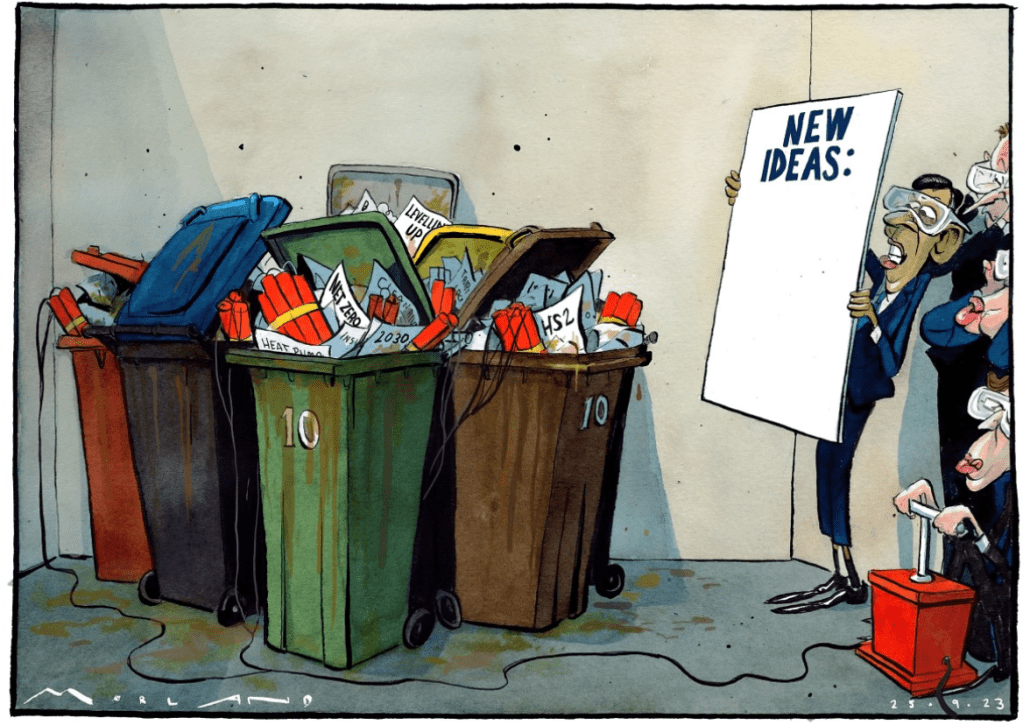
Concrete scandal: Minister issues ‘unreserved apology’ to schools after headteachers blamed

A minister has issued an “unreserved apology” to headteachers for the chaotic way the crumbling concrete crisis has been handled, the body overseeing school trusts said on Thursday.

Evening Standard

More than 400 members of the Confederation of School Trusts (CST) attended an online meeting to lay out their “grave” concerns over how the government had responded to the scandal and to question “whether they can rely on” its guidance.

Education minister Baroness Barran apologised after hundreds of headteachers received a letter from her office instructing them to urgently return a questionnaire on whether RAAC concrete was present in their buildings when they had already sent back the forms.

CST chief executive Leora Cruddas said “a significant number of CST members reported concerns about the RAAC portal”.

“What has emerged is that many or most of you had already [completed the survey] – for a number of you, multiple times,” Ms Cruddas said in a letter to headteachers on Thursday morning.

“The minister offered an unreserved apology for the tone of the letter and the fact that it appears to have been sent in error to many CST members.”

She added that the “most pressing issue” now was to establish “the reasons that a very large number of CST Members received letters”.

She told the Standard: “I’ve asked the department to reset its tone in external communications, because I don’t believe that some of the comments made in the media recently by politicians have been helpful or constructive.

“But equally I would stay that Baroness Barran’s response to our concerns has been incredibly rapid and she’s taking our concerns incredibly seriously.”

Reinforced autoclaved aerated concrete is a lightweight building material used from the 1950s up to the mid-1990s, but is now assessed to be at risk of collapse.

Thousands of students have been disrupted on the first week of term by the scandal.

Schools leaders also said they were anxious that DfE guidance over RAAC and are questioning whether they can rely on to identify the concrete in their buildings.

“Many CST members have expressed grave concern about the reliability of the DfE guidance and are questioning whether they can rely on it,” Ms Cruddas said in her letter.

“Although I have been told by officials that there is a ‘triage’ and that visual inspection is not the only indicator of RAAC, we heard yesterday morning from members that they do not believe that this is sufficient in relation to concealed RAAC, which requires an invasive survey.

“The Minister offered to take this issue away and seek expert advice. I have asked for the DfE’s assessment or risk and reassurance on this matter as soon as possible.”

Bridget Phillipson MP, Labour’s shadow education secretary, said: “Yet more evidence of incompetence from this shambolic Department and an Education Secretary who is incapable of gripping a crisis of her own making.

“The Minister has now rightly apologised for at least some of the bungling by the department throughout the RAAC crisis.

“The Education Secretary should now apologise for telling schools to get off their backsides and for blaming schools for the mess the Tories created’.”

Liberal Democrat MP Munira Wilson said: “Headteachers and governors have been working round the clock to reassure parents and secure surveyors. It’s totally tin-eared for ministers to accuse them of not doing their job, when in fact the Department lost their forms.

“This chaos is yet another example of the Conservatives’ failure to get a grip on the crumbling concrete crisis.”

The DfE was contacted for comment.

Devon school concerned about lack of funding for rebuild

A school in disrepair is concerned there is not the government funding available for a rebuild.

Please form an orderly queue for a school rebuild which doesn’t involve crumbly concrete. – Owl

Tiverton High School was previously promised a rebuild as part of Labour’s Building Schools for the Future (BSF) in 2009 – but the £55bn scheme was scrapped in 2010.

By Ewan Murrie www.bbc.co.uk

In December, Tiverton High, in Devon, was listed for rebuilding works as part of the Schools Rebuilding Programme.

It learnt in July there was a feasibility process, which may not begin until April 2027, before any money is awarded.

The Department for Education (DfE) said it was committed to the project but its “scope” will be decided by the process.

‘Leaking roof’

The building has not been directly affected by the Raac (reinforced autoclaved aerated concrete) crisis, however, the school is worried that work now needed in other schools and public buildings may mean the money is not available for its rebuild.

Jon Sowden, Tiverton High School estate manager told BBC Radio Devon, the premises were “very poor, very dated and not fit for 21st century teaching and learning”.

He said the building sits on a flood plain, requires rewiring and suffers with deteriorating pipes and a windowed corridor that has had condensation inside the panes of glass since 1998.

The DfE said the school is on a list for improvement works in coming years but it was too early to say if this would be a full rebuild, heavy refurbishment, or a mixture of the two across different buildings.

One pupil said: “Winters can be quite damp and rainy and sometimes there can be leaks through the roof.”

Tiverton High School was previously promised a rebuild as part of Labour’s Building Schools for the Future (BSF) in 2009 – but the £55bn scheme was scrapped in 2010.

In December 2022 the school was added to the School Rebuilding Programme (SRP) as one of 500 schools which the Department for Education committed to rebuilding by 2030.

Mr Sowden claimed this gave a false impression that the £40m required for a rebuild had been allocated which he argued was “not quite the case”.

He said: “We’ve been told we can enter a scheme and we don’t know what the result of that feasibility study is going to be.

“There is no guarantee in anything that we’ve seen that this school will be rebuilt.”

A DfE spokesperson said: “We have committed to rebuilding 500 schools under the School Rebuilding Programme between 2020 and 2030 and are on track to deliver that commitment.

“Awarding contracts and establishing projects takes time but we have made rapid progress and are exceeding delivery timescales compared to the previous Priority School Building Programme, while delivering schools that will be net zero in operation.

“The Infrastructure and Project Authority has also highlighted the strength of the SRP’s progress.”

‘Degrade and crumble’

Lib Dem Tiverton and Honiton MP Richard Foord has urged the government to set out a clear timeframe for rebuilding.

He said: “The government has been talking about rebuilding Tiverton High School for more than a decade, in which time the buildings have continued to degrade and crumble around pupils.

“We were given a glimmer of hope last year when a rebuild was provisionally approved, yet it was later confirmed that work is not set to start any time soon.

“This is totally unacceptable.”

South West Water under scathing attack and accused of ‘blackmail’

by the prospective Tory candidate for the new Tiverton & Minehead constituency, as he asks for an urgent debate in the commons, Mr Liddell-Grainger MP.

He is currently member for Bridgwater and West Somerset.

In a post on March 1, Owl reported the Westminster Hall debate on South West Water, led by Simon Jupp a few days previously, under the heading: “Jupp sets disappointing tone with political point scoring.

Mr Liddell-Grainger MP, the Chair of Simon’s debate, believes another is needed, vindicating Owl’s judgement.

If only Simon could become a serious politician, he might be more effective in representing his constituents.

Mr Liddell-Grainger MP also alleges that South West Water ‘s Chief Executive “has hired City lawyers to threaten the press and parliamentarians if we speak out against the company.”

Lewis Clarke www.devonlive.com

A South West MP claimed he has been threatened by South West Water in an explosive attack on the company and its chairman in the House of Commons. Speaking in Parliament on Thursday, September 7, Mr Liddell-Grainger, who represents Bridgwater and West Somerset but is also the prospective candidate for Tiverton and Minehead for the Conservatives, slammed the Pennon-owned company, which later said it was “open and transparent” but had a duty to protect its employees.

Addressing Leader of the House Penny Mordaunt, he said: “This House, as the Leader of the House is aware, takes a dim view of bullying—unless it is by me.

“She will be shocked to learn that Britain’s worst water company has now resorted to thuggery and strong-arm tactics to silence parliamentarians and the press.

“I refer, of course, to the Pennon Group, which includes the nation’s filthiest and leakiest supplier, South West Water. Its chairman, Gill Rider—who worked for the Cabinet Office and so is used to leaks, I suppose—has hired City lawyers to threaten the press and parliamentarians if we speak out against the company.

“She is running a mob that has convictions for polluting rivers, pays its top gun criminal bonuses and, despite the wettest July on record, still has a hosepipe ban. It is operating like a mafia.

“This is absolutely appalling. May we have an urgent debate in Government time on these ruddy water companies, who are blackmailing their customers and parliamentarians to stop the truth coming out?”

Ms Mordaunt responded saying: “My hon. Friend has raised issues related to that particular company many times in business questions, and the whole House can sense his frustration and anger with what is happening.

“I suggest that he may wish to raise the matter with the relevant Secretary of State on 19 October. He is an experienced parliamentarian and will know how he can achieve a debate.”

In response, South West Water issued the following: “South West Water is an open and transparent business that welcomes scrutiny from all stakeholders, including parliamentarians, media and of course our customers.

“However, we have a responsibility to protect any member of our 3000-strong team who are working hard to deliver for customers, the region and our environment.

“We work in collaboration with all our parliamentarians as we deliver on our investment commitments.”

Woking plans to cut funds for care, arts, sports and toilets to plug £1.2bn deficit

“If Conservatives can’t run a council, they can’t be trusted to run the country”

[to coin a phrase from Simon Jupp]

Woking council has laid out a drastic package of cuts to local services after it in effect declared itself bankrupt this summer, revealing a £1.2bn deficit racked up from a risky investment spree overseen by its former Conservative administration.

Richard Partington www.theguardian.com 

Plans include scrapping funding for dozens of the town’s sports pavilions and toilets, the closure of a swimming pool, cutting resources for parks, the arts, and ending council backing for some community centres, annual concerts, and involvement in youth sporting events.

The troubled Surrey local authority also proposed scrapping millions of pounds in support for playgrounds and community care schemes for young, old and vulnerable residents in an attempt to balance the books. It will launch a consultation on the proposals next month.

In a document setting out a wide-ranging austerity programme, it also revealed plans to remove funding for choir and dance classes for residents with Parkinson’s disease, as well as grants for community transport for elderly and disabled people, and for a local charity helping domestic abuse survivors.

John Bond, a former independent councillor in the authority, said: “It’s horrendous. I think residents were unaware really quite how bad it would be. Who will want to come and live in Woking now?

“It’s going to affect everything, with the vulnerable suffering most. There is so much money owing, it’s going to go on for 10 or 20 years. The amounts are mind-boggling.”

The council also said it could not afford to complete a 1,200-home development at the Sheerwater estate, a regeneration scheme it was part way through building, and would seek “alternative options” to finish the project.

Council coordination and support for a summer concert series, annual celebrations for Diwali and Chinese new year, and the town’s involvement in the Surrey Youth Games will also cease.

As one of a growing number of English local authorities in financial distress, Woking issued a section 114 notice in June, signalling that it lacked the resources to balance its budget.

Birmingham city council, the largest local authority in the UK, became the latest to issue such a notice this week, blaming a £760m bill for equal pay claims, problems installing a new IT system and £1bn in government cuts over the past decade.

Rishi Sunak sought this week to capitalise on the Labour-run authority’s meltdown, telling the Commons: “They’ve bankrupted Birmingham, we can’t let them bankrupt Britain.”

However, councils from across the political divide are increasingly sounding the alarm over mounting financial pressures, after years of cuts to central government funding, soaring inflation, and rising demand amid the cost of living crisis.

Others to issue section 114 notices in the past couple of years include Conservative-run Northamptonshire and Thurrock, alongside Labour-run Slough and Nottingham. At least 26 English local authorities are thought to be at risk of issuing a section 114 notice within the next two years.

Woking’s troubles stem from a programme of commercial investments and regeneration schemes involving hotels and skyscrapers overseen by its former Tory administration, after piling up debts of £1.8bn – more than 100 times its annual £16m of core funding from council tax, government grants and other income.

The council’s Liberal Democrat leadership has blamed the party, which they ousted last year, for borrowing billions of pounds to fund risky schemes, including a complex of towers in the town centre – standing as the tallest buildings outside a big city in England – with a four-star Hilton hotel, public plazas, parking facilities and shops.

Ann-Marie Barker, the council leader, said: “These are dreadful proposals we don’t want to put forward. However, it’s important to note that it is historic debt levels we’re dealing with, on an unprecedented scale.”

Although acknowledging that Woking residents would “rightly be unhappy with what we’re going to do”, Barker said the Conservatives were responsible for running up its £1.2bn deficit. “We need to put our house in order to live within our means.”

Despite the efforts to find savings, the council documents, published before a key meeting next week setting out its medium-term financial plan, predicted Woking would still face an £11m shortfall in its budget for 2024-25. The council said it was also in talks with central government to explore a potential package of financial support.

Budleigh Monster crane update

Owl’s correspondent reports that two out of three sections of the new footbridge were lowered into place successfully yesterday, watched by many.

These will ultimately span a 70m breach which will be made in the 200 year old embankments gradually over the next couple of months to reconnect the estuary with its floodplain.

The last section is likely to be hoisted today.

A spectacle, apparently, not to be missed!

Hospitals regularly have to shut units due to dilapidation, NHS England says

[Boris Johnson first made the promise of 40 new hospitals during the campaign to be elected in 2019.]

Some hospitals are so dilapidated that they regularly have to shut wards and operating theatres to safeguard patients’ safety, a senior NHS boss has admitted.

Denis Campbell www.theguardian.com 

Julian Kelly, NHS England’s deputy chief executive, made the statement when giving evidence to the House of Commons public accounts committee on Thursday.

He was being questioned about the progress of the government’s pledge to build 40 new hospitals by 2030. Kelly told MPs that some NHS facilities were in such disrepair that the health service had “examples all the time where hospitals are having to shut units, decant patients into other spaces, where we are losing theatres … which limits our capacity to treat patients”.

Kelly was referring to problems caused by hospitals being left structurally unsound either because they are made of reinforced autoclaved aerated concrete (Raac) or because their environment has deteriorated over recent years as the NHS’s capital budget has been squeezed.

“We have hospital teams which are managing these sort of issues day in and day out,” Kelly said. “And so we have examples of managing fire risk, flooding … a lot of this is because we know we’ve seen a big increase in backlog maintenance and we know there was a pause in investment in new hospital infrastructure.”

The cost of addressing the backlog of maintenance across the NHS estate in England has risen to a record £10.2bn, of which £1.8bn is needed for repairs of “high-risk” problems.

For example, the Queen Elizabeth hospital in King’s Lynn, Norfolk, had to mothball four of its operating theatres between September 2022 and May this year to allow “failsafing work” to take place across the site, to stop ceilings and walls from collapsing due to Raac.

Under the hospital’s ongoing “decant programme” some of its clinical services and wards are being moved into a temporary area while steel supports are inserted to reduce the risk of its roof falling down because of Raac, a hospital spokesperson said. The programme is 40% completed, she added.

Amanda Pritchard, NHS England’s chief executive, told the MPs that hospital staff found it “really quite burdensome” to monitor Raac. Even enhanced monitoring of the concrete “does not, and can’t completely, eliminate the risk from Raac,” she said. The NHS is implementing a plan to eradicate all Raac from its estate by 2035.

Doncaster Royal infirmary is at risk of “enforced closure” because it is experiencing so many problems related to the fact that it is so old, the Health Service Journal reported this week. In May it was removed without explanation from the list of 40 new hospitals that are due to be rebuilt.

At the PAC hearing, Kelly and Shona Dunn, the Department of Health and Social Care’s second permanent secretary, confirmed that the promised 40 new hospitals would not be built by 2030.

Meanwhile, new research by the House of Commons library shows that the seven hospitals worst-affected by Raac have 1.9 million people in the populations they serve and employ 43,000 staff.

“It is frankly a national scandal that so many people live in areas with hospital buildings at risk of collapse”, said Ed Davey, the leader of the Liberal Democrats, which requested the analysis.

“Hard-working doctors and nurses were the heroes of the pandemic and deserve better than to work in unsafe conditions under roofs at risk of collapse.

“This feels like a disaster waiting to happen with the NHS”, he added.

East Devon agrees to foot £1million for homes for Afghan refugees with the ‘hope’ they can become future council houses

“This is government money, and the government is asking us to do this. We have a duty to support Afghan people who supported our forces in the conflict.” Paul Arnott

Local Democracy Reporter eastdevonnews.co.uk

Homes will be provided in East Devon for refugees arriving in the county from Afghanistan, writes local democracy reporter Guy Henderson.

More arrivals, whose work to support British forces in Afghanistan means their lives are in peril, are expected to reach Devon in the coming months.

East Devon District Council has agreed to provide five homes at a cost of almost a million pounds. A further £750,000 will come from the Government.

Four of the homes will be specifically for refugee families.

Members of the council’s cabinet heard this week that once the homes are no longer needed by Afghan refugees, they will be available for people on local housing lists.

The Government’s department for levelling up, homes and communities has issued funds to help councils provide temporary accommodation for Afghan refugees who are currently living in hotels such as one in Exmouth.

A report to the committee said the government money is designed to help Afghan citizens who helped Britain during the conflict in their country. All local authorities have been encouraged to take part.

The report said that while there is currently no local refugee need for the new properties, more Afghan refugees are expected to arrive from other countries in the next few months. They would have priority for the four properties.

The report added: “It is not possible to say with certainty for how long the accommodation will be needed for its primary purpose. However, based on our experience of the bridging hotel, most families have looked to move to other areas, usually larger cities such as London or Birmingham.

“This would suggest that the length of time for any placement would likely be more temporary, perhaps less than a year.”

Liberal Democrat council leader Paul Arnott (Coly Valley) said: “Hopefully if the world calms down in the next five to 10 years and there aren’t refugees, this will be housing stock that can be used for other people.

“This is government money, and the government is asking us to do this. We have a duty to support Afghan people who supported our forces in the conflict.”

Paul Arnott discusses Housing and Pollution

Paul Arnott 

Most of us will have sat in a room at some time where just about everyone present is moaning. Often with good cause. My approach to that has always been, give the moaners a hearing, throw a moan into the mix myself if needed, but don’t leave till you have spent just as much time suggesting solutions.

Here are two common moans. First, the country is not building enough new homes to meet the demand. Second, a combination of new building and poor practice in agriculture is causing devastating pollution in our streams and rivers.

A couple of years ago, these issues became linked. Natural England, the organisation entrusted with making sure we do not allow our environment to be irreversibly wrecked, reported that this pollution was getting worse, unsustainably so. The particular problem was discharging phosphates into rivers, 70% of which came from agriculture, but 30% from new build projects.

Just around Easter 2022, East Devon District Council received a letter from Natural England, instructing us to cease making any progress with giving planning consent in most of the Axe Valley. By which they also meant large parts of west Dorset and south Somerset which feed into the Axe lower down.

I found myself at a house a few weeks back in a village a few miles south of Crewkerne. The host told me he’d wanted to build a small structure in his garden but had been informed by Somerset County Council that there was no point even applying for permission while the ban was in place. It’s not just Axminster affected.

East Devon councillors have been made well aware that the construction industry is up in arms about this, saying that most of the phosphate pollution is caused by agriculture and not by them. “Most “being the operative word. They are still causing pollution.

Last week Michael Gove, who runs the government department overseeing development, made a typically confusing announcement. The country needs more homes, the ban on construction in some areas is blocking that, therefore he is lifting the ban on construction. Oh, and just to show that he has not forgotten that phosphates are a problem, he announced a £250 million fund to help farmers clean up their act, about a zero short of what is really needed.

And just to throw a bit of red meat to his right wing, he boasted that he can do this now because we are no longer in Europe, despite his and Mr Johnson’s multiple assertions that leaving the EU would not be allowed to diminish our environmental protection in future. Who now can be even mildly surprised that it was a lie then and a lie now?

Mr Gove’s party is of course massively dependant on funding and political support from the construction industry. He knows full well that by Christmas next year the Conservatives will be in opposition, so he’s doing one for his mates on the way out of the door. It stinks, literally so.

So, what’s the solution? I would suggest a National Housing Commission, cross-party, is set up as an emergency intervention to last at least a decade. Clause One is “don’t screw up the environment”, and there is no reason not to achieve this. Then it needs to look at the catastrophic loss of social housing stock and, commissioning through local councils who understand the need and the unique characteristics of their areas, get delivering, training up the local workforce in the process. The Tories have had every chance since 2010 to do that. A fresh new government needs to get this going from the get-go.

Water firms accused of illegal sewage release on dry days

Southern, Thames and Wessex Water together discharged sewage for more than 3,500 hours last year when it was not raining, according to the BBC. This is not allowed under their permits.

England’s other private wastewater firms refused to release figures, citing a criminal investigation by the Environment Agency.

Adam Vaughan www.thetimes.co.uk 

Labour has called for an immediate investigation into apparent illegal dry sewage spills by three water companies.

Southern, Thames and Wessex Water together discharged sewage for more than 3,500 hours last year when it was not raining, according to the BBC. This is not allowed under their permits.

The companies released data on the start and stop times of sewage spills from storm overflows, which BBC journalists cross-referenced with rainfall data. England’s other private wastewater firms refused to release figures, citing a criminal investigation by the Environment Agency.

Companies are allowed to release sewage from storm overflows, designed as the sewer network’s relief valves, at times of heavy rainfall when the capacity of treatment works is overwhelmed. Swimmers, paddleboarders and other river users typically know to avoid using rivers or take extra care after downpours.

However, the new analysis suggests that last year Wessex Water released 215 spills, Thames Water 110 and Southern Water 63. The apparent spills occurred at a variety of sites, including the River Chew in north Somerset, the River Lavant near Chichester and a river in a park in Dagenham, east London.

“There must be an immediate investigation into both the breach of the licence and the environmental damage caused. Only then can we expose this illegal pollution and bring those responsible to justice,” said Steve Reed, Labour’s shadow environment secretary. Southern and Thames did not dispute the spills, although Wessex said it had doubts about the accuracy of its own data.

The investigation is not the first evidence of dry spills but is the first analysis of its extent last year. The water industry had proudly boasted that the total number of spills last year had fallen by almost a fifth in 2022, although there were still more than 300,000 reported by the Environment Agency.

‘Bad for humans, bad for rivers’

The charity Surfers Against Sewage has used public data to calculate that between October 2021 and September 2022 there were 143 dry spills. However, the BBC analysis suggests the true picture is much bigger, especially given that most of the wastewater companies did not disclose their figures.

“It’s depressing if not surprising to hear that dry spills are occurring so often. Discharging untreated sewage in dry weather is bad for both human health and river health — lower river flows mean more concentrated pollutants,” Tessa Wardley, director of communications and advocacy at The Rivers Trust, said.

The trust described the sewage discharges as the “canary in the coalmine” that pointed to wider problems in the water industry, including groundwater seeping into broken pipes and blockages in the sewer network. The trade body Water UK said the spills should be investigated.

Separately, lawyers and air quality experts have written to the environment secretary, Thérèse Coffey, asking her to ensure air pollution rules are not ditched later this year following the Retained EU Law Bill (REUL), which seeks to revoke certain EU laws.

The environmental law charity ClientEarth and academics at Imperial College London, University College London and the University of York said the National Emission Ceilings Regulations 2018 should be taken off a “kill list” to ensure they are not removed from statute books.

The government’s green watchdog, the Office for Environmental Protection, has also recently written to Coffey urging her not to renege on air quality protections.

“Despite repeated warnings from its own environmental watchdog, the UK government is set to do away with critical clean air laws in the middle of a public health and biodiversity crisis,” Emily Kearsey of ClientEarth said. “This government reassured the public that the UK would not be backsliding on environmental protections as a result of the REUL Act, but it is doing just that.”

Monster crane assembled on Budleigh Seafront

A Correspondent writes:

One of the largest mobile cranes in the country has been assembled in the Lime Kiln car park, Budleigh Salterton. It is part of the final stage of the LORP project, reconnecting the Otter estuary to its floodplain.

The 500 ton crane will be used to hoist three sections of newly constructed footbridge in place to span a 70-metre section of embankment.This will then be gradually removed over a period of up to three months

It’s quite a spectacle!

Simon Jupp becomes a laughing stock on social media

Two days ago Simon Jupp thought he would be clever and  retweeted a BBC politics post on the Birmingham City bankruptcy with the comment “If Labour can’t run a council, they can’t be trusted with our country”.

This attracted what might be a record number of comments, most negative. (He went on to retweet his own post the following  night with this comment: “Well, this seemed to annoy all the right people.” This also received comments heading towards a thousand.)

Simon seems blissfully unaware that Conservative controlled councils have also gone bust, with many others, including Devon, teetering on the brink.  

But for Simon, there is a silver lining, as a new career opportunity as a comic script writer opens up.

Frank Cottrell-Boyce, author of humorous books for children commented.

“The more I think about it, the more I think @simonjamesjupp is a comedy genius”

“When people say they laughed out loud at something they read, I’m always dubious. Laughter is a shared thing. It’s v hard to get someone to laugh alone. But I’m in my office laughing to the point of snot loss at this one.”

Simon will have been busy since, blocking those who criticise him and his beloved party.

Plymouth shooting: Sunak defends response to firearms reforms

Mr Pollard, the MP for Plymouth Sutton and Devonport, said it appeared some proposed measures would not proceed due to “pressure from shooting groups”.

Brodie Owen www.bbc.co.uk

Prime Minister Rishi Sunak has insisted firearms controls are improving despite concerns that reforms proposed in the wake of the Plymouth shootings could be “watered down”.

The Home Office is still considering public responses into proposed changes to firearms licencing laws.

But Labour MP Luke Pollard said in the House of Commons the measures “look like they could be watered down”.

Mr Sunak said in reply that firearms controls were “kept under constant review”.

In June the government launched a consultation into firearms licencing, which has since closed, but rejected a key recommendation to align shotgun and firearms legislation.

Jake Davison, 22, used a legally-held shotgun to kill his mother Maxine Davison, 51, and four others before shooting himself in the Keyham area of the city on 12 August 2021.

Campaigners have previously criticised the Home Office consultation as “tokenistic”.

Mr Pollard, the MP for Plymouth Sutton and Devonport, said it appeared some proposed measures would not proceed due to “pressure from shooting groups”.

He said: “Will the prime minister bow down to lobbyists from the shooting industry or will he stand with the grieving families and those in Plymouth who want to see no other tragedy like this ever happen with stronger gun laws?”

Mr Sunak said the government had taken action to increase information sharing between GPs and police while firearms applicants were also subject to social media checks.

“[Mr Pollard} will know that firearms are subject to stringent controls, and rightly so, but those controls are kept under constant review,” he said.

The Home Office would respond to the consultation responses “in due course”, the prime minister added.

More than half of dilapidated English schools were refused rebuilding money

More than half of English schools that are so dilapidated they are at risk of partial closure were refused money under the government’s school rebuilding scheme, Department for Education (DfE) statistics show.

Peter Walker www.theguardian.com 

Amid mounting concerns about a wider apparent neglect of the schools estate in recent years, beyond the immediate alarm about crumbling concrete panels, it emerged that of 500 rebuilt schools planned for England over 10 years from 2020, just four were completed in 2021.

In another development, the Guardian has learned that the Treasury vetoed a push by the Department for Education (DfE) to use a £1bn underspend to rebuild hundreds of schools during Liz Truss’s government.

The apparent disinclination of Treasury ministers to invest in new school buildings carries significant political risk for Sunak, after it emerged that a DfE plan to rebuild as many as 400 schools a year was slashed to 50 when he was chancellor.

The schools rebuilding programme is not directly linked to the current turmoil over schools forced to close classrooms or buildings because of increased concerns about crumbling reinforced autoclaved aerated concrete (Raac), although some of the work will be to replace Raac-constructed blocks.

Under the most recent full data published by the DfE, of 1,105 schools that applied to be rebuilt, 300 had been selected and 797 refused, with eight dropping out.

Of those turned down, 356 applied under a DfE-set metric called “exceptional case”, which means the school leaders believe the condition of their blocks is “so severe as to risk imminent closure, or a block is already closed”.

Schools can also apply as an exceptional case because the issues needing remedy can be solved only through a complete rebuild, or the school has not had a structural survey under a DfE programme to assess the state of the buildings.

In total, 267 exceptional cases were among those given funding, meaning the success rate for the category was only 43%.

Sunak and Gillian Keegan, the education secretary, have come under pressure about the rate of school rebuilds after a spate of sudden failures in Raac, the lightweight concrete intended to be used for only 30 years, meant some students were forced to begin the term from home or in temporary classrooms and cabins.

The decision to rebuild at a rate of 50 a year was made when Sunak was chancellor, and came despite a DfE submission for funding to the Treasury asking for between 300 and 400 a year to be approved due to “a critical risk to life” from Raac and other issues.

Separately, the Guardian was told that when Kit Malthouse was education secretary in Truss’s short-lived government he tried to reallocate a £1bn underspend in the DfE’s capital budget for school rebuilding and repairs, believing it could cover about 700 schools.

Some of these were affected by Raac, but others had other reasons for needing urgent refurbishment.

According to government sources, despite discussions between the DfE and Treasury over the following few weeks, the idea was not taken forward.

After Truss quit and Sunak replaced Malthouse with Keegan, it was decided that about £500m worth of capital underspend would be used instead to fund energy efficiency improvements to schools.

Keegan has become a particular focus for criticism over the current crisis, particularly after her complaint on Monday that “everyone else has sat on their arse” while she tried to fix the problem. On Tuesday, she risked angering schools by telling those responsible for returning questionnaires about possible Raac to “get off their backsides”.

Anger at Keegan is growing among some senior Tories. One called her “politically stupid” for not “pitch-rolling” MPs before the announcement some schools would have to close fully or partially. They added: “Keegan has been over-promoted and is emblematic of this government’s approach, which is to blame people for not understanding why they’re right.”

Downing Street has defended the pace of school rebuilds, saying 50 a year was around the average for the previous decade, and that other work was being carried out beyond the school rebuilding programme.

Sunak’s official spokesperson said it was incorrect to say that only four schools were rebuilt in 2021, and that when various schemes were considered, 72 were completed that year.

“The numbers do vary, but they obviously cover a number of schemes, just because of the way they have been introduced,” he said.

On the high proportion of “exceptional case” schools refused funding, a DfE spokesperson said the criteria for decisions was established after consultation with councils and others, and that so far 400 of the planned 500 schools had been selected.

They added: “Where there is a significant issue with a building that cannot be managed within local resources, we provide additional support on a case-by-case basis.”

A Department for Education spokesperson said after consultations, all those schools that applied for funding with “exceptional need” verified against the criteria were included.

“That means the schools with buildings in the worst condition are already being addressed,” they said. The spokesperson added: “The department has taken action to select 400 schools with the greatest need, with 100 more yet to be confirmed. Where there is a significant issue with a building that cannot be managed within local resources, we provide additional support on a case-by-case basis.”

13 schools with RAAC had building work scrapped

At least 13 schools confirmed to have reinforced autoclaved aerated concrete (RAAC) had funding to rebuild withdrawn in 2010, the BBC has found.

By Daniel Wainwright & Lucy Gilder www.bbc.co.uk

They had been approved for rebuilding under a Labour scheme, later scrapped by the Conservative-led government.

School buildings have been closed because potentially dangerous RAAC has been found.

The analysis raises questions about whether schools could have been helped far earlier with government investment.

Prime Minister Rishi Sunak is likely to face strong criticism from Labour leader Sir Keir Starmer in the Commons on Wednesday, marking the first prime minister’s questions since the story broke and the summer recess.

Labour says Mr Sunak’s past decisions on funding when he was chancellor have led to the disruption, but the PM has insisted claims he was to blame for the problems were “utterly wrong”.

The Labour scheme – Building Schools for the Future (BSF) – was a £55bn project to renew every secondary school in England, rebuilding half of them and refurbishing the rest.

It was ditched by the coalition government (which launched its own school building scheme in 2014).

The then education secretary Michael Gove said BSF was characterised by “massive overspends, tragic delays, botched construction projects and needless bureaucracy”.

There were questions about the value for money in the project, but the structural issues for the schools applying were real.

More than 700 projects were shelved. Mr Gove’s department published a list of schools affected in 2010.

This list stated which ones had work “stopped” but did not detail what the work was. Projects that had already had their finances agreed were able to continue.

Geoff Barton, general secretary of the Association of School and College Leaders, called the crumbling concrete crisis a “national scandal”.

“This analysis shows that these 13 schools would not now be facing the huge disruption caused by the RAAC crisis if the government had not pulled the plug on the building schools for the future programme,” he said.

“Instead we have an £11.4 billion backlog of repairs and remedial work required and the chickens have come home to roost over this neglect of school buildings.”

BBC Verify looked at the schools which were listed as having their building projects “stopped” and then checked these names against the list of schools affected by RAAC, published by the BBC.

Thirteen schools, which had their building work cancelled in 2010, are on the list of schools with potentially dangerous RAAC concrete.

  • Aston Manor Academy – Birmingham
  • Ferryhill School – County Durham
  • Carmel College – Darlington
  • The Ellen Wilkinson School for Girls – Ealing, London
  • The Billericay School – Essex
  • The Bromfords School – Essex
  • The Appleton School – Essex
  • The Gilberd School – Essex
  • The Thomas Lord Audley School – Essex
  • Thurstable School Sports College and Sixth Form Centre – Essex
  • Wood Green Academy – Sandwell, West Midlands
  • London Oratory School – Hammersmith and Fulham, London
  • Holy Family Catholic School, Bradford

We double-checked the names of the schools as they were in the 2010 list and as they are now in the official 2023 schools census data.

Each school has a special individual registration number, which in most cases stays the same even if the name of the school changes, such as when it becomes an academy.

The Bromfords School in Essex, which missed out on BSF funding, was on a list of schools that had successfully applied for the Condition Improvement Fund (CIF) in 2022-23, some of which was to tackle RAAC.

The London Oratory School in Fulham had RAAC removed during work on its DT Block and Sixth Form common room, but it is still present in roofing panels elsewhere on the school site. The school was listed in the CIF data as needing to do “urgent RAAC deck removal”.

Daniel Kebede, general secretary for the National Education Union, claimed there wouldn’t be RAAC in a single secondary school if “BSF had been allowed to continue”.

“It has in my opinion been calculated neglect”, he said.

Most of the 13 schools identified by the BBC as having missed out on BSF funding have had some building work investment in the intervening years, according to reports in local media.

This ranges from refurbishment of a dining hall and toilets to new art and sports blocks.

We contacted eleven of the schools involved.

We shared our findings with the Department for Education (DfE) and asked them to comment.

A DfE spokesperson said: “We committed to rebuilding 500 schools over the next decade as part of the Schools Rebuilding Programme and we are on track to deliver that.

“That is on top of 520 schools already delivered since 2015 under the Priority Schools Building Programme.

“The School Rebuilding Programme is in its initial stages of delivery and there will be an increase in the number of projects beginning construction in the next year.”

Another No 10  “Ostrich, head-in-the-sand mentality” example 

This time at the start of Covid.

Downing Street showed an “ostrich, head-in-the-sand mentality” towards Covid in early 2020 as Boris Johnson’s government instead focused on subjects such as Brexit, a former health minister has said.

Peter Walker www.theguardian.com 

Speaking to the Institute for Government as part of its ongoing series of in-depth interviews with former ministers about their time in office, James Bethell also said officials did not want him to discuss the potential economic impacts of Covid policies and would delete this from his speeches.

Asked about the health department’s interaction with other arms of government, Lord Bethell, who was a whip before becoming a junior health minister, said it could be “pretty turbulent”.

He said: “No 10 didn’t want to prioritise the pandemic in early 2020, even though the evidence was mounting – there was a post-election, ostrich, head-in-the-sand mentality, which I saw again around the invasion of Ukraine.

“Its priority, and what we were told many times, was Brexit and levelling up. ‘We have to deliver Brexit, so could your pandemic quietly go and mind your own business, please,’ we were told. So we had several weeks of this brushing off, and then they switched into it eventually. After that we got a lot of erratic dipping in. In Yiddish, it’s called ‘kibitzing’: erratic and ill-informed interference.”

While noting that as a junior minister his personal interactions with Downing Street were limited, Bethell said that from his point of view “coordination within government got a lot better” after Dominic Cummings, Boris Johnson’s chief adviser, left No 10 in November 2020.

Separately in the interview, Bethell said he was never given any advice about the economic impact of Covid policies, calling this “a mistake”. He said: “I was really surprised that we never got any kind of economic briefing. I asked for it many times, and I wrote speeches to give in the Lords where I articulated the economic thinking that I was personally working from.

“But my officials intervened, quite reasonably and quite correctly, and said: ‘It is not your role as the health minister to try to make up the government’s economic policy. The Treasury will go mad if you try to do that, we will not get the speech cleared by their officials, and by the way it’s neither smart nor right.’ And they had a point, so that stuff got deleted.”

In another recollection, Bethell said he was first asked if he wanted to become a minister in 2019 when he was at the Womad festival and was phoned by the then chief whip in the Lords.

“I was in a really great mood, feeling warm about the world, he made a very charming pitch and [I] immediately said yes,” Bethell said. “I am not sure I fully thought through all the implications.”

‘School buildings crisis sums up approach of this government’

Richard Foord, MP for Tiverton & Honiton 

One of the most important duties of a government is to protect its citizens. This includes the conventional ways we think of, such as providing a well-equipped armed forces and responsive local police force, but also ensuring that public buildings like schools and hospitals are maintained properly.

This issue has come to the forefront in recent days with the revelations about the true scale of the problem posed by RAAC (Reinforced autoclaved aerated concrete). This is a lighter form of concrete, often used in construction during the 1950s and 60s, that has a much shorter lifespan than regular concrete.

As a result, buildings built using this material degrade faster and need replacing much sooner. This has reached literal breaking point this week as the government has finally accepted the huge danger posed due to the number of schools still using buildings built with this material.

Over the weekend it was confirmed that 156 schools have been found to have buildings contain RAAC, of which 104 require urgent repair work. And on Monday it was further revealed that 5% of all schools – roughly 1200 – are affected by this growing crisis.

We’ve known for years that this is a growing problem as classrooms across the country, and here in Devon, are literally falling apart around pupils. The urgent rebuilding of schools like Tiverton High School and Tipton St John have long been promised, yet we are still waiting to see spades in the ground.

What is even more shocking is that the Government knew about this. The former permanent secretary at the Department for Education said on Monday that officials warned back in 2018 of a “critical risk to life” from crumbling school buildings, but requests for additional funding were ignored.

Rishi Sunak may claim that he’s not to blame, but that’s simply not true. Earlier this year his Conservative government cut £900 million from the education capital spending budget, which is spent ensuring classrooms are safe.

This crisis perfectly sums up the approach of this Conservative government. They are content to sit back and take us for granted, letting these issues fester until they reach crisis point – then they scramble to pick up the pieces.

Our children and communities deserve far better than this reckless boom and bust approach.

Will Tipton Primary rebuild slip down the pan?

Nine months ago, with great fanfare, Simon Jupp amongst others announced that, at last, Tipton St John Primary rebuild had been included in the school rebuilding programme. [In 2015 the Environment Agency (EA) declared that there is a ‘risk to life’ of the children attending the hub and that it must be rebuilt outside of the flood zone.]

There is now an urgent crisis in schools across the country needing fixing to stop pupils being crushed by crumbly concrete. Ministers have said that they will “do what it takes” to fix the problem.  However, the treasury has made it clear that “no new money” is available.

So inevitably, it looks to Owl, as though there will have to be some radical re-prioritising and rescheduling of the capital expenditure programme within the Education Department.

In these circumstances the easiest “savings” to make are on those projects not yet committed, even though they may have been scheduled or, indeed, “promised”.

We need a clear statement that Tipton Primary will not be affected by the current crisis.  

Are schools at fault for not knowing if they have crumbly concrete?

Gillian Keegan tells teachers to ‘get off backsides’ and answer Raac survey

The education secretary, Gillian Keegan, has angered teachers a day after a sweary outburst landed her in trouble, this time claiming headteachers who had not responded to a survey about whether they were affected by crumbling concrete should “get off their backsides”.

Ben Quinn www.theguardian.com 

Her comments in a radio interview came a day after she was forced to apologise after being caught swearing on camera while expressing frustration about the crisis surrounding reinforced autoclaved aerated concrete (Raac) in schools, claiming that “everyone else has sat on their arse” while she tried to fix the problem.

Keegan told Jeremy Vine on BBC Radio 2 on Tuesday: “The annoying bit, and this was probably a bit of my frustration yesterday, is despite asking since March 2020, there’s 5% of schools or responsible bodies that have not responded to the survey. Now hopefully all this publicity will make them get off their backsides.

“But what I would like them to do is to respond because I want to be the secretary of state that knows exactly in every school where there is Raac and takes action.”

She added: “We’ve written to them quite a few times and we’ve also set up a call centre to phone them up to ask them to do it and they still haven’t. So we have written to them yesterday and given them until the end of the week.”

In response, the National Education Union (NEU) said that laying any responsibility for the concrete crisis at the door of schools was “outrageous”.

Daniel Kebede, the general secretary of the NEU, said: “It is outrageous of the education secretary to lay any responsibility for the Raac crisis at the door of schools. The fact is that the Department for Education has dragged its heels over many years on this issue.

“The government has failed to show leadership on this issue for very many years.”