Seems to be scratching his bum! – Owl
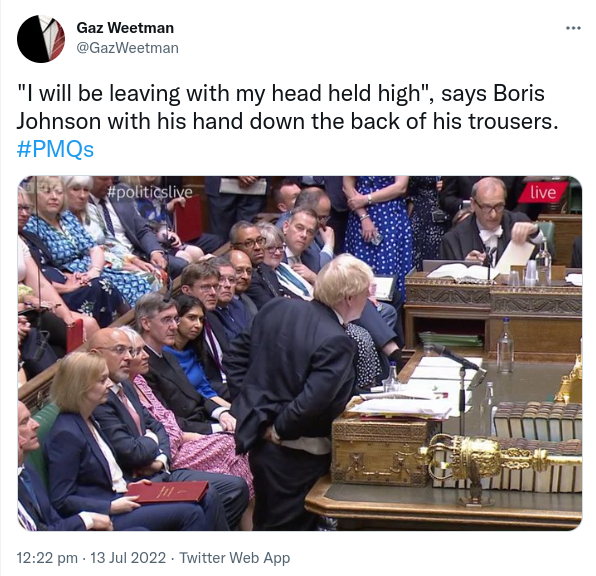

Seems to be scratching his bum! – Owl
To put this number in perspective there were 70,000 civilian deaths and 384,000 soldiers killed in combat during the six year course of WWII.
“We got the big calls right” or did we? – Owl
Tom Whipple www.thetimes.co.uk
Over 200,000 people in Britain have now had Covid recorded on their death certificate, according to the latest figures from the Office for National Statistics.
The milestone comes more than a year after the country reached 150,000 Covid-related deaths towards the end of last winter.
With hospital admissions continuing to rise amid a wave fuelled by a subvariant of Omicron, public health officials expect the toll to increase over the next few weeks.
Simon Clarke, from the University of Reading, said that the latest wave, in which infections are close to record levels, showed the importance of staying on top of the vaccination programme.
“At the moment we have transitioned to a situation where population-wide immunity, delivered largely by vaccination, means that Covid-19’s worst effects are likely to be a mass sickness which keeps people off work, and while this could disrupt public services, it doesn’t fill intensive care units with people struggling to breathe,” he said.
“But we are seeing the virus change and try to squeeze through the gaps in that immunity, so the vaccine producers need to ensure that future boosters take into account those changes to the virus and the government needs to ensure that boosting is comprehensive enough.”
At present the government plans to offer a booster to over-65s in the autumn, as well as those in younger age groups at increased risk. The JCVI, the committee advising the government on vaccinations, does not yet know whether that booster will, for the first time, be tweaked to match the variants. Both Pfizer and Moderna have vaccines in development that are specifically targeted to Omicron.
Sajid Javid, as health secretary, recently indicated that he was looking at extending this booster programme to include those aged over 50. Clarke said that doing so could be money well spent, adding: “A half-baked booster rollout done on the cheap risks not covering enough people and could end up costing the economy more in the long run.”
The 200,000 figure, announced today by the ONS, represents deaths up to June 25. The delay is because the statisticians have to wait for the official death certificates, where doctors mention Covid only if they deem it contributed to someone’s death.
These numbers are separate from the more rapid but less accurate “28-day” measure, in which those dying within 28 days of a positive test are all recorded as Covid deaths — in England this figure is 157,000 and in Wales 7,500. This measure is no longer used in Scotland and Northern Ireland.
The latest wave has not translated so far into steeply rising deaths. ONS data shows that total mortality is only slightly higher than expected at this time of the year, although because of the lag from infection to hospitalisation, more deaths are expected.
While scientists do not expect to see peaks anywhere near those encountered pre-vaccination, when there were more than 1,000 Covid deaths a day during the worst periods, some groups remain at risk.
A survey by Blood Cancer UK has found that a quarter of those with the cancer are still only leaving home for essential trips. Treatment for the condition can wipe out the immune system, and more than four fifths of those surveyed by the charity said they were still anxious about Covid.
An estimated half a million Britons are immuno-compromised, meaning they typically have a less strong response to the vaccines.
The organisation called for those who have not gained vaccine protection to be offered Evusheld, an antibody prophylactic.
“The number of people with blood cancer who have died of Covid is shockingly high,” said Gemma Peters, the chief executive of Blood Cancer UK.
“We also know that the effort to avoid coming into contact with the virus has had a huge mental health impact. While it is completely understandable that the country is now getting back to normal life after a horrible two years, this return to normality needs to be accompanied by much more support for those who are still vulnerable to Covid.”
It isn’t often that the people of East Devon make a real difference to national politics.
Martin Shaw, Chair, East Devon Alliance www.midweekherald.co.uk
But I think we can safely say that when voters in Honiton, Seaton and Axminster helped return our first non-Conservative MP last month, we played a major role in forcing Boris Johnson’s grudging commitment to leave Downing Street later this summer.
While everyone knew that Johnson was badly discredited – for his Seaton photo opportunity he lurked at the yacht club end of the beach to avoid bumping into residents – it was only after 22,500 of us voted in the Liberal Democrat, Richard Foord, that enough Tory MPs got the message that sticking with Johnson could cost them their seats.
So our great Devon victory was a vital first step towards getting the country out of its mess.
But the problem is much bigger than Johnson. Most other Conservatives (including virtually all the new contenders to lead the party) excused his behaviour even after we called time on it. And that behaviour itself was just the tip of the iceberg.
When the East Devon Alliance was formed nine years ago to tackle corruption in our district council – after a Conservative councillor was exposed offering planning permission for £25,000 – people did not often use the word ‘corruption’ to describe British politics. We thought East Devon was an exceptionally bad case, the result of a long period of one-party rule.
But now it is routine to describe the national government in this way. During the pandemic, millions of pounds were handed without proper scrutiny to firms linked to ministers’ cronies and Tory donors – while many of the latter, including the oligarch son of the former KGB agent that Johnson met in a Tuscan villa, were awarded peerages. (I wonder if Johnson’s strong support for Ukraine is partly an attempt to compensate for the Tories’ Russian links?)
This self-interested clique at the centre of the Conservative party has scant concern for the real problems of the country and the difficulties facing ordinary people. Their claim that they have ‘got the big calls right’ doesn’t stand up to examination.
The early response to Covid was a shambles and the policy towards care homes was ruled unlawful after EDA’s Cathy Gardner took them to the high court. Indeed the government washed their hands of the pandemic after the third vaccine was rolled out.
Until last week, Sajid Javid presided over an NHS which has never been in a worse state, with six millions waiting for treatment, the ambulance service in crisis, and staff shortages worse than ever.
Similarly, Rishi Sunak delayed and delayed supporting people with their energy prices, and then the help was too little, especially for the people whose benefits he slashed only last year. He has continued the decade of austerity which has made it impossible for local councils to maintain, let alone really improve, public services – even Devon County Council could be at risk of bankruptcy.
Instead of solid work to improve our economy and society, for 12 wasted years the Conservative Party has given us an endless soap opera of rivalries between wealthy, overentitled men (and a few women).
They serenade us with pretend policies like ‘levelling up’, which no one really knows the meaning of, and which have brought precious little benefit even to the north, let alone to Devon, which has again been taken for granted.
Half of these years have been taken up with the fantasy of Brexit, which has had virtually no practical benefits but has wrecked much of our trade, damaged the fishing industry it was meant to help and divided Europe just when it faces the threat of Putin.
As the soap opera resumes, Tories are telling each other that the next prime minister has to be a Brexiteer. In my view, the next prime minister, like our new MP, should be a non-Conservative.
The UK’s failure to get serious about inequality and weak growth over the past 15 years has left the average British household £8,800 poorer than its equivalent in five comparable countries, research has found.
Owl thought our Local Enterprise Partnership had cracked the problem of productivity growth and, along with its local business partners, were assuring us of sunny uplands.
Are there any grownups running our economy?
Larry Elliott www.theguardian.com
A “toxic combination” of poor productivity and a failure to narrow the divide between rich and poor had resulted in a widening prosperity gap with France, Germany, Australia, Canada and the Netherlands, the report from the Resolution Foundation said.
The thinktank said that if the UK matched the average income and inequality levels of those countries, typical household incomes in Britain would be a third higher and those of the poorest households two-fifths greater.
Its chief executive, Torsten Bell, said: “Britain is a rich country, with huge economic and cultural strengths. But those strengths are not being built on with the recent record of low growth leaving Britain trailing behind its peers.
“This forms a toxic combination with the UK’s high inequality, leaving low- and middle-income households far poorer than their counterparts in similar countries.
“We must turn this around, but we are not on track to do so. We underestimate the scale of our relative decline and are far from serious about the nature of our economy or the scale of change required to make a difference. This has to change.”
The foundation’s report – Stagnation Nation – coincided with calls from the Confederation of British Industry (CBI) and the Treasury select committee for the government to produce a coherent growth strategy.
In an open letter to ministers, the CBI director general, Tony Danker, took a sideswipe at the tax-cut bidding war being conducted by the Tory party contenders to replace Boris Johnson, urging the candidates to show how growth policy was “about more than this”.
The overriding objective of tax policy currently should be to boost business investment, the business lobby group added. “Growth that relies on only government or household consumption is doomed to fail, especially at a time of rising inflation and high debt.”
Danker said the economy could be boosted by £700bn over the coming decade provided the government developed “serious, credible and bold” policies for growth.
“There are prizes on offer through decarbonisation, innovation, trade, thriving regions, labour and health. And those prizes can be realised if government pulls on four key growth levers: smart taxation to unlock investment; building a workforce for the future; delivering catalytic public investment; and making markets to outcompete the world.”
Meanwhile, the cross-party Treasury committee expressed concern at the “chop and change” in the government’s economic approach, warning of a risk of fragmentation and a lack of long-term thinking after the abolition of its industrial strategy and replacement with the plan for growth. It was not clear how the plan for growth was an improvement on its predecessor, the report said.
Mel Stride, the committee’s chair, said: “We have a new chancellor and shortly will have a new prime minister. Getting a grip on productivity will be key to kickstarting economic growth and stimulating greater business investment in the UK. The evidence that we received suggests there needs to be greater stability and long-term certainty in government policymaking.”
The Resolution Foundation said the UK had closed the productivity gap with France and Germany in the 1990s and the first half of the 2000s, but since then the gap had widened from 6% to 16% – the equivalent of £3,700 per person.
While the top 10% of households in Britain were richer than those in many other European countries, middle-income British households were 9% poorer than their counterparts in France, while the poorest fifth of households in Britain were more than 20% poorer than their French and German equivalents.
Meanwhile, the latest monthly barometer of confidence from YouGov and the Centre for Economic and Business Research shows that weak growth and rising inflation in recent months have led to a seventh successive decline in consumer confidence.
Background: A survey of the Tory party membership from the Conservative Home website has shown that Sunak would comfortably win in a run-off against Hunt, but would struggle against many of the other candidates including Truss, Kemi Badenoch and Penny Mordaunt.
‘It’s a stitch up!’ Nadine Dorries rages at Rishi ‘dark arts’ to secure PM win

Rishi Sunak faces two major opponents in battle to PM
Cally Brooks www.express.co.uk
Writing on Twitter, the Secretary of State for DCMS wrote: “This is dirty tricks/a stitch up/dark arts. Take your pick. Team Rishi want the candidate they know they can definitely beat in the final two and that is @Jeremy_Hunt. It was in response to a Tweet by Commentator Dan Hodges who revealed he was told Gavin Williamson, who is on Rishi Sunak’s team, organised a “syphoning off of some votes” to help Jeremy Hunt get to the election.
He wrote: “One rival camp tells me Gavin Willamson (who is on Team Rishi) has organised syphoning off of some votes to let Jeremy Hunt get over the threshold.”
Nadine Dorries is a member of the Conservative Party and has served as Secretary of State for Digital, Culture, Media and Sport since 2021.
It comes as the first eight leadership candidates to get through to the first round of voting have been revealed.
Kemi Badenoch, Suella Braverman, Jeremy Hunt, Penny Mordaunt, Rishi Sunak, Liz Truss, Tom Tugendhat and Nadhikm Zahawi have made it through.
Sajid Javid and Rehman Christi withdrew from the content minutes before the deadline.
But some have denied the accusations, with Sky News’ Political Editor Beth Rigby claiming sources have told her it is “complete nonsense”.
She wrote on Twitter: “Update on the Williamson/Hunt story doing rounds. Source close to Sunak campaign tells me its ‘complete nonsense.
“Mel Stride running the whipping op & that behaviour isn’t happening. It’s a dirty story being spread by anti-Rishi people’.”
It comes after Rigby challenged Rishi Sunak over his suitability to lead the country as she pointed out he shares several flaws with Boris Johnson.
The Sky News chief editor questioned Rishi Sunak about his record as she noted the former Chancellor had been building his campaign to succeed Boris Johnson on the need for change within the party.
Beth Rigby noted Mr Sunak had also been handed a fine after he was found to have breached lockdown rules by attending a gathering at a time when groups could not meet. She also noted he is currently seen as a “corrosive” figure because of his fiscal policies, questioning his chances of securing the leadership of both the party and the country.
Ms Rigby said: “You’ve just stood here and said Boris Johnson is a remarkable person, you don’t want history to demonise him.
“But the fact is, the party just ousted him on the basis of conduct, probity, and causing division. And here you are, and I have to put it to you that you have a police fine over Partygate.”
Rigby added: “And there have been questions too over your very wealthy family avoiding paying millions of pounds in tax due to your wife being a non-dom taxpayer.
“I know that has changed very recently. And I have to say you’re an utterly corrosive figure in the parliamentary party for a big chunk of it. There are many in the party who do not want you to be Prime Minister.”
The former Chancellor said: “I think it’s important, whoever wins this election does restore trust because trust has been broken. We need to rebuild all that with the country. It’s something I’m keen to do as leader.
“I think I can do that, and I think it’s about the conduct of Government, which is important. And you can expect that’s the kind of leadership I will provide.”
This leadership campaign reveals the ideological narrowness of the Conservative Party
Editorial www.independent.co.uk
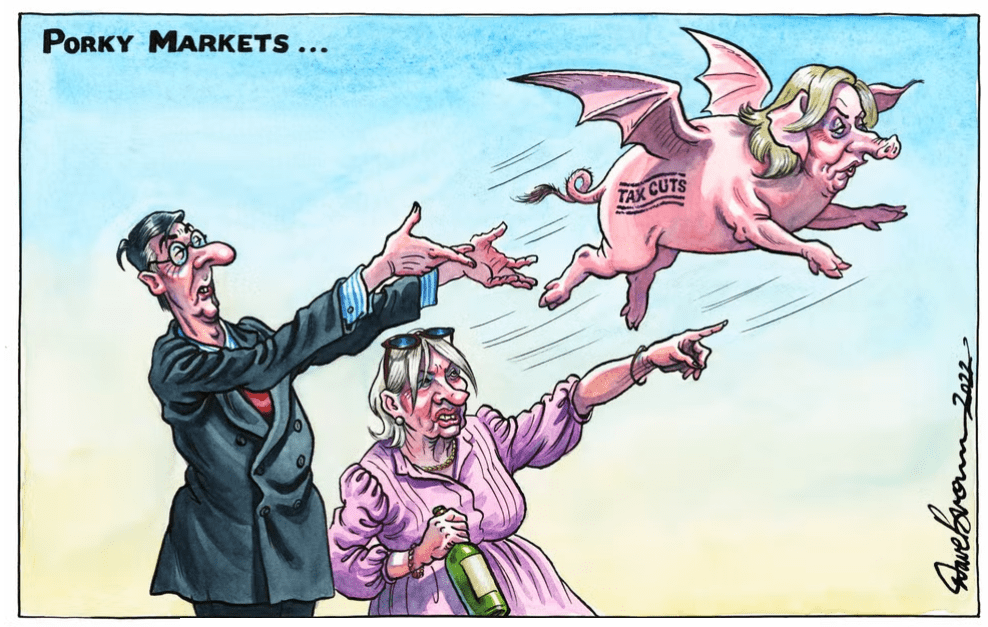
A leadership election campaign ought to be a good chance for potential prime ministers to set out how they would deliver the kind of government that the people want. Instead, we have had a parade of leading lights offering fantasy tax cuts, and one candidate who seems to be running on a ticket to abolish unisex toilets.
What is the No 1 priority of the British people? It is the cost of living. And what do the candidates have to offer them? Unfunded tax cuts, mainly. Cuts to national insurance contributions, income tax, fuel duty, and even corporation tax. And none of them spelling out credible spending cuts to pay for these things, implying higher borrowing at a time when interest rates are rising, meaning it would pile on costs to be paid by future generations.
To his credit, Rishi Sunak, the recent chancellor, set the terms of the election by pre-emptively attacking “fairytales” about the economy. This does seem to have forced at least one candidate, Penny Mordaunt, to rein in the impossible promises and to agree that lower taxes are only prudent when the public finances are sustainable.
But the tone has been set by Jacob Rees-Mogg, who is now backing Liz Truss, in condemning Mr Sunak as a “socialist” chancellor for belatedly doing the right thing and using the benefits system to protect vulnerable households from the rise in energy bills.
The overall impression is of a party that would prioritise tax cuts, which by definition help the better off (those who pay taxes), over broad-based help for people on low incomes.
What else do the British people care about? The National Health Service. The coronavirus backlogs and the dangerous delays in ambulance call-outs. And what do the Tory candidates have to say about that? The only candidate who seems to have taken the NHS issue seriously is the recent chancellor. His allies criticised Boris Johnson in the weekend press for failing to set up regular meetings, led by the prime minister, to oversee the backlog programme. This kind of Blairite public-service-reform focus is the only way to ensure that the full weight of the government machine is devoted to identifying the bottlenecks and clearing them.
The people’s priorities include the housing crisis. Only one candidate has mentioned it – Sajid Javid, though he has since stood down from the race. People are worried about crime. That has been the subject of familiar sloganising, but no new thinking. And people are also concerned about the arrival of small boats across the Channel, while being uneasy about the Rwanda scheme proposed by Priti Patel, the home secretary, as her main response to that problem. So far, all the candidates have backed the scheme – while the scheme itself has been suspended until the new prime minister takes office at the beginning of September.
The other huge issue with which the British people expect their leaders to engage is the climate emergency – coincidentally underlined by the current unusual heatwave. On this, the centre of gravity of the Conservative Party seems to be moving away from the people. Kemi Badenoch, the biggest surprise candidate of this race, described the target of net zero carbon as “economic disarmament”. While other candidates have not gone that far, the tone of the debate is all about “realism”, which is code for backsliding.
There is time for some of the candidates to prove us wrong, but the early stage of this contest has exposed the gulf between the Conservative Party’s deepest instincts and the people’s priorities. A leadership election ought to be a chance for a party to showcase its best talents. So far, it has shone an unforgiving light on the party’s true nature.
“Boris Johnson was able to rise because of powerful anti-democratic forces”
Double Down News
A second Somerset council has called on the government to urgently address the cost of living crisis – though Conservative councillors abstained from the final vote.
Daniel Mumby www.somersetlive.co.uk
Somerset West and Taunton Council became the second local authority in Somerset to pass a formal motion urging government action on the cost of living, following a similar vote by Mendip District Council in late May. In a full council debate held in Taunton on Tuesday evening (July 5), councillors from all parties spoke out about the pressures being placed on working families, urging action on energy bills, universal credit and fuel duty.
However, members of the Conservative opposition group abstained from the final vote, with their leader stating the motion was “overtly politicised” and the debate was a “missed opportunity” to find common ground. The motion called for a cut in the standard rate of VAT from 20 per cent to 17.5 per cent, restoring the universal credit supplement of £20, and reinstating the pension triple lock (whereby pensions rise in value by either average earnings, inflation or 2.5 per cent a year – whichever is higher).
It also called for the government to cut fuel duty in rural areas and to uncouple power prices from gas prices (which would enable a drop in household electricity bills). Like Mendip‘s declaration in May, the council also committed to staging a “cost of living emergency summit” with Citizens Advice, food banks, trade unions, chambers of commerce and the district’s two MPs – Ian Liddell-Grainger (Bridgwater and West Somerset) and Rebecca Pow (Taunton Deane – and until recently a Defra minister).
The council has also committed to creating a £50,000 support fund for those residents most affected by rising food and energy prices, which will be administrated alongside Citizens Advice by the end of the summer. Councillor Chris Booth, portfolio holder for communities, introduced the motion by stating: “We are all aware of the difficult times that our residents are going through, and it’s now the time to show that we want to do more than we already are.
“We urgently need more of this government as the shadow of hardship consumes more of us.” Councillor Benet Allen, portfolio holder for communications and corporate resources, said he was “dismayed” that the government had dithered over restoring the £20 uplift in universal credit.
He said: “The cost of living crisis is real, it affects many of us, and I’m dismayed that the government has avoided doing the one, simple, affordable thing that it could do to put money in the pockets of those who need it most – which is to restore the £20 on universal credit. They’ve done lots of other things, most of which are headline-chasing.
“I believe that this government for political reasons has avoided doing anything along the lines of putting money back into the pockets of the very poorest. We are overtaxed on our use of electricity because our electricity bills are directly connected to our gas bills. Very little of our electricity is generated by gas.
“The cost of renewable energy has plummeted in recent months – we are actually all overpaying for electricity by a factor of two or three.” Councillor Libby Lisgo, who leads the Labour opposition group, joked that the council would struggle to find a minister to whom these concerns could be addressed in light of the copious resignations from Boris Johnson‘s administration.
She said: “The way that the government is almost, it would seem, wilfully ignoring the needs of the people who most need support probably ought to beggar more belief than it does. The way they’re falling tonight [July 5] suggests that [finding a secretary of state] might be easier said than done.”
Councillor Dave Mansell – one of two Green Party councillors – added: “The motion focusses on short-term solutions, and those are definitely needed and important. I would like to add that long-term solutions are needed too, particularly for our energy security.
“The government has stopped us investing in the lowest-cost energy source, which is on-shore wind power. that is contributing to a situation which we now face, and that urgently needs to change.” The motion was passed by a substantial margin, though all the Conservatives present in the chamber abstained – and two members of the party left the chamber before the vote took place.
Councillor Roger Habgood, who leads the Conservative group on the council, said after the debate that he and his party were in support of action to address the cost of living but believed the motion was the wrong way to go about this. He said: “Unfortunately the cost of living motion to full council was deliberately set out taking an overtly politicised position by the local Lib Dems.
“The cost of living increases in our economy are of course concerning to us all, and if Mr Booth and the Lib Dem leader had taken a few minutes to construct the motion collaboratively, it could have received unanimous support. Sadly that approach and option was not chosen and an opportunity has been lost.
“Continuously blurring the lines of responsibility between the district, county and unitary councils and the national government is unhelpful. Our councillors are best placed to focus our attention on reducing costs and improving services under our direct control, rather than being distracted by matters outside of their control.
“Of course we should engage with Westminster. We have two MPs who represent us – after all that is how the latest cost of living payments for eight million families coming into effect from July 14 was formulated.
“My colleagues and I continue to focus on what we can do for residents as local councillors in these challenging times.”
At one point, Spicer calls Johnson a “fart pipe” and gives Johnson’s wife, Carrie, the nickname “Wallpaper Wendy” in reference to the £840-per-roll wallpaper the couple bought for their flat renovation.
(Read the intro then watch the video below, or just watch and enjoy! – Owl)
Ellie Harrison www.independent.co.uk
Comedian Michael Spicer has been praised for his video roasting Boris Johnson’s resignation speech.
Last week, Johnson announced he would step down as prime minister following an onslaught of resignations in protest over his leadership.
Spicer – whose sketches often see him impersonating a fictional, frustrated Johnson aide working in a side-room – shared a video on Tuesday (12 July) mocking the speech.
“Remember it’s time to be humble,” he can be seen telling the outgoing prime minister. “And, just to be on the safe side, I’ve written down the definition of humble and emailed it to you under the subject heading: ‘You have well and truly f***ed everything up.’”
He suggests that Johnson apologise for “partying every single Friday while telling us at the same time we couldn’t sit on a park bench with our nans”.
When Johnson says in his speech that he is proud he “got Brexit done”, Spicer cuts in with: “It’s not done, it’s a mountain of burning tyres that threatens the Good Friday Agreement.”
When Johnson talks about how he got the country through the Covid pandemic, Spicer says: “180,000 people died but, yes, let’s claim it as a triumph, why not? I mean, literally nothing you say matters any more.”
At one point, Spicer calls Johnson a “fart pipe” and gives Johnson’s wife, Carrie, the nickname “Wallpaper Wendy” in reference to the £840-per-roll wallpaper the couple bought for their flat renovation.
Getting increasingly irate, he demands that the prime minister apologise. “Dig right down into that poisonous soul of yours and try to find one apology,” he says.
The video ends with Spicer holding his head in his hands in total despair.
Broadcaster and author Fern Britton was among those to praise the clip. “Totally brilliant and factually correct,” she tweeted. “He is a fart pipe.”
“‘Wallpaper Wendy’ had me snorting water out of my nose,” added another.
A third wrote: “Another slice of perfection. Thank you.”
A fourth said: “You’re the only way I can watch these speeches.”
“Immensely satisfying,” posted a fifth.
A sixth person simply wrote: “Thank you YOU ABSOLUTE BLOODY BEAUTY!”
Raab and Shapps back Rishi Sunak in race for Tory leadership
Rees Mogg and Dorries are backing Liz Truss
Looks like North East Somerset is the only place where 20 people can be found to back the “Boris Continuity” candidate JRM.
None of the above – Owl
Heather Stewart www.theguardian.com
The UK deputy prime minister, Dominic Raab, and the transport secretary, Grant Shapps, have both thrown their weight behind the frontrunner, Rishi Sunak, in the race to succeed Boris Johnson as Conservative leader.
Raab, who had not previously backed a candidate, introduced Sunak as he formally launched his candidacy at an event in Westminster.
With the other candidates in a bidding war to promise tax cuts, Raab told the enthusiastic audience: “Just remember this: while others talk the talk, Rishi this month delivered the biggest tax cut for working people in a decade; and he did it because he’s a true Conservative, imbued with the values of enterprise, hard work and family. Rishi’s values are our values.”
He also highlighted Sunak’s early support for Brexit, his “seminal” pamphlet on freeports, and his strong poll ratings relative to other candidates.
Also appearing on stage was Shapps, who has withdrawn from the Tory leadership race and thrown his weight behind Sunak, after it became clear he was unlikely to secure the backing of the 20 MPs needed to progress to the ballot paper.
Key supporters including Oliver Dowden, who resigned as party chair after the disastrous Tiverton and Honiton and Wakefield byelections, and the former chief whip Mark Harper, were also present.
Sunak has sought to distinguish himself from the rest of the field by declining to promise lavish tax cuts immediately, instead stressing the importance of not believing in “fairytales”.
In his own speech, he said it was time for a “grown-up conversation” with the public about the challenges ahead. He said he wanted the campaign to be “a moment where the party and the country came together”.
Sunak also sought to explain why he had backed Johnson until last week, saying: “We owe it to the people who elected Boris in 2019 to explain why he is leaving office.
“Boris Johnson is one of the remarkable people I’ve ever met, and whatever the commentators say, he has a good heart,” he said, insisting he would not take part in a “rewriting of history” about his premiership.
He has secured the most public endorsements from MPs, who will narrow the field down rapidly to two candidates over the next 10 days. Sunak, who resigned last week, said he was bringing “a message of change”.
Says it all! – Owl
Poke Staff www.thepoke.co.uk
No-one will miss Boris Johnson from Downing Street quite like his culture secretary Nadine Dorries.
And there can surely be no more fitting tribute to their extra special relationship than this musical mash-up which has just gone viral on Twitter.

Absolutely the best/worst thing we’ll see today.

You have to admire the enterprise and job creation – but is this “healthy eating”? – Owl
A new community Waffle Café has opened at Seaton Hospital.
Philippa Davies www.midweekherald.co.uk
It’s being run by the not-for-profit community enterprise Waffle which has had a similar café in Axminster for a few years, with a mission to combat loneliness, bring people together and offer new opportunities.
The opportunity to open the new café emerged when the Seaton community interest company RE: STORE was offered a disused kitchen in the hospital. The hospital is run by NHS Property Services which supports social prescribing, connecting people with community groups to improve their wellbeing.
RE:STORE was already running a gardening project in the grounds of Seaton hospital. Keen to create a wellbeing hub/cafe on the site, the company joined forces with Waffle.
The cafe is open Wednesday to Saturday from 9am until 5pm. On Monday and Tuesday the space is used for private groups and community activities.
The hospital is also partnering with Axminster Project Food, who will use the café’s kitchen to educate schoolchildren about cooking and healthy eating.
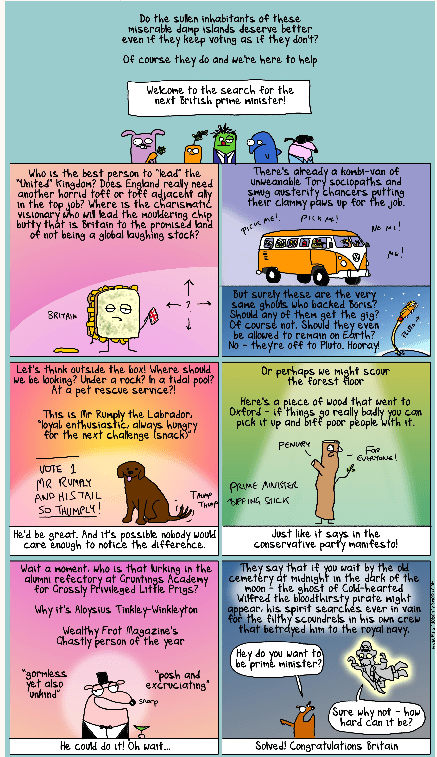
Should it be Aloysius Twinkley Winkleyton, Wealthy Frot Magazine’s Person of the Year, or this stick that went to Oxford? You decide!
First Dog on the Moon www.theguardian.com
The only chance the Conservatives have of early recovery is if they consciously abandon the discredited Johnsonian era, reject anyone associated with him, and opt instead for someone from a new, untainted generation.
The final choice lies in the hands of the small band of “True Blue” party members, so this looks unlikely. – Owl
Opinion by Peter Mandelson inews.co.uk
The Tories have only themselves to blame for the damage they have inflicted both on themselves and the country
Whoever succeeds Boris Johnson as prime minister, it is impossible to imagine that they will be as bad, a narcissist who sees every issue through the lens of his own personality, whose only abiding question is how it makes him look, a politician who lives for the next story to tell rather than detailed policy to formulate. Britain has never been as ill-served by its chief minister as we have been by Johnson.
In 2019, as the race to succeed Theresa May got underway, I was at a function and fell into conversation with the chair of the Conservatives’ 1922 Committee who said there were no circumstances in which Tory MPs would have Johnson as their leader because “they all know what he’s like”.
A month later he was duly elected despite his party knowing what he was like. The Conservatives have only themselves to blame for the damage they have inflicted both on themselves and the country.
Brexit was never going to bring the benefits for Britain its advocates claimed, but the narrow, confrontational, ideological, short-termist way in which it has been implemented by Johnson and his cohorts is going to do acute, lasting harm to our economy and future living standards.
I say nobody could be a worse prime minister because our quality of government and the whole of our politics have reached their nadir under Johnson. Ask any civil servant how professionally degraded they feel through proximity to him. The absence of any deep, objective thinking about the challenges facing Britain and of consistent, rational policy making and commitment have meant we have lurched from one makeshift, hand to mouth spasm of prime ministerial interest, to the next.
Although the crisis was not of his making, Johnson was lucky the Ukraine invasion came along: it enabled him to distract attention from all his other failures and to seek phone calls and meetings with President Volodymyr Zelensky every time he felt the need to burnish his leadership credentials.
Yes, it may be difficult to imagine that Suella (“I owe it to the country to run”) Braverman and Steve (“People are imploring me to stand”) Baker would be an improvement on the last three years, but they would not dare show the same wholesale indifference to rules and standards in public life that Johnson has demonstrated.
Surely Liz Truss and her myopic approach to trade and foreign policy, as she takes a wrecking ball to Britain’s economic relations with both of the vast markets of both Europe and China, could not fail to be some improvement, however limited.
But none of these are the answer to the Tories’ needs. The only chance the Conservatives have of early recovery is if they consciously abandon the discredited Johnsonian era, reject anyone associated with him, and opt instead for someone from a new, untainted generation. Tom Tugendhat or Tobias Ellwood come to mind but there are probably other men and women whose faces and names are not familiar to me or the general public who could engineer the necessary separation of the Tory party from its immediate past.
A new, fresh face and mind would then have to construct a programme for government which equips the nation’s priority objectives with practical, lasting plans to achieve them, for example in decarbonisation, economic and productivity growth and transformation of public services. These policies should not pander to ideological extremes but instead aim to generate the widest possible consensus so as to enable policies to survive a change of government.
Good policies depend on durability and lasting impact. A general election will take place in the not too distant future and key elements of policy should be built on rather than scrapped. We cannot afford tabula rasa policymaking, a wiping clean of the policy canvass as one administration takes over from another in Whitehall. The UK’s economy and businesses, as well as public services, need continuity for growth and improvement, not constantly shifting ground and decision-making.
There is little doubt what the public wants to see at the heart of a new programme of government. Manifest integrity and honesty in how Britain’s government and institutions are run. Fairness in the distribution of both tax burdens and spending benefits as well as the prevailing rules of immigration and welfare. Realisation of the economic opportunities offered by Britain’s world class science and technology base in which so many decades of investment has taken place.
Keir Starmer is rightly arguing that it is the Conservative Party not its leader which is incapable of bringing the change Britain needs. Starmer will continue to build the case for change with Labour as he has already started to do. The way Labour is viewed by the public is light years away from how it was judged in 2019. The party is electorally competitive again.
But if the Conservatives want to restore their own electability they will have to start with a very different leader from the one we are saying goodbye to now.
The one who claimed he had no working class friends!
Perhaps a surprising choice for someone who worked as a SPAD for the right winger Dominic Rabb – Owl
[Current list of candidates with their declared supporters can be found on this link. We don’t know who Dominic is backing].
East Devon MP Simon Jupp, whose constituency includes Sidmouth, is backing former chancellor Rishi Sunak in the Conservative leadership race to become the next prime minister.
Mr Sunak was chancellor of the exchequer in Boris Johnson’s cabinet until he resigned on 5 July.
Boris Johnson then resigned on 7 July as Conservative leader amid mounting pressure. He will step down as PM when a new leader replaces him.
Simon Jupp MP, who also called for Johnson to resign on 6 July, said: “Rishi is the right person to lead the nation.
“He’s serious about the South West and understands the opportunities ahead.
“I trust him to deliver a credible Conservative vision for the future which restores trust and rebuilds our economy.”
Eleven candidates have now put their names forward [at the time this article was written].
They are:
The Conservatives’ 1922 Committee is meeting today (Monday 11 July) to decide how the leadership race will go ahead.
Jacob Rees-Mogg mulls Tory leadership bid
Jacob Rees-Mogg is mulling a shock entry in the Conservative leadership race as a “continuity Boris” candidate, The Telegraph can disclose. www.telegraph.co.uk
 The Farmhouse Rousdon DT7 3XRRef. No: 22/1469/FUL | Validated: Fri 01 Jul 2022 | Status: Awaiting decisionFoxwood Combpyne Axminster EX13 8SYRef. No: 22/1476/FUL | Validated: Fri 01 Jul 2022 | Status: Awaiting decisionWindsor House West Street Axminster Devon EX13 5NXRef. No: 22/1475/LBC | Validated: Fri 01 Jul 2022 | Status: Awaiting decisionWindsor House West Street Axminster Devon EX13 5NXRef. No: 22/1474/FUL | Validated: Fri 01 Jul 2022 | Status: Awaiting decisionLand And Barn North Of Summerway Farm NorthleighRef. No: 22/1460/FUL | Validated: Thu 30 Jun 2022 | Status: Awaiting decision2 Glen Farm Crescent Honiton Devon EX14 2GXRef. No: 22/1458/FUL | Validated: Thu 30 Jun 2022 | Status: Awaiting decision45 Mill Street Ottery St Mary Devon EX11 1ABRef. No: 22/1459/FUL | Validated: Thu 30 Jun 2022 | Status: Awaiting decision15 Long Park Woodbury Devon EX5 1JBRef. No: 22/1455/FUL | Validated: Thu 30 Jun 2022 | Status: Awaiting decision40 North Street Ottery St Mary Devon EX11 1DRRef. No: 22/1454/FUL | Validated: Thu 30 Jun 2022 | Status: Awaiting decision30 Primley Road Sidmouth Devon EX10 9LDRef. No: 22/1463/FUL | Validated: Thu 30 Jun 2022 | Status: Awaiting decisionRoselea Dalwood Axminster EX13 7DZRef. No: 22/1453/FUL | Validated: Thu 30 Jun 2022 | Status: Awaiting decision1 The Red Lodge 11 Elwyn Road Exmouth EX8 2ELRef. No: 22/1464/FUL | Validated: Thu 30 Jun 2022 | Status: Awaiting decisionHalse Hill House 1 Halse Hill Budleigh Salterton EX9 6ABRef. No: 22/1466/TCA | Validated: Thu 30 Jun 2022 | Status: Awaiting decision6 Summer Meadow Lympstone Devon EX8 5BQRef. No: 22/1447/FUL | Validated: Wed 29 Jun 2022 | Status: Awaiting decisionJackmoor Cottage Upton Pyne Exeter EX5 5HYRef. No: 22/1448/FUL | Validated: Thu 30 Jun 2022 | Status: Awaiting decisionLand Opposite Broadhembury Memorial Hall BroadhemburyRef. No: 22/1435/AGR | Validated: Fri 01 Jul 2022 | Status: Awaiting decision56 Foxholes Hill Exmouth Devon EX8 2DHRef. No: 22/1439/FUL | Validated: Fri 01 Jul 2022 | Status: Awaiting decisionTrelowen Higher Metcombe EX11 1SLRef. No: 22/1443/FUL | Validated: Tue 28 Jun 2022 | Status: Awaiting decisionGoodrich House Cheese Lane Sidmouth EX10 8RARef. No: 22/1440/TRE | Validated: Tue 28 Jun 2022 | Status: Awaiting decision14 Essington Close Exmouth EX8 4QYRef. No: 22/1438/FUL | Validated: Tue 28 Jun 2022 | Status: Awaiting decisionBroadhayes Farm Stockland Honiton EX14 9ELRef. No: 22/1422/AGR | Validated: Mon 27 Jun 2022 | Status: Awaiting decisionUpexe Farm UpexeRef. No: 22/1426/FUL | Validated: Mon 27 Jun 2022 | Status: Awaiting decisionHoneysuckle Thatch Talaton Exeter EX5 2RNRef. No: 22/1428/FUL | Validated: Tue 28 Jun 2022 | Status: Awaiting decisionMortimer House Cliff Road Sidmouth EX10 8JNRef. No: 22/1429/FUL | Validated: Mon 27 Jun 2022 | Status: Awaiting decision20 Linden Close Exmouth Devon EX8 4JWRef. No: 22/1423/FUL | Validated: Tue 28 Jun 2022 | Status: Awaiting decision9 Mudbank Lane Exmouth Devon EX8 3EGRef. No: 22/1431/FUL | Validated: Mon 27 Jun 2022 | Status: Awaiting decision3 Old Barn Close Stoke Canon Exeter EX5 4ADRef. No: 22/1430/FUL | Validated: Mon 27 Jun 2022 | Status: Awaiting decisionThe Walled Garden RousdonRef. No: 22/1421/FUL | Validated: Mon 27 Jun 2022 | Status: Awaiting decisionVillage Station The Strand Lympstone EX8 5JWRef. No: 22/1424/TCA | Validated: Wed 29 Jun 2022 | Status: Awaiting decision27 The Laurels Sidmouth Devon EX10 8UXRef. No: 22/1413/TCA | Validated: Tue 28 Jun 2022 | Status: Awaiting decisionInglenook Rockbeare Hill Rockbeare EX5 2EZRef. No: 22/1401/FUL | Validated: Mon 27 Jun 2022 | Status: Awaiting decisionBendarroch House Bendarroch Road West Hill Ottery St Mary EX11 1JYRef. No: 22/1397/TRE | Validated: Tue 28 Jun 2022 | Status: Awaiting decision12A Tower Country Chalet Park Harepath Hill Seaton Devon EX12 2TFRef. No: 22/1404/FUL | Validated: Tue 28 Jun 2022 | Status: Awaiting decisionMarble Close Alston Axminster EX13 7LGRef. No: 22/1399/FUL | Validated: Mon 27 Jun 2022 | Status: Awaiting decision189 Manstone Avenue Sidmouth EX10 9TLRef. No: 22/1408/FUL | Validated: Tue 28 Jun 2022 | Status: Awaiting decision7 Woodlands Drive Exmouth EX8 4QPRef. No: 22/1375/FUL | Validated: Wed 29 Jun 2022 | Status: Awaiting decisionRose Cottage Lower Budleigh East Budleigh EX9 7DLRef. No: 22/1381/FUL | Validated: Mon 27 Jun 2022 | Status: Awaiting decision1 Knowle Hill Budleigh Salterton EX9 7ALRef. No: 22/1374/FUL | Validated: Thu 30 Jun 2022 | Status: Awaiting decision5 Moor Lane Budleigh Salterton Devon EX9 6PPRef. No: 22/1366/FUL | Validated: Wed 29 Jun 2022 | Status: Awaiting decisionBurnthouse Farm Northmostown Sidmouth EX10 0NLRef. No: 22/1370/FUL | Validated: Wed 29 Jun 2022 | Status: Awaiting decisionMaglea Barn KerswellRef. No: 22/1344/FUL | Validated: Fri 01 Jul 2022 | Status: Awaiting decisionLand At Hayne Farm Hayne Lane Gittisham Honiton EX14 3PDRef. No: 22/1322/MOUT | Validated: Mon 27 Jun 2022 | Status: Awaiting decisionEbford House Old Ebford Lane Ebford EX3 0QPRef. No: 22/1332/LBC | Validated: Fri 01 Jul 2022 | Status: Awaiting decision8 Meadow Bank Kilmington Devon EX13 7RLRef. No: 22/1324/FUL | Validated: Mon 27 Jun 2022 | Status: Awaiting decisionFlat 2 Norton Garth Court Station Road Sidmouth EX10 8NYRef. No: 22/1320/LBC | Validated: Thu 30 Jun 2022 | Status: Awaiting decision1-2 Mill Street Sidmouth Devon EX10 8DFRef. No: 22/1327/FUL | Validated: Thu 30 Jun 2022 | Status: Awaiting decisionFlat 8 Norton Garth Court Station Road Sidmouth EX10 8NYRef. No: 22/1310/LBC | Validated: Thu 30 Jun 2022 | Status: Awaiting decision3 Mayfield Drive Exmouth Devon EX8 2HDRef. No: 22/1291/FUL | Validated: Thu 30 Jun 2022 | Status: Awaiting decisionAshmount Green Lane Axminster Devon EX13 5TDRef. No: 22/1257/FUL | Validated: Thu 30 Jun 2022 | Status: Awaiting decision91 Sidford High Street Sidford Sidmouth EX10 9SARef. No: 22/1270/FUL | Validated: Wed 29 Jun 2022 | Status: Awaiting decisionKillerton House Killerton Exeter EX5 3LERef. No: 22/1212/LBC | Validated: Mon 27 Jun 2022 | Status: Awaiting decisionMorton Cottage The Strand Lympstone EX8 5JRRef. No: 22/1217/LBC | Validated: Mon 27 Jun 2022 | Status: Awaiting decisionChurch Cottage Church Hill Otterton EX9 7HURef. No: 22/1080/FUL | Validated: Thu 30 Jun 2022 | Status: Awaiting decisionCrinhayes Farm Yarcombe Honiton EX14 9NDRef. No: 22/1044/FUL | Validated: Thu 30 Jun 2022 | Status: Awaiting decisionCricketers Cottage 4 Chapel Street Sidbury Devon EX10 0RFRef. No: 22/1050/LBC | Validated: Wed 29 Jun 2022 | Status: Awaiting decision
From the London Playbook www.politico.eu
FIGHT FOR THE RIGHT: MPs head back to Westminster this morning with the race to be the next prime minister about to hit full throttle. Foreign Secretary Liz Truss has finally announced her bid for Downing Street, Tom Tugendhat and Kemi Badenoch have clinched major endorsements and onlookers are asking themselves: Who the hell is Rehman Chishti? The temperature gauge will edge up another notch tonight when Conservative bosses announce the rules of engagement — but don’t expect bitter briefing against rivals, accusations and recriminations to be outlawed. The Tories wouldn’t be able to handle a contest without gnawing lumps out of each other.
All in a spin: The number of MPs still to decide which candidate to support is fast diminishing, which means most of the people Playbook spoke to last night were spinning like mad. Others who are still to back a horse used words like “ridiculous” and “mental” to describe the ballooning circus of hopefuls, and were finding the smorgasbord of right-wing crazies overwhelming. No one had the faintest idea who might win the thing, or if the last Conservative standing would be up to the job. “You need people with experience and humility in the final two,” one minister quipped. “But those aren’t characteristics that are common in people who think they could be prime minister.”
On that note … Chair of the committee on standards in public life Lord Jonathan Evans told the Week in Westminster last night that after the Boris Johnson era, a new PM must show that “public standards are going to be very high on their agenda.” On the Andrew Neil Show on Channel 4, former Chancellor George Osborne said the Tories must “drain the poison” of Johnson’s period in office.
One thing is for certain: The U.K. is showing little sign of shifting to the center ground anytime soon, as my POLITICO colleague Annabelle Dickson writes in her take on the pledges made so far. She brands it “a heady mix of tax-cutting, woke-bashing and Brexit-backing policies.” It’s no surprise Conservatives Zac Goldsmith and Chris Skidmore are terrified the fight for net zero will be a victim in the leadership race.
By the time the Conservative party gets around to electing a new leader, Britain will either be in recession or perilously close. The cost of living crisis will be entering a new, more painful phase with a fresh surge in energy bills. A tough autumn will be approaching, with inflation – already at a 40-year high – heading for 11%.
All they are offering is a game of tax-cut Top Trumps
Richard Partington www.theguardian.com
These are far from ideal conditions for an incoming prime minister. Yet so far, none of the Tory candidates is offering real solutions to the cost of living challenge. Instead, the leadership contest is taking place in some parallel universe where the biggest tax cutter is king.
With the tax burden heading for the highest level since Labour’s Clement Attlee was prime minister in the late 1940s and early 1950s, this game of tax-cutting Top Trumps is perhaps understandable. The party feels it has lost its way, and needs a major reset. However, it’s a debate that is devoid of reality.
Of the leading candidates, only Rishi Sunak is arguing for restraint. The Sunday newspapers are full of pledges to cut rates for businesses, workers and consumers, with promises worth billions. Taken together, they would eradicate the tax base of a small country. In a big economy such as the UK, they would blow a serious hole in the public finances – something past Conservative leaders told us could turn Britain into Greece.
Tax cuts, big spending and budget deficits aren’t always bad news if they are backed by sound economic reasoning. However, planning fiscal policy to woo a narrow group of mainly affluent Tory party members isn’t likely to meet the needs of wider society amid the worst hit to household finances of our times.
Outside of this world of fantasy politics, economists warn that some of the tax cuts being dangled would throw petrol on the inflationary fire and turbocharge inequality.
Take VAT: cutting the rate from 20% to 17.5% would cost up to £15bn a year, but help richer households most. Inflation would be stoked by boosting the spending power of wealthier families, who were likelier to have built up savings during lockdown. Poorer households, suffering most from soaring living costs, would benefit least.
To kickstart a moribund economy, Sajid Javid and Jeremy Hunt are promising not only to scrap a planned corporation tax rise from 19% to 25% from next April – a move that was supposed to bring in about £17bn a year – but also go further, with a cut to 15% that would cost billions more.
It’s a demand that not even the big business lobby groups are making, and one that two former health secretaries ought to recognise would have serious consequences for public services.
Britain already has one of the lowest corporation tax rates among rich countries, and slashing it to 15% would fly in the face of the emerging global consensus that a race to the bottom on tax competition is a zero-sum game. Almost 140 nations – including the UK – agreed this much at the OECD last year, acknowledging that governments lose while footloose multinationals prosper.
There is growing recognition that headline tax cuts are terrible at promoting more business investment. According to a report by the Social Market Foundation, the UK spent close to £100bn with little to show for it when George Osborne slashed the corporation tax rate from 28% in 2010 to 19% today. Economic growth remained weak, while levels of business investment fell behind comparable rich nations.
When companies invest, they do so because of far more than just tax, often placing more weight on political and economic stability, as well as other key fundamentals that might benefit their returns – such as the skills of the local workforce, quality of infrastructure, and depth of their potential market.
Business investment has stalled because of Brexit and the pandemic – and now an imploding political system. It now stands almost 10% below pre-Covid levels.
Business leaders will this week warn that the wrong types of tax cut will make matters worse. The Confederation of British Industry, the country’s foremost business lobby group, will publish a report calling for a smarter tax policy rather than eye-catching measures to please the Tory faithful.
“We need tax changes that drive investment, not tax changes that fuel inflation,” it will say.
The lobby group is worried about the planned rise in corporation tax to 25% next spring, but has previously suggested it could be offset by a package of tax reliefs to support business investment. Such a move would be a far smarter way to develop a pro-growth economic stance.
Sunak, the architect of this carrot-and-stick approach to business taxation before his resignation as chancellor, has used his leadership campaign to kick back against the party telling itself “comforting fairy stories” of magical-sounding but ultimately reckless giveaways.
It’s an argument strikingly similar to Labour’s bitter infighting of recent years, reminiscent of Tony Blair warning the party against reaching for the comfort blanket of Jeremy Corbyn’s socialist policies. His argument was that this might feel right to the party faithful, but is splintered from mainstream opinion and not what the country needs.
Sunak is right to argue that cutting taxes for the sake of ideological purity is not a recipe for sound public finances and a strong economy. Where his message falls apart, however, is that tight budgetary constraints should triumph every time. This embraces a Treasury orthodoxy that ought to have been binned after a decade of austerity. For years it has been recognised that budget deficits can and should be used to soften economic shocks and support recoveries, if good tax and spending decisions are taken.
For the Conservatives it’s important to remember that where Boris Johnson cut through with the public was on the need to escape austerity and “level up” Britain’s lopsided economy. Levelling up delivered an electoral coalition spanning poorer “red wall” constituencies and the more prosperous south. Blunt tax cuts are not the tool to achieve a better balance.
In focusing on ideologically driven tax cuts alone, the Conservatives are missing the point that a more fundamental rethink of Britain’s economy is needed than an old and tired reboot of Thatcherism.
For a more detailed economic assessment, also by Richard Partington see:
Boris Johnson has left the UK economy in a parlous state www.theguardian.com
Extract:
…In the midst of this succession of generational shocks, experts say deep structural faultlines have been exposed – all made more difficult to tackle by three problems: the legacy of austerity; Brexit; and Johnson’s lack of a coherent plan to deal with them all.
“This whole period is his legacy,” said Prof Jagjit Chadha, the director of the National Institute of Economic and Social Research, who believes without Johnson’s key role in the Vote Leave campaign six years ago, Brexit may not have happened. At least not in the same way.
“It has dominated our economic performance since 2016,” he said, referring to the year in which Britain voted to leave the EU.
What has followed is weak business investment – with the level of spending estimated to be about 20% below where it would have been without Brexit – as well as limited gains in living standards.
Without sufficient investment and productivity gains – and now with a lack of workers to fill record job vacancies – growing the economy without stoking inflation has become harder.
Prices are rising at a rate of 9.1%, and heading for 11% this October. The Bank of England is responding by hiking interest rates to the highest levels since the 2008 financial crisis, with more rises expected next month.
“We’ve had very slow growth,” said Chadha. “To be fair to Johnson, there has been a sequence of errors from successive governments. Brexit was thought to be the answer to our economic woes. In the way it has been managed, it has only exacerbated them.”…
Rishi Sunak’s 2001 video is very different to the glossy one that emerged “overnight” following Boris’ resignation.
Could this sink his chances (not what he says but the way he says it)? – Owl
More than 10,000 people on Twitter have ‘liked’ and shared Kathryn Franklin’s video of Sunak’s comments. Kathryn, from Huddersfield, told WalesOnline: “We first saw that Rishi Sunak clip on our local BBC Politics show back in March. We recorded it as we found it to be quite shocking and telling. I tweeted it at the time but I haven’t many followers so it didn’t get seen.
“I then saw Rishi Sunak’s slick campaign video in support of his bid to become PM and it seemed to contradict what he’d said in that video clip back in 2001. So I posted the clip again… It did take me by surprise how many people were seeing the little video that my husband Stuart and I had clipped but we felt it was a good insight into the potential PM candidate and we’re glad it’s been seen by quite a few people now. We don’t belong to any political party but we just think honesty, integrity and authenticity are important values in public life. All sadly lacking of late.”
Source Wales Online

Watch video on Twitter here
The 2022 Rishi Sunak is portrayed here
 East Devon Watch