
- Application to the vary the Section 106 Agreement in relation to accessible and adaptable homes
 Land North Of Old Tithebarn Lane Clyst HonitonRef. No: 24/2133/V106 | Validated: Sat 05 Oct 2024 | Status: Awaiting decision
 - Proposed rear single storey extension 12 Elmside Budleigh Salterton EX9 6RPRef. No: 24/2085/FUL | Validated: Fri 04 Oct 2024 | Status: Awaiting decision
- Certificate of lawful development for rear door and window replacement and internal change to reduce garage.15 Franklea Close Ottery St Mary EX11 1BQRef. No: 24/2080/CPL | Validated: Fri 04 Oct 2024 | Status: Awaiting decision
- Minor amendment for 10/1210/MFUL : Reduction of caravan units from 7 to 6 at parcel H as detailed within the masterplan in 10/1210/MFUL Devon Cliffs Holiday Centre Sandy Bay Exmouth Devon EX8 5BTRef. No: 24/2068/NMA | Validated: Thu 03 Oct 2024 | Status: Awaiting decision
- Removal of existing rear conservatory and replacement with single storey extension to the South West and South East elevations, construction of porch, existing garage enlarged and driveway extended. 104 Littleham Road Exmouth EX8 2RDRef. No: 24/2074/FUL | Validated: Thu 03 Oct 2024 | Status: Awaiting decision
- Proposed single storey rear extension (N.W.), side garage extension (N.E.) and revised roof including rear dormer (N.W.) to provide additional first floor accommodation. 6 Ryll Court Drive Exmouth EX8 2JPRef. No: 24/2075/FUL | Validated: Thu 03 Oct 2024 | Status: Awaiting decision
- Discharge of conditions for 23/0174/FUL : Condition 3 (tree protection), Condition 4 (landscaping), Condition 5 (surface water drainage) Sunnylands Dalwood Devon EX13 7EARef. No: 24/2070/DOC | Validated: Thu 03 Oct 2024 | Status: Awaiting decision
- Discharge of condition for 24/0823/FUL: Condition 5 (glazed balustrade details) Sidmouth Lifeboat The Lifeboat Station The Esplanade Sidmouth EX10 8BERef. No: 24/2069/DOC | Validated: Thu 03 Oct 2024 | Status: Unknown
- Proposed alterations to the existing roof and erection of a front dormer on the south west elevation. 4 Powells Way Dunkeswell Honiton EX14 4XLRef. No: 24/2072/FUL | Validated: Thu 03 Oct 2024 | Status: Awaiting decision
- Discharge of condition for 24/0161/LBC: Condition 4 (door details) Perhams Green Farm Plymtree Cullompton EX15 2LWRef. No: 24/2076/DOC | Validated: Thu 03 Oct 2024 | Status: Awaiting decision
- T1, Lime: Remove epicormics and thin by 10%, MDC 25mm. T2, Lime: Remove epicormics and thin by 10%, MDC 25mm. T3, Lime: Remove epicormics and thin by 20%, MDC 25mm. Prune eastern aspect to achieve a minimum 2m clearance from house. Prune southerly aspect for canopy separation with Holm Oak. T4, Lime: Remove epicormics and thin by 10%, MDC 25mm. Hafod Cricket Field Lane Budleigh Salterton EX9 6PBRef. No: 24/2063/TRE | Validated: Wed 02 Oct 2024 | Status: Awaiting decision
- Demolition of existing garden room and replacement two storey side extensionPineheath Rockbeare Exeter EX5 2HBRef. No: 24/2062/CPL | Validated: Wed 02 Oct 2024 | Status: Awaiting decision
- Discharge of condition for 21/2834/FUL: Condition 3 (cladding) 30 Glebe Close Upton Pyne Devon EX5 5JBRef. No: 24/2065/DOC | Validated: Thu 03 Oct 2024 | Status: Unknown
- Certificate of lawful development for proposed extension to provide new ground floor W/C.3 Ash Cottages Wood Lane Exmouth EX8 4BZRef. No: 24/2061/CPL | Validated: Wed 02 Oct 2024 | Status: Awaiting decision
- T1, T2 and T3, Eucalyptus: fell and remove. Bear Inn King Street Colyton EX24 6LFRef. No: 24/2055/TCA | Validated: Thu 03 Oct 2024 | Status: Awaiting decision
- T4: Oak – fell. Windmill Garage Offwell Honiton Devon EX14 9RPRef. No: 24/2045/TRE | Validated: Tue 01 Oct 2024 | Status: Awaiting decision
- Discharge of condition for 24/0665/FUL: Condition 3 (Solar Panels)The Water Shed Causeway Beer Seaton EX12 3FDRef. No: 24/2053/DOC | Validated: Wed 02 Oct 2024 | Status: Unknown
- Minor amendment for 22/2000/MRES: Amendments to the layout, house types, cycle path, boundary treatments, roof tiles, and location of affordable housing units Land North Of Tithebarn Green Phase 3Ref. No: 24/2035/NMA | Validated: Mon 30 Sep 2024 | Status: Awaiting decision
- Construction of single garage with alteration to fenestration on existing garage Homedale Cowley Exeter EX5 5ELRef. No: 24/2042/FUL | Validated: Mon 30 Sep 2024 | Status: Awaiting decision
- Single storey extension to replace conservatory; new porch; two storey side extension and first floor extension. 18 Boucher Road Budleigh Salterton EX9 6JFRef. No: 24/2039/FUL | Validated: Mon 30 Sep 2024 | Status: Awaiting decision
- Discharge of condition for 23/1482/LBC: Condition 3 (Render) The Priory Greenway Woodbury EX5 1LPRef. No: 24/2032/DOC | Validated: Mon 30 Sep 2024 | Status: Awaiting decision
- Discharge of Condition for 23/1657/FUL: Condition 9 (Toilets) Sidmouth Drill Hall The Esplanade Sidmouth EX10 8BERef. No: 24/2038/DOC | Validated: Tue 01 Oct 2024 | Status: Awaiting decision
- Discharge of condition for 23/2372/FUL: Condition 3 (materials) Ottery St Mary Cricket Club Strawberry Lane Salston Ottery St Mary EX11 1RGRef. No: 24/2029/DOC | Validated: Mon 30 Sep 2024 | Status: Awaiting decision
- T1: Oak – remove first 150mm diameter branch at 4m over garden. T2: Oak – remove three 100mm secondary branches at 5m over garden. T3: Cherry – fell (dying). The Vicarage Bendarroch Road West Hill Ottery St Mary EX11 1UWRef. No: 24/2028/TRE | Validated: Mon 30 Sep 2024 | Status: Awaiting decision
- New timber stables Tarka Barn Rawridge Honiton EX14 9PXRef. No: 24/2016/FUL | Validated: Fri 04 Oct 2024 | Status: Awaiting decision
- Prior Approval application for conversion of agricultural buildings to flexible commercial use (Class E (commercial, business or service)) under Class R of the Town and Country Planning (GPD) (England) order (amendment) 2024 Barns South Of Green Lane FenitonRef. No: 24/2014/PDR | Validated: Thu 03 Oct 2024 | Status: Awaiting decision
- Proposed two storey extension, replacing single storey accommodation. 4 Hill House Yarcombe Honiton EX14 9AARef. No: 24/2011/FUL | Validated: Wed 02 Oct 2024 | Status: Awaiting decision
- Single storey extension to front elevation 17 Roman Way Honiton EX14 1PTRef. No: 24/2009/FUL | Validated: Sun 06 Oct 2024 | Status: Awaiting decision
- Oak – Re-pollard (18/1955/TRE) leaving a trunk and lower stems of approximately 10m. 2 Sylvan Close Exmouth EX8 3BQRef. No: 24/2003/TRE | Validated: Tue 01 Oct 2024 | Status: Awaiting decision
- Construction of a concrete track along same footprint of an existing route Brookfield Farm Offwell Honiton EX14 9SURef. No: 24/1982/FUL | Validated: Thu 03 Oct 2024 | Status: Awaiting decision
- Prior approval (Class Q) for change of use of 1no. agricultural buildings to 2no. dwellinghouse (Use Class C3) with associated works. Horriford Barn Holyford Lane ColyfordRef. No: 24/1985/PDQ | Validated: Wed 02 Oct 2024 | Status: Awaiting decision
- T10: Ash – remove 9m long, lowest, SE branch back to main stem, maximum diameter cut 300mm. Land Adjacent 24 Glen Farm Crescent Honiton EX14 2GXRef. No: 24/1981/TRE | Validated: Tue 01 Oct 2024 | Status: Awaiting decision
- Balcony extension to the existing dormer and internal alterations Flat A 32 Victoria Road Exmouth EX8 1DWRef. No: 24/1979/FUL | Validated: Thu 03 Oct 2024 | Status: Awaiting decision
- Two storey extension on the North West elevation. 51 Queens Road Budleigh Salterton EX9 6QJRef. No: 24/1971/FUL | Validated: Thu 03 Oct 2024 | Status: Awaiting decision
- Single storey rear extension, with access created from existing window 4 The Bothy Rousdon Lyme Regis DT7 3YDRef. No: 24/1947/LBC | Validated: Tue 01 Oct 2024 | Status: Awaiting decision
- Excavation of front garden to create parking space 31 Church Hill Honiton EX14 2DBRef. No: 24/1949/FUL | Validated: Wed 02 Oct 2024 | Status: Awaiting decision
- Single storey rear extension 4 The Bothy Rousdon Lyme Regis DT7 3YDRef. No: 24/1946/FUL | Validated: Tue 01 Oct 2024 | Status: Awaiting decision
- Proposed New Freestanding Canopy, Out-seating Areas and two food/drink service containers Ladram Bay Holiday Park Ladram Bay Otterton Budleigh Salterton EX9 7BXRef. No: 24/1933/FUL | Validated: Wed 02 Oct 2024 | Status: Awaiting decision
- General purpose building and extension to staff car-parking area The Grazing Cow Offwell EX14 9RRRef. No: 24/1941/FUL | Validated: Tue 01 Oct 2024 | Status: Awaiting decision
- Double sided internally illuminated with LED post sign A303 Services Yarcombe EX14 9NDRef. No: 24/1943/ADV | Validated: Mon 30 Sep 2024 | Status: Awaiting decision
- Proposed erection of a farm succession dwelling Land East Of Keepers Cottage TalatonRef. No: 24/1904/FUL | Validated: Tue 01 Oct 2024 | Status: Awaiting decision
- Demolition of existing agricultural buildings to be replaced with five new dwellings. Oakhay Barton Stoke Canon EX5 4EDRef. No: 24/1830/FUL | Validated: Fri 04 Oct 2024 | Status: Awaiting decision
- Creation of small layby within the residential curtilage Byways Upottery EX14 9PLRef. No: 24/1824/FUL | Validated: Mon 30 Sep 2024 | Status: Awaiting decision
- Replace 2no. windows on ground floor and 2no. windows at first floor on front elevation and replace 1no. door on front elevation 20 Montpellier Road Exmouth EX8 1JNRef. No: 24/1828/LBC | Validated: Thu 03 Oct 2024 | Status: Awaiting decision
- Change of use of the land for the permanent stationing of a caravan to provide living accommodation for a rural worker Caravan Otter Valley Stud Farm Rawridge Honiton EX14 9QPRef. No: 24/1782/FUL | Validated: Thu 03 Oct 2024 | Status: Awaiting decision
- Single storey rear extension, loft conversion and associated rear facing dormers. Gunnersbury Manor Road Sidmouth EX10 8RRRef. No: 24/1649/FUL | Validated: Sat 05 Oct 2024 | Status: Awaiting decision
- Replace roof using cement fibre roofing slates, and re-clad dormer using white Upvc; replacement front door. 55 Bicton Street Exmouth EX8 2RURef. No: 24/1517/FUL | Validated: Tue 01 Oct 2024 | Status: Awaiting decision
- Proposal for fenestration changes on south and west elevations, with additional first floor level timber cladding, and removal of external chimney. Removal of internal staircase and modern fireplace. Lower Woodmanton Farm Woodmanton Woodbury EX5 1HGRef. No: 24/1445/LBC | Validated: Tue 01 Oct 2024 | Status: Awaiting decision
- Proposal for fenestration changes on south and west elevations, with additional first floor level timber cladding Lower Woodmanton Farm Woodmanton Woodbury EX5 1HGRef. No: 24/1444/FUL | Validated: Tue 01 Oct 2024 | Status: Awaiting decision
- Enlarge existing side extension on south elevation, including new roof profile, rooflights, replace 3no. windows at first floor and 2no. windows at ground floor front west elevation; replace 2no. windows at first floor, 2no. at ground floor, replace 1no. door and 1no. French doors with window panels either side on east rear elevation; new slate roof, rooflights and windows to existing garden room at rear (east) elevation; Ground floor: new internal steps from side extension into main cottage; new partition to existing Utility room. First floor: re-locate partition walls/doors to create enlarged bedroom and shower room. Richmond Upton Pyne EX5 5JARef. No: 24/0875/LBC | Validated: Mon 30 Sep 2024 | Status: Awaiting decision
- Construction of Single Detached Dwelling, new access and associated works 1 School Cottage Clyst Honiton Devon EX5 2LZRef. No: 24/0691/FUL | Validated: Wed 02 Oct 2024 | Status: Awaiting decision
“It’s the sand wot done it”
After the “wrong leaves on the line” stop the trains; we now learn that abrasive sand is the cause of the sewers wearing out!
Note: according to a report in the FT, less than 12 per cent of the sewage network in England and Wales was built in the 19th century, undermining water industry claims that outflows of raw effluent and storm water are a result of antiquated Victorian infrastructure.
The majority of the network was instead built in the years before privatisation, with approximately a fifth constructed during the 1960s and 1970s, according to data analysed by consultancy Arup and campaigners Windrush Against Sewage Pollution. – Owl
Sand and grit blamed for damaging pipes – some more than a century old
Bradley Gerrard, LDRS hellorayo.co.uk
A new report on the state of Exmouth’s sewers largely blames sand and grit for causing slow but sustained damage to underground pipes.
The 24-page document by consultants Pell Frischmann was commissioned by South West Water in the wake of recent damage that caused untreated sewage to spill, leading to beach closures at the height of tourist season.
The red-flagged beaches prompted the town’s MP, David Reed (Conservative, Exmouth and Exeter East), to request a meeting with Susan Davy, the water company’s boss, with the four-week investigation by Pell Frischmann instigated shortly after.
A key conclusion of the report is that in most of the town’s rising mains – pipes which rise in level towards sewage treatment plants (STPs) – sand and grit is dragged up with the flow of effluent, scratching the inside of the pipes as it goes.
Once the pumps that push the sewerage up these rising mains stop, that very same sand and grit rolls down the same pipes, causing further scouring.
“Once the surface of the liner or pipe wall itself is compromised, failure becomes a matter of time,” the report states.
It added that with the exception of a rising main at Imperial Road, “the majority of the bursts show a similar pattern of wear and penetration of the pipe wall.
“It is noticeable that many pump stations that ultimately feed Maer sewage pump station are located in areas close to the seafront and collect flows direct from roads and hardstandings affected by wind-blown sand,” the report stated.
Exmouth’s sewerage system also deals with flows from Lympstone, the hamlet of Sowden, Sandy Bay Holiday Park and Budleigh Salterton, the majority of which can be affected by wind-blown sand because of their proximity to the coast or estuary.
Quantifying the problem
While 2024 has been a bad year for bursts in Exmouth, with incidents cited in the report at Imperial Road, Lime Kiln, Maer Road and Phear Park this year alone, Pell Frischmann claims the town does not have an disproportionate problem.
When comparing it to nine similar systems in Devon and Cornwall, the Maer Lane sewage treatment works has suffered an average 6.5 bursts per 100 kilometres of rising mains per year between 2018 and 2023, lower than 10.7 for comparative locations.
The figure for 2024 is 17.3, but Pell Frischmann said even if this was included in averages for 2018-2023, Maer would still come out below the average.
In terms of questions for SWW, the report highlights that pipes analysed from Maer Road and Phear Park did not have concrete linings, which can help lengthen their life.
Phear Park had a zinc coating on the outside, but did not have further protective measures such as plastic wrap.
Pell Frishmann said that since 1995, all ductile iron sewerage pipelines are internally coated with a thin layer of high alumina cement and the outer surfaces with zinc protective paints and “in particularly aggressive ground conditions, pipes can be sleeved with polyethylene and tape wrapped”.
Before 1995, however, there was no requirement for a standard protection.
Imperial Road’s rising main had an internal concrete lining and zinc protection on the outside as well as a polythene sleeve.
‘Constantly under attack’
The time taken to wear away part of a pipe depends on many factors, the report noted, including sharpness and hardness of debris inside, as well as the thickness of the pipes.
The first burst of the Phear Park rising main is thought to have happened in 2001, just eight years after being installed. The 10mm thickness of the pipe is possibly a key reason it failed far more quickly than Maer Road’s, which at a 22mm thickness lasted some 40 years before having its first burst in 2011.
“If sand and grit is constantly fed into the system (as is the case in Exmouth) there would be a continuous cycle of replenishment to allow the invert to be constantly under attack,” the report noted.
But Imperial Road’s pipe seems to have been corroded from the outside.
A contractor who previously replaced a section of it told Pell Frischmann that “various extraneous objects” were encountered during the excavation process to reach the pipe, “with a car chassis being one example”.
“It would therefore appear that the ground through which the main was laid was made ground and probably contaminated with a number of oils, chemicals or other substances that attacked the pipe,” the report said.
“This contaminated ground may have been identified during the design of the main as the pipes were wrapped in polyethylene, but it would appear that this protection was insufficient to prevent attack.”
Other factors
A previous surge analysis report recommended two air valves be installed in the Phear Park sewage pumping station to help manage pressure in the pipes.
Over-pressurisation, commonly known as surge, occurs in rising mains when pumps are stopped suddenly, or fail completely, or during sudden operation of valves.
“These two air valves have not been installed to date, due to construction constraints,” the report said.
“Pressure monitors are installed on both the Phear Park and Maer Road mains. The data for these has been requested but has not been received to date.”
Residents may want to know why those valves were not installed, and why the data from pressure monitors was not provided to Pell Frischmann, even though the contractor notes “there is little evidence that indicates that over-pressurisation of the rising mains is an issue or is a contributary factor to the mains failures”.
The report contains no details about around 15 bursts of the Underhill rising main prior to the early 2000s. Only two are said to have occurred since.
“Due to this apparent discrepancy, it is possible that the original main has been replaced or relined over the affected section, but South West Water have no record of any work being undertaken to replace or reline this main,” the report states.
Phear Park’s 2001 burst also has “no recorded information alongside it”.
Ageing systems
While critics may not see it as justification, most of Exmouth’s sewage pipes are also likely to be decades old and laid prior to South West Water taking on responsibility for them. Some could even be centuries old.
The Pell Frischmann report says the sewerage network accepted surface water run-off to reduce the frequency of flooding “especially when the railway was built in the 1860s and blocked run-off routes to the River Exe”.
Most of the 12 sewage pump stations in Exmouth’s system predate the formation of the South West Water Authority in 1974.
Only Phear Park (1993), Imperial Road (1996) and Lime Kiln in Budleigh Salterton (1994) were built under SWW’s ‘Clean Sweep’ programme, following privatisation in 1989.
In SWW’s favour, the report states that sections replaced in Exmouth in the past “have been undertaken using high performance polyethylene, and where this has been done, the burst profile has radically reduced”.
But looking into the future, Pell Frischmann said it is difficult to know how long the newer materials would last under the same conditions the iron pipes have suffered.
“High performance polyethylene pipelines are relatively abrasion resistant, but there is limited investigation on the resistance of polyethylene pipes to abrasion from different materials and, therefore, there is always a risk that the same damage mechanism may be at work within the replacement polyethylene pipelines,” the report added.
Government housing targets unrealistic and unfair, English councils warn
Councils have raised the alarm over what they describe as unrealistic government targets for new housing, saying these penalise local authorities when the fault often lies with developers sitting on sites that already have planning permission.
Land banking is always ignored by governments who like to blame sluggish planning authorities. – Owl
Peter Walker www.theguardian.com
Local authorities have also complained that targets under the proposed new national planning policy framework (NPPF) for England are sometimes totally unrealistic, both in terms of what can be built and, in some cases, the amount of homes needed.
It follows earlier concerns that the wording of the NPPF, which is being consulted on, could result in large expanses of pristine green belt being built over so councils can reach their targets.
The leaders of every political group on one council, including Labour, have written jointly to Angela Rayner warning that councils are “being set up to fail” with a planning framework based on an overly simplistic view of the housing market.
Under the NPPF, set out in July with a blueprint to deliver 1.5m homes this parliament, all regions apart from London must plan for thousands more homes. Councils that fail to deliver could risk penalties or even a takeover by ministers.
The joint letter to Rayner, the housing secretary, by Arun district council in West Sussex says the authority has approved more than 8,000 planning permissions that have not been built by developers, and that simply adding new numbers to a target will not alter this.
“The proposed NPPF changes appear to rest on the premise that the planning system is solely responsible for the shortfall in housing delivery and thus continue to penalise councils for missing housing targets,” it reads. “This is simply not true.”
Martin Lury, the Liberal Democrat leader of the council, who signed the letter with the leaders of the Conservatives, Labour, Greens and two independent groups, said that while they all recognised the need for new homes, local infrastructure was “cracking at the seams”, and available land was limited by the South Downs national park and flood plains.
“The message is: stop penalising us for things that are beyond our control. It’s unfair. This isn’t about our planning system. We’ve delivered what they wanted,” he said. “If they are serious about increasingly affordability, they need to do what we did in the 1950s and invest very heavily in social housing.”
Mike Northeast, who leads Arun’s Labour group, said the centrally imposed targets ignored local factors, not least the 8,000 unbuilt approved sites.
He said: “We support what the government is saying about building more affordable homes – but not, when it comes to us, about councils dragging their feet. It’s developers land banking, and it doesn’t seem fair that it’s us who should be penalised.”
The leadership of another council in the south of England, Waverley in Surrey, has also written to Rayner to warn about the new planning targets, saying it was expected to deliver 3.4 times more homes in the next 20 years than in the previous two decades.
The Lib Dem-led council said the plan was “simply unachievable” in an area where building was heavily constrained by the Surrey Hills national landscape – the new term for an area of outstanding natural beauty – and that the planned new housing far exceeded projections for local population growth.
Joe Harris, the leader of the Lib Dem group on the Local Government Association, who is also the leader of Cotswold district council, said many councils he had talked to were increasingly concerned about the targets.
“We all want more affordable housing, but just setting a housing target and saying you’ve got to meet it isn’t addressing the core issues that strangle housing – land availability, developers land banking, and the perilous financial situation which many councils are in,” he said.
Harris described the target for his own council as “crackers – it’s not going to happen. It’s just not deliverable in terms of the land availability.”
He added: “Eighty per cent of my district is a national landscape, which means you can only build really strategic developments in the 20% which isn’t. And of course, that puts huge pressure on infrastructure.”
A spokesperson for the Ministry of Housing, Communities and Local Government said: “We are in a housing crisis so all areas of the country must play their part in ending it by building the homes we need.
“We will work in partnership with councils to deliver 1.5m homes over the next five years, and our new housing targets better respond to affordability pressures to ensure homes are built where they are needed most.”
EDF reportedly seeking up to £4bn from investors to finish Hinkley Point C
It was due to be up and running in 2012 at a cost of €3.3 billion. Puts this call for more funds into perspective.
Those with long memories will remember that Hinkley C was considered one of the “golden opportunities” to regenerate and double our local economy in 20 years by “Heart of the South West (HotSW)” our Local Enterprise Partnership. – Owl
Jillian Ambrose www.theguardian.com
The French energy company EDF is reportedly in talks with investors to raise up to £4bn to finish the delayed Hinkley Point C project in Somerset, Britain’s first new nuclear reactors in a generation.
The utilities company, owned by the French state, has approached investors to help cover the ballooning cost of constructing the nuclear plant, which is understood to have reached almost £50bn due in part to supply chain issues and struggles securing skilled engineers, according to Bloomberg.
EDF is reportedly engaged in talks with sovereign wealth funds and large infrastructure funds to raise the extra money through a bespoke financial instrument that would hand investors a stake in Hinkley while protecting them against the risk that the project is not finished.
Hinkley Point C is due to begin generating electricity by 2030, according to EDF – five years later than first planned and 12 years after construction began. The project’s costs have also spiralled, from £18bn when its contracts were signed in 2016 to £47.9bn in today’s money.
The cost overruns and delays are understood to be in part due to spending on extra safety measures to satisfy UK authorities, and trouble securing skilled engineers after Brexit.
A team of specialist engineers at the Hinkley site, represented by the trade union Prospect, voted to strike for 24 hours from Thursday after pay talks broke down. The union said the engineers had not had a pay increase in the last four years.
The financial pressure on the project has deepened after EDF’s partner, China General Nuclear Power Group (CGN), a state-run company, declined to plough more funding into the project beyond its contracted term in 2023.
CGN has scaled back its interest in investing in the UK after tensions between Westminster and Beijing over security concerns made it clear that a Chinese company would not be given permission to lead a nuclear project in the UK.
In response, EDF has called on the UK government to stump up the cash to help finish the project, which will only benefit from bill payer subsidies once it begins generating, but the suggestion was rebuffed by the previous government.
One of the companies considering an investment in the troubled project is Centrica, the owner of British Gas, which has previously been linked to investment talks relating to EDF’s planned nuclear project at Sizewell C in Suffolk. The FTSE 100 company is reportedly in early talks to invest up to £1bn in Hinkley Point C, according to the Daily Telegraph.
skip past newsletter promotion
after newsletter promotion
Investing in new nuclear reactors would help to secure future electricity supplies for Centrica, which holds a 20% share in all five of EDF’s remaining UK nuclear power stations, four of which are due to close this decade.
Centrica is understood to be interested in investing in either Hinkley or Sizewell – but not both.
EDF and Centrica declined to comment.
Covid hospitalisations rise by more than a fifth in a week as new variant spreads
The number of people admitted to hospital with Covid soared by 22 per cent in one week as the new XEC variant continues to spread, new figures show.
Tom Bawden inews.co.uk
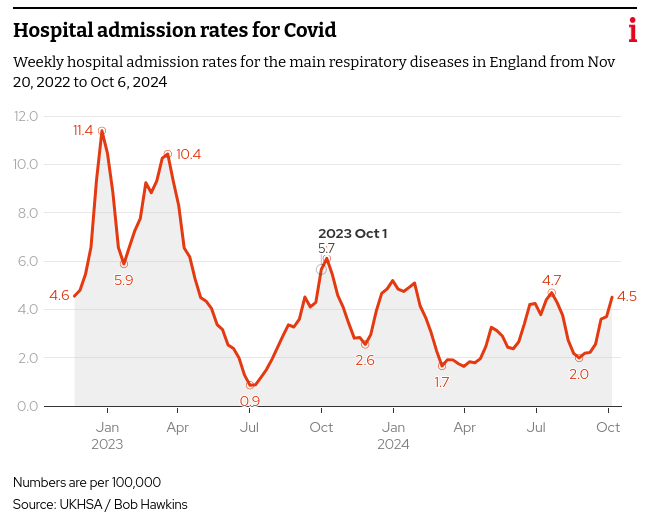
Some 4.55 people per 100,000 were hospitalised with the virus in the week to Sunday, 6 October, compared to 3.72 the week earlier, according to the latest data from the UK Health Security Agency (UKHSA).
That compares to 2.0 per 100,000 in late August and 4.7 in late July.
The rise comes after cases rose sharply in October driven by the cooler weather, children going back to school and the new variant.
New infections typically take a week or two to cause a patient to be hospitalised as their health deteriorates.
On a more positive note, the UKHSA figures also showed that new Covid infections were stable in the same week, after rising for several weeks – although they remain at relatively high levels.
Rhinovirus infections – the main cause of the common cold – were also stable, again after sharp increases.
Flu cases, meanwhile, jumped by 27 per cent in the week but remain low for now – with scientists warning of further rises as winter approaches.
The new figures show the number of people with respiratory symptoms testing positive for Covid in hospitals was 13.4 per cent in the week to last Sunday – compared to 13.3 per cent the previous week.
Meanwhile, the so-called positivity rate for rhinovirus was 17.1 per cent and for flu it was 1.9 per cent.
Positivity rates among hospital patients with symptoms are typically much higher than infection rates in the general population – figures which are not available for the UK outside of winter. But scientists say they give a good indication of trends.
The new XEC variant is spreading so fast it looks set to become the UK’s dominant Covid strain this week, fuelling the current wave of the virus, experts predict.
XEC is thought to be significantly more contagious than the other variants and quickly grew to account for 21 per cent of UK infections on Saturday 28 September, according to the Gisaid Covid database.
The new figures also showed that the rate of Respiratory infections from the Respiratory syncytial virus (RSV) are soaring, albeit from a very low base.
The positivity rate for the virus more than doubled in the week to Sunday 6 October, from 0.7 per cent to 1.6 per cent – while hospital admissions jumped by 39 per cent to 0.39 per 100,000.
RSV is another common cause of coughs and colds that can occasionally be serious for infants and older people, where it can cause pneumonia and infant bronchiolitis.

Dr Jamie Lopez Bernal, consultant epidemiologist at UKHSA, said “Covid is continuing to circulate”.
“As winter approaches, we expect flu and RSV to increasingly circulate too, so if you’re eligible to get vaccinated against the three main winter threats – Covid-19, flu and RSV – now is the time to take them up and get winter strong,” he said.
He added: “Current information doesn’t suggest we should be more concerned about XEC but we are monitoring this closely. The most important thing to do is to get your vaccination as soon as possible if you’re eligible.
“If you are showing symptoms of flu or Covid-19 such as a high temperature, cough, and feeling tired and achy, try to limit your contact with others, especially those who are vulnerable.
Professor Lawrence Young, a virologist at Warwick University, told i: “It’s clear is that both Covid and flu infections are heading in the wrong direction. This is particularly worrying as we enter the winter months where infections are likely to get worse.
“This is even more reason for those who are eligible to get their Covid and flu jabs and for others to consider private vaccinations”.
Simon Williams, of Swansea University, added: “We can expect Covid, flu and RSV rates to rise over the coming weeks and months into winter – which will put extra strain on health services.”
“And although Covid doesn’t cause the kind of hospitalisations that it did earlier in the pandemic, it is we still putting another debilitating virus in the mix. Covid is a year-round virus but it does tend to spike during winter, in part because of the way we socialise indoors more.”
Dr Williams is also concerned about the low level of vaccine uptake for respiratory viruses in general, which, in the case of Covid, means that an estimated 70 per cent of the UK population over the age of 12 has not been vaccinated for at least two years – with the effects of the vaccine typically dropping sharply after three to six months, although they can continue to offer some protection for a year or more.
“Most concerning is the lower uptake of vaccines, for example the lower flu vaccine uptake among pregnant women. We need to emphasise the importance of boosters and flu jabs in eligible groups,” he said.
Would Susan Davy jump into a bath of 97 litres of water and 3 litres of raw sewage?
(or even a 15 mls tablespoon) – Owl
This is the question posed by Jo Bateman in response to this little piece of “Greenwash” on the Escape facebook page
Hi. Are you aware that SWW are saying 97% of what they put in the sea is treated
Hello, sewage does not get dumped into the sea – I can appreciate that most people’s first experience of the wastewater network is through media portrayal, and this portrayal is often negative and can cause misconceptions.
Of the millions of litres of sewage that enters the network each day, over 97% of this is treated and we are working hard to lower the other 3%.
The network for this is vast and complex, with over 9000 miles of pipework and over 650 treatment works across the region, and part of this is an essential asset called a storm overflow.
These work as safety valves on the network and are used to prevent flooding into homes and businesses.
These are mostly used during heavy rainfall, and due to the size of the network, it can take many days for this rainfall to work its way through.
Blockages in the network can also see an increase in these, as it stops waste from being able to travel through the network and can cause issues elsewhere.
What is discharged from these overflows is mainly storm water, and any sewage is highly diluted.
You can see more how they work here – https://www.water.org.uk/protecting…/storm-overflows and what we are doing to lower their usage here – https://www.southwestwater.co.uk/waterfit – Kendall
I think of it like this…
Suppose I filled a bath with 97 litres of water, then added 3 litres of raw sewage. Would you get in? Would Susan Davy?
Deconstructed – Ofwat’s “Water Company Performance Report 2023-24”
Given the failings listed in this report Owl finds it hard to comprehend the mindset of a regulator who calmly grades water companies such as South west Water (SWW) as “average” (as in “average” in a bad lot).
SWW features in the press report below as reporting the biggest increase (80%) in pollution incidents.
Here are some more examples of “average” SWW performance in critical measures.
[To add confusion Ofwat for the next couple of years will be reporting SWW-Bristol separately from the SWW-South West we are familiar with, following the amalgamation of Bristol water into SWW in Feb 2023.]
From the detail, SWW Bristol increased its water leakage despite being allowed enhancement expenditure for leakage reduction at the 2019 price review.
The majority of non-compliant sewage treatment works (the number increased in the reporting period) were attributed to Anglian Water (13), Dŵr Cymru (12) and South West Water (12). The remaining eight companies all had less than five non-compliant works each.
Five companies have reported deteriorating performance on sewer collapses, including South West Water that had 65% more sewer collapses per 1,000 km of sewer in 2023-24 compared to 2022-23.
Owl’s more detailed extracts from the report follows this press overall summary:
Ofwat orders water companies to pay £158m back to customers
Adam Vaughan, Laurence Sleator www.thetimes.com
Water companies will have to return £158 million to customers after their worst year for pollution incidents since 2020.
Water regulator Ofwat found that nine out of 11 water companies caused more pollution incidents than the year before. South West Water reported the biggest increase, up 80 per cent. United Utilities, which serves northwest England, saw a 71 per cent rise and Northumbrian Water was up by 65 per cent.
The performance across the water sector was so bad that a target for curbing water pollution now looks out of reach. Firms had committed to cutting their pollution incidents by 30 per cent by 2025. However, the dire record last year means that they have only achieved a 2 per cent reduction to date.
Water companies have previously blamed a wet year for a record number of sewage spills in England. However, Ofwat said wet weather was no excuse for pollution.
Helen Campbell, senior director for sector performance at Ofwat, said: “I hear that a lot from water companies. I hear a number of other excuses like it was too dry or it froze or our topography is different, we’ve got more valleys than other parts of the UK. My challenge back would be: that is known, and you need to manage your assets.” The Times’ Clean it Up campaign has been urging companies and regulators to tackle water pollution.
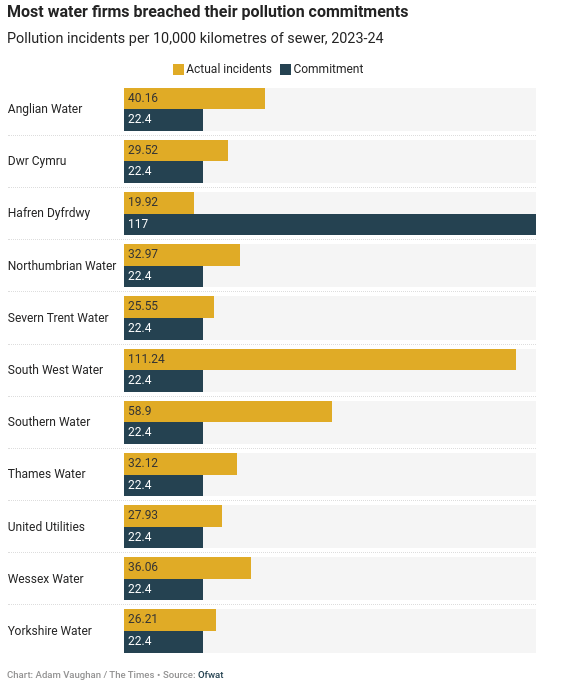
Only two companies, Hafren Dyfrdwy in Wales and Southern Water in England, reduced their pollution incidents. Hafren Dyfrdwy was the only one of 11 wastewater firms to meet its performance commitment set by Ofwat, recording 19.92 incidents per 10,000 kilometres of sewer against a pledge of 117.
By comparison, South West had promised to limit incidents to 22.40 per 10,000 kilometres of sewer but reported 111.24. The company is the furthest from meeting the 2025 goal to cut incidents.
Ofwat’s annual assessment of water companies’ overall performance breaks them down into three categories: leading, average and lagging behind.
For the second year in a row, not a single company achieved leading status. However, four companies moved from lagging to average: Thames Water, Yorkshire Water, South West Water (Bristol region) and South East Water. Southern Water, Anglian Water and Welsh Water remain lagging.
Steve Reed, the environment secretary, has written to the chief executives and chairmen of every water company, setting out the performance improvements he expects in the next year. “Our waterways should be a source of national pride, but years of pollution and underinvestment have left them in a perilous state,” he said.
The net £157.6 million penalty for underperformance across the sector is dominated by a £56.8 million charge for Thames Water, which Britain’s biggest water firm will have to return to customers through their water bills. Chris Weston, who was appointed chief executive of Thames Water in January, took a £195,000 bonus this year in addition to his £197,000 salary. Labour has promised to ban bonuses at egregiously polluting companies, and Ofwat is expected to begin consulting later this month on how the ban could be triggered.
Other big fines include £38.1 million for Anglian Water and £36 million for Yorkshire Water. However, four companies with better performance will be allowed to charge customers more. United Utilities will effectively gain £33.2 million, for example.
Today’s penalties compare to £177.6 million issued last year, which was later reduced to £114 million. The Times understands there is expected to be less movement in this year’s final figure.
Companies made some progress on leakage from pipes, which was down 6 per cent annually. But Ofwat has said more needs to be done. Almost a fifth of water is still lost from pipes before it reaches taps. Firms also made improvements on mains repairs and unplanned water outages.
Even the biggest penalty, of £56.8 million for Thames Water, will only equate to a couple of pounds off each customers’ bill. Most customers’ bills will fall by less than £10.
Experts said that the poor performance in other areas would concern households, who are being asked to shoulder an average £94 water bill increase by 2030 to pay for £88 billion of spending.
In Thames Water’s case, the regulator has suggested a £99 increase over five years — less than half of what the company has asked the regulator for. That means despite the missed targets, any discounts from Tuesday’s penalties will be more than cancelled out by the yearly growth in the price of water.
“Customers will rightly question why some companies should be trusted with more of their money for future investment, when they are struggling to deliver on their existing commitments,” said Mike Keil, chief executive of the Consumer Council for Water, a consumer watchdog.
A spokesman for Water UK said: “We know there is much more to do and companies are fully committed to boosting performance.” The industry body repeated its call for Ofwat to allow it to invest £105 billion by 2030 rather than £88 billion, before a final decision expected in December, but which could be delayed until January.
The fines are in addition to those imposed by an Ofwat investigation into failings at sewage treatment works, which has already lead to three firms being hit with a £168 million penalty.
Four performance measures where South West Water is particularly bad
Owl has extracted these four quotes from the Ofwat Water Company Performance Report 2023-24:
Water leakage
It is disappointing that four companies have reported an increase in leakage from 2022-23 to 2023-24; South West Water – South West region, Dŵr Cymru, Affinity Water and Northumbrian Water.
We are concerned that Anglian Water, South West Water – Bristol region and South East Water were all allowed enhancement expenditure for leakage reduction at the 2019 price review but have failed to meet the PCL again this year.
Pollution
It is disappointing that nine of 11 companies have had an increase in pollution incidents between 2022 and 2023. The biggest increases were reported by South West Water (80%), United Utilities (71%) and Northumbrian Water (65%).
Anglian Water, South West Water, Southern Water and Thames Water have now failed to meet the performance commitment level for four consecutive years.
Sewage treatment works
Just over half of companies met the treatment works compliance performance commitment deadband in 2023,3 which is one more than in 2022. However, compliance is still lower than the peak in 2020, when 10 companies met the deadband.
Across the sector, 57 wastewater and water treatment works were non-compliant with the relevant EA permit requirements in 2023. This is nine more than in 2022. The majority of non-compliant works were attributed to Anglian Water (13), Dŵr Cymru (12) and South West Water (12). The remaining eight companies all had less than five non-compliant works each.
Sewer collapse
Five companies have reported deteriorating performance, including South West Water that had 65% more sewer collapses per 1,000 km of sewer in 2023-24 compared to 2022-23.
[Bristol Water’s regulated business was transferred to South West Water Limited on 1 February 2023, but the company will still report separately on performance in the pre-existing South West Water and Bristol Water areas against their performance commitments for the remainder of the 2020-25 price control period. This report shows South West Water – Bristol region performance and South West Water – South West region performance separately. ]
Breaking – next leader of Tories: Badenoch or Jenrick
Right! – Owl
Well…blimey! I think this could actually be the point when the Tory party ceases to be a movement contending for government. Lib Dems now have a very serious responsibility and opportunity to fill the gap. This is our moment.

Martin Shaw: Vaccination fiasco shows NHS doesn’t understand Seaton

[7 October] I’ve just had to abandon a Covid/flu vaccination appointment at the Tesco car park after waiting an hour, since I’d have to wait another hour before being done. This is despite having an appointment. The core reason for the fiasco is that the NHS grossly underestimated the walk-in demand in the morning, so that people who had waited hours were ahead of the people with timed appointments (there was also a medical emergency which apparently slowed things a little).
All a striking contrast with the orderly vaccination process in Seaton hospital during the pandemic. The NHS obviously just doesn’t understand that 45 per cent of Seaton’s population are over 65 and therefore eligible. They’re trying to do vaccination on the cheap and they are not taking into account that people are rightly still very concerned about catching Covid.
Another celebrity chef’s enterprise bites the dust
Who will be next? There is no way of avoiding the inescapable fact that this is a seasonal site, remote from the town and exposed to the elements. Who, for example, would really have wanted to venture out last night in the howling wind and rain? – Owl
Mickeys Exmouth is being sold off and closing on October 9
After over three years of trading, Mickeys will be closing after the dinner service on Wednesday October 9.
Adam Manning www.exmouthjournal.co.uk
They say that the closure is planned and the preparation for a sale is subject to final details. Located at Sideshore, Exmouth Seafront Mickeys Beach and Café Patisserie Glacerie opened in April and May of 2021 in line with the reopening of hospitality following the lockdown of Covid-19.
A further announcement will be made following the completion of the sale where the new owners will be announced.
Speaking about the closure, chef and owner Michael Caines said: “On behalf of all the team we would like to thank our customers and suppliers for your support, we have thoroughly enjoyed serving each and every one of you and making Mickeys and the Café a special place to meet by the sea.
“I would also like to thank my team for their unwavering support and dedication, despite the challenging times we have had, I am proud of what we have been able to create.
“We are however delighted to announce the sale of the business to another local business operator who shares a similar passion, for fun relaxed dining.”
A spokesman for Michael Caines said: “For those that have enjoyed Mickeys Beach Bar & Restaurant, head to the Pool House Restaurant at Lympstone Manor Hotel for casual and relaxed dining, overlooking the Exe Estuary and the Vineyard. ”
29 Devon beaches hit with more sewage alerts
Could this be termed a “clean sweep”? – Owl
A number of beaches and popular swimming spots across Devon have been hit with pollution alerts after the rainfall yesterday. The region was battered with heavy downpours and strong winds after the Met Office issued a yellow weather warning.
Molly Seaman www.devonlive.com
Surfers Against Sewage (SAS), a charity and campaign group, has warned people to avoid 29 beaches across Devon today. There is sewage pollution at the large proportion of Devon beaches following the rain.
The sewage warnings come after Devon was battered by thunderstorms, rain, hail and strong winds yesterday. Exeter-based forecasters at the Met Office issued the warning while the Environment Agency warned of the possibility of flash floods.
An interactive map from SAS highlights the areas where sewage has been discharged into the sea and rivers. It is common after heavy rainfall as storm overflows are used to prevent drains becoming overwhelmed.
A sewage pollution alert means “storm sewage has been discharged from a sewer overflow in this location within the past 48 hours”. Meanwhile, a “pollution risk forecast” means there is potential for sewage to be in the area.
Sewage pollution alerts are in place at the following locations in Devon:
- Firestone Bay
- Plymouth Hoe East
- Plymouth Hoe West
- Mothercombe
- Coastguards Beach Erme Estuary
- Challaborough
- Hope Cove
- Salcombe South Sands
- Mill Bay
- Warfleet Creek Dart Estuary
- Dartmouth Castle and Sugary Cove
- Stoke Gabriel Dart Estuary
- Steamer Quay Dart Estuary
- St Marys Bay (Devon)
- Paignton Preston Sands
- Torre Abbey
- Meadfoot
- Teignmouth Holcombe
- Dawlish Town
- Exmouth
- Sandy Bay
- Budleigh Salterton
- Sidmouth Town
- Beer
- Seaton (Devon)
- Ilfracombe Hele
- Woolacombe Village
- Instow
- Westward Ho!
SAS is calling for an end to sewage discharges into all bathing waters, and high-priority nature sites, by 2030. In 2023, there were 584,001 recorded discharges across England, Scotland and Wales – an 51 per cent increase on the previous year – with sewage released into waterways for a total of 12,966,322 hours.
First Tesco to gain “Blue Plaque”
“A lettuce purchased here in September 2022 lasted longer than prime minister Liz Truss.”

Blue Plaque Put Up At Supermarket Where The Lettuce That Beat Liz Truss Was Bought
A fake blue plaque has been installed outside the supermarket where the lettuce that famously defeated Liz Truss was bought.
Kevin Schofield www.huffingtonpost.co.uk
The commemoration is yet more humiliation for the former prime minister, who only last 49 days in office.
It has been erected at a Tesco in Walthamstow, east London, and says: “A lettuce purchased here in September 2022 lasted longer than prime minister Liz Truss.”

The lettuce stunt was launched by the Daily Star as Truss battled to save her political career in the wake of the disastrous mini-Budget.
Chancellor Kwasi Kwarteng’s package of unfunded tax cuts sent the financial markets into crisis, saw interest rates soar and the value of the pound plummet.
At one stage, the Bank of England even had to step in to prevent the British pensions industry from collapsing.
The Daily Star website set up a livestream, showing the lettuce with eyes and a blonde wig, to see if it would last longer than Truss did in No.10. The lettuce won.
Since leaving office, Truss has struggled to shake off the embarrassment of being defeated by the leafy vegetable.
In August, a banner depicting a lettuce and the message “I crashed the economy” slowly unfurled from the ceiling behind her as she spoke at a pro-Donald Trump event.
Once she noticed it, the former PM left the stage, and the following day wrote on X: “What happened last night was not funny. Far-left activists disrupted the event, which then had to be stopped for security reasons. This is done to intimidate people and suppress free speech.
“I won’t stand for it. Would we see the same reaction if the activists were far-right?”
East Devon District Council to get better return on investments
Better-than-expected returns from East Devon District Council’s investments means it is predicting a budget surplus.
But not out of the woods – Owl
Bradley Gerrard www.exmouthjournal.co.uk
The local authority thinks it will earn just over £2.3 million in investment income in this financial year, compared to the £1.5 million anticipated when it set its budget.
The boost outweighs lower-than-expected income from planning fees so far this year, although the council believes there is “significant potential” for that to improve thanks partly to two major residential planning applications at Cranbrook.
The council had also saved money from its management of public toilets, but its £300,000 target hasn’t yet been met.
However, the investment income again counteracts this, meaning the authority is expecting a surplus of around £500,000 in its general fund.
In its housing budget, which is ring-fenced money, a small surplus of £77,000 is predicted, with higher returns from investment income helping again.
Furthermore, while there is a predicted underspend in its housing capital account – a specific pot of money for the likes of housing repairs – this will either be spent this year or rolled over to next.
Millions of pounds in extra funding to rectify years of under-investment in social housing in the district was approved in July, with the council’s leader then claiming previous efforts to tackle the issue hadn’t worked.
The full council agreed nearly £12 million of additional funding in the summer, mainly to help it cover the cost of increased requirements on social landlords to ensure properties meet high safety and quality standards.
Like many councils, this means East Devon’s housing-related costs are rising more quickly than its income, exacerbated by what several councillors and officers referred to as sustained under-investment.
Latest news on investigation into Chief Constable – Alison Hernandez waits and so must we
PCC to wait on criminal investigation into chief constable
The police and crime commissioner for Devon and Cornwall says she’s expecting an update on a criminal investigation into the force’s chief constable in “the next month or so”.
Elliot Ball, Ben Woolvin www.bbc.co.uk
Will Kerr was suspended in July 2023 after an investigation was opened into “serious allegations of sexual offences” in Northern Ireland, which he denies.
Alison Hernandez said she had hoped to receive an update from the Public Prosecution Service for Northern Ireland (PPSNI) in September, but had now been told “they will get back to me in October or in a couple of months”.
Speaking on the investigation following Friday’s meeting of the Police and Crime Panel, Ms Hernandez said: “My timescale is that I will wait until the public prosecution service has decided whether there is a criminal charge or not.”
‘Still waiting’
She added: “If there is a criminal charge I may well not want to wait it out but if there is not a criminal charge I would be interested to what the misconduct element looks like and how long that may take.”
Ms Hernandez said she had written to the PPSNI and “I’m still waiting and I’m putting pressure on for a decision to be made because it’s not just affecting an individual’s life but the whole police force.”
In her attempt to move the investigation on, Ms Hernandez also said she had asked the chief inspector of His Majesty’s Inspectorate of Constabulary Fire and Police Services to write to the PPSNI.
“I really am now hopeful that it should be in the next month or so that I get an answer and that helps me make a decision about what I do next,” she said.
The PPSNI said the file it received in May had been significantly progressed but there was no specific timescale for a decision at this stage.
‘Not really acceptable’
Mr Kerr remains on full pay with an annual salary of £197,000, according to the latest accounts.
Councillor Philip Hackett said the Police and Crime Panel had been told in July that it would be informed of Mr Kerr’s position at the meeting on 4 October.
However in Friday’s meeting the panel was instead told the date had been “pushed [forward] another couple of months”.
He said: “It’s basically been punted into the long grass.
“It’s not really acceptable when resources are so tight.”
Water quality at cleanest swimming spots plummets in winter
Several of England’s cleanest seaside swimming spots deteriorate in autumn and winter, an unpublished government report has found. This includes Summerleaze, Exmouth and Firestone Bay
Adam Vaughan www.thetimes.com
Outside the bathing water season, which runs from the middle of May to September, there is no regular site monitoring for harmful bacteria.
However, campaigners have called for year-round testing because of the growing popularity of cold-water swimming, thanks to advances in wetsuits.
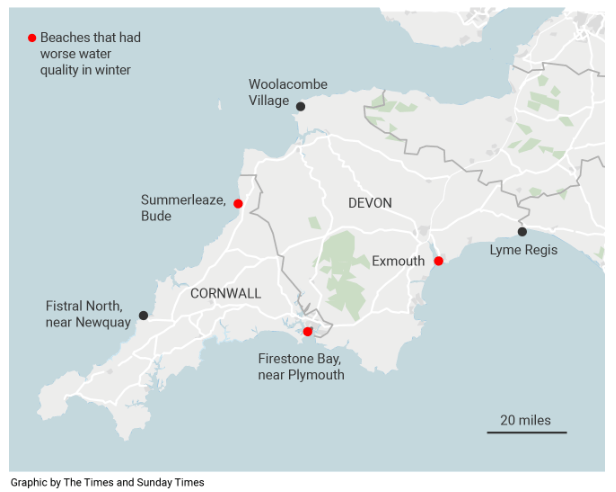
The Times can reveal that the Environment Agency (EA) ran a pilot project of winter water testing at several bathing sites. It found year-round testing was feasible despite challenges, and an internal EA document obtained by Greenpeace’s investigative unit, Unearthed, showed three of six beaches in Devon, Cornwall and Dorset became dirtier in winter.
Water quality at designated swimming spots is rated “excellent”, “good”, “sufficient” or “poor” in summer, depending on the levels of harmful bacteria found by weekly tests.
Exmouth fell from excellent in summer to poor in winter, an unsafe level for swimming, the EA project found. Summerleaze, in Bude, and Firestone Bay, near Plymouth, both dropped from excellent to sufficient. Two beaches stayed the same; one, Lyme Regis, improved from good to excellent.
Jo Bateman, a retired physiotherapist who is a wild swimmer in Exmouth, said: “I just think it’s shocking, but not a surprise. It’s totally unacceptable. People swim all year round, and many people use the water in winter here: kitesurfers, windsurfers, kayakers, rowers.”
Bateman, who is taking legal action against South West Water for a loss of amenity — being unable to swim — due to sewage spills, said monitoring of bathing waters should be extended to winter. “One hundred per cent, it’s essential. To say the bathing water quality is excellent, but it’s only for four months of the year, that’s disingenuous.”
Andy Tyerman, a local resident and member of the campaign group End Sewage Convoys and Poollution Exmouth, said: “We are obviously very disappointed that the results for Exmouth were so poor.” The EA is considering legal action against South West Water over sewage discharges at the town in August, when swimmers were told to stay out of the water.
During the bathing water season officials from the EA take weekly tests for two types of bacteria that cause sickness: intestinal enterococci and E. coli, which are found in faeces. Sewage, manure run-off from fields and birds can all be sources of the pollution. Four years of data are usually used to inform classifications.
At a meeting last month the agency showed little interest in taking water samples all year round, but the water regulator did commission a project that tested waters at the six beaches from last October to March this year.
The aims of the project were to see if winter testing was possible and to gauge how bacteria levels differ in winter, when heavier rain can wash more pollutants down rivers to coastal waters.
The deterioration in winter at Summerleaze, Exmouth and Firestone Bay — the latter designated a bathing water spot only last year — was blamed on greater pollution from rivers. At Exmouth, sewage incidents on the beach were also an issue.
Analysis of the types of bacteria at Firestone Bay indicated the source was roughly half human and half cattle — suggesting a mixture of sewage and agricultural pollution. At Summerleaze and Exmouth, farming appeared to have played a greater role.
Rougher seas in winter meant only 60 per cent of a possible maximum of 174 samples were successfully collected across the six sites. Officials said with extra resources catch-up testing could be done on safer days, allowing a dataset for winter to be produced that was comparable with summer’s.
“This story simply states what surfers and swimmers across the country already know — sewage ain’t seasonal,” Giles Bristow, chief executive of Surfers Against Sewage, said.
“We demand a water quality testing regime which is based on the reality of how the polluting water industry operates and how people actually use our rivers, lakes and seas. It’s 2024, not 1924.”
South West Water said it was aiming for year-round high water quality at all bathing sites. The company has started going beyond statutory requirements, taking daily samples at 14 swimming spots including Exmouth and Firestone Bay. Richard Price, managing director of waste water services, said: “Bathing water quality in our region remains a priority, and we fully support efforts to better understand conditions across the 157 bathing waters we serve.”
The EA noted that 90 per cent of bathing waters in summer met “good” or “excellent” standards. It is understood to have chosen the six beaches as representative of bathing waters across the country and commissioned the project to see how climate change was affecting beaches.
“During the bathing water season, we take more than 7,000 samples at 451 bathing waters to provide people with water quality information to make informed choices on when and where to swim. We will continue to work closely with the agriculture sector, water companies and local communities to ensure the highest standard of bathing waters for the public,” the agency said.
The Times’ Clean it Up campaign has been demanding great regulatory action and investment to improve the UK’s waters.
South West Water blasted over Brixham bug response
Cllr Ged Yardy (Lib Dem, Dartmouth and East Dart) told a full South Hams council meeting: “Their system for compensation is utterly disappointing.
“They are spending money on expensive lawyers to defend compensation cases when they should be just paying up.”
Guy Henderson, local democracy reporter www.radioexe.co.uk
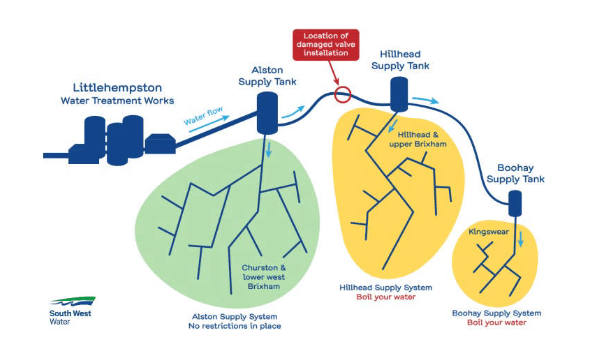
Diagram showing the supply to the Brixham and Kingswear tanks (Image courtesy: South West Water)
South West Water has come under fire again for the way it has responded to the cryptosporidium outbreak that hit South Devon earlier this year.
Thousands of homes in Kingswear and Brixham were told to boil their water before drinking it after the bug got into supplies from a small reservoir nearby.
The disruption lasted for weeks, with South West Water (SWW) having to hand out tens of thousands of bottles of water to worried households. Dozens of people were made ill by the bug, and several were hospitalised.
The water company has been summoned to a ‘summit’ in the coming weeks to explain the outbreak and what is being done to make sure it doesn’t happen again.
Cllr Ged Yardy (Lib Dem, Dartmouth and East Dart) told a full South Hams council meeting: “Their system for compensation is utterly disappointing.
“They are spending money on expensive lawyers to defend compensation cases when they should be just paying up.”
And Cllr Jacqi Hodgson (Green, Dartington and Staverton) said the £3.2 billion SWW says it has paid in dividends to shareholders since 1990 could have been better spent on improving the company’s infrastructure.
And, she went on: “All of these public services that we have privatised will spend more on lawyers than on the common decency of paying compensation for what has gone wrong.”
Anger over county housing cash ‘betrayal’
‘They have an opportunity to address the housing crisis and have decided not to’
Devon County Council is being accused of betraying local families in desperate need of homes.
Guy Henderson – Local Democracy Reporter www.radioexe.co.uk
County Hall has announced that instead of ‘ring-fencing’ proceeds from doubling council tax on second homes and using it for housing projects, it will spend some of the money on fixing potholes instead.
The announcement sparked fury from South Hams district councillors, who wanted all the cash ploughed back into housing. The area has 4,000 second homes, and the £6.4 million raised is the highest of any district in Devon.
“What the county council is doing is a betrayal of the people of Devon,” said Cllr David Hancock (Lib Dem, South Brent). “They have an opportunity to address what they have declared as a housing crisis, and they have decided not to.”
But South Hams’ full council dropped a call for the extra money raised in the district to be kept there, after hearing that they could drive a better bargain by being more flexible.
Members were voting on a motion brought by Cllr Nicky Hopwood (Con., Woolwell), who said the county council should repair road from its existing budget rather than spending council tax funds.
“I would never have voted for 200 per cent council tax if I thought for one moment that Devon would not ringfence it for affordable housing,” she said.
She said she was ‘bitterly disappointed’, and went on: “We didn’t raise the council tax to give it to the whole of Devon. We raised it to give it to the South Hams.
“If we can’t keep that money in the South Hams, what’s the point of charging it?”
Council leader Julian Brazil (Lib Dem, Stokenham), who also sits on the county council, said while it would be wrong to demand that the money stay in the South Hams, it was right to say it should stay in the housing budget.
He went on: “This is about the county, having declared a housing crisis, betraying the people of Devon by saying they are going to spend money putting a sticking plaster over potholes in the roads.
“This is a once-in-a-generation opportunity to invest tens of millions of pounds into housing we desperately need.
“Our communities are being hollowed out. They are becoming retirement homes for people from up-country.”
Cllr Jonathan Hawkins (Con, Dartmouth and East Dart) said while communities benefit from money brought in by second home owners, there were streets in Dartmouth and Kingswear which had just one local family living in them all year round.
Families were moving out and relocating to Torbay and Newton Abbot, where they could afford homes.
“It is really soul-destroying,” he said.
Lib Dem leader to hear concerns about state of hospital
Buildings at North Devon District Hospital over 50 years old
Liberal Democrat leader Ed Davey will hear about North Devon District Hospital’s ageing operating theatre and critical care infrastructure when he visits next week.
Alison Stephenson, local democracy reporter www.radioexe.co.uk
Because of its remoteness, North Devon Liberal Democrat MP Ian Roome wants the Barnstaple hospital to be made a special case as the government undertakes its review into planned upgrades formerly announced by the Conservatives.
A number of Lib Dem MPs in Devon have joined a petition by Cornish MP Ben Maguire demanding the government reconsiders the review and allows the works to go ahead. They include Steve Darling (Torbay) and Caroline Voaden (South Devon). Torbay Hospital and a new women’s and children’s hospital at Treliske in Cornwall are also on the list as is Derriford’s new urgent and emergency care facility.
The New Hospital Programme (NHP) was expected to be backed with £20 billion of funding but health secretary Wes Streeting says the plan is “not deliverable”.
MPs are now concerned that the hospitals in review – ones without business case approval for their main build phase – could be cancelled.
Mr Roome, a former mental health nurse, said former Tory health minister Lord Markham visited North Devon District Hospital (NDDH) last summer and promised spades would be in the ground by February this year.
“We have not seen a penny. It’s all been about business cases and consultants,” he said. “It is absolutely imperative that the government’s review into the New Hospital Programme at NDDH focuses on urgent needs in the area. The decision to scrap these plans would be catastrophic.”
He has invited Mr Davey to visit on Wednesday.
“The NDDH has a high level of on-site infrastructure risk and, given that it’s the most remote mainland hospital in England, the effects of losing this funding could be devastating, forcing people to travel long distances to access essential care,” said Mr Roome.
He said the hospital provided a 24/7 emergency service and is a designated trauma unit, meaning it could “stabilise the most severe conditions” before patients are transferred to more specialised hospitals at Bristol, Plymouth of London.
“The thing is if you lose a hospital in London, there is another 10 minutes away. That is not the case here in North Devon. Patients in Lynton and Lynmouth face a two hour trip to get to Exeter.
“Our hospital is over-capacity as it is, and the theatre and intensive care unit are over 50 years old.”
At a board meeting of the Royal Devon University Healthcare NHS Foundation Trust this week, chief executive Sam Higginson said the trust is continuing to make the case for NDDH “very strongly” with the government.
He said they are concerned “if there was a failure there what the implications of that might be for patients” given risks faced with the ageing theatre and critical care infrastructure.
“I, and the chair, have both written to the secretary of state for health to make that case yet again and invited him to come and visit us in Barnstaple to see for himself.” he said.
“We think we will see some outcome from the review around about budget time (Wednesday 30 October) and we will convene as a board to decide the next steps once we are clear what the future holds
“The most important thing for me is that we end up in a position where we have safe and appropriate infrastructure.”
In a letter to MPs in constituencies affected by the review, Mr Streeting said the previous government failed to hold a spending review in their last few years of office, which allowed the Conservatives to suugest £20 billion of investment for hospitals which hadn’t been accounted for.
Conservative MP for South West Devon Rebecca Smith has launched her own petition to save the urgent and emergency care facility at Derriford.
She said: “I welcome the fact that the government is still considering this essential scheme. The capacity challenges at Derriford Hospital are in plain sight. Its health workers operate in an extremely challenging environment. Every day my inbox is filled with emails from constituents who are left waiting for treatment at Derriford Hospital.”
Public loos in Exmouth, Budleigh, Seaton and Honiton upgrade dates (weather permitting)
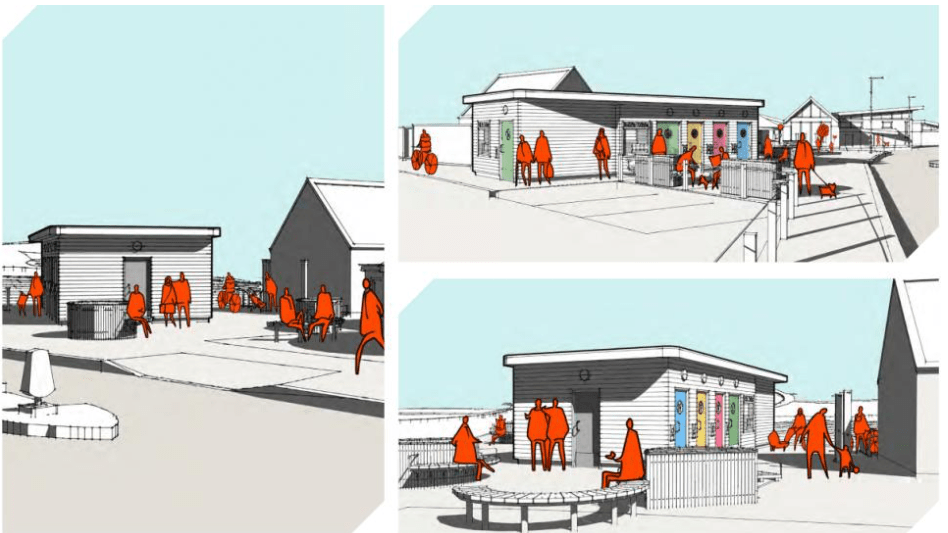
Work to replace four toilet blocks in Exmouth, Budleigh Salterton, Seaton and Honiton is set to begin soon.
Adam Manning www.exmouthjournal.co.uk
Construction is expected to last around two to three months at each site. The scheduled start dates (weather permitting) are as follows:
· Exmouth (Foxholes): Monday, 7th October
· Budleigh Salterton (East End, Lime Kiln): Monday, 21st October
· Seaton (West Walk): Monday, 4th November
· Honiton (Lace Walk): Monday, 18th November
Initial works will involve site set-up and essential surveys, with major groundworks commencing at the Exmouth site near the beginning of November with other sites following shortly thereafter.
All investment works are scheduled for completion by early 2025, with the Exmouth site expected to be finished in December and the Honiton site by February.
Temporary toilet facilities will be provided at Exmouth, Budleigh Salterton, and Seaton throughout the works, but no temporary facilities will be available at Lace Walk, Honiton, due to levels of usage and access to other public toilets in locality.
The works will provide modern fit-for-purpose facilities, improved accessibility and generally a more pleasant user experience.
This project follows the 2021 Public Toilet Review consultation. Read more: East Devon Council extend closing date for public toilets.
A new toilet block was proposed at Ham East in Sidmouth, but the planning application was refused.
Temporary toilets will be provided at all phase one sites except Lace Walk, Honiton. Accessible toilets will also be available, and no radar key will be required.
The new toilets will cost 40p to use, and showers will be installed at all seafront locations.
The work is part of an East Devon District Council (EDDC) public toilet investment programme majority funded by the council with top-up funding from national government towards new adult changing places facilities at the Exmouth, Budleigh Salterton and Seaton sites.
For more information, visit the EDDC website.
Dragon Patchers – Five thousand Devon potholes repaired in months
Five thousand Devon potholes have been fixed in just six months using a device known as a ‘dragon patcher’.
Bradley Gerrard, local democracy reporter www.radioexe.co.uk

Devon’s Dragon Patchers flying through pothole repairs (image courtesy: Devon County Council)
The machines, which emits flames, are being used across the county’s vast road network to tackle the huge number of damaged surfaces.
Since April, more than 33,000 square metres of material have been laid to fix potholes and road damage across 5,250 patches.
The success of the dragon patchers appears to be because the heat of their flames helps the repair material bond effectively to the existing road surface.
Cllr Jerry Brook (Conservative, Chudleigh and Teign Valley) told the county council’s corporate infrastructure and regulatory services scrutiny committee he had been “criss-crossing” Devon recently and had seen a clear improvements on the roads.
“There has been an enormous amount of work and therefore improvement to our network in quite a short space of time,” he said.
“Some places are diabolical still and they may never get done, but I want to say congratulations to the team as there has been quite considerable improvement.”
The committee’s chair, Frank Letch (Liberal Democrat, Crediton), added: “I would reiterate that in my area too.”
In the first four months of this financial year, more than 24,000 potholes were recorded – a 54 per cent increase on the same period last year.
The council’s highways department was helped by an extra £12 million in funding.
More than £7 million of this has been put towards capital funding, which has allowed the council to double the number of patching teams from two to four.
 East Devon Watch