
Given the failings listed in this report Owl finds it hard to comprehend the mindset of a regulator who calmly grades water companies such as South west Water (SWW) as “average” (as in “average” in a bad lot).
SWW features in the press report below as reporting the biggest increase (80%) in pollution incidents.
Here are some more examples of “average” SWW performance in critical measures.
[To add confusion Ofwat for the next couple of years will be reporting SWW-Bristol separately from the SWW-South West we are familiar with, following the amalgamation of Bristol water into SWW in Feb 2023.]
From the detail, SWW Bristol increased its water leakage despite being allowed enhancement expenditure for leakage reduction at the 2019 price review.
The majority of non-compliant sewage treatment works (the number increased in the reporting period) were attributed to Anglian Water (13), Dŵr Cymru (12) and South West Water (12). The remaining eight companies all had less than five non-compliant works each.
Five companies have reported deteriorating performance on sewer collapses, including South West Water that had 65% more sewer collapses per 1,000 km of sewer in 2023-24 compared to 2022-23.
Owl’s more detailed extracts from the report follows this press overall summary:
Ofwat orders water companies to pay £158m back to customers
Adam Vaughan, Laurence Sleator www.thetimes.com
Water companies will have to return £158 million to customers after their worst year for pollution incidents since 2020.
Water regulator Ofwat found that nine out of 11 water companies caused more pollution incidents than the year before. South West Water reported the biggest increase, up 80 per cent. United Utilities, which serves northwest England, saw a 71 per cent rise and Northumbrian Water was up by 65 per cent.
The performance across the water sector was so bad that a target for curbing water pollution now looks out of reach. Firms had committed to cutting their pollution incidents by 30 per cent by 2025. However, the dire record last year means that they have only achieved a 2 per cent reduction to date.
Water companies have previously blamed a wet year for a record number of sewage spills in England. However, Ofwat said wet weather was no excuse for pollution.
Helen Campbell, senior director for sector performance at Ofwat, said: “I hear that a lot from water companies. I hear a number of other excuses like it was too dry or it froze or our topography is different, we’ve got more valleys than other parts of the UK. My challenge back would be: that is known, and you need to manage your assets.” The Times’ Clean it Up campaign has been urging companies and regulators to tackle water pollution.
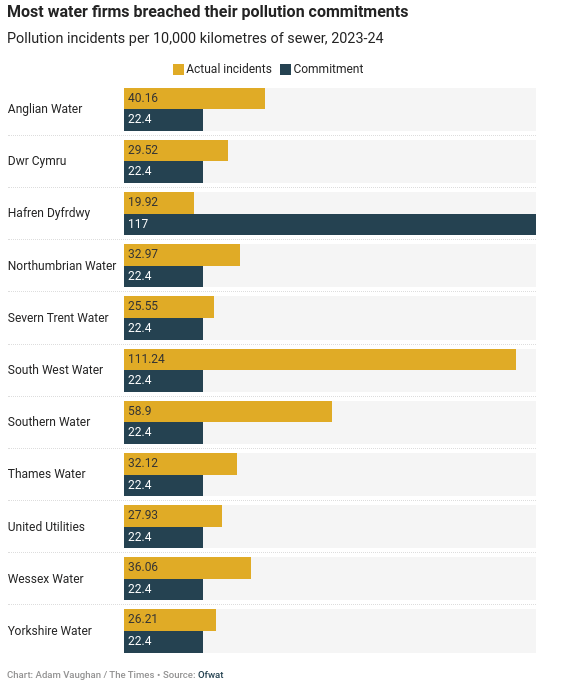
Only two companies, Hafren Dyfrdwy in Wales and Southern Water in England, reduced their pollution incidents. Hafren Dyfrdwy was the only one of 11 wastewater firms to meet its performance commitment set by Ofwat, recording 19.92 incidents per 10,000 kilometres of sewer against a pledge of 117.
By comparison, South West had promised to limit incidents to 22.40 per 10,000 kilometres of sewer but reported 111.24. The company is the furthest from meeting the 2025 goal to cut incidents.
Ofwat’s annual assessment of water companies’ overall performance breaks them down into three categories: leading, average and lagging behind.
For the second year in a row, not a single company achieved leading status. However, four companies moved from lagging to average: Thames Water, Yorkshire Water, South West Water (Bristol region) and South East Water. Southern Water, Anglian Water and Welsh Water remain lagging.
Steve Reed, the environment secretary, has written to the chief executives and chairmen of every water company, setting out the performance improvements he expects in the next year. “Our waterways should be a source of national pride, but years of pollution and underinvestment have left them in a perilous state,” he said.
The net £157.6 million penalty for underperformance across the sector is dominated by a £56.8 million charge for Thames Water, which Britain’s biggest water firm will have to return to customers through their water bills. Chris Weston, who was appointed chief executive of Thames Water in January, took a £195,000 bonus this year in addition to his £197,000 salary. Labour has promised to ban bonuses at egregiously polluting companies, and Ofwat is expected to begin consulting later this month on how the ban could be triggered.
Other big fines include £38.1 million for Anglian Water and £36 million for Yorkshire Water. However, four companies with better performance will be allowed to charge customers more. United Utilities will effectively gain £33.2 million, for example.
Today’s penalties compare to £177.6 million issued last year, which was later reduced to £114 million. The Times understands there is expected to be less movement in this year’s final figure.
Companies made some progress on leakage from pipes, which was down 6 per cent annually. But Ofwat has said more needs to be done. Almost a fifth of water is still lost from pipes before it reaches taps. Firms also made improvements on mains repairs and unplanned water outages.
Even the biggest penalty, of £56.8 million for Thames Water, will only equate to a couple of pounds off each customers’ bill. Most customers’ bills will fall by less than £10.
Experts said that the poor performance in other areas would concern households, who are being asked to shoulder an average £94 water bill increase by 2030 to pay for £88 billion of spending.
In Thames Water’s case, the regulator has suggested a £99 increase over five years — less than half of what the company has asked the regulator for. That means despite the missed targets, any discounts from Tuesday’s penalties will be more than cancelled out by the yearly growth in the price of water.
“Customers will rightly question why some companies should be trusted with more of their money for future investment, when they are struggling to deliver on their existing commitments,” said Mike Keil, chief executive of the Consumer Council for Water, a consumer watchdog.
A spokesman for Water UK said: “We know there is much more to do and companies are fully committed to boosting performance.” The industry body repeated its call for Ofwat to allow it to invest £105 billion by 2030 rather than £88 billion, before a final decision expected in December, but which could be delayed until January.
The fines are in addition to those imposed by an Ofwat investigation into failings at sewage treatment works, which has already lead to three firms being hit with a £168 million penalty.
Four performance measures where South West Water is particularly bad
Owl has extracted these four quotes from the Ofwat Water Company Performance Report 2023-24:
Water leakage
It is disappointing that four companies have reported an increase in leakage from 2022-23 to 2023-24; South West Water – South West region, Dŵr Cymru, Affinity Water and Northumbrian Water.
We are concerned that Anglian Water, South West Water – Bristol region and South East Water were all allowed enhancement expenditure for leakage reduction at the 2019 price review but have failed to meet the PCL again this year.
Pollution
It is disappointing that nine of 11 companies have had an increase in pollution incidents between 2022 and 2023. The biggest increases were reported by South West Water (80%), United Utilities (71%) and Northumbrian Water (65%).
Anglian Water, South West Water, Southern Water and Thames Water have now failed to meet the performance commitment level for four consecutive years.
Sewage treatment works
Just over half of companies met the treatment works compliance performance commitment deadband in 2023,3 which is one more than in 2022. However, compliance is still lower than the peak in 2020, when 10 companies met the deadband.
Across the sector, 57 wastewater and water treatment works were non-compliant with the relevant EA permit requirements in 2023. This is nine more than in 2022. The majority of non-compliant works were attributed to Anglian Water (13), Dŵr Cymru (12) and South West Water (12). The remaining eight companies all had less than five non-compliant works each.
Sewer collapse
Five companies have reported deteriorating performance, including South West Water that had 65% more sewer collapses per 1,000 km of sewer in 2023-24 compared to 2022-23.
[Bristol Water’s regulated business was transferred to South West Water Limited on 1 February 2023, but the company will still report separately on performance in the pre-existing South West Water and Bristol Water areas against their performance commitments for the remainder of the 2020-25 price control period. This report shows South West Water – Bristol region performance and South West Water – South West region performance separately. ]

