Water quality: a Correspondent takes “Responsibility”

From a correspondent:

A South West Water story about “taking personal responsibility ” …

Suddenly, after many years in my home with clean water, dirty black marks on shower head and toilet rim and little, black “worm like things” coming out of all basin taps.  Ugh!  Reported to SWW.

South West Water say it is “biofilm” – a completely harmless interaction of substances inside water pipe and my job to keep it at bay – bleach, etc.  They even sent me a leaflet telling me what to do, which I did, but it didn’t stop.

Refused to accept this and, after pressure my tap water was tested.  Same response from SWW – clear, harmless “biofilm” and my responsibility.

Pointed out an area just behind my home (miles from a water course and on top of a hill) covered in pondweed and always wet and suggested there might be a leak – no response.

I found a university which specialised in biofilm research – yes, it is kind-of harmless ON ITS OWN BUT known to attract bugs and bacteria – including e coli and other nasties.  Remember, I was told I could brush my teeth in this stuff …

A few weeks later, without warning, a repair team turned up and did a “running” repair to the water main (ie water not turned off so no-one needed to be informed).

Since then:

no black stuff in water or toilet

showerhead clean

no “worms”

water pressure has improved enormously

pondweed outside drying up and being replaced by grass and normal weeds

Yep, I took MY responsibility … 

New rent-a-beach hut scheme at Budleigh

This summer, you can rent a beach hut at Budleigh Salterton. 

Adam Manning www.exmouthjournal.co.uk 

Running from April 1, until October 23, the new scheme by East Devon District Council includes five large huts and seven small ones. The new huts were put in place last week, replacing the broken structures from last season. 

EDDC Budleigh and Raleigh ward Councillor Paul Jarvis said: “This can only be a step forward in sharing our wonderful resources. Both locals and visitors can both enjoy the use of the huts, giving them all a truly unique Budleigh experience.”

Cllr for Budleigh, Tom Wright, added: “It will be wonderful to be able to offer these bright new beach huts. After two dreadful years an omen of things to come.”

A small beach hut for a day will cost £35 and £110 for the week. A large hut for the day will cost £40 and £120 for a week.

To hire a hut or make inquiries about availability, contact Budleigh Information Centre on 01395 445275 , email info@visitbudleigh.com or use the booking inquiry form on www.lovebudleigh.co.uk  or www.visitbudleigh.com

Teignmouth Hospital set to close

“Torbay and South Devon NHS Foundation Trust is committed to continuing to engage with local people on both the development of the planned new health and wellbeing centre and the future of Teignmouth Community Hospital.”

“Committed to continuing to engage” this buzz phrase says it all – Owl

Ollie Heptinstall www.devonlive.com 

The first purpose-built NHS hospital looks set to close after a review dismissed concerns about consultation over the plans. An independent panel found the NHS consulted ‘adequately’ with councillors over the future of Teignmouth Hospital.

The community hospital on Mill Lane was the first to be built by the NHS in 1954 but is planned to close, with services moving to Dawlish Hospital and a new £8 million health centre in Teignmouth town centre. Doubts about the hospital’s future were first raised in 2014, and campaigners have argued against the closure decision made by NHS Devon. They say community hospital beds are “desperately needed,” and a petition titled ‘Hands Off Teignmouth Hospital’ has been supported by more than 1,000 people.

Last March, the county council’s health and care scrutiny committee reconsidered the NHS Devon Clinical Commissioning Group’s plans and decided they were unhappy with the lack of consultation over the future of the site. After referring the issue to the health secretary, it was announced in November that Sajid Javid had agreed to the request and plans to close the hospital would be reviewed by a panel of independent experts – the IRP.

The panel has now ruled that the CCG’s consultation with the committee was “adequate,” paving the way for the closure to go ahead. But it did warn there are “lessons to be learned for both parties, particularly around engagement with scrutiny committee members to resolve issues and agree reasonable timescales for discussion before a final decision on a proposal is made.”

The CCG said during its consultation process that the hospital site would be “likely to be sold to generate funds for reinvestment in the NHS”. But it has since told the panel that any decisions are for owner Torbay and South Devon NHS Foundation Trust to make.

Despite complaints from the committee, the panel’s report ruled: “…the future of Teignmouth Community Hospital under the proposal has been in plain sight for everyone and open for discussion with the NHS since 2018.”

However, it went on to say: “With hindsight, and given the sensitivities around this, the panel feels that the CCG perhaps could have been more explicit in its communication with the public about how they would be involved in determining the hospital’s future, should the proposal be implemented. In this regard, for example, the public consultation document was a missed opportunity.”

The NHS must also “engage the local community and interested parties, such as the local authority, in a programme to determine the future” of the site, it added, drawing on the example of nearby Dartmouth where the former cottage hospital could be taken over by the community.

Despite concerns about 12 rehabilitation beds not reopening, especially during Covid to help with capacity, the view of the experts was that: “…opening beds at Teignmouth Community Hospital is not a viable option to consider for providing additional COVID-19 capacity in the future.”

The report also concluded that the plans would not disadvantage groups with protected characteristics but agreed there are “still some legitimate concerns” around public transport and called for a group of stakeholders to work on the issues. In addition, it recommends the NHS “keeps its scenario planning and risk analysis of bed and workforce capacity under close review” following the pandemic, and that mental health services are included in the care model for the Health and Wellbeing Centre in Teignmouth.

Responding to the findings in a statement, MP Anne Marie Morris said the decision “is not one I welcome.” She added: “I remain very concerned that this decision is not in the best interests of Teignmouth residents given the lack of evidence that, following Covid, our local health system will have the capacity it needs, and lack of any evidence as to the adequacy of home-based care which it is argued satisfactorily replaces it.”

Ms Morris went on to say the panel had made “a number of helpful recommendations to ensure the community is fully involved in the future of the Teignmouth Hospital site. “For me that has to mean full consideration is given to options of including the site in some form in the ongoing provision of care in the Teignmouth community,” she added

Although there can be a judicial review of the process undertaken by the panel in the High Court, Ms Morris said it is “eye-wateringly costly and without a good case to show that the IRP process was flawed, could not succeed.” In the report, the panel says it “acknowledges the CCG’s evidence on reducing hospital admissions and that the integrated care model is able to care for around four times as many patients at home when compared to caring for patients on a ward at Teignmouth Community Hospital.”

Ms Morris added: “My priority now must be not only to ensure the recommendations proposed are taken up but to hold the CCG to account for what it says it can and will deliver to the residents of Teignmouth and I will be asking Healthwatch and Devon County Council to undertake full scrutiny of the quality and adequacy of home-based care.”

She commended the “tireless determination of the local Teignmouth community, the League of Friends of Teignmouth Hospital and the many other groups who have lobbied hard in our fight to save the hospital and ensure the provision of excellent healthcare in Teignmouth and more widely in Teignbridge.

“I would also praise Devon County Council’s health and care scrutiny committee for calling this in to the Secretary of State and recognising the deficiencies in the process. I have little doubt but that they will work with the Teignmouth community and the NHS to ensure these recommendations are implemented in full.”

In response to the findings, Dr David Greenwell, clinical representative for the southern locality on the governing body of NHS Devon CCG, said: “We are pleased that the Independent Reconfiguration Panel found that the CCG has fulfilled its responsibilities and we accept the additional recommendations made by the panel.

“The IRP noted that the CCG has carried out extensive engagement and consultation since 2013, and found that the future of Teignmouth Community Hospital under the proposal had been in plain sight for everyone and open for discussion with the NHS since 2018.

“We believe this is the right outcome for the future of health and care services in Teignmouth and Dawlish and we will now continue our focus on investing in a new health and wellbeing centre in the heart of the town.

“Torbay and South Devon NHS Foundation Trust is committed to continuing to engage with local people on both the development of the planned new health and wellbeing centre and the future of Teignmouth Community Hospital.”

Planning applications validated by EDDC for week beginning 7 March

Rare Devon plants being relocated

A nationally scarce plant that grows in East Devon is to be moved to new sites in the county this week as work continues on the Lower Otter Restoration Project (LORP).  

www.radioexe.co.uk 

The area is being returned to a natural state of floodplain in a scheme to avoid a catastrophic failure of sea defences. But floodwater means that some plants will need help.

   The Lower Otter is currently the only known place in Devon where the divided sedge (Carex divisa) is found and is one of only a few sites in the south west where it grows.

Their survival is threatened by rising sea levels and the deterioration of embankments at the Lower Otter. Volunteers will be helping to move the yellow-tipped grass-like plant to new sites nearby.    

    Also being moved are some populations of galingale (Cyperus longus), which is also scarce nationally, though less so in Devon than the divided sedge. Unlike the divided sedge, the galingale will be able to continue to survive in some areas of the lower Otter valley.  

    Three sites with similar ecological characteristics have been chosen to replant these rare species and their progress will be monitored over the next year. One of the chosen sites is grazing marsh associated with the Axe estuary, where divided sedge had been known to grow but was last recorded  in 1934.  

Divided sedge is on the move (courtesy: Environment Agency)

Moving the rare plants follows on from 400 southern marsh orchids that grew on the Lower Otter being relocated elsewhere last year.  

    Dr Sam Bridgewater, head of wildlife and conservation for Clinton Devon Estates, which owns the land which is being deliberately flooded as part of a conservation scheme said: “The divided sedge is an unassuming little plant which you could be forgiven for overlooking, but it’s the rarest living thing that the LORP scheme will provide help to. We hope it will thrive in the new sites it is to be moved to.”  

    Last week saw planting of hedgerows to the north of Little Bank begin. Native species, including hawthorn, blackthorn and dog rose, have been planted in among gaps to existing hedgerows. The LORP project will see a net gain of 1.5km of hedgerow when completed.  

    The Environment Agency led LORP project is one of two schemes under the ERDF’s Interreg France Channel England funded Promoting Adaptation to Changing Coasts project. The second site of the total €26m project is in the Saâne Valley in Quiberville, Normandy.  

Sewage? You should take ‘personal responsibility’

South West Water pleads poverty and tells East Devon residents to “do their bit” to prevent sewage overflows into rivers and seas.

Joe Ives, local democracy reporter www.radioexe.co.uk 

People living in Devon need to do their bit to help prevent sewage overflows going into rivers and the sea, according to a boss at South West Water (SWW).

It follows a year of controversy for the private company, whose sewage dumping has come under increasing scrutiny after it was revealed it made 42,000 raw discharges into Devon’s rivers and coastal areas in 2020.

Speaking at a meeting of the overview and scrutiny committee at East Devon District Council (EDDC), Alan Burrows, director of environmental liaison and culture for South West Water, argued that people should consider their own actions in addressing the problem and that the company wants to “educate” people on their personal responsibility. 

“We can do many things,” he said, “but we can’t do it alone. South West Water can build systems, it can create treatment works – but ultimately those treatment works are built to receive certain things.

“Those certain things aren’t armchairs, they’re not bricks, they’re not wet wipes etcetera etcetera, which is surprisingly what we find in our networks.”

The main thing, he said, is to “love your loo,” pointing to a campaign by South West Water to promote the “three P’s: pee, poo and paper.” 

“That’s what we should be receiving and that’s what we should be treating. If everybody did that we would remove 4,500 blockages a year because we wouldn’t have wet wipes blocking it. 

“We wouldn’t have oils and greases blocking up the network as well which can create those instances when the storm overflows operate at the wrong time.” 

The company says 200,000 wet wipes found in South West Water’s sewers in 2021, enough to fill 11 double-decker buses. 

Mr Burrows said storm overflows of sewage are a “necessity” because SWW has an ageing system with surface water and sewage going to the same network and an increasing demand on it caused by a growing population and high numbers of tourists.

East Devon has had more than its fair share of sewage problems recently. Problems have been particularly acute for residents of Clyst St Mary. The village was flooded with sewage at least 11 times last year, with South West Water offering portable loos to the worst affected households, some of which were left without working toilets for up to 60 hours at a time. 

The situation attracted criticism from local councillors and East Devon’s Conservative MP Simon Jupp.

Speaking at a previous EDDC meeting councillor Eleanor Rylance (Lib Dems, Democratic Alliance Group, Broadclyst) said: “We actually have turds in the streets in some places when it rains, and that’s really not on. 

“We can’t have poo in the streets, we can’t have poo in the rivers and we can’t have poo in the sea. We need to find out why it’s happening and get it sorted out.”

Overflow pipes for sewage (courtesy: BBC Panorama)

Members thanked Mr Burrows for coming to speak to the council, but with only an hour in his schedule for both his presentation and a follow-up Q&A, the meeting raised more questions than answers.  

In the brief session, the SWW boss was questioned by members of the public as well as councillors. 

In a dramatic piece of staging, local resident Geoff Crawford attended the morning meeting, held on Zoom, standing at the end of a combined sewage overflow pipe in Exmouth.

He said: “The pipe that I’m stood on top of,  it’s two hours from low tide and it’s completely exposed.

“I swim in the sea most mornings and I’ve realised that there’s a back eddy here and it doesn’t matter if the tide is going in or going out, the sewage comes in because the back eddy brings the sewage even when the tides going out to the beach.

“No amount of sewage discharge is acceptable, and that’s where you should start as a basis.”

Mr Burrows responded, saying he agreed that any sewage released into Devon’s waters is not good but defended his company, saying  “it is technically challenging and it isn’t something we can do alone.”

Local resident Geoff Crawford quizzes South West Water at an East Devon District Council meeting

It will take money to fix the problems. As a private business SWW gets to choose where that money goes. The company is owned by Exeter-based Pennon Group plc,  which is listed on the FTSE 250.

It made £157 million in pre-tax profit in the 2020/21 financial year.  In that time South West Water’s CEO Susan Davy received a bonus of more than £370,000, on top of her £475,000 base salary. 

Commenting last year about concerns over flooding in East Devon, South West Water’s engineering director Matt Crabtree said: “We are committed to delivering a permanent solution which will involve detailed works and upgrades to our network.”

Speaking after Mr Burrow’s presentation to EDDC, Councillor Tom Wright (Conservative, Budleigh and Raleigh), chair of the council’s overview and scrutiny committee, said it could be beneficial for the committee to come up with recommendations on “how we can keep South West Water’s hand on the stove so to speak.”

The committee agreed that it would invite the company back for more detailed discussions in the near future. 

Biarritz curbs holiday lets to make way for locals

Local officials this month passed tough new rules to block the development of Airbnb and holiday lets in 24 towns and villages across the region, including in Biarritz.

www.theguardian.com 

With its elegant boutiques and stretches of golden sand, the French resort of Biarritz has long proved a popular holiday destination. Wealthier visitors have flocked to the Hôtel du Palais, while another crowd comes for the surf and heads inland for stunning mountain hikes.

Yet as tourism has boomed, local residents have increasingly struggled to find somewhere to live. The reason, say campaign groups, is holiday homes. The number of holiday lets across the French Basque country has more than doubled to 16,500 between 2016 and 2020. Private rental accommodation is scarce and there is almost a two-year wait for social housing.

Local officials this month passed tough new rules to block the development of Airbnb and holiday lets in 24 towns and villages across the region, including in Biarritz.

From June, landlords who want to let a second home for holiday stays will need to provide an equivalent property to rent for the whole year in the same town or village. As many landlords will struggle to find and fund a third property that matches the requirements, advocates hope the new rules will bring thousands of flats back on to the rental market.

Maider Arosteguy, the mayor of Biarritz, described the current situation as “untenable”. At the vote, she raised the case of a couple going through a separation but forced to remain in the same accommodation despite incidences of domestic violence. She said officials had to “find solutions to enable young people and those on average incomes to stay and live in the Basque country”.

The move may help people such as Charlotte Belot, a 27-year-old environmental campaigner. “When I finished my degree, it was impossible to find somewhere to live,” she said. “So I moved back in with my parents. I later found a shared house where the contract ended each June so the landlord could turn it into a tourist flat for the summer.

“I was lucky enough to be able to go home again, but some of my housemates had to rent Airbnbs for two months at summer prices as they had nowhere else to go. Finding a place here is really hard.”

Edouard Gruson, director of the Maisons du Sud-Ouest property agency, agreed that “something had to be done for long-term lets”, particularly for younger people, and believes the new rules will have an effect. He estimates that for every long-term let the agency advertises, it receives 30 to 40 inquiries. Still, Gruson described the new rules as “too tough”. He understood the desire to target smaller apartments but hoped the rules will be reviewed for bigger houses.

The Pays Basque is not the first region in France to restrict the development of Airbnb and similar platforms. In some larger towns and cities, listings have to be registered with the local authority, while primary residences cannot be let out for more than 120 days per year. Paris and Bordeaux are among those to have implemented tougher restrictions, particularly targeting short-term lets.

The new rules in the Basque country will affect both existing and future lets, as licences need to be renewed every three years. Landlords will not be able to convert ground-floor commercial premises such as beloved local boulangeries into accommodation.

Campaign group Alda described the decision as a “social and ecological victory”, though for it and many others this is still the start of a process. Some see the need for complementary measures on second homes. There are disagreements over whether the measures will harm tourism or improve it by protecting accommodation and the local character

Questions remain too over the prospect of landlords simply removing their holiday lets and putting the properties up for sale. “In that case, they would again be out of reach for those who want to live and work here,” said Belot. “So this new measure is not enough, but it’s a start.”

Our Local News stable changes hands, again!

Thriving local journalism is vital to local democracy, social media is no substitute. – Owl

Local newspaper giant Newsquest seals deal to snap up rival Archant

Henry Saker-Clark www.independent.co.uk 

Newsquest said it has completed the acquisition of Archant Community Media from private investment firm Rcapital.

Local newspaper publisher Newsquest is to expand further after sealing a deal to buy East Anglia-based rival Archant.

The move will solidify Newsquest – which publishes titles including the Northern Echo and Lancashire Telegraph – as one of the country’s biggest newspaper groups.

It confirmed on Friday that it has completed the acquisition of Archant Community Media from Rcapital, a private investment firm which snapped up majority ownership of the publisher in a rescue deal in September 2020.

Archant owns a number of local newspaper brands in East Anglia, including the Eastern Daily Press and Norwich Evening News, alongside a portfolio of regional Country Life magazines and employs 760 staff.

Sky News reported last week that the two groups were in talks over a merger deal which would value Archant at between £10 million and £15 million.

Henry Faure Walker, Newsquest chief executive, said: “We’re really looking forward to working with the Archant group who worked so hard to build up the business after it went into administration 18 months ago.

“The Archant strategy focused on building out digital marketing solutions and digital subscriptions is closely aligned with our own and the additional scale that our combination brings will greatly assist Archant’s local news and Life brands in building a stronger future.”

Lorna Willis, Archant chief executive, said: “By bringing the best of Archant and Newsquest together we have the opportunity to lead the way in building an exciting future for regional media, a future that speaks to growth, innovation and sustainability, built on quality local journalism.”

HSBC to close 69 more bank branches as Covid speeds shift online

Sidmouth on the list but you have a Post Office within a mile and a half and plenty of other ATMs (for now)!

Rupert Jones www.theguardian.com

HSBC is to shut a further 69 branches, on top of the 82 it axed last year, claiming the pandemic has accelerated the shift to digital banking.

It is the latest in a line of banks to announce it is reducing its network in response to changing customer habits. Consumer organisation Which? said the number of closures during the last few years was “alarming” and that millions of people were not yet ready or able to go fully digital.

Early last year HSBC had 593 branches, but the latest round of closures – scheduled to take place between mid-July and early October – will take that down to 441, of which 96 are described as “full service” outlets offering a comprehensive range of services.

The 69 branches that are closing are spread across the UK, from Inverness in the Scottish Highlands to Falmouth in Cornwall.

Those being axed include branches in high-profile London locations such as New Bond Street, Moorgate, Angel Islington and Gloucester Road in South Kensington – areas that are likely to have seen a reduction in footfall during the pandemic, when millions of the capital’s employees turned to working from home.

HSBC said the decision to “reshape” its network was in response to an increasing preference for mobile and online banking.

Fewer than half of its customers now actively use the branch network, with average footfall falling by more than 50% since 2017, said a spokesperson.

The closures mean the average distance a customer will have to travel to a branch to speak to a real person will be four miles.

Jenny Ross, the money editor at Which?, said: “There has been an alarming number of bank branch closures in recent years, and many consumers who rely on banks to access cash for everyday essentials and face-to-face services will be concerned about what these latest closures mean for them.”

A series of branch closures have been announced during the pandemic, with financial institutions insisting customers are spurning traditional counter service in favour of online banking. In November 2021, TSB announced it was closing a further 70 branches. Last October, Lloyds Banking Group said it would be closing a further 48 branches, while in September, Virgin Money announced it was shutting 31 outlets for good.

Ross said Which? urged the government to make good on its promise to bring in legislation to ensure consumers would continue to be able to access cash for as long as it was needed.

HSBC said all of the branches that were closing had a post office within 1.5 miles, and that 90% had 10 or more free-to-use ATMs within one mile. It added that it would be refurbishing branches in important locations, installing new integrated deposit and withdrawal cash machines, holding pop-up events in local libraries and community halls, and providing free tablet devices to some vulnerable customers.

‘We can’t help everyone because it’s too expensive’

Tories facing a cost of living reckoning

inews.co.uk 

Rishi Sunak says he has already done enough to shield Britain from the looming cost-of-living crisis. Every time the Chancellor is questioned on how he will shield people from soaring energy bills and inflation which far outstrips wage growth, he replies confidently that his £9bn package of grants and loans announced last month will do the job.

Independent experts, Opposition MPs and – crucially – Conservative backbenchers disagree. And on Wednesday, Mr Sunak will face a reckoning as he delivers his Spring Statement in the House of Commons. The Treasury wants this event to be as low-key as possible: rather than a mini Budget, the official view is that these statements should be nothing more than an update on the economy and the public finances.

But will an update cut it? The Bank of England is now forecasting that inflation will peak at 8 per cent this year. Petrol prices have hit their highest level ever, and heating bills will more than double in the autumn if the market price of gas remains at its current rate. One former Treasury minister told i the Chancellor would have no choice but to step in again, even if the intervention is smaller than those unveiled during the pandemic: “He’s going to have to do something, it just can’t be the full Covid.”

The senior Tory added that if Mr Sunak sticks to his guns, the Government will suffer in the eyes of the public just as it was starting to recover from the “Partygate” scandal. “Living costs haven’t really hurt us in the polls too much so far, but that is going to change,” the MP said.

Lord Hayward, a Conservative peer and polling expert, is more optimistic, telling i voters would conclude that any inflation linked to the war in Ukraine would be seen by voters as “part of what we’re paying for a fight for democracy”. He added: “You can say the oil price is high, petrol’s expensive.”

But other parties are rubbing their hands at the prospect of the Chancellor finally losing his shine. In focus groups, voters from across the spectrum have stopped bringing up popular Covid-era initiatives such as furlough when asked for the views of Mr Sunak, according to one person who has been running them for an Opposition party.

Speaking at the Conservative spring conference on Friday, Mr Sunak finally hinted he was willing to go further. He said he had “enormous sympathy for what people are going through at the moment”, adding: “That’s why we will always be there to make a difference if we can.” Over the weekend he is planning a media blitz with TV and newspaper interviews defending his position.

Mr Sunak is said to be “receptive” to approaches from Tory MPs with ideas for how to soften the impact of the crisis. Some argue Mr Sunak’s costly support packages throughout the pandemic have built him up a certain level of credibility and trust with the public – and, arguably, with his colleagues.

This, they suggest, means he can be “honest” with them about what the Government can and cannot afford to do: “He can say we can’t help everyone because it’s too expensive,” one said. “He is a pragmatist.”

For some MPs, the number one demand is delaying the rise in national insurance contributions which takes effect in just a fortnight and adds an additional 1.25 per cent levy to the tax bill of every worker. While both the Prime Minister and the Chancellor have stuck to their guns, one MP has suggested a way out: “If it’s about pride, they can now say that Ukraine is the reason they need to change course.”

But opinion is split and many backbenchers previously hostile to the policy have come round to it. Multiple MPs told i that raising national insurance was the right thing to do, and they do not see Mr Sunak reneging on this. “It’s cuts, borrowing or taxes,” one said. “I am not pro-increasing taxes but here it’s the best policy.”

That same backbencher added, however, that they would support removing green levies on energy bills to reduce the cost for households. And they would like to see the Government offering more support to big industries, such a steel.

Others have a particular concern for pensioners who are likely to have limited options for increasing their income and face a significant real-terms cut in their pension due to inflation and the suspension of the triple lock.

Duncan Baker, MP for North Norfolk, says living in a rural area like his own constituency can make things even worse for the elderly. “We have a double whammy of people relying on their cars more to get around and being off the gas grid so having to use heating oil,” he said. “Two or three years ago, oil per litre was 30 pence, it’s now £2. It’s unbelievable.”

Backbenchers are not short of ideas for how to help hard-pressed households. Suggestions submitted to Mr Sunak include bringing forward a scheduled increase in universal credit; reducing the tax rate faced by the lowest earners; cutting VAT and green levies on energy bills; slashing fuel duty; increasing the tax relief for people who need to drive as part of their job; cutting the universal credit “taper rate” again; and bringing back the triple lock.

Economist Tom Pope, of the Institute for Government, pointed out that the Spring Statement was originally supposed to be a simple update of the latest forecasts from the Office for Budget Responsibility – telling i: “In normal times, once a year should be enough for Chancellors to make changes to the tax system.”

But he accepted that this time around, there is a strong case for Mr Sunak to go further. “The Spring Statement is there to make policy changes if the situation has changed since the autumn,” Mr Pope said. “The situation has been so volatile that it is understandable – but there is a danger that you never return to the cycle. This should be a small, select set of changes.”

Both inflation and unexpectedly strong economic growth give the Chancellor cover to U-turn: a stealth tax rise announced in the Budget, which freezes the current payment thresholds for income tax, will raise £12.5bn more than expected because of inflation, while overall Government borrowing in the past year is forecast to come in £20bn lower than originally expected.

Mr Sunak’s two years in office have been dominated by a series of short-term interventions to prevent economic catastrophe, rather than building for the future, a fact which Labour’s shadow Chancellor Rachel Reeves has exploited – dubbing him a “high tax, low growth” politician.

A former Tory minister agreed with the assessment, saying: “We don’t seem to have many pro-growth policies, we’ve pretty much given up on supply-side reforms.”

Mr Sunak’s future ambition to move from No 11 to No 10 is no secret. But he has been painstakingly subtle: one of his closest friends in Parliament told i they had not had a single discussion on the issue and insisted that anyone canvassing on his behalf was “doing it without permission”.

Allies of the Prime Minister are showing some signs of irritation – one No 10 insider said Mr Sunak “always gets to do the shiny stuff” by announcing interventions which often come with his signature plastered on them online.

His standing with colleagues remains high: one MP who entered the Commons at the same time as him said that “we always knew he was the most talented of any of us and the most likely to reach the top”.

Nevertheless, Wednesday will be a key moment in determining whether or not the Chancellor keeps his status as Britain’s most popular politician. According to Redfield & Wilton Strategies his approval ratings have slumped to +6, down from +35 last summer, as Mr Johnson’s fortunes have partially recovered. If voters continue to feel poorer, Mr Sunak’s fortunes will suffer too.

Devon NHS Trust declares two critical incidents as Covid admissions double

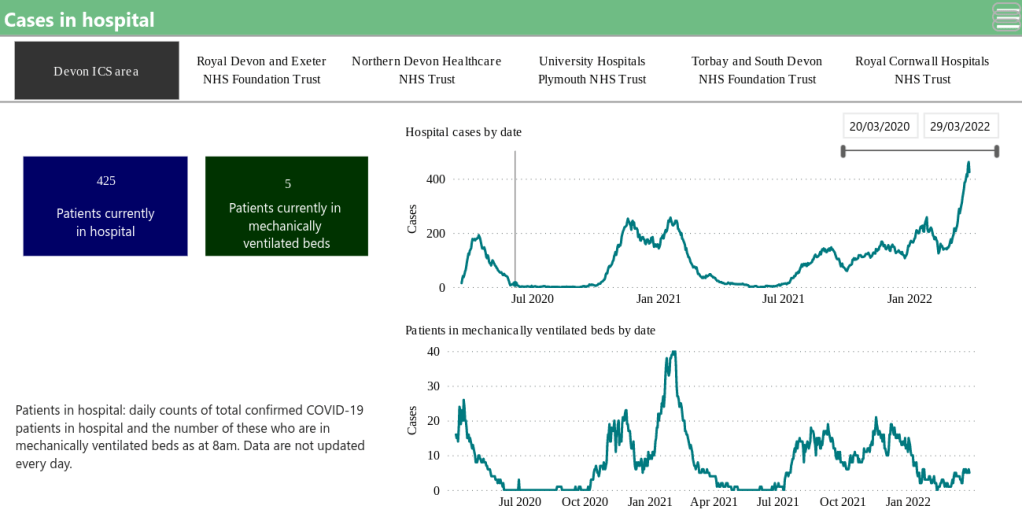
A hospital in Devon has declared a second critical incident following extreme pressures, as Covid-19 admissions in the region double, The Independent has learnt.

Rebecca Thomas www.independent.co.uk

North Devon Healthcare Trust declared a critical incident on Monday, after it declared another earlier this month it has confirmed.

The news comes as the number of people with Covid-19 across two hospitals in Devon has doubled in just two weeks.

As of Thursday, there were 292 Covid positive patients in across hospitals in Devon, with a further 37 awaiting test results.

According to a statement from healthcare leaders in Devon, Plymouth and Torbay, as of Thursday there were almost 1,200 NHS staff off work due to Covid.

Meanwhile 183 care services, such as care homes and other social care providers, in the area have reported Covid outbreaks, making it harder to discharge patients, the leaders said.

NHS data published on Thursday showed there were 213 patients across three hospitals in Devon, waiting to be discharged.

Covid-19 infections are also continuing to rise across most of the UK, with levels in Scotland hitting another record high, new figures show.

Heather Brazier, for North Devon Healthcare Trust director of operations said in a statement to The Independent: “On Monday 14 March we declared an internal critical incident due to insufficient bed capacity to admit emergency admissions.

“There continue to be significant bed pressures at North Devon District Hospital and South Molton Community Hospital. This is due to challenges with discharging patients from hospital, particularly those with ongoing care needs, alongside sustained high levels of urgent care demand. Our emergency department is very busy and people attending the ED are experiencing long wait times.”

“While things remain challenging, we ask that our community do what they can to help their local NHS, including choosing the right healthcare services for their needs. If people need urgent care please call 111 and please support any loved ones you have at the hospital to get ready to go home as soon as they are able to leave hospital.”

The news comes as Covid-19 admissions surge across the country and infections have led staff absences to increase again, with more than 17,000 off with Covid related illness nationally.

In England, 2.7 million people had Covid this week, up to 12 March, compared to 2.1 million people in the week up to 5 March, according to the Office for National Statistics. In Wales, the estimate is up from 97,900 people, or one in 30, to 125,400 people, or one in 25.

In Scotland infection levels have increased for seven weeks in a row and have hit a new record high with 376,300 last week. The ONS described the trend in Northern Ireland as “uncertain”, with 130,600 people likely to have had Covid-19 last week.

In a statement, on behalf of hospitals across Devon on Thursday leaders said: “High Covid-19 numbers are having a very significant impact across Devon’s health and care system.”

“The last time Covid-19 numbers were this high was in January 2021, before most people had the benefit of Covid-19 vaccines.”

It added said many people have tested positive for Covid while in hospital which has led to patients who are already vulnerable, becoming more unwell and impacted on the ability to admit other patients.

Ian Currie, medical director for Torbay and South Devon Foundation Trust said: “We currently have more patients with COVID-19 in our hospitals than almost any time during the pandemic. While it is encouraging that the majority of our patients who have tested positive for Covid are in hospital for other conditions and are asymptomatic or experiencing mild symptoms the impact that the presence of Covid has in our hospitals is really significant.”

“Under current infection prevention and control guidelines, one patient testing positive for Covid can result in the closure of the whole ward, meaning that beds are unavailable for emergency admissions and for planned operations. This means people waiting longer for treatment in the community and operations being cancelled or postponed and long waits in Emergency Departments for people needing a hospital bed.”

Professor Tim Spector, lead scientist on the ZOE Covid study, warned: “Covid cases are now at the highest levels the ZOE COVID study has ever recorded. Even more concerning is the rise in new cases in people aged over 75. This vulnerable group have had low case numbers for months.

“We will need to wait a few weeks to see the full impact on increased hospitalisation but numbers have already started to rise.”

Crocodile tears from Government Ministers over P&O pre-recorded video sacking

  1. They knew about it 24 hours before
  2. They voted, on Boris’ instructions, against blocking this practice in October. Neil and Simon shame on you.

Economic background: Last October the Office Budget Responsibility (OBR) projected that average real wages in the UK will still be lower in 2026 than they were in 2008. Since then, things have got a lot worse with the inflationary spike caused by the invasion of Ukraine .

UK is likely to have to endure almost two decades of stagnant earnings. This action by P&O is a race to the bottom.

View the Tweet video here

Guardian comment:

Don’t let the Tories fool you, by condemning P&Q s firing of 800 British staff. They voted against protecting workers from this practice only in October. Liars, the lot of them.

Flashback: To when Govt blocked a new law aimed at curbing fire-and-rehire

By Redrow www.thelondoneconomic.com 

Reminders that the government blocked a new law to curb businesses’ ability to ‘fire-and-rehire’ have been making the rounds on social media following the controversial P&O debacle.

The ferry operator sparked outrage after sacking 800 seafarers and replacing them with cheaper agency workers.

Many of those fired were refusing to leave ships, leading to security guards with handcuffs being deployed to remove them.

The ferry operator, bought by Dubai-based logistics giant DP World in 2019, insisted the decision to cut jobs was “very difficult but necessary” as it was “not a viable business” in its current state.

In October of last year, new laws preventing businesses from laying off staff and taking them back on with different – often worse – pay and terms were rejected by the government.

Labour’s Barry Gardiner said the government was “cowardly” for using Parliamentary tactics to stop his bill in its tracks.

But No 10 said it wanted new guidance for companies, rather than a law.

A spokesman for Boris Johnson said at the time: “Using threats of firing and rehiring is completely unacceptable as a negotiating tactic. We expect companies to treat their employees fairly.

“However, there is insufficient evidence to show legislation will stop the practice or will be effective.”

Instead, the government says it will ask the arbitration service Acas to “produce more comprehensive clearer guidance to help all employers explore all the options before considering fire and rehire”.

“Bullying” bosses

The government ordered Conservative MPs to oppose the legislation.

But union chiefs said that amounted to siding with “bad” and “bullying” bosses.

The Labour Party ordered its MPs to support the bill, even though the party has said it would go further if it won power and ban fire-and-rehire completely.

Before voting on the bill itself, MPs voted on a closure motion – essentially a vote on whether to vote on the bill – and due to the government’s opposition, it failed to get enough support by 188 votes to 251.

The government knew of P&O Ferries’ mass sackings in advance but ‘didn’t tell anyone’

by: Evie Breese www.bigissue.com 

Union RMT has called the move “​​one of the most shameful acts in the history of British industrial relations.”

The government knew of P&O Ferries’ plan to fire its entire 800 person crew with no notice and replace them with contractors but “didn’t tell anyone”, a union boss has revealed.

South West Water to spend £10m on anti-pollution drive

Peanuts and most of it is not “new money” [£5.3m of investment which has been already delivered and a further £4.5m which is a combination of accelerated spending, alongside new investment to support “nature-based solutions” which aim to reduce nutrient pollution in the area] – Owl

Context:

Water companies have collectively cut investment in wastewater and sewage networks by almost a fifth in the 30 years since they were privatised. They have collectively paid out more than £15 billion in dividends to shareholders since 2010 and their bosses have been paid more than £65 million in the past five years.

Remember that both Simon Jupp and Neil Parish dutifully voted last October against the Lords amendment imposing legal duties on water companies to clean up their act. 

Susan Davy, chief executive of Pennon, the parent company of South West Water, was paid £1.7 million, including £1.2 million in bonuses in 2020/2021

Owl notes that the claimed “commitment” is “almost” £10m of which only £4.5m is new money little more than twice Susan Davy’s pay for last year and we don’t know over how many years this “commitment” is spread.

Coincidentally South West Water attended a special virtual EDDC scrutiny meeting on Thursday to answer questions about water pollution in East Devon. Recording can be found on EDDC YouTube channel here.

Latest Pennon Group financial report

South West Water to spend £10m on anti-pollution drive

William Telford www.business-live.co.uk

Utilities giant South West Water has committed almost £10m to helping offset the impact of future housing development on two rivers just months after the Environment Agency found it had missed pollution targets for the 10th year running.

The Exeter-based company, part of Pennon Group, will now splash the cash on the Rivers Axe and Camel catchments. It includes £5.3m of investment which has been already delivered and a further £4.5m which is a combination of accelerated spending, alongside new investment to support “nature-based solutions” which aim to reduce nutrient pollution in the area.

The company said that while development unlocks jobs and homes, it also has an environmental impact that the nature-based solutions it will deliver through this funding will support more sustainable development to progress.

Investment includes funding to improve treatment works, alongside building on South West Water’s existing Up Stream Thinking catchment management programme which works with partners to protect and enhance land and natural habitats.

Work in this area will create up to 100 hectares of new woodland and wetlands, which will form natural buffers to improve river water quality and also improve habitats and help ecosystems thrive.

South West Water said will also continue to work closely with developers to promote nature-based drainage solutions for new developments and make sure that networks have sufficient capacity when new homes are built.

The announcement comes just months after the Environment Agency hit South West Water with the lowest environmental rating of the nine large privatised sewage and water companies in England and Wales.

In 2021, the regulator singled out the regional monopoly for its poor record, and said its 2020 performance had been “consistently unacceptable” for the 10th year running. Stock Exchange listed Pennon, which was recently given approval to take over Bristol Water, has been criticised for slashing capital expenditure in the past.

And in 2021, campaign group Surfers Against Sewage annual Water Quality report – which said water companies spilled raw sewage into coastal waters 5,517 times during a 12-month period – criticised discharges near beaches in the South West Water region during the bathing season and called out a “notably poor performance for the third consecutive year”.

Susan Davy, chief executive of Pennon Group, said the new spending will, however, do much to benefit the environment, and said: “We have a track record of working with partners across our region to restore, protect and enhance around 100,000 hectares of land through our catchment management programme. This investment will help unlock more sustainable housing development through the planting of trees and the creation of wetlands in the catchment through continued partnership work. We recognise the importance of doing what we can to help unlock the region’s shared levelling up ambitions.”

South West of England set to grow faster than any other UK region in 2022

Does this reflect a permanent change in workforce practice or a rebound from a low base? – Owl

Hannah Baker www.business-live.co.uk 

The South West economy is expected to grow faster than any other region of the UK in 2022 including London, according to a new report.

The region’s recovery is being driven by the performance of its cities as they rebound from the effects of the pandemic.

The Demos-PwC Good Growth for Cities Index estimates the South West’s GVA – a measure of economic output – grew by 8.2% in 2021 and will grow another 6.1% in 2022.

Meanwhile the South East’s GVA is expected to grow by 5.9%, the East of England by 5.7% and London by 4.7%.

The report said the movement of city dwellers to commuter belts or rural areas amid a growing focus on wellbeing, the environment and income distribution is driving the South West’s performance.

Many cities with smaller populations have experienced – and are expected to continue to see – stronger GVA growth rates than larger metropolitan cities.

Cities in the West Country performed well in the index’s overall ranking, which takes into account factors such as health, work-life balance and income distribution.

The region’s cities were all within the top half of the 50 locations profiled, with Bournemouth coming in at second place on the list – only behind Oxford – and Swindon at third.

Meanwhile, Bristol ranked ninth on the list, Exeter at 11 and Plymouth at 18. There is evidence that some of the West’s more rural areas are also doing well, with Cornwall and Dorset both scoring highly in the index.

Ben Pykett, director in PwC’s West practice, said: “These findings confirm the resilience of our cities; we have recovered more quickly than anywhere else in the UK as we enter the post-pandemic economy.

“Combine that with the success of our cities against other metrics such as safety, health, wealth equality and work-life balance, and the West is well-placed to continue delivering sustainable growth.”

Ms Pykett said some of the West’s success since the pandemic was due to its ability to attract people who work flexibly or remotely – and who previously would have lived close to London or another major urban centre.

“Local authorities and businesses in smaller cities and other areas now have to consider how they can capitalise on changing public preferences and ensure the move away from large cities isn’t a temporary one,” she added.

The Good Growth for Cities Index measures cities’ performance against a series of 12 variables, with each one weighted relative to how important it is considered by the 1,000 people surveyed as part of the study.

In comparison to last year’s report, the importance given to these indicators by the members of the public who have been polled has shifted considerably.

Jobs and skills, two of the most important variables last year, saw significant decreases in importance in the updated Index, while the environment and income distribution saw increases.

Of the 12 variables included, the biggest driver for improvement for cities over the last three years was better work-life balance, PwC said.

Broad improvements in the skills of older workers, as well as income distribution and life expectancy, have also seen the gap narrow slightly between the highest and lowest ranked cities.

GVA growth rate by region

Region2021 GVA growth rate2022 GVA growth rate
South West8.2%6.1%
South East7.9%5.9%
East of England7.8%5.7%
London7.4%4.7%
Scotland7.1%4.9%
East Midlands6.9%4.8%
West Midlands6.9%4.8%
North West6.8%4.5%
Yorkshire and the Humber6.7%4.5%
North East6.7%4.5%
Northern Ireland6.4%4.1%
Wales6.3%4.0%

Boris Johnson’s broken promise on MPs’ second jobs fits a pattern

“Like the farrago over Downing Street parties during lockdown, the prime minister’s change of heart – if such it is – over MPs’ second jobs appears to fit a longstanding pattern, in which he says whatever it takes to get out of a tight spot, and thinks nothing of reversing course later”.

Heather Stewart www.theguardian.com 

Boris Johnson’s promise to crack down on MPs’ second jobs came at a perilous moment for his premiership last autumn, with backbenchers in open revolt over the botched attempt to save the disgraced MP Owen Paterson.

It was a classic Johnson manoeuvre – a bold bid to get ahead of the story, claiming to outflank Labour by promising that MPs would be “appropriately punished” if they put their second employers, not their constituents, first.

Yet, like the prime minister’s initial response to the Partygate stories that began to emerge in December, also aimed at making hostile headlines go away, it has unravelled completely.

In October the fury over MPs’ second jobs had been stoked by Johnson’s own behaviour. After marching Tory MPs through the voting lobbies to protect Paterson, the prime minister U-turned the next day, as opposition parties refused to take part in a cross-party committee to rewrite the parliamentary standards system.

As the outrage over the Paterson case grew, the government was rocked by story after story about Tory MPs’ lucrative second jobs – including the former attorney general Geoffrey Cox practising from the British Virgin Islands during the pandemic.

So febrile was the mood that when Johnson flew to Glasgow to join the crucial Cop26 climate summit for a day, he found himself challenged about parliamentary sleaze, telling the assembled journalists the UK was “not remotely a corrupt country”.

Several days later, with Labour poised to exploit Tory divisions by using an opposition day debate to force a vote on toughening up the rules, Downing Street abruptly announced that it would go further.

Cracks appeared almost immediately. Cabinet ministers, sent out to explain the move, which was tabled as an amendment to Labour’s motion, offered few details. Asked how exactly second jobs would be constrained, Dominic Raab said: “You could do it by the amount or you could do it by the number of hours.”

When the trade secretary, Anne-Marie Trevelyan, was asked how many hours might be reasonable, she gave several different answers in a single morning broadcast round.

There was always an element of theatre to the plan, too. The long-established standards committee, chaired by Chris Bryant, which had handed down Paterson’s 30-day suspension, was already carrying out a review of MPs’ code of conduct, which was expected to cover issues including second jobs.

It is to that review that the government has now made its own submission – flatly contradicting the promises made by ministers in the autumn.

It is unclear whether Johnson and his aides knew at the time they made the proposal that they had no intention of pushing it through to a conclusion, or whether they have caved in in the face of intensive lobbying from backbench MPs keen to hold on to their lucrative side hustles.

Certainly, Johnson has never had any principled objection to second jobs, having edited the Spectator while an MP and then been a Telegraph columnist – as well as, for a short while, being both mayor of London and MP for Uxbridge.

Having described the £250,000 a year he was paid for his Telegraph outpourings as “chicken feed”, and frequently complained to friends about his money troubles, he may also have had some sympathy for those colleagues complaining that they couldn’t live on their parliamentary salary alone.

But like the farrago over Downing Street parties during lockdown, the prime minister’s change of heart – if such it is – over MPs’ second jobs appears to fit a longstanding pattern, in which he says whatever it takes to get out of a tight spot, and thinks nothing of reversing course later.

Tory MP says the best way to deal with rising energy bills is to ‘get a job’

Looks like we are back in 1980’s with the politics of a “semi-house-trained polecat” – Owl

Harrison Jones metro.co.uk 

A Conservative MP has suggested that the best ‘opportunity’ for people to cope with soaring bills is to get a job.

Blackpool South MP Scott Benton made the comments amid dramatic increases in the cost of living in the UK, with countless people in work struggling to pay their bills.

Fuel, heating and food are among some of the essentials rocketing in the UK, with experts fearing petrol could hit £2.40 a litre amid the Ukraine war.

Tory backbencher Mr Benton told the Commons: ‘It would be remiss of me not to point out that the state can only do so much.

‘Work pays and so getting people into employment so that they can provide for themselves and their families ultimately gives them the very best opportunity.’

His intervention came after the SNP’s Stewart Hosie read out a letter he had received from a constituent living with her disabled partner in a single-income household, who had done ‘everything in her power’ to cut costs.

The unnamed individual could not afford to ‘turn on the storage heaters due to the sheer cost’, the Dundee East MP said.

Mr Hosie explained that his constituent’s standing charge had more than doubled even though her electricity all came from renewables, and added she had been ‘flatly denied’ a pay rise or increase in expenses for her work-from-home job.

He added: ‘This is someone who has already done everything she can and yet has been hammered by energy price rises.’

Broadband scheme ‘preventing Devon village connections’ – Northleigh

A scheme to provide decent broadband in rural Devon is actually preventing a village from getting it, residents say.

www.bbc.co.uk

Northleigh broadband sign

Northleigh residents said they “took matters into their own hands” to get better broadband

Villagers in Northleigh, near Colyton, went directly to infrastructure provider Openreach to get connected.

But they said rural broadband arranger Connecting Devon and Somerset (CDS) had taken over and was using another provider, which would take years longer.

CDS said the village was due to be connected by the end of 2023.

‘A village divided’

About 30 homes in the village have been plugged in via the Openreach work since December 2021, but 90 homes were still without good connections, residents said.

Andy Cornish, who has a high-speed connection, said residents “took matters into their own hands” to get Openreach involved under the government’s gigabit voucher scheme, which gave it £82,000 in 2020.

He said “gatekeeper” CDS appointed provider Airband in 2021 to finish the work “without consulting our community, and so we are now precluded from receiving any further state aid to finish the project with Openreach”.

Mr Cornish said he understood it now meant his whole community would not get fibre connection “until the end of 2024” because of other work already scheduled ahead of Northleigh.

“We are now a village divided by a hill and 21st Century internet,” he added.

Northleigh sign

About 90 homes in Northleigh are still without good broadband connections

Andrea Wood, one villager waiting for full broadband, said the change “just doesn’t make sense” as it would be “duplicating the [Openreach] fibre that is already going right the way around our village”.

CDS is a taxpayer-subsidised programme, supplying rural areas not seen as cost-effective for commercial providers.

It said if it made changes it could undermine the viability and economic value of the contract with Airband, “which was tendered for in good faith”, and could “put at risk broadband delivery to other communities”.

The government-led partnership said Airband was awarded the contract at the end of 2020 “to deliver a full fibre open access network by the end of 2024 to around 40,000 premises in our region, including those in Northleigh not covered by the previous community scheme”.

It said: “Airband will begin design and survey work in the community in January 2023 and build is scheduled to be completed by the end of that year.”

It added that it had put in almost £5,000 to help Northleigh finish Openreach’s initial work and that it had delivered superfast broadband to more than 315,000 homes and businesses across England.

Sidmouth ‘shoppers’ car park’ excluded from £2 hourly fee

Plans for a £2-per-hour charge at all Sidmouth’s district council-run car parks are being amended to provide one cheaper parking area for short-stay shoppers. 

Philippa Davies http://www.sidmouthherald.co.uk 

It is now proposed that from April 1, fees at the Roxburgh car park will be 75p for 30 minutes and £1.50 per hour, with a maximum stay of two hours. The planned increase will still come into effect at Sidmouth’s other car parks. 

The recommendation will go before an extraordinary consultative meeting of East Devon District Council on Tuesday, March 22. 

The decision to increase parking charges across the district has been criticised widely, with a petition by Sidmouth Chamber of Commerce calling for the rise to be limited to £1.20 per hour. The Conservative group on the district council voted against the budget plan last month because it included the rise in parking fees. 

But leader, Cllr Paul Arnott, said the change of plan was not a U-turn. 

He said: “The last few months of finessing car park charges across East Devon has been intensely hard work. For more than a decade previous administrations ducked this issue, and when they then became the opposition with a duty to complete a charging review, they simply did not finish the work. Therefore, we needed to pick up the baton, and quickly, last December. 

“Cabinet had always intended to ensure that there was a shoppers’ car park in Sidmouth at an hourly rate of £1.50 rather than £2, but in the short time we had before budget setting last month, the detail was still being sense-checked. It had always been our intention for the Roxburgh to be designated at the lower rate and we had open discussions about how we could do this. 

“For the record, this decision, which will need to be agreed at full council, has nothing at all to do with local protests or petitions as we already had it in mind. However, due process meant that we could not announce it before now until after the agenda was published. I have repeatedly said in public and in this newspaper that we have had Sidmouth traders and shoppers uppermost in our thinking, and we are pleased to be able to deliver on that. 

“Finally, I once again commend to local people the extraordinarily good value of our monthly and yearly parking permits, where it is possible to park for under £2.40 a week, as well as our £8 all day charges, and our £2 all day rates between November and March.” 

The chairman of Sidmouth Town Council, Ian Barlow, said: “We criticised (the price rise) because it was going up so much. I thought £1.50 would be a better price, and  obviously it’s better for Sidmouth than £2. We still don’t like it, but it’s better than it was going to be.” 

Honiton’s new town councillors outline their aims

Honiton’s four new town councillors have expressed delight at winning their seats, and said they are looking forward to making a positive difference in the community. 

Philippa Davies www.midweekherald.co.uk

Lisa Beigan, Jenny Brown, Robert Fowles and Cathy Maunder were all elected to the St Michael’s ward following the poll on Thursday, March 10. 

Two other candidates, John Taylor and Andrew Pearsall, stood but were not successful. 

After the results were announced, Lisa told the Herald: “I am very excited and proud to be voted on to Honiton Town Council. Being a town councillor will allow me to bring fresh ideas and positivity to a town that I know and love.”

“Helping our town recover from the difficulties caused by the recent pandemic are of particular interest to me, I own a restaurant so I have a lot of contact with the public, I therefore have an insight into their thoughts and anxieties. Mental well-being is a important issue, particularly at times like these, I feel it is important that the town council can help restore public confidence, support mental health and create positive experiences.” 

Jenny said: “Since my election to HTC I have been invited to join ‘East Devon Line Forum’ with representatives including Network Rail, South Western Railway and other key stakeholders, with a view to picking up where I left off and demonstrating that the benefits of the railway can also be a unifying, inspiring and positive force at the heart of the community. 

“Not least finally getting a ‘passing loop’ at Whimple, which would permit a twice hourly service to and from Honiton, with the prospects and opportunities that would bring for both work and leisure activities in town.” 

Robert said: “The Town Council has seen much discontinuity in recent times. I look forward to working on selected committee’s and working groups, with councillors existing and new, to bring some stability, as we all endeavour to deliver the improvements identified in the Work Programme for the benefit of all Honiton residents.” 

Cathy said: “I’m looking forward to working with a team of councillors who all have the very best interests of Honiton at heart.  I hope we can work with our younger children, teenagers and supported living community to make Honiton all-inclusive.  A place to make happy memories.”