‘We are a petri dish’: world watches UK’s race between vaccine and virus

To mix metaphors – essential reading for lab rats. – Owl

Ian Sample www.theguardian.com 

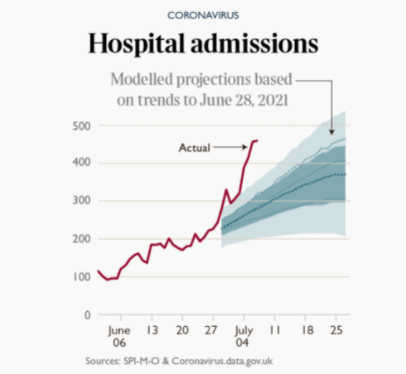
Not for the first time in the coronavirus pandemic, the UK finds itself in a unique position. Through a combination of history, biology, mathematics and politics, the country stands alone in pitting an advanced vaccination programme against a substantial wave of Covid driven almost entirely by the fast-spreading Delta variant.

Nowhere in the world is the race between vaccination and virus more keenly watched than here.

Other countries – and Israel stands out – have vaccinated more of their population. India has endured more Delta cases.

But much of North America, Europe and Asia are behind the UK with their vaccine programmes and are only now seeing Delta take hold.

The World Health Organization believes Delta will become dominant. The variant accounts for a fifth of new cases in the US and but expected to dominate within weeks. After a 10-week decline, cases are rising in Europe. In France, the government’s lead science adviser, Prof Jean-François Delfraissy, has warned of a fourth wave driven by the variant.

“The UK is in an absolutely unique position,” says Mark Woolhouse, professor of infectious disease epidemiology at the University of Edinburgh. “We have the biggest Delta outbreak in a well-vaccinated country. We are a petri dish for the world.”

There is plenty other countries can learn from what happens in the UK in the coming months. Most obvious is how the variant spreads in the population and what impact different vaccines, and different levels of vaccination, have on cases, hospitalisations and deaths.

Analysis by Public Health England has already shown the variant to be about 60% more transmissible than the Alpha, or Kent, variant and perhaps twice as likely to hospitalise people. Countries looking on will want to know who are the people needing hospital care, who needs mechanical ventilation, who dies, and in what numbers.

There is already some good news. While the Pfizer/BioNTech and Oxford/AstraZeneca vaccines aren’t quite as effective against Delta as they are against the Alpha variant, particularly after one dose, two shots reduce the risk of hospitalisation from Delta infections by 96% and 92% respectively. This is hugely welcome and gives countries a handle on what’s to come.

“People will undoubtedly look at the UK and learn as much as they can from our experience,” says Prof David Salisbury, former director of immunisation at the Department of Health and assistant fellow on the Global Health Programme at Chatham House.

“If the UK has a certain percentage of people double vaccinated and France has a third less, they might extrapolate to what that could mean for them. I’m sure that’s what public health people will be doing in many countries when they look at the UK data.”

Perhaps the most crucial question is this: can vaccination break the link between Delta variant infection and hospitalisation, or between infection and death?

The concept of breaking the link entirely makes more sense in epidemiology textbooks than in the real world.

While vaccines massively reduce the risk of death, they do not reduce it to zero, and they do far less to prevent infection. When a highly transmissible variant such as Delta is in circulation, it will still have a good chance of spreading widely and finding those people who are unvaccinated, or not-well protected from their shots.

How well it does this in the UK will alert other countries to how threatened their own vaccination programmes may be.

“The link cannot be entirely broken unless you have eradicated the virus,” says Salisbury. “If the virus is still in circulation, there have to be some consequences from it.”

All of which leads to the related question of what proportion of the population needs to be vaccinated to crush a national epidemic – and is this even achievable?

Israel originally pushed down on cases with aggressive vaccination, but cases have risen again with the arrival of the Delta variant.

For now, Israel is keen to watch and wait, to see if cases rise, but not severe illness. But while Israel relies largely on the Pfizer vaccine, the UK has bet on Oxford/AstraZeneca.

For that reason, other countries that are banking on the cheaper, more easily stored Oxford/AstraZeneca vaccine will be watching the UK . “If the UK avoids serious damage it will be important for those countries that have been relying on Oxford/AstraZeneca,” says William Hanage, a professor of the evolution and epidemiology of infectious disease at Harvard.

To crush an epidemic of Delta variant, scientists believe 85% of the population need to be protected by a vaccine that prevents all onward transmission.

But that assumes the virus is allowed to let rip with no other measures to control it. “At the moment we clearly haven’t vaccinated enough people to stop the virus circulating,” says Woolhouse.

“What that tells you is we are not at the herd immunity threshold yet. The delta variant, being more transmissible, has raised the bar.”

Countries looking on will want to see how the UK handles this dilemma. Vaccination and the immunity people have from past infection will get us a long way, but more measures are likely to be needed to eventually control the epidemic.

Siân Griffiths, emeritus professor at the Chinese University of Hong Kong and the co-chair of the Hong Kong government’s inquiry into Sars, says south-east Asian countries are watching the UK, along with Israel, to see how they cope with Delta.

Many of these countries went for a zero-Covid approach and have extremely low vaccination rates. They are now seeing cases of Delta variant spring up and will need to throw more into vaccination. “What you’re seeing is a gradual realisation that it isn’t going to be a world without Covid,” she says.

As the UK goes into the autumn, a combined Covid and flu vaccination programme may swing into action, giving time for Australia, New Zealand and other countries in the southern hemisphere to see the impact before their winter arrives.

But there are behavioural lessons to be had too. While the UK has worrying inequalities around who takes up the vaccine, coverage across the population is the envy of the world.

“Many countries are trying out different ways to get people to come forward,” says Griffiths. “They might want to look at why the UK has come forward for vaccination in the numbers it has.”

Devon records 27 new Covid cluster areas

Devon has 121 Covid cluster areas in the latest data released.

Lili Stebbings www.devonlive.com

This has risen from 94 clusters in previous figures, meaning that 27 more areas have been found to have a rise in the number of positive Covid cases.

Exeter has seen the most positive cases in the week ending June 26 – the latest figures – with 297 in total, followed by Plymouth with 223, East Devon with 127, and Mid Devon not far behind with 125.

Torbay and Torridge have a total of 119 and 80, respectively, and Teignbridge saw 76 new positive cases. South Hams ended on 51 and West Devon with just nine.

Locations are split into Middle Layer Super Output Areas (MSOA) which consist of around 7,500 people each. Any MSOA which has at least three new positive Covid-19 tests during the most recent seven-day period that statistics are available for is deemed to have a cluster.

Below are the latest statistics between June 20 and June 26. [Owl has only included details for East Devon and Exeter – go to online article for the full list]

The figure on the left is how many new positive Covid cases there have been and the figure on the right is the case rate per 100,000.

If your area is not on the list it means it has fewer than three positive cases and is therefore not seen as a cluster.

East Devon

Axminster 4 – 42.9

Budleigh Salterton 6 – 96.5

Clyst, Exton & Lympstone 9 – 131.7

Cranbrook, Broadclyst & Stoke Canon 15 – 111.4

Exmouth Brixington 6 – 92.6

Exmouth Halsdon 5 – 72.1

Exmouth Littleham 8 – 106.5

Exmouth Town 15 – 203.1

Exmouth Withycombe Raleigh 6 – 80.9

Feniton & Whimple 6 – 68.5

Honiton South & West 3 – 54.5

Kilmington, Colyton & Uplyme 6 – 71.9

Ottery St Mary & West Hill 10 – 112.3

Poppleford, Otterton & Woodbury 3 – 48.8

Seaton 12 – 159.3

Sidbury, Offwell & Beer 9 – 166.8

Sidmouth Sidford 4 – 56.9

Exeter

Alphington & Marsh Barton 11 – 149.8

Central Exeter 30 – 248.2

Countess Wear & Topsham 5 – 64.8

Exwick & Foxhayes 8 – 105.8

Heavitree West & Polsloe 17 – 199.1

Middlemoor & Sowton 10 – 79.7

Mincinglake & Beacon Heath 17 – 242.2

Pennsylvania & University 103 – 885.6

Pinhoe & Whipton North 4 – 42.7

St James’s Park & Hoopern 37 – 386

St Leonard’s 9 – 133.9

St Thomas East 17 – 207.7

St Thomas West 12 – 164.9

Wonford & St Loye’s 17 – 205.1

What else are they not telling us? – Good Law Project

On Monday we published a short post, pointing out that the so-called “transparency” data – which is supposed to list all of the external meetings Ministers have – failed to mention a meeting on 1 April 2020 that Lord Bethell had with Abingdon shortly before his department awarded it the first of two contracts worth up to £87.5m in total.

us15.campaign-archive.com /

The contracts – which Good Law Project is challenging in the High Court – are highly controversial not least because Government’s own lawyers advised they were unlawful.

Government blamed the missing meeting on an “admin error” and responded on Tuesday by publishing an updated list of the external meetings Lord Bethell had, including the 1 April meeting with Abingdon:

The problem is that the updated list is also wrong.

First, the updated list doesn’t make any mention of a meeting Matt Hancock had on 1 April 2020 with a group of would-be test suppliers.

We know that it took place because we have the emails.

Here is an invitation to a conference call at 5pm issued to “Excalibur Health” – no mention of this meeting appears in the so-called transparency data. We also know that other providers including Abingdon received the same invitation.

Indeed, it looks very much as though Matt Hancock had two meetings with Abingdon.

Here is a further email setting out that Matt Hancock wanted to join a second, follow-up, private call with Abingdon later that evening at 19.10.

The so-called transparency data, even in its revised form, fails to mention his attendance at either.

Government will, no doubt, say they made a second “admin error” in correcting the first “admin error”. And perhaps you are inclined to give them the benefit of the doubt and assume it is merely gross, and repeated, incompetence.

But even the most sweetly trusting of us must wonder whether the real explanation is that this is a deliberate attempt to mislead the public as to the former Secretary of State’s involvement in the ill-fated and unlawful Abingdon deal.

Thank you, 

Jo Maugham

Director of Good Law Project

Sidmouth set to benefit from gigabit broadband coverage

Sidmouth is set to benefit from gigabit broadband connectivity as provider Jurassic Fibre announced it is to extend its network to the coastal town and surrounding villages.

Alex Walton www.sidmouthherald.co.uk

Construction is due to commence shortly. Once complete, the network will deliver ultrafast internet speeds of up to 950Mbps for residents and 10Gbps for businesses.

In addition to Sidmouth, the surrounding villages of Sidbury, Weston, Salcombe Regis and Branscombe are also set to benefit.

Sidmouth resident Michael Maltby, founder and CEO of Jurassic Fibre, set up the company in 2018 after working on broadband networks around the world from Russia to the Caribbean. Since then, the company has been building a cutting-edge full fibre network, connecting communities across the region.

Michael said: “As a local resident of Sidmouth, announcing the start of our build in Sidmouth is a milestone for Jurassic Fibre. I set up Jurassic in 2018 after years of frustration over the quality of the local internet, which was doubly frustrating having worked on building fibre networks around the world. The aim was simple: to provide the digital plumbing the region needs to thrive in the 21st century and secure Sidmouth and the South West’s position as the best place to live, work and relax in the United Kingdom.”

Simon Jupp, MP for East Devon, said: “I know just how important it is for everyone to have access to reliable and high speed internet. It is something I am committed to championing across East Devon and I am delighted that Jurassic Fibre are extending their network to Sidmouth and the immediate area.

“As a local resident of the town, I am particularly pleased with this important step forward for Sidmouth and hope that very soon thousands of local homes and businesses will have the opportunity to access better broadband.”

Matthew Galley, Head of Partnerships at Jurassic Fibre, commented: “We’re delighted to be able to extend our network, not just in the centre of Sidmouth, but to all of the surrounding villages which are so often forgotten. We aim to work with communities to bring decent broadband to some of the most remote and hard to reach areas wherever possible.”

Exeter-based Jurassic Fibre is armed with a £250m investment from Fern Trading, advised by Octopus Investments, to deliver a fibre network for the South West, passing over 350,000 premises.

So far, the company has connected towns and villages across Devon and Somerset, including Exmouth, Sowton, Honiton, Barnstaple and Bridgwater. Further locations are expected to go live in the coming months.

Full fibre means the line is fibre optic cable directly from an exchange to the property. Currently, the majority of the infrastructure in place relies on copper cables which slows the internet speed down considerably.

Jurassic Fibre has a goal to future-proof the broadband infrastructure across Devon, Somerset and Dorset for years to come, providing best-in-class connectivity to communities which have historically been overlooked by other providers.

Jurassic Fibre has a range of flexible plans for both business and home. Residential customers benefit from Jurassic Fibre’s innovative 30-day rolling contracts.

Villages with high demand for full fibre are urged to register their interest with Jurassic Fibre via the company’s website.

Breaking: VIP lane for Test and Trace

Good Law Project can reveal the existence of a VIP lane for Test and Trace spend – and that ‘VIP stakeholder engagement’ was run from a private gmail address.

us15.campaign-archive.com /

We are today publishing emails showing the existence of a “fast-track” for contacts of Ministers. One of those emails states: “If [offers] come from a minister/private office then please put FASTTRACK at the beginning of the subject line.”

This evidence is corroborated by the LinkedIn account for the individual who advertised himself as the lead for “VIP stakeholder engagement with Life Science Minister James Bethell”.

Good Law Project can also reveal that the “industry secondee” – a Mr Simon Greaves – used a private gmail address for his “VIP stakeholder engagement.”

The National Audit Office has previously expressed concern over the lack of transparency in relation to procurement decisions made in the PPE VIP lane. The revelation that key elements of VIP Test and Trace procurement were conducted using a private gmail address piles fuel on that fire.

How could civil servants monitor discussions between Ministerial contacts and an industry secondee when they were taking place via private gmail addresses?

Back in October, Good Law Project revealed the red carpet-to-riches VIP lane that benefited so many associates of Ministers by helping them to win vast PPE contracts. This new evidence corroborates reports in November from unnamed insiders that there was a VIP channel for testing supplies. The total spend on Test and Trace is £37bn, dwarfing that for PPE.

Responding to Good Law Project, Simon Greaves said: ‘I used a DHSC email account and computer for the majority of my time…’’ but also confirmed he used his personal gmail account from his start date in April through to May.

Good Law Project has also approached the DHSC for comment.

Further questions need to be asked about how Government came to spend over £3bn – without any competition – with Innova, whose testing kits have been described by the US Food and Drug Administration as “presenting a risk to health” and subject to “the most serious type of recall.” Good Law Project understands extraordinary new revelations about Innova will emerge in the coming days.

Thank you,

Jo Maugham

Director of Good Law Project

“Kiss of Death” for Alison Hernandez?

BoJo “big fan” of Devon police commissioner

Paul Nero www.radioexe.co.uk

WATCH: PM gives thumbs up to Alison Hernandez

It’s often the kiss of death for beleaguered politicians…the prime minister has thrown his weight behind Devon and Cornwall police and crime commissioner.

Boris Johnson has used his appearance at prime minister’s questions on Wednesday to say he is a “big fan” of Alison Hernandez.

Mr Johnson made was responding to a soft underarm question from Anthony Mangnall, Conservative MP for Totnes, who asked if the prime minister would support  ‘counsel advocate’ schemes, such as those introduced by Ms Hernandez in the south west.

Councillor advocates are volunteers from each council in Devon, Cornwall and the Isles of Scilly who provide a communication conduit between the police, the commissioner and the public.

Not surprisingly, the PM said he would support the scheme launched by Ms Hernandez, the Conservative commissioner who was re-elected for a second-term in May. He said she’d done “absolutely the right thing” by introducing the scheme and that he was a “big fan” of hers.

Every three months, the councillor advocates for each policing area meet with a representative from Devon and Cornwall Police, a Community Safety Partnership (CSP) representative and a police and crime commissioner community engagement officer.

These meetings allow them to raise issues on behalf of their council’s communities while also giving the police and opportunity to update councillors on relevant information or to request support with a specific issue. 

Members are also invited to attend regular exclusive events to gain a greater understanding of policing and how to help keep their communities safe.  Previous talks have been given by firearms officers and operators from the police’s drone team.

Exmouth seafront will “delight visitors”

Nearly 10 years after redevelopment plans for Exmouth seafront were first proposed, a longer term vision for the site that will “delight visitors” will come forward soon.

Daniel Clark, local democracy reporter www.radioexe.co.uk

Ten years on, more plans expected

In 2012 plans were introduced to redevelop the area between the old lifeboat station – now a rowing club –  and the Maer. Since then, several iterations of plans have failed, with the scheme being referred to as ‘Exmouth’s Brexit’.

While phase one – the relocation of the Queen’s Drive road – and phase two – the watersports centre – have been completed and are open, phase three remains in doubt.

Planning permission for the redevelopment of a 3.6-hectare swathe of Queen’s Drive has been granted, and has been implemented, the council says, with the realignment of the road, but the attractions currently on the Queen’s Drive space – the replacement for the former Fun Park – only have planning permission until March 2022, with no further extension allowed under planning law. 

Plans for the longer term future will be presented to the Queen’s Drive Delivery Group in September and they will consider uses next season.

Cllr Nick Hookway, chair of the group said: “The Queens Drive Delivery Group considers that the Phase three site offers great potential for a range of attractions that will delight visitors. Plans will be shortly considered on what attractions can be put in place to celebrate the Queen’s Platinum Jubilee in June 2022.”

Cllr Paul Arnott, leader of the council, added: “Since taking over the administration a year ago we have placed Exmouth seafront and town at the centre of our efforts. We have tried hard to maximise councillor and public engagement and having sorted out summer 2021 our focus will turn to the long-term.

“The seafront has been a divisive issue for the community, and we are determined to proceed with consensus and with respect for local views.”

Additional funding for a staffing resource to support the phase the project and other projects in Exmouth over the next two years has been agreed with recruitment for these posts to follow shortly.

“Once these staff are in place they will be building on the initial work that has been undertaken in recent months on the Levelling-Up bid working with key stakeholders in Exmouth,” a council spokesman said.

“They added: “The Queen’s Drive Delivery Group which for the past nine months has met in public is next meeting in September and will consider uses for the area next season and in particular the planning implications of this.”

THE HISTORY OF QUEEN’S DRIVE

In 2012, plans to redevelop the area between the old lifeboat station and the Maer, known as the Splash Zone, formed part of the Exmouth Masterplan which sets out future regeneration.

The controversial plans divided opinion in 2013 when more than 500 people completed questionnaires. More than half (52 per cent) of respondents  were in favour of the overall proposals, with 41 per cent against.

In December 2013, East Devon District Council’s Development Management Committee gave the go-ahead for the development of Queen’s Drive.The outline permission includes the realignment of the road and a proposed new watersports hub, cafe and public open space.

East Devon District Council were then working with Moirai Capital Investments of Bournemouth. Plans included luxury flats, shops, eateries, a multi-screen cinema and a new Harbour View Café and coastwatch tower.

At the same time, a new action group was launched to ‘save’ Exmouth seafront from developers, with Save Exmouth Seafront concerned that the £18 million redevelopment would mean some of the town’s oldest most popular businesses closing.

In October 2015, the Carriage Café on the seafront left the town. It had been open for nearly 50 years. Around the same time, more than 1,000 residents and visitors took part in the Exmouth Seafront Survey, initiated by Cllr Megan Armstrong. Led by author and analyst Louise MacAllister, the survey aimed to discover if plans for a multi-screen cinema, outdoor water splash zone and adventure golf park were wanted.

Organisers said the survey showed 95 per cent were against the redevelopment, it showed widespread support for the businesses occupying the seafront and that many Exmouth residents felt their concerns regarding the plans had been ignored.

In April 2016, Exmouth residents went to the polls in a referendum. Called by concerned residents, the parish poll saw 4,754 people – 18 per cent of the electorate – take part. Around 95 per cent of participants wanted more consultation.

The summer of 2016 saw Moirai Capital Investments sacked because of the time it had taken for them to develop more plans. September 2016 saw Jungle Fun and Arnold Palmer Putting Course close. Hours earlier, locals and tourists flocked to the attractions for one last round. 

In November 2016, campaigners in Exmouth staged a protest march calling for further consultation. Save Exmouth Seafront protesters marched through Imperial Road, The Strand and Alexandra Terrace before finishing on the seafront.

April 2017 saw an application for the seafront redevelopment approved. It meant the council could now go ahead and redevelop a 3.6-hectare swathe of Queen’s Drive, but had no plans to do so. Had the application been rejected, it would have meant the outline permission for redevelopment would have lapsed and sent the project back to the drawing board.

A bid to reprieve the Fun Park from closure failed two weeks later, when East Devon councillors voted 26 to 21 against extending its lease. The contents of the Fun Park were auctioned the following day. The Harbour View café was also due to close at the same time, but its lease was extended.

October 2017 saw an Exeter company, Grenadier, reveal plans for the Watersports Centre, before submitting the formal planning application in February 2018, which was then approved in June 2018.

The temporary attractions for the seafront at the Queen’s Drive Space, which include the food and drink area and the dinosaur-themed play park opened in May 2018. Permission was initially granted for one year, followed by a second permission for a further three years. That expires in March 2022, and the council will not be able to apply for any further temporary use.

Work began at the end of 2018 to realign the Queen’s Drive road, which was completed in June 2019, although questions have been raised about where the funding for the road, which East Devon District Council paid for, actually came from.

At the end of 2019, HemingwayDesign and Lambert Smith Hampton submitted their vision for Phase Three for Exmouth Seafront to East Devon District Council. Suggested uses for the site include a new two storey café/restaurant on the existing Harbour View café site, a mix of playspace (including free play) and open public space on the remainder of the site, and an 60–80 bed, three-to-four star hotel.

In February 2020, East Devon District Council’s cabinet agreed to launch a marketing exercise to identify developer or operator partners. But the council’s scrutiny committee then unanimously agreed that the panel for the purpose of agreeing the selection criteria for the commercial development was not properly balanced, and expressed anger at how they felt Exmouth residents were not being listened to.

That process was delayed by the coronavirus pandemic and a change of administration.

At a meeting of the Queen’s Drive Delivery Group last October, Tim Child, senior property & estates manager, said that it was not usual for a temporary permission to be renewed for a third time unless there are exceptional circumstances regarding why a permanent planning solution cannot be brought forward for the site with a detailed planning application, adding: “If it is not permissible to pursue a further temporary planning application, the council needs to consider what it will do with the site from March 2022 when the site has to close.”

That meeting saw councillors agree and express a desire to ‘Get Seafront Done’, as Cllr Joe Whibley put it, but that as Exmouth is the biggest town in East Devon, it was critically important to the economy and the reputation of the council that they do the right thing and get a scheme that is both popular with the residents and viable in the long term.

While subsequent meetings of the Queen’s Drive Delivery Group have taken place, none have seen the longer term future of Queen’s Drive and Phase 3 discussed in any detail. Their next meeting is scheduled for July 13, with the following meeting on September 7, with the council saying the latter is likely to be when future plans will be discussed.

The ultimate decision over what happens with Phase three will lie with the council’s cabinet.

New plan for cameras to catch out Devon drivers

Cameras are set to be installed to prohibit motorists from driving through a ‘bus gate’ to access a new housing development in Barnstaple in order to better manage traffic in the area.

Daniel Clark www.devonlive.com

The North Devon Highways and Traffic Orders Committee, when they meet next Wednesday, are being recommended to revise the access arrangements for a large housing development at Larkbear being constructed between Old Torrington Road and the A361.

Planning permission has been granted for over 200 new homes, with the potential for more to be constructed in the future, with the existing arrangements which require traffic to access the estate via Bickington Road and Old Torrington Road to north leading to congestion.

This is because a ‘bus gate’ is currently in place, preventing access from Gratton Way, which mean most vehicles are banned from driving through the ‘gate’, which despite the name, does not feature a physical barrier.

But the proposals, which have been backed by residents and officers, would revoke that traffic regulation and introduce a new bus gate on Old Torrington Road, to the north of the junction with Gratton Way, which would be enforced by cameras.

This would mean that traffic would be directed through Gratton Way to the new development, the crematorium and properties at the southern end of Old Torrington Road instead of from Bickington Road (A3125), in order to better manage traffic in the area and reduce congestion due to the new housing development.

The proposed changes to the Restrictions in Old Torrington Road in Barnstaple

The proposed changes to the Restrictions in Old Torrington Road in Barnstaple

The proposals and associated works are being funded by the housing developer for the Larkbear development, Persimmon Homes and the camera enforcement equipment for the bus gate would also be funded by the developer, councillors on the HATOC will be told.

Only buses, emergency vehicles and bicycles would allowed to pass along the section of road, which would be monitored by cameras which recognise number plates, and those breaching the restrictions would be liable for penalty charge notices.

Meg Booth, chief officer for highways, infrastructure development and waste, in her report, said these proposals would reduce congestion and traffic queuing on Old Torrington Road at the A3125 and the alternative of not implementing the proposed bus gate would cause too much congestion.

Consultation with residents throughout May and June had seen 224 responses received, of which 174 were in favour and 47 objected, and Mrs Booth added: “After considering the comments, it is recommended that the new bus gate and associated waiting restrictions on Old Torrington Road are introduced as advertised. It is also recommended that existing bus gate on Gratton Way is revoked as advertised.”

The North Devon HATOC, when they meet on Wednesday, July 7, are recommended that the proposed bus gate and waiting restrictions on Old Torrington Road be implemented as advertised and the traffic regulation orders be made and sealed, and the existing prohibition on Gratton Way be revoked as advertised and the traffic regulation order be made and sealed.

Under the Road Traffic Regulation Act 1984, councils are allowed to carry out a number of measures under the banner of civil parking enforcement (CPE), including fining people for misusing bus gates.

However, measures like this cannot be implemented purely to generate revenue – they must be put in place to make the surrounding area safer or to improve traffic flow.

House prices at an all-time high in Exeter

New figures have revealed that Exeter is now the 10th least affordable location in England for first-time buyers.

Howard Lloyd www.devonlive.com

The first Homes scheme affordability index – compiled by online mortgage broker Mojo Mortgages – looked at various factors affecting home affordability in June 2021 including house prices, average annual salary and monthly take-home pay to work out where in England was most and least affordable.

Based on the average monthly mortgage payment as a percentage of income, Exeter was the 10th least affordable location in England for first-time buyers with the average monthly mortgage repayment taking up 35.03 per cent of a couple’s take home pay.

This is based on an average property price in the city of £327,165 and an average annual salary of £25,881, with a 10 per cent deposit and a mortgage term of 30 years at 3 per cent interest.

Oxford was the least affordable location for first-time buyers (49.37 per cent) with Bath (47.65 per cent) and London (47.12 per cent) making up the top three highlighting the difficulty of getting onto the property ladder in these areas.

In contrast, it was Bradford that was most affordable for first-time buyers.

With an average property price of £145,981 and an average annual salary of £28,790, this equated to 14.30 per cent in terms of monthly mortgage payments as a percentage of income – the lowest in England.

The figures have been released following the launch of the Government’s First Homes scheme this month, which is designed to help first-time buyers and key workers onto the property ladder in their local areas that might otherwise have had to move to another city to afford their first home.

First Home properties will be priced at a discount of at least 30 per cent of the original market value to allow more affordable deposits and mortgages with prices being capped at a maximum of £250,000 (£420,000 in Greater London).

For example, for those in London that purchase a property under the scheme, they can expect to pay on average around £766 less a month on their mortgage repayments, taking their percentage spend of income from 42.17 per cent to 32.97 per cent – a significant saving.

This discount will apply to the lifetime of the property, meaning that same percentage discount will apply when the home is resold in the future.

“While of course it’s important to remember the 30 per cent plus discount will apply throughout the lifetime of the property, and will apply when you eventually sell for the first time, a First Homes scheme property is still very much worth considering regardless of location as an option for first-time buyers looking to get onto the property ladder,” said Cassie Stephenson, director of mortgages at Mojo Mortgages.

“The savings available – particularly allowing first-time buyers access to higher LTV (loan to value) mortgages through reduced deposits – could also mean better access to lower interest rates and improved overall savings across the lifetime of a mortgage. Plus of course, purchasing a home is a significant long term investment towards your financial future as opposed to lining a landlord’s pocket.

“We’re excited to see how this new scheme develops over the coming months as new properties and developments continue to crop up across England.”

The 10 least affordable areas in England based on mortgage as a percentage of income were as follows:

  • Oxford (49.37 per cent)
  • Bath (47.65 per cent)
  • London (47.12 per cent)
  • Reading (38.98 per cent)
  • Poole (38.72 per cent)
  • Cambridge (38.49 per cent)
  • Brighton (37.19 per cent)
  • Slough (36.68 per cent)
  • Cheltenham (36.38 per cent)
  • Exeter (35.03 per cent)

The top 10 most affordable areas for first-time buyers as follows:

  • Bradford (14.30 per cent)
  • Blackpool (15.94 per cent)
  • Stoke-on-Trent (17.35 per cent)
  • Sunderland (17.56 per cent)
  • Middlesbrough (17.70 per cent)
  • Hull (17.72 per cent)
  • Carlisle (17.82 per cent)
  • Durham (18.10 per cent)
  • Liverpool (18.56 per cent)
  • Bolton (19.19 per cent)

Lord Bethell ‘failed to declare meetings’ with firms that got £1bn contracts

A health minister is facing fresh calls to lose his job after it emerged that he apparently failed to declare a week’s worth of meetings with companies who went on to be granted £1bn contracts.

Nicola Slawson www.theguardian.com

Labour, who had already been demanding that Lord Bethell be fired for using his private email account for ministerial business, are again demanding his removal. The deputy leader, Angela Rayner, accused the Tory donor of “treating the public purse like his personal cashpoint”.

Bethell, who oversaw the award of Covid contracts, has been under pressure for a number of days now. As well as the use of private emails, he has also come under fire for sponsoring a parliamentary pass for Hancock’s aide Gina Coladangelo, with whom the former health secretary had an affair.

At least nine of the undeclared meetings were with firms who later obtained millions of pounds worth of Covid contracts, according to Byline Times.

The list includes meetings with Abingdon Health, SureScreen Diagnostics Ltd, Novacyt, the BBI Group, Oxford Nanopore Technologies, Cambridge Clinical Laboratories, OptiGene, Una Health and CIGA healthcare, which all went on to secure contracts valued at more than £1bn, it was reported.

The commission has been blamed on an “administrative error” and the official records have now been updated for the missing week at the beginning of April last year.

On Tuesday, Downing Street admitted that Bethell had used private emails for government business despite denying it 24 hours earlier. But it defended him, saying he had abided by the guidance.

Bethell, a close ally of Hancock’s, defended his use of email on Tuesday. “In terms of the use of private email, can I just reassure members that I have read the ministerial code, I have signed the ministerial code, and I seek to uphold it in everything I do,” he told the House of Lords.

On Monday, the Guardian revealed that a number of emails were copied into Bethell’s private email account. His address was copied into at least four official exchanges relating to a businessman who was attempting to win government contracts during the pandemic.

Rayner launched a blistering attack on the health minister on Twitter on Wednesday evening. She said: “Matt Hancock’s mate and donor [Bethell] – the minister who handed out taxpayers’ money on his private email – had 27 meetings with companies and didn’t declare them. The companies were given over £1bn in contracts. Lord Bethell must be sacked and this racket must end now.”

She said Johnson had already showed that he “lacks the leadership qualities required” of a prime minister by failing to sack Hancock.

“Lord Bethell has been treating the public purse like his personal cashpoint, using his private email to hand out contracts & not declaring meetings,” she said. “Lord Bethell must be sacked immediately, and we need a full and independent inquiry into the private emails and undeclared meetings across government that have seen taxpayers’ money handed out to Conservative cronies.”

A Department of Health and Social Care spokesperson said: “One week’s worth of meetings from Lord Bethell’s returns were not included in the previous transparency returns, due to an administrative error.

“This has now been corrected with the full list of meetings, including those from 1-5 April, available to review in the usual way.”

New Acting CEO at The Donkey Sanctuary following resignation of former chief executive Mike Baker

Charity Commission:  ‘currently assessing concerns relating to the charity’s governance’.

Many may not realise the key part this charity plays in the economic life of East Devon.

It is a very large employer. Owl recalls reading a few years ago that it was the largest private employer in the District and it may still be. In 2019 the charity employed an average of 780 staff, though not all will have been employed in East Devon. For comparison EDDC full time equivalent staff numbers are around 460, and, taking a few companies from the 150 top businesses in Devon and Cornwall: MIDAS group of Exeter employs around 540; F. W S. Carter and Sons around 170; M.J.Baker Foodservices 120.

The Donkey Sanctuary has, over the years, bought five small farms in the district. By doing so the charity helps to maintain the traditional landscape pattern of small fields which might otherwise be uneconomic to maintain. – Owl

Philippa Davies sidmouth.nub.news

A new Acting Chief Executive Officer has been appointed at The Donkey Sanctuary, following the resignation of Mike Baker as CEO.

Meanwhile, the Charity Commission has confirmed that it is ‘currently assessing concerns relating to the charity’s governance’.

A spokesperson for the Commission said they ‘could not comment further at this time’, but explained that the concerns are being assessed as part of a compliance case, which means the Commission is seeking to establish facts. It is not a statutory inquiry, or a finding of wrongdoing.

This afternoon, Tuesday, June 29, a spokesperson for the charity confirmed that Mr Baker had stepped down.

They said: “Following the resignation of Mike Baker as Chief Executive of The Donkey Sanctuary, the Trustees are pleased to confirm the appointment of Marianne Steele as Acting CEO of the charity.

“Marianne is currently Deputy Chief Executive and her interim appointment will ensure a smooth transition of responsibilities.”

Chair of Trustees Stuart Reid said: “I thank Mike for his service and wish him well in his future, secure in the knowledge that in Marianne we have a very able and experienced leader with a long-standing commitment to The Donkey Sanctuary.”

“As expected from a charity of The Donkey Sanctuary’s size, we are in contact with the Charity Commission to keep them updated regarding Mike Baker’s resignation.”

Hancock may have gone, but the bill is still on the table!

Press release – Rally and public petition stall will take place this Saturday, 3rd July – the NHS’s 73rd birthday – in Exeter’s Bedford Square from 12 – 2pm, with the theme “For Patients – Pay Justice – End Privatisation.”

Exeter NHS campaigners say that former Secretary of State for Health & Social Care has now gone, but his Bill is still on the table, and it’s one we should all refuse to accept.

Keep Our NHS Public (KONP), along with other campaigning groups like We Own It, and NHS Staff Voices, are calling on the public this Saturday, 3rd July – the NHS’s 73rd birthday – to show their opposition to the Government’s Health and Care Bill, laid before Parliament in May. A rally and public petition stall will take place in Exeter’s Bedford Square from 12 – 2pm, with the theme “For Patients – Pay Justice – End Privatisation.”

Local KONP member Dave Chappell said: “The 2021 Health and Care Bill’s plan for ‘Integrated Care Systems’ (ICS) may sound innocent enough, but in practice we believe these will further undermine the NHS we all want to see. For example, the proposals would give private companies seats on NHS boards, NHS contracts agreed without competition (as we’ve already seen during the pandemic), and more access to confidential patient information, with no clear protection for patient privacy.

“What we need is a national high quality, well-funded, and public NHS for everyone, not the increasing marketisation that successive Governments have pursued for decades. A poll last year showed 3 out of 4 of us want our NHS properly reinstated as a fully public service after the pandemic (the NHS Reinstatement Bill campaign is at http://www.nhsbillnow.org/)”

Contacts:

Dave Chappell (07790727965); davejchappell@gmail.com

Gordon Read (01392 278452); gordon.read.55@gmail.com

Background information and more notes:

Matt Hancock’s disingenuous White Paper ‘Integration and Innovation: working together to improve health and social care for all’ (Feb 2021) sets out proposals for a future management of the NHS and Social Care, merging NHS Clinical Commissioning Groups with other care providers – including Local Councils – into 42 ‘Integrated Care Systems’. The Government has chosen to drive these changes through during the worst pandemic for 100 years, when health and care professionals are exhausted, and local representatives distracted, and when people want to know the reason for excessive deaths from Covid-19. The Bill will not “improve health and social care for all”. It is bad news for patients by making it harder to get treatment, requiring more cuts to NHS services, while there will be more profit for private companies. Added to that is the sneaky attempt to force GPs to give NHS Digital all patients’ personal information, likely to be sold to private companies. This complex legislation needs careful analysis to identify Key Concerns:

·         NHS services will continue to be lost at a local level – community and district hospitals, surgeries, walk-in centres, community clinics and minor injury units (and North, East & West Devon is already over £400 million short).

·         The NHS will no longer be accountable to Local Authority Councils’ scrutiny.

·         Council representatives will be in a permanent minority on the joint decision-making ICS boards.

·         Impoverished Councils will remain responsible for delivering all community health and care but without control over how budgets are allocated within the ICS local health and care system.

·         Rationing of hospital-based care will place greater demands on social and community services (as well as on GPs who provide primary care).

·         Digital – online – Health will be prioritised for development and in time will become the first line of access to the NHS, with online advice and diagnostics replacing face to face consultations with GPs & specialists. 

·         Patients’ voices and concerns will be lost in merged provider networks and bureaucratic systems.

·         Private interests are being embedded into the NHS – not just providing care but running organisations, sitting on boards, deciding budget allocations and models of care, and providing major parts of NHS infrastructure (especially digital and logistics).

·         Corruption and cronyism will become rife, as contracts are awarded with no transparency or competitive tendering.

·         Personal health care records will be available to private corporations.

No 10 admits Matt Hancock did use private email for official work and refuses to say if rules were broken

Matt Hancock and his deputy did use private emails for official work, No 10 has admitted – while refusing to say if they complied with government rules.

www.independent.co.uk 

On Monday, Downing Street insisted the pair had not used personal accounts – despite leaked minutes suggesting otherwise – but it has backtracked 24 hours later.

Boris Johnson’s spokesman was then asked if the former health secretary, and his deputy Lord Bethell, copied in all important information onto work accounts, as required.

But he repeatedly ducked the question, saying only that all ministers are “aware of that guidance”.

That official guidance states that all “substantive” government information must be “accessible” by, for example, “copying it to a government email address”.

The controversy has blown up because leaked minutes showed a top health department civil servant warned Mr Hancock “only” deals with his private office “via Gmail account” – and, extraordinarily, that he “does not have” an official email inbox.

Meanwhile, Lord Bethell, “routinely uses his personal inbox and the majority of [approvals for Covid contracts] would have been initiated from this inbox”, the documents obtained by The Sunday Times said.

The Information Commissioner has revealed she is weighing up an investigation, arguing there is genuine public concern that vital information is being concealed.

“It is an important principle of government transparency and accountability that official records are kept of key actions and decisions,” Elizabeth Denham said.

On Monday, Downing Street insisted that both ministers “only ever conducted government business through their departmental email addresses”.

Mr Hancock quit on Saturday for breaking Covid rules by embracing his lover in his office, but Lord Bethell remains in his post – despite Labour calls for him to be dismissed,

In the Lords, the peer also ducked questions when challenged, saying: “I have read the ministerial code, I signed the ministerial code and I seek to uphold it in everything I do.”

Angela Rayner, Labour’s deputy leader, said: “Lord Bethell used his private email account to sign off contracts and the government tried to cover it up.

“Sack him, publish the private emails and hand them over to the public inquiry.”

Dominic Cummings, Mr Johnson’s former chief aide, had ridiculed No 10’s denial of any personal email use as “nonsense”, tweeting: “I can prove it with screenshots from my phone”.

They included examples of Mr Hancock using WhatsApp to “discuss procurement issues” with Tory donors and with Downing Street officials, he claimed.

Asked, again, if personal emails had been used for government work, the spokesman said: “Yes. Ministers are able to communicate in a variety of different ways as long as they adhere to the guidance as set out.”

But, asked if Mr Hancock and Lord Bethell had copied information to official accounts, he replied: “What I am saying is that ministers are aware of the guidance and government business is conducted in line with that guidance.”

Warning from SAGE scientist over same lockdown mistake as last summer

A scientist advising the Government on coronavirus response has warned against making the same mistakes as last summer.

Neil Shaw www.devonlive.com 

Professor Stephen Reicher, from the University of St Andrews and a member of the Scientific Advisory Group for Emergencies (Sage) subcommittee on behavioural science, said the country was in danger of repeating last summer’s mistakes.

He told Times Radio: “My fear is that we’re on line to repeat the mistakes of last summer – if you remember, the Prime Minister told us it was our patriotic duty to go to the pub, that people should go to work or they might lose their jobs, we had eat out to help out.

“The consequence was we never got infections low enough to be able to deal with the disease and so when conditions changed in the autumn, when schools went back and people went back to work and universities went back and the weather got worse and we went inside, so infections spiked.

“And I think this time round, we should learn from that and we should get infections low to a point where we we’re in a much better place in the autumn, where we don’t have to reimpose restrictions.

“So I think the real question is how can we do that without inconveniencing people too much?”

He said test and trace was still not working properly or contacting people quickly enough, and pointed to the lack of support for people to self-isolate.

He added: “It seems to me that if we got right the basic public health moves to suppress infection, we wouldn’t be talking about a high reservoir of infection which can then spike very quickly when conditions change.”

Professor Reicher said he believed vaccines had weakened the link between cases and hospital admissions but it was not broken.

He told Times Radio that “vaccination has made a huge difference but the danger is if we overstate it, and we over-rely on it, actually we undermine all its good effects”.

He added: “So it’s belt and braces, of course vaccination makes a difference but it doesn’t mean you forget about everything else.”

Dominic Raab’s mobile number freely available online for last decade

Last year from “the secret diaries” we learned that Hugo had “Dave’s” personal phone number. In retrospect was this such a big deal? – Owl

Jessica Elgot www.theguardian.com 

The private mobile number of Dominic Raab, the UK foreign secretary, has been online for at least 11 years, raising questions for the security services weeks after the prime minister’s number was also revealed to be accessible to anyone.

Raab’s number was discovered by a Guardian reader using a Google search. It appears to have been online since before he became an MP in 2010, and remained after he became foreign secretary and first secretary of state – de facto deputy prime minister – in 2019.

The web page showing the number also contained other personal details for Raab. It has since been removed following extensive correspondence with the website by the Guardian, and the number no longer appears online or via Google.

The foreign secretary has previously warned of the cybersecurity threat posed by rogue states.

In April, it emerged that Boris Johnson’s personal mobile could be found at the bottom of a press release and had been online for 15 years, raising questions over why the confidentiality of senior politicians’ contact details was not thoroughly investigated.

The former UK national security adviser Peter Ricketts said the breach regarding Raab’s number showed more attention must be paid to online security.

“The wide availability of Mr Raab’s personal phone number must increase the risk that other states, or even criminal gangs, have been able to eavesdrop on his calls,” he said. “It also means that anyone who happens to have had his phone number … is able to lobby the foreign secretary, bypassing the official channels which everyone else has to use. Anyone taking on a role as sensitive as this should in their own interests pay as much attention to online as to physical security.”

The shadow foreign secretary, Lisa Nandy, called for an investigation. She said: “This is a staggering lapse in security from a foreign secretary who, only last month, was lecturing Nato allies about the cybersecurity threat posed by authoritarian regimes.

“It is typical of the government’s approach that when it comes to national security and defending democracy they say one thing but do another. This should be the subject of an investigation. Both the prime minister and foreign secretary have failed to protect their own phones. How can we be assured they aren’t as careless with sensitive intelligence and diplomatic cables too?”

The government said it had requested the removal of the web page containing Raab’s details after being alerted by the Guardian.

Johnson’s number was found on a thinktank press release, unearthed by the newsletter Popbitch, related to his work as a shadow higher education minister when he was also MP for Henley, inviting journalists to contact him for comment. The number has since been disconnected.

Last week, the Mail on Sunday reported that MI5 had been given the go-ahead to examine the phone for possible hacks.

Concerns are also said to have been raised over the amount of government business conducted on WhatsApp amid fears over the risk that significant private information could be read if a phone were stolen or hacked.

Senior officials had reportedly advised Johnson to change his phone number due to concerns about how many people had access to it from his time as a journalist, MP and mayor of London, but he is said to have refused.

Johnson was criticised for text message exchanges with the entrepreneur Sir James Dyson and with the Saudi crown prince, Mohammed bin Salman.

Dominic Cummings, formerly the prime minister’s most senior aide, recently revealed details of government WhatsApp groups that coordinated the coronavirus pandemic response, involving the prime minister, health secretary and the country’s most senior medical and scientific advisers.

A Foreign, Commonwealth and Development Office spokesperson said: “Private information was wrongly retained online, before the foreign secretary’s appointment. Once we were made aware, we had it removed immediately. Most of it was out of date, and no security was compromised.”

The Tory donors, peers and former aides who have been appointed non-executive directors

More than a dozen Conservative donors, peers and former aides have been handed top jobs overseeing Whitehall departments as non-executive directors, it can be revealed today.

John Stevens www.dailymail.co.uk

Ministers are facing growing scrutiny over the roles after Downing Street yesterday admitted Matt Hancock personally appointed Gina Coladangelo – who was revealed as his lover last week – as a NED at the Department of Health.

The departmental board members are supposed to be recruited through ‘fair and transparent competition’ and come ‘primarily from the commercial private sector, with experience of managing complex organisations’.

But at least 13 of those currently holding the positions – which carry an average salary of £15,000 per year – have close links to the Conservatives.

They include donors who have contributed hundreds of thousands of pounds to party coffers. 

Lord Nash, who is the Government’s lead non-executive director across Whitehall, is a former Tory schools minister who has donated more than £484,000. 

The peer is also a NED at the Cabinet Office led by Michael Gove. He gave £3,250 to Mr Gove’s failed 2016 Tory leadership campaign.

Another Cabinet Office NED, Henry de Zoete, is a former special adviser to Mr Gove.

At the Department for International Trade board members include former Tory vice-chairman Dominic Johnson, who has donated £290,000 to the party.

He is a business partner of Commons Leader Jacob Rees-Mogg – they co-founded investment firm Somerset Capital Management.

Former Tory MP Douglas Carswell also sits on the department’s board. Baroness McGregor-Smith, who ran to be Conservative candidate for London Mayor, is a NED at the Department for Education along with Nick Timothy, Theresa May’s former No10 joint chief-of-staff.

Eleanor Shawcross, who was a special adviser to former chancellor George Osborne, is a NED at the Department for Work and Pensions. 

Baroness Wyld, who worked in No10 as an aide to ex-PM David Cameron, is one at the Department for Digital, Culture, Media and Sport. 

Lord Hill, who served in Mr Cameron’s Cabinet as Leader of the Lords, is a NED at the Treasury.

Fellow Tory Baroness Morrissey has the same role at the Foreign Office.

Ben Goldsmith sits on the board at the Department for Environment, Food and Rural Affairs where his brother Zac is a minister. 

He has donated £76,000 to the party, including £2,500 to Taunton Deane MP Rebecca Pow, who is also a minister in the department.

Nick Campsie, a NED at the Ministry of Justice, states on his LinkedIn page that he ‘campaigned on behalf of the Conservative Party during the EU referendum and has made donations in support of the party’s activities’. 

Wol Kolade, who is a non-executive director at NHS Improvement, has given more than £859,000 to the Conservatives, including £15,000 to Mr Hancock.

There were fresh questions yesterday about the appointments after No10 said former health secretary Mr Hancock had personally handed Miss Coladangelo her role as a NED last September.

Mr Hancock stood down on Saturday after leaked footage showed him in an intimate embrace with Miss Coladangelo on May 6 when such contact between households was advised against. 

The PM’s spokesman said: ‘I believe ministers are entitled to make direct appointments. Her appointment followed correct procedure.’

Labour’s shadow Cabinet Office minister Fleur Anderson said: ‘The Government must publish all documents relating to the appointment of Gina Coladangelo. 

‘The role of a non-executive director is to challenge and scrutinise the minister. 

‘We need to know if the nature of their relationship was declared and whether the recruitment process was carried out in a fair and transparent way.’

It remains unclear if their romance began before she was appointed to the department or if this was ever declared as a conflict of interest. 

But Justice Secretary Robert Buckland told Sky News: ‘Everything that I understand so far leads me to believe due process was followed in the appointment of this person and any declarations that should’ve been made were made.’ 

Up for sale: What is happening to your Health Data?

Looks like the Tories were stitching up a deal to sell NHS data in 2019.

On 12 May this year, then health secretary Matt Hancock quietly issued a legal direction to every GP in England, instructing them to upload their patient records to a central database, with patients given just a few weeks to find out about the plans. This has now been paused.

However, if you live in Somerset tough, because Somerset Foundation Trust has already done a deal.

Opendemocracy is holding a free webinar on the subject.

Principle stitched up in Davos in 2019 (from Politico website)

The U.K. government began courting U.S. data and surveillance firm Palantir to work on ways to tap patient data from the NHS back in January 2019, according to documents seen by POLITICO’s Graham Lanktree that shed light on the relationship with the controversial company.

In a meeting at Davos that year, former Trade Secretary Liam Fox encouraged the U.S. data giant’s executives to make use of “untapped” NHS data. Internal emails, meeting briefings and readouts obtained through freedom of information law show that efforts to help Palantir win U.K. government work were underway long before the coronavirus crisis, with ministers and officials making direct references to the potential of Britain’s health service as they tried to drum up inward investment.

NHS Somerset Foundation Trust has already done a deal

NHS data sale ‘an invasion of privacy’, campaigners say

BBC News www.bbc.co.uk

An NHS trust has said it will consult patients before selling 1.1 million medical records it owns to a private firm later this year.

NHS Somerset Foundation Trust struck the deal with Sensyne Health in November 2020 but is yet to transfer any information.

Campaigners have labelled the plan “an invasion of privacy”.

The trust said: “We will not share information with Sensyne that can identify a patient.”

The deal is worth up to £1.25m and Somerset is one of 11 NHS trusts which have signed deals with the Oxford-based data firm.

NHS Somerset Foundation Trust runs mental health and community services, 13 community hospitals in Somerset and hospital services from Taunton’s Musgrove Park Hospital.

Earlier this month, the creation of a central digital database using GP records in England was pushed back, amid concerns patients needed more time to understand the system.

Sensyne said it uses “anonymised” data, which it analyses on behalf of other organisations, including drug companies, enabling its clients to produce new drugs and treatments.

In return, NHS trusts can get shares in the company and a proportion of profits.

However, privacy campaigners have disputed whether the data really is anonymised and have claimed it could still be used to identify patients.

Former IT consultant David Orr from Taunton has been campaigning against the deal since it was announced.

He said: “In my case I’ve got a particular combination of historical [health] conditions and it wouldn’t take a computer very long to work out that my age range, gender and a couple of historical conditions would only really be me.”

He also believes people should be able to opt out of having their data shared for commercial purposes.

Somerset NHS Foundation Trust has confirmed patients who have opted out of sharing information via the national data opt-out will still have their data shared under this agreement.

Mr Orr said this is unacceptable: “In the private sector, when we share our details for example to a phone company, you don’t expect those to be shared with other organisations.”

CEO of Sensyne Health Lord Drayson, said: “This agreement will enable research to improve patient care and accelerate medical research by helping to grow our overall data set to over 5.6 million patients.”

The trust has told the BBC it will supply a patient’s age range, gender and the first part of their postcode, as well as medical information. This fits the definition of “anonymised” data required by the data protection law GDPR, it added.

Somerset NHS Foundation Trust’s director of strategic development and improvement David Shannon said: ” We will not share information with Sensyne that can identify a patient.

“The terms of the contract provide our organisation with the investment needed for us to anonymise the data before providing it to Sensyne Health and for us to benefit from any breakthroughs that Sensyne makes.

“The monies we receive from Sensyne Health will be invested in our analytical capability to support research and improve patient care.

“We want people to have confidence in how their personal data will be used and we know that it’s crucial that, from the start, we clearly explain this to people.

It has has promised “local engagement events” in the autumn.

A spokesperson for Sensyne added: “We never sell data, we never share data, data never leaves Sensyne, and we never use data for anything other than for the purposes of medical research.

“The data is owned by the NHS Trust not Sensyne. Sensyne complies with the strictest standards of data security and privacy.

What’s happening to your GP data and what can you do about it?

us02web.zoom.us 

Welcome! You are invited to join a webinar: What’s happening to your GP data and what can you do about it?. After registering, you will receive a confirmation email about joining the webinar.

Health data is both hugely sensitive and immensely valuable – to our health, and to big business. The UK’s NHS data has been valued at £10bn. And our GP data – with details of everything from diagnoses and medications to depression, abortions, sexually transmitted infections and addictions – is the most detailed, valuable and sensitive of all.

On 12 May this year, then health secretary Matt Hancock quietly issued a legal direction to every GP in England, instructing them to upload their patient records to a central database, with patients given just a few weeks to find out about the plans.

openDemocracy, along with a coalition of other groups issued a legal threat that has forced the government to pause the process. But what does this mean for your health data, what will happen next, and what can you do about it?

Join us (register here) in the free, live discussion as we explore this topic with an expert panel. Hear from:

Helen Salisbury – GP, lecturer, and writer for the British Medical Journal

Diarmaid McDonald – Lead organiser, Just Treatment

Phil Booth – Coordinator, MedConfidential

Chair: Caroline Molloy – editor, openDemocracy UK

Out with the Old, in with the Old

Sajid Javid has not rebelled on anything since quitting as Chancellor and returning to the backbenches last February, perhaps trying to stay in the administration’s good graces with half an eye on a swift Cabinet return.

Boris Johnson refuses to deny using private email for government matters amid security risk concerns

Boris Johnson has refused to deny using his personal email address to carry out government business amid concerns about the conduct of a sacked cabinet minister.

www.independent.co.uk

Asked by reporters during a campaign visit to the town of Batley whether he had had also broken the rules, Mr Johnson said would not comment on the matter.

It comes after Labour demanded an investigation into allegations that Matt Hancock and junior health minister Lord Bethell had used their personal accounts for official work.

During the by-election campaign trail visit to Johnstone’s Paints Limited, the Prime Minister said: “I don’t comment on how I conduct Government business.”

Justice Secretary Robert Buckland this morning admitted the practice of using personal email accounts was a threat to government security.

Asked in a Monday morning interview whether Matt Hancock’s use of a personal email account was a “huge security issue” that could potentially see hackers gain access to government communications, Justice Secretary Robert Buckland told the BBC:

“I agree, and that’s why I think it’s important that we use the systems that we are provided with.”

Ministers are supposed to use their secure government emails and telephones for work to avoid hackers and foreign security services listening in on the inner workings of government.

The approach also ensures official correspondence is logged and subject to data protection and freedom of information laws.

Questions have been raised about whether Mr Hancock’s use of a personal email account will make it harder to scrutinise the process by which so many emergency Covid contracts came to be given to Conservative aquaintances and donors.

But commenting on the admission about security by Mr Buckland, Angela Rayner, Labour’s deputy leader, said: “It’s staggering that a government minister has admitted that the Tory party could be putting national security at risk by carrying out government business on private emails but hasn’t said that ministers are going to do anything about it.

“We already know that hostile actors target Ministers’ private email accounts to access sensitive information.

“We need a full independent inquiry to get to the bottom of how wide this goes, whether Ministers have put our national security at risk and what steps will be taken to protect vital information and our country’s security.”

Mr Johnson’s visit to Batley comes ahead of the Batley and Spen by election, scheduled for 1 July, where the Tories are hoping to win a seat off Labour.

Speaking on Monday morning less than 48 hours after Mr Hancock’s resignation, Mr Buckland claimed that under the rules, “anything that is very sensitive, I can assure viewers, isn’t actually viewed on email”.

On the question of an inquiry, he told Sky News: “We should use Government emails, I think that’s very clear.

“I think the Cabinet Office, if they’re asked to look at this, they probably will be, will need to satisfy themselves that if that was the case then the material is available.”

Mr Hancock quit on Saturday following revelations about his relationship with an aide and CCTV footage of them embracing and apparently breaking social distancing instructions in a government office.

Health minister Helen Whately used private email for government work

A third health minister, Helen Whately, used a private email account for government business, the Guardian can reveal, as the UK’s information watchdog said it was considering launching an investigation into the use of Gmail by Matt Hancock and James Bethell.

Jessica Elgot www.theguardian.com 

The Guardian can also reveal a number of emails were copied into Lord Bethell’s private email account. His address was copied into at least four official exchanges relating to a businessman who was attempting to get government contracts during the pandemic.

Bethell, who oversaw the award of Covid contracts, has faced calls for his resignation over his use of private email and his sponsorship of a parliamentary pass for Hancock’s married aide Gina Coladangelo, with whom the former health secretary had an affair.

In April 2020 the businessman had approached his MP, Oliver Dowden, as he believed his firm’s testing kits were cheaper than those being bought by the government.

Andrew Feldman, the former Conservative party chairman who had been brought into the government to advise on its approach to the pandemic, passed the matter on to a number of officials, copying in a private email address belonging to Bethell.

Later that day, a Department of Health and Social Care official (DHSC) circulated another email to his colleagues, again copying in the private email address belonging to Bethell. The emails were obtained by the Good Law Project, which has launched a series of legal challenges over the government’s handling of contracts during the pandemic.

Separately, Whately, the social care minister, copied in a private Gmail address to a diary invitation, according to a leaked email. Whately’s diary invitation, seen by the Guardian, was sent to both her official email and her Gmail and does not contain sensitive information, but will raise further questions about the routine use of private accounts.

Boris Johnson has also refused to answer whether he has ever conducted government business using a personal email account, saying: “I don’t comment on how I conduct government business.”

Hancock is reported to have routinely used a private account, according to minutes of an official meeting at the DHSC seen by the Sunday Times. The minutes said Hancock was only dealing with his private office “via Gmail account” and said he did not have a departmental inbox.

The minutes, which were to discuss a Good Law Project legal challenge over government contracts for faulty tests, also say that Bethell “routinely uses his personal inbox and the majority of [approvals for contracts] would have been initiated from this inbox”.

Cabinet Office guidance says ministers should use official email accounts in order to leave a paper trail for important decisions and to allow for scrutiny.

Elizabeth Denham, the UK information commissioner, said she was considering further action. “It is an important principle of government transparency and accountability that official records are kept of key actions and decisions,” she said.

“The issue of ministers and senior officials using private email accounts to conduct sensitive official business is a concerning one for the public and is one my office has advised on before. I am looking carefully at the information that has come to light over the past few days and considering what further steps may be necessary to address the concerns raised with me.”

The prime minister’s official spokesperson said: “Both the former health secretary and Lord Bethell understand the rules around personal email usage and only ever conducted government business through their departmental email addresses,” and said using personal Gmail was “related to things like diary acceptances”.

Johnson’s former aide Dominic Cummings suggested the prime minister and Hancock routinely used WhatsApp messages instead of official communications channels. He said there were “WhatsApps between PM, [Hancock] and Tory donors which No 10 officials know exist cos they’re copied in to some … So dozens of No 10 officials know No 10 press office openly lying again.”

The Cabinet Office minister Julia Lopez defended the use of private email addresses with regards to contracts, telling the Commons “a huge volume of correspondence was coming to ministers via their personal email addresses …”

Angela Rayner, the shadow chancellor of the Duchy of Lancaster, called for an investigation into government use of private email. “Who is telling the truth, the Cabinet Office minister and the Department of Health and Social Care civil servants, or the prime minister’s official spokesperson?” she said.

“We need a fully independent public inquiry to get to the bottom of ministers using their private email accounts to discuss and agree government contracts, which have resulted in taxpayers’ money being handed out to Tory donors and their friends.”

A Department of Health and Social Care spokesperson said: “All ministers are aware of the rules around personal email usage and government business is conducted in line with those rules.”