“A Pig’s Ear” and more: the Tory Press on Boris

‘Captain of a rudderless ship’: Tory media turn on Boris Johnson

Nick Hopkins www.theguardian.com 

Normally Conservative-leaning media turned on Boris Johnson on Monday amid rising anger about the government’s handling of the coronavirus crisis, and the late decision to in effect cancel Christmas.

Here are some of the comments they made …

Daily Mail: ‘Does the prime minister have any idea what he’s doing?’

Mr Johnson’s previous message, ‘Have yourself a merry little Christmas’, has morphed into another popular song with a very different tone – ‘Lonely this Christmas’.

Carefully and lovingly laid plans for families to get together for the first time in months were dashed at a stroke. Overnight, the season of goodwill evaporated. And, after yet another screeching U-turn, the question on many lips is: does the prime minister have any idea what he’s doing or where he’s going? Is there a coherent Covid strategy?

Or is he all at sea – the captain of a rudderless ship being controlled by the currents rather than steering a steady course?

Instead of meekly buying into every scientific scare story, Mr Johnson must interrogate each one and come to measured conclusions based on a balance of risk. That is what political leadership is all about. Seize control of events or, sure as shooting, they will seize control of you.

Daily Telegraph leader: ‘This dismal pattern of promising one thing and delivering another …’

Tory MPs critical of the lockdown measures question whether this decision was deliberately delayed until the Commons rose for the recess on Friday, thereby avoiding a possible backbench revolt.

This is denied by ministers who say they were not fully alerted to the spread of the new variant of the virus until Friday night and action could no longer be put off. We concede that these are difficult times for the government but this dismal pattern of promising one thing and delivering another is hardly designed to reinforce public faith and trust in the way this crisis is being handled.

The Times: ‘The mother of all U-turns …’

I worked with Johnson for years. I don’t believe he sets out to be duplicitous or to mislead. He is just desperate to be liked, a trait which is desperately incompatible with leading a country through such a time.

The weekend’s mother of all U-turns must prompt him and those around him to reject their approach to date. In the days and weeks ahead, sober caution must win out over reckless optimism. Instead of cheery promises and cheerleading about Britain’s greatness we need the government to think pessimistically, act early and act decisively. For once, it must get ahead of events – on three fronts.

Clare Foges, columnist

The Sun: ‘No doubt Boris Johnson has made a pig’s ear of things recently …’

There’s no doubt that Boris Johnson has made a pig’s ear of things recently. Hard-up families waking up in tier 4 this morning will long remember the way in which their festive reunions were cancelled at the 11th hour – after the cash had been spent.

But we applaud the PM for standing up to cabinet colleagues who pushed for even more ruinous restrictions. And it’s clear to all but the most fervent Tory-haters that he is at least acting in good faith: his agonised flip-flopping on Christmas is proof that the heartbreaking decision was not made lightly.

Telecoms sector has ‘no belief’ UK will meet broadband targets, MPs find

The telecoms sector has “no genuine belief” the government will be able to meet its broadband targets, a parliamentary inquiry has found, despite those targets having been cut just weeks ago.

Alex Hern www.theguardian.com 

In its national infrastructure strategy, published in late November, the government announced plans to connect 85% of the country with ultrafast gigabit broadband, which usually requires a fibre-to-the-home connection, by 2025.

That target was a downgrade from a previous goal, affirmed as recently as October, to connect 100% of the country by that date. “There is no genuine belief that it is achievable,” one witness told the DMCS select committee about the nationwide goal.

But despite the reduced ambitions, the committee has warned that the government still risks missing the new target unless it improves management of the infrastructure plan.

“It would not be acceptable having abandoned one unrealistic target, for the government to fail to meet a second, less ambitious, target through lack of effective planning or inadequate investment,” the committee writes in the final report from its inquiry into the UK’s broadband infrastructure.

“The government should outline … how it settled on the new gigabit-capable broadband target of 85% coverage by 2025, a full assessment of how likely it considers it to be met, and the detail of how it plans to deliver it,” the report adds.

The committee was also doubtful that the government’s belated shift to a “technology-neutral” approach would help achieve the target.

Whereas the initial focus had been on securing full-fibre connections, running fibre-optic cables to the doorstep of every home in the UK, the new strategy takes into account other modes of delivering ultrafast broadband, including the latest technology underpinning Virgin Media’s cable TV network, and the fastest varieties of 5G.

While the shift makes sense, the committee reported, “the government must not let it come with a trade-off in performance or longevity: any technologies used to deliver gigabit connectivity must be future-proof.

“Moreover, fibre will be a significant component of other gigabit-capable technologies, such as 5G, and therefore the challenges of rolling out a truly nationwide full-fibre network must not be underestimated.”

The committee also warned that the funding from the government, a £5bn pledge to bring broadband to the hardest to reach fifth of the country, was not enough.

“It is difficult to see how £5bn will be enough to meet the government’s aim [and] it is therefore disappointing that over the next four years, the government will make available only 25% of the £5bn it had committed,” the report finds.

On Tuesday, the Government set out how it intended to spend that tranche of funding, releasing a procurement strategy that prioritised upgrades to homes that do not yet have access to super-fast broadband.

“Today we’ve set out our bold programme of national infrastructure projects to future-proof the UK’s internet networks so we can build back better from coronavirus and create new jobs and economic opportunities,” said Matt Warman, the minister for digital infrastructure. “We will begin these procurements rapidly so broadband providers big and small can move quickly to get the job done and level up communities with this much faster, next generation broadband.”

New Covid variant in UK: spreading Christmas fear?

What a year! Mutant algorithms followed by mutant Covid-19, both pretty scary. – Owl

“Asserting that it would be inhumane to cancel Christmas – and then doing it – sent an alarming message, potentially unnecessarily, to the rest of the world.”

Sarah Boseley www.theguardian.com 

If a new virus sounds scary, a new mutating virus sounds scarier still. In Kent in September, scientists now believe, somebody with Covid was the unlucky first person to pass on a variant form of the coronavirus that is maybe as much as 70% more transmissible than the version we have been used to.

The exponential recent rise in cases now blamed on that incident and the UK government response have sparked alarm around the world, with other countries banning flights into the UK for at least 48 hours while everyone figures out what is going on.

We have the new variant, called B117, to thank for cancelled Christmases. London and much of south-east England are locked away in tier 4, quarantined from families in the rest of the UK.

And beyond Christmas and the New Year, prospects for a return to normality do not look great. Children, who were less likely to be infected by the original coronavirus, may be more susceptible to this one. There is no reason to think they are more likely to be ill, but they could be more likely to get the virus and pass it on. That could conceivably have an impact on the return to school in January.

Scientists knew about the variant on 8 December, when they reviewed cases that had been routinely genome-sequenced – about 10% of the total – to see what was going on.

During the November lockdown, case numbers dropped in most places, but in Kent, they continued to rise. There are two possible explanations for that: firstly, people were not observing the social distancing rules through fatigue or loss of faith in the government. Or, secondly, there is a more transmissible version of the virus about.

Christian Drosten, the celebrated virologist in Germany, told a German broadcaster that it was unclear. “The question is: is this virus being washed up by a coming new wave in that region, or is this virus responsible for creating this wave in the first place?” Drosten said. “That’s an important difference.”

Viruses mutate all the time. Sars-Cov-2 has done so, but no mutation has yet been significant. This time, there are 23 mutations in this one variant.

Experts in the UK on the government’s advisory body Nervtag (New and Emerging Respiratory Virus Threats Advisory Group), say they now have high confidence that B117 is more transmissible than the original. But, importantly, they have no evidence at the moment that it makes people sicker.

There is no suggestion – yet – that the hygiene, mask-wearing and social distancing rules we have been told to follow will no longer be enough to keep us safe from infection, although Susan Hopkins from Public Health England pointed out that staying 2 metres away from people and spending less than 15 minutes in proximity were notional figures. The further away we stand, and the less time we spend with people outside of our household, the safer we are.

As people mull over their lost festivities and lift a sad glass to distant loved ones on Zoom calls, there is bound to be some bitterness aimed at the government, which pulled the plug with just five days to go.

Ministers assert that they only knew about the rampaging mutant viral strain on Friday, after a Nervtag meeting. Even if that is so, they knew that cases dipped only briefly after the end of the November lockdown and that the rise has been swift and steep after that. Other countries in Europe and other nations in the UK were talking of lockdown before Friday.

The UK is not the only country with B117 cases. It may be because we do more genome sequencing than others that we have picked up so many.

Asserting that it would be inhumane to cancel Christmas – and then doing it – sent an alarming message, potentially unnecessarily, to the rest of the world.

Firm with mystery investors wins £200m of PPE contracts via ‘high-priority lane’

A company with mystery investors and links to the Isle of Man was awarded government contracts worth £200m to supply the UK with personal protective equipment (PPE) after it was placed in a “high-priority lane” for well-connected firms, the Guardian can reveal.

David Conn www.theguardian.com 

PPE Medpro has not revealed the identities of the financiers and businessmen behind the venture, and it remains unclear how its offer to supply PPE came to be processed through a channel created for companies referred by politicians and senior officials.

PPE Medpro was awarded its first contract, for £80.85m to supply 210m face masks, on 12 June. The company secured its second contract two weeks later, for £122m, to supply 25m surgical gowns. Both contracts were awarded directly by the government without competitive tenders under Covid-19 emergency regulations that have waived normal requirements.

Two of the company’s three directors, Anthony Page and Voirrey Coole, are also directors of Knox House Trust, which is part of the Knox Group in the Isle of Man, a tax advisory and wealth management firm run by the businessman Douglas Barrowman.

Page is also registered at Companies House as the sole owner of PPE Medpro, although he has said there is a “group behind PPE Medpro” whose members have decades of experience in distributing medical products. Page has declined to identify the investors due to unspecified “confidentiality obligations”.

The National Audit Office said in a report last month that earlier in the pandemic, as the government grappled with the urgent need to provide frontline workers with PPE, it set up a high-priority lane to assess and process potential leads from “government officials, ministers’ offices, MPs, members of the House of Lords, senior NHS staff and other health professionals”.

Companies processed through the high-priority lane were 10 times more successful in securing PPE contracts, the NAO found, leading to questions about whether some firms profited from political connections.

The Department for Health and Social Care (DHSC) minister Lord Bethell said earlier this month that the government did not plan to disclose which companies were given high priority, because “there may be associated commercial implications”. However, a spokesperson for the government confirmed to the Guardian that PPE Medpro’s offer to supply PPE was indeed processed through the high-priority lane.

The NAO report said 47 companies obtained contracts after being processed through the high-priority lane, but identified only two: Ayanda Capital and another, Pestfix, that the DHSC said had been put in that lane by an initial mistake. PPE Medpro is therefore only the third company to have been identified as having been processed through the high-priority lane – and the first the government itself has disclosed as having been referred in that way.

The DHSC declined to say how or why PPE Medpro’s offer was given high priority, or who referred the company. Page told the Guardian via his lawyer that he was unaware that there was a high-priority lane. He said that the UK government “requested assistance” from the group behind PPE Medpro, who had prior experience in the industry, and that the contracts were awarded because the firm could deliver the PPE reliably and at competitive prices.

The contract had been under discussion “for a considerable time” before PPE Medpro was incorporated on 12 May, he said. Asked how the UK government knew the group behind PPE Medpro, and how the request for assistance was made, Page, via his lawyer, declined to explain.

He also did not respond to a question about how the Knox House Trust came to provide services to the group, including the directorships of PPE Medpro and its registered office in London.

Barrowman, the founder and chair of the Knox Group, is married to Michelle Mone, the former owner of Ultimo lingerie and a Conservative peer. She also has a connection to Page, who was previously the registered secretary for her company, MGM Media, which, according to her House of Lords register, manages her personal brand.

A lawyer for Mone and Barrowman told the Guardian that neither of them is an investor, director or shareholder in PPE Medpro, and that neither had any role or function in the company, or in the process by which the contracts were awarded.

Page said that neither he nor anybody involved with PPE Medpro approached any MPs, peers, government officials, ministers, NHS staff or other health professionals as part of making the approach to the government to supply PPE, and that all discussions were with the “correct and appropriate individuals” within the civil service.

“PPE Medpro was not awarded the contract because of company or personal connections to the UK government or the Conservative party,” he said.

The government has rejected accusations that it has operated a “chumocracy” in its award of contracts during the pandemic. The Cabinet Office minister Julia Lopez said last week that the high-priority lane was “a separate mailbox” set up to assess the influx of offers to triage credible leads. “All PPE offers went through the same eight stage checks. This was not a case of special treatment for friends of ministers.”

Jolyon Maugham QC, director of the Good Law Project, said the government should disclose all the companies that came through the high-priority lane. “Slowly it is going to emerge which companies won highly lucrative public contracts having been ushered through the VIP lane,” he said. “There is a serious public interest in the government explaining precisely who was put in that lane, and why.”

Exmouth Tesco workers test positive for Covid

It has confirmed that Tesco workers at Exmouth’s superstore have tested positive for coronavirus.

Anita Merritt www.devonlive.com 

The precise number has not been disclosed, but Tesco has assured it is a ‘small number’.

It is believed that no colleague at the store has tested positive for Covid-19 in the last seven days.

A member of staff, who did not wish to be named, told Devon Live that employees have been told of more than four positive cases, but have not been told to isolate.

A Tesco spokesperson said: “A small number of colleagues at our Exmouth superstore have tested positive for Covid-19. Their close contacts have been informed.

“The safety of our colleagues, customers and suppliers remains our number one priority and we are working with local public health authorities, following all Government guidance and taking the relevant precautions.

“We have extensive measures across all of our stores to help keep everyone safe, including protective screens at every checkout, social distancing signage and regular cleaning.”

Yesterday, the latest Covid-19 figures for Devon continued to show infection rates rising steadily and more clusters emerging across the county.

Fremington and Instow in North Devon still had the most new positive cases, 42, during the rolling seven-day period up December 15. Chagford, Princetown and Dartmoor saw a steep rise from 16 to 41 cases.

Elsewhere, Wonford and St Loyes had 16 cases in Exeter. The city has seen a 23 per cent case rate increase over seven days. The average rate per 100,000 of population is just above 100. Surrounding areas are now starting to see increases with Cranbrook, Broadclyst and Stoke Canon registering 22.

Clusters in East Devon included Honiton North & East, (21) and Exmouth Brixignton (20). Rates of infection in both areas were above 300 per 100,000 of population. The current rate across England is 262 and rising.

The cluster map was updated on Sunday afternoon (December 20).

It shows a decreasing number of areas recording three or fewer cases – though much of Mid Devon, South Hams, Torbay and parts of Teignbridge are still relatively free of the virus. Clusters are areas with three or more.

Overall Devon had 944 people with at least one positive test result int he most recent seven day period. The rate per 100,000 across the county, excluding Torbay and Plymouth, was 118.

What do we know about the fast-spreading Covid variant in UK?

A fast-spreading variant of Sars-CoV-2 – the virus that causes Covid-19 – compelled Boris Johnson to scale back his government’s “Christmas bubble” plans for England, including a “stay at home” order covering London and much of the south and east of England.

Natalie Grover www.theguardian.com

These additional restrictions on millions of people may have to remain in place for several months until vaccines have been rolled out across the UK. But what can scientists tell us so far about this variant, and should we be worried?

What do we know about this new variant?

All viruses, and indeed coronaviruses, mutate all the time, so it is not unexpected that this new variant has emerged.

Dr Muge Cevik, a member of the government’s New and Emerging Respiratory Virus Threats Advisory Group (Nervtag), said that more than 4,000 Sars-Cov-2 mutations had been observed so far, of which maybe a handful appeared to be of any significance.

The chief medical officer for England, Chris Whitty, said the new variant discovered in the south-east could be up to 70% more transmissible and could increase the R value by 0.4 or more. Given the data so far, it does not appear to raise the risk of severe illness or the mortality rate.

In a Nervtag summary released on Sunday, experts wrote that they had “moderate confidence” that the variant demonstrated a substantial increase in transmissibility compared with other variants.

They cautioned, however, that the data was preliminary and based on modelling. Cevik said: “Although the results depend on the quality and quantity of data you feed it, this appears to be an important variant based on genetic data – it is potentially its more transmissible but we don’t know how much and we don’t have absolute certainty … Right now, we can’t make a causal relationship, it’s only an association effect.”

The data accumulated so far is consistent with the understanding that the variant is more infectious, or able to spread more efficiently, but we do not have laboratory-based confirmation of that or any idea of why it is spreading faster, said Stuart Neil, a professor of virology at King’s College London.

The variant was associated with 10% to 15% of cases in certain areas a few weeks ago, but last week it jumped to roughly 60% of cases in London, he said,

What do we not know?

Of most concern to scientists at the moment are changes in the variant’s spike protein – the part of the virus that allows it to infiltrate cells in the lungs, throat and nasal cavity by interacting with a receptor called ACE-2, said Neil.

The mutation on the spike protein may enhance the virus’s ability to interact with ACE-2, giving it a growth advantage, he said. On the other hand, the spike protein is the bit of the virus that the vaccines are designed to develop antibodies against, so this mutation could impede the vaccine from doing its job. “It’s something that really does need to be monitored,” he said.

Another big concern is that it is still unclear how many factors had been driving up the transmission in recent weeks, Cevik said. It is likely the variant has influenced transmissibility, but high rates of transmission have also been observed in of areas under higher restrictions.

“Sometimes it comes back to the uncomfortable fact about social inequalities. Lockdowns have limited effects on people who can’t work from home,” she said.

Should restrictions be tightened if there are so many unknowns?

It is always difficult to make decisions based on limited data, but given what we know about this variant so far, experts say it is important to err on the side of caution.

“We may see trends, but they may not pan out later on. In this current situation I think … it’s probably too early to tell. Bu,it was a bit difficult not to act on it, especially since there was a plan for families to come together over Christmas,” Cevik said.

Prof Andrew Hayward, a professor of infectious disease epidemiology at University College London and a member of the Scientific Advisory Group for Emergencies (Sage), said: “London and the south-east are very far ahead, but it only took them one or two weeks to really move from relatively low levels to very high levels and so it feels to me as though it’s going to be inevitable that tougher restrictions will be needed across the country.

“As usual, as always really, it’s better to go in harder earlier if you want to avoid the maximum number of deaths.”

He said the tighter restrictions were an effort to reduce transmission until as many vulnerable people as possible could be protected.

“That would buy us many more weeks in which we could get people vaccinated, and would save … in my view, tens of thousands of lives.”

Is social distancing guidance sufficient if the variant is more transmissible?

We do not understand enough about the variant to know its impact on existing guidance in terms of social distancing and mask wearing, experts says.

Catherine Noakes, professor of environmental engineering for buildings at the University of Leeds and a member of Sage, said: “I think a lot of people are quite relaxed now around distancing, and we do have to remember the risk goes up the closer you get to somebody.

“We need to be taking as many steps as we can to reduce our potential exposure to it … where interactions are necessary, that we’re really rigorous in applying the measures that we’ve got.”

Should schools reopen in January given what we know about the variant?

It is a great advantage that schools are not open at this time, said Hayward. “I think one of the questions to me is whether it’s really sensible to be going back early in January even with a staggered start for planning to get all students back to school.

Neil said: “The scientist in me says the most effective way to block virus transmission is to limit any contact between anyone that could pass the virus on. But there’s the other half of me, the parent, who sees just how potentially damaging the effect on limiting children’s development and education through closing the schools can have.

“My feeling is that the last thing you should possibly consider is closing the schools. I would, however, advocate a far more aggressive prospective testing of staff in schools.”

Should we be worried?

“I think we already have enough information to know that this variant has the potential to cause a major further epidemic, worse than we had previously predicted,” Hayward said, noting that an increase in transmissibility, even given the same mortality rate, would lead to many more deaths.

Noakes said: “I think over the next few months we’re going to be balancing restrictions … until we have sufficient coverage with the vaccine to be able to relax a little bit.”

Police Funding Settlement for Devon and Cornwall – Labour’s view

Home Secretary Priti Patel announced a one-year funding settlement for policing on December 17th including £414m to help recruit an additional 6000 officers nationally and £288m that would depend on all Police and Crime Commissioners increasing the Police Precept in Council tax for local residents by £15 for a Band D property. This means an additional £18.7m for Devon and Cornwall if the Commissioner raises the Precept to the full extent.

Nick Thomas Symonds MP – Labour’s Shadow Home Secretary said: 

‘The Prime Minister’s promise on police recruiting is unravelling. The Tories are putting the cost of extra officers onto local Council Tax payers and demanding £120m of “efficiency savings” which will mean further cuts to already overstretched police forces. This settlement also expects the police force to recruit the same number of officers last year but for less money. You simply can’t trust the Conservatives to keep people safe.’

Gareth Derrick – Labour’s candidate for Police and Crime Commissioner in Devon and Cornwall, comments:

“Funding for more police officers is very welcome, but the Home Secretary’s announcement doesn’t go far enough as yet again it relies heavily on local taxpayers to make up for what should be put right by government. The impact of cuts imposed by the Conservative’s since 2010 can’t be underestimated. These cuts brought about a tremendous strain on police resources across Devon and Cornwall which continue to bite hard into the ability to keep our communities safe.

If our Police and Crime Commissioner implements this plan it will need a seriously inflation-busting rise in the police precept by nearly 7% next year, adding up to a rise of over 30% in the past 4 years. What are we getting for these huge increases?

There have been big challenges for policing with the pandemic, and our communities are struggling with an unprecedented economic downturn and worse to come with the Brexit uncertainties. This is simply unfair and it will hit Devon and Cornwall harder than most. Sadly, we’ll be shouldering the responsibility for getting policing back on track that should be met by central government.

It is sad too that the settlement does little to boost other roles such as PCSOs, the civilian Control Room staff and forensics teams. All of these are vital to ensure the best results from policing and need proper funding too.”

  1. Details of the Home Office Provisional Police Funding Settlement can be found here.

Gareth Derrick  Labour Party candidate for Police and Crime Commissioner, Devon and Cornwall and the Isles of Scilly. Email: contact@garethderrick.org Website: www.garethderrick.org

Six more coronavirus deaths recorded in East Devon and one in Exeter

Six more coronavirus-related deaths have been recorded in East Devon and another one in Exeter, according to the latest weekly figures.

East Devon Reporter eastdevonnews.co.uk 

Office for National Statistics (ONS) data published on Tuesday (December 15) shows the seven-day toll of 38 across Devon and Cornwall is the region’s second-highest since the start of May.

The figures relate to deaths which occurred in the week of November 28 – December 4 and were registered up to December 12.

Another three have been backdated to the week of November 21-27.

Five of the deaths recorded in East Devon were at hospital and one was at a care home.

The Exeter fatality was in hospital.

There were six deaths in Plymouth; seven in Torbay; five North Devon; two each in Teignbridge, Mid Devon and the South Hams; and one in both Torridge and West Devon.

Seven deaths due to coronavirus were recorded in Cornwall.

The previous seven-day period saw 40 Covid-related deaths – four of them in East Devon and ten in Exeter – recorded across Devon and Cornwall.

In total, 67 Covid-19 deaths have now been registered in East Devon; 32 of them in hospital, 30 in care homes and five at home.

The total for Exeter is 54; 30 of them in hospital, 22 in care homes and two at home.

Some 779 coronavirus-related deaths have been registered across Devon and Cornwall; 449 in hospitals, 257 in care homes, 59 at home, one in a hospice and three ‘elsewhere’.

Of these, 132 have been in Plymouth; 102 in Torbay; 49 in Teignbridge; 37 in North Devon; 28 in Torridge; 27 in Mid Devon; 23 in West Devon; and 22 in the South Hams

A total of 238 deaths due to the virus have been registered in Cornwall.

The ONS figures for Devon and Cornwall include people who have died at home, in hospital, in care homes, hospices, ‘other’ communal places, or ‘elsewhere’.

They are broken down by the local authority area in which the deaths were registered.

Government figures show at total of 2,024 Covid-19 cases have been confirmed in East Devon to date. The number for Exeter is 2,961.

Planning applications validated by EDDC for week beginning 7 December

Devon Covid-19 hotspots show rates higher than England average

The latest Covid-19 figures for Devon continue to show infection rates rising steadily and more clusters emerging across the county.

Paul Greaves www.devonlive.com 

Fremington & Instow in North Devon still had the most new positive cases, 42, during the rolling seven-day period up December 15. Chagford, Princetown & Dartmoor saw a steep rise from 16 to 41 cases.

Elsewhere, Wonford & St Loyes had 16 cases in Exeter. The city has seen a 23 per cent case rate increase over seven days. The average rate per 100,000 of population is just above 100. Surrounding areas are now starting to see increases with Cranbrook, Broadclyst & Stoke Canon registering 22.

Clusters in East Devon included Honiton North & East, (21) and Exmouth Brixignton (20). Rates of infection in both areas were above 300 per 100,000 of population. The current rate across England is 262 and rising.

The latest data comes as the Prime Minister announced that London and parts of the South East would enter a new Tier 4 of restrictions, effectively putting million of people into a new lockdown.

The cluster map was updated on Sunday afternoon (December 20).

It shows a decreasing number of areas recording three or fewer cases – though much of Mid Devon, South Hams, Torbay and parts of Teignbridge are still relatively free of the virus. Clusters are areas with three or more.

Overall Devon had 944 people with at least one positive test result int he most recent seven day period. The rate per 100,000 across the county, excluding Torbay and Plymouth, was 118.

Cases in Devon (December 9 – December 15)

Area, Number

Fremington & Instow 42

Chagford, Princetown & Dartmoor 41

Cranbrook, Broadclyst & Stoke Canon 22

Honiton North & East 21

Bideford South & East 21

Exmouth Brixington 20

Roundswell & Landkey 20

Woolwell & Lee Mill 18

Feniton & Whimple 16

Sidbury, Offwell & Beer 16

Wonford & St Loye’s 16

Kingsteignton 16

Ottery St Mary & West Hill 15

Uffculme & Hemyock 15

Barnstaple Pilton 15

Crediton 14

Chudleigh & Bovey Tracey 14

Tavistock 14

Exmouth Littleham 13

Exmouth Withycombe Raleigh 13

Willand, Sampford Peverell & Halberton 13

Barnstaple South 13

Braunton 13

Ivybridge 13

Ogwell, Mile End & Teigngrace 13

Exmouth Town 12

Central Exeter 12

Heavitree West & Polsloe 12

Barnstaple Central 12

Poppleford, Otterton & Woodbury 11

Sidmouth Sidford 11

Alphington & Marsh Barton 11

Axminster 10

Countess Wear & Topsham 10

Pennsylvania & University 10

St Leonard’s 10

Bratton Fleming, Goodleigh & Kings Heanton 10

Lynton & Combe Martin 10

Dawlish South 10

Shiphay & the Willows 10

Exwick & Foxhayes 9

Middlemoor & Sowton 9

St Thomas West 9

Cullompton 9

Tiverton West 9

Dawlish North 9

Honiton South & West 8

Pinhoe & Whipton North 8

Tiverton North & Outer 8

South Molton 8

Woolacombe, Georgeham & Croyde 8

Bishopsteignton & Shaldon 8

Moretonhampstead, Lustleigh & East Dartmoor

Hartland Coast 8

Bere Alston, Buckland Monachorum & Yelverton

Hatherleigh, Exbourne & North Tawton 8

Exmouth Halsdon 7

Seaton 7

St James’s Park & Hoopern 7

Bradninch, Silverton & Thorverton 7

Ilfracombe West 7

Ashburton & Buckfastleigh 7

Newton Abbot, Highweek 7

Holsworthy, Bradworthy & Welcombe 7

Lifton, Lamerton & Bridestowe 7

Kilmington, Colyton & Uplyme 6

Mincinglake & Beacon Heath 6

Salcombe, Malborough & Thurlestone 6

Blatchcombe & Blagdon 6

Shebbear, Cookworthy & Broadheath 6

Horrabridge & Mary Tavy 6

Okehampton 6

Clyst, Exton & Lympstone 5

St Thomas East 5

Barnstaple Sticklepath 5

Upton & Hele 5

Westward Ho! & Northam South 5

Winkleigh & High Bickington 5

Budleigh Salterton 4

Dunkesewell, Upottery & Stockland 4

Sidmouth Town 4

Bampton, Holcombe & Westleigh 4

Morchard Bishop, Copplestone & Newton St Cy

Tiverton East 4

Chillington, Torcross & Stoke Fleming 4

Marldon, Stoke Gabriel & Kingswear 4

Heathfield & Liverton 4

Newton Abbot, Broadlands & Wolborough 4

Brixham Town 4

Higher Brixham 4

Preston & Shorton 4

Torquay Central 4

Watcombe 4

Appledore & Northam North 4

Great Torrington 4

Heavitree East & Whipton South 3

Bishop’s Nympton, Witheridge & Chulmleigh 3

Dartmouth 3

Kingsbridge 3

Kingskerswell 3

Newton Abbot, Milber & Buckland 3

Starcross & Exminster 3

Chelston, Cockington & Livermead 3

Churston & Galmpton 3

Paignton Central 3

Bideford North 3

Bow, Lapford & Yeoford 0

Ilfracombe East 0

Loddiswell & Dartington 0

South Brent & Cornwood 0

Totnes Town 0

Wembury, Brixton & Newton Ferrers 0

Yealmpton, Modbury & Aveton Gifford 0

Ipplepen & Broadhempston 0

Newton Abbot, Town Centre 0

Tedburn, Shillingford & Higher Ashton 0

Teignmouth North 0

Teignmouth South 0

Babbacombe & Plainmoor 0

Clifton & Maidenway 0

Ellacombe 0

Goodrington & Roselands 0

St Marychurch & Maidencombe 0

Wellswood 0

Is this the start of the third wave?

According to the ZOE COVID Symptom Study UK Infection Survey figures based on swab tests data from up to five days ago, daily new cases of COVID-19 in the UK are rising again but there are big differences between regions. Regions like Wales and London are seeing sharp rises, whereas in  the North East and Yorkshire cases are still falling, and others are rising slowly. 

Covid.joinzoe.com Data Press Release 18 December 2020

Key findings from ZOE COVID Symptom Study UK Infection Survey this week: 

  • There are currently 26,897 daily new symptomatic cases of COVID in the UK on average over the two weeks up to 13 December (excluding care homes) 
  • This compares to 19,190 daily new symptomatic cases a week ago
  • The UK R value is 1.1.
  • Regional R values are: England, 1.1. Wales, 1.2. Scotland, 0.9. (full table below) 
  • Wales with an R value of 1.2 now has more cases than at the peak of its second wave before the firebreaker and is still rising rapidly with more cases than anywhere else in the UK
  • In London, where cases never truly peaked since April, the number of daily new cases is climbing again and nearly 10 percent of tests are positive. There are wide six fold differences across the boroughs. Enfield, Havering and Merton are the worst affected areas. Westminster, Kingston upon Thames and Hounslow are the least affected areas (see a map and a graph of for London below)
  • In most other UK regions, cases are either steady or rising, the only exception is the North East and Yorkshire where daily new cases continue to fall 
  • Age groups: cases in the over 60s are slightly up from last week, notably in Wales, which is a key metric linked to hospital admissions (see graph below)

The ZOE COVID Symptom Study UK Infection Survey figures are based on around one million weekly reporters and the proportion of newly symptomatic users who have positive swab tests. The latest survey figures were based on data from 10,442 swab tests done between 29 November to 13 December 2020. 

ZOE COVID Symptom Study English Tier Dashboard 

With the recent Tier change announcements, the ZOE COVID Symptom Study’s English Tier Dashboard [**] this week shows the regions that are performing badly in Tier 2 and well in Tier 3. Full table of results below. 

Tim Spector OBE, lead scientist on the ZOE COVID Symptom Study app and Professor of Genetic Epidemiology at King’s College London, comments on the latest data:

With just a week until Christmas Day it’s a bleak picture across the UK, particularly for Wales and London. Our data shows that cases and hospitalisations are rising again, which worryingly could mean the start of a third wave earlier than we expected. Sadly, Christmas 2020 won’t be normal . People should stay in small groups, avoid travelling to and from higher risk areas and socialise outdoors. People also need to know about the 20+ symptoms of early infection they can experience including fatigue and headache and not take risks if they start feeling unwell. There are no exceptions, everyone needs to take care, but we are urging people to consider postponing Christmas socialising until Easter.”

Graphs and tables for ZOE COVID Symptom Study – 18th December 2020:

Worst performing regions in Tier 2:

Best performing regions in Tier 3:

Incidence / Daily new symptomatic cases regional breakdown [*]

Borough-level Prevalence map of London

Borough-level prevalence rates in London

The COVID Symptom Study UK Infection Survey results over time for the UK

Table of R Values

Map of UK prevalence figures: 

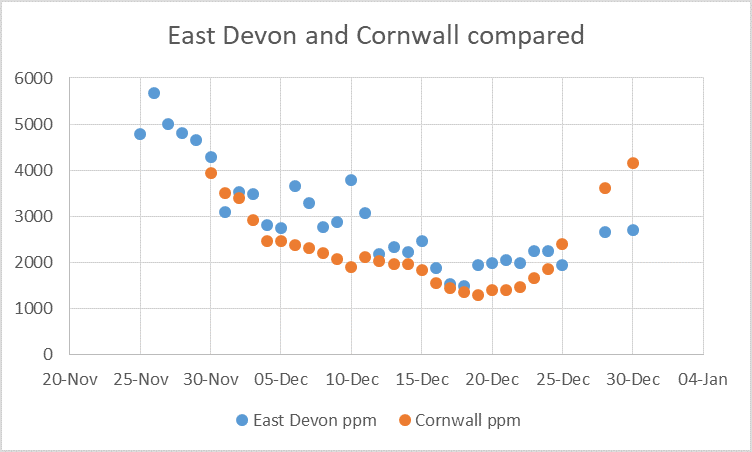
[Owl expands the prevalence map for Devon and Cornwall below to show the Devon current “hot spots” and that, for the moment East Devon is on a per with Cornwall.]

Estimated rate of people with Symptomatic COVID across age groups

 NOTES TO EDITORS

[*] Note that incidence estimates by NHS region are calculated separately from the UK nations and  they don’t necessarily add up to the total for England.

[**] Explanation of how the English Tier Dashboard is created. Using data from the app and from publicly available sources, the ZOE app team has created a way of tracking regions based on alignment with the five key indicators the Government has outlined as its criteria for the current tiers in England (five indicators detailed below). Based on this data, the English Tier Dashboard ranks the regions to show which areas best and worst according to the government’s own criteria. Note that prevalence rates indicate the total numbers with symptoms and typically lag the changes in daily new symptomatic cases (incidence). 

Government indicators are: 

Sources to recreate the government indicators:

CSS data:

  • Prevalence and prevalence rate in the 60+ age group is computed  on the tier subregion level.
  • Positivity rate and R is computed  on NHS region level.

Publicly available NHS data:

  • The % hospital bed occupancy is calculated as a ratio of the Total number of confirmed COVID-19 patients in hospital on the reporting date (source: coronavirus.gov.uk, frequency: daily) and the overnight bed availability for acute and general cases (source: NHS Statistics, frequency: quarterly)

..//

This analysis for incidence data requires swab testing, which was kindly provided by the Department of Health and Social Care for England. As Scotland and Wales are not yet offering tests to our app users, we provided indirect estimates using countrywide averages and wide confidence limits. Testing is happening in Northern Ireland, but the number of participants is too few to generate an accurate estimate. These figures exclude care homes as there is not enough data from the app to estimate this population.

..//

The COVID Symptom Study UK Infection Survey has been running since early May when the COVID Symptom Study commenced the daily swab testing programme provided by the Test and Trace. The CSS has so far recorded over a million swab results from app users. The COVID Symptom Study UK Infection Survey estimates the number of current COVID-19 positive cases in the community based on the information logged by users in the app and the results from the swab testing programme. It identifies differences in numbers within the regions throughout the UK, and tracks the change in estimated cases over time. It is the largest survey of its kind in the UK. We estimate from a sub-study of app users with antibodies that the asymptomatic rate is around 19%, which should be added when comparing to general surveys like ONS. The paper is live on the Journal of Infection: https://www.journalofinfection.com/article/S0163-4453(20)30653-8/fulltext

What have the Romans ever done for us?

Dr Mike Galsworthy on Twitter: “This is superb. Monty Python’s “what have the Romans ever done for us?” 👇😂 

Travel chaos as trains and motorways loaded with people escaping London for Christmas

Travel chaos took hold on Saturday evening as people rushed to leave London before the introduction of tier 4 restrictions.

www.independent.co.uk

Traffic data showed jams increasing inside London and its surrounds, and train prices were surging with increased demand.  

Additionally, train tickets were selling out quickly. By 7pm on Saturday evening, there were no trains available online from several London stations including Paddington, Kings Cross and Euston.

Footage taken at London’s St Pancras station showed passengers streaming down the concourse to board trains heading north.

Travellers were told that social distancing “will not be possible” due to the volume of people on board, and those that felt “uncomfortable” should not stay on the train.

Harriet Clugston, a passenger, said that people on board the trains had attempted to secure space for themselves, but that there was not enough room to do so.

“As expected, train is crammed,” she wrote on Twitter.

“Announcement on tannoy says social distancing ‘will not be possible’ due to volume and to get off if you are not comfortable with that.

“People have tried to secure social distance by placing [bags] on seats but being asked to remove them by other passengers as the train is so full.”

One woman, who did not wish to be named, said she and her partner had made the “split decision” to take their young son to her parents’ home on the coast.

“We just made the decision to leave based on the fact that my parents said come, and we couldn’t bear the thought of no fresh air and a toddler going rogue round a small flat for the foreseeable,” she told the Press Association.

Anectdotal reports suggested motorways leaving London were packed with drivers heading out to beat the new restrictions. 

Some people were driving to leave their newly-restrictive areas for a long stretch of time, while others were leaving to spend the last few hours without tier 4 anywhere.

Izzy, 22, from Bristol, said that she wanted “the security of being home for Christmas” and that her parents had come to collect her before the restrictions came into effect.

“I have a slight nervousness that they might block the roads or something stopping me going home,” she told Press Association.

Boris Johnson announced on Saturday that all areas of east and southeast England – including London – that had been in tier 3 would go into the newly defined tier 4 from midnight.

Tier 4 effectively returns residents to the rules in place during the national lockdown.

Those in tiers 1, 2, and 3 are now only able to mix with other households for a Christmas celebration on 25 December instead of the longer stretch initially planned by the government.

Additional reporting by Press Association

What is the new Covid strain – and will vaccines work against it?

Viruses mutate all the time. Most of the new variants die out. Sometimes they spread without altering the virus’s behaviour. Very occasionally, they trigger dramatic changes.

Robin McKie www.theguardian.com

And the question now facing scientists is straightforward: does variant VUI-202012/01 fall into this last category? Does it represent an increased health risk? Or has its recent rapid spread through southern England occurred because it has arisen in people who are infecting a lot of other people, possibly because they are ignoring Covid-19 restrictions?

These key questions, debated last week after health secretary Matt Hancock revealed the existence of the new variant, were answered firmly yesterday, by the government’s chief medical officer, Chris Whitty.

“As a result of the rapid spread of the new variant, preliminary modelling data and rapidly rising incidence rates in the south-east,” he announced, “the New and Emerging Respiratory Virus Threats Advisory Group (Nervtag) now considers that the new strain can spread more quickly. We have alerted the World Health Organization and are continuing to analyse the available data to improve our understanding.”

These analyses will involve scientists growing the new strain in laboratories, studying its antibody responses and testing its cross-reactions with Covid-19 vaccines. In addition, health officials are now carrying out random sequencing of samples from positive cases across the country in order to survey its spread through the nation and to build up regional maps of its prevalence. This will take at least two weeks.

The appearance of the new variant is alarming – though it should be noted that there have been several previous mutations of Covid-19. Last month, the Danish government culled millions of mink after it emerged that hundreds of Covid-19 cases were associated with Sars-CoV-2 variants carried by farmed mink. And in October, analyses suggested a coronavirus variant that originated in Spanish farm workers spread rapidly through Europe and accounted for most UK cases.

In neither case was it found that these variants increased transmission of the disease. However, it is now clear that this not the case for variant VUI-202012/01. What scientists must now tackle are concerns about the impact of the new variant – in particular whether it will lead to an increase in cases of severe Covid illness or actually result in fewer cases. The other big issue is whether the new variant will be able to bypass the protection offered by the Covid-19 vaccines now being administered across Britain.

“If the new variant was going to have a big impact on disease severity, we would have seen that by now,” said Ewan Birney, deputy director general of the European Molecular Biology Laboratory and joint director of its European Bioinformatics Institute in Cambridge.

“Hospital cases as a proportion of numbers of infections would have either rocketed or dropped dramatically. Neither has happened, so we can conclude that the impact on numbers of severe cases is likely to be modest: slightly more or slightly fewer.”

In addition, Birney said the vaccines have been tested with many variants of the virus circulating. “So there is every reason to think that the vaccines will still work against this new strain, though obviously that needs to be tested thoroughly.”

Exactly where the variant first appeared is not known. It may simply be that Britain’s extremely robust virus surveillance system spotted it before other nations did. “However, it is just as likely that the mutations that created this variant occurred in the UK and that is why we have seen it first,” added Birney.

Budleigh postboxes ‘yarnbombed’ for charity

Post boxes in Budleigh have been given a unique makeover in a bid to raise funds for two regional causes. 

Daniel Wilkins​ www.exmouthjournal.co.uk 

Budleigh postboxes get a yarnbomb make over.

Budleigh postboxes get a yarnbomb make over. – Credit: Clare Suttie

Yarnbombers have topped four red post boxes in the town with knitted coverings – one of which depicts the three kings from the Christmas story. 

Yarnbombing is the practice of covering public landmarks with knitting usually in an effort to spread positivity. 

Budleigh postboxes get a yarnbomb make over.

Budleigh postboxes get a yarnbomb make over. – Credit: Clare Suttie

The initiative is part of a fundraising campaign for charities Devon Mind and Hospicare and is the brainchild of Clare Suttie and the team at Atlas Translations.

Clare, who lives in Colaton Raleigh, said: “After everything that 2020 has thrown at us, the Atlas Translations’ team thought Budleigh Salterton needed a bit of extra festive cheer. And what could make you smile more than some clever crochet and knitting?

“We ask people to admire the postbox toppers, smile, take a photo, share on social media #budleighsaltertonpostboxes – and donate using the link below.

“There are 4 postboxes to find in Budleigh Salterton.”

Budleigh postboxes get a yarnbomb make over.

Budleigh postboxes get a yarnbomb make over. – Credit: Clare Suttie

Andre Pusey, marketing and fundraising officer at Devon Mind, said: “We’re so grateful to Clare, Candy and the Atlas team for going the extra creative mile for Devon Mind. 

“It’s thanks to such generous support that we are able to grow and improve the services we offer the people of Devon. We know that the mental health impact of Covid is huge, so we’ve got big plans in 2021 to reach as many people in isolated areas and underrepresented groups as possible.

“Any money raised as part of this campaign will be hugely beneficial to these efforts.”

Karen Palmer, fundraiser at Hospiscare, said: “We have just over three clinical nurse specialists working in the EX8 area and eight Hospiscare at home nurses who also cover the Budleigh area.

“In the last 12 months, the combined team have had 243 referrals and have noted that the care is becoming more complex and the support need ever more vital.  

“To provide this and many other services to local people,  Hospiscare needs to raise £8million with just 18% being provided by the NHS.

“The impact of Covid on our finances has been devastating and we are predicting a £1million+ deficit this year.”

The people are urged to go to a Virgin Money page to donate – so far £75 has been raised. 

To donate, visit http://uk.virginmoneygiving.com/Team/BudleighSaltertonPostboxes

New help-to-buy loans are limited to first-time buyers

The latest version of the help-to-buy equity loan scheme opened on Wednesday, with first-time buyers now the only people allowed to apply for government assistance to get on to the housing ladder.

Duh! Imagine that! – Owl

Hilary Osborne www.theguardian.com

The scheme, which allows buyers to borrow up to 20% of a new-build property’s value, or 40% in London, will no longer be available to movers and is subject to new regional caps on prices.

In London, it can still be used to buy a property costing up to £600,000 but in the rest of England prices will be capped at 1.5 times each region’s average first-time buyer house price.

In the north-east, for example, the maximum property price it can be used on is £186,100, while in the east Midlands it is £261,900.

More than 270,000 properties were bought with the first version of the scheme between April 2013 and 31 March 2020, with first-time buyers accounting for 82% of purchases, but there were concerns that help was not being targeted at those who most needed it.

The loans granted through the scheme are interest-free for the first five years. Buyers pay a reservation fee of £500 and need to raise a deposit of at least 5% of the property’s value.

The loans can be repaid at any time but must be settled when the home is sold or the mortgage is paid off.

First-time buyers who sign up will be able to move in from 1 April 2021. This version of the scheme is set to close in 2023.

UK fishing rights will remain ‘in hands of millionaires and multinationals’ after Brexit

Could it be that some of these millionaires live in East Devon? – Owl

Martina Bet www.express.co.uk 

Fishing has been a contentious point in Brexit talks, with the UK highly critical of the EU’s longstanding Common Fisheries Policy (CFP), which allows member states to fish in each others’ waters based on a quota system set by the bloc. The EU’s own mandate for trade talks says the UK and Brussels should fix a long-term deal on access to each others’ waters in exchange for a Free Trade Agreement (FTA), but the UK is pressing for annual talks to set those quotas – with the ability to block EU vessels if those discussions break down. France is one of many nations dependent on British fishing grounds and before the negotiations even started, it was Emmanuel Macron’s government who made it clear to the EU’s chief negotiator Michel Barnier that he had to push for stronger commitments on regulatory alignments in return for maintaining free trade.

Seven months later and with less than two weeks until the transition period comes to an end, an agreement still appears far away.

As many Brexiteers wonder whether a no deal scenario could be the only way to get back control of British waters, a 2018 investigation reveals that even if there is no agreement struck between the EU and Britain, the majority of UK fishing rights will remain in the hands of a small domestic elite and a handful of foreign multinationals.

The Fisheries Act published in 2018, which sets the legal foundations for the UK’s fishing industry after Brexit, does not see any redistribution of Britain’s existing quota rights.

The investigation published by Unearthed reads: “More than two-thirds of the UK’s fishing quota is controlled by just 25 businesses – and more than half of those are linked to one of the biggest criminal overfishing scams ever to reach the British courts.

“Meanwhile, in England nearly 80 percent of fishing quota is held by foreign owners or domestic Rich List families, and more than half of Northern Ireland’s quota is hoarded onto a single trawler.”

Half of England’s quota is held on Dutch, Spanish, or Icelandic-owned “flagships”, so called because they sail under a British flag.

One Dutch multinational alone controls around a quarter of English quota, the investigation found.

By comparison, the UK’s small scale, “inshore” vessels must fish from a pool of quota amounting to less than two percent, despite making up around 79 percent of the UK fishing fleet.

Responding to Unearthed’s findings at the time, former Shadow Environment Secretary Sue Hayman said that ministers needed to take “urgent action to use the powers that they have domestically to redistribute fishing quota to deliver a fairer deal for smaller boats”.

She continued: “Fishing was the poster child of the Leave campaign and Michael Gove has already broken promises he made to the industry to secure full control of our waters during the transition.

“With all the talk of ‘take back control’, ministers have the power to distribute UK quota now and put the smaller-scale fleet first. So why wasn’t it mentioned in their white paper?

“This investigation shows that, while it points the finger at others, this government is to blame for a sector rigged in the interests of the super-rich.

“Any future fishing policy must consider how new and existing quota can be more fairly distributed and we will treat this as a priority in the upcoming Fisheries Bill.”

One of the priorities of the Fisheries Act, which became law on November 21, is that “fishing activities of UK fishing boats bring social or economic benefits to the United Kingdom”.

Current rules say even if vessels are 100 percent foreign-owned, they must have an “economic link” to the UK.

That means they must meet one of five conditions, which include landing more than half their catch at UK ports or having majority British crews.

A consultation by the Department for Environment and Rural Affairs (Defra), which closed in November, outlined plans to “increase the landing requirements from 50 percent to 70 percent for quota catch caught by English registered vessels landing more than two tonnes per annum”.

The consultation stated that this change “could result in up to £60million worth of additional landings each year”, but it did not mention any changes to rules around ownership.

A Defra spokesperson told Express.co.uk: “As an independent coastal State we’re committed to ensuring a fairer share of fishing opportunities, and while we will provide certainty and stability to the industry by managing existing quota with the current method – we are currently exploring alternative methods for allocating and managing additional quota.

“Commercial fishing vessels must demonstrate a genuine link with the UK economy to fish in our waters, ensuring local communities benefit from the fishing activities of UK-registered vessels.”

For many in the fishing industry, though, Defra’s proposals are not good enough.

Paul Lines, from Fishing for Leave, a pro-Brexit group within the British fishing industry, recently told BBC: “If the Government allows foreign companies to continue to own more than half of England’s quota, it would be a calamity.”

Darts Farm defends carol service from Covid criticism

Darts Farm has come under fire after pictures circulated on social media of a carol singing event which appears to show vast numbers of people not socially distancing or wearing face coverings.

132 comments so far, mostly scathing! – Owl

Anita Merritt www.devonlive.com 

However, the popular farm shop in Topsham – which shared the event live online yesterday – has insisted that the event was safe and well-organised, and did not breach Covid-19 regulations.

An outdoor Christmas carol evening was held within the grounds of the farm last night [Friday], December 16, from 7.30pm.

Visitors were asked to congregate outside by The Shack with Christ Church Woodbury and SW Comms Band leading the music.

A screen shot of the outdoor Christmas carol evening at Darts Farm

On its Facebook page yesterday, Darts Farm stated: “Everyone is welcome, there is no need to book.

“Please note, we will not be handing out booklets. Instead, all of the carols can be found here https://www.dartsfarm.co.uk/outdoor-christmas-carol-evening – please bring your phone with you to access them.”

The event, which included a collection for Exeter Foodbank and offered mince pie and mulled apple juice, was watched by many on Dart Farms Twitter feed last night and the link has since been removed.

On its Facebook page, people have vented their anger and disgust at how the event has potentially put peoples’ lives in danger.

One person said: “Who thought this would be a good idea? I’m furious how you think you could be above the law?”

In agreement someone said: “I am beyond fuming. You’re bragging about supporting families who have been hit hard by Covid then you host a get together to sing carols.

“The pictures show the massive crowd with no distancing and no masks. Covid has affected us all in one way or another, but you go ahead with a get together that the government has banned others from.

“Those that attended and whoever thought up such a stupid idea should be fined too.”

Another said: “This is disgusting. In the current situation and having friends working at RD&E and also having family and friends currently recovering from Covid and laying in ICU with Covid this is appalling.

“By all means have a carol concert, but lay down Covid rules such as masks must be worn, social distancing and limit numbers.”

A concerned Devon Live reader added: “I am horrified having watched it on Instagram. Hundreds of people were not socially distanced and without masks. They are singing which increases the spread.

“This is surely illegal, immoral, irresponsible. Several people could die as a result of this.”

A spokesperson for Darts Farm said: “We are so thrilled to have been able to run our Outdoor Christmas Carol Evening last night, that complied with all the guidance from the government’s ‘Covid-19: suggested principles of safer singing’.

“With unlimited outdoor space and using closed off car parking, everyone was able to social distance and stand where they wanted. You could say that it was more organised than most busy high streets on a Saturday.

“The actual programme for the evening, including all of the carols, was on our website so that everyone could follow and sing using their phones – reducing any contact with no one gathered around a screen with projected words.

“From all those that attended, we have had nothing but positive feedback and interestingly the only criticism has come from those that didn’t actually attend the evening.

“The comments we have received include, ‘really moving hearing people singing together again even at a distance’, and ‘a big thank you for the organised carol service this evening. You do not know how much we needed that. God bless and merry Christmas’.

“It was brilliant to be able to see our local community come together in festive spirits in what has been a very challenging year. Outdoor carol singing is something that has been encouraged by the government in their recent guidance to help lift our spirits this Christmas.”

Greedy developers sitting on land for 1 million homes despite housing crisis

The Government is under pressure to tackle greedy developers sitting on land for a million homes as the housing crisis continues to grow.

Chris McLaughlin www.mirror.co.uk 

Critics say builders are hoarding “land banks” until they can make bigger profits.

And councils are demanding powers to force them to build on the sites or sell up using compulsory purchase orders.

The Local Government Association says 1,003,600 homes given approval are unbuilt. It comes as charity Shelter says the social housing waiting list has hit 1.6million, with 280,000 homeless.

The Covid crisis could force thousands more into homelessness while official figures say 4,500 people will be sleeping rough this Christmas. David Reynard, LGA housing spokesman, said the system was “broken”.

And Labour’s Shadow Housing Minister Mike Amesbury, said: “Some greedy developers have to be told to get building.

“The Government has to give councils the teeth to ensure land owners are forced to use it or lose it.”

The Home Builders Federation insists some sites are not “deliverable”.

But a Housing Department spokeswoman said: “Compulsory purchase can play an important role in supporting housing development – we plan to consult on reforms to improve this process next year.”

Lies, Damned Lies and Housing Statistics – Byline Times

The  Campaign to Protect Rural England (CPRE) analysis of the statistical underpinning of the 300,000 annual house building target gaining traction. – Owl 

Julian Mercer bylinetimes.com 

Julian Mercer continues his investigation into the erroneous calculations underpinning the Government’s house building programme

The Office for National Statistics (ONS) is under investigation for the way in which it forecasts population growth – a key component informing the Government’s drive to build 300,000 homes a year.

The UK Statistics Authority has accepted an appeal from the Campaign to Protect Rural England (CPRE) to review ONS data in the West Midlands that, protestors say, has multiplied housing targets by three times the actual need.

In a letter, co-signed by cross-party MPs and the Conservative West Midlands Mayor Andy Street, CPRE claims that the impact of the ONS data will be devastating.

“Large amounts of the historic Forest of Arden – precious for history, biodiversity and providing the green lungs of a crowded urban area – have been removed from green belt,” it reads. “It is a case of bad data leading to bad decisions.”

Last month, Byline Times reported how the Government is sidestepping another factor in the calculation of housing need. Overestimates of the rate at which households form mean up to 80,000 unnecessary homes are built every year. If the new ONS complaint is upheld, a second key pillar of Government’s housing policy will be undermined.

The situation in the West Midlands came to light through the work of Merle Gering, a Californian who has lived in Coventry for 40 years and chairs the protest group, Keep Green Belts Green. For years, Gering has seen favourite country walks bulldozed for house building, but his concern reached new heights when Coventry council, heeding the ONS data, targeted 42,000 more homes by 2031.

Definitive measures of population come only from the 10-yearly Censuses. From 2001 to 2011, Coventry’s population rose by 5% to 317,000. Before the next census in 2021, planners rely on ONS projections – which is where the trouble begins. The ONS predicts that the city’s population will mushroom – at three times the rate of the West Midlands region – to reach 420,000 in 2031.

“Nothing in the geography or economy of the city justifies these differences,” wrote CPRE to the statistics regulator. “Coventry is a traditional centre of population that has experienced relatively sluggish growth in recent decades. That its population will now suddenly ‘take off’ defies belief and is against all intuition.”


Ghosts Who Leave No Shadow

Gering began a detailed study of local population indicators to see how much growth had actually occurred.

“If there are vast numbers of people pouring into Coventry, they don’t vote, don’t go to A&E, don’t have babies or send children to school and they don’t make waste,” he says. “They are ghosts or vampires who leave no shadow.”

He then analysed the key elements of population forecasting: the numbers of births and deaths, and of migration. Outside London, Coventry has one of the highest student populations, with 16,000 overseas scholars coming every year to the city’s two universities.

Their presence is confirmed in the age profile of the ONS data, revealing a sharp rise in 18 to 24 year olds. But is it fair to assume that they stay in the city after graduating and will thus trigger a huge increase in housing? In a review of migration policy in 2018, Theresa May didn’t think so: “Students, coming in for the period of their education and then leaving, actually wash through the numbers; they don’t have a long-term impact.”

To gauge graduate destinations, the ONS consults the International Passenger Survey (IPS), which questions people moving in and out of the UK. But the IPS has been widely criticised, not least because of its relatively small sample size. The House of Lords concluded in 2017 that it “cannot be relied upon to provide accurate estimates of net migration” and the statistics regulator said that it “generates a narrative that is potentially misleading”.

So Gering looked elsewhere. Warwick University revealed that only 4% of graduates remained in the city after 10 years – exactly the percentage who came from Coventry in the first place, and a number matched by the Home Office exit checks which ensure non-EU students don’t overstay their visas. The Higher Education Statistics Agency reckons, meanwhile, that 94% of Coventry’s overseas students leave promptly.

“This could have the effect of exaggerating the growth in Coventry’s population by up to 60,000 over 20 years”, wrote CPRE to the regulator. “We believe this may well be a more general problem. Others around the country disbelieve the projections in their local authority areas.”

Other university towns are indeed receiving high growth projections but perhaps of greater concern to the nation as a whole is how the ONS counts natural change – the difference between births and deaths.


Hatches and Despatches

A glance at birth and death registrations in Coventry reveals that the native population is growing, but at a decreasing rate. The number of deaths is relatively constant but there are fewer births.

Inexplicably, the ONS forecasts the opposite. For example, a series of projections of Coventry’s population in 2019 predicted that, on average, there would be 2,400 more births than deaths. But when the actual number of registrations in the city last year was counted, the difference was only 1,451. In other words, whatever else is decided, Coventry’s population is being overestimated by at least 1,000 a year.

How could the ONS get it so wrong? “The birth rates that feed into the projections will be affected by the increased numbers of students,” wrote the ONS’ deputy director, Rich Pereira, in a letter to Gering. A reasonable assumption if those students hung around.

Gering believes that the ONS projections of migration and natural change are inflating Coventry’s population by up to 80,000 people. And he has impressive support. “Compelling evidence,” said past-President of the British Society for Population Studies, Piers Elias. A leading demographer at Newcastle University, Professor Tony Champion, called it “highly valid” and, at Oxford University, Professor David Coleman described the work “as good as it can be”.

To be clear, 80,000 extra people would require at least 30,000 extra houses, almost exactly the number by which the city has been forced to raise its housing target. “We have been forced to use figures that are stupid by the Government,” said one former council leader, John Mutton.


An Emperor Without Clothes?

In launching the ONS investigation, the UK Statistics Authority promises to ensure that “the official statistics can bear the weight put on them where they are used in decision-making”.

The ONS says that it will work with the review and has “always sought to be fully transparent and helpful in discussions around the methods we use”.

But if it is found to have miscalculated, will it make any difference?

Byline Times also reported last month how the Government dismissed as “methodological” the shortcomings in its household projections. “They do not understand the changes are not ‘methodological’ but about removing obsolete, distorting data,” says a housing activist in Liverpool, Professor David Gregg. “You cannot make rational local policies based on grossly distorting ‘adjustments’ imposed from the centre for political reasons.”

The findings of the review are awaited, but Gering knows time is of the essence: “On the back of absurd population projections, a cherished piece of our green and pleasant land is about to vanish, because no one will admit that the numbers do not stack up and the emperor has no clothes.”