Some Devon homes given wrong advice after parasite outbreak

It’s safe to drink the water – oh no! Wait a minute, it’s not safe.

What a farcical shambles. – Owl

Wrong boil water advice given to some Devon homes

A water company has apologised after nearly 30 properties in Devon were wrongly told they could stop boiling their water after a parasite outbreak.

George Thorpe www.bbc.co.uk

South West Water (SWW) on Saturday lifted a boil water notice for 14,500 properties in Brixham after part of the network was given the all-clear.

About 2,500 properties in Hillhead, Kingswear and upper parts of Brixham are still being advised to boil their water.

However, some residents received a letter saying they could drink the tap water, only to get a separate message hours later advising them to keep boiling it.

SWW blamed an issue with its digital mapping system for the error and said it was offering an extra £75 compensation to people given the wrong advice.

It said 28 properties received the wrong notice.

There are 46 confirmed cases of cryptosporidiosis, an illness that causes diarrhoea, linked to the outbreak.

The first letter sent to residents said the UK Health Security Agency and the local environmental health department agreed the boil water notice could be lifted.

The second letter, seen by the BBC, warned the parasite was still in the area’s water supply and residents should continue boiling their water.

‘Sort yourselves out’

Rhian Manley said she received two notices, with the second letter arriving at about 22:00 BST.

She said the situation was “embarrassing” and could have had serious implications for residents.

“My message to South West Water is sort yourselves out and actually start working for the people who pay for you,” she added.

Conservative MP Anthony Mangnall, whose Totnes constituency covers Brixham, said the leaflet issue was another sign of how poor SWW’s communication had been.

He advised residents to look at a postcode checker, external on SWW’s website to see if they should boil their tap water or not.

“It is deeply disappointing that South West Water continues to frustrate residents with unclear communications,” he said.

‘Technical issue’

SWW apologised for the confusion caused by the conflicting letters.

“This was caused due to a technical issue with our digital mapping system,” it said.

“We also had a small number of customers in a localised area who, in error, received the wrong notice advising them that their property was no longer covered by the notice.”

The firm said it was contacting customers affected by the conflicting advice.

These customers would be receiving an extra £75 compensation, SWW said.

Dee Agirdici-Maher said she would use bottled water for the time being

Other residents in Brixham have said they are still worried about drinking tap water, saying they do not trust how clean it is.

Dee Agirdici-Maher, who lives near Alston and has been told she can drink her tap water again, said it was going to be “a while” before she trusts the water.

She said she would drink bottled water until she was “totally comfortable” with the supply.

“It’s going to take time,” she said.

She said the water company’s handling of the outbreak had been poor.

“Truthfully, with all the money that they’ve got, it shouldn’t have happened in the first place,” she said.

SWW on Saturday increased the level of compensation available for the remaining affected households, rising from £115 to £215.

However, it said it had been made aware of fraudulent calls being made to some customers.

The company said customers did not need to do anything to receive the payment as it would be paid straight into their accounts and urged people to report any suspicious calls.

“All household customers who have been issued with the boil water notice will receive their compensation by way of an automatic payment,” a SWW spokeswoman said.

“Where we hold direct debit details this will be made as an immediate payment, where we do not this will be added as a credit to the next available bill.”

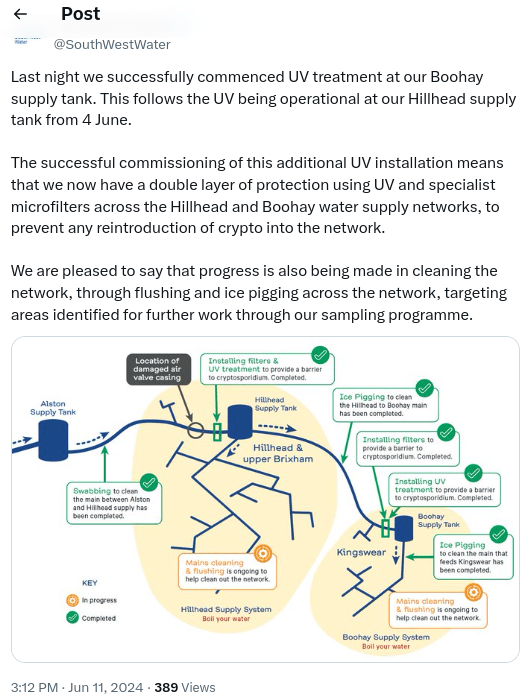
David Harris, SWW’s drought and resilience director, said the water tank at Hillhead reservoir had been drained.

He said the tank, where tests confirmed the presence of cryptosporidium, would be thoroughly cleaned before being refilled.

A damaged valve on private land in the area was identified as the “possible cause of contamination” and it was isolated from the network, the company said.

Thousands gather across UK to demand clean rivers, beaches and lakes

Thousands of people across the UK gathered at beaches, rivers and lakes on Saturday to demand change in the country’s water pollution levels.

[See ESCAPE for images of the Exe “Paddle Out” event.]

Athena Stavrou www.independent.co.uk

Protesters gathered at swimming spots from West Pier in Brighton to Gyllyngvase Beach in Falmouth following reports that millions of litres of raw sewage were pumped into Windermere in the Lake District for 10 hours in February.

Some held signs and placards calling for clean oceans while others wore costumes as people were seen paddle-boarding out into the ocean.

Among the demands from activists was an end to sewage discharges into all bathing and high-priority nature sites by 2030.

The campaign, coordinated by Surfers Against Sewage (SAS), saw protests at more than 30 locations.

In Brighton, Olympic gold medal runner and keen paddle-boarder Dame Kelly Holmes addressed demonstrators through a megaphone before leading dozens in a paddle-out.

In Falmouth, surfers paddled out en-masse while sea-kayakers carried placards on their boats calling for fish not faeces. Meanwhile, more than 200 people entered the water at a wild swimming spot at Ferris Meadow Lake in Surrey.

Emma Jackson, who organised the Shepperton Open Water Swim event, said she was contacted by SAS after setting up a campaign to save the lake from the River Thames Scheme, which will build a new flood relief channel through the area.

She said the lake naturally cleans itself and was much safer to swim in than the Thames but, under the proposal, the lake would be connected to the river, leaving it in danger of contamination.

She said she could not imagine being unable to swim at the lake if it became unsafe, adding: “I don’t want to think about it. Today is the first day of the season here at Shepperton Open Water Swim and I can tell you, speaking to my community of swimmers, they are all just over the moon to be back and it is a really special place for us.

“There are plenty of spaces you can swim, there are other lakes in the local area, there are other bodies of water that are equally as safe and we can we can swim in but… this place holds a special place in a lot of people’s hearts.”

Dinah Sershi, 54, and Georgina Palffy, 55, who are regular swimmers at the lake, attended the protest.

Ms Palffy said they would feel “bereft” if they were no longer able to swim there due to water contamination.

“We do swim in other places, but none of them are quite as magical as this, and none of them have the amazing clean water that they get here, which is something really special,” she said.

Ms Sershi said swimming at the lake was particularly important for women who are going through the menopause.

“I’m particularly passionate about swimming here,” she said. “I’m a woman in my 50s. And I know a lot of people in this community are in their 40s and 50s and find the water an incredible way of managing the menopause symptoms.”

Emma Pattinson, 55, whose family operates Shepperton Open Water Swim, said there was an “alternative route” for the River Thames Scheme, which would circumvent the lake.

“Obviously we don’t want anyone to be flooded on our behalf,” she said. “But we also want this lake to retain its clean water for our swimmers. It matters a lot to them.”

The protests came after raw sewage was pumped into Lake Windemere for nearly 10 hours in February after a telecommunication failure at a pumping station operated by United Utilities, a major water and wastewater services provider in the North West.

The situation was labelled a “scandal” by opposition politicians, while Downing Street said it was “completely unacceptable” and that the Environment Agency had the power to launch a criminal prosecution if necessary.

Lake Windermere at Bowness in the Lake District national park (Alamy)

The discharge happened at the company’s pumping station at Bowness-on-Windermere in Cumbria on the night of 28 February and intermittently the following day.

The emergency pumps discharged more than 10 million litres of raw sewage into the Unesco world heritage site after the main pumps abruptly stopped due to a telecom fault, insiders at the firm told BBC News, whose report also cited internal documents from the company.

The latest incident comes amid warnings from environmental agencies that swimming and other activities in and around some of the country’s rivers and lakes could be hazardous due to high levels of sewage pollution.

There were 68,481 incidents of sewage released into England’s seas last year, totalling 440,446 hours, campaign group Friends of the Earth said on Wednesday after analysing Environment Agency data.

The Times view on Britain’s utility companies: Troubled Waters

The Times Leading Article

There is no more basic service for public health and welfare than providing clean water. Yet Britain’s water industry has acquired a reputation for incompetence and excess that is deserved and self-inflicted. It is exemplified in sewage spillages and even disease for consumers, alongside high financial rewards for water companies’ executives and dividends for shareholders. The water industry might almost be a Brechtian parable of the iniquities of capitalism. That would be wrong, but supporters of the market economy need to explain why this industry is exceptional while pressing for tougher consumer protection against its failings.

In the past few days 46 cases of a waterborne disease causing diarrhoea and vomiting have been confirmed in an area of Devon, and more than 100 other residents have reported similar symptoms. South West Water has found what it terms “small traces” of a parasite associated with this disease in a local reservoir, and advised households across the area to boil water before drinking it.

This is not merely an oversight. It is part of an established pattern of errors of omission and commission. There are 11 regional water and sewage companies in England and Wales, with a further five water-only companies. Together they make up a sector that is loaded with debt, even while paying out handsome dividends, and has a dismal record of raw sewage discharges in rivers and on beaches, and inadequate investment.

The costs of failure appear to be minimal. Severn Trent Water, which services more than 4.5 million households and businesses in the Midlands and Wales, was responsible for more than 60,000 sewage spills last year while its chief executive, Liv Garfield, had a compensation package worth £3.2 million. United Utilities, which supplies water in the northwest of England, declared a dividend increase of 9.4 per cent this week, almost exactly coincident with reports of its failure to stop or promptly report a sewage discharge in Windermere, in the Lake District, in February.

While financial rewards for agents and principals in water companies are ample, bills for consumers have risen by more than 40 per cent since the industry was privatised in 1989. It is hardly surprising that populists see it as an example of what is wrong with a market economy. It would be an error to heed their message but policymakers need to address the sector’s dire performance.

There is nothing wrong with high pay for bosses in companies and sectors that compete successfully in a global marketplace. That does not apply to the chief executive of a water company that enjoys an effective monopoly. Ms Garfield’s pay package (and she is not the only one) brings the industry into further well-deserved disrepute. It also lends superficial plausibility to the case that a Labour government, likely to take office within months, should nationalise the sector.

In truth, public ownership would not resolve the problem of poor infrastructure and, for some companies such as Thames Water, financial fragility. As this newspaper’s Clean It Up campaign argues, water companies need to spend more on investment to expand reservoir capacity and fix leaks. Ofwat, the regulator for water and sewage in England and Wales, ought to be far more insistent on investment targets, and ensure that the burden is borne equitably by shareholders and customers.

And on no account should a financially stretched water company be bailed out by taxpayers; there is no systemic threat to the economy, and the costs should fall on holders of the company’s securities.

Water is a test case for capitalism. Because regional providers do not have obvious competitors, the easiest route to generating profits is to skimp on investment, raise bills and pump sewage into rivers. This government and its successor must ensure that stringent regulation puts a stop to this business model and serves the public instead.

 “Very, very hard questions” for the Conservatives to answer as well as SWW – Owl

In the article below the Health Secretary, Victoria Atkins, is reported as saying there will be “very, very hard questions” for South West Water over the outbreak of cases of cryptosporidium.

Owl thinks equally hard questions need to be addressed to her and Conservative governments past and present. There’s the 1989 privatisation in the first place: with all debts being placed on the shoulders of taxpayers and the new companies given a £1.5bn “green dowry” as well;, followed by austerity cuts and “light touch” regulation.

Victoria Atkins was elected to parliament in 2015 and appointed as a junior minister in 2017 when austerity was still being pushed hard.

Did she, for example, follow the whip over watering down attempts to toughen regulation and targets on pollution alongside Simon Jupp? – Owl

Health Secretary looks into the South West water crisis

Tim Herbert www.midweekherald.co.uk

Health Secretary Victoria Atkins said there will be “very, very hard questions” for South West Water over the outbreak of cases of cryptosporidium, a waterborne disease caused by a microscopic parasite, confirmed in the Brixham area of Devon, writes PA.

Speaking to reporters during a visit to the University of Exeter, Ms Atkins said: “There will be very, very hard questions for South West Water to answer. At the moment I think we probably need to give them the space to conduct their investigation; we know that they have identified the source.

“The public will want to know how on earth that source happened, what was the chain of events that led to this, because of course we all understand the expectation that we all have when we turn our taps on is that (we get) clean drinking water and we want to be able to trust it.”

She added: “Outbreaks such as this are very, very unusual in our drinking water. The authorities are looking into this very carefully. People must please follow the advice for the time being and as the investigation proceeds, more answers will be obtained for the public.”

Voters back taxing rich more to help pay for NHS – as report shows Sunak wealthier than the King

Nearly two thirds of voters would be more likely to back a political party committed to higher taxes on the wealthiest to fund the NHS and public services.

Andy Gregory www.independent.co.uk

The data on public opinion on taxes comes as the annual Sunday Times Rich List found Britain’s 350 richest families hold a combined wealth of £795bn – with the fortune of prime minister Rishi Sunak rising.

Both major political parties clicked into general election campaign mode this week, with Sir Keir Starmer unveiling a Tony Blair-style set of election pledges and chancellor Jeremy Hunt using a speech on Friday to warn that taxes would rise under a Labour government.

But a new FocalData survey commissioned by the group Tax Justice UK suggests that there is public support for major changes to the tax system.

Told that a 1 to 2 per cent ‘mansion tax’ on assets worth over £10m would affect around 20,000 people and could raise up to £22bn a year, 72 per cent of respondents indicated that they would support for such a tax, with 73 per cent backing such a toll to help invest in the NHS.

And 57 per cent of the survey’s 1,011 respondents said they would support charging the same tax rate on income derived from wealth as on income earned from employment.

The findings come as the publication of the Sunday Times Rich List suggested that prime minister Rishi Sunak is now wealthier than King Charles.

The personal fortune of the prime minister and his wife, Akshata Murty, surged by more than £120m over the past year, soaring to £651m in the latest list – as the latter’s shares in her father’s IT firm Infosys grew in value by £108.8m.

This put the Sunak’s wealth above that of the King, whose fortune rose by £10m to hit £610m.

Responding to the new Rich List, Downing Street insisted Mr Sunak should be judged on his actions and not his personal fortune.

The prime minister’s deputy spokesperson told reporters: “He’s been asked about this before and we’d always point people to the actions that he takes to support people … That’s his focus and his priority and he should be judged on that.”

The 350 wealthiest individuals and families on the list together held combined wealth of £795.36 billion, according to the new data – which showed the number of British billionaires tumbled slightly from a peak of 177 in 2022 to 165 this year.

Robert Watts, who compiled the rich list, said the findings suggested that “Britain’s billionaire boom has come to an end”, adding: “Many of our home-grown entrepreneurs have seen their fortunes fall and some of the global super rich who came here are moving away.

“Thousands of British livelihoods rely on the super-rich to some extent. We’ll have to wait and see whether we have now reached peak billionaire, and what that means for our economy.”

Responding to the findings indicating support for taxing such individuals more stringently, Tax Justice UK’s head of advocacy and policy Rachael Henry said: “Taxing the wealth of the very richest is an extremely popular policy – a vote winner – and an incredibly sensible way to help fix the country.

“People in Britain are really struggling and so are public services. The NHS is wounded, getting an NHS dentist is akin to a lottery win, and GP surgeries are creaking under pressure. Politicians need to see the wood for the trees and use the tools available to them to inject life back into the country.”

Tories try to gain power in temporarily “hung” Torbay council

Takes you back to the Tory shenanigans in East Devon during May/June 2000. – Owl 

Walkout, anger and tears mar Torbay mayor-making meeting

Tory group’s U-turn leaves Mayor-elect stunned

The bitter power struggle for control of Torbay Council boiled over into angry scenes at the annual mayor-making meeting.

Guy Henderson – Local Democracy Reporter www.radioexe.co.uk 

Traditionally a ceremonial occasion with no hostile debate involved, it ended with tears, cries of ‘shame’, accusations and a mass walkout.

Afterwards councillors said future co-operation between Conservative and opposition members of the council was ‘in tatters’.

The row centred on the appointment of a new civic mayor for the bay. In February the council had been unanimous in nominating long-serving Liberal Democrat councillor Swithin Long (Barton with Watcombe) for the role. His nomination was even seconded by Conservative council leader David Thomas (Preston).

Cllr Long had invited friends and family to the mayor-making meeting and had already accepted invitations to charity events in the opening weeks of his mayoralty.

But two days before the meeting Cllr Thomas announced a sudden U-turn, saying the Tory group would not, after all, be supporting Cllr Long’s nomination.

He maintained that it was traditional for the council to appoint one year’s deputy mayor into the next year’s top job, having served a year’s ‘apprenticeship’, and that would mean Tory councillor Hannah Stevens (Furzeham with Summercombe) getting the job.

But he also conceded that the Tory group’s abrupt change of mind had come as a result of the balance of power on the council shifting.

The death of Prosper Torbay councillor Patrick Joyce, who jointly formed the group after leaving the Tory group, has led to a by-election which will take place in Wellswood next month. If the Conservatives win Wellswood back, it will mean there are 18 Tories and 18 opposition members of the council, giving the mayor the crucial casting vote when debates are split.

Some councillors have described the next mayor’s role as that of ‘kingmaker’, and both Conservatives and the opposition are keen to make the role theirs.

However, the fallout from the U-turn over the mayoral nomination was bitter. Cllr Long himself said: “I am genuinely shocked and disappointed that this is becoming a political event.”

And Katya Maddison (Shiphay), who is the other member of the Prosper Torbay group in the opposition, said it was ‘an example of bad faith’ and ‘casual reneging on a commitment’.

And she told her former Tory colleagues: “The Conservative party needs a clean-out, and I question whether you are fit for the job.”

Opposition leader Steve Darling (Lib Dem, Barton with Watcombe) said the position of mayor had been ‘dishonoured’ by the wrangle, and warned that squabbling could damage prospects for Torbay.

“This is creating a poisonous brew,” he said. “We should be coming together and championing Torbay.”

And Cllr Darren Cowell (Ind, Shiphay) went on: “This is a sad day. A coach and horses has been driven through an arrangement based on trust.

“The role of civic mayor is non-political, but today it has been weaponised.”

Voting went down strict party lines, with the motion to have Cllr Long as mayor defeated, along with one for Cllr Kelly Harvey (Lib Dem, St Marychurch) to be his deputy.

Cllr Thomas then succeeded with a motion to put off setting the political make-up of the council’s committees until after the Wellswood by-election on 6 June, instead of doing it on the same day as the mayor-making as normal.

Almost all of the opposition councillors had walked out of the chamber in disgust before the vote was completed.

Bodies left to decompose in NHS hospitals – inspectors’ report

Bodies have been left to decompose at NHS hospitals across England, according to reports by inspectors.

The Newsroom www.newschainonline.com

Officials from the Human Tissue Authority (HTA) have told how inadequate storage facilities and lack of freezer space means some bodies have been left for too long at unsuitable temperatures.

Official HTA guidance says that bodies should be moved into frozen storage after 30 tdays in fridges or before, depending on the condition of the body.

However, a series of reports show NHS trusts are not always adhering to these rules and keep bodies for far longer in fridges.

In one case at Leeds General Infirmary, reported last year, the HTA said: “The inspection team noted a body that had been in storage for 70 days that had not been placed into frozen storage despite being released by the coroner.

“This body showed signs of decomposition and had soiled shrouding.

“A second body had been in storage for 47 days, had also been the subject of a coroner’s release notification and had not been placed into frozen storage and showed signs of decomposition.”

Inspectors also found there was no cleaning schedule for the body store at Leeds General, and “the door from the visitors area to the staff office is not fitted with a lock…This allows potential access to the main mortuary.”

At the Royal Blackburn Hospital, inspectors in 2022 found major flaws, including discovering “two bodies in an advanced state of decomposition as a result of not being moved into frozen storage after 30 days”.

Elsewhere, at King’s College Hospital in London, inspectors reported “critical” shortfalls in 2022, with mouldy and infested conditions for body storage.

The report added: “At the time of the inspection there were several adult bodies which had been stored in excess of 30 days in the fridge units.

“Whilst these bodies were subject to regular condition checking, signs of deterioration were present.

“Bodies required movement to freezer storage to prevent further deterioration however the long-term storage unit was at capacity.”

Meanwhile, inspectors in 2022 to the John Radcliffe Hospital in Oxford found inadequate storage space and “identified a number of bodies which had been held in refrigerated storage longer than the recommended 30 days which were beginning to show signs of deterioration”.

The Health Service Journal (HSJ), which first reported on the issue, said it had found at least 10 cases across the country since 2022 where inspectors discovered one or more bodies had started to deteriorate.

A spokeswoman for the HTA said: “The management of the deceased in some licensed mortuaries was identified as a concern through the HTA on-site inspection process.

“The deceased should be stored at temperatures that preserve their condition and there should be sufficient storage provision and alternatives in place if needed.

“We expect all licensed establishments to be compliant with our standards and ensure the dignity of the deceased is maintained.

“When we find shortfalls we work with establishments to ensure an action plan for improvement is put in place, lessons are learnt and the issue is escalated within the establishment where necessary.”

Dr Magnus Harrison, chief medical officer at Leeds Teaching Hospitals NHS Trust, said: “Our aim is to provide a safe and dignified service in our mortuaries for people who have died, and unfortunately in this instance, this was not the case.

“We now have improved systems in place including better communication with our coroner and respective partners to ensure this doesn’t happen again.

“Duty of Candour procedures are followed when next of kin information is available.”

A spokeswoman for King’s College Hospital NHS Foundation Trust said: “Following an inspection report in 2022 by the HTA, we have significantly increased the size of our mortuary provision.”

An Oxford University Hospitals spokeswoman said: “We take great care to ensure that our patients are always treated with compassion and dignity, including after death.

“Some deterioration of the deceased is expected in refrigerated storage, even for short periods, and would not normally fulfil criteria for notification under duty of candour guidance.

“Usual practice is to transfer deceased to frozen storage if they are to be stored for more than 30 days, though this depends on the condition of the deceased, location and availability of appropriate freezer space, and the likely timing of transfer to funeral directors, for whom receiving the deceased in a frozen state brings additional challenges and could delay a funeral.

“Freezing itself affects the appearance of a body, and therefore tends to be avoided when the deceased is likely to be moving to a funeral director’s care in the very near future.

“The OUH mortuary has recently been refurbished and expanded to increase its capacity in the context of rising regional and national demand for mortuary facilities.”

In 2021, David Fuller was convicted of the murders of two young women in Tunbridge Wells.

He worked at Kent and Sussex Hospital and the Tunbridge Wells Hospital in Pembury from 1989 and sexually abused the bodies of 101 women and girls in the hospital mortuaries between 2005 to 2020.

Sunaks’ wealth rises to £651m in latest Sunday Times Rich List

Is this why he said so confidently: “We have a plan and it’s working”? – Owl

The personal wealth of Rishi Sunak and his wife Akshata Murty rose by £122m last year, according to the Sunday Times Rich List.

Paul Seddon www.bbc.co.uk 

The couple’s fortune was estimated at £651m in the latest list, up from £529m in 2023.

This was mainly due to Ms Murty’s shares in Infosys, the Indian IT giant co-founded by her father.

It means they are richer than the King, according to the annual list of the UK’s most wealthy people., external

Charles III was ranked higher than the Sunak family last year, but his personal fortune is estimated to have grown more modestly over the past year, up £10m to £610m.

The Sunaks were ranked higher than the late Queen in 2022 – with Elizabeth II’s personal fortune that year evaluated at £370m.

However, estimating the personal fortunes of monarchs is tricky, while the wider wealth of the monarchy – which includes various estates and palaces – has been estimated at dozens of billions of pounds.

Mr Sunak became the first front-line politician to feature on the Sunday Times’ annual wealth list in its 35-year history when he appeared on it as chancellor in the 2022 edition.

At that point, the family’s wealth was estimated at £730m.

Mr Sunak worked as a hedge fund manager before entering politics and is personally wealthy, listing £2.2m in income, earnings, and capital gains last year in his latest tax summary.

But he owes his place at the top table of wealthy Britons mainly to his wife’s Infosys shareholding, estimated to be worth £590m last year.

Downing Street declined to comment on Mr Sunak’s latest appearance in the rich list, saying it was a “private family matter”.

But the PM’s official spokesman added: “When he’s been asked this question before he’s responded and asked that people judge him by his actions, including to support livelihoods during the pandemic though the furlough scheme as an example.

“That’s his focus and his priority and he should be judged on that.”

‘They should beg for forgiveness’: Brixham seethes at water company

Tap water not even fit for dogs! – Owl

For Colin Sherratt, the first sign of trouble with his water supply was when his dog refused to drink from her bowl.

Jack Malvern www.thetimes.co.uk

Marney, a papillon, knew something was amiss long before the water company that apologised on Thursday for allowing a parasite to infect the water supply for 16,000 households and businesses in Brixham, south Devon.

Sherratt, 74, and hundreds of other residents have been exposed to cryptosporidium, a microscopic bug that causes diarrhoea and vomiting and can be fatal for people with weakened immune systems.

Those who spoke to The Times on Friday were unimpressed with South West Water’s apology for the contamination, which was traced to a damaged air valve at the Hillhead reservoir that appears to have allowed tap water to be contaminated with animal waste.

Susan Davy, the water company’s chief executive, has said that she is “truly sorry” for the outbreak.

Sherratt said: “The water company should be down on their knees begging for forgiveness. I went down to Broadsands yesterday to pick up bottled water and was waiting an hour and ten minutes to get six bottles of water.”

When he fell ill, he said, he wondered if it was because he had been to the town’s Pirate Festival at the beginning of the month.

“I can understand why people think they got it from the Pirate Festival because a lot of people have a bit to drink,” he said. “I don’t use Facebook so I only found out what it was when my daughter sent me a link on WhatsApp and I said ‘that’s exactly what your mother had a week ago’. She flew off to Rhodes and she was ill and vomiting the whole flight.”

The UK Health Security Agency said on Friday that 46 cases of cryptosporidium had been confirmed, up from 22 on Thursday, and that more were anticipated.

Residents have been given a “boil order”, requiring them to boil and cool water before drinking it or using it for cooking. They have also been offered bottled water.

Kayley Lewis, whose son, Jacob, 13, was admitted to hospital, called for Davy to speak to residents in person. “I don’t accept the apology,” she said. “I think they need to mean it and they can show that by keeping up maintaining the water pipes.

“The statement feels like they are covering their own backs, even after all this is finished they know the backlash they are going to get. They haven’t been quick enough to deal with it once they discovered the problem.”

Lewis added that the £115 compensation offered was insufficient. “The bosses need to come down here and arrange something in Brixham town hall and speak to the people who are affected and explain what happened and when.

“I was angry when I found out the cause, we had joked that it must be something in the water but only because we were sure it was a bug. When Jacob fell ill we were told to keep him hydrated so we fed him more water, which actually made him worse.”

At the reservoir, dozens of South West Water workers sought to deal with the fault, pumping water out onto nearby roads.

Tanya Matthews, 42, who was the first to complain on a local Facebook group on Monday that the water was making her ill, also said that the apology was inadequate.

“The day after I posted it they came round to test the water but they were still telling everybody to keep drinking it,” she said. “The water they took from my house they said would take 24 hours to get the results so they weren’t all negative. Why didn’t they put a boil order in place as a precaution while they tested? That delay has led to a lot more sick people.”

Matthews also said that the £115 was scant compensation for her partner, who lost a week of work to illness, or for the cost of travelling to get bottled water and lavatory paper.

Sam Hankin, 35, said he had suffered stomach cramps, but his five-year-old daughter Evelyn had been badly ill for two weeks and was waiting for GP test results to confirm whether she had been exposed.

“I think the trust has gone with South West Water, there wasn’t much there in the first place and it’s not what happened, it’s how they handled it,” he said. “I don’t know if we’ll go straight back to trusting the water.”

 Exmouth’s part time Post Office at W H Smith

From correspondent Kate Wilcox:

Since Exmouth Post Office was franchised to W. H. Smith in 2019,  there have been a number of occasions when the Post Office has been closed without notice.  This happened again on Wednesday 15 May and staff shortages were cited as the reason.  A number of elderly people had travelled into town to carry out business with the Post Office only to be told it would be open for the morning of May 16th.  When local bus services are sporadic and unreliable, after making the effort to get into Exmouth town centre, it is frustrating and annoying to find that the Post Office is closed.  Other local post offices are not within easy walking distance.

The franchising of Post Offices to WH Smith in 2016 was met with fierce opposition from the CWU and members of the public. The All Party Parliamentary Group expressed its concern that WH Smith’s marketing director Roger Gale was unable to outline the organisation’s contingency plan in the event of WH Smith collapsing. MP and APPG chair Gill Furniss told RN: “I was left disappointed by the answers from Post Office officials. Despite the Post Office’s protestation that there will be a consultation on the closures, it was revealed that in fact the decision to close the Crown Post Office is final and not up for consultation.”

I wrote to Sir Hugo Swire, the local Conservative MP in 2019 at the time when the franchising was established, to voice my opposition and concerns for the future of a post office in the town centre should WH Smith close down.  These objections were brushed aside with no explanation of how the Post Office would deal with the eventuality.

There appears to be no enforceable regulation concerning the number of staff required to be available to run the post office or the hours of opening.  The WH Smith staff have no control over the opening or closing of the post office but they get abuse from angry customers who have had wasted journeys.

Yet again, the Conservative Government has allowed a public service body to be privatised with no regulation to protect members of the public from poor or non- existent service should the owners fail to meet their obligations.

Yours sincerely,

Kate Wilcox

Medical emergency at Budleigh beach

A person was rescued at a beach in Devon after a medical incident was reported. HM Coastguard and lifeguard crews rushed to he scene at Budleigh Beach, near Exmouth around 10am today (Thursday, May 16).

Shannon Brown www.devonlive.com

According to an eyewitness, an RNLI lifeboat launched from Exmouth before heading out on the water towards Sidmouth. They said: “Exmouth life boat launched this morning 10amish to recover a body from the waters towards Sidmouth.”

A HM Coastguard spokesperson said a medical incident had been reported and that one person was recovered. The RNLI said an unresponsive swimmer was being helped out of the sea at the beach. After being aided by members of the public, the swimmer was left in the hands of the South Western Ambulance Service.

A spokesperson for the Coastguard said: “HM Coastguard responded to reports of a medical incident at Budleigh Beach near Exmouth this morning, 16 May.

“Alerted at around 10am, Exmouth Coastguard Rescue Team and a lifeboat from Exmouth RNLI were sent to the scene. A casualty was taken into the care of the ambulance service.”

Exmouth RNLI said in a statement: “Exmouth RNLI lifeboat launched on service to reports of an unresponsive swimmer. At 09.55 this morning, H.M. Coastguard requested the launch of the RNLI Exmouth lifeboat following a report of an unresponsive sea swimmer being helped from the water at Budleigh Salterton.

“The ILB George Bearman II and three volunteer crew launched at 10.00 and set off at best speed to the location. Upon arriving at scene, the casualty had recovered sufficiently to be supported by members of the public and the Exmouth Coastguard Rescue team to a waiting ambulance. Our volunteer crew was therefore stood down and returned to station.”

Cheers as ‘precious’ Brixham beach car park protected

Standing room only in the council chamber

Torbay Council’s cabinet members were applauded by a standing-room-only audience as they passed a motion to protect Brixham’s Breakwater Beach area from over-development.

Guy Henderson – Local Democracy Reporter www.radioexe.co.uk 

Nearly 100 people travelled to the meeting in Torquay to hear the cabinet discuss making the council-owned Breakwater car park into an ‘asset of community value’.

That means an official endorsement that the car park exists mainly to ‘further the social wellbeing or social interests of the local community’, and it means that the local community would get first option to buy it if the council ever decided to sell.

The move also means that if the tenant of the Breakwater Bistro alongside the car park wants to redevelop the site, he will have to do so without encroaching on the car park or the beach beyond.

Last summer leaseholder Jack Turton announced plans to ‘transform’ the area, and hundreds of local people queued across the car park to examine the plans. Many were furious, and the brightly-coloured buildings in the proposal were described as ‘vile’ and ‘monstrous’.

Designers have since said they are going back to the drawing board to come up with something more acceptable, pointing out that the current bistro building has structural issues and needs to be replaced.

The original £25million hotel complex would have created a 44-bed hotel, spa and beachside bistro. But the multi-coloured design was compared to the fictional village setting in the children’s TV show Balamory.

The cabinet meeting followed an application by the Breakwater Beach Community Group to have the area listed, and council officers advised the cabinet to say yes.

Cllr Jackie Thomas (Con, Kings Ash) said: “I can see from today’s attendance that people are passionate and very keen to have this piece of land listed as a community asset, and I fully support them.”

And ward councillor Anna Tolchard (Con, St Peter’s with St Mary’s) told the meeting: “Breakwater beach is very precious to the residents of Brixham, and that is underlined by the number of people who have come along this evening to support the application.”

Cllr Adam Billings (Con, Churston with Galmpton) said the area was used for recreational purposes and had community value, and Cllr Chris Lewis (Con, Preston) said it was vital for any would-be developer to consult local residents and councillors.

“It is imperative that they take people with them,” he said. “We want to help Brixham, and we want to work together with everyone to provide a better Brixham.”

Cabinet members passed the proposal to protect the car park unanimously.

‘Somebody is going to die’ because of polluted rivers

Harmful bacteria in rivers due to sewage pollution is going to lead to someone dying, MPs have been warned.

Adam Vaughan www.thetimes.co.uk

Speaking as the illegal dumping of millions of litres of raw sewage into Windermere was revealed, the founder of a charity trying to prevent severe river pollution warned that lives were being put at risk.

“I’m not exaggerating, somebody is going to die because of this pathogen levels in our rivers”, said Charles Watson, the chief executive of River Action UK. The charity found dangerously high levels of harmful bacteria in the Thames before this year’s Oxford-Cambridge Boat Race.

In a three-hour hearing of the environmental audit committee in parliament, the water industry announced it would need to spend an extra £4 billion to meet environmental targets. The move is likely to lead to increases in household water bills of about a third.

Water companies said last year they would need to spend £96 billion between 2025 and 2030 on sewage treatment work upgrades, new reservoirs and other infrastructure.

However, Stuart Colville, deputy chief executive of the industry body Water UK, said that figure had been revised up to £100 billion after discussions with the government about meeting environmental goals. Thames Water alone accounts for about a fifth of the spending.

Separately, six water companies — Anglian Water, Northumbrian Water, Thames Water, Wessex Water, Yorkshire Water and South West Water — will imminently face the result of a major years-long investigation into widespread rule-breaking at sewage treatment works. David Black, chief executive of the economic regulator Ofwat, told MPs that a decision was coming this summer.

The minister for water, Robbie Moore, said “he would not hold back” on companies that pollute waterways. He warned United Utilities, which caused the discharge of untreated sewage in Windermere, that it would face fines or penalties if a new Environment Agency investigation found evidence of wrongdoing. The minister called the incident “unsatisfactory”.

A telecoms fault meant pumps to a United Utilities waste treatment works stopped in February, before a separate set of pumps sent raw sewage into the lake for hours. The Environment Agency investigated at the time, but considered the case to be a minor incident.

Matt Staniek, of the Save Windermere campaign, says the lake is a dumping ground for sewage

The illegal discharge into England’s largest lake, revealed by whistleblowers who spoke to the BBC, came as the company was ordered by the data watchdog to release information to The Times that could show further illegal pollution.

During the incident in February, the emergency pumps operated for six hours. Insiders estimated that it would have resulted in more than ten million litres of raw sewage being dumped into the middle of the lake.

The company disputed the figure, but has not given an alternative one. It also said it had not been notified of the unexpected fault on the telecommunications network. An engineer did not arrive at the pumps for ten hours.

Matt Staniek, of the Save Windermere campaign, claimed the company was the single biggest threat to the popular tourist spot. “I can tell you this is a continuous and repeated pattern of regulatory oversight and exploitation of England’s largest lake. It’s used as a dumping ground for sewage and the watchdog is fast asleep,” he said.

United Utilities, which serves the northwest including Liverpool, Manchester and the Lake District, caused more sewage spills from storm overflows than almost any other company in England last year. A spokesman said: “This incident was caused by an unexpected fault on the third-party telecoms cable network in the area, which United Utilities was not notified about and which affected both the primary system and United Utilities’ back-up.”

The Liberal Democrats tabled an amendment on Wednesday to the Criminal Justice Bill for a new criminal offence for bosses of water companies that fail to tackle sewages. However, the attempt to give a criminal record to individuals and companies is likely to fail as Labour is expected to abstain.

The Times is demanding faster action to improve the country’s waterways. Find out more about the Clean It Up campaign.

Daily Mail savages South West Water and Susan Davey

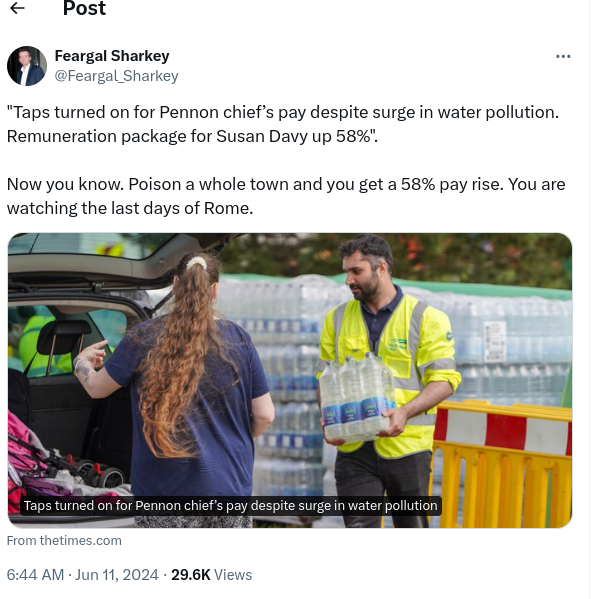
The £4m fat cat water boss giving you diarrhoea: As her customers fall ill, how South West Water CEO…

The £4m fat cat water boss giving you diarrhoea: As her customers fall ill, how South West Water CEO Susan Davy has pocketed millions while her firm pollutes beaches and rivers (but don’t worry, her Devon home isn’t affected by contaminated water)

www.dailymail.co.uk headlines

The need for a new regulatory model for our water

Correspondent Kate Willcox writes:

The latest scandals to hit the water company industry  – raw sewage being pumped into Lake Windermere and cryptosporidium found in the water supply of south Devon residents –  is yet more evidence that the privatised water companies are unfit to run this industry.

The Briefing Room on Radio 4 on Monday evening 13th May sets out clearly the reasons why the water companies are performing so badly.  Firstly, the water companies used their reliable income stream – water bills – to finance their activities and then borrowed heavily against the public assets that were handed over to them. The water companies had further cash from the tax payer to ensure that they could raise money for infrastructure investment. Shareholders’ money was not invested to maintain and improve the infrastructure; they just got dividends  of 77 million pounds to date for buying water company shares with no risk to their investments.  OFWAT failed to address this misuse of the assets which should have been used  to maintain and expand the water infrastructure.

The government ignored warnings at the time of privatisation that companies could fail to invest in the water industry and just reward shareholders and themselves, without strict regulation of the use of money raised against its assets, but these warnings were not acted upon.

The Government hobbled the regulatory bodies that are supposed to ensure that the companies run the industry effectively.  The Environment Agency had its funding cut to ensure that it could not carry out its duties effectively in regulating the water companies. The revolving doors between OFWAT and the water companies and the Government’s requirement that OFWAT do not prejudice the balance sheets of the water companies by enforcing their regulatory powers, has resulted in very gentle slaps on the wrists to the water companies. Now the water companies are coming back to the long suffering consumers demanding that water bills rise to pay for improvements to the water infrastructure that has already been paid for by consumers but spent on enriching shareholders and directors of the water companies.

Sir Dieter Helm Professor of Energy at the University of Oxford argues that the current extremely bad regulation of the water companies requires bringing in the special administrators to wind up Thames Water.   This approach could be used with all the privatised water companies to pass the water industry on to new and better organisations with a new regulatory model which will ensure that our water industry is run properly.  Wouldn’t it be great to look forward safe bathing in seas and rivers, safe drinking water and healthy rivers.

Yours sincerely,

Kate Wilcox

South West Water CEO Susan Davy issues statement to customers

Dear Customer,

I wanted to provide an update on what’s happening in Brixham, south Devon.

Your health and safety is our first and foremost priority. That’s why, on Wednesday 15 May, we advised those in the affected area to boil their drinking water before consuming it, following test results indicating the presence of cryptosporidium at Hillhead.

Recent tests showed that water leaving our treatment works was clear. However, in the early hours of Wednesday morning, we detected small traces of cryptosporidium in the Hillhead area of Brixham. Working with the UK Health Security Agency, we moved quickly to issue a boil water notice to affected customers and businesses.

Since then, our ground technicians have been working around the clock to identify the source of the contamination and rectify the situation so we can resume a normal water supply. While we urgently find and fix the problem, we have been delivering bottled water to vulnerable customers and to local businesses, including schools. We have also made bottled water available to residents in the local area.

I understand the significant impact the boil water notice has had on daily life. In recognition of this burden, our compensation payment will be increased to £115. This payment will be made automatically, where we have direct debit details, or applied as a credit to your next water bill, where we do not. You do not need to take any action.

To those in the affected area and our customers across the South West, I am truly sorry for the disruption and wider anxiety this has caused. While incidents like these are thankfully very rare, our customers expect a safe, clean, and reliable source of drinking water. I know on this occasion we have fallen significantly short of what you expect of us.

We will be providing updates, including on our website homepage and ‘In Your Area’ section, with additional information on Facebook. Our team is also available to answer your questions.

All of us at South West Water live and work in the region, just like you. It is our home and a place we love. I am sorry this has happened.

I promise you that we will not stop working until the situation has been resolved and drinking water returns to the quality level you expect.

Yours sincerely,

Susan Davy
Chief Executive Officer

Cryptosporidium – Brixham school shuts

A primary school in Brixham has been forced to close today (Thursday, May 16) after South West Water (SWW) confirmed a parasite has contaminated the drinking water. Eden Park Primary School in Brixham announced that it would not be opening to pupils today following the outbreak.

Molly Seaman www.devonlive.com 

SWW revealed that a ‘small trace’ of the parasite Cryptosporidium had been found in the water in Brixham yesterday afternoon despite previously telling residents its tests were clear. It advised people in the affected area to drink boiled and cooled tap water to avoid contracting the parasite.

Bottled water stations were set up yesterday to provide clean, safe water for residents to take home. However, Eden Park Primary wrote to parents yesterday evening to say they had not received any bottled water.

In a post to parents, Eden Park said it would be closing today as it could not safely open for students without clean drinking water. The full statement issued last night said: “Eden Park Primary School were only informed this afternoon (15/5/24) that the school was in an area where the tap water should be boiled.

“The school have taken swift action to put safety plans in place and contact the appropriate authorities about providing safe drinking water.

“At the time of writing this update (7.30pm), and despite repeated calls to South West Water about the urgency of the situation, the school has not received any bottled water or assurances of when water will be delivered. To enable parents and carers to make childcare plans for the morning, leaders have made the difficult decision to close the school tomorrow, Thursday 16th May.

“All Year 6 children should attend the school as usual, to complete their final SATs paper in the morning. They should bring their own full water bottle and be collected at 11:15am. The school will also provide bottled water for children and staff in school tomorrow. No other children should attend the school.

“A further update will be provided tomorrow afternoon, regarding the opening the school on Friday 17th May. Thank you for understanding with this rapidly changing situation.”

It is thought hundreds of residents are experiencing a range of symptoms including watery diarrhoea, stomach pains, nausea or vomiting, a mild fever, and loss of appetite.

Cryptosporidium is a parasite that can live in the intestines and faeces of infected humans and animals. It can spread through swimming in or consuming contaminated water, but can also be passed on in food.

A South West Water spokesperson said: “Customers in Alston and the Hillhead area of Brixham are advised to boil their drinking water before consuming following new test results for cryptosporidium. We are issuing this notice following small traces of the organism identified overnight and this morning.

“We are working with the UK Health Security Agency and other public health partners to urgently investigate and eliminate the source. We apologise for the inconvenience caused and will continue to keep customers and businesses updated. Bottled water stations will be set up in the affected areas as soon as possible.”

Martin Shaw announces progress in campaign to save Seaton Hospital

On behalf of the Seaton Hospital Steering Committee, I am pleased to issue the following press release:

The Seaton Hospital Steering Committee, comprising representatives of the local community elected at a public meeting, has been working hard to develop a business plan for a community hub which would take over the wing of the Hospital which Devon NHS no longer requires for its services. 

In developing our plan, we have met with a range of groups and organisations which are interested in using space in the building. The aim is to bring different sectors of the community together, so that the new space serves local people of all ages and offers facilities which local groups can use to improve their health and wellbeing.

Since early this year, monthly meetings have been held with the NHS’s Integrated Care Board and NHS Property Services, which owns the Hospital building, in order to clarify the terms on which community use would take place. The present aim is to present a plan to our partners by the end of June. 

Following the successful application to list Seaton Hospital as an Asset of Community Value, the Committee has also submitted a funding application to the government’s Community Ownership Fund, which accepted our initial expression of interest, and Richard Foord MP (a member of the Committee) has sought support in Parliament for the community to make full use of the empty wing at the hospital to assist with health and wellbeing issues.

Contacts:

General enquiries about the Committee’s work: Martin Shaw, saveseatonhospital@gmail.com 07972 760254

Enquiries about using space in the Hospital wing: Ben Tucker, ben@restoreseaton.co.uk

Cryptosporidium confirmed in water supply in two Brixham areas 

Yesterday SWW stated that all its current water supply tests had come back clear and that customers should continue to use their water as normal………….

Anita Merritt www.devonlive.com

South West Water (SWW) has confirmed that further testing has found the presence of cryptosporidium in two areas of Brixham. Yesterday, May 14, the UK Health Security Agency confirmed 16 cases of the infection and around 70 reported cases of diarrhoea and vomiting in Brixham, with more cases reported by victims on social media.

Yesterday SWW stated that all its current water supply tests had come back clear and that customers should continue to use their water as normal. Today, May 15, it has announced it has detected ‘small traces’ of the organism in Alston and the Hillhead area of Brixham.

Residents living in those areas are being advised to boil their drinking water before drinking it and bottled water stations have been set up for them. Cryptosporidium is a parasite which can cause sickness and diarrhoea if consumed. Drinking water can become contaminated for various reasons and SWW says it is fully investigating the cause.

It added that data from its tests over the last several weeks showed that the treated water leaving its treatment works was not contaminated. However, in the Hillhead section of its network, further tests taken overnight and working with the advice of UK Health Security Agency (UKHSA), it has found ‘small traces’ of cryptosporidium.

A South West Water spokesperson said: “Customers in Alston and the Hillhead area of Brixham are advised to boil their drinking water before consuming following new test results for cryptosporidium. We are issuing this notice following small traces of the organism identified overnight and this morning.

“We are working with the UK Health Security Agency and other public health partners to urgently investigate and eliminate the source. We apologise for the inconvenience caused and will continue to keep customers and businesses updated. Bottled water stations will be set up in the affected areas as soon as possible.”