Number of ‘ghost patients’ registered with NHS GPs up two-thirds since 2018

The number of patients who might not exist but are registered with GPs has risen by almost two-thirds over the last five years, figures suggest.

www.theguardian.com 

‘Ghost patients’ refers to when more people are registered with GP practices than are in the population. GPs are paid for patients on their list, meaning practices could be receiving millions of extra pounds for people who may not be real.

NHS Digital figures analysed by the PA news agency show 62.9 million patients were registered at a GP practice in England on 1 November last year.

This compares with Office for National Statistics estimates of 57.1 million people in England in 2022, meaning about 5.8 million ghost patients were registered with surgeries.

This figure is 61% higher than five years ago – 2018 data suggests there were about 3.6 million ghost patients.

GP surgeries received an average of £164.64 per registered patient in 2022-23, meaning practices could have received about £955m for patients who might not exist.

The Royal College of GPs said surgeries “try hard to keep their patient lists up to date” and are not deliberately profiting by keeping more patients on their lists than actually exist.

It said some patients, including babies, may not be included in the count, while others have left the surgery or moved elsewhere. But the TaxPayers’ Alliance said the public is unfairly subsidising GP practices for patients who may not exist.

It called for lists to be amended if unknown users cannot be found.

In 2019, the NHS Counter Fraud Authority began investigating whether GPs were claiming for nonexistent patients, but this investigation was halted and has not been reopened.

Tom Ryan, a researcher at the TaxPayers’ Alliance, said: “When it comes to GP patients, the numbers simply don’t add up. Taxpayers are subsiding service users who may not even exist.

“Unless these missing patients can be found, funding for GP practices should be amended accordingly.”

Dr Victoria Tzortziou-Brown, vice-chair of the Royal College of GPs, said: “GP practices try hard to keep their patient lists as up to date as possible, but this relies on timely and accurate information about the movement of patients so that individuals are not inappropriately removed from a GP list.

“So-called ghost patients are nothing sinister, and are not a case of surgeries deliberately profiting by keeping patients on their lists when they shouldn’t be there – they are a records management issue.

“This known discrepancy between the estimated size of the local population and the number of people registered at GP practices can occur for a number of reasons.

“In addition to list inflation, which incorrectly increases the count of patients, there are also issues associated with under-coverage.”

An NHS England spokesperson said it works with GP surgeries to review and update patient lists “and it is vital that practices do this on a regular basis, so they are as accurate as possible”.

A spokesperson for the NHS Counter Fraud Authority said: “The NHSCFA had planned to undertake an intelligence assessment on the nature and scale of GP capitation fraud in 2019.

“This was to improve our understanding of the risk posed to the NHS by fraud and error in general practice, primarily as regards GP capitation [the money paid to GPs for every registered patient].

“It was effectively halted by difficulties in obtaining core data and our priorities shifted from this position with the NHS response to Covid-19.

“We have not yet revisited the issue as we direct our resources to where the intelligence indicates the most appropriate priorities sit.”

South West universities team up to produce more pharmacists

The South West has the highest community pharmacy vacancy rate in England.

Two universities are joining forces to try to tackle the urgent need for more pharmacists, particularly in the south-west of England.

What a good idea!

Did anybody in all the following unaccountable overseeing organisations such as: the Heart of the South West, our Local Enterprise Partnership; or the Great South West reborn as the Great South West Partnership (made up of businesses, universities, LEPs and local authorities, including Dorset Council, BCP Council and Dorset LEP; think of it? Too busy devising strategies?

What part did any of the local NHS overseeing organisations play or were they too busy flicking the beads on their abacus? – Owl

John Ayres www.bbc.co.uk

The University of Bath is working with the University of Plymouth to deliver its well-established MPharm course at both institutions.

Pharmacists are on the government’s national shortage occupations list, especially in the South West, which has the highest community pharmacy vacancy rate in England.

With no pharmacy degree courses west of Bath, course leaders said they hoped students studying in Plymouth would then fill local vacancies when they graduated.

Bespoke teaching facilities

Lyn Canning, director of Practice-based Learning in the School of Pharmacy at the University of Bath, said the plan, supported by NHS England, “gives us that opportunity to produce more graduates”.

She added: “The other thing it does is gives us an opportunity to have brand new bespoke pharmacy practice teaching facilities that are then available within the south-west.”

Prof John Curnow, the University of Plymouth’s deputy vice chancellor, said the partnership would see pharmacy students learn “in practice-based and clinical teaching spaces, with consultation rooms and simulation equipment”.

Rhiannon Hardie is a recently qualified pharmacist who studied at Bath and returned to Cornwall, where she grew up.

She said she believed the new scheme would offer an opportunity which was not available when she was training and it would attract others from the county to the career.

“There are loads of opportunities down here,” she said.

“I can definitely spread my wings and, now that I have qualified, there are lots of different things that I could do down here that I liked the idea of.

“Cornwall as a whole can be quite a deprived area … [but students] wouldn’t have to go away and spend all this money to stay at university if it is right on their doorstep.”

The course would be delivered in close collaboration with NHS England and local stakeholders, bosses said.

Changes to pharmacy education will allow pharmacists to prescribe medication on registration from 2026.

Growing proportion of England’s flood defences in disrepair, analysis finds

Ministers have been told they will be “punished” by voters after analysis revealed the decline of vital flood defences across England.

Josh Halliday www.theguardian.com 

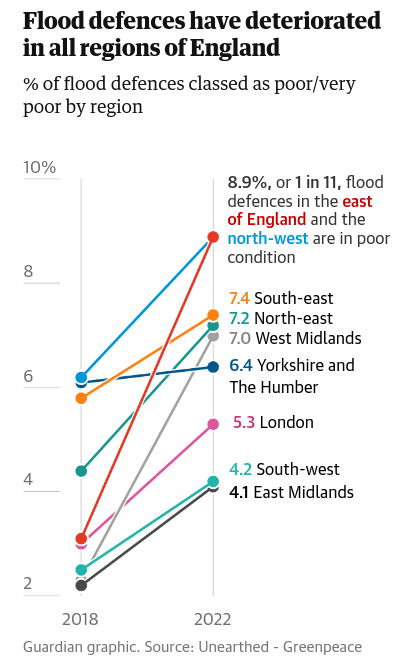
The proportion of critical assets in disrepair has almost trebled in the West Midlands and the east of England since 2018, leaving thousands of homes and businesses more vulnerable to storms.

Critical assets are defined as those where there is a high risk to life and property if they fail.

The east of England, which spans the Conservative heartlands from Suffolk to Bedfordshire and Essex, has one of the highest proportion of rundown flood defences in England, with nearly one in 11 – more than 850 assets – considered “poor” or “very poor” by Environment Agency inspectors.

Steve Reed, the shadow environment secretary, said: “The Conservatives’ sticking-plaster approach to flooding has left communities devastated and cost the economy billions of pounds.”

Using Environment Agency data obtained by Greenpeace’s investigative arm, Unearthed, the Guardian tracked the state of England’s vital flood defences from 2018 to 2022.

The analysis revealed a sharp rise in the proportion of critical assets in disrepair across many parts of the country.

In the east Midlands, which was deluged by Storm Babet in October, the proportion of flood defences in the worst conditions has almost doubled in the last five years.

Together with the east of England, the north-west has the highest rate of flood defences so damaged they are almost useless, with one in 11 defences considered in disrepair in 2022 – more than 815 – up from one in 16 in 2018.

In the West Midlands, the rate of ruined assets has risen from one in 44 in 2018 to one in 14 last year.

The number of damaged flood defences has increased across all regions in the last five years. However, the analysis examined the proportion of flood defences in disrepair rather than the number because thousands more assets have been built since 2018.

Experts said the picture of disrepair was likely to worsen after higher costs and budget shortfalls forced the Environment Agency to axe a quarter of its new flood defence projects.

Georgia Whitaker, Greenpeace UK’s climate campaigner, said the analysis painted a “grim and desperate picture”.

She said there was “absolutely no excuse for this lack of preparation” from the government, and added: “If politicians fail to commit to crucial climate action, they risk being punished at the ballot box.”

In total, 4,204 of England’s most important flood defences were in a poor or very poor condition in 2022. This accounts for about one in 15 of the total, up from the one in 25 registered four years ago.

Of these, 856 were judged very poor, meaning they had “severe defects resulting in complete performance failure”, essentially rendering them useless.

The remaining 3,348 were in poor condition, meaning they have defects that would “significantly reduce” their performance.

The government’s environment department (Defra) claimed that more than 61,500 flood defences met the required condition and that 2,400 did not, but the Guardian has not been able to verify this data.

A spokesperson said mitigation measures, such as increased inspections, would be put in place when assets were not found to be in the right standard.

Defra said: “Flooding can be devastating to communities – which is why we are investing a record £5.2bn between 2021 and 2027 to better protect hundreds of thousands of properties, including over £200m a year for maintaining of flood defences.”

The Environment Agency has slashed the number of homes it expects to protect from flooding over the next five years as higher costs have forced it to scale back projects.

A National Audit Office report last month said the agency had pledged to protect 336,000 properties from the risk of flooding by 2027 – but that this had been cut to 200,000 – a reduction of 40%.

The Environment Agency also removed 500 of the 2,000 new flood defence projects originally included in its six-year flood and coastal erosion programme.

Tories express alarm at Dominic Cummings’s ‘secret election talks’ with Rishi Sunak

A sign of desperation. - Owl

‘Never bring an arsonist into your home,’ Conservative MPs warn their leader.

Nadine Dorries is reported as saying “Sunak has repeatedly denied on the record having contact with Cummings which makes him an on the record liar,” 

Peter Walker www.theguardian.com 

Conservative MPs have expressed anger and alarm at the claim that Rishi Sunak offered Dominic Cummings a secret deal to help him win the election, with one saying Boris Johnson’s former chief aide should have “no place in political life”.

Other Tory MPs have commented in WhatsApp groups to express opposition to the idea, first revealed in the Sunday Times, with some saying it showed a lack of judgment by Sunak. Another likened it to letting “an arsonist into your home”.

Downing Street has not denied Sunak met Cummings twice for discussions, but rejected Cummings’s contention that this involved a job offer, saying the prime minister simply had “a broad discussion” with him.

Cummings, one of the architects of the successful Vote Leave campaign, was sacked by Johnson after less than a year but remains one of the most controversial figures in UK politics.

Part of this comes from his apparent breach of lockdown rules when he took his family from London to the north-east of England in spring 2020. He is also a notably abrasive figure, accused by others of being at the centre of a toxic, misogynistic and arrogant cabal of advisers in Johnson’s No 10.

According to the Sunday Times, Cummings and Sunak held talks in North Yorkshire, where the prime minister’s constituency is located, in July. Cummings had previously had a meeting in London in December 2022 with Sunak and Liam Booth-Smith, Sunak’s chief of staff, the report added.

Cummings told the Sunday Times Sunak had offered him a private role preparing for the next election, but that the PM would not agree to his terms.

Cummings said: “He wanted a secret deal in which I delivered the election and he promised to take government seriously after the election. But I’d rather the Tories lose than continue in office without prioritising what’s important and the voters.

“I said I was only prepared to build a political machine to smash Labour and win the election if he would commit to No 10 truly prioritising the most critical things, like the scandal of nuclear weapons infrastructure, natural and engineered pandemics, the scandal of MoD procurement, AI and other technological capabilities, and the broken core government institutions which we started fixing in 2020 but Boris [Johnson] abandoned.”

One former cabinet minister told the Guardian: “I’m staggered that this was even thought to be a good idea, especially when Rishi said in the past he was having nothing to do with Dominic Cummings.

“This is a man who is deeply toxic, whose approach to politics is sociopathic, and I’m being polite. Why on earth would you want to entertain someone like that back in the heart of politics, when they did so much harm?

“It shows no judgment at all. Dominic Cummings has no place in political life, in my view, and that would be the view of most people in the Conservative party, from left to right.”

A senior backbencher said: “Every Conservative MP should remember the thousands of emails from outraged constituents after Dom’s trip to Bernard Castle. Never let an arsonist into your home, most certainly don’t welcome them in, no matter how bad the polls. Dominic Cummings has no interest in the Conservative party.”

One usually supportive MP said: “Picking anybody’s brains is fair enough, even if you disagree with them. But to offer a job to someone as controversial and damaging, both to policy and to the Conservatives, is a retrograde step. All this will do is dig up a lot of memories that we in the party would rather forget.”

The Lib Dems called for an inquiry into whether Sunak had breached the ministerial code in failing to declare both meetings in the official register.

A government spokesperson said: “In full accordance with the ministerial code, meetings with private individuals to discuss political matters do not need to be declared.”

Jonathan Ashworth, the shadow paymaster general, whose role is central to Labour’s election preparations, said: “Out-of-touch Rishi Sunak is asking the wrong question if he thinks the lockdown rule-breaking architect of Boris Johnson’s failed premiership is the answer.”

Cummings became a figure of some national ridicule during the pandemic after claiming he drove his family to the County Durham beauty spot of Barnard Castle to test his eyesight.

More recently, at the public inquiry into Covid, Cummings was accused of “aggressive, foul-mouthed and misogynistic” abuse after messages showed he tried to sack the senior civil servant Helen MacNamara, saying No 10 was “dodging stilettos from that cunt”.

England heads for obesity disaster as minister frets about nanny state

Let them eat cake – Owl

Plans to introduce a range of measures to tackle obesity in England, including curbing junk food advertising and restricting volume offers like buy-one-get-one-free, kicked into the long grass.

Victoria Atkins (Health Secretary), who says there is no conflict of interest with her husband’s role as managing director of one of the world’s largest sugar companies, signalled she is very unlikely to take any significant action..

Andrew Gregory www.theguardian.com 

Less than three weeks into her new role as health secretary, Victoria Atkins left health campaigners aghast when she suggested her approach to tackling obesity would largely focus on dietary advice.

Obesity is a devastating public health problem harming millions of people in the UK that will never be resolved by tips on what to eat and what to avoid. Two in three adults are overweight or obese and the problem costs £100bn a year.

The country’s food environment is in such a sorry state that everywhere you look, unhealthy food options dominate – every workplace, every leisure facility, every shop, every corner. Tens of millions of people are struggling with their weight – it’s not about a lack of individual willpower or self-control. Even those who spend every waking hour trying desperately hard to shed the pounds are often thwarted by relentless advertising, easy availability and low-cost promotions.

Yet Atkins, who says there is no conflict of interest with her husband’s role as managing director of one of the world’s largest sugar companies, signalled she is very unlikely to take any significant action.

“We could all do with help and advice on how to be healthier,” she told the Times this month. “We’ve got to try to do that in a way that is not nanny-stateish but if we give people information then that can be part of helping us try to lead healthier lives.”

Atkins said she believed tackling obesity was “incredibly important” but added that she wants to ensure “all of us have a healthy relationship with food” as she prioritises diet advice.

The government vowed to introduce a range of measures to tackle obesity in England, including curbing junk food advertising and restricting volume offers like buy-one-get-one-free.

But the plans, to the utter dismay of doctors, public health professionals and health campaigners, have since been shelved – until October 2025. Even then there are no guarantees. Atkins says she “will want to convince myself as to the effectiveness of measures that have been announced”.

Now a new report, commissioned by the government’s own obesity research unit and obtained by the Guardian, provides vital new evidence on obesity – and a call for action. Far from it being a problem that simply requires more responsibility from society, the report shows that many people are trapped into making poor decisions and buying unhealthy food.

One of the paper’s authors, Dr Paul Coleman, told the Guardian that after conducting more than 100 interviews with adults across the socioeconomic spectrum, it was clear most were aware of what constitutes a healthy diet.

The problem, according to those interviewed, was the dizzyingly wide availability and promotion of cheap junk food – and the comparatively higher cost of healthier options.

“For many families, particularly those relying on insecure and unpredictable income, it is often the most affordable and appropriate option to rely on processed and less healthy ready meals,” Coleman said.

“This is due to rising food and energy costs, time pressures, low quality kitchen spaces, and a fear of spending a limited budget on more expensive fresh produce which may be left uneaten and wasted.

“In contrast ultra-processed meals, which are cheap to purchase and prepare, are unlikely to go off or be wasted before being consumed. Families were aware of the negative health impacts but felt they had little choice but to purchase these products.”

The report found that because little action has been taken to promote healthy food or tackle unhealthy food, millions of families, particularly those on low incomes, are failing to prevent their children’s poor diets becoming normalised – permanently.

In short, we are heading for disaster.

In England, two in five children are leaving primary school overweight and are subsequently at a higher risk of chronic illnesses, mental health problems and even a shorter lifespan. Children living with obesity are at greater risk of high blood pressure, high cholesterol, diabetes and other long-term conditions, even cancer, that can last into adulthood.

Tam Fry, chair of the National Obesity Forum, who was not involved with the report, says its message is clear. “The incessant advertising and availability of cheap ultra-processed food on-the-go is increasingly putting the mockers on parents who would dearly like their children to eat at a table like granny did.”

Until action is taken to curb the attraction and availability of ultra-processed food and foods high in fat, sugar and salt “their most serious by-product – namely obesity – will continue to rise”, he says.

27 areas in Devon with sewage warnings ahead of New Year’s Day swims

Welcome to 2024! – Owl

Thousands of Devon residents and holidaymakers planning to head to their local beach come [Monday] morning for a chilly dip in the sea are being warned of potential sewage in the waters.

Lisa Letcher www.devonlive.com

South West Water says sea swimmers could be heading to sewage-polluted waters due to the heavy rainfall that has been coming down in the past 48 hours. It’s as continued heavy rain and strong winds are expected with a Met Office weather warning in place until midnight.

As a result, beaches where some of the largest New Year’s Day dips take place annually have already been impacted with 27 sewage pollution alerts in place. They include Sidmouth, Croyde and Sandy Bay. Check the full list from Surfers Against Sewage 

Posting on Facebook, South West Water wrote: “It’s that time of year when many of us are looking forward to the traditional New Year’s Day swim. Based on the current weather forecast we are expecting heavy rainfall over the weekend, which may result in activation of some of our coastal storm overflows.

“These are essential to prevent flooding into homes and businesses during these periods of heavy rain. Our operational teams are constantly reviewing the weather forecast and taking action, where possible, to prevent or limit their use.”

An interactive map by SAS is its online version of the Safer Seas & Rivers Service (SSRS), tracking real-time sewage discharge and pollution risks around the UK. It monitors water quality at over 450 river and coastal locations across the country so you can swim, surf, paddle or splash without the risk of getting sick and currently has warnings issued for 27 Devon beaches.

England’s sewers were designed with 14,500 storm overflows to stop them from becoming overwhelmed, allowing a mixture of surface water and sewage to be discharged during heavy rainfall. But according to the Environment Agency, these overflows are now used on a routine basis.

Water companies discharged untreated sewage through storm overflows almost 390,000 times in 2022 for a total of 1.7 million hours. Last year the Lib Dems issued a warning ahead of New Year’s Day swims. Mr Farron, the Lib Dem’s environment spokesman, said: “This is a real Christmas stink for so many hoping to enjoy their traditional festive swim.

“The freezing cold water should be the only thing swimmers worry about, not sewage floating by them. It’s disgusting that our coastlines and lakes have been polluted by this foul habit. There needs to be a ban on sewage discharges in swimming areas.”

South West Water has a similar alert system to SAS’s with its Waterfit Live page. It lists 18 beaches in Devon with a current warning that reads: “Condition of the bathing water may be affected by the operation of overflows”

All the beaches with sewage warnings in place on New Year’s Eve in Devon according to SAS:

South Coast

Plymouth Firestone Bay

Plymouth Hoe West

Plymouth Hoe East

Mothecombe

Thurlestone South

Salcombe South Sands

Mill Bay

Sugary Cove

St Marys Bay

Goodrington

Paignton Preston Sands

Beacon Cove

Meadfoot

Teignmouth Holcombe

Dawlish Coryton Cove

Dawlish Town

Exmouth

Sandy Bay

Budleigh Salterton

Sidmouth

Beer

Seaton

North Coast

Westward Ho!

Croyde Bay

Woolacombe Village

Ilfracombe Hele

Combe Martin

MP’s Dickensian rant against Mid Devon but ministers see no cause for concern

The Tory candidate for Tiverton & Minehead, and sitting MP, Ian Liddell-Grainger, has launched a scathing attack on Mid Devon District Council (MDDC) in a 25-minute tirade in Westminster.

Lewis Clarke www.devonlive.com

Ian Liddell-Grainger’s comments have been described as ‘bald faced lies, sexist and sexually inappropriate’ by Mid Devon’s leader, Luke Taylor.

His main focus of attack was alleging that MDDC’s development arm, 3 Rivers Development’s Ltd, which has ceased trading following losses of up to £21 million was a ‘loss-making white elephant’.

The company was founded in 2017 while the authority was under Conservative leadership, before independent councillors were leading the authority between 2019 and 2023 when in May the Liberal Democrats had a landslide victory.

Mr Liddell-Grainger, MP for Bridgwater and West Somerset, made a scathing speech in Westminster Hall on Tuesday, December 19, in which he called the council’s investment venture a “modern morality tale in the manner of Charles Dickens”.

He said that the council’s senior officers, led by chief executive Stephen Walford and deputy chief executive Andrew Jarrett, were “chronically naive” and “out of touch” with the way commerce works, and that they had gambled with taxpayers’ money on risky projects that failed to deliver.

He said: “When Walford and Jarrett moved into their jobs as top officers, I think they probably wanted to make their mark. But neither of them had any experience at all in any other trade or profession; I do not think either of them had ever actually even done a paper round.

“There should have been alarm bells ringing at every level, but Mr Walford and his number-crunching colleague were a convincing double act like Laurel and Hardy—and many others I can think of.”

He also criticised the council’s current leader, Liberal Democrat Luke Taylor, whom he mockingly referred to as “Mr Thingamabob”, for refusing to shut down the company, which he said had cost the council £21.3 million in loans.

He said: “The Liberal Democrats, who are now refusing to shut down this loss-making white elephant, never objected to its creation in the first place. If they did, they did it so quietly that nobody noticed. Mr Thingamabob may well have been won over by his smooth-talking chief exec; after all, it would be perfectly normal for him to trust his officers.

“Elected members never get paid enough to justify full-time work on council business. They are dedicated amateurs, no matter the party. They are obliged to listen to their officers—especially the most senior, who is the chief executive.”

He claimed that the council had been “incredibly coy” about revealing any details about the company, and that the scrutiny committee had produced a “cack-handed and useless” report that did not hold anyone accountable.

He said that the council had become “toxic” and that there was a “poor relationship” between the company and the elected members, who had lost trust in the officers.

He also alleged that the council had withheld information from the public, and that the chairman of the council, Councillor Frank Letch, had “brutally suppressed” any debate.

He concluded: “This is a saga of wasted opportunity, of council officials wielding enormous influence over councillors, letting them down, then falling out with the whole council. It is a disgrace. Those are all distressing situations, but there have been well-sourced stories in the press recently of real anger from members of the public who tried to obtain simple information about 3 Rivers Developments but were rebuffed.

“People complained that MDDC thinks that the whole business is far too complicated for ordinary people to understand, so information is deliberately withheld.

“When complaints are made at full council meetings, the chairman of the council brutally suppresses any debate. The chairman’s name, incidentally, is Councillor Frank Letch—a man with a short fuse. Perhaps it is a struggle—the naming of a person like Letch. Mainly, the posh dwellings designed for some spare land next to the council buildings are being converted for the use of over-60s, even though the location is completely unsuitable.

“I could, but will not, go on and on. This is a saga of cockups and blunder, and it is very expensive indeed. I would rather risk public money with Ebenezer Scrooge than with those responsible in Mid Devon, and especially the chairman of scrutiny, who is quite ridiculously incompetent.”

The Parliamentary Under-Secretary of State for Levelling Up, Housing and Communities, Simon Hoare responded in the debate saying: “Mid Devon District Council is not on my departmental radar as a council causing concern in terms of its finances. Financial management is a different thing. In terms of its basic finances, it is not on the radar.

“I do not know the gentleman to whom he refers with regard to the senior officers, and I can only speak from experience of my exposure and interaction with local government officers over very many years. My experience is that they are women and men of integrity who, day in and day out, devote themselves to the public service of their communities and always strive to do their best.

“Sometimes the best is not good enough, and sometimes the wrong decisions are taken. I think that the motivations of people in public service are usually strong and beyond challenge. I say gently to my hon. Friend that he may not like some of the things that the council has done, and he may have done things differently, but I repeat that the council is not currently on our radar.”

He concluded: “It is particularly important when any party has a very large majority, as the Liberal Democrats do in Mid Devon at the moment. One almost needs to double up and double down on scrutiny in order to prove beyond peradventure that that job is being done. I am about to run out of time. I am grateful to my hon. Friend for raising this issue. As I say, I am happy to continue our conversation in order to ensure that the good folk of Mid Devon receive the service and services to which are they entitled and deserve.”

Mid Devon Liberal Democrats have welcomed remarks from the Local Government Minister, after they expressed confidence in the financial position of Mid Devon District Council.

Councillor Luke Taylor, Liberal Democrat Leader of Mid Devon District Council, said: “Unlike Mr. Liddell-Grainger, Liberal Democrats are focused on ensuring that the residents of Mid Devon receive the quality service and services that they deserve.

“Despite inappropriate language and wild claims by the MP for Bridgwater, it’s telling that even his own Government acknowledges that Mid Devon District Council has no case to answer when it comes to financial management.

“I am sure that Bridgwater residents would rather their MP be focused on tackling the issues they face, instead of these desperate attempts to be relevant here in Mid Devon.

“On behalf of the Mid Devon Liberal Democrats, I want to thank the government for acknowledging the council’s financial prudence. We will remain focused on doing all we can to support everyone living across our towns and villages.”

He added: “Despite the unfounded allegations, bald faced lies, sexist and sexually inappropriate language used by the Conservative MP for Bridgwater, cowering behind Parliamentary Privilege, this Government has recognised that MDDC has no case to answer. We can only hope that this will bring an end to the sordid campaign run by this most un Parliamentary of MPs.”

Exmouth & Exeter East Tory candidate outlines priorities and credentials

In a long press article the Tory candidate for the new Exmouth & Exeter East seat, David Reed, outlined his priorities and credentials in somewhat disjointed terms.

The three key issues he will address if elected are: reducing sewage spills; improving social care access; and promoting apprenticeships. 

Many would say that the first two of these issues are the direct result of right wing conservative policies intended to reduce taxes by shrinking the state and cutting investment in services and infrastructure.

Water companies (and Railways, which he doesn’t mention) are examples of how privatisation has broken Britain.  

In a speech to a Conservative Forum in April 2009, for example, David Cameron declared that “the age of irresponsibility is giving way to the age of austerity”, and committed to end years of what he characterised as excessive government spending. He became PM in 2010 with George Osbourne as Chancellor and we can now see the result of what he meant by “austerity”.

In the article David Reed described himself as ‘centre-right’ which doesn’t seem to be a good starting point to stop leaks in sewage or improving access to social care.

On promoting apprenticeship schemes he says they allow:

“…companies, the private sector, to invest in their people, and it creates a much better connection so that people can actually learn on their job, but also have the opportunity once they’re qualified to save a lot more and then buy into things like housing, have a family, which I think the Labour [education] policy has eroded. “

Maybe news to him: the Tories have been tinkering around the edges of the policy on apprenticeship schemes for the past 13 years with the latest funding package published last October.

In Owl’s view apprenticeships suffer from the short term nature of so many investment decisions taken in Britain by both government and the private sector. We need a complete reset on investment but that can only come with a government demonstrating confidence in managing the economy, not conducting mad cap experiments with the likes of Liz Truss.

Asked about his relative political inexperience, he said: “I would like to think that I’ve actually packed a lot into my life so far.  

“I’ve been very close to central government policy for a long time, and I’ve been on the sharp end of delivering that policy, either through the military [as a former Royal Marine] or in other jobs that I’ve done, or in the defence industry [defence contractor BAE Systems with whom the MoD currently spends £4.0bn annually 2021/22].  

“I’m coming in knowing how the state works, understanding how to bid for central government money, how to write an effective bid, which is very, very important, and then how to actually work with relevant authorities to actually get on the job and actually deliver those things. 

“It takes a long time to see how that puzzle fits together, but I come good to go.” 

(Is that a promise? – Owl)

Read the full article here 

As yet, inexperienced David Reed who has only tenuous local connections doesn’t know who he might be facing in the General Election. They could trump him both on experience and local connection.

Exmouth & Exeter East is a seat that Labour has said is not, for them, a “battleground seat”.

Could this be another two horse race?

There are nearly 26,000 Claire Wright votes to play for between the Exmouth & Exeter East constituency and the Honiton & Sidmouth constituency. Owl can’t see many of these going to either of the Tory candidates.

Why we should not blame councils for housing crisis 

 Letter www.theguardian.com

The latest attack on our planning system is misguided (Michael Gove threatens action against English councils over housing plans, 19 December). Michael Gove misses the real reason why the UK lags so far behind other parts of Europe. For decades, governments have relied on housebuilders, who want to make money quickly. At the same time, it has cut the capacity of local authorities to be more than regulators.

Even in popular areas with agreed plans, such as Northstowe in Cambridge, Southall in west London, or around Gloucester, building is grinding to a halt as confidence dissolves. The results are congestion, pollution and stress for local communities.

The government needs to rebuild capacity to deliver from the bottom up. New towns provide inspiration, but development must be joined up with existing infrastructure capacity, especially local rail. Our Wolfson prize-winning plan for Uxcester Garden City showed how mid-sized cities such as Oxford or York could be doubled in size through a visionary spatial plan. Yet the proposal was blocked by a previous housing minister, apparently because it would extend a tightly bounded city into Tory strongholds.

Good strategic planning requires the use of compulsory purchase powers to assemble land in the right locations at existing use values with long-term loans from pension funds and insurance companies for the foundations. Delivery should be through small builders, including cooperatives (as in the Netherlands or Germany) to create neighbourhoods where people on a range of incomes want to live.

The government needs to resource strategic planning properly rather than continually attacking councils for what is not their fault.
Dr Nicholas Falk
Executive director, the Urbed Trust

House prices in some parts of Cornwall fall by a quarter

A map has revealed the average price of houses in every Cornish postcode and how they have changed over the past year. Data shows the places where prices have dropped the most significantly, including on the pretty Lizard peninsula.

Lisa Letcher www.cornwalllive.com

The data covers houses sold from October 2022 to October 2023 and comes from the Land Registry, where all property sales are recorded. Some postcodes however have seen less than 20 sales and the lower the number of houses sold, the less realistic the average price overall.

It revealed that house prices in TR12 which covers the Lizard peninsula, below Helston, have fallen by more than a quarter with 76 total sales. In October 2022 the average cost of a house was £537,768 but now it’s £116,995 less – a 26.5 per cent decrease.

That’s the largest drop of any postcode district in Cornwall to have had at least 20 sales over the last 12 months. Homes in PL10 – covering Cawsand, Cremyll, Fort Picklecombe, Freathy, Kingsand and Millbrook – saw the next largest drop for an area with over 20 sales.

The average property there cost £336,700 in the year to October. That’s down by 16.1 per cent compared to a year earlier when the average was £400,434.

In TR2 – Truro, Gerrans – prices fell by 13.1 per cent to £455,012, in TR5 – St Agnes – by 13.1 per cent to £506,175, and by 12.1 per cent in PL28 – Padstow, Crugmeer, Porthcothan, St Merryn, Trevone, Treyarnon – to £678,757.

You can see how prices have changed in your local area by using our interactive map as house prices fell by an average of £3,000 across the UK in the year to October. We’ve also listed the top ten places with the largest fall in average house prices.

The average house UK-wide cost £288,000 in 12 months to October 2023, new data from the Land Registry has revealed. That’s 1.2 per cent lower than in the year to October 2022. Average house prices decreased by 1.4 per cent to £306,000 in England and by 3.0 per cent to £214,000 in Wales, but increased by 0.2 per cent in Scotland to £191,000.

Cornwall postcodes with the largest average house price drop

PostcodePlacesAverage price in October 2023Total sales this yearAverage price in October 2022Sales last yearPercentage change yearChange
PL29Port Isaac, Port Gaverne, Port Quin, St Endellion, Trelights£539,37516£776,86818-30.9%-£237,493
TR12Lizard peninsula£420,77376£537,76898-26.5%-£116,995
TR17Marazion£336,6676£413,53627-24.7%-£76,869
PL10Cawsand, Cremyll, Fort Picklecombe, Freathy, Kingsand, Millbrook£336,70039£400,43457-16.1%-£63,734
PL34Tintagel, Bossiney, Trewarmett£332,54617£403,05431-14.9%-£70,508
TR2Truro, Gerrans£455,012103£499,452146-13.1%-£44,440
TR5St Agnes, Mithian£506,17532£580,41465-13.1%-£74,239
PL28Padstow, Crugmeer, Porthcothan, St Merryn, Trevone, Treyarnon£678,75738£732,34567-12.1%-£53,589
TR20Penzance£361,01975£396,385126-9.9%-£35,367
TR6Perranporth, Bolingey, Perrancoombe£434,10845£446,25364-6.6%-£12,145

Devon seaside town homes approved despite strong warning

Following a planning appeal, Churchill Retirement Living has been granted permission to build 54 independent living retirement apartments and six retirement living cottages in Fore Street.

Anita Merritt www.devonlive.com

Controversial plans to build a large block of retirement apartments in the centre of Exmouth which were refused by councillors who argued more homes need to be built with younger people in mind will now go ahead. Following a planning appeal, Churchill Retirement Living has been granted permission to build 54 independent living retirement apartments and six retirement living cottages in Fore Street.

They will be built on the site of builders’ merchants Jewson. In June, East Devon District Council’s planning committee rejected the plans stating the town had reached “saturation point” with homes for older people.

The application had been recommended for approval by planning officers, stating it would be a “sustainable development” and help improve housing supply. In the appeal decision notice, the government’s planning inspector K Ford said it would bring several benefits to the town.

The notice said: “It would deliver economic benefits, both during construction and through the operation of the retirement facility thereafter. There would also be job creation from the commercial space to be provided as part of the development.

“There would also be economic benefits from the local spend by the residents of the development, particularly given the location of the scheme in close proximity to the town centre.”

The Inspector added that “with regards to environmental benefits, the development would make efficient use of previously developed land. Churchill Retirement Living has welcomed the decision and says it will contribute around £465k a year to the local economy and create more than 100 jobs both during and after construction, including eight permanent full-time local jobs.

The new apartments and cottages will encourage independence and the development will also include a communal owners’ lounge, a guest suite, a lodge manager, and a 24-hour emergency call alarm service.

A Churchill spokesperson said: “This is a very positive result and we will now look forward to starting work on this new development in Exmouth in 2024. Retirement housing is shown to be the most effective form of residential development for generating local economic growth, supporting local jobs, and increasing high street spend.

“Our new apartments and cottages will also help improve the health and wellbeing of those who live there, and meet the housing needs of many older people in Exmouth and the surrounding area. Enabling older people to downsize will also help to free up homes for younger families in the area to move into.”

When the plans were rejected in June, the majority of the planning committee members voted against the proposals due to the lack of a “mixed balance” of properties, a loss of employment land, and because the site hadn’t been marketed for the required time of at least a year. The committee’s decision came after several objections were heard at the meeting, including from Exmouth Town Council.

Devon and Cornwall police tenth worst force in England and Wales

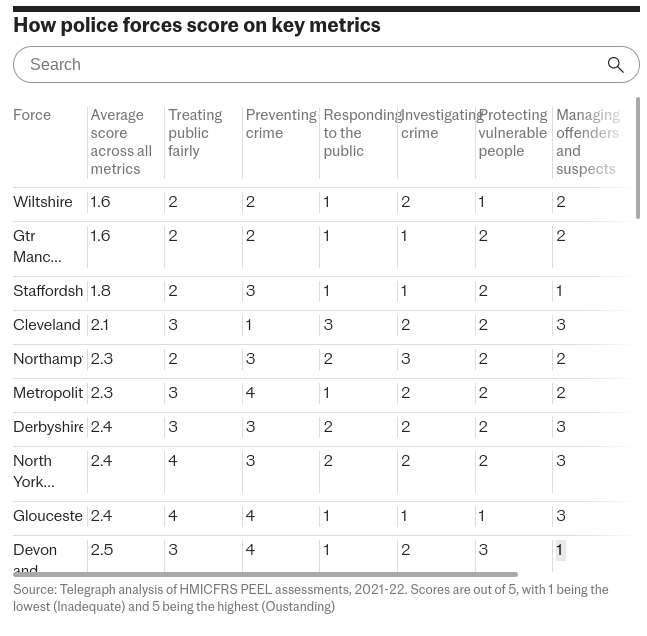
An in-depth inspection of all 43 police forces in England and Wales across eight criteria  in 2021/22 shows shocking results for Devon and Cornwall.

Devon and Cornwall police rank tenth worst on these measures with an average across all metrics of 2.5. Scores are out of 5 with 1 the lowest and 5 the highest. Wiltshire scored worst with an average score of 1.6 and Humberside the best with an average of 4.8.

Devon and Cornwall scored badly in responding to the public, and managing offenders and suspects, with a score of 1. It only got a 2 for investigating crime, and strategic planning and value for money. 

Step forward Conservative Hernandez who was first appointed commissioner in 2016!

Where’s the congratulatory selfie?- Owl 

Half of police forces not investigating crime properly

Charles Hymas, Home Affairs Editor www.telegraph.co.uk

More than half of police forces are failing to investigate crime properly, according to official watchdog reports.

Of the 43 forces in England and Wales, 22 were judged by inspectors to be “inadequate” or “requiring improvement” in investigating crime – the two worst performance ratings.

They face an investigation by His Majesty’s Inspectorate of Constabulary next year into the failings that have caused the proportion of crimes solved to plummet to record lows.

Forces have missed leads that could have solved burglaries, thefts and assaults, and failed to arrive at crime scenes promptly to recover evidence or catch suspects, according to the reports.

The watchdog told The Telegraph that many forces faced “real challenges in answering and dealing with emergency calls in a timely manner” and that an “unacceptably low” number of crimes was being solved following investigations.

“If the police are to rebuild public trust and confidence, it is vital that forces work quickly to rectify these issues and provide the high level of service that the public deserves,” said a spokesman for the inspectorate. “We intend to carry out a thematic inspection of police investigations in 2024.”

Home Office figures show that just one in 18 offences reported to police led to a suspect being charged in the year to June 2023, compared with one in six a decade ago.

The explanation for those figures is provided by in-depth inspections of all 43 forces in 2021/22 across eight criteria. In particular, these assessments cover their effectiveness in investigating crime and responding to the public including how quickly officers are despatched to crime scenes after 999 calls.

Humberside emerged as the best force in Britain across the eight criteria, followed by South Yorkshire, West Yorkshire, Durham and Leicestershire.

The six worst in 2021/22 were Wiltshire, Greater Manchester, Northamptonshire, Staffordshire, Cleveland and the Met, three of which are in special measures. Greater Manchester was taken out of special measures in October last year.

Find out how your local force performed with our search tool below.

Responding to the data, a Home Office source said ministers expected a “zero tolerance” approach to all crimes by police, with forces having agreed in September to follow up “every line of enquiry for all crimes – without exception”.

The source said: “Since March, there have been record-ever numbers of police and over half a billion pounds extra invested. These extra resources must deliver a significant increase in the number of crimes solved.”

It comes as new figures reveal police abandon investigations into four crimes every minute without tracking down the perpetrators.

Forces gave up on investigations into 2,306,623 reported crimes in the year to June – including hundreds of thousands of violent offences and burglaries – marking an increase of nearly 13 per cent on the previous year

The official Home Office figures, seen by the Daily Mail, are equivalent to more than 6,300 every day on average, or one every 14 seconds.

No force rated ‘outstanding’

Forces are ranked on metrics including looking after their workforce, providing value for money and treating the public with respect, but when judged on investigating crime alone the ratings fall.

They scored worse on these metrics than other criteria such as preventing crime, treating the public with fairness and respect, and value for money.

Not a single force was rated as “outstanding” in either investigating crime or responding to the public. Outstanding is the top of five levels of performance, which then go through good, adequate, requiring improvement and inadequate.

Three forces were ranked inadequate for investigating crime, with 19 judged as “requiring improvement”. Eight were assessed as “inadequate” in responding to the public, and a further 17 found to be “requiring improvement”.

The Telegraph analysis was based on inspections from 2021/22, covering all 43 forces over the same period to allow a fair comparison.  The performance of five forces – the Metropolitan Police, West Midlands, Devon and Cornwall, Staffordshire and Wiltshire – is of such concern that they are currently in special measures.

So far, nine forces have had updated ratings after further inspections for the 2023-25 period. Of these, five are deemed to have got worse at investigating crime, including Thames Valley, Surrey, Merseyside, Durham and West Midlands, which has declined to inadequate. Only one – Greater Manchester – improved.

Six have had their scores for responding to the public worsen, including Suffolk and Surrey, whose ratings dropped from “adequate” to “inadequate”. Greater Manchester jumped from “inadequate” to “adequate”.

The National Police Chiefs’ Council said all forces strived to deliver the best possible service and the inspections showed most were “performing well”.

A spokesman said: “However, whenever a force falls short in a certain area, we will work with them, alongside His Majesty’s Inspectorate, to ensure that the necessary improvements are made.”

Newton Abbot general election will be “two-horse race”

The Labour Party’s decision to put Newton Abbot on its list of ‘non-priority’ general election constituencies has been welcomed by the man who wants to wrest the seat from the Tories.

Guy Henderson, local democracy reporter www.radioexe.co.uk

Lib Dem Martin Wrigley, who leads Teignbridge Council, will stand at the  election expected in 2024, aiming to unseat Tory MP Anne Marie Morris.

In the autumn, Labour published a list of seats where it isn’t planning to campaign vigorously, including Torbay; Honiton and Sidmouth; Tiverton and Minehead; Torridge and Tavistock and North Devon.

Now it has updated the list, with all the remaining Devon seats apart from those in Plymouth, Exeter and Totnes among them. It means they are among 211 seats which Labour does not consider to be its key battlegrounds.

The Lib Dems, with Mr Wrigley as their candidate, came second to the Tories in Newton Abbot at the last general election, and Mr Wrigley said the two parties would face off again.

He said: “This constituency will be a two-horse race between the Liberal Democrats and a desperately out-of-touch Conservative party.

“With our local health services at breaking point, local rivers being destroyed by sewage and hardly any local crimes being solved, people have told me it’s time for change.

“The Conservative party is too busy fighting amongst themselves to govern this country. They are taking people here for granted and failing to deliver for our communities.

“Enough is enough.”

Mr Wrigley came second to Ms Morris in the 2019 election, the last time the whole country went to the polls. The Conservative MP had a majority of 17,501 and Labour candidate James Osben finished third.

Weather changes causing chaos for UK flora and fauna, says National Trust audit

The disappearance of reliable seasonal patterns is causing chaos for the flora and fauna of the UK, a long-running annual audit of the impact of weather on nature has found.

Steven Morris www.theguardian.com

Extreme weather events, from storms and pounding rain to searing heat and drought are putting huge pressure on animals, plants and the environment, the report from the National Trust says.

The conservation charity is urging politicians to prioritise “urgent action” to protect nature and people from future climate shocks and says parties should commit to making changes in their manifestos for the next UK general election.

Ben McCarthy, the head of nature and restoration ecology at the National Trust, said: “The shifting weather patterns we’re seeing, particularly the warmer temperatures, is continuing to upset the natural, regular rhythm of the seasons. This loss of predictability causes chaos for the behaviours of animals in particular, but can also impact trees and plants.”

The National Trust gave a long list of species that have suffered in the last 12 months, including oak trees, which are increasingly vulnerable to the oak processionary moth, whose caterpillars infest them. The lack of prolonged cold snaps in recent years means the moths have spread northwards from their traditional home in the Mediterranean.

Another troublemaker doing well is the heather beetle, which is killing off swathes of the heathland plant in some areas. A drone survey of Dunwich Heath in Suffolk revealed a 60% loss in heather.

The warmer winters means hibernators such as dormice are emerging from their torpor too early and using up vital energy stores. It is also leading to red deer rutting later, meaning calves are born in the summer rather than the spring, with insufficient time to grow and put on fat reserves to survive.

According to the trust, some of the rare lichens and liverworts that grow in the temperate rainforest at Lydford Gorge, on the edge of Dartmoor in Devon perished because of the lack of water last winter.

But then water voles were driven from flooded burrows when the torrential rains have come in, putting them at increased risk of cold, hunger and predation.

McCarthy, said: “These baseline changes that we’re seeing are really worrying and what we should be taking more notice of, particularly when combined with extreme weather events, which makes things even more challenging.

The autumn storms, Babet and Ciaran, caused havoc, knocking down trees including a 260-year old Cedar of Lebanon at Charlecote Park in Warwickshire and eroding river banks and beaches.

One of the consequences of the storm just coming to light is the possible impact on the population of the shags, the seabirds that look similar to cormorants that live and breed on the Farne Islands in Northumberland. There are hardly any birds in the winter roosts on the islands, with a number of dead birds being washed up on the islands. It is thought Babet disrupted their ability to feed and led to starvation.

There were scraps of bright news. Record-breaking numbers – at least for recent years – of choughs were spotted in Cornwall with a 60% increase in the number of chicks on 2022. The elegant crow is a symbol of Cornwall but became extinct and is back on the rise.

At Formby in Merseyside, rangers recorded the first emergence of natterjack toadlets since 2020 in May with approximately 150 counted across the site.

The rare black oil beetle was spotted at Kinver Edge in Staffordshire for the first time in nine years. The sandy soil there suits burrowing insects such as solitary bees, whose nests and eggs the oil beetle feeds on.

Persistent rain in July and the warm, wet conditions that continued into the autumn were ideal for waxcap grassland fungi. One, the dark velvet fanvault was found at Hardcastle Crags in West Yorkshire, the first record of it in the UK.

Butterflies and moths on the whole seem to have had a better year than expected, considering last year’s drought. Staff noted record-breaking numbers of the Heath fritillary butterfly on the Holnicote Estate on Exmoor in Somerset.

But the charity’s audit, which it has been carrying out for 15 years, makes gloomy reading overall.

“We need to see more action from politicians, particularly as we enter this election year, to ensure tackling the nature and climate crisis is a top priority,” said McCarthy.

“We want to see parties commit to accelerating progress on nature restoration, increase support for nature-based solutions to climate change and to put climate adaptation at the heart of their manifestos, so the UK can be better prepared for the weather extremes we will increasingly experience.”

Government to reintroduce the pint of champagne!

What every hard pressed family needs! Cheers – Owl

Johnson’s imperial measurements plan scrapped – but pints of champagne will return

Champagne and other wines will be sold in pints for the first time in decades under a new Government plan to take advantage of Brexit freedoms.

Hugo Gye inews.co.uk

The range of bottle sizes which can legally be sold in the UK’s shops will be expanded some time next year, the Department for Business and Trade has said.

It will include the return of the pint of champagne, which is said to have been Winston Churchill’s favourite measure.

But the Government has stopped short of a post-Brexit overhaul of the measurements system in general, after nearly 99 per cent of those responding to a consultation said they wanted to stick with the metric system.

Proposals to remove the requirement to display metric measurements on most products, or allow retailers to display imperial measurements more prominently, have now been abandoned.

The proposals made by Boris Johnson were denounced at the time as “nostalgia”.

The sale of pints of champagne, which became illegal when Britain joined the EU, has long been championed by Brexiteers such as Sir Jacob Rees-Mogg – although some champagne houses have said they will not start selling their products in new bottle sizes after the regulations change.

Under the new rules, it will be legal to sell still and sparkling wines in 200ml, 500ml and 568ml sizes – the latter being the equivalent of a pint in metric terms – as well as the more usual full and half bottles.

There will be no obligation on producers or retailers to stock the new sizes, and the regulations do not apply to pubs or restaurants, which operate under a different set of rules.

Business minister Kevin Hollinrake said: “Innovation, freedom and choice – that’s what today’s announcement gives to producers and consumers alike. Our exit from the EU was all about moments just like this, where we can seize new opportunities and provide a real boost to our great British wineries and further growing the economy.”

Nicola Bates, the head of WineGB, added: “We welcome the chance to be able to harmonise still and sparkling bottle sizes and we are happy to raise a glass to the greater choice that allows UK producers for domestic sales.”

After the UK entered the EU in the 70s, most measurements were legally changed to metric although a number – including pints in pubs and miles on road signs – remained in the traditional imperial system.

Some Brexit campaigners have previously argued that the ability to use more imperial measurements is one of the major benefits of leaving the European single market.

But when Mr Johnson launched the consultation in May 2022, Labour MP Angela Eagle accused ministers of “attempting to weaponise nostalgia for a time few can remember and even fewer wish to return to”, while Tory backbencher Alicia Kearns said: “Not one constituent, ever, has asked for this.”

Tories accused of overseeing ‘pothole pandemic’

Sixty-three claims for pothole-related damage were made by motorists every day last year, the Liberal Democrats have said.

Dominic McGrath uk.news.yahoo.com

The party has called for road maintenance budgets to be fully-restored by the Government, accusing the Conservatives of overseeing a “pothole pandemic” on English roads.

Data from 85 local authorities in England, obtained by freedom of information requests, shows that compensation paid to motorists reached £1.77 million in 2022/23 – a slight rise on the previous year.

The Liberal Democrats said that the number of pothole claims has grown significantly in the last year, with 23,042 in 2022/23 compared with the 13,579 recorded the previous year.

Housing and Communities spokeswoman Helen Morgan said: “This Conservative Government has overseen a pothole pandemic on our roads. It’s now become almost impossible to drive in some parts of the country without having to swerve to avoid potholes.

“This has led to thousands of drivers having to claim for damage to their vehicles or even personal injury caused by crater-filled roads.

“The Government is firmly to blame for this failure to maintain our roads properly after having slashed funding for local road repairs.

“Cash-strapped councils are being left without the funding to maintain roads properly while having to shell out thousands of pounds in pothole payouts.

“Local authorities need to have their highway maintenance budgets urgently restored so that we can end this vicious cycle of pothole payouts and poorly maintained roads.”

A Department for Transport spokeswoman said: “We are investing an extra £8.3 billion to resurface roads across the country, the biggest ever funding increase for local road maintenance.

“This is enough to resurface more than 5,000 miles of roads and is on top of the more than £5.5 billion that we have already invested in highway maintenance.”

Only active public investment will cure Britain’s ills 

Observer editorial www.theguardian.com 

The economy will end the year on the brink of recession and it is not hard to see why. After 13 years of Conservative misrule that reached its nadir last year during Liz Truss’s brief tenure as prime minister, the country is crawling towards a light that flickers dimly. Even the so-called recovery since Truss’s calamitous mini-budget has proved a mirage. Official figures on Friday showed that the economy shrank in the summer, when previous estimates told a story of modest growth. The signs are already flashing red for a further contraction in the autumn and winter months.

If a technical recession – one that charts a decline in gross domestic product (GDP) across a six-month period – comes to pass, it will reveal that Rishi Sunak’s mix of income tax rises and public sector cuts have backfired, as many experts said they would, leaving the UK worse off in almost every way possible.

The average family has very little spare cash with which to pay bills and afford a celebration at Christmas. A government devoid of ideas has sapped the life out of the private sector in the same way that its dogmatic adherence to austerity has hobbled investments in much-needed public services. Companies are reluctant to invest in the UK after more than a decade of stop-start planning that accompanied one of the most disastrous economic decisions that parliament was in a position to make – leaving the EU’s single market and customs union. Neither the Bank of England nor the Office for Budget Responsibility, the Treasury’s independent forecaster, have changed their minds about the huge hit to the UK’s trade and investment from Brexit.

A recession won’t trigger the usual dramatic rise in unemployment or a major spike in company failures. It will feel more like a prolonged period of stagnation.

For some Tory backbench MPs a long period of zero growth may seem more palatable than maintaining alliances with our European trading partners, but the situation leaves Sunak’s administration with only meagre resources to tackle the great issues of the day.

In every direction the government turns, there is a neglected area of the public sector desperate for support from Whitehall. And these public services, which provide the backbone of the economy and, never let it be forgotten, allow private firms to operate, don’t just need cash. They need an administration that is prepared to rethink how those services might be provided in a digital world, with the added complication that digital advances exclude millions of people from the community of users. But this rethink cannot rely on yet more doses of privatisation, as we show has happened in the care sector, where analysis of official data by the Observer reveals a dramatic rise in the number of centres providing care for vulnerable children that are fully or partially controlled by investment companies.

We have a housing crisis that depends on private sector property developers building the homes Britain needs, when it is clear they will only drip feed properties into areas at a pace that maintains prices.

There is a shortage of dentists in large parts of the country following the almost total collapse of dentistry inside the NHS for anything other than the most dire emergencies. Hospitals remain hampered by strikes, while the health ministry conducts a war with junior doctors. US health firms are waiting in the wings to capitalise on the public’s growing distrust of health services provided by the state, as they did in the 1990s when John Major’s privatising government chipped away at the NHS.

A programme for new hospitals announced by Boris Johnson has gone the same way of so many Johnsonian promises, while school repairs, despite a succession of ministerial pledges, are delayed again and again. Local councils are going bust at an alarming rate as they confront the spiralling costs of adult and children’s services, many of which they are legally obliged to provide. It’s true that the first batch of councils to declare themselves technically bankrupt – Tory and Labour – had made investments that went sour, or, like Birmingham, embarked on costly legal action.

But for the many councils warning that they too are likely to declare themselves bust, the theme is solely about budgets knocked sideways by the impact of inflation and the rising number of people – children and adults – falling into the arms of council officers when there is nowhere else to turn.

Britain needs an activist state that takes on some of the heavy lifting in the search for ways to provide public services, and without simply pouring extra cash into tired old systems and processes, often dating back several decades.

This level of engagement is anathema to the current Tory party, as it is in other areas of public policy. The Tories cannot see any other solution than a private one, even when it is clear that the corporations hungry for deals with the state are interested only in short-term profits, and not the long-term health of the economy.

Call for action over river pollution

 South West Water has been urged to do more to protect Devon’s vulnerable rivers from sewage and pesticide spills.

Guy Henderson, local democracy reporter www.radioexe.co.uk

Officials from the company and the Environment Agency faced questions from South Hams Council’s overview and scrutiny committee over issues ranging from pollution and water quality to household water bills and nationalisation.

Council chairman Guy Pannell (Lib Dem, South Brent) said the number of discharges of untreated sewage into the River Avon at Diptford had risen to 119 in 2022 from 83 last year.

The Avon had been ‘named and shamed’ by the Wildlife Trusts as being among the country’s 20 rivers most at risk from human and farm sewage, pesticides and fertilisers.

”The Wildlife Trusts chief executive described it as a national disgrace,” said Cllr Pannell.

“I feel very ashamed that my beautiful river is being called a national disgrace.”

And Cllr Matt Steele (Lib Dem, Ivybridge East) said there had been only two days in the past two months when there had been no sewage ‘dumps’ into the River Erme.

“Residents are incensed by seeing sewage flowing through the centre of Ivybridge,” he said.

South West Water’s director of external liaison Alan Burrows told councillors: “No pollution is good pollution.” And he said the company had learned from previous cases.

Serious pollution incidents had fallen, he said, and SWW was aiming for zero by 2025.

Pollution from storm overflows was also reducing, he claimed, and the South Hams had good quality bathing waters.

Clarissa Newell, the Environment Agency’s area manager, said there had been a huge improvement in water quality in the last 20 years, and the district’s bathing waters were the best they had ever been.

“The South Hams is in a really good position for quality of water,” she said. 

Cllr Pannell asked what measures SWW was taking to address water shortages such as the one which caused a hosepipe ban last summer, and  if the company had plans for new reservoirs.

Mr Burrows said there were new resources such as a desalination plant and new water mains in Cornwall. Water from a new reservoir in Somerset could be pumped anywhere in the network. He also said households could be encouraged to use less water.

Cllr Pablo Munoz (Lib Dem, Ivybridge West) asked why, when SWW’s parent company Pennon was paying billions of pounds to shareholders, westcountry households paid the highest water bills in the country.

The company’s director of asset management Mark Worsfold said shareholders expected a return on their investment.

He went on: “If we didn’t give them their dividend, they wouldn’t give us their money, and we wouldn’t be able to fund our investment programmes. They would take their money and put it somewhere else where they would get a higher return.”

Councillors asked if the water industry should be nationalised again rather than being in private hands, but Mr Burrows pointed out that if that happened, it would have to compete for funding alongside education, the NHS, social housing and other government budgets.