Growing proportion of England’s flood defences in disrepair, analysis finds

Ministers have been told they will be “punished” by voters after analysis revealed the decline of vital flood defences across England.

Josh Halliday www.theguardian.com 

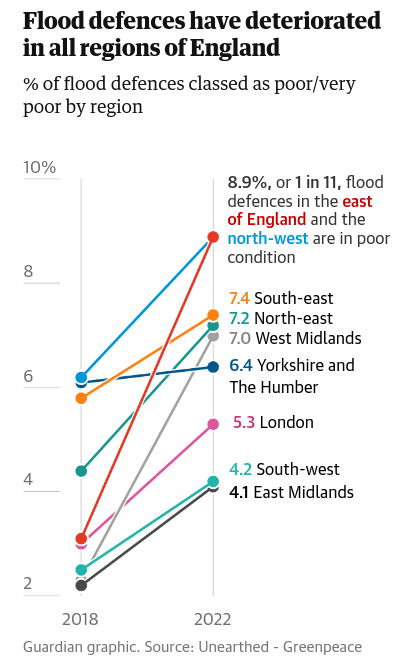
The proportion of critical assets in disrepair has almost trebled in the West Midlands and the east of England since 2018, leaving thousands of homes and businesses more vulnerable to storms.

Critical assets are defined as those where there is a high risk to life and property if they fail.

The east of England, which spans the Conservative heartlands from Suffolk to Bedfordshire and Essex, has one of the highest proportion of rundown flood defences in England, with nearly one in 11 – more than 850 assets – considered “poor” or “very poor” by Environment Agency inspectors.

Steve Reed, the shadow environment secretary, said: “The Conservatives’ sticking-plaster approach to flooding has left communities devastated and cost the economy billions of pounds.”

Using Environment Agency data obtained by Greenpeace’s investigative arm, Unearthed, the Guardian tracked the state of England’s vital flood defences from 2018 to 2022.

The analysis revealed a sharp rise in the proportion of critical assets in disrepair across many parts of the country.

In the east Midlands, which was deluged by Storm Babet in October, the proportion of flood defences in the worst conditions has almost doubled in the last five years.

Together with the east of England, the north-west has the highest rate of flood defences so damaged they are almost useless, with one in 11 defences considered in disrepair in 2022 – more than 815 – up from one in 16 in 2018.

In the West Midlands, the rate of ruined assets has risen from one in 44 in 2018 to one in 14 last year.

The number of damaged flood defences has increased across all regions in the last five years. However, the analysis examined the proportion of flood defences in disrepair rather than the number because thousands more assets have been built since 2018.
Experts said the picture of disrepair was likely to worsen after higher costs and budget shortfalls forced the Environment Agency to axe a quarter of its new flood defence projects.

Georgia Whitaker, Greenpeace UK’s climate campaigner, said the analysis painted a “grim and desperate picture”.

She said there was “absolutely no excuse for this lack of preparation” from the government, and added: “If politicians fail to commit to crucial climate action, they risk being punished at the ballot box.”

In total, 4,204 of England’s most important flood defences were in a poor or very poor condition in 2022. This accounts for about one in 15 of the total, up from the one in 25 registered four years ago.

Of these, 856 were judged very poor, meaning they had “severe defects resulting in complete performance failure”, essentially rendering them useless.

The remaining 3,348 were in poor condition, meaning they have defects that would “significantly reduce” their performance.

The government’s environment department (Defra) claimed that more than 61,500 flood defences met the required condition and that 2,400 did not, but the Guardian has not been able to verify this data.

A spokesperson said mitigation measures, such as increased inspections, would be put in place when assets were not found to be in the right standard.

Defra said: “Flooding can be devastating to communities – which is why we are investing a record £5.2bn between 2021 and 2027 to better protect hundreds of thousands of properties, including over £200m a year for maintaining of flood defences.”

The Environment Agency has slashed the number of homes it expects to protect from flooding over the next five years as higher costs have forced it to scale back projects.

A National Audit Office report last month said the agency had pledged to protect 336,000 properties from the risk of flooding by 2027 – but that this had been cut to 200,000 – a reduction of 40%.

The Environment Agency also removed 500 of the 2,000 new flood defence projects originally included in its six-year flood and coastal erosion programme.

Tories express alarm at Dominic Cummings’s ‘secret election talks’ with Rishi Sunak

A sign of desperation. - Owl

‘Never bring an arsonist into your home,’ Conservative MPs warn their leader.

Nadine Dorries is reported as saying “Sunak has repeatedly denied on the record having contact with Cummings which makes him an on the record liar,” 

Peter Walker www.theguardian.com 

Conservative MPs have expressed anger and alarm at the claim that Rishi Sunak offered Dominic Cummings a secret deal to help him win the election, with one saying Boris Johnson’s former chief aide should have “no place in political life”.

Other Tory MPs have commented in WhatsApp groups to express opposition to the idea, first revealed in the Sunday Times, with some saying it showed a lack of judgment by Sunak. Another likened it to letting “an arsonist into your home”.

Downing Street has not denied Sunak met Cummings twice for discussions, but rejected Cummings’s contention that this involved a job offer, saying the prime minister simply had “a broad discussion” with him.

Cummings, one of the architects of the successful Vote Leave campaign, was sacked by Johnson after less than a year but remains one of the most controversial figures in UK politics.

Part of this comes from his apparent breach of lockdown rules when he took his family from London to the north-east of England in spring 2020. He is also a notably abrasive figure, accused by others of being at the centre of a toxic, misogynistic and arrogant cabal of advisers in Johnson’s No 10.

According to the Sunday Times, Cummings and Sunak held talks in North Yorkshire, where the prime minister’s constituency is located, in July. Cummings had previously had a meeting in London in December 2022 with Sunak and Liam Booth-Smith, Sunak’s chief of staff, the report added.

Cummings told the Sunday Times Sunak had offered him a private role preparing for the next election, but that the PM would not agree to his terms.

Cummings said: “He wanted a secret deal in which I delivered the election and he promised to take government seriously after the election. But I’d rather the Tories lose than continue in office without prioritising what’s important and the voters.

“I said I was only prepared to build a political machine to smash Labour and win the election if he would commit to No 10 truly prioritising the most critical things, like the scandal of nuclear weapons infrastructure, natural and engineered pandemics, the scandal of MoD procurement, AI and other technological capabilities, and the broken core government institutions which we started fixing in 2020 but Boris [Johnson] abandoned.”

One former cabinet minister told the Guardian: “I’m staggered that this was even thought to be a good idea, especially when Rishi said in the past he was having nothing to do with Dominic Cummings.

“This is a man who is deeply toxic, whose approach to politics is sociopathic, and I’m being polite. Why on earth would you want to entertain someone like that back in the heart of politics, when they did so much harm?

“It shows no judgment at all. Dominic Cummings has no place in political life, in my view, and that would be the view of most people in the Conservative party, from left to right.”

A senior backbencher said: “Every Conservative MP should remember the thousands of emails from outraged constituents after Dom’s trip to Bernard Castle. Never let an arsonist into your home, most certainly don’t welcome them in, no matter how bad the polls. Dominic Cummings has no interest in the Conservative party.”

One usually supportive MP said: “Picking anybody’s brains is fair enough, even if you disagree with them. But to offer a job to someone as controversial and damaging, both to policy and to the Conservatives, is a retrograde step. All this will do is dig up a lot of memories that we in the party would rather forget.”

The Lib Dems called for an inquiry into whether Sunak had breached the ministerial code in failing to declare both meetings in the official register.

A government spokesperson said: “In full accordance with the ministerial code, meetings with private individuals to discuss political matters do not need to be declared.”

Jonathan Ashworth, the shadow paymaster general, whose role is central to Labour’s election preparations, said: “Out-of-touch Rishi Sunak is asking the wrong question if he thinks the lockdown rule-breaking architect of Boris Johnson’s failed premiership is the answer.”

Cummings became a figure of some national ridicule during the pandemic after claiming he drove his family to the County Durham beauty spot of Barnard Castle to test his eyesight.

More recently, at the public inquiry into Covid, Cummings was accused of “aggressive, foul-mouthed and misogynistic” abuse after messages showed he tried to sack the senior civil servant Helen MacNamara, saying No 10 was “dodging stilettos from that cunt”.

England heads for obesity disaster as minister frets about nanny state

Let them eat cake – Owl

Plans to introduce a range of measures to tackle obesity in England, including curbing junk food advertising and restricting volume offers like buy-one-get-one-free, kicked into the long grass.

Victoria Atkins (Health Secretary), who says there is no conflict of interest with her husband’s role as managing director of one of the world’s largest sugar companies, signalled she is very unlikely to take any significant action..

Andrew Gregory www.theguardian.com 

Less than three weeks into her new role as health secretary, Victoria Atkins left health campaigners aghast when she suggested her approach to tackling obesity would largely focus on dietary advice.

Obesity is a devastating public health problem harming millions of people in the UK that will never be resolved by tips on what to eat and what to avoid. Two in three adults are overweight or obese and the problem costs £100bn a year.

The country’s food environment is in such a sorry state that everywhere you look, unhealthy food options dominate – every workplace, every leisure facility, every shop, every corner. Tens of millions of people are struggling with their weight – it’s not about a lack of individual willpower or self-control. Even those who spend every waking hour trying desperately hard to shed the pounds are often thwarted by relentless advertising, easy availability and low-cost promotions.

Yet Atkins, who says there is no conflict of interest with her husband’s role as managing director of one of the world’s largest sugar companies, signalled she is very unlikely to take any significant action.

“We could all do with help and advice on how to be healthier,” she told the Times this month. “We’ve got to try to do that in a way that is not nanny-stateish but if we give people information then that can be part of helping us try to lead healthier lives.”

Atkins said she believed tackling obesity was “incredibly important” but added that she wants to ensure “all of us have a healthy relationship with food” as she prioritises diet advice.

The government vowed to introduce a range of measures to tackle obesity in England, including curbing junk food advertising and restricting volume offers like buy-one-get-one-free.

But the plans, to the utter dismay of doctors, public health professionals and health campaigners, have since been shelved – until October 2025. Even then there are no guarantees. Atkins says she “will want to convince myself as to the effectiveness of measures that have been announced”.

Now a new report, commissioned by the government’s own obesity research unit and obtained by the Guardian, provides vital new evidence on obesity – and a call for action. Far from it being a problem that simply requires more responsibility from society, the report shows that many people are trapped into making poor decisions and buying unhealthy food.

One of the paper’s authors, Dr Paul Coleman, told the Guardian that after conducting more than 100 interviews with adults across the socioeconomic spectrum, it was clear most were aware of what constitutes a healthy diet.

The problem, according to those interviewed, was the dizzyingly wide availability and promotion of cheap junk food – and the comparatively higher cost of healthier options.

“For many families, particularly those relying on insecure and unpredictable income, it is often the most affordable and appropriate option to rely on processed and less healthy ready meals,” Coleman said.

“This is due to rising food and energy costs, time pressures, low quality kitchen spaces, and a fear of spending a limited budget on more expensive fresh produce which may be left uneaten and wasted.

“In contrast ultra-processed meals, which are cheap to purchase and prepare, are unlikely to go off or be wasted before being consumed. Families were aware of the negative health impacts but felt they had little choice but to purchase these products.”

The report found that because little action has been taken to promote healthy food or tackle unhealthy food, millions of families, particularly those on low incomes, are failing to prevent their children’s poor diets becoming normalised – permanently.

In short, we are heading for disaster.

In England, two in five children are leaving primary school overweight and are subsequently at a higher risk of chronic illnesses, mental health problems and even a shorter lifespan. Children living with obesity are at greater risk of high blood pressure, high cholesterol, diabetes and other long-term conditions, even cancer, that can last into adulthood.

Tam Fry, chair of the National Obesity Forum, who was not involved with the report, says its message is clear. “The incessant advertising and availability of cheap ultra-processed food on-the-go is increasingly putting the mockers on parents who would dearly like their children to eat at a table like granny did.”

Until action is taken to curb the attraction and availability of ultra-processed food and foods high in fat, sugar and salt “their most serious by-product – namely obesity – will continue to rise”, he says.

27 areas in Devon with sewage warnings ahead of New Year’s Day swims

Welcome to 2024! – Owl

Thousands of Devon residents and holidaymakers planning to head to their local beach come [Monday] morning for a chilly dip in the sea are being warned of potential sewage in the waters.

Lisa Letcher www.devonlive.com

South West Water says sea swimmers could be heading to sewage-polluted waters due to the heavy rainfall that has been coming down in the past 48 hours. It’s as continued heavy rain and strong winds are expected with a Met Office weather warning in place until midnight.

As a result, beaches where some of the largest New Year’s Day dips take place annually have already been impacted with 27 sewage pollution alerts in place. They include Sidmouth, Croyde and Sandy Bay. Check the full list from Surfers Against Sewage 

Posting on Facebook, South West Water wrote: “It’s that time of year when many of us are looking forward to the traditional New Year’s Day swim. Based on the current weather forecast we are expecting heavy rainfall over the weekend, which may result in activation of some of our coastal storm overflows.

“These are essential to prevent flooding into homes and businesses during these periods of heavy rain. Our operational teams are constantly reviewing the weather forecast and taking action, where possible, to prevent or limit their use.”

An interactive map by SAS is its online version of the Safer Seas & Rivers Service (SSRS), tracking real-time sewage discharge and pollution risks around the UK. It monitors water quality at over 450 river and coastal locations across the country so you can swim, surf, paddle or splash without the risk of getting sick and currently has warnings issued for 27 Devon beaches.

England’s sewers were designed with 14,500 storm overflows to stop them from becoming overwhelmed, allowing a mixture of surface water and sewage to be discharged during heavy rainfall. But according to the Environment Agency, these overflows are now used on a routine basis.

Water companies discharged untreated sewage through storm overflows almost 390,000 times in 2022 for a total of 1.7 million hours. Last year the Lib Dems issued a warning ahead of New Year’s Day swims. Mr Farron, the Lib Dem’s environment spokesman, said: “This is a real Christmas stink for so many hoping to enjoy their traditional festive swim.

“The freezing cold water should be the only thing swimmers worry about, not sewage floating by them. It’s disgusting that our coastlines and lakes have been polluted by this foul habit. There needs to be a ban on sewage discharges in swimming areas.”

South West Water has a similar alert system to SAS’s with its Waterfit Live page. It lists 18 beaches in Devon with a current warning that reads: “Condition of the bathing water may be affected by the operation of overflows”

All the beaches with sewage warnings in place on New Year’s Eve in Devon according to SAS:

South Coast

Plymouth Firestone Bay

Plymouth Hoe West

Plymouth Hoe East

Mothecombe

Thurlestone South

Salcombe South Sands

Mill Bay

Sugary Cove

St Marys Bay

Goodrington

Paignton Preston Sands

Beacon Cove

Meadfoot

Teignmouth Holcombe

Dawlish Coryton Cove

Dawlish Town

Exmouth

Sandy Bay

Budleigh Salterton

Sidmouth

Beer

Seaton

North Coast

Westward Ho!

Croyde Bay

Woolacombe Village

Ilfracombe Hele

Combe Martin