Building works for the new store in Seaton started in April and are expected to be completed later in 2023.
Janet Phillips, the owner of 4 Seasons clothing shop in a shopping complex next to the building site, said noise and dust was “destroying her business”.
Aldi said the store would “create jobs and provide affordable, high-quality groceries for local residents”.
The supermarket added that work on the Harbour Road site was being carried out “in line with the planning consent given”.
Ms Phillips said she wants Aldi to compensate her for an estimated £20,000 dip in trade since work began.
“I think it’s absolutely appalling – they are destroying our businesses,” she said.
Sophie Nevitt, the owner of homewares shop So Sophie, told the BBC in May she felt “insulted” by the supermarket’s treatment of her.
“Since the closure of the car park, the effect has been crippling on my business,” she said.
“The disregard for actually how they have affected me as a small business is insulting.”
Del Haggerty, from Seaton Town Council, said the supermarket needed to “reconsider how they treat local shops”.
“They should reconsider the compensation they give these three shops here because they’re right in their backyard and it would make a difference to them,” he said.
“When the planning goes through people have got to expect disruption but not complete devastation,” he added.
Aldi said it was working with affected businesses to “improve access and maintain footfall”.
The supermarket said: “Our new store in Seaton will create jobs and provide affordable, high-quality groceries for local residents. Construction is on track and in line with the planning consent given.
“We are working with local businesses to provide advertising at the site and in the local area to ensure customers are aware that neighbouring businesses are open as usual.
“We are doing all we can to improve access and maintain footfall to nearby businesses while work is ongoing and we apologise for any inconvenience caused.”
Remember: the NHS has lost almost 25,000 beds across the UK in the last decade, according to a damning report last year that says the fall has led to a sharp rise in waiting times for A&E, ambulances and operations.
In March 2019, at the start of the pandemic, Owl pointed out that the South West has the lowest number of critical care beds per head of population. It also has the oldest population (so highest expected mortality).
But who took the beds away in the first place? Over the years East Devon Watch has chronicled the zeal with which local Tories have pursued local cuts in beds and slapped down all criticism, it’s all “on the record”.
The government has announced £250m in funding to provide an extra 5,000 NHS hospital beds in England this winter.
Ministers say 900 new beds should be ready by January, with the remainder to follow soon after, boosting capacity and helping lower record waiting lists.
The increase will mean nearly 100,000 permanent beds on wards and in A&E, available at the busiest time of the year – a 5% rise on current levels.
NHS Providers said the extra capacity was needed “before winter begins”.
Miriam Deakin, director of policy and strategy at NHS Providers, said trusts would welcome the support but cautioned any new beds would need to be staffed.
She added that, since winter is the busiest time of the year for urgent and emergency care, trust leaders would be concerned that the promised extra capacity is only expected to be in place by January.
“For the best results, trusts would need these new beds before winter begins,” she said.
Pat Cullen, from the Royal College of Nursing, added: “The elephant in the room is who will staff these additional beds? Nursing staff are already spread too thinly over too many patients.”
Co-ordinated follow-up care
The government money will also fund services where people can be treated without requiring a hospital stay.
Funding will be focused on developing or expanding urgent treatment centres and same-day emergency care services, where patients can be seen quickly without the necessity of being admitted to hospital.
NHS England is also preparing to make it easier to discharge hospital patients when they are medically-fit to leave, through the rollout of so-called “care traffic control centres”.
These bring together the NHS community, housing and charity teams to help co-ordinate support for those patients who require continuing care once they are discharged from hospital.
The aim is that plans for a prompt and efficient discharge can be drawn up shortly after patients are first admitted to hospital, thanks to better co-ordination among teams regarding follow-up care.
Alongside these measures, there will be at least 10,000 ‘virtual’ hospital beds available by autumn, allowing some patients to be monitored in their home.
It comes after new data from NHS England revealed waiting lists had reached a record 7.6 million at the end of June.
‘Longer-term challenges’
Prime Minister Rishi Sunak said the planning for winter had started “earlier than ever before” and that the public could be reassured the NHS would be given the resources it needs.
“These 900 new beds will mean more people can be treated quickly, speeding up flow through hospitals and reducing frustratingly long waits for treatment,” he said.
Health Secretary Steve Barclay said: “We know that winter is a difficult time, so we’re working to get ahead of pressures whilst also creating a sustainable NHS fit for the future.”
NHS chief executive Amanda Pritchard said: “Winter is always a busy time for the NHS and so it is right that we put robust plans in place as early as possible to boost capacity and help front-line staff to prepare for additional pressure.
“Our winter plans, which build on the progress already made on our urgent and emergency care recovery plan, aim to reduce waiting times for patients, and to transform services with an expansion of same-day care and virtual wards, helping patients to be cared for in their own home where possible.”
But certain longer-term issues have yet to be addressed, warned Ms Deakin from NHS Providers.
“Underlying issues, including workforce shortages, a lack of investment in capital and the desperate need for social care reform will ultimately hinder progress unless also addressed,” she said.
“It will also be important to understand where new beds are being created, and where beds are being freed up by better means of meeting patients’ needs – through care at home or same-day emergency care, for example.
“Steps like this are promising, but the only way to recover urgent and emergency care – and to put the NHS on a sustainable footing – is for the government to tackle the longer-term challenges in health and care,” she said.
Bibby Stockholm barge: Council didn’t tell ministers about migrant barge Legionella for three days
A council has claimed it told the Home Office about Legionella bacteria being found on the UK’s first asylum barge three days before 39 migrants were evacuated, as a blame game over the fiasco broke out.
The debacle saw the asylum seekers housed on the Bibby Stockholm, docked in Portland Port in Dorset, evacuated on Friday, just five days after arriving, when it emerged tests had found traces of Legionella bacteria in the water supply.
The tests were carried out on July 25 by Dorset Council’s environmental health department but the initial results did not come back until last Monday, August 7, after the go ahead had been given to allow migrants onto the barge that day and the first had arrived.
A government source had expressed concern over why it took two days for the council to alert the UK Health Security Agency (UKHSA), who were only told on Wednesday night.
Dorset Council has revealed it “verbally” told the Home Office on Tuesday. The council said that the findings of Legionella on the barge were mentioned at a meeting late on Tuesday where a junior Home Office official was present with the contractors.
Dorset Council opposed the plans for the barge to house migrants, and planned to take legal action against it before deciding it would be too expensive and was unlikely to succeed.
The discovery of Legionella means it will be several weeks before asylum seekers can be moved back onto the barge from hotels, currently costing the Government £6 million a day to house 51,000 migrants.
The fiasco has prompted senior Tory MPs to accuse the Home Office of “incompetence” and even led to renewed calls for the sprawling department to be broken up by hiving off immigration from its other responsibilities for policing, crime, counter-terrorism and security.
The Telegraph has established the timeline which raises questions over why ministers were kept in the dark for so long and how asylum seekers could have been put at risk.
Dorset Council said it told the barge contractors of the Legionella traces in the tests on August 7 “as the responsible body for the barge, employed by the Home Office”.
It confirmed that it received the preliminary report on the test results that day, but said it was the duty of the barge contractors to operate it safely.
Asked why migrants were allowed onto the barge without the test results, it said: “Dorset Council cannot, and did not, make the decision about whether or not migrants could be placed on the barge.”
It said it had discussed the test results with the barge contractor on August 8, but a second site visit on August 9 led to “concern about control measures” on the barge and it decided to alert the UKHSA.
The agency told The Telegraph that it was not informed by Dorset council until after 5pm on August 9 when it convened a “multi-party incident management meeting” for the morning of August 10, including the Home Office.
Home Office officials, however, failed to alert ministers until the evening of August 10. It was believed a further six asylum seekers boarded the barge that same day.
UKHSA advised the Home Office that no more asylum seekers should be allowed on board, which meant the six on August 10 would have to be removed. However, once alerted, it was believed ministers decided to go further and order all 39 to be evacuated.
Robert Jenrick, the immigration minister, was understood to have told the barge’s two contractors that they need to be more transparent in future.
Legionella ‘a common problem’
Industry insiders said that Legionella bacteria was a common problem on vessels. The test results were thought to have only revealed marginal traces.
Legionella can cause serious illnesses among over-50s, smokers and those with underlying health conditions. Death rates from contracting Legionnaires disease are as high as 10 per cent. The bacteria multiply when the temperature of water is between 25C and 50C, or if there is poor or no flow into a water system.
The Home Office said no migrants had fallen sick or developed Legionnaires. The asylum seekers were evacuated by 7pm last Friday night and taken to hotels understood to be a two hours’ drive away.
Ministers intend the Bibby Stockholm to hold 500 migrants, but it has already been delayed by a month owing to a longer than anticipated refit, bad weather and safety checks.
It is one of three mass accommodation sites to reduce the £6 million a day cost of migrant hotels. The other two are former RAF bases.
A former Royal Marines captain is aiming to neutralise Johnny Mercer’s electoral “trump card” of having a military service record, after being selected by Labour to stand against the veterans minister at the next general election.
Fred Thomas, 31, who spent seven years in the elite commando force, will be attempting to overturn a nearly 13,000 Conservative majority in Plymouth Moor View.
In his first national media interview, Thomas said he had been partly driven to politics by his Tory opponent’s claims to be helping veterans, many of whom are struggling to survive.
“I would love to see Johnny Mercer lose his seat to anyone, even if I hadn’t left the Royal Marines to do this, because he uses veterans as a huge campaigning tool. He just hasn’t delivered.
“Veterans are really struggling with the cost of living crisis and he is part of the government that caused that.
“While I was serving, it was incredibly frustrating, time and time again, to hear someone painting themselves as a great champion for veterans’ rights when this was going on,” he said.
His combative words will set up an intriguing political battle for the seat in south-west Devon, in a city that is home to many veterans and is built around a naval base.
Mercer, 41, a former captain in the Royal Artillery, took the seat from Labour in 2015, and increased his vote share in 2017 and 2019.
Conservative leaflets have sought to highlight Mercer’s 10-year career in the army. He has written a book about his three tours of Afghanistan, in which he referred to his time working with special forces.
Thomas said he hoped that facing an opponent from the armed forces might push the Conservatives and Mercer to talk about their political records instead.
“I am sure he finds me threatening, and I think he will know that his trump card that he has used for the last eight years he has been an MP he no longer can use,” he said.
Thomas, one of five children born to a civil servant and a teacher, was a pupil at the top public school Winchester college before reading religion, politics and ethics at King’s College London.
Thomas learned to read and write Arabic, studied in Egypt shortly after the Arab Spring, and was there while there was a coup against the Muslim Brotherhood.
After signing up to the military, he became the Royal Marines’ light heavyweight boxing champion and was deployed to train in Arctic warfare and worked in nuclear security on Faslane naval base in Scotland.
He also served in combat missions before leaving the corps in February, he said, but remains tightlipped about the details. Asked if he served with special forces, as sources have claimed, Thomas declined to comment.
Thomas said his primary motivation for leaving the corps for politics was because he had “a sense of public service” and realised that the UK’s economic and political institutions were breaking down.
“There was this assumption when we [the Royal Marines] were engaged in international development or international security work that the UK has got the basics sewn up. But increasingly I saw that it was not the case,” he said.
He indicated that the next government should recommit to spending 0.7% on international development. “Whether we like it or not, countries do look to us because we do have experience of driving change in an international sphere,” he said.
The Labour party appears to be quietly elated at having bagged a presentable former senior army officer. One party insider said Thomas was “a younger, better looking and more accomplished version of Mercer”.
Thomas acknowledged that Labour HQ was throwing resources at the seat, because it was precisely the kind that would have to fall if Starmer was to form the next government. “I’ve actually got two Labour party staff video makers with me in Plymouth. We are off the ground,” he said on Thursday.
Thomas said he expected a bruising election campaign, given Mercer’s fondness for public confrontations, often on social media. Shortly after Thomas’ selection as Labour’s candidate, Mercer’s wife, Felicity Cornelius-Mercer, claimed in a tweet that her husband’s war record was more impressive than his new opponent.
“Fred doesn’t compare to JM’s frontline combat,” she wrote.
Thomas said he was prepared for intense scrutiny and criticism in the lead-up to the election. “I get it. It is a Royal Marines captain against an army captain. I understand that as a story. But this is about everyone in our community being served by someone who supports policies that will improve their lives,” Thomas said.
As part of the Levelling Up and Regeneration Bill, the government has plans to appoint a toilet commissioner – the so-called Lavatories Tsar – to address the closure of public facilities by councils. The Lavatories Tsar will work with a panel of advisers to come up with a strategic plan to reverse this decline.
Who needs a strategy? How about reversing Local Authority funding cuts for starters?
Never see a police officer on the beat? Don’t worry you will soon be able to spot your local Lav Inspector instead!
But this is not all! The Government is gunning to ban Unisex toilets at the same time! – Owl
Lavatories Tsar appointed by government – as plans face ridicule
Rishi Sunak’s government has been mocked for introducing a “Lavatories Tsar”, as ministers announced an attempt to crack down on gender-neutral public toilets.
New shops, public buildings and offices will be ordered to have single-sex loos, as the PM and his equalities minister Kemi Badenoch lean into the “culture war” row with transgender rights groups on the issue.
But the latest idea has risked ridicule, being compared with John Major’s “cones hotline” fiasco in the early 1990s, when the then Tory prime minister was mocked for his focus on minor traffic issues during a major economic recession.
Damian McBride, a former adviser to Labour’s Gordon Brown, scoffed at Britain becoming the “first country in the world to appoint a dedicated ‘Lavatories Tsar’,” adding: “I bet you didn’t have that on your Tory summer fightback bingo card.”
James Asser, Labour’s deputy mayor of Newham Council, compared it to Major’s much-mocked initiative, which allowed the public to call and report rogue traffic cones on motorways. “Lavatories Tsar? We’re into Cones Hotline territory now,” he tweeted.
Launching her new crackdown, Ms Badenoch said the rise in gender-neutral toilets had removed the “fundamental right” of women and girls to have “privacy, dignity and safety”.
Trans rights groups have argued that gender-neutral toilets can help combat discrimination since trans people can face difficulties using male or female toilets.
But the Sunak government argues that communal cubicles and hand-washing facilities have led to “dignity and privacy concerns” among women who feel “unfairly disadvantaged”.
Pledging to halt the increase in gender-neutral facilities, the government is changing regulations to specify that all new non-residential buildings must offer separate single-sex toilets for women and men.
Self-contained, private unisex toilets should be provided in new buildings if there is space – but should not be put in at the expense of single-sex toilets.
“It is important that everybody has privacy and dignity when using public facilities,” said Ms Badenoch. “Yet the move towards ‘gender-neutral’ toilets has removed this fundamental right for women and girls.”
Separately, the government has plans to appoint a toilet commissioner – the so-called Lavatories Tsar – to address the closure of public facilities by councils.
Some 10 per cent of council-run public restrooms are thought to have remained shut following the Covid pandemic, while longer-term cuts mean availability has declined by 60 per cent since 2011.
As part of the Levelling Up and Regeneration Bill, the Lavatories Tsar will work with a panel of advisers to come up with a strategic plan to reverse this decline.
Former government adviser Sam Freedman mocked the Tories for complaining about an “overcentralised state” while having “someone sitting in Whitehall telling councils how many toilets to open”.
The government has previously been accused of using gender-neutral toilets and other trans-related issues to stoke divisions in a “war on wokeism”.
Labour’s Wes Streeting, the shadow health secretary, told The Independent in June that Rishi Sunak was exploiting the trans debate as a “wedge issue in an ugly culture war”.
The PM was also accused of transphobia after a leaked video saw him mocking Ed Davey for “trying to convince everybody that women clearly had penises”.
The Lib Dem leader accused the PM of treating trans people like a “punchline” after the clip surfaced. But No 10 insisted the joke was at the expense of Mr Davey, not a minority group.
It comes as the government prepares to set out new guidance to schools on trans issues when parliament returns next month.
The delayed document is widely expected to tell headteachers to consult parents if their child talks about a desire to transition socially to a different gender.
[PS Remember Boris Johnson: “…one final ingredient, the most important factor in levelling up, the yeast that lifts the whole mattress of dough, the magic sauce – the ketchup of catch-up and that is leadership and this brings me to the crux of the argument- this country is not only one of the most imbalanced in the developed world, it is also one of the most centralised…..”]
This weekend it emerged that NCA officers are preparing to interview Michael Gove, the former Cabinet Office minister, and his former deputy, Lord Agnew, as witnesses in their investigation.
The PPE firm that received more than £200 million of taxpayers’ money after Baroness Mone lobbied ministers faces fresh questions about its ownership following claims it may have failed to declare the identity of its real owner.
Dan Neidle, a leading tax lawyer, has analysed PPE Medpro’s filings at Companies House and queried the company’s compliance with laws that require all firms to register the name of the person who controls them.
He has called for an investigation after the firm recently replaced one accountant with close links to Mone’s husband, Douglas Barrowman, as the so-called “person with significant control” (PSC) with another Barrowman associate.
PPE Medpro is already the subject of a long-running corruption inquiry by the National Crime Agency (NCA).
This weekend it emerged that NCA officers are preparing to interview Michael Gove, the former Cabinet Office minister, and his former deputy, Lord Agnew, as witnesses in their investigation.
Mone, 51, a Conservative peer, wrote to both ministers on their private email addresses in May 2020 offering to source urgently needed PPE supplies as the pandemic took hold in Britain.
She did not declare any financial interest in PPE Medpro and has previously denied being connected to it in any way.
Despite having no previous medical track record, the company was referred to the government’s “VIP” lane and was awarded two contracts, collectively worth £203 million, to supply face masks and surgical gowns.
In December last year it was claimed that Barrowman, 58, was paid at least £65 million in “profits” originating from PPE Medpro’s work.
Almost £29 million of this was later transferred to an offshore trust that benefits Mone and her children, according to The Guardian. A lawyer for Barrowman and PPE Medpro said at the time that a continuing investigation limited what his clients could say on the matter. He was instructed to say that some of the reporting was inaccurate.
Last weekend The Sunday Times reported that Anthony Page, a key aide to Mone and Barrowman, was sacked by PPE Medpro in May. Page, an accountant, was also dismissed from Barrowman’s Knox Group of companies on the Isle of Man for alleged gross misconduct.
Until his recent departure, Page, 47, who denies the misconduct allegations, had been listed as a director and sole shareholder of PPE Medpro, and was registered at Companies House as its PSC. On May 11, he was replaced in these roles by Arthur Lancaster, another accountant involved in Barrowman’s offshore business empire. Lancaster, 60, has also previously worked with the Duke of York and his now-defunct Pitch@Palace initiative.
In a new analysis of PPE Medpro’s filings, Neidle, the founder of the Tax Policy Associates think tank, argues that had Page been the true owner of the company he would have remained the PSC despite being fired by the Knox Group.
Neidle writes: “If, as appears to have happened, the Knox Group had the power to remove Mr Page as shareholder/director of PPE Medpro and replace him with Mr Lancaster, then the Knox Group (and Douglas Barrowman, as the person who controls the Knox Group) had ‘significant influence or control’ over PPE Medpro and Mr Barrowman should have been listed as the PSC. If the Knox Group was acting for some other unknown party then they should also have been listed as a PSC.”
Companies have been required by law since 2016 to declare their real owners, or PSC. Failure to do so could result in directors being prosecuted and, if convicted, jailed for up to two years or fined an unlimited amount.
If an individual knows that they control a company and have not been declared as the PSC then they may also have committed a criminal offence, punishable by up to two years in jail or an unlimited fine.
Mone, a former lingerie tycoon nicknamed “Baroness Bra”, is being investigated separately by the House of Lords standards’ commissioner over possible breaches of parliamentary rules. Last December it was announced the peer was taking a leave of absence from parliament “in order to clear her name of the allegations unjustly levelled against her”.
Mone’s lobbying of ministers to secure contracts for PPE Medpro has previously been characterised as rude and abrasive. At one point, an exasperated Gove is said to have described her as “a right pain in the arse”. A spokesman for Gove declined to comment while Agnew was unavailable when approached.
The NCA said: “The NCA does not routinely confirm or deny the existence of investigations or the names of those who may or may not be under investigation.” Page declined to comment. In an email to The Sunday Times, the Barrowman private office disputed the interpretation of the accounts.
The hub – in Trinity Square – will offer a shared banking space providing face-to-face financial services.
Counter services will be operated by the Post Office, while customers of “major banks and building societies” can carry out cash transactions.
Customers will also be able to speak to their bank about “more complicated issues” they might have.
A different bank or building society representative will be available each day, including those from HSBC, Santander, Lloyds, NatWest and Barclays.
Cash Access UK, which is setting up the hub, said it was “working hard” to get the premises open by October or November.
Its CEO Gareth Oakley, said he was “delighted” the site – which used to house Lloyds Bank – was accessible for all.
“The hub, upon opening, will positively impact the local community, businesses and tourists in this market town by supporting them with cash services,” he said.
More than 90% of freshwater habitats on England’s most precious rivers are in unfavourable condition, blighted by farming pollution, raw sewage and water abstraction, an Observer investigation reveals.
[“Our environmental improvement plan, published this January, marked a step change in how we deliver our commitment to restore 75% of our protected sites to a favourable condition by 2042 – setting an interim target to turn things around now, helping nature to recover, and putting us on the right path to achieving this goal by 31 January 2028.” Mañana – Owl]
None of the approximately 40 rivers with protected habitats in England are in overall good health, according to an analysis of government inspection reports. These include the River Avon in Hampshire, the Wensum in Norfolk and the Eden in Cumbria.
Recent government figures show that only 9.9% of these habitats on sites of special scientific interest (SSSI) are in favourable condition. SSSI status encompasses freshwater habitats, along with nearby woodland, marsh and fenland. In comparison 59.4% of protected habitats on coasts and estuaries are in favourable condition. The Observer’s analysis suggests the freshwater habitats are most at threat because of a cocktail of pollution from agricultural runoff, sewage discharges and microplastics, as well as damaging human interventions such as dredging.
Out of 256 assessments of freshwater habitats on 38 English rivers that are SSSIs, just 23 (9%) were in favourable condition, meaning they are in a healthy state and are being conserved by appropriate management.
“It is an utter disgrace,” said Charles Watson, founder and chair of the charity River Action, which raises awareness of river pollution and the need for solutions. “These should be the most protected river catchments in the country, but there has been a total failure of regulation.”
Some of the SSSI river sections have not been inspected since 2010 because of lack of funds. Volunteers across the country are stepping in to measure the quality of their local rivers and are demanding action to counter what they claim to be the government’s inadequate inspection regime.
Campaigners believe the government is not taking the problem seriously enough. SSSIs are meant to safeguard England’s most important areas of natural heritage, and Natural England, the conservation watchdog, has a legal duty to protect them. But when the Department for Environment, Food and Rural Affairs (Defra) was asked by the Observer more than a week ago for “a list of rivers in England which are sites of special scientific interest and their current status”, it responded it was unable to “get this specific dataset”.
On the River Avon, one of the country’s most diverse chalk streams, which rises in Wiltshire and flows into Hampshire, there are 17 stretches of river and streams that are protected habitats and just two are in favourable condition. “Water quality fails on several indicators,” said an assessment from September 2021.
The River Wensum, which flows from its source in north-west Norfolk to its confluence with the River Yare, has excessive phosphate concentration at all points where there is monitoring data. Excess nutrients in the water can cause the rapid growth of certain plants and algae blooms that damage habitats.
The River Eden and its tributaries in Cumbria have 35 stretches of water that are protected habitats. None are in favourable condition. Assessments found physical barriers to salmon migration and several stretches “exceeding the phosphorus target”. A charity, the Eden Rivers Trust, has been working to protect and restore the river.
The six stretches of the River Itchen in Hampshire that are SSSI units are all classified as unfavourable. A Natural England document says “water quality measurements show phosphorus concentrations to be exceeding the targets in most units”.
All four stretches assessed on the River Kennet, a tributary of the River Thames, are classified as unfavourable, but are considered to be recovering with a strategy to improve the health of the river.
A June 2022 Natural England assessments says the long-term issues have been low water flow, discharges from sewage treatment systems and channel modification such as dredging.
The condition of the River Wye was downgraded in May after a campaign over the impact of intensive chicken farming, and following sampling of the river by volunteers. All seven stretches of the Wye assessed as SSSIs are now “unfavourable-declining”, along with all four SSSI units on its tributary the River Lugg. The River Wye is showing declines in salmon and white-clawed crayfish, while water quality on the Lugg has declined.
The Environment Agency and Natural England have a joint river restoration programme for about 30 rivers and their catchments, covering most of the main SSSI rivers with projects continuing across the country. The work includes environmental schemes aiming to restore the Avon, Eden, Wensum, Kennet, Itchen, Wye and Lugg. The River Restoration Centre, which advises the government on the programme, said more resources were required.
An assessment of water bodies published under the EU water framework directive in September 2020 showed the proportion of rivers in England with good ecological status was 14%, but that none achieved good status for chemicals.
A river must be considered good in both categories to be classified good overall, so no rivers met the criteria.
Government target dates for water bodies to achieve good chemical and ecological status range from 2027 to 2063.
Natural England’s chair, Tony Juniper, said: “We are incredibly fortunate to have so many fantastic rivers in England – including nearly all of the world’s precious chalk streams – and many of these rivers are protected because of their outstanding natural features.
“However, most are under huge pressure, from overabstraction to chemical pollution and from physical modification, to now, also, the effects of global heating. Many of the pressures causing river health to decline, such as runoff from fields, can arise some distance away from our sites of special scientific interest, but cause damage nonetheless.
“That’s why an integrated approach is essential to restoring our rivers – working together with partners to deliver solutions that work for farmers, landowners and industry and the environment on which we all depend.”
“Working at the level of whole catchments is an essential part of this integrated approach, bringing together action on wastewater treatment, abstraction, farming, housing, infrastructure and physical habitat restoration to create rivers resilient to climate impacts.
“I’m very pleased the government is increasingly focused on catchment-scale action, which will help to deliver the national target to restore all protected sites, including SSSI rivers, to favourable condition by 2042.”
A spokesperson for Defra said its own published figures showing SSSI unit conditions along rivers were “experimental” statistics.
They said: “Overall, 89% of priority habitats are in favourable condition or recovering. But our rivers and rare chalk streams are hugely important to communities and to nature– as are the protected sites they flow through – which is why we are prioritising their recovery.
“Our environmental improvement plan, published this January, marked a step change in how we deliver our commitment to restore 75% of our protected sites to a favourable condition by 2042 – setting an interim target to turn things around now, helping nature to recover, and putting us on the right path to achieving this goal by 31 January 2028.
“Our plan for water sets out how we will tackle every source of water pollution alongside additional investment, stronger regulation and tougher enforcement on those who pollute. On top of this, our storm overflows discharge reduction plan set strict new targets on water companies and it prioritises action in ecologically important sites – such as SSSIs – so overflows in these areas are addressed. We will continue to work with Natural England and other partners to drive actions that return our protected sites to favourable condition.”
The UK’s investment in renewable energy has lagged significantly behind the rest of the world in recent years, according to an analysis of global data.
Still cutting the “Green Crap” policies as announced by David Cameron. – Owl
The latest government figures reveal the UK’s renewable capacity has fallen to an average increase of 4.45% in the past three years, compared with an average 9.67% annual increase globally.
The analysis follows the government’s announcement that it will approve more than 100 new oil and gas licences.
In the UK, total renewable capacity grew by 1.96% in 2020, 3.65% in 2021 and 7.74% in 2022, averaging a capacity of just 4.45% a year – well down from the 24.26% growth recorded in 2015.
The rest of the world recorded much higher levels of growth in renewable capacity compared with the UK in the last three years. In 2020, renewable capacity grew by 10.3%, followed by 9.1% in 2021 and 9.6% in 2022. This averages a 9.67% increase, more than double that of the UK over the same period.
The Liberal Democrats’ energy and climate spokesperson, Wera Hobhouse, criticised the government’s failure “to invest in the greenest, cheapest and most popular form of energy” and demanded it do more, including removing restrictions on new solar and wind and empowering local authorities to support decentralised energy that will “not only bring down bills, but also provide skilled jobs for the future”.
She said the figures showed the Conservative party could not be trusted with the environment. “They would rather new onshore oilfields than solar farms and wind turbines,” she said.
Roger Fouquet, a senior research fellow at the Energy Studies Institute in the National University of Singapore, said that as countries such as Iceland move towards 100% renewable energy, “its investment is likely to slow down, only increasing to meet the rising demand of power”. However, he noted that the UK cannot compare.
“The UK’s current renewable electricity capacity is below 50%, and has a great deal of further investment to undertake to claim to be a leader in low-carbon energy systems. In fact, 45% of European economies have a higher share of renewable electricity capacity,” Fouquet said.
RenewableUK, a leading non-profit energy trade association, believes the government needs to develop a plan to compete with the EU and US in a competitive renewables market.
Its executive director of policy, Ana Musat, said: “The government urgently needs to develop a comprehensive strategy for making the UK renewables sector the most attractive to global investors, so that we can continue to build new clean energy projects at scale and attract supply chain investment in key areas such as blades, cables and floating offshore wind.”
The Department for Energy Security and Net Zero said: “We won’t apologise for moving faster and earlier on renewable energy than many other countries, and we are glad to see that nations across Europe and the rest of the world are starting to catch up.
“We have already attracted around £120bn investment in renewables since 2010, and are expected to attract a further £100bn in net zero by 2030 – powering up Britain and supporting up to 480,000 jobs. This has meant we have increased the amount of energy coming from renewables from 6.7% in 2010 to 41.5% in 2022.”
New plans to convert Sidmouth’s seafront Drill Hall into a Rockfish restaurant have been unveiled with images as to what it will look like. The plans are bigger and better than a previously approved scheme and include a new outdoor terrace.
Mitch Tonks’ chain have also acquired the toilet block adjacent to the Drill Hall on Sidmouth seafront which ‘will result in a much enhanced restaurant offer on this site’. Work has been ongoing and now Rockfish are at the stage where they have submitted a fresh planning application for the site.
News of the chain’s expansion into Sidmouth was first reported in 2020, and initial plans for the former Drill Hall were given the go-ahead by planners. But three years on, work has yet to begin, beset by delays and ‘legal matters’ having slowed down the proposals – but now they are back.
“With our proven track record and our focus on quality, family and sustainability, we believe Rockfish is the right fit for Sidmouth which being by the water will provide a perfect destination for people to travel to and eat fresh seafood,” a statement with the planning application, submitted to East Devon District Council says. “As with all our other restaurants we will create 30 – 40 local full and part time jobs. The investment into Rockfish Sidmouth will be in Excess of £1m in total.”
A spokesperson for Rockfish said the submitted plans honour the historic significance of the Drill Hall, which would house the new Rockfish restaurant. They added the projected works will preserve the working aesthetic of the Drill Hall in its setting and blend in with the character of the existing, neighbouring buildings on Sidmouth’s esplanade.
They continued: “The submitted design also outlines efforts to protect the local landmark from any further erosion or decay as a result of the elements, by adding a layer of further insulation to the outer walls. Alongside these preservative works for the Drill Hall, Rockfish’s plans for the site now also include the redevelopment of the adjacent toilet block and the addition of new, more modern public toilet facilities for the town.”
Artist impression of Rockfish’s plans for Drill Hall on Sidmouth seafront
A statement with the planning adds: “If approved the building will serve as a restaurant for popular seafood chain, Rockfish, with a view to help rejuvenate the East end of Sidmouth’s historic Seafront Esplanade which has been neglected in recent years. The proposal would be the first restaurant in the Eastern end of the town and as such would help to draw more people to the Port Royal area, improving the commercial viability of nearby businesses such as Sidmouth Trawlers and the Lifeboat Shop.
“The primary dining space is proposed to be located in the Main Hall on the ground floor level, with a more suitable quantity of natural daylight being introduced to the restaurant through the creation of four new window openings in the bays along the Eastern wall. The extension would have secondary seating with three large windows opening up its natural light and highlighting sea views. The original interior is proposed to be preserved as much as possible, with the hammer-beamed roof structure and brick arches retained to act as focal points of the space.
“The proposal is to operate largely within the form of the existing building, as well as the extension which replaces the toilet block. The extension includes extended seating to the main restaurant, prep area and store room for kitchen. A new toilet block will replace the old one. It is proposed to have two unisex bathrooms both accessible with baby changing.”
Founder & CEO Mitch Tonks added: “I’m really excited about this incredible, historic location and about Rockfish joining the thriving community in Sidmouth. Opening a sustainable seafood restaurant in a seaside town, right by the water, naturally feels like the perfect fit. We’re also very honoured and proud that our works on the Drill Hall will go beyond the restaurant itself and provide a public service to those who live and are planning to visit this fabulous location.”
Rockfish has sites in Brixham, Salcombe. Dartmouth, Exeter, Exmouth, Plymouth, Torquay, as well as Poole and Weymouth in Dorset. New openings in Topsham, as well as Sidmouth, and a second Salcombe site are planned.
East Devon District Council planners will determine the fate of the application at a later date.
The Bibby Stockholm could be out of action for weeks after Legionella bacteria was detected in the water supply.
Migrants on board the housing barge have been moved back to hotels after they were evacuated from the vessel on Friday.
It comes just five days after the first group of asylum seekers moved onto the barge following a series of delays.
Senior MPs have now questioned why the group of 39 migrants was allowed to board before the test results had been returned.
“Small boats week has turned into Carry On Up the Channel week,” one senior Tory said.
“This is deeply troubling, and rapidly turning into a farce that the Home Office can ill afford,” former minister Tim Loughton said.
He continued: “Given the importance of the project, it was important that every risk assessment was performed before the people were put on the barge. Given the delays, there are serious questions as to why they were not done and what comeback there is on the contractors or whoever is responsible for signing it off for habitation.”
Another MP said the incident was an “embarrassment” and signalled “incompetence”.
Reports suggest that Home Office officials were told about the discovery of Legionella bacteria in the water on Wednesday.
But despite this, six more migrants were transferred onto the barge the following day.
Legionella bacteria can cause Legionnaires’ disease, a lung infection that causes flu-like symptoms, coughs, chest pain and shortness of breath.
In extreme cases, it can lead to people coughing up blood.
None of the people on board have shown any symptoms yet, but they have used the water supply.
Ministers were later informed by the UK Health Security Agency on Thursday evening about the bacteria discovery and were advised to remove the six newly boarded migrants from the floating accommodation.
However, the Home Office announced on Friday all 39 migrants would be relocated as a “further temporary precaution”.
It is understood that the Home Secretary, Suella Braverman, and Immigration Minister, Robert Jenrick, were first informed of the bacteria’s presence on Thursday.
A Home Office spokesperson said on Friday: “As a precautionary measure, all 39 asylum seekers who arrived on the vessel this week are being disembarked while further assessments are undertaken.
“No individuals on board have presented with symptoms of Legionnaires’, and asylum seekers are being provided with appropriate advice and support.
“The samples taken relate only to the water system on the vessel itself and therefore carry no direct risk indication for the wider community of Portland nor do they relate to fresh water entering the vessel. Legionnaires’ disease does not spread from person to person.”
It is believed the migrants on board have now been relocated to hotels around a two-hour drive from Portland, where the vessel is moored, according to The Telegraph.
It could take weeks before the pipes are free of the bacteria and new checks are carried out.
Speaking to LBC’s Ben Kentish on Friday, Shadow Immigration Minister Stephen Kinnock said that the Bibby Stockholm barge was a “floating symbol of Tory incompetence and failure”.
Continuing, MP Stephen Kinnock stated how Labour would “scrap the unworkable, unethical and unaffordable Rwanda plan” if elected, adding they would channel the funds into improving the National Crime Agency.
Mr Kinnock added that if elected as Prime Minister, Keir Starmer would show “respect” to the EU to secure a migrants return deal.
It comes just days after Tory minister Sarah Dines insisted to LBC’s Nick Ferrari at Breakfast: “It is a safe place for people to live and stay.
“It is a very complex situation. Let us just be clear that the Government is determined to use barges such as this one to make sure we have somewhere which is proper – rudimentary but proper – accommodation for migrants.”
Migrants are being housed on the barge as part of government plans to grapple with soaring levels of small boat arrivals in the UK.
It is designed to be cheaper than paying for hotels across the country, which has proved controversial with some communities and even led to some being targeted by protesters.
More than 100,000 people have now crossed the Channel since records began in 2018.
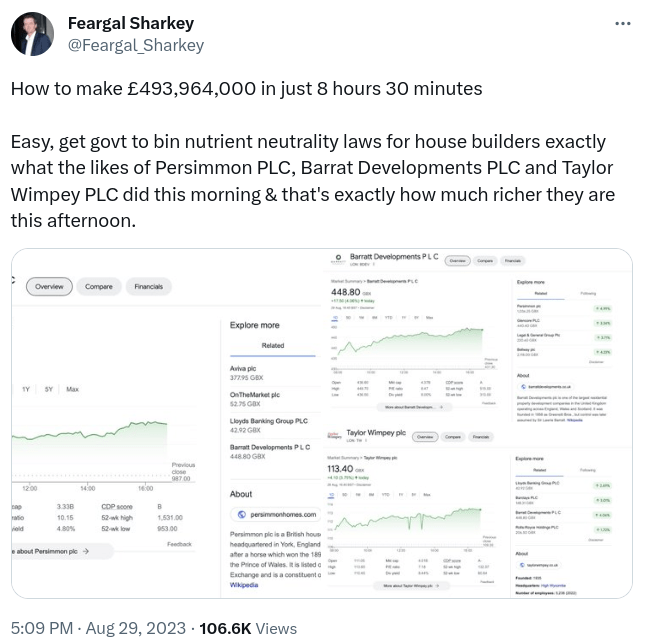
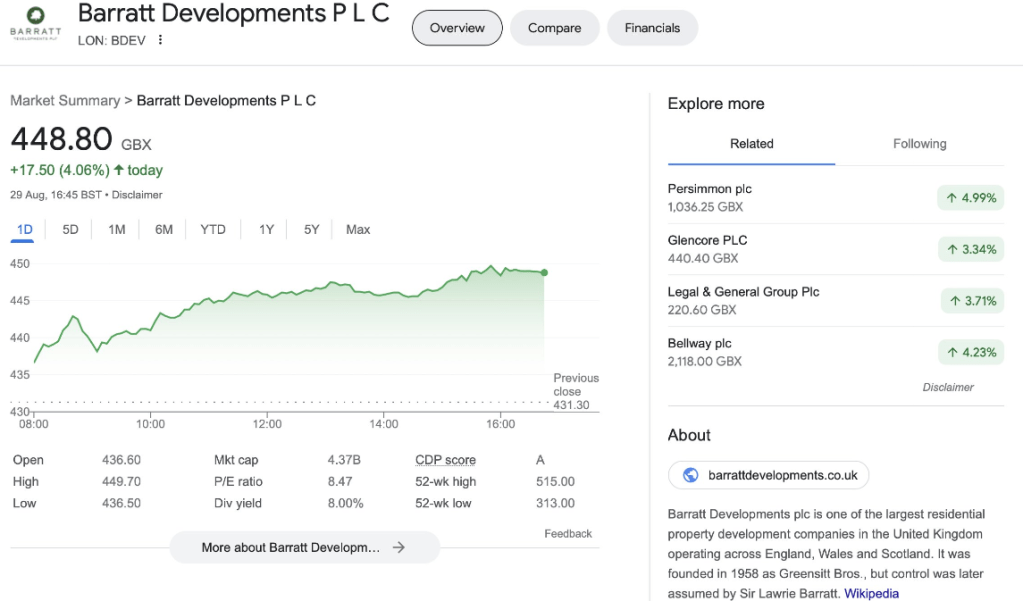
In the space of a few weeks, Persimmon, Bellway, Berkeley, Taylor Wimpey and Barrett Developments, which together have been responsible for building around 30,000 homes a year in the past, have all warned they’re planning to cut construction this year off the back of lower demand.
UK housing market data from RICS shows more signs of a slowdown in property, as agreed sales fell to -44% in July, down from -36% the previous month.
The pressure of high interest rates has choked both buyer demand and mortgage applications, meaning that price declines reached levels last seen in 2009.
The average two-year fixed mortgage deal is now 6.83%, according to Moneyfacts. The typical five-year deal stands at 6.34%.
House price slump hurts Persimmon
Persimmon has announced it reduced its headcount by almost 300 in the first half of the year and further reviews are ongoing to cut costs by as much as £25m annually.
Home sales dropped to 4,249 in the six months to June, compared with 6,652 in the first half of 2022 while underlying operating profit fell to £152.2m from £440.7m.
“Against a backdrop of higher mortgage rates, the removal of Help to Buy and significant market uncertainty, Persimmon has delivered a robust sales rate excluding bulk sales whilst growing the private average selling price in our forward order book and also securing cost savings,” chief executive Dean Finch says.
Still, the average price of each new home sold by the business rose from £245,597 to £256,445.
“As we have seen elsewhere, trading conditions have waned over the last 4-6 weeks with sales rates falling to 0.41. Pricing appears to remain resilient, but the next big test for the market will be the autumn selling season,” says Investec analyst Aynsley Lammin.
Persimmon’s downbeat assessment of the housing market comes only a few days after Bellway announced it would shut two of its divisions and slow activity in a third, as it predicted that house completions would “decrease materially” over the next 12 months.
The company said it completed 10,945 homes, down from 11,198, with an average selling price of £310,000, down from £314,399 the previous year. Reservations were also down, declining 28.4% in the year to 31 July.
The FTSE 250-listed group said it would update its forecast on volumes in its full-year results in October.
It warned that surging mortgage costs impacted sales in the final three months of 2022 when the UK was already reeling from the bonds crisis sparked by Liz Truss’ mini-Budget.
Bellway is also currently consulting on the closure of its London partnerships arm, which sees it working with housing associations, councils and private rental sector investors on projects, as well as its South Midlands division.
The move could see around 90 employees from the company’s 3,000-strong workforce lose their jobs.
Dark clouds build over the housing market
As well as Bellway and Persimmon, Taylor Wimpey has said it is planning to cut jobs in order to find savings of £20m a year.
While Barratt announced in July that it would build 20% fewer homes in 2024, and Berkeley has said its annual sales were expected to fall by a fifth.
Competitors Crest Nicholson and Vistry have said high mortgage rates were hampering demand from first-time buyers.
An estimated 7.6 million people were waiting to start routine hospital treatment at the end of June – up from 7.5 million in May, NHS England said.
The figure is the highest number since comparable records began in August 2007.
The prime minister made cutting waiting lists one of his priorities for 2023, pledging in January that “lists will fall and people will get the care they need more quickly”.
But far from cutting waits, lists are still growing to a level never seen before, the latest numbers suggest.
The latest backlog figures come as junior doctors are set to walk out again for their latest four-day strike on Friday, with the stoppage ending on Tuesday morning.
Doctors have had their real wages cut in recent years and are asking for their salaries to be restored, in part to stem a recruitment and retention crisis in the health service. The government says the demand is unaffordable.
Labour has accused the government of making “excuses” for failing to tackle waiting lists by blaming doctors.
Health think tanks including the King’s Fund and Health Foundation, as well as groups such as NHS Providers, which represents hospitals, have consistently said the health service needs more funding to make improvements.
The government and NHS England have set a target to eliminate all waits of more than a year by March 2025.
By this narrower metric, there has been slight progress, with the number of people waiting more than a year for treatment down from 385,022 at the end of May to 383,083 people at the end of June.
But at the current rate of change, this target will not be reached.
An even narrower target, to eliminate waits of 18 months or more for NHS treatment, was missed in April this year. A total 7,177 were waiting longer than 18 months in June 2023, down from 11,446 at the end of May.
The government has said it will draft in spare capacity from the private sector to try and cut waiting lists, including the use of eight new privately-run diagnostic sectors.
Ministers also say they are changing the rules to make it easier for the NHS to buy in private services, by altering the so-called “provider selection regime”.
Dr Rosena Allin-Khan, a Labour shadow health minister, said the government had no plan to turn the situation around.
“One in eight people are now waiting for NHS treatment, more than ever before. Patients are waiting in pain and discomfort for months or even years,” she said.
“Rishi Sunak has no plan to turn this around, he only offers excuses. He blames hard-working doctors and nurses, yet he hasn’t lifted a finger to stop the strikes.
“The last Labour government delivered the shortest waiting lists and highest patient satisfaction in history. The next Labour government will provide the staff and reform the NHS needs, so it is there for us when we need it once again.”
Ministry of Defence data show he took almost one such flight a week during his first seven months in office.
The prime minister has been accused of hypocrisy for flying short journeys domestically, given his pledges to curb planet-warming carbon emissions.
But Mr Sunak has said air travel was the “most effective use of my time”.
In response to Freedom of Information requests, the BBC was told the number of domestic flights on Command Support Air Transport aircraft broken down by prime minister between July 2016 and April 2023.
The RAF division – known as 32 Squadron – operates two Dassault Falcon 900LX jets and a helicopter to transport the PM and other ministers domestically.
In total, Mr Sunak boarded 23 domestic flights on these aircraft in 187 days, which is one every eight days on average.
Two caveats to bear in mind are the brevity of Ms Truss’s time in Downing Street, and the limitations on Mr Johnson’s travel during the Covid-19 pandemic.
The BBC initially requested data on the number of flights each UK prime minister since Tony Blair had taken using a military aircraft to travel domestically. But the MoD rejected the request on cost grounds and advised asking for data on those flights since Mrs May.
The prime minister sometimes has access to an RAF Voyager plane for overseas trips, and the government also charters private flights on aircraft operated by Titan Airways.
Separately, Mr Sunak has accepted more than £70,000 worth of private jet and helicopter travel to Conservative Party events from political donors this year.
High politics
Mr Sunak’s use of flights for UK engagements has come under intense scrutiny, with critics questioning why he had not used the train instead of RAF aircraft for relatively short trips to Newquay, Dover and Leeds this year.
Last month, Mr Sunak said those who say “no one should take a plane” in their approach to climate change were “completely, and utterly wrong”.
Labour said the PM was “developing an expensive habit of swanning around on private jets courtesy of the taxpayer”.
The party’s deputy leader, Angela Rayner, suggested Mr Sunak had breached the ministerial code, which states he is supposed to use scheduled flights, unless “it is essential to travel by air”.
In his speech at the COP27 climate summit last year, Mr Sunak said it was “morally right to honour” the UK’s promise to reduce carbon emissions.
The UK has set a legally binding target of achieving net-zero carbon emissions by 2050, as part of the global effort to avert the worst effects of climate change.
Flights produce greenhouse gases – mainly carbon dioxide (CO2) – from burning fuel, and these emissions contribute to global warming.
Emissions per kilometre travelled from domestic flights are significantly worse than any other form of transport, and private jets typically produce more CO2 than commercial flights.
But carbon emissions vary considerably depending on the size of the plane, how efficient its engines are, and how many passengers it carries.
In 2019, before the pandemic struck, international and domestic UK aviation accounted for 8% of the UK’s total greenhouse gas emissions.
PM’s priorities
Anna Hughes, whose Flight Free UK campaign urges people to fly less for the sake of the climate, said Mr Sunak’s transport choices were “frustrating”.
She said if leaders demonstrated “the kind of behaviour that we all need to adopt to avert the climate crisis, it communicates that it’s serious and real”.
“You can’t just say I’m the prime minister, I’m too busy and important,” she added.
One former official with knowledge of ministerial travel prior to Mr Sunak’s premiership said transport choices “were based on time”, adding the train would be used “nine times out of ten”.
The former official, who did not wish to be named, said they “had access to the PM’s diary and every single minute of every day is accounted for”.
“In order to achieve a long visit, the only way was to use an aircraft,” they said.
A Downing Street spokesperson said ministers “sometimes require the use of non-commercial air travel”.
“This is a standard practice for governments around the world and this has consistently been the case under successive UK administrations of all political colours,” the spokesperson said.
“Value for money, security, and time efficiency is taken into account in all travel decisions and all flights are carbon offset.”
Although we have the number of domestic flights Mr Sunak has taken up to April this year, we don’t know the details of all those journeys, and what aircraft he used.
We did ask for that information, but the MoD said the “RAF does not retain records for air miles flown by aircraft”, and withheld data on the PM’s trips.
That means we can’t calculate the overall carbon footprint of Mr Sunak’s domestic flights during his first seven months in office.
What we can do is estimate the carbon emissions of some individual flights, using information in the public domain.
For example, on 19 January, the prime minister flew from RAF Northolt in west London to Blackpool Airport on a Dassault Falcon 900LX.
A number of aviation websites say the Falcon has a fuel consumption of about 260 gallons per hour. The flight from London to Blackpool took 41 minutes, which means approximately 178 gallons, or 805 litres, of fuel was consumed.
Based on the government’s fuel-to-emissions conversation rates, the flight would have produced about two tonnes of CO2.
Falcon jets typically have 12 seats. So if we assume the plane was full for the Blackpool trip, two tonnes of CO2 would be 166 kg per person.
To put that into context, the International Energy Agency estimated that the global average energy-related carbon footprint was about 4.7 tonnes of CO2 per person in 2021.
In contrast to Mr Sunak’s flight, a train journey from London Euston to Blackpool North would produce 14.31kg of CO2 per passenger, according to a LNER carbon calculator..
The Trainline website says it takes an average of three hours and 43 minutes to travel from London Euston to Blackpool by train.
Additional reporting by Mark Poynting, BBC climate researcher
Labour says losses to Treasury bond fund costing £8,900 for every UK household
A Treasury bond fund has careened from an asset to a liability, with losses so profound that each UK household now faces a staggering burden of £8,900, Labour has said.
Figures show the Treasury fund, originally devised to capitalise on the Bank of England’s quantitative easing programme, has been rapidly eroding over the past three years.
According to Labour, the fund’s decline turned it into the most substantial liability on the Treasury’s balance sheet by the close of March 2023, culminating in a £251 billion loss.
The party says in terms of losses for the taxpayer, it represents a cost of £8,900 for every household in the UK and is 76 times the amount that was lost on Black Wednesday in 1992, when the UK was forced out of the Exchange Rate Mechanism.
It also claimed it is equivalent to 10% of the UK’s gross domestic product in 2022, or the entire GDP of Scotland and Wales combined.
Shadow chancellor Rachel Reeves said: “Families are already feeling the squeeze from what feels like an endless Tory cost-of-living crisis. Now they face yet another hit thanks to the Conservatives’ catastrophic mistakes in managing this fund.
“This Tory bond black hole will land working people with another astronomical bill for years to come.
“And it leaves them paying the price for the failings of successive Tory chancellors: the hubris of George Osborne thinking this fund was a one-way bet, the complacency of Rishi Sunak ignoring the warning signs in the bond market, and the recklessness of Kwasi Kwarteng turning a crisis into a disaster.
“All of them are guilty of putting their short-term political ambitions ahead of the long-term economic interests of the country.
“That will only change when we have a Labour government in place, determined to rebuild the foundations of economic responsibility, and give Britain the more secure, more resilient economy it needs.”
This Tory bond black hole will land working people with another astronomical bill for years to come.
Labour additionally pointed out that the Treasury’s assessment of taxpayer returns over the entire fund’s existence has changed from a net profit of £128 billion by the end of March 2021 to a net loss of £58.8 billion by the end of March 2023.
Established in January 2009 as part of the Bank of England’s quantitative easing effort to aid the UK’s recovery from the global financial crisis, the Asset Purchase Facility (APF) acquired significant sums of Government bonds and other assets from banks, pension funds and finance firms, providing vital liquidity to a stagnant market.
As the economy rebounded and interest rates remained low, Government bonds regained appeal among corporate investors, leading to an increase in the Bank’s asset portfolio’s value.
In 2013, Labour noted, former Tory chancellor George Osborne revised the rules for the APF, ensuring that future profits from the Bank of England’s investments would be directed to the Treasury.
Ms Reeves, who at that point was shadow Treasury minister, warned Mr Osborne at the time that his short-term cash grab from the Bank was no substitute for a proper strategy “to create the jobs and growth we need to get the deficit down”.
The figures were published in the Treasury’s annual accounts for 2022/23 on July 20.
Treasury minister Andrew Griffith said: “The only black hole facing the British people is the £90 billion unfunded spending splurge that Labour would slap on families across the country.
“There’s a world of difference between movements in a long-term bond portfolio versus the certainty of a Labour government spending other people’s money until there is no money left.
“Meanwhile, we are making progress on the British people’s priorities – halving inflation, growing our economy and reducing debt.”
Buildings across the health service “are in a very bad way and getting worse”, it has been reported this week, with the Government being warned that patients “deserve better”.
It comes after an investigation by the Liberal Democrats found evidence of chemical leaks in patient areas at a number of hospitals in England, as well as broken fire alarms in some facilities.
Saffron Cordery, deputy chief executive of NHS Providers, said: “Keeping patients and staff safe is vital. High-quality care depends on having reliable buildings and equipment.
“Too many NHS buildings and facilities are in a very bad way and getting worse.
“Trust leaders have warned long and loud about the eye-watering cost of trying to patch up creaking infrastructure and out-of-date facilities. The multibillion-pound repairs bill is growing at an alarming rate.”
Data from one Freedom of Information (FOI) request made by the party revealed there had been 115 chemical leak incidents at NHS hospitals between June 1 2022 and May 31 2023.
It has raised more concerns over the funding of the NHS, which were discussed on Jeremy Kyle’s show on TalkTV last night.
Former Tory advisor Leon Emirali said the answer to “fixing” the NHS is “full privatisation”, adding:
“Joanna made a point about free at the point of access. We can still have that with a level of privatisation, where we have private suppliers of healthcare – but for those who need it most, we can means test access to the NHS where those who need it the most in society get their healthcare for free and those who can afford to pay for it do.”
Can you believe this? The government has privately asked water companies to explore saving money on future water supplies by assuming unrealistically low levels of climate change.
On sewage: the Environment Agency appears to ask companies [in a letter] to stick to the bare legal minimum on environmental efforts to save money. “You are expected to explore opportunities to phase non-statutory commitments including net zero to future price review periods where appropriate.”
Angling and river groups, including the Rivers Trust, warn the government that pushing back schemes to 2030 would “delay essential environmental action and, ultimately, increase costs to consumers”.
Separately, the Liberal Democrats accused water firms of a “scandalous cover-up”, after the companies said they either did not know or would not hand over data on how much sewage they were spilling into rivers and seas.
(And can you believe this? Regulators do not instruct water companies to monitor volume of sewage, only the duration and number of times it is discharged. Last year there were more than 300,000 spills.)
Water firms are required to publish “water resources management plans” every five years for how they will ensure the water supply for the next 25 years, including new reservoirs and transfers from wet to dry parts of the country.
Amid rising government concern about how environmental targets will push up consumer water bills, the Environment Agency wrote to water companies in July to ask them to ensure their plans “protect your customers from adverse bill impacts”.
The agency said Thérèse Coffey, the environment secretary, had asked it to “investigate the scale of investment needed” in the context of “many families and individuals struggling to pay their utility bills”.
The regulator said companies should see how they could minimise costs from 2030 onwards, while meeting legal requirements. One option given was to see if money could be saved by assuming a “low climate change scenario”.
In the scenario, countries around the world would act dramatically to cut carbon emissions and ensure the global average temperature rose by only 1.6C above pre-industrial levels.
However, such a low level is considered unlikely. The United Nations has said countries’ climate plans put the world on track for 2.4C of warming at best and 2.8C at worst.
Earth has already warmed by 1.2C above the 1850-1900 average due to climate change and July was the hottest month on record.
“With hot tub temperatures at sea and many rivers still recovering from drought, the climate and nature crisis is clearly upon us. Yet the government is steering water companies toward the most optimistic warming scenarios,” said Eleanor Ward, policy officer at Wildlife and Countryside Link, an alliance of environmental groups including the National Trust and RSPB.
Climate change is expected to bring hotter, drier summers and warmer, wetter winters to Britain, putting pressure on water supplies. Even with an “exceptionally wet” July, parts of southwest England remain in drought. Devon and Cornwall remain under a hosepipe ban dating back to last summer.
The latest water supply plans include £14 billion of investment that would create seven new reservoirs, including at Havant Thicket near Portsmouth. Together they would provide an extra two billion litres of water a day, more than the 2.6 billion that the UK’s biggest water firm, Thames Water, provides today.
The Environment Agency asked water companies whether the “basic climate change scenario” would risk their water supply plans or if it might leave the firms “vulnerable to climate change”.
A spokesman for trade group Water UK said: “We strongly oppose the watering down of any plans that will help to safeguard water supplies in a changing climate. Last year’s record-breaking temperatures and the ongoing droughts across Europe are a reminder that investment in water resources must be a priority.”
In a separate letter to water companies, about the industry’s “national environment programme”, the Environment Agency appears to ask companies to stick to the bare legal minimum on environmental efforts to save money.
In one passage, companies are told: “You are expected to explore opportunities to phase non-statutory commitments including net zero to future price review periods where appropriate.” That implies ways of reducing carbon emissions — such as treating sewage with reedbeds rather than more carbon-intensive infrastructure at treatment works — could be delayed to 2030 and beyond.
Water industry figures think the government has realised how much its pledges on sewage pollution will push up water bills, and is now asking companies what they can cut to keep bills down. Normally, suggestions for what should be cut would come from the Environment Agency itself, but in this case firms are being told to look again at their plans for savings.
In a letter to Coffey’s department, environment, angling and river groups, including the Rivers Trust, warn the government that pushing back schemes to 2030 would “delay essential environmental action and, ultimately, increase costs to consumers”.
They added it put nature goals at risk. “This requirement on companies is out of step with the government’s commitment to halt and reverse the decline of nature by 2030,” the groups said.
Separately, the Liberal Democrats accused water firms of a “scandalous cover-up”, after the companies said they either did not know or would not hand over data on how much sewage they were spilling into rivers and seas.
However, regulators do not instruct water companies to monitor volume of sewage, only the duration and number of times it is discharged. Last year there were more than 300,000 spills.
Where is the payoff for the Osborne austerity era? – Owl
A West Yorkshire council said it was close to going bust unless a £47m funding gap could be closed, as a growing number of local authorities warned that they were almost running out of funds.
Kirklees council, which counts Huddersfield as its main town, said it could face a section 114 notice – signalling that it cannot balance its budget – in the 2024/25 financial year if the authority did not deliver required savings and minimise its expenditure this financial year.
It is understood several authorities are on the brink of issuing section 114 notices this year if the government does not release additional funding to stabilise the sector.
Hastings council, which has spent millions of pounds coping with a rise in demand for temporary accommodation, also signalled this month that it could be forced to issue a section 114 notice.
Last week, Derby City council’s leader, Baggy Shanker, described its finances as “absolutely dire” and its chief executive has called for urgent help.
A report by Kirklees council officers outlining the precarious financial position, due to be presented to councillors on 15 August, has warned that “the seriousness of the council’s financial position cannot be understated”.
The report says that the council has saved more than £250m since austerity measures were introduced in 2011 by the former chancellor George Osborne, and that it has continued to face “funding reductions and increasing demand pressures far greater than more affluent areas with lower levels of relative need”.
It added that the rising demand for services and cost of living crisis had also contributed to the council’s financial problems.
Kirklees council is the 13th biggest local authority in the UK in terms of population, with 430,000 people living in the area, according to the last census.
Councillor Paul Davies, the cabinet member for corporate services at Kirklees council, said: “Even though inflation has slowed marginally, prices are still increasing at a rate we haven’t seen for decades. Alongside additional demand for some of our most vital services and our need to protect our most vulnerable residents given the cost-of-living impact, we need to take action now to balance the budget.”
This year Woking council was forced to issue a section 114 notice after a risky investment strategy that left it with a £1.2bn deficit. The small local authority, in Surrey, purchased a slew of commercial assets, such as skyscrapers and hotels, but became overwhelmed by the sheer scale of its debt, which is forecast to hit £2.6bn.
Woking’s effective bankruptcy followed Thurrock, Croydon and Slough, where money was ploughed into seemingly lucrative commercial deals to try to plug gaping holes in budgets caused by central government funding policies.
A slew of other councils, including Kent, Hastings, Southampton, Guildford, and Bradford, have warned that they are also facing section 114 notices. After 13 years of slashed budgets and some poor commercial decisions, councils have more recently faced challenges with skyrocketing inflation, which has piled extra costs on local authorities to provide basic services.
The difficult financial position local authorities face has prompted them to continue cutting services this year, while also increasing council tax by the maximum amount possible, pushing further cost increases on to cash-strapped taxpayers.
The Department for Levelling Up, Housing and Communities has been approached for comment.
Is this a spreadsheet government that knows the price of everything but the value of nothing? – Owl
A Correspondent writes:
It seems that the UK Government has learned nothing from previous Covid fiascos, and are setting the UK up for another bad bout of the pandemic illness.
Although this appears at face value to be an acceptance of a recommendation from an independent body (the JCVI) allowing them an excuse, I would imagine that the Terms of Reference for the JCVI include some sort of value-for-money objective or a do-only-what-is necessary to avoid the NHS being overwhelmed guideline, thus giving the Government an excuse to save money rather than safeguard lives. Just because the most vulnerable and at-risk people get the COVID/Flue jab, does NOT mean that people who don’t get the jab but then develop the disease are not at risk of dying or having serious consequences to their health. And given the low cost of a vaccination jab vs. the high cost of COVID treatment when someone gets seriously ill and is hospitalised, and the significant economic consequences when significant numbers are off work with Covid – I am surprised that there is not a decent business case to offer the vaccination to a wider group.