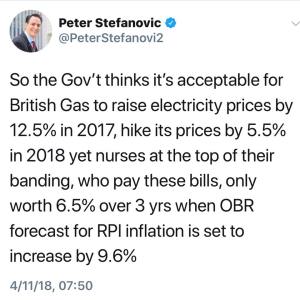
Expensive gas or cheap nurses?

Claire Wright’s blog:
“The all Conservative Devon County Council Cabinet has thrown out its own health watchdog’s unanimous resolution on deferring the implementation of Devon’s Integrated Care System, while a range of assurances were received.
Dozens of objections from members of the public came flooding in at the 22 March Health and Adult Care Scrutiny Committee meeting and my resolution on the thorny issue, which can be found here –
http://www.claire-wright.org/…/devons_nhs_asked_to_provide_…
… had been backed unanimously by councillors.
A revised resolution that the Cabinet supported yesterday, merely noted that a new system was being set up and everything else was so watered down as to be almost meaningless.
The message was repeated at length that this was not an endorsement but simply noting that it was happening and that progress will be monitored.
I reminded the cabinet of the County Solicitor’s advice to the Health Scrutiny Committee in November that it is unique in scrutiny committees in that we provide a legal check on health services – the only legal check – and that our remit is to take up issues of public concern. And we were flooded with emails of public concern.
I then went through the issues as I saw them.
When summing up, Cabinet member, Andrew Leadbetter, accused me of bringing a set of ‘pre-determined’ proposals to the Health and Adult Care Scrutiny Committee.
This is a serious allegation and I immediately asked him to withdraw it. Leader, and Cabinet Chair, Cllr John Hart, backed me up and Cllr Leadbetter retracted his statement.
I had in fact prepared the proposals during the lunch-hour before the meeting. it is quite permissable (and very common) to conduct business in this way.
There was cross party support for the Health Scrutiny resolution with Cllrs Alan Connett, Brian Greenslade and Rob Hannaford also addressing Cabinet along similar lines.
Here is the Cabinet’s final resolution, which you can compare with my proposals which are set out in yesterday’s post below:
(a) that the original recommendations of the Cabinet (a – d), as outlined in Cabinet Minute *148 and reproduced below, be re-affirmed:
(i) that the key features of an emerging Devon Integrated Care System being a single Integrated Strategic Commissioner, a number of Local Care Partnerships, a Mental Health Care Partnership and shared NHS corporate services, be noted.
(ii) that the proposed arrangements in Devon as set out in paragraph 4 of the Report be endorsed, reporting to the Cabinet and Appointments and Remuneration Committee as necessary.
(iii) that the co-location of NHS and DCC staff within the Integrated Strategic Commissioner, subject to agreement of the business case, be approved; and
(iv) the Health and Adult Care Scrutiny Committee be invited to include Integrated Care System governance in its work programme.
(b) And, in light of the Scrutiny Committees deliberations, Cabinet further RESOLVE
(i) that the Health and Wellbeing Board is reformed to lead new governance arrangements for the development of integrated strategic commissioning of health and social care; and
(ii) that there is continued proactive communication to the public using clear and consistent messaging and where appropriate there will be relevant involvement and engagement.”
Here’s the webcast – https://devoncc.public-i.tv/…/po…/webcast_interactive/325467
Article by Andrew Motion, President, CPRE in today’s Times (pay wall):
“In launching the revised National Planning Policy Framework (NPPF) last month, the communities secretary Sajid Javidpromised “a continued emphasis on development that’s sustainable and led locally”. Was he really talking about the same NPPF that, for the past five years, has forced wholly unsustainable development on communities already struggling with overstretched infrastructure and shrinking green spaces?
Initial analysis of the revisions by the Campaign to Protect Rural England shows that there is still not enough emphasis on a plan-led system such as the one that has been a cornerstone of our local democracy since 1947. We are calling for the final version to give a cast-iron guarantee that locally agreed development plans (including neighbourhood plans) should be upheld when deciding planning applications. It is the only way to restore communities’ faith in neighbourhood planning.
Local volunteers spend a great deal of time and effort in promoting good development, assessing housing needs and negotiating sites that respect settlement boundaries and preserve valued green spaces. So it is deeply disheartening that the revised NPPF could allow local authorities to overrule neighbourhood plans, either when local plans are reviewed (every five years) or if not enough homes are delivered elsewhere.
Communities across England are being targeted by parasitic “land promoters” who speculate on their ability to shoehorn large, expensive homes on to greenfield sites. In many cases the financial might of these companies allows them to steamroller councils in the appeals process, where the NPPF’s current “presumption in favour of sustainable development” provides the necessary loophole.
If it’s hard to achieve democratic decisions with respect to housing, the situation threatens to become even worse with fracking. The majority of recent applications have been decisively rejected by local authorities, yet the revised NPPF forces local authorities not only to place great weight on the supposed benefits of fracking for the economy, but also to recognise the benefits for “energy security” and “supporting a low-carbon transition”. This misguided emphasis can only lead to more travesties like January’s approval for oil exploration by West Sussex county council, in the face of 2,739 letters of objection (and 11 in support).
We must have new housing and infrastructure, but it remains vitally important that development benefits those who have to live with it. Now more than ever, we need to put people at the heart of the planning system.”
Owl says: due diligence?
September 2017:
“Construction of East Devon District Council’s new headquarters in Honiton is progressing well with groundworks completed and the building foundations underway.
The council is expected to be working in the new premises by December 2018 and contractors, INTERSERVE Construction Ltd, are on schedule to complete on time. …”
TODAY:
Outsourcer Interserve seeks vote for borrowing increase
INTERSERVE will call a meeting of shareholders to seek approval to increase its borrowing limits and prevent it breaching its banking covenants.
The construction and public services group says that it needs higher borrowing levels because of expected “significant balance sheet writedowns”, which it expects to report in full-year results delayed until the last day of this month, only two days after the meeting.
INTERSERVE is one of Britain’s biggest outsourcing companies, cleaning schools, hospitals, government offices and railway stations. It also operates facilities for the ministries of defence and justice. It has annual revenues of £3.2 billion and employs 80,000 people.
It has been feared that INTERSERVE could become another Carillion, a larger rival that went bust at the turn of the year after the failure of several building contracts. Interserve is on the government’s watch list, with Deloitte, the accounting firm, having been brought in to monitor the company. EY, another of the Big Four accountants, is advising Interserve and its lenders.
The business’s problems emerged two years ago after the failure of a venture to build energy-generating incinerators led to it having to pay out £195 million in compensation and penalties.
In a statement to the stock market, Interserve said that at its year-end, its net debt had risen to £513 million. …”
Source: Times (paywall)
“Seven years of austerity has seen police numbers cut by “more than 15%”, according to new research from Unison.
There are now 2,817 fewer people employed by the South West’s five forces than there were in 2010.
Devon and Cornwall’s force has been hit worst – losing 22% of its strength.
Unison says the government needs to stop the cuts and get numbers back to a reasonable level.
Its Police and Justice Lead Mike Cracknell said austerity is “hitting public safety”.
“Our police workers are 100% committed to keeping people safe, often putting themselves in danger to do so. But you can’t do the job with a skeleton crew.”
The Home Secretary Amber Rudd says the evidence doesn’t back up claims that reduced resources are the cause of more crime.”
 East Devon Watch