Another construction greed and sleaze scandal

“Bosses at Britain’s largest private construction business enjoyed a sharp rise in payouts last year despite ongoing losses and a bumpy refinancing that forced it to file its accounts months after the legal deadline.

Five directors at Laing O’Rourke, which has worked on major projects such as Crossrail and Heathrow Terminal 5, were paid £3.4m in salaries and short-term incentives in the year to March 2018, compared with just £1.6m in the previous 12 months.

The accounts were due to be filed in September but auditors refused to sign off on the company as a going concern until it refinanced £177m of debt in its UK business. …”

https://www.telegraph.co.uk/business/2019/02/24/bumper-pay-day-bosses-loss-making-laing-orourke/

More on Swire’s business pal, Russians and Tories

Bumped from comments below:

Thanks again for keeping an eye on this, Owl.

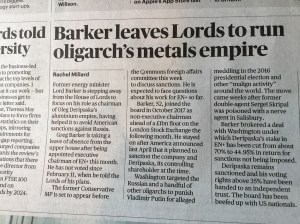
Your scanned piece from the Sunday Times can be picked up on-line – where the bit we can read tells us that Barker “is set to appear before the Commons foreign affairs committee this week to discuss sanctions. He is expected to face questions about his work for EN+ so far.”

https://www.thetimes.co.uk/article/greg-barker-leaves-lords-to-run-oligarch-oleg-deripaskas-metals-empire-km7gclptf

The same article refers to Barker’s lack of interest in the second chamber:

“Former energy minister Lord Barker is stepping away from the House of Lords to focus on his role as chairman of Oleg Deripaska’s aluminium empire, having helped it to avoid American sanctions against Russia. Greg Barker is taking a leave of absence from the upper house after being appointed executive chairman of EN+ this month. He has not voted since February 11, when he told the Lords of his plans.”

Back in August 2016, the Sun considered two of the resigning PM’s choices for gongs:

“TWO of David Cameron’s cronies have attacked criticism of his decision to shower aides and allies with honours. Hugo Swire, who was given a knighthood on Thursday, and Greg Barker who was made a Lord last year hit back at Mr Cameron’s ex-guru Steve Hilton who branded the resignation list “corruption” for including Tory donors.”

https://www.thesun.co.uk/news/1561555/theresa-may-plots-drastic-house-of-lords-overhaul-after-david-camerons-resignation-honours-list-sparks-outrage/

The Daily Mail ran a piece back in July 2014 lambasting the Tories for cosying up to Russian money – and it began with an auction:

“As bidding passed the £100,000 mark, guests at this year’s Conservative Summer Party broke into spontaneous applause. For sale was what auctioneer Hugo Swire, a Foreign Office minister and former director of Sotheby’s, billed as a ‘once-in-a-lifetime’ experience: the chance to play a tennis match with both David Cameron and Boris Johnson.”

https://www.dailymail.co.uk/news/article-2702132/As-Cameron-talks-tough-Russia-scrutiny-grows-oligarchs-Putin-cronies-showering-Tories-Moscows-millions.html

The £160,000 prize was famously won by a Russian oligarch’s wife:

https://www.mirror.co.uk/news/politics/boris-johnson-defends-playing-tennis-12209056

What is clear, though, is not only that the Conservative Party has seriously compromised itself in taking Russian money (it was the Labour Party which was lambasted for doing so from the 1920s…) – but the extent to which lobbying on behalf of Russian business (aka political) interests is happening at the heart of Westminster – as reported last year by intelligenceonline.com:

https://www.intelligenceonline.com/corporate-intelligence/2018/07/11/barker-finds-en_-an-ally-in-westminster,108316537-bre

It will be interesting, then, when Barker gives oral evidence on “Global Britain: the future of UK sanctions policy” to the Commons foreign affairs committee this Wednesday:

https://www.parliament.uk/business/committees/committees-a-z/commons-select/foreign-affairs-committee/#
.
Keep at it, Owl!

“Housing is creaking — and not just because of Brexit”

David Smith, economics editor The Sunday Times:

“… There are two other elephants in the room.

The first is affordability. Official figures show that the average house price in England and Wales is 7.8 times annual full-time average earnings. The ratio has continued to climb in recent years, even since the crisis.

Over the past 20 years, it has more than doubled in England — up 123% — and nearly done so in Wales — up 92%. Viewers in Scotland have their own figures, but it has also gone up substantially.

It is true, of course, that ultra-low interest rates affect the affordability calculation when it comes to monthly mortgage payments, making bigger mortgages more affordable, but high prices are still a mountain to climb when it comes to deposits.

Also, even though wage growth has picked up, at a little over 3%, it is not making much of a dent in the high house price/earnings ratio. Older readers will remember a time when you took out a mortgage you could barely afford, confident in the knowledge that salary rises would come to the rescue. Things are different now.

The other elephant is the Help to Buy scheme, beloved of my friends in the housebuilding industry, where it has been like manna from heaven. First-time buyers have been steered towards new housing by Help to Buy equity loans on up to 20% of a property’s value in most of the country and a hefty 40% in London.

This has had two effects. By tilting first-time buyers towards new-build homes, it has distorted patterns in the market for existing homes. Young people who used to buy older homes, including “doer-uppers”, now have a powerful incentive to buy new. Normal housing market chains are not having a chance to form.

The second effect has been to push up prices for new properties relative to existing homes. Again, this comes out clearly from the affordability data.

In the early 2010s, the house price/earnings ratios for new and existing homes were similar. Since then they have diverged significantly. The latest figures are that the ratio for new homes is 9.7 — the average new home costs nearly 10 times average earnings — compared with 7.6 for existing homes. First-time buyers are being pulled into higher-priced homes and, ultimately, more debt. …”

Source: Sunday Times (pay wall)

“Final contract yet to be signed for Exmouth watersports centre project”

“East Devon District Council (EDDC) and Grenadier Estates agreed a development deal in August 2017 and planning permission for the facility was granted in June last year, but the supplementary agreement relating to beach access has yet to be signed.

Peter Quincey, director of Grenadier, has said the company is excited to commence with this project and is keen to get on site as soon as possible, but the details of a supplementary agreement is still to be finalised.

The council’s deputy chief executive told councillors at a cabinet meeting that Grenadier is still being chased.

At the meeting on Tuesday, February 12, Exmouth councillor Steve Gazzard asked for answers on the Queen’s Drive project.

He said: “I am trying to be helpful, but I want some answers.

“Can we have an update on whether Grenadier signed finally signed the contract, whether Michael Caines is definitely opening a restaurant or is just interested in opening a restaurant, and whether, subject to planning permission being granted, there is money allocated in a budget for repairs to the play park on the seafront?”

Richard Cohen said: “I cannot say specifically what the details between Grenadier and Michael Caines are, but the fact they have announced he will be opening a restaurant suggests they have a high degree of confidence in it.

“We will have to budget for any maintenance at the play park that needs to be carried out and we have already done some work on wear and tear repairs.”

After the meeting, Mr Quincey said: “We are delighted to have Edge Watersports and Michael Caines supporting the new watersports centre on Exmouth seafront. Work is expected to begin on site in Summer 2019 and conclude Summer 2020.”

In November, the cabinet approved the £1.2m work on realigning the road and the car park as part of ‘phase one’ of the Exmouth seafront regeneration scheme, The second phase will be the development of the watersports centre and ‘phase three’ is a mix of leisure facilities on the former Exmouth Fun Park site and the current Harbour View plot.”

https://www.exmouthjournal.co.uk/news/watersports-centre-contract-not-signed-1-5896955

Swire’s business partner leaves Lords to run Russian oligarchs oil empire

So, just what is the (currently dormant) 50/50 business Eaglesham Investments Ltd Which he runs with Swire FOR:

https://eastdevonwatch.org/2019/01/28/swire-eagle-and-sham-an-unfortunate-choice-of-company-name/

Originally it was described as investing in “emerging markets” and later as being for “renewable energy” investments.

Shouldn’t our MP tell us?

Sunday Times: “Council stings residents of Cranbrook for ‘new town tax’ of £370 a year”

Owl says: they don’t mention the district heating system – which keeps residents tied to one supplier – E.on – for 80 (yes EIGHTY years)!

“Local authorities and developers are charging for supplying services in new towns that are free to other homeowners.

Residents of a new town in Devon are being charged an extra £370 a year in council tax in a practice — already being called “the new town tax” — that could spread across the country.

Cranbrook, a new town to the east of Exeter, is charging band F properties a £370 surcharge, rising to £512 for band H properties. Residents receive no more services than people elsewhere in Devon.

Mark Williams, chief executive of East Devon district council, said: “It is very likely that other towns not just in East Devon but elsewhere will have to adopt a similar approach if they wish to maintain their local assets or facilities.

“We believe that the approach adopted by Cranbrook town council is likely to be replicated across the country, especially in areas where there are areas of significant new housing.”

Cranbrook, whose population will eventually exceed 25,000 people, was managed by developers who levied an “estate rent charge” on residents.

The charge was a contribution for the upkeep of facilities such as landscaped gardens and bin collections. When the town council took over responsibility for the services, it kept most of the charge as an addition to the council tax.

Activist groups have sprung up to help residents nationally who have moved into new homes only to discover they are at the mercy of developers on service costs for green spaces or parking. Developers can levy fees because local authorities are not obliged to “adopt” new housing and provide the services.

Cathy Priestley of Homeowners Rights Network, a pressure group, has been contacted by people from 457 new estates housing 86,000 residents with fees ranging from £100 to more than £700 a year. The developers include Bovis, Linden, Persimmon, Redrow and Taylor Wimpey.

She said: “Buyers are lumbered with hidden estate taxes no matter who collects them or who is to blame for this set-up. Stop the rot! Adopt the lot!”

The prospect of permanent higher council taxes for buyers of homes on greenfield sites will be controversial. The government is supporting a housebuilding drive intended to benefit younger people and the “squeezed middle”.

Kevin Blakey, chairman of Cranbrook council, justified the council tax surcharge by saying a lot of people “simply couldn’t afford” to pay the developer’s flat-rate service charge “and the collection rates were going to be pretty awful”.

He added: “There are no council houses but 40% of the first phase of development was given over to social housing managed by housing associations. These charges [were] being applied to people in East Devon who are probably least able to afford it.”

Blakey said that even though the town council would provide services more efficiently than the developers, the charges reflected the cost of maintaining trees and green spaces, including a country park, insisted on by the district council. The residents have to meet the costs even though it is open to everyone. “Our arguments have fallen on deaf ears,” he said.

Williams said: “There are no rules. The government has allowed developers to pass their obligations directly onto new home owners and the ability to remedy the situation lies with the government. This is a national issue.”

Source: Sunday Times (paywall)