Politics: when your (very recent) past comes back to bite you

And why Independents make sense – no party line, no whipping.

“Activists for political parties are hardy souls.

They’re used to braving the elements, leafleting and door knocking in the depths of midwinter and encountering the uninterested, the unruly and even the odd bloodthirsty dog.

But from conversations I’ve been having with councillors and council candidates from both main parties over the past few days, all campaigning for next month’s local elections, the reaction they’ve received this time round has been of a quite different order.

The Tories, most of all, are in abject despair with many believing they are heading for the drubbing of their lives.

One, a local chairman from Essex, told me that his prime minister’s actions represent “an absolute betrayal of the British people”.

He told me: “Next month’s elections are going to be absolutely pivotal – we are going to get absolutely hammered.

“We are struggling to get anyone to deliver leaflets, even members of our executive don’t want to go out.”

This theme of Conservatives being unable to turn out their own members was commonplace across the country.

One exasperated Tory councillor told me: “Every association I’ve spoken to are struggling to get their members out.

“Members are saying, why should I get s*** on the doorstep and doors slammed in my face when I’m as angry as they are?”

Most are unequivocal: they blame Theresa May and want her to go. “It isn’t just six weeks of incompetence, it’s two and a half years.”

But this isn’t just a rejection of the Tory party and Theresa May, the backlash extends to Labour too.

I’ve spoken to a score of Labour councillors from up and down the country who are deeply concerned about the reaction they’re getting. …”

https://news.sky.com/story/brexit-backlash-party-activists-fear-hostility-could-turn-sinister-11691211

18 days to local elections – today’s picture

Swire (and his party’s view right down the line to councillors):

As explained here by Claire Wright:

https://eastdevonwatch.org/2015/03/24/claire-wright-responds-to-hugo-swires-jokes/

Much cheaper water bills in south west – thanks to Jeremy Corbyn!

Threatened with nationalisation, South West Water cuts bills by 15% – interesting!

“Under threat of nationalisation from a putative Jeremy Corbyn-led Labour government, Britain’s three listed water companies have agreed to the largest cuts in customer bills since privatisation by Margaret Thatcher 30 years ago.

The reductions will mean that households in the West Country will pay 15 per cent less at 2019 prices over the next five years. In the northwest of England, bills will fall by 11 per cent before inflation.

While the inflation link in water charges will mean bills will fall by less, new penalties for missing environmental and operational targets could mean suppliers having to cut household charges by even more as a means of compensating their communities.

Of the 17 water companies in England and Wales, three have made a fast-track agreement with Ofwat, the regulator, to set customer charges from April 2020 to March 2025.

The other 14 suppliers have been given a must-do-better notice by Ofwat. Having been told by the regulator to resubmit their plans and make them more ambitious, the 14 will be told by Ofwat in July whether their revised proposals are acceptable.

As there is no competition in the supply of water to households, the 17 suppliers are all local monopolies and as such are tightly regulated by Ofwat. However, critics of the regulatory regime, including MPs on both sides of the House of Commons, have argued that Ofwat has for too long allowed suppliers to put up prices without investing enough in, for instance, stopping leaks, which in some areas lead to 25 per cent of the treated water in the mains system going missing.

The three suppliers who have been fast-tracked by Ofwat for presenting credible business plans for the 2020-25 price review are, coincidentally, the three remaining stock market-quoted water companies: United Utilities, formerly known as North West Water, which serves 3 million homes from Cheshire to the Scottish border; Severn Trent, which serves 4.3 million customers in the Midlands; and South West Water, which supplies 1.8 million people in the West Country and is a subsidiary of Pennon Group.

Household customers of South West Water have long had the largest bills in the country. Ofwat has agreed with the group that those bills will fall before inflation by 15 per cent, or £77, from this year’s £527 average to £450.

However, South West Water has also agreed with Ofwat that if it does not clean up its act with the Environment Agency — it is the most regularly fined for pollution incidents — then it could face further cuts to the charges it makes.

United Utilities has agreed to a £49, or 11 per cent, cut in bills over the next five years but has been told it will have to cut charges more if it does not hit targets to reduce its leaks by 20 per cent.

Severn Trent is to cut bills by 5 per cent, or £16, over the five years. It has committed to more than halving the average time its customers are without water every year or face penalties.

Under Ofwat’s rules, bills will go up every year in line with CPIH, the consumer price index that includes housing costs, now running at 1.8 per cent.

The suppliers’ charges will get final clearance in December. David Black, the Ofwat director in charge of the process, said: “Our draft decisions for these companies show that investment in service and infrastructure can go hand in hand with more affordable bills.”

Source: The Times (pay wall)

20 days to local elections: today’s picture

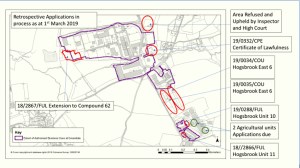
This image below shows current planning issues at Greendale Business Park – many of which have been allowed, or allowed to drag on, by EDDC Tory councillors who form the majority decision-makers in “planning” and planning “enforcement” (those inverted commas are there deliberately!). Many of Greendale’s planning applications have been approved retrospectively.

Independent Councillor Geoff Jung works tirelessly (in the face of great difficulty) to try to ensure that Greendale stays within its proper boundaries – but it is a never-ending task:

Secretively towards a new kind of emergency service in Devon?

Currently many firefighters are trained as medical first responders too. Now they are being trained as police first responders.

Is this a plan to have just one type of first responder – police, fire AND ambulance?

“A police force has trained firefighters as special constables in an attempt to boost officer numbers in rural areas.

Seven Devon and Somerset firefighters have taken on the community responder roles after two months training with Devon and Cornwall Police.

They can now arrest suspects, but must prioritise fighting fires when needed.

Police and fire unions have criticised the scheme as a ploy to “paper over the cracks” saying “firefighters exist to save lives, not to enforce the law”.

The Police and Crime Commissioner for Devon and Cornwall, Alison Hernandez, said the new roles would help make “communities in Devon and Cornwall safer”.

“They are a great addition to rural communities and importantly represent extra resource for blue-light services,” she said.

“They are not a replacement to full-time sworn police officers, whose ranks we are also adding to with a further 85 being recruited this year, taking our numbers to the highest level since 2012.”

But Dave Green, from the Fire Brigades Union (FBU), said: “Firefighters provide a humanitarian service, which often allows access to areas of the community that the police sometimes struggle to engage with.

“Independence from the police is vital to ensure that communities know firefighters exist to save lives, not to enforce the law.

“We remain opposed to any attempt to turn firefighters into law enforcement, either in Devon and Somerset, or elsewhere in the country.”

Simon Kempton, of the Police Federation, told The Telegraph that the project was an attempt to “paper over the cracks” caused by cuts in funding.

“It just exposes how scant resources are in some rural areas,” he said.
Cullompton, Crediton, Dartmouth, Honiton, Okehampton, Newton Abbot and Totnes will all receive a community responder later this year.”

https://www.bbc.co.uk/news/uk-england-devon-47880818

Deprivation no longer a criterion for extra local authority funding

“Labour leader Jeremy Corbyn this week chose local government funding as the central focus of Prime Ministers Questions, describing the Fair Funding Review as an Orwellian phrase.

Local government organisations have voiced concerns that poor areas of the country will lose out under government proposals to remove deprivation as a factor in calculating the foundation formula for grants to councils.

Speaking in the Commons on Wednesday, Corbyn said that the Fair Funding Review proposals are likely to make things worse for struggling local authorities.

He said: “Tory proposals on the new funding formula for councils will make poorer areas even poorer. “They are removing the word ‘deprivation’ from the funding criteria. “In a phrase that George Orwell would have been very proud of, they have called this the fairer funding formula.”

However, May hit back, saying: “No, that is not what we are doing. “What we are doing is ensuring that we have a fairer funding formula across local authorities. “We are also ensuring that we are making more money available for local authorities to spend.”

However, Corbyn pointed to concerns raised by local authority representatives over the removal of the deprivation factor. He said: “The Society of Local Authority Chief Executives has called the fairer funding formula decision ‘perverse’. “Even before this new formula kicks in, councils are losing out now.

“A Conservative council leader said earlier this year: ‘We are really, really short of money…I mean there is no money.’”

Publication of the review proposals sparked an angry response from urban councils, which said they would be hit by the removal of the current deprivation measure.

And in February, even the County Councils Network (CCN), whose members are set to benefit from the move, said: “Considering recent debate within the sector on deprivation we recognise that the government may wish to consider whether deprivation should be included…”

However, the CCN it said that this should only be done at a small weighting, if its inclusion was supported by evidence, and did not compromise the review’s principles of simplifying the system.

Paul Carter, chairman of the CCN, said: “…if we are to see this review through – and if we are to grasp this opportunity – compromise and pragmatism on all sides of the local government sector, will be necessary.” …”

Corbyn attacks ‘Orwellian’ Fair Funding Review

Privatisation the Virgin way

Virgin has many privatised contracts with the NHS. Is there any reason to believe his companies will treat the NHS any differently to the way they treat what used to be our railways?

“Sir Richard Branson will have taken at least £306m in dividends from Virgin Trains by the time the firm’s 22-year tenure as a rail operator comes to an end within the next 12 months.

Branson said on Wednesday the Virgin name could disappear from trains by November, after its joint venture partner, Stagecoach, was blocked from three franchises by the Department for Transport over its refusal to pay more into rail staff pensions.

Analysis by the Guardian indicates that Virgin Rail Group Holdings, the joint venture company, will have collected at least £600m since its launch in 1997, a figure that drew criticism from Labour. …

The final total is likely to be higher once this year’s dividend is declared when the company’s next set of annual accounts is published in October next year.

Branson’s Virgin Group owns 51% of the venture, giving him a £306m share of the overall dividend pot.

The remaining £294m was allocated to the Stagecoach transport group, whose largest shareholder is the Scottish businessman and Scottish National party donor Brian Souter, together with his sister, Ann Gloag.

The highest dividend in a single year was paid in 2009, when Virgin Trains paid out nearly £95m. The figure has hovered around £50m over the past three years.

Andy McDonald, the shadow transport secretary, said: “This money could and should have been used to invest in services and hold fares down, not siphoned off by shareholders.

“The railway should be run as a public service in public ownership. Instead, absurdly, its run in the financial interest of foreign state-owned companies and billionaires such as Richard Branson. If Virgin disappears from the railway as Branson warns, it won’t be missed by taxpayers or passengers. …””

https://www.theguardian.com/business/2019/apr/11/richard-branson-earned-300m-virgin-rail-franchises?

McCarthy and Stone poor results: closing operations in south-west – whither PegasusLife now?

“A slowdown in secondary housing transaction volumes eroded operating margins for McCarthy & Stone (MCS) during the first-half, as the retirement home providers used discounts and incentives – including part-exchange – to boost sales.

Management hopes to make more than £90m in cash savings between 2019 and 2021 by scaling back sales and marketing teams, standardising build designs and closing operations in the south-west of England.”

https://www.investorschronicle.co.uk/shares/2019/04/10/mccarthy-stone-hindered-by-property-slowdown/

AND

“Half-year profits at McCarthy & Stone tumbled by two-thirds as it ploughed more cash into a turnaround to cope with a slowdown in the housing market.

The retirement housebuilder handed consultants £4.5m for advice relating to its strategy shake-up, which included closing offices in Scotland and the south-west of England and making almost 200 of its 2,500 staff redundant at a cost of £3.5m.

Those and other one-off costs left McCarthy & Stone with pre-tax profits of £3.6m for the six months to February, down from £10.5m the previous year.”

https://www.telegraph.co.uk/business/2019/04/10/redundancies-restructuring-hit-mccarthy-stone-profits/

Read this before buying a new home (particularly from Taylor Wimpey )

Owl says: surely developers building shoddy or dangerously constructed new homes should be banned from tendering for new schemes and banned from using government subsidies from Help to Buy schemes to sell homes already constructed forever?

“It took seven families two years, but a group of homeowners in Scotland has taken on a housing giant in order to have their “crumbling” new-build homes repaired. It’s part of a broader, UK-wide issue – this is their story.

Sheila Chalmers moved to Peebles with her husband 10 years ago. Her three-bed home was one of 250 built by developer Taylor Wimpey on a new site in the Scottish borders.

For eight years, life went on as normal. Then something strange started to happen. Overnight, families at the top end of the estate started to vanish. But there were no for sale signs and no-one new was moving in. “It became almost a ghost street,” she says. “Houses were empty. People were disappearing.”

Sheila later heard that the properties had been bought back by Taylor Wimpey after problems were discovered. The owners had signed non-disclosure agreements so they could not speak out.

Taylor Wimpey confirmed it did buy back a “small number of homes” to start with. It later sent a letter to all the remaining residents, saying that some houses did have a problem with the mortar holding together their bricks.

Sheila thought she did not have anything to worry about, but she went outside and checked anyway. Patches of mortar were clearly eroding, she says, and in other places it could be scraped out with a fingernail.
She paid for assessments by two different structural engineers, who both said the house needed extensive repair work, though Taylor Wimpey said its own inspections found that was not the case.

Mortar is made up of two key materials: cement and sand. The more cement in the mix, the stronger the mortar, though the more brittle it can be.
The family paid to have their laboratory tests on the mortar carried out by a specialist firm.

The results suggested that there was far more sand in the mix than you would expect for a home in that area, although Taylor Wimpey says the type of chemical test used was “not appropriate” and the results could not be relied upon.

Our investigation in 2018 found similar complaints about weak mortar across at least 13 estates in the UK all built by different companies.

Three doors down from Sheila, live Pete and Jill Hall with their 13-year-old son. Like Sheila, they first learned about the problem two years ago when Taylor Wimpey were buying back the individual houses. They paid for their own tests, which showed only one in eight samples taken from their home met industry guidelines, although again Taylor Wimpey says the test used was “not appropriate”.

“On the garage the tests came back showing it was just sand,” said Pete.
A video filmed by the family after a rainstorm clearly shows the mortar on the back wall falling out when a screwdriver was run gently along it.

Handmade signs

In the end, seven core households became involved – passing on details to a wider community group on the estate. The families worked together to build their case, paying for their own structural surveys and using Freedom of Information laws to demand internal documents from the local council.
They made handmade signs and protested outside the showroom of another Taylor Wimpey estate in the area.

In 2017, they presented their findings to Taylor Wimpey’s lawyers, saying that they would go public if their properties were not fixed, demolished or bought back. They were surprised at the response.

The families’ solicitors received a letter back saying they had decided not to report the group to the authorities under the Proceeds of Crime legislation. “It was accusing us of bribery, effectively,” said Pete. “It took me about 10 minutes to stop laughing. But it was intimidation, a threat.”

By then, Pete and Jill had hired their own engineers to examine the house. They recommended that the couple should stop using the garage because it was at risk of collapse, although Taylor Wimpey denies that there was a structural problem.

The couple bought a giant shipping container, covered it with warning stickers and left it on their front lawn.

That, they say, got Taylor Wimpey’s attention and – two years down the line – an agreement has now been reached for their home to be fixed. “It falls short of where we think a full repair should be, but they have said it’s that or nothing – so we have accepted it,” Jill says.

‘Someone has to stand up’

In December 2018, Taylor Wimpey sent out letters saying all 130 houses in the estate built with the weaker mortar would now be offered “remediation” work.

Properties are being dealt with one at a time. Construction crews are scraping out the old mortar and replacing it with a stronger material.

Taylor Wimpey said it “sincerely apologises” to the all the homeowners affected, is “fully committed to resolving matters” and has “a clear plan in place to remediate affected homes”. “This is a localised issue and falls short of the high-quality standards we uphold,” it said.

The firm has now apologised to Sheila and, even though its own inspections found a full repair is not needed, said work to replace the mortar in her home will start this summer. It will refund the £16,000 she has spent on legal costs and technical reports, most of which she had to borrow.
Repair work on Pete and Jill’s property, which may involve the demolition of the garage, is due to start in mid-July.

Both families say the fight has been time-consuming, stressful and put them off ever buying a new-build home again. “These developers, these companies, cannot be allowed to continue the destruction of people’s lives with building shoddy homes,” said Sheila. “Somebody has to stand up and show them that they cannot get away with it.”

What went wrong?

Maps drawn up by Taylor Wimpey show about half of the 250 homes were built with far weaker mortar than recommended under industry standards

A memo sent to all developers in the UK by the National House Building Council (NHBC) in 2013 warned about this problem

The local council in Peebles says the mortar used was not the type in the original building warrant and was changed later without its knowledge

Taylor Wimpey says the material was “of sufficient strength to meet structural requirements” as “supported by an independent review” by the local council, but accepts it may be “less durable under prevailing exposure conditions”

It says it has now offered to repoint “any home which was constructed with the same mortar, regardless of whether our inspection found this was necessary or not”

https://www.bbc.co.uk/news/business-47816530

EDDC external auditors being investigated for their work with failed EDDC HQ builder

“Britain’s audit watchdog said on Thursday it was investigating the audits by Grant Thornton UK of some financial statements of Interserve, the outsourcer that was taken over by lenders last month.

Scrutiny of Britain’s “Big Four” accounting firms has been spurred in the past year by a handful of investigations into listed company’s financial reporting as well as the collapse of Carillion and Poundworld, which led to an inquest in auditing industry standards.

One of the British government’s biggest contractors, and a peer of collapsed infrastructure and outsourcing group Carillion, Interserve was placed in administration in mid-March after shareholders rejected a rescue plan to deal with its debts.

The Financial Reporting Council said it was probing the audit of the company’s financial statements for 2015, 2016 and 2017.

Grant Thornton UK did not immediately respond to a request for comment outside of work hours.

The FRC is already investigating the accounting firm’s audit of cafe chain owner Patisserie’s financial statements for 2015-2017 after the discovery of a black hole in its finances led to the breakup and sale of the group.

The run of bad news has led to calls by lawmakers for the breakup of Britain’s “Big Four” accounting firms Ernst and Young, KPMG, Deloitte and PricewaterhouseCoopers.”

https://uk.reuters.com/article/uk-britain-interserve-investigation/uk-watchdog-investigating-grant-thornton-interserve-audit-idUKKCN1RN0IN

Retiring Chief Constable blames political choices for ‘systemic failings’

“A departing police chief has used his farewell address to suggest his force no longer has the resources to “protect its citizens”.

Jon Boutcher, chief constable of Bedfordshire Police, attacked government cuts as he announced he would be leaving after five years in the job.

It comes amid a row between police forces and ministers over whether reduced policing budgets are to blame for a rise in violent crime.

In a statement announcing his departure, Mr Boutcher claimed that Bedfordshire Police had been the worst-hit force in the country.

“Policing remains hugely underfunded and Bedfordshire Police provides the most profound example of this as a force with the most challenging and complex demands normally only faced by metropolitan forces such as the Met, West Midlands and the like, and yet the funding gap has still not been addressed,” he said.

“I recognise recent efforts by the current Home Secretary and Policing Minister to reverse a long standing lack of police investment however I would remind everyone that it is the first responsibility of government to protect its citizens, policing must be properly funded.

“The consequences of previous budgetary decisions are now being felt by all of our communities. This must be addressed.”

Mr Boutcher earned nearly £123,000 a year, and will be entitled to a healthy taxpayer-funded pension. Last year it was revealed that two thirds of chief constables received a total of at least £1.37million in pension contributions in the last two years – with some getting more than £40,000 a year.

In March 2017 Mr Boutcher publicly criticised a report by Her Majesty’s Inspectorate of Constabulary which rated his force as the worst in the country for keeping people safe and reducing crime. It identified “systemic failings”, and deemed overall service provision “inadequate”, a drop from the previous year’s assessment of ‘good’.

In response, Mr Boutcher claimed: “My officers cannot cope with the demand and no-one seems to be listening. Something is going to give. Things cannot go on as they are. My officers are exhausted.

“I can’t tell you why they aren’t listening. I can only assume it is political.” …”

https://www.telegraph.co.uk/news/2019/04/08/police-chief-warns-force-can-no-longer-protect-citizens-blames/

21 days to local elections – today’s picture

ALL community hospital beds in Axminster, Honiton, Seaton and Ottery St Mary have been closed, leaving community beds only in Sidmouth and Exmouth. As a result, beds are being blocked at the Royal Devon and Exeter ACUTE hospital:

“Middle classes losing out to ultra-rich”

“Middle-class families are seeing their incomes stagnating as they are squeezed by the ultra-rich taking a bigger slice, says an international report from the OECD economics think tank.

The report says the middle classes are being “hollowed out”, with declining chances of rising prosperity and growing fears of job insecurity.
The OECD says there will be political consequences for Western countries.

It says middle classes have often been the “bedrock of democracy”.
Against a background of political populism and concerns about rising extremism, the report says that traditionally moderate middle-class families are feeling “left behind” and are increasingly likely to support “anti-establishment” movements.

‘Dismal growth’

It warns of a destabilising impact if this section of society – defined as earning between 75% and 200% of the average income – continues to feel that prosperity is slipping away.

In the UK, almost 60% of people live in households classified as being in this middle-income group. …

From an international perspective, the OECD shows a changing economic model, in which high earners have accelerated upwards, while those in the middle have seen “dismal income growth” or a falling back.

Across OECD countries, which include most of the big economies in Western Europe and North America, the 10% of highest earners have increased their income by a third more than middle earners

In the UK, more than a third of middle-income households “report having difficulty making ends meet”, says the OECD

In the United States over the past three decades, the top 1% of earners have increased their slice of total annual income from 11% to 20%

“Middle incomes are barely higher today than they were 10 years ago,” says the analysis.

Loss of trust

The report warns of social consequences if the middle classes lose trust in the system, beyond their own economic self-interest.

It says the middle classes have been important supporters of sectors such as education, health and housing and “good quality public services”. …

The widening gap of incomes has pushed more people to the extremes of rich and poor, so that millennials in their 20s are less likely to be in middle-income households than baby boomers in their 50s and 60s.

“A strong and prosperous middle class is important for the economy and society as a whole,” says the study.

But it says middle-class households feel a sense of “unfairness” and are “increasingly anxious about their economic situation”.

https://www.bbc.co.uk/news/education-47853444

Stagecoach rail franchise in pensions row

Owl says: Stagecoach has a near monopoly on bus routes in the Exeter commuter and rural hinterland – hoping the bus franchise is healthier.

But just another privatisation cash grab.

“Stagecoach says it is “extremely concerned” after the Department for Transport (DfT) barred it from three UK rail franchise bids.

The DfT says the bids for the East Midlands, South Eastern and West Coast franchises were “non-compliant” because they did not meet pensions rules.
Martin Griffiths, chief executive of Scotland-based Stagecoach, has called for an “urgent meeting” with the DfT.

Stagecoach had “repeatedly ignored established rules”, the DfT said.
Mr Griffiths said in a statement: “We are extremely concerned at both the DfT’s decision and its timing. The department has had full knowledge of these bids for a lengthy period and we are seeking an urgent meeting to discuss our significant concerns.”

Bidders for the franchises have been asked to bear full long-term funding risk on relevant sections of the Railways Pension Scheme, Stagecoach said. The Pensions Regulator has estimated the UK rail industry needs an additional £5-6bn to plug the pensions shortfall, and the company said it was being asked to take on risks it “cannot control and manage”. …”

https://www.bbc.co.uk/news/business-47877858

We pay mortgages on MPs second homes – they take the profit

Wonder how much Swire’s second home is worth now – but is it the one in mid-Devon or the one in London? Is Neil Parish’s second home his London pad or his Somerset farm?

“Boris Johnson’s Oxfordshire ­farmhouse has soared in value to £1.2million – but the taxpayers who helped him buy it won’t see a penny.

Boris’s nest egg is one of 170 “second homes” owned by current and former MPs that have shot up by £100million.

Many were bought in flashy Central London postcodes before the 2000s boom – some have quadrupled in value.

The average growth is £570,000 for each of the 170 MPs, before costs and tax, if the properties were sold today.

Boris bought his country pile in 2003 after he was elected MP for Henley.

He paid £640,000 for it and has since seen its value rise by £560,000, or 88%.

Boris designated it his second home, meaning between 2004 and 2008 he claimed £77,957 in mortgage interest. He continued to own it throughout his two-year stint living at taxpayers’ expense while Foreign Secretary.

Of the MPs’ properties the Mirror has uncovered, the top five increases in value were all owned by Tories. …”

https://www.mirror.co.uk/news/politics/boris-johnson-among-170-mps-14272830

Sidford Business Park: deadline for appeal comments approaching

“Representatives for and against the multimillion pound proposal to build on land at Two Bridges in Sidford have until April 22 to send in evidence and comments to the Planning Inspector.

The Say NO to Sidford Business Park has mounted a final push for objectors to send in statements relating to highway concerns after the application was refused on those grounds back in October last year.

The campaign has raised £1,500 towards legal representation at appeal proceedings.

A group spokesman said: “We had been anticipating having to put a plea out to raise significantly more funds in order to fund legal representation at the appeal hearing. At this stage however we do not think this is necessary as we believe we have sufficient funds to support the work that is required over the next few crucial weeks.

“We may however possibly need to consider raising additional funds in a few months time should we decide to seek a professional representative to take the lead on our behalf at the appeal hearing.”

https://www.sidmouthherald.co.uk/news/say-no-to-sidford-business-park-raise-1-500-towards-planning-appeal-process-1-5979874

Say No to Sidford Business Park Facebook page here:
https://m.facebook.com/sayNOtoSidfordBusinessPark/

23 days to local elections – today’s pictures

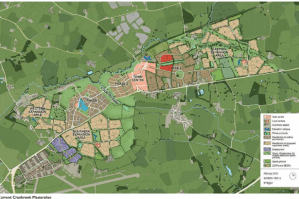
Cranbrook – planned entirely by East Devon District Council:

Roads to narrow to park on:

ALL the shops for the 3,000 or so people who currently live there:

Eventually it looks as though local villages will be swallowed up and Cranbrook will be a suburb of Exeter:

“Second-hand uniform banks” for poor children

“Two million children in England have been sent to school in dirty, ill-fitting or incorrect uniform, a children’s charity has said.

A Mirror probe has uncovered a surge in cash-strapped families who rely on handouts from uniform banks for school kit, including basic essentials such as coats, shoes and even underwear.

Figures last month revealed 4.1 million children are in living in poverty and 70% of those are in working families.

An estimated 13% of UK children live in families who are getting into debt to pay for school kit, with 17% cutting back on basic essentials, including food, to dress children for school, according to Children’s Society research.

In response, dozens of uniform banks and exchanges have been set up across Britain.

Sam Royston, of the Children’s Society, said: “These community groups… are clearly in high demand, but it is distressing so many families are getting to this point in the first place.”

Kate France founded the Uniform Exchange, in Kirklees, West Yorks, which provides kit for pupils at 181 schools.

Requests have surged from 600 in 2017 to 800 last year.

This year they are on track to clothe 1,200 children.

Kate said: “We have seen a huge growth. I have also seen a rise in underwear requests from families who need socks, tights, pants and vests.

“I can’t believe that families haven’t got the basics – I find it really sad.”

Nicola Roderick, 25, of Holmfirth, who uses the Exchange, said: “Spending £20 for a jumper is hard when your disposable income is very little…”

A Government spokesperson said: “We’re helping parents to move into full-time work to give families the best opportunity to move out of poverty.

“Meanwhile we have made clear to schools that when setting uniform policies they should keep costs to a minimum and be mindful that they are affordable for everyone.”

https://www.mirror.co.uk/news/uk-news/demand-donated-uniforms-spikes-two-14249909

“EU orders UK to recover illegal tax aid from multinationals”

It has been said this was one reason why some people were anxious for an early hard Brexit – and one company mentioned is the Daily Mail!

“BRUSSELS (Reuters) – Britain will have to recover millions of euros from some multinationals after EU antitrust regulators ruled on Tuesday that an exemption in a UK tax scheme was illegal.

The European Commission’s decision, following a 16-month investigation, is part of an ongoing crackdown against multinationals benefiting from sweetheart tax deals offered by EU countries.

The EU investigation focussed on Britain’s Controlled Foreign Company (CFC) rules, which are aimed at attracting companies to set up headquarters in Britain and discourage UK companies moving offshore.

The EU competition regulator said an exemption in the scheme for interest income earned by offshore subsidiaries between 2013 and 2018 – which had been criticised by tax campaigners as a major loophole – flouted EU laws.

“The UK gave certain multinationals a selective advantage by granting them an unjustified exemption from UK anti–tax avoidance rules. This is illegal under EU State aid rules,” European Competition Commissioner Margrethe Vestager said.

The Commission said the exemption could be justified if interest payments received from loans did not result from British activities. However, if they were derived from UK activities, the exemption would not be justified.

The Commission did not say which multinationals are affected nor did it give an estimate for the amount Britain would recover, leaving it to UK tax authorities to reassess the tax liabilities.

BBA Aviation, Chemring, Daily Mail & General, Diageo, Euromoney, Inchcape, London Stock Exchange, Meggitt, Smith & Nephew and WPP are some of the companies which have mentioned the EU investigation in their accounts.

Vestager has already ordered Apple, Starbucks, Fiat Chrysler and several other multinationals to pay back taxes totalling billions of euros to various EU countries.”

https://uk.reuters.com/article/uk-britain-eu-subsidies-idUKKCN1RE0WB