Whitehall snubbing offers from local councils to help with Covid vaccinations

Two aspects of this article caught Owl’s eye, the main one is yet another example of councils being sidelined:

“Offers to transform thousands of leisure centres, libraries and civic buildings into vaccination hubs are being rebuffed by Whitehall and NHS chiefs, The Times can disclose.”

And, in the detail, there is this quote from a London council source which Owl reads in the context of Monday’s announcement that  96% of the population is within 10 miles of a vaccine service.

“London leaders say that the promise of a vaccination centre within ten miles of a household was unsuitable in the capital. “Ten miles is a long way across in pandemic-stricken London,” “

If ten miles is a long way in London, what is it like in rural Devon?

Sean O’Neill, Chief Reporter | Neil Johnston www.thetimes.co.uk 

English councils are ready to open buildings, redeploy staff and arrange community minibuses to transport elderly people to receive their jabs. Conservative and Labour council leaders are frustrated that they are being bypassed and say that the vaccine programme is run by “national edict”.

Concerns about the government’s strategy include the emergence of vaccine blindspots such as Spalding, Lincolnshire, where no vaccination centres are yet open and the first injections are expected this weekend. Elderly and vulnerable people have been left to queue in the cold because small centres have no waiting facilities.

Steve Reed, the shadow local government secretary, said last night that it was “mission critical” that ministers used local government expertise to speed up vaccinations. He said: “The government must not repeat the earlier mistakes of overcentralising the response to the pandemic which led to failures on PPE distribution, contact tracing and testing.” Sir Keir Starmer, the Labour leader, will repeat that call today and urge the use of more than 11,000 community pharmacies.

Lord Porter of Spalding, Conservative leader of South Holland council in Lincolnshire, said that he was “massively concerned” at the lack of provision for his largely rural area. “We’ve offered redundant buildings, we’ve got a community hospital they are not using. The answer we get back is ‘No thanks, we don’t need it, we are all sorted.’ ”

The Labour leaders of Waltham Forest and Greenwich boroughs in London have written to Nadhim Zahawi, the vaccine minister, saying that councils are ready to take some of the pressure off the overstretched NHS. Clare Coghill, of Waltham Forest, who offered the use of five leisure centres, said: “I believe a failure to harness our collective strength fully could lead to more unnecessary deaths.”

London leaders say that the promise of a vaccination centre within ten miles of a household was unsuitable in the capital. “Ten miles is a long way across in pandemic-stricken London,” said one council source.

Louise Gittins, Labour leader of Cheshire West and Chester council, said provision in her borough ranged from small GP surgeries, where people queued in the street, to a wedding venue only accessible by car. “This is a top down approach again when it should be bottom up,” she said. “We have good relations with our local NHS but their hands are tied by national edicts.”

A spokesman said the government was “hugely grateful for all offers of support and assistance as we continue to expand the biggest vaccination programme in this country’s history. This is a huge national effort and the NHS is putting into practice the decades of experience it has in delivering large-scale vaccination programmes.”

Great South West Tourism Partnership: Covid – 19 Business Impact Survey

www.sogosurvey.com /survey.aspx

This survey aims to gather further evidence and continue to evaluate the effects of COVID-19 on tourism and hospitality businesses across the Great South West area of Cornwall, Devon, Plymouth, Torbay, Somerset and Dorset.  The survey will also help us identify your business priorities for the next 12 months to allow us to support you to recover and grow after the current lockdown.  The results will also be used to continue to lobby the Government for support for our sector.

It should only take a few minutes for you to answer the questions.

The survey has been commissioned by the organisations whose logos are shown above – [see online].

The survey is being undertaken by The South West Research Company.  Your answers will be treated as strictly confidential and will be combined with those from other businesses in your area to provide overall results.  Should you have any problem in completing this survey online please email info@tswrc.co.uk

Does Boris Johnson Now Have Blood On His Hands Over His Covid Christmas Relaxation?

Is Boris Johnson now relying on the vaccine to provide him with the “Dick Barton” gambit:

“With one bound he was free……”? – Owl

Paul Waugh www.huffingtonpost.co.uk extract

“……In evidence to the liaison committee of senior MPs, Boris Johnson admitted there was a “very substantial risk” that the NHS’s intensive care unit capacity nationwide could be “overtopped”. Yes, that was the prime minister himself conceding just how much more dire the situation could get.

That note of fatalism made it sound as though Johnson had done all he could and was now just waiting for the virus pattern to play out. Yet as Keir Starmer suggested in PMQs, the PM had it in his power to get ahead of the Covid curve, rather than merely watch it rise. Starmer was at his forensic best as he laid the most sombre charge at Johnson’s feet: 17,000 people had died since their last PMQs, mainly because the PM delayed for 17 days between being alerted of the new variant and imposing a tough national lockdown.

This, as well as the claim that Johnson could have saved thousands of lives by imposing a lockdown earlier last spring, felt like a preview of the public inquiry to come. If dithering over Covid once could be classed as misfortune, and dithering twice was carelessness, the sheer size of this third wave looks like a sheer recklessness with other people’s lives.

UCL professor of medicine Hugh Montgomery suggested before Christmas that people who failed to obey Covid rules would “have blood on their hands”. But that will be the very charge laid at Johnson’s door if the next few days and weeks provides evidence that the spike in deaths was linked not just to the new variant but to his crucial refusal to “cancel Christmas” for England outside London and the south east.Starmer didn’t quite go that far in PMQs, but he came close, saying we are now seeing “the tragic consequences” of the PM’s delay. It certainly sounded like a central plank in the case for the prosecution, and if nothing else Starmer knows how to prosecute. The Sage minutes of December 22 – when the PM was explicitly warned by scientists that a November-style lockdown simply would not be “sufficient to maintain R below one in the presence of the new variant” – are sure to be Exhibit A……”

Paul Waugh www.huffingtonpost.co.uk extract

“……In evidence to the liaison committee of senior MPs, Boris Johnson admitted there was a “very substantial risk” that the NHS’s intensive care unit capacity nationwide could be “overtopped”. Yes, that was the prime minister himself conceding just how much more dire the situation could get.

That note of fatalism made it sound as though Johnson had done all he could and was now just waiting for the virus pattern to play out. Yet as Keir Starmer suggested in PMQs, the PM had it in his power to get ahead of the Covid curve, rather than merely watch it rise. Starmer was at his forensic best as he laid the most sombre charge at Johnson’s feet: 17,000 people had died since their last PMQs, mainly because the PM delayed for 17 days between being alerted of the new variant and imposing a tough national lockdown.

This, as well as the claim that Johnson could have saved thousands of lives by imposing a lockdown earlier last spring, felt like a preview of the public inquiry to come. If dithering over Covid once could be classed as misfortune, and dithering twice was carelessness, the sheer size of this third wave looks like a sheer recklessness with other people’s lives.

UCL professor of medicine Hugh Montgomery suggested before Christmas that people who failed to obey Covid rules would “have blood on their hands”. But that will be the very charge laid at Johnson’s door if the next few days and weeks provides evidence that the spike in deaths was linked not just to the new variant but to his crucial refusal to “cancel Christmas” for England outside London and the south east.

Starmer didn’t quite go that far in PMQs, but he came close, saying we are now seeing “the tragic consequences” of the PM’s delay. It certainly sounded like a central plank in the case for the prosecution, and if nothing else Starmer knows how to prosecute. The Sage minutes of December 22 – when the PM was explicitly warned by scientists that a November-style lockdown simply would not be “sufficient to maintain R below one in the presence of the new variant” – are sure to be Exhibit A……”

Westcountry’s Covid-19 hospital occupancy

From today’s Western Morning News:

Three of the Westcountry’s five hospital trusts currently have the lowest percentage of beds occupied by Covid-19 patients anywhere in England.Figures from NHS England and the Health Service Journal based on the position as of Monday, January 11, show that the Northern Devon Healthcare Trust, which runs North Devon District Hospital, has the lowest percentage of adult acute beds occupied by Covid-positive patients at just three per cent.

Torbay and South Devon NHS Foundation Trust has just five per cent of beds occupied, while University Hospitals Plymouth (Derriford Hospital) had eight per cent of beds occupied – the only three trusts in England where the number was below 10 per cent.

In contrast, at least ten hospital trusts of the 123 in England have half or more of their adult acute beds occupied by Covid-positive patients, with 45 of them having at least a third of their adult general and acute beds occupied by patients with coronavirus.

The Royal Devon and Exeter NHS Foundation Trust is currently seeing 17% of its beds occupied, with the Royal Cornwall Hospitals NHS Trust at 12%. But Plymouth rose by 6.8% and Cornwall by 6.7% in a week, showing there is no room for complacency.

Meanwhile twelve more people with coronavirus have died at Westcountry hospitals, the latest NHS data shows.

Figures released on Wednesday confirmed that there were three Covid-19 fatalities in North Devon, one at the Royal Devon & Exeter Hospital, and one at Derriford Hospital.

Seven more deaths were recorded at the Royal Cornwall Hospitals NHS Trust.

In total 600 people have died in hospitals across Devon and Cornwall with coronavirus since the start of the pandemic.

Free meals firm was run by Conservative party donor

The companies at the centre of the outcry over the “disgusting” free meals provided to struggling families while schools remain closed have links to the Conservatives, it has emerged.

www.independent.co.uk

Compass Group and its subsidiary Chartwells are under fire after football star and campaigner Marcus Rashford shared photos of Chartwells’ meagre parcels – saying they were “just not good enough”.

Electoral Commission records show Paul Walsh – chairman of Compass Group until he stepped down last month – has given more than £10,000 to the Tory party.

Mr Walsh, who had been at the helm of Compass since 2014, was a member of No 10’s business advisory group during the early years of David Cameron’s time as prime minister. 

Boris Johnson’s government has promised to urgently investigate the inadequate food parcels sent to parents, which education secretary Gavin Williamson admitted on Wednesday were “absolutely disgusting.” 

However, ministers are facing fresh questions on the contracts awarded to Compass Group and Chartwells to provide the school meals.

The food catering giant and its subsidiary have been awarded almost £350m in school meal catering contracts since 2016, according to analysts at Tussell. The public procurement experts said Compass and Chartwells remain the biggest providers of school meals in the UK.

Labour leader Sir Keir Starmer asked on Twitter: “Where is the money going? This needs sorting immediately so families don’t go hungry through lockdown.”

Chartwells and other catering contractors have been forced to adapt to the pandemic by providing food at home to families eligible for free school meals.

The packages shared by frustrated parents on Twitter have recently replaced the weekly £15 food vouchers given to low-income parents when lockdown first forced schools to close. Eligible families were given £30 in vouchers over the recent Christmas holidays.

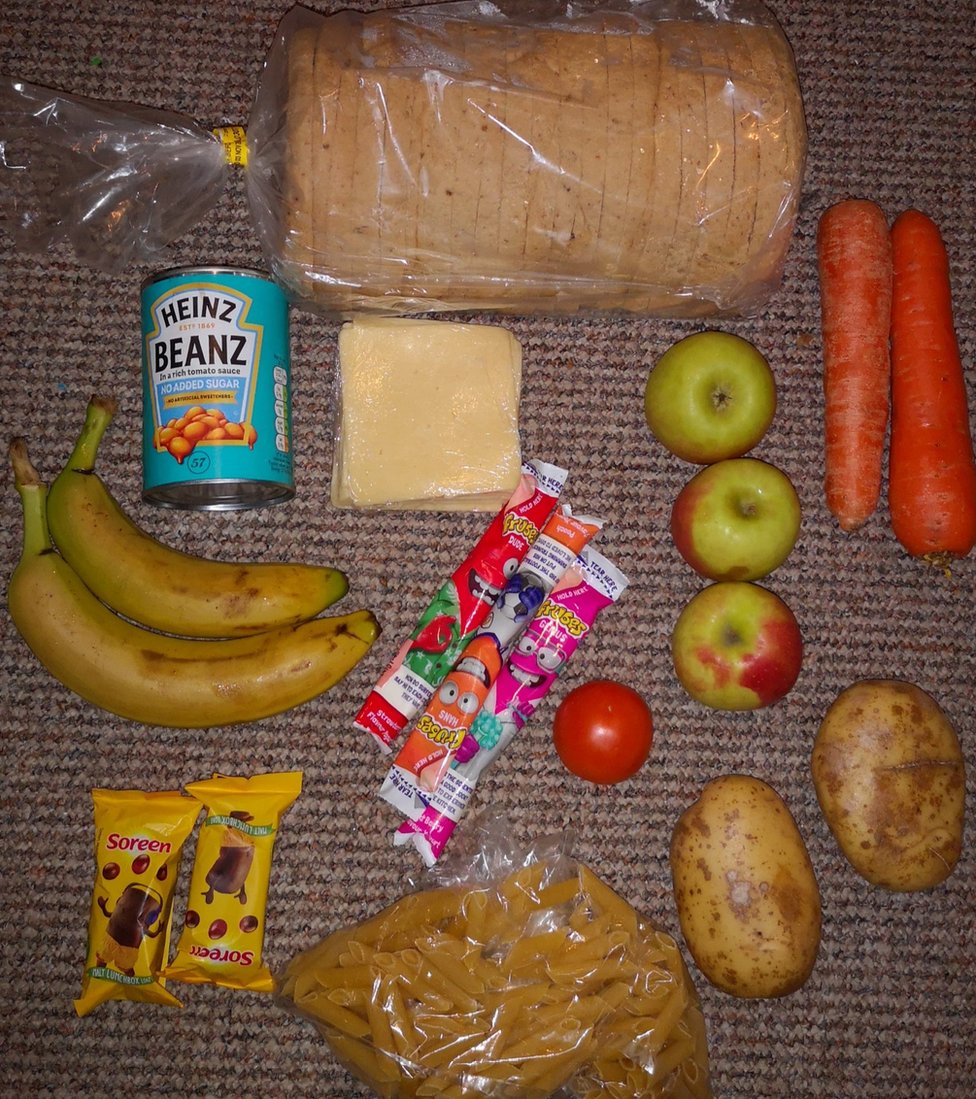
After the latest incident, a Chartwells spokesperson said: “We have had time to investigate the picture circulated on Twitter. For clarity this shows five days of free school lunches (not 10 days) and the charge for food, packing and distribution was actually £10.50 and not £30 as suggested.

“However, in our efforts to provide thousands of food parcels a week at extremely short notice we are very sorry the quantity has fallen short in this instance.”

Children’s minister Vicky Ford said caterers must “urgently” improve the quality of the packages now being provided to low-income families. Ms Ford has said anyone experiencing problems should give details to the Department of Education (DfE) for investigation.

The DfE has also said its national voucher scheme, which offered stand-ins for cash to be used at supermarkets during the first coronavirus lockdown, would resume “shortly”.

The Independent has contacted Compass Group and Chartwells for more information on its school catering contracts with government.

Staying local: will be different in different areas – Kit Malthouse MP

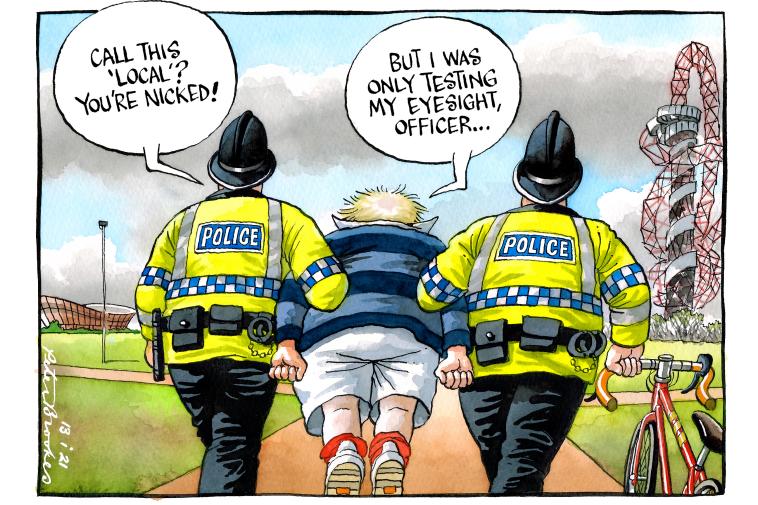
Boris Johnson’s 7 mile cycle ride to the Olympic Park on Sunday has provoked much comment on just what is meant by “staying local”. His ride came after two women were stopped and initially fined for travelling five miles to take a walk (with two takeaway coffees, judged to be a picnic) in Derbyshire. (These charges have since been dropped).

Speaking on BBC Breakfast, policing minister Kit Malthouse MP wanted to clear things up. He insisted people must not “stretch the rules” but went on to say that whether seven miles was local “depends on where you are.”

“Seven miles will be local in different areas;’ he added. [Too true, see below – Owl]

Obvious parallels have been drawn with Dominic Cumming’s trip to Barnard Castle and another example of those in authority stretching the rules made for others to follow.

Not all take this view apparently. Linking to a story about the incident from the Guardian, former Lib Dem leader Vince Cable called the report “unbelievably petty” and went as far as to ask what the publication “had against cycling” . [Owl stripped Vince of his “sainthood” for being the architect of “Local Enterprise Partnerships”, despite the fact that in 2014 he admitted: “I’m not sure we’ve got it right…”]

However, for Marina Hyde it is not far enough:

“It’s much too close. Ideally, I would like him to be one ocean, two deserts and seven miles (of solid lead) away from any seat of power.”

Finally, Owl rehearses the “staying local” argument as it applies to residents of Newton Poppleford.

Readers may recall they have been assigned by the Clinical Commissioning Group to the Ottery St Mary practice. As the crow flies the two are only about 3½ miles apart (but you wouldn’t want to walk the busy narrow lanes, let alone take a child in a pushchair).

There is no direct bus route, patients have to travel into Exeter and out again, a distance of around 23 miles, standard return adult plus child is £23.50, with a round trip time of 2hrs 30 mins plus connection time (pre-Covid,  2019 schedules and prices). There is a surgery in Sidmouth on a direct route with journey time of 5 mins but it is closed to Newton Popp. residents. 

Devon taking the lead on climate change

(John Hart takes a lead – Wow! – Owl)

John Hart www.midweekherald.co.uk

Not many of us will look back on 2020 with any affection. But I want to look forward.

I’m an optimist and, as far as Covid-19 is concerned, we can have some hope with the roll-out of the vaccination programme.

But this week I want to consider another vital subject where I can report on some very positive progress in our county.

Before the pandemic, global warming was dominating the news agenda. And in Devon, work on reducing our carbon emissions has been proceeding apace – despite the coronavirus.

I am very proud that Devon County Council has been taking a lead on the issue.

We declared our intention to be net-zero carbon by 2030 and pledged £250,000 to help establish the Devon Climate Emergency Response Group.

This is made up of the chief officers of more than 25 public, private and voluntary sector organisations in Devon and is tasked with delivering Devon’s Carbon Plan, our roadmap to carbon neutrality.

I am taking this extremely seriously and I have asked the county council’s chief executive, Phil Norrey, to chair the group.

Now in case you are thinking this is just another talking shop, I can assure you it isn’t.

If we are to tackle global warming then all of us need to change our behaviour – personally, in our communities and in the organisations and companies of which we are a part.

And if people are going to change then they need to feel part of the process. So a major consultation’s been launched this month to enable everyone in Devon to have their say on what needs to be done.

Our interim Carbon Plan has been produced by a task force chaired by Professor Patrick Devine-Wright, an environmental social scientist from Exeter University and a lead author for the United Nations’ Intergovernmental Panel on Climate Change.

The task force held hearings and received nearly 900 suggestions from local people and organisations on the actions we should take.

They’ve based much of the plan on this feedback and now we want your views and your ideas for how we can cut our carbon emissions.

You can read the plan and respond to a consultation questionnaire at the Devon Climate Emergency website on devonclimateemergency.org.uk/governance/devon-climate-emergency-response-group or you can obtain a paper copy from your local library from January 6, by emailing environmentalpolicy@devon.gov.uk or by phone on 0345 155 1015.

Devon’s last major consultation on our libraries drew 20,000 responses and we’re hoping for something similar or even more this time.

Climate change affects us all and if we feel committed to the actions needed to combat it and have made our contribution to defining them, then we’re more likely to make the effort and, potentially, to take the pain.

Already progress is being made. The county council’s own carbon footprint has fallen by almost half in the last eight years.

Within two years our streetlights will all be LED, cutting carbon emissions by three-quarters. That’s 15,000 tonnes of carbon a year – equivalent to taking 8,000 cars off the road.

We will further reduce emissions by improving the energy efficiency of county council buildings.

We’ve installed solar panels at County Hall and we’ll repeat that on other buildings and we’ll buy renewable energy direct from new solar power projects in Devon.

We’re planning to make at least half of our vehicle fleet electric in the next few years and we’re working to ensure our supply chain is carbon neutral by 2030.

None of that is enough but, with your help, we can inspire individuals, communities, companies and organisations across Devon to do even more.

Hospital patients to be sent to hotels to free up beds for critical Covid patients

Looks like Plan B (already adopted in Derriford) – Owl

Thousands of hospital patients are to be discharged early to hotels or their own homes to free up beds for Covid-19 sufferers needing life-or-death care, the Guardian has learned.

Denis Campbell www.theguardian.com 

Hospital chiefs in England intend to start discharging patients early on a scale never seen before, as an emergency measure to create “extra emergency contingency capacity” and stop parts of the NHS collapsing, senior sources said.

Documents seen by the Guardian also revealed that the NHS is asking care homes to start accepting Covid patients directly from hospitals and without a recent negative test, as long as they have been in isolation for 14 days and have shown no new symptoms.

Under the “home and hotel” plan, patients discharged early into a hotel will receive help from voluntary organisations such as St John Ambulance and the British Red Cross, armed forces medical personnel and any available NHS staff.

The London Hotel Group (LHG) has started taking Covid-positive patients who are homeless from King’s College hospital in south London and is looking after them in its Best Western-branded hotel in nearby Croydon. It is in talks with 20 other NHS trusts and says it could provide 5,000 beds.

Families will be expected to play a key role in monitoring and caring for loved ones who are sent home days or weeks before they would otherwise have left hospital, with support from health professionals where possible.

The plans come amid growing concern that hospitals will soon be overwhelmed and that the crisis may not peak for several weeks. More than 35,000 Covid patients are in UK hospitals, with that number rising by 6,213 in the last week alone.

NHS leaders fear that the new Covid variant, which has driven up infection rates in London and south-east and east England, is leaving many hospitals struggling to cope, and will soon do the same in the south-west and north-west.

Record levels of sickness absence in the health service and its central role in the government’s mass vaccination drive led NHS sources to warn that few staff will have time to deliver significant care at private homes or hotels once patients are discharged.

But they said patients will not be asked to leave hospital early if they are still medically at risk, so they should need mainly light-touch care. “This is for patients who don’t need to be in a hospital bed but still need to be in a protected environment,” said one official.

NHS England, as well as bosses of hospitals under the most extreme pressure, are having detailed discussions about implementing the “home and hotel” option for what a senior NHS source said would involve “thousands” of patients. It is part of their efforts to create “extra emergency contingency capacity” once other options, such as doubling or tripling critical care capacity and using the emergency Nightingale field hospitals, have been exhausted, sources said.

LHG said its hotels could provide beds for at least 5,000 patients facing early discharge, including 1,500 in London. LHG’s chief executive, Meher Nawab, said: “We will be looking to roll this solution out across our hotels to provide hospitals with a lifeline at this critical time.”

An LHG spokesperson added: “The patient group the NHS is seeking to accommodate at this stage are recovered or recovering from Covid and who are medically fit for discharge, and thus do not require specialist medical supervision or specialist care, but can’t yet return home. This frees up NHS bedspace and capacity and is relatively easy for hotels to accommodate.”

But the plan has generated controversy, with patient groups voicing unease about its impact. Lucy Watson, chair of the Patients Association, said: “This is a dire situation, in which the NHS often has no good options available. Discharging patients early from hospital is likely to be one of few options open to the NHS to manage the scale of the current need.

“However, early discharge can often cause problems that result in harm to the patient and the need to re-admit them. Care by volunteers in hotels is not an adequate substitute for proper hospital care. But at a time when hospitals are overwhelmed by critically ill patients and striving to prevent loss of life on a large scale, clearly they will be making desperate choices.”

Dr Charlotte Augst, chief executive of the umbrella group of health charities National Voices, said: “We have questions about where the health and care staff to look after those people will come from and how any deterioration would be dealt with given the very long waits for 111 or 999 services.

“In our view this proposal is indicative of the unpalatable decisions NHS leaders are now forced to make due to the immense pressures placed on the system by this latest lockdown coming yet again too late to protect the NHS’s ability to provide universal high quality services for all.”

Jeremy Hunt, the former health secretary who now chairs the Commons health select committee, warned on Tuesday that the NHS is facing a “triple whammy” of pressures that could leave it dangerously exposed this winter and mean the greatest pressure may not arrive until February.

Chris Hopson, chief executive of NHS Providers, said that trusts would expand capacity but “will also work closely with community services and social care partners to maximise the discharge of medically fit patients”.

Meanwhile, the NHS is asking care homes to start accepting Covid patients directly from hospitals and without a recent Covid test, the Guardian has learned.

The policy had been to send Covid patients to designated “hot” care homes where infection spread could be limited and to prevent a repeat of last spring’s epidemic in care homes, which was partly fuelled by hospital discharges. But a target to set up 500 such homes has been missed, leaving only 2,533 beds available.

An NHS document sent to some care providers says: “We are now advising that for some within this group, it will be appropriate for them to move directly to a care home from hospital … because we now know they do not pose an infection risk to other residents in a care home.”

If clinicians assess a patient has no new Covid symptoms or exposure and has completed their isolation period, they can be discharged straight to a care home without a further Covid test in the 48 hours before discharge, it adds.

The plan sparked concern among care operators who want assurances that anyone coming out of hospital 14 days after a positive test cannot still pass the virus on.

“We have said we need to see strong clinical evidence,” said Nadra Ahmed, executive chairman of the National Care Association, which represents independent care operators. “We need to have absolute confidence if someone is coming out of hospital having been Covid-positive that they are no longer infectious.”

Prof Martin Green, chief executive of Care England, which represents private care providers, said: “The key is, it is for the care homes to decide and hospitals should not put undue pressure on care homes.”

The Department of Health and Social Care has been approached for comment.

‘What am I supposed to make with this!’ Parents on schools’ meagre food parcels

Another example of how the private sector delivers a public service – Owl

The government and the catering companies it has hired have come under fire after photographs of free school meal parcels were circulated online.

Molly Blackall www.theguardian.com 

The food packages sent to children who qualify for free school meals and are remote learning because of the national lockdown were not considered to contain enough high quality food. The Department for Education said it was looking into the issue, and that “parcels should be nutritious and contain a varied range of food”.

Four families who are eligible for food parcels shared their response.

‘It makes things so difficult’

Mother of three, Karen Phillips, 33, has been forced to spend her rent money on her children’s lunches after receiving a “disgraceful” food parcel from her school last week.

The parcel, intended to last her 12-year-old daughter all week, didn’t contain any carbohydrates except two potatoes, alongside one onion, two peppers, a satsuma, single tomato and carrot, and two eggs wrapped in cling film. The parcel also included one small tub of soup powder, the same sized tub of tuna mayo, and a small bag of grated cheese.

The food parcel given to Karen Phillips last Tuesday.

The food parcel given to Karen Phillips last Tuesday. Photograph: Karen Phillips/Guardian Community

“I phoned the school straight away and said, ‘what am I supposed to make with this?’ They said they had complained to their suppliers, and were going to start doing food vouchers instead, but they haven’t told us when they’ll be getting them. There were no instructions about what I could make with the food, and the school had no idea,” said Phillips, who lives in Berkshire as a full-time parent.

“I’d like to know how the catering company are getting away with it,” she added.

Her two children at primary school have not yet been offered anything.

“I told the teacher that I was going to use my rent money to pay for her daughters’ school dinners but the teacher said she couldn’t help,” she said. “It makes things so difficult. With homeschooling children as well, you don’t need the added stress of wondering if you can feed your kids.”

‘Where does the money go if this is what they’re giving people?’

The food parcel given to Sarah yesterday, including two packs of bagels with best before labels of 3 April 2020 and 31 August 2020.

The food parcel given to Sarah included two packs of bagels with best before labels of 3 April 2020 and 31 August 2020. Photograph: Sarah/Guardian Community

Sarah, a 36-year-old single mother in Birmingham, said she thought her parcel was “a bit of an insult” when it was delivered from her daughter’s secondary school this week. The package didn’t contain any fresh food except two potatoes. It also included bagels which, while they were frozen, were nine months out of date.

With the parcels supposedly costing £15 (for one child) from the government, Sarah said she could not understand where the extra money had gone.

“I know it’s free, and it does help, but they’re getting government funding to do this,” she said. “Where does the money go if this is what they’re giving people? It’s a bit disappointing.”

‘It’s totally shocking’

For her three children in high school, Caroline McMullen, 42, received “a small loaf of bread, apple juice, one apple each, a bag with a handful of pasta each, three small bags of raisins, cheese slices, a tub of butter and three tins of beans”, which was supposed to last for 10 days. Other than three apples, there wasn’t any fresh fruit or vegetables included.

“I’ve seen parents giving negative reviews of their parcels on Twitter, but I think, at least you’ve got a tomato. I didn’t get a single one,” said McMullen, who lives in Blackpool.

“Because of Covid, I’m trying to force as much fruit and veg down the kids’ mouths as possible, to keep their immune systems up. To give them pasta and raisins, it’s disgusting.”

McMullen said the food would not go far enough to keep her children fed for the 10-day period.

“It’s totally shocking,” she said. “I have a 14-year-old lad that eats me out of house and home. How do I tell him he’s only got an apple? It’s not even a bag of pasta, it’s a handful in a bag.”

She is also concerned that the school is not able to deliver the parcels. After the school confirmed another case of coronavirus on Tuesday morning, she said she was worried about having to travel into the school to collect food.

“What’s the point in keeping the kids off school if I have to go in? I feel like I have to choose between letting them starve or risk getting infection,” she said.

‘When you’re given food you can’t eat, it’s a waste’

Other parents were concerned that the limited supplies and lack of choice in the parcels would mean that children with dietary requirements could not benefit.

In Reading, one of Sharon’s* three children has Prader-Willi syndrome, a medical condition that means his diet is heavily restricted.

“It’s totally pointless me accepting the food parcel of potatoes and Soreen snacks, pasta and beans, when he is unable to eat any of it due to his dietary requirements,” she said.

Sharon is yet to receive her parcel but has emailed her son’s school to see if they can adapt it for her son’s needs. For families like hers, Sharon said, the voucher system was much more effective, as well as being better value for money.

“At least with the voucher I am able to buy food he is actually allowed to eat,” she said. “When you’re given food you can’t eat, it’s a waste. It should be more of a blanket policy. The vouchers are much easier, they allow you to utilise the scheme for your family.”

* Name has been changed

And from Roadside Mum BBC news

A food parcel received by Twitter user Roadside Mumimage: Roadside Mum

“Public funds were charged £30. I’d have bought this for £5.22,” said Twitter user Roadside Mum of the parcel she received

EU-funded estuary flooding begins in Spring

Work on a landscape-scale project to address the impact of climate change by returning a Devon estuary and flood plain to a more natural condition is set to begin in the Spring.

Daniel Clark www.devonlive.com

East Devon District Council’s planning committee last Wednesday approved a pioneering project to help a river valley on England’s Jurassic Coast adapt to climate change and create an internationally important wildlife reserve.

The EU-funded Lower Otter Restoration Project (LORP) will reconnect the River Otter to its historic floodplain and return the lower Otter Valley to a more natural condition; creating more than 50 hecatres of intertidal mudflats, saltmarsh and other valuable estuarine habitats.

The success of the £15 million project rested on it being given the thumbs up by East Devon District Council, and planning approval means work on the project can start this spring and be completed by early 2023.

The Otter Estuary

The Otter Estuary (Image: REKORD Media)

Although much loved, the Lower Otter Valley has been heavily modified by human hand in the last 200 years with the construction of an embankment, a road, a rubbish tip, an aqueduct and an old railway line.

These structures are difficult and expensive to maintain and restrict natural processes including the movement of water and reduces habitat quality and diversity, and since the creation of an embankment in the early 19th Century, the River Otter has been disconnected from much of its natural flood plain.

The creation of new habitats and restoration of the site will be achieved by breaching the embankment. This will allow a much greater extent of the original floodplain to flood at high tide and drain at low tide producing important intertidal habitat, mudflats and saltmarsh for wading birds. There will also be areas of reedbed and grazing marsh.

Once established, the new site will become a wildlife reserve of international importance within five years, fulfilling the aspirations of all partners involved.

The Lower Otter valley is the subject of plans from the Environment Agency

The Lower Otter valley is the subject of plans from the Environment Agency

The LORP is a partnership between the Environment Agency, local landowner Clinton Devon Estates, and the East Devon Pebblebed Heaths Conservation Trust that currently manages the estuary. It also has the support of Natural England, RSPB and Devon Wildlife Trust.

Mark Rice, Environment Manager for the Environment Agency, said: “Climate change is affecting the way we manage our coasts and estuaries and we must adapt to that change.

“The Lower Otter Restoration Project is an example of how we can do that. We aim to deliver long term benefits for people and wildlife by working in partnership and through more sustainable management of the Otter Estuary.”

Dr Sam Bridgewater, head of wildlife and conservation at Clinton Devon Estates, said: “The Estate is proud to be associated with this project. Coastal communities must adapt as sea levels rise and storm events become more frequent.

“It is our belief the Lower Otter Restoration Project will provide a more sustainable and certain future for the threatened Otter valley. It will also deliver very significant benefits to people and wildlife.

“The granting of planning approval is a major step forward in helping us deliver this vision.

“We have worked very closely with a wide range of stakeholders who have helped us reach this milestone and we are grateful for their input over the years.”

Cllr Geoff Jung, East Devon’s cabinet member for coast, country and environment, said: “I am delighted that East Devon’s planning committee unanimously voted to allow the Lower Otter Restoration Project to go ahead.

“This council is totally committed to issues related to climate change, from purchasing electric vehicles, a national leader in recycling and waste, and working with partners and landowners to manage our valuable natural coast and countryside from the dangers of our changing climate and sea level-rises.

“We recognise that there will be some disruption, whilst the work is being carried out, but the alternative risk of allowing the embankments to fail was too greater a risk. The proposal will return the Lower Otter to a more natural sustainable state, which will provide extra wildlife habitat that is being lost both here in East Devon and elsewhere.

“We would like to thank the team at Clinton Devon Estates and the Environment Agency for their shared commitment to this exciting and pioneering project.”

The Lower Otter Estuary in Budleigh Salterton.

The Lower Otter Estuary in Budleigh Salterton. (Image: PACCo)

Budleigh and Raleigh ward members Cllr Alan Dent, Cllr Paul Jarvis and Cllr Tom Wright added: “We are all very pleased planning permission for this application has been granted. Not only will it have very important environmental gains but it will also secure the future of Budleigh Salterton Cricket Club and access along South Farm Road which is vital for those South Farm businesses.”

When the application went before councillors last week, they were told it would see the Big and Little Marsh floodplains around Budleigh Salterton restored, with breaches created in the Little Bank, the Big Bank and the River Otter Embankment to allow water to flow through.

The aim is to avoid the significant risk that a major flood or extreme tidal event could lead to catastrophic failure of the existing embankments, with unpredictable environmental and social impacts, given that in recent years, part of the South West Coast Path that runs along the embankments have been closed to the public for significant periods due to erosion caused by such events.

The committee heard that if nothing was done, then changes to the environment would likely occur, but would be unmanaged and unpredictable, and backed the officer recommendation to approve the scheme.

As part of the plans to restore the historic floodplain of the River Otter, breaches in existing embankments would be created to allow water from both the River Otter and the Estuary to inundate the site, creating intertidal saltmarsh and mudflats.

In addition, South Farm Road will be realigned and raised at a point just to the south of the existing road, and a small car park created at its western end and a new road bridge will be required, and a new footbridge to the South. Existing footpaths will be realigned and the landfill site capped and planted with grassland and woodland.

The spit to the south will be allowed to evolve naturally, necessitating the removal of the southern part of the loop path known as Donkeys Turn.

The cricket club will be moved from its current location to land off of East Budleigh Road, permission for which has already been granted under a separate planning application. Floods have left part of their current Ottermouth home under water on three occasions in the last 10 years, with a plan to relocate to Janie’s Field on the outskirts of the town having been agreed.

A cautionary tale of relaxing infection controls

Cornwall also has paid a price for it’s short stay in Tier 1 – Owl

Military helicopters could be used within days to airlift coronavirus patients from the Isle of Wight, the island’s medical director has said, after an “astronomical” rise in infections fuelled by mixing and visitors over Christmas.

Josh Halliday www.theguardian.com 

A 71-fold increase in cases means the Isle of Wight has the 13th highest infection rate in the UK this week, from having one of the lowest in early December.

The county of 141,606 people recorded 1,871 new cases in the first 10 days of January – 43% of its total since the pandemic began. Hospital admissions and deaths are rising sharply.

Stephen Parker, the medical director of the Isle of Wight NHS trust, said he was planning “unthinkable options”, including evacuating Covid-19 patients to the mainland as the island’s small hospital treated a four-fold increase in people with the disease since Christmas Day.

He told the Guardian that a Chinook helicopter, more commonly seen in war zones, had carried out a test landing on a playing field near the island’s St Mary’s hospital in anticipation that military aid might be needed before the end of January.

“These are unprecedented times for the NHS and they are unprecedented times for the island,” he said. “I think it really is important to realise that we are one of the smallest hospitals in the country; we are challenged about moving patients and we could be overwhelmed.”

The Isle of Wight had considered itself a Covid success story before December, managing to keep the virus mostly at bay. It spearheaded a trial of the government’s contact-tracing app. “Where the Isle of Wight leads, the rest of Britain will follow,” declared Matt Hancock, the health secretary, at the time.

That all changed last month. The lifting of the national lockdown in December left the island one of only three places in England in the lowest level of restrictions.

It meant islanders could meet in groups of up to six, hotels were open and pubs were allowed to serve alcohol without food. Yet Portsmouth, only a 45-minute ferry trip away, and one of the first places to see significant transmission of the highly-contagious new Covid variant, was in the strictest tier 4 restrictions, alongside London.

The rapid rise in the infection rate – from 16 cases per 100,000 people in the first week of December to 1,130 per 100,000 this week – has prompted fury among some islanders who blame an influx of visitors from mainland England, including second homeowners, in the run-up to Christmas.

One resident told the County Press he saw “coaches of people piling into local hotels and evening lights ablaze in the many second homes” on the island, whose elderly population – more than one in three residents are 60 or over – are particularly vulnerable to the disease.

Twenty-two Isle of Wight residents died of Covid-19 in the first 10 days of January – 19% of its total since the crisis began and on course to top the 39 fatalities in May, its deadliest month so far. The number of Covid patients in the island’s only hospital has nearly quadrupled since Christmas day, up to nearly 70 people, or about one in four of all beds.

David Stewart, the Conservative leader of Isle of Wight council, said he believed “there are some people over here who shouldn’t be here” and that some islanders had visited the mainland before Christmas. He told the Guardian he would meet police forces and ferry companies this week to discuss what more could be done to identify those flouting the rules.

Parker said the Isle of Wight was paying the price for being in tier 1 before Christmas. He said: “Quite clearly, we’ve obviously had a massive increase in transmission between individuals and that’s a reflection of individual behaviours. It’s not up to me to make political comments as to why that has occurred but if we think that every interaction has to be essential, I would challenge people who either travel to the island to their second home and I would also challenge people on the island who possibly have been to the mainland ‘to do their Christmas shopping’.

“I would certainly challenge people who actually continued to have a relatively normal social life when we were in tier 1. I think tier 1 gave people false reassurance. And my personal view is that we are now paying the price for that.”

The island’s Conservative MP, Bob Seely, said there was “no basis in fact” for the claim that that second-home owners had brought the new strain to the island, pointing out that many key workers travel to and from mainland England every day.

Seely apologised in June for attending a barbecue, alongside the Brexit party chairman and political journalists, at a time when there was strict guidance against groups mixing from different households or people visiting and entering another person’s home or garden. Seely said he was unaware others would be present when he arrived for a meeting, and that social distancing had been followed at all times.

Parker praised St Mary’s medics for doing a “fantastic job” while under strain, with staff absences two to three times higher than usual, but said there was “anxiety that sometimes stretches to fear” about the next fortnight. “If the NHS is going to be overwhelmed, it is going to be the next two to four weeks. And that’s why it is so scary having gone from what was a relatively stable position in the autumn.”

Big screen planned for Exmouth’s Strand amongst 73 EDDC objectives for FY 2021/22

Higher car parking charges, work to address climate change, beach management protection plans, the start of work on Cranbrook’s town centre, and a big screen on the Strand in Exmouth are among the objectives for East Devon District Council in the next 12 months. Seventy-three proposals (all listed below) are in the council’s draft budget and key service plans developed by the Independent councillors who run the council.

Daniel Clark, local democracy reporter www.radioexe.co.uk 

They’re planning to review the business case for a fixed big screen on the Strand, Exmouth, using funding set aside for the area after its redevelopment some years ago. A large screen could run local advertising and council promotions as well as events such as Wimbledon, concerts and proms.

Most car park charges haven’t been increased since 2010 and some have been reduced significantly. Increasing the capacity of Manor Road car park in Sidmouth, the Ham car parks in Sidmouth and Coombe Lane Car Park in Axminster is also considered, while they’ll consult on how to manage several currently free car parks.

The council plans to deliver the Sidmouth and East Beach Management Scheme and submit a business case to the Environment Agency. Work could begin next year.

Upgrades to play areas are planned, as is a new tram halt and boardwalk at Seaton Wetlands, using part of Seaton Tramway’s Heritage Lottery Grant Fund, while The Manor Pavilion theatre should improve its customer experience.

Work on a vibrant town centre for Cranbrook is planned, while the revision of the Axminster Urban Extension masterplan and the development of a masterplan for the Hayne Lane, Honiton will take place.

Not all of the service objectives are new, and some may not be finished by March 2022, but work to begin them is targeted.

THE 73 SERVICE PLAN OBJECTIVES

  • Delivery of Wild Honiton project as a local Nature Recovery Network pilot with a target of green space improvements to existing EDDC green spaces – wildlife, access and recreational enhancements
  • As part of the Wild Exmouth Heritage Lottery Fund, deliver, design and deliver Green Space map for each household in the town, install interpretation boards of the map in key green spaces, Sow and cultivate 2 new wildflower areas and complete the second phase of Artist in Residence’s Tree and Orchard Trail, developing 2 more Orchard Locations and provide grafting and pruning workshop for volunteers
  • Creation of a new volunteer group in partnership with natural England at the Undercliffs National Nature Reserve and creation of a new Wild Honiton volunteer group to help manage green spaces in town
  • Develop a further pilot (third stage) with Active Devon for over 55s, including Wild swimming for two towns TBC, along with Outdoor Club in Exmouth.
  • Deliver the Sheep’s Marsh inter tidal habitat scheme to creates 62,200 m2 of salt marsh habitat, an additional 150m metres of public access, and to deliver a new improved habitat for wildlife, increasing visitor interest in the south of the site
  • Creation of a new Tram Halt and linking boardwalk to Seaton Wetlands as part of Seaton Tram’s Heritage Lottery Fund grant.
  • Deliver new visitor infrastructure to Seaton Wetlands to enhance visitor experience and monetise the increased footfall, including the creation of a café offer and installation of contactless payment points and car park machine for donations
  • Collaborative work at the Holyford Woods Local Nature Reserve to manage woods and to set up a new natural regeneration project, continue Dormice monitoring project, improve habitat for Devon Greater Horseshoe Bat project and utilise wood products for charcoal initiative.
  • The tree team to develop a Tree Strategy that sets out the framework for engaging with climate change, tree wardening and community engagement and tackling pests and diseases.
  • The Thelma Hulbert Gallery to deliver Creative Communities 2021 – through exhibitions, public programme and events, to invite communities to join us to explore complex issues such as equality and environmental justice, whilst celebrating the importance of individual creative expression and the joy it can bring.
  • To develop and deliver phase 2 of Culture + Climate – the Creative Cabin / Climate Cabin The ‘Climate Cabin’ programme is a new strand of activity developing against the context of East Devon District Council’s commitment to Devon’s Climate Change Emergency declaration and the University of Exeter’s Declaration of an environment and climate emergency.
  • Develop Phase two of the Abode of Love – enabling an artist of national acclaim to work with schools and groups of young people to develop a public artwork which responds to the site and context of the climate emergency
  • The Manor Pavilion theatre to improve its customer experience by setting up a Theatre Club and a theatre volunteer group, deliver pantomime performances in June 2021 by Hot Lock Productions as part of COVID recovery & reimagining performances, for Ballet Theatre UK going from strength to strength plan 3 new ballets for 2021/22, working with new production company – Complete Theatre Company to produce high profile and commercially successful musical, and a target of 90% advance hiring for theatre for 2020, with target 60% advance bookings for 2021- 2022.
  • Support work of EDDC’s Arts & Culture Forum during 2020/21 to agree and oversee the delivery of a rural touring programme for Villages in Action programme
  • To work across the Council to identify opportunities to reduce the impact of our activities including reductions in both commuting and business miles travelled by the implementation of our green travel plan
  • To work with other public and private sector partners to develop electric vehicle charging infrastructure linked to sustainable generation of electricity and on-site storage.
  • To continue to work with the Director of Public Health to ensure that the Council continues to respond to and recover from the COVID-19 pandemic.
  • To work with the Member Champion for Mental Health to consider the options around an officer role to support the Council’s commitment.
  • To work on one or more public health projects during recovery phase from the Covid-19 pandemic, which could include support for national / regional / local activities such as poverty initiatives and/or climate change mitigation, e.g. fuel poverty
  • Subject to the outcome of the car parks Task and Finish Forum, propose to increase our car parking fees and charges during 2021, as the majority of our charges have not been increased since 2010 and some have been reduced significantly, and over that period we have not passed on the increase in VAT (from 15% to 17.5% to 20%).
  • To consult on developing our car parks portfolio during 2021/22 by increasing the capacity of Manor Road car park in Sidmouth, the Ham car parks in Sidmouth and Coombe Lane Car Park in Axminster
  • Subject to outcome of the Car Parks TAFF, the council proposes to consult widely on how their customers would like them to manage the following car parks during 2021/22 – The Green (Victory Hall) car park in Broadclyst, School Lane car park in Newton Poppleford, Manor Farm Estate Yard car park in Sidbury, Temple Street car park in Sidmouth, Jarvis Close car park in Exmouth, Upper Station car park in Budleigh Salterton, Brook Road car park in Budleigh Salterton, Church Street car park in Sidford, Coach Park in Seaton, Town Hall in Seaton and Cliff Top, Beer
  • To work with partners including NHS Property Services, the CCG and Devon County Council to review the way in which the Blackmore Gardens car park, Sidmouth is currently managed and make any appropriate recommendations to Members for a new management regime going forward
  • With the assistance of Strata continue to utilise Firmstep to introduce more efficient online process and continue to increase email contact with customers over printing and post.
  • Develop a poverty dashboard drawing upon data from internal systems that are linked to low income households to help support decision making
  • Take additional measures to support the recovery of our income collection performance across Council Tax, Business Rates and Sundry Debts which has been severely impacted by Covid-19 whilst balancing this against residents and businesses ability to pay.
  • Review of Taxi Policy to help seek to meet climate change targets and reduce emissions
  • Revising the Cemetery Regulations to ensure an updated and fit for purpose regime for burials.
  • Deliver the Clyst Valley Regional Park proposals including engaging with key stakeholders and the community
  • Identify, design and help to bring forward proposals for Suitable Alternative Natural Green Space to serve Cranbrook
  • Ensure the large scale delivery of zero carbon development in the West End of the District through agreeing a pathway for achieving zero carbon development, submitting a bid for Heat Network Investment Programme funding and engaging with landowners/developers and energy companies to help broker and deliver a solution
  • Complete a review of delivery vehicles to support the implementation of the new Local Plan up to and including the establishment of a Development Corporation.
  • Lead the delivery of the Enterprise Zone programme to accelerate the delivery of new commercial space, to bring forward investment proposals, and Manage the investment programme ensuring that key outputs are realised
  • Support the delivery of a vibrant town centre for Cranbrook including bringing forward specific investment proposals in conjunction with the One Public Estate programme
  • Support the development of a sustainable aviation cluster focused on Exeter Airport in line with the ambition set out in the Local Industrial Strategy
  • Carry out an updated Stock Condition Survey on our Council owned housing stock in order to collate up to date information, including energy performance, and use it to inform a new stock investment programme to decarbonise the Housing assets
  • Lead on the production of a corporate Poverty Strategy aimed at reducing the effects on East Devon residents.
  • Produce a new Housing Strategy focusing on how we will deliver our services and how we will increase our supply of housing stock from 2020-2024.
  • Develop the re-use and recycling furniture programme to assist residents with setting up their home, recognising the increasing amount of people arriving in our homes with few possessions.
  • Meet the increased demand from homeless households and secure suitable temporary and permanent accommodation, supporting households who present with physical and mental health needs, poverty and other issues, to ensure they are able to sustain their tenancies
  • Publish a five year planned maintenance and cyclical decoration programme to provide tenants with visibility of planned works
  • Develop the Axminster Fairshare project working with Tesco in Axminster and Nourish to collect food from the supermarket, cook and freeze it, and distribute to people with an identified need. Aim to do more for rural areas and link with other work
  • Identify areas of Housing land that are being used by residents without permission and ensure the appropriate signage is posted at all entrances and exits to prevent future claims of easements over our land.
  • To reduce the carbon footprint of the organisation with the installation of more energy efficient lighting and equipment to all of the 9 leisure centres and swimming sites
  • Revise the Axminster Urban Extension masterplan to consider what elements can be delivered in the absence of external funding.
  • Ensure that new developments are required to deliver appropriate levels of open space and promote walking and cycling to deliver better health and wellbeing outcomes.
  • Investigate the potential for the wider use of development orders to reduce red tape and pro-actively promote the development of sites.
  • Enable the delivery of affordable housing, gypsy and traveller pitches, homes for life, self build plots etc to enable our diverse range of housing needs to be met.
  • Work with the land owners to develop a masterplan for the Hayne Lane, Honiton employment land allocation in the Local Plan and a plan for its delivery
  • To work with the Cranbrook consortium of developers to promote and enable the development of Cranbrook Town Centre in a way that secures a sustainable economy within the town and meets the communities
  • Investigate and trial more sustainable alternatives to herbicides for weed control and to reduce the use of glyphosate and other chemicals by undertaking an audit of use and analysis of alternatives across sports pitches, green spaces and public realm areas.
  • Ensure all major parks/public realm areas have an event or engagement activity during the year which offers opportunities for health & wellbeing.
  • Apply for Blue Flag retention at Exmouth and Sidmouth in 2021 and Seaside awards for Sidmouth, Seaton and Budleigh following another year of excellent water quality results and to continue work at Seaton to reach Blue Flag criteria
  • Work with Sidmouth lifeboat to support them in setting up beach lifeguards for Sidmouth, finalising the contract of service arrangements as agreed previously
  • Apply for Green Flag awards at Connaught Gardens Sidmouth, Manor Gardens Exmouth and Seafield Gardens Seaton and to improve the management plan of the The Glen, Honiton and aim for a Parks Award 2021/22 working towards green flag status in the future.
  • Continue work to maintain and build on a recycling rate of 60.5% so it becomes our annual rate, striving to be in the top 10 Local Authorities in England for recycling.
  • Help to publicise the circular economy and reduce, reuse, recycle through resident participation schemes and the Clean Devon doorstep/schools education programme.
  • Achieve target of 15,000 green waste bins, helping improve our recycling rate and capture of green waste (removing from residual stream) in 2021/22.
  • To support the delivery of the Lower Otter Restoration Project (LORP)
  • A Play Strategy linked to our adopted Green Space Plan to improve outdated sites, ensure appropriate provision and introduce play space and ‘play along the way’ micro parks.
  • Plan and deliver the Sidmouth & East Beach Management Scheme as now the funding gap has been closed, submit the Outline Business Case for approval by the EA, with Permissions to follow including planning and works to be tendered to start late 2021/22.
  • Review the economics model for the project to achieve a greater degree of grant funding, to meet the increased project costs, but to continue working with Network Rail to deliver the under track crossing and to deliver phase 3 & 4 to complete the Feniton flood alleviation scheme.
  • Update business case and economics to include railway damages and review project funding for the Whimple Flood Alleviation Scheme
  • Continue work to close the £150k partnership gap for the Seaton Beach Management Plan and to submit Outline Business Case to Environment Agency for approval and access to funding
  • Form a stakeholder group, and agree scope of beach management works for Exmouth.
  • Repoint northern section of harbour wall and resolve drainage issue on stone track to south at Axmouth harbour
  • The replacement of play areas which have reached the end of their service life at well used sites on EDDC land and continue the important provision of high quality, free to use play at Lime Kiln – Budleigh Salterton, Liverton Copse – Exmouth, Jerrard Close – Honiton, Pale Gate Close – Honiton, Baker Close – Sidmouth, The Crescent, Exmouth, Greenway Lane, Budleigh Salterton, Butts Close, Honiton and Millway, Axminster.
  • Rebuild of boundary retaining wall at St Swithun’s church, Woodbury.
  • Design and, if approved, deliver a layout for motorhome parking at the Northern end of the Exmouth Estuary car park. Incorporate recycling/bin points, toilet access and water/sluicing access
  • Continue to investigate feasibility and funding for installing a network of water refill points in key town or park/beach areas in line with our climate change themes and reuse/waste reduction.
  • Assist Exmouth Town Council with the design, procurement and project management of the Bapton Valley cycle route.
  • Complete the long term public toilet review taking account of Covid secure building design, staffing and cleaning frequency, investment in improved toilet facilities, the right toilet in the right location and medium term financial plan savings requirements.
  • Review the business case for a fixed big screen on the Strand in Exmouth, using the Strand redevelopment reserve, giving us the ability to run local advertising, council promotions and messages as well as screen large scale events such as Wimbledon, Concerts and Proms.

Onward: New ideas for a new generation

New Onward research: The Policies of Belonging

This morning Onward publishes its latest research report, The Policies of Belonging, supported by a cross-party coalition of MPs and leading civic organisations. The report calls for ministers to hand power and capital back to communities after the pandemic to repair Britain’s fraying social fabric.

www.ukonward.com

Read the research

The Government’s flagship levelling up ambition will fail unless Ministers take concerted action to invest in and empower fraying communities after the pandemic, our report finds. The report, The Policies of Belonging, is a response to growing evidence that community is in long term decline in Britain. In 2019, polling for Onward found that 71% of people agree that “community has declined in my lifetime” and in September 2020 the thinktank warned that there has been a steady fall in the last decade in levels of volunteering, local group membership, church attendance, community activities, family trips, philanthropy and social trust. While the pandemic led initially to an outpouring of public spiritedness, this benefited high trust neighbourhoods much more than others. 

To rekindle a sense of belonging in all Britain’s communities after lockdown finally ends, Onward sets out a series of policies to give power to individuals and communities to give back locally, and greater resources to ensure that the most fraying communities have strong reciprocal networks and institutions. The main proposals suggest ministers should:

  1. Give every local area the “right to self government” through a parish or town council. At present, only 25% of England is represented by a parish or town council, compared to 70% of Wales and 100% of Scotland, and many recent attempts to create them have been thwarted by boroughs or districts. In next year’s Devolution White Paper, Ministers should pave the way for the widespread introduction of town and parish councils, while also giving town and parish councils the right to assume ownership of, and responsibility for, green spaces, community sports facilities, community centres and local high street maintenance in their area. 
  2. Introduce a “family tax allowance” to allow partners to transfer their £12,500 tax allowance to their working spouse. This would replace the marriage tax allowance and extend it from the current £1,250 to the full £12,500 tax -free amount. This would recognise families rather than just the individuals through the tax system and allow either partner to commit to child or family care without foregoing their tax allowance – or balance part-time work and familial or community commitments without a penalty.  
  3. Empower communities to secure land for community-led housing to ensure a supply of local affordable or social homes. Few things root people to places than secure housing, so communities should be given the right to establish a community land trust to provide affordable homes for local people. Where social housing waiting lists are excessive or housing is scarce, there should be a new obligation placed on local authorities to identify, purchase and zone suitable land to meet the identified housing need for local people. The report also recommends that Ministers should offer discounted land to private rented tenants who want to self-build their own home, either individually on small plots or collectively across a larger site, in a new discounted “Right to Buy” for renters.
  4. Introduce ‘Year to Serve’, a civic service scheme to give unemployed young people a paid placement with local charities or social businesses. To mitigate the long-term scarring of unemployment and to build upon the wave of volunteering during the pandemic, the Government should pay young people the national minimum wage to serve their community: tutoring early years pupils to halve the literacy gap, supporting residents of care homes, by planting 30 million trees per year, or boosting English language teaching for migrants. The scheme would easily be introduced alongside the Government’s current Kickstart or developed within it. 
  5. Give workers the ability to draw down a year of their pension early to take a “civic sabbatical” from work to give back to society. This would give people of working age the right to access one year of their pension early in order to give them the financial security to volunteer, start a community venture, retrain or start a local company. They would retire a year later to make up for the working – and contributing – time lost and to maintain fairness in the system. 

The report is backed by a large number of MPs, including: Jo Gideon MP, Gareth Davies MP, Paul Maynard MP, Aaron Bell MP, Kevin Hollinrake MP, Siobhan Baillie MP, Rob Largan MP, Alex Stafford MP, Nicholas Fletcher MP, Robert Halfon MP, Paul Bristow MP, Danny Kruger MP, Jon Cruddas MP. In addition to the programme funders – the Joseph Rowntree Foundation, Shelter and Power to Change, the report has also been endorsed by Local Trust, Trust for London, New Philanthropy Capital, Unbound Philanthropy, the Young Foundation, NAVCA and Catch22. 

The report is the latest in Onward’s Repairing our Social Fabric Programme, a major cross party programme launched last year to study the changing nature of community in the UK and to develop ideas for how to strengthen the ties that bind people together at a local level. 

Will Tanner, Director of Onward, said:

“Everyone focuses on the impact of lockdown on the economy but the truth is that the pandemic has taken a terrible toll on the social fabric of our lives, compounding the long-term decline of community over recent decades. 

“As we emerge – finally – from the pandemic, we need to not just revive a flatlining economy, we need to take steps to empower and recapitalise communities, to give people back a sense of belonging and rekindle the social networks and institutions upon which we all rely.”

UK COVID-19 vaccines delivery plan

Yesterday the Government published its 43 page vaccine delivery plan.

Owl found this interesting section under the heading:

Drawing on local authorities’ knowledge of their communities

Para 5.30

“Meaningful community engagement is also being led by local Integrated Care Systems (ICSs) across the country. For example, Devon ICS are working with national advocacy organisation Friend, Families & Travellers to produce a best practice guide to engaging with the traveller community which will include community informed communications and be shared across the country. Building on lessons learnt, Bristol, North Somerset and South Gloucestershire ICS are developing best practice approaches to engaging and supporting people experiencing homelessness, including providing accessible information and supporting GP registration. This is supported and shared nationally through well established networks of frontline outreach workers and practitioners. These are just two examples of community engagement that is going on up and down the country; systems are working hard to engage effectively with their local communities, through established community leaders, such as faith leaders, or by working with local partners to address the concerns and meet the needs of communities.”

There is also a separate map showing the vaccination sites that are open across the country, meaning 96% of the population is within 10 miles of a vaccine service. But,  looking at the map, journey distances seem to be based on “as the crow flies” which doesn’t reflect actual journey distance in rural areas.

Quarter of Covid hospital admissions in England aged under 55

A quarter of coronavirus admissions to hospital are people under the age of 55, the head of NHS England has said.

Rajeev Syal www.theguardian.com

Sir Simon Stevens told MPs on Monday the virus was spreading out of control across much of the country, with worrying consequences for hospitals.

“In London perhaps one in 30 people has the coronavirus, in parts of London it may be twice that number. In Merseyside in just the last week there has been a further 50% increase in the number of Covid hospitalisations,” he said.

“It’s worth remembering that this affects all ages – a quarter of the Covid admissions to hospital right now are for people aged under 55.”

Officials later confirmed that for the week commencing 28 December, 3,326 under-55s were admitted to hospitals in England, out of 13,530 overall admissions.

Stevens’ comments came as data showed the youngest person with no known underlying conditions whose death from Covid-19 was reported in the last 24 hours was aged 26.

The NHS England chief, addressing the public accounts committee about the UK’s vaccine programme, also revealed more than 370,000 people in England had received two doses of a Covid vaccine, despite ministers previously saying first doses would be prioritised.

“There were some second jabs, where that was a clinical decision to do so given that last week was just a few days after the changed advice from the JCVI [Joint Committee on Vaccination and Immunisation] and chief medical officers,” Stevens said.

Localised vaccine data – crucial to ensure the vaccines are being evenly spread around the country – will be sent out over the next week to 10 days, Stevens said.

Kate Bingham, who recently stood down from her position as head of the vaccines taskforce, told the same committee she was the victim of “politically motivated” attacks. She had faced criticism over a £670,000 contract for public relations advice and was also forced to deny claims she shared commercially sensitive information with investors.

Bingham, who is married to the minister Jesse Norman, said she knew Boris Johnson when they were both undergraduates at Oxford University but dismissed allegations of cronyism. She said the taskforce could have been more open about its work.

“I just don’t think we have handled that very well. So if I had my time again I would be more insistent that we did cross-party briefings – because those didn’t happen – and that anybody who wants to know what it was that we were doing or how we were doing it or wanted to kick the tyres, within Westminster, should be free to do so,” she said.

‘Hot homes’ scheme to ease strain on NHS falls well short of target

A government plan to relieve packed hospitals by designating hundreds of care homes to accept Covid patients has fallen far short of its target, increasing pressure on the NHS.

Owl isn’t surprised by this news, given the risks of repeating the mistakes of last year.

Denis Campbell www.theguardian.com

Only 136 “hot home” social care facilities have been set up across England, despite the Department of Health and Social Care (DHSC) saying in October that up to 500 would be approved by the end of November to prevent beds being blocked in hospitals. They are mostly wings of care homes that use separate staff and separate entrances to prevent the virus from spreading.

There are now more than 29,000 people in hospital with Covid in England, and more than 3,800 are being admitted daily. But only 2,533 care home bed spaces have been found where patients who may still be infectious can be cared for without the risk of sparking fresh care home outbreaks, according to figures from the Care Quality Commission (CQC), which has been checking the safety of proposed locations.

In the absence of designated facilities, the NHS now wants the government to underwrite the risk of normal care homes taking in hospital patients who are ready to be discharged. With many care homes refusing to take Covid patients because insurers will not cover the risks associated with the virus, the NHS has urged the Treasury to effectively indemnify care homes against possible claims triggered by accepting patients.

“It’s imperative that care homes take patients that can be discharged safely in order to free up capacity [in hospitals] to deal with the huge numbers of Covid patients that require care,” said a well-placed NHS source. “You’d have to do this only with patients where there’s no risk of spread of Covid. And it mustn’t be seen as a dumping exercise. But it needs to happen, and urgently.”

It could cost the taxpayer between £600m and £800m, the Guardian understands, and the DHSC is understood to endorse NHS England’s view that accessing care home beds is vital to protect the NHS.

Fifty-eight council areas have not designated any facilities, although some have proposed NHS facilities such as community hospitals.

Without a deal on insurance, care bosses have said more designated settings are needed to ensure that care homes will not have to take in Covid-positive patients when it is not safe to do so.

“If people cannot be supported to leave hospital, whether that is by moving into a care home or having care at home, then the whole system will fail,” said Vic Rayner, executive director of the National Care Forum, which represents not-for-profit providers. “NHS saves lives, but so does social care, and it must be properly supported to ensure that it can play its vital role in making the whole system work.”

Rising outbreaks in care homes and growing staff absences are causing some providers to stop accepting new admissions.

The number of care homes in England that recorded a Covid infection in the last week of 2020 rose to 503, more than double the total a fortnight ago. Care managers are facing absences of between 11% and 50% of staff caused by positive Covid tests, according to a survey by the NCF.

Four residents died and 43 staff were infected in an outbreak at Oakdown House in East Sussex last month, its owner, Mike Derrick, told the Guardian on Monday. “The new variant seems to be so easily transmissible that once it is into a service, it spreads so quickly,” he said. “It’s so much more difficult.”

Derrick, who chairs the East Sussex Registered Care Association, said at least three other homes in his area had had serious recent outbreaks, and the local authority “has serious concerns about several homes every week”.

Last week it emerged that over the Christmas period, 13 residents died at Edendale Lodge care home in Crowhurst, East Sussex.

The CQC said it was in talks with the government “to address issues of capacity across the country, particularly in areas where there is a shortage or lack of designated settings”.

“It is our role to ensure that proposed locations … are safe for people with a confirmed Covid-19 test result to be discharged into,” said Kate Terroni, chief inspector of adult social care. “By rapidly inspecting and, where appropriate, approving designated locations … we are working to help combat the spread of infection and increase the number of people who can access care by ensuring that people can be safely discharged from hospital.”

A DHSC spokesperson said: “We have put in place enough designated care homes or NHS community settings to provide the small proportion of Covid-positive residents who require access to this care with the support they need, while protecting other vulnerable residents from the risk of infection.”

Briefings Postponed until ……..

“Today was supposed to be the day No. 10 Press Secretary Allegra Stratton held her first televised briefing, but alas that’s been postponed to the end of the pandemic — with many Tory insiders now doubting they’ll ever happen. The Sunday Times reported the new Downing Street media suite refurbished for the briefings cost the taxpayer £2 million. What’s it made out of, gold?”

Just another £2,000,000 to add to the bill – Owl

(Politico newsletter)

Covid-19: Hundreds of rule breaches in Devon and Cornwall

Background to earlier story on Police clarification of Covid rules

www.bbc.co.uk

A deputy chief constable has said “people are beginning to flout” lockdown rules, following hundreds of coronavirus breaches over the weekend.

“People are beginning to get fed up with it and I can understand that, but we have to be firm,” said Devon and Cornwall Police’s Paul Netherton.

A control room supervisor tweeted that he had dealt with more than 250 coronavirus rule breaches on Saturday.

Government guidance says unless it is necessary you must not leave your home.

“People know what the rules are by now” but “they’re beginning to think how can I get away with the rules rather than abide by them,” said Mr Netherton.

He said police officers do not want to be seen as “draconian”, but they are going out to tell people that by mixing, the disease is continuing to spread.

“So in Devon and Cornwall, we are stopping people” and “having to make a really difficult judgement about what is reasonable and what is not”.

“But the key message remains, stay at home.”

Just an hour into his shift, control room supervisor with Devon and Cornwall Police Glenn Shuttleworth said there had been “41 Covid breaches” attended by police..

Unless you have a reasonable excuse for doing so, you are not able to leave your home for holidays or overnight stays – this includes staying in second homes or caravans, if they are not your primary residence, according to government guidance.

People are only allowed to leave their homes for exercise, once per day and are advised to not travel outside their local area.

On Friday, Devon and Cornwall’s chief constable Shaun Sawyer said: “We can’t enforce” lockdown rules without help from the public.

Somerset Council writing to Prime Minister to ‘set the record straight’ after claims by MP

A Somerset MP has accused the county council of using central government grants to “balance its books” rather than support residents during the coronavirus pandemic.

Planetradio.co.uk By Daniel Mumby, local democracy reporting partnership

Ian Liddell-Grainger, who represents the Bridgwater and West Somerset constituency, used parliamentary privilege on Wednesday (January 6) to accuse Somerset County Council of financial irregularities.

The Conservative MP (who has held the seat since 2001) described senior council officials as “cowboys” and urged prime minister Boris Johnson to personally intervene in the matter.

The council has strongly denied Mr Liddell-Grainger’s claims and said it would be writing to the prime minister directly to “set the record straight.”

Mr Liddell-Grainger made his comments directly to Mr Johnson during a debate in the House of Commons on Wednesday afternoon (January 6).

He said: “We in the Bridgwater and West Somerset constituency accept that the lockdown was vital and we appreciate the extra help for businesses, but will my right honourable friend consider urgently the way in which government help for local authorities is being paid?

“Somerset County Council has been given huge grants but has then diverted much of the money to balance its books, which is not what it was for.

“These cowboys want to become a new unitary authority. It is a con trick to use that cash, which was meant to fight covid.

“The Prime Minister is Somerset born and bred. I urge him to put a stop to this, so that the money goes to the people who need it most—the people of Somerset.”

Mr Liddell-Grainger has been a consistent critic of the county council’s One Somerset proposals, which would see both it and the four district councils dissolved and replaced with a single unitary authority.

The government is currently considering this proposal, along with the rival Stronger Somerset proposals for two unitaries, to which Mr Liddell-Grainger has lent his support.

Mr Johnson responded: “My honourable friend is absolutely right to highlight what is going on in Somerset.

“The county obviously has a duty to use covid grants for that purpose and not for any other. I thank him for drawing attention to what is going on.”

Somerset County Council has received a total of £31.9M of covid funding from the government in four tranches, the most recent being £2.8M in October 2020.

Leah Green, the council’s finance manager, told the cabinet in mid-December that these funds were being allocated to essential services to cover additional expenditure the council had accrued during the pandemic.

She said in her written report: “The four tranche of funding will initially be added to the corporate contingency and then allocated to services to cover their additional costs.

“The government is also covering some of the council’s losses of income and it is estimated that a total of £3.7M can be claimed back though this scheme.”

The council has vehemently denied any wrongdoing, and said it would be writing to Mr Johnson directly to assure him that all grants were being used appropriately.

A spokesman said: “We will be writing directly to the prime minister to set the record straight, but we can confirm that all covid grants received from the government have been used as they were intended – to help residents, communities and businesses in Somerset.”

The Ministry for Housing, Communities and Local Government is expected to give its verdict on the separate unitary proposals for Somerset in the spring, including a ruling on the prospect of delaying the local elections in May.