‘Far from clear’ how planning reforms will help build homes more quickly

Summary findings from Clive Betts’ Housing, Communities and Local Government Committee report on planning reforms:

“The Government should reconsider the case for the three areas proposal.” (Growth, renewal and protected).

The future of the planning system in England – Housing, Communities and Local Government Committee

publications.parliament.uk 

Or here for pdf

Summary

This report considers the Government’s proposed reforms to the planning system announced in August 2020. It also builds on our predecessor committee’s report into land value capture. We will continue to examine future proposals for reforming the planning system, and stand ready to undertake pre-legislative scrutiny of the Planning Bill.

We heard consistently in our evidence that there was a need for greater detail about how the Government’s proposed reforms would work. There were concerns about the omission of various important issues relating to housing and to non-housing elements of the planning system.

The Government’s three areas proposal

The Government has proposed that local areas will be divided (through Local Plans) into three parts: growth, renewal and protected, with different planning rules applying in each. We have sympathy with the Government’s wish to enhance the importance of Local Plans, but we are unpersuaded that the Government’s zoning-based approach will produce a quicker, cheaper, and democratic planning system.

The Government should reconsider the case for the three areas proposal.

If the Government does proceed with the principle of the three areas proposal, consideration should be given to the inclusion of additional categories. Further details also need to be provided—particularly around how much detail will be needed in Local Plans, the impact of the three areas proposal on vital infrastructure, and who will determined if Local Plan requirements have been met.

Local authorities should set out detailed plans for growth and renewal areas which specify heights of buildings, density of development, minimum parking standards, access to retail, education, transport, health facilities and other local amenities. This may be by way of a planning brief for particular sites, which may be undertaken subsequent to the local planning process and which is subjected to detailed consultation with local people.

Public engagement and reforms to Local Plans

The Government proposes to shift public engagement from individual planning applications to the Local Plan stage. We found that far more people engage with individual planning proposals and fear that the proposed change will reduce public involvement in the planning process.

All individuals must still be able to comment and influence upon all individual planning proposals.

To ensure that public engagement throughout the planning process is facilitated we welcome the Government’s plan to expand the role of digital technology. The benefits of virtual planning meetings have been demonstrated during the Covid-19 pandemic and should be retained. This needs to sit alongside exploring new methods of interaction such as citizens assemblies; ensuring the public is consulted about the draft Local Plan before rather than concurrently with Secretary of State; and through retaining more traditional methods of notification about planning proposals such as signs on lampposts.

We sympathise with the Government’s wish to enhance the importance of Local Plans in determining where development should take place. But achieving public acceptance of any increased importance for Local Plans requires them have credibility as an accurate reflection of public views in an area.

We welcome the introduction of a statutory obligation that requires that all local authorities have a Local Plan. We also support a timeframe for introducing the new Local Plans. But we heard it would be impractical to deliver them within the Government’s proposed thirty-month timeframe, and in particular for statutory consultees to comment on each plan during its development. To ensure there is effective cooperation between local authorities the Government also needs to explain how it plans to replace the duty to cooperate that places a legal duty on councils to work together on planning issues that cross their borders.

The Government should consider a staggered roll-out of the new types of Local Plans across the country. It should be permissible and straightforward to undertake quick updates of Local Plans every two years, including with appropriate time for public consultation.

Housing formula

In August 2020 the Government proposed reforms to the current formula (the ‘Standard Method’) used to determine housing demand in each local authority. Whilst our evidence endorsed the principle of having a nationally set formula, the majority disapproved of this new proposed formula. In December 2020 the Government announced a new approach, preserving the existing formula whilst adding an ‘urban uplift’ to the demand figures for twenty major town and cities. This would greatly increase the numbers in those areas. We would like clarity from the Government on how these major towns and cities can deliver the housing demanded given restrictions on the availability of land, both in terms of brownfield sites and constraints posed by seas, rivers and protected green spaces.

We think the Government’s abandonment of its proposed formula for determining housing need is the correct decision. There remains a need for additional information about how the Government’s revised approach, announced in December 2020, might work in practice.

Housing delivery

To meet the Government’s 300,000 housing unit target there is a need to speed up the delivery of housing. The problem of ‘build out’ rates needs to be tackled, with a mixture of carrots and sticks needed to achieve this.

The Government should set a limit of 18 months following discharge of planning conditions for work to commence on site. If work has not progressed to the satisfaction of the local planning authority then the planning permission may be revoked. An allowance of a further 18 months should be allowed for development to be completed, after which the local authority should be able, taking account of the size and complexity of the site, and infrastructure to be completed by other parties, to levy full council tax for each housing unit which has not been completed.

To command public support there also needs to be greater clarity on why and how the housing target needs to be delivered, including why relying on brownfield sites alone would be insufficient.

The Government should lay out the evidential basis for its 300,000 housing units a year target and how it will achieve it, both by tenure and by location.

We support measures to promote specialist, affordable and social housing. Given the failure of the previous Starter Homes programme, a clear timeframe is also needed for delivering First Homes without adversely affecting other housing tenures. To reflect local circumstances, local authorities should have discretion over what proportion of affordable houses must be First Homes.

Funding infrastructure

The Government has proposed replacing the current Section 106 and Community Infrastructure Levy with a national infrastructure levy. We find that there is a case for replacing the latter, but not the former. Preserving Section 106 will protect against a possible loss of affordable housing. We think that the proposals of the 2017 review into the Community Infrastructure Levy and our predecessor committee’s recommendations for greater land value capture represent the best way of ensuring sufficient revenue. If the Government does proceed it will need to charge various local rates and provide additional funding for the infrastructure that will not be met out of the levy revenues.

Resources

There is a need for additional resources for planning departments, and specialist skills. The pressures on the system will only increase if the Government proceeds with its reforms, including the thirty-month timeframe for Local Plans, at the same time as local planning authorities are also operating the current system.

The Ministry for Housing, Communities and Local Government should now seek to obtain a Treasury commitment for an additional £500 million over four years for local planning authorities. Providing this certainty of funding should precede the introduction of the Planning Bill.

Design and beauty

We welcome the Government’s commitment to enhance the place of design and beauty in the planning system. It was emphasised to us that this enhancement needs to consider a broader definition of design than one focused on aesthetics, important though that is. This should include ensuring innovations in design are not unduly stifled and the subjective nature of beauty is recognised.

Green Belt, and environmental and historical protections

One of the most contentious issues in planning is the status of the Green Belt. We heard passionate defences of it; whilst also hearing calls for a review of its status.

A review should examine the purpose of the Green Belt, including whether it continues to serve that purpose, how the public understand it, what should be criteria for inclusion, and what additional protections might be appropriate.

A major feature of the planning system since the Second World War has been ensuring the protection of environmental and historic sites and buildings.

We recommend that the Government publish an assessment of the impact of its proposed changes on historic buildings and sites.
Six people from one family have Covid after Devon holiday

Six out of a family party of 10 holidaymakers who stayed at a Devon holiday park during half-term have tested positive with Covid-19 – and they blame poor hygiene.

Colleen Smith www.devonlive.com

They say one of the caravans was particularly dirty when they arrived – and some of the mess included a previous occupants’ discarded test kit.

Now they are terrified that they may have passed on the virus to their elderly father who was too ill to travel with them to Devon because he has serious lung problems. Now he is also feeling ill and the family is awaiting the result of his Covid test.

The holiday was planned as a nostalgic get-together to celebrate the end of lockdown at Devon Cliffs at Sandy Park in Exmouth – which they used to visit as children.

Devon Cliffs owners Haven Holidays say they have strict cleaning protocols in place and say the family did not complain when they first arrived. Haven says no team members has Covid “at the time of the family’s break” and the person who cleaned their caravans has had no symptoms: “Whilst we take all complaints seriously we also hold our cleanliness to the highest standards and would, if we had been made aware on arrival, re-cleaned the family caravan in line with our Caravan Cleanliness Guarantee.”

The family – several of whom work in the NHS – had travelled to Devon from Portsmouth and Derby, because they have happy childhood memories of Devon Cliffs. But now they say: “We wish we had never gone.”

The family say they complained via the check-in App about one of their caravans being dirty – they cleaned up most of the dirt themselves and park owners Haven Holidays came and took away cushions which appeared to have blood stains the following day.

One of the family said: “The cutlery and crockery were all dirty. There are no dishwashers in those vans so we had to clean all of those again. The cushions and walls were dirty with what looked like blood stains.

“When we first arrived mine looked OK at first sight, but my sister told them she wasn’t satisfied and asked to speak to somebody – nobody came and so she went to reception the next day to complain.”

They also found packaging which they later realised was from a Covid test kit discarded by the previous occupants.

One of the party who has tested positive is a senior NHS nursing Sister who has been caring for people with Covid for the last 18 months: “It’s been a horrible time – I’ve not seen my parents in all that time because I wanted to protect them. We didn’t see them at Christmas – and now we have put them at risk and contracted Covid because of poor hygiene.

“It’s not good enough. I’m off work – my daughter works for the NHS and she’s off work. My youngest daughter is a student with a part-time job. She’s off work and won’t get paid – the domino effect of this is massive.”

She drove from Derby with her two grown-up children and picked up her mother. They met up with two of her sisters and four nieces.

The NHS worker said: “I feel exhausted. I suffer with asthma and I am trying to stop it going on to my chest.

“Dad has had part of his lung removed. What worries us is that before we knew we had Covid, some of us hugged dad when we got home. When we left the holiday park – one of my sisters thought she was ill with hay fever on the Friday because they were cutting the grass.

“It wasn’t until we got home that we were tested and found out six out of 10 of us are positive.”

The family has raised the issue with Devon County Council’s Environmental Health department and the CEO of Haven Holidays Jane Bentall.

A spokesman for Haven said: “Since the start of the pandemic Haven has taken a number of steps to ensure that the safety and security of its guests, owners and team remains its number one priority. We have very strict protocols in place in relation to Covid 19 with regard to the cleanliness of our holiday homes and would ask guests to contact our teams immediately on arrival if they find their accommodation has not been cleaned to our high standards.

“In the case of this family, after checking in they updated our arrival app confirming they had reached their holiday home and when asked to score the cleanliness of the caravan and if they required a call back they did not raise any issues.

“The following morning they contacted our team regarding the cleanliness of the scatter cushions which was addressed at the time, with one being taken from the caravan as a stain could not be removed. The cleaning was undertaken by a senior member of the team and the family were happy with the cleaning response. Later that day the family asked if the scatter cushion could be returned which was duly done. No other concerns were raised during the stay.”

The family dispute this and say they ticked ‘not satisfied’ on the check-in App and asked for a member of staff to contact them.

The Haven spokesman said: “Since reopening Haven has made huge investment in cleaning teams including extending the amount of dedicated park teams focused on public areas on park as well as extending the cleaning time allotted to each individual holiday home and the usage of specialist cleaning materials known to kill viruses such as Coronavirus and would refute any claim in relation to this.

“Once a holiday home has been cleaned with particular attention to high touch areas such as work surfaces, handles and television remotes, it is checked by a specialist team member and then a special seal is placed across the door to show it meets Haven’s new standard.

“At the time of the family’s break we had no team members with symptoms of Covid or any team self- isolating, in addition the cleaner who cleaned the caravan also has had no symptoms of Covid pre or post break. We are also not aware of anyone who has stayed in the caravan prior to the family stay that has contracted Covid19.

“Over the course of the last year we have worked closely with the local primary authority who have viewed our standard operating procedures and Covid Risk Assessments and have always been satisfied with our procedures and paperwork. Whilst we take all complaints seriously we also hold our cleanliness to the highest standards and would, if we had been made aware on arrival, re-cleaned the family caravan in line with our Caravan Cleanliness Guarantee.

“We are aware that the family have contacted Environmental Health Officers and we have provided them with full details surrounding the claims from the family.”

Great South West steams back in action, any substance in its latest report?

In September 2017 Owl reported: We’ve had the Heart of the South West LEP! We’ve had the “Golden Triangle” LEP (Exeter, Plymouth, Torquay).We”ve even had the “Golden Quadrangle” LEP (Owl’s suggestion for adding in Cornwall or Dorset).NOW we have the “Golden Pentangle” (adding in Cornwall AND Dorset), yet ANOTHER unelected, unaccountable and non-transparent quango: The Great South West, the LEP for LEPs

In February 2020, with incredibly bad timing, The Great South West sent its latest report to Savid Javid just as he was replaced by Rishi Sunak “The Great South West pitches to the wrong man. A week is a long time in politics”  . Then the pandemic broke.

In July 2020 The Great South West appeared to be defunct, but it has re-awakened in time for the G7 (is anyone in Government listening?):

Report says South West needs ‘levelling up’ as much as ‘red wall’ north

William Telford www.business-live.co.uk 

The South West needs “levelling up” as much as the so-called “red wall” areas of the north, a new report tells the Government.

Pennon, the South West’s biggest employer and parent company of South West Water, has written a document on behalf of the Great South West economic task force calling for the region not to be overlooked in the Government’s plans. The report demands a “green jobs boom” to stop the brain drain of talented young people leaving the region.

The call is timed to coincide with the G7 summit being held in Cornwall from June 11, which looks at the economic challenges and opportunities facing the region.

The report, Levelling Up the Great South West: A G7 Legacy, analyses every parliamentary constituency in Devon and Cornwall and says they deserve as much political attention as those in the electoral battleground of the so-called “red wall” in the North of England and Midlands.

The new ‘levelling up analysis’ in Pennon’s Great South West report finds that:

Devon and Cornwall trail the rest of the UK in terms of productivity – Cornwall and the Isles of Scilly has the lowest productivity of any UK subregion, and Devon is the seventh lowest productivity area in the UK.

On a ranking of all parliamentary constituencies in England and Wales by productivity, 13 out of 18 Devon and Cornwall constituencies are in the lowest third, with St Ives, Torridge and West Devon, South East Cornwall, North Cornwall and Torbay in the bottom 25 in the whole of England and Wales.

The working age population of the region is declining as a share of the total, with an exodus of young people to larger urban areas, especially London. 70% of 15-17 year olds in Cornwall say they will need to leave the county in order to obtain a good job.

Many parts of the region have high levels of empty shops, a key indicator of the health of the high street, reflecting low spending levels and lack of investment. In Camborne and Redruth the rate of empty shops is 38% higher than the England and Wales average, in Torbay it is 30% higher, and in Plymouth, Sutton and Devonport it is 43% higher.

The new figures point to some of the biggest economic challenges facing England’s two most south-westerly counties. Yet the report says that with the right investment and support the Great South West has huge potential too.

The combination of the natural environment and environmental science specialisms in the region means Devon, Cornwall and the wider South West could set its sights on becoming Britain’s greenest regional economy, turning global concerns over sustainability into locally-led economic growth.

It recommends that every British region, including the South West, has an economic growth plan delivered by regional leaders with regional accountability; a Transport for the South West body which can champion regional transport infrastructure projects; the delivery of ultra-fast broadband across the region; more investment in research and development in the South West’s advanced manufacturing and environmental science clusters; and more STEM pathways for students in further and higher education in the region.

What is the Great South West initiative?

The Great South West initiative is the coming together of a wide range of organisations across the South West, including three Local Enterprise Partnerships, seven county and unitary authorities, six universities and major businesses.

The Great South West partners published growth prospectus in January 2020 that aims to deliver £45billion of economic benefit and 190,000 new jobs during the next 15 years.

We won! – Good Law Project

Michael Gove broke the law by giving a contract to a communications agency run by long time associates of him and Dominic Cummings, the High Court has decided.

us15.campaign-archive.com /

The Court found that the decision to award the £560,000 contract to Public First was tainted by “apparent bias” and was unlawful. The Court found that Gove’s:

“failure to consider any other research agency… would lead a fair minded and informed observer to conclude that there was a real possibility, or a real danger, that the decision maker was biased” (paragraph 168).

Michael Gove had claimed that the work was such that only Public First could carry it out. However, the High Court rejected that version of events. The simple truth, it held, was that the Cabinet Office didn’t even consider whether anyone else should have the contract.

The decision vindicates Good Law Project’s long-running characterisation of pandemic procurement as “institutionalised cronyism”.

Emails released in the case also showed that both Michael Gove and Number 10 were keen that Public First (and Hanbury) should win no-tender polling contracts. Good Law Project’s judicial review of the decision to award a contract to Hanbury will be heard on 26 July.

The decision is the second in our long slate of crowdfunded procurement judicial reviews – and we have succeeded in both. Two Cabinet Ministers – Michael Gove and Matt Hancock – have now been found to have broken the law.G

Following the first decision, Good Law Project wrote to Matt Hancock making proposals to improve procurement and get better value for money for taxpayers. We offered, if that invitation was accepted, to drop our further procurement challenges to save public money. Mr Hancock did not respond. Since that letter, huge further sums in public money have been wasted in fruitless defence of unlawful conduct.

Good Law Project repeats its invitation to the Government to learn lessons – and to stop wasting more public money staving off political embarrassment.

Good Law Project is grateful to its legal team of Jason Coppel QC and Patrick Halliday of 11KBW Chambers, instructed by Rook Irwin Sweeney. And of course to the tens of thousands of people whose financial contributions make litigation like this possible.

We are the arrow but you draw the bow.

Thank you,

Jo Maugham

Director of Good Law Project

“Gifts” for Cornwall ahead of G7 talks

Investment in three Cornish towns worth more than £65m and a major nature recovery initiative across 21,000 hectares of land were announced by Prime Minister Boris Johnson last night, as he prepared to host the G7 Summit of major world leaders in Carbis Bay.

(From the print edition of today’s Western Morning News)

The Town Deals announced for Penzance, St Ives and Camborne will fund projects at the heart of communities in some of Cornwall’s most deprived areas.

This includes creating a new network of foot and cycle paths across Camborne, Penzance and from St Ives to St Erth. Community hubs including theatres, sports clubs and historic buildings will also be restored and expanded, to ensure both residents and visitors can fully enjoy the cultural heritage of the region. 

Other funding will go to sustain businesses and commercial sectors most badly hit by the coronavirus pandemic and to create new business hubs in the towns designed to re-establish them as “economic powerhouses and centres of innovation” – creating new jobs.

And in an effort to reverse the decline in biodiversity and restore Cornwall’s natural environment the Government, in partnership with Natural England and the Cornwall Wildlife Trust, is launching a land restoration and regeneration programme, planting trees, restoring peat, making improvements to water quality, recreating scarce habitats and reintroducing lost and declining species such as dormice and the marsh fritillary. 

Boris Johnson, said: “As the eyes of the world look to Cornwall this week, not only will they see an area of outstanding beauty, they will witness a region that is innovative, exciting and looking firmly towards a bright future.

“The exciting projects we have announced today are a fitting legacy for a region playing host to some of the most important diplomatic talks in a generation. As the world builds back better from coronavirus, Cornwall will lead the way.” 

Natural England Chair, Tony Juniper, said: “We are very pleased to announce this new G7 environmental legacy project in Cornwall. It will assist with nature recovery through reconnecting habitats and ecosystems across the region, contributing to the conservation of rare species, carbon capture and improved water quality.”

The Government says it is working closely with Cornish leaders and institutions to shape the long-term legacy for the region from hosting the G7.  The Summit this week will profile local contractors – including its website being designed in Cornwall, tables for the Summit being made in Falmouth and gifts for world leaders being sourced from St Ives. Ahead of the Summit, the Government has also made a £7.8m investment into Cornwall Airport Newquay’s facilities.

Visit Cornwall estimates the total economic impact of hosting the G7 Summit will be £50 million – £24m during the event itself, and over £26m from future growth in the international tourist market over the next five years.

Proposed boundary changes and coastal communities

A correspondent writes:

One benefit of the proposed boundary changes is that there will be 2 coastal towns in the Honiton constituency and not one (Seaton).  Parish, with his Somerset farming background and farming interests in Parliament, seemed oblivious to the needs of the coast.  Perhaps now Sidmouth is included any future MP might feel the need to balance rural and coastal issues more carefully than heretofore.

Though maybe it would have been more sensible to split the constituencies into “East Devon Rural” and “East Devon Coastal” to allow MPs to concentrate on the very different issues and avoid conflicts of interest.

UK is only country in Europe where Covid cases are surging, grim graph reveals…

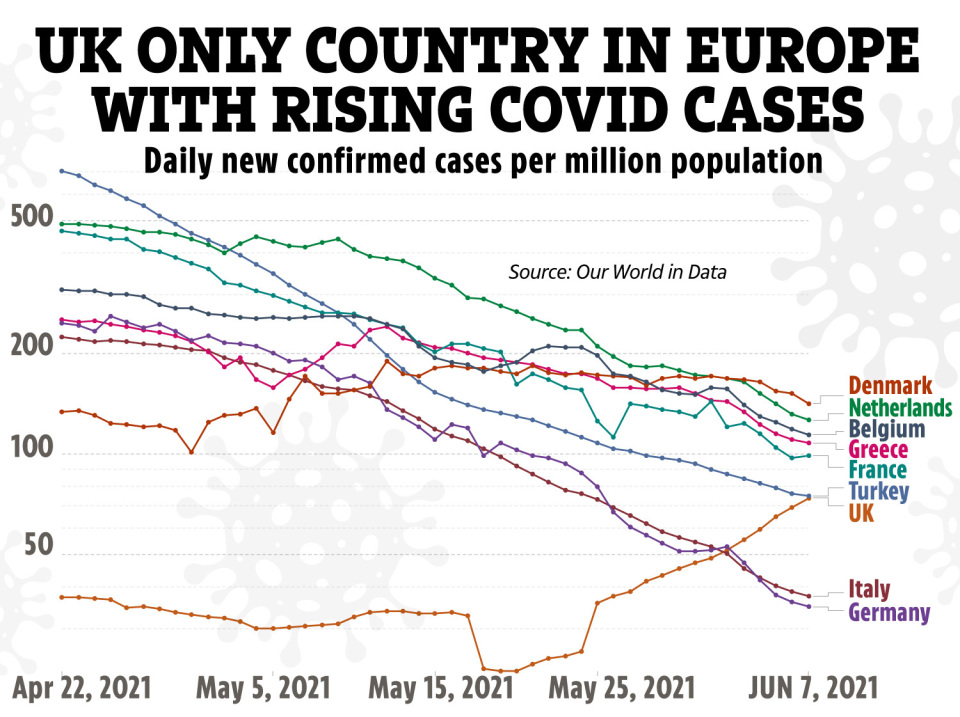
THE UK is the only country in Europe seeing a surge in Covid cases, grim graphs reveal.

Infections are being driven by the new Delta variant that first emerged in India.

Vanessa Chalmers www.thesun.co.uk (Extract)

The UK is the only nation in Europe seeing a surge in Covid cases, having had the lowest infection rate for months

At least 3,500 cases of Delta have been detected in the UK.

But the true figure is likely to be twice as high, given that only half of Covid tests are screened to see which variant they were caused by.

Daily new cases per million people have doubled in the UK between May 25 and June 7, according to official Covid figures collected by Our World in Data.

During the same period, other EU nations have continued on a downward trend.

Only France has seen a marginal uptick in cases, as health officials say there have been scattered clusters of the Delta strain.

The UK, diagnosing 74 cases per million a day, does not have the highest infection rate.

France, the Netherlands and Denmark among those with worser case rates.

However, if the UK’s cases continue to grow at the same pace, it looks to soon overtake those countries. 

Between January and mid-April, the UK’s case rate dwindled rapidly thanks to lockdowns and the vaccine drive.

Meanwhile, the rest of Europe battled a “third wave” which peaked around April time as its jab programme started at a snail pace.

But the tables have turned once more thanks to the Delta variant making its way onto British soil.

It ends an almost three-month spell of the UK having the lowest case rate in Europe.

Why has the NHS patient data-sharing scheme been pushed back?

Plans to allow an NHS system to extract patient data from doctors’ surgeries in England have now been pushed back by two months amid worries over privacy. Here are some of the key questions and concerns about the proposals.

Peter Walker www.theguardian.com

What is the plan?

Officially known as General Practice Data for Planning and Research, it had been due to come into force in England from 1 July, but has now been delayed to 1 September. The plan is to compile information about physical, mental and sexual health from GP surgeries into a central database, including diagnoses, symptoms, test results, medications, allergies, immunisations and referrals, as well as data on sex, ethnicity and sexual orientation, and on who has treated patients. It will exclude any identifying details such as names, addresses, images or details of conversations. Postcodes will be included, but in a coded form.

What data will be collected?

It will include everything for the last 10 years, and will be updated constantly as more data is added to GP records. Some elements of data are not allowed to be shared under law, for example about IVF treatment, and some information about gender re-assignment. Individual patients can also opt out from the scheme. They had been given until 23 June to exercise this right, but a now likely to have longer, though a new deadline has not yet been announced.

Why is it being collected?

According to NHS Digital, the data will be used for a “wide variety of research and analysis to help run and improve health and care services”. Among areas it highlights include the long-term impacts of Covid, health inequalities and research for serious illnesses. However, it will also be available to private sector organisations with the necessary provisions, although the data cannot be used purely for commercial purposes.

How is this different to what existed before?

It replaces a data system called General Practice Extraction Service, which also allows for the study of pseudonymised data (and in certain cases, data with identifying elements). However, rather than being one ever-updated central store of data, it is a more bespoke system, with individual GP practices voluntarily agreeing to take part and sending information when requests are made.

What are the objections?

There are two main worries. One is the sheer amount of data being held centrally, and the concern for breaches, or for the leak of any identifiable information. The other is what is seen as a lack of public information about the scheme, and the limited time for people to opt out. Similar concerns led to the scrapping of an earlier data-sharing scheme in England in 2016 called Care.data.

Who is concerned?

Primarily doctors’ groups. The Royal College of General Practitioners has written to NHS Digital to say that, while it backs the idea of data sharing, it was “critical that this is transparent and that patients have confidence and trust in how the NHS and other bodies might use their information”. On Friday last week, the British Medical Association called for the scheme to be delayed “until patients and the public have had time to be aware of and understand the programme and choose to opt-out if they wish”. On Sunday, Labour also called for a delay to allow for a wider consultation.

Local MPs and town council chairman respond to shake-up of parliamentary constituencies

Neil Parish feels “cut in half”.

Simon Jupp voted to stop parliament blocking the change but holds his thoughts on the proposals close to his chest.

Sidmouth Town Council Chairman, Ian Barlow, would be disappointed to lose “young and modern” Simon Jupp but thinks Sidmouth would no longer be overshadowed by Exmouth as it would become the largest town (by a short head) in the restructured “Honiton” constituency”.

Of course Neil Parish could be the candidate for “Tiverton and Bridgewater” which presumably includes his family farm and Simon Jupp could avoid a relocation by becoming the candidate for “Honiton”.

Does Budleigh now become a suburb of Exmouth? – Owl

Philippa Davies sidmouth.nub.news 

Reactions have been coming in following the boundary review announcement his morning, which would see Sidmouth becoming part of the Honiton parliamentary constituency.

A public consultation’s under way on the re-drawing of the boundary lines, which will create a new constituency for Exmouth, including Budleigh Salterton and Topsham, and another for the Tiverton area.

The Honiton constituency would have Sidmouth and Ottery on its western border, with Axminster on its eastern edge: read more and view the map here.

Constituency boundaries are changed regularly in response to population growth in some areas, to make sure that each MP has a similar number of people eligible to vote in their patch.

The chairman of Sidmouth Town Council, Ian Barlow, told Sidmouth Nub News there would probably be ‘pros and cons’ to the changes, but he would be disappointed if they result in Sidmouth losing Simon Jupp, the current East Devon MP, as the town’s parliamentary representative.

He said: “Simon Jupp is young and modern, and he seems to be working really hard for Sidmouth, engaging with us at town council level which I think is unusual, and it’ll be a shame if he’s not our MP any more.

“The only bonus to Sidmouth is that we would be the largest town in that constituency – in East Devon we’re the second largest town and maybe we’re missing out because of that.”

Mr Jupp told us: “The constituency I’m proud to represent contains the largest population in Devon and has to change under the rules of the boundary review. I will put forward my views as part of the consultation process as the East Devon constituency will change to reflect a growing population across the area. I voted to ensure Parliament can’t block the final recommendations which are designed to make Parliamentary representation fairer across the United Kingdom.”

Neil Parish, the MP for the current Honiton and Tiverton constituency which looks set to be split in two, expressed shock at being ‘cut in half’.

Talking to Nub News, he said: “I was not expecting Tiverton and Honiton to be sliced apart. It was certainly a surprise, and this clearly affects my position as the constituency’s MP.

“My current electorate will be split and so I will no longer be able to represent each of my current constituents.

“I will have to await the final proposals in full, to ensure I have all the details, before I can make any decisions on whom I will seek to represent within the new boundaries.”

In terms of Devon as a whole, the planned changes would mean an additional MP.

The public consultation runs until August 2. To view the proposed changes in full, and submit a response, click here.

Shock maps reveal rapid spread of Indian variant in WEEKS – is your area a hotspot?…

MAPS reveal how quickly the super infectious Delta (Indian) variant spread to all corners of the country. 

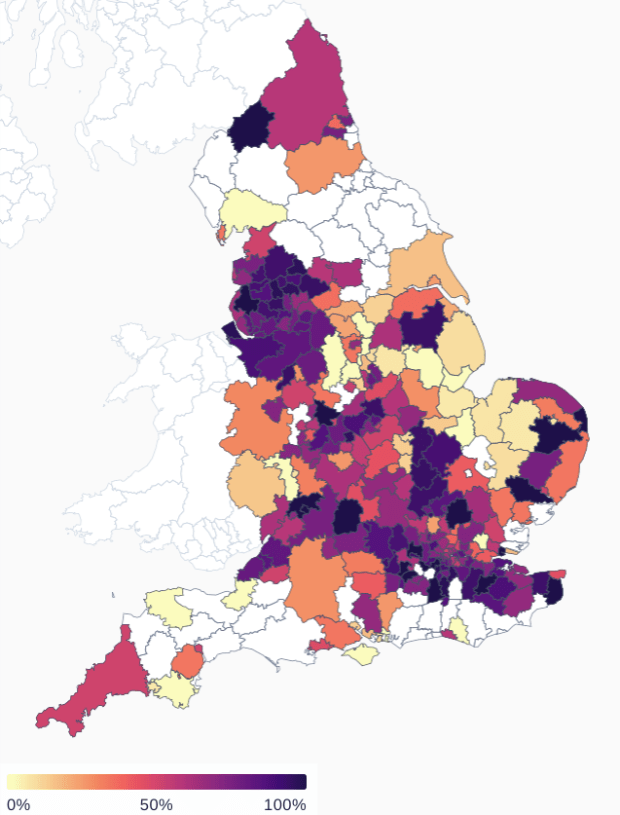
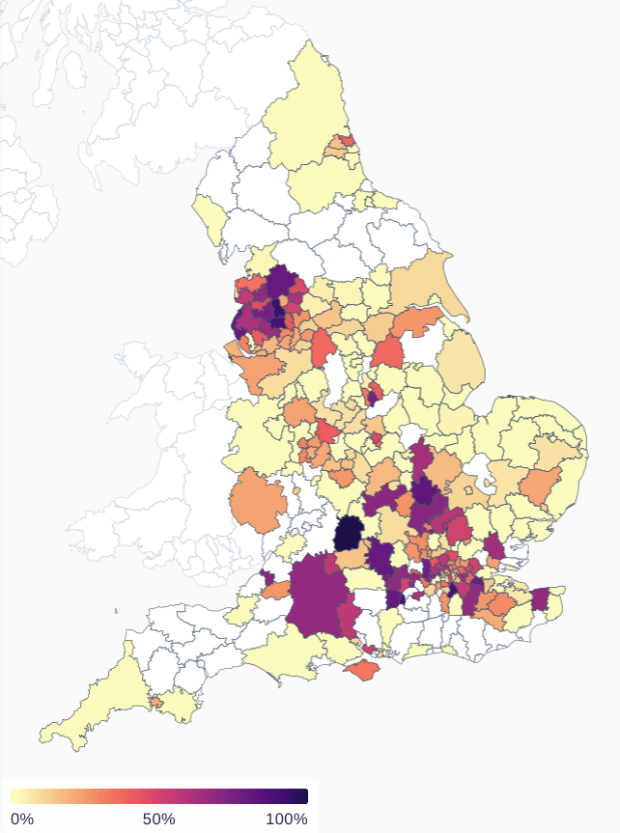
In just two weeks, the strain went from a proportion of 38 per cent to 75 per cent, making it dominant in England.

Vanessa Chalmers www.thesun.co.uk  (extract)

May 15: Where the Delta (Indian) variant had become dominant

May 29: Where the Delta (Indian) variant is now dominant

The data from the Welcome Sanger Institute shows how fast the variant has managed to grip the UK, having only been detected for the first time on April 10.

It’s reminiscent of the Alpha (Kent) strain which caused havoc at the end of 2020 when it soared to dominance in a matter of weeks, throwing England into the third lockdown.

The data comes amid growing pressure to delay the June 21 unlocking in England. 

The Delta variant is driving the rise in Covid cases, alongside lifting of restrictions.

Experts have said it is now evident the UK is at the start of a third wave and things would only escalate if June 12 went ahead. 

Not only is the Delta variant (B.1.617.2) faster spreading by around 40 per cent, but there is now evidence that it causes more severe disease.

But rising cases is yet to be mirrored by increasing hospital cases, however, with the latest data showing patient numbers have climbed slightly.

The NHS is in a race to double jab the vulnerable as fast as possible given that one jab is not considered protective enough

But some Tory MPs are fighting against “moving goalposts” for the opening of society due to the damage it will have on businesses. 

There are reports the PM is considering holding back by just two weeks to allow more time for vaccinations, with a decision imminent.

Data from the Sanger Insitute – which tracks Covid variants – shows that in the fortnight to May 15, the Delta variant had already become dominant in no more than 50 areas.

Fast-forward to May 29 – the most recent date available – the Indian variant has become dominant in at least 150 areas.

The Delta variant (B.1.617.2) now makes up 75 per cent of cases, according to Sanger data which does not take into account travel related or surge testing cases. The Alpha (Kent, B.1.1.7 ) strain is the cause of only 23 per cent of cases

Dominance means that of all Covid cases sequenced, B.1.617.2 is making up at least half.

On May 15 the “hotspots” were visible and centred in the North West. Parts of the South West and South East, including London, were also more affected. 

But now there is a sea of dominance in the Midlands, with hotspots including Derby and Leicester.

Delta has spread throughout the South East, now dominant in the majority of London boroughs, through to Kent and some parts of Essex.

Only parts of the South coast spared, such as Brighton.

The North West region has become completely overthrown by the variant, having had hotspots of Bolton and Blackburn with Darwen for a few weeks. 

The maps also show the Delta variant spread quite rapidly to the East of England in one fortnight.

And parts of the South West are also facing a growing epidemic, including Cornwall and North Somerset.

Case numbers are not always high in areas where the Delta variant is dominant. 

The article goes on to list hotspots by case numbers and by dominance.

Cornwall hospital discharging patients to free space for G7, claim Lib Dems

Fears have been raised that patients are being discharged from Cornwall’s main hospital to clear space in case it is needed for VIPs, delegates, police or protesters during the G7 summit.

Steven Morris www.theguardian.com 

The Liberal Democrats in Cornwall claimed two wards had been emptied at the Royal Cornwall hospital in Truro in readiness for the three-day meeting of world leaders.

Health officials refused to discuss details of their plans but confirmed that “capacity” was being created to prepare for the event, which begins on Friday.

Andrew George, the health spokesperson for the Lib Dems in Cornwall, accused the UK government of not planning adequately for the event, during which tens of thousands of delegates, police, protesters and media representatives will descend on the far south-west of Britain.

George said: “The early discharge of sick patients to clear hospital wards is among the inevitable consequences of the government failing to put proper plans in place before the G7 comes to town.”

One woman, from Newquay, claimed she had been asked to find a care home bed for her 97-year-old father who is in the hospital, which is known locally as Treliske.

The woman, who spoke to Radio Cornwall and gave her name as Lindsey, said: “I was absolutely incensed at the thought that patients needing treatment are being shipped out of hospital, and local people including my father are not able to find a space. I am absolutely disgusted with the situation.

“A care home owner told me that Treliske hospital has to provide 78 empty beds for the G7 and that patients were being sent out of the hospital into care homes and so she said you were very unlikely to find anywhere.”

NHS Kernow said: “As at any time when we expect increased demand for our services, we work together with our health and care partners to create additional capacity in our hospitals. We have done this to ensure we are prepared for G7, as we would with any major event in the county.

“Patients being discharged are, as always, medically fit and with an adult social care package in place when required. This is business as usual for health and social care.

“It is not good for people to remain in hospital longer than they need to and places additional pressure on our hospitals. We work closely with Cornwall council to ensure it has put in place a social care package to support anyone who is fit and well enough to leave hospital. Especially when our hospitals are so busy.”

On Tuesday, NHS Kernow tweeted a request for people to help the health service during the summit by only calling 999 if they faced a life-threatening emergency and believed they needed the care of a paramedic on the way to hospital.

NHS Kernow also urged people not to turn up at a minor injury unit without contacting NHS 111 first and not to visit an emergency department “unless you have an urgent, life-threatening condition such as a suspected heart attack, stroke, severe loss of blood, difficulty breathing, or are unconscious”.

It also advised people who are booked for a Covid vaccination to allow extra time for journeys if they live in an area where there will be travel disruptions.

A UK government spokesperson said: “The government has not requested that any patients be removed from local hospitals to prepare for the G7 summit. Decisions on patient care are matter for the local NHS, and Cornwall council is responsible for adult social care provision.”

Judge slams Michael Gove’s office as openDemocracy wins transparency court case

openDemocracy has won a significant legal victory against the UK government. The judgement forces transparency on a secretive unit accused of ‘blacklisting’ Freedom of Information requests from journalists, campaigners and others.

Peter Geoghegan www.opendemocracy.net 

After a three-year battle, judge Chris Hughes found that the documents the Cabinet Office presented in court about the controversial Clearing House unit were ‘misleading’. He added that there is a “profound lack of transparency about the operation”, which might “extend to ministers”.

Finding in openDemocracy’s favour, Hughes also criticised the Cabinet Office for a “lacuna in public information” about how the Clearing House coordinates Freedom of Information (FOI) requests referred to it by government departments and agencies.

The Cabinet Office had offered an out-of-date Wikipedia entry as evidence that information about the Clearing House, which circulates lists of journalists across Whitehall, was available to the public.

The ruling came in an information tribunal case taken by openDemocracy, with public interest law firm Leigh Day, in a bid to bring transparency to the Cabinet Office Clearing House. The case was heard in April but the judgement was published only late last month.

openDemocracy had previously revealed that the Clearing House has blocked the release of politically sensitive information, in one instance comparing the handling of an FOI request to the Chilcot Inquiry into the Iraq war.

Cabinet minister Michael Gove had previously called openDemocracy’s journalism “ridiculous and tendentious” but his department has now been ordered to release further details of how the Clearing House blocked FOI requests.

Tory MP David Davis called for change, saying the ruling ‘demonstrates what we have known all along’

The judge said that “given all the circumstances” including “a lack of accurate publicly available information about the constitutionally significant role in coordinating FOI responses there is real weight in the public interest in disclosure”. The Cabinet Office has yet to release the documents to openDemocracy.

The tribunal judgment has been hailed as a major victory by politicians and transparency campaigners.

Shadow cabinet office secretary Angela Rayner urged Gove to “intervene and set out how he will be ensuring that this government abides by the law and upholds the right of citizens, journalists and campaigners to access information under Freedom of Information”.

Conservative MP David Davis called for immediate change, claiming the ruling “demonstrates what we have known all along”.

He said the Cabinet Office had “failed to meet its obligation either to the letter or the principle of the Freedom of Information Act and has withheld important information about government activity from the public domain”.

Michelle Stanistreet, general secretary of the National Union of Journalists, said: “This is an important win in an FOI battle to get the Cabinet Office to come clean about the tracking of FOI requests made by journalists and NGOs.”

The judge also noted that the Cabinet Office had “minimised the significance of” the Clearing House FOI list, which is circulated daily across Whitehall and which has contained the names and details of journalists from openDemocracy, The Guardian, The Times, the BBC, and many others, as well as researchers and campaigners. These lists also contain the Cabinet Office’s advice to departments on how to handle FOI requests.

Freedom of Information requests are supposed to be ‘applicant-blind’, meaning who makes the request should not matter. Data protection experts have warned that the Clearing House could be breaking the law.

‘High political sensitivity’

The Clearing House has existed since FOI legislation was introduced. The Cabinet Office took responsibility for the unit in 2015, which started to receive significant attention only after openDemocracy revealed extensive details about its operation late last year. In February, more than a dozen former and serving Fleet Street editors signed an open letter calling for an inquiry into its operation.

The tribunal ruling comes almost three years after openDemocracy first asked for a sample of the Clearing House lists, in August 2018. When the Cabinet Office appealed against an order from the Information Commissioner’s Office (ICO) to disclose details of the Clearing House, openDemocracy took a case to the information tribunal.

The Cabinet Office had previously insisted that the FOI unit was fully compliant with all legislation. Ahead of the tribunal in April, Michael Gove wrote to The Guardian and the Society of Editors criticising openDemocracy’s reporting on the Clearing House.

But behind the scenes, the Cabinet Office backtracked. Gove’s department published information about the Clearing House, including criteria by which FOI requests – such as those regarding “cases involving high political sensitivity” – were referred for review.

The unit also released some of its lists, which showed that the Clearing House had encouraged departments to dismiss information requests.

In one case, the unit said that an FOI for details of government records systems from Times journalist George Greenwood “appears to have no discernible purpose”.

At the hearing, the Cabinet Office said the Clearing House handled round robin requests sent to multiple government departments but stated that these lists did not include requests deemed ‘sensitive’.

Noting that the Cabinet Office had “changed its position radically”, the judge found that Gove’s department had “misled” the tribunal by originally stating that the Clearing House lists included ‘sensitive’ data, which would have justified withholding the information.

However, questions have been raised about the Cabinet Office’s argument at the tribunal. Analysis conducted by openDemocracy has found that a third of requests on a sample Clearing House list released under FOI were individual requests that had not been sent to multiple departments. Often these requests were of high public interest.

Documents obtained by openDemocracy also show that Whitehall departments have routinely flagged ‘sensitive’ requests to the Clearing House. In one instance, the Cabinet Office unit instructed the Treasury to withhold information from infected blood campaigner Jason Evans, whose father died after being given blood contaminated with HIV.

Katherine Gundersen, deputy director of the Campaign for Freedom of Information, said: “The Cabinet Office’s handling of this request raises questions about its fitness to advise other departments on FOI.

“It inaccurately described the contents of its ‘round robin’ lists, misleading its own minister, the Information Commissioner and the tribunal by suggesting the information was more sensitive than it actually was.”

Noting that the Cabinet Office had ‘changed its position radically’, the judge found that it had ‘misled’ the tribunal

An openDemocracy report, ‘Art of Darkness’, which was published last year, found that the Cabinet Office is the worst performing Whitehall department on key FOI metrics.

Since the report was written, the Cabinet Office has stonewalled a number of requests from openDemocracy about the Clearing House operation.

A Cabinet Office spokesperson told openDemocracy: “A Clearing House function has existed since 2004 to help ensure there is a consistent approach across government to requests for information which go to a number of different departments or where requests are made for particularly sensitive information.

“We remain committed to transparency and always balance the need to make information available with our legal duty to protect sensitive information.

“In order to be as transparent as possible we have released the vast majority of information that was requested in this case and have already published a considerable amount of information on Clearing House, including a gov.uk page explaining its purpose and remit.”

An ICO spokesperson said: “We welcome the decision of the tribunal”.


The round robin lists released to openDemocracy can be viewed here, which are being hosted at a new research project at the University of Westminster, UK Unredacted.

Your area of Devon could face huge constituency change – more analysis

Devon is set to gain an extra MP under proposals for a shake-up of England’s electoral map in 2023 – with major changes planned for other constituencies.

[So will another Blue MP mean the Government will take any more notice of Devon? And what about the cross border proposal for a “Tiverton” and “Minehead” constuency – could this be mirrored in the “unitary authority” carve -up of Devon that Phill Twiss, new memebr of DCC cabinet, is rumoured to be cooking up?]

Daniel Clark www.devonlive.com 

Across the South West, the region has been allocated 58 constituencies – an increase of three from the current number – which includes an extra seat in Devon, albeit a cross-boundary division including parts of Somerset.

A seat straddling Devon and Cornwall – the infamous ‘Devonwall’ proposal – has been avoided but the Commission said it had “not always been possible to allocate whole numbers of constituencies to individual counties”, with a proposed Tiverton and Minehead constituency which will cross the county boundary between Somerset and Devon.

Across Devon, main changes include the splitting of the existing Tiverton and Honiton seat held by Neil Parish into a Tiverton and Minehead and a new Honiton constituency.

Changes to the electoral boundaries proposed for the East Devon area - existing boundaries in blue and proposed changes in red

Changes to the electoral boundaries proposed for the East Devon area – existing boundaries in blue and proposed changes in red

The Tiverton and Minehead constituency would cover Tiverton, Uffculme, Willand, and Bampton, as well as the ‘West Somerset’ section of the existing Bridgwater and West Somerset seat.

The Honiton constituency would comprise of Cullompton, the existing areas of East Devon it serves, as well as areas around Sidmouth and Ottery St Mary, currently in the East Devon seat.

A new Exmouth constituency would be created, comprising the remainder of the existing East Devon seat, but also see part of the Priory ward in Exeter, covering the area around Wonford and Burnthouse Lane move from the Exeter constituency into the Exmouth constituency.

Changes to the electoral boundaries proposed for the Exeter area - existing boundaries in blue and proposed changes in red

Changes to the electoral boundaries proposed for the Exeter area – existing boundaries in blue and proposed changes in red

The seats of Newton Abbot, North Devon, Torbay and Central Devon are proposed to be broadly unchanged, although Poltimore would move into the latter from East Devon.

Torridge and West Devon would be renamed Torridge and Tavistock, and see the area around Crapstone, Buckland Monachorum and Meavy moved into the South West Devon constituency, which would in turn lose the area around Modbury, Kingston and Bigbury into the Totnes constituency.

In Plymouth, the proposal divides the Peverell ward between the Plymouth Sutton and Devonport, and Plymouth Moor View constituencies in order to keep change elsewhere to a minimum and to allow for the Devonport ward to remain in a maritime constituency.

Changes to the electoral boundaries proposed for the Plymouth area - existing boundaries in blue and proposed changes in red

Changes to the electoral boundaries proposed for the Plymouth area – existing boundaries in blue and proposed changes in red

The proposed changes would leave Devon with 13 MPs – up one on the existing 12 – although one would be split across Devon and Somerset.

The proposals from the Boundary Commission for England says the aim is to make Parliament fairer by giving each MP a roughly similar number of voters, which involves redrawing and renaming some seats.

The total number of seats in the House of Commons will stay at 650 but population changes mean England is set to have 543 MPs, Wales 32 and Scotland 57 – that is an extra 10 for England, with Wales losing eight and Scotland’s count cut by two

The review is designed to end the discrepancies in the current system with some MPs having only 50,000 constituents and others having double that, and seats will be redrawn so they have, by law, between 69,724 and 77,062 registered voters each, although some island constituencies, such as the Isle of Wight and Anglesey, being given special dispensation to be outside these requirements.

The Boundary Commission is consulting on the initial proposals for an eight-week period, from June 8 to August 2.

In Blue, Existing Constituencies, And In Red, Proposed Changes to electoral boundaries across Devon

In Blue, Existing Constituencies, And In Red, Proposed Changes to electoral boundaries across Devon

A spokesman said: “We encourage everyone to use this opportunity to help us shape the new constituencies – the more responses we receive, the more informed our decisions will be when considering whether to revise our proposals. Our consultation portal at www.bcereviews.org.uk has more information about our proposals and how to give us your views on them.”

A second consultation with public hearings will then get under way in spring 2022, followed by a final four-week consultation on revised plans in autumn 2022.

Final recommendations are due by July 1, 2023, after which the government has four months to implement the plans.

The changes will only come into effect in late 2023, but if a General Election is called before the new boundaries are in place, the election would be fought on the old boundaries.

Lockdown lifting set to be delayed after update from Whitty and Vallance

Is June 21 “on” or “off”, “green” or “red”, “go” or “irreversibly stopped”?

Which has priority: business at all costs or people’s health?

Neil Shaw www.devonlive.com

England’s chief medical officer Professor Chris Whitty and chief scientific adviser Sir Patrick Vallance are reported to have given a ‘downbeat’ update on the state of coronavirus in the UK to ministers.

The briefing yesterday could mean lockdown lifting on June 21 being delayed.

That would mean easing of measures – such as permission for large events and the reopening of nightclubs – would not go ahead as planned.

Reports have suggested the final step in the Government’s road map could be delayed by two weeks, with The Times saying ministers were given a “downbeat” briefing on the latest data on Monday by chief medical officer Chris Whitty and chief scientific adviser Sir Patrick Vallance.

The Times reports that they emphasised concerns over the rate of transmission of new strains of Covid, including the Delta variant (first identified in India), and that vaccinations did not provide 100 per cent protection.

A cabinet source was reported to have said that they expected a delay of “between two weeks and a month” and that Chris Whitty and Sir Vallance had expressed reservations about the timetable.

“They emphasised again that the vaccine did not provide 100 per cent protection and there were real concerns about the transmissibility of the new variants,” the source said.

“I think you’re looking at a delay of between two weeks and a month. As long as we have fully opened things up by the school holidays then I don’t think the political damage will be too great.”

Another cabinet source described the mood in Whitehall as “downbeat” and one said the delay would make sense to avoid any “confusion” in the messaging.

Ministers are said to believe that the easing of restrictions may need to be delayed to ensure all over-50s are protected.

Mr Hancock said a decision on moving to Step 4 would be delayed as long as possible, with a final announcement to be made next Monday – a week before any changes could come into effect.

Downing Street said there was “nothing in the data” to suggest a delay would be needed.

Despite the uncertainty surrounding June 21, the Health Secretary said he was confident that “one day soon freedom will return”, with the latest data suggesting vaccines were protecting people against the Delta variant first identified in India.

And as the vaccination programme moved into its final stage – with under-30s the final cohort on the vaccine priority list – the NHS described the six-month anniversary as a “watershed moment”.

NHS England national medical director Stephen Powis said: “It is remarkable to think that just six months after that first jab back in Coventry in December – Maggie Keenan got it, remember – we have now vaccinated three-quarters of the adult population with their first dose and over half with their second dose.

“That really is a tremendous achievement and of course the vaccine programme is our way out of this pandemic, so it is crucial that when you get the invite for your jab, come and get it.”

As of June 6, England has delivered 23,710,646 second doses of Covid-19 vaccine, meaning the equivalent of 53.6% of its adult population is fully vaccinated, with 76.4% of adults having received one jab.

In Wales, the equivalent of 49.5% of its adult population is fully vaccinated, with 86.5% of adults having received a first jab, while in Scotland 50.8% of adults are fully vaccinated and 76.4% of adults have received a first dose.

The equivalent of 48.9% of Northern Ireland’s adult population is fully vaccinated, while a first dose has been given to 75.1% of adults.

All adults have already been called forward to get their vaccine in Northern Ireland and most of Wales, while people aged 18 to 29 in Scotland have been asked to register for their jab, with appointments starting in mid-June.

Mr Hancock said the Delta variant “made the race between the virus and this vaccination effort tighter” but the vaccine was breaking the previously “rock solid” link between infections and hospital admissions.

The variant is thought to be 40% more transmissible than the Alpha variant first seen in Kent which swept across the UK over the winter peak.

As of June 3, from 12,383 cases of the Delta variant 464 went on ,hospital.

Of those admitted, 83 were unvaccinated, 28 had received one dose and three had received both doses of the vaccine, Mr Hancock said.

The spread of the Delta variant has seen cases increase in almost all parts of north-west England, London and Scotland.

The rise in rates has yet to be mirrored by a steady increase in hospital cases. Latest data shows numbers have climbed slightly, with the seven-day average for patients in hospital reaching 912 on June 3 – the highest since May 26.

Nearly three-quarters of local areas of the UK (283 out of 380) recorded a week-on-week rise in Covid-19 case rates for the seven days to June 2, the highest proportion since January 6.

Downing Street said data emerging over the coming week will be “crucial” in deciding whether England’s legal coronavirus restrictions can end as hoped on June 21.

However:

Devon MPs urge Government to lift lockdown on June 21

Daniel Clark www.devonlive.com

Devon’s MPs from across the political spectrum have called for the Government to go ahead and lift all remaining Covid restrictions on June 21.

Step 4 of the roadmap out of lockdown, which is set to take place not before June 21, would remove all remaining legal limits on social contact, ease restrictions on large events and reopen premises such as nightclubs which have remained closed.

A review of social distancing and other long-term measures that have been put in place to cut transmission, such as wearing of face coverings and working from home, is also due to be completed with these restrictions also potentially removed.

But the relaxing of the remaining rules has been thrown into doubt by the recent rise in cases being confirmed, as well as the Delta variant, first seen in India, which is thought to be about 40 per cent more transmissible than the Alpha (Kent) strain.

However, with deaths and hospitalisations staying low, and with Devon having some of the lowest Covid rates in England, the county’s MPs have urged the Government not to delay the planned lifted of restrictions on June 21.

Latest figures show that there is just one person in hospital in Devon following a positive Covid-19 test, while there have been no deaths in the county since May 9, and infection rates are at 6.9/100,000, down 35 per cent week-on-week, and the lowest they have been since September 2.

Newton Abbot MP Anne Marie Morris, who has been a ‘lockdown sceptic’, and who voted against the third lockdown, has urged the Government not to delay the planned lifting of restrictions on June 21.

She said: “Given the specific situation we find ourselves presented with in Devon (both health-wise and economy-wise) I would urge the Government not to delay the planned lifting of restrictions on Jun 21st. While the latest steps have helped the local economy begin to get back on its feet, it won’t be until all restrictions are lifted that we will be able to enjoy the full freedom that we desperately all want.

“The vaccination rollout has been a stunning success and this should allow us to re-open with confidence. We cannot keep flinching at the slightest sign of every potential new variant. It’s damaging to physical and mental health and the economy.”

And Labour MP for Exeter Ben Bradshaw also joined the chorus of those calling for restrictions to go on June 21, saying that it should not be delayed in the county because ‘of a small number of hotter spots or because of fears about a theoretical new variant emerging’.

He added: “The data that matters now is on serious illness, hospitalisation and deaths and so far the evidence is that the vaccines protect against all currently known variants.

“There may be an argument for continuing with certain limited guidance that does not impact negatively on the economy, such as continuing to work from home if possible and wearing face protection in enclosed public spaces, but the June 21st date should not be delayed, particularly for low incidence areas like Exeter and Devon, because of a small number of hotter spots or because of fears about a theoretical new variant emerging.

“People have put up with unprecedented restrictions to their freedoms for long enough and with life returning to more or less normal across the rest of Europe, it would seem unreasonable for the Government here to impose unnecessary restrictions on the British for longer, particularly given our high vaccination rate, which the Government promised would deliver us a vaccine dividend.”

Central Devon Mel Stride MP said that the decision was ‘finely balanced’, but his hope and expectation was for June 21 to go ahead.

He said: “The decision on opening up fully is finely balanced at the moment. Hospitalisations and fatalities are obviously low but whilst many are vaccinated not all are and if the delta variant expands very rapidly over the next week then there may be a case for rowing back a little on fully opening. My hope and expectation however is that step 4 will be taken pretty much in full on the 21st.”

Sir Gary Streeter, MP for South West Devon, also added that the further release should go ahead.

He said: “I think it is finely balanced. Government said it would look at the date from the proceeding steps from lockdown and that is what they will do. There is a case for delaying full release until more people under 50 have been vaccinated, but my personal preference would be to proceed with the further release on the grounds that the vaccine is working and younger people tend not to get Covid seriously. The government has exercised terrific judgement on this in the last few months and I am happy to back their judgement whatever they decide.”

Selaine Saxby, MP for North Devon, said: “I very much hope the decision will be driven by the data, which in North Devon remains very positive. There are the four tests which need to be met for the next phase of unlocking to go ahead and the question about “variants of concern” is one that I am not privy to the data on at this time, but my understanding of the data I am able to see is that the other three are looking optimistic and very much hope that we will be able to progress to the next stage as planned.”

No decision on whether to proceed to step 4, or delay the step, will be taken until June 14 to allow for the full four weeks of data since the relaxation of step 3 on May 17 can be seen.

The Government says that the he decision will be based on four tests – that the vaccine deployment programme continues successfully, the evidence shows vaccines are sufficiently effective in reducing hospitalisations and deaths in those vaccinated, infection rates do not risk a surge in hospitalisations which would put unsustainable pressure on the NHS, and the assessment of the risks is not fundamentally changed by new variants of concern.

Meanwhile the traffic build up to the West doesn’t stop:

M5 and A38 experiencing heavy traffic delays – updates

Katie Timms, Eve Watson www.devonlive.com

There is heavy traffic across Devon and Cornwall this morning.

The M5 in Tiverton is partially blocked with heavy traffic due to a broken down vehicle, which has left the northbound exit slip road up to the roundabout is reportedly blocked.

Initial proposals for new parliamentary boundaries – consultation closes 2 August

Here is a link to the details

https://boundarycommissionforengland.independent.gov.uk/2023-review/

First impressions: major changes reflecting population growth.

New map of proposed local boundaries:

Existing boundaries (not to same scale):

Boris Johnson rapped for ‘taking parliament for granted’ over cuts to foreign aid

Prime minister spared potentially embarrassing defeat in a vote on overseas aid but gets harsh words from the Speaker.

[Owl now thinks that Neil Parish is one of the non-cut rebels but no idea about Simon Jupp.]

Esther Webber www.politico.eu 

LONDON — Tory rebels have vowed to fight on after Boris Johnson was spared a potentially embarrassing defeat in a vote on overseas aid ahead of the G7 summit. 

Funding for foreign aid was cut from 0.7 percent of national income to 0.5 percent at the beginning of the year, as Chancellor Rishi Sunak argued it was “difficult to justify” amid the coronavirus crisis.

Conservative Party rebels, with cross-party support, introduced an amendment that would have reintroduced the 0.7 percent target from next year, attaching it to a law setting up the U.K.’s new Advanced Research and Innovation Agency.

However, the Commons Speaker, Lindsay Hoyle, ruled on Monday that it was outside the scope of the bill and could not be voted on. 

In explaining his decision, Hoyle said he understood the “frustration” of those seeking a vote, adding: “This House should not continue to be taken for granted but we must do it in the right way… not only for this House but the country needs this to be debated and aired and an effective decision to be taken.”

The MPs who want to see the cut reversed interpreted this as a call for the government to bring forward legislation on the matter, which it has so far resisted. 

Johnson argued earlier this year that it was permissible for him to act without changing the law because the target can be temporarily missed in exceptional circumstances.

Andrew Mitchell, the former international development secretary who organized the amendment, accused the government of “riding roughshod” over parliament and of “seeking to thwart our democratic rights” after the Speaker’s statement.

The Speaker announced an emergency debate would be held on the issue, which would be held over three hours on Tuesday but would not be subject to a binding vote.

Anthony Mangnall, who coordinated the campaign alongside Mitchell, told POLITICO: “Today has only shown the strength of our argument and numbers. Tomorrow we will make that case. The Speaker made it clear that the government ought to bring forward legislation — an almost unheard-of request.”

Other would-be rebels acknowledged privately the emergency vote would need to be followed by legislation and there was not a clear route towards this. 

One commented: “The government holds most of the cards, alas.”

Cornwall’s homeless are moved out of hotels to make way for tourists

Cornwall is facing an accommodation “crisis” after it was revealed that about 130 people homeless people were asked to move out of hotels to make way for paying customers.

Lee Trewhela  www.cornwalllive.com 

The promise of a busy summer season, next week’s G7 Summit, a packed Bank Holiday weekend and half-term have all meant that hotel and B&B owners who have provided temporary and emergency accommodation for homeless people and families want to return to welcoming paying guests.

Olly Monk, Cornwall Council’s cabinet member for housing, told CornwallLive the situation was a “crisis” and the council needed to come up with solutions as quickly as possible.

He said: “Last week about 130 people left temporary and emergency accommodation that the council provides at hotel chains and B&Bs for the reason that people wanted to get back to the business of providing hotel accommodation for regular, paying guests.

“The good weather, the bank holiday and the end of lockdown on June 21, hopefully, has meant those businesses want to get back on a regular footing of providing regular accommodation.”

The Conservative councillor for Newquay Trenance said the council didn’t have any long-term contracts in place with hoteliers so the businesses had the flexibility to terminate the contracts.

“Cornwall Housing managed to rehouse pretty much all of them,” added the councillor. “A lot of them moved in with family or friends, some were rehoused in Plymouth.

“A very small number of people, discretionary claimants, who were housed in Cornwall during Covid who couldn’t get back to where they came from during the pandemic have been offered accommodation elsewhere.”

Mr Monk said he had not heard any reports of anyone being made homeless as a result of the move.

“This is a crisis and we need to come up with some innovative solutions to it very quickly,” he stressed. “Moving forward, the people we are homing in temporary and emergency accommodation are going to come under more pressure as the holiday season progresses and as landlords cash in on the AirB&B side of things.

“Long-term our administration is looking at providing more council housing and open market rented properties for the people of Cornwall. But right now we’ve got a problem with a lot of people in temporary accommodation that we need to house and provide that provision until we start building the council housing that people need.

“This is why I wanted the housing job, it’s something I feel passionate about – it’s a problem in Cornwall and I want to do my best to help.”

Another Cornwall councillor hopes that a legacy from the G7 will provide more accommodation for homeless people.

Jayne Kirkham, Labour councillor for Falmouth Penwerris, said: “The G7 and the encroaching holiday season has flagged up a real weakness in homelessness and housing provision in Cornwall.

“Trying to rehouse so many people at short notice in Cornwall in the summer with the place full due to the G7 is incredibly difficult and expensive. The worry is that some people will slip through the net and end up back on the streets. All the good work done engaging with the support services will be lost and they will go backwards.”

Cornwall Housing installed homeless ‘pods’ in Truro and Penzance last year and are planning a new homeless centre in Truro with 11 rooms. They also received money from the Next Steps Accommodation Fund to purchase accommodation and fund support workers.

Ms Kirkham added: “They have done a huge lot of work in the last year in trying to get ‘everybody in’. Despite the rough sleeper count in November 2019 showing there were only 24 people rough sleeping in Cornwall, 168 people were given emergency accommodation in the first few months of the pandemic.

“However, there is always more that could be done and the G7 and our summer holiday season have highlighted the current fragility of emergency housing provision in Cornwall. Particularly the part that is commissioned with national hotel chains and is incredibly expensive and hard to find at certain times of the year, due to our seasonal economy.

“Much is spoken of the ‘legacy’ the G7 may provide to Cornwall. I would suggest that the Government consider that the G7 has proven that we need extra support with our homelessness provision.

“I went up to Falmouth Rugby Club last night where there are 40 ‘pods’ for security staff to occupy during G7. These buildings were rented, but there will be similar across the Duchy. Maybe if some of these housing pods could stay in Cornwall after the G7 moves on, along with some extra funding for more permanent accommodation, it would go some way to help plug a gaping hole.

“We obviously need more reliable options than renewing room bookings at national hotel chains.”

Foreign aid: Aid cuts could see lives lost, warns senior Tory – How will Parish and Jupp vote?

If this goes to a vote tonight, how do you think our MPs Neil Parish and Simon Jupp will vote? Neither particularly noted for their “independence” – Owl

Children could die as a result of UK cuts to the overseas aid budget, a senior Conservative backbencher says.

By Hazel Shearing www.bbc.co.uk

The prime minister is facing a possible Commons defeat after cutting spending of national income on international development from 0.7% from 0.5%.

David Davis – among more than 30 Tories against the move – said some UK-backed schemes have already been cancelled and “morally, this is a devastating thing”.

The government’s supporters say the cut is temporary, necessary and popular.

The Conservative Party committed to spending 0.7% in its manifesto for the 2019 general election – but ministers say it is hard to justify given record levels of peacetime borrowing during the pandemic.

The cut amounts to almost £4bn, but the government said it will still spend more than £10bn on foreign aid in 2021.

Speaking at the start of a week in which the UK hosts the G7 summit in Cornwall, Mr Davis said: “Historically, I am a critic of aid spending but doing it this way is really so harmful.”

He told BBC Radio 4’s Today programme if the government were to offer a compromise of a short time frame for their cut to foreign aid spending, “it helps”.

But he said “if you’re a small child and suddenly you get dirty water, you get an infection from it and you die, temporary doesn’t mean much”.

Mr Davis added: “If you’re going to kill people with this, which I think is going to be the outcome in many areas, we need to reverse those immediately”.

Former Prime Minister Theresa May is one of the other Tory rebels hoping to achieve a U-turn with an amendment to the Advanced Research and Invention Agency (ARIA) Bill – a planned new law to set up a new agency designed to come up with innovative policy.

It would oblige the agency to make up any shortfall in aid spending if the government were to miss the 0.7% target.

The bill is due to be scrutinised in the Commons on Monday afternoon – but it will be up to Commons Speaker Sir Lindsay Hoyle to decide whether the rebels’ amendment should be put to a vote.

Voting on the bill will begin no later than 21:00 BST.

Former Labour Prime Minister Gordon Brown also criticised the cuts, telling BBC Breakfast it was “a life and death issue” and made “no economic or moral sense”.

Former International Development Secretary Andrew Mitchell, who is leading the rebellion, said the UK is the only member of the G7 group of advanced economies cutting aid this year – and that “contributing our fair share of aid is essential for a successful G7 summit” this week.

“The eyes of the world are truly upon us. But in this moment Britain is found wanting, because we have removed a foundational piece of our own global leadership,” he has written in the Guardian.

The aid reduction has meant millions of pounds less is being spent on supporting girls’ education, reproductive health, clean water, HIV/AIDS, the humanitarian crisis in Yemen and Syria, and hundreds of other projects.

media captionSir Bob Geldof: ”We don’t take the piece of bread from that child’s mouth in Yemen”

Dozens of charities said there was “no justifiable economic need” for them in a letter to Mr Johnson over the weekend, and Archbishop of Canterbury Justin Welby called the cuts “indefensible” on Twitter,.

The government has promised to restore spending to the 0.7% level “when the fiscal situation allows” – but has not specified a date.

Anti-poverty campaigner Sir Bob Geldof told the BBC’s Andrew Marr on Sunday that he feared they could become permanent.

Duty to ‘protect our citizens’

But Solicitor General Lucy Frazer said the government would return to spending 0.7% levels “when the fiscal situation allows”.

She said the UK was a big aid donor but added: “We have a duty to ensure we protect our citizens here as well as those in the rest of the world.”

A senior government source told BBC political correspondent Chris Mason that if the amendment were to go through, it would be the equivalent of putting up income tax by a penny for every pound earned.

And ex-Work and Pensions Secretary Esther McVey argued the UK shouldn’t “end up going into deeper debt in order to finance other countries”.

Writing in the Telegraph, she said the UK should instead help poorer countries “trade their way out of poverty”.

“If more and more aid was the solution, large parts of Africa would have escaped all poverty decades ago,” she added.

Planning applications validated by EDDC for week beginning 24 May

Got a staff shortage? Raising wages normally helps

Consequences of a low pay, low investment economy? 

Owl’s view has always been that moving to a high wage economy is the way to improve productivity (and improved standard of living).

Larry Elliott www.theguardian.com

From Michel Roux Jr to Tim Martin, from swanky Le Gavroche in London to Wetherspoons pubs, the message is the same: we need more staff. Labour shortages were not a problem envisaged when the UK was plunged into lockdown in the spring of 2020. Then, the fear was of massive job losses and the highest unemployment since the 1930s.

Now, the hospitality sector says a lack of chefs, bar staff and waiters is affecting trade. Roux has announced he is closing Le Gavroche at lunchtimes. At Wetherspoons, Brexit-supporting boss Martin has urged ministers to use their ability to set immigration laws to grant visas to EU citizens.

In part, the problem has been caused by the sudden surge in consumer demand as restrictions have been eased. Having been cooped up for so long over the winter, consumers have wanted to go out for a drink, a meal, or enjoy a weekend break. Lots of venues have been looking for staff at the same time.

The hospitality sector employs one in 10 workers in the UK – more than three million people in total – but has been particularly hard-hit by the repeated lockdowns of the last 15 months. Some of those employed in pubs, restaurants and hotels are still on furlough and not ready for a new job. Others have decided to change career or to stay on ine education rather than risk the vagaries of the labour market. Workers from the EU have returned to their own countries during lockdown and for a variety of reasons – health concerns and Brexit in particular – are not coming back.

There are solutions to this problem. The more unscrupulous employers might sweat their workforces harder, something made possible by the low level of union membership in the sector. They could decide – as Roux has done – to limit opening hours, although this is more feasible for businesses at the luxury end of the market than it is for high-volume outlets. A third option would be to attract more workers from overseas, which is what Tony Blair did when he welcomed people from the countries of eastern Europe after they joined the EU in 2004.

The only other solution is the most obvious one: make the jobs more attractive through higher pay.

There would be knock-on effects. The price of a pint would go up as employers passed on higher costs to their customers. Inflation would be a bit higher. Some businesses would close. Yet one of the basic tenets of economics is that raising the price of something – in this case the wages of a chef or a waiter – increases its supply.

The impact on labour shortages would almost certainly not be instant, because those attracted to a job in hospitality by the lure of higher wages may not have the necessary skills. But incentives would eventually make a difference in a sector notorious for its long hours and low pay.