The science is clear: the case for more Covid restrictions is overwhelming

Don’t you worry your little head over this Simon, just carry on partying. – Owl

Ian Sample www.theguardian.com

For a variant that came to light less than a month ago, the evidence for Omicron’s potential to wreak havoc has mounted at breakneck speed. What studies have emerged are rapid first takes, but the message they convey is now loud and clear: the scientific case for more restrictions is overwhelming. Without hard and swift action to curb transmission, the NHS faces a battering.

The first red flag came in late November when scientists in southern Africa shared early genomes of what became known as Omicron. Soon after they landed, Tom Peacock, a virologist at Imperial College London, highlighted the “awful” mutations that marked it out as a fast-spreading, vaccine-dodging variant. On receiving a text about Peacock’s tweet, Dr Susan Hopkins, the chief medical adviser to the UK Health Security Agency (UKHSA), conceded it filled her with gloom.

The warning spurred research around the clock to nail down the extent of the threat. One of the first to report was Dr Alex Sigal at the University of KwaZulu-Natal in Durban. His team confirmed that Omicron largely escaped antibodies from vaccines or past infection, with antibodies following the Pfizer shot 41 times less effective against Omicron than the original Covid-19 virus. Other data from South Africa, and soon from around the world, showed that Omicron spread like wildfire, doubling every two to three days. As Prof Chris Whitty, England’s chief medical officer, phrased it: “There are several things we don’t know, but all the things that we do know are bad.”

As the infection spread, the UKHSA crunched early numbers to show that two doses of Covid vaccine did little to prevent symptomatic infection, though a booster kicked protection up to about 70%. On Friday, two reports from Prof Neil Ferguson’s group at Imperial College rounded out the picture. Their findings are tentative, but suggest a booster provides 80-86% protection against hospitalisation from Omicron. That is good from an individual perspective, but compares with 95% for Delta. The upshot is that hospitalisation rates for boosted people could be four times higher with Omicron.

Further analysis from the Imperial team shed light on the single most important unknown: how severe can Omicron infections be? Data from South Africa gave some cause for hope, with hospitalisations down on previous waves, but the researchers found no evidence Omicron was milder than Delta.

There are still hints of good news, however. Lab work led by Prof Ravi Gupta at Cambridge University suggests that Omicron may be less effective at attacking the lungs than Delta. The finding chimes with University of Hong Kong research that found Omicron replicated 70 times faster than older variants in the bronchial tubes, but is less likely to infect the lungs. The hope is this could make the variant spread fast but cause less severe disease.

But in documents released by the Sage committee on Saturday – after they pored over updated outbreak modelling from Warwick University and the London School of Hygiene and Tropical Medicine – the assessment is frank. England is “highly likely” to have 1,000 to 2,000 daily hospitalisations by the end of December. Many of these are already baked in and will arrive at hospital doors in the next week or so, regardless of actions taken now. With no further restrictions beyond “plan B”, models point to at least 3,000 daily hospitalisations at the peak of the wave next month. “To prevent such a wave of hospitalisations, more stringent measures would need to be implemented before 2022,” the scientists wrote. That would prevent hospitalisations, not just delay them, as it would give more time for boosters to take effect.

Throughout the epidemic, scientists have stressed the importance of moving fast when cases take off. This is doubly true with a virus spreading as fast as Omicron, according to an assessment released by the environmental modelling and behavioural science groups that feed into Sage. If taken soon enough – within days – restrictions like those in place after step one or step two of the roadmap in England need not be in place for more than a few weeks, the experts write.

“The timing of such measures is crucial,” they add.

Sidmouth: Councillors agree Sidford Business Park building heights ‘through gritted teeth’

Remember that Cllr Stuart Hughes claimed that this business park within the AONB had been deleted, when it hadn’t’, during the last iteration of the Local Plan. – Owl

Joe Ives, Local Democracy Reporter sidmouth.nub.news 

The size of buildings at a controversial business park to be built in Sidford has been agreed by East Devon District Council (EDDC) “through gritted teeth.”

The development, which was rejected by EDDC’s planning committee before being approved on appeal by the government’s Planning Inspectorate in August 2019, has been a source of contention for both the council and local residents.

The council had previously refused an outline application for the eight-square-kilometre business park because of concerns over dangers from increased HGV traffic through Sidbury and Sidford as a result of the development. There are also worries about the visual impact, as it is in an ‘Area of Outstanding Natural Beauty.’

When the Planning Inspectorate’s decision was announced in 2019, Sidmouth and Sidford councillor Stuart Hughes (Conservative) described the judgment as “basically a two fingers up to the Sid Valley” – a sentiment which is still widely felt.

When making its decision, the inspectorate pointed to the 250 new jobs expected to be created as one of its reasons for approval.

Either way, with the inspectorate’s 2019 decision the council had little choice but to support the proposals for the final details of the height of the buildings.

Sidford already struggles to get large vehicles through its roads (Credit: Daniel Clark/LDRS)

EDDC’s planning committee voted in favour of the ‘reserved matters’ application for the size of the buildings from the applicant, 0G Holdings Retirement Benefit Scheme.

It means the industrial estate will mainly consist of six-metre tall buildings. There will be two 7.5-metre-high buildings, roughly two storeys in height, next to the entrance at Two Bridges Road. The developer says the visual impact of these buildings will be partly mitigated by new trees.

A letter of objection from a local resident was read to the planning committee. It said: “There comes a point in time when somebody has to say enough is enough. This development has nothing to do with local economic benefit or creation of opportunities.”

They said the scheme had driven them “beyond anger.”

In 2019 The ‘Say NO To Sidford Business Park’ campaign collected 1,500 signatures in a petition.

However, given the decision of the Planning Inspectorate, EDDC can do little except approve the specific details as presented to the government.

Each councillor who voted for approval expressed their reluctance before doing so. Councillor Olly Davey (Green Party, Exmouth Town) and Cllr Richard Lawrence abstained. Councillor Geoff Pratt (Independent, Ottery St Mary) voted against approval. But in the end, the vote was carried.

Councillor Mike Howell sympathised with the objections raised by members of the public but stated there were no grounds for refusal, given the 2019 decision of the planning inspectorate. He said: “It is purely scale we are talking about and this is exactly the same as the proposal that went to appeal. The scale is set.

“We are really struggling with this and I wish I could see any hope of amending, changing – doing anything. As far as I can see there is no hope in hell. In fact, I would say if we did vote against it we would have costs awarded against us for acting ‘unreasonable.’”

Councillor Richard Lawrence (Conservative, Whimple and Rockbeare) said: “We are between a rock and a hard place and there is very little we can do about this.

“I can’t understand why the inspector gave these decisions but at the end of the day we’re faced with them and we must comply with them.”

Councillor Joe Whibley (Independent, Exmouth Town) said: “I would like the people who have objected to this to know that we do this [the reserved matters approval] through gritted teeth. This is not something that we’re all happy just to wave through.

“It’s incredibly frustrating.”

The proposed final appearance of the buildings will be voted on by the planning committee at a later date.

The Tories call it electoral reform. Looks more like a bid to rig the system 

Showing you papers before you vote, surely this is something our “libertarian” Simon Jupp MP will have to oppose? – Owl

Nick Cohen www.theguardian.com

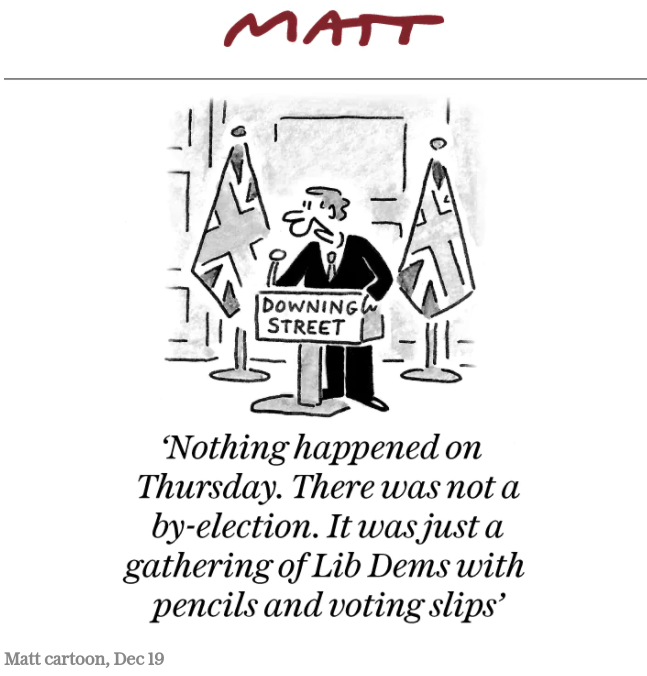
Picture the chaos at the next general election. Officials refuse to allow voters into polling stations because the Johnson government has denied democratic rights to everyone who cannot or will not produce photo ID.

Some are angry because they don’t have the required documents. Others sound paranoid as they tell reporters they don’t want to show passports and driving licences because they fear state surveillance. If nothing else, Covid has taught us the extent of the conspiratorial mentality. On election day the government reveals it is content to encourage a climate of paranoia, if it will give the Conservatives an advantage. Trust in the integrity of the election withers as the scale of voter suppression becomes apparent.

Last Monday, the Commons public administration and constitutional affairs committee, chaired, I must emphasise, by a Conservative MP, William Wragg, said that if Northern Ireland were a guide, ID checks would cause turnout to drop by 2.3%. On this measure, the Tories would disfranchise about one million of the 47.6 million people registered to vote.

Unlike Northern Ireland, the rest of the UK has no record of sectarian gerrymandering and civil war to justify controls. The facts of recent history do not concern Michael Gove. He has pursued vote rigging with Gollum-like obsessiveness since 2019. His oppressive intent is evident in the failure to produce proof that frauds are turning up at polling stations and stealing the identities of honest citizens. The protests of people denied the ballot would be everywhere in the media if that scare story were true. As it is, there was only one conviction for impersonation after the 2019 election, and the Commons committee described the government’s pretence that there was a hidden epidemic of voter fraud as “simply not good enough”.

It is evident in the speed with which the government is forcing its elections bill through parliament. It is evident in the lack of public consultation and bipartisan support. It is evident, above all, in the government’s choice of targets.

In a satirical twist, the Conservatives have assigned the task of ending the level playing field of free and fair elections to Gove’s Department for Levelling Up. They believe people without driving licences or passports will be poor and less likely to vote Conservative. I wouldn’t count on that in every Leaver town, and nor do ministers. They are leaving nothing to chance. Expats, who are more likely than not to be Tories, will be able to vote, however long they have lived abroad. All foreign nationals will be denied the vote, however long they have lived in the UK. People over 60, who disproportionately vote Conservative, will be able to use their travel passes as photo ID. The young, who don’t, won’t.

If this were happening in Hungary or Zimbabwe, we would know what to say: a corrupt clique was bending the rules to maintain its power. We don’t know what to say when election rigging happens in our own country because a self-satisfaction born of the UK’s lucky history holds that “it can’t happen here”. Even when it is happening here. Protests about the elections bill are confined to a nerdish group of politicians, journalists and academics.

The fate of the Electoral Commission ought to shake the complacent. Boris Johnson is threatening the independence of the referee that protects against corruption. The elections bill allows ministers to set the “strategy and policy” the commission must follow. The government claims it has been forced to act because of loss of confidence in the commission. The Commons investigation said there was no more evidence that the public had lost faith in the commission than there was of hordes of frauds at polling stations.

It warned instead of the danger of the government abusing its power to help it stay in office, even if abuse means undermining “public confidence in the effective and independent regulation of the electoral system”.

We risk becoming like the US where every vote is disputed by the losing side, and impartial arbiters are replaced with political lackeys. Indeed, we are already on that path. Whether in the courts, broadcasting or the regulatory system, undermining checks and balances has been the modus operandi of this government.

The scandal that led to the Conservatives losing North Shropshire began when the cabinet organised an assault on Kathryn Stone, the parliamentary commissioner for standards. She found against Owen Paterson for promoting companies that were paying him £110,000 a year for his bespoke services. Johnson, himself the subject of Stone’s inquiries, wanted the rules changed to give him and his colleagues more freedom to sponge at will. Kwasi Kwarteng, the business secretary, showed his unfitness for public office by saying he found it “difficult” to see how Stone’s career could survive such an impertinence.

Stone saw off her enemies. By contrast, Lord Geidt, Johnson’s ministerial standards adviser, now cuts a pathetic figure. The credulous man actually believed the prime minister when he said he knew nothing about a businessman buddy, Lord Brownlow, paying for the refurbishment of his Downing Street flat until the media mentioned it in February 2021. A scrupulous investigation by the electoral commission found Johnson was tapping Brownlow for money in November 2020. Now Johnson wants to punish the Electoral Commission.

On Tuesday, Wragg wrote to Geidt to ask how he was independent when he did not appear to have the power to conduct proper investigations. “What steps are open to you if you feel that, in the course of an investigation, you may have been misled?”

The answer this government wants to hear is “none”, and not only from Geidt.

Once cautious Conservatives worried that, if they used their majority in parliament to hound their enemies, their opponents would one day turn the weapons they forged on the right.

Perhaps today’s Conservatives believe there will never be a Labour government that treats the Tory press the way they treat the BBC, or twist the rule of law and regulation of elections to suit the Labour rather than the Tory cause. After the revival of Labour and Liberal Democrat fortunes, you might find it ludicrous for Conservatives to think they can be in power for ever. If so, I urge you to look at how they are playing with electoral law to give themselves the best possible chance of doing just that.

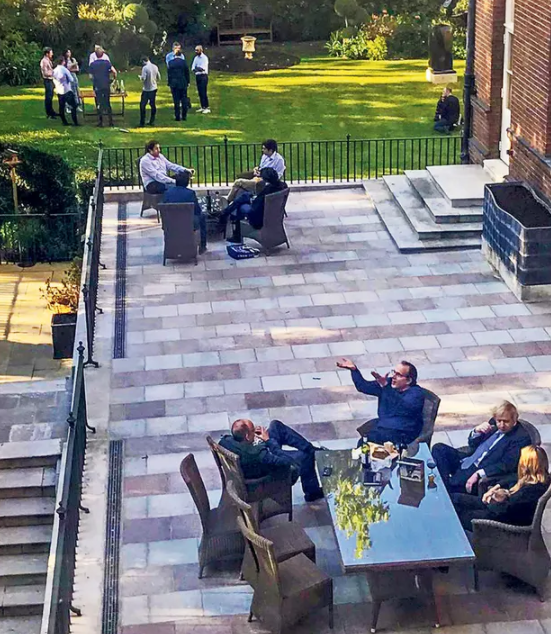
Boris Johnson and staff pictured with wine in Downing Street garden in May 2020

Boris Johnson has been pictured with wine and cheese alongside his wife and up to 17 staff in the Downing Street garden during lockdown, raising questions over No 10’s insistence a “work meeting” was taking place.

Dear reader, how good were your social contacts in May 2020, did you have wine and nibbles with 17 in your garden when social mixing between households was limited to two people? – Owl

Rowena Mason www.theguardian.com 

The photograph was shared with the Guardian following No 10’s denial last week that there was a social event on Friday 15 May 2020 including wine, spirits and pizza inside and outside the building. Johnson’s spokesman said Downing Street staff were working in the garden in the afternoon and evening.

However, the picture raises questions over that assertion. Bottles of wine are in evidence, there is a lack of social distancing and 19 people are gathered in groups across the Downing Street terrace and lawn.

At the time social mixing between households was limited to two people, who could only meet outdoors and at a distance of at least 2 metres. In workplaces, guidance said in-person meetings should only take place if “absolutely necessary”.

Angela Rayner, the deputy leader of the Labour party, described the picture as “a slap in the face of the British public”, adding: “The prime minister consistently shows us he has no regard for the rules he puts in place for the rest of us. Alleged drinking and partying late into the evening [at No 10] when the rest of us were only recently getting one daily walk.”

The prime minister has faced a string of allegations of partying and socialising in No 10 while Covid restrictions were in place. He was forced to order a civil service inquiry, though its head stepped down on Friday over allegations of his own Christmas party.

The past week has been described as the worst of the prime minister’s premiership, with a major rebellion by Conservative MPs over Covid regulations followed by a historic byelection defeat and the shock departure of the Brexit minister, David Frost.

In the new image shared with the Guardian, Boris Johnson and Carrie, who appears to be holding their newborn baby, are seen sitting around a table with a cheeseboard and wine, along with two people believed to be a civil servant and an aide. Last week No 10 said Johnson was working in the garden before retiring to his flat at 7pm.

On that day Matt Hancock, then health secretary, had given a 5pm press conference urging people to stick to the rules and not take advantage of the good weather over the May weekend to socialise in groups.

At the time schools were still shut and pubs and restaurants were closed, with strict controls on social mixing. More people had been allowed to return to their workplaces, but guidance said social distancing of 2 metres should be followed at all times and “only absolutely necessary participants should attend meetings and should maintain 2-metre separation throughout”.

The Guardian reported last week, as part of a joint investigation with the Independent, that Johnson had been present for an alleged social gathering in Downing Street on 15 May 2020. Sources said the prime minister had spent about 15 minutes with staff, telling an aide inside No 10 that they deserved a drink for “beating back” coronavirus.

Insiders claimed about 20 staff drank wine and spirits and ate pizza following a press conference on that day, some in offices inside No 10 and others going into the garden. Some staff stayed drinking until late into the evening, they alleged. The sources described the event as having a “celebratory” feel given the initial loosening of some restrictions and the good weather in London that day.

In response, No 10 said Johnson and staff had been working in the garden and made no reference to the allegations of drinking alcohol and socialising. The prime minister’s official spokesperson said last week: “In the summer months Downing Street staff regularly use the garden for some meetings. On 15 May 2020 the prime minister held a series of meetings throughout the afternoon, including briefly with the then health and care secretary and his team in the garden following a press conference.

“The prime minister went to his residence shortly after 7pm. A small number of staff required to be in work remained in the Downing Street garden for part of the afternoon and evening.”

Hancock, who was health secretary before he had to resign after breaking social distancing rules with his aide, Gina Coladangelo, said it was “not true” that he was involved in a social gathering. “After the press conference, which finished at approximately 5.53pm, Matt debriefed his own team, then went to the Downing Street garden to debrief the prime minister. He left Downing Street at 6.32pm and went back to the Department for Health and Social Care,” Hancock’s spokesperson said. There is no suggestion he was drinking or stayed late.

In light of the new picture, it is understood No 10 maintains that people drinking at work was not against regulations at the time. A Downing Street spokesperson said on Sunday: “As we said last week, work meetings often take place in the Downing Street garden in the summer months. On this occasion there were staff meetings after a No 10 press conference.

“Downing Street is the prime minister’s home as well as his workplace. The prime minister’s wife lives in No 10 and therefore also legitimately uses the garden.”

There have been a string of accusations that Downing Street staff broke rules by having Christmas parties, with the prime minister presiding over a Zoom quiz and giving a speech at a leaving do.

Johnson ordered an investigation after a video was leaked to ITV showing aides laughing about a Christmas party with wine and cheese, and suggesting passing it off as a business meeting. Simon Case, the cabinet secretary, stepped down from leading that investigation after it emerged his own office had held a Christmas party, and has been replaced by another senior civil servant, Sue Gray.

Rayner said: “This picture is utterly heartbreaking to see for the people that spent the first wave of the pandemic on the frontline of our health service, desperately missing their loved ones, enduring loneliness, missing funerals … Every day that passes seems to add another event to Sue Gray’s growing list of investigations into alleged unlawful gatherings in Downing Street.”

“Boris Johnson’s government is run with the attitude that it is one rule for them, and another for everyone else. He is totally unfit to lead our country.”

Nadine Dorries ousted from Conservative WhatsApp group for praising PM

Owl would be interested to know whether Simon Jupp is one of the over 100 Tory MPs (now minus Nadine Dorries) who make up the “Clean Global Brexit” group. 

Were the Tories to oust Boris how long before Steve Baker MP formed a splinter group to oppose his successor?

Are we about return to 1997 headlines such as: “Tories fighting like ferrets in a sack” ?

Culture Secretary Nadine Dorries has been kicked out of a Conservative WhatsApp group after urging MPs to show the prime minister “a bit of loyalty”.

www.bbc.co.uk

Tory WhatsApp group

Messages shot around the “Clean Global Brexit” group – made up of over 100 Tory MPs – following the resignation of Brexit Minister Lord Frost on Saturday.

After claims his exit was a “disaster” and a “hammer blow” for Boris Johnson, Ms Dorries called the PM “a hero”.

But former minister Steve Baker removed her, saying: “Enough is enough.”

The prime minister is facing growing criticism from a section of his backbenches, especially over the introduction of further Covid measures to tackle the Omicron variant.

He faced the biggest rebellion of his premiership on Tuesday when 100 of his own MPs voted down Plan B restrictions for England, including the introduction of Covid passports for certain venues.

But the measures passed after Labour decided to vote in favour of the plan.

Since then, the UK has reported days of record breaking case numbers, with Saturday’s coming in at 90,418.

And despite upset from his own party, Health Secretary Sajid Javid refused to rule out further Covid restrictions, telling the BBC’s Andrew Marr programme there were “no guarantees in this pandemic”.

On Saturday night, the resignation of Lord Frost – who had planned to leave in January – was leaked to the Mail on Sunday, speeding up his departure from government.

In his letter to the PM, he highlighted his “concerns about the current direction of travel” in No 10, and warned Mr Johnson “not be tempted by the kind of coercive measures we have seen elsewhere” to tackle coronavirus.

Tory MPs began reacting to the news in the WhatsApp group, calling Lord Frost a “hero” and saying his views were echoed by most of the party’s MPs.

But Ms Dorries – who was promoted to cabinet in the last reshuffle – responded by saying: “The hero is the prime minister who delivered Brexit.”

She added: “I’m aware as someone said today that regicide is in the DNA of [the] Conservative Party, but a bit of loyalty to the person who won an 83 [seat] majority and delivered Brexit wouldn’t go amiss.”

Her colleague Conor Burns said she was “absolutely right”, adding: “Memory seems to be very short.”

But before his post had even come through, Mr Baker removed Ms Dorries from the group, with another MP thanking him for the move.

He said there were two “critical” reasons for Mr Johnson’s large win in the December 2019 election – his Brexit deal being rejected by Parliament and the fact “someone (ahem) but not him persuaded [Nigel] Farage not to run against incumbents”.

But Mr Baker urged other members not to argue, posting: “We have troubles enough in our immediate future.”

Omicron wave yet to reach Devon and Cornwall, expert warns

We are still experiencing the tail-end Delta surge from the large summer events such as Boardmasters!

Have you got that, Simon? – Owl

Evie Townend www.devonlive.com

An expert has warned that Devon and Cornwall are yet to experience the wave of Omicron that is gripping the rest of the country.

Dr David Strain, a senior clinical lecturer at the University of Exeter, said that the region is experiencing the tail-end of the Delta-variant surge that was caused by large events such as Boardmasters at the end of summer.

While the overall Covid numbers across the region appear to be falling, he says this is due to the Delta washing out while the Omicron hit is still to come.

David said: “Bizarrely as numbers are climbing nationally, the overall numbers in the South West appear to be waning but that’s more because we are coming out of a late wave of the Delta variant spread from the end of the Boardmasters peak that we saw in summer.

“We still have lots of Delta variant patients with only around 12 to 13% Omicron cases in the South West but I suspect that what’s been seen nationally with Omicron rising tremendously, I’m expecting it will hit us next week.”

While the severity of the Omicron variant is not entirely known, David said that its rapid transmission within the vaccinated population is a large cause for concern.

He said: “There are a few cases of the Omicron variant in hospital but the bigger problem that we’re seeing with Omicron is how quickly it’s spreading even within populations that are vaccinated.

“From a staffing point of view, across the whole of the health service, you can’t be going to work if you’re carrying the virus that will spread to the compromised patients that you’re looking after.

“So one of the big things we’re very worried about is the impact that this is going to have on our ability to continue to provide a health service in the next few months.”

David said he hoped that there would be some sort of circuit-break lockdown in the near future, however he felt “the government had made it very clear that they were not going to interfere with Christmas.”

Instead, he said that along with cancelling super-spreader events, extending school holidays or reintroducing remote schooling was a sensible option that could be a “half-way house” between a full two-week lockdown with the potential to “nip the variant in the bud.”

He said: “What we saw in October, particularly stark across Devon and Cornwall, was a massive reduction in transmission when the kids were on half term and that was actually a lot more than we could have hoped for.

“It was the same in the summer, with the so-called ‘freedom day’, everyone thought it would go catastrophic but it turns out that children are acting much more as vectors than anyone was expecting.

“Kids are about to start holidays and so actually what I would suggest the most sensible thing at the moment would be to extend the school holidays by a week or so.

“If they extend the Christmas holidays by a week or two that means that any covid within the family unit will stay there as more people will have to work from home or got out, it sort of becomes a lockdown by default.

“A week or two extra weeks of kids not mixing at school, which is where most of the spread of the delta variant spread, could be enough to nip Omicron in the bud.”

Lord Frost resigns from government in fresh crisis for Boris Johnson

Brexit minister David Frost has resigned from Boris Johnson’s cabinet in protest at “the direction of travel,” triggering a fresh crisis inside Downing Street after an already turbulent week for the prime minister.

www.independent.co.uk

Lord Frost – one of the most popular members of the cabinet among the Conservative faithful – handed in his resignation a week ago and had been persuaded to stay in his post until January but last night said he would step down “with immediate effect.”

His resignation represents a major political blow for the prime minister who is already facing a series of crises over “gatherings” in No 10 during Covid restrictions, growing discontent on the Tory backbenches over his leadership and this week’s historic loss in the North Shropshire by-election – a seat held by the party since 1832.

In his resignation letter, Lord Frost told the prime minister he was disappointed about Covid restrictions, warning him not to be “tempted by the kind of coercive measures we have seen elsewhere,” but also hinted at other concerns, saying: “You know my concerns about the current direction of travel.”

The cabinet minister, who Mr Johnson had elevated to the Lords, helped negotiate the Brexit agreement and in recent months has been instrumental in negotiations with the EU over the Northern Ireland protocol.

His departure will fuel speculation about the future of Mr Johnson’s leadership, but in his letter Lord Frost was careful to express “confidence” in the PM. On Friday, Tory MPs put Mr Johnson on notice while one backbencher revealed he had submitted a letter of no confidence in the prime minister to the chair of the 1922 committee of backbench Conservative MPs.

Jenny Chapman, the shadow Brexit secretary, said: “As if we didn’t already know, Lord Frost resigning shows the government’s in chaos.

“The country needs leadership not a lame duck PM whose MPs and cabinet have lost faith in him. Boris Johnson needs to apologise to the public and explain what his plan is for the next few weeks.”

The Liberal Democrat foreign affairs spokesperson, Layla Moran, added: “This shock resignation is a sign of the chaos and confusion at the heart of this Conservative government. The rats are fleeing Boris Johnson’s sinking ship as he lurches from crisis to crisis.

“Even the prime minister’s once-loyal supporters are now abandoning him, just as lifelong Conservative voters are switching in their droves to the Liberal Democrats.

“At a time we need strong leadership to get us through the pandemic we instead have a weak prime minister who has lost the support of his allies and the trust of the British people.”

On Friday, it had also emerged the UK had abandoned its attempt to strip EU judges of the power to oversee the Northern Ireland protocol – despite repeated pledges by Lord Frost and the government to “remove” the role of the European Court of Justice (ECJ).

In October, Lord Frost travelled to Lisbon and vowed the ECJ would not be allowed to have a remit, but new UK proposals would see it interpret matters of EU law.

Disputes would be settled by an independent arbitration panel, rather than the European Commission, a model offered to Brussels by Switzerland. At a Brussels press conference, Maros Sefcovic, the commission vice-president, said the UK signed up to the ECJ’s existing remit, so it was “a topic we are not ready to include in our discussions”.

Describing Lord Frost’s decision to leave the cabinet as “enormous”, Arlene Foster, the former first minister of Northern Ireland, said: “The resignation of Lord Frost from the Cabinet is a big moment for the government but enormous for those of us who believed he would deliver for NI.’’

In a recent speech to the Centre of Policy Studies, the Brexit minister said he agreed with Rishi Sunak, the chancellor, that the Conservatives’ “goal must be to reduce taxes” and said Brexit won’t succeed if “all we do is import the European social model”.

He was also effusive in his praise of the lack of Covid restrictions during the 23 November speech, saying: “Unavoidably, we have had a lot of state direction and control during the pandemic.

“That cannot and must not last for ever, and I am glad that it is not. I am very happy that free Britain, or at least merry England, is probably now the free-est country in the world as regards Covid restrictions. No mask rules, no vaccine passports – and long may it remain so.”

Devon covid down again but figures pre-date Omicron concerns

Covid infections across Devon have fallen in the latest seven-day period, but  the numbers don’t yet reflect the surge in Omicron cases hitting the nation.

Joe Ives, local democracy reporter www.radioexe.co.uk

The latest weekly statistics run to Sunday, 12 December.  On that single day alone, the UK  recorded 50,149 cases. By Friday, 17 December that number had nearly doubled to 93,045, the highest daily figure since the start of the pandemic.

Nevertheless, before Omicron took hold, infections in Devon dropped. Now the new weekly figures to 12 December show 7,591 new cases, 1,412 (16 per cent) fewer than the previous week. On that day, the county’s infection rate was 662 per 100,000 of the population, still higher than the national average of 536.

Cases fell in every council area in Devon apart from Plymouth, where infections rose three per cent. The 2,206 new cases in the city was 56 (3 per cent) more than the previous week. During this period, Plymouth had an infection rate of 839 per 100,000 of the population.

The Devon County Council area, which excludes Plymouth and Torbay, saw cases drop 22 per cent, with 1,331 fewer. The rate of infection across ts seven districts stood at 567 per 100,000.

After having the highest rates of infection of anywhere in the country in late November, Torridge welcomed a drop in cases for the second consecutive week. The number of people contracting covid was down a third (36 per cent), with 408 new infections, down from 226 the week before, and a rate of 594 per 100,000.

Torbay recorded 791 new cases, down 146. The 16 per cent drop takes the Bay’s rate of infection to 581 per 100,000.

Hospitalisations

The most recent data (from Tuesday, 7 December) shows 160 patients in Devon’s hospitals with covid, an increase of 12 from the previous week.

Sixty-nine are at Derriford Hospital in Plymouth, 36 at the RD&E, 30 in Torbay, 22 in North Devon and three at Devon Partnership mental health sites.

Of the total number of patients, 16 are in ventilation beds.

Deaths

Seventeen people died within 28 days of receiving a positive covid test across Devon in the most recent complete seven-day period (up to Sunday, 12 December) – six more than in the previous week.

Ten people died in the Devon County Council area, which excludes Plymouth and Torbay. Six deaths were recorded in Plymouth. One death was  in Torbay.

Across Devon, a total of 1,389 people have now died within 28 days of a positive covid test.

Vaccinations

Eighty-seven per cent of people aged 12 and above have had their first dose of a vaccine in the Devon County Council area, excluding Plymouth and Torbay, with 81 per cent receiving both doses. Forty-nine per cent have now had their ‘booster’ dose.

In Plymouth, 84 per cent have had one dose, while 77 per cent have had both. Thirty-eight per cent have had the booster.

In Torbay, 85 per cent have received one dose, while 79 per cent have had both jabs. Fifty-one per cent have had their third vaccine.

The national rates are 89, 82 and 45 per cent respectively.

On Friday,  17 December, promising early research was shared which suggests that booster vaccines could be 85 per cent effective in preventing severe illness from the Omicron variant.

The modelling, from Imperial College London, is based on limited information on Omicron.

The researchers say there is a high degree of uncertainty until more real-world information is gathered.

Imperial researchers Prof Azra Ghani said: “One remaining uncertainty is how severe the disease caused by the Omicron variant is compared to disease caused by previous variants.

“Whilst it may take several weeks to fully understand this, governments will need to put in place plans now to mitigate any potential impact.

“Our results demonstrate the importance of delivering booster doses as part of the wider public health response.”

Dr Clive Dix, former chair of the UK Vaccine Taskforce, said: “There is a huge amount of uncertainty in these modelled estimates and we can only be confident about the impact of boosters against Omicron when we have another month of real-world data on hospitalisation, ICU [intensive care] numbers and deaths.

“It remains the case that we still need to get vaccines current and future to the whole world.”

New Charity Commission Chair is ‘close friend’ of PM who left charity over inappropriate behaviour – Good Law Project

[Widely reported yesterday, Mr Thomas, new Chair of the Charity Commission, has resigned before starting the job (another one under the bus). Why was he given it in the first place?]

goodlawproject.org

When the Government announced that Martin Thomas was their preferred candidate for the new Chair of the Charity Commission, many people in the charity sector breathed a sigh of relief. This may have been premature. 

Mr Thomas had a low public profile and was not an obvious candidate to deliver on the former Culture Secretary’s promise to hire someone who would stop charities pursuing a “woke agenda”. 

His credentials suggested he had professional charity sector experience under his belt. Prior to being selected, Martin Thomas was Chair of the Board at two charities, Downside Up and the Forward Arts Foundation. Before that, he was the Chair at Women for Women International UK, which helps women survivors of war rebuild their lives. 

But all was not quite as it seemed. 

The Times has reported that Martin Thomas is understood to be ‘close friends’ with Prime Minister Boris Johnson. The pair studied Classics at Oxford University at the same time and Johnson is still a patron of Downside Up. In 2013, when Johnson was Mayor of London, Mr Thomas gifted him an antique Russian ‘Takema’ watch.  

Then things start to get worse.

We understand that three formal complaints were made against Mr Thomas while he was Chair at Women for Women International. The last of these was partly upheld and was the subject of a serious incident report to the Charity Commission in 2021. 

We’ve heard that, following the investigation into the 2021 complaint, the Board of Women for Women International had planned to ask Mr Thomas to step down as Chair immediately, but he resigned before they could. The first complaint, which was not upheld, concerned Mr Thomas sending an unsolicited photograph. He had intended to send it to one female employee, but accidentally sent it to another, and then asked her to forward it to its intended recipient, also female. 

Shocking behaviour, especially from the Chair of a women’s rights charity. The sort that might properly disqualify someone from chairing the Charity Commission.

How, despite all of this, did he come to be appointed? Was there political interference? Were references taken up from Women for Women International? Did anyone check with the Charity Commission about his record before appointing him as Chair?

What we’ve uncovered casts serious doubt on Mr Thomas’s suitability, and raises grave questions about the integrity of the process. These must be answered as soon as possible. 

This is not how public appointments should happen. We have written asking the Secretary of State to concede that the process leading to Martin Thomas’ appointment was deeply flawed. We’ve asked them to tell us whether the Prime Minister or his staff played any role in the recruitment process; to tell us whether the complaints from Women for Women International were disclosed by Mr Thomas as part of the interview and assessment process; and ultimately, to reconsider and withdraw Mr Thomas’ nomination to be Chair of the Commission. 

The independence of the Charity Commission is essential to the future of UK charities, which provide lifelines to countless people and marginalised groups. We will not stand by as its integrity is damaged by this appointment. 


Good Law Project only exists thanks to donations from people across the UK. If you’re in a position to support our work, you can do so here

Met Police refusing to investigate No 10 gatherings likely to be unlawful – Good Law Project

goodlawproject.org 

A week since shocking stories first emerged of illegal gatherings in and around No 10 and still the Met Police won’t investigate. Would they be as shy had you or I broken the law? Look at the form they publish for gathering evidence on breaches of Coronavirus rules by normal people and you rather doubt it.

So why the difference?

We decided to cut through the nonsense and commission two of the country’s leading lawyers – top policing barrister Danny Friedman QC and leading authority on Covid regulations Adam Wagner – to advise on whether the Met Police refusal to investigate is unlawful. We are today publishing that advice in full.

Their view is that a policy of not investigating retrospective breaches is likely to be unlawful; a failure to publish the policy is likely to be unlawful; and a decision not to investigate based on an absence of evidence is also arguably unlawful.

We remain astonished at what looks, to us, like the Met’s willingness to tolerate conduct that undermines public health and erodes trust in the rule of law. In 1733 Dr Thomas Fuller wrote “Be you ever so high, the law is above you.” Those are fine words – and we think the Met should pay heed.

A week ago today we wrote to the Met telling them we intended to sue if they continued to refuse to uphold the law. They have two weeks to change their minds.


Good Law Project only exists thanks to donations from people across the UK. If you’re in a position to support our work, you can do so here.

Fresh embarrassment for Boris, could this be true?

Read it in the Mail on Sunday

New Allegra tape headache for Boris: No10 braces for fresh embarrassment amid fears ex-spokeswoman was questioned about the PM’s private life in ANOTHER excerpt from Partygate tape that could be screened in days

  • Allegra Stratton’s now-infamous mock press conference was filmed in December last year
  • It forced PM into humiliating Commons apology, led to Ms Stratton’s tearful doorstep resignation and contributed to loss of 23,000 Tory majority at Thursday’s North Shropshire by-election
  • Former and current No 10 staff fear further damning tapes, including embarrassing material for PM, might also be in circulation
  • Source told MoS that the recorded sessions included mock questions aimed at Ms Stratton referring to ‘mistresses’ and ‘love children’ of Mr Johnson

Led by Donkeys plays partygate “evidence” on big screen to Scotland Yard

From led by Donkeys

Hello friends,

While most of us obeyed the rules and made sacrifices last winter, Boris Johnson’s Downing Street was holding raucous law-breaking parties. It’s an open and shut case, but the Metropolitan Police is refusing to investigate. The Met says there is an “absence of evidence.” That’s an absurd claim to make, so we took the evidence direct to Scotland Yard on a giant TV screen – with a voiceover that a lot of people found familiar.

There’s a blizzard of speculation about whether it’s the Superintendent Ted Hastings from Line of Duty. For operational reasons we can neither confirm nor deny it.

But that didn’t stop the Daily Star putting our protest on the front page this morning:

While GMB ran the film at 7am on national television:

The film has been shared over 150,000 times and viewed more than 8 million times across social media. Last night the Met put out a defensive statement which we think shows they’re under real pressure to reverse their absurd position.

As ‘Ted’ says, “Our leaders partied while families were separated and our citizens died in their thousands. Who exactly does the Metropolitan Police work for ma’am? Our citizens, or Boris Johnson?”

If you’ve not seen it yet, you can watch it on Twitter, Facebook, Instagram and YouTube.

Thanks to everyone who has signed up to become a Led By Donkeys supporter. You make this important work possible.

Cheers,

Ben, James, Olly & Will x

Will the bodies now pile up?

Following the revolt by Simon Jupp and his like, how can Boris Johnson now introduce more restrictions, should that prove necessary?

Without commanding the confidence of a majority of Tory backbenchers, he would have to rely on the support of the Opposition. What would that do to his self-image?

Owl can’t see him acting decisively. We will all suffer the consequences.

Covid: More measures needed to limit hospitalisations – Sage scientists

By Jim Reed www.bbc.co.uk

More stringent restrictions need to be brought in “very soon” in England if ministers want to stop hospital admissions reaching 3,000 a day, the government’s scientific advisers say.

The BBC has seen leaked minutes of a meeting of the Scientific Advisory Group for Emergencies held on Thursday.

The document says there are “many uncertainties” about the future path of hospitalisations linked to Omicron.

It comes as the UK’s four nations are to hold a Cobra meeting this weekend.

Timing of measures ‘crucial’

According to those leaked minutes, the Sage advisers say that without intervention measures beyond the Plan B rules currently in place, modelling indicates that hospital admissions could peak at “at least” 3,000 a day in England.

The number of people requiring treatment in hospital has been rising, with admissions being between 800 and 900 every day in the past week.

The current Plan B rules for England include Covid passes for certain events, face masks in more places and people being urged to work from home if they can.

The other nations of the UK had already brought in similar rules – and Scotland has gone further by asking people to limit social contact to three households at a time in the run-up to Christmas. Wales has also ordered nightclubs to close from 27 December.

The Sage minutes say: “If the aim is to reduce the levels of infection in the population and prevent hospitalisations reaching these levels, more stringent measures would need to be implemented very soon.”

The record of the meeting goes on to say that measures equivalent to those in place after Step Two or Step One of the roadmap in England, if enacted early enough, “could substantially reduce the peak in hospital admissions and infections compared with Plan B alone”.

Step One and Two of the roadmap for easing lockdown – which was in place in England in the Spring – banned indoor social contact and indoor hospitality. Step Three allowed six people, or two households, to meet indoors and indoor hospitality could reopen.

“The timing of such measures is crucial,” say the Sage minutes. “Delaying until 2022 would greatly reduce the effectiveness of such interventions and make it less likely that these would prevent considerable pressure on health and care settings.”

Sage meetings are designed to advise officials and ministers about the possible path of the pandemic in certain circumstances rather than offer up concrete predictions.

The Department of Health has been contacted for comment.

It comes as Omicron continues to spread across the UK – and is thought to now be the dominant variant in England and Scotland, replacing Delta.

On Friday the UK saw another record number of daily Covid cases for the third day in a row, with more than 93,000 infections announced.

But there was also a record 861,306 booster and third dose jabs announced – the highest daily total so far.

It means half of all UK adults had now received a booster jab, Prime Minister Boris Johnson said.

He later tweeted that a meeting of the government’s emergency committee Cobra will be held over the weekend with representatives from the devolved administrations.

Elsewhere, new research on Friday showed that a Covid booster shot would offer around 85% protection against severe illness from Omicron.

The protection is a bit less than vaccines gave against earlier versions of Covid – but it means the top-up dose should still keep many people out of hospital.

Across Europe, health officials are braced for a wave of infections. Additional restrictions were announced in Germany, the Irish Republic and the Netherlands on Friday as governments seek to stem the tide.

French Prime Minister Jean Castex warned that the Omicron variant is “spreading at lightning speed” in Europe and will likely become dominant in France by the start of next year.

On Friday, France imposed strict travel restrictions on those entering from the UK.

Chris Whitty v Tory MP Joy Morrissey: who to believe on Covid?

Conservative MPs have been taking out their frustration on England’s chief medical officer, Chris Whitty, for what they see as his promotion of “lockdown by stealth”. Chief among them is Joy Morrissey, who said Whitty should “defer” to politicians like her.

Matthew Weaver www.theguardian.com 

In a now deleted tweet, Morrissey, who is on the government payroll as a parliamentary aide, said: “Perhaps the covid unelected public health spokesperson should defer to what our ELECTED members of parliament and the prime minister have decided. I know it’s difficult to remember but this is not how democracy works. This is not a public health socialist state.”

So who should the public trust on the pandemic – the chief medical officer or the MP for Beaconsfield? Their respective CVs may offer a clue.

Prof Chris Whitty CB FRCP FFPH FMedSci

Age: 55.

Occupation: chief medical officer for England and practising NHS consultant physician.

Previous jobs: acting chief scientific adviser; director of research at the Department for International Development; chief scientific adviser to the Department of Health; head of the National Institute for Health Research Education; consultant physician at University College London hospitals; professor of public and international health at the London School of Hygiene & Tropical Medicine.

Education: doctorate in medical science from Oxford; two diplomas, in tropical medicine and hygiene, and economics; three master’s degrees, in epidemiology, medical law and business administration.

Awards: Companion of the Order of Bath; fellow of the Academy of Medical Science; honorary doctorate for medical work in the community from the University of Plymouth.

What people say about him: Prof David Mabey, an infectious disease specialist at the London School of Hygiene & Tropical Medicine says: “Chris is a polymath. He is really extraordinary. Since I’ve known him he’s done a diploma in economics, a degree in law and an MBA in his spare time. And in terms of his research, he covers all the disciplines: clinical medicine, epidemiology, health economics, social science. That’s really what makes him unique. He is the best man for the job, we are extremely lucky to have him.”

Joy Morrissey MP

Age: 40.

Occupation: member of parliament for Beaconsfield and parliamentary private secretary to the justice secretary, Dominic Raab.

Previous jobs: Ealing councillor; actor including a role in a “bonkfest” TV movie called Geek Mythology, about a man who acquires a magical statue that makes him irresistible to women.

Education: master’s degree in European social policy from the London School of Economics.

Awards: shortlisted for the Conservative London mayoral candidacy in 2021 but beaten by Shaun Bailey.

What people say about her: The Financial Times said she was a “passionate Brexiteer motivated by social injustice”. Morrissey has said of herself: “I don’t really care that much what people think, particularly if I think I’m right.” Her campaign to offer all homes and businesses a portrait of the Queen was dismissed as “Stalinist”.

“Beam me up Scottie” to……..

From a correspondent

A Tory MP has given us her definition of democracy (since deleted):

From this I have to surmise that elected MPs and the Prime Minister are the most intelligent beings on this planet.  Just by being elected (especially if they are Tory, of course) they are automatically more clever than any and every scientist, doctor, professor, etc.

My first thought?  “Beam me up Scottie” – to any planet other than this one! Although, on reflection, maybe just beam me up to Amersham and Chesham or North Shropshire where some sense of reality may be emerging on THIS planet!

Simon Case will no longer lead No10 party probe after allegation of party in department’s office

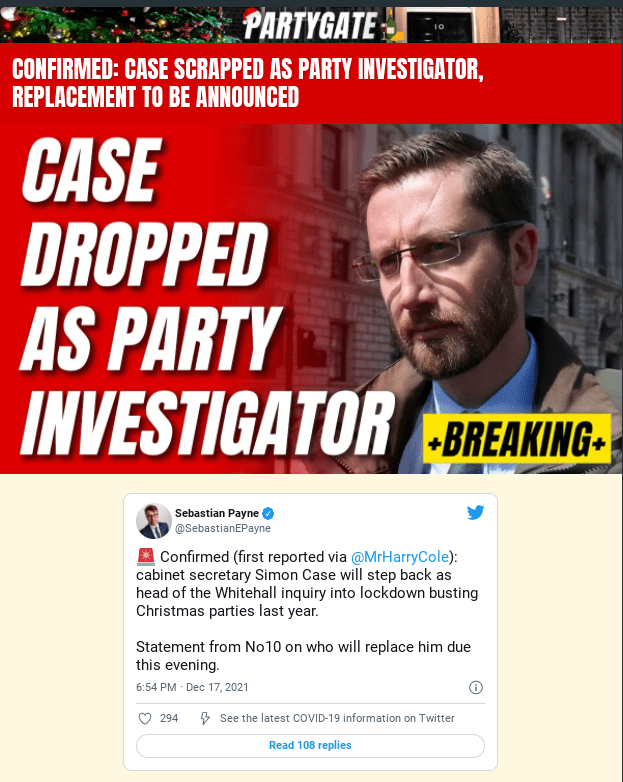
After nearly a week of investigation the Cabinet Secretary discovers that he himself is compromised and “recuses” himself from continuing to “mark his own homework”.

Given this knowledge, Owl wonders why he accepted the task in the first place. 

If all this results in a whitewash, will anyone except Boris believe it? 

“With each revelation, there is more evidence of a culture of turning a blind eye to the rules.” – Angela Rayner

www.itv.com

Cabinet Secretary Simon Case will no longer lead an investigation into several alleged Covid lockdown-breaking Christmas parties held in Whitehall last year, following accusations that his department’s office held its own gathering.

Mr Case had been tasked by Prime Minister Boris Johnson to lead an inquiry into whether a series of gatherings held in Whitehall in November and December last year breached strict restrictions.

And it was confirmed the scope could be widened to other alleged parties if Mr Case thought it necessary.

However following reports that two parties were held in the Cabinet Office in December 2020, a No 10 spokesperson said: “To ensure the ongoing investigation retains public confidence the Cabinet Secretary has recused himself for the remainder of the process.

“The work will be concluded by Sue Gray, second permanent secretary at the Department for Levelling Up, Housing and Communities.

“She will ascertain the facts and present her findings to the Prime Minister.”

A source confirmed to ITV News that a partially virtual quiz took place in Mr Case’s department’s office on December 17, with six people who were in the office that day, taking part in person in a socially distanced manner. Most attendees dialled in remotely from home.

However, the source said Mr Case did not actively take part but acknowledged staff. The source added he knew the gathering was happening as he had to walk past the group in order to get to his private office.

Anger has been growing against Mr Johnson’s party as allegations of further gatherings emerge

The Cabinet Office later confirmed these reports in a statement on Friday evening, with a spokesperson telling ITV News: “Staff in the Cabinet Secretary’s private office took part in a virtual quiz on December 17 2020.

“A small number of them, who had been working in the office throughout the pandemic and on duty that day, took part from their desks, while the rest of the team were virtual.

“The Cabinet Secretary played no part in the event, but walked through the team’s office on the way to his own office. No outside guests or other staff were invited or present.

“This lasted for an hour and drinks and snacks were bought by those attending. He also spoke briefly to staff in the office before leaving.”

At the time, London was under tough Tier 3 Covid restrictions, under which the law stated: “No person may participate in a gathering in the Tier 3 area which consists of two or more people, and takes place in any indoor space.”

According to Guido Fawkes, a second event in Mr Case’s department saw staff drinking together in the office before heading out elsewhere in December.

Who is the new No 10 Christmas party inquiry lead, Sue Gray?

Ms Gray was director-general of propriety and ethics in the Cabinet Office from 2012 to 2018, and is seen as a Whitehall heavy hitter who would not pull any punches in an inquiry.

Ms Gray oversaw the Plebgate inquiry in 2012 after former chief whip Andrew Mitchell was accused of calling a policeman a “pleb” at the Downing Street gates, and was described as “deputy God” by then Labour MP, Paul Flynn, in a meeting of Parliament’s Public Administration Committee the same year.

Former Tory MP and Cabinet office minister Oliver Letwin is reported to have once said of Ms Gray: “It took me precisely two years before I realised who it is that runs Britain.

“Our great United Kingdom is actually entirely run by a lady called Sue Gray, the head of ethics or something in the Cabinet Office.

“Unless she agrees, things just don’t happen.”

She was once described by BBC Newsnight’s then policy editor as “the most powerful person you’ve never heard of”.

Labour’s deputy leader Angela Rayner said Ms Gray has the “incredible responsibility” on her shoulders of restoring public trust.

Ms Rayner said: “I do believe that the investigation that Sue Gray is going to be leading up, there’s the evidence there, they need to carry that investigation out very swiftly to restore the public trust and then hand over that evidence to the police because nobody’s above the law.”


It had previously been questioned whether Mr Case was the right person to lead an inquiry, after the prime minister would not confirm or deny whether he attended an alleged No 10 party on December 18. The prime minister put Mr Case up for the job and was forced to apologise after ITV News released a video showing some of his senior advisers laughing about the alleged Christmas party in Downing Street.

Mr Johnson later confirmed the investigation would also look into a Downing Street quiz on December 15 – after a picture emerged of the PM allegedly hosting it – along with an alleged festive drinks party that is accused of breaking Covid rules on December 10 at the Department for Education.

The Department for Transport also admitted a “socially distanced gathering in the large open-plan office” was held on December 16.

And Tory London mayoral candidate Shaun Bailey apologised “unreservedly” and stood down from his role as chair of the London Assembly’s policing body for attending a gathering at Conservative Campaign Headquarters (CCHQ), organised by staff on his campaign team on December 14, when London was in Tier 2 and indoor mixing between households was banned.

Labour’s deputy leader said she was “incredibly disappointed” in Mr Case.

Ms Rayner said: “I wrote to him and obviously had asked for this investigation and the fact that he didn’t come right away and say ‘actually, I can’t do that investigation because of the implications of my actions’ I find disappointing.”

She earlier had said: “With each revelation, there is more evidence of a culture of turning a blind eye to the rules.

“Labour made it clear the person leading the investigation should be uncompromised, free to make an independent judgement.”

Breaking News: Anyone with a shred of integrity left in Whitehall?

No 10 inquiry chief Simon Case faces questions over own ‘party’ last year – Breaking news from Guido Fawkes web site:

www.bbc.co.uk

A staff “Christmas party” was held last year at the office of the man investigating lockdown parties at Downing Street.

Top civil servant Simon Case is due to report shortly on claims Covid rules were broken at events for staff in the run up to last Christmas.

But the BBC has been told that Mr Case’s position as chair of the inquiry is now under consideration.

The Cabinet Office has been asked to comment.

The BBC understands a quiz was held for members of Mr Case’s private office on 17 December 2020, and invites were sent out titled “Christmas Party!”

About 15 people were invited to the gathering at 70 Whitehall, near Downing Street, although it is understood not everyone turned up.

The BBC has been told that while Mr Case did not take part in the Christmas quiz, he was present for the event.

Mr Case, who has been cabinet secretary since September last year, has been asked by Boris Johnson to investigate gatherings for staff in government buildings last year.

His inquiry is focusing on events in Downing Street on 27 November, 15 December and 18 December, and at the education department on 10 December.

Responding to press reports of the gathering in Mr Case’s office, Labour’s deputy leader Angela Rayner said: “Boris Johnson as prime minister has set the tone for the civil service and the rest of government.

“With each new revelation there is growing evidence of a culture of turning a blind eye to the rules.

“Labour made it clear when the investigation was launched that the person in charge should be uncompromised and able to make a fair and independent judgement. These fresh revelations put that into question.”

Tory MP Attacks Chris Whitty As ‘Unelected Spokesperson’ In ‘Socialist State’

With Boris Johnson equivocating on giving clear guidance the public seems to be heeding the advice being given the CMO. 

Wes Streeting, the shadow health secretary, said the Prime Minister needed  “to take on the swivel-eyed tendency in the Tory Party, but he’s too weak”. 

Since 1850 the Chief Medical Officer has been giving advice to the general public – it’s his/her job! – Owl

Alexandra Rogers www.huffingtonpost.co.uk 

A Tory MP has launched an attack on chief medical officer Chris Whitty, calling him an “unelected covid public health official” who should “defer” to parliament and the prime minister.

Joy Morrissey, the MP for Beaconsfield since 2010, made the comments in response to a tweet from Times journalist Steven Swinford who highlighted the difference in messaging between Boris Johnson and Whitty over socialising during the Christmas period.

In her tweet — which has since been deleted — Morrissey said: “Perhaps the unelected covid public health spokesperson should defer to what our ELECTED Members of Parliament and the Prime Minister have decided.

“I know it’s difficult to remember but that’s how democracy works. This is not a public health socialist state.”

Joy Morrissey's now-deleted tweet

Joy Morrissey’s now-deleted tweet

Twitter

Her tweet appeared to be criticised by MPs on her own side, including former chief whip Julian Smith, who said “personal attacks by any politician on members of the civil service are completely unacceptable”.

In a reply to Morrissey, writer James Felton said: “His job is to present the scientific view and what’s best for public health, not repeat what Boris Johnson said because he can’t keep his own MPs on board with basic health measures.”

The Labour Party’s south east branch said Morrissey should “focus her attention” on the actions of the chancellor “instead of attacking public health officials”.

Fellow Tory MP and health minister Gillian Keegan defended the government from accusations of mixed messaging on Thursday morning, as commentators pointed out that while the PM told people not to cancel social events, Whitty suggested they “prioritise” those that were most important to them.

Keegan denied Johnson was at odds with Whitty, arguing that they were “both basically saying the same thing”.

“What they were saying was prioritise, because obviously the more contacts you have, the more chance you have of testing positive, and that would mean that you’d be isolated on Christmas Day,” she told Times Radio.

“Obviously if you want to have a family Christmas, then be cautious, otherwise you could end up testing positive and having to isolate over Christmas. That’s the message.”

Omicron and cold-like symptoms rapidly taking over in London

covid.joinzoe.com 

According to ZOE COVID Study incidence figures, in total there are currently 87,131 new daily symptomatic cases of COVID in the UK on average, based on PCR and LFT test data from up to five days ago [*]. An increase of 4% from 83,658 new daily cases last week. In the vaccinated population (at least two doses) there are currently 27,000 new daily symptomatic cases in the UK. An increase of 6% from 25,411 new daily cases last week (Graph 1). 

The UK R value is estimated to be around 1.0 and regional R values are; England, 1.0, Wales, 1.0, Scotland, 1.0 (Table 1). Whilst these figures and R values suggest little is happening, London has an R value of 1.1, and is currently seeing a rapid rise in positive cases (Graph 3), this could be an early warning of what could happen across the rest of the country soon. 

In terms of prevalence, on average 1 in 57 people in the UK currently have symptomatic COVID. In the regions, England, 1 in 56. Wales, 1 in 46. Scotland, 1 in 79. (Table 1).

In the regions, cases are rapidly increasing in London (Graph 4), this rise is being driven by Omicron. Cases remain high in Midlands, East of England and Wales (Graph 4). 

The number of daily new cases among 0-18 year-olds remains high, while cases in the 19-35s are rapidly rising and the 36-55 age group continue to rise more steadily. Cases in the 55-75 age group are dropping and cases remain low in the over 75s, likely due to third dose vaccines but also a change in behaviour such as face mask wearing and avoiding large social gathering which we expect is being driven by fear of Omicron (Graph 2).

ZOE’s predicted Long COVID incidence rate currently estimates, at current case rates, 1,418 people a day will go on to experience symptoms for longer than 12 weeks. (Graph 4). 

The ZOE COVID Study incidence figures (new symptomatic cases) are based on reports from around 750,000 weekly contributors and the proportion of newly symptomatic users who have received positive swab tests. The latest survey figures were based on data from 52,489 recent swab tests done in the two weeks up to 11th December 2021. 

Omicron symptoms

In order to take a first look at the potential symptom profile of Omicron, this week ZOE conducted an initial analysis of symptom data from positive cases in London. London was selected due to the higher prevalence of Omicron compared to other regions. 

To compare Delta and Omicron, London data was selected from a week where Delta was dominant (03-10.10.2021) and compared to the most recent data (03-10.12.2021). This initial analysis found no clear differences in the early symptoms (3 days after test) between Delta and Omicron. 

The top five symptoms reported in the ZOE app were: 

  1. runny nose
  2. headache
  3. fatigue (either mild or severe)
  4. sneezing
  5. sore throat

ZOE will be conducting further research into the symptom profile of Omicron in the coming weeks. 

Professor Tim Spector, lead scientist on the ZOE COVID Study app, comments on the latest data:

“Omicron is set to be the dominant strain in the UK by Christmas, and in the New Year cases could hit a peak higher than anything we’ve ever seen before. In London cases have been rising rapidly, but this will likely slow down soon, as people change their behaviour, such as wearing face masks again, cancelling parties and working from home more. Hopefully people now recognise the cold-like symptoms which appear to be the predominant feature of Omicron. These are the changes that will slow the spread of the virus. It’s my hope that the rest of the country is doing the same to avoid big outbreaks outside of London, especially in big cities. 

Ahead of Christmas, if people want to get together and keep vulnerable family members safe, I’d recommend limiting social contact in the run up to Christmas and doing a few Lateral Flow Tests just before the big family gathering. As our latest data shows, Omicron symptoms are predominantly cold symptoms, runny nose, headache, sore throat and sneezing, so people should stay at home as it might well be COVID. We are also seeing two to three times as many mild infections in people with boosters in Omicron areas as we do in Delta variant areas, but they are still very protective and a vital weapon. The ZOE app is one of the best tools we have to rapidly understand this new variant so we want to encourage everyone to download the app and start logging. It only takes a minute to report but each contribution makes a huge difference to the fight against COVID.”

To ZOE COVID Study app can be downloaded here: https://api.covidradar.org/launch/ 

Graph 1. The ZOE COVID Study UK incidence figures results over time; total number of new cases and new cases in fully vaccinated

Graph 2. Incidence by age group 

Graph 3. Incidence in London 

Graph 4. Prevalence rate by region

Graph 5. Predicted Long COVID incidence over time

Please refer to the publication by Thompson at al. (2021) for details on how long covid rates in the population are modelled

Table 1. Incidence (daily new symptomatic cases)[*], R values and prevalence regional breakdown table 

Map of UK prevalence figures