First Downing Street officials receive £50 lockdown party fines

Will it be only the junior staff who take the rap? – Owl

Rowena Mason www.theguardian.com 

Officials have begun to receive emails giving out £50 fines for attending Downing Street parties, according to sources.

After the Metropolitan police said on Monday that they were issuing 20 penalty notices, emails have gone out to some of those involved, who the police “have a reasonable belief” attended gatherings during lockdown.

Government sources said the Met appeared to have tackled the “low-hanging fruit first” by concentrating on parties where those involved had acknowledged their participation.

The Met suggested the fines were issued as part of a “first tranche”, indicating that more could be handed out in relation to more complicated events where those involved are denying having attended illegal gatherings.

One of the events where some of the people in attendance are believed to have got fines is a leaving party on 18 June, which was held for a departing No 10 aide.

There is little transparency over the issuing of fines, with civil servants not obliged to tell their bosses if they have received penalty notices. The Met is also not providing a breakdown of which out of 12 events being investigated have led to fines so far.

No 10 has said it will provide an update if Boris Johnson receives a fixed penalty notice. The prime minister is believed to have been present at several of the gatherings under investigation, including a birthday party and a gathering in the garden of No 10 organised by his principal private secretary, Martin Reynolds.

However, he has refused to accept that a fine would mean he has broken the law, and his allies suggest he would not resign if he is issued with a penalty.

In contrast, Kit Malthouse, the policing minister, appeared to back the view of two cabinet colleagues in stating that the issuing of partygate fines is evidence that police believe the law has been broken.

Malthouse, a Home Office minister, said it was fair to say a fixed-penalty notice (FPN) signalled police felt an unlawful act had been committed.

Speaking to BBC Breakfast, Malthouse said: “A fixed-penalty notice means police have a reasonable belief that you’ve broken the law – you still have a right to challenge it if you want.

“Having said that, the police practice is not routinely to release the names of those who receive fixed penalties, and I don’t see why that rule should be waived for those people who may or may not be in receipt of it in Downing Street.”

Malthouse, who attends cabinet, said he had not personally received a fine in relation to the Scotland Yard investigation, but he would declare it if he did.

6 bits of bad news slipped out by the Tories hours before the Easter holiday

It’s ‘Take Out the Trash Day’ – when the government rushes out a flurry of announcements 

Aletha Adu www.mirror.co.uk (Summary)

1. Civil servants offered an effective pay cut

Unions are threatening to take industrial action after the Government quietly slipped out a below-inflation pay offer for civil servants.

2. Under-fire firm axed from school tutoring scheme

The company running the Government’s national tutoring programme has lost the contract for next year.

3. Home Office rapped for exaggerating Windrush progress

The Home Office has been blasted for exaggerating the progress made to shift its internal culture in the wake of the Windrush scandal.

4. Surplus PPE to be auctioned off

Surplus personal protective equipment will be auctioned as the Government bids to stop paying out millions of pounds of taxpayers’ cash to store stock.

5. Sewage dumped into rivers 1,000 times a day

Raw sewage was dumped into English rivers and seas hundreds of thousands of times last year, official data shows.

6. Universal Credit cuts ‘will push 400,000 children back into poverty’

The latest annual poverty statistics show around 400,000 children had been pulled off the breadline by the temporary increase to Universal Credit.

Sidmouth councillor praises phasing out of pesticide use by East Devon District Council

The use of environmentally damaging and potentially carcinogenic pesticides to kill weeds on East Devon District Council (EDDC) property will be phased out by September.

Owl is waiting for the Tory “in touch” attack dogs (who know the price of everything but the value of nothing) to criticise anything to do with saving the environment as a waste of money, next edition perhaps?

Joe Ives, Local Democracy Reporter sidmouth.nub.news

'Hot foam' weed killer (BBC News). Inset: Cllr Denise Bickley (EDDC)

‘Hot foam’ weed killer (BBC News). Inset: Cllr Denise Bickley (EDDC)

Streetscene, which cleans and maintains public spaces in East Devon including parks, public gardens and council-owned toilets, has been given the go-ahead to make the move following a vote by EDDC’s cabinet.

It means calling time on the use of glyphosate, the most commonly used pesticide in the district’s urban areas. Woody weed killers will also be banned. Right now these herbicides are used on paths and pavements, including in schools, parks, gardens, playgrounds and hospitals.

“These are all areas used on a daily basis by our residents and visitors – and often by those most vulnerable to the adverse effects of pesticides; elderly people, young children, pregnant women and those with underlying health conditions,” a council report warned.

The harmful chemicals will be replaced with a vinegar solution from the Royal Horticultural Society which has been trialled with “some success.” It will be combined with manual weeding and two ‘hot foam’ weed control machines, expected to cost £67,000.

Hot foam machines work by creating a ‘thermal blanket’ that keeps water at a high temperature when placed on weeds, killing or significantly damaging the plants.

Streetscene says it has ruled out using ‘flame guns’ to treat the problem due to their reliance on fossil fuels. The devices use an estimated 61kg of fossil fuel gas per hectare.

Speaking to EDDC’s cabinet, Tom Wood, deputy Streetscene manager said: “There needs to be an understanding that we will see a slightly higher prevalence of weeds across our towns and parishes.”

He concluded that although there is “no magic wand in replacing glyphosate as it is so effective” the positive impact on the environment will outweigh the downsides.

When asked why pesticides couldn’t be phased out sooner Mr Wood said it will take until September this year to prepare staff and arrange equipment. Deputy leader of EDDC, councillor Paul Hayward (Independent East Devon Alliance and Democratic Alliance Group, Yarty) added: “It is a significant issue but we are addressing it – it just takes a little bit of time.”

A council report outlined the environmental problems with pesticides, saying their use “has a negative effect on urban wildlife, and has been identified as a contributory factor in the decline of butterflies, bees, insects, birds, mammals and aquatic species.

“Pesticides sprayed onto the hard surfaces in towns and cities can rapidly run off into drains and sewers and find their way into water supplies. The cost for removing pesticides from our water supplies runs into millions of pounds per annum.

“Pesticides do not only pollute waterways; they leach into soil and kill susceptible microorganisms and earthworms, which reduces soil fertility and structure, creating an unhealthy monoculture.”

Councillor Denise Bickley (Independent East Devon Alliance and Democratic Alliance Group, Sidmouth Town) assistant portfolio holder for climate action and emergency response, praised the move, describing glyphosate as a “hideous chemical.”

New website launched in Devon for residents wanting to help Ukrainian refugees

The local authorities are giving particular support to families in Devon whose relatives in Ukraine

Lewis Clarke www.devonlive.com

Devon’s local authorities are supporting local residents who want to provide sanctuary to the Ukrainian refugees who have been forced to flee their homes. A new website now hosts the latest guidance and information as it becomes available.

Team Devon, which includes Devon County Council, East Devon, Mid Devon, North Devon, South Hams, Teignbridge and Torridge District Councils, West Devon Borough Council and Exeter City Council, condemned Russia’s actions when it first invaded Ukraine.

The local authorities are giving particular support to families in Devon whose relatives in Ukraine are fleeing the conflict, as well as to households who volunteer to accommodate refugees.

The councils’ support of Ukraine follows their previous commitment, alongside health and voluntary sector partners and local communities, to help Syrian families and those fleeing conflict in Afghanistan.

The county council is receiving the latest information from the government on the sponsors who have registered, and DBS checks on the sponsor families are being carried out. Devon’s district authorities are using a common approach to assess each sponsor’s accommodation, which will help better assess any potential safeguarding risks.

Chair of the Devon District’s Forum Councillor Bob Deed said: “The fighting continues to have a devastating impact on civilians, and we have a moral duty to support families fleeing Ukraine to join their family members here in the UK.

“There has been a huge groundswell of goodwill with many Devon residents registering to help with more registering every day, and now we are focused with ensuring that the refugees can join their families as quickly and safely as possible.

“The safety and wellbeing of those we are welcoming is one of our main priorities we have already made good progress in that regard.

“As soon as we receive new information or guidance from Government, we will post it on https://www.devon.gov.uk/supporting-ukraine/.”

Removal of mass Covid testing ‘premature’, NHS leaders fear as infections at all-time high

Hospital trusts fear the removal of mass free Covid testing is “premature” and likely to exacerbate health inequalities, a leading NHS chief has warned, as infection levels in England reach new highs for the pandemic.

Samuel Lovett www.independent.co.uk

Chris Hopson, the chief executive of NHS Providers, which represents all trusts in England, said there was “nervousness” in the sector at the “speed and scale” in which free testing has been scaled back, adding that members “would have preferred” to keep the policy in place “until we were further through this”.

The move comes at a time of record-breaking infection levels: one in 13 people in England caught the virus last week, according to the Office for National Statistics (ONS). This amounts to 4.1 million infected individuals.

Hospital admissions have also risen in recent weeks, showing that the NHS still faces “significant risk” from the virus, Mr Hopson told The Independent.

Under current guidance, free testing will continue to be provided for hospital patients and patient-facing staff, those who remain vulnerable to Covid-19 and are eligible for community drug treatments, care home residents and people working in some high-risk settings, including prisons.

Along with numerous campaign groups and scientists, NHS trusts are particularly concerned by the prospect of poorer communities bearing an even greater burden of disease due to the inability to afford regular testing.

“One of the issues is inequality, where we are now in a position in which people are potentially able to look after their health better if they’re able to afford tests, compared to those who can’t,” said Mr Hopson.

“That feels deeply uncomfortable given that the NHS is based on the fundamental principle of care being available for free at the point of use, based on clinical need, not ability to pay. This impact on health inequalities is the concern I hear most from our members.”

The most deprived parts of England have been hardest hit throughout the pandemic, while recent analysis from The Independent showed that at least 30 per cent more coronavirus deaths occurred in these areas in the first six weeks of the year.

Separate ONS data also shows that poorer regions in the country are a greater risk of re-infection, with the now-dominant Omicron sub-variant, known as BA.2, known to be capable of repeatedly infecting people over a matter of months.

Although Mr Hopson acknowledged the government has “difficult decisions” to make in managing the “trade-offs between costs and public health protection,” he warned that the details of the new testing regime for hospitals could have an adverse impact on operations.

Previously, patients penned in for surgery were required to carry out a PCR test in the days before their appointment. “We knew where people stood before they came to the hospital,” Mr Hopson.

Now, patients are required to return a negative result via a lateral flow test “in advance of admission,” NHS guidance states.

“There’s a nervousness that in switching to on-the-day LFT testing, as opposed to advanced PCR testing, where trusts have been providing results before patients travel in, we’ll see more people coming in and saying ‘I didn’t realise I was meant to have an LFT test’,” Mr Hopson said.

“That could mean greater levels of cancellations on the day, just at the point when we are trying to maximise elective operation throughput.

“Trust leaders are nervous about the impact of making what might seem to be small changes, when actually they could have quite a significant operational impact. We’ll need to work through the details of exactly what this new regime means.”

Fears are also mounting over the persistence of hospital-acquired infections (HAIs) as BA.2 continues to spread throughout the UK. In the past 28 days, 23.7 per cent of people in hospital with Covid caught the virus after being admitted for a separate health issue, data show.

Although free testing will continue to be available for patients and their doctors and nurses, ancillary staff and visitors are not eligible. This risks repeatedly exposing already sick patients to the virus, said Mr Hopson.

“Another area of nervousness is protecting the much larger number of vulnerable and immunosuppressed patients we see in healthcare settings,” he said.

With BA.2 bringing the issue of HAIs back into focus, there is concern that the new testing policy regime could endanger trusts’ most vulnerable patients, Mr Hopson suggested. “Are we striking the right balance here between, again, the public cost of testing versus ensuring we’re doing everything we can to protect people?”

Added to the threat posed by on-ward infections, the number of people admitted to hospital, both with and for Covid-19, rose last month, while prevalence levels in the community are currently at record highs.

There were 15,632 people in hospital in England with Covid as of Wednesday, up 18 per cent week on week, and the highest figure since 19 January.

While roughly half of patients in hospital with Covid were receiving treatment for other health issues, numbers are also rising in primary Covid hospitalisations, while admissions in over-65s are now 15 per cent higher than their January 2022 peak.

“As we can see from current levels of hospitalisations, which have gone up over the last few weeks, we still face significant risk in terms of Covid being around and I think there’s nervousness about we simply don’t know what and how this virus is going to develop,” he said.

Given the current context, trust leaders “would have preferred to have had availability of free testing for a longer period until we were further through this and we were in more of an endemic state,” Mr Hopson added.

“People are nervous this is premature and what they’re particularly nervous about are the health inequality consequences and the impact on vulnerable patients.”

Professor Tim Spector from King’s College London, who runs the Zoe Covid tracking app, told Times Radio the timing for the end of free testing “couldn’t really be worse”.

The latest estimates from the ONS show that 4.9 million people in the UK were infected with Covid-19 between 20 and 26 March, up from 4.3 million in the previous week.

Kara Steel, senior statistician for the ONS Covid-19 infection survey, said: “Infection levels remain high, with the highest levels recorded in our survey seen in England and Wales and notable increases among older age groups.”

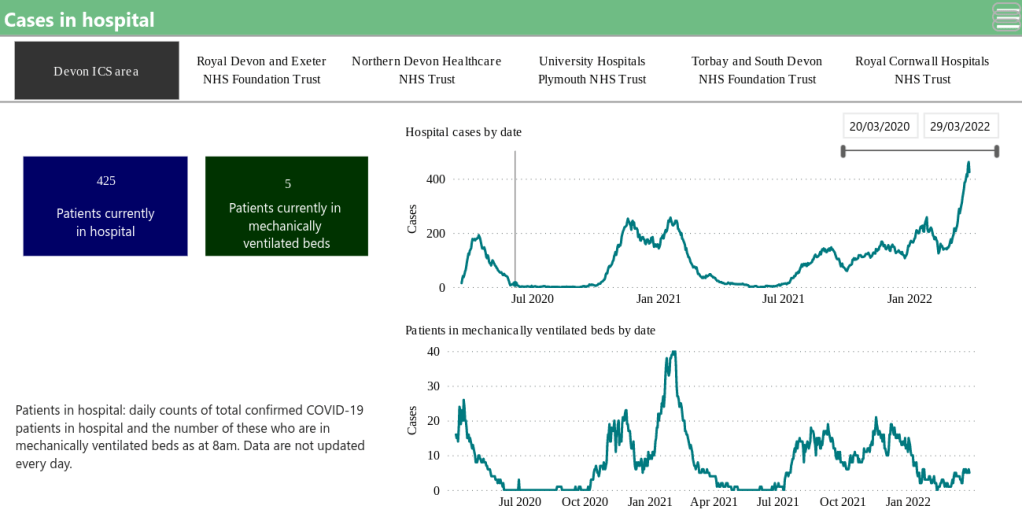
Latest Hospital data for the Devon ICS (includes all hospitals in the County)

Levelling up’s ‘tyranny of competitive funding’

In the absence of any evidence-based central resource allocation, Whitehall falls back on the easy option: create a competition.

Winners can be judged on the “weight” of the submission (literally) and the glossiness of the brochures. It favours those local authorities who already have spare capacity over those who are already resource constrained.

Favours style over substance. –  Owl (from experience)

www.room151.co.uk 

Speakers at Room151’s Local Authority Treasurers Investment Forum (LATIF) North have expressed concern about the funding processes established by central government as part of the levelling up agenda.

Professor Steven Broomhead, chief executive of Warrington Borough Council, criticised the “tyranny of competitive funding”. He said this reflected central government’s top-down approach, and  suggested that “SW1 in the next five years will still be making all the decisions”.

“With levelling up there are no additional resources except where you have to bid through a tyranny of competitive funding for money that is already in government programmes – town deals, skills accelerator, levelling up funds.”

He said that bidding processes were time-consuming and directed effort away from strategic policies that could make a difference to local people in their communities.

“It is dead easy to set up a competition for this, that and the other. I would like to see things funded properly through a policy-based, evidence-based approach and mainstream the funding rather than all these little pots of money, which keep the civil servants very busy.”

Lisa Harris, executive director of place at St Helens Council, said her plea to government would be to join up the different funding regimes and offer long-term revenue funding. “All too often we can be granted funding with one hand and then funding pulled elsewhere.”

It is about joining up those funding regimes at government so that we have a continuation of funding, so that we have a much more balanced funding portfolio in order to make that long-lasting difference and change.”

Harris said that competitive bidding processes often required external assistance from consultants because there was no capacity left in local government. “The most frustrating thing for me is that that competition means we don’t have time to collaborate and we don’t have time to innovate.”

Ministerial mixed messages

Ian Knowles, chief executive of West Lindsey District Council, highlighted an issue with the government’s £2.6bn Shared Prosperity Fund (SPF). The SPF is due to replaces EU structural funds, with all areas of the UK receiving an allocation based on a formula rather than competitive bids.

In England, SPF funds will be devolved to the mayoral combined authorities or to the Greater London Authority and, in localities outside of these areas, to unitary or lower-tier authorities. But Knowles said this conflicted with previous messages from ministers emphasising the role of district councils in place shaping.

“I think there are mixed messages there in terms of how [SPF allocations] will operate within two-tier environments,” he told delegates.

“I would like to see government following through on the fair funding arrangements that they have been talking about for years. Business rates needs to get sorted – we have been waiting for that for far too long. If you can get a better funding base, then we can start to make those plans going forward – particularly if we can get a three- or four-year settlement.”

Jackie Weaver, chief officer of the Cheshire Association of Local Councils, highlighted the relationship between town and parish councils and county, district and unitary authorities.

“For town and parish councils, it is a blessing and a curse that we get no central government funding at all. But then we have the opportunity of getting funding from our principal authorities.”

However, Weaver said that grants from principal authorities were often tied to particular priorities “It would be nice if it started at grass-roots level, and you said ‘come to us with something innovative and we will consider it’ even if it doesn’t tick one of these boxes.”