“He has lost it and gone full ‘Hulk.’
He will be absolutely furious — because it has to be someone else’s fault,” a former government official who had also worked alongside the prime minister said. “It’s despotic.”
Annabelle Dickson www.politico.eu
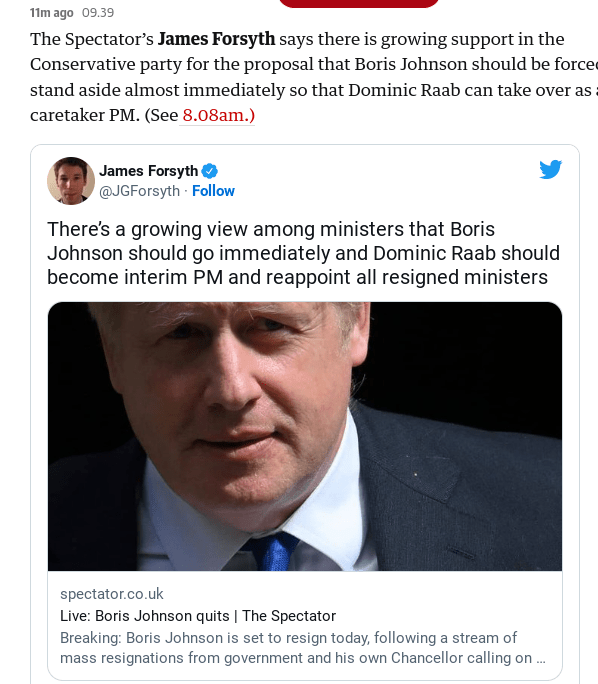
LONDON — The party’s over but Boris Johnson refuses to leave.
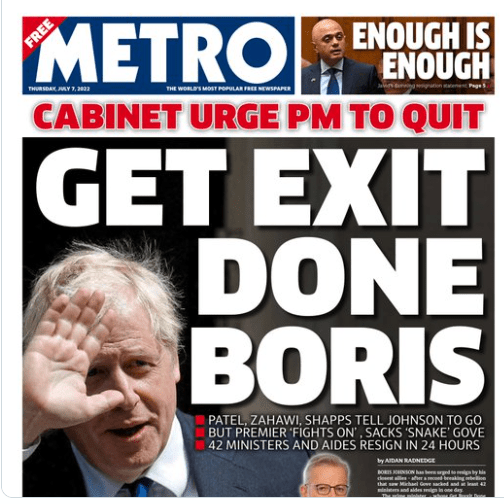
Despite more than 40 resignations from his government, an attempted coup by his top team and numerous calls to quit from his own Conservative backbenchers, the British prime minister was locked in No. 10 Downing Street with his closest aides on Wednesday night, trying to map out a way for him to retain power.
For him to do so would be unprecedented. Johnson’s government has been in crisis mode for months, first fending off criticism about coronavirus lockdown-busting parties and later over Johnson’s handling of allegations of abusive behavior by Conservative MPs.
But a defiant prime minister, who spent much of his day in public obliviously answering questions from MPs, insisted his general election mandate — which gave him a huge parliamentary majority just two and half years ago — took precedent over the concerns of colleagues.
Early signs of a fightback were brutal, with Johnson firing one of his most senior ministers, his Brexit-supporting frenemy Michael Gove. It was Gove, who has held multiple senior roles in Johnson’s government, who went into No. 10 earlier in the day with the metaphorical bottle of whiskey and revolver, Tory MP Tim Loughton told Sky News: “Clearly Boris has downed the whiskey and turned the revolver on Michael Gove.”
Unless Johnson bows to the immense political pressure he is under, there is no immediate mechanism to remove him. Under the British political system — which relies largely on unwritten rules — convention dictates that a prime minister do the honorable thing and bow out voluntarily once they lose the confidence of their party.
“He’ll be dragged out on his chair with his heels dug in,” according to one official who has worked closely with the prime minister in recent months.
“He has lost it and gone full ‘Hulk.’ He will be absolutely furious — because it has to be someone else’s fault,” a former government official who had also worked alongside the prime minister said. “It’s despotic.”
To survive, Johnson must first fill the many vacancies in his administration and rebuild his team even as more, including Welsh Secretary Simon Hart, announced they were quitting. Johnson could then eye an election as a way to reclaim a mandate to govern, something that is in the prime minister’s gift to initiate but a scenario he insisted he wouldn’t pursue. With the Tories trailing Labour in the polls, many in Johnson’s party are very keen to avoid a public vote.
Faced with the prime minister’s refusal to take a hint, the rest of his party must also calculate their next move.
Johnson narrowly survived a vote of confidence in his leadership by Tory MPs in June and under current Conservative Party rules, he is immune from another challenge for a year. But MPs are planning to change those rules and may mount another challenge next week.
Another mechanism to oust him would be for the opposition to call a confidence vote in the House of Commons. If enough Tory MPs sided with opposition parties to vote him down, Johnson would be required by parliamentary convention to resign — not that he has shown the least interest in following conventions.
Hanging on
Two of Johnson’s most senior Cabinet ministers, Chancellor Rishi Sunak and Health Secretary Sajid Javid, set off a domino effect Tuesday by resigning within 10 minutes of each other.
On Tuesday night, Johnson promptly replaced them, appointing Nadhim Zahawi as chancellor and Steve Barclay as health secretary.
In a baptism of fire for Zahawi, he started his first day on the job with a 7 a.m. round speaking to the media. He insisted ministers were getting on with the job. Two members of Johnson’s government announced their resignations as he was speaking.
By the time Johnson entered the House of Commons at noon for his weekly prime minister’s questions session — his first public appearance since his government began falling apart — several more ministers including John Glen, the fourth in command at the Treasury, and Victoria Atkins, the prisons minister, had departed. Javid walked in just afterward and was met with a small cheer.
“Today is a big day,” Johnson began, drawing dark laughter from the chamber. But for the rest of the session, Tory MPs sat silent and stony-faced. Johnson faced hostile questions from MP Loughton — who asked sarcastically whether there were any circumstances in which he would resign — and David Davis, who repeated his call for the PM to quit. Most significantly, Gary Sambrook launched an emotional and excoriating attack on Johnson, accusing him of suggesting that victims of sexual assault had been drinking too much.
In response to a Labour MP who asked about a constituency issue, Johnson said he was already looking into it and urged him: “Hang on in there — that’s what I’m going to do.”
At a highly-charged briefing with journalists immediately afterward, Johnson’s press secretary insisted three times that he has the support of his parliamentary party and said he would contest a second confidence vote if one were held.
All the while, Javid was delivering a resignation speech — doubling up as a thinly veiled leadership pitch — in the Commons.
In the rest of the parliamentary estate, MPs, advisers and journalists were working up to a state of frenzy. In Portcullis House — the atrium at the heart of the parliamentary estate where all of Westminster congregates — Johnson’s Deputy Chief of Staff David Canzini sat in quiet congress with Conor Burns, one of the prime minister’s most long-standing allies. A book titled “Conundrum” lay on the table atop a pile of papers before them.
By 2:30 p.m., Johnson had endured a record-making number of ministerial exits in 24 hours. As the resignations piled up, Johnson was grilled by the cross-party liaison committee of senior MPs, who worked their way through a succession of unrelated, administrative topics as dictated by their agenda.
Asked by one MP how his week was going, Johnson replied: “Terrific.”
Darren Jones, a Labour MP, read out a quote that said when a regime has been in power for too long you can “rely on the leaders of that regime to act solely in the interests of self-preservation, and not in the interests of the electorate.” Asked if he could guess where this was from, Johnson asked sarcastically: “Cicero?” It was from one of Johnson’s own prior newspaper columns.
As the conversation turned to the sustainability of the government’s fertilizer supply and delays with processing passports, a delegation of Cabinet ministers headed to No. 10 with the intention of telling Johnson that the game was up and it was time for him to resign. They included Zahawi, who had only been appointed chancellor the previous evening and who had defended the prime minister on the morning media round.
When the committee broke the news of the imminent Cabinet coup to Johnson, he looked irritated. “You’re asking me to comment … I’m not going to give a running commentary on political events,” he responded — but insisted he was happy to discuss the cost of living or environmental issues.
Bernard Jenkin, the senior Conservative backbencher chairing the committee, concluded by reflecting: “In the end, we’re all dispensable.”
“That is certainly true,” Johnson replied. “But my job is to get on and deliver the government’s aims, which is what I was elected to do … The welfare of the British people and the security of the nation are indispensable.”
Meanwhile just a few doors down the corridor, the 18-strong executive of the 1922 committee of Conservative backbenchers — which oversees the rules by which the party can oust Johnson — was also meeting.
Some rebels had pushed for the committee to agree to an immediate change to its rules, in order to enable a fresh confidence vote in the prime minister immediately. They declined and instead agreed to hold their annual executive elections on Monday afternoon. And if the MPs elected to the committee support a rule change, a confidence vote could be triggered as soon as Tuesday.
By 5 p.m., both meetings had ended and the prime minister dashed down the escalators to exit parliament and back to Downing Street, batting away questions from reporters on his way.
Meanwhile, his deputy Dominic Raab headed to address another meeting of backbench Tory MPs.
One Conservative MP told POLITICO that in a room of 160 MPs, the “lone voice of support” came from Daniel Kawczynski, a staunch Brexiteer who last year was forced to apologize to the Commons for bullying parliamentary staff.
Meanwhile, a former parliamentary staffer said, Conservative MPs were messaging their whips — responsible for party discipline and junior appointments — to say: “Don’t bother phoning me, I don’t want to serve [in Johnson’s government].”
Over in No. 10, a group of Cabinet ministers — Zahawi, Transport Secretary Grant Shapps, Education Secretary Michelle Donelan and Welsh Secretary Hart — had arrived to speak to Johnson. Within hours, Hart had quit and it emerged that Gove had been sacked.
The Times meanwhile reported that Home Secretary Priti Patel, previously a staunch defender of Johnson and one of his most senior ministers, had spoken to the Tory leader and sided with those urging him to go.
Not quite everyone had deserted Johnson by the end of Wednesday. Ultra-loyalist Culture Secretary Nadine Dorries insisted: “The PM’s priority is to stabilize the government, set a clear direction for the country and continue to deliver on the promises he made and the British public voted for.”
James Duddridge, another Johnson loyalist, told TV interviewers the prime minister was “buoyant” and “up for a fight.”
The only certainty is that it is going to be a big one.