Corruption question put to Mid Devon District Council leader

Corruption could never occur in Local Government? -Owl

Lewis Clarke www.devonlive.com

Questions have been asked on how Mid Devon’s leader is not at risk of corruption after a report by Transparency International UK. Councillor Barry Warren (Lower Culm, Non-Aligned) spoke at a Mid Devon Council meeting on Wednesday, July 6, saying that they released a report entitled Corruption in UK Local Government The Mounting Risks.

He said: “On page 43 of the report is a paragraph which reads ‘council leaders have considerable patronage power which can facilitate corruption. They are able to appoint the members of their cabinet and award chairmanships, all roles which bring financial gain for the recipients in the form of special responsibility allowances.

“This may lead to situations where councillors are unwilling to challenge a leader because they fear losing one of these roles, or where they feel obliged to provide informal favours, such as offering information or turning a blind eye to misconduct.’”

He continued: “Since 2019 election two additional cabinet posts have been created. Seven cabinet members have been removed from their portfolios and replaced by other members and two changes of chairman of scrutiny committee have been instigated. What assurance can the leader give to the residents who are administered by Mid Devon District Council that there is no risk of potential corruption as identified in that report?”

Leader of the council, Councillor Bob Deed (Cadbury, Independent) responded saying: “What you’ve just read out probably applies to Westminster, but it certainly does not apply to Mid District Council.

“In terms of patronage as leader, I have always taken the view that the appointments that I make are based on the available members who would be suitable for the post which I am requesting them to undertake at the time.

“Throughout the last three years, the cabinet at any one time has represented the best available talent that was at my disposal. Patronage doesn’t come into it and never will come into it. I’m not sure that the leader from memory has any control over any committee chair apart from the cabinet because he’s in situ.

“I don’t know why you should think that there might be a problem among members of the cabinet or the leader’s approach in Mid Devon. When I was in the city, I was always considered somebody to be trusted, which was why 25 years ago I had £500million to control in terms of lending. My director never asked me about anything.”

Cllr Warren added: “I wasn’t thinking anything. I saw this and thought we ought to get it out the way because somebody raised it with me from outside. That clears the air nicely.”

‘Smelly’ black sand on beach investigated

People are advised to keep off a section of beach because of a reported pollution incident.

“All of our assets in the area are operating as expected”. – SSW

Has Captain Mainwaring been reincarnated in SWW? – Owl

BBC News www.bbc.co.uk

Exmouth beach

A large patch of black sand has been found on Exmouth beach. Image source, Google

East Devon District Council said there was a “large patch of black and smelly sand” at the east end of Exmouth beach.

South West Water (SWW) said “all of our assets in the area are operating as expected”.

The council said people should not bathe between Orcombe Point and Exmouth lifeboat station “until this is resolved”.

SWW said it would continue to “monitor the situation”.

The Environment Agency is also investigating.

Breaking news: Sky cancels planned Tory leadership debate after Sunak and Truss say they won’t participate

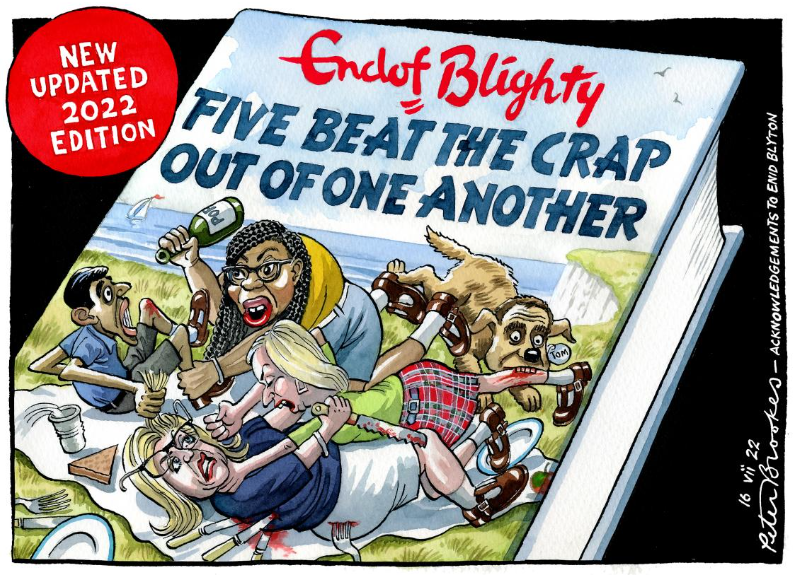
The Tory contenders to be the next PM won’t discuss how to tackle the crises facing the country and are only interested in slagging each other off, and saying how much they are going to cut taxes and shrink the state. 

So Owl is not surprised that they aren’t interested in trying to convince the general public they have got what it takes to be Prime Minister.

So, for now, all “public debate” is off. 

Sky News has just announced it has cancelled the Tory leadership debate planned for tomorrow night after Rishi Sunak and Liz Truss said they would not take part. This is from Sky’s Tamara Cohen.

Conservative MPs let rip over WhatsApp warning ‘blue on blue’ attacks could kill their party

Conservative MPs have reacted with shock and sorrow to the scale of “blue-on-blue” attacks in the Conservative leadership race – culminating in bitter clashes during ITV’s debate on Sunday night

(Watch for breaking news – Owl)

Anushka Asthana www.itv.com 

Some warned that the in-fighting could “kill” their party, while others said the attacks were “shameful”. 

Westminster WhatsApp groups were “kicking off more than usual” after the debate, according to sources, as people warned about the damage that this could do to the party.

Following a night in which Liz Truss accused the former chancellor Rishi Sunak of driving the country towards recession, and he hit back that her ideas were “socialist”, and Kemi Badenoch accused Tom Tugendhat of failing to have enough experience, while Penny Mordaunt faced attacks over trans issues, MPs started messaging each other over WhatsApp.

They warned that the debate, but also “smears” in the newspaper, threatened to damage the party because of the divisiveness.

In messages seen by ITV News, one MP warned: “The division, smears and personal attacks this weekend have been disgraceful. Nothing will kill our party more than blue on blue.”

WhatsApp messages sent by Tory MPs as in-fighting threatens to destroy the party.

WhatsApp messages sent by Tory MPs as in-fighting threatens to destroy the party.

Another wrote: “We have an 80-seat majority and have spent time in-fighting and bringing down the party and are now fighting publicly. It’s shameful. I can’t believe this is happening.” 

One MP told ITV news that it was more “sorry than anger” in terms of the mood, but admitted: “It’s hard to see how people partner up when they go so hard at each other.”

WhatsApp messages seen by ITV News.

WhatsApp messages seen by ITV News.

The battle continued on Monday morning as Liz Truss’s team highlighted a new analysis by the Centre for Economics and Business Research (CEBR) suggesting that there will be £60bn more than the Office for Budget Responsibility’s base estimates in 2024/25.

Setting out the foreign secretary’s plans to use that to help families, a spokesperson said: “Under Rishi Sunak’s time as chancellor the tax burden in the UK has risen to the highest it has been in 70 years and the UK is forecast to have the lowest growth in the G20.”

Mordaunt tried to hit back at newspaper briefings suggesting she had changed her mind on the issue of whether trans people should be able to “self identify”, saying: “It is unedifying… I know why this is being done, but all attempts to paint me as an out-of-touch individual will fail.”

Some argued that the TV debates had been a mistake. 

Westminster Whatsapp groups were "kicking off more than usual" after the debate

Westminster Whatsapp groups were “kicking off more than usual” after the debate.

But not everyone agreed that there should not be robust attacks. One MP wrote: “Disagree. If we are changing a PM without the public’s permission then the public deserve to see who we are making the next PM.”

However, this morning it emerged that Rishi Sunak would no longer do a Sky News debate on Tuesday, but would now only do one when the competition was down to the final two. 

Cost to save crumbling coastline is now £19m

Vital sea defences to save Sidmouth’s crumbling coastline and protect the Esplanade has now gone up by £5million increasing the estimated cost to a total of £19million. Last October, East Devon District Council (EDDC) and the Sidmouth and East Beach Beach Management Plan Project Advisory Group approved a new and improved £14 million outline proposal.

Anita Merritt www.devonlive.com 

It is now proposing to proceed to the next stage, with plans to secure the extra funding from government or by bridging the shortfall if required. The aim is to start work on the scheme in spring 2025, giving Sidmouth seafront and East Beach the coastal defences it needs.

Both locations are said to be at increasing risk from predicted storm events due to climate change. Plans to protect vital flood defences for the town, which would also better protect the Esplanade and the town’s crumbling cliffs above East Beach, have long been needed and discussed.

After changes to DEFRA funding in 2020, EDDC was able to start work on plans for a new ‘hybrid option’ to replace the former 2018 ‘preferred option’. This option includes at least one additional rock island, which may reduce the need to raise the splash wall along The Esplanade and could lower the long-term costs of recharging the beach with new material, which will be needed in the future.

The hybrid option still includes a 120m rock-groyne at East Beach and requires a beach recharge on both East Beach and the town beach. This option was originally costed using 2020/21 prices, with funding coming from EDDC, Devon County Council, Sidmouth Town Council and the South West Regional Flood and Coastal Committee, along with DEFRA grant funding.

An outline business case is currently being prepared for the Sidmouth Beach Management Scheme (BMS) readying it for submission to the Environment Agency (EA) for funding. The increase in the cost of the scheme is said to be due to a number of factors including material costs rising by up to 200 per cent; diesel costs rising by 50 per cent as low VAT Red Diesel is no longer allowed; staff shortages caused by a smaller labour pool after leaving the EU; ongoing Covid issues; the Russia-Ukraine war increasing energy costs further; construction risks such as availability of materials and equipment and the danger of cliff falls on East Beach.

Sidmouth's East Beach

Sidmouth’s East Beach (Image: Daniel Clark)

A cross-country campaign has been launched by all the bodies developing flood and coastal defence projects seeking to change Government funding to enable the projects to proceed. The Sidmouth BMS is being used as an example to explain the urgent requirement for extra funding to avoid these government-funded schemes from failing.

To allow the scheme to progress, the authority will submit a report to EDDC’s cabinet and full council, seeking approval for the additional funds from the capital budget as a temporary loan until further money can be secured from elsewhere.

Councillor Geoff Jung, EDDC’s portfolio holder for coast country and environment and chair of the Sidmouth BMP Project Advisory Group, said: “The estimated uplift in costs is most worrying, but the advisory group considers that these works must proceed urgently to protect Sidmouth from the increasing risk from predicted storm events due to climate change. Therefore, the recommendation to proceed to the next stage will be put to a full council meeting shortly.

“I would like to thank our engineers’ officers, consultants and all members of the advisory group for all their work to get to this important stage.”

The anticipated timeline:

  • Late summer 2022 – Submit the funding case for approval to EA, which if successful, secures the funding in principle. Approval should be granted by autumn 2022.
  • Late autumn 2022 – Work on the scope of the detailed design stage with a sub group made from members of the Sidmouth and East Beach BMP Project Advisory Group. They will help represent Sidmouth residents, providing guidance on what the town needs from the scheme, what it looks like, how it will work and how it will be designed and built. This will include discussions on the number and position of additional rock breakwaters.
  • Early 2023 – Finalise the scope for the detailed design.
  • Followed by – Appointing an engineering consultant to manage the detailed design process and prepare for construction.
  • Summer 2023 – autumn 2024 – Public consultation on the detailed design and propose a planning application.
  • Autumn 2024 – Early 2025 – Appoint a contractor to build the scheme.
  • Spring 2025 – Start construction.

Tory tycoon refuses to hand over £500k donation unless Boris Johnson can stay PM

A multi-millionaire Tory tycoon is refusing to hand over £500,000 of donations from himself to the party – unless Boris Johnson is given a chance to remain Prime Minister.

Dan Bloom www.mirror.co.uk (Extract)

Peter Cruddas – who Mr Johnson put in the Lords against official advice – said there has been a “coup” against the PM and said he should be allowed to be on the ballot for a new leader.

He told the Sunday Times: “I planned to donate a total of £500,000 this year but that is on hold and will not be paid unless the membership have a chance to vote on Boris being PM.

“I have no interest in Rishi who I deem to be not fit for high office due to his plotting and the orchestrated way he and others resigned to remove the PM.”

Five candidates remain to be Tory leader under rules agreed by the Conservative Party – which decided Mr Johnson would be barred from standing again.

Last year Boris Johnson overruled advice from the Appointments Commission to put Peter Cruddas in the Lords after he failed its vetting process.

Net zero slumps to bottom of Tory members’ priority list

Hitting net zero came bottom of a list of ten policy areas, behind cutting personal taxes, increasing defence spending and strengthening Britain’s global standing in YouGov survey.

Most pressing concern is winning the next election!

Right now these are the people with our future in their hands. Scary! – Owl

George Grylls www.thetimes.co.uk

Conservative Party members care very little about reducing greenhouse gas emissions, polling shows.

Only 4 per cent of those surveyed said that hitting the target of net-zero emissions by 2050 was one of their three priorities for the next Tory leader.

Members said the most pressing concern was winning the next election, followed by controlling immigration and helping families with the cost of living, a YouGov survey for The Times showed.

In April a poll for the think tank Onward found that 64 per cent of all voters supported the government’s plans to hit net zero. Nine per cent were opposed.

In the YouGov poll, 56 per cent of the Tory party members surveyed said that winning the next election was the most important issue. Hitting net zero came bottom of a list of ten policy areas, behind cutting personal taxes, increasing defence spending and strengthening Britain’s global standing.

Alok Sharma, the cabinet minister who led the Cop26 climate talks in Glasgow last year, has threatened to resign in protest at “lukewarm” commitments by Tory leadership candidates on the environment. He said that the failure of the five remaining contenders to commit themselves unequivocally to net zero emissions by 2050 risked causing “incredible damage” to British diplomacy.

Sharma told The Observer: “Anyone aspiring to lead our country needs to demonstrate that they take this issue incredibly seriously, that they’re willing to continue to lead and take up the mantle that Boris Johnson started off. I want to see candidates very proactively set out their support for our net-zero agenda for green growth. This is absolutely a leadership issue.”

Liz Truss, the foreign secretary, who came third in the first and second ballots of Tory MPs on Wednesday and Thursday, has promised to suspend the green energy levy to help households struggling with the cost of living. This would cost £4.2 billion a year.

Sharma said that the policy would not address the real cause of higher bills. “We need to very clearly understand what is actually driving the price of energy. It isn’t green levies, it is the wholesale gas price,” he said.

In 2019 the government committed itself to the 2050 target via an amendment to the Climate Change Act. Other candidates who have suggested they might change environmental policies if elected Tory leader include Kemi Badenoch and Tom Tugendhat. Badenoch called the 2050 target “arbitrary”. Tugendhat is reported to have told a hustings of the 1922 Committee of Conservative backbenchers that he thought the date should be delayed. However, he later reaffirmed his commitment to the target.

Asked if he would consider resigning if a candidate who was weak on net zero were elected, Sharma, 54, said: “I don’t rule anything out and I don’t rule anything in.”

The Tory leadership race has been nothing but a tribal beauty contest devoid of any new ideas

This selection process, on display for the third time in six years, is symptomatic of a floundering political system

Aimee Meade inews.co.uk 

A few hours before the first Tory leadership debate was broadcast on Channel 4, I was talking to a terrific palliative care team. At one point, the doctor said in matter-of-fact manner that there was no point trying to call an ambulance these days since it might take up to five hours to arrive. I was astonished. We were talking in the centre of London, not a remote rural area. Yet this dismal situation comes amid routine stories of staff shortages, handover delays at hospitals, more people using emergency services due to an inability to access GPs, even avoidable deaths among waiting patients. The data shows average ambulance waiting times even for serious conditions is now more than double the target.

Clearly the health service is creaking under pressure. Partly this is the legacy of Covid-19. But it is also tied to the collapsing social-care system, which Boris Johnson promised to fix but remains trapped in a catastrophic crisis that is devastating millions of families. Accident-and-emergency waiting times are at record levels. Patient satisfaction is plummeting. Delayed diagnosis for conditions such as cancer will cause thousands of preventable deaths, leaving doctors to lament over lives they might have saved with earlier treatment.

Yet the picture is more complex than presented by shroud-waving medical unions. NHS funding has risen sharply since the Tories came to power in 2010. According to the King’s Fund think tank, Britain entered the Covid crisis spending a similar slice of its economy on health to comparable nations – yet treatment outcomes for many major conditions are significantly worse.

Health soaks up a rapidly growing proportion of day-to-day public spending in our ageing society and amid stunning scientific advances: rising from less than a third in 2010 to a predicted 44 per cent by 2024. Yet still we see a succession of patient safety scandals – and these tend to harm or kill older, female or disabled citizens.

Clearly health is a major issue. Yet when it came up in the first broadcast leadership debate, the discussion was unbearably banal. Rishi Sunak thanked doctors for “heroic” work and said he “really believed” in the NHS as proved by his funding. Kemi Badenoch said her chipped tooth showed the access difficulties in dentistry, then said the NHS needed more efficiency. Tom Tugendhat expressed gratitude to the NHS for treating injured army colleagues and delivering his children. Liz Truss said the NHS did “a fantastic job” during the pandemic but “we need to work as hard as we can to reduce the backlog.” Penny Mordaunt at least seemed to have some grasp of issues, although offered little more than calling for fewer caveats on spending while stating the obvious by saying innovation and prevention were vital.

Badenoch concluded by saying “there must be things we can do differently that would improve how we can tackle these issues”. But surely the point of a leadership contest is to present ideas and reforms for tackling such problems rather than simply spewing out a stream of cliches and inanities? This battle is, after all, picking our nation’s next prime minister. Badenoch still looks the most impressive candidate on the party right, yet she is such a blank sheet that after five years in parliament and serving in three ministerial offices her position on anything to do with China – the single most important foreign-policy issue – could not be discerned by a group of analysts monitoring relations with Beijing.

She does, however, have strong views on gender-neutral toilets; indeed, makeshift “Mens” and “Ladies” signs were taped to the doors at her launch event. This rammed home her strident opposition to gender self-identification, an issue seized on by culture warriors on the right despite being backed by the Commons’ Women and Equalities Committee and implemented in about 20 countries including Ireland and the United States. As a consequence, this subject has soaked up far more space in the leadership struggle than, say, the decrepit state of health and care systems or how to handle the rise of China under a belligerent nationalist dictatorship that are, dare I say, far more important to the future well-being of our country.

This battle for power has been a dispiriting spectacle so far – a tribal beauty contest scarred by smears and snide asides but devoid of serious policy ideas, let alone inspirational signs of fresh vision. They talk of delivery but ignore that Tory failures in office have resulted in low pay, a sluggish economy and struggling public services. The problem is that the candidates are seeking first the votes of 358 Tory MPs, so reliant on backroom deals and job offers struck secretly in Westminster, and then pitching to a party membership that is overwhelmingly white, older, male, middle-class and concentrated in safe Tory seats. So they strike hardline poses on migration, posture about tax cuts, pretend Brexit is a success, polish up their life stories and shy away from the toughest questions confronting our nation.

This selection process, on display for the third time in six years, is symptomatic of a floundering political system. It exposes a party searching desperately for a saviour after choosing a woman who proved not up to the job, followed by a man who was untrustworthy for high office. It is contemptuous of the electorate to impose a prime minister in this manner, especially when modern party leaders adopt a presidential style and determine election outcomes – as seen clearly in 2019 when Johnson cut through the Red Wall and Jeremy Corbyn repelled moderates. People may have strong views on whether Tugendhat won the first debate, Truss was a disaster or Sunak will emerge victorious. But few voters will be left inspired by this next wave of leaders jousting for power, let alone feel reassured over the future of our country.

Number of affordable homes slashed on much hated development

The developer behind a controversial new build in Truro has been slammed by locals after it quietly lowered the number of affordable homes it promised to build. Wain Homes recently put forward its detailed plan to build 275 new properties at Dudman Farm, at Highertown in Truro.

Developers pleading poverty as usual – Owl

Edward Church www.cornwalllive.com 

Wain Homes pledged 30% of the homes will be sold as affordable – below market rate prices – in the application submitted in May 2022. Outline planning permission for the project was approved in 2016 on the basis that the affordable housing figure was at 40%.

Truro City Council’s planning committee was sent the reserved matters – the more detailed plans such as layout and design after outline permission is granted – to look over last week. Committee members, several of whom live in the area, strongly objected to the plans, with one, Councillor Karen La Borde, saying it’s unacceptable that the number of affordable houses could be changed at this stage.

Cllr La Borde said: “In 2016, the outline planning permission was agreed by Cornwall Council. The one thing which gets me overall is that the application is so old.

“When they agreed it, it was going to be 40% affordable housing, but now they say the site is unviable and they’ll do 30%, which is 5% less than they need and 10% less than they agreed to before. They say it’s viability, but surely they knew the site before they went there.

“They want their profit, it’s speculative development. They’ll be making profit and the people of Truro are losing out. They should not have been allowed six years to do this. We’re in a different time from 2016, we have different priorities.”

The 2022 planning documents submitted by Wain Homes said the 40% figure was not financially viable. The application reads: “The existing Section 106 agreement requires a 40% provision of affordable housing which would generate 110 affordable units across the scheme. This is above the policy requirement of 35% which would generate 97 affordable units.

“Due to viability considerations the application however proposes a level of 30% affordable housing which would generate 82 affordable units. The tenure split is proposed as 70% affordable rented homes and 30% intermediate housing for sale which accords with the Section 106 agreement.

“As the overall percentage would not be policy compliant, this will be subject to a separate request for a deed of variation to the existing Section 106 supported by the requisite viability assessment as required by Local Plan Policy 10: Managing viability.”

In short, the agreed terms of the Section 106 agreement from 2014-16, when it was submitted and approved, respectively, are being changed. The final decision is with Cornwall Council, which must respond by August 26.

Cllr La Borde, who also sits on Kenwyn Parish Council, which encompasses the area of Highertown including Dudman Farm, also joined many other locals in criticising the development as a whole on ecological grounds. She said: “The reaction to the idea of building 275 houses on that land is quite emotional.

A“Locals have been using the land for up to 20 years since it stopped being used for farmland. It’s become a public resource. We’re all used to it now, even more so after Covid. During lockdown it became a bit like the M1 down there, people going out all the time.

“It’s a very valuable resource. It’s not an easy site to develop because of the valley and the train track. But it’s just valuable land for the wellbeing of the people that live from Malabar to Threemilestone.

There are plans to build 275 homes at Highertown, Truro

There are plans to build 275 homes at Highertown, Truro (Image: Google)

“It’s easily accessible and residents will be losing this great asset. We have a site over there that is sucking up as much carbon as it can as it’s been left for so long. Semi mature oak trees which will all have to go, the meadows of wild flowers are absolutely stunning.

“And, much has changed since the outline plans were approved. We now have 4,000 houses being built at Langarth, another 400 at Pydar Street and the city will have exceeded its national determinants for housing. We’re in a good spot in Truro, we don’t need these 275 houses here with the other developments.”

Martin Webster, who lives in an estate very near to the Dudman Farm site, said the area – which has become a popular walking spot – saved his life during the Covid lockdown. Mr Webster explained that it would be a huge loss for him, personally, should the development go ahead at all.

He said: “I’m a former veteran, served for 12 years and have PTSD (post traumatic stress disorder). It was a lifesaver to walk in that countryside during lockdown and I know it saved a lot of other people’s lives.

“Having that unspoilt beauty removed, for me, it’s criminal. For someone who fought for it, I despise it and think the developers should be held accountable.”

Mr Webster said on a practical level he thinks the development will be disastrous for the area: “How will people feel here when their kids are in a class of 80 not 40? How much more of the natural area will be gone?

“Surely you need to improve the infrastructure of Truro before you start to okay these houses. There should be affordable housing for people but that’s not the priority for these companies.

“There’s lovely little pictures of the family, but it’s bulls**t. You go to houses on new builds and after two years they’re having to rebuild them. Also, the in road is always blocked with lots of cars. Imagine what it’ll be like when you’ve got 275 more houses being built.”

Cllr Steven Webb, mayor of Truro, told CornwallLive he felt it was wrong for a developer to sit on outline planning for this long and not have to start from scratch – given the changing priorities of local planning boards.

Fifty-two other locals added their criticisms on the council’s planning portal. Colin Andrews said: “It clashes with local policies. It is not needed. The council has met its housing need for Truro. It will have a negative impact on a local amenity.

“Biodiversity net gain cannot be met by the developer and wildlife will be destroyed. Not in the neighbourhood plan. It will increase pressure on a struggling traffic network.”

Sarah Searle added: “I walk with my dog and my young family daily in the area and to see the wildlife decimated and the green space disappear forever would be a travesty. Cornwall Council please do not approve planning. We are losing our green space in Cornwall at a mighty speed but we need it for our mental health and wildlife needs our help.

“We are in a climate emergency, take notice, do something to help and don’t approve nearly 300 houses in a green space where the road infrastructure is already at breaking point. Please listen to local people, the green space is important to us all. It’s was used so much during the pandemic and continues to be a popular place to walk and spend time outdoors. We can’t afford to lose it!”

Bus service changes ‘a blow’ to Ottery passengers

A new bus timetable which ‘substantially’ reduces services in the Ottery St Mary area comes into force from Sunday, July 31. 

Philippa Davies www.sidmouthherald.co.uk

The changes affect Stagecoach’s 4/4A/4B routes between Exeter and Axminster via Cranbrook and Honiton, which currently run between Exeter and Ottery every 30 minutes in both directions. 

Service 4 will operate between Exeter and Cranbrook only. Two new routes, 44 and 44A, will serve Honiton and Axminster.  

Service 44 will operate hourly, Monday to Saturday daytime between Exeter and Honiton via Cranbrook (London Road), Rockbeare, Marsh Green and Ottery St Mary, with some journeys also serving Gittisham.  

Service 44A will run every two hours in each direction Monday to Saturday between Exeter and Axminister, via Cranbrook (London Road), Whimple, Ottery St Mary, Honiton and Wilmington. 

The buses will also finish earlier and there will be fewer services on Sundays and public holidays. 

Jess Bailey, the county councillor for the Otter Valley, said: “The substantial reduction in bus services to Ottery St Mary and the surrounding area comes as a real blow. Not only will it cause huge problems for the many people who rely on the service but it will force people back into their cars, which flies in the face of the climate emergency.” 

In other changes affecting the wider area, service 9A will no longer serve the Seaton to Lyme Regis route, which will be covered by another operator. The 9/9A/X9 Monday to Saturday evening service between Exeter and Sidmouth will be reduced from hourly to every 90 minutes, and the evening service between Sidmouth and Sidbury will be withdrawn. 

The changes are part of a Devon-wide review of Stagecoach’s services which aims to ‘provide a sustainable bus network now, so that we can grow services over the long term.’ 

Regional managing director Mike Watson said: “In addition to this, with the current nationwide shortage of bus drivers, we need to concentrate our resource on the services where demand is greatest to ensure that vital journeys and connections are maintained and to provide a network that best meets the changing needs of the communities we serve. 

“We will be working together with national and local government to attract more people out of their cars and onto more sustainable public transport. The more people who switch to bus, the stronger our networks will be.”


The state we’re in: Cornwall woman travelled to London for emergency healthcare

Truly shocking, “NHS safe in our hands” ? Clearly not, as all candidates for next PM want to shrink the state – Owl

A former GP with heart problems travelled nearly 300 miles to access emergency healthcare after deciding the wait nearer home was too long.

BBC News www.bbc.co.uk

Dr Alison Durkin spent hours waiting to be seen on Monday in an ambulance outside the Royal Cornwall Hospital.

When she felt worse the next day, she travelled from Helston to find a hospital with no queues and is now in a serious condition in London.

The Royal Cornwall Hospitals NHS Trust apologised for the distress caused.

The Hospital, near Truro, declared an internal ‘critical incident’ this week due to “acute pressure” on beds.

‘Wouldn’t be here now’

Mrs Durkin said she was seen by a junior doctor on Monday evening and returned home, but when she woke up on Tuesday feeling worse, she and her husband Ross decided to travel from Helston to find emergency care.

He said: “The first thing we did was to check the situation at Plymouth and that was no better, so geographically we headed up country, Exeter was much the same, Bristol Royal infirmary had 88 people waiting in A&E.

“The only answer was to go to and find a hospital where there wasn’t a massive queue outside and where she could actually get decent quality of care.”

Mrs Durkin was admitted into Charing Cross Hospital, where she remains in a serious condition.

Mr Durkin said if they had not taken matters into their own hands, he feared the worst: “I’m not sure whether she’d still be here to be honest, it’s not an easy thing to say.

“It wasn’t a hard decision to make because we knew that if we did nothing, the potential outcome was she wouldn’t be here now,” he added.

Mrs Durkin was assessed in an ambulance outside the Royal Cornwall Hospital on Monday evening

The Royal Cornwall Hospitals NHS Trust apologised for the distress caused to Mrs Durkin and her husband.

“Our staff are working exceptionally hard in very difficult circumstances and will always make sure patients are assessed on their arrival at our emergency department and those most critically ill will be admitted right away,” it said.

Cornwall Council, the body responsible for social care in the county, said it was “working closely with partners across the health and care sector to support people to leave hospital as soon as they can”.

It said recruitment in the sector continued “to be an issue”.

Tory leadership contest: Beggar-my-neighbour race to the bottom

Liz Truss has sought to breathe new life into her faltering Conservative leadership campaign with a flurry of uncosted tax cut promises worth billions of pounds, as the five remaining candidates took part in their first mass debate.

Liz Truss bids to save Tory leadership campaign with new tax cut pledges

Peter Walker www.theguardian.com 

Truss, who has the third highest number of Tory MPs’ votes – behind Rishi Sunak and Penny Mordaunt, promised to scrap a planned rise in corporation tax and suspend green energy levies, costing more than £20bn a year overall.

The unexpected offer, on top of an existing pledge by the foreign secretary to reverse a rise in national insurance, worth another near-£11bn a year, came as the would-be successors to Boris Johnson joined a Zoom Q&A hosted by the Conservative Home website.

Thursday’s second round of voting by Tory MPs, a process that will eventually whittle the candidates down to a final two with the winner then chosen by party members, saw Truss lagging well behind Sunak, the former chancellor, and Mordaunt, the surprise package of the race so far, who is now the bookmakers’ favourite.

After criticism of a somewhat flat campaign, Truss used a question about the cost of living crisis to set out significant new tax cut proposals.

“We immediately need to start putting money back into people’s pockets, we know families are struggling to make ends meet at the moment,” she said. “I would reverse the national insurance rise; I opposed it in cabinet at the time because I thought it was a mistake, I think it’s even more of a mistake now when we’re facing such strong economic headwinds.

“I would also have a temporary moratorium on the green energy level to cut £153 from people’s energy bills. And I would also not do the corporation tax hikes because I think it’s vitally important that we’re attracting investment into our country.”

Truss, along with some other candidates, had previously said she would reverse the national insurance increase, intended to help improve social care.

It has been estimated that scrapping the planned rise in corporation tax from 19% to 25% next year would cost about £15bn a year. Suspending green levels on energy bills would cost an estimated £5bn a year.

Labour has condemned an “arms race” of uncosted tax cut pledges among candidates. Sunak has said he would wait to stabilise inflation before cutting any taxes.

In a boost to Truss, shortly after the debate the attorney general, Suella Braverman, who was eliminated from the contest after finishing last in Thursday’s MPs’ vote, reiterated her call for supporters to switch to the foreign secretary.

Braverman is ideologically close to Kemi Badenoch, the former levelling up minister, who along with backbencher Tom Tugendhat is still in the contest, and came fourth in Thursday’s vote.

But in a robustly worded message to supporters, Braverman urged them to “look realistically at the numbers” and back Truss, the other candidate seen as being firmly on the right of the party.

“Liz and Kemi are not both going to make it into the final two,” Braverman wrote. “So a decision needs to be made to back one of them. The one we should back, I’d argue, is the one who can get to the final round: Liz can, Kemi cannot.”

In the ConservativeHome debate, Mordaunt, who has been the subject of a spate of negative briefings since emerging as a favourite, said she hoped for “a positive contest”. She said: “I don’t want mudslinging. Without that teamwork, we can’t deliver.”

In her closing speech the international trade minister pitched herself as the candidate who could take on Labour.

“We need to win at the next general election, and what all the polling shows is that you can only win with me,” Mordaunt said. “Every poll in our party, and in the country, I top it. I win against Keir Starmer in London; I poll the highest in both red wall and blue wall seats; I lead with women, with young people; and I also have the best reach in Scotland.

“So I have some question for you: do you want to win the next general election, or do you want to hand everything that we have achieved to the Labour party?”

Five key takeaways from the first Conservative leadership debate

“Whoever wins out of this contest in the end, they have an uphill climb.”

The five candidates still standing for the leadership of the Conservative party were in action in a TV debate broadcast on Channel 4 on Friday night. Here are the five key takeaways:

Martin Belam www.theguardian.com 

Tom Tugendhat was the only one able to answer freely

Given the opportunity to answer “Yes” or “No” to the question “is Boris Johnson honest?”, Tom Tugendhat was the only person able to do it. He got warm applause for simply saying: “No”.

Kemi Badenoch came closest, saying “Sometimes”. Rishi Sunak, Penny Mordaunt and Liz Truss all refused to be drawn into the one word answer, and prevaricated.

Τugendhat essentially played the role of the minority party candidate in a multi-party debate, free to just speak his mind, call out the hypocrisy in everybody else, all the while safe in the knowledge there’s virtually zero chance he will end up elected.

Truss has a delivery mantra problem

Truss tried to focus again and again about delivery in every department, saying that her trade deals with Australia and Japan had been considered impossible, and that she had stood up to Vladimir Putin. But it all felt heavily scripted from her.

Badenoch and Tugendhat felt more off the cuff, and Sunak was a more fluid performer here than he has been on the radio over the last 48 hours. Truss felt rigid and dogmatic.

Sunak’s Treasury experience is a potential asset – but not with party members

In a crucial exchange that was mostly Sunak vs Truss, the foreign secretary told the former chancellor that Covid was a once-in-a-century occurrence, and that the government should look accordingly at paying it back over a longer term. Sunak was clear, saying: “The best way for people to have money in their pocket is to get a grip of inflation.”

Again and again during the debate he demonstrated a better command of the numbers and Treasury brief, but you still ended up with the feeling that a man instinctively fiscally conservative is being pushed into a corner and portrayed as a leftist for not wanting to cut taxes

Trans rights questions are not going away for Mordaunt

The culture warriors in the Conservatives have identified the question of trans rights as a wedge issue they can use against Labour, but Mordaunt’s apparent different standpoints over the years have made it awkward for her too.

The trade minister claimed to be baffled that anybody found her position unclear. It may not be high up the agenda when you poll voters on what they care about, but expect to see this get asked of the women standing to be PM again and again.

There was little love in the room for any of the candidates

Applause was sporadic, and mostly directed either at Tugendhat, or when Sunak was singing the praises of an NHS worker who had asked a question. At the end Krishnan Guru-Murthy asked for a show of hands of the floating voters in the audience who had been persuaded to be more likely to vote Conservative. Ten hands went up at most.

It wasn’t a feral BBC Question Time audience, but at times, particularly when issues around trust and Partygate were being touched upon, the disdain for the audience with politicians was palpable. Whoever wins out of this contest in the end, they have an uphill climb.

Short analysis of where the three front runners stand

One of the factors that makes the flow of supporters in this leadership contest so unpredictable is that none of the leading candidates fit into neat boxes. 

From Politico:

Mordaunt is progressive on social issues but is also a Brexiteer who refused to endorse Theresa May’s Chequers plan.

Truss models herself on Margaret Thatcher, has long been an unapologetic advocate for tax cuts in Cabinet and is a foreign policy hawk — but used to be a prominent Remain campaigner.

Sunak is in some ways the continuity candidate — having been the second-most-powerful person in government for over two years — but is despised by those around Johnson. And while he’s reluctant to bow to pressure on tax cuts, those who know him say his instincts are most aligned with the Tory right, which is now trying to stop him from winning.

Liz isn’t fizzing – Tory press turns on PM4PM

Desperate scramble to reunite the Tory right – though “right” is a relative term as it becomes pretty clear the Tories are swinging to the right in this contest in any event.

The snap poll of 876 Conservative Party members (by Yougov on Wednesday), who will decide between the final two candidates to replace Boris Johnson, showed Penny Mordaunt ahead on 27%. Second place was Kemi Badenoch on 15%, followed by Rishi Sunak and Liz Truss on 13% 

In the event that Ms Mordaunt does not make the final round, Ms Truss would beat Mr Sunak by 67% to 28%.

Looks like Simon Jupp is backing a loser! – Owl

From the BBC’s review of the news headlines:

Many of today’s papers are leading on scrutiny being directed at Conservative leadership candidate Penny Mordaunt by supporters of her rival Foreign Secretary Liz Truss.

“Knives out for Penny!” says the Daily Express – after Ms Mordaunt again performed well in the latest round of the leadership race. The paper says there’s now a “determined bid” among Ms Mordaunt’s critics to “wreck” her hopes of becoming prime minister.

There’s ample evidence of this in the Daily Mail, which sports the headline, “Mordaunt under the Microscope”. It also devotes 10 pages to the contest and describes in detail the claims her enemies have made about her.

The paper raises questions about her attitude to women and transgender issues, the free press and her Royal Navy credentials – as well as suggesting that she was a “part-time minister”.

She is also condemned by Lord Frost, a prominent backer of Liz Truss, who writes in The Telegraph that a government led by her could not succeed.

The Guardian thinks the contest is becoming “increasingly acrimonious” and that rival Tory camps are aiming their fire at Ms Mordaunt.

The i believes her rivals fear her popularity among the grassroots – who will choose the winner from the final two candidates. The paper carried out polling suggesting the public prefer her to Liz Truss and former Chancellor Rishi Sunak – even though she remains relatively obscure among voters.

The Mail’s sketch-writer, Henry Deedes, believes Ms Truss gave a true-blue message during her campaign launch on Thursday – but her presentation remains a work in progress. Her “joints could do with a squirt of oil,” he says.

The Financial Times notes the foreign secretary mistimed her entrance at the event and failed to remember the way out – symbolising a campaign struggling to find its bearings.

Macer Hall, the political editor of the Daily Express, believes the party’s low-tax, free-marketeer wing is paying the price for disunity and there is now a desperate scramble to reunite the right.

The Times’ editorial welcomes the upcoming TV debates, saying the candidates need to be subjected to forensic scrutiny to establish which of them is genuinely up to the job.

SWW slammed with rock bottom rating due to eco concerns

South West Water is now the joint worst performing company among England’s nine water and sewerage firms.

Maybe its bosses should spend less time writing “greening” reports for “the Great South West” and concentrate on the day job.

Owl has previously expressed a number of concerns about the leading role played in “the Great South West” project by the Pennon Group

William Telford www.cornwalllive.com

South West Water has been given a rock bottom one-star rating for its environmental performance with the Environment Agency calling for its boss to face prison if there is a serious pollution incident. The Exeter-headquartered company, which supplies Plymouth, is now the joint worst performing company among England’s nine water and sewerage firms.

South West Water (SWW) and Southern Water received just a one-star rating in the Environment Agency’s (EA) four-star rating system. SWW, part of the Pennon Group Plc, lost the two-star rating it had held since 2016. It has never been higher than a two-star company.

Susan Davy, SWW chief executive, said she was “deeply disappointed” by the downgrading and vowed to make improvements and take the firm to four-star status. She said: “This is not where we want to be. I want to reassure our customers that the investments and changes we are already making across our network are delivering real results, including a one-third reduction in pollution incidents last year to the lowest number in 10 years.

“One pollution is one too many, and that’s why we are committed to bringing this down further year on year by strengthening our round-the-clock response, increasing resourcing levels by 25%, and investing £330m over the next three years in our wastewater network. However, we know there is significant progress still to make.”

The EA said the environmental performance of the water providers in 2021 was “the worst we have seen for years” and called for courts to impose much higher fines for serious and deliberate pollution incidents – and for prison sentences for chief executives and board members whose companies are responsible for the worst spills’.

The EA also wants company directors to be struck off after illegal environmental damage so they can’t get promotions and move on with their careers. The agency said fines currently handed down by the courts often amount to less than what a chief executive is paid.

Most companies’ performance declined, the new report said. Four companies – Anglian, Thames, Wessex and Yorkshire Water – were rated only two stars, which means they require significant improvement. The agency’s annual environmental performance report found serious pollution incidents increased to 62 in 2021, the highest total since 2013, with eight of the most serious category one incidents, compared with three in 2020.

Ms Davy said: “EPA assessment criteria are rightly becoming more stringent and customer expectations are increasing, reflecting the need for us to go further and faster in protecting and enhancing the UK’s natural environment. We remain committed to becoming a four-star EPA-rated company by the end of 2024.

“At the same time, we continue to take action on wider environmental issues that matter most to our customers, including on areas that are not included in the EPA assessment such as storm overflows and coastal bathing water quality. Earlier this year, we achieved 100% coastal bathing water quality for the first time across the South West’s 860 miles of coastline. In April, we launched WaterFit, our new plan for healthy rivers and seas, which will see South West Water dramatically reduce its use of storm overflows, maintain our excellent bathing water quality standards all year round, and remove our impact on river water quality by 2030.

“Since becoming CEO nearly two years ago, delivering our plans to protect our natural environment has been a key priority for me. South West Water is fully committed to playing its part in protecting and enhancing our rivers and seas now and in the future.”

In June water regulator Ofwat launched an investigation into SWW after becoming concerned about the way a sewage treatment works is operated. The company was added to a growing list of water suppliers to come under the microscope as the watchdog probes how wastewater companies manage their treatment works.

With tax cuts pledges galore, the Tories are out of touch with economic reality

Imagine for a second that it was Labour rather than the Tories choosing the next prime minister. Consider what the response would be if the hopefuls said it would be no problem to find an extra £30bn to tackle poverty or an additional £40bn for the NHS, and vied with each other to come up with the most ambitious spending pledges.

Larry Elliott, Guardian’s economics editor www.theguardian.com 

It doesn’t take a genius to work out what the response from the Conservatives and the Conservative-supporting papers would be. At the very least, there would be questions asked about how the plans would be financed. More likely there would be warnings of a run on the pound and imminent economic meltdown. The headlines would read something like: “Loony left plans to bankrupt Britain”.

Funnily enough, a different view is taken of the deep and immediate tax cuts now being promised by almost all those bidding to replace Boris Johnson. To those egging on the candidates, these are not reckless fiscal incontinence that will give the City the jitters. They do not represent voodoo economics, in which tax cuts pay for themselves. If you think the Tories in the summer of 2022 are in a similar place to where Labour was in the 2019 general election campaign, you could not be more wrong. As far as the right is concerned, tax cuts are the only way to grow the economy and make Britain great again.

This is wrong on many levels, but let’s begin with the idea that there is something wildly dangerous about the level of taxes in the UK. International comparisons produced by the Organisation for Economic Cooperation and Development show that last year tax revenues as a share of national income across its rich-country members stood at 32.9%. The figure for the UK was 32.8%.

To be sure, the UK’s tax take is rising and is on course to be the highest since Clement Attlee was prime minister, but this is to cover two developments: a pandemic and upward pressures on spending caused by an ageing population. The baby boomers are getting on a bit, and this has implications for spending.

A quick glance at the OECD international tax table shows the range of options. Countries that have generous welfare states are high-tax. Countries that have rudimentary welfare states can be low-tax. No countries have Swedish levels of public spending and US levels of tax.

There are those on the right who know this and are honest enough to spell out that the logic of lower taxes is a smaller state, with people expected to contribute more to their own welfare, whether through payments for healthcare or less generous state pensions.

The rank outsider Kemi Badenoch is really the only one of the candidates for Johnson’s job prepared to argue that trade-offs between tax and spending might need to be made. Even Rishi Sunak, who has billed himself as the fiscally prudent choice, says tax cuts are a matter of when not if.

To the extent that there is an economic strategy, it is that cutting taxes will pay for themselves because they will lead to faster growth and higher revenues for the Treasury. This, supposedly, is what worked for Margaret Thatcher in the 1980s, but it is simply untrue.

Cuts in income tax made by the incoming Thatcher government in 1979 were offset by higher VAT. Taxes were raised when the economy was deep in recession in 1981. It was only after several years of growth and a marked improvement in the public finances that income tax rates were cut. Until 1988, the top rate of income tax was 60%.

The idea that personal tax cuts are a magic bullet that will give the economy its mojo back and solve the cost of living crisis also represents a serious misdiagnosis. Britain has serious economic problems, but they are mostly long-term and structural rather than short-term and fixable through an injection of consumer spending power.

The reason inflation is heading for 10% and the trade deficit is ballooning is that supply is failing to keep up with demand, and the only way to deal with that is to address the UK’s chronic deficiencies in skills, investment and infrastructure. Tony Danker, the director-general of the CBI, is quite right when he says personal tax cuts would only make inflation worse, and that if there are to be any they should be designed to boost investment and be part of an overall growth plan. Lower taxes would almost certainly lead to the Bank of England becoming more aggressive with interest-rate increases.

There are, of course, other ways of spending more while taxing less. One option would be to borrow more – something that could just about be done while sticking to the government’s own rules, but which leaves little wriggle room should the economy continue to struggle.

Another option would be to print more money. According to the advocates of modern monetary theory (MMT), governments that issue their own currency do not need to rely on taxes or borrowing to cover their spending because they can print all they need up until the point when inflation becomes a problem.

It is reasonable to assume that in the current circumstances, with inflation already standing at 9.1%, none of the wannabe prime ministers is going to come out in favour of MMT. That, though, means they need to come up with a coherent explanation of why tax cuts are needed and how they would be paid for. So far there has been plenty of magical thinking and not much else.

Seaton beach trials disabled access ahead of possible roll-out across East Devon

Wheelchair users and disabled people can now easily access Seaton beach thanks to a purpose-built path across the pebbles.

Becca Gliddon eastdevonnews.co.uk 

The pilot project launched this week with the installation of an 85-metre platform made of specially-designed plastic and aluminium fitted on the beach.

The aim of the new path is to give greater access to those who find navigating the pebbles a problem.

The track could be extended in both directions if the pilot project proves a hit.

East Devon District Council (EDDC) said the path was already in use – saying the track had enabled a Seaton resident to access the beach for the first time in a decade.

The track was installed after a group of disabled and physically impaired people lobbied EDDC and Seaton Town Council (STC).

EDDC Councillor Geoff Jung said he hoped the track scheme could be rolled out across other East Devon beaches ‘as soon as possible’.

Councillor Amrik Singh, Seaton mayor, said: “Seaton Town Council appointed Nicky Dack as its ‘Disability Champion’ to assist the town council  in making small adjustments around the town to make it more accessible for all.

“The beach matting is a great addition to the beach and complements the town’s wide accessible promenade and upcoming free summer beach school for local children, with one-to-one sessions available to accommodate all needs. Seaton is the town where everyone is welcome.”

Dan Ledger, EDDC and STC Councillor, said: “It’s great to see this pilot programme come forward.

“From Nicky’s original idea to the reaffirmation of its need from the public consultation and then partnership working from all three levels of local authority to make it happen.

“It really is a story of success and working together to deliver for tangible changes for the public.

“Hopefully, the scheme is a great success and work can then begin on gaining funding for a further extension.”

The project came was made possible thanks to joint funding from EDDC, STC and Councillor Marcus Hartnell’s Devon County Council locality budget.

If the pilot proves successful EDDC plans to seek extra cash to extend the length of the path in both directions.

The Tuff Trac path is being closely monitored to ensure it is set up in the most effective way, EDDC said.

Marcus Hartnell, Seaton deputy mayor EDDC Councillor, said: “I’m really pleased to support this project with my locality budget.

“Making our beach more accessible will mean that many more people can enjoy spending time during the summer with friends and family and not feel excluded.

“I’d like to thank our local disability champion Nicky Dack who suggested this idea to councillors last year and I very much look forward to working with her and others to deliver more initiatives like this that will make Seaton more accessible.”

Jack Rowland, ward Councillor, said: “Having been involved in the initial meeting with Nicky Dack and other residents and listening to their concerns I’m really pleased to see this track matting installed.

“This is evidence of all three levels of local government, at town, district and county, working together to research, cost and finance this initiative and all credit to the EDDC beach safety officer Pete Blyth and the team behind him for bringing this to fruition.”


Tory MP Suella Braverman says ‘too many rely on benefits’, yet claimed £159,000 in expenses last year.

 Let’s unpick that.

Chloe Laws www.stylist.co.uk

Suella Braverman is on the shortlist of eight MPs currently in the race to become prime minister following the announcement of Boris Johnson’s resignation. If you’re unfamiliar with Braverman, she was appointed as attorney general on 13 February 2020, having been elected as the Conservative MP for Fareham in May 2015. She has consistently voted against laws that promote equality and human rights, including voting against allowing gay marriage in Northern Ireland. 

In a rather grim but perhaps unsurprising move, the MPs’ leadership bids have been focusing on scapegoating minority groups and pitting sections of society against each other rather than, oh, I don’t know, focusing on the cost of living crisis, fixing the economy, supporting the NHS, tackling the climate crisis and a myriad of other things that make it increasingly difficult to live in the UK. 

Rishi Sunak, Penny Mordaunt and Suella Braverman have already signalled their intention to oppose trans equality, weaponising trans rights in an attempt to win lazy political points from those hellbent on attacking some of the most vulnerable people in society. For instance, Sunak has promised a “manifesto for women’s rights” that opposes trans women’s inclusion in sport and the use of gender-inclusive language; meanwhile Mordaunt commented in the past week: “And I am legally a woman. Some people born male and who have been through the gender recognition process are also legally female. That does not mean they are biological women, like me.”

And recently, speaking on ITV News, Braverman has targeted other vulnerable people: “I think we spend too much on welfare. There are too many people in this country who are of working age, who are of good health, and who are choosing to rely on benefits, on taxpayers’ money, on your money, my money, to get by. I don’t think there’s enough rigour. Universal Credit’s been a brilliant thing in stamping out the culture of dependency but there’s further we can go, there’s more we can do.”

Let’s pick this statement – and its hypocrisy apart.     

Braverman has accused people of “choosing to rely on benefits”. She is entitled to a £99,732 cabinet salary on top of her £81,932 pay as Conservative MP for Fareham, Hants. So, her combined salary is likely around £181,600 a year. What is that compared to the average UK salary in 2021/2022? According to the ONS, the average UK salary was £38,131 for a full-time role and £13,549 for a part-time role.

Yet, she claimed £159,000 in expenses last year. Universal Credit for a single person is £4,018.92 for an entire year while she claimed £4,815.59 in expenses for her second home. Given the energy crisis we’re all facing right now and the surging price of bills, it’s worth noting she charged a £3,945 energy bill as expenses. The taxpayer pays for all this. Remember the part of her statement about people ‘choosing to rely on benefits’? 

What about her suggestion that the UK spends “too much’ on welfare”? The government dedicates roughly one-fifth of its GDP to social spending – placing us 17th among OECD countries – around the middle of the pack and hardly what most would see as over-the-top. 

The way Braverman is framing welfare alludes to the well-trodden trope that those claiming benefits are lazy or don’t need them. As poverty continues to rise, this language is dangerous and puts the blame on individuals, rather than a government that has allowed austerity to thrive over the last 11 years. It’s also a misunderstanding of what welfare is – something you’d hope an MP would have a better grasp on. Social spending, aka welfare, covers all social protection, not just working-age benefits – eg pensions and other benefits that are often seen as more ‘socially acceptable’.

Braverman isn’t unique in this regard. As prime minister, Boris Johnson claimed a salary of £75,440 on top of £84,144 for his role as an MP. According to the Financial Times in 2021, he has regularly been heard to say: “I just can’t afford to do this job.” Meanwhile, Sunak is believed to be the richest man in the House of Commons, The Sunday Times Rich List values Sunak and his wife Akshata Murthy’s fortune at £730 million. In Sunak’s campaign to become PM, he’s using ’let’s rebuild the economy’ as a rallying call even though he has been the chancellor for the past three years. 

Almost a third of children in Britain live in poverty. This is something MPs like Braverman and the rest of the Conservative government should be focusing on and working to change. Given the state of the UK right now, we should be increasing welfare to support those in society who need it most, and not attacking people who have to rely on benefits. Personally, I’d rather the tax I pay goes towards those in need, not an MP’s second home. 

Stylist has approached Suella Braverman for comment.