A correspondent says the South West Water platform has moved recently and sent a photo of it off Straight Point with, possibly, two tugs to the left.
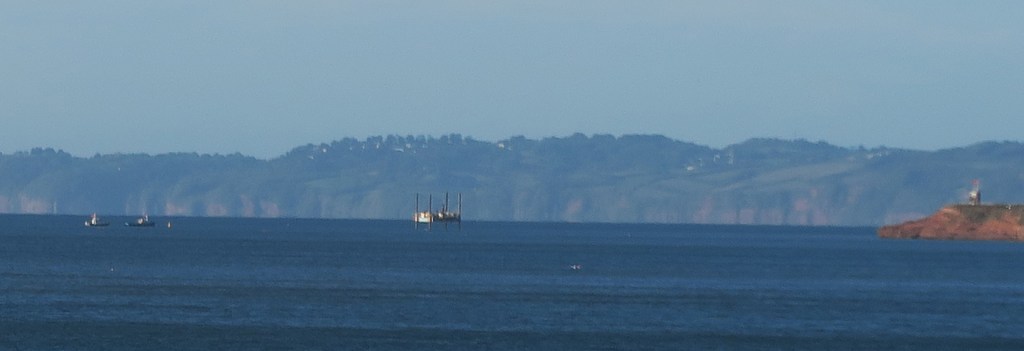

A correspondent says the South West Water platform has moved recently and sent a photo of it off Straight Point with, possibly, two tugs to the left.
Latest news on the “Nasty Party” – Owl
Liz Truss is teetering on the edge of performing another big U-turn as Tory MPs warned she would lose a vote on delivering a real-terms cut to benefits while new research showed the move could push an extra 450,000 people into poverty.
Aubrey Allegretti www.theguardian.com
Despite desperate pleas for party unity from senior ministers after weeks of bitter infighting, the row over welfare threatened to overshadow the prime minister’s attempt to reassert her authority when the Commons returns from recess on Tuesday.
Fresh threats of moves to oust Truss if she digs in were also being discussed by MPs over the weekend, while senior Tories, including former chancellor George Osborne, warned the Conservatives ran the risk of a wipeout at the next election for embarking on a “political experiment”.
In their ring-around of colleagues on Sunday, government whips were warned that dozens of Tory backbenchers would rebel against benefits rising in line with earnings – about 5.5% – rather than September’s inflation figure, which stands at about 10%.
While no formal vote is required, it is believed that an amendment would be tabled to the finance bill which would force all MPs to show their hand.
Unease extends the full length of the party, with some figures in the cabinet thought to be pushing Truss to match the inflation increase. One government source put the number of backbenchers who would rebel at least 30, while another said No 10 would be “forced to cave”.
Truss’s U-turn last week to reinstate the top rate of tax after the chancellor, Kwasi Kwarteng, announced it would be abolished in the mini-budget has given some Tory MPs heart they can force another climbdown. “She gave in on 45p, she’ll have to do so again,” said one.
In a sign Truss was softening her stance, a No 10 source insisted “nothing is decided” and added: “She will listen.”
It came as new analysis by a conservative thinktank, seen exclusively by the Guardian, showed low-income households with children, or people with disabilities, would bear the brunt of any move to uprate universal credit and other working-age benefits in line with earnings rather than inflation.
Such a move would swell UK relative poverty rates already at their highest level this century, the Legatum Institute said, as the cost of living crisis leaves millions of people struggling to pay energy bills and put food on the table regularly.
Legatum estimated more than 1.5 million more people in the UK will be in relative poverty this winter compared with before the Covid pandemic, even after the government’s energy support packages. Real-terms benefit cuts next April would boost the overall figure to 16 million, nearly a quarter of the UK population.
Tory peer Lady Stroud, the chief executive of Legatum, urged ministers to uprate benefits in full. “Failing to do so … would consign many on low incomes to a winter of impossible choices between heating their homes, putting food on the table or putting fuel in their car to get to work,” she said.
Conservatives from all wings of the party are angry Truss is prepared to drop Boris Johnson’s promise, made in May, to uprate benefits in full, potentially leaving millions of low-income families hundreds of pounds worse off in the middle of a cost of living crisis.
Those who have publicly opposed a real-terms cut to benefits include the Commons leader, Penny Mordaunt, the former chief Brexit negotiator Lord Frost, and the former culture secretary Nadine Dorries, who called the cuts “cruel” and “a lurch to the right”.
Stephen Crabb, a Conservative MP and former work and pensions secretary, said the Legatum findings were “further evidence cutting benefits in real terms will inevitably lead to an increase in poverty and hardship, at the worst possible time”.
The welfare budget was targeted by ministers after it became clear the government would need to cut billions from public spending after its disastrous mini-budget last month. Uprating by earnings would save the Treasury about £5bn, an option condemned by anti-poverty campaigners as “morally indefensible”.
The Legatum Institute analysis found uprating benefits in line with earnings rather than – as is the convention – September price inflation would result in 450,000 more people in poverty in 2023-24. Of these, 350,000 would be in households where someone works, and 250,000 in families that included a disabled person.
Such a cut would also result in a quarter of a million more people pushed into “deep poverty”, defined as an income at least 50% below the official poverty line. People in deep poverty are in near destitution, facing a constant struggle to afford basic essentials such as food, energy, clothing and toiletries.
Legatum also modelled the impact of an even more severe real-terms cut – freezing benefits at their 2022 levels. This would result in an extra 1 million people in relative poverty next year, including 700,000 people in deep poverty.
The findings were echoed in a separate study by the charity Child Poverty Action Group (CPAG), which concluded 200,000 children – almost all in families where one parent is working – would be in poverty if benefits were raised in line with wages rather than inflation.
An analysis by consultants Policy in Practice estimated low-income families would be almost £400 a year worse off as a result of real-terms cuts. The cut is even larger for some groups, with in-work households losing out by £458 and couples with children £640 worse off.
Given the Conservatives’ poll ratings, which are hovering about 30 points behind Labour, some have warned Truss could lead the party to electoral annihilation.
Dorries on Sunday told the BBC that if an election were held tomorrow, the Tories would face a “complete wipeout”, while Osborne believed voters would judge the prime minister’s “political experiment” harshly. “I think a Tory wipeout is potentially on the cards, but we’ve got two years to run,” he told Channel 4.
However, Nadhim Zahawi, the chancellor of the duchy of Lancaster, appealed for colleagues to come together and warned that inter-party division would only hamper delivery of policies, leading to defeat. He said the Conservatives had 24 months to win back trust, suggesting the election would be in October 2024.
A Department for Work and Pensions spokesperson said: “The secretary of state commences her statutory annual review of benefits and state pensions from late October using the most recent prices and earnings indices available.
“We are committed to looking after the most vulnerable which is why we’ve delivered at least £1,200 of support to families this winter while also saving households an average of £1,000 a year through our energy price guarantee. This support is on top of the annual working-age benefits bill which is over £87bn.”
A charity has accused the Environment Agency of being “missing in action” at the height of the pandemic after figures revealed inspections of companies’ monitoring at sewage treatment plants dramatically.
Each year the regulator inspects the self-monitoring that water companies undertake for discharges into rivers from the 6,327 wastewater treatment works across England and Wales to ensure the data withstands scrutiny. Between 2015 and 2019 there was an average of 475 inspections a year.
However, statistics released under freedom of information rules show inspections more than halved in 2020, to 223, before increasing last year to 334. The lack of oversight coincided with a period of water pollution incidents in English rivers that led the Environment Agency to threaten water bosses with jail sentences.

Christine Colvin, from The Rivers Trust, said: “Self-monitoring by the water companies can only work in a highly transparent and accountable environment. This was missing in action during 2020 and 2021 with the low level of visits.
“It’s now clear that complacency cannot continue and the public want urgent action to stop sewage pollution.”
Political pressure on water companies to tackle sewage spills is intensifying. Last week Ranil Jayawardena, the environment secretary, vowed to increase maximum fines from £250,000 to £250 million.
A spokesman for the Environment Agency said: “Site inspections of wastewater treatment works ran at a reduced rate during the pandemic in line with government advice to minimise the risk to staff, water company personnel and the public. This does not mean that regulation decreased.”
However, sources said that inspections could have been prioritised. One insider at the regulator said: “The Covid excuse is nonsense as both agency and water companies were key workers, unless they class these inspections as very low priority. Also, inspections can always be made up over a year, and the agency chose not to.”
Most Covid-related restrictions were relaxed in spring 2021. In another sign that suggests the drop could have been avoided if given greater priority, The Times understands there were several attempts to make checks remotely.
One source at the regulator said resourcing was the problem. “The inspections side has been pared back to the bone. The reason [for the fall] was a reduction in resources to the agency.”
Colvin said: “We need strong regulation. We need a regulator equipped to do the job, and site visits are an essential component of that work.”
Philip Dunne, Tory chairman of the environmental audit committee, which published a damning report on the state of England’s rivers in January, said: “It is clear reliance on self-monitoring has been part of the problem of sewage discharges in recent years. It is therefore more important than ever that audits and inspections carried out by the Environment Agency are robust.”
• Thousands of Environment Agency staff are to be balloted on a potential strike over pay, the Unison union said. This year workers voted to reject an offer of 2 per cent plus an additional £345.
Simon Clarke, the levelling up secretary, threatens to reignite the feud over housebuilding within the Conservative party with a significant “planning reset” that could water down environmental protections and affordable home requirements across England.
[According to this article Clarke has been meeting with several MPs who were staunch rebels on the planning reforms attempted by Johnson’s government. Would these include Simon Jupp? Unlikely – Owl]
Aubrey Allegretti www.theguardian.com
The latest in Liz Truss’s string of supply side reforms – nicknamed “Operation Rolling Thunder” in Whitehall – is slated to be launched by Clarke within weeks, and is expected to see him argue for a flurry of housing development as part of the government’s “dash for growth”.
He will probably claim that creating new houses would be better to grow the British economy than reshuffling assets between older and younger generations, and wants to launch a charm offensive on voters who do not want new developments in their area – which would see him “fighting to turn nimbys into yimbys”.
Clarke has said building more houses should not mean compromising on quality, beauty or the environment. But he has drawn up plans, seen by the Guardian, to reduce barriers for developers in England.
The proposed measures include a bonfire of red tape pertaining to aspects of housing development such as EU rules, affordable housing, nutrient pollution and biodiversity improvements.
Government sources also said the target of building 300,000 new homes a year by the mid-2020s had quietly been abandoned. They said it was unlikely to be officially abolished, as it had been a 2019 manifesto pledge, even though Truss hit out over the summer at “Soviet-style targets”.
But blue wall Tory MPs in the south-east of England are pressing for a firm commitment that the nationally imposed housing target will be dropped, and are wary of further planning reforms that would lead to a significant increase in development.
They are seeking to ensure local authorities maintain a “master veto” over developments before pledging their support to Clarke’s plan. This would keep any drastic new developments to areas that want them – but potentially limit the plans to turbocharge housing numbers.
One former minister said: “If we’re really going to fix the housing crisis, then you need something that’s profoundly radical. The problem is Liz probably doesn’t have a majority in parliament – so maybe this is the best they could do.”
Clarke is understood to have held meetings with several MPs who were staunch rebels on the planning reforms attempted by Johnson’s government, and is wary of again sparking a fierce backlash from backbenchers – particularly after a bitterly divisive Tory party conference.
Labour said the government must “think again” if their big idea was to “slash and burn regulations in a mythical search for growth”.
Lisa Nandy, the shadow levelling-up secretary, said: “To get growth we need to invest to create good, well-paid jobs, get businesses thriving, and get money back in people’s pockets. The answer is not less affordable housing, fewer environmental protections, more fracking, new warehouses and tax giveaways for the largest corporations.
“We have a Tory economic crisis, made in Downing Street, being paid for by working people. The government should be reversing its disastrous budget, not doubling down on an approach that has crashed the economy.”
In his plans, Clarke is pushing for developers in England to be given “greater flexibility on affordable housing requirements”, and wants to ease requirements for builders to leave land in a better state for the environment than beforehand, known as “biodiversity net gain”.
Housing delays caused by nutrient pollution, when development contaminates nearby earth and surrounding bodies of water, are also to be reduced.
Clarke wants to scrap what he described as the “perverse outcomes of historic EU regulations and rulings that are currently blocking 100,000 homes in this country”. The aim is for these laws to be scrapped in the spring of 2023, well before all retained EU law falls off the statute book automatically by the end of next December.
Quangos viewed as having unnecessary interference in the planning system would also be shut out of the process, with some – such as Active Travel England, which is the agency responsible for promoting walking and cycling – told they no longer have a legal right to be consulted on planning applications. And Clarke wants to allow more people to convert agricultural and commercial properties into homes.
While his proposals have been submitted to No 10, Truss’s team have not given their signoff and other departments are yet to offer their response.
Amid concerns among some Conservative MPs that Boris Johnson’s levelling up agenda is dead, Clarke is also expected to recommit to the mission in a speech earmarked for 19 October.
A source said No 10 had pushed for Clarke’s announcement to be focused on planning, but the Teesside MP wanted to widen it to include more aspects of levelling up, growth and opportunity.
Truss’s team initially wanted eight big supply-side reform announcements across October, but given the torrent of criticism she has faced from many in her own party, the number could be slimmed down as Downing Street seeks to focus on “quality, not quantity”.
Last year, there were 216,490 new homes built in England. The figure was down by 11% compared with the previous year.
A government spokesperson said: “The government is committed to exploring policies that build the homes people need, deliver new jobs, support economic development and boost local economies.”

