Owl dissects Angela Rayner’s LGR “pause” statement and her answers to MP’s questions.
Change of emphasis
Angela Rayner indicated a couple of times, that, under Andy Burnham’s leadership, the emphasis has shifted from reorganisation to an ambition to ensure that every area in England has, or is in the process of establishing, a strategic authority by the end of 2027, with strategic authorities in place everywhere by the end of 2028.
[Remember Devon and Torbay formed a non-mayoral Strategic Authority in 2025. Plymouth initially pulled out from early negotiations but are now exploring the possibility of rejoining.]
Summary
She gave a twice repeated commitment that Local Government Minister, Jim McMahon will be happy to meet with Devon Members to discuss the challenges that they face, especially in rural areas.
To Richard Foord, she said: We want to work with Devon to make sure that people in Devon get the right local devolution and local government reform for them. That is why I paused the decision.
Steve Race (Exeter) (Labour) tried to press the urban-centric case by saying “One of the policy goals of LGR is to encourage economically important cities like Exeter to better play their role in generating jobs, growth, housing and better place-based services. In our case, devolution does not work if Exeter is not in the strategic authority, as it is one of the two big economic drivers of the region. Can the Secretary of State confirm that this remains the case…“
Angela Rayner replied, once again prioritising devolution over reorganisation which wasn’t the answer he was hoping for: I reassure my hon. Friend that I have said that this review should be rapid, and that we should get on as quickly as possible with engagement, but also that the timetable for devolution should not be affected. We need to make sure that we make the right decisions on local government reform, but we want to take forward devolution at pace.
Caroline Voaden (South Devon) (LD) had the last, and no holds barred, question and received a reassuring answer.
Statement on Local Government Reorganisation 7 September Hansard
The Secretary of State for Housing, Communities and Local Government
(Angela Rayner)
Opening statement
With permission, Mr Speaker, I will make a statement on local government reorganisation. This Government are committed to delivering good growth across the country and power in every postcode, with places able to set their own ambitions and integrate services to meet people’s needs. Achieving that requires a fundamental rewiring of the state, giving power held by Westminster and Whitehall back to the people and the places where they live and work. As we set out in the Cabinet statement on rewiring the state, effective and sustainable local government is the vital foundation of our devolution ambitions.
As we are now determined more than ever to devolve power closer to the people we represent, it is only right that I, as the new Secretary of State, ensure that everything we do is working towards that plan to change Britain. [Interruption.]
The Prime Minister told the House last week that he was “prepared to look at local government reorganisation”,and he asked me, as his Communities Secretary, to do that. Throughout this process, the Government have listened to representations from Members of this House, councils and the public, and I want to be clear on how critical this is to me, given their importance to our democracy and the services they provide for local people. However, there will always be a wide range of divergent views, which means that achieving perfect consensus will never be possible.
I understand that feelings run high and people naturally have strong views in different directions. In that context, and in the light of legal advice, I want to satisfy myself first that the right process is in place, that it is robust and, of course, that it complies with the law. Secondly, I want to fully test whether our proposals for local government reorganisation meet the priorities of the new Administration and the new Prime Minister, and any additional considerations.
With those two considerations in mind, I have decided to withdraw the decisions made in March this year for Essex, Hampshire, Norfolk and Suffolk and, where relevant, their neighbouring unitary authorities. The Government’s legal representatives have notified the court of this step.
I have also decided to conduct a full review of the local government reorganisation programme, including the decisions that were announced in July this year for a further 14 areas, and the two areas where decisions have not yet been taken, and ask that reorganisation activity be paused. These 14 areas are Derbyshire, Devon,East Sussex, Gloucestershire, Hertfordshire, Kent, Lancashire, Leicestershire, Lincolnshire, Nottinghamshire, Oxfordshire, Staffordshire, Warwickshire, Worcestershire and, where relevant, their neighbouring unitaries.
I do not take this lightly. I recognise the huge amount of work that has already gone into progressing reorganisation in each of these areas, and I am very grateful for it. I know that many Members of the House and many council leaders will have lots of questions about what this means for them and their communities, and I will try to address those questions as best I can today.
First, we are working across Government on rewiring the state following the Cabinet statement. We recognise that effective and sustainable local government is fundamental to our ambitions for a devolved country that works better for and with communities, and we will consider this issue as part of our wider approach.
Secondly, as an immediate step, I have asked the Minister for Local Government, Devolution and Regional Growth to undertake a rapid review of the current local government reorganisation programme, including the position of the four areas where we have withdrawn and the further 14 areas that we are reviewing and pausing, alongside the two remaining areas. The new councils for East Surrey and West Surrey will be unaffected because they are already established in law, have had their first elections and are on track to go live in April 2027.
Thirdly, I want to be clear about what this means for elections scheduled for next May. Elections will go ahead in May 2027 on existing council boundaries. Finally, my Department will provide support to council leaders, officers and Members representing impacted areas, and the Minister for Local Government has written to leaders and copied in Members of this House.
I want to ensure that all those who represent these areas feel fully included in considering their future, and I will update the House at the earliest opportunity. My ministerial team and civil servants from the Department are ready to discuss and work with those representatives. My team will proactively reach out to discuss the local implications in detail. My Department remains committed to working in partnership with local government, both in this immediate period and in the longer term. I commend this statement to the House.
First mention of change
Gareth Snell (Stoke-on-Trent Central) (Lab/Co-op)
……Can the Secretary of State give some indication of the impact on the timetable for moving towards mayoral combined authorities …..
Angela Rayner
My hon. Friend is right to raise the opportunities of devolution. The Prime Minister is really clear that the Government’s ambition is to ensure that every area in England has, or is in the process of establishing, a strategic authority by the end of 2027, with strategic authorities in place everywhere by the end of 2028. The process that I have put in place today is about making sure that we have a rapid review and make the right and correct decisions on reorganisation.
[Officer resources within councils are so stretched that it is likely to be impossible to pursue the formation of fully functioning strategic authorities and reorganisation in tandem].
Questions from Devon MP’s
Steve Darling (Torbay) (LD)
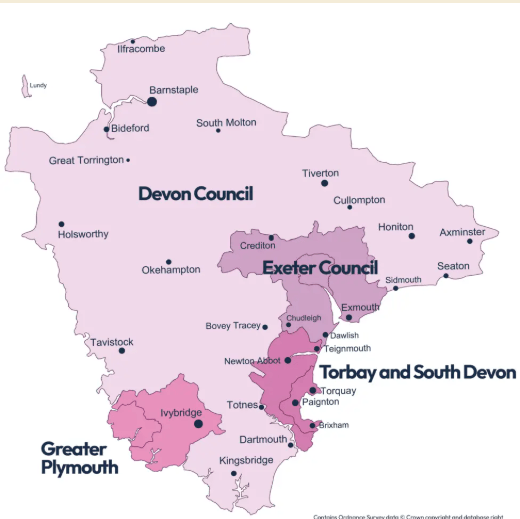
The current proposals for Devon were the brainchild of Exeter and Plymouth and were endorsed by the Conservative leader of Torbay council, and they resulted in a rural rump for Devon. Will the Secretary of State assure us that the rural rump of Devon will not rear its ugly head again?
Angela Rayner
Like I said, I have paused that decision today, and we will be reviewing it. I am sure that the Local Government Minister will be happy to meet with Devon Members to discuss the challenges that they face.
David Reed (Exmouth and Exeter East) (Con)
Building 1.5 million new homes and doing LGR at the same time was clearly bonkers. From freedom of information requests that I have submitted, I know that local councils in my area have already spent more than £1 million trying to do LGR. That much-needed money could have been spent on special educational needs and disabilities and other critical things in my county. Before any more money is wasted, will the Secretary of State be very explicit about what is happening in Devon? Will elections be happening next May? Can she give an indication of when a decision will be reached?
Angela Rayner
I have said that we will look at the review happening as speedily as possible. The Government have committed £63 million for transition costs to support councils, including £900,000 per unitary. Again, I do not think this money is wasted. Certainly, from my perspective as the Secretary of State and from the perspective of the Prime Minister, local government reform is about delivering for people in their local area with better services. I want to work with the hon. Gentleman and his local leaders to ensure that that
Richard Foord (Honiton and Sidmouth) (LD)
Devon is one of 14 areas where local government reorganisation is being reviewed and paused, and I am grateful to the Secretary of State for having listened to Liberal Democrats in Devon and perhaps also to her legal advisers. When the rapid review takes place, will the Secretary of State please consider the greater costs associated with delivering in the countryside, such as rural Devon?
Angela Rayner
One of the challenges that rural areas face is transport. One of the reasons that the Prime Minister has been so eager to make sure that devolution happens is that those who are closest to what is going on in their local area know what challenges are being faced and how we can unlock some of the potential, and Devon can take the positives from that. We want to work with Devon to make sure that people in Devon get the right local devolution and local government reform for them. That is why I paused the decision.
Steve Race (Exeter) (Lab)
One of the policy goals of LGR is to encourage economically important cities like Exeter to better play their role in generating jobs, growth, housing and better place-based services. In our case, devolution does not work if Exeter is not in the strategic authority, as it is one of the two big economic drivers of the region. Can the Secretary of State confirm that this remains the case, and that after the rapid review, should it have a positive outcome, we can move forward with both LGR and devolution in Devon quickly?
Angela Rayner
I reassure my hon. Friend that I have said that this review should be rapid, and that we should get on as quickly as possible with engagement, but also that the timetable for devolution should not be affected. We need to make sure that we make the right decisions on local government reform, but we want to take forward devolution at pace.
[So Exeter’s self interest, arguably a major contributor to Angela’s problems, is brushed aside]
Caroline Voaden (South Devon) (LD)
From the LGR options that were on the table for Devon, the Government opted for a Labour-led proposal to create three urban growth areas, with all the rural bits that were left behind dumped together into one huge, unworkable authority that divided communities, had no economic hub and had little chance of being sustainable. I therefore welcome the Secretary of State’s announcement that she will review the decision, although it is not clear how the review will happen, who will do it or how long it will take. Will she commit to meeting all Opposition Members who represent rural Devon so that we can discuss the best proposal for the for the biggest number of people across Devon? The one we had was going to leave rural Devon behind, and we want to ensure that does not happen again.
Angela Rayner
I want to reassure the hon. Member that we do not want to leave rural Devon behind, either. As the Minister, my hon. Friend the Member for Oldham West, Chadderton and Royton (Jim McMahon), has just had to nip out for another meeting, I will volunteer him for the commitment to meet those Members. It is of serious concern for me to ensure that people are heard in the process. That is why I decided to have the review.

 East Devon Watch