Owl has been looking into the incentive scheme Ofwat has devised for water companies, or “Outcome Delivery Incentives”, as it’s called. This is a scheme whereby water companies are fined or paid a bonus for meeting targets.
It leaves Owl worrying about the prospect of the triple whammy as water companies charge us more to meet the targets and “guess who” underwrites Ofwat’s handouts for meeting them; justifying even greater Bosses’ Bonuses to boot.
It will need careful adjustment of the scheme to avoid this. But in a monopoly market you have to ask whether such schemes are ever likely to work to the consumers’ advantage.
The latest figures show Ofwat “in profit” to the tune of £67m to be applied during 2022 – 2023. This covers the 17 water and waste companies in England and Wales.
The biggest bonus payment is to United Utilities (operating in the North West) £20.5m, followed by Anglian Water £11.7m. The three biggest losers are: Thames Water -£53.2m, Southern Water -£46.0m and South West Water -£15.4m
A housing developer has been knocked back after trying to remove a condition requiring 78 new homes to be sold to the over 55s.
Taylor Wimpey was granted permission back in 2016 to build 1,040 new homes on land to the east of Clitheroe off Pendle Road.
One of the conditions in granting planning permission required 7.5 per cent of the new homes – 78, to be sold to the over 55s but the developer submitted an application to Ribble Valley Borough Council in November requesting that the condition, known as a Section 106, be varied.
The application has now been rejected with council officers stating Taylor Wimpey’s argument is “not acceptable”.
In a report explaining its decision the council said: “The applicant has explained that they have consulted with local market experts and when mortgage lenders take into consideration affordability they will consider the applicants age and the term that the mortgage can be taken out over. They consider that in the current climate the over 55s clause will severely limit the number of lenders willing to lend on the properties and the saleability of them.
This is not considered to be an acceptable argument. There is a clear need for over 55s housing in the borough and this strategic site is expected to make a significant contribution to this.
“This argument would suggest that persons over 55 would find it difficult to purchase a property in any scenario. Furthermore, the proposal seeks to remove the requirement to build homes to a lifetime standard which would also remove a contribution of this type of home to housing supply in the borough.
“The amendments proposed will affect the delivery of a significant number of lifetime homes and homes restricted to over 55s for which there is a demonstrated need in the borough. The justification offered is not considered to be convincing and as such the modifications are considered unacceptable.
“The proposal would be contrary to policies H2 and H3 of the Core Strategy, which aim to ensure that there is a suitable mix of housing to meet the housing needs and demands for the borough and ensure that properties are available to accommodate the changing needs of occupants. Therefore it is recommended accordingly.”
A spokesperson for Taylor Wimpey said the developer “understood” the council’s decision.
“We recognise there is a need for housing for the over 55s in the area and we are committed to delivering new homes that meet local requirements,” the spokesperson said.
“We understand and accept the council’s decision regarding our proposed S106 amendment and will continue to deliver homes in line with the approved planning documents.”
Levelling up secretary Michael Gove last week unveiled the government’s long-delayed plans to address regional and social inequalities, but cash-strapped councils across England are having to plan heavy cuts to frontline services after more than a decade of ongoing austerity. Recent funding increases have not undone £15bn of cuts in central government grants to local authorities between 2010 and 2020, and councils wrestling with the impact of Covid are set to pass a succession of savings measures plus widespread council tax increases. Several local authorities are facing votes on service cuts in the coming weeks.
Nottingham is planning cuts to youth services, with all play schemes axed and a move toward targeted rather than universal provision. Its Early Help service would see a reduction in staffing and early intervention for families. Funding for its Base 51 youth centre, which provides services including counselling and crisis support, would be axed. Six of the city’s nine children’s centres would close from 2023.
Sandwell in the West Midlands is reviewing the respite support it provides, to allow unpaid carers such as family members a much-needed break while the person they care for is looked after by someone else. Sandwell plans to halve this from 56 days a year to 28, which the council admits “will reduce the level of service offered”. It is also planning to increase the amount adult care users pay for non-residential care.
Kent is planning to cut more than £2m from subsidised bus services, with some contracts potentially terminating. The cost of a school bus discount pass will rise by £80 a year, and by £30 for children receiving free school meals. The council is also planning to cut travel concessions for those accompanying disabled people.
Liverpool is planning to cut funding for community organisations that run three libraries: they took these over from the council in 2015 to save them from closure.
Hartlepool is planning to end free home-to-school transport for 16- to 19-year-olds with special education needs and disabilities (Send). Support may be axed for current students or perhaps just for new starters.
A spokesperson for the Department for Levelling Up, Housing and Communities said the government was increasing councils’ “core spending power” by 4% and “providing the largest cash-terms increase in grant funding in 10 years”.
Boris’ wasted call, the “Cream Tea Plot” looks to have gone full “Doom Bar” as Johnny Mercer gives his enthusiastic support to the hospitality sector. – Owl
Johnny Mercer had spent afternoon watching FA Cup and Six Nations contests, according to his partner
A Tory MP was “so p****d” following an afternoon watching sport he “couldn’t remember what was said” when Boris Johnson called him on the phone, according to his wife.
Felicity Cornelius-Mercer shared a photo on social media on Saturday of her husband, Plymouth Moor View MP Johnny Mercer, sitting on a sofa with his head thrown back, apparently in a deep sleep.
She said the prime minister had called Mr Mercer after he had spent the day following his local side Plymouth Argyle’s narrow defeat to Premier League side Chelsea and England’s rugby team loss to Scotland in the Six Nations.
“So..funny story…the Prime Minister rang tonight directly after an afternoon of FA Cup football and England rugby..and @JohnnyMercerUK was so p****d he can’t remember what was said,” Ms Cornelius-Mercer wrote.
She joked that she was thinking of “winding him up” the next day, and asked her Twitter followers for suggestions of what to tell him he had discussed with the PM.
Some people suggested that she should tell her husband he had agreed to do an early-morning round of media interviews.
Others suggested she say that Mr Johnson offered him a new job, whether in Downing Street or his Cabinet.
Earlier in the evening, Mr Mercer quote-tweeted Plymouth Argyle’s tweet about the match and wrote: “Heartbreak. So proud – of fans and team.”
A number of crises have embroiled the prime minister recently, but Mr Mercer has not said whether he would submit a letter of no confidence in Mr Johnson or not, according to PlymouthLive.
When asked by the local news outlet if he had plans to submit a letter of no confidence, Mr Mercer said he would not comment– and when asked why he would not comment, he replied: “Ha Ha.”
The “Levelling Up” White Paper puts great emphasis on recreating a modern day “Renaissance”.
Owl quotes from the paper (page xiv):
“The Renaissance flourished in Italian city states that combined innovation in finance with technological breakthroughs, the cultivation of learning, ground-breaking artistic endeavour, a beautiful built environment and strong civic leadership. And the first Industrial Revolution in Britain came about through the interplay of innovative financial instruments, sharper rewards for enterprise, new institutions of learning, improvements in transportation and rivalrous emulation between local leaders and entrepreneurs. Those same concerted forces are needed to drive productivity, innovation and growth across the UK today.
This contemporary Medici model, our twenty-first century recipe for a new Industrial Revolution, depends on harnessing an array of interventions and catalysing a range of sectors. Levelling up will require us to:
a. boost productivity, pay, jobs and living standards by growing the private sector, especially in those places where they are lagging;
b. spread opportunities and improve public services, especially in those places where they are weakest;
c. restore a sense of community, local pride and belonging, especially in those places where they have been lost; and
d. empower local leaders and communities, especially in those places lacking local agency.”
Here are members of the Great South West Team presenting a regional growth prospectus to the Minister for Local Growth, Rt Hon Jake Berry MP, in January 2020. They then briefed him on ambitions to deliver £45 billion of economic benefit and 190,000 new jobs over the next 15 years. We’ve not heard much since.
Who, if any, of our local leaders deserves the accolade of a contemporary Medici?
Here’s what you are looking for:
The role models: Cosimo and Lorenzo de Medici
Could it be Devon County Council Leader John Hart?
Devon County Council (DCC) has revealed that out of the 317 care homes in the county, currently around half have two or more linked cases of Covid among staff and residents.
Last month, Devon Live reported how Covid outbreaks in Devon’s care homes had reached their highest level since the pandemic began.
Figures presented to the county council’s health and adult care scrutiny committee revealed that, as of 10 January, there were 160 such outbreaks in care settings across Devon.
The number was far higher than the previous peak of just over 90 a year ago, with the total number of active outbreaks tripling in less than a month.
Sadly the situation has not improved going into February. DCC has assured care homes are working hard to manage infection, mitigate risk, and to protect their residents and staff from coronavirus.
Where there are outbreaks – two or more linked positive cases – those care homes are said to be working even more closely with Public Health Devon to follow temporary additional measures to reduce risk.
Recently the government has changed its guidance over care home visiting rules to allow more visits.
Due to the high Covid numbers currently affecting Devon’s care homes, the relaxation of the rules is causing great concern to many care home providers in the region. It is feared that opening up to visitors right now will put residents and staff at greater risk of infection.
Under the new national rules, care home visitors are asked to make arrangements with care homes in advance of their visit, so that care home providers can manage the number of people attending at any one time, to ensure safety for residents and staff.
Steve Brown, Devon’s director of public health, said: “Visiting loved ones and friends who live in care homes is vitally important to the resident’s wellbeing.
“We want there to come a time soon when additional restrictions will not be needed, but while cases in Devon care homes remain high, we ask visitors to make arrangements with their care home in advance of their visit, so that the care home can manage risk of infection to residents and staff.
“We also ask that visitors follow the care home’s own policy, through careful hand hygiene, wearing of appropriate personal protective equipment, and using lateral flow device tests prior to visiting.”
“..lessons from previous efforts are not being learnt, claim critics. And the focus should be on people rather than “shiny new buildings”, says the former head of a flagship scheme in Newcastle.”
This week the government published its eagerly awaited White Paper, setting out plans to reduce regional inequality. Levelling up aims to revitalise communities in places like Rhyl, where BBC News has been tracking progress of this key policy.
But lessons from previous efforts are not being learnt, claim critics. And the focus should be on people rather than “shiny new buildings”, says the former head of a flagship scheme in Newcastle.
Florist Carol Parr clips the ends of flower stems on a bouquet as she explains the dilemma she faced. “I had a little battle with myself. Do I stay? Do I commit to Rhyl?” she says. “Not many people say good things about Rhyl, which I can understand based on crime, there’s a lot of trouble.”
Despite that, Carol opted to move into a larger shop on the high street three years ago. “I’m very optimistic and over the last two or three years I have seen a change in Rhyl. I think it’s an up-and-coming town again.”
Such optimism is not always evident in the seaside town, which was struggling long before its economy was pounded by the pandemic. But Carol’s act of faith may be repaid.
The local MP and the county council want to transform the town centre and recently prepared a £10m bid from the UK government’s levelling up fund.
Money from the £4.8bn fund aims to narrow the gap between richer and poorer parts of the UK. It will allow overlooked and undervalued communities to take back control of their destiny, the levelling up minister, Michael Gove, told parliament on Wednesday. But there are concerns that vital lessons from the past are being ignored.
Lessons from Newcastle
A generation ago, West Newcastle was undergoing a radical plan for change. It was one of 39 English communities that received funds under Labour’s New Deal for Communities (NDC). Within a few years levels of deprivation fell.
Graeme Williams ran the scheme and on a freezing cold January afternoon he gives us a tour of the area. We walk in shadows cast by the tower blocks of Cruddas Park, not far from the city centre. Twenty years ago “they looked awful”, says Mr Williams. “They were awful.”
Some of the blocks were refurbished, others demolished as part of the £55m spent in West Newcastle during a decade of regeneration. But most of the money didn’t go on capital projects, such as buildings.
His team appointed eight people who knew the area well to work with residents to prioritise what changes were needed. Decisions were taken by a management board made up mostly of residents.
The emphasis was “around training, education and supporting people to move into employment”, says Mr Williams. “People recognised they had agency where they could actually generate change.” It gave them hope.
An independent assessment of the New Deal for Communities by academics at Sheffield Hallam University concluded “in many respects these neighbourhoods have been transformed”. It said: “The biggest improvements were for indicators of people’s feelings about their neighbourhoods.”
Mr Williams still works in the city. He is now a director of the Centre West charity. And while proud of some of his achievements, he says a lot of work was “undone by austerity” which “hammered areas like the west end of Newcastle”.
“It’s massively disheartening and incredibly frustrating because we seem to take two steps forward and then two or three steps back as far as urban regeneration is concerned,” he says. “There’s an awful lot of really good evaluation work that’s been done to identify what works and how we can do things better and it’s not being used. “
Levelling up “might produce some nice shiny new buildings. But I don’t think it will necessarily improve the lives and prospects of people living in them communities”.
Supporters of what the Labour government policy achieved include a former Tory speech writer for Theresa May. Will Tanner, now director of the Onward think tank, assessed 60 years of regeneration projects by previous governments. “This isn’t a party-political point. This is just about the right policy based on the evidence,” he says.
He said putting power in the hands of communities worked best, “so they are pulling themselves up by their own bootstraps, rather than relying on a top-down government programme”.
He says the government is right to want to change the economic geography of the UK and is supportive of its plans. But adds: “The most important thing for the levelling up fund to do is to let go of power from Whitehall and to empower community organisations right down at the hyper-local level.”
The White Paper acknowledges the importance of local decision-making and promises more regional mayors. It isn’t yet clear what role will be played by people at a neighbourhood level.
Bricks and mortar
Back in Rhyl, we stroll around the town centre with Conservative MP James Davies, walking past boarded up and shuttered shops. He agrees. “Just building things, bricks and mortar is not the answer. It needs to be a cleverly thought through scheme that’s going to boost economic activity.”
We pause outside the derelict Queen’s Market, which is being bulldozed. It’s hoped a new food hall with flats and offices will be developed on the site through a mix of funding from the Welsh government, Denbighshire County Council, the levelling up fund and private businesses.
The plans would also see the town reconnected to the seafront. Incredibly, though an expansive sandy beach is just yards away, you can’t see it from the high street. Mr Davies says there is local backing. A master plan went out to consultation and has “the support of local councils, residents, businesses”.
But a potential obstacle is the number of high street shops owned by absentee landlords. A sample of Land Registry documents seen by BBC News show only five out of 25 High Street properties are owned by people local to Rhyl.
“That’s a real challenge,” Mr Davies acknowledges. “All you can do is invest in the areas that the local authority and willing partners own as a priority. And then you hope that economic activity will encourage others to follow over time.”
How do locals out and about on a beautiful, bright winter’s morning feel about their town centre and the plans to regenerate it?
“I’m not quite sure how to put this. It’s appalling,” says a man who moved to Rhyl seven years ago. “Shops closing, shutting arcades. Rhyl just isn’t what it used to be. I don’t think it will ever come back.”
But octogenarian former mayor, Diana Hannan, out on her mobility scooter, loves the town so much she moved back after emigrating to Australia. “We’ve got the best seaside resort in Wales,” she says.
“We get all this negative press about drugs and alcohol and all the rest of it, but we’ve got a lovely community living here. Rhyl is going to boom. You wait until all of these stores go up.”
On the road out of town we stop off at a food bank run out of the back of the Wellspring church. Amid shelves straining under the weight of tins of baked beans, pastor Mark Jones explains how Rhyl is full of “fabulous people”. But he says “there’s a lack of energy, a lack of enthusiasm”. “There’s this sense of hopelessness amongst the people. If you walk down the high street, you can just see it in people’s eyes.”
Mr Jones, who has lived in the town for more than 40 years, supports the levelling up plans but says the proposals “need to show the people of Rhyl that there is a hope and a future for them”.
“It’s OK to invest,” he says. “But you also need to inspire.”
Last week Exeter-based Midas, one of the country’s biggest privately owned construction and property service companies, filed a notice of intention to go into administration.
Together with its construction arm Midas Construction and housing division Mi-Space, the group has a turnover of almost £300 million and 500 people working directly for it, with many more employed through subcontractors.
But the company recently posted a loss of over £2 million for its last financial year, blaming its troubles on the pandemic, ongoing shortages of materials and labour, and a significant rise in costs because of inflation.
Midas’ projects in the county currently include contracts with Torbay Council to build an £11 million Premier Inn, improvements to a school in Torquay and nine affordable homes in Paignton.
A spokesperson for Torbay Council said: “We are saddened to hear the news about Midas and their notice of intent to enter administration. We are continuing to work with Midas to identify issues and solutions and any further implications that might need attention in the future.
On the hotel, they added the council “remains committed to the scheme which will not only generate new employment opportunities but will complement existing hotel accommodation in Torquay that will attract thousands of guests each year, boosting our local tourism economy by more than £3 million.”
The Lib Dem leaders of Torbay, Teignbridge, North Devon councils have sent out a call to the secretary of state for levelling up, Michael Gove, asking for Westminster to step in to help the company.
Councillor Steve Darling, leader of Torbay Council said: “Midas filing it’s notice of intention to appoint administrators is a grave concern for us.
“We are becoming aware of the millions that are owed to subcontractors and are aware that this could significantly impact on thousands of jobs and businesses in the south west.
“If the government is serious about their levelling up agenda, then the secretary of state must step in to stop this engine of regeneration from collapsing and sending the south west’s economy in to reverse.”
While neighbouring Cornwall Council also has a number of contracts with the company for schemes which include homes, schools and workspace projects, Devon County Council said it has no current projects with Midas.
Exeter City Council and Mid Devon District Council say they currently have no live contracts with the firm, which has offices in Exeter and Newton Abbot as well as elsewhere in the south west.
However, Midas is Teignbridge District Council’s main contractor for work currently taking place to decarbonise its Forde House headquarters.
A spokesperson for that council added: “While they are in the current phase of appointing an administrator, we are investigating alternative options to progress with the works.”
In a statement to confirm its intention to go into administration last week, Midas said: “the company continues to operate, while the directors work to explore all available options to achieve the best outcome for the business and our people, our customers, supply chain partners and all our stakeholders.
“Midas is committed to pursuing an outcome that will achieve continuity for our live contracts and asks all our valued stakeholders to remain supportive of the group at this time.”
Clyst St Mary Residents wait with bated breath for the recommendation by East Devon Planners
On 40 four-storey apartments in Zone D at Winslade Park
Many Clyst Valley Road residents, living adjacent to this inappropriate proposal, are holding their breath in anxiety, uncertainty and dread to see whether such an incongruous, urban design (which many have likened to an inner-city car park), opposite a historic Grade II* Listed Manor House in the rural village of Clyst St Mary, will be recommended for approval by East Devon Planners when the Reserved Matters Application (21/2217/MRES) is judged by the Planning Committee in the near future.
This Zone D proposal by Burrington Estates (New Homes) Limited, (alongside a further 39 homes on a green field at the entrance to Winslade Park – Zone A) was approved by East Devon District Council (EDDC) Planners on 2nd December 2020 merely in outline, under a hybrid application which included full planning permission for the refurbishment of the vast Winslade Park Office complex because the entire masterplan was deemed of significant economic value to East Devon but resulted in other pivotal planning issues being disregarded.
In December 2020, EDDC elected Councillors were advised by their Development Manager that the outline approval was only permitting the basic, foundational principles for residential development in both Zones A and D and Burringtons’ subsequent Reserved Matters applications would provide the crucial details regarding design, height, massing, access etc, which would take into account consultations from professional consultees and local contributors and could be challenged and amended to ultimately achieve the most desirable design resolutions.
Planning Committee Councillors (including the District Councillor for Clyst St Mary) recommended that the Zone D outline proposals for three-storeys should be lowered to two-storeys and that Burringtons should consult with local people, before their submission of Reserved Matters, to ensure that their designs were compatible with the Neighbourhood Plan and did not encroach on adjoining homes creating any local detrimental issues.(See the U-Tube recording on EDDC Planning Portal for Planning Committee on 2nd December 2020 for Application No. 20/1001/MOUT).
Unfortunately, Burringtons failed to provide a full consultation with the majority of the community (as advised by EDDC) preferring to restrict their consultation, at very short notice, to around 21 selected residents over a two day period! Sadly, this limited consultation has resulted in none of the comments made by any residents being included in Zone D amendments and to date no amended proposals for Zone A are published. However, instead of lowering the 40 apartment blocks to two storeys (recommended by Planners in December 2020), Burringtonsincreased them to four-storeys and also raised the entire ground level by approximately 2 metres for both the apartments and the access road (presumably to avoid potential ground-floor flooding in their proposed flats resulting from them building in a recognised flood-vulnerable zone)?
Although Burringtons have named Zone D ‘Woodland Villas’ – the truth is that their proposals include significant felling/thinning of mature trees in a woodland protected by a Tree Preservation Order, with removal of up to 18m tall early mature oak, ash, lime and cherry and young holly, hazel, field maple, cherry laurel and sycamores in the under-storey, purely to facilitate the access road and additional parking necessary for these 40 four-storey flats. Furthermore this woodland is primarily deciduous and so will not provide sufficient screening for the existing traditional two-storey Clyst Valley Road homes during 6 months of the year – because the proposed raised four-storey flats will overlook and encroach on existing indoor home spaces and cause detrimental issues of noise, light and air pollution from the towering flats and the raised access road and boundary parking.
Worryingly, the lack of safe pedestrian access at the bottom of Winslade Park Avenue for this entire Winslade Park development appears to have been ignored, despite extreme concerns from local residents that there are no pavements or lighting approaching a blind bend that seem crucial for 79 new homes and the commercial development to enable safe pedestrian access to the village amenities of the school, shop, post office etc?
Although the Developers have agreed financial contributions towards a footpath (that is yet to be provided) between the Village Hall car park and the school, this footpath is on the other side of the A3052 from Zones A and D! The Development Manager emphasised (on 2nd December 2020 at the outline planning meeting) the safety issues that were of concern in Winslade Park Avenue – but suggested that prospective residents of Zones A and D could drive to the Village Hall car park to access a safe footpath to be provided there in the future. However, many residents would, surely, rather walk the short 100 metres distance from Zone A to access the village facilities? To date, there appears to be no plans to clarify this unsustainable situation?
Surely, ‘the elephants in the room’ are the inappropriate design for 40 four-storey towering apartments in a small, rural village opposite a historic asset, the overlooking of local residents’ indoor home spaces, the lack of safe pedestrian access to and from two large residential sites, the loss of protected trees and the exacerbation of flooding in a vulnerable flood risk area?
Hopefully these matters will be addressed before any further decisions have to be made by East Devon’s Planning Committee in the near future – but the public perception is that economic benefits should not override the social and environmental issues and perhaps the Developers should be encouraged to submit proposals that will work for the people and not just generate profits for themselves?
The bottom of Winslade Park Avenue where there is no footpath or lighting
Pie, a fictional news correspondent portrayed by actor and comedian Tom Walker, kicked off his US segment by explaining the Patygate scandal that has rocked the Boris Johnson administration to viewers.
Dubbing the prime minister a “liar” – a term ‘banned’ in UK political discourse – he said “Trumpian is the ease with which he tells porkies”.
Discussing the Patygate scandal Pie said Downing Street hosted “16 separate p*ss-ups” in breach of its own lockdown rules, including two that happened the night before the Duke of Edinburgh’s funeral.
The comedian said Boris’s lies “are no secret” as he listed off all the things he’s fibbed about.
“He essentially lied to the Queen when he illegally shut down parliament, he lied to the country when he said Brexit would be good for farming, and fishing, and trade deals, and the economy.
“He’s been fired twice for lying. He was fired as a journalist for the Times newspaper for simply just making stuff up, and he was fired for lying about shagging someone behind his wife’s back.”
Pie went on to explain what shagging means, as well as other unfamiliar terms such as ‘scotch egg’, ‘pub’ and ‘Eton’.
Watch the hilarious clip in full HEREor on twitterHERE
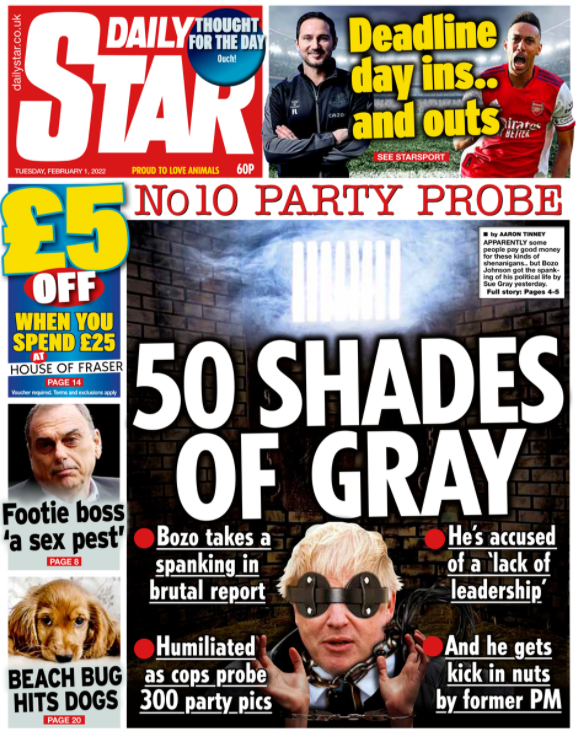
Liberal Democrats are today [Tuesday] tabling a bill to force Boris Johnson to admit to any fines he receives for lockdown breaches – and they calculate the prime minister could be forced to shell out up to £12,300.
In a swift U-turn on Tuesday, Downing Street agreed to inform the media if the PM received a fine as a result of the Metropolitan Police inquiry into 12 social gatherings at No 10. The climbdown came 24 hours after No 10 caved in to pressure over its efforts to keep Sue Gray’s final report into the Partygate affair secret.
But it remains unclear whether the size of any fine will be revealed, and Mr Johnson’s official spokesperson said there was no commitment to publicise penalties for any other ministers, officials or members of the PM’s family.
Scotland Yard is not planning to reveal details of any fines, as this is not normal practice.
Under the Ministerial Disclosure Bill being tabled by Lib Dem home affairs spokesperson Alistair Carmichael and seen by The Independent, any government minister issued with a fixed penalty notice would be required by law to make it public.
Because Covid FPNs can be increased for each subsequent office, Mr Carmichael calculates that Mr Johnson could face a total of £12,300 in fines if police penalise him in relation to six events which he is alleged to have attended.
These include the “bring your own booze” garden party on 20 May 2020 (£100); the celebration of Mr Johnson’s 56th birthday on 19 June (£200); the leaving do for former communications chief Lee Cain on 13 November (£800) and the alleged party to celebrate Dominic Cummings’ departure in the Johnsons’ flat that evening (£1,600).
Later events for which the Lib Dems believe the PM could incur fines are another leaving do on 17 December 2020 (£3,200) and a gathering in Downing Street on the departure of two No 10 private secretaries on 14 January 2021 (£6,400).
At present, there is no legal mechanism to force Mr Johnson to reveal fines if he chooses not to do so. His official spokesperson said he would release information voluntarily because of the “significant public interest” in him.
Mr Carmichael told The Independent that the repeated flip-flops from No 10 showed that the prime minister “holds the British public with deep disdain and is taking them for fools”.
He challenged Tory MPs to back his bill or face accusations that they are assisting Mr Johnson and his ministers in covering up their misdemeanours.
“We’ve never needed a legal mechanism to force ministers to reveal if they’d received fixed penalty notices because we’ve never had a leader as shameless as Boris Johnson,” said Mr Carmichael.
“He not only flouts the laws he asked us all to follow, but then repeatedly lies about it.
“Conservative MPs have no excuse – they know that this man is not fit for public office. They should back my Bill so Boris Johnson is forced to come clean. If Johnson is found to have broken the law and fined by the police, he will surely have no choice but to resign.”
Mr Carmichael has also written to the Independent Parliamentary Standards Authority, calling on them to rule out the possibility of the Prime Minister using taxpayer-funded expenses to pay any potential fines which Boris Johnson receives.
The Finance Bill had its third reading in the House of Commons and included a provision to lower the rate of a surcharge on banking profits of more than £25 million from 8% to 3% from next year.
Coming on the eve of an expected increase in the energy price cap which could see bills rise for millions of households, the tax cut provoked anger on opposition benches, but passed by 302 votes to 226.
An amendment, which would have seen the tax cut axed, was defeated.
Labour called on the Chancellor, Rishi Sunak, to scrap the tax cut and instead use the estimated £1 billion it raises each year to fund support for households struggling to deal with the cost-of-living crisis, amid rising fuel prices and energy bills.
East Devon MP Simon Jupp (Con) supported the bill, as did fellow Conservative Neil Parish (Con, Tiverton and Honiton).
Did Devon MPs vote in support of the bill?
Ben Bradshaw (Lab, Exeter): No
Sir Geoffrey Cox (Con, Torridge and West Devon): Yes
Simon Jupp (Con, East Devon): Yes
Anthony Mangnall (Con, Totnes): Yes
Anne Marie Morris (Ind, Newton Abbot): Yes
Neil Parish (Con, Tiverton and Honiton): Yes
Selaine Saxby (Con, North Devon): Yes
Sir Gary Streeter (Con, South West Devon): No vote recorded
Mel Stride (Con, Central Devon): Yes
The cut was announced in last year’s Budget by the Chancellor.
Labour said the surcharge raised £8.3 billion since 2016, which could fund solid wall insulation for 110,000 homes, cavity wall insulation for a million homes, or 380,000 new gas condensing boilers.
And after the vote Richard Burgeon (Lab, East Leeds), said: “Sickening. I just voted to scrap a multi-billion tax cut for bankers.
“Not a single Tory MP voted to stop bankers getting even richer.
“How dare they do this when millions can’t even afford to pay their energy bills.”
The reviewers are right: it lays out the problems in a number of academic style essays but offers no cures.
On page 96 we get to the nub of the issue:
Size the Prize
Subject to some assumptions, it is possible to “size the prize” by unlocking places from their low-growth equilibrium. For example, consider if the performance of the bottom-performing quarter of places by productivity were to be “levelled up” to the median. The boost to productivity would be equivalent to a pay rise of around £2,300 for individuals in the poorest areas. For the UK economy as a whole, this would deliver a GVA gain of around £50bn per year.
So we are going to invest in……………..? Owl tried following up the 192 references to “productivity” only to find generalities about improving this and improving that.
(We have been here before with our Local Enterprise Partnership, HotSW, haven’t we?)
Next Owl turned to Chapter 2 to try to learn something about plans for devolution:
Chapter 2 Systems Reform (yes this the place to look)
2.1 Introduction
“Chapter 1 described the scale and source of the UK’s geographic disparities and the role public policy can play in counteracting them. It showed that there is no simple or singular solution to reversing spatial disparities because local economies are complex systems, shaped by cumulative and interconnected economic, social and institutional factors. Successful policy programmes need to act on the six capitals [See below] which underpin the prosperity of places to reverse these forces.
This chapter starts by explaining why past attempts to promote spatial convergence in the UK have been unsuccessful and what lessons can be taken from that experience. In sum, decision-makers nationally and locally have typically lacked the information, incentives and institutions to act in ways which support the closure of spatial disparities in a signifcant and sustained way.
Drawing on these lessons from the past, this chapter recommends wholesale changes to the information, incentives and institutions which underpin spatial decision-making in the UK. This transformation in the system of government, and in the governance of spatial policy, is supported by five pillars:
a. a mission-oriented approach to setting policy;
b. a reorientation of central government decision-making;
c. greater empowerment of local government decision-making;
d. a revolution in data and transparency at the subnational level; and
e. enhanced transparency and accountability of this new regime.
These five pillars are mutually reinforcing. Each performs a necessary role in the new policy regime. But it is their combined effect that is necessary to reshape decision-making and deliver the long-term objectives of levelling up, as part of a new system of governance. That is why the focus of this chapter is the improved information, incentives and institutions underlying the new policy regime. “
By this time Owl had forgotten about the Six Capitals and had to return to the Executive Summary:
The Six Capitals
Levelling up requires a focused, long-term plan of action and a clear framework to identify and act upon the drivers of spatial disparity. Evidence from a range of disciplines tells us these drivers can be encapsulated in six “capitals”.
• Physical capital – infrastructure, machines and housing.
• Human capital – the skills, health and experience of the workforce.
• Intangible capital – innovation, ideas and patents.
• Financial capital – resources supporting the financing of companies.
• Social capital – the strength of communities, relationships and trust.
• Institutional capital – local leadership, capacity and capability.
County Deal
Apparently Devon will be one of the first invited to negotiate a “County Deal”.
Now where does the paper explain what such a deal might include and what the conditions might be?…………..
The Prime Minister has been asked to help women in East Devon facing an 120-mile round trip to get to their nearest menopause clinic.
Speaking in Parliament, on Wednesday, February 2, Simon Jupp, the Member of Parliament for East Devon, asked Prime Minister Boris Johnson: “My constituent Jinty Sheerin has launched a campaign for a dedicated menopause clinic in Devon.
“Women in East Devon currently face a 120-mile round trip to get to the nearest specialist menopause clinic. It is not good enough, is it?
“Will my right hon. Friend outline what steps the Government are taking to improve access to menopause services in Devon and the south-west?”
The Prime Minister responded: “I thank my hon. Friend for raising this very important campaign. We are committed to improving menopause care so that all women can have access to the support that they need to manage the symptoms.
“Menopause will be a priority in our women’s health strategy, and we are committed to establishing a UK-wide menopause taskforce.”
Exmouth’s need for a new police station has been a longstanding one, but its need for neighbourhood police officers is greater.
Seven years have passed since the station closed to the public, with not a whisper heard from the Conservative government, responsible for closing it.
Over the past two years since I was elected, I have written to the Police & Crime Commissioner on numerous occasions on behalf of local residents, many of whom contacted me appalled at the fact for a town of our large size, we don’t have enough officers to deal with local issues.
Commissioner Hernandez has said that she hopes the new station will improve ‘visibility’. She has suggested that her own officers may be frustrated that the station has been prioritised over new officers. I’m not surprised.
Being a good public servant requires the ability to order priorities according to the need of residents. For a town of Exmouth’s size, it is unacceptable not to have a public police reception with a ‘Lost and Found’ service and an enquiry desk. So this news is to be welcomed.
But it won’t on its own make our streets safer, and in that regard will not fully reassure the public.
What residents experiencing anti-social behaviour need are more neighbourhood police officers on the streets.
As a constituent and retired former Inspector was at pains to tell me, the new police officers announced does not go far enough to replace the frontline officers lost since the Tories came to power.
Indeed, since Commissioner Hernandez has been in post, there has been a drop in the number of police officers in frontline roles.
When Commissioner Hernandez refers to a ‘record number of police officers’, it is neither visible to my constituents, nor is it true.
Exmouth, like the rest of Devon and Cornwall, has much fewer numbers of police officers as a proportion of its population than the vast majority of other areas of England and Wales.
As such, police officers here are often under extreme pressure due to under-resourcing decided nationally, while my constituents suffer.
Demand in Exmouth is getting ever greater. Government policy on developments which so often lead to houses piled on top of each other, with no infrastructure, are also a problem as they create the ingredients for conflict.
If we are to be both tough on crime and tough on the causes of crime, central government must commit to greater devolution of its almost Stalinist planning regime to local areas so as to give local people with more local knowledge greater power to design their communities with more care and sensitivity than a civil servant (the Inspector) in Whitehall.
In addition, the police require clear and and proportionate strategic direction on how they prioritise their limited resources.
Neither our police force, nor our democracy, are served by the wicked attempt by the (still) Prime Minister Boris Johnson and Home Secretary Priti Patel to outlaw peaceful protests which just happen to be ‘noisy’.
While the House of Lords rejected it a fortnight ago, Johnson and Patel appear determined to force through and it is coming back to the House of Commons.
Peaceful protests are a basic human right. While they’re more likely seen in Exeter than in Exmouth, the protests in opposition to the appalling treatment by East Devon District Council of local Exmouth families running businesses on the seafront in Exmouth was effective in raising the important issue of the Conservative run Council’s historic lack of empathy towards ordinary people.
A new law would effectively ban the only action some local citizens have to disagree with actions they, often rightly, perceive as unacceptable.
These days, the new rainbow coalition administration in control of the council ensures that local people are beginning to be treated with more dignity and respect, but much of the old guard still remain.
A new law to ban protest would undermine this work.
Tim Jones, chair of the South West Business Council, said: “There are no nuggets in this for the South West. It’s disappointing. They are taking a very complacent view of the South West being safe in Government circles.” (Today’s Western Morning News)
Council leaders say they don’t want Devon to have a new elected mayor as the government unveiled its ‘levelling up’ plans for the UK.
The idea has come up under plans for a new combined authority for the county to take over government powers.
The new body could control cross-council issues like training, housing, transport and business support.
But Labour, Conservative and Liberal Democrat councillors all say they don’t want to see a new mayor in charge.
The government announced that under its levelling up plans, Devon, Torbay and Plymouth are on a list of nine areas where devolved powers will be handed over to a mayoral combined authority.
The government says it wants to create more of the strong local leadership shown by regional mayors like Andy Burnham in Greater Manchester.
Council leaders in Devon say they are waiting for more details and support greater partnership working.
But they stress they don’t want to see the current system scrapped, and don’t want a new elected mayor.
Labour described the scheme as a “stunt” and said the money would not make up for the millions cut from local government by the Conservatives over 12 years of austerity.
Local government in Torbay and Plymouth is currently delivered by top-tier unitary authorities, in charge of all council services from licensing to waste collection.
In the rest of Devon there is a three-level system of parish and town councils for local issues like grass-cutting, district councils for services like planning and recycling, and Devon County Council for the rest including social services and highways.
A joint bid for a combined authority was submitted to government by all the Devon councils, but in talks with government they ruled out the need for an elected mayor.
John Hart, Conservative leader of Devon County Council, said: “What we have here is Devon having an opportunity to be in the forefront of what changes the government is going to make.”
He added: “It is about building on the strengths of the relationships we have.
“It is also having the government give us the powers to get on with some things, hopefully with a bit of money to give us the powers, to get us to be able to make decisions more locally than nationally.”
He said the new authority could focus on supporting the economy with skills and training, in partnerships with further education colleges like in Exeter, for example in the aviation and pharmaceutical industries, and in the care sector.
Cllr Hart said there were also huge opportunities in renewable energy and marine industries, such as building off-shore wind power generation, and developing the plans for a freeport at Plymouth and the surrounding area.
The Conservative leader said the councils in Devon had worked closely together during the pandemic and shown how support could be delivered effectively to local communities.
Plymouth City Council Labour group leader Tudor Evans, leader of the opposition on the Conservative-controlled authority, described levelling up as a “slogan” and the announcement as a “stunt”.
He said funding cuts over 12 years had seen the government grant to Plymouth drop from £106million 12 years ago to £10million now.
He said in real terms, without a cut, the grant should be £145million, and nationally local government funding had been cut by more than half, leading to the closure of hundreds of libraries, children’s centre, and police stations.
Cllr Evans, who used to be the city council’s leader, said: “The money that is on the table is dwarfed by the amount of money that has been taken from local government.
“The point is that this announcement is giving us a dance for a tiny bit of the money to be put back, forgetting the money that they have cancelled from local government over the last 12 years.
“Nobody must be under the illusion that this intervention will in any way make up for that, but more worrying than that, it won’t make up for the decades of underfunding in the South West.”
In Torbay, which is the most deprived area of the South West, the government has already allocated £22million of regeneration funding in Torquay and £13million in Paignton.
Liberal Democrat leader Steve Darling said all political parties in Devon were not interested in having an elected mayor.
The role was scrapped in Torbay in 2019 after a referendum in 2016 about whether to continue the system.
Cllr Darling said: “It should be about devolving powers to people, and then choosing the structures that work for them, rather than central government imposing what they think they should be.”
A mayoral combined authority is a legal body that allows councils to work together to make collective decisions across council boundaries, taking advantage of powers devolved to them by central government.
Nine mayoral combined authorities have been set up so far in England, with one covering the West of England, and there is one in the North East without a mayor.
The next nine areas to start talks over setting up the system are Cornwall, Derbyshire and Derby, Devon, Plymouth and Torbay, Durham, Hull and East Yorkshire, Leicestershire, Norfolk, Nottinghamshire and Nottingham, and Suffolk.
There had been speculation that Devon would be next for a shake-up of local government after the two-tier council system was replaced by all-powerful unitary authorities in Dorset and Somerset.
But it appears any change to the current set-up of county and districts in Devon would now be resisted during talks about setting up a new combined authority.
“The whole national fund is less than half of the annual budget for Manchester City Council for the next financial year, an institution that serves around 600,000 people.”
The levelling-up white paper lays out the problem of regional inequality. But it doesn’t offer a cost-benefit analysis for the cure – or the means to buy the medicine.
The consensus from economists and policy-makers is that it’s a start. However, years after the promise to level up the nation was sold to voters in the 2019 election, it is no more than a start.
Swathes of the 332-page document are dedicated to the history of economics rather than a meaningful action plan. That includes an entire page that republishes an infographic from a 2016 Guardian article on ancient history.
The rest of the paper explores the flagship policy’s 12 missions, which range from skills to transport and lay out how small amounts of cash have been given to different areas.
It has three main limitations: cash, local powers and timelines.
The levelling-up fund is worth £4.8bn for a UK population of about 70 million. It is helpful to put that number in some context in order to understand just how small it is in terms of a flagship economic, social and moral policy. The public and politicians will probably end up asking, “Where are the billions?” Economists are likely to be left asking, “Where are the trillions?”
There’s no easy like-for-like comparison, but the whole national fund is less than half of the annual budget for Manchester City Council for the next financial year, an institution that serves around 600,000 people.
It is not just that the investment involved is small. It is that while the missions the paper lays out are given a 10-year rolling deadline there is no clear long-term financial commitment from central government laid out in the document.
This is not a project that can be done quickly or on the cheap. The unified German government has been trying to level up east and west since 1990. It has spent around €2trillion and still not managed it entirely – unemployment remains stubbornly higher in the former communist east.
Boosting skills and industry requires long-term financial settlements. Programmes of study also need to be plugged into trade strategy. The paper falls very short on detail in these crucial areas.
It notes benefits of deals that have not even been successfully negotiated and does not – for instance – ask the question about how exactly the government and private sector will train workers who can benefit from exporting to countries such as those within the Comprehensive and Progressive Agreement for Trans-Pacific Partnership.
While politicians and politically-minded economists might disagree about whether levelling-up efforts should drive greater investment or more tax cuts and relaxed planning laws, the paper offers few next steps on either.
It leaves the question of radical changes to the planning process for another day, money to develop brownfield sites is siloed into multiple pots. There is also merely a promise to develop a separate white paper on health inequality.
Local councils often exhaust huge energy and resources into bidding for the small pots of money. The white paper might have been better off showing a radical shift not only in investment, but also the power to allocate that money more freely for local government. It falls short on a meaningful shift in devolved powers.
Like every government strategy paper of the past decade (possibly longer) it falls into a trap of suggesting hubs or clusters or zones as a magic bullet for an industrial strategy and a sprinkling – it really is a sprinkling – of money to create them.
If the government really wants the private sector to play a greater role in terms of cash and training and help build these clusters, it will take more than some fairly general points about making finance more available to small and medium firms. History suggests it will take billions of public funds over the long term alongside a clear and stable outlook for taxation and regulation.
Freeports make a fresh appearance. These zones have been possible in the UK even while it was an EU member. Some argue that more freedom in areas like tax breaks and regulation can shift the dial on their success, but few economist believe they will offer net economic benefits in a low tariff, industrialised and open economy like Britain’s.
In some areas, by laying out the scale of the problem and starting to work out how to measure it in a more accountable manner – with efforts such as the the Spatial Data Unit in order to illustrate progress on a range of inequality measures – it lays some ground for some detailed policymaking in the future.
Few people disagree that levelling up should be a government priority, both among people wherever they live but also between places. But if anyone had hoped that this was a Marshall Plan that would make the UK economy fit for the challenges of the 21st century, they will be disappointed. It does not give communities the ability to take back control and in economic terms it’s unlikely to have any short- or medium-term impact on prosperity.
Each selected local authority will be invited to put forward a high street or centre which can benefit from help to address local challenges and to develop strategies for positive change. The Task Force, which was appointed by government in 2019, will provide these locations with expert consultancy and training, working directly with local government and facilitating engagement with communities and civic societies.
The support, which will start in each selected location from Summer this year, begins with a visit from High Streets Task Force experts who will consult and collaborate with the local authority, businesses, and community groups, with the aim of unlocking the potential of each place.
Support for locations
In order to target high streets with the greatest need for support, regional indicators of deprivation and inequality have been analysed to produce the list of 68 local authorities noted below. This analysis also takes into account the effect of COVID-19 on high streets.
This new help for places continues the work of the Task Force, which has already directly supported 84 local authorities across England and provided further online resources that are available to all towns and cities responding to the impact of COVID-19.
Mark Robinson, High Streets Task Force Chair, said:
“Over the last 2 years, the Task Force has witnessed the resilience of high streets and the diversity of their communities. We’ve engaged over 4,000 placemakers so far and I’m delighted we’ll be supporting a further 68 local authorities to consider their own ambitious plans for recovery and long-term growth.”
“We know from our work that high streets thrive when businesses, councils and community champions work together. The Task Force aims to provide that impetus to partnerships and to help them learn quickly from other local success stories.”
Further 68 local authorities to receive support:
Local authority
–
–
–
Allerdale
Dudley
King’s Lynn and West Norfolk
Slough
Basildon
Ealing
Kirklees
Somerset West and Taunton
Bassetlaw
East Staffordshire
Lancaster
Southend-on-Sea
Bedford
East Suffolk
Medway
Southwark
Bolsover
Eastbourne
Newark and Sherwood
Stevenage
Boston
Fenland
Newcastle-under-Lyme
Stockport
Breckland
Folkestone and Hythe
North Devon
Tamworth
Brighton and Hove
Gloucester
North Lincolnshire
Telford and Wrekin
Bury
Gosport
North Norfolk
Thurrock
Camden
Gravesham
North Tyneside
Torridge
Cannock Chase
Greenwich
Northumberland
Waltham Forest
Carlisle
Hammersmith and Fulham
Nuneaton and Bedworth
Warrington
Chesterfield
Harlow
Reading
West Lindsey
Task Force approach to transformation
Support available to local authorities starts with a diagnostic visit to identify the needs of each selected location and to prescribe follow up products and services relating to relevant expertise and strategies, for example place branding, visioning, governance or spatial design.
Follow up products and services consist of up to 4 days of expert consultancy time, mentoring where there is a need to build local relationships, and specific workshops to support the development of place making activity or a local vision. Locations can also access footfall data and online training courses on the use of place data and sentiment.
The High Streets Task Force, which is led by the Institute of Place Management based at Manchester Metropolitan University, has appointed 150 independent experts from the professional bodies Design Council, Landscape Institute, Institute of Place Management and the Royal Town Planning Institute. Appointed experts work with places, bringing their insight into town centres and how to build capacity for change.
Matt Colledge, Director of the High Streets Task Force, said:
“Our approach to support is designed in recognition that every place is unique. Whether it’s local heritage, a town’s infrastructure and built environment, the broader needs of its community, or its unique culture, services and attractions. We start by meeting with local stakeholders to get a deeper understanding of their place, so we can offer advice that really helps.”
“Of course, places haven’t been waiting for the Task Force before getting started. They’re already well underway delivering investment and high street transformation, and – whether it’s through our data provision, training programmes or expert advice – we want to help ensure their work provides the greatest local impact.”
Visits to each of these newly selected areas will continue until mid-2024.
Cheshire West and Chester Council were part of the High Street Task Force Pilot programme, working with the Task Force in Ellesmere Port. Councillor Richard Beacham, Cabinet Member for Inclusive Growth, Economy & Regeneration said:
“We began working with the High Streets Task Force in Ellesmere Port, as part of its pilot programme in 2020. With their advice and support we began work to establish a framework to develop the vision for Ellesmere Port, based on the principles of partnership and working closely with the community to deliver on our collective ambitions for the area.”
“Ellesmere Port is a proud industrial town on the River Mersey and like many places has faced challenges with empty units and encouraging people to the town centre. Building on our work with the Task Force, we’ve recently supported a new programme of events, centred around our local market, and there is great positivity in the community about our future vision.“
The Queen’s cheddar cheese supplier has admitted more than 20 river pollution offences, including an illegal discharge of poisonous waste that killed hundreds of fish.
The breaches occurred over several years at the Davidstow Creamery in Cornwall, which is owned by Saputo Dairy UK and produces Cathedral City cheddar. It is the only cheddar maker to hold a royal warrant.
The company, previously known as Dairy Crest, has admitted 21 environmental offences at the site, said to be the biggest cheddar factory in the world. They led to fish being killed in the River Inny in 2016 and 2018; each offence could result in an unlimited fine at crown court.
In the summer of 2018 hundreds of dead fish were found in the river, prompting the Environment Agency to designate a “major category 1” incident — the most serious. The bed of the river was found to be smothered in sludge that “appeared brown on the surface but was jet black in colour underneath”.
Martin Harmer, chairman of the Launceston Anglers’ Association, which helped to bring the pollution to light, said that the Environment Agency had been slow to take steps to protect the ecosystem. “As anglers we have been all too aware of problems on the River Inny caused by this site. Chronic and acute pollutions on the Inny have been going on for years,” he said.
“Saputo says it is committed to improvement at the Davidstow site but that will remain to be seen. We hope that this, along with the promise by the regulator of a permit review, will be a turning point for the river and give its ecology a chance to recover.”
The offences included “discharging poisonous, noxious and polluting matter, namely biological sludge” into the river. The anglers’ association found high levels of phosphate pollution and witnessed fish kills first-hand.
The charity Fish Legal investigated, and said it had found “shocking levels of environmental permit breaches”. Residents had complained of a “pungent fishy stink” wafting from the creamery, which had made people nauseous and kept them awake at night.
Saputo is expected to be sentenced at Truro crown court in May.
Last year it apologised to the Environment Agency and the public.
An Environment Agency spokesman said: “We are pleased to see that courts are imposing higher fines but we would like to see them grow higher still. We also want to see the criminal courts applying penalties consistently and proportionately, and would welcome the most serious breaches by very large companies attracting sanctions based on a percentage of turnover.”