Strategic Planning Committee -Councillor Skinner withdraws from “the chamber”

Yesterday’s Strategic Planning Committee which considered the responses to the working draft of the Local Plan 2020-2040, drawn up after a first round of consultation, lasted for over 6 hours.

This is just a snippet from the early part of the meeting that caught Owl’s attention.

Unlike under the Old Guard, the New Guard is trying to make the compilation of the Local Plan more transparent and open to public consultation, a difficult task given the contentious nature of Local Planning. 

In previous rounds the process had been cloaked in secrecy. The last plan was driven by the Old Guard’s choice of adopting a high growth jobs-led “policy-on” scenario. This time the New Guard has to respond to housing figures dictated from Whitehall.

The process starts with a call for sites from landowners to establish what land is potentially available. This appraisal of the amount of land available for housing and economic use is called a Housing and Economic Land Availability Assessment (HELAA), and the potential sites are referred to throughout the meeting as HELAA sites. These sites are given scores for suitability and not all will enter the final plan.

For the 2020-2040 Plan EDDC has used sites that were put forward for the Greater Exeter Strategic Plan (GESP) in 2017, which EDDC has now withdrawn from, and from a new appeal for sites earlier this year.

At the point of the meeting (36.31) when each committee member made the usual declaration of interest. Councillor Skinner declared that he had a piece of land in Talaton that was in the “process” and also a longstanding interest with F W Carter and Sons. 

Questions from councillors started after a presentation on the Draft Plan at around 57min. At this point Councillor Skinner asked for clarification on the status of sites “found”. He received an answer from Ed Freeman that all those sites identified as appropriate and acceptable for development from both the 2017 and 2021 HELAAs still left a shortfall of 900 houses.

At this point Councillor Paul Arnott intervened on a point of order asking  the Chair for confirmation that Councillor Skinner had declared a land interest. Through the Chair, Councillor Skinner replied that he had declared ownership of a site that was in the HELAA process. Councillor Arnott then raised the point that such an interest was a pecuniary one and not personal and therefore presented possible difficulties in subsequent debate. 

The Chairman pointed out  that declarations were up to individual Councillors and that the advice of Mrs Shaw (Legal Officer) could always be taken. Councillor Skinner immediately agreed to take the advice of  Mrs Shaw. 

Her advice was that a registered interest in land would amount to a disclosable pecuniary interest in this case. She read out various sections of the constitution, and pointed out that Councillors with pecuniary interests, and without any dispensation from either the Monitoring Officer or Standards Committee, should declare, withdraw from debate and leave the chamber. She also said that as this particular debate was wide ranging, Councillor Skinner would need to consider at what point it would be appropriate for him to “step away” from this debate. 

Councillor Skinner decided that he would step away immediately and take further advice from the Monitoring Officer on this matter.

Owl copies below the relevant section from the rules governing members conduct:

19.4 Disclosable Pecuniary Interest 

Unless a dispensation has been granted, a member shall not participate in any discussion of, or vote on, any matter in which they have a Disclosable Pecuniary Interest and having first declared to the meeting the existence and nature of that interest shall withdraw from the room where the meeting is being held at the commencement of the consideration of that business, or (if later) the time at which the interest becomes apparent. 

Where the Disclosable Pecuniary Interest is sensitive (as defined on the Member Code of Conduct of the respective Councils) the member need not disclose the nature of that interest but must still state there is a Disclosable Pecuniary Interest and otherwise follow the requirements of the previous paragraph.

Covid expert pours scorn on Sajid Javid’s 200,000 daily cases claim

Currently the experts are in the realm of trying to make sense of limited data on Omicron.

It is quite proper in these circumstances to look at possibilities or “scenarios” that cover the range from pessimistic assumptions to optimistic ones. But at all times infection projections must be subject to common sense “reality” checks, as Professor Spieglehalter points out.

It looks like the Health Secretary has failed this test, to the detriment of government credibility at a critical time.

www.independent.co.uk

A Covid expert has poured scorn on government claims that omicron infections have reached 200,000 a day, branding the figure implausible.

Ministers have failed to explain how the estimate – announced by health secretary Sajid Javid one day before a huge Tory revolt against the Plan B restrictions – was calculated.

Now David Spiegelhalter, a statistician at the University of Cambridge, has attacked the sudden use of the figure – suggesting the real daily tally was 45,000 new cases on Monday.

“It’s bit naughty to give this number without having a justification behind it,” Prof Spiegelhalter said.

“It’s not based on the published modelling that came out from UK Health Security Agency a few days ago.

“If you put that through their model it comes to 45,000 infections yesterday – which is high, but does seem more plausible.”

The professor of the public understanding of risk, and a regular commentator on pandemic modelling, added: “From what has been made public, I can’t see how you can derive this number.”

The latest estimate is that omicron cases are doubling every 2-3 days – the reason why Plan B curbs are coming in – which implies 1.2 million new infections by Christmas Day.

But Prof Spiegelhalter suggested a tailing off is inevitable, telling BBC Radio 4: “Whatever the line is, it’s got to curve over sometime – because we are not going to get up to these vast numbers of millions of people getting it every day.”

After the shock of the 200,000 figure put out by Mr Javid, his officials were unable to explain how it had been calculated, other than to say it is based on “modelling”.

Omicron is believed to make up around one-fifth of all Covid cases, but as many as 44 per cent in London, the UK hotspot for the new variant.

It is expected to become the dominant strain in the capital by the end of Wednesday at the latest, Mr Javid told MPs on Monday.

However, the government is struggling to persuade its own MPs to back curbs already introduced – let alone more severe measures many are calling for before Christmas.

Chris Whitty, the chief medical officer, warned the cabinet to expect a “significant increase” in hospitalisation, while hospital leaders warn parts of the NHS are already “beyond full stretch”.

But around 70 Tory MPs have signalled they will vote against Covid passes for crowded venues – with less opposition against the extension of mask-wearing to cinemas and theatres.

It is not the first time Prof Spiegelhalter has criticised the government’s use of Covid statistics as the pandemic is progressed.

Last May, he attacked the announcement of “unreliable” daily test totals, as “number theatre”, when the public was crying out for “proper detail”.

Simon Jupp goes “ostrich” in Covid votes

In the three Covid votes last night, Simon Jupp voted against covid passes, abstained on mandatory vaccination of NHS staff, and even abstained on the retrospective extension of mandatory face coverings.

A Tory MP who voted for the measures said it was “good of the nutters to self-identify”.

Fleur Anderson (Lab) asked why the Tories MPs opposed to the “papers please” aspect of Covid passes are not opposing the elections bill, which is requiring people to produce photo ID when they vote.

Will anyone be joining Simon when he next goes nightclubbing?

Neil Parish supported the Government and Opposition on all three.

Tory aides threw Christmas party in London while the city was in lockdown

A leaked image has revealed that Tory aides threw a Christmas party last year – during the middle of last years coronavirus lockdown.

Looks suspiciously like a gathering to Owl

Jonathon Manning www.devonlive.com 

The photograph shows around two dozen people crowded together in the Conservative party’s Westminster headquarters.

The event was organised by Shaun Bailey’s mayoral campaign and took place on December 14, 2020. At the time London was in Tier 2 lockdown, according to The Mirror.

Mr Bailey was approached for comment by The Mirror tonight. He then abruptly quit as the chair of the London Assembly’s police and crime committee.

The image shows 24 people, many wearing paper hats and eating party food at the Conservative campaign headquarters.

Shaun Bailey can be seen in the middle of the crowd of closely packed party-goers.

He is thought to have left the party early in the evening, soon after the picture was taken.

A spokesperson for Shaun Bailey’s campaign said: “On the evening of December 14 2020, at the end of the working day, the campaign hosted a post-work event to thank campaign staff for their efforts over the course of the year.

“This was a serious error of judgement and we fully accept that gathering like this as that time was wrong and apologise unreservedly.”

Also present was billionaire Tory donor Nick Candy, who is shown raising a glass of wine while the photo was taken. Another guest is thought to have been a senior figure within Boris Johnson’s leadership election campaign.

A spokesperson for Mr Candy said: “Nick Candy attended the office of the Shaun Bailey campaign for an end of year review on 14 December 2021. He gave a short thank you speech to the team and spent some time with Shaun Bailey to discuss campaign matters before leaving shortly afterwards.”

Those at the party are understood to have danced and drank wine late into the night, while the revellers also damaged a door at the “raucous” event.

But at the time, London was in the midst of Tier 2 restrictions. It meant that social mixing between households indoors was banned. The capital was later moved into Tier 3.

The Conservative Party has now launched disciplinary action against four of the CCHQ staff seconded to the campaign.

A spokesman for the Conservative Party said: “Senior CCHQ staff became aware of an unauthorised social gathering in the basement of [CCHQ] organised by the Bailey campaign on the evening of 14th December.

“Formal disciplinary action was taken against the four CCHQ staff who were seconded to the Bailey campaign.”

Labour deputy leader Angela Rayner has slammed Shaun Bailey’s campaign for deliberately breaking lockdown rules.

She said: “This is damning new evidence of a party, with a buffet, drinks, Christmas attire and absolutely no social distancing held at Conservative Party HQ.

“Shaun Bailey is an elected official that is clearly breaking Covid regulations in this photo and encouraging the same of his staff.

“Whilst everyone else was making sacrifices to keep their community safe, the chair of the Police and Crime committee in the Greater London Authority was partying.

“His position as chair was untenable and he knew that.”

This is the latest in a series of controversial stories regarding the Conservative Party that has suggested politicians have broken lockdown rules last Christmas.

It has been claimed that a Christmas party was hosted at Number 10 last year, while footage has also emerged of Boris Johnson hosting a Christmas quiz at Number 10 surrounded by colleagues.

Did anyone tell the NHS to hit “warp speed”? Is it being set up to fail?

Johnson staggers from crisis to crisis unable to lead a team that can deliver, clutching at straws in the wind, then throwing them under a bus when things go wrong. Owl expects casualties this week.

We can’t hit Covid booster jabs target, warn NHS bosses

Chris Smyth, Oliver Wright www.thetimes.co.uk 

Boris Johnson’s goal of giving everyone a booster jab by the end of the year is unlikely to be met, NHS leaders warned as huge queues formed outside vaccine centres.

Waits of up to five hours were reported at some clinics and the central booking website repeatedly crashed as it struggled to keep up with demand.

The UK Health Security Agency estimated that 200,000 people were infected with Omicron today, far more than previously known to have caught Covid-19 in a single day and suggesting that the variant has already outpaced Delta. The prime minister launched an appeal for vaccine volunteers to help the NHS “hit warp speed” on boosters. Councils, fire brigades and police have been asked to offer up any staff trained in delivering jabs.

Vaccination centres were told last night to be ready to run 24 hours a day and through Christmas as ministers insisted that boosters take precedence over routine care. Hospitals and GP surgeries were ordered to redeploy staff to support what Amanda Pritchard, head of NHS England, called “an immediate, all-out drive” on boosters.

Deliveries of vaccine doses to units will be doubled today and centres were told to put up tents and portable buildings to get through as many jabs as possible. Omicron is more transmissible than previous variants and better at evading vaccine protection. Data last week showed two doses offered minimal protection against the strain but a third jab could be up to 75 per cent effective against symptomatic infection.

Despite the vaccine mobilisation, NHS leaders fear they are being “set up to fail” by Johnson’s promise of a million jabs a day and a goal of offering all adults a booster by the end of the month. They said the booster programme may not be finished until well into the new year.

There were 397,532 boosters reported yesterday and the rolling average now stands at 425,869, about half the record daily total of 844,285 in March. It means 18 million people in England are yet to have a third jab. Johnson acknowledged that to hit his target “we’ll have to attain a pace and a number of daily booster doses that will exceed anything that we’ve done before”.

After Johnson made a televised commitment on Sunday night that all adults in England “will have the chance to get their booster before the new year”, NHS leaders clarified that they were not promising to jab all remaining adults in the next two and a half weeks.

They said the health service can only commit to offering people the chance to make appointments by the end of the year, with large numbers of jabs expected to be administered in January. Some may even run into February if people are slow in coming forward.

Javid suggested the target would be met if people had received a text from the NHS before New Year’s Eve, insisting he could not make promises about how many people would be vaccinated.

Challenged in the Commons on when boosters would be completed, Javid said: “There’s a distinction between the NHS being able to offer an individual a jab, so they might receive an email or text saying ‘please come forward’ … but it does take that individual to come forward.” Although 390,000 people booked online yesterday, the NHS website crashed repeatedly. People have been warned they face long waits if they do not book.

NHS chiefs believe it is feasible to reach five million jabs a week, a million more than the programme’s best week so far, but have resisted giving firm commitments. One senior NHS source said the vaccine target would be harder than adapting to coronavirus in March last year or dealing with January’s peak in admissions, expressing irritation at Johnson for not acknowledging this.

Ministers “have a duty to set realistic expectations so they don’t set up the public services they lead to fail”, they said, likening the pledge to Johnson’s promise last year of a “world beating” test and trace service that would avoid the need for further restrictions.

They added that there was also “a real question of how quickly the required increase can happen”, saying it would take several days even to know what was feasible given workforce shortages.

But the source also said that the NHS was treating the booster programme as an emergency akin to the arrival of Covid-19 itself, saying “I don’t feel ready to say a million a day by Christmas is ludicrous. It might just happen”.

A Downing Street source said Johnson knew he had set an “ambitious” target but stressed that “no one is going to get the blame if that doesn’t happen”.

My message to Simon Jupp MP as he opposes Plan B today: ‘Protect our health, or you won’t have an economic recovery’ – Martin Shaw

As East Devon MP Simon Jupp goes full ostrich in the face of the Omicron wave, my new column for the Midweek Herald and Sidmouth Herald challenges the sheer irresponsibility of his and other Tories’ opposition to even the minimal Plan B proposed by the government:

seatonmatters.org 

“If the rapidly escalating Omicron wave of Covid puts the country into some kind of lockdown by New Year, please remember to blame the knee-jerk responses of backbench Tories like Simon Jupp as well as the weakness of Boris Johnson and his action plan. 

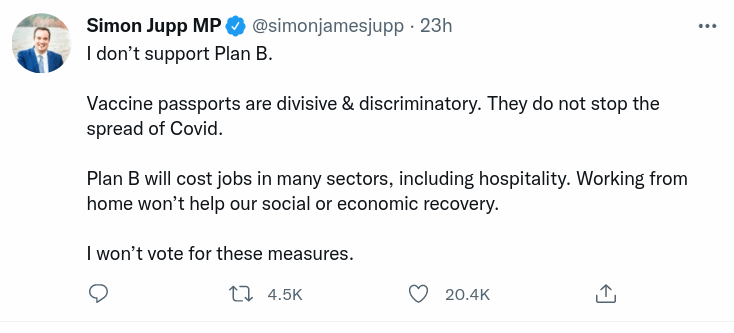
Within hours the East Devon MP tweeted, ‘I don’t support Plan B. … I won’t vote for these measures.’ Perhaps Mr Jupp would like pop down to the RD&E to explain in person to patients queuing in ambulances? To the ambulance staff, prevented from doing their job and getting to other patients on time? To those whose operations have been postponed over and over again, now looking at even longer waits? To exhausted hospital staff, now facing a new surge of Covid patients on top of everything else? To those whose relatives have died because of delayed treatment?

I’m sure that Mr Jupp will be able to convince them that because ‘working from home won’t help our social or economic recovery’, as he claimed on Twitter, he is right to try to stop this proven method of slowing infections. Mind you, if they don’t agree with him, and take to Twitter themselves to express their views, they’ll find that Mr Jupp has blocked them from replying to him.

Mr Jupp believes that ‘Plan B will cost jobs in many sectors, including hospitality’. He doesn’t even seem to have read the small print, which excludes pubs and restaurants from the requirement to wear masks. In fact, it’s almost certain that limited protective measures like working from home and masking in shops and public transport – which might have been sufficient to reduce the high levels of infection that we already had before Omicron hit – will not now be enough. This weak, discredited government, overly scared of backbenchers like Mr Jupp, is setting itself up for another massive U-turn by yet again doing too little and too late.

There is no excuse for Mr Jupp’s ignorance. I don’t mean to be disrespectful, but he doesn’t seem to be looking at the evidence, or learning from experience. Even after three difficult lockdowns, he still hasn’t grasped that letting the virus rip is only a recipe for another lockdown down the line. He hasn’t understood that, far from blocking economic recovery, measures like home-working, mask-wearing and requiring people to be vaccinated or tested before entering public spaces are the only way to let normal economic life carry on in a pandemic.

Sadly, even before Omicron, the government’s protective measures were too little. It would not have harmed the economy to require masks and install ventilation filters in schools – it would have protected education. But by refusing to slow the schools epidemic this autumn, the government ensured that the UK continued to have a very high level of Covid transmission, feeding through into consistently high levels of hospitalisations and deaths. Where was Mr Jupp’s protest about that?

It’s not just that our hypocritical prime minister has been listening to his ill-informed backbenchers. They in turn are in thrall to the anti-vax warriors, the anti-maskers and the people who call entry requirements ‘vaccine passports’, which Mr Jupp says are ‘divisive and discriminatory’. So, we should simply allow unprotected and potentially infected people into every crowded space? 

When more than 1 person in 40 in East Devon has Covid – more in younger age groups – this is a recipe for disaster. I have news for Mr Jupp. With our boosters, many of us were just beginning to feel safer, and going again into the very pubs and restaurants which seem to be the only part of our local economy that he cares about. But unless the government halts the Omicron wave, those who care about their health and the state of the NHS will vote with their feet once more. Protect our health – or you won’t have an economic recovery to talk about.”

MP Jupp would happily live in ‘pod’

Does Simon know the difference between social housing and so-called “affordable” housing (many don’t) – Owl?

This is what Cornwall’s temporary housing “pods” look like:

MP Jupp would happily live in ‘pod’

Ollie Heptinstall, local democracy reporter www.radioexe.co.uk

Eco-friendly modular homes to be built by Mid Devon District Council for social housing have been described as ‘awesome’ by a Devon MP.

An initial 14 properties, designed to be ultra-low to net-zero carbon with low running costs, are planned for sites in Tiverton and Cullompton in collaboration with producer Zed Pods. They will all be classed as ‘affordable’ at 80 per cent of market rates.

“Awesome” homes “don’t fill developers’ pockets”

The modular units are factory-made before being transported to site. The company claims they are “built to higher standards than conventional houses” and are “super insulated,” with triple-glazing and solar panels.

Applications are in for eight such apartments at Shapland Place in Tiverton and six more at Cullompton’s St. Andrews Estate. Mid Devon District Council planners will have to decide whether to approve them.

East Devon MP Simon Jupp cited Mid Devon’s plans for the modular homes as an innovative way of providing much-needed housing in Devon “that don’t basically fill the pockets of developers.”

Speaking to the BBC’s Politics South West, he said: “I’ve been inside several modular homes. They’re awesome. I would very happily live in one and they’re a cheaper way…. to actually provide affordable housing on both rent and when you come to buy it.”

Mr Jupp, a Conservative MP since 2019, added they are “a much cheaper of producing and building a house. Bricks and mortar takes time and costs money. Modular housing is a heck of a lot cheaper, and the government is actually looking at ways to support modular housing across the country.”

Speaking about them in the summer, Councillor Bob Evans (Conservative, Lower Culm), Mid Devon’s cabinet member for housing said: “We are committed to providing more social housing across the district and these homes will provide this as well as help us strive towards our goal of being carbon-neutral by 2030.”

Covid: NHS in crisis mode as hospitals told to discharge patients where possible

The NHS was put on a crisis footing tonight as hospitals in England were told to discharge as many patients as possible while estimated daily Omicron cases hit 200,000 and the variant claimed its first life in the UK.

Rowena Mason www.theguardian.com 

Boris Johnson is braced for his biggest rebellion as prime minister on Tuesday, with about 80 Tory MPs confirmed to be preparing to vote against measures on working from home, Covid passports and more mask wearing. He will have to rely on Labour support for the votes to pass.

Amid a scramble for tests and booster jabs, the country’s doctors called for further restrictions to be imposed to stem the rise in cases and Downing Street did not rule out fresh measures.

In a letter to hospitals, NHS England chiefs said patients who could be discharged to care homes, hospices, their own homes or hotels before Christmas to free up beds, should be. The letter from NHS England’s chief executive, Amanda Pritchard, and medical director Prof Stephen Powis said the service was facing a level 4 “national incident”.

Hotels are already being turned into temporary care facilities staffed with workers flown in from Spain and Greece to relieve rising pressure on NHS hospital beds.

Hospitals and GPs have also been told to scale back normal services and limit care to those needing urgent attention so that NHS staff can be freed up to deliver boosters. Hospitals will undertake fewer non-urgent operations, but “highest clinical priority patients”, including people with cancer and those who have been waiting a long time, will be given priority.

They have also been told to take ambulance-borne patients into A&E more quickly so that paramedics can get back on the road to answer more 999 calls, speed up efforts to bring in nurses from overseas to help tackle the NHS’s lack of staff, and send as many patients as possible for surgery at private hospitals.

A campaign to give boosters to more than 1 million people a day got under way, prompting the NHS website to crash and people to queue in the street for up to five hours for their jabs.

But the British Medical Association said the vaccination campaign would not be enough to stop the spread of Omicron, with one in four still not eligible for a booster. They called for a return to face masks in pubs and restaurants, 2-metre social distancing indoors, limits on public gatherings, legal requirements for ventilation in schools and other settings, more rapid testing and advice to wear FFP2 masks.

No 10 insisted that the booster campaign was its immediate priority, with a senior government source describing the main strategy as “keep on jabbing”. But Boris Johnson refused to rule out tougher restrictions if necessary to maintain public health. No 10 said all options were still on the table, leaving open the possibility of closing schools “as a last resort” and bringing in curbs without consulting MPs “in extremis”.

Addressing MPs, Sajid Javid revealed there may now be as many 200,000 Omicron infections a day. He said around 20% of confirmed cases in England had been identified as the Omicron variant, and warned of “difficult weeks ahead”. In London, the centre of the Omicron outbreak, it accounted for over 44% of cases and was expected to become the dominant form within 48 hours, the health secretary said.

He said Covid passports would be toughened to require people to have a booster or recent lateral flow test (LFT) in the new year, risking inflaming Tory backbench anger against restrictions ahead of Commons votes on “plan B” restrictions.

Labour backed the government’s booster campaign and stopped short of calling for any new restrictions, with Keir Starmer saying it was Labour’s “patriotic duty” to vote for plan B.

The prime minister confirmed the first death of a patient with Omicron and 10 people hospitalised with the variant, saying people needed to “set aside” the idea that the variant was mild.

Meanwhile, head teachers warned of “chaos” in schools, with high levels of staff and pupil absences and reports that some parents were planning to keep children home to avoid the virus before Christmas.

On the first day of the new vaccine campaign, 386,000 people in England are understood to have booked booster jabs – almost 50,000 an hour. But there was confusion over whether all eligible over-18s would be able to get a booster by the end of the year, with No 10 insisting they would, while the NHS cast doubt on the goal. Javid suggested the target was to “offer” rather than deliver the boosters.

Johnson and Pritchard launched a joint plea for the public to volunteer in vaccination centres, calling for tens of thousands of people to act as unpaid stewards and thousands to sign up as paid vaccinators. It is understood No 10 will also launch a new effort to reach the unvaccinated, using a publicity campaign potentially involving faith leaders and celebrities.

On Monday people trying to get LFTs were told they were unavailable despite a new requirement for Covid contacts to take them daily for a week.

The call from the BMA for tougher restrictions echoed warnings from scientists that vaccination alone would not be able to stop Omicron causing a dangerous second wave. Leaked documents from the UK Health and Security Agency showed on Friday that public health officials believe there should be “stringent national measures” by 18 December at the latest, with sources saying plan B will not be enough.

The BMA, which represents 150,000 doctors, is the first major medical organisation to call for stricter measures. Dr Chaand Nagpaul, BMA council chair, said: “Despite describing the current situation as an ‘emergency’ with a ‘tidal wave’ of infections on the horizon, the government’s response, relying entirely on the vaccine booster programme, is missing the wider measures required to control the spread of Omicron, including protecting millions of people who will not be eligible for the booster programme by the end of December.”

Chris Hopson, the NHS Providers chief executive, said the new guidance “gives an indication of what a monumental effort this will be”.

The former chair of the South African ministerial advisory committee on Covid-19, Prof Salim Karim, told BBC News early data from South Africa looked good.

“In the past three waves, about two out of every three patients admitted were cases of severe disease, and right now we have only one out of four cases that is severe.”

However, it is important to note that South Africa has a younger population than the UK.

No 10 has been resistant to new measures before Christmas but is planning to review the situation on 18 December.

Hotels being used as care facilities to relieve pressure on NHS

Wouldn’t it be a great idea to have community hospitals as “half way” accommodation … oh wait …

Robert Booth www.theguardian.com 

Hotels are being turned into temporary care facilities staffed with workers flown in from Spain and Greece to relieve rising pressure on NHS hospital beds.

Three hotels in the south of England are being used, including one in Plymouth into which 30 hospital patients have been discharged to be looked after by live-in carers. It is understood that the staff are staying on upper floors while patients are below.

At least three other health authorities are considering the move, which is partly driven by the severe shortage of domiciliary care workers able to look after people in their own homes, according to Anne-Marie Perry, chief executive of Abicare, a home care company contracted to set up the facilities. She said they were for people who are ready to be discharged to their homes but couldn’t be because care packages were not available.

“The hospitals are on their knees and we are being contacted fairly regularly by clinical commission groups,” said Perry. “The problem Plymouth have is there is not enough domiciliary care provision, so that’s one of the reasons why they can’t discharge patients.”

A similar tactic was used at the start of the pandemic in spring 2020, when hotels were used to help discharge tens of thousands of hospital patients in anticipation of hospitals being filled to breaking point with Covid cases. It happened again in some places in January this year.

Now, with similar warnings that the NHS faces being overwhelmed by the Omicron variant, Abicare said it has converted whole floors of hotels, and has recruited British nationals living in Greece and Spain, as well as some from the north of England, to staff them in a shift pattern of three weeks on and three weeks off.

On Monday, NHS Providers said bed occupancy in hospitals was at 94%–96%, and its chief executive, Chris Hopson, said on Sunday that the shortage of social care staff was a big driver of delayed discharges, with more than 10,000 beds last week occupied by medically fit patients.

Perry said the cost of care – around £300 a night – was well under half that of an NHS bed, but the move is likely to raise questions about levels of care, as hotels are not equipped with sluice rooms and other facilities normally available in care homes.

Jane Townson, the chief executive of the Homecare Association, described the move as “unacceptable” and said it “feels like [people] being warehoused”. She called for greater funding to boost the workforce that helps people in their own home.

Nadra Ahmed, executive chairman of the National Care Association, said she was shocked by the arrangement because hotels were not configured to deliver care and questioned the safety and wellbeing of residents if they need urgent medical assistance.

“Is home care so broken that we can’t support people in their own homes where they need to be?” she said. “This is another sticking plaster and the person being moved into the hotel is the person being let down.”

Abicare said it had been unable to find live-in care workers based in the UK so it was using expats. But has warned that with more health authorities approaching it to set up hotel facilities in the new year, it may not be able to find staff to meet much greater demand.

In January, NHS England issued guidance about using hotels for discharges which said it “should only be used as a short-term measure (days, rather than weeks) for the specific purpose of reducing length of stay for people in hospital and ensuring they are discharged when they no longer meet the ‘criteria to reside’ in a hospital.”

Abicare said it has previously worked with Holiday Inn and Best Western hotel groups. A spokesperson for NHS Devon clinical commissioning group said: “Thirty-two beds are currently available to support people who would be delayed in hospital waiting for support at home. Feedback from patients has been excellent and since March 2020 this has saved several thousand hospital bed days. This has freed beds for people who needed inpatient care in a hospital setting.”

NHS England has been approached for comment.

Skewering No 10 over Christmas parties has made Ros Atkins a BBC star

“Drinks, nibbles, games”: three words delivered in a studiously measured tone that have added to serious stress headaches at the heart of government and sparked nagging rumours of the prime minister’s exit.

Alexandra Topping www.theguardian.com 

The BBC’s Ros Atkins, who delivered the deadpan words in a video explainer of the “partygate” scandal that went viral, has become an unlikely star of the festive saga. Admirers from across the political divide – from Piers Morgan to James O’Brien – have praised his commitment to the cold, hard presentation of facts, while he has been credited with creating a “whole new genre of reporting”.

In a series of short explainers, the BBC News Channel’s Outside Source presenter has repeatedly skewered the Boris Johnson administration, while never coming within striking distance of seeming to have an opinion.

“Forensic, measured, factual, brilliant,” wrote veteran broadcaster Andrew Neil after Atkins’ explainer on 6 December. Two days later Morgan tweeted: “Ros once again brilliantly illustrating that the best journalism is often the simplest: just damn people with cool, calm, collected & utterly irrefutable facts.”

The first video on the Christmas parties was posted on 2 December, two days after the story broke, and two more have followed. In nine days the 3-4 minute clips – long for viral videos – have been watched over 11m times, far more than any other digital news series, with insiders in the BBC admitting that their popularity has confounded expectations about the desires of online news consumers.

Watch them here

The 47-year-old is no hotshot newcomer. He has been at the BBC for 20 years, joining the corporation weeks after 9/11. He started out as a producer on Simon Mayo’s 5 live show, before becoming a presenter on the BBC World Service in 2004.

Atkins, a former DJ who ran a club night in Brixton in the 2000s and performed at Womad, was part of the team that launched Outside Source, a daily show that curates news from wires, video feeds and social media on the News Channel and BBC World News, in 2014.

His explainers started with coverage of the Australia bush fires in late 2019, and earlier this year the BBC launched Ros Atkins On, promising 10 minutes of his “straight-talking style of analysis and explanation” on the biggest issues of the day on iPlayer, BBC Breakfast and the BBC’s news website.

His films, covering the heatwaves in the States and the Belarus migrant crisis as well as domestic political issues, “explain the background and context to current events in a scrupulously impartial, accessible way”, said Jamie Angus, senior controller, news output and commissioning, at BBC News. “He’s made this type of explainer his own, and it’s proved wildly popular with audiences across the world, and very shareable on social media,” he said.

The explainers, very much seen as Atkins’ baby, were created in an attempt to make live TV also work as an on-demand digital product, with one former BBC news executive describing their style as “assertive impartiality”.

“Ros is just brilliant at this,” the executive said. “If you look at what he’s done, it’s stripped down ‘this is what happened’ in three minutes flat – there’s no florid tedious language, there’s no self indulgence to it.”

Atkins’ unflinching presentation manages to get the viewer to raise an eyebrow through facts alone, said the former executive. “I think sometimes the BBC mistakes impartiality for sucking the life out of something. But Ros is human and has a personality, while never making it about him, or leaving himself open to accusations of bias.”

Colleagues say Atkins, who is married with two teenagers, is dedicated, rehearsing lines and tweaking scripts until he is sure they will have the greatest impact. One former colleague compared his approach to news to his love of squash. “He makes things look effortless but they’re not effortless. Just like being a very good squash player takes years of practice, being a really good TV craftsman takes a long time too – he works bloody hard to make it spot on.”

[The “BBC Outside Source” series of short explainers are well worth looking at – Owl]

Boostered: did Boris “bounce” the NHS with his vaccine booster speech?

[And would he have reasons other than Omicron to grab the headlines right now? – Owl]

Yesterday he announced the “Omicron Emergency Booster National Mission” to encourage everyone who is eligible to “get boosted now”.

Government discussing Covid Plans D and E

Possible Plans D and E are being discussed by the government should current measures fail to bring the Omicron variant under control, Whitehall insiders have said.

Meanwhile it’s the vote on Plan B tomorrow, Plan C possibly on December 21. – Owl

Clare Busch www.devonlive.com

The Mirror reports the tougher Covid-19 plans being discussed include another lockdown.

MPs have already been told they may have to return to Parliament for a vote on tougher restrictions should Omicron infections hit the expected million mark.

A vote on Tuesday, December 21 could move the current Plan B rules to Plan C, which would require masks in all indoor establishments and the use of Covid app for pubs and restaurants. Vaccine passports could be required for smaller venues.

Plan C would also include a return to table service only and a required self-isolation after contact with someone infectious.

The possible Plan D could mean all pubs and restaurants stopping indoors service with only outdoor service allowed.

A Plan E would see a return to lockdown with all pubs, cafes, restaurants and non-essential retail closed.

Individuals would only be able to leave their home for essential reasons such as work, medical appointments and to buy food.

Schools would be the last to close.

Plan B includes masks for public transport and most indoor settings, vaccine passports for large events and advice to work from home. The plan came into effect today (Monday, December 13) just as Boris Johnson confirmed the first death associated with Omicron in the UK.

The Prime Minister said at a vaccination clinic in west London: “Sadly yes Omicron is producing hospitalisations and sadly at least one patient has been confirmed to have died with Omicron.

“So I think the idea that this is somehow a milder version of the virus, I think that’s something we need to set on one side and just recognise the sheer pace at which it accelerates through the population. So the best thing we can do is all get our boosters.”

Boris Johnson said that Omicron now represents about 40% of coronavirus cases in London. He added: “tomorrow it’ll be the majority of the cases” there.

Plan B will stay in force for at least six weeks, with a review on January 5.

A Health Department source told the Mirror: “If you follow the science, we should really be doing Plan C now. The PM is gambling with the NHS to save his leadership.

“But we all know the PM can’t let anything hit Christmas. That really did him damage last time round. To do it again would be killer.”

Planning applications validated by EDDC for week beginning 29 November

Good Law Project threatens legal action against Met Police for its refusal to investigate No 10 parties

Good Law Project has today written to the Metropolitan Police asking it to justify its failure to investigate reports of an unlawful party being held at No 10 Downing Street on 18th December 2020 – and threatening legal proceedings if it fails to do so.

www.thelondoneconomic.com 

There have been multiple reports from people who say they were in attendance on the night that a party of 40 – 50 people took place in the prime minister’s own home. This would have been a clear breach of the “tier 3” restrictions in place at the time.

Yet – unbelievably – the Met claims there isn’t enough evidence to open a criminal investigation.

Apparently, this wasn’t even the only unlawful gathering held at Boris Johnson’s home during this period.

Further reports have now emerged alleging there were gatherings at the prime minister’s flat on 13th November 2020, a leaving party at No. 10 held on 27th November 2020 for former aide Cleo Watson, and a party at the Department for Education on 10th December 2020.

Good Law Project’s lawyers have today sent a pre-action protocol letter to the Met asking it to open an investigation, or to set out the full and detailed reasons behind its refusal to do so.

The pre-action protocol letter also asks the Met to provide details of its policy ‘not to investigate retrospective breaches of the covid regulations’, referred to in its statement of 8 December 2021.

If the Met refuses, Good Law Project will consider suing.

The Met is due to respond by 31st December 2021.

Jo Maugham, Director of Good Law Project said: “Now we know what Boris Johnson and his advisors think about the awful sacrifices people up and down the country have made. They think sacrifices are for the ‘small’ people – but not for ‘Great’ people like them.

“But the law says we are all equal. Great and small alike, subject to the same laws. That’s what the law says – and the Metropolitan Police need to apply it.”

EDDC Strategic Planning Committee to discuss Local Plan Consultation – Tomorrow

Agenda for Strategic Planning Committee on Tuesday, 14th December, 2021, 9.30 am

Online meeting to discuss:

Infrastructure Funding Statement PDF 336 KB

And:

Working draft of the proposed East Devon Local Plan 2020 – 2040 PDF 441 KB

Details here.

Number of healthy patients ‘stranded’ in English hospital wards rises by 80%

The number of patients stuck in hospital in England despite being medically fit to leave nearly doubled between February and November this year. The rise is worrying health experts, who say it is more evidence that the crisis in the adult care system is creating backlogs in the NHS.

Chaminda Jayanetti www.theguardian.com 

NHS England data shows that the number of times hospital trusts were unable to discharge a patient who no longer met the criteria to stay in hospital increased from 223,593 in February to 402,211 in November – a rise of almost 80%.

The data shows the extent of “stranded patients” – people who are clinically fit to leave hospital but cannot be discharged, often because of a lack of adult care or NHS community health provision. As a result, patients find themselves stuck in an environment where they pick up infections, while hospitals are unable to free up bed space for new admissions.

The Observer has also obtained data on “delayed transfers of care” (DTOC), which measures the number of days individual patients stayed in hospital after they were ready to be discharged.

NHS England stopped collecting DTOC statistics at the start of the pandemic, but a freedom of information request found 26 hospital trusts that are still recording these figures – with DTOC numbers rising by nearly 75% between February and October.

Miriam Deakin, director of policy and strategy at NHS Providers, the membership body for NHS trusts, said: “Trusts do all they can to reduce delayed transfers of care, given its impact on patients. However, with the latest performance figures showing more than one in 10 beds are occupied by patients who are medically fit to leave hospital, there is a pressing need to invest in social care and care in the community.

“In addition, urgent investment is needed in the social care sector including in home-care services – which is why we have called for retention payments to support people to remain within the care workforce over these critical winter months.”

University Hospitals Dorset NHS Foundation Trust saw acute care DTOC numbers increase from 2,701 on 1 April to 4,452 on 1 October. DTOC cases caused by problems securing care packages at home doubled in that time, while those arising from difficulties in finding beds in community hospitals more than doubled.

Dr Tristan Richardson, clinical director for medicine at University Hospitals Dorset NHS Foundation Trust, said: “If we have a patient who can’t leave hospital because a package of care is not available to support them at home, or there is not a place in a care home, for example, that means a patient can’t move from our emergency department on to a ward.”

He added that this “fills up our emergency department, which in turn means other patients are waiting to enter the emergency department in ambulances, and consequently those ambulances can’t then be attending an emergency in the community. The knock-on effect presents a clear compromise to all patients.”

A report from Dorset council in November described the link between the crisis in adult care and delayed discharges from hospitals: “The shortage of home care and therapy support is… having an adverse impact on the local hospitals; people are waiting for packages of care… to be available before they are discharged. Therefore increasing length of stay and decreasing hospital capacity.”

The report identified “significant gaps in workforce capacity such as the lack of home care and therapy workers”, and noted that the workload of hospital social work teams had tripled but that the “workforce has not increased to match the demand”.

David Fothergill, of the Local Government Association, said: “Councils and care providers are doing all they can to ensure people are able to safely return from hospital to their homes and communities as quickly as possible, despite multiple and ongoing pressures.

“These include, but is not limited to, significant shortages in the social care workforces, with more than 100,000 vacancies available on any given day, and extremely high turnover rates.

“Recent extra government funding for care workforce retention and recruitment will help, but this falls well short of enabling an immediate significant uplift in pay, which is the single biggest factor behind staffing shortages.”

NHS England did not respond to a request for comment.

Be ‘adult’ about who you mix with

Torbay health boss advises caution

Joe Ives, local democracy reporter www.radioexe.co.uk 

Torbay’s health boss wants residents to take an “adult,” risk-based approach to social activities as covid cases rise across the Bay.

Latest complete figures (the week to Sunday 5 December) show covid infection rates across Devon have risen for the fourth week in a row with all parts of the county having an infection rate higher than the UK average.

Torbay recorded 934 new cases, up 57 on the previous week. The seven per cent rise takes the infection rate in the Bay to 686 per 100,000 of the population – almost 30 per cent higher than the national average of 496.

With the rising cases and concerns over the new Omicron variant, Torbay’s director of public health Lincoln Sargeant advises residents to take precautions when meeting other people. 

He said: “I think rather than saying ‘don’t’ I think it’s a matter of people working through what kind of activity is it? How many people are involved? Are there any vulnerable people that are there? And based on those kind of questions, decide whether you should go ahead or not and if you’re going ahead [think about] how you’re going to make it as safe as possible – is there an option to meet outdoors for example? 

“As a standard, any meetings that we’re going to with people who are not in our household or general social circles that we’re already interacting with we should lateral flow tests done as a minimum, so I would say it’s more of people thinking about the measures they can take and how they can mitigate risk rather than saying ‘this’ or ‘that’ activity shouldn’t go ahead.

“Let’s be responsible and adult, and look at our activities, do the relevant risk assessments and act accordingly.”

Dr Sargeant will change his advice if infections start rising in the over sixties. He said that although this age group tends to be more prudent than younger ages, he will be keeping a careful eye on hospital admissions, especially as family groups of different generations meet up over Christmas.

He said: “The kinds of triggers to change the advice would be if we suddenly saw a spike in [hospital] admissions and if we began to see the over sixties’ rate of infection beginning to ratchet up. Then it might be a situation of saying we might want to tighten up on our advice and restrictions.”

Leader of Torbay council Steve Darling (Liberal Democrats, Barton with Watcombe) added: “The buck does stop with the government. It’s they who give the national guidance.”

More than five cases of the Omicron variant have been identified in Devon. This more transmissible form of the disease is expected to overtake Delta to become the dominant form of covid.

Health officials are encouraging eligible members of the public to take up ‘’booster’ shots when offered. Vaccination drives are expected in the Bay in the new year.

In Torbay, 85 per cent of residents aged 12 or over have received one dose of a covid vaccine, while 79 per cent have had both jabs. Forty-six per cent have had their third vaccine.

Across Devon, 1,372 people have now died within 28 days of a positive covid test. A total of 206 of these deaths were in Torbay.

People aged 30 and over can now book their booster jab two months after their second dose, a month before becoming eligible to receive the third injection.

“A man can be judged by the company he keeps”

Full list: the vaccine passport rebels

Coffee House www.spectator.co.uk

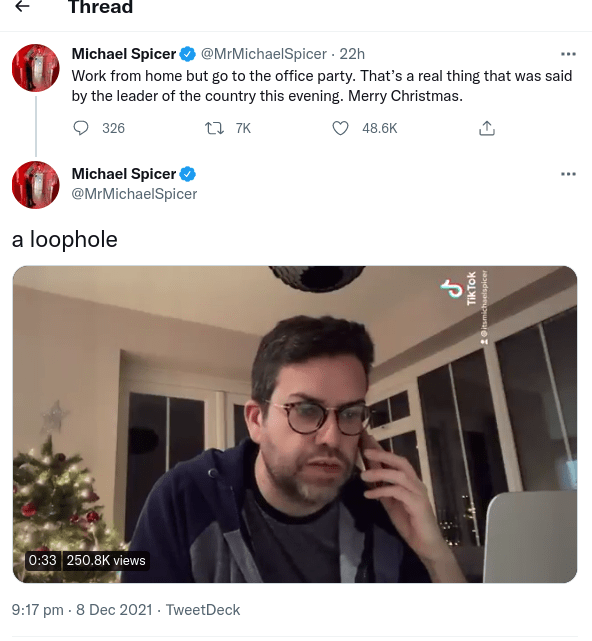
On Tuesday next week [tomorrow], a vote will be held on Boris Johnson’s new Covid restrictions to tackle the Omicron variant. They will include vaccine passports for large gatherings, compulsory face masks in more places,  and people being asked to work from home when they can (but told they can still go to parties).

When the health secretary Sajid Javid introduced the measures in the Commons this week, he was greeted with jeers and calls for him to ‘resign’ from his own party members. There is now a growing backbench rebellion against the government’s proposals, with several MPs publicly denouncing the winter restrictions, which they feel are a step too far in a society protected by what Boris Johnson once called the ‘huge wall of immunity’ from vaccines.

Below is the full list of Tory MPs who have so far promised or indicated they will vote against the measures next week. The list will be updated ahead of the vote. At present, it looks as if Johnson will need Labour’s support to pass his measures.

1. Steve Baker

2. Ben Bradley

3. Brendan Clarke-Smith

4. Graham Brady

5. Philip Davies 

6. Richard Drax

7. Simon Jupp

8. Stephen McPartland

9. John Redwood

10. Greg Smith

11. Dehenna Davison

12. Marcus Fysh

13. Gary Sambrook

14. Pauline Latham

15. William Wragg

16. Geoffrey Clifton-Brown

17. Iain Duncan Smith

18. Christopher Chope

19. Craig Tracey

20. Robert Syms

21. Anthony Mangnall

22. Greg Clark

23. Esther McVey

24. Liam Fox

25. David Davis

26. Mark Jenkinson

27. Alicia Kearns

28. Mark Harper

29. Darren Henry

30. Steve Brine

31. Craig Mackinlay

32. Simon Fell

33. Andrew Bowie

34. David Warburton

35. Siobhan Baillie

36. David Jones

37. Tom Randall

38. Ben Spencer

39. Andrew Rosindell

40. Charles Walker

41. Douglas Ross

42, Karl McCartney

43. Anne Marie Morris

44. Johnny Mercer

45. Tom Tugendhat

46. Richard Fuller

47. Giles Watling

48. Desmond Swayne

49. Andrew Bridgen

50. Andrew Lewer

51. Christian Wakeford

52. Adam Afriyie

53. Julian Sturdy

54. Peter Bone

55. Chris Grayling

56. Chris Green

57. Tim Loughton

58. Tracey Crouch

59. Miriam Cates

60. Jackie Doyle-Price

61. Lee Anderson

62. Jonathan Djanogly

63. Mark Francois

64. Jill Mortimer

65. Tobias Ellwood

66. Scott Benton

67. Henry Smith

68. Matt Vickers