Next meeting of DCC Health Scrutiny meeting: SOHS suggests action

SOHS suggests the following action following receipt of a letter from Martin Shaw Independent East Devon Alliance Cllr for Seaton and Colyton.

SOHS:

Please email the councillors on the Devon Adult Care Scrutiny Committee insisting that they discuss this and vote to stop implementation due on 1 April.

sara.randalljohnson@devon.gov.uk
nick.way@devon.gov.uk
hilary.ackland@devon.gov.uk
john.berry@devon.gov.uk
paul.crabb@devon.gov.uk
rufus.gilbert@devon.gov.uk
brian.greenslade@devon.gov.uk
ron.peart@devon.gov.uk
sylvia.russell@devon.gov.uk
philip.sanders@devon.gov.uk
richard.scott@devon.gov.uk
jeff.trail@devon.gov.uk
phil.twiss@devon.gov.uk
carol.whitton@devon.gov.uk
claire.wright@devon.gov.uk
jeremy.yabsley@devon.gov.uk
pdiviani@eastdevon.gov.uk

“Devon’s two Clinical Commissioning Groups (CCGs) are pushing ahead with far-reaching, highly controversial changes to the NHS in the County from 1st April – without alerting the public or even the public watchdog, the Health and Adult Care Scrutiny Committee at Devon County Council.

“The changes will turn the Sustainability and Transformation Plan – which itself grew out of the misnamed ‘Success Regime’ which closed our community hospital beds – into a more permanent Devon Accountable Care System. The first phase, in the first part of the financial year 2017-18, will develop integrated delivery systems, with a single ‘strategic commissioner’ for the whole county.

However the real concern is the next phase, which will lead to the establishment of Accountable Care Organisations. These will lead to services being permanently financially constrained, limiting NHS patients’ options for non-acute conditions, and pushing better-off patients even more towards private practice.

“Large chunks of our NHS will be contracted out for long periods, probably to private providers. The ‘toolkit’ for this fundamental change talks about ensuring ‘that there are alternative providers available in the event of provider failure’. In the aftermath of Carillion, do we really want most of our NHS contracted out to private firms?

“Devon’s public are not being consulted about this change – unlike in Cornwall where the Council has launched a public consultation – and there is no reason to believe that they want a privatised, two-tier health system.
“Devon’s CCGs have pushed the change through without publicity, and it is only because I have put it on the agenda that Health Scrutiny will have a chance to discuss in advance of April 1st. I have written a 7-page paper for the Committee outlining what we know about the ACS and posing eight questions which they should ask about it.”

Top construction companies not accepting fixed-price PFI deals

The new NHS Accountable Care Organisations are relying on fixed-price PFI contracts for their savings.

“Bosses of top construction and outsourcing companies have warned ministers they will no longer accept fixed-price PFI deals after the collapse of Carillion.

The threat is a blow to the government’s £600bn infrastructure programme, which is already struggling to attract bidders. Last week the National Audit Office said there was little evidence that private finance initiative deals offered value for money for taxpayers.

Carillion plunged into insolvency last week with just £29m cash in the bank. Its threadbare finances were undone by failings on a string of PFI contracts, which left it unable to access hundreds of millions of pounds.

Balfour Beatty, Britain’s biggest construction company, has been moving away from fixed-price PFI contracts, which leave the winning bidders vulnerable to big losses if the projects encounter unexpected problems. The £2bn company is emerging from a disastrous spell of contract problems, which led to seven profit warnings.

Galliford Try — Carillion and Balfour Beatty’s partner on the Aberdeen bypass PFI contract — is also refusing to consider new fixed-price deals.

Rupert Soames, chief executive of the outsourcing giant Serco, said contractors would refuse to bid if too much risk were piled on them.

“Government would say, ‘You signed the bloody contract.’ But it’s not in anyone’s interest if you consistently get suppliers making huge losses. That’s no way to encourage a vibrant market. Both sides need to learn lessons from this,” said Soames, whose company’s government contracts include running prisons.

Balfour Beatty said in a report: “We need to move away from the position where fixed-price contracts, risk transfer, lowest-cost tendering and adversarial relationships are the norm.”

Carillion’s crisis was exposed in July when it admitted that contracts to build the bypass, Birmingham’s Midland Metropolitan Hospital and the Royal Liverpool Hospital were to blame for a large chunk of an £845m writedown. All three deals were public-private contracts, which left Carillion to foot the bill for cost overruns. There were unexpected problems in Aberdeen and Liverpool.

Despite this, the government wants contractors to bear all the risk on two huge PFI projects: a £1.6bn tunnel to bypass Stonehenge in Wiltshire and the £1bn Silvertown tunnel in east London.

Stephen Rawlinson of the analyst Applied Value, said: “The government has become more and more of a bully and transferred risk that the private sector cannot cope with.”

● Richard Adam, Carillion’s former finance chief, has quit the board of the warship designer BMT. Adam, 60, oversaw a huge expansion in debt at Carillion before his departure at the end of 2016. He joined BMT only eight months ago. He has recently left the boards of the developer Countryside, estate agent Countrywide and transport company First Group.”

Source: Sunday Times (pay wall)

Hunt asked to pause Accountable Care Organisations – but will he?

“Thank you for signing the petition STOP the new plans to dismantle our NHS, please share this!

https://you.38degrees.org.uk/petitions/stop-the-plans-to-dismantle-our-nhs

Great news! Sarah Wollaston MP, Chair of the Health Committee has written to Jeremy Hunt asking him to “delay the introduction of the new contract for Accountable Care Organisations until after the Health Committee has taken the opportunity to hear evidence on the issues around the introduction of accountable care models to the NHS”

People are beginning to wake up to the possibility that the NHS is about to be privatised and are not happy about it. Has something worried Sarah Wollaston enough to take this step?

The Judge giving permission for the 999 Call for the NHS into the lawfulness of the Accountable Care Organisation contract to be heard and setting capped costs because of the importance and huge public interest, gave us all a sense of hope. Their case is due to be heard in Leeds in April and they are still crowdfunding for that.

The doctors and academic’s Judicial Review with regard to lack of public consultation and Parliamentary scrutiny which was joined by physicist Stephen Hawking created more publicity.

Now this news published today (Friday). We believe Accountable Care Organisations have huge implications for patients.

Let’s share the petition and make it huge. Together we can win this.”

https://you.38degrees.org.uk/petitions/stop-the-plans-to-dismantle-our-nhs

EDA Councillor Martin Shaw on the next threat to our local NHS

PRESS RELEASE:

“Devon’s two Clinical Commissioning Groups (CCGs) are pushing ahead with far-reaching, highly controversial changes to the NHS in the County from 1st April – without alerting the public or even the public watchdog, the Health and Adult Care Scrutiny Committee at Devon County Council.

The changes will turn the Sustainability and Transformation Plan – which itself grew out of the misnamed ‘Success Regime’ which closed our community hospital beds – into a more permanent Devon Accountable Care System. The first phase, in the first part of the financial year 2017-18, will develop integrated delivery systems, with a single ‘strategic commissioner’ for the whole county.

However the real concern is the next phase, which will lead to the establishment of Accountable Care Organisations. These will lead to services being permanently financially constrained, limiting NHS patients’ options for non-acute conditions, and pushing better-off patients even more towards private practice.

Large chunks of our NHS will be contracted out for long periods, probably to private providers. The ‘toolkit’ for this fundamental change talks about ensuring ‘that there are alternative providers available in the event of provider failure’. In the aftermath of Carillion, do we really want most of our NHS contracted out to private firms?

Devon’s public are not being consulted about this change – unlike in Cornwall where the Council has launched a public consultation – and there is no reason to believe that they want a privatised, two-tier health system.

Devon’s CCGs have pushed the change through without publicity, and it is only because I have put it on the agenda that Health Scrutiny will have a chance to discuss in advance of April 1st. I have written a 7-page paper for the Committee outlining what we know about the ACS and posing eight questions which they should ask about it.

Martin Shaw
Independent East Devon Alliance County Councillor for Seaton & Colyton”

Accountable Care Organisations: what the former Medical Director of the NHS thinks you should know

Dr Graham Winyard is a former medical director of the NHS and deputy chief medical officer. This is his view on “Accountable Care Organisations” one of which is planned for Devon:

“Brexit’s dominance of media coverage and parliamentary time is providing the perfect cover for controversial reform of the NHS by stealth.

Jeremy Hunt and NHS England’s latest big idea is Accountable Care Organisations (ACOs). These bodies would be allowed to make most decisions about how to allocate resources and design care for people in certain areas.

At the moment, that’s done by public bodies whose governance is regulated by statute, set up by parliament after wide consultation and sometimes fierce debate. ACOs, by contrast, can be private and for-profit bodies. They are not mentioned in any current legislation and would have no statutory functions. They are not subject to the statutory duties imposed on other parts of the NHS.

Although NHS England plan to get several ACOs up and running this year, no detailed policy proposals have been presented to parliament or the public. Indeed, details are so sparse that the House of Commons library briefing is forced to use definitions provided by the King’s Fund, a health think tank.

Hunt is planning to lay a raft of secondary legislation – which doesn’t require a full parliamentary vote – in February, so that the first ones can be up and running by April 1st.

The ACOs are going to be given long-term commercial contracts of between ten and 15 years. We know these are difficult to get right and expensive to get out of. Think of Virgin and the East Coast Main Line or the private finance initiative, which has left the NHS paying hundreds of millions to offshore finance companies for hospitals that cannot now be afforded. Warnings about risks of PFI were once brushed aside as alarmist, often by the same people who now dismiss criticism of ACOs in similar terms.

I’m working with four colleagues to challenge these proposals through judicial review. Our case is not concerned with whether ACOs are a good or bad idea. That’s for parliament and the public to decide, not the courts. Our case is that such a radical and significant change cannot lawfully be introduced and implemented without public consultation, parliamentary scrutiny and primary legislation. The case was filed on December 11th and clearly struck a chord with the public. They’ve provided £176,000 through crowd funding in over 6,000 donations.

We are also deeply concerned that by using contracts instead of statute to allow ACOs to operate, the government is exposing the NHS to major risks.

We’re concerned that ACOs will be governed only by company and contract law, yet can be given “full responsibility” for NHS and adult social services. Because they span free health care and means-tested social care, ACOs will be able to decide on the boundary of what care is free and what has to be paid for. They can include private companies – including private insurance and property companies – which will make money from charging. Their accountability is unclear, in spite of their name, yet they will be given long-term contracts and be allowed to make “most decisions” about how to allocate NHS resources and design care for the local population. They will have control over the allocation of huge amounts of taxpayers’ money, yet their accountability for spending it and their obligations to the public would be under commercial contracts instead of statutes. The parallel with railway franchises seems inescapable. And by establishing them this way, it’ll be harder to exclude ACOs from free trade deals.

Lots of serious people are genuinely worried and object to their fears being brushed aside. If ACOs are not opening the door to greater privatisation of the NHS, why is their detailed documentation so explicit that they can indeed be private bodies?

We are not zealots opposed to change. We’re simply people who care about the founding principles of the NHS, have taken the trouble to read the small print and have the experience and knowledge to understand its implications.

If ACOs are now seen as being central to the delivery of effective health and social care, they should be set up as proper public bodies with clear democratic accountability. This would require a detailed explanation, proper public debate and the kind of parliamentary scrutiny that primary legislation demands.

https://t.co/wKr3bYTMEQ

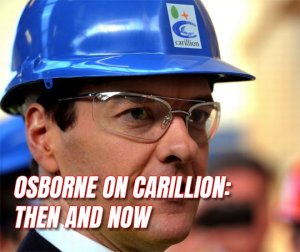
Osborne and Carillion then and now

“George Osborne’s Evening Standard editorial on Carillion today: “Why has the state found itself so dependent on a few very large outsourcing firms? The failure to use a variety of smaller, mid-size companies undermines innovation and leaves services hostage when things go wrong.”

George Osborne, signing off on another Carillion contract as Chancellor in 2014: “It is great to see successful companies like Carillion winning contracts around the world. This deal, the first in a pipeline of many, will help us reverse the age-old trend of not exporting enough, boosting growth and creating jobs.”

He even wore their hat…”

https://order-order.com/2018/01/15/osborne-on-carillion-then-and-now/

Lessons to learn BEFORE Accountable Care Organisations are operating

Professor John Colley of Warwick Business School says Carillion was sunk by two serious mistakes:

“Too many contracts were taken at poor margins and terms, which prevented any subsequent profitability under competitive pressure. Some were allocated during the recession when it was win work at all costs.

“The other key issue is project accounting, which tends to recognise losses late in the project, effectively when the project starts to run out of money. There will no doubt be serious retrospective scrutiny of the accounting.”

and

Guardian columnist Simon Jenkins:

What the Carillion saga demonstrates is the rampant indiscipline in the contracts themselves. The company’s demise is attributable to favouritism, cost escalation, excessive risk, obscene remuneration and reckless indebtedness. Carillion and its bankers clearly thought it too big to fail. Whitehall behaved accordingly. It was like a pre-2008 bank.

There must now be a review of how privatisation is working. Its so-called parastatal companies are not true private entities. They depend on the state, and the state depends on them. Their lobbyists develop an unholy relationship with ministers and officials – witness the uncontrolled revolving door between Whitehall and the boardrooms.

and

Peter Kitson, Partner at law firm Russell-Cooke, says Carillion may have caused its own demise by pitching its services at an uncompetitively low rate – to win business.

”The procurement rules (the Public Contracts Regulations) which govern public sector procurement are central to understanding what has happened here. Almost all Carillion contracts have been competitively tendered under those procurement rules.

The rules require public sector clients to investigate and possibly to exclude any tenderer whose bid is ‘abnormally low’. One contributory factor here may be that Carillion has tendered at very low margins, possibly unsustainably low, in order to win these huge volumes of work.

If such bids have succeeded, that can only mean either than the Regulations themselves are ineffective or that public sector clients lack the confidence or the expertise properly to enforce those rules.

Following this morning’s announcement, I am sure that many of those public sector clients will be seeking advice on the extent to which those same procurement rules allow short term emergency replacement contracts to be let without formal procurement.”

https://www.theguardian.com/business/live/2018/jan/15/carillion-crisis-liquidation-last-ditch-talks-fail-business-live

Accountable Care Organisations: spot the difference between them and Carillion!

Carillion bid for, and got, many big contracts to offer privatised services in every part of the UK. While it was making profits, these were creamed off first by directors and then by shareholders with a good slice for donations to the Tory party and as little as possible to taxation.

Directors changed its rules to eliminate or vastly reduce their risks (see below). When it went bust, it was “too big to fail” so now the Tory government – which believes, or so it says, in the “free market” and DEFINITELY NOT in nationalisation – picks up the tab and we, the taxpayers, pay for its failure.

Can anyone tell Owl the difference between Carillion and Accountable Care Organisations for the NHS? Big contracts to be offered to privatised services such as Virgin Care, to offer their privatised services all over the UK, where once again, directors cream off the first layer of profits and shareholders the rest. Though in the case of Branson and Virgin HE pays no tax.

What incentive do they have to keep costs down and quality up. when, if they fail, we pick up the tab?

Imagine if this was happening under Corbyn. Who would the Conservatives be blaming? What would they be saying if his government was picking up the bills.

This is NOT a homily to Corbyn – just saying!

Judicial review of Accountable Care Organisations allowed

“A judge has granted permission for national campaign group 999 Call for the NHS to bring a Judicial Review of NHS England’s draft Accountable Care Organisation contract.

The group believe this is not only unlawful under current NHS legislation, but would threaten patient safety standards and limit the range of available treatments. The case will be held in Leeds High Court on 24th April 2018.

‘999 Call for the NHS’ and internationally recognised public law firm Leigh Day are launching the third and final stage of their crowdfund on 12 January, in order to cover all the costs of bringing the Judicial Review, and are appealing for £12,000. This amount, when added to existing funds donated by hundreds of generous members of the public in 2017, will cover the £37,000 cost of the Judicial Review.


The link to crowdfund is: Crowd Justice Healthcare4All Stage 3 . Please give what you can – any amount is useful.

 The crowdfunding starts at 6pm this evening.

Recognising that it is in the public interest to establish if the Accountable Care Organisation contract is lawful or not, the Judge has awarded 999 Call for the NHS a capped costs order of £25K. This limits the costs that the campaign group would have to pay NHS England, were they to lose the case.


999 Call for the NHS – originally well known as the Darlo Mums who organised a 300 mile Jarrow to London People’s March for the NHS in 2014, culminating in a rally in Trafalgar Square attended by 20,000 people – are challenging NHS England’s introduction of a model contract for use by new local NHS and Social Care organisations, known as Accountable Care Organisations (ACO).

We can help https://www.crowdjustice.com/case/healthcare4all-stage3

Interestingly Dudley Clinical Commissioning Group “is in the process of trying to establish …perhaps the only example of an advanced ACO type model”, according to the Health Service Journal (HSJ), and had hoped to award the Accountable Care Organisation contract by April 2018. Now however, they have confirmed they are planning to award the contract after guidance by NHS England and NHS Improvement (the Regulator with Dido Harding as ‘Chair’) with a start date in April 2019.

Has the 999 Call for the NHS Judicial Review put a spanner in the works? We can only guess!

According to the HSJ, the Dudley Clinical Commissioning Group had planned that the contract would take forward the “multispeciality community provider” (MCP) new care model, (a form of Accountable Care Organisation). Worth £5bn, the contract would incorporate a capitated (per person) budget to cover much of the health and some social care for the population in the area. This is not the usual current form of payment for NHS treatments, which is based on the actual costs of treatments that are provided.

What happens if the Accountable Care Organisation budget for the population does not meet the costs of the treatments that patients need? Who gets treatment then?

Please help us fight the dismantling of the NHS, to save healthcare for all. https://www.crowdjustice.com/case/healthcare4all-stage3

Sign and share

https://you.38degrees.org.uk/petitions/stop-the-plans-to-dismantle-our-nhs
Many thanks”

Source: 38 Degrees

Judicial review of changes to NHS given go-ahead – with capped costs – but final £12,000 needed urgently

FROM: Crowdjustice
Press Release
Website for donations:

http://999callfornhs.org.uk/999-judicial-review/4593838706

“Update on Our NHS – comprehensive healthcare for all – STAGE 2

We have some very good news!

On Thursday 21st December our lawyers, Leigh Day, contacted us to tell us that a judge had considered our papers and those of NHS England and we now have permission for our JUDICIAL REVIEW to go ahead, at some time after 16th February 2018!

This is fantastic news as it means our papers and those of NHSE have been examined and the judge has recognised our legal arguments as a case that is important for public interest.

This is a real Christmas present.

And… despite NHS England stating that we should not be considered for a Capped Costs Order (the amount we have to pay the courts if we lose) the Judge has also agreed to a Capped Costs Order of £25,000.

Although this is more than than the £15,000 we had hoped for, the fact remains that the judge has agreed to it, which shows that he considers it is in the public interest for our case to be heard. It is a very positive gift for all of us. Capped Costs are not granted freely.

So the 999 Call Team have made the ONLY decision possible

We all voted unanimously that this was an opportunity we could NOT afford to turn down. We have notified Leigh Day we are going ahead and will campaign hard to raise the extra £12,000 to meet the £25,000 CCO and extra court procedure costs.

What this means is that we are going to have to open a new Round 3 of CrowdJustice fundraising to raise the extra money. We will be launching towards New Year’s Day as people begin to think of new opportunities, new adventures and new HOPE. Because that is what our Judicial Review offers all of us.

WE HOPE you can help us launch and promote it.

Today, just as we enter Christmas, you could forward and share this email with 3 or more of your friends – adding any personal message to help explain that Round 3 of our Healthcare For All Judicial Review fundraising is about to launch.

You could send them to visit our website page: 999 Judicial Review

You could highlight the fact that this case is not about one group or one region – it affects all of us, everyone up and down the country. Our JR is a real opportunity to bring into the open NHS England’s contentious contract for a new form of local NHS and social care organisation that is based on a business model used by the USA’s Medicare/Medicaid system. A system which only provides a limited range of healthcare for people who are too poor to pay for private health insurance.

Exposing this new NHS England contract to a review of its lawfulness is a vital step in protecting the NHS as a source of comprehensive healthcare for all who need it.

Thank you for all your support so far and we wish you and your loved ones a happy festive week ahead.

Please be on standby for the launch of Round 3. We need all of us now.”

Thanks from all the 999 Call for the NHS Team”

The price of Tory policies: tax and VAT rises and privatising NHS says IMF

Interesting that the IMF says that another £20 billion of spending cuts will be needed. That’s roughly how much Hunt wants to cut spending on the NHS.

The long game of 100% privatising the NHS – bringing with it rationing, post code lotteries and American-style health care approaches, appears to be nearing its conclusion.

As regards harmonising VAT at its higher rate – currently 20% – this would mean a 15% VAT increase on heating costs, all food and drink, charitable fundraising, equipment for disabled people, water, materials to insulate homes, boilers, children’s clothes …. the full list is here:

https://www.gov.uk/guidance/rates-of-vat-on-different-goods-and-services

“Taxes will have to rise if the government is to balance the books by the middle of the next decade and the NHS may have to be privatised, the International Monetary Fund has warned.

Property taxes, the removal of preferential VAT rates for goods such as pasties, and higher national insurance contributions by the self-employed need to be considered if Britain is to have any chance of eliminating its budget deficit by 2025 because spending cuts have gone about as far as they can, the global economic watchdog said in its annual review of the UK.

Weak productivity and the increasing care demands of an ageing population will make deficit reduction harder. Public services such as the NHS may have to be scaled back or privatised, it added.

The warnings are a reminder of the persistent problem of Britain’s public finances almost a decade after the financial crisis caused borrowing to soar. National debt is 87 per cent of GDP and spending on public services exceeds revenue from taxes by more than 2 per cent of GDP.

“Continued deficit reduction is critical to create further room to respond to future shocks,” Christine Lagarde, managing director of the IMF, said. “There is not much space for additional spending cuts and the revenue side of the equation has to be looked at.”

Britain is already forecast to be paying 34.3 per cent of GDP in tax by 2022, more than at any time since the 1950s, but economists estimate that at least £20 billion of extra austerity will be needed to hit the government’s target of balancing the books.

Ms Lagarde said population changes were adding to the problem. “Population ageing is expected to lead to material increases in spending on healthcare, pensions and long-term care, while productivity growth has been slow. And a slowly growing economy means fewer resources will be available to meet increased spending,” she said.

The public spending burden will soon make Britain face some hard choices, the IMF added. “The UK may face difficult decisions about the desired size of its public sector, as well as the mode of delivery and financing of public services. Brexit-related effects may exacerbate the challenge.”

To address the problem, Britain needs to boost productivity. Ms Lagarde welcomed the chancellor’s £31 billion fund for infrastructure investment and focus on technical qualifications because “the UK underinvests in infrastructure and falls short in human capital development”. But she said that more needed to be done “such as easing planning restrictions and reforming property taxes to boost housing supply”.

As well as introducing a land tax, the government should harmonise VAT for goods that get preferential rates and better “align the tax treatment of employees and the self-employed”. Both proposals have proved a poisoned chalice for chancellors. George Osborne tried to harmonise VAT rates for hot food in his “omnishambles budget” and Philip Hammond had to backtrack this year on raising national insurance for the self-employed. The IMF also recommended “reducing the tax code’s bias towards debt” and scrapping the triple lock on state pensions.

John McDonnell, the shadow chancellor, said: “The IMF has played the role of the ghosts of Christmas past, present and future to remind the chancellor that seven years of Tory failure is undermining our economy.”

“Social care postcode gap widens for older people”: EDDC tries to claw back its mistakes too late

Last week, desperate Tories put a much-too-little! much-too-late motion to East Devon District Council:

“To ask the Leader of East Devon District Council to request Sarah Wollaston, Chair of the Parliamentary Health Select Committee, to investigate the effects on Rural Communities of the STP actions and to test if Rural Proofing Policies have been correctly applied to these decisions in order to protect these communities”

https://eastdevonwatch.org/2017/12/13/effect-of-sustainability-and-transformation-plans-on-rural-communities-east-devon-tories-miss-the-boat-then-moan-about-it/

As Owl noted at the time, this is somewhat rich, as their Leader, Paul Diviani, voted at Devon County Council AGAINST sending the document to the Secretary of State for Health (where this could have been highlighted in the covering submission) against the instructions of his EDDC Tory Councillors and never having consulted other Devon Tory councils he was supposed to represent. He was ably assisted in this by former EDDC Chairman Sarah Randall Johnson, who as Chair of the DCC committee, railroaded their choice of action by effectively silencing any opposition (EDW passim)

This led to the accelerated closure of community beds in Honiton and Seaton, following on from earlier closures in Axminster and Ottery St Mary.

A subsequent vote of “No Confidence” in Diviani at EDDC (brought by non-Tory councillors) was defeated by the very Tory councillors he had defied!

Now we read that “Social care postcode gap widens for older people” and that social care is breaking down in deprived areas – many of which are inevitably rural.

… The knock-on effects for the NHS see elderly patients end up in hospital unnecessarily after accidents at home, while they cannot be discharged unless they have adequate community care in place. Among men, 30% in the poorest third of households needed help with an activity of daily living (ADL), compared with 14% in the highest income group. Among women, the need for such help was 30% among the poorest third and 20% in the highest third.

There is a growing army of unpaid helpers, such as family and friends, propping up the system. Around two-thirds of adults aged 65 and over, who had received help for daily activities in the past month, had only received this from unpaid helpers, the figures revealed.

Spending on adult social care by local authorities fell from £18.4bn in 2009-10 to just under £17bn in 2015-16, according to the respected King’s Fund. It represents a real-terms cut of 8%. It estimates there will be an estimated social care funding gap of £2.1bn by 2019-20.

While an extra £2bn was provided for social care over two years, a huge gap remains after the latest budget failed to address the issue. Theresa May was forced to abandon plans to ask the elderly to help pay for social care through the value of their homes, after it was blamed for contributing to her disastrous election result. The government has promised to bring forward some new proposals by the summer, but many Tory MPs and Conservative-run councils are desperate for faster action.

Ministers have dropped plans to put a cap on care costs by 2020 – a measure proposed by Sir Andrew Dilnot’s review of social care and backed by David Cameron when he was prime minister.

Izzi Seccombe, the Tory chair of the Local Government Association’s community wellbeing board, said: “Social care need is greater in more deprived areas and this, in turn, places those councils under significant financial pressures. Allowing councils to increase council tax to pay for social care, while helpful in some areas, is of limited use in poorer areas because their weaker tax base means they are less able to raise funds.

“In more deprived areas there is also likely to be a higher number of people who rely on councils to pay for their care. This, in turn, puts even more pressure on the local authority.

“If we are to bridge the inequality gap in social care, we need long-term sustainable funding for the sector. It was hugely disappointing that the chancellor found money for the NHS but nothing for adult social care in the autumn budget. We estimate adult social care faces an annual funding gap of £2.3bn by 2020.”

Simon Bottery, from the King’s Fund, said: “We know that need will be higher in the most deprived areas – people get ill earlier and have higher levels of disability, and carry that through into social care need.

“We also know that the councils that have the greater need to spend are, on average, raising less money through the precept [earmarked for funding social care].”

https://www.theguardian.com/society/2017/dec/16/social-care-for-elderly-postcode-gap-grows

Accountable Care Organisations: angels or devils?

Owl says: if you believe that Accountable Care Organisations are a good thing you will believe anything. Back-door privatisation a la USA and a ruthless way of enforcing rationing and post code lotteries rather than proper funding.

“Accountable care organisations have many strengths but should be openly debated before being implemented.

The war over the future of the NHS is being fought on multiple fronts. Campaigners, the Labour party, the government, NHS England and even Stephen Hawking are locked in combat over the structure, funding, transparency, accountability and legality of the current wave of reforms, along with the never-ending fight about privatisation – real or imagined.

The famous physicist has joined campaigners in a high court bid to block the introduction of accountable care organisations to oversee local services without primary legislation, arguing they could lead to privatisation, rationing and charging.

Meanwhile, the shadow health secretary, Jon Ashworth, has tabled a Commons early day motion after the government announced plans to amend regulations to support the operation of accountable care organisations. Ashworth argues that they are a profound change to the NHS that should be debated in parliament.

Accountable care – a term imported from the US, where it plays a key role in Obamacare – can take many forms, but it typically involves an alliance of providers with a fixed budget collaborating to manage the health needs of their local population. NHS England wants to see sustainability and transformation partnerships (STPs) evolving into accountable care systems in which integrated care supports good physical and mental health.

In June, NHS England announced that eight areas would be leading the accountable care drive. Greater Manchester is also adopting this approach, and many others are starting to use the accountable care language.

Accountable care has the potential to address many of the criticisms the most vociferous supporters of the NHS have made for many years. It goes a long way to replace competition with collaboration, and the NHS England chief executive, Simon Stevens, said it could mark the end of the infamous purchaser/provider split, which weighs down the health service with costly and often pointless bureaucracy.

Locally led, integrated systems are essential if we are going to shift the NHS from a 1970s-style hospital service to one that provides a community-based health and wellbeing service. Pooling budgets across the local area is not a ruse to disguise cuts. It is the most effective way to manage public money, irrespective of the level of funding.

The court case confuses the issue of how the NHS is organised with its funding and the role of the private sector. These are three different issues.

But the legal basis for accountable care is shaky. Faced with the wreckage left by Andrew Lansley’s infamous 2012 reforms, NHS England introduced STPs because trying to plan services through more than 200 clinical commissioning groups was never going to work.

As demand climbed, funding flatlined in the aftermath of the 2008 crash and managing long-term conditions became the dominant challenge; it was imperative to move from competition to collaboration and set a long-term goal of population health management. That is where accountable care comes in.

STPs and accountable care are operating under legislation meant for clinical commissioning groups – so collaborative systems typically serving 1.2 million people in which local government and all parts of the NHS have a say are underpinned by a legal framework for GP-managed competition overseeing populations of 250,000.

This is such a precarious legal balancing act that the 2017 Conservative manifesto promised to tidy up the legislation and regulations. But introducing an NHS bill now would be political harakiri for Theresa May, and most health service staff would prefer legal ambiguity to yet another round of organisational upheaval that would inevitably follow legislation.

So the choice is to either continue to find legal bodges to allow the NHS to collaborate and plan or – if the high court challenge succeeds – to return to the Lansley dream-turned-nightmare of full-blooded competition.

But although the thinking behind the legal challenge is muddled, that campaign and Labour’s early day motion highlight the major problem: a profound change in the management and leadership of the NHS is being introduced without informed public and parliamentary discussion.

The new approach has many strengths, but introducing it under the radar only serves to feed anxieties and misconceptions about the objective. NHS England needs to get the discussion about accountable care out in the open.”

https://www.theguardian.com/healthcare-network/2017/dec/15/under-radar-nhs-reforms-fuelling-public-anxiety

NHS “Accountable Care Systems” – about money not people

Sustainability and transformation partnerships should tell NHS England if it is “getting in the way”, the HFMA annual conference heard yesterday.

Matthew Style, director of strategic finance at NHS England, encouraged local areas to adopt accountable care systems (ACSs) – which evolve from STPs – where possible.

But, speaking at the conference in London, he added: “I am conscious some things we [NHS England] do make local relationships at a local level more strained.

“We get in the way. You do and should keep us to account on that.”

NHS England was committed to ACSs, he said, and areas that did not have them – if they feel ready – should adopt the principles.

“The finance community has a pivotal role to play to drive forward this agenda,” he added. He advised the audience that any investments they made should “show demonstrably [they] are sustainable as a whole”.

Style also told the conference the Budget package “hasn’t taken away stark challenges we are facing” and that NHS England would not be changing the way fund was allocated next year.

Philip Hammond promised £10bn of capital investment to the health service by 2020 in the Budget last month.

Style also predicted there would be clinical commissioning group mergers in the future.

Bob Alexander, the deputy chief executive and director of resources at NHS Improvement, also addressed the conference. He told delegates they were doing a “tremendous job” but warned there was still a reliance on “non-recurrent stuff”. The Treasury stipulates NHS commissioners set aside 1% uncommitted spending at the start of a financial year as a buffer for ‘non-recurrent’ health economic priorities.

Alexander also warned NHS finance managers not to let “risks hang in the air” and advised: “Some of the best help comes from those colleagues who are a little bit removed from the day to day”.

This was Alexander’s last speech to the conference as he is leaving his role to become chair of Sussex and East Surrey STP next year.”

http://www.publicfinance.co.uk/news/2017/12/tell-us-get-out-way-nhs-england-finance-chief-tells-stps

“Labour demands Commons vote on ‘secret’ plan for NHS”

This is the most dangerous thing to happen to our NHS since the Health and Social Care Act 2012 paved the way for wholesale privatisation. Once this goes through (on the nod as it will with this government) our NHS ceases to exist.

Currently, money in the true NHS stays in it and recirculates. With ACOs first big salaries for ACO staff are creamed off, then boardroom and shareholder dividends of the companies concerned and then the NHS gets cut and rationed – with only high-profit interventions (usually things such as elective surgery which can be costed to the penny) made available.

“Party says ministers are trying to push through changes that could lead to greater privatisation and rationing of care

Denis Campbell Health policy editor

Labour is demanding that MPs be allowed to debate and vote on “secret” plans for the NHS that they claim could lead to greater rationing of care and privatisation of health services.

The party says ministers are trying to push through the creation of “accountable care organisations” (ACOs) without proper parliamentary scrutiny.

Jonathan Ashworth, the shadow health secretary, has written to Andrea Leadsom, the leader of the House of Commons, urging her not to let “the biggest change to our NHS in a decade” go ahead without MPs’ involvement.

NHS England’s chief executive, Simon Stevens, and the government see ACOs as central to far-reaching modernisation plans that they hope will improve patient care, reduce pressure on hospitals and help the NHS stick to its budget.

ACOs involve NHS hospital, mental health, ambulance and community services trusts working much more closely with local councils, using new organisational structures, to improve the health of the population of a wide area. The first ACOs are due to become operational in April in eight areas of England and cover almost 7 million people.

Labour has seized on the fact that the Department of Health plans to amend 10 separate sets of parliamentary regulations that relate to the NHS in order to pave the way legally for the eight ACOs.

In his letter, Ashworth demands that Leadsom grant a debate on the plans before the amended regulations acquire legal force in February.

“Accountable care organisations are potentially the biggest change which will be made to our NHS for a decade. Yet the government have been reluctant to put details of the new arrangements into the public domain. It’s essential that the decision around whether to introduce ACOs into the NHS is taken in public, with a full debate and vote in parliament,” he writes.

A number of “big, unanswered questons” about ACOs remain, despite their imminent arrival in the NHS, he adds. They include how the new organisations will be accountable to the public, what the role of private sector health firms will be and how they will affect NHS staff.

Ashworth also says “the unacceptable secrecy in which these ACOs have been conceived and are being pushed forward is totally contrary to the NHS’s duty to be open, transparent and accountable in its decision-making. The manner in which the government are approaching ACOs, as with sustainability and transformation plans before them, fails that test.”

Stevens’s determination to introduce ACOs has aroused suspicion because they are based on how healthcare is organised in the United States. They came in there in the wake of Obamacare as an attempt to integrate providers of different sorts of healthcare in order to keep patients healthier and avoid them spending time in hospital unnecessarily.

A Commons early day motion (EDM) on ACOs also being tabled by Labour on Thursday, signed by its leader, Jeremy Corbyn, and other frontbenchers, notes that “concerns have been raised that ACOs will encourage and facilitate further private sector involvement in the NHS”.

In his letter Ashworth adds: “There is widespread suspicion that the government are forcing these new changes through in order to fit NHS services to the shrinking budgets imposed from Whitehall.” The EDM also notes “concerns that ACOs could be used as a vehicle for greater rationing”.

The King’s Fund, an influential health thinktank, denied that ACOs would open up NHS services to privatisation. “This is not about privatisation; it is about integration,” said Prof Chris Ham, its chief executive.

“There is a groundswell of support among local health and care leaders for the principle of looking beyond individual services and focusing instead on whatever will have the biggest impact in enabling people to live long, healthy and fulfilling lives,” added Ham.

Dr Chaand Nagpaul, the chair of the British Medical Association, backed Labour’s call for greater transparency but said care services should be integrated.

However, he added: “ACOs will not in themselves address the desperate underfunding of the NHS and may divert more money into processes of reorganisation. Current procurement and competition regulations create the potential for ACOs to be opened up to global private providers within a fixed-term contract and with significant implications for patient services and staff.”

The Department of Health refused to say if MPs would be able to debate ACOs. “It is right that local NHS leaders and clinicians have the autonomy to decide the best solutions to improve care for the patients they know best – but significant local changes must always be subject to public consultation and due legal process.

“It is important to note that ACOs have nothing to do with funding – the NHS will always remain free at the point of use,” a spokesman said.”

https://www.theguardian.com/society/2017/dec/07/labour-demands-commons-vote-secret-plan-nhs

RDE rushes ahead with unaccountable “Accountable Care Organisation” plans

[By total coincidence, of course, Tiverton has the only local 24 bed PFI-funded community hospital which cannot therefore be closed].

NEWS RELEASE
Tuesday 5 December 2017

“Tiverton GP practice due to join hospital trust – pioneering the way for Devon’s first primary and secondary health care integration

On 2 January 2018, Tiverton’s Castle Place Practice and its 50 members of staff*, including GPs, plan to join the Royal Devon and Exeter NHS Foundation Trust (RD&E). This new venture will be the first of its kind in Devon and will provide locally-led seamless care for the Tiverton community
This move fits with the direction of the NHS Five Year Forward View and offers better integrated working by removing organisational barriers. Castle Place is already co-located with Tiverton Community Hospital and has an established close working relationship with the Trust’s community teams so it was a pragmatic option for the practice to approach the RD&E with the proposal to explore a fully integrated model. Whilst offering the opportunity to work differently for the benefit of all the local community, it will also help address some of the challenges faced by primary care, particularly the difficulty in recruiting new GP partners and balancing time for clinical care with the demands of running a business.

Dr James Squire, GP Partner at Castle Place, explains: “This is an exciting new venture for us and one in which our patients’ best interests are central to our rationale for pursuing this change. I’d like to reassure our patients that in the short-term there will be no changes to the services we offer and in the longer-term will only provide better care.

“The ever increasing challenges and pressures are resulting in necessary changes right across the healthcare system. Thankfully, due to our focus on person-centred, continuity of care we have managed to fare some of these challenges well but we know that to maintain this for our current patients and future generations we need to explore new ways of working. There are a number of different ways GPs could adapt but it was important for us that we secured a future which was true to our core values and principles. Joining the RD&E gives us an opportunity to concentrate our efforts on leading and providing excellent clinical care in a way that’s right for our community”.

“This is a bold step for us but the whole team here is motivated to test new ways of working, not only between the practice and the hospital but also with the community services for our population, and we are really keen to share our experiences and learning for the wider benefit.”

Suzanne Tracey, RD&E Chief Executive, said: “At the RD&E we are prioritising working more closely with local health and care partners to support a move towards ‘place-based care’. This is the future of healthcare and we want to help create the conditions which enable communities to take the lead. To achieve this, we envisage working with our partners in a number of exciting and different ways and this proposal initiated by the Castle Place Practice in Tiverton is a great opportunity to put this into practice.

“Whether in primary or secondary care, all of us want to do what’s right for the person and right for a community but sometimes competing demands, targets and finances can get in the way or slow the pace of change. The partnership with Castle Place Practice is a great opportunity for us to work together with GPs to develop more proactive care which keeps people well and independent in their own communities.”

Castle Place Practice’s 15,000 registered patients, which is around half of Tiverton’s population, will see no immediate changes. Staff will continue in their existing roles, patients’ named GP will not change and access to appointments and services will continue in exactly the same way. However, in the longer term it will enable and increase the opportunities for better management of long term conditions plus improve access to care at home and in the community.”