EDDC councillors start to wake up

Rather like Sleepimg Beauty some previously somnolent EDDC councillors appear to be waking up after spending most of their time during this current council asleep.

They are popping up at parish council meetings (particularly to support current planning applications) and their photographs are appearing like a rash in local newspapers.

It wouldn’t have anything to do with council elections getting closer and still no six year land supply would it?

Would this also explain the sudden decision to extend Cranbrook by a further 25% from 6,000 houses to 7,500?

Speaking of which, a new wheeze seems to have made an appearance. We have heard of a local councillor asking EDDC for details of pre-application advice to an applicant and being refused and told to submit A Freedom of Information request – the due date for which would mean the answer (if indeed there was one) would arrive after the application had been to the Development Management Committee!

What to do if you don’t like your Leader

http://www.bbc.co.uk/news/uk-england-devon-29698476

Unfortunately, he is also the Mayor which is not quite so easy to change.

The (ex) Leader sacked the majority of his Cabinet (5 members out of nine) because they did not agree with his decisions, now his colleagues have decided to sack him.

Just shows what backbenchers can do … if they have the will.

86% of MPs think we trust them – 25% of us say we do!

If anything demonstrates the fact that politicians just have not understood us, this is it!

http://www.telegraph.co.uk/news/general-election-2015/11172654/MPs-are-less-popular-then-they-think-they-are-surveys-show.html

“David Babbs, executive director of 38 Degrees, added: “MPs don’t just speak a different language – they’re on a different planet to the rest of us.
“Ordinary people haven’t stopped caring about the way the country runs, but faith in tribal Westminster politics is crumbling. Giving voters the power to get rid of bad apple MPs would be the first step towards restoring people’s faith in politics.”

Still, 100% of us will be able to tell them what we really think when we vote in May 2015?

Harry Potter, Darth Vader and elephants: last night’s “full” council meeting

Halloween


Elephants and Dark Forces rampaged around the room at EDDC’s first full council since July last night and  the public address system squealed and howled as if possessed by Harry Potter’s Dementors (or perhaps by the elephants).

The man with the screwdriver on the night was the Chief Executive himself, but his best fiddlings with an array of knobs could not prevent speeches from the dais sound like Darth Vader (mixed movie metaphors here surely?) summoning those from the Dark Side of the Sid Valley and beyond. Or was it a protest on the part of the elephants because they were missing the dulcet tones of unusually absent Leader Paul Diviani? Maybe see if one of those miraculously recruited 25 new canvassers knows a good sparks before the next meeting, Mark.

Longest-serving councillor Douglas Hull did his best to deliver the devastating news he had just received in the previous hour that Axminster Hospital is to lose all its overnight beds, but for some reason fellow Axminsterite and Chairman of the Council Graham Godbeer did everything he could to fluster him, made all the more menacing by the Darth Vader microphone set-up.

It was not dirty laundry Mr Godbeer or Leader-for-the-Night Andrew Moulding (also Axminster) wanted washing in public. Not when there were so many best kept village and long service awards to be dished out.  Whilst nobody would be grumpy enough to deny these good people due recognition, it does make it more soul destroying for this to be followed by bland supplementary answers to incisive written questions (and bland written answers) from Independent councillors sent in prior to the meeting.

The Independents shrewdly chose to reserve comment on many matters until the Leader’s chair can be filled again by Mr Diviani in person. Other Tory councillors must have known it was understudy night because we lost count of the apologies for absence. Unusual this for October – it is usually August when councillors are away from their posts. Perhaps Harry Potter or Darth Vader strike again and those unavailable were preparing themselves for Halloween by sharpening their fangs or preparing for an assault by the Dark Forces at a later date – like election day, perhaps.

Claire Wright did her best, yet again, to induce Deputy Exec Richard Cohen to give the people of East Devon the merest hint of a suspicion of a whiff of what his action resisting the Information Commissioner was currently costing us, but he seemed neither to have an estimate of what has been spent so far, nor any idea of what final cost would ultimately be. Not sure how this sits with public sector procurement policy?

Two questions from the public. Paul Arnott asked Mark Williams why he had not told Tim Wood, Chairman of the Overview and Scrutiny Committe, that he had been summoned before an all-party Select Committee at Westminster on electoral matters to explain why he had done no legally-obligatory door-to-door canvassing of the electorate in recent years. Mr Williams replied that he had taken “soundings”, and that’s why he hadn’t told Cllr Wood. “Soundings” lovely word that – should be the opposite of transparent.

Paul Freeman gave a forensic analysis, following up his lauded previous work, on why Mr Williams stated strategy at Westminster of relying on land-line phone canvassing might not be working in the era of the mobile phone, and mentioned again Cllr Eileen Wragg’s experience of finding house-after-house in one Exmouth street with unregistered voters (a fact brought to the attention of Mr Williams at the time).

The Tories did their best to fluster the redoubtable Mr Freeman with their usual background rumblings, and Chairman Godbeer tried to cut him off before his three minutes was up (is this a portent of things to come: cutting down the number of people who can speak and then gradually cutting down the time to nothing!) but they would do well to listen again to what he was saying. Not least, why South Somerset, where Mr Williams is also CEO, has discovered more than tens thousand extra voters in recent years by knocking on doors, while East Devon (CEO Mark Williams) has discovered none by not knocking on any doors.

Mark Williams thanked Mr Freeman him for being the cause of his being summoned to Westminster, where he said he was able to boast to the nation of a consistently more than 90% registration of the electorate. The elephant in the room here was, more than 90% of what, precisely? More than 90% of 100% of the electorate minus the ?% of missing voters. Difficult equation to process that one.

The other standout event was the presentation of a 900 strong petition to the council from the people of Seaton asking Helen Parr’s Development Management Committee not to approve any planning application for a site next to Tesco other than for the much promised and much needed hotel. The site is now being hunted down by McCarthy Stone as yet another retirement complex. An excellent speech from Seaton councillor Steve Williams, followed by the delivery of the petition, which will now be put before the DMC as a consideration before any application is debated, was probably the only moment when the electorate were actually heard in the entire pantomime.

elephants

Chickens, eggs and intrepid explorers

Our Electoral Registration Officer, Chief Executive Mark Williams, leads councillors to believe that he was summoned to the Parliamentary Select Committee on Voter Engagement to give them his personal words of wisdom, such is the efficiency with which he approaches his job – tearing up the rule book here, capturing telephone users there.  All in the name of saving us all money (if I lived in South Somerset where he follows a different path should I be begging him to tear up the rule book there too)?

And, why then, did he not blow his trumpet to his councillors when he was given the invitation rather than attempting to explain why he had kept it secret from them?  It would be a Press Officer’s Dream Press Release surely?  His excuse was that it is an entirely separate role and nothing to do with them.

He also believes he deserves praise for his “efficiency” in not sending out door-to-door canvassers to the more than 3,000 homes as yet unregistered, preferring instead telephone and internet methods of persuasion.

Just two small points:  to telephone someone who has not registered, you need their telephone number – how do you get it if they are under the radar or have private mobile phones only?  And what do you do if they are in one of the many homes in East Devon which does not have an internet service – something he admitted is at a lower level than average in the district?

Still, problem solved, in spite of this “efficiency” 25 canvassers will be trecking the wilds of East Devon shortly tracking down the “Refuseniks” (Mr Williams’ own word for those not yet registered).

Might we see a BBC adventure programme on how these intrepid explorers cross the wilds of the Blackdown Hills and the concrete jungle of Cranbrook?

Oh, and who is he responsible to in this role?  He says he is responsible to the Chief Executive (himself) yet in Parliament he corrected himself and said “I suppose councillors”.  Best get that straight, Mr Williams and tell us:  is the role and its performance within the remit of the Overview and Scrutiny Committee or is it not?

A one word answer, yes or no, will do.

Has Mark Williams’ ‘clerical error’ method of Electoral Registration worked?

Following Mark Williams’ statements to the Parliamentary Committee on Monday (13 Oct), the following Freedom of Information request has  been submitted to EDDC.

https://www.whatdotheyknow.com/request/conduct_of_the_may_22_2014_local?nocache=incoming-573167#incoming-573167

For a reminder of what was said when MPs questioned Mr Williams about his performance as East Devon’s Electoral Registration Officer, click here:  http://www.parliamentlive.tv/Main/Player.aspx?meetingId=16033


Performance of officers and councillors being much more heavily scrutinised and heads roll

In the past few days, the website Local Government Lawyer has run the following stories:

The current system of local monitoring of councillors is not working:

http://localgovernmentlawyer.co.uk/index.php?option=com_content&view=article&id=20383%3Awatchdog-warns-that-inappropriate-member-conduct-not-dealt-with-effectively&catid=59&Itemid=27

Councillor banned from serving in Cabinet for using false name to send council-friendly texts to local radio station:

http://localgovernmentlawyer.co.uk/index.php?option=com_content&view=article&id=20383%3Awatchdog-warns-that-inappropriate-member-conduct-not-dealt-with-effectively&catid=59&Itemid=27

The monitoring officer at Barnet Council has left the local authority in the wake of an investigation into how flawed reports were presented to council for decision.

http://localgovernmentlawyer.co.uk/index.php?option=com_content&view=article&id=20398%3Amonitoring-officer-leaves-barnet-with-westminster-head-of-legal-taking-interim-role&catid=59&Itemid=27

The shape of things to come?

Moral:  Have Monitoring Officers and other senior officers who really understand their jobs and are well qualified to do them,  get principles councillors and punish those who fall short and remove officers who do not meet the required standard.


Have we missed something?

That’s the headline  of ‘From the editor’s chair’ in today’s View from Sidmouth, (www.viewfromonline.co.uk  Tuesday, October 14th 2014, page 3).

The piece begins, ‘If I was a district councillor in East Devon I think I might be asking a pertinent question or two about why elected members had no previous knowledge that chief executive Mark Williams had been summoned before a Government select committee. ‘

It goes on, ..’I have some sympathy with the view expressed by experienced Ottery St Mary councillor Roger Giles when he said:”I would have thought that it might just have been of passing interest to the members of EDDC”, noting that in his 19 years of service he could not remember the chief executive being invited to meet with such an august body as the Political and Constitutional Reform Committee on Voter Engagement in the UK. ‘

Then, referring to the East Devon Alliance as ‘a pressure group which rarely shies away from rattling a few cages at Knowle’, the editorial points out that ‘The matter was first raised by (EDA member) Paul Freeman, who made ‘the alarming claim that 6,000 names had gone missing from the electoral roll in east Devon before the European elections’ , and that Mr Freeman’s question about it to Full Council in July  is said to have had “an arrogant brush off” by Mr Williams.

‘Mr. Freeman did not let the matter rest and maintains that Mr Williams had been invited to Westminster to “explain himself”.

As to be expected , the communications department of EDDC put a very different spin on it. They say Mr Williams had been invited in his capacity as returning officer for East Devon “to give evidence on voter engagement in rural areas”. ‘

The View from editor sums up as follows:  ‘A great deal of council business is delegated to unelected officers and that often means the flow of information to councillors, and indeed the public, leaves much to be desired.  Roger Giles, somewhat tongue in cheek, commented: “Have I missed something? Clearly he had—like the rest of us.’


The missing 6,000 voters and the additional 15 canvassers!

 24 September 2014

The following response was received to a Freedom of Information request:

“The current position is that 2 canvassers have been appointed but ideally the Council requires a minimum of 10 to ensure that the work can be done as effectively as possible. We are therefore re-advertising the positions from next week (week beginning 29th September) with a view to recruiting more Canvassers. Canvassing will commence from the week beginning 27th October.”

Source: http://eastdevonalliance.org/2014/09/24/the-missing-6000-voters-update-not-good-news/


7 October 2014

an email went out to all town and parish clerks in East Devon (and presumably to all internal EDDC staff) – coincidentally this is the date on the written evidence to the Parliamentary Select Committee from Mark Williams.

Source: http://eastdevonalliance.org/2014/10/13/eddc-appears-to-be-still-recruting-canvassers-writes-eda-chairman-paul-arnott/

On 14 October 2014 at the Parliamentary Committee on Voter engagement, Mr Williams was asked if all canvassers were now in post. He said YES. On that same day he sent out an urgent appeal to town and parish clerks to try to find additional canvassers as soon as possible to start work on 28 October 2014.

Source: http://eastdevonalliance.org/2014/09/24/the-missing-6000-voters-update-not-good-news/


13 October 2014

when asked if all canvassers had now been recruited, Mr Williams said Yes.

Source: http://data.parliament.uk/writtenevidence/committeeevidence.svc/evidencedocument/political-and-constitutional-reform-committee/voter-engagement-in-the-uk/oral/14118.html


14 October 2014

We learn from the Express and Echo website today that in all there are 25 canvassers who will start work on 28 October 2014.

“East Devon now has a pool of 25 canvassers, who will carry out household visits between 28 October and 28 November this year. The majority of those appointed have resulted from an internal advertisement among EDDC staff.”

Source: http://www.exeterexpressandecho.co.uk/East-Mid-Devon-district-council-chief-executives/story-23153767-detail/story.html


Anyone sniff the smell of panic and the sound of stable doors being bolted somewhere?


Source:

Official transcript of EDDC CEO evidence to Parliamentary Committee on Voter Engagement

http://data.parliament.uk/writtenevidence/committeeevidence.svc/evidencedocument/political-and-constitutional-reform-committee/voter-engagement-in-the-uk/oral/14118.html

“I think you are one of the few authorities that have repeatedly and brazenly broken the law” , MP tells EDDC’s ERO

When asked today by the Parliamentary Select Committee whether his council’s scrutiny committee had expressed concerns about his performance,  EDDC’s Chief Executive, Mark Williams, who is also its Electoral Registration Officer (ERO) ,  replied,  “Not hitherto”. “There’s nobody else overseeing you,” was the swift retort from one MP.

Hear the full interview for yourself at  http://www.parliamentlive.tv/Main/Player.aspx?meetingId=16033

Info on Parliamentary Select Committee who will question Mark Williams this afternoon

The interview can be viewed live at 5.15 today (see details on EDA homepage). For the names of the MPs who sit on the committee, and more about its purpose, follow links given here: http://www.parliament.uk/business/committees/committees-a-z/commons-select/political-and-constitutional-reform-committee/news/voter-engagement-13th-evidence-session/

Scrutiny and where it is lacking

This thoughtful and insightful short report on scrutiny, commissioned in the wake of the Rotherham scandal, should be required reading for all our councillors:

….. “Effective scrutiny involves looking beyond the information with which scrutiny is presented in formal meetings. We talk a lot about the need for scrutiny to work closely with the executive. This does not mean uncritically accepting reports and performance information at face value. It means providing constructive, critical challenge based on gathering data from a range of sources and triangulating it to see where official information might be at variance with reality. We still see far too many councils engaging in discussions on agenda items at scrutiny committees where the committee’s only source of evidence on that subject is a report written and presented by a chief officer. Very often these are reports are presented “to note” – requiring no action, seemingly placed on agendas as a tick-box exercise so that officers can console themselves that they have “consulted” members on a topic, and members can similarly console themselves that they have received an “update” on an issue, and that all is well. This kind of committee activity is at best lacking in value and at worst can be dangerous, as it lulls everyone into a false sense of security that effective governance and oversight exists where it does not. Furthermore, it uses up precious resources which should correctly be used to carry out the real business of scrutiny.

So what *is* the real business of scrutiny? Repeated service failures and tragedies suggest to us that scrutiny should be playing a much more active role in challenging councils, and their partners, to back up their assertions of the quality of service that public agencies provide to local people. There are three key questions which scrutiny should be asking – not just in relation to child protection or healthcare, but every service.

 How do I know that this council, and those with whom it works, will be aware when significant problems rear their head – and do I have confidence that this information will be acted on? This is about making sure that performance indicators measure the right things – it is also to ensure that performance systems have within them a sense of humanity, with officers and members remembering that they are taking responsibility for people’s lives in ways that will have a profound effect on their future. If members cannot be assured that such systems for picking up on and addressing problems exist, they cannot effectively carry out their oversight role. This is because limitations of resources will require that scrutiny look at issues “by exception”. If members lack confidence in the council’s own performance management systems – and/or if they do not fully understand those systems and how they operate – scrutiny can become disjointed, disproportionate and meaningless. We have published more detailed thoughts on performance management which may help;

 Does scrutiny itself have access to information which will allow me to confidently challenge, on the basis of evidence, the council’s assertions about the quality of a service? Relying exclusively on the council’s official data for this exercise is inadequate. Scrutiny will have to know that it has systems in place to delve deeper into a service to explore the frontline reality that sits behind the views of senior officers at the committee table. In some cases this might involve reviewing a random, anonymised sample of case files (the kind of review which would have immediately highlighted problems in Rotherham). In others, it may involve speaking to frontline workers, and to service users themselves. It is important to say that anecdotes like these are not a replacement for performance information, but they set that information in a vital, human context. CfPS has explored the various different sources of corporate information available to councillors in a recent Practice Guide;Do council officers and officers from other agencies agree and accept that scrutiny has this role to play? One of scrutiny’s principal strengths is in policy and service development. But in order to develop and improve you need evidence on how things are done now. You also need the respect and acknowledgement of those at every level of an organisation. When scrutiny involves sitting in a committee room talking to no-one except senior officers and other carefully-vetted witnesses, it risks becoming part of the same groupthink that we criticised earlier in this piece. Some councils need to seriously reappraise their standing practices about how and when scrutiny engages with frontline officers and others who might have different stories to tell about how services are delivered. There is, for example, a serious case for building scrutiny formally in to whistleblowing procedures.

Questions for political and managerial leaderships

We believe it is important to restate that council leaderships – political and managerial – bear some responsibility for ensuring they have effective arrangements for scrutiny and challenge. Too often we hear from leaders and senior officers either complaints that scrutiny members are ineffective or a rejection of the very idea that better scrutiny of what the executive is doing should be encouraged. Leaders and Chief Executives are statutorily responsible each year for signing off the council’s accounts, including the Annual Governance Statement in which they confirm that there are effective arrangements for ensuring good governance, probity and accountability. Where scrutiny is acknowledged to be weak or where there is either overt or covert collusion in keeping it weak, it is hard to see how such statements can reasonably be made. Research we carried out around our Accountability Works campaign and, more recently, when we looked at public sector transparency, sets out these cultural expectations clearly and unambiguously.

The Stafford and Rotherham examples present instances of councillors being blocked from accessing critical information about council services. Anecdotally we know that a worrying number of scrutiny functions experience this level of obstruction, leading in some extreme cases to councillors having been forced to use Freedom of Information Act to require their own council to provide them with information to which they are in fact entitled. This kind of difficulty continues, notwithstanding enhancements in councillors’ information access rights brought in by secondary legislation. When faced with this kind of blockage – both to information, and to attempts to effect change through asking difficult questions and making challenging recommendations – there can be few places to which scrutiny can turn. Likewise the officers who support scrutiny – often relatively junior compared with the chief officers whose directorates their members may be questioning – can be pressured not to let the members get too close to a problem. There are statutory scrutiny officers with a responsibility for promoting and ensuring the effectiveness of scrutiny. However, it seems to us that their role and status may need to be strengthened, and Monitoring Officers need to step up to the plate in ensuring the constitution functions correctly and protects those whom it is designed to protect.

We have recently set out proposals for the establishment of local Public Accounts Committees which we see having a formal power of referral to national bodies like the national PAC and NAO. We see no reason why powers should not also be given to enable scrutiny committees to refer issues formally to bodies such as Ofsted and the Care Quality Commission where they have concerns which are being blocked or ignored locally. While there is nothing to prevent scrutineers from contacting these bodies directly now, that kind of formal power could act as a much-needed incentive to councils and others to take the role and responsibilities of scrutiny much more seriously. There is strong evidence that the existing power of referral held by health overview and scrutiny committees over NHS reconfigurations has been used responsibly and to achieve better outcomes.

Even without these powers, and in councils with limited resources, scrutiny must be prepared to take action along the lines we have suggested above. No-one else is going to. As elected councillors, scrutiny members have a unique credibility and legitimacy to exercise this role – robustly, on the basis of evidence and in a public forum. It is not about poring over every figure, every piece of data, being suspicious and sceptical of everything a senior officer tells you. It is about scrutiny members asking the questions to assure themselves that there are systems locally which mean that, in future, they will be able to trust the data they get – to know that it is recording the right things, to know that big issues are not being ignored, and to know that emerging risks of failure are recognised and acted on without delay.

This is not a job for next month or next year. It’s a job for right now. If scrutiny isn’t fundamentally about the central issue of improving outcomes for people, there’s no point to it. The only way that it can go about making that improvement happen is by understanding how services are really experienced on the ground, and challenging those responsible to review and improve. Receiving reports and performance scorecards at committee meetings is not the way to do this. Forensic, targeted, meaningful scrutiny – crucially, incorporating listening to the voices of those who experience the services – is.”

Centre for Public Scrutiny September 2014

W: http://www.cfps.org.uk

Tw: https://twitter.com/CfPScrutiny

Click to access 06_09_17_Rotherham_report_1.pdf

‘Work and challenges of a council chief executive’. Talk by Mark Williams, EDDC CEO, on Oct 30th.

Hosts are the Sidmouth Men’s Forum. Venue: All Saints Church Hall, 3pm on Thursday 30th October. The forum welcomes new members who can just turn up on the day.
Contacts: membership secretary Peter Lacey, 01395 579100, or treasurer Mike Newman on 01395 513313.

October is proving an extra busy month for EDDC’s CEO..who has been summoned to London today,to appear before a Parliamentary Committee, who want to know why East Devon had 6,000 voters missing from its electoral roll.

Summary of the missing voters story in this Express and Echo report: http://www.exeterexpressandecho.co.uk/Chief-executives-East-Mid-Devon-councils-attend/story-23062955-detail/story.html

..”We can only look for change via the ballot box”

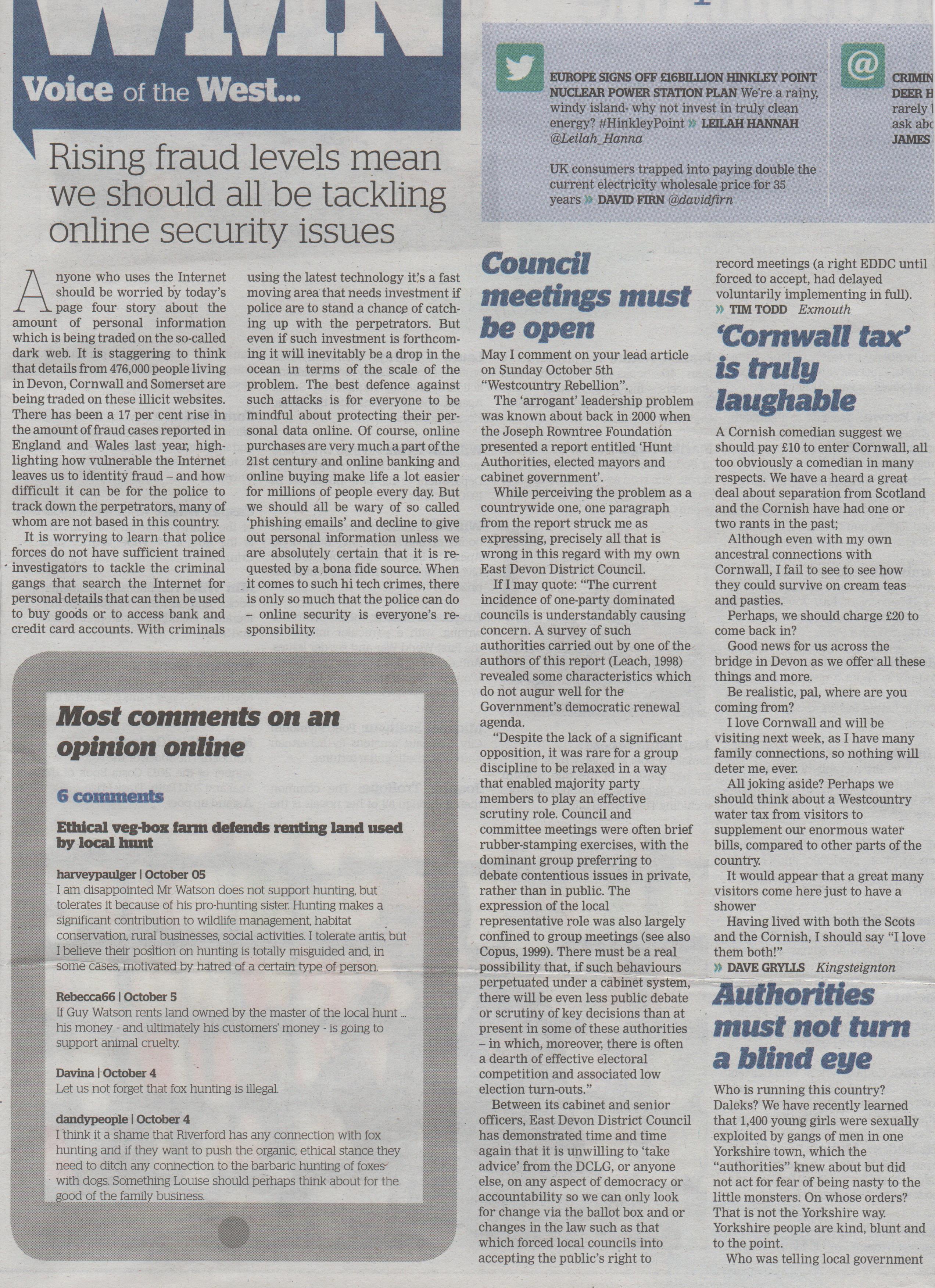
The Western Morning News has given prominence to this letter,dated 7th October, from EDA member, Tim Todd.

‘Dear Sir,

May I comment on your lead article on Sunday Oct 5th.

The ‘arrogant’ leadership problem was known about back in 2000 when the Joseph Rowntree Foundation presented a report entitled ‘Hung Authorities, elected mayors and cabinet government’. Whilst perceiving the problem as a country wide one, one paragraph from the report struck me as expressing precisely all that is wrong in this regard with my own East Devon District Council . If I may quote :

“The current incidence of one-party dominated councils is understandably causing concern. A survey of such authorities carried out by one of the authors of this report (Leach, 1998) revealed some characteristics which do not augur well for the Government’s democratic renewal agenda. Despite the lack of a significant opposition, it was rare for group discipline to be relaxed in a way that enabled majority party members to play an effective scrutiny role. Council and committee meetings were often brief rubber-stamping exercises, with the dominant group preferring to debate contentious issues in private, rather than in public. The expression of the local representative role was also largely confined to group meetings (see also Copus, 1999). There must be a real possibility that, if such behaviours perpetuated under a cabinet system, there will be even less public debate or scrutiny of key decisions than at present in some of these authorities – in which, moreover, there is often a dearth of effective electoral competition and associated low election turn-outs.”

Between its cabinet and senior officers, East Devon District Council has demonstrated time and time again that it is unwilling to ‘take advice’ from the DCLG , or anyone else, on any aspect of democracy or accountability so we can only look for change via the ballot box and or changes in the law such as that which forced local councils into accepting the public’s right to record meetings, (a right EDDC , until forced to accept, had delayed voluntarily implementing in full).’

Yours sincerely

Tim Todd

EDDC’s untimely curtailment of public speaking is”self-defeating, reactionary and arrogant”

The latest Sidmouth Herald’s report (10th October, p.4) on East Devon District Council’s New rules to trim ‘unwieldy ‘talks , includes strong criticism by the East Devon Alliance Chair, Paul Arnott. In summary, Mr Arnott warns, “Our beautiful district is under pressure from speculative planning applications as never before, and while EDDC fails to have its Local Plan in place this will only increase. In this context, public speaking at the DMC has repeatedly prevented the council from rubber-stamping a hard-pressed officer’s recommendation to approve. To curtail the right for such sincere people to contribute at this very moment is self-defeating, reactionary and arrogant. For the leaders to claim that EDDC’s new speaking restrictions make them somehow better than other councils in the south west ignores the elephant in the room – the severe crisis in public confidence in planning and democratic practice specific to East Devon.”

‘Council meetings must be open’

Following its recent front page report on the widespread local unrest, the Western Morning News today highlights a letter from EDA member Tim Todd. WMNSunday12thOctTim 001

(Bigger version will be posted here shortly).
For those who missed it, here’s the WMN story: http://www.westernmorningnews.co.uk/Grassroots-rebellion-arrogant-leadership-Devon/story-23044099-detail/story.html

We have had enough … sack the man in charge

“We have had enough. Since he came to power [he has] has undermined local democracy, contravened the local plan, and gone against the wishes of local people – enough is enough.”

Relax Mr Diviani – this is a petition circulating about the Mayor of Torbay who has sacked the majority of his Cabinet because they do not agree with him.

But today Torbay, tomorrow … who knows.

Read more: http://www.torquayheraldexpress.co.uk/Hundreds-sign-online-campaign-oust-Mayor-Gordon/story-23119861-detail/story.html

EDDC’s new website – another Council Bloxham project, oh dear …..

Anyone tried the “new” EDDC website yet – the responsibility for which can be laid at the door of the redoubtable Councillor Ray Bloxham – you know, the one who cut down public speaking so much at EDDC that it is now virtually non-existent and you can’t say anything until you have told EDDC in triplicate a year before what you intend to say …..

Well, he’s at it again – trumpeting the newly-designed EDDC website. Except that we hear it is generating lots of complaints. Unwieldy, not-fit-for-purpose, a step backwards rather than a step forwards, etc etc.

Trying to find out what is going on at meetings to come or meetings past is an absolute nightmare – minutes linked individually so that you have to go back and forwards many times to read them all, links that don’t lead anywhere, you name it, all in the name of “progress” so that EDDC can offer “more services” online.

Except that it is almost impossible to find the services!

However, see what Councillor Bloxham has to say here (if you can find it):

http://new.eastdevon.gov.uk/news/2014/07/open-for-business/

Well, yes, we do know that EDDC is open for business for SOME people who get unlimited access to REAL people – mostly developers. But for the rest of us are we to be subjected to “New-EDDC website lite beta” rather like “New Labour” or “New Fairy Liquid” … not always a step in the right direction!

Why are the missing 6,000 voters so critical?

THIS is why:

http://www.telegraph.co.uk/news/politics/ed-miliband/11153129/Heywood-and-Middleton-by-election-Labour-holds-off-Ukip-surge-by-just-617-votes.html

A majority of 617. UKIP could have won if just another 1,000 or so voters had been registered.

Is this what our council is afraid of?