“Dark money lurks at the heart of our political crisis”

“Democracy is threatened by organisations such the Institute of Economic Affairs that refuse to reveal who funds them.

A mere two millennia after Roman politicians paid mobs to riot on their behalf, we are beginning to understand the role of dark money in politics, and its perennial threat to democracy. Dark money is cash whose source is not made public, and which is spent to change political outcomes. The Facebook/Cambridge Analytica scandal, unearthed by Carole Cadwalladr, and the mysterious funds channelled through Northern Ireland’s Democratic Unionist party to the leave campaign in England and Scotland have helped to bring the concept to public attention. But these examples hint at a much wider problem. Dark money can be seen as the underlying corruption from which our immediate crises emerge: the collapse of public trust in politics, the rise of a demagogic anti-politics, and assaults on the living world, public health and civic society. Democracy is meaningless without transparency.

The techniques now being used to throw elections and referendums were developed by the tobacco industry, and refined by biotechnology, fossil fuel and junk food companies. Some of us have spent years exposing the fake grassroots campaigns they established, the false identities and bogus scientific controversies they created, and the way in which media outlets have been played by them. Our warnings went unheeded, while the ultra-rich learned how to buy the political system.

The problem is exemplified, in my view, by the Institute of Economic Affairs (IEA). In the latest reshuffle, two ministers with close links to the institute, Dominic Raab and Matthew Hancock, have been promoted to the frontbench, responsible for issues that obsess the IEA: Brexit and the NHS. Raab credits the IEA with supporting him “in waging the war of ideas”. Hancock, in his former role as cabinet office minister, notoriously ruled that charities receiving public funds should not be allowed to lobby the government. His department credited the IEA with the research that prompted the policy. This rule, in effect, granted a monopoly on lobbying to groups such as the IEA, which receive their money only from private sources. Hancock has received a total of £32,000 in political donations from the IEA’s chairman, Neil Record.

The IEA has lobbied consistently for a hard Brexit. A report it published on Monday as an alternative to Theresa May’s white paper calls for Brexit to be used to tear down the rules protecting agency workers, to deregulate finance, annul the rules on hazardous chemicals and weaken food labelling laws. Darren Grimes, who was fined by the Electoral Commission on Tuesday for spending offences during the leave campaign, now works as the IEA’s digital manager.

So what is this organisation, and on whose behalf does it speak? If only we knew. It is rated by the accountability group Transparify as “highly opaque”. All that distinguishes organisations such as the IEA from public relations companies such as Burson-Marsteller is that we don’t know who it is working for. The only hard information we have is that, for many years, it has been funded by British American Tobacco (BAT), Japan Tobacco International, Imperial Tobacco and Philip Morris International. When this funding was exposed, the IEA claimed that its campaigns against tobacco regulation were unrelated to the money it had received. Recently, it has been repeatedly dissing the NHS, which it wants to privatise; campaigning against controls on junk food; attacking trade unions; and defending zero-hour contracts, unpaid internships and tax havens. Its staff appear on the BBC promoting these positions, often several times a week. But never do interviewers ask the basic democratic questions: who funds you, and do they have a financial interest in these topics? …

While dark money has been used to influence elections, the role of groups such as the IEA is to reach much deeper into political life. As its current director, Mark Littlewood, explains, “We want to totally reframe the debate about the proper role of the state and civil society in our country … Our true mission is to change the climate of opinion.”

Astonishingly, the IEA is registered as an educational charity, with the official purpose of helping “the general public/mankind”. As a result it is exempted from the kind of taxes about which it complains so bitterly. Charity Commission rules state that “an organisation will not be charitable if its purposes are political”. How much more political can you get? In what sense is ripping down public protections and attacking the rights of workers charitable? Surely no organisation should be registered as a charity unless any funds it receives above a certain threshold (say £1,000) are declared.

The Charity Commission announced last week that it has decided to examine the role of the IEA, to see whether it has broken its rules. I don’t hold out much hope. In response to a complaint by Andrew Purkis, a former member of the Charity Commission’s board, its head of regulatory compliance, Anthony Blake, claimed that the IEA provides a “relatively uncontroversial perspective accepted by informed opinion”. If he sees hard Brexit, privatising the NHS and defending tax havens as uncontroversial, it makes you wonder what circles he moves in.

I see such organisations as insidious and corrupting. I see them as the means by which money comes to dominate public life without having to declare its hand. I see them as representing everything that has gone wrong with our politics.

• George Monbiot is a Guardian columnist”
https://www.theguardian.com/commentisfree/2018/jul/18/dark-money-democracy-political-crisis-institute-economic-affairs

Might there be a General Election soon? Swire’s e-bulletin might be a hint!

Swire’s “e-bulletin” messages have been few and far between recently. Perhaps his wife has been busy (as he says she helps with his digital presence).

We have seen the following e-bulletins:

Aug 2014, Nov 2014, Mar 2015, Aug 2015, Dec 2015
Apr 2016, Aug 2016, Dec 2016
Apr 2017, Nov 2017
and now
Jul 2018

So apparently now less than half-yearly.

Of course, now he is no longer a Cabinet Minister we can fully understand why he has LESS time to devote to constituents – it’s all those other jobs he has which take up so much time:

https://publications.parliament.uk/pa/cm/cmregmem/180702/swire_hugo.htm

But Owl does fantasise (just a bit) about whether issuing this now is actually a response to the deteriorating political situation for his party – or perhaps Claire Wright’s hard work locally and her recent activities in Westminster getting him increasingly worried.

If you want to read it, go to his web page but Owl has a few observations. However, here is Owl’s summary:

Whatever happened to the Sidmouth Survey he mentions?

He writes extensively about English Tourism Week – yet he does more and speaks more in more in Parliament for tourism in the Middle East.

He boasts about his army service – probably worth reminding people that it was both short and completely devoid of active service in e.g. Afghanistan or Kuwait or the Balkans or any other real hot-spot.

Then he has another boast about his Middle East work.

Next he boasts about his work with CPRE – and having attended one public meeting at their invitation.

Then, we get to THE MOST IMPORTANT TOPIC of his e-bulletin which is SO IMPORTANT it gets a boastful video rather than just a boring old boastful photograph. Yes – you guessed correctly – it’s unemployment? … health care? … social care? … infrastructure? … impact of Brexit? … tourism? … no actually its Protecting British Flora from Imported Diseases.

Next up, he has piggybacked on the efforts of Cllr Elli Pang and Philip Algar and other locals (including Claire Wright) in Ottery St Mary who have been campaigning ceaselessly about Ottery Hospital for decades, to claim to be vitally interested in what happens to it.

Then it’s back to nature topics again to use two columns to double up on his concerns about Sea Horses.

So, there you have it.

Owl’s suggestion: go here instead for a more comprehensive and meaningful view on local issues: http://www.claire-wright.org/

So many problems, so little attention being paid to them

Underfunding to blame for child protection ”crisis”, says report
The Local Government Association has a newsletter of articles from the press that might interest councillors amd council officers. This is today’s. Owl couldn’t reduce the list so here are ALL the topics. SO, SO worrying – all of them.

Underfunding to blame for child protection ”crisis”, says report

Pressure on councils’ safeguarding services in some areas is so severe that often the only way to guarantee safety for children is to take them into care, MPs have said. The report by the All-Party Parliamentary Group for Children, said children and young people in serious need got varying levels of help, or no help at all, depending on where they lived, with budgets influencing interventions. Cllr Roy Perry, Vice Chairman of the LGA’s Children and Young People Board, said: “This report is yet further evidence that children’s services are being pushed to the brink.”
Guardian p16, Times p16

Government needs to learn from academy failures that damaged children’s education, MPs say

The Government needs to learn the lessons from high-profile academy failures that have been damaging to children’s education and costly to the taxpayer, MPs have said. The Department for Education did not pay enough attention to scrutiny checks in a rush to convert large numbers of schools into academies, according to a Public Accounts Committee report, which also expressed concern about the levels of support available to struggling schools. Recent LGA analysis revealed that councils are better at turning around failing schools than academy chains. Cllr Roy Perry, Vice Chairman of the LGA’s Children and Young People Board, said: “It is only by working with councils and giving them the necessary powers, rather than shutting them out, that we can meet the challenges currently facing the education system.”
Independent Online, Telegraph p2

The end of the road for vital bus services?

An article on bus services highlights the case of a cancer patient’s struggle to get to hospital for treatment and the challenge of councils battling over-stretched budgets to maintain bus routes. A recent LGA report warned that nearly half of all bus routes in England are fully or partially subsidised by councils and were therefore under threat due to austerity measures. Cllr Martin Tett, the LGA’s Transport spokesman, previously said: “Councils know how important buses are for their residents and local economies and are desperate to protect them.”
Guardian p34

Opinion: Matt Hancock’s new role as Health and Social Care Secretary

An editorial in the Times argues that new Health and Social Care Secretary Matt Hancock’s priorities should include “an urgent need to resolve the question of how to fund and organise social care in Britain” and addressing “an enormous amount still to be done in the areas of preventative medicine and lifestyle improvements”.
Times p27

Bosses who revive high street properties are punished with soaring business rate hikes

Thousands of business owners and entrepreneurs are being hit with higher business rates once they renovate dilapidated or rundown stores. Business rates are calculated on the rental value of a property so renovating a run-down site inevitably comes with a rates increase. The Daily Mail is running a campaign ‘save our high streets’ and is calling for a reform of business rates, cuts to parking charges and a fair tax for big internet shopping businesses.
Mail p19

Poor air quality linked to spikes in GP visits

Air pollution leads to spikes in health problems and drives up hospital admissions and visits to the GP, according to a study. The Dundee University report proves an “absolutely clear” link between poor air quality and health problems and researchers said it should serve as a warning to politicians about the serious effects of toxic air pollution on public health.
Guardian p8

New test woe for under 11s

Official figures show that a third of primary school children aren’t achieving higher standards in reading, writing and maths tests, however performance in the SATs exams have improved, with two-thirds reaching the more rigorous requirements, up from just over a half a year ago. Some teachers believe the key stage two tests put too much pressure on young children and does not accurately reflect performance.
Sun p2, Telegraph p2, Guardian Online, i p13, Mail p29

Energy drinks consumption

Public Health Minister, Steve Brine, has warned that children in the UK consume a worryingly high level of energy drinks and is way above the European average. According to Government figures, nearly 70 per cent of ten to 17 year olds consume energy drinks. The Government plans to consult on a ban on children buying the drinks as part of its childhood obesity plan.
Sun p18, Times p4, Telegraph p10, ITV Online, i p21, Express p21

Emerging sex disease MG ‘could become next superbug’

Health experts are warning that a little known sexually transmitted infection could become the next superbug unless people become more vigilant. The British Association of Sexual Health and HIV is launching new advice about MG, which has no symptoms but can cause pelvic inflammatory disease, which can leave some women infertile.
BBC Online, Times p4

C of E to create 100 new churches as number of Anglicans hits new low

The Church of England will create more than 100 new churches to “revive the Christian faith in coastal areas, market towns and outer urban housing estates” in the face of a record low number of people identifying as Anglicans. Up to 50 new churches will be established in the diocese of Leicester and 16 in the diocese of Manchester.
Guardian p9, Telegraph p8″

“The national calamity we don’t hear about – the death of local democracy”

‘We cannot survive as we are beyond this next financial year. There is no money. I am not crying wolf. I never cry wolf.” So says the Conservative leader of Torbay council, in Devon: a local authority that delivers the full range of services but can no longer function at even the most basic level.

After years of bone-crunching austerity, by 2020 it will be faced with another £12m of cuts – so the most obvious option is to downgrade itself to a district council, hand over its most essential work to the bigger Devon county council, and hope for the best. Whether this will improve anything is an interesting question: since 2010, in real terms, Devon’s funding from government has been cut by 76%.

Northamptonshire’s council has already effectively gone bankrupt. Somerset, Norfolk and Lancashire are reportedly faced with comparable problems. And in our big cities, similar stories have been unfolding for years, as the great cuts machine set in motion by George Osborne in 2010 continues to grind away, while both costs and demand for basic services increase.

Bristol faces a £108m funding gap by 2023, and is cutting services accordingly. Having already hacked well over £200m from its budgets, Leeds is in the midst of making £38m of savings in a single year. In Newcastle, by 2020, insiders reckon that over half the city council’s spending will in effect have been slashed within a decade. Many authorities are putting up council tax, but that doesn’t come close to easing the economies they have to make. And the results are obvious: less comprehensive child protection, less dependable care for older people, fewer children’s centres, more rubbish in the streets – and yet more dire damage to a social fabric that has been pulled apart for nearly a decade.

Why is this national calamity so under-reported?

Some of the answer is about the continuing tragedy of Brexit. Political journalists who work themselves into a lather about this or that item of Westminster gossip hear the dread phrase “local government” and glaze over. It is some token of Whitehall neglect that confusion still surrounds the Tory plan to abolish the core grant given from central government to local authorities and make them completely dependent on business rates and council tax. All told, senior politicians routinely treat non-Westminster people as a mere annoyance: last week, for instance, it was revealed that though the government has commissioned an updated official assessment of the likely effects of Brexit on Greater Manchester, it will not let the people who run that part of the country see it.

There have been times when the UK’s deep tendency to centralise has been momentarily held back, as evidenced by the devolution to Scotland, Wales and London, and Osborne’s encouragement of the rebirth of city regions and the arrival of elected “metro mayors”. But even in those cases – let alone when it comes to the counties, boroughs and districts where devolution remains off-limits – Whitehall’s habit of clinging to power and the effects of austerity have got in the way. Moreover, as evidenced by the calamities that have befallen health and education, particularly in England, politics has tended to revolve around grand schemes authored by politicians who have Bonapartist ideas of controlling everything from the centre – which, in the midst of a society growing more complex and unpredictable by the day, are usually bound to fail.

Yet here is a remarkable thing. For all their travails, some people in charge of councils are among the most inventive, energetic politicians I have ever met. Figures such as Manchester’s Richard Leese, Newcastle’s Nick Forbes, Leeds’s Judith Blake and Plymouth’s recently re-elected Tudor Evans – all Labour people – are located where their policies play out, deeply familiar with local nuances and complexities, and able to move fast. (Weirdly, they are now under attack from their own side: the people at the top of Labour have plans to end the system whereby council leaders are elected by other councillors, and impose one in which their selection would be in the hands of the party’s newly expanded membership – a brazenly factional move that may well be illegal, misunderstands how councils are deeply collective bodies, and threatens constant tension and disruption, just when the people concerned are in the midst of their most difficult era in living memory.)

Meanwhile, at the other end of the local government hierarchy, an experiment in participatory, non-party “flatpack democracy” in my adopted hometown of Frome, Somerset, highlights the revived belief in the power of truly local government, as does the related rebirth of town and parish councils in other parts of the country.

How would such examples of energy and creativity become the norm? Everything ought to start with an acknowledgment that the system is now an incomprehensible mess. It amounts to a random archipelago of town, parish, district, county, city and borough councils, new city regions, police forces and elected commissioners often based on completely different geographies, local enterprise partnerships and an array of other bodies – not to mention an increasingly centralised education system, and a health service now so complicated that very few people understand it. All this feeds into the sense of popular bafflement that defines a country that is simultaneously the UK’s most populous component but also its most powerless: this, it seems to me, is the essence of the modern English condition.

Any political project with radical intentions ought to consider the contrastingly clear, comparatively simple models in most of western Europe: the Spanish structure of municipalities, provinces and regional “autonomous communities” isn’t a bad place to begin. Learning from such examples should lead on to genuine financial independence for councils, based on a decent share of income tax and the ability to raise funds for big projects through bond issues, and a drastic redrawing of the responsibilities of national and local government – not least in the area of basic public services.

Council cuts are putting the vulnerable at risk, Tory peer says
If the NHS is to survive, it is going to have to decisively shift from treatment towards prevention, something that can only be organised at the social grassroots. It is high time we broke up the dysfunctional Department for Work and Pensions, and handed the administration of most benefits and the jobcentre system to local actors who know what actually works. Education urgently needs to be re-localised. If our troubled high streets are to find a new role, it will be people living next to them who will have to be given the power to find it. To even begin to solve the national housing crisis, we will also have to allow local, city and regional politicians to take the initiative. So, we should pay them properly, and allow them the parental leave, holidays, pensions and sick pay that most of them currently do without.

Across the board, we need to leave behind the lingering fantasy that our fate is wholly in the hands of national politicians who can somehow blow the dust off the failed institutional machinery of the 20th century and save us. That world is gone, and its passing ought to be marked with a collective recognition that at the point when councils ought to be in the midst of revival and reinvention, they are actually being killed. God knows, Britain is now well used to the politics of self-harm, but how amazingly stupid is that?”

https://www.theguardian.com/commentisfree/2018/jul/10/death-local-democracy-cuts-closures-westminster

“How to maintain high ethical standards in local government: a perspective on the Committee on Standards in Public Life’s review so far”

Professor Colin Copus is a specialist advisor to the Committee on Standards in Public Life’s review into local government ethical standards. He writes here in a personal capacity:

“As academic advisor to the Committee on Standards in Public Life’s review into ethical standards in local government, I’ve been reflecting on the evidence I’ve heard so far.

The aim of the review is to test the robustness of the current system for maintaining high standards of public behaviour in local government. It is not a hatchet-job on councillors or intended to identify a problem where there is not one. Rather, the review will assess evidence to enable a judgement to be made about what, if any, changes are required to the current regime to ensure the maintenance of the highest ethical standards in local government.

My impression so far is that there are two competing themes emerging that pose a challenge to anyone considering how best to create the environment for strong ethical behaviour in local government. Those themes result in the question: do we nationalise or do we localise ethical standards in local government?

The danger in any review in local government is for rose-coloured spectacles to temper one’s view of past systems. It is nowhere more the case than in the ethical standards debate.

The evidence received by the Committee so far has highlighted some difficulties with the effectiveness of localising standards that came with the abolition of the standards board and the past regime associated with the board by the Localism Act 2011.

Concern has also been expressed about placing control over the ethical regime (and code of conduct) with councils themselves and about the apparent weaknesses in the sanctions available to councils when dealing with ethical and behavioural issues.

Moreover, the review has heard that local codes of conduct can result in councillors who sit on county, district and parish councils at the same time potentially being subject to three different codes. We do not yet know how widespread this issue is or if it generates regular and intractable problems for councillors and officers.

But the review has also heard that there is a recognition that centralising and nationalising ethical standards can result in a system that is remote, anonymous, lacking in appreciation of local differences of culture, tradition and behaviour.

Nationalising the system also prevents flexibility and responsiveness to specific local issues and at worse can result in councillors feeling on ‘trial’ and subject to a remote and bureaucratic system, which in itself can damage local democracy.

The issue of sanctions also looms large as does the role of independent input or oversight of the local process of assessing standards issues.

Sanctions pose a particular problem, not least because under the current arrangements, a party in power may be tempted to misuse their majority when imposing sanctions, but also because there is a line between what is appropriate for councils to be able to require and impose as sanctions and what is appropriate that the electorate themselves have at their disposal.

The question of sanctions is closely tied to that of oversight: even the power to suspend councillors from committees, council meetings or council premises and restrict resources for a short while may be subject to misuse. Robust safeguards and rights of appeal must, therefore, be available to councillors whose behaviour is not the real problem – but instead find themselves the subject of a complaint when they are an effective and vocal opponent of the ruling administration.

We also do not yet know how widespread such a problem may be. It is clear that the issue of sanctions, the system by which they are imposed and independent oversight and involvement, will be a key theme of the Committee’s assessment of the evidence in this review.

The hazard with any ethical regime – local or national – is how the political parties in local government respond to that regime.

Given that over 90 per cent of all councillors in England are from the Conservative and Labour parties and the Liberal Democrats, the temptation to use a set of rules and regulations designed to control councillors’ behaviour for party political advantage or to silence councillors from other parties, is considerable.

Any ethical regime must not provide a system that can be misused for party advantage or by officers to restrain troublesome councillors as both can damage free speech within local democracy.

It must also be remembered that ethical standards in English local government are among the highest across Europe and that results in a commitment by the overwhelming majority of councillors to public service and the public wellbeing.

The Committee has a difficult tightrope to walk to make observations and recommendations that provide an opportunity for all local authorities and the central government to finesse and reform the current system, to ensure the highest standards of ethical behaviour are maintained and strengthened in local government. It is well worth the walk.”

http://www.democraticaudit.com/2018/07/10/how-to-maintain-high-ethical-standards-in-local-government-a-perspective-on-the-committee-on-standards-in-public-lifes-review-so-far/

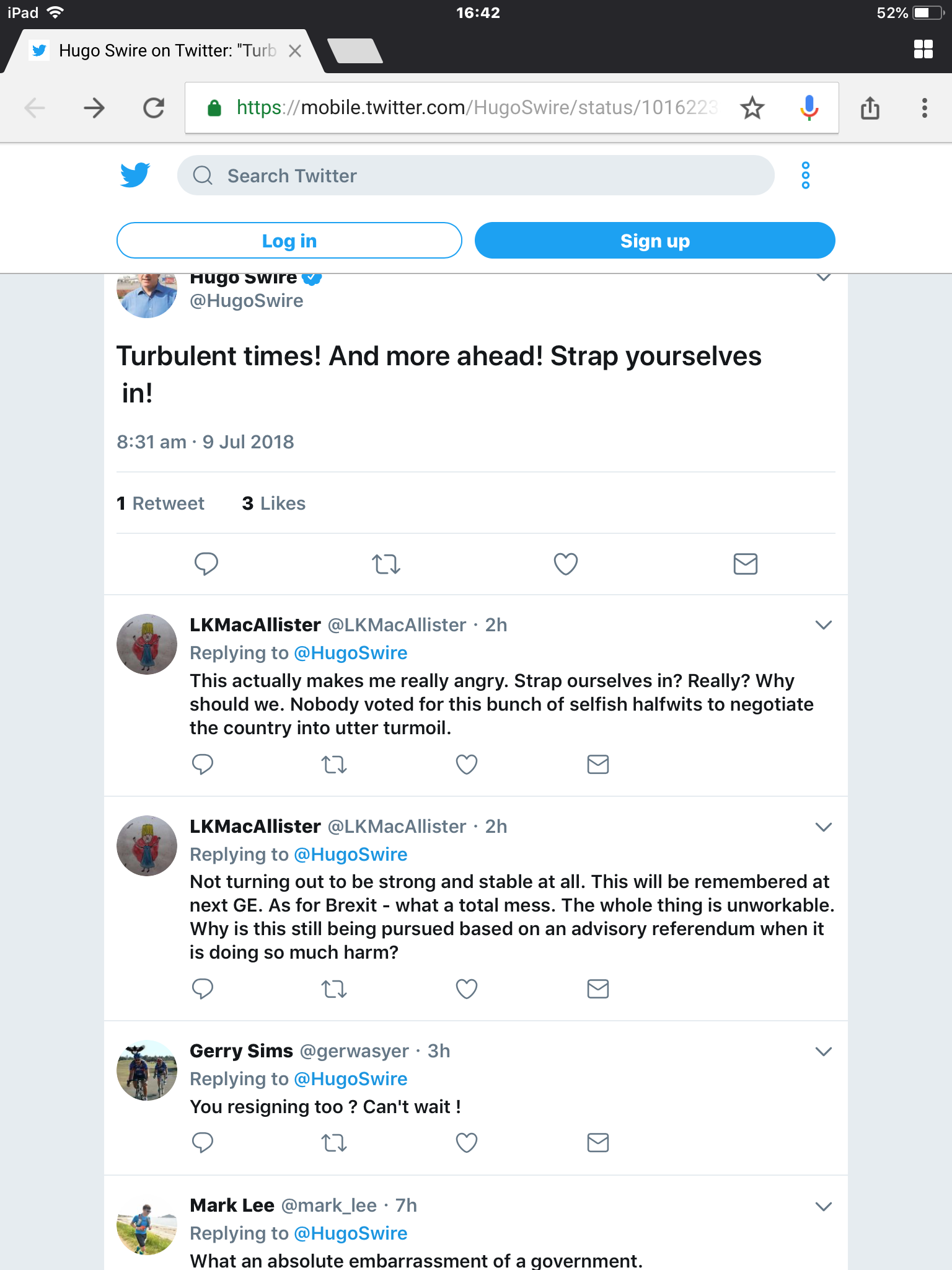
Swire tells us to “strap ourselves in” …

Swire’s advice to us in his Twitter post?

“Turbulent times! And more ahead! Strap yourselves in!”

Unfortunately it was followed by several replies on the lines of:

  • your lot caused it so why crow about it;
  • not a good example if “strong and stable”; and
  • when can we look forward to your resignation

Rather backfired …. seems to be catching.

New all-party push for proportional representation

This week is the first National Democracy Week – a rare moment to put the ‘nuts and bolts’ of democracy on the agenda.

The elections of the past year have shown that Westminster’s First Past the Post system is failing at the lowest democratic hurdle – allowing everyone to participate equally in our politics.

One in five people felt forced to ‘hold their nose’ and opt for a lesser evil rather than their preferred candidate in 2017’s General Election.

68% of votes had no impact on the result – going to either unsuccessful candidates or being ‘surplus to requirements’. Under the Westminster’s system, all that is required for victory is a majority of one.

And the system is exaggerating divisions in the UK – Labour secured 29% of the vote in the South East but got just 10% of seats, while the Conservatives won 34% of the North East vote but got just 9% of seats.

This isn’t some anomaly – this is built into a stone-age system where having one more cross in the box than the rest is all that counts: every other vote goes to waste.

But Westminster’s system can’t even do what it says on the tin – produce ‘strong’ single-party government. The Conservatives were required to make an agreement with the Democratic Unionist Party (DUP) to ensure it could govern with any degree of reliability.

These serious flaws in the Westminster system are why today, during the first National Democracy Week, we are marking the relaunch of the All Party Parliamentary Group for Proportional Representation.

This will see MPs from across the political spectrum meet to support a change in the voting system – to one which better matches seats in the House of Commons to how people actually voted.

It will be chaired by Labour MP Daniel Zeichner, joined by Martyn Day MP (SNP), Wera Hobhouse MP (Liberal Democrat), Jeremy Lefroy MP (Conservative), Caroline Lucas MP (Green), Lord Warner (Crossbench) and Hywel Williams MP (Plaid Cymru) as Vice-Chairs. This is a powerful cross-party coalition for change.

We know that while the existing Westminster system may be all that many voters in England have ever known, it is far from the only way. There are much better options.

Every new democratic institution created in the past two decades has, in fact, rejected First Past The Post. Voters in Wales, Scotland and Northern Ireland (and indeed, in most modern democracies) are all used to more proportional systems – seeing their voices properly and fairly reflected in the corridors of power, and with seats matching votes. (For more information on the alternatives see here)

Yet Westminster’s creaking voting system is stuck in the dark ages.

National Democracy Week has been launched with the noble intention that “regardless of who we are or where we are from, we must work together to ensure that every member of society has an equal chance to participate in our democracy and to have their say.”

Let us recognise that the ‘one-party-takes-all’ system does not achieve this. It was designed for another age – and doesn’t work today.

Let’s move towards a democratic system built for our time: where everyone’s voice is heard. That, surely, would be fitting progress to mark the first National Democracy Week.”

https://www.electoral-reform.org.uk/a-cross-party-group-of-mps-are-fighting-westminsters-broken-voting-system/

“Earl of Devon elected to the Lords in a poll of his hereditary peers” (he got a majority – 12 votes)

Aka Charlie Courtney c/o Powderham Castle.

Wonder what he will do for us? Still, the £300 per day just for signing in will buy a few cushions from Harrods!

https://www.theguardian.com/politics/2018/jul/04/earl-of-devon-elected-lords-hereditary-peers-byelection

“Democracy Week” …. why it is undemocratic

Apparently, it’s “Democracy Week” …. Owl finds it hard to believe.

Here are 4 reasons from the Electoral Reform Society why it is anything but:

1. The first-past-the-post system of voting.

2. Inequality in the minimum voting age in England, Scotland, Wales and Northern Ireland.

3. “A House of Cronies” aka the gerrymandered House of Lords.

4. The political gender gap.

For more information, see:

https://www.electoral-reform.org.uk/four-ways-westminsters-politics-needs-fixing-this-democracy-week/

The shame: UN to investigate Tory record on poverty and human rights

The sound of Charles Dickens as he turns in his grave.

“The United Nations has launched an investigation into poverty and human rights in the UK which will examine the impact of the austerity policies of Theresa May and David Cameron over the past eight years.

The inquiry will be led by Prof Philip Alston, the UN’s special rapporteur on extreme poverty and human rights, who angered the Donald Trump administration this month when he concluded after a similar visit to the US that the White House’s contempt for the poor was driving “cruel policies”.

The fact-finding trip is scheduled for this autumn and will be the first visit to a western European country by a representative of the UN’s rapporteur’s office since a trip to Ireland in 2011. Alston’s most recent inquiries into extreme poverty have taken him to the US, China, Saudi Arabia and Ghana.

“The UK has gone through a period of pretty deep budget cuts first under the coalition and then the Conservatives and I am interested to see what the outcome of that has been,” Alston told the Guardian. “I am also interested to look at what seems to be a renewed debate on all sides about the need to increase spending at least for some of the key programmes.”

He said the challenges facing the UK were different to the US, where he has concluded Trump’s policies were “tailor-made to maximise inequality and to plunge millions of working Americans, and those unable to work, into penury”.

Alston said: “In the UK, things are at a different place where there is no great budget surplus to be mobilised. Welfare cuts have taken place but there is now an interesting debate on whether they have gone too far and what measures need to be taken to shore up the NHS and other programmes.”

Alston has not yet determined exactly what he will focus on and will shortly invite submissions from groups who want to suggest matters for him to consider. They could include housing squalour, insecurity at work, in-work poverty, mental health and political disenfranchisement. …”

https://www.theguardian.com/society/2018/jun/28/united-nations-tory-record-poverty-human-rights

Should local party members elect council leaders?

So says a writer (Labour) in a Huffington Post blog. No problem in East Devon – most of the dwindling local Tory party membership are already councillors!

Some of the comments seem quite pertinent to East Devon:

” … a council leader who oversees a large budget and thousands of local government workers, is only selected by the party members who live in their individual ward to be a candidate for councillor, from there a vote of councillor colleagues takes place behind closed doors. There is no mechanism for members to have a say on who should be the Labour [or other political party] group leader or to debate the principles, priorities and policies they will lead before they are in place. In practice, there is no recourse for members if the leader chooses to act in a way that undermines the values our party is founded upon – other than to deselect them as a candidate to be councillor when they are next up for election, which may be four years away. …

[Ah, yes, who can forget Diviani being told to save community hospitals at EDDC and voting to close them at DCC]

… Too often we see Council Cabinet members dependent on the grace and patronage of their leader for their income and livelihood – no Cabinet position means no job, and as such very little dissent. In some places even scrutiny chairs – the name should give away what they’re there for – are put in place by the very leadership they are supposed to scrutinise. …”

[Scrutiny – we never did manage to get to the bottom (or even very slightly below the surface) of the relationship between disgraced Councillor Graham Brown, the council and their relationship with the East Devon Business Forum]

Source: Huffington Post

“UK democracy under threat and reform is urgent, says electoral regulator”

“The Electoral Commission has called for urgent reforms to electoral law after a series of online political campaign scandals, acknowledging concerns that British democracy “may be under threat”.

Following a series of revelations involving the likes of Cambridge Analytica, the elections regulator has asked Westminster and the devolved governments to change the law in order to combat misinformation, misuse of personal data and overseas interference in elections.

Among other recommendations, the Electoral Commission has called for:

A change in the law to require all digital political campaign material to state who paid for it, bringing online adverts in line with physical leaflets and adverts.

New legislation to make it clear that spending in UK elections and referendums by foreign organisations and individuals is not allowed.
An increase in the maximum fine, currently £20,000 per offence, that the Electoral Commission can impose on organisations and individuals who break the rules.

Tougher requirements for political campaigns to declare their spending soon after or during a campaign, rather than months later.

A requirement for all campaigners to provide more detailed paperwork on how they spent money online.

The intervention follows years of debate about the largely unregulated world of online political campaigning in the aftermath of the 2016 EU referendum and Donald Trump’s election as US president.

“Urgent action must be taken by the UK’s governments to ensure that the tools used to regulate political campaigning online continue to be fit for purpose in a digital age,” said Sir John Holmes, chair of the Electoral Commission.

“Implementing our package of recommendations will significantly increase transparency about who is seeking to influence voters online, and the money spent on this at UK elections and referendums.”

His organisation also backed proposals to publish a database of political advertisements that will enable the public “to see what adverts a campaigner has taken out and how much they paid”. Facebook is already due to launch such a facility for UK political adverts within the coming months.

The regulator, alluding to foreign governments such as Russia, also raised concerns that there is currently no explicit ban on overseas organisations buying online political ads aimed at a British audience. …

… A Cabinet Office spokesperson said: “The government is committed to increasing transparency in digital campaigning in order to maintain a fair and proportionate democratic process, and we will be consulting on proposals for new imprint requirements on electronic campaigning in due course.”

The Electoral Commission has also asked for the power to investigate individual political candidates if they have broken constituency spending limits in general elections. At the moment only the police can investigate such allegations, resulting in the long-running investigation into Tory candidates’ spending on battle buses, which was dropped by the Crown Prosecution Service due to insufficient evidence.

Other proposals include pushing political parties to count online advertising targeted at local constituencies within individual candidate spending limits – which can be as low as £10,000 – rather than as part of national campaigns which are allowed to spend up to £19.5m. During the 2017 general election the Conservatives were able to target Facebook ads regarding local issues at individuals in specific constituencies and count it as national spending – just so long as they didn’t mention the name of the local Tory candidate.

Both Labour and the Conservatives spent substantial sums of money on online promotions during the last general election, with digital spending accounting for more than 40% of all advertising spending by political parties in 2017. …”

https://www.theguardian.com/politics/2018/jun/26/uk-democracy-under-threat-and-reform-is-urgent-says-electoral-regulator

SWIPE – South West Independent Party for England! A pipe dream …?

A post from East Devon Watch August 2015 is recently seeing revived interest from readers. Here it is again – the points it makes no less relevant now:

“Following on from our post about how much the South-West loses out to other areas of Britain, particularly the South-East, we have been considering the suggestion that we should create in this region a party similar to (but definitely not the same as) the Scottish National Party – a party representing an area which finds itself time and again the poor relation to other areas.

One should recall that the South-West has had a long tradition of non-conformity. Indeed, search on the words “south west england” and “nonconformity” and a whole host of links will turn up. Devon County Council even has web pages for it:

http://www.devon.gov.uk/index/councildemocracy/record_office/north_record_office/leaflets/sources_for_history_of_nonconformity-2.htm

Admittedly, this refers specifically to religious non-conformity. But the South-West showed its independent thinking by being a hotbed of liberalism when liberalism was something more than Nick Clegg getting into bed with the Tories. From Yeovil to Cornwall, this area steadfastly refused to be buttonholed into conformity to the pendulum swings between Labour and Conservative.

So, given that the area is now so definitely politically blue, are we getting a better deal? The post from earlier this week shows very definitely that we are not:

https://eastdevonwatch.org/2015/07/31/is-it-time-the-west-country-had-its-own-party/

So, Owl thinks it is time we started thinking about alternatives.

Firstly, what is the South-West? Officially (for political and statistical purposes) it consists of nine official regions of England: Gloucestershire, Bristol, Wiltshire, Somerset, Dorset, Devon, Cornwall and the Isles of Scilly. The Owl thinks that we can discount Gloucestershire (hunting, shooting, fishing, the residences of Prince Charles and the Princes Royal and MI5 keep them firmly blue!) and Wiltshire seems just a little too close to the Home Counties and includes Swindon – definitely out. Dorset we dismiss too – they are totally conformist (see Letwin, Oliver and Grand Designs)!

That leaves Bristol, Somerset, Devon, Cornwall and the Isles of Scilly. Bristol has gone extremely green over recent years and are likely to remain so (hopefully) and the Isles of Scilly have always done their own thing and have never considered themselves part of mainland life, but they can have the option of joining us within Cornwall (as at present). This leaves Devon, Cornwall (including the Isles of Scilly if they so wish) and Somerset. These three counties have so much in common. Long sea coasts, poor infrastructure and transport links, large retirement communities, large number of second homes, tourism forming an important part of economic life, a history of being overlooked when the honey pot is being shared out.

Imagine a specific party for Devon, Somerset and Cornwall! Imagine what a group of people from this area who held the balance of power in Parliament could achieve. Imagine just how powerful that could be.

And the acronym: South West Independence Party England – SWIPE!

Take a SWIPE at London-centric politics – devolution for the Cornwall, Devon and Somerset region!

Alas, just a pipe dream – for now …”

https://eastdevonwatch.org/2015/08/02/swipe-south-west-independence-party-england/

Teignbridge Council CEO given £264,000 to push off – now working for West Sussex on £138,000 plus perks

“A council chief executive was given a golden handshake of more than £250,000 in a deal that bosses tried to keep secret to avoid causing her “unnecessary or unjustified distress”.

Nicola Bulbeck, 60, left Teignbridge district council in Devon last summer after 11 years’ service. The council had repeatedly refused to reveal how much she received but its draft annual accounts disclosed yesterday that the former barrister left with a £264,000 “exit package”.

It was also revealed that she was allowed to stay on until the day after the general election last year so that she could earn a further £30,000 for being the returning officer.

After leaving the local authority she was appointed an executive director at West Sussex county council last January on an annual salary of £138,000.
There has been concern about a “revolving door” of senior local authority staff receiving significant payoffs before moving to similar jobs.
Several Teignbridge district councillors have alleged that Ms Bulbeck kept her company car as part of the leaving package. The council has declined to comment on the claim.

Phil Shears, who replaced Ms Bulbeck, had defended the decision not to release details of her payout when she departed. He claimed that the disclosure would “cause unnecessary or unjustified distress or damage” to his predecessor. Mr Shears was appointed the council’s managing director on a salary of £94,656, considerably less than Ms Bulbeck earned. Ms Bulbeck had been criticised for accepting a 12 per cent pay rise that took her annual pay packet from £126,000 to almost £142,000.

The district council and the Information Commissioner’s Office rejected several attempts by the Mid-Devon Advertiser to unearth Ms Bulbeck’s settlement. The accounts show that she received £173,091 “compensation for loss of employment” as part of her exit package”.

Jeremy Christophers, the council’s Conservative leader, said: “We have followed strict council policy and abided by the legal advice given.”

Gordon Hook, a Liberal Democrat councillor, said: “The leaving packages for some senior officers at local authorities are nothing short of obscene in the eyes of many. My view is that the general public have every right to know how their council tax is spent.”

Ms Bulbeck was not available for comment yesterday.”

Source: The Times (pay wall)

“Downing Street Accused Of Burying Electoral Commission Investigation Into Theresa May’s Advisors”

“Downing Street has been accused of pushing through key Brexit votes before MPs know the result of an investigation into whether Theresa May’s advisors broke the law during the EU Referendum

Stephen Parkinson, the PM’s political secretary, and Cleo Watson – also a Downing Street staffer – are both being investigated by the Electoral Commission as part of an inquiry into whether the official Brexit campaign broke spending limits.

The investigation was launched in November, but the Electoral Commission has now presented its findings to those under investigation. They have 28 days to provide a response to the conclusion before the report is made public.

Labour’s Deputy Leader Tom Watson is questioning if the votes on the EU Withdrawal Bill – planned for Tuesday and Wednesday – are being rushed through before MPs have the chance to consider the results of the investigation.

He said: “Each day the plot thickens about the murky dealings of the various Brexit campaigns.

“Now it seems senior figures at the heart of Number 10 who were involved in Vote Leave could have been informed about the contents of this important Electoral Commission investigation long before anyone else.

“If that’s true Number 10 would have had time to plan and even ensure key Brexit votes like the ones this week could happen before the investigation
should really still be shaping and taking decisions at the heart of Government.”

The investigation centres around payments made by Vote Leave to clear debts of £625,000 run up by university student Darren Grimes with the digital campaign company AggregateIQ Data.

Grimes – who ran the BeLeave group – was allowed by electoral law to spend £700,000 in the campaign.

As the official campaign group, Vote Leave could spend £7million, and if it had commissioned and spent that £625,000 itself it would have breached the spending limits.

The Electoral Commission initially accepted the Vote Leave argument that it had donated the money to Grimes, despite settling the bill with AggregateIQ directly.

A separate group, Veterans for Britain, also received £100,000 from Vote Leave.

But in November it reopened its investigation, claiming new information had come to light.

Downing Street is drawn into the investigation as Stephen Parkinson – the PM’s Political Secretary – was National Organiser for Vote Leave during the referendum campaign.

He is accused by former Vote Leave volunteer Shahmir Sanni of directing how BeLeave should spend money – something which would be a breach of electoral law.

In March, Parkinson revealed he and Sanni had been in a relationship as part of his denial, prompting Sanni to claim his family in Pakistan – who did not know he was gay – were forced to take “urgent protective measures” for their own safety.”

https://www.huffingtonpost.co.uk/entry/downing-street-brexit-electoral-commission_uk_5b1e58a0e4b0adfb826bbe6e?guccounter=1

“Free speech” at Devon County Council – only for Tory councillors?

From Martin Shaw, East Devon Alliance for Seaton and Colyton councillor at Devon County Council:

“Conservative Councillor Richard Scott from Exmouth – where the hospital is safe because it’s kept its beds – accused me of ‘abusing the procedure’ when I went along and argued why Seaton and Honiton hospitals, which my constituents use, need to stay open with all the services and clinics currently provided – and more.

Seaton and Honiton were named by Dr Simon Kerr of NEW Devon CCG as being ‘at risk’ in the CCGs’ forthcoming Local Estates Strategy. Although the CCG has denied it has plans to close the hospitals, all local hospitals which have lost their beds – including Axminster, Ottery St Mary and Okehampton – could still be closed.

I was fully within my rights to speak up for my constituents and this was an unworthy personal attack. ClaireWright and deputy chair Nick Way (Lib Dem) both defended me.

When Claire Wright put her motion for the Committee to protect ALL community hospitals, all the Conservative members voted against this and it was defeated.

Martin Shaw
Independent East Devon Alliance County Councillor for Seaton & Colyton

“The government tried to bury news on the bloated House of Lords. Here’s the facts…”

“Theresa May backs bid to cut the size of House of Lords” began a headline in February. It seems that three months is a lifetime in politics…

Over the weekend, the PM attempted to bury news that she is appointing 13 new Lords – amid the clamour of the Royal Wedding. It was a cynical attempt to hide what both the PM and opposition know: new appointments to Parliament’s ‘private member’s club’ are unpopular and wrong.

New research we’ve published in the Daily Mirror today has shown what the new Lordships will mean in practice for the bloated second chamber.

The cost of cronyism

With more members comes more expenses claims. The total cost of the new Peers – based solely in terms of annual allowances and travel expenses – is expected to be at least £289,558 a year, according to ERS analysis. That’s based on the average claim of £22,273.69, for the circa 141 days the chamber sits each year.

But a response to a Parliamentary question last year suggests it could be much higher. The average cost of a peer – looking at the total cost of the House, minus works and building costs, is as much as £83,000 per year – meaning the new appointees may have just added £1,079,000 to the overall annual bill.

When you consider that Peers who failed to speak in the Lords for an entire year claimed nearly £1.3m in tax-free expenses last year, it shows that more members doesn’t even guarantee more scrutiny.

These costly cronies are rarely impartial experts: the new appointments mean the House is now packed with 187 ex-MPs, 26 ex-MEPs and 31 ex-members of devolved institutions – figures which rubbish claims the unelected House is full of independent experts.

Out of control

This latest batch of Lords appointments comes despite a report commissioned by the Lord Speaker, Lord Fowler, proposing a ‘two-out, one-in’ system to bring the total down to 600 by 2027, published at the end of last year.

During a debate on the size of the House in December, several peers expressed embarrassment or discomfort about the size of their chamber:

Lord Harries of Pentregarth said: “I believe that our present size … brings us into disrepute. I feel embarrassed when someone enquires about our size, even when I stress that the average daily attendance is only about 484.”

Lord Selkirk of Douglas added: “It cannot sit altogether comfortably that when legislatures around the world are listed by size, we come second only to the National People’s Congress of China.”

We’ve seen no action since that report, when Peers said they’d start work shrinking the second chamber. So these new appointments, therefore, represent both the inability of peers to regulate their own house – and the unwillingness of politicians to act on this issue.

Time for a clear-out

The House of Lords is already the second largest legislative chamber in the world, behind China’s National People’s Congress. There are more peers than could ever sit in the chamber at the same time and the bulk of the work of the House is done by a much smaller group of peers.

Make no mistake: these new additions are an insult to voters. Given that all parties claim to want to reduce the size of the second chamber, they should act on their word.

We’re calling for the House authorities to refuse to allocate time for the introduction ceremonies in line with that. It is now time for cross-party legislation to finally reform this archaic and super-sized second chamber. We’ve had years of stalling on this front – the main parties must now act.”

https://www.electoral-reform.org.uk/the-government-tried-to-bury-news-on-the-bloated-house-of-lords-heres-the-facts/

Sign their petition here:
https://action.electoral-reform.org.uk/page/3342/petition/1

Stating the obvious …

We have an EDDC Tory councillor saying their new Leader is a “problem solver” and now we have an Exmouth town councillor saying Exmouth’s new mayor is ‘the man to get things done’.

Anyone heard of a Leader or Mayor who can’t solve problems or doesn’t get things done? Aren’t they basic requirements of the job?

On second thoughts maybe don’t answer that …

http://www.exmouthjournal.co.uk/news/jeff-trail-is-appointed-new-mayor-exmouth-town-council-annual-meeting-1-5533000

Time for a change? East Devon Alliance conference this Saturday

Still time to register (free) for East Devon Alliance conference “Time for a Change” at Beehive, Honiton – this Saturday 10 am – 1 pm.

Details here:

http://www.eastdevonalliance.org.uk/

Free registration here:

https://www.eventbrite.co.uk/e/east-devons-time-for-a-change-peoples-conference-tickets-45482525458

“This conference is for YOU. Speakers will include County Councillors CLAIRE WRIGHT and MARTIN SHAW, and PAM BARRETT, Chair of the Independent Buckfastleigh Town Council and regional expert on transforming democracy from the bottom up.

In two sessions you will be able to hear our experience and then CONTRIBUTE your own personal views:

a) how did the democratic deficit in East Devon happen? Or – the problem.
b) what can we do about it through democracy in our parishes, towns and district. Or – the solution.

Please come. We are all volunteers but if we band together now to fight for hospitals, homes and jobs we have a chance to change how our local area is run.

Parking: nearest is Lace Walk. 2 minute walk. If full, New Street, 5 mins”

So you want to be a (female) councillor? Fawcett Society meeting in Exeter

To register go to Eventbrite: https://www.eventbrite.co.uk/e/exploring-your-political-pathway-workshop-panel-discussion-tickets-45097615181