http://www.bbc.co.uk/news/science-environment-28214685
No cheering words for places like Feniton or for our coastal communities.

http://www.bbc.co.uk/news/science-environment-28214685
No cheering words for places like Feniton or for our coastal communities.
Beavers are a native species, hunted to extinction 500 years ago. Re-introductory trials (at some expense) are taking place in Scotland but it seems that Nature is taking is taking her own course here in the river Otter.
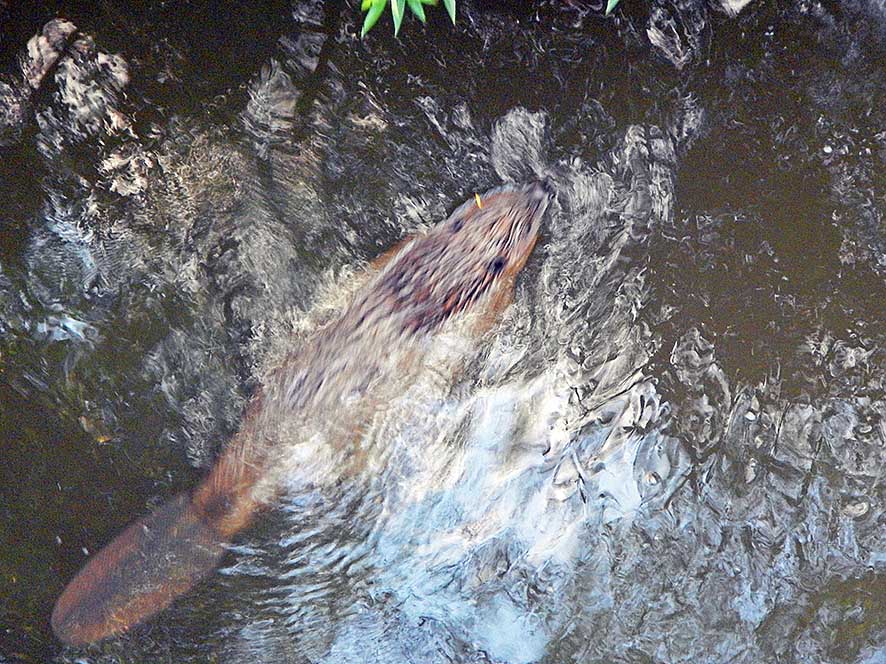
The photo above was taken very recently in Otterton. Defra, whose first response to most problems seems to be to cull, wants to get rid of them.
Devon-based wildlife consultant Derek Gow, who was responsible for three imported beavers destined for an animal sanctuary in Scotland, is a long-standing campaigner for the animals to be returned to the wild. He is reported as saying: “At the moment they [Defra] are ringing all the zoos and asking them if they will take the beavers. “What Defra should do is look at a more informative project where by the beavers are left and studied – it becomes an English beaver trial.”
He blamed angling groups for demanding the beavers be removed [beavers are vegetarian]. “Why should three beavers be three beavers too many?,” he said. “This will be the first time in history that we have exterminated a native mammal twice, setting an extraordinary historical precedent”.
Only recently have Otters returned to the lower Otter. The water vole has been in decline nationally attributed partly to the American mink, an aggressive predator of the vole, together with unsympathetic farming and watercourse management which destroyed parts of the water vole’s habitat. The water vole, an important indicator of a healthy environment, has not yet returned to the lower Otter.
American mink are a non-native, carnivore species, introduced to Devon so that they could be farmed for their fur. Over the years escapees have naturalised and there are still mink in the Otter. EDDC Countryside Service monitored the mink rafts in the Otter, owned by Clinton Devon Estate, for many years because of the threat that they posed, but this has now stopped due to budget cuts. The Axe, which belongs to EDDC, has priority for funding and monitoring continues there.
Some believe that beavers make a positive contribution to flood prevention and river quality. With the Environment Agency expressing concern over the bathing water quality in Budleigh Salterton, and flooding a well-known vexation, one wonders whether we have got our priorities right.
More information, including reference to two “save the beaver” on line petitions, can be found here:
http://www.westernmorningnews.co.uk/petitions-Devon-beavers-remain-large/story-21312530-detail/story.html#comments
http://www.claire-wright.org/index.php/post/beavers_found_living_wild_in_devon_countryside_to_be_sent_to_the_zoo
As readers of the EDA website will know, campaign groups throughout the country have created a united Community Voice on Planning organisation (CoVoP). Our Formby branch will take part in in a discussion on Greenbelt and housing, in this weekend’s BBC Politics Show on Sunday morning. Details here: http://www.fragoff.co.uk/
Information on CoVoP at this link: http://www.covop.org/
http://www.hlf.org.uk/news/Pages/StateUKParks.aspx#.U60xwOe9Kf0
Well, we know our council isn’t interested in them (except as housing or supermarket land) as they are trading in their beautiful working environment (so good for mental and physical health) for an HQ between an airport runway, power generatingfacility, call centre and a parcel depot!
Sir Andrew Motion points out the irreparable damage resulting from the current National Planning Policy Framework (NPPF), in an article published today: http://www.theguardian.com/commentisfree/2014/jun/26/fields-england-postwar-countryside-englishness
It seems that these days we are being pressurised into believing that only supermarkets can fund ” improvements”. How did we do this before supermarkets existed? Surely there must be other ways of raising funds. And does everyone necessarily want “improvements” that they don’t get a say in anyway?
How have Exmouth, Axminster, Ottery and Seaton “improved” thanks to supermarkets?
Eric Pickles has said that large solar farms and wind farms are not to his liking but has said nothing about the “small” ones referred to below:
Threat looms over everyone’s back yard – a cri de coeur fromCrediton.
Letter to the Editor, The Independent, 16 June:
We live under the shadow of a massive wind turbine application, overlooking rural hamlets that have been there for 1,000 years, with more than 50 listed buildings.
I can understand why some people would consider these things unimportant; that is a matter of opinion. However, when one looks at how the Government has established the planning rules for these constructions, the principle is very clear. These turbines can be put up anywhere unless “there is a very good reason not to”. Usually local people object, and in some cases the local councils refuse permission. The turbine developer then appeals to the Government, which usually agrees that there is no very good reason not to and permission is granted.
My belief is that when the question of forcing through wind turbine applications was first suggested, some bright politician said: “If we force this through, how many people will it really upset?” The answer came back “Well, they are all out in the country, spread out, probably throughout the UK about 50,000 very unhappy people”. So the bright politician responded: “Oh is that all? Well, if they all vote against us in a general election, it will make no difference to the result. Those people do not matter.”
Julian Pratt Crediton, Devon
Our reader responds:
The problem, Julian, is that most of us live in a safe constituency (Crediton is in the Central Devon constituency with a Conservative majority of 9230 or 52% of the vote). In safe constituencies, of whatever political colour, the voters are taken for granted. If the majority stay blindly loyal (as they tend to), their views on “minor” things such as building wind turbines in sensitive places, or development in AONB’s etc., can be safely ignored. (Other voters’ views can be disregarded anyway). The only way to be heard is to turn safe constituencies into unsafe ones or find a candidate who will put the interests of his or her electorate above those of career advancement within the party.As you say: “Those people do not matter”.
EDDC Leader Paul Diviani seems to have completely changed his tune about Sidmouth, now praising its ‘vibrant economy’ as a model for the vast new town at Cranbrook. Much of Sidmouth’s business depends on tourism. Visitors are attracted by its small shops and uniqueness, and unspoilt natural surroundings.
The following reports, from 2011, give a broader picture of the value of tourists’ spending power, and of why they come to Devon.
Click to access 2011%20Devon%20&%20districts%2011.pdf
2011 (all of Devon) but shows
Devon highest for staying accommodation
tourism-related employment 22%
day visits and spend are highest in Devon
E Devon see pp.16-24
Click to access TA_327_353.pdf
very interesting: page 7 – if only govt changed its policy re VAT on tourism, this could give a huge boost to the local economy… not a level playing field with the rest of Europe
• Of the 27 EU countries, the UK is one of only four that charges the full rate of VAT
on tourism accommodation (the others being Denmark, which has no reduced
rates of VAT, and Slovakia and Lithuania, which were persuaded to increase its rate
under IMF pressure). The UK now has the second highest rate of VAT on
accommodation in Europe.
• The average VAT rate for accommodation in the other European countries is 10.3%.
• The UK is one of only 14 EU countries that apply full rate VAT on restaurant meals.
The average for the rest of the EU is 8.8%.
• The UK is one of only 13 EU countries that apply full rate VAT on admissions to
amusement parks.
• The UK is one of only 10 countries that applies full rate VAT on admissions to
cultural attractions such as museums, theatres, shows and cinemas.
• A Deloitte/Tourism Respect study has estimated that reducing VAT on
accommodation and attractions could result in a net present value gain for the
Treasury of £2.6bn over 10 years.
• In the two years since France reduced VAT on restaurant meals from 19.6% to
5.5%, the Government has calculated that 62,700 new jobs have been created in
the sector, while employment in the rest of the economy has declined
Report producec by DCC and Natural Devon:
 East Devon Watch