Environment Agency severely criticises water companies about pollution risks

Water companies – you know, those privatised companies (with monopolies in their areas) that hand massive bonuses and dividends to their (often foreign) owners and shareholders.

From the report:

“… “This report shows that:

• with one exception, none of the companies are performing at the level the environment needs

• rather than improving, the performance of most companies has deteriorated, reversing the trend of gradual improvement since we introduced the EPA in 2011

• serious pollution incidents which damage the local environment, threaten wildlife and in the worst cases put the public at risk, have increased

This report is about 2018, but I am sad to say we are not seeing dramatic improvements in 2019. As a result we will toughen our regulatory approach!”

Click to access Water_company_performance_report_2018.pdf

Cranbrook: “Banned from switching energy firm for 71 years”

“New-build homeowners across the country are being denied the chance to save hundreds on their energy bills because they are trapped in long-lasting contracts with a single supplier.

In the new town of Cranbrook near Exeter in Devon, residents pay nearly twice as much as the cheapest available tariff, yet they will not be able to switch for 71 years.

This is because the housing development gets its heat and hot water from an unregulated ‘district heating scheme’ run by Big Six provider, E.on.

The energy centre, half a mile from the small town, allows households to heat their homes without the need of a boiler — potentially saving homeowners £300 a year on maintenance costs.

But the heating scheme can only be run by one supplier, meaning all 2,000 homes are signed up to E.on for their heating, under an agreement which is currently in place until 2090. And a further 1,500 homes are set to be built in the growing East Devon town.

Suppliers of the environmentally friendly schemes also do not have to be regulated — so their tariffs do not have to stick to watchdog Ofgem’s price caps.

John Clements moved into his £300,000 property in Cranbrook with wife Katie, 39, a police officer, in March 2015. The couple, who have a six-year-old daughter, now pay E.on around £70 a month for their heating.

John, 56, a semi-retired child safeguarding professional, says: ‘Once you realise there isn’t any other option of switching supplier you do become concerned about the fact someone has a monopoly. You’re at the mercy of rising prices.’

Their bills are made up of a service or ‘standing’ charge — which covers the fixed costs of supplying your home including maintenance to the network — and the household’s energy usage.

Ofgem’s energy cap currently stands at 4p per kilowatt hour (kWh) for gas and £96.80 for an annual standing charge.

Yet the Clements are paying 8.7p per kWh, up from 8.19p per kWh in April 2018. And last year the couple’s standing charge went up from £196 to £205.

E.on was instructed to provide the heating in an agreement with East Devon District Council and developers, which include Taylor Wimpey and Persimmon Homes.

District heating systems distribute heat through insulated pipes, in the form of hot water and steam, after producing it off-site in an energy centre.

As the homes are all supplied by the centre, they are currently tied to the energy provider that runs it — unlike those who have a boiler of their own.

Single mother Boh Magassouba, 29, pays around £42 a month to heat the Cranbrook property she shares with her three children — the youngest of whom is four months old.

The former Exeter College cleaner, who will be 100 by the time she can switch supplier, says: ‘When I moved here five years ago, I didn’t realise I wouldn’t be able to switch provider.

‘It’s so unfair that I’m stuck with them. Sometimes when I see how much I am spending on my bills I feel like crying.’

E.on says it surveys local gas prices, standing charges and boiler maintenance packages, and prices its heat and service bills in line with them.

As these providers have to stay under the price cap, it claims its own charges are directly affected as a result.

But data from comparison site uSwitch shows the average household in the area could pay as little as £493 for a 12-month gas-only tariff with SSE.

The households are able to switch their electricity suppliers, as this utility is not supplied by the district heating system.

E.on, which operates around 60 district heating systems across the country, says Cranbrook will one day save 13,000 tonnes of CO2 a year.

The Competition and Markets Authority (CMA) says there were 14,000 heat networks across the country last year, supplying 450,000 customers.

Around 2,000 of these heat networks were district heating systems. The rest were smaller communal networks, which supply individual buildings, such as a block of flats.

But the CMA report also cited concerns that ‘some networks may be offering poor value for money’ and concluded that district heating networks should be regulated.

David Goatman, head of energy at estate agency Knight Frank, says: ‘District heating systems have only become more prevalent in the past ten years.

‘In the next five or ten years I suspect that most new developments, especially larger ones, will probably be supplied by a district heating system.’

The Committee on Climate Change estimates that around 18 per cent of UK heat will need to come from heat networks by 2050 if the UK is to meet its carbon targets cost effectively.

Richard Neudegg, head of regulation at comparison site uSwitch, says: ‘The concept of district heating networks is sensible if we are ever going to reduce emissions from heating our homes.

‘But if households are locked in to just one provider they’ll have no escape route if they find they face higher prices.’

Mark Todd, co-founder of energyhelpline, says an advantage of the scheme is households avoid paying for and maintaining a boiler, which could be around £300 a year.

But he says: ‘Being a captive customer must be worrying to some residents.’

An E.on spokesman says details of the scheme were clearly set out to residents, adding: ‘We hope customers feel reassured by having a secure, more sustainable and cost-effective heating supply.’

E.on is a member of the Heat Trust, a voluntary self-regulating scheme which provides district heating scheme households with access to the Energy Ombudsman.

It said its usage charges were not directly comparable to Ofcom’s cap partly because district heating is more energy efficient.

Cranbrook customers pay on a tiered system for usage whereby charges drop from 8.29p per kWh after the first 3250 kWh to 5.02p per kWh before VAT is added.

But while it is supported by the Government, as the Heat Trust is not a regulator with statutory powers, it cannot set price caps.

In April, Energy Minister Claire Perry wrote to heat network owners and operators advising that a policy consultation later in the year would set out plans for future regulation of the sector.

A Taylor Wimpey spokesman says the provision of a district heating system was a requirement for the planning permission issued by East Devon District Council.

He adds: ‘We are continually working to ensure that our customers benefit from both improved choice and flexibility.’

A spokesman from East Devon District Council says research commissioned in 2007 demonstrated it would be more cost effective to meet ‘increasingly stringent carbon performance targets at Cranbrook’ through a district heating system.”

https://www.thisismoney.co.uk/money/bills/article-7229901/Banned-switching-energy-firm-71-years-Yes-really-Eco-plan-locks-new-build-residents.html

Water, water everywhere, but ne’er a drop to drink …

“The owners of Britain’s water companies received almost £5 billion in dividends over the past five years, according to analysis by a union campaigning for renationalisation.

The GMB union said shareholders had “pocketed eye-watering sums” from the privatised water industry, which it called an “abject failure”, including a further £1.4 billion in the form of interest on loans.

Industry returns are in the spotlight after Labour vowed to renationalise the industry and after Southern Water was fined a record £126 million in penalties last week after systematically covering up sewage leaks over seven years.

There are 17 water companies in England and Wales. Three are listed — Severn Trent, United Utilities and South West Water, part of Pennon Group — and the rest privately owned.

The GMB analysis calculates £4.7 billion in dividends were paid out to shareholders between 2014 and 2018, including more than £800 million last year. It counted a further £264 million in other payouts such as share buybacks. It said owners of the water companies had also received £1.4 billion in interest on loans and had accrued a further £520 million in interest, giving a total of almost £6.9 billion it said shareholders had made.

Tim Roache, general secretary of the GMB, said: “If you needed a poster child for abject failure, the privatisation of the water industry is it. Bills up 40 per cent above inflation, billions of litres of water lost in leaks as families face hose-pipe bans and all the while shareholders are trousering billions in profit.”

A spokesman for Water UK, the industry’s representative body, said: “Privatisation of the water and sewerage industry has achieved a great deal over the last 30 years — nearly £160 billion of investment, a healthier environment, better water quality and improved service to customers.

“Customers are now five times less likely to suffer from supply interruptions, eight times less likely to suffer from sewer flooding and 100 times less likely to have low water pressure than when the industry was in government hands. Nationalisation would risk turning back the clock to the days when service and quality failures were far more common, and cash-strapped governments wouldn’t pay for the improvements needed.”

Mr Roache called it a “complete disgrace” and urged the government to do “something about it”.”

Source: The Times (pay wall)

“The UK’s big flooding problem is only going to get worse”

“… In February, the Environment Agency warned that if global temperatures continue to rise in line with current trends, the UK will need to spend £1 billion a year to adequately protect homes from flooding. Currently the UK government spends just under two-thirds of that amount – £600 million. Meanwhile, the risk of flooding appears to be heading in only one direction: upwards.

… While the risk of heavy flooding is becoming more frequent – the Met office logged 17 record-breaking rainfall months since 1910, with nine of them since 2000 – the UK remains reliant on flood defense systems to limit its impact. A June 2019 analysis by Flood Re, a scheme set up by insurers and the government to cut the cost of property cover for people in flood-prone areas, showed that inland flooding would cost the entire country almost three times more on an annual basis without defences – £1.8bn rather than £700m.

This is based on the UK’s past experience with flooding. For instance, the Environment Agency said the floods caused by Storm Desmond in 2015 cost the economy about £1.6bn in England alone, a figure which could have exceeded £2.8bn if Cumbria had not upgraded its flood defences, following previous flooding in 2009 and 2005. The agency’s latest economic assessment estimates that for every £1 spent on defences, around £9 in property damages and wider impacts would be avoided.

On launching the Environment Agency’s new strategy, chair Emma Howard Boyd said: “The coastline has never stayed in the same place and there have always been floods.” Building high walls and barriers may not be enough to deal with flooding as climate change is increasing and accelerating the threat, she says, adding that “We need to develop consistent standards for flood and coastal resilience in England that help communities better understand their risk and give them more control about how to adapt and respond.” These standards could include sustainable drainage systems and the design of existing and new properties, in addition to traditional barriers and natural flood control techniques such as tree planting and no-till farming.”

https://www.wired.co.uk/article/flooding-in-uk-weather-defence

“Government axes ‘pro-fracking’ paragraph from NPPF following court defeat”

“The government has removed a paragraph from the National Planning Policy Framework (NPPF) intended to support the extraction of “unconventional hydrocarbons” following a High Court ruling earlier this year which found that a public consultation on the policy was flawed.

Paragraph 209 (a) of the NPPF had stressed the benefits of onshore oil and gas development, including “unconventional hydrocarbons”.

It stated that such developments benefit the security of national energy supplies and support the transition to a low-carbon economy. It went on to give a commitment that policies will be put in place to facilitate on-shore exploration and extraction of hydrocarbons, including fracking for shale gas.

The paragraph was added to the NPPF as part of revisions to the document published last year.

But in March, environmental campaign group Talk Fracking successfully challenged the new paragraph at the High Court.

Judge Mr Justice Dove ruled that the public consultation on the new policy was unfair and unlawful and the government had failed to take into account up-to-date scientific evidence on the climate change impacts of such development.

He ruled that the secretary of state “did not consciously consider the fruits of the consultation exercise in circumstances where he had no interest in examining observations or evidence pertaining to the merits of the policy”.

“This had the effect of excluding from the material presented to the minister any detail of the observations or evidence which bore upon the merits of the policy,” he added.

Yesterday, the housing ministry announced that it had removed the paragraph from the NPPF.

This followed a written ministerial statement in May which stressed that, despite paragraph 209 (a) being removed, the remainder of the NPPF policies “and, in particular, Chapter 17 on ‘Facilitating the Sustainable Use of Minerals’ remain unchanged and extant”.

“For the purposes of the National Planning Policy Framework, hydrocarbon development (including unconventional oil and gas) are considered to be a mineral resource,” it added.

In addition, the statement added that the written ministerial statements of 16 September 2015 on ‘Shale Gas and Oil Policy’ and 17 May 2018 on ‘Planning and Energy Policy’ “also remain unchanged and extant”.

It added: “The written ministerial statements sit alongside the National Planning Policy Framework.

“Planning Practice Guidance is also unaffected by the ruling. This suite of policies and guidance remain material considerations in plan making and decision taking for hydrocarbon development and they should be afforded appropriate weighting as determined by the decision maker.”

Government axes ‘pro-fracking’ paragraph from NPPF following court defeat

Schools need protection from air pollution

… Reviews of air pollution in schools, similar to Ofsted inspections, will be launched for the first time amid mounting concerns over the effect of toxic fumes on pupils’ health and education.

Air quality audits will be carried out in classrooms and playgrounds, with a range of measures being introduced to clean up the worst affected schools.

This includes the possibility of cars being banned from streets bordering some schools and moving bus stops further away from schools. …”

Source:Times, paywall

“Councils ‘must restrict traffic to protect children from pollution’ ” (Sidford Business Park?)

“Local authorities are being urged to restrict traffic around schools after a study in London found “relatively high levels” of air pollution inside classrooms, posing a risk to children’s health.

The Health and Environment Alliance (HEAL) study, Healthy Air, Healthier Children, reported data from the monitoring of indoor and outdoor air pollutants at seven primary schools in Lambeth in March, April and May this year.

Results shows the presence of nitrogen dioxide (NO2) both inside classrooms and outside all the schools. NO2 is a pollutant that comes predominantly from traffic, the study said, and can lead to asthma as well as make health problems of asthmatic people worse.

As there were no indoor sources of NO2, worryingly, the pollutants inside classrooms could only have come from outdoor air pollution, the report highlighted.

While NO2 was also detected outdoors (it was measured at school entrances for one month) at all the schools, at two schools levels came close to the annual EU legal limit and World Health Organization guideline of 40µg/m3, with averages of 35µg/m3 and 36µg/m3. Although, the study noted, these levels are averages and are likely to have been higher during school hours.

In addition, the research found high concentrations of carbon dioxide (CO2) inside classrooms well above the recommended level of 1,000 parts per million (ppm).

This indicates that there is a need for more ventilation, the report said.

“Poor ventilation inside schools may cause asthma, dizziness, inability to concentrate, headaches and irritated throat – amongst other symptoms.”

It added: “Children at school should not be exposed to these levels of air pollution as they are especially vulnerable to its negative health effects since their bodies are still developing.

HEAL has called on local authorities to widen out an initiative called School Streets, already implemented in 40 schools across the UK, where streets immediately surrounding a school are closed off to cars during the school run.

The government also needs to help local authorities fund and deliver a network of walking and cycling routes to school, it added.

Anne Stauffer, director for strategy and campaigns at HEAL, said: “In cities, emissions from cars, buses and lorries are a major contributor to poor air quality, so investments should be made into not only reducing traffic around schools, for example with a ban on engine idling or restricted school streets, but also to finance those measures that will lead to a decrease in car use overall.”

https://www.publicfinance.co.uk/news/2019/06/councils-must-restrict-traffic-protect-children-pollution

“Air pollution: Houses on polluted street face demolition”

“Residents on one of the UK’s most polluted roads are set to be given 150% of the value of their homes to knock them down.

Recorded levels of nitrogen dioxide on the A472 at Hafodyrynys were higher than anywhere else apart from central London 2015 and 2016.

These far exceed World Health Organisation guidelines.

Next week, Caerphilly council’s cabinet will be asked to approve plans to purchase the 23 worst-affected homes.

The A472, between Newbridge and Pontypool, suffers pollution from an estimated 21,000 vehicle movements a day.

Life on Wales’ most polluted road – Hafodyrynys, Caerphilly

There have been many proposals for improving air quality, including buying and demolishing the houses and businesses, which would cost about £4.5m.
This was the Welsh Government’s preferred option. …”

https://www.bbc.co.uk/news/uk-wales-48694087

“Ministers reject plans for 1p per garment levy to tackle fast fashion”

Climate crisis – what climate crisis?

“Ministers have rejected recommendations from MPs to clean up the huge environmental impact of fast fashion, which sees 300,000 tonnes of clothing burned or buried in the UK every year.

MPs on the Environmental Audit Committee (EAC) said a charge of 1p for each garment was urgently needed to raise £35m a year for better clothing collection and sorting, a move supported by many in the industry. But the government’s response, published on Tuesday, failed to commit to this, stating only that it could be considered by 2025.

The MPs report, Fixing Fashion, was published in February and revealed that UK shoppers buy more new clothes than any other European country, and roughly twice as many as in Germany and Italy. It also said textile production contributes more emissions to the climate crisis than international aviation and shipping combined, consumes lake-sized volumes of fresh water and creates chemical and microplastic pollution.

The cross-party EAC said there should be a ban on incinerating or landfilling unsold clothes that can be reused or recycled. But the government said: “We believe that positive approaches are required to find outlets for waste textiles rather than simply imposing a landfill ban.”

The MPs also recommended mandatory environmental targets for fashion retailers with a turnover above £36m. However, the government said it would only “encourage the wider industry to take part in [the voluntary] Sustainable Clothing Action Plan (Scap)”. …”

https://www.theguardian.com/fashion/2019/jun/18/ministers-reject-charge-of-1p-an-item-to-clean-up-fast-fashion?

“Painted bike lanes are waste of money, say cycling commissioners”

“The government has wasted hundreds of millions of pounds painting pointless white lines on busy roads and calling them cycle lanes, according to Britain’s cycling and walking commissioners.

In a letter to the transport secretary, Chris Grayling, the commissioners – including the Olympic champions Chris Boardman (Greater Manchester), Dame Sarah Storey (Sheffield City region) and Will Norman (London) – say painted cycle lanes are a “gesture” and do nothing to make people feel safer on a bike. Recent studies have shown they can actually make people less safe, they argue.

“As there are currently no national minimum safety standards for walking and cycling infrastructure, these practices can and will continue wasting public money and failing to persuade people to change their travel habits,” the letter says. …”

https://www.theguardian.com/politics/2019/jun/17/painted-bike-lanes-waste-money-cycling-commissioners?

Natural England: “English nature’s ‘jewels in crown’ threatened by cuts, says watchdog”

“The reserves and protected places that are the “jewels in the crown” of English nature cannot be managed properly because of budget cuts, Tony Juniper, the chair of Natural England, has said.

The budget for the government’s conservation watchdog has been slashed in half over five years, leaving it “massively depleted”, according to Juniper, the influential former Friends of the Earth campaigner whom the environment secretary, Michael Gove, appointed earlier this year.

Sites of special scientific interest (SSSIs) cannot be monitored to ensure their wildlife riches are maintained, and on national nature reserves Natural England can only afford to ensure basic health and safety for visitors, he said.

“I’ve inherited an organisation that is depleted, massively depleted,” Juniper told the Guardian in his first national newspaper interview since taking the job. “On a whole range of subjects, we cannot do what society expects of us.

“For example, all we’re able to spend on the management of the national nature reserve estate is for health and safety so visitors don’t hurt themselves.

We’ve got no monitoring capacity on the SSSIs. Our ability to give advice to planning applications and our works on landscapes, national parks and areas of outstanding natural beauty is cut now to pretty much nothing.”

Juniper, visiting Halvergate Marshes in Norfolk, an SSSI and the second largest block of freshwater marshland in Britain, said he had been given no guarantees over budget increases or even an end to cuts so Natural England can revive wildlife and use natural landscapes to help tackle the climate emergency. But he said he had taken the job because he wanted to “reinvigorate the official nature conservation effort in this country”.

Juniper said budget cuts left the watchdog vulnerable to legal challenges. The WildJustice group led by Mark Avery, Ruth Tingay and Chris Packham successfully forced Natural England to scrap the “general licence” that previously allowed landowners to freely kill certain bird species such as crows and woodpigeons.

WildJustice has launched a fresh legal challenge against new temporary general licences, and Juniper invited Avery, Packham and Tingay to meet him.

“They are good friends of mine and I’d be pleased to talk to them about this or anything else, but the involvement of lawyers makes that more difficult,” he said. “I would hope that conservationists could be working together to try to solve these problems in a less time-consuming and confrontational manner because these legal actions do use up a vast amount of resources.”

Juniper appeared to accept that Gove was unlikely to remain environment secretary much longer.

He said: “Michael Gove has been an incredibly energetic, dedicated and effective secretary of state for the environment and it’s very rare we get those. The last one who made that kind of impact was John Gummer back in the early 90s. As was the case with John Gummer we were very surprised how the brief became so passionately owned – Michael Gove has done that and the conservation community has a lot to thank him for, for putting these issues back on the map.”

Juniper said he hoped Gove’s successor would take heed of the public mood, as outlined by recent Extinction Rebellion protests and the school climate strikes. He said: “I would hope no matter what the personal views of the new secretary of state they will come to the role recognising that the voters these days really want delivery on this stuff.”

A spokesperson for the Department for Environment, Food and Rural Affairs said: “Natural England’s work is vital for protecting and enhancing the nation’s natural environment. We have worked closely with Natural England to settle their budget for the coming year.”

https://www.theguardian.com/environment/2019/jun/14/english-natures-jewels-in-crown-threatened-by-cuts-says-watchdog-tony-juniper?

EDDC Development Management Committee agrees industrial expansion in Woodbury AONB

Details of industrial business expansion plan for Woodbury Common site agreed.

he first phase of expansion plans for an industrial business at the former Blackhill Quarry in Woodbury Common has been approved.

Last year, East Devon District Council’s development management committee gave the go-ahead for outline plans for 35,000 sq ft of additional industrial floor space at the quarry, operated by Blackhill Engineering, in Woodbury.

Tuesday’s meeting saw the committee approve the details of the first of those buildings, which will become the first part of a four-building development for Blackhill Engineering Services.

The site lies in the open countryside, this part of which is designated as an AONB and lies adjacent to the Pebblebed Heaths SAC, where development should be strictly controlled.

Cllr Tom Wright proposed that the scheme be approved, saying that the buildings would be less intrusive than the cranes and the movements to and from the quarry beforehand.

He added: “We also have to take into account the CDE management of the pebblebed heaths and no other organisation is more committed to retaining the high quality wildlife.” …

Cllr Olly Davey said that the ecological measures go some way to mitigating the effect of this, but said it was such an incongruous place for such a development to actually be taking place and that it was unfortunate it is here.

Cllr Nick Hookway added that he also had a real problem with the application. He said: “I understand the need for jobs but I am at a loss as to how the outline permission was passed by the previous DMC as this doesn’t seem to fit in at all here.

But Cllr Wright said that Blackhill have been there for decades and there are time limits of when they can operate.

Councillors voted by nine votes to two, with two abstentions, to approve the scheme.

Outline permission was granted last year despite calls for the former quarry land to be returned to heathland.

Concerns had been raised by parish and district councillors in Woodbury and the Otter Valley Association about the continued industrial use of a site in an Area of Outstanding Natural Beauty.

Outline permission was granted last year despite calls for the former quarry land to be returned to heathland.

Concerns had been raised by parish and district councillors in Woodbury and the Otter Valley Association about the continued industrial use of a site in an Area of Outstanding Natural Beauty.”

https://www.devonlive.com/news/devon-news/details-industrial-business-expansion-plan-2970387

Surfers Against Sewage warn bathers to avoid Exmouth and Budleigh Salterton after recent heavy rain

“Pollution Alert: Storm sewage has been discharged from a sewer overflow in this location [Exmouth and Budleigh Salterton] within the past 48 hours.

https://www.devonlive.com/news/devon-news/urgent-warning-not-go-sea-2969102

(Former) EDDC accused of “corporate vandalism” – paint cliffs wrong shade of red!

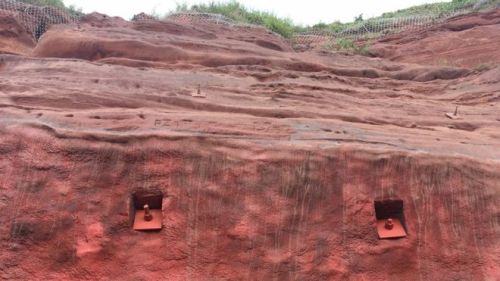
“Sightseers and geologists have slammed a council for painting historic sandstone cliffs in a “weird” red.

Sidmouth rocks are a famous feature of the Devon coast, noted for their natural earthy colouring.

But the decision to paint a section in the “wrong red” during recent stabilisation work has left experts and tourists bemused.

A councillor said reinforcing concrete had been dyed to “help it blend in with the surrounding stone”.

During the works, completed at the end of April, large bolts set in concrete were installed into the cliff to stabilise a large piece of rock.
The work was completed at the end of April.

Geologist Dr Alasdair Bruce said he could only describe East Devon District Council’s effort as “corporate vandalism”.

“They have sprayed most of the cliff. It’s almost like an Eric Sykes film,” he said.

“I’ve seen councils do some strange things with cliffs but this clanger really is at the top of the pile.”

The cliffs at Sidmouth are thought to date back about 220 million years to the Triassic period, which came before the Jurassic period.

Bill Shaw, a metal sculptor from Bideford on holiday with his wife, Peach, said: “It’s a bit weird. It just looks fake.

“It’s the wrong red as well, it should be more of a terracotta colour or would be better just left as it was.”

Geoff Jung, the council’s portfolio holder for the environment, said: “The concrete was dyed to help it blend in with the surrounding stone as opposed to leaving it as a plain concrete finish.”

He said the stabilisation work allowed the council to keep the walkway under the cliffs open and the public safe.”

https://www.bbc.co.uk/news/uk-england-devon-48613244

‘Say No to Sidford Business Park’ submission to planning inquiry

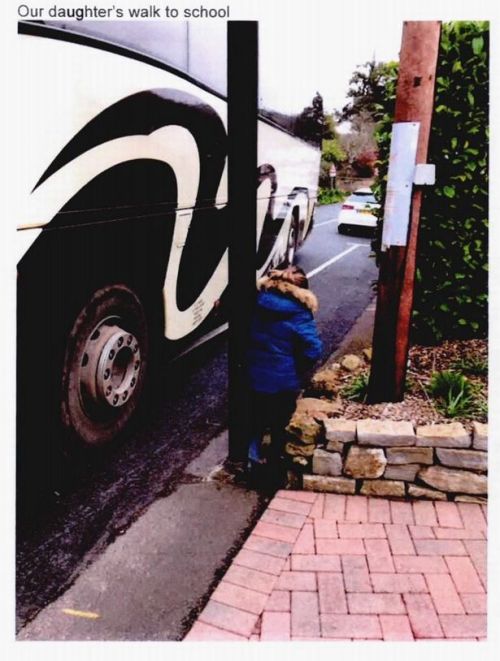
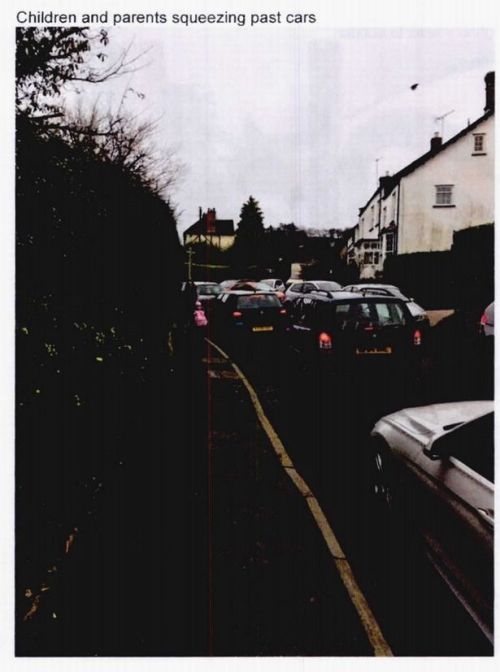
A picture is worth a thousand words. Words here:
https://www.devonlive.com/news/devon-news/objectors-outline-traffic-chaos-safety-2934450

Some of the pictures here:

Otter and Axe estuaries added to Marine Conservation Zones

“The Axe and Otter estuaries are amongst 12 new Marine Conservation Zones created in the south west of England.

The expansion of the UK’s ‘Blue Belt’ was announced by Environment Secretary Michael Gove today (Friday May 31).

Among the species and habitats given greater protection by the designation are fan mussels, native oysters, tentacled lagoon-worms and the deep sea bed. …”

https://www.midweekherald.co.uk/news/government-moves-to-protect-east-devon-marine-life-1-6081523

“The dream of free buses still lives on”

Guardian letters:

“David Walker’s recollection of South Yorkshire’s publicly subsidised public transport system (Letters, 30 May) is only part of the story.

The aim of the cheap fares was to make the bus service totally free of fares by 1984 – a hop-on, hop-off service funded through a precept on the rates and savings made from not having to collect fares.

The South Yorkshire Freedom Riders are pressing the Sheffield city region mayor Dan Jarvis, the Labour and Green parties, locally and nationally, to give serious consideration to a publicly owned and run universal basic service with a zero-fare expanded bus service. For most people it will mean a minimum of a £30 uplift in disposable income as well as removing cars from our roads and reducing levels of pollution.

Motorists are facing higher costs to force them into buses. Let’s give them a viable alternative. Let’s give everyone access to towns, villages, friends, the countryside and work. Let’s give them a free-to-use bus service as was intended by a visionary authority in 1974.

Mike Smith
South Yorkshire Freedom Riders, Barnsley”

https://www.theguardian.com/money/2019/may/30/the-dream-of-free-buses-still-lives-on?

Citizens Assembly to tackle climate crisis?

“Oxford City Council is to be the first UK local authority to establish a citizens assembly to help address the issue of climate change, and consider the measures that should be taken in Oxford.

The recent Intergovernmental Panel on Climate Change (IPCC) report warned that the current global target of 80% cut in carbon emissions by 2050 is not enough to avert catastrophic temperature change. It said it’s essential that global temperature change is limited to 1.5 degrees Celsius and that rapid, far-reaching and unprecedented changes in all aspects of society are required to ensure this.

Next week the UK’s independent Committee on Climate Change (CCC) will publish its advice to the UK Government on tightening Britain’s carbon reduction targets. This will lead to new minimum requirements for us all.

In January, Oxford City Council members unanimously declared a climate emergency and agreed to create a citizens assembly in Oxford to help consider new carbon targets and additional measures to reduce emissions.

The citizens assembly will involve a randomly-selected representative sample of Oxford residents and will meet in September. It will be the first citizens assembly in the UK created to consider climate change.

The City Council will be commissioning research to develop options and timescales for carbon reduction in areas such as housing and transport, which will be put to the citizens assembly. In addition, it will hear from a range of independent contributors. The citizens assembly’s recommendations will assist the City Council in its final decisions on adoption of carbon abatement measures and targets. …”

https://www.oxford.gov.uk/news/article/1064/oxford_city_council_to_establish_uk_s_first_citizens_assembly_to_address_climate_emergency

“Rewild a quarter of UK to fight climate crisis, campaigners urge”

Rewilding would (according to the Environment Secretary) focus on:

Native woodlands
Salt marshes
Peat bogs
Ponds and lakes
Meadows and grasslands

all of which we have in abundance in East Devon.

Perhaps it is now time to revive the idea of a Jurassic Coast National Park (West Dorset would be an already-enthusiastic partner) which was squashed by the previous council because they feared losing their cosy relationship with housing developers …

And, as part of our climate emergency, make rewilding an integral part of all future neighbourhood, district and Greater Exeter development plans.

“Environment Agency Chair calls for new approach to flood and coastal resilience”

“… Launching a major, long-term strategy to tackle flooding and coastal change, Environment Agency Chair, Emma Howard Boyd has said ‘we cannot win a war against water’ by building higher flood defences and called for a new approach to ensure communities are resilient to the threat of flooding posed by climate change.

Opening an 8-week consultation on the new strategy, Emma Howard Boyd said that the Environment Agency is preparing for a potential 4°C rise in global temperature and urgent action is needed to tackle more frequent, intense flooding and sea level rise.

Among the recommendations in the strategy, the Environment Agency has committed to working with partners to develop consistent standards for flood and coastal resilience across the country. To achieve these standards, communities should have access to a range of tools which give them control of how they prepare for and respond to flooding and coastal change, based on the challenges or flood risk that particular location may face.

These could include traditional defences, temporary barriers, natural flood management, sustainable drainage systems, effective flood warnings and emergency response, alongside designing and adapting existing properties and new development so they can recover quickly from a flood. …”

https://www.gov.uk/government/news/environment-agency-chair-calls-for-new-approach-to-flood-and-coastal-resilience