
“Jacob Rees-Mogg needs to work on his ‘common touch’ skills. The high priest of Brexit, who led calls for Mrs May to be toppled last week, has complained that he is struggling to make ends meet. The multi-millionaire told the Sydney Morning Herald: ‘Nobody can afford to live in London. I’m not sure I can! I wish I were joking.’ Given Jacob’s property portfolio includes a £5 million townhouse in Westminster, Dog [and Owl] trusts he’ll be fine…”
Category Archives: Inequality
Children in poverty can’t even get a nourishing meal at school
“Schools have had to remove hot lunches from their menus due to the rising cost of food, a report has found.
Caterers that provide meals to schools across the UK are also blaming the national living wage and tightening budgets for forcing them to provide less nutritious food.
According to the Times, charity The Soil Association found that schools were dropping fresh fruit, yoghurts and salmon from its menus and replacing these products with cheaper cuts of meat, biscuits and custard puddings.
In 2014, free school meals for all infants were introduced at a cost of millions, but although schools are now obliged to provide a lunchtime meal for pupils, this doesn’t have to be hot.
Lower quality food
Some are now offering cold “pick and mix” lunchbox options because it saves money on washing up and serving staff. The charity spoke to 20 catering companies, all of whom reported rising costs and negative effects on quality of food.
Caterers said they were under pressure from local authorities to cut costs as one said: “Pressure is mounting on expenditure and cold meals will be the result.” One caterer said the cost of fresh fruit and vegetables had increased by 20 per cent and eggs by 14 per cent and the report concluded that a no-deal Brexit could result in a 22 per cent average tariff on food imports. …”
Read more at: https://inews.co.uk/news/education/rising-food-costs-to-blame-for-fruit-and-hot-lunches-taken-off-school-menus/
Two-thirds of bank branches have closed in the last 30 years
“A Which? survey has revealed the UK has lost two-thirds of its bank branches in the past 30 years.
The consumer group found there were 7,586 bank branches currently operating compared with 20.583 in 1988. …
… Which? money expert Gareth Shaw told the FT: “We can’t stop tech disrupting traditional models of banking.
“But this is happening at such a pace, we are concerned some people are being disenfranchised and excluded from accessing finance.”
https://www.insider.co.uk/news/uk-bank-closures-rbs-scotland-13598672
United Nations Poverty envoy says callous policies driven by political desire for social re-engineering
“The government said it “completely disagreed” with Alston’s analysis. …”
Well, it would – wouldn’t it!
“The UK government has inflicted “great misery” on its people with “punitive, mean-spirited, and often callous” austerity policies driven by a political desire to undertake social re-engineering rather than economic necessity, the United Nations poverty envoy has found.
Philip Alston, the UN’s rapporteur on extreme poverty and human rights, ended a two-week fact-finding mission to the UK with a stinging declaration that despite being the world’s fifth largest economy, levels of child poverty are “not just a disgrace, but a social calamity and an economic disaster”.
About 14 million people, a fifth of the population, live in poverty, and 1.5 million are destitute, unable to afford basic essentials, he said, citing figures from the Institute for Fiscal Studies and the Joseph Rowntree Foundation. He highlighted predictions that child poverty could rise by 7% between 2015 and 2022, possibly up to a rate of 40%.
“It is patently unjust and contrary to British values that so many people are living in poverty,” he said, adding that compassion had been abandoned during almost a decade of austerity policies that had been so profound that key elements of the post-war social contract, devised by William Beveridge more than 70 years ago, had been swept away.
It took a UN envoy to hear how austerity is destroying lives | Aditya Chakrabortty
In a coruscating 24-page report, which will be presented to the UN human rights council in Geneva next year, the eminent human rights lawyer said that in the UK “poverty is a political choice”.
He told a press conference in London:
Austerity Britain was in breach of four UN human rights agreements relating to women, children, disabled people and economic and social rights. “If you got a group of misogynists in a room and said how can we make this system work for men and not for women they would not have come up with too many ideas that are not already in place,” he said.
The limit on benefits payments to only the first two children in a family was “in the same ball park” as China’s one-child policy because it punished people who had a third child.
Cuts of 50% to council budgets were slashing at Britain’s “culture of local concern” and “damaging the fabric” of society.
The middle classes would “find themselves living in an increasingly hostile and unwelcoming society because community roots are being broken”.
The government said it “completely disagreed” with Alston’s analysis. …”
Local policing priorities and Police and Crime Commissioner criticised
MUCH criticism of Hernandez:
https://www.devonlive.com/news/devon-news/police-abandoned-streets-can-turn-2227527
“No let-up in housing crisis: Developers slow house-building ahead of Brexit and government targets will be missed”
“Britain’s housing crisis is not set to improve in the near future as official figures today revealed developers have slashed the rate at which they are building new houses ahead of Brexit.
Government figures revealed a bit more than 222,000 new homes were delivered in 2017/18, up just 2 per cent on the previous year and well below the government’s promised target of 300,000.
The rate of growth for residential construction meanwhile has halved, from 11.9 per cent in 2016/17 to 6.4 per cent in 2017/18.
… ‘Housebuilders and would be-buyers alike are nervous about what the fall-out from Brexit could be and that’s hit the number of net additional dwellings hard.’
Grainne Gilmore, head of UK residential research at Knight Frank, said warned that other data was already pointing to a further slowdown in housing completions to come.
‘Net additions are still around 26 per cent lower than the government’s 300,000 annual target while separate housing starts data, which captures information on new homes being started on site, shows a moderation in activity that could weigh on housing completions in 2020/21,’ she said.
Meanwhile a trading statement from Bovis Homes released this morning blamed ‘uncertainty surrounding Brexit’ for a fall in buyer interest.
It said: ‘Our sales rate per outlet per week for the year to date is 0.51, with pricing in line with our expectations. Whilst we have maintained our rate of sale, the uncertainty surrounding Brexit has impacted discretionary buyers.’
Taylor Wimpey has also said it expects flat sales growth next year due to Brexit uncertainty, but claimed there is potential for ‘significant growth’ after 2020.
It comes amid a slew of data pointing to a gloomy outlook for Britain’s housing market.
Earlier this week UK Finance, the trade body representing British banks, confirmed that mortgage lending in September was down on a year ago as people sit on their hands to see what happens with Brexit.
First-time buyer numbers have dropped 4.5 per cent since September 2017, households moving home fell 8.4 per cent over the same period and landlords purchasing properties slumped 18.8 per cent.
… Gilmore said today’s construction figures presented ‘a headache for policymakers’ in London particularly, with the net number of new dwellings in the capital falling by 20 per cent over the year.
‘Only 12 of the 33 boroughs in the capital reported a rise in the number of new homes provided in the year to March,’ she said. “
Guardian letters on austerity and extreme poverty
“• Outrage, anger, despair, shame, impotence: the feelings aroused by Aditya Chakrabortty’s article (It took a UN envoy to hear how austerity is destroying lives, 14 November). The truths consequent on the savage, unnecessary, uncaring cuts to public services are not hidden away but confront us daily. Welfare benefits slashed, millions dependent on food banks. Libraries, museums, childcare centres, youth clubs, swimming pools consigned to the scrapheap; road repairs and park budgets cut, bus routes terminated. In Darley Dale a helpful notice tells us that the lavatory is closed and the nearest one is 2.1 miles away.
The true story is that of a government that has chosen private profit over civic services, while it wreaks an assault on the services that make towns and communities good places to live. In a 2015 Guardian article about benefits, sanctions and food banks, Ken Loach called for “public rage” and spoke about “conscious cruelty”.
The word “austerity” has allowed the government to disguise both intent and outcome. In its original meaning “austerity” suggests plainness and simplicity, a cosy view of cutting back, perhaps a mythical wartime pulling together. “Austerity” is now a weasel word used to promote the Tory rhetoric that there is no alternative, that anaesthetises public anger as we are led to believe that there is no choice. There must be a new script. We should ban the word.
Beyond that, how do we create the public rage? We must not be bystanders. Somehow we have to trust that petitions, marches, demonstrations, letters to MPs and local papers and involvement with political parties will change the climate. We have to build in our own communities and in daily conversations a challenge to the dialogue of cuts as economic necessity, to work to expose the hypocrisy and devastation of central government’s assault. We have to sing loud that deep into our hearts, “I do believe, we shall overcome, some day.” Together we can, we must, we will change our worlds.
Emeritus Professor Roger Clough
Darley Dale, Derbyshire
• Aditya Chakrabortty’s article about Philip Alston’s visit to the UK was devastating to read. Government politicians have ignored the impact of austerity. They have lied about it, joked about it and refused to measure it. They have shoved the blame on to its victims and the responsibility on to charities that buckle under the strain. These actions represent a deliberate attempt to break people’s “dependency” on the state. Now, anyone who is sick, disabled, unemployed or in any other way vulnerable is expected to fend for themselves. Through a punitive sanctions regime and the inbuilt hardships of universal credit, the state itself has become an instrument of punishment rather than support.
If our “decade of shame” is not to become permanent, we need a public debate about the welfare state – one that recognises that a strong society is one in which everyone is strong. We will all be weakened if we continue to watch as people sink under the weight of this government’s monstrous political choices.
Jane Middleton
Bath
• The UN inquiry by Professor Philip Alston might well prove one of the most significant events in British civil society this decade, as Aditya Chakrabortty suggests. Let’s hope he will report on the chaos in UK housing policy created by the application of extreme free-market principles to the inevitably limited supply of land in our British isles. Since 1979 rich and powerful institutions, national and international speculators have increased the unearned value of UK land over and over again. The Thatcher government bought votes by encouraging bank lending for, and the taxpayer funding of, home ownership, so further inflating land values. From 1997 Blair and Brown did not dare touch the housing market for fear it would lose value and they would lose votes.
The focus on home ownership has continued since 2010, as always to the detriment of tenants. The consequence can be seen in the rising number of tenant families in temporary accommodation – up 65% to 79,880 since 2010. Here in Haringey the council is unable to permanently house 4,400 such families without forcing them into the private sector, so increasing their rent from £90 a week for two bedrooms to at least £300 a week for a private landlord. The dictatorship of the UK free market forces levers low-income tenants towards rent-induced poverty, the food bank, mental and physical ill health, and an early death in the deprived Tottenham wards.
Rev Paul Nicolson
Taxpayers Against Poverty
• I note that, although the two-week visit by the UN special rapporteur on extreme poverty and human rights includes several UK cities (Report, 5 November), there is only one non-metropolitan coastal area included, Jaywick Sands. Will any rural contexts be considered? Our experience is that the pain of austerity is felt as keenly in areas which, behind a beautiful and serene facade, hide many who are struggling with low wages, reduced benefits, isolation and unaffordable or nonexistent transport.
Rob Pearce
Dorset Equality Group
• Taunton? A “centre of fake nutritional excellence” (Suzanne Moore, G2, 6 November)? My dear, we haven’t even a Waitrose, an aspiration turned down some years ago on the grounds that we are “the wrong demographic”. Visit Taunton and see for yourself the preponderance of people suffering from eight years of austerity. You’ll notice poverty and homelessness aplenty, pale, pasty, stressed-out faces, a main street full of betting shops, fast food outlets, and boarded-up chain stores. I used to joke that at the end of our road we had two pawn shops and two porn shops. Things have only got much worse.
Margaret Markwick
Taunton, Somerset
• How convenient that Esther McVey decided to resign over Brexit. Now she needn’t meet UN special rapporteur Philip Alston, who is due to report his findings on poverty in the UK. What craven behaviour from a politician with no integrity.
Susan Clements
Newcastle upon Tyne”
Pity the children of Sidford
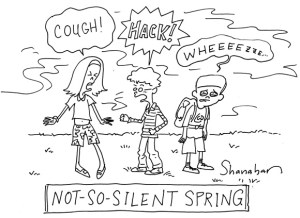
“Pollution from diesel vehicles is stunting the growth of children’s lungs, leaving them damaged for life, a major study has found.
The research, conducted with more than 2,000 school children in London, is the first such study in a city where diesel pollution is a significant factor, and has implications for cities around the world. It also showed that charges to deter polluting trucks from entering the city did reduce air pollution a little but did not reduce the harm to children’s lungs. …”
Tory county council failing vulnerable children – task force sent in
“Ministers are to send in a task force to crisis-hit Northamptonshire county council after it emerged hundreds of vulnerable children were being placed at greater risk of harm because of rapidly deteriorating frontline child protection services..
The move follows publication of a highly critical letter by Ofsted inspectors revealing that children referred to council social services were not effectively supported or protected, with 267 young people waiting up to four months to be assessed and allocated a social worker.
The watchdog said political and financial turbulence at the Tory-controlled council, which declared itself effectively bankrupt earlier this year, had contributed to safeguarding services being in a position where they could not effectively meet the needs of at-risk children.
AdvertisementHide
A joint letter to Northamptonshire by the communities secretary, James Brokenshire, and the education secretary, Damian Hinds, said the government was “minded” to appoint a commissioner in the next few days to stabilise and improve the council’s child protection services.
The ministers were responding to a request by the council’s existing commissioners for help to turn around the service. They wrote to ministers earlier this month saying they had no confidence the children’s services management team was able to deliver adequate safeguarding services.
The commissioner’s letter said: “Despite the production of action plans designed to tackle accepted shortcomings, we have witnessed the failure of the leadership within the service to address the fundamental problems facing it, including its operational stability, performance and finance.”
The council’s children services underwent government intervention between 2013 and 2016 after Ofsted declared them “inadequate”. The government sent in two commissioners to oversee the entire council in May after a separate critical inspection report declared its problems were so entrenched it must be abolished.
The Ofsted letter highlighted poor oversight and management as a key factor in the decline of safeguarding services over the past two years. “Senior leaders are aware of these serious weaknesses and have taken remedial action to respond. However, this has not been effective or with sufficient urgency or rigour,” it said.
Child protection social workers had told inspectors they were “overwhelmed” and “drowning” under the pressure of rising demand, the letter said. Some professionals were juggling caseloads of between 30 and 50 children.
The letter is the latest blow for a council reeling from half a decade of mismanagement and funding cuts that have left it on the verge of collapse. The local authority is currently setting out drastic proposals to cut services back to a bare legal minimum in an attempt to balance the books.
Victoria Perry, Northamptonshire’s cabinet member for children, families and education, said: “We know that our children’s services are not working well and we will put this right. It is clear from the findings from Ofsted that these failures in the system have taken place over the last two years, and we are now completely focused on recovering from these failures.”
Ofsted’s letter, published on Tuesday after inspectors visited child protection services in Northampton last month, said safeguarding services had “significantly declined” since the previous full inspection in 2016.
It highlighted poor leadership, poor decision-making and a failure to identify risk in individual cases referred to the council. “This lack of oversight and poor management leaves children at potential risk of harm,” the watchdog said.
Some cases where children should have received support were closed prematurely, while less serious cases were wrongly escalated to a first-response team, the letter said. “This level of inconsistency regarding the application of thresholds not only means that children do not consistently receive the right service to meet their needs, but it also leads to additional pressure on the service.”
Although the council had reduced the number of unallocated cases from 551 at the beginning of the year, the overall number remained between 200 and 300, the letter said. “Although senior managers had taken action to review these cases either shortly before or during the focused visit, in cases sampled by inspectors there was no evidence of risk being identified, managed or robustly reviewed.”
The council will not be in a strong position to invest heavily to turn around child protection services. It has drained reserves in recent years in order to prop up services and needs to make about £60m of cuts before April to stave off bankruptcy.
The letter will increase the pressure on Northamptonshire’s leader, Matt Golby, who is leading the rescue plan designed to stabilise the council. In August, he promised that no children would be put in danger as a result of the proposed cuts.
Opposition Labour councillors said the county was failing in its legal duty to protect children. “The children of Northampton and Northamptonshire are being placed into positions where the county council is failing to protect them,” said Jane Birch, the deputy leader of the council’s Labour group.
“The priority is saving money rather than protecting those who need it most; I shudder to think what may happen.”
“Rule changes ‘risk new social housing black hole’ in England”
“A proposal designed to speed up the creation of new homes in England risks “supercharging” a get-out clause allowing developers to build properties without providing social housing, the charity Shelter has said.
The government has proposed new rules that would allow builders to buy and demolish commercial buildings and create new homes without planning permission.
The plan would extend permitted development rights, which allow the conversion of office buildings to homes.
The rules have also allowed developers to build tiny homes, some as small as 13 sq metres.
Almost one in 10 new homes created last year were created this way, but councils do not get the chance to see plans before the homes are built and miss out on planning fees, as well as contributions towards affordable homes.
Shelter said extending the right could create a new “social housing black hole” if they allowed more developers to avoid building affordable homes as part of their project.
The charity said in a handful of local authorities more than half of new homes had been delivered like this, despite the need for social housing in those areas.
In Stevenage, for example, 73% of new homes built last year came through permitted development rights, while in Nottingham 60% of its 975 new homes were created this way.
At the same time, 159 affordable homes were delivered in Stevenage, and its waiting list for social housing stood at 1,862 households. In Nottingham, 5,188 households were waiting for social housing, and 143 affordable homes were built.
Under the proposal in the consultation paper delivered on budget day, the government says the current system “may encourage an owner to change use rather than seek to redevelop the site, which is likely to allow for a higher density development”.
It also raises the question of contributions for affordable homes, asking for input on how this money could be secured for projects that do not need planning permission.
Polly Neate, the CEO of Shelter, said: “Anyone can see it’s wrong to give developers a licence to dodge social housing when hundreds of thousands of people are homeless.
“We need to raise the alarm so the government halt these plans and instead look to bring down the cost of land to build the social homes we need.”
The Town and Country Planning Association recently voiced its concerns about the plan to extend the permitted development rules, warning that it could deprive local authorities of essential funding and risked “creating poor living conditions for vulnerable people”.
“Under the existing system of permitted development, 1,000 new flats can be built in an old 1970s office building or industrial estate, and the local council can’t require a single square foot of play space for the children who live there – and the communities have effectively no say,” said its interim chief executive, Hugh Ellis. “This cannot become the norm.”
A spokesperson for the Ministry of Housing, Communities and Local Government, said: “No one benefits from delays in planning applications. We expect these proposals to provide flexibility, reduce bureaucracy and make the most effective use of existing buildings.
“We are committed to delivering more affordable housing and we are investing £9bn.”
“Universal Credit Is Fuelling A Rise In Unpaid Council Rent, BBC Panorama Reveals”
“Council leaders have warned Universal Credit could halt house-building because of a surge in unpaid rent caused by the flagship benefits reform.
An investigation by BBC Panorama found that council tenants on Universal Credit owe on average £663 in rent, two-and-a-half times more than the £262 owed by those still on housing benefit.
The programme reveals that in Flintshire in North Wales, one of the first areas in the UK to receive the new system, the amount of rent owed to the council by people on Universal Credit is £1,424 in average – or six times the amount owed by those on the existing system.
The local authority says evictions in the county are up by 55% compared to the same time last year, and it has spent an extra £270,000 on advice staff to cope with the increasing numbers of people needing help.
The figures were based on Freedom of Information responses from around 130 councils that manage social housing. …”
https://www.huffingtonpost.co.uk/entry/universal-credit-rent_uk_5be89c53e4b0e84388993c8d
Local Enterprise Partnership “scrutiny” committee – an oxymoron
Minutes (for what little they are worth) here:
REAL scrutiny by DCC Independent East Devon Alliance Councillor Martin Shaw of this laughable attempt to continue to hoodwink us here:
“‘A political choice’: UN envoy says UK can help all who hit hard times”
“What tells you most about a society is how it treats its poor and vulnerable, the UN special rapporteur on poverty and human rights, Philip Alston, told a packed public meeting held in the UK’s poorest neighbourhood on Sunday.
He said a wealthy country could decide to help all those who hit hard times, ensure that they don’t slip through the net and are able to live a life of dignity: “It’s a political choice.”
Alston was in Jaywick, a tiny village by the sea in the south-east corner of Essex. It has found itself at the top of official indices of deprivation since 2010, and in countless articles and TV documentaries has come to symbolise the kind of bleak and gaudy poverty fuelled by chronic economic neglect and social breakdown. …”
“‘I’m scared to eat sometimes’: UN envoy meets UK food bank users”
“At Britain’s busiest food bank in Newcastle’s west end people loaded carrier bags with desperately needed groceries as unemployed Michael Hunter, 20, took his chance to spell out to one of the world’s leading experts in extreme poverty and human rights just how tight money can get in the UK today.
Previous destinations for Philip Alston, the United Nations rapporteur on the issue, have included Ghana, Saudi Arabia, China and Mauritania. But now his lens is trained on Britain, the fifth richest country in the world, and he listened as Hunter explained an absurdity of the government’s much-criticised universal credit welfare programme.
Users have to go online to keep their financial lifeline open, but computers need electricity – and with universal credit leaving a £465 monthly budget to stretch the three people in Michael’s family (about £5 each a day), they can barely afford it with the meter ticking.
I have to be quick doing my universal credit because I am that scared of losing the electric,” he said. Alston mentally logged the situation, ahead of a report ruling on whether Britain is meeting its international obligations not to increase inequality. But it was not just the computer that was too expensive to power.
“Universal credit has punched us in the face,” said his mother, Denise, 57. “Before much longer people will turn to crime. People will smash the windows to get what they want. This is going to cause riots.”
The Hunters’ story was just one of a long list of stark insights into life in poverty delivered by the people of Newcastle to Alston during his trip to uncover what austerity is doing to the people of the UK and “to investigate government efforts to eradicate poverty”.
Last year his no-holds-barred UN report into the impact of Trump-era policies on the US brought a stinging reaction from the White House. The odds are that Alston will say the UK is far from doing enough to meet its obligations. In 1976 the UK ratified the UN covenant on economic, social and cultural rights agreeing that policy changes in times of economic crisis must not be discriminatory, must mitigate, not increase, inequalities and that disadvantaged people must not be disproportionately affected.
But first he must gather evidence, and Newcastle is a good place to start. It was the first city to introduce the new all-in-one universal credit (UC ) welfare payment. The council says central government cuts and rising demand for services mean 60% is being wiped from its spending power between 2010 and 2020. …
Some people have to work five zero-hours jobs to make ends meet, said Phil McGrath, chief executive of the Cedarwood Trust community centre. The trust is encouraging residents to engage in local and national politics to have their voice heard. It is paying off with some people who have never voted turning out at the last general election, he said.
Mike Burgess, who runs the Phoenix Detached Youth Project, told Alston how 18 publicly funded youth workers in the area in 2011 had dwindled to zero today. He described how a young man he worked with was in hospital for months after having a kidney removed. The jobcentre said he had to get back to work or face being sanctioned (losing benefits). He went to work in pain, but his employer realised and said he was not fit.
“There’s no safety net for my lad or people with mental health problems,” he said.
And that is the hidden cost facing many at the sharpest end of austerity in Newcastle.
“In the last two or three weeks we have seen a massive increase in numbers of people with mental health issues and people with breakdown,” said McGrath, blaming benefit sanctions and a lack of social and mental health workers to catch people. “People are just being ground down.”
“[Privatised] Academies record £6.1bn deficit”
“Academy schools in England recorded a £6.1bn deficit at the end of last August, leading to one major teaching union calling them “unsustainable”.
The 7,003 academies received total income of £22.5bn in 2016-17, compared to £20.5bn in the academic financial year before, and spent £24.8bn, compared to £20bn in 2015-16, according to the academy schools annual report and accounts released on Tuesday.
The £6.1bn deficit recorded includes an £8.4bn asset derecognition charge. The government took land and buildings assets off academies’ balance sheets where they did not feel trusts were controlling them, even though, academies continued to occupy them.
The number of academy trusts, charities which academies must be part of, in cumulative deficit at the end of August 2017 went up to 185 from 167 in August 2016, the report showed.
Kevin Courtney, joint general secretary of the National Education Union, said academies’ financial situation was “unsurprising” given the overall pressures on school budgets. “But it is particularly serious for academies which cannot call on help or support from the local authorities,” he added.
“These accounts also show us why the academy system is unsustainable and undemocratic.”
Academies are independent state schools funded directly by the Department for Education via the Education and Skills Funding Agency – rather than through local authorities.
Courtney said it was “high time” the government recognised the academy system was a “failed policy” that needed to be consigned to the “dustbin of history”.
“We need to return to the principle of local schools, accountable to local communities,” he added.
The accounts also showed that 8% more trusts (from 873 to 941) were paying some staff £100,000 or more in 2016-17 compared to the year before.
The number of staff paying salaries of £150,000 or more went up 3% from 121 to 125 over the same period. …”
https://www.publicfinance.co.uk/news/2018/11/academies-record-ps61bn-deficit
“The poor pay for the mistakes of the rich”
In an article on the rise of homelessness in London:
“Austerity has been about the poor paying for the mistakes of the wealthy for years and those who are homeless have paid the most”
Rabbil Sikdar
Lefty Muslim writer
… When a majority of impoverished families are working households or when a million families depend on food banks, then it becomes less difficult to see just why homelessness has become a big a problem as it has. Austerity has been about the poor paying for the mistakes of the wealthy for years and those who are homeless have paid the most. In London, the chances of going overboard and losing everything is always high. The opportunities here are limitless but so are the risks. Take Tower Hamlets as the chief encapsulation of the city’s wonderful prosperity but failure to share it fairly. Here, the financial district exists but so does extreme poverty. High inequality is the unspoken story of London and many of those who cannot cope with the city’s suffocating pressures end up on the streets.
The Institute of Fiscal Studies found that 40% of Londoners’ incomes were being consumed by rent. There is little security in the private rent sector, less so if your job pays poorly or goes. The winners in this crisis are landlords who, according to a Savills report published earlier in October, were benefiting from the steep rise in people renting, due to the housing crisis, and being able to charge high rents. The latter often leads to landlords being subsidised by the welfare state due to the housing benefits which many renters need to get by.
There is a tendency to sometimes disconnect issues from the wider political narratives pumped out by those in power, to treat it as isolated incidents, but the awful plight of the homeless in London is a sign of how the Tories have looked at the poor.”
Universal Credit – the tide turns
Claimants could be up to £7,500 a year worse off:
https://www.thesun.co.uk/news/7689479/you-could-lose-up-to-7500-a-year-on-universal-credit-new-study-reveals/
For two days a week, I can’t afford to eat:
https://www.mirror.co.uk/news/politics/two-days-month-cant-afford-13441040
Benefits freeze could cost Tories next election:
https://www.independent.co.uk/news/uk/politics/theresa-may-benefits-freeze-david-davis-justine-greening-conservatives-universal-credit-a8623356.html
Universal Credit: leading article in “The Times”
“Moral Debit
The botched and underfunded rollout of universal credit is starting to cause real hardship for many of the poorest and most vulnerable members of society.
The shocking deprivation revealed by our investigation today has many causes, but the proximate explanation for the misery being endured by the poorest members of society is the mismanaged and underfunded introduction of universal credit. Despite the extra resources announced in last week’s budget, and the welcome signs that the Department for Work and Pensions is listening to concerns about the impact of the scheme, additional finance and further reform is required.
For many years, universal credit was the holy grail of welfare reform. Rolling the six major benefits into one monthly payment would simplify an over-complex system and ease the transition of claimants into work. The former work and pensions secretary Iain Duncan Smith was passionate about universal credit. Her Majesty’s Treasury under George Osborne was less so. As soon as he was able to deliver a budget, in 2015, not dependent on Liberal Democrat votes, Mr Osborne cut £3.2 billion from the new super-benefit’s funds. Soon afterwards Mr Duncan Smith resigned. His big idea, however, limped on, dogged by IT disasters and an exchequer more interested in cuts than reform.
There was and is much to recommend a simplified system. Multiple benefits are so complex that not even some officials, let alone claimants, understand them. The benefit system has, by common consent, trapped generations of Britons in poverty and dependence. Tax credits failed sufficiently to incentivise work, and work is rightly seen as the best long-term solution to rebuilding self-esteem and helping deprived communities.
Yet whatever its faults, the complex system being phased out generally had the merit of keeping a roof over its beneficiaries’ heads and food on their tables. The introduction of universal credit has seen a distressing rise in debt and evictions, hunger and queues at food banks and diseases more normally associated with the 19th century than the 21st, such as rickets and scurvy. The former prime minister Sir John Major has warned of poll-tax style disorder if hardship is not alleviated. By 2023 seven million people will be receiving universal credit. Figures suggest that without reform, 3.2 million households will lose out while only 1.2 million will benefit. The hardest hit will be the self-employed, the disabled and those with more than two children.
The single most urgent reform required is that existing benefits should continue to be paid up until a claimant’s migration to the new system is complete. At present there is a five-week hiatus between the last old payment and the first new one. The government has agreed to shorten this period by 2020, but that is too far away. Poor people live a hand-to-mouth existence. They tend not to have savings or freezers full of food or relatives who can tide them over. They go broke instantly. Hence the phenomenon of teachers buying shoes for pupils and children wolfing down five bowls of cereal at school breakfast clubs.
It would be naive to imagine that all hardship is caused by lack of money. Poor parenting, substance abuse, and other addictions such as gambling play their part. However, a monthly payment can be challenging to people not in the habit of budgeting that far ahead. Domestic violence campaigners have criticised the fact that under universal credit, the household payment is made to the main earner rather than the main carer — a problem for women in abusive relationships or in families dealing with substance abuse.
With public sector pay unshackled and wages starting to rise, not only is welfare still frozen but now it emerges that the transition to a new system has plunged many of the country’s poorest inhabitants into destitution. As Sir John commented: “That is not something that a majority of the British people would think of as fair.” He’s right. It isn’t.”
Universal Credit – even “The Times” can’t stomach it now
Today’s “Times” has several stories about the iniquity of Universal Credit. The “benefit” that you can’t get until you have had at least 5 weeks with no benefits at all.
This follows on from the story Owl printed yesterday about the 9 year old girl from Devon trying to find a job to help her widowed father and two siblings:
The Times has a story about 150 children in a school who desperately need its breakfast club – some eating 5 bowls of cereal because they are so hungry.
A family with 2 children where the father works 12 hour days who can’t afford to pay for a new fridge freezer or even think about Christmas.
The Times notes:
“a Times investigation into poverty in Britain, which discovered that:
• More families stand to lose than gain under the new universal credit benefit, according to a new analysis.
• In-work poverty is higher than at any time in two decades and rising faster than the rate of employment.
• Malnutrition has tripled over the past decade.
• Mr Duncan Smith threatened to make a Treasury official “eat his balls for breakfast” during a row over universal credit.”
As an EDW reader notes:
“Where is the Tories’ moral compass? The article in yesterday’s EDW reduced me to tears… Fat cat bankers – not one went to jail …”
“Universal Credit forces Devon girl, 9, to beg for work after mum died and dad lost job”

“A nine-year-old girl begged for work to feed her family after delayed Universal Credit payments left her dad skint.
The girl made a heartbreaking plea on the phone to a charity, telling how her mum died and that her dad had recently lost his job as a lorry driver in Torbay.
And a five-week delay in her father’s first Universal Credit payment meant the family was left with barely and food.
She said: “I’ll do anything. I don’t mind cleaning floors, making beds,” The Mirror reports.
Ellie Waugh, who took the heartbreaking call yesterday, said the youngster was “really worried because her family didn’t have any money”.
She offered to do “any” job to help buy food and get her two younger siblings Christmas presents.
The little girl added: “I don’t want to let them down.”
Ellie said: “I can’t tell you how horrendous it was hearing a child beg for work in this day and age.
“She told me, ‘I don’t mind cleaning floors, making beds. My daddy has always worked and he says you have to work to get things. I’ll do anything I can so I can buy my brother and sister a Christmas present. I can cook and I don’t mind working on a Saturday and Sunday or after school.’ After the call I just cried. Hearing that is like we’ve gone back to Victorian times.”
The dad was raising the three children alone in Torbay after his wife died four years ago. The girl contacted Humanity Torbay, which provides food banks and support for the vulnerable.
CEO Ellie reassured the brave child she would not have to work. She called her dad, who wants to remain nameless, and promised food and support.
Ellie said: “He cried because he was embarrassed but because he is proud of her. Proud that she loved her brother and sister so much she wanted to help them. He said they were literally down to their last few bits in the freezer.”
Ellie and her volunteers visited the family with food parcels last night.
Offers of support also flooded in, with strangers donating Christmas turkeys and presents.
The dad said: “I’m very proud of my daughter and horrified I’ve been reduced to this. It’s humbling that people want to help us.”
Ellie has invited Theresa May and work and pensions secretary Esther McVey to visit her charity, but is yet to receive a response.
She said: “I want them to see the reality of what Universal Credit is doing, to see the look of ‘no hope’ in people’s eyes when they come asking for food.”
Lib Dem MP Christine Jardine said: “It is heartbreaking that a young girl was so worried about her family she begged a charity for work. Tory ministers cannot put their hands over their ears and pretend they can’t hear her.”
https://www.devonlive.com/news/devon-news/universal-credit-forces-devon-girl-2190936
 East Devon Watch